
The best AI detectors in 2026 are Pangram for high-stakes review of long documents, GPTZero for teachers screening essays, and Originality.ai for publishers and SEO content teams. None of them gives a score you can treat as proof on its own.
The research explains why: one detector scored 0% in a Springer study by Van Vlasselaer and 100% in the JAIT study, and the accuracy table below shows which one. Accuracy depends on the text: its length, how much a person edited it and which model wrote it.
My picks by job:
- Pangram: high-stakes review of long documents
- GPTZero: teachers screening essay-length work
- Originality.ai: publishers and SEO teams commissioning content every week
- Copyleaks: multilingual teams that need many seats
- Scribbr AI Detector: free checks of your own paper, with no account
- QuillBot AI Detector: free daily checks inside a writing suite
- Winston AI: shareable reports for a small team
- Sapling AI Detector: developers adding detection to their own product
- Turnitin AI Writing Detection: institutions that already license it
- Grammarly AI Detector: teams already paying for Grammarly Pro
- PlagiarismDetector.net AI Content Detector: a free first check beside a plagiarism checker
In This Article (18 sections)
Best AI Detectors Compared: Price, Free Option and Key Limit
The 11 tools fall into four kinds. Six are standalone subscriptions (Pangram, GPTZero, Originality.ai, Copyleaks, Winston AI, Sapling) and three are free web checkers (Scribbr, QuillBot, PlagiarismDetector.net); Grammarly is a suite feature, and Turnitin an add-on only institutions can buy.
| Detector | Best for | Free option | Paid entry, monthly / annual billing | Key limit | Study results |
|---|---|---|---|---|---|
| Pangram | High-stakes long documents | 20 checks a day after sign-up | Individual $20 a month; annual billing saves $60 a year | No prediction under 50 words | Springer, Van Vlasselaer: 65% strict on fully AI-written papers, where three rivals scored 0% |
| GPTZero | Teachers screening essays | 10,000 words a month | USD prices not quoted in this guide | 50,000 characters per scan on Premium | JAIT: 90.0% on non-native-style AI rewrites; Springer, Van Vlasselaer: 0% strict on fully AI-written papers |
| Originality.ai | Publishers and SEO teams | 3 scans a day, 2,000 words each | Pro $14.95 / $12.95 | Subscription credits expire monthly | Springer, Hadra: caught 83% of AI texts but 2% of hybrid texts |
| Copyleaks | Multilingual teams with many seats | None listed | Personal $16.99 / $13.99; Pro $99.99 / $74.99 | Switching plans overrides unused credits | JAIT: 100% on paraphrased AI text |
| Scribbr AI Detector | Students checking their own work | Unlimited checks, 1,200 words each | Premium check included with a plagiarism check from $19.95 | 1,200 words per free check | Scribbr’s own test: 78% for the free tool (vendor tier) |
| QuillBot AI Detector | Free checks inside a writing suite | 6 scans a day, 1,200 words each | Premium $8.33 a month, billed annually | 80-word minimum | JAIT: 95.5% at baseline, 22.3% on non-native-style rewrites |
| Winston AI | Shareable reports for a small team | 2,000 credits for 14 days | Essential $18 / $10 | Limited on social posts and translations | Not in the accuracy matrix below |
| Sapling AI Detector | Developers | 2,000 characters per check | Pro $25 / $12 | Short, essay-like text raises false positives | JAIT: 97.7% at baseline, 25.0% on non-native-style rewrites |
| Turnitin AI Writing Detection | Institutions that license it | License add-on, quoted by your institution’s account manager | Add-on priced by the account manager | 300 to 30,000 words of prose | Springer, Villa: caught 26.7% of AI manuscripts, flagged no human ones |
| Grammarly AI Detector | Teams already on Grammarly Pro | Free web detector; in-app detection needs Pro | Pro $30 / $12 per member | Its own rewrite agents raise the score | JAIT: 90.9% at baseline, 2.1% on non-native-style rewrites |
| PlagiarismDetector.net AI Content Detector | Free checks beside a plagiarism checker | 2,000 words per check, no account | AI Detector 30,000 words for $10 (Monthly view) | English, French and Spanish only | Not in the accuracy matrix below |
Sources: Pangram pricing, GPTZero pricing, Originality.ai pricing, Copyleaks pricing, Scribbr AI Detector, QuillBot Premium, Winston AI pricing, Sapling pricing, Turnitin AI Writing Report guide, Grammarly Pro, PlagiarismDetector.net pricing, checked October 2026. Study figures: Van Vlasselaer et al. 2026, Makhmutova et al. 2026, Hadra et al. 2026, Villa et al. 2026.
Two columns matter more than price. The key limit tells you whether a tool accepts your shortest routine document, and the study-results column tells you which study, if any, has measured the tool.
How I Ranked Them, and Who Tested These Tools
The order weighs independent results on the hard cases first (full-length papers, mixed human-and-AI text, rewritten AI text), then minimum input length, team size and false-positive handling. Vendor accuracy claims carry no weight, so every accuracy figure here comes from a named study.
The evidence has three tiers:
- Journal, conference and preprint studies: Springer journals (Van Vlasselaer and Hadra, International Journal for Educational Integrity, 2026; Villa, Research Integrity and Peer Review, 2026; Weber-Wulff and colleagues, 2023). JAIT (Makhmutova and colleagues, 2026). RAID on aclanthology.org (ACL 2024). The Stanford preprint by Liang and colleagues on arXiv (2023).
- A working paper: on bfi.uchicago.edu, Jabarian and Imas, BFI Working Paper 2025-116 (University of Chicago), which I use as support, not proof.
- A vendor-tier test: Scribbr’s 12-tool comparison, where two of the 12 tools are Scribbr’s own and the AI texts came from GPT-3.5 and GPT-4.
My first pick led both independent evaluations that include it: full-length papers in the Springer study by Van Vlasselaer and humanized text in the working paper on bfi.uchicago.edu.
My second pick has the best non-native-style result in the JAIT study, despite 0% strict on fully AI-written papers in the Springer study. My third pick is strong on clean AI text but caught 2% of hybrid texts in the Springer study by Hadra.
I left ZeroGPT out after it dropped to 13.4% on non-native-style rewrites in the JAIT study, although Scribbr’s own comparison ranks it seventh of its 12 entries. Affiliate relationships do not change the order.
1. Pangram: Best for High-Stakes Review of Long Documents
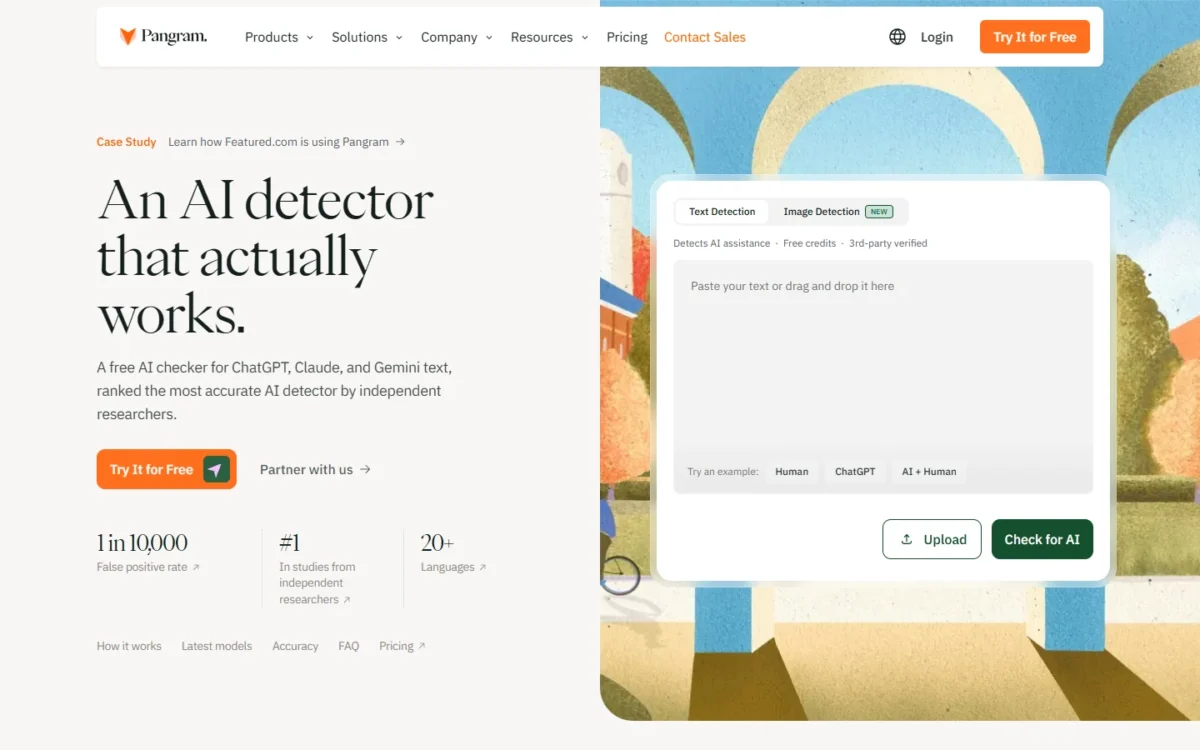
Pangram earns first place on a result no rival here matches. In the Springer study by Van Vlasselaer of papers of at least 4,000 words, it was the only detector to classify fully AI-written papers correctly under the strict criterion, with 65% against 0% for the three rivals tested.
The lead held on blended text in the Springer study by Van Vlasselaer: 92.5% strict accuracy on both hybrid and humanised papers, where the next best rival managed 60% and 50%. The working paper on bfi.uchicago.edu found the false negative rate stayed low even after StealthGPT humanized the AI passages.
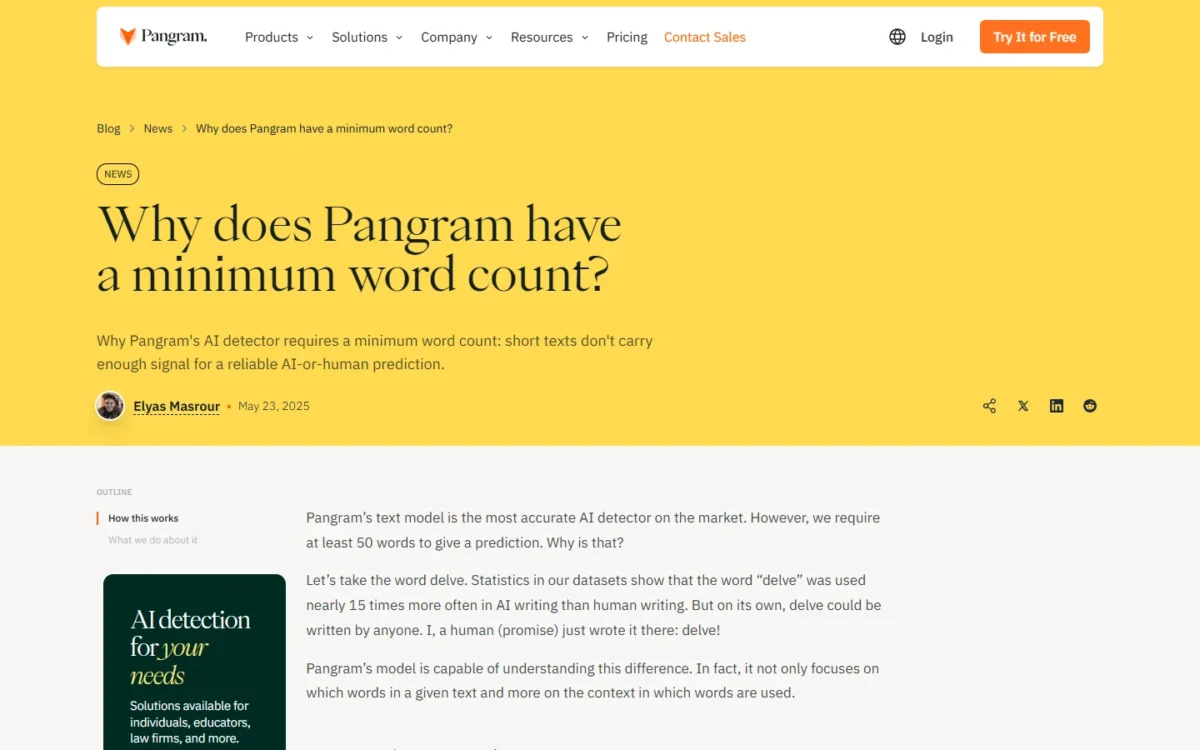
Pangram also refuses to predict on fewer than 50 words, and its minimum-word-count post gives the reason: the model needs enough context for a prediction you can trust. A reviewer never gets a confident score on a two-sentence answer.
The tradeoff. Pangram bills Team per seat, so the best evidence in this list gets more expensive with every reviewer you add.
- Pricing:
- Individual costs $20 a month for 300,000 words, and annual billing saves $60 a year. Team bills $20 per seat per month, so five reviewers pay 5 x $20 = $100 a month.
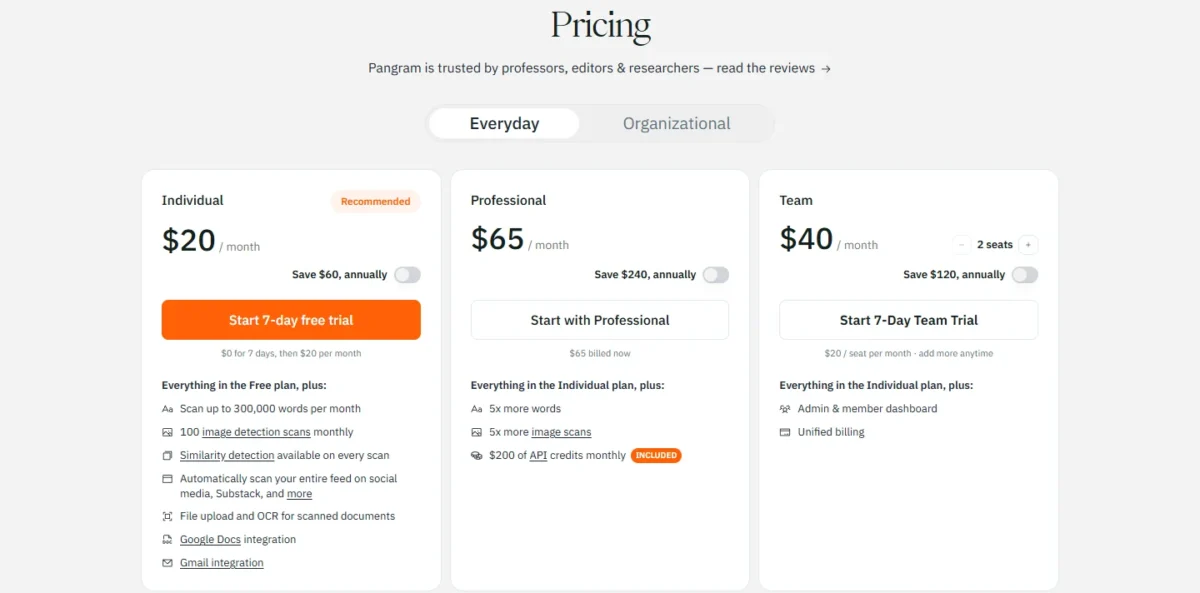
Individual also covers 100 image scans, OCR for scanned documents, and Google Docs and Gmail integration. Professional ($65 a month) adds five times the words and $200 of API credits monthly, which only matters if a developer will call the API.
The free plan gives twenty checks a day after sign-up, so treat it as a trial rather than a budget line.
- Skip it if:
- most of your text runs under Pangram’s 50-word minimum, or you need ten or more seats on a small budget.
2. GPTZero: Best for Teachers Screening Essay-Length Work
This detector scored 100% in the JAIT study and 0% in a Springer study by Van Vlasselaer, and the gap tells a teacher where to trust it. It was also the strongest of nine detectors on AI text rewritten in a non-native English style, at 90.0% mean accuracy in the JAIT study.
The 100% came at the JAIT baseline, on texts of about 400 words from four chat models: ChatGPT, DeepSeek, Gemini and Grok. Springer’s Villa dentistry study gave it an AUC of 0.99 on manuscripts from GPT-4.5, GPT-4o and DeepSeek-R2, so its strong record covers text from mainstream chat models.
The 0% came on one kind of text in the Springer study by Van Vlasselaer: papers of 4,000+ words written with ChatGPT Deep Research, an o3-based mode. In that Springer study the detector returned 70% false negatives and 30% partial false negatives, and caught none of the 40 hybrid papers.
Two more warnings sit beside the good numbers. The same Springer study recorded a small false positive rate on human papers for this detector, the only one of four tools with any. The working paper on bfi.uchicago.edu found its false negative rate rose to around 50% and above once a humanizer rewrote the AI text.
GPTZero’s own benchmark post sets a 250-character minimum on the dashboard, about 50 words. I treat the accuracy claims in that post as vendor claims.
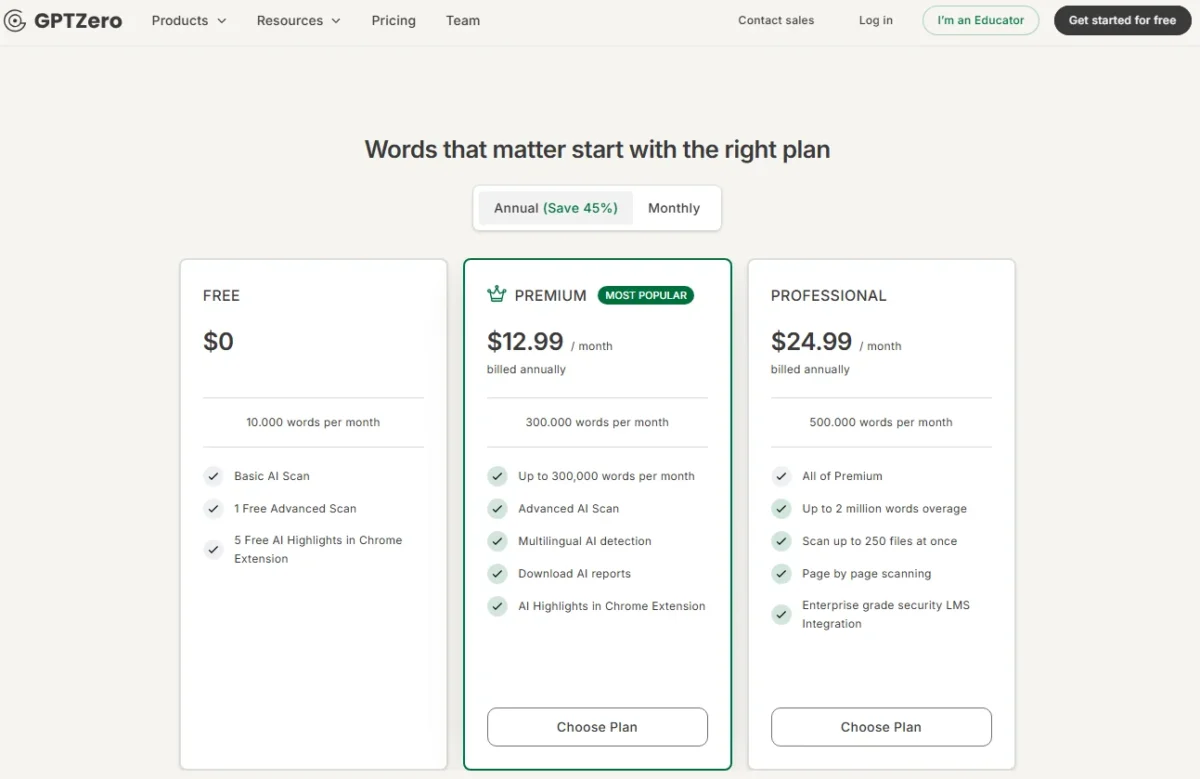
Plans: Free covers 10,000 words a month. Premium gives 300,000 words a month, 50,000 characters per scan and downloadable AI reports; Professional gives 500,000 words, 150,000 characters per scan and LMS integration for Canvas and Google Classroom.
- Pricing:
- This guide quotes GPTZero’s plan limits but not its dollar prices. Check those on GPTZero’s pricing page, where annual billing saves 45%.
- Skip it if:
- you screen long research papers that may have been built with Deep Research-style tools, as in the Springer study above, or you need a score you can defend on its own.
3. Originality.ai: Best for Publishers and SEO Content Teams
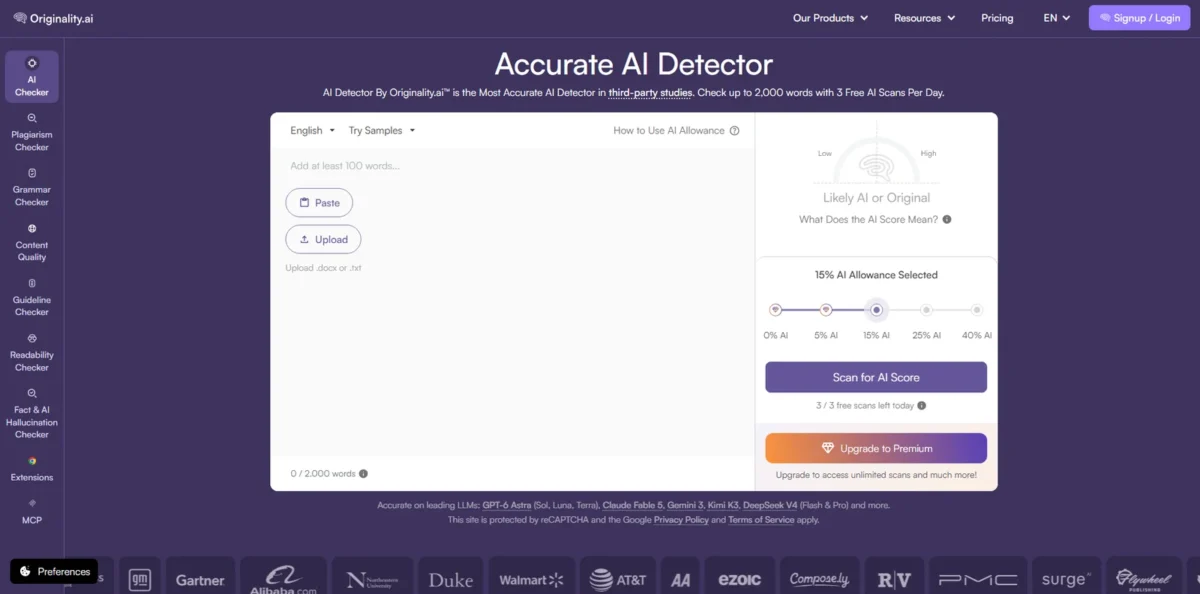
Originality.ai’s subscription credits expire at the end of each month, so the plan pays off for a team that commissions content every week and wastes money in a quiet month. It also has a free tier: three scans a day of up to 2,000 words each, for AI detection only.
Pro is built for a content operation: full site scans by URL, tags shared across team members, team management and a Chrome extension that replays the writing process in Google Docs.
The independent record is strong on clean AI text and weak on blended text. In the Springer study by Hadra, this detector caught 83% of AI-written texts but 2% of hybrid texts that mixed human and AI writing about half and half.
In that Springer study it still beat the only other tool tested overall, 0.69 against 0.61, and classified all 48 professional human texts correctly.
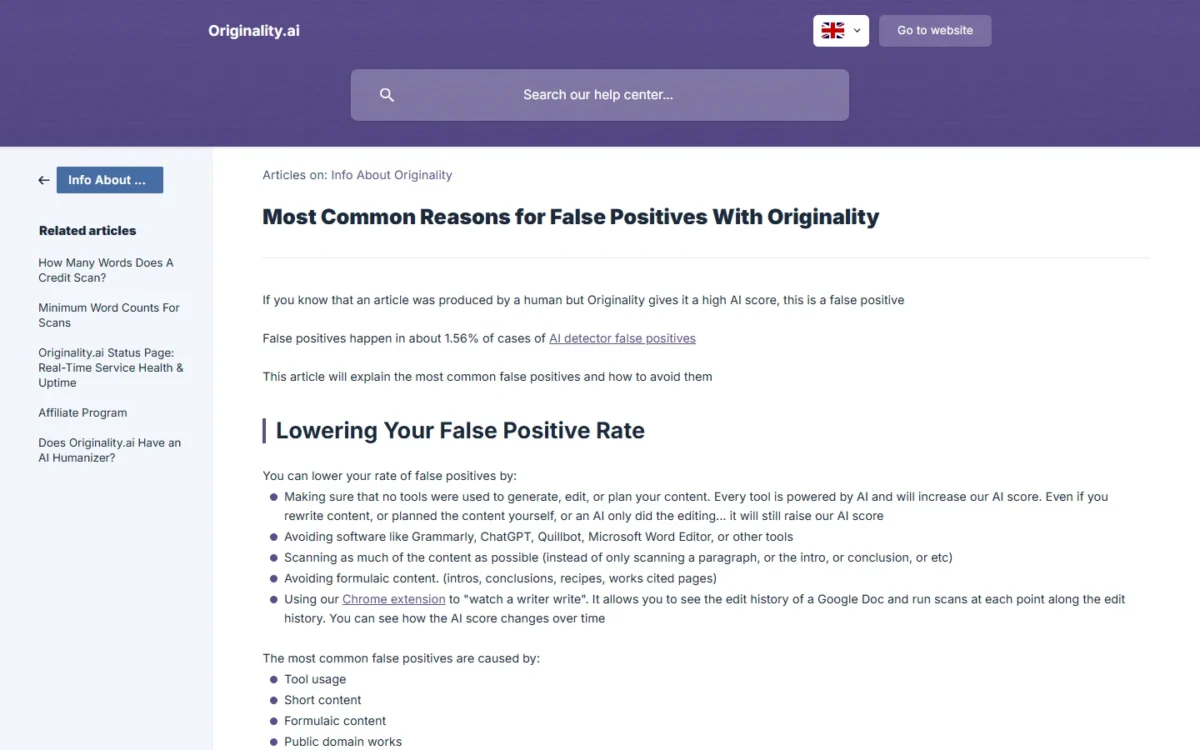
For an editor, that profile protects freelancers better than it catches light AI assistance. Originality’s own false-positive guide asks for at least 100 words and warns that formulaic intros, conclusions and statistics-heavy articles score higher.
- Pricing:
- Pro costs $14.95 a month, or $12.95 a month billed yearly ($12.95 x 12 months = $155.40), for 2,000 credits a month. At 100 words per credit, that is 2,000 x 100 = 200,000 words a month.
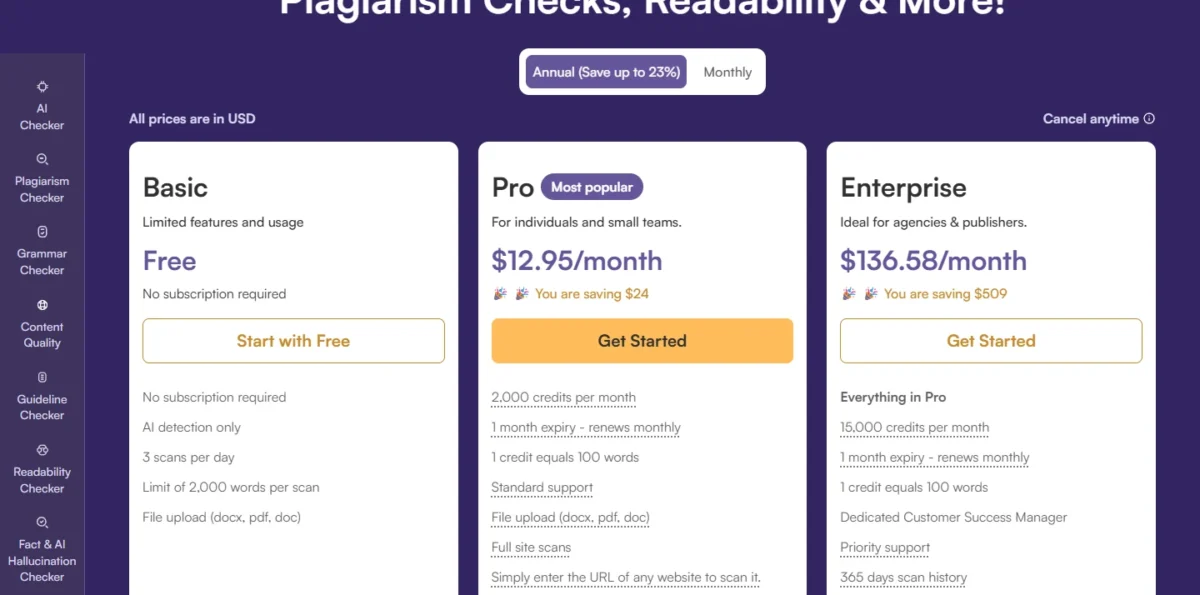
Extra seats cost $9.95 a month, or $8.62 on annual billing, and the page does not say how many seats Pro includes. Enterprise ($179 a month, or $136.58 billed yearly) adds 15,000 credits, API access and 365 days of scan history.
- Skip it if:
- your real risk is undisclosed AI assistance, or your volume swings from month to month.
4. Copyleaks: Best for Multilingual Teams That Need Many Seats
Copyleaks suits teams that need many seats: Pro includes 25 user seats for $74.99 a month on annual billing, so the sixth reviewer costs nothing extra.
Its strongest independent result is on rewritten text. In the JAIT study, it stayed at 100% on paraphrased and back-translated AI text and held 87.5% on non-native-style rewrites, where most tools collapsed. Springer’s Villa dentistry study gave it an AUC of 0.98.
The full-paper test was harsher. The Springer study by Van Vlasselaer recorded 75% false negatives and 25% partial false negatives on fully AI-written papers, so 0% strict, and 30% strict accuracy on hybrid papers. The same Springer study found that it flagged none of the 40 human papers.
That makes Copyleaks a safer pick for rewritten or translated essays than for long papers written with ChatGPT Deep Research.
AI detection runs in 30+ languages, which tells you what the tool accepts, not how accurate it is in each one.
- Pricing:
- Personal costs $16.99 a month with 100 credits, or $13.99 a month billed annually ($167.88) with 1,200 credits. Pro costs $99.99 a month with 1,000 credits, or $74.99 a month billed annually ($899.88) with 12,000 credits; one credit covers 250 words or one image.
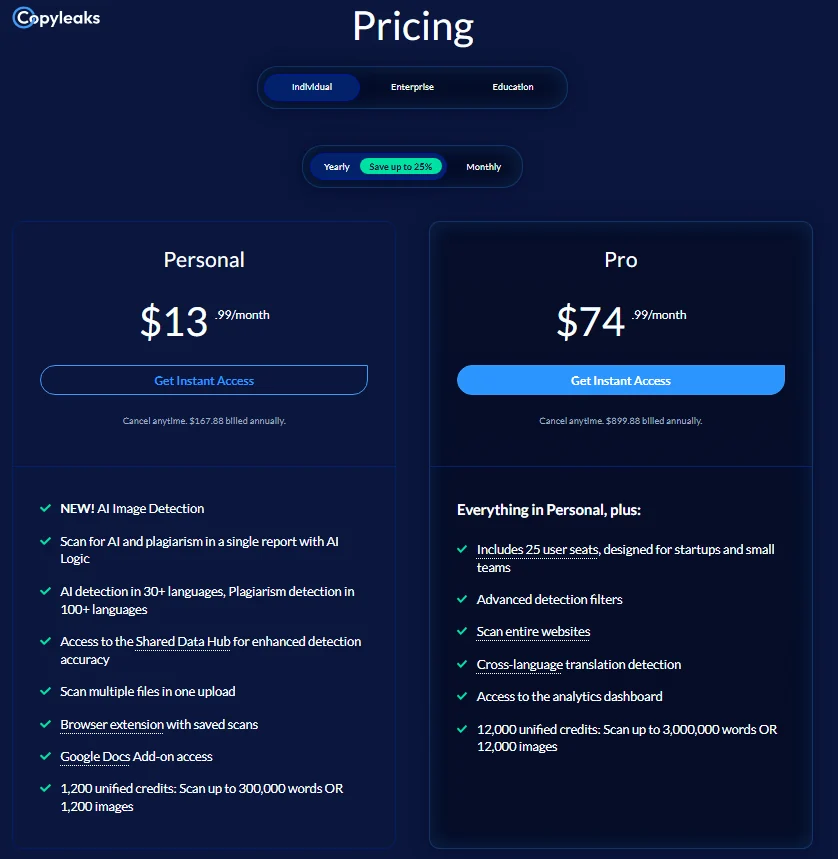
Watch the plan rules. Copyleaks plans don’t stack, and switching plans overrides the current plan, including any remaining credits. The pricing page lists no free plan.
- Skip it if:
- you change plans often, or you need one cheap seat for occasional checks.
5. Scribbr AI Detector: Best Free Checker for Students and Writers
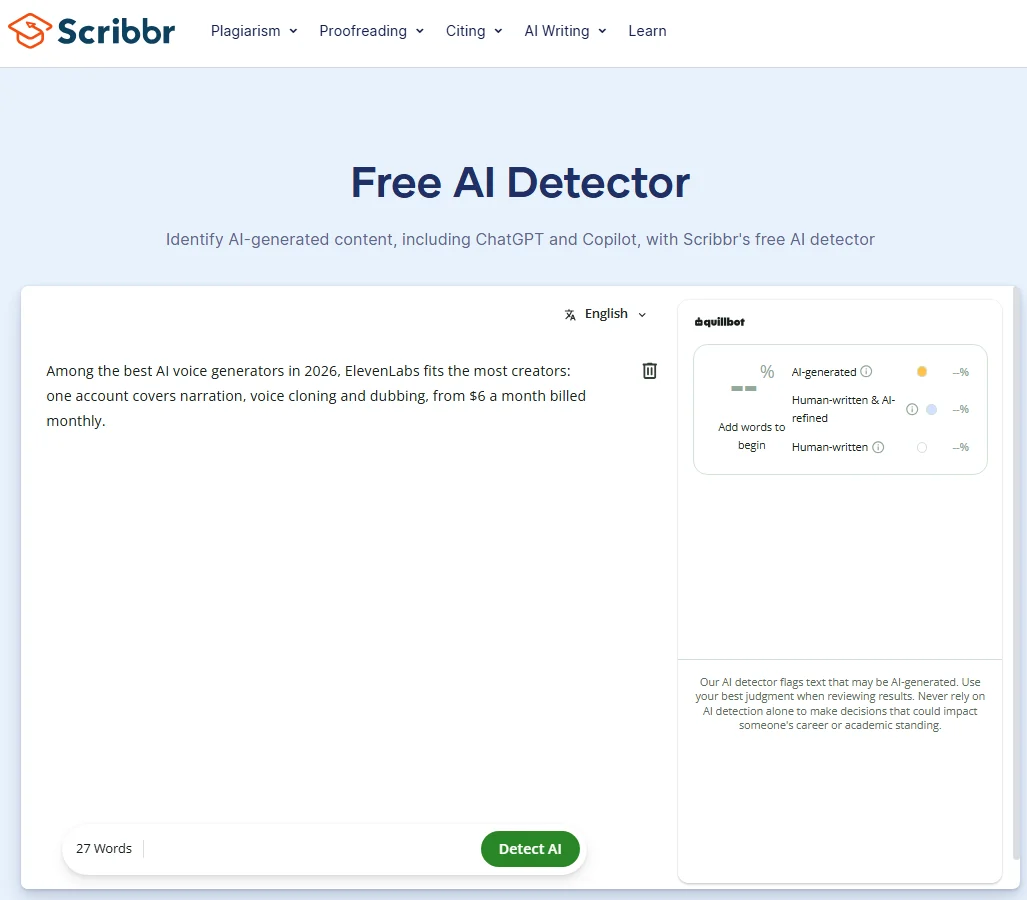
For one writer revising one document, Scribbr’s free detector beats every subscription here: unlimited checks of up to 1,200 words each, with no account.
It also reports four categories: AI-generated, AI-generated and AI-refined, human-written and AI-refined, and human-written. A student who wrote a draft and let a tool polish it gets a label for that, not a binary verdict.
The detector reads English, German, French and Spanish. Scribbr’s AI Detector page says no AI model on the market can guarantee 100% accuracy, “including ours”, and recommends scanning longer pieces rather than single sentences.
Scribbr’s own comparison ranks its free detector at 78% and its premium detector first at 84%. That is a vendor-tier test on 30 texts of 1,000 to 1,500 characters, so I treat the ranking as Scribbr’s own claim, not independent confirmation.
- Pricing:
- The free detector costs nothing. The premium AI Detector comes free with a premium plagiarism check, priced per document: $19.95 up to 7,499 words, $29.95 for 7,500 to 49,999 words and $39.95 for 50,000+ words.
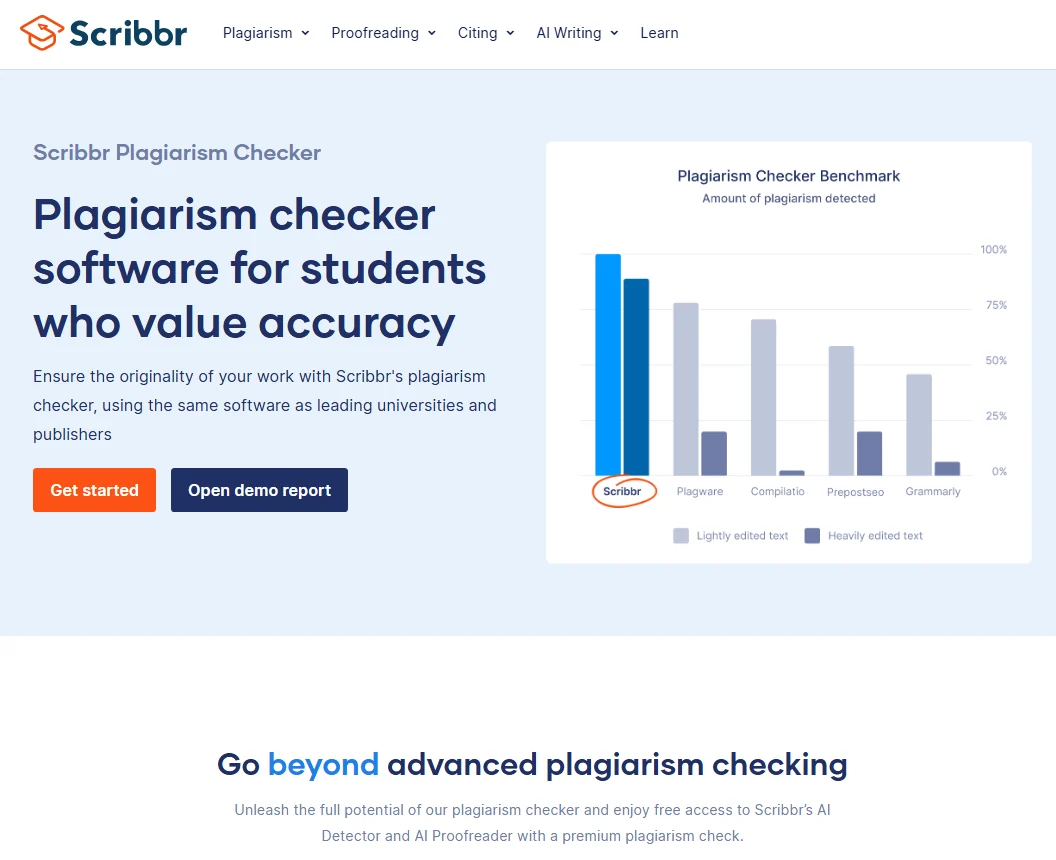
That per-document price suits a thesis checked once, not a teacher screening a class every week.
- Skip it if:
- you need a record of past checks, shared team access, or more than 1,200 words per free pass.
6. QuillBot AI Detector: Best Free Detector Inside a Writing Suite
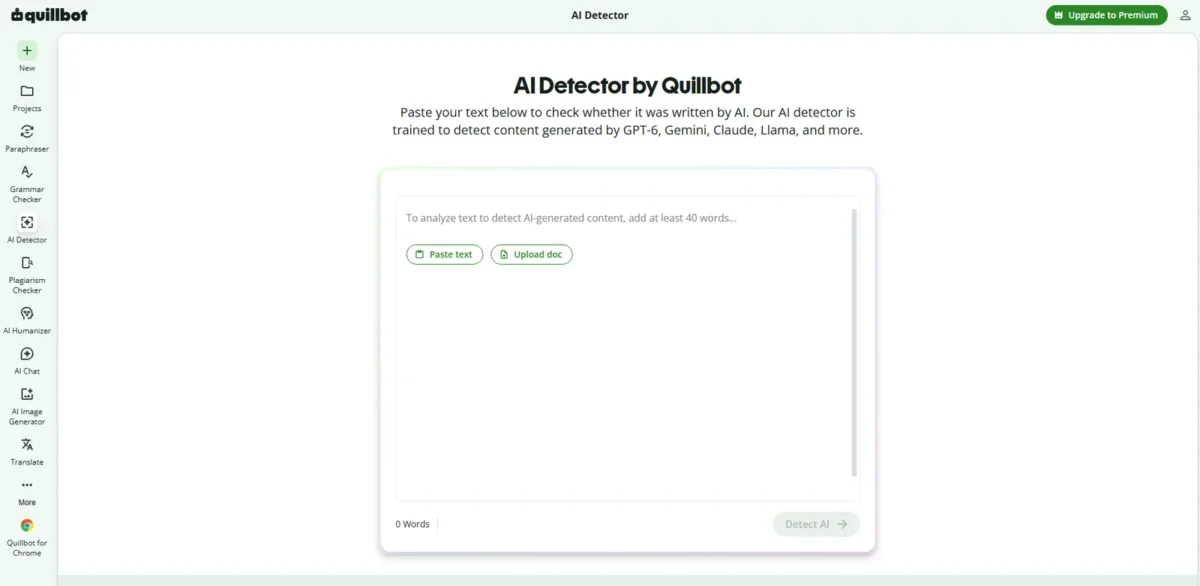
QuillBot’s detector gives the writer the benefit of the doubt: when a result is unclear, the model tends to classify the text as human. That lowers false accusations and raises misses.
The free tier is generous by count: six scans a day of up to 1,200 words each, so 6 x 1,200 = 7,200 words a day. Each scan needs at least 80 words. Free accounts also get QuillBot’s Grammar Checker, Humanizer and Plagiarism Checker.
That suite is the tension. The JAIT researchers made their paraphrased test set with the company’s own rewriter, and Turnitin’s report guide lists that rewriter as an example of an AI word spinner. The same company sells the detector and the rewriting tools detectors look for.
Results swing by condition: 95.5% at the baseline of the JAIT study but 22.3% on non-native-style rewrites, and 78% with no false positives in Scribbr’s own test.
QuillBot’s AI Detector page cites a 99% detection rate from RAID evaluations, which I count as a vendor claim.
- Pricing:
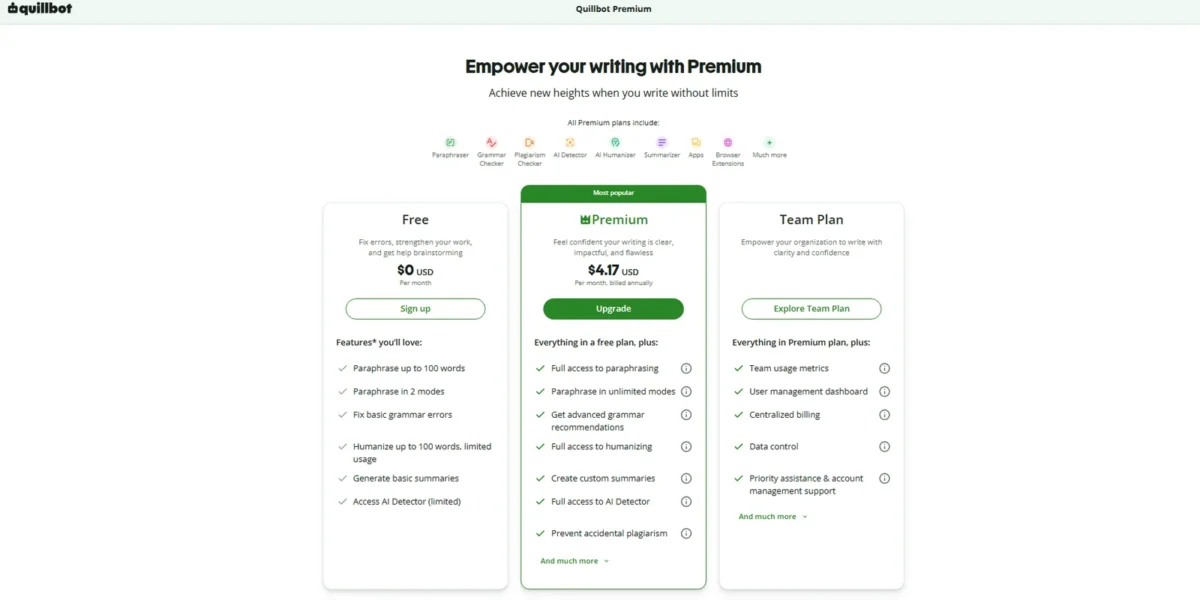
- Premium costs $8.33 a month, billed annually, and removes the word limit and the daily cap on detection scans. QuillBot’s Premium page shows no monthly price and no Team price.
- Skip it if:
- you need more than six free checks a day, or your texts run under 80 words.
7. Winston AI: Best for Shareable Reports on a Small-Team Budget
Winston AI publishes what it cannot scan. Winston’s help center rates social media posts, bullet-point lists, translated content and heavily edited AI drafts as limited, and source code, math, boilerplate legal text and tables as not suitable.
That list is more useful than a headline accuracy figure, because it tells a reviewer which documents not to run. A scan needs at least 500 characters, and Winston advises 300 words or more for best results.
The case for Winston is the package. Every paid plan lists OCR for pictures and handwriting, shareable PDF reports, plagiarism detection and AI image and deepfake detection. A small desk can send a freelancer or student the report behind a decision.
The image checks matter if your team also receives pictures made with the best AI image generators. For text-only work, ignore them.
The case against is evidence. The accuracy matrix below has no result for this detector, and vendor accuracy claims carry no weight in this ranking.
- Pricing:
- Advanced costs $29 a month, or $16 a month on annual billing, for 200,000 credits and up to 5 team members; that is $16 x 12 months = $192 a year. Essential is $18 or $10 for 100,000 credits, and Elite is $49 or $26 for 500,000 credits with unlimited team members.
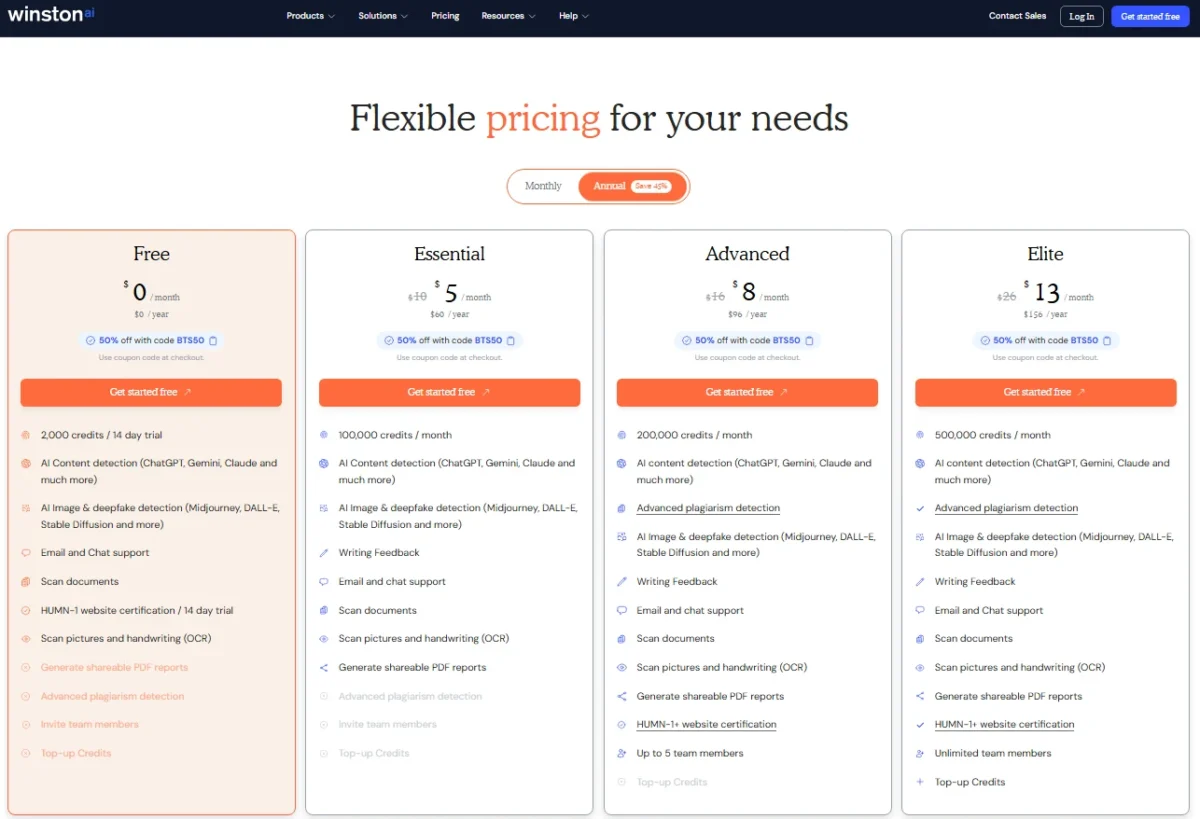
Each scan takes up to 200,000 characters. The free tier is a trial of 2,000 credits for 14 days, and the pricing page does not say how many words a credit covers.
- Skip it if:
- you need a detector with a result in the accuracy matrix below, or you screen translated text or short social copy.
8. Sapling AI Detector: Best for Developers Embedding Detection
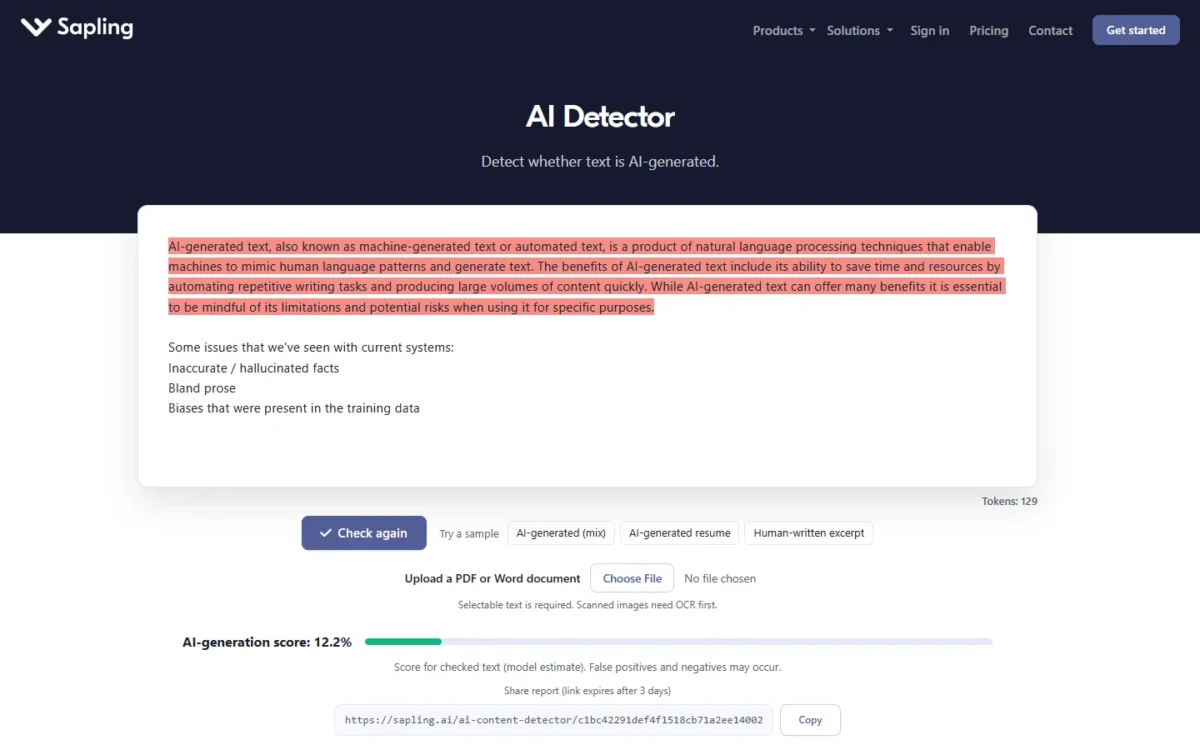
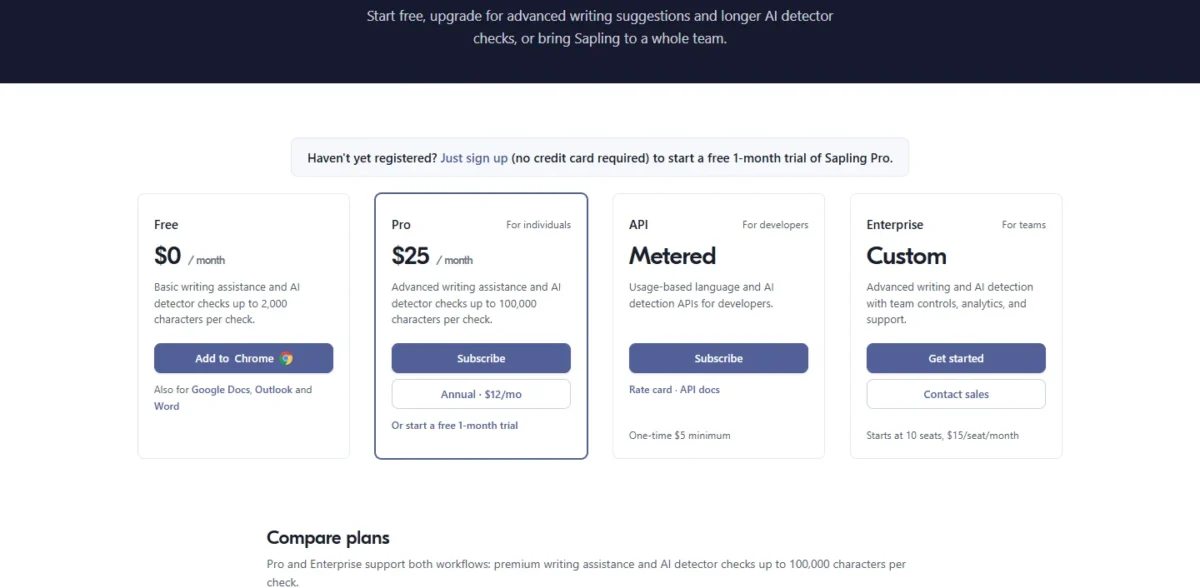
Sapling sells detection to developers on a meter: its usage-based API starts from a one-time $5 minimum. For people pasting text, the jump from free to paid is the point: free checks stop at 2,000 characters, while Pro checks up to 100,000 characters at a time.
Sapling’s AI Detector page says plainly where it goes wrong: the shorter, more general and more essay-like a text, the more likely a false positive. It adds that no detector, Sapling’s included, should be used as a standalone check, and that accuracy varies with the dataset, text length and threshold.
The page also says Sapling retrains the detector to keep up with models including GPT-5, Claude 4.5, Gemini 2.5, Qwen3 and DeepSeek-V3, so a team that drafts with Claude can check its assistant against that list.
Independent results split by condition. The JAIT study measured 97.7% at baseline and a 96.50% mean on paraphrased text, but 25.0% on non-native-style rewrites. Scribbr’s own test gave it 68% with no false positives.
- Pricing:
- Pro costs $25 a month, or $12 a month on annual billing, after a free one-month trial. Enterprise starts at 10 seats at $15 per seat per month, a floor of 10 x $15 = $150 a month.
- Skip it if:
- you want a free checker for full documents, or a team plan below ten seats.
9. Turnitin AI Writing Detection: Best for Institutions That Already License It
No individual can buy Turnitin’s AI detection: it is a license add-on, and pricing comes from the institution’s Turnitin account manager. For most readers, the real decision is how to read the report.
The independent record says this detector misses AI text far more often than it accuses a human. In Springer’s Villa dentistry study it caught 26.7% of AI manuscripts and flagged no human ones, with an AUC of 0.63.
In the same Springer study, detection swung by generator: 66.7% of GPT-4.5 manuscripts, 10% of GPT-4o and 3.3% of DeepSeek-R2. A reviewer who knows which of the best AI chatbots wrote a flagged draft can read its score with that swing in mind.
On full papers, the Springer study by Van Vlasselaer recorded 100% false negatives on fully AI-written work but 60% strict accuracy on hybrid papers, second only to the leader. The JAIT study measured 3.7% on non-native-style rewrites, and the Springer study by Hadra measured a sensitivity of 0.31 on hybrid texts.
Turnitin’s report guide sets the rules a reviewer must know:
- 300 to 30,000 words of prose in a long-form format, per the AI Writing Report guide
- English, Spanish, Japanese or Arabic, with AI paraphrasing and bypasser detection in English only
- scores from 1% to 19% shown as an asterisk (*%), because false positives are more frequent in that range
- no reliable detection of poetry, scripts, code, bullet points or tables
Turnitin also says the model “should not be used as the sole basis for adverse actions against a student”.
- Pricing:
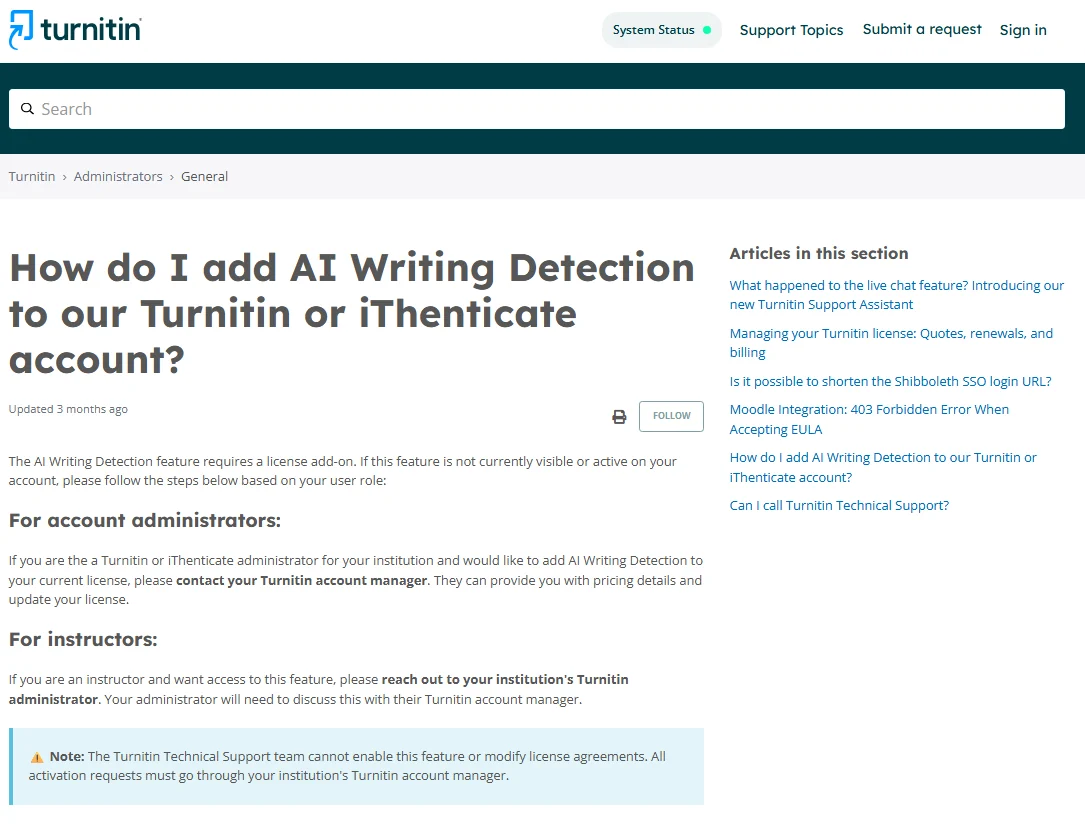
- Turnitin publishes no price. An administrator asks the institution’s account manager, as Turnitin’s help center explains, and instructors go through their administrator.
- Skip it if:
- you are an individual, or a student hoping to pre-check a paper with the same model.
10. Grammarly AI Detector: Best for Teams Already Paying for Grammarly
Grammarly’s detector has a problem of Grammarly’s own making. Its user guide warns that rewrites from its Grammarly, Paraphraser and Humanizer agents will likely be flagged as AI-generated, so accepting those rewrites can push a human draft into a higher score.
That makes it a self-check for writers who type their own sentences, not a screening tool for a team that edits with Grammarly’s agents. Grammarly says its model is optimized to minimize false positives, that shorter passages are harder to score, and that its scores may differ from Turnitin, GPTZero and Copyleaks.
The independent numbers are the weakest in the JAIT study: 90.9% at baseline and 2.1% on non-native-style rewrites. In the same JAIT study it managed 19.0% on paraphrased text from xAI’s Grok.
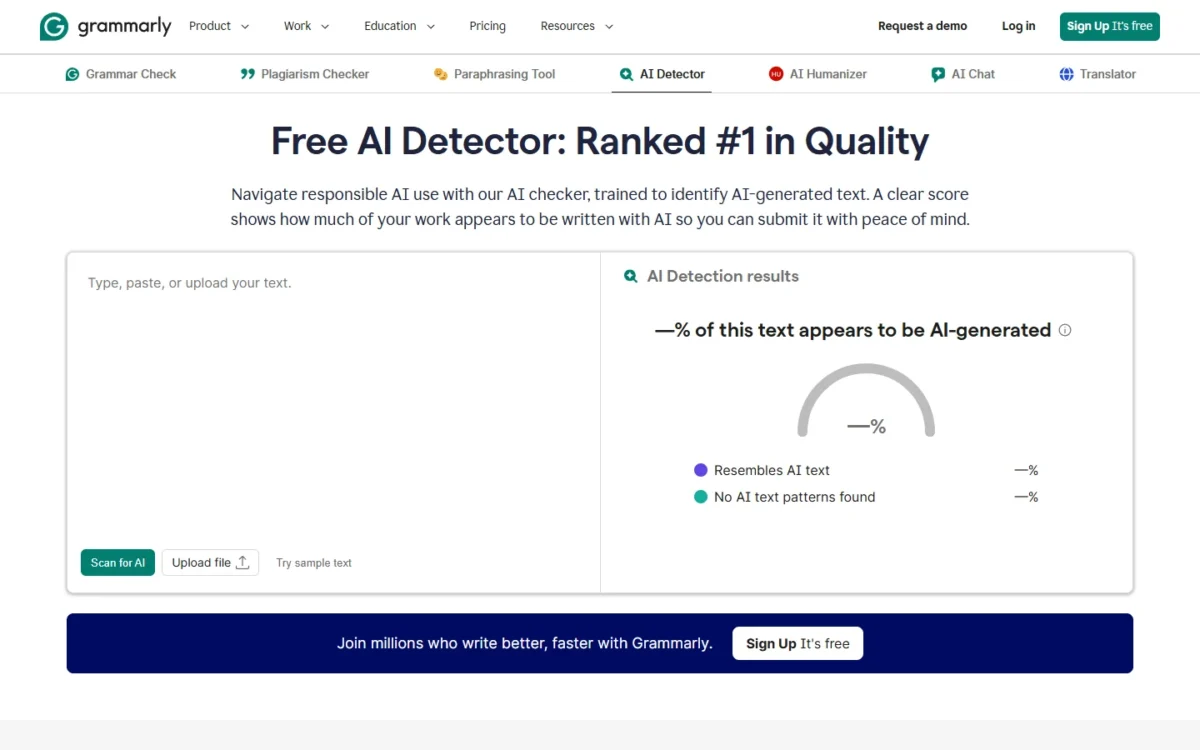
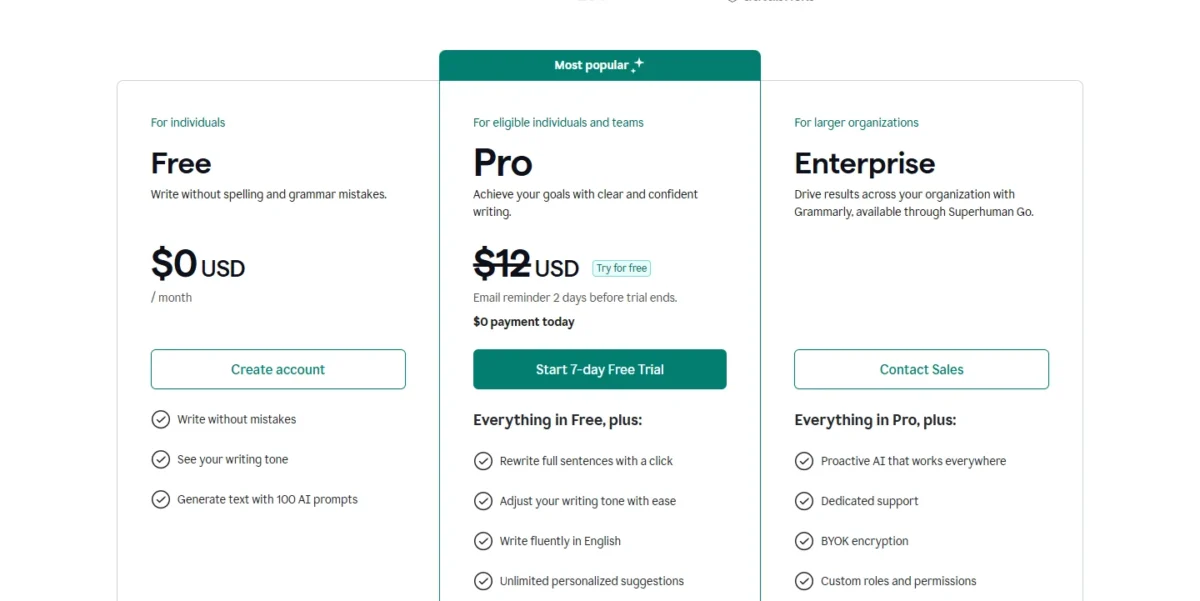
Grammarly runs a free web detector on its AI detector page, which returns a percentage. In-app detection is a Pro feature: in Google Docs through the browser extension, in the Mac and Windows apps inside Word, and as an AI Detector agent.
- Pricing:
- Grammarly Pro costs $12 per member per month, billed annually, or $30 billed monthly. Five members pay 5 x $12 = $60 a month on annual billing.
- Skip it if:
- you would buy Grammarly only for detection, or your writers rely on its rewriting agents.
11. PlagiarismDetector.net AI Content Detector: Best for Free Checks Beside a Plagiarism Checker
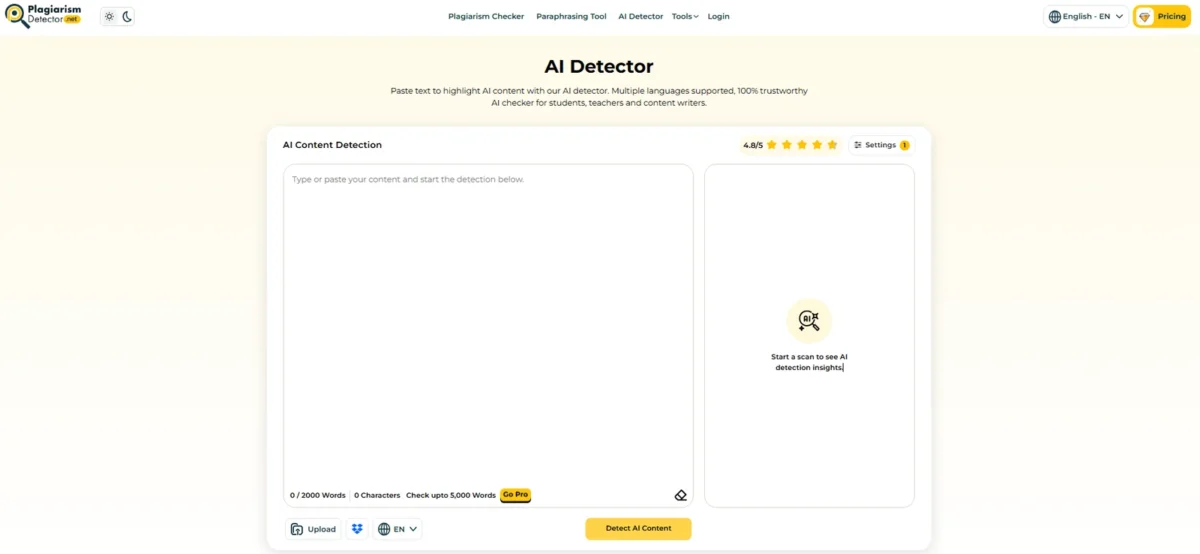
PlagiarismDetector.net is a plagiarism-checking site with an AI detector beside it. That is how I would use it: a free, no-account first pass on English, French or Spanish text, not a score to base a decision on.
The vendor’s AI detector page counts up to 2,000 words per check and says the tool is free no matter how many files you check. The same page also lists “No word count limit” among its features, so plan around the 2,000-word counter.
The settings panel shows what the free scan covers: GPT-4 (Standard), Gemini 1.5 Flash and Deep Seek. Deep Scan, GPT-5 (Dev), Claude 4 (Preview) and Cross Model check carry PRO labels, and the pricing page does not say which plan unlocks them.
The accuracy language is the weakest part. PlagiarismDetector.net’s detector page calls its results “100% reliable and accurate”, guaranteed and fit to be “shared as evidence”. I would not accept a guarantee from any AI detector, and that claim, with no result for this detector in the accuracy matrix below, is why it ranks last.
The study that tests the site examined its plagiarism checker instead: in Gao and colleagues’ study in Nature’s npj Digital Medicine, ChatGPT-written abstracts scored a median 0% “plagiarized”. A clean plagiarism result says nothing about who wrote a text.
The vendor says it never stores or shares uploaded text and offers 24/7 support by email. A school with a data-processing rule should still ask for the policy in writing before pasting student work.
- Pricing:
- In the Monthly view, the AI Detector line costs $10 for 30,000 words on Basic and $30 for 114,000 words on Premium, with no billing period printed. That is 3,000 words per dollar on the $10 line and 3,800 on the $30 line.
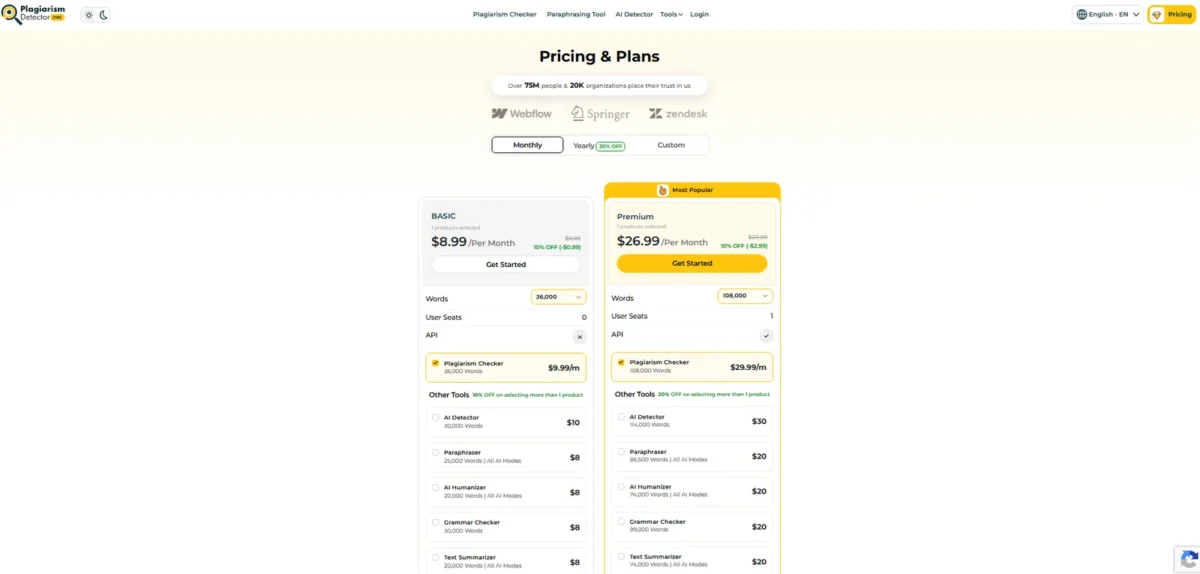
At the free 2,000-word check size, the $10 line covers 15 checks. The Yearly view lists the AI Detector at 1,800,000 words for $50 a month on Basic and 5,112,720 words for $80 a month on Premium.
Free checks are already unlimited at 2,000 words each, so I would pay only to check longer documents in one pass.
- Skip it if:
- you need Deep Scan or the PRO model checks free, text in other languages, or a score you must defend.
How Accurate Are AI Detectors? What Independent Studies Agree On
No AI detector is 100% accurate, and none is the most accurate in general: accuracy belongs to a detector paired with a kind of text. Even Grammarly’s AI detector page says no detector reaches 100%, and the table below shows one tool at 100% in the JAIT study and at 0% in a Springer study.
An AI detector is a classifier that scores how likely a text is to be machine-written; it does not identify the author. If you are new to the models behind that text, start with my primer on what generative AI is before the study results.
Scribbr, QuillBot, Sapling, Turnitin and Grammarly all say in their own documentation that a score alone is not proof.
The same detector can top one study and fail another
Different corpora, lengths and generators produce different numbers, so the columns below measure different things and must not be averaged. Weigh what each study measured against your own documents, and where a tool has a free option, test a sample of them there before you pay.
| Detector | Free option | JAIT baseline | JAIT non-native-style rewrites | Villa AUC (Springer) | Van Vlasselaer, fully AI-written papers, strict (Springer) |
|---|---|---|---|---|---|
| Pangram | 20 checks a day after sign-up | Not tested | Not tested | Not tested | 65% |
| GPTZero | 10,000 words a month | 100% | 90.0% | 0.99 | 0% |
| Originality.ai | 3 scans a day, 2,000 words each | 100% | 79.0% | 0.98 | Not tested |
| Copyleaks | None listed | 100% | 87.5% | 0.98 | 0% |
| Scribbr AI Detector | Unlimited checks, 1,200 words each | Not tested | Not tested | Not tested | Not tested |
| QuillBot AI Detector | 6 scans a day, 1,200 words each | 95.5% | 22.3% | Not tested | Not tested |
| Sapling AI Detector | 2,000 characters per check | 97.7% | 25.0% | Not tested | Not tested |
| Turnitin | License add-on, quoted by your institution’s account manager | 93.2% | 3.7% | 0.63 | 0% |
| Grammarly AI Detector | Free web detector; in-app detection needs Pro | 90.9% | 2.1% | Not tested | Not tested |
| ZeroGPT | Not reviewed here | 95.5% | 13.4% | Not tested | Not tested |
Sources: Makhmutova et al., JAIT 2026, Villa et al., Springer 2026, Van Vlasselaer et al., Springer 2026, read October 2026. Free options: Pangram pricing, GPTZero pricing, Originality.ai pricing, Copyleaks pricing, Scribbr AI Detector, QuillBot AI Detector, Sapling pricing, Turnitin help center, Grammarly AI detector page, checked October 2026.
Each study column tests something different. JAIT used AI texts of about 400 words from four models plus 20 human excerpts. The Springer study by Van Vlasselaer used papers of at least 4,000 words.
In another Springer study, Villa scored 120 full dentistry manuscripts, where an AUC of 0.50 means no discrimination at all.
The second row shows the problem: near the top in three columns and at zero in the last. A vendor’s headline figure describes the corpus the vendor chose; it does not transfer to your documents.
Mixed human-and-AI text is the hard case
Most detectors miss writing that a person and a model produced together. In the Springer study by Van Vlasselaer, the best of four tools reached 92.5% strict accuracy on hybrid papers and the next best 60%.
In the Springer study by Hadra, which tested two tools, sensitivity on hybrid texts was 0.31 for one and 0.02 for the other, even though the second caught most pure AI texts.
The older evidence points the same way. In a Springer journal paper, Weber-Wulff and colleagues ran 14 tools over 54 test cases: accuracy was 74% on unmodified AI text, 42% after human editing and 26% after machine paraphrasing. Their verdict was that the tools are “neither accurate nor reliable”.
Text run through AI humanizer tools is the same problem in a harder form. On humanised papers in the Springer study by Van Vlasselaer, strict accuracy ran from 2.5% to 92.5% across the four tools.
RAID, a benchmark on aclanthology.org that its authors call the largest of its kind, spans over 6 million generations from 11 models and found 12 detectors easily fooled by adversarial attacks, sampling changes and unseen models. A detector protects against wholesale AI submission far better than against AI assistance.
False positives cluster in short text
On long documents, the 2026 Springer studies found almost no false positives. Springer’s Villa dentistry study saw none among 30 human manuscripts, and the Springer study by Van Vlasselaer saw none for three of four tools. In the Springer study by Hadra, both tools classified 44 of 48 EFL student texts correctly.
The alarming 2023 figure came from essays by non-native English writers: on arXiv, Liang’s team reports that seven detectors run over 91 TOEFL essays had an average false positive rate of 61.22%, against 5.19% on 88 US eighth-grade essays. In the same arXiv paper, rewriting the TOEFL essays with richer vocabulary cut the rate to 11.77%.
That contrast suggests the kind of text matters more than the brand, and the vendors’ own floors tell you where short text starts:
| Detector | Minimum input | Kind of rule |
|---|---|---|
| Pangram | 50 words | No prediction below it |
| GPTZero | 250 characters, about 50 words | Dashboard minimum |
| QuillBot AI Detector | 80 words | Required to scan |
| Originality.ai | 100 words | Recommended |
| Winston AI | 500 characters; 300+ words advised | Required, plus advice |
| Turnitin | 300 words of prose | Required for a report |
| Sapling AI Detector | No minimum stated; accuracy improves after about 50 words | Warns that short text raises false positives |
| Grammarly AI Detector | Not stated on its AI detector page or user guide | Says shorter passages are harder to score |
| Scribbr AI Detector | Not published | Recommends longer pieces |
| Copyleaks | Not on its pricing page | No rule stated there |
| PlagiarismDetector.net | Not published | No rule published |
Sources: Pangram minimum word count, GPTZero benchmark post, QuillBot AI Detector, Originality.ai help, Winston AI help, Turnitin guide, Sapling AI Detector, Grammarly AI detector page, Copyleaks pricing, checked October 2026.
If your shortest routine document is a discussion post, a cover-letter paragraph or a product blurb, no detector in this list is safe to act on.
What a score can and cannot prove
A score opens a review; it never closes one. Turnitin hides scores from 1% to 19% in its AI Writing Report, and QuillBot calls scores “signals, not verdicts”. Grammarly says its percentage is not “an objective source of truth”, and Sapling says no detector should be a standalone check.
Detectors also disagree with each other. In Springer’s Villa dentistry study, one of the six tools showed only slight agreement with the high-performing detectors, with a kappa of about 0.13 to 0.17. A draft from a general assistant such as the one in my ChatGPT review can therefore score differently in two detectors.
After a high score, do three things before any decision:
- Scan several pieces by the same writer to set a baseline, as Originality.ai recommends.
- Read the drafts and version history.
- Talk to the author.
What AI Detectors Really Cost: Free Limits and a Five-Person Team
For five reviewers, Winston AI Advanced costs $16 a month on annual billing and Copyleaks Pro $74.99 a month on annual billing with 25 seats. Pangram Team costs 5 x $20 = $100 a month. Free limits come in different units (words, characters, scans and checks), so no single free allowance is the most generous overall.
Free plans compared in their own units
Scribbr is the free pick for repeated checks of one document; for other jobs, match the free unit to the work:
- Unlimited checks of one document: Scribbr at 1,200 words per check, or PlagiarismDetector.net at 2,000 words per check.
- A few full scans a day: QuillBot at 6 x 1,200 = 7,200 words a day, or Originality.ai at 3 x 2,000 = 6,000 words a day.
- A monthly pool: GPTZero at 10,000 words a month.
- Counted checks: Pangram at twenty checks a day after sign-up.
- Short snippets: Sapling at 2,000 characters per check.
- A trial only: Winston AI at 2,000 credits for 14 days.
Copyleaks lists no free plan and Turnitin sells only to institutions. Grammarly’s free web detector exists, but its in-app detection needs Pro.
Five reviewers on annual billing
Seat rules, not list prices, decide what a team pays:
| Tool and plan | Seat rule | Five people, per month on annual billing | Five people, per month on monthly billing |
|---|---|---|---|
| Winston AI Advanced | Up to 5 team members included | $16 | $29 |
| QuillBot Premium | Individual plans; Team price not published | 5 x $8.33 = $41.65 | Not published |
| Originality.ai Pro | Extra seats; seats in Pro not stated (assumes one) | 4 x $8.62 = $34.48; $12.95 + $34.48 = $47.43 | 4 x $9.95 = $39.80; $14.95 + $39.80 = $54.75 |
| Grammarly Pro | Per member | 5 x $12 = $60 | 5 x $30 = $150 |
| Sapling AI Detector Pro | Individual plans | 5 x $12 = $60 | 5 x $25 = $125 |
| Copyleaks Pro | 25 seats included | $74.99 | $99.99 |
| Pangram Team | $20 per seat per month | Annual rate not printed | 5 x $20 = $100 |
Sources: Winston AI pricing, QuillBot Premium, Originality.ai pricing, Grammarly Pro, Sapling pricing, Copyleaks pricing, Pangram pricing, checked October 2026.
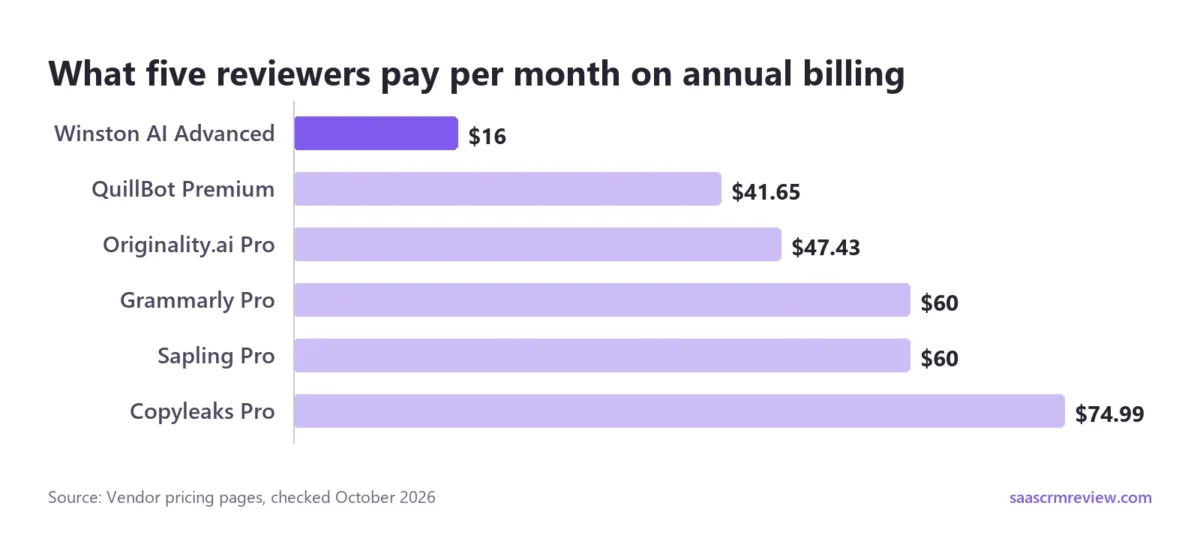
Winston is cheapest for five because Advanced bundles five members into one price. GPTZero is missing because this guide does not quote its dollar prices. Turnitin prices by institutional license, Scribbr by document and PlagiarismDetector.net by word allotment, so none fits a per-reviewer table.
At ten people the order shifts again. Winston Elite at $26 a month and Copyleaks Pro at $74.99 cover everyone, while per-seat plans climb: Grammarly to 10 x $12 = $120 and Pangram to 10 x $20 = $200 a month.
Credits that expire or disappear
Two billing rules never show in a starting price. Originality.ai subscription credits expire at the end of each month, while its Pay As You Go credits last 2 years after purchase.
At Copyleaks, moving from an annual plan to a different plan forfeits the unused annual credits. Time any upgrade to the end of a billing period.
Should SEO and Marketing Teams Use an AI Detector?
Not to protect rankings. Google’s guidance on AI-generated content says it rewards high-quality content “however it is produced”, and its spam policies target scaled content abuse “no matter how it’s created”.
A detector earns its place in a content team for other jobs. It can check commissioned copy against a contract that bans undisclosed AI, enforce a brand’s disclosure rule, and screen guest posts or user reviews.
The working paper on bfi.uchicago.edu is the closest evidence for marketing text. Across the 1,992 passages in the bfi.uchicago.edu paper (news, blogs, consumer reviews, novels, restaurant reviews and résumés), the detector I rank first had essentially zero errors on medium-length to long passages, and slightly more on short ones.
Short ad and social copy sits under most floors, and Winston rates social posts as limited. Formulaic copy is the other trap: Originality says intros, conclusions and statistics-heavy articles score higher, so scan several pieces per writer.
Three tools fit content work best:
- Originality.ai for site scans and shared tags across a publishing team
- Winston AI for PDF reports you can send a freelancer
- Pangram Individual for automatically scanning a feed on social media or Substack
Scan a draft before an editing tool rewrites it, since Grammarly’s own agents raise its score. If your team drafts with the best AI tools for content creation, agree the disclosure rule first and run the detector second.
If freelancers draft with free AI content generators, put the AI clause in the brief before the first invoice.
Which AI Detector Should You Choose?
The text you check decides first, then team size and stakes. Pick by situation:
- High-stakes review of long documents: Pangram.
- A school on a budget, essay-length work: GPTZero, or Turnitin if your institution already licenses it.
- Commissioned content every week: Originality.ai.
- Multilingual teams, or 6 to 25 reviewers: Copyleaks Pro.
- Up to five people who need shareable reports: Winston AI Advanced.
- Developers adding detection to an app: Sapling’s API.
- One writer checking their own work for free: Scribbr, or QuillBot for six scans a day.
- Already paying for Grammarly Pro: use its detector before writers accept agent rewrites.
- A free first check plus plagiarism: PlagiarismDetector.net.
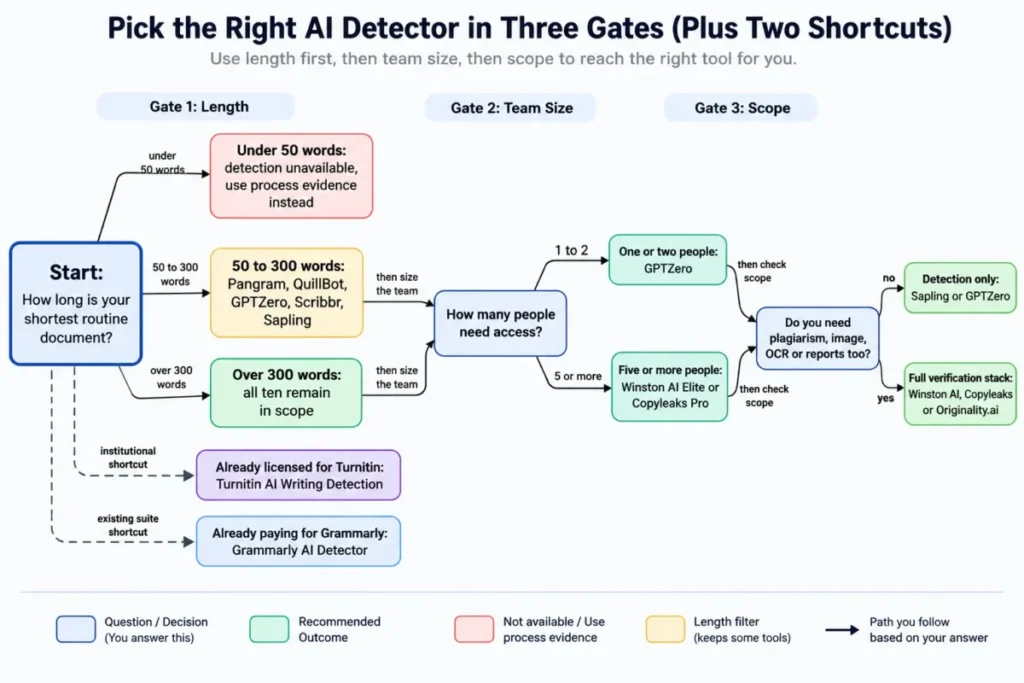
Between them, Turnitin’s and Winston’s own documentation name source code, bullet lists, tables, poetry, scripts, translated text and social posts as content their detectors judge poorly. Check the drafts and the history instead.
Start with one measurement: the length of your shortest routine document. If it falls under a tool’s floor, that tool leaves your shortlist whatever its rank. If your team also drafts with AI, my AI writing tools compared match each writer to the job.
AI Detector FAQ
Is Turnitin 100% accurate?
No. Turnitin hides scores between 1% and 19% in its AI Writing Report because its own testing found more false positives there. Reports generated before July 8, 2024 may still show numbers below 20%, so check the report date before comparing scores. In Springer’s Villa dentistry study, it also missed most AI-written manuscripts.
Is ZeroGPT the best AI detector?
Not on the evidence in this guide. ZeroGPT scored 95.5% at the baseline of the JAIT study and held up well on back-translated text, but it fell to 13.4% on non-native-style rewrites. Scribbr’s own test gave it 64% overall, with one false positive among its human texts.
Can a student check a paper with Turnitin before submitting?
No. Turnitin’s AI detection is a license add-on that only an institution’s administrator can request through its account manager. Any self-check runs on a different model, so a different score from Scribbr or QuillBot is expected and is not a sign that something is wrong with the paper.
What is the difference between an AI detector and a plagiarism checker?
A plagiarism checker looks for text copied from existing sources; an AI detector scores how likely new text is machine-written. In Gao’s study in Nature’s npj Digital Medicine, even iThenticate gave ChatGPT abstracts a median similarity index of 27, against 100 for the originals, because generated text is new. QuillBot recommends using both tools together.
Do AI detectors work in languages other than English?
Many accept them: Copyleaks lists 30+ languages, Pangram 20+, and Turnitin and Scribbr four each. No vendor here publishes accuracy by language. The closest evidence is the back-translation test in the JAIT study, where one tool stayed at 100% and another fell to 30.3% on Grok text, so pilot on documents you know.