
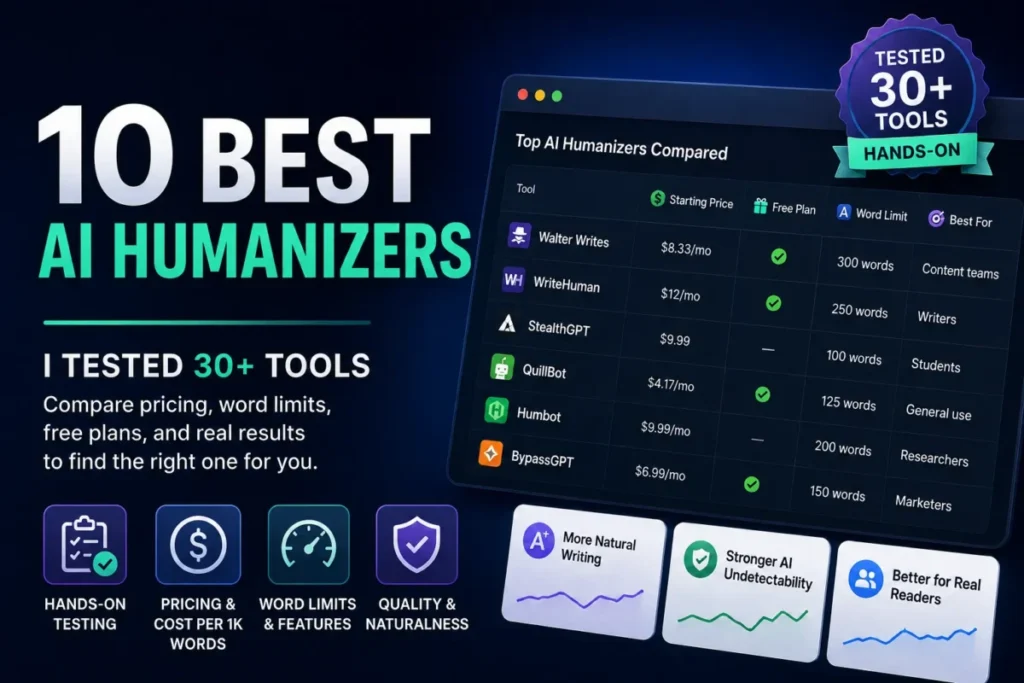
This edition compares ten AI humanizers on what a buyer can confirm before paying: how much text each plan accepts in one submission, how many submissions a long article needs, what a thousand words actually costs, what the free tiers allow, and whether an API or team route is published at all. Every figure was read from the vendor’s own plan or documentation page on August 21, 2026.
What this edition does not do is benchmark output. Naturalness, meaning preservation and detector behavior were not independently tested here, so no tool is ranked on how well it writes. The numbered order below is an operational ranking built from independently verifiable purchasing and workflow constraints, not an output-quality ranking.
Read it as a commercial and workflow comparison. It answers what each plan gives you and what it costs, which is the half of the buying decision that can be settled from published documentation.
In This Article (19 sections)
Quick Verdict
| Pick | Tool | Why |
|---|---|---|
| Best for Long-Form Capacity in This Comparison | Phrasly.AI | Uncapped humanization count paired with the largest quantified per-process ceiling at 5,000 words |
| Best Capped Plan for Cost per Included Word in This Comparison | Walter Writes AI | About $0.13 per 1,000 included words on the Elite allowance |
| Best Request-Based Free Evaluation in This Comparison | WriteHuman | Three real humanizer requests a month at 250 words each |
| Best Recurring Free Access in This Comparison | QuillBot | 125 words per use, six uses a day, renewing daily |
| Lowest Labeled Monthly Entry Price in This Comparison | GPTinf | $4.99 monthly, with no annual commitment attached to the figure |
| Only Published Team Plan in This Comparison | Walter Writes AI | Ten seats, 500,000 words and a printed price |
| Clearest Published API Rate in This Comparison | StealthGPT | $0.20 per 1,000 words, pay as you go, no subscription |
| Broadest Editing Suite with Published Pricing in This Comparison | QuillBot | Humanizer sits beside paraphrasing, grammar, citations and translation |
| Only Documented Term-Protection Controls in This Comparison | GPTinf | Frozen keywords and selective rephrase, both listed on the plan page |
| Only Tier With a Published Consumer Price That Uncaps Both Monthly Usage and Input | HIX Bypass Unlimited | Removes the monthly allowance and the input ceiling together, at $15.00 per month on annual billing |
Best for Natural Writing and Best for Preserving Meaning are deliberately absent. Both require output testing that this edition does not contain.
Best AI Humanizers Compared
| Rank | Tool | Best For | Starting Price | Monthly Capacity | Input Limit | Free Access | API and Team | Operational Verdict |
|---|---|---|---|---|---|---|---|---|
| 1 | Phrasly.AI | Long-form, high volume | $10.99/mo billed annually | Unlimited humanizations | 5,000 words per process | $2.00 for three days | No API rate published | Largest quantified input ceiling, at the lowest price among plans with uncapped monthly usage |
| 2 | Walter Writes AI | Cost per included word, teams | $8/mo billed $96 annually | 30,000 to 500,000 words by tier | 750 to 2,000 words per request | None published | MCP access from entry, Teams plan with 10 seats | Lowest published cost per included word, low entry batch ceiling |
| 3 | WriteHuman | Evaluating before buying | $12/mo billed $144 annually | 3 to unlimited requests by tier | 250 to 3,000 words per request | 3 requests of 250 words per month | MCP on Pro and Ultra | Strongest request-based free evaluation |
| 4 | QuillBot | Writers who also edit | $8.33/mo billed annually | Not published for the paid plan | Not published for the paid plan | 125 words per use, 6 uses per day | No API rate published | Strongest recurring free access, unpublished paid ceiling |
| 5 | Undetectable AI | Predictable bundles | $9.99 monthly or $5.00/mo annually | 10,000 to 50,000 words by bundle | Not published | 250-word trial | API compatibility stated, no rate | Fully specified prices, unpublished ceiling |
| 6 | HIX Bypass | Rewrite modes, uncapped input on the top tier | $14.99 monthly or $9.99/mo annually | 5,000 to unlimited by tier | 3,000 words per input, removed on the Unlimited tier | None published | No API rate published | Strong above Premium, highest entry rate calculated here |
| 7 | GPTinf | Budget entry, term protection | $4.99 monthly | 5,000 to unlimited humanizer words | Not published | None published | No API rate published | Lowest labeled monthly entry, smallest entry quota |
| 8 | StealthGPT | Developers | $9.99, cadence not labeled | 50 to 1,000 requests by tier | 1,000 to 20,000 words per request | None published | API at $0.20 per 1,000 words | Clearest API terms, unlabeled consumer cadence |
| 9 | Humbot | Broad toolkit | Not rendered on the plans page | 3,000 to unlimited Basic words | 500, unlimited or 1,200 by tier | None published | API from $30 per month | Consumer cost cannot be compared |
| 10 | BypassGPT | Interface preview | Free plan, paid prices not rendered | 150 free words per month | 80 words per input | 150 words per month | No API rate published | Free tier too small to evaluate |
Output quality, meaning preservation and detector performance were not independently benchmarked for this edition. Every figure in the table above was read from the vendor’s own plan or documentation page on August 21, 2026.
How We Compared and Ranked AI Humanizers
Hands-on testing. None was performed for this edition. No tool was run, no output was generated, and no detector was queried. Everything below is documentation-based.
Documentation verification. Thirteen official pages were retrieved on August 21, 2026: the plan or pricing page for all ten products, the Walter Writes help-center article on subscription billing, the StealthGPT API page and the Humbot API page. Each was read for price, billing cadence, monthly allowance, per-request ceiling and free or trial capacity.
Source hierarchy. Official pricing pages first, then official documentation and help centers, then vendor marketing claims. Marketing claims are attributed to the vendor and are never presented as results.
Vendor claims. Detection statements stay attributed. Undetectable AI lists “Passes AI detectors” as a plan feature, BypassGPT lists “Bypass all basic AI detectors,” and GPTinf lists “Passes AI detection tools.” None was independently checked, and none is treated here as a measured outcome.
The intended scoring framework. The full framework for this category weights naturalness at 25 percent, meaning preservation at 20 percent, editing required at 15 percent, detector performance at 15 percent, price and value at 10 percent, batch limits at 5 percent, features and workflow at 5 percent, and ease of use at 5 percent.
Seventy-five percent of that framework depends on output testing that has not happened. The remaining 25 percent is not enough to produce a meaningful weighted score on its own, so no numerical score is published in this edition, and the full weighted ranking is reserved for a future update built on hands-on testing. Assigning numbers to untested dimensions would be inventing them.
What the current order is instead. Positions 1 to 10 reflect operational buying fit across factors that can be verified from published documentation: per-request input limits, monthly capacity, price and billing cadence, cost at different usage levels, free evaluation access, whether a team plan exists, whether an API rate is published, and whether a consumer price renders at all.
What the current order is not. It is not a writing-quality ranking. Nothing here says that the tool at position 1 produces better prose than the tool at position 2. A tool could move several places once output testing is complete, and this article will say so when it does.
1. Phrasly.AI: Best for Long-Form Capacity
Why it ranked here. Phrasly Unlimited is the lowest-priced plan in this comparison that combines uncapped monthly usage with a published input ceiling large enough to take a full-length article in one submission. Its monthly usage is uncapped, its input is not: 5,000 words per process is a hard limit.
Pricing and limits. Unlimited costs $10.99 per month billed annually. It includes unlimited AI humanizations, 5,000 words per process, 20,000 plagiarism-check words a month and up to 30,000 content-generator words a month. Three-day access is $2.00 and is capped at 800 words per process with up to 50 uses a day.
The 5,000-word ceiling is the number that matters. A typical 2,000-word article goes through in one submission, and so does a 5,000-word guide. Among the plans that publish a fixed numeric ceiling, this is the largest. Two plans go further by removing the ceiling entirely: HIX Bypass Unlimited and Humbot Pro both state unlimited input, and HIX Unlimited also removes the monthly allowance. HIX Unlimited costs $15.00 per month on annual billing against Phrasly’s $10.99, and $59.99 month to month. Humbot does not render a price at all.
At 100,000 words a month the flat plan works out near $0.11 per 1,000 words. At 10,000 words a month the same plan is closer to $1.10. Flat pricing rewards volume and penalizes light use, which is the clearest buying rule in this category.
Evidence note. Phrasly’s pricing and published capacity limits were verified from the plan page. Its output quality was not benchmarked here, and the plan documentation describes no keyword-locking or selective-rewrite control, so nothing on the page indicates a way to protect defined terms from being rewritten.
- Best for.
- Content teams and prolific writers producing more than roughly 30,000 words a month who want cost to stop tracking output.
- Avoid if.
- You want to try before paying. There is no free tier, and the $2.00 three-day option requires an account and a card.
| Pros | Cons |
|---|---|
| Largest quantified per-process ceiling at 5,000 words | No free tier |
| Monthly humanization count removed entirely | Unlimited applies to count, not to batch size |
| 20,000 plagiarism-check words included | Plagiarism and generator words are separately metered |
| Cost per 1,000 words falls sharply as volume rises | Narrower toolkit than a full writing suite |
| $2.00 three-day route for evaluation | Output quality not independently benchmarked |
- Bottom line.
- If your problem is that long articles keep getting chopped into fragments, this plan addresses it at the lowest price among plans with uncapped monthly usage. Buy annually or skip it, because the value sits in the flat rate.
2. Walter Writes AI: Best Capped Plan for Cost per Included Word
Why it ranked second. Among plans that publish an included word allowance, Walter Writes Elite has the lowest cost per included word in this comparison, and the vendor publishes the only team plan here with seats, capacity and a price. Its entry tier makes you work for that value.
Pricing and limits. Starter is $8 per month billed $96 annually for 30,000 words a month at 750 words per request. Pro is $13 per month billed $156 annually for 70,000 words at 1,500 per request. Elite is $26 per month billed $312 annually for 200,000 words at 2,000 per request. Teams is $99 per month billed $1,188 annually for 500,000 words, 2,000 per request and 10 team members.
Elite works out at about $0.13 per 1,000 included words. Teams lands near $0.20 per 1,000 words, but that figure is not comparable with a single-user plan, because part of the price buys ten seats rather than more capacity.
Two other rates in this article go lower under different assumptions, and the difference in method matters. Phrasly reaches about $0.11 per 1,000 words only at a hypothetical 100,000 words of monthly use on a flat plan with no included allowance. WriteHuman Pro reaches about $0.075 per 1,000 only if all 200 requests are filled to their 1,200-word ceiling, which is a mathematical maximum rather than a typical month. Walter’s figure is an included allowance you are entitled to regardless of how you use it. These are three different cost models and they should not be read as one league table.
Then there is the ceiling. A 5,000-word article needs seven passes on Starter, four on Pro and three on Elite. Seven passes means seven pastes, seven waits and six places where tone can drift between chunks.
One rule changes the arithmetic. On an annual plan, credits refresh every month on the billing date and reset rather than roll over. Anyone with uneven output is paying for capacity that expires.
Evidence note. Pricing, allowances and per-request ceilings were verified from the plan page and the billing help-center article. A built-in AI Detector is listed on the Starter feature set, which is a documentation fact rather than a performance one.
Compared with Phrasly.AI. Cheaper per included word at Elite, and it publishes a real team plan. Against that, its batch ceiling is a third of Phrasly’s at best and a seventh at entry level, so long documents cost you handling time instead of money.
- Best for.
- Buyers optimizing cost per included word who can work in short passes, and any team that needs seats without a sales call.
- Avoid if.
- Your documents routinely run past 1,500 words and you value your time at all.
| Pros | Cons |
|---|---|
| About $0.13 per 1,000 included words on Elite | Starter accepts only 750 words per request |
| Only published team plan with seats and a price | Unused monthly credits do not roll over |
| 30,000 words a month at $8 on annual billing | Every published price assumes annual billing |
| Built-in detector and MCP access from Starter | No free tier |
| 80 or more languages supported | Long drafts require manual reassembly |
- Bottom line.
- Buy Pro rather than Starter unless your work is genuinely short-form. The $5 monthly difference doubles the batch ceiling, which is where the handling cost sits.
3. WriteHuman: Best Request-Based Free Evaluation
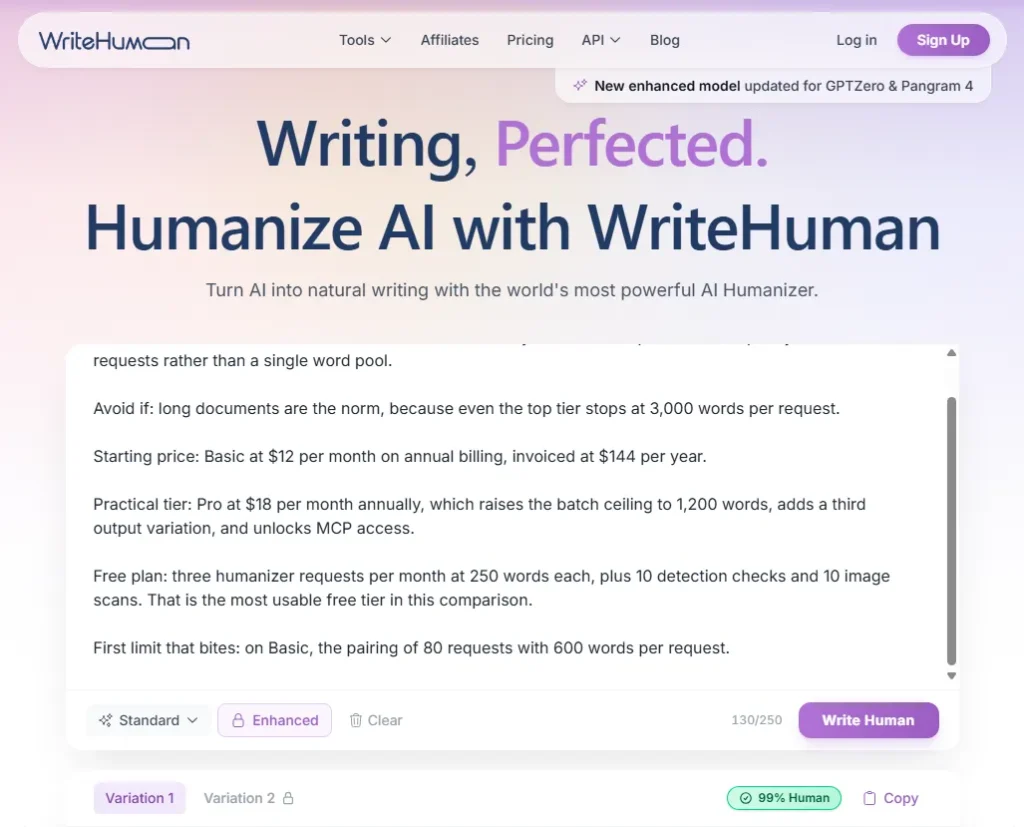
Why it ranked third. Its free tier allows three 250-word passages rather than a single sample sentence, and it is the only tool in this comparison whose plan page documents multiple output variations per request.
Pricing and limits. Basic is $12 per month billed $144 yearly for 80 requests a month at 600 words each, 2 output variations and 160 detection checks. Pro is $18 per month for 200 requests at 1,200 words, 3 variations and MCP access. Ultra is $36 per month for unlimited requests at 3,000 words, 5 variations and 1,000 MCP uses. The free plan gives 3 requests a month at 250 words each.
Multiply Basic out and its ceiling appears. Eighty requests at 600 words each is 48,000 words a month, which at $12 works out to $0.25 per 1,000 words. That rate only holds if every request is filled to the top, and real submissions rarely are.
Requests are an unfamiliar unit, and that is the trap. A plan quoted in requests looks generous next to one quoted in words until you multiply.
Evidence note. Quotas, prices and variation counts were verified from the plan page. Output quality was not benchmarked. Multiple variations give a writer alternative rewrites to compare, which may make it easier to select an output closer to the intended voice, though whether the variations differ usefully is an output question this edition did not answer.
Compared with QuillBot on free access. WriteHuman offers the more useful request-based free evaluation, because 250 words is long enough to judge a real paragraph and each request returns variations. QuillBot offers the stronger recurring free access, because 750 words a day renewing daily adds up to far more free volume over a month. They answer different questions, and neither is the single best free tier.
Compared with Phrasly.AI. You can evaluate it properly for free before deciding. Against that, even the $36 Ultra tier stops at 3,000 words per request, so a long guide still needs splitting.
- Best for.
- Writers who want to hear the engine on their own paragraphs before paying, and anyone who refuses to buy software sight unseen.
- Avoid if.
- You need long documents processed whole, or you dislike reasoning about capacity in two units at once.
| Pros | Cons |
|---|---|
| Three free requests a month at 250 words each | Ultra still caps requests at 3,000 words |
| Two to five output variations by tier | Basic capacity depends on filling every request |
| Published quota matrix covering every tier | All prices displayed on annual billing |
| Detection checks and image scans included | MCP gated to Pro and metered even on Ultra |
| Ultra removes the monthly request cap | Capacity quoted in requests is hard to compare |
- Bottom line.
- Start on the free plan. Three 250-word passages give you a better basis for judging whether the output suits your voice than relying on plan specifications alone.
4. QuillBot: Broadest Editing Suite with Published Pricing
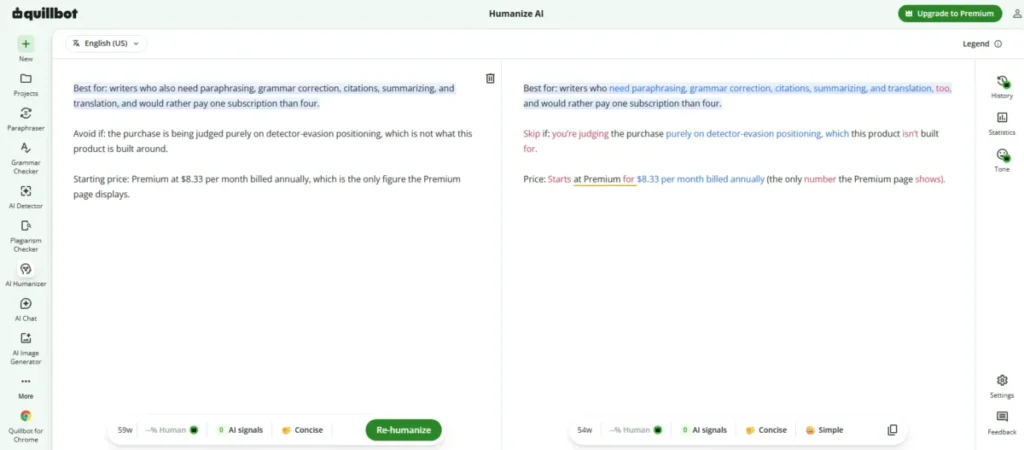
Why it ranked fourth. Its humanizer is a module inside a working writing suite rather than the whole product, and it offers the largest recurring free allowance in this comparison. What it does not publish is a paid batch ceiling.
Pricing and limits. Premium is $8.33 per month billed annually. The free humanizer runs to 125 words per use, six uses a day. Premium adds full humanizer access with insights and history, paraphrasing in 23 languages, translation into more than 40, grammar correction, citations and plagiarism prevention. Image generation is metered at 300 images a month and document storage at 100 MB.
The Premium page displays only the annual figure. A monthly rate exists, but it is not stated on the pricing page, so it is not quoted here.
Six uses of 125 words is 750 words a day at no cost, and it renews daily rather than monthly. Over a month that is the largest free allowance in this comparison by a wide margin. It is also the most fragmenting at 125 words per use, though BypassGPT’s free tier is smaller still at 80 words per input.
No per-process ceiling is published for the paid plan. Along with Undetectable AI and GPTinf, that makes QuillBot one of three products here whose paid batch behavior cannot be established from the pricing page.
Evidence note. Pricing and free-tier limits were verified from the Premium page. Premium includes full access to QuillBot’s AI Detector, which is a feature listing rather than a performance result. Output quality was not benchmarked.
Compared with Phrasly.AI. One subscription replaces three or four separate tools, and the free tier lets you evaluate across several sessions rather than one sitting. Against that, no published batch ceiling means long-form work cannot be planned from the pricing page.
- Best for.
- Writers whose drafts need editing rather than disguising, and anyone already paying separately for a paraphraser and a grammar checker.
- Avoid if.
- You are buying purely on detector-evasion positioning. That is not what this product is built around, and ranking it on that basis misreads it.
| Pros | Cons |
|---|---|
| 750 words a day free, renewing daily | Free tier processes only 125 words per use |
| One subscription covers a full editing toolkit | Paid per-process ceiling not published |
| $8.33 per month on annual billing | Monthly rate not stated on the pricing page |
| Full AI Detector access on Premium | Not positioned as a bypass-first tool |
| Humanizer insights and history included | Image generation capped at 300 a month |
- Bottom line.
- The best documented fit here for writers who want an all-in-one editing suite. Use the free tier for a week before deciding, because it costs nothing and gives you plenty to judge.
5. Undetectable AI: Best for Predictable Bundles
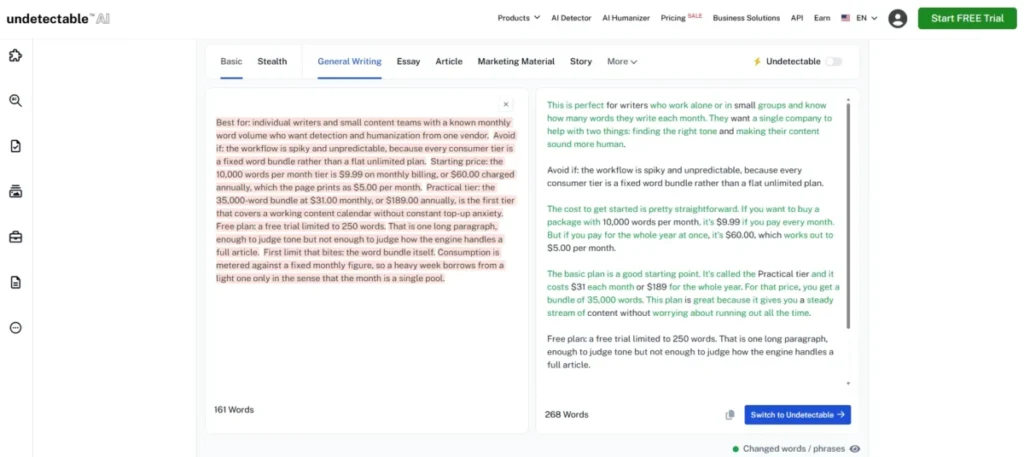
Why it ranked fifth. Its plan page is the most completely specified in this comparison on price and cadence, and it omits the one number that decides long-form suitability.
Pricing and limits. The 10,000 words per month tier is $9.99 monthly, or $60.00 charged annually, which the page prints as $5.00 per month. Larger bundles run to 20,000 words at $19.00 monthly, 35,000 at $31.00 and 50,000 at $42.50. The free trial is limited to 250 words. Business plans add non-expiring credits, white labeling and custom pricing.
The entry bundle works out at $0.50 per 1,000 words on annual billing and $1.00 monthly. That is mid-table, and it is unambiguous: you know the number before you pay.
What you do not know is the per-request ceiling, because the plan page does not publish one. For a buyer whose main question is whether a 3,000-word draft goes through in one pass, that omission is the whole decision.
Evidence note. Prices, cadences, bundle sizes and the trial limit were verified from the plan page. Unlimited AI detecting is included on paid plans, and the page carries the vendor claim “Passes AI detectors,” which was not independently checked. Writing-level matching is listed as a feature, which indicates that tone control exists without establishing how it behaves.
Compared with Phrasly.AI. Both billing cadences are printed for every bundle, so no cadence guessing is required, and a 250-word trial exists. Against that, there is no flat plan, so cost climbs with output, and no published ceiling, so long-form behavior is unknown before purchase.
- Best for.
- Individual writers with predictable monthly volume who want detection and humanization from one vendor and one invoice.
- Avoid if.
- Your volume is spiky, or your documents are long enough that an unpublished batch ceiling is a real risk.
| Pros | Cons |
|---|---|
| Both cadences printed for every bundle | No per-request ceiling published |
| Four bundle sizes from 10,000 to 50,000 words | No flat unlimited consumer plan |
| Unlimited AI detecting on paid plans | Free trial caps at 250 words |
| API compatibility stated on the plan table | API terms not priced on the page |
| Business tier offers non-expiring credits | Bundle metering penalizes irregular volume |
- Bottom line.
- A safe pick if you know your monthly volume and your documents are short. Confirm the input ceiling before committing to long-form work.
6. HIX Bypass: Rewrite Modes and the Widest Cadence Gap
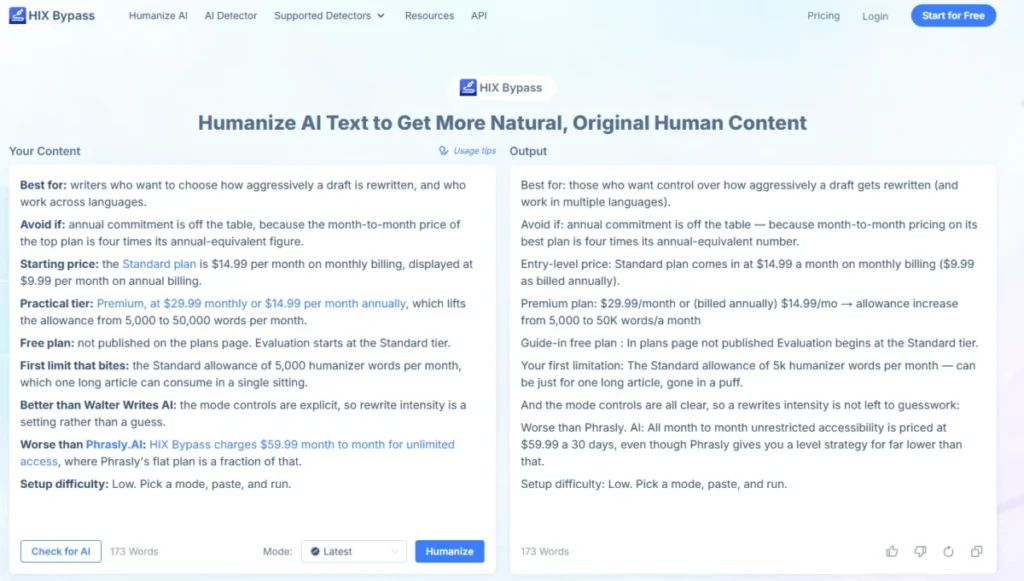
Why it ranked sixth. Its top tier removes both the monthly allowance and the input ceiling, which is the largest capacity claim in this comparison that carries a published price. Its entry tier produces the highest rate per 1,000 words calculated in this article, and the gap between its monthly and annual prices is the widest of any vendor here.
Pricing and limits. Standard is $14.99 per month, displayed at $9.99 per month on annual billing, for 5,000 humanizer words a month with a 3,000-word input limit. Premium is $29.99 monthly or $14.99 annually for 50,000 words. Unlimited is $59.99 monthly or $15.00 per month on the annual display. Fast, Aggressive and Latest modes are listed, along with support for 50 or more languages.
The cadence gap on Unlimited is the largest in this comparison. Month to month it is $59.99, the highest month-to-month individual consumer price in this comparison. Only Walter Writes Teams costs more per month at $99, and that is a ten-seat team plan sold on annual billing rather than an individual month-to-month subscription. On the annual display HIX Unlimited is $15.00. Any article comparing HIX against a rival’s monthly price without stating which cadence it used risks producing a misleading price comparison.
Standard at $9.99 annually across 5,000 words is just under $2.00 per 1,000 words, the highest rate calculated anywhere in this article. Premium at $14.99 annually across 50,000 words drops that to about $0.30, which is competitive with the middle of the field. Unlimited at $15.00 annually reaches about $0.15 per 1,000 words at 100,000 words of use. The entry tier reads less like a working plan and more like a step onto the ladder.
Those three rates come from different bases and should not be stacked against another vendor’s rate without checking the base. Standard and Premium are included allowances. Unlimited is a usage scenario on a flat plan, the same basis as the Phrasly figure.
Evidence note. Prices, cadences, allowances and input limits were verified from the plan page. Output quality and meaning preservation were not benchmarked. Aggressive mode makes meaning preservation an especially important thing to check yourself, because the mode is described as producing larger rewrites.
Compared with Phrasly.AI. Explicit rewrite-intensity modes, stated support for 50 or more languages, and a top tier with no input ceiling at all. Against that, Standard costs just under $2.00 per 1,000 words while Phrasly’s flat plan falls under $0.25 per 1,000 words at 50,000 words of monthly use, and HIX’s better rates depend entirely on committing to a year.
- Best for.
- Multilingual writers who want to dial rewriting up on marketing copy and down on technical documentation, and high-volume buyers who need both monthly usage and input uncapped and will commit annually.
- Avoid if.
- Annual commitment is off the table, or you would land on Standard and stay there.
| Pros | Cons |
|---|---|
| Three named rewrite-intensity modes | Standard allowance is only 5,000 words a month |
| 3,000-word input ceiling handles most articles | Entry rate just under $2.00 per 1,000 words |
| Unlimited tier removes allowance and input ceiling | Monthly Unlimited pricing is $59.99 |
| 50 or more languages supported | Best value requires annual billing |
| Both cadences shown for every plan | No free tier |
- Bottom line.
- Buy Premium or Unlimited annually, or do not buy at all. Standard is priced like a trial and metered like one.
7. GPTinf: Lowest Labeled Monthly Entry and Term Protection
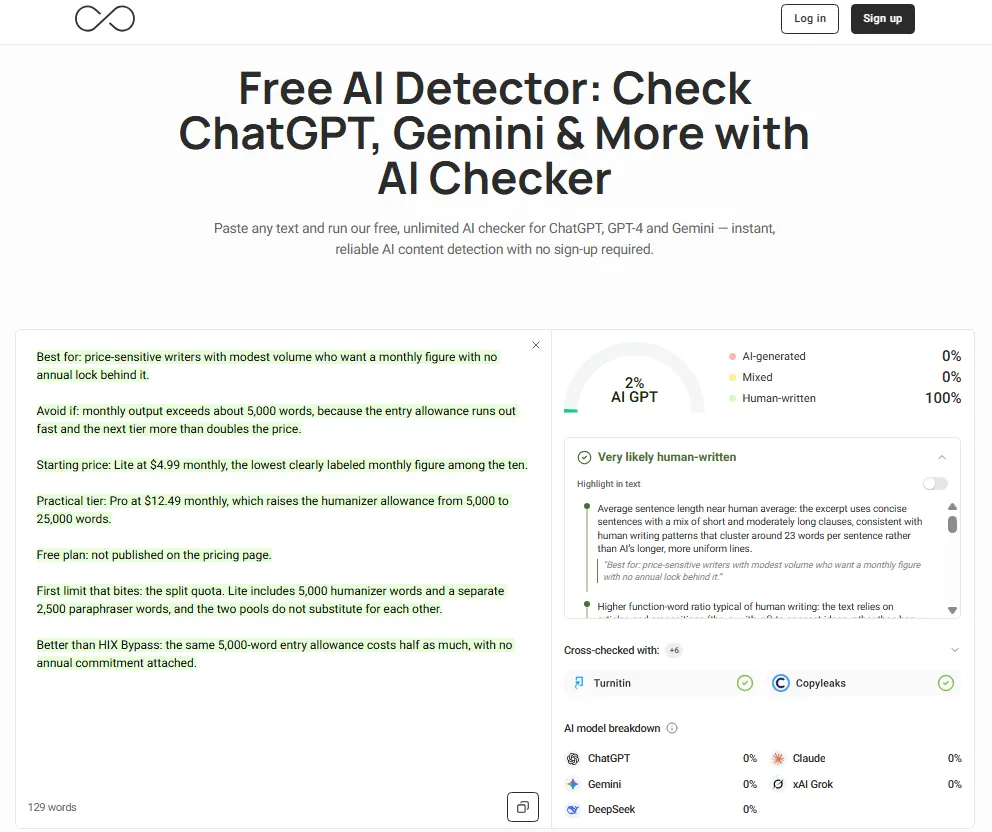
Why it ranked seventh. It has the lowest clearly labeled monthly price in this comparison and the only documented controls for protecting specific words from being rewritten, offset by the smallest entry quota and an unpublished batch ceiling.
Pricing and limits. Lite is $4.99 monthly for 5,000 humanizer words and 2,500 paraphraser words. Pro is $12.49 monthly for 25,000 and 12,500. Unlimited is $29.99 monthly. Unlimited plagiarism checks, grammar checks, detector checks, re-humanizing, frozen keywords and selective rephrase are listed even on Lite.
Two pools, not one. The humanizer and paraphraser quotas do not substitute for each other, so a Lite subscriber who paraphrases heavily still cannot humanize past 5,000 words.
Unlimited re-humanizing matters more than it sounds. You can run the same passage repeatedly until it reads correctly without burning additional quota, which turns a small allowance into a usable one for short work.
Lite is $0.998 per 1,000 humanizer words, roughly a dollar. Pro at $12.49 for 25,000 words drops that to about $0.50, level with the annual entry rate calculated for Undetectable AI. Unlimited at $29.99 reaches about $0.30 per 1,000 words at 100,000 words of monthly use.
No per-request ceiling is published, which puts GPTinf alongside QuillBot and Undetectable AI in the group whose batch behavior cannot be established before purchase.
Evidence note. Prices, quotas and feature listings were verified from the plan page. A built-in AI detector is listed on every tier, and the page carries the vendor claim “Passes AI detection tools,” which was not independently checked. GPTinf provides frozen-keyword and selective-rephrase controls intended to reduce unwanted changes to protected terms. Whether they hold in practice is an output question this edition did not test.
Compared with Phrasly.AI. Costs a fifth as much to start, requires no annual commitment, and documents explicit controls over what the engine may not touch. Against that, Lite’s 5,000-word allowance can be exhausted by two 2,500-word articles, and no batch ceiling is published.
- Best for.
- Price-sensitive writers doing short-form work, and anyone whose copy is dense with product names and figures they want to shield from rewriting.
- Avoid if.
- You write more than about 5,000 words a month and do not want to move to Pro immediately.
| Pros | Cons |
|---|---|
| Lowest labeled monthly entry at $4.99 | Lite allowance is only 5,000 humanizer words |
| Frozen keywords documented on every tier | Humanizer and paraphraser quotas are separate |
| Unlimited re-humanizing on paid plans | Per-request ceiling not published |
| Selective rephrase targets specific passages | No free tier |
| No annual commitment required | Entry rate close to $1.00 per 1,000 words |
- Bottom line.
- Move to Pro before your volume grows, not after. Lite is a test drive priced like a plan.
8. StealthGPT: Clearest Published API Rate in This Comparison
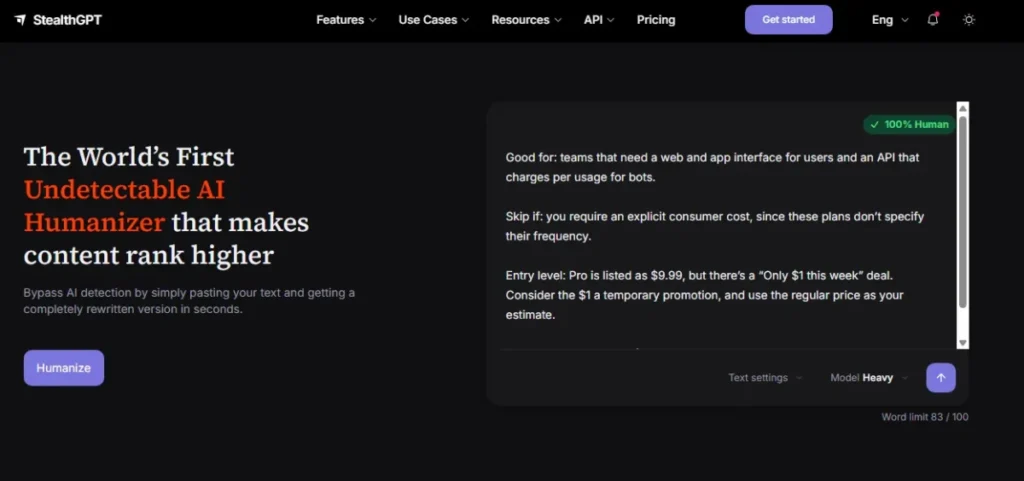
Why it ranked eighth. Its developer product carries the clearest published rate of the ten compared here, and its consumer plan is the only one here that shows a price without labeling the billing cadence.
Pricing and limits. Pro is displayed at $9.99 with a separate promotional line reading “Only $1 this week.” Pro allows 50 requests a month at 1,000 words each. Max is $19.99 for 100 requests at 2,000 words. Enterprise is quoted, at 1,000 requests and 20,000 words per request. The plan page notes savings of up to 42.5 percent with yearly billing.
The retrieved page does not attach a billing cadence to the $9.99 figure. Treat the $1 offer as promotional and the standard price as the number to budget against, but confirm the cadence at checkout before comparing it with anything else here. Humbot and BypassGPT provide even less usable consumer pricing information, because neither renders a consumer figure at all.
The API is priced at $0.20 per 1,000 words on pay-as-you-go terms with no subscription, and purchased words do not expire. For a content pipeline that is a cleaner commercial model than buying seats, and it is the most specific number this vendor publishes.
Pro’s 50 requests at 1,000 words is 50,000 words a month if every request is filled. A 5,000-word article consumes five of those requests in one sitting.
Evidence note. Plan quotas, the API rate and the promotional line were verified from the pricing and API pages. Output quality was not benchmarked, and the consumer billing cadence could not be established from the retrieved page.
Compared with Phrasly.AI. A published metered API rate, an iOS app and a Chrome extension. Against that, you cannot establish what the consumer plan costs per month without going to checkout.
- Best for.
- Teams automating humanization inside a publishing workflow, where the API is the real product.
- Avoid if.
- An unambiguous consumer price is a precondition for purchase.
| Pros | Cons |
|---|---|
| API published at $0.20 per 1,000 words | Consumer price carries no cadence label |
| Purchased API words do not expire | Pro allows only 50 requests a month |
| iOS app and Chrome extension included | Enterprise ceiling requires a sales quote |
| Enterprise reaches 20,000 words per request | Promotional pricing sits beside the list figure |
| Seats and priority support on the plan table | No free tier |
- Bottom line.
- Take the API pricing at face value and treat the consumer plan as unpriced until you have seen checkout.
9. Humbot: Broad Toolkit, No Rendered Consumer Price
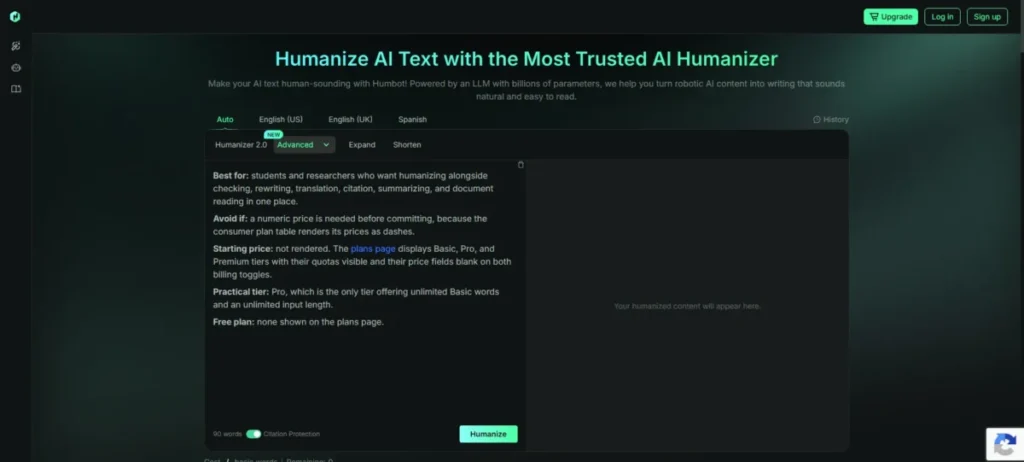
Why it ranked ninth. The feature surface is wide and the quota ladder is published, but the plans page does not render a consumer price, so the tool cannot be placed on a cost comparison at all.
Pricing and limits. The plans page shows Basic, Pro and Premium with quotas visible and price fields rendering as dashes on both billing toggles.
Basic allows 3,000 Basic words and 1,000 Advanced words a month with a 500-word input limit. Pro allows unlimited Basic words, 10,000 Advanced words and unlimited input. Premium allows 30,000 Basic words, 5,000 Advanced words and a 1,200-word input limit.
Read that ladder twice. Pro offers unlimited input and unlimited Basic words while Premium above it caps input at 1,200 words. Without prices on the page there is no way to tell which represents better value, and that is the problem in one sentence.
The two word pools are not interchangeable. A Basic subscriber has 3,000 words of one kind and 1,000 of another, not 4,000 words.
The API is documented separately and begins at $30 a month for 50,000 words, running to $1,999 a month for 10,000,000 words. That is the only Humbot figure that can be budgeted against.
Evidence note. Quotas, input limits and API pricing were verified from the plans and API pages. Consumer prices could not be verified from the retrieved page. An all-in-one AI Checker is listed as a feature. Output quality was not benchmarked.
Compared with BypassGPT. The API is priced publicly, so at least one route to this engine has a number attached, and Pro’s uncapped input is the second such tier in this comparison, though its Advanced word pool stays capped at 10,000 a month. Against that, neither product renders a consumer price, and Humbot has no free tier to fall back on.
- Best for.
- Students and researchers who want humanizing beside checking, rewriting, translation, citation and document reading, and who are willing to discover the price at checkout.
- Avoid if.
- You need a numeric price before shortlisting.
| Pros | Cons |
|---|---|
| Wide tool suite spanning checking and translation | Consumer prices render as dashes |
| Pro offers unlimited Basic words and unlimited input | Basic input limit is only 500 words |
| API published from $30 a month | Basic and Advanced pools do not substitute |
| Three humanization modes | Premium quotas look weaker than Pro on input |
| Translation, citations and ChatPDF included | No free tier |
- Bottom line.
- Shortlist it for breadth, not for value, and get the consumer figure in writing before it goes on a comparison sheet.
10. BypassGPT: Interface Preview Only
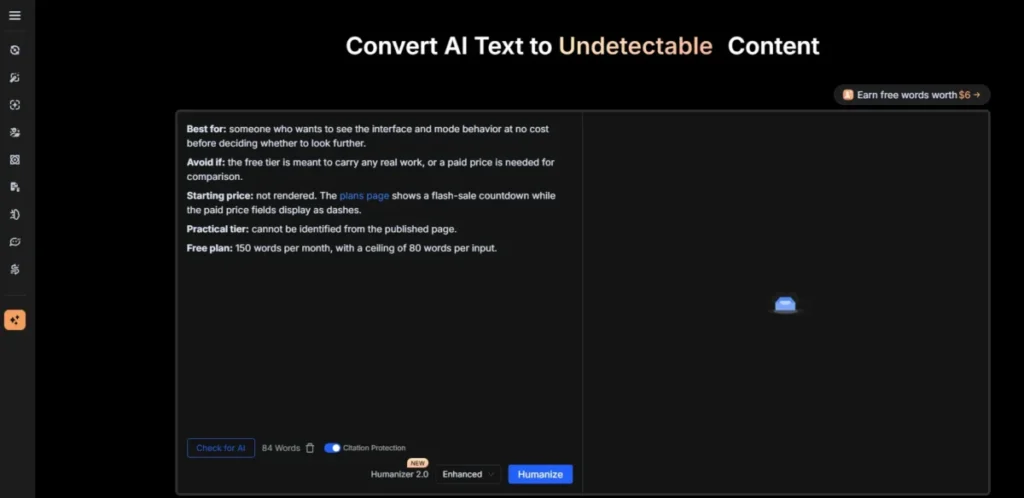
Why it ranked tenth. A free tier exists, which five tools here do not offer, and it is too small to evaluate anything. No paid price renders on the page.
Pricing and limits. The free plan provides 150 words a month with a ceiling of 80 words per input. Fast, Creative and Enhanced modes are listed along with a built-in AI checker and a 3-day money-back guarantee. Paid price fields render as dashes beside a flash-sale countdown.
Eighty words is a short paragraph. A 450-word test passage needs six submissions and would consume three times the entire monthly free allowance, so it cannot be run at all. The free tier shows you the interface and little else.
Evidence note. The free allowance, input ceiling, mode names and guarantee were verified from the pricing page. Paid prices could not be verified from the retrieved page. The page carries the vendor claim “Bypass all basic AI detectors,” which was not independently checked.
Compared with WriteHuman. WriteHuman’s free plan provides five times the monthly free words at three times the input ceiling, and returns output variations. BypassGPT’s advantage over Humbot is narrower: a free tier exists at all, so the interface can be seen without payment.
- Best for.
- Looking at the interface before deciding whether to look further.
- Avoid if.
- The free tier needs to carry any real work, or you need a paid price to compare.
| Pros | Cons |
|---|---|
| Free tier requires no payment | Free allocation is only 150 words a month |
| Three named humanization modes | Input ceiling of 80 words blocks real evaluation |
| Built-in AI checker included | Paid prices do not render on the plans page |
| 3-day money-back guarantee stated | No paid tier can be identified from the page |
- Bottom line.
- Treat the free tier as a preview rather than an evaluation, and get a paid figure before it enters a shortlist.
Pricing and Usage Limits Compared
Every figure below was read from the vendor’s own plan page on August 21, 2026. Where a calculation is derived rather than published, the basis is stated in the table.
Lowest-cost access against the tier you will actually use
The left column mixes free tiers, paid trials and subscriptions, because that is what these vendors actually offer as a first step. It is labeled accordingly and should not be read as a like-for-like subscription comparison. A $2.00 three-day trial and an $8 monthly subscription are different products.
How the practical tier was selected. The practical tier is the lowest published paid tier that provides at least 25,000 words of monthly humanizing capacity and accepts at least 1,000 words per request. Where a vendor does not publish one of those two figures, the rule is applied to the figure that is published. Where a vendor publishes neither, the table shows the lowest paid tier available and states that the threshold cannot be confirmed. QuillBot, Undetectable AI and GPTinf require modified application of this rule because one or both threshold metrics are unpublished.
| Tool | Lowest-cost access shown by vendor | Practical tier | Capacity at that tier |
|---|---|---|---|
| Phrasly.AI | $2.00 for three-day access (trial) | Unlimited at $10.99/mo annually | Unlimited humanizations, 5,000 per process |
| Walter Writes AI | $8/mo billed $96 annually (subscription) | Pro at $13/mo annually | 70,000 words, 1,500 per request |
| WriteHuman | Free, 3 requests of 250 words per month | Pro at $18/mo annually | 200 requests of 1,200 words |
| QuillBot | Free, 125 words per use, 6 per day | Premium at $8.33/mo annually (lowest paid tier, threshold cannot be confirmed) | Neither monthly capacity nor input ceiling published |
| Undetectable AI | 250-word free trial | 35,000-word bundle at $31.00 monthly (capacity criterion only) | 35,000 words, input ceiling not published |
| HIX Bypass | $14.99 monthly or $9.99/mo annually (subscription) | Premium at $29.99 monthly or $14.99 annually | 50,000 words, 3,000 per input |
| GPTinf | $4.99 monthly (subscription) | Pro at $12.49 monthly (capacity criterion only) | 25,000 humanizer words, input ceiling not published |
| StealthGPT | $9.99, cadence not labeled (subscription) | Pro at $9.99 | 50 requests of 1,000 words |
| Humbot | Not rendered on the plans page | Pro, price not rendered (lowest tier meeting both criteria on capacity) | Unlimited Basic words, unlimited input |
| BypassGPT | Free, 150 words per month | Not identifiable from the page | Not published |
Source: official vendor pricing pages, checked 2026-08-21. Promotional prices re-verified on the publish date: 2026-08-21.
Three patterns fall out.
Annual-equivalent pricing is the headline number on four of these ten pages, and two more display both cadences. Annual-equivalent prices can materially understate the cost faced by a buyer who needs month-to-month billing, and the size of that gap varies by vendor rather than following a single rule.
The practical tier is rarely the entry tier, and the multiple varies widely. Where both figures are published, it ranges from the same price as the entry tier at StealthGPT to roughly three times it at Undetectable AI, which moves from $9.99 to $31.00 monthly. Walter Writes and WriteHuman sit closer to 1.5 times, at $8 to $13 and $12 to $18 respectively. GPTinf is about 2.5 times, at $4.99 to $12.49.
Two products are not expensive or cheap, they are simply not comparable. Humbot and BypassGPT do not render a consumer price.
Allowance is not batch size
A monthly allowance says how much text a plan processes in a month. A per-request ceiling says how much it accepts in one submission. Confusing the two is the most common buying error in this category.
The table below adds a column most comparisons omit. A theoretical pass count divides 5,000 by the published input ceiling and rounds up, but it says nothing about whether the plan has enough monthly allowance to actually complete the document.
| Tool and selected plan | Allowance | Words per request | Theoretical passes | Can process 5,000 words within allowance? | Notes |
|---|---|---|---|---|---|
| HIX Bypass Unlimited | Unlimited words per month | Unlimited input | 1 | Yes | Both monthly usage and input uncapped, $15.00/mo annually |
| Humbot Pro | Unlimited Basic words | Unlimited input | 1 | Yes on the Basic pool | Consumer price not rendered on the plans page |
| Phrasly Unlimited | Unlimited humanizations | 5,000 | 1 | Yes | Only selected plan in this table with a fixed numeric ceiling that accepts 5,000 words in one submission |
| HIX Bypass Standard | 5,000 words per month | 3,000 | 2 | Yes, and it consumes the entire monthly allowance | One document per month at this tier |
| WriteHuman Ultra | Unlimited requests | 3,000 | 2 | Yes | Request count uncapped, input capped at 3,000 |
| StealthGPT Pro | 50 requests per month | 1,000 | 5 | Yes | Uses 5 of 50 monthly requests |
| Walter Writes Starter | 30,000 words per month | 750 | 7 | Yes | Seven pastes and six reassembly points |
| WriteHuman Basic | 80 requests per month | 600 | 9 | Yes | Uses 9 of 80 monthly requests |
| Humbot Basic | 3,000 Basic words per month | 500 | 10 | No, 5,000 words exceeds the monthly Basic allowance | Advanced pool does not substitute |
| QuillBot free humanizer | 6 uses per day | 125 | 40 | Only across multiple days, at least 7 | Daily renewal, not a monthly pool |
| BypassGPT free plan | 150 words per month | 80 | 63 | No, the allowance covers 150 words | Free tier cannot process the document |
| Undetectable AI 10K bundle | 10,000 words per month | Not published | Cannot be determined | Unknown | Ceiling not published on the plan page |
A theoretical pass count does not mean the plan can process the document. Three cases in the table illustrate the problem. Humbot Basic and the BypassGPT free plan run out of allowance long before they run out of passes, and Undetectable AI cannot be assessed at all.
The theoretical pass count ranges from one to 63, but allowance limits make several of those scenarios impractical or impossible within a single billing period. Among paid consumer plans shown here with a published price and enough capacity, the range is one to nine passes. Including QuillBot’s free daily tier, which can complete the document across at least seven days, it extends to 40. If you write long-form, treat that column as the primary filter and price as the tiebreaker, because a plan that costs less per word and triples your handling time is not cheaper.
What 1,000 words actually costs, by usage level
Rates in this category are quoted on incompatible bases, so a single league table would mislead. The table below fixes three usage levels and shows what each vendor’s cheapest qualifying plan works out to, with the basis labeled on every row. Every figure in the three right-hand columns is an effective cost per 1,000 words, not a total monthly bill.
| Vendor and plans used | Cadence | Basis | Effective $/1,000 words at 10K words/mo | Effective $/1,000 words at 50K words/mo | Effective $/1,000 words at 100K words/mo |
|---|---|---|---|---|---|
| StealthGPT API | Pay as you go | Metered rate | $0.20 | $0.20 | $0.20 |
| Phrasly Unlimited | Annual | Flat plan, usage scenario | $1.10 | $0.22 | $0.11 |
| HIX Bypass Premium then Unlimited | Annual | Included allowance, then flat plan | $1.50 | $0.30 | $0.15 |
| WriteHuman Basic then Pro | Annual | Requests times ceiling, maximum utilization | $1.20 | $0.36 | $0.18 |
| Walter Writes Starter, Pro, Elite | Annual | Included allowance | $0.80 | $0.26 | $0.26 |
| StealthGPT Pro then Max | Cadence not labeled | Requests times ceiling, maximum utilization | $1.00 | $0.20 | $0.20 |
| GPTinf Pro then Unlimited | Monthly | Included allowance | $1.25 | $0.60 | $0.30 |
| Undetectable AI bundles | Monthly | Included allowance | $1.00 | $0.85 | Not published as one plan |
| QuillBot Premium | Annual | Paid capacity not published | Cannot be verified | Cannot be verified | Cannot be verified |
| Humbot and BypassGPT | Not rendered | Consumer price not published | Cannot be verified | Cannot be verified | Cannot be verified |
Four labels are kept separate throughout. A metered rate is a published per-word price. An included allowance is capacity the vendor commits to. Maximum utilization assumes every request is filled to its ceiling, which is a mathematical ceiling rather than a typical month. A usage scenario divides a flat price by an assumed volume.
Across the usage assumptions shown here, the calculated effective rates span roughly an order of magnitude, from about $0.11 to about $1.50 per 1,000 words, and HIX Standard sits further out at just under $2.00. The underlying pricing models are not identical, so that spread is an argument for doing your own arithmetic rather than a clean ranking.
Team pricing sits outside all of this. Walter Writes Teams is $99 per month billed $1,188 annually for 500,000 words with 10 seats, which is about $0.20 per 1,000 words. That figure is not comparable with a single-user plan, because part of the price buys seat access rather than capacity.
Rather than naming winners by volume band, the useful move is to match the pricing model to your own pattern.
If your volume is low and steady, below roughly 10,000 words a month, an included-allowance bundle or a free tier usually costs less than a flat plan, and Undetectable AI’s annual entry bundle and QuillBot’s daily free tier are the concrete options here.
If your volume is moderate, roughly 10,000 to 50,000 words, the field is genuinely close. Walter Writes and WriteHuman are efficient on included allowance if you can work in short passes, HIX Premium is level with them on rate, and Phrasly’s flat plan reaches a comparable figure at the top of that range while removing the pass-counting entirely.
If your volume is high, above roughly 50,000 words, a flat plan becomes the simplest structure for a buyer whose usage is consistently high, because the bill stops moving. A large fixed allowance such as Walter Elite gives similar predictability, so the real question is whether your months are consistent enough that a flat plan pays off.
If humanization runs inside a pipeline, the StealthGPT metered rate of $0.20 per 1,000 words is the lowest figure in the table at 10,000 words and is matched only by StealthGPT Pro at 50,000. At 100,000 words the Phrasly and HIX flat plans work out lower, at $0.11 and $0.15, though both of those figures rest on a usage assumption while the metered rate does not.
Free access, quantified
| Tool | Free or trial access | What that buys |
|---|---|---|
| QuillBot | 125 words per use, 6 uses per day | 750 words a day, renewing, the largest free volume here |
| WriteHuman | 3 requests per month at 250 words | Three real passages and their output variations |
| Undetectable AI | 250-word free trial | One paragraph, a tone check only |
| Phrasly.AI | $2.00 for three days, 800 words per process | The most thorough evaluation route, and it is paid |
| BypassGPT | 150 words per month, 80 per input | An interface preview |
Five of the ten publish no free or trial access at all: HIX Bypass, Walter Writes AI, GPTinf, StealthGPT and Humbot. Evaluation there happens after payment, which makes the refund window the thing to read before the feature list.
QuillBot and WriteHuman offer the two most useful free tiers, and they are useful in different ways. QuillBot gives the most free words over a month. WriteHuman gives the longest single passage and returns variations. If you want to hear the engine on a real paragraph, start with WriteHuman. If you want to work through a document over several days at no cost, start with QuillBot.
Consumer plans and API pricing are different products
Do not assume API usage is included in a consumer subscription. Verify API pricing and access separately for each vendor before budgeting.
Two vendors publish a rate. StealthGPT sells API words at $0.20 per 1,000 on pay-as-you-go terms with no subscription and no expiry, which suits bursty pipeline work. Humbot sells API capacity as a monthly commitment starting at $30 for 50,000 words. Those are opposite commercial models: one charges for consumption, the other for reserved capacity.
Two more publish an automation route without a rate. Undetectable AI states API compatibility on its plan table, and Walter Writes AI includes MCP server access from its entry tier. Neither page prices that access, so a developer is looking at a sales conversation before a cost model.
The remaining six publish no API rate on the pages retrieved for this comparison.
If humanization is going to run inside a publishing workflow rather than a browser tab, price the automation route first and treat the consumer plan as a separate line item for the people still working by hand.
Do AI Humanizers Actually Work?
Several vendors here make detection-related claims. Undetectable AI lists “Passes AI detectors” as a plan feature, BypassGPT lists “Bypass all basic AI detectors,” and GPTinf lists “Passes AI detection tools.” Those are vendor statements about their own products, not measured outcomes, and this edition did not test them.
Three reasons to keep them at arm’s length. Detector models change on their own schedule, so a result observed in one month describes that month. Different detectors disagree with each other on the same text. And the input matters, because a dense technical passage and a marketing paragraph do not behave alike under rewriting.
A low detector score is also not proof that a human wrote something, and it is not the same thing as good writing. Those are three separate properties and only one of them is what you are actually buying.
The more useful question is what the rewrite does to the document. Rewriting that lowers a score by flattening sentence structure, softening precise terms or swapping defined vocabulary has damaged the work even when the number improves.
That is why GPTinf’s frozen keywords and WriteHuman’s output variations are worth more attention than any percentage on a landing page. Both give writers more control over rewriting, either by constraining protected terms or by offering alternative outputs to compare, though neither mechanism was tested here.
A workable habit is to read the original and the rewrite side by side before accepting anything. Check that no factual claim changed, that names and figures survived, that references still point where they claimed to, and that the tone still sounds like the person whose name goes on it.
There is a policy dimension no pricing page addresses. Institutions, publishers and employers set their own rules about AI assistance and disclosure, and a rewriting tool does not change what those rules require. These products are useful for improving readability, removing repetitive machine phrasing, editing drafts and adapting tone. Using one does not make undisclosed work disclosed.
Which AI Humanizer Should You Choose?
Six steps, ordered to eliminate the most options soonest. Each narrows the field by one buyer cohort, one workflow constraint or one plan gate.
Measure a normal month. Count the words that would actually pass through the tool. Below 10,000 words, entry bundles may be sufficient, and only some free tiers cover meaningful ongoing volume: QuillBot’s 750 words a day is the only free allowance here that approaches it, while WriteHuman’s 750 words a month and BypassGPT’s 150 do not. Above 50,000 words, a flat plan or a large included allowance is the simpler structure.
Measure a normal document. Take the longest piece you produce in a typical week and divide it by each candidate’s per-request ceiling. That number is how many passes every future document needs. Then check that the monthly allowance can actually cover it.
Put every price on one cadence. All monthly or all annual, before comparing anything. Four of these ten pages headline an annual-equivalent figure and two more show both.
Decide whether automation is in scope. If humanization runs inside a pipeline, only StealthGPT and Humbot publish a rate to budget against, so an unpublished API rate is a disqualifier for that cohort.
Test what can be tested. QuillBot and WriteHuman allow a real evaluation at no cost, and Phrasly allows a more thorough one for $2.00. Use them on your own writing rather than a sample sentence, and check meaning preservation specifically.
Confirm the renewal terms. Ask what happens to unused words, whether the displayed price is the renewal price, and whether a trial converts automatically. Walter Writes publishes its no-rollover rule. Most vendors here do not address the question at all.
Common mistakes when buying an AI humanizer
Shopping on the entry price. The entry tier is often not the working tier. Where both are published here, the practical tier ranges from the same price to about three times the entry figure.
Reading a monthly allowance as a batch size. A plan can offer 30,000 words a month and still refuse a 1,000-word paste.
Reading a batch size as a monthly allowance. Humbot Basic accepts 500 words per input and allows 3,000 Basic words a month, so it cannot complete a 5,000-word document at all.
Comparing an annual figure against a monthly one. This alone moves HIX Bypass Unlimited from the highest month-to-month individual consumer price in this comparison at $59.99 to $15.00 per month on the annual display.
Treating unlimited as unconditional. “Unlimited” usually applies only to explicitly named dimensions, so check monthly usage and per-request input separately before assuming either is uncapped. Phrasly is uncapped on monthly usage only, GPTinf Unlimited is uncapped on monthly humanizer words with no published input ceiling, and HIX Unlimited is uncapped on both.
Assuming a subscription covers the API. Verify API access and pricing separately for each vendor. Two vendors here publish a rate, two mention a route without pricing it, and six publish nothing.
Buying on detector claims. They are vendor statements, they change over time, and they say nothing about whether your meaning survived.
Ignoring what happens to unused capacity. Where credits reset monthly without rolling over, the effective rate rises for anyone whose output is uneven.
What This Comparison Found
Six findings emerged from comparing 13 official pricing, documentation and help-center pages across 10 AI humanizer products. These patterns become visible only when the plan structures are set side by side.
The per-request ceiling is one of the main constraints on long-form work, and it is rarely published prominently. Three of the ten do not publish it at all: QuillBot for its paid plan, Undetectable AI, and GPTinf. Among those that publish a fixed number, the spread runs from 80 words to 5,000. Two tiers state unlimited input: HIX Bypass Unlimited and Humbot Pro.
Billing cadence can invert a ranking. HIX Bypass Unlimited is $59.99 month to month and $15.00 per month on the annual display. Any comparison mixing cadences produces a false order.
Request quotas hide their real capacity. WriteHuman Basic reads as 80 requests. Multiplied out it is up to 48,000 words a month, which reframes the plan entirely, provided every request is filled.
A theoretical pass count is not a capability. BypassGPT’s free plan divides out to 63 passes for a 5,000-word document, but its 150-word monthly allowance means the document cannot be processed at all. Humbot Basic fails the same test at 10 passes.
Rollover terms are mostly unpublished. Walter Writes explicitly states that unused credits reset monthly on annual plans. Most other vendors in this comparison do not clearly publish rollover terms, and silence is not evidence of either policy.
Pricing visibility is itself a product difference. Two vendors do not render a consumer price, and a third shows a figure without labeling the cadence. That is not a research inconvenience, it is a buying risk. That lack of pricing visibility is a major reason those products sit near the bottom of this operational ranking.
FAQ – Best AI Humanizer
What is the best AI humanizer in 2026?
That depends on what you are optimizing, and this edition can only answer the commercial half of the question. On capacity and cost, Phrasly.AI is the top operational pick, because its flat plan removes the monthly humanization count while accepting 5,000 words in a single submission at $10.99 per month on annual billing. Output quality, meaning preservation and detector behavior were not independently tested here, so nothing in this article establishes which tool writes best.
Do AI humanizers actually work?
AI humanizers are designed to rewrite AI-generated or machine-like text. Whether a given rewrite is good, and whether it preserves your meaning, varies by tool and by input, and this edition did not measure either. Several vendors state that their output passes detection, and those remain vendor claims.
Can AI humanizers bypass AI detectors?
Several vendors say so on their own pages. Detector models change, different detectors disagree on the same passage, and results vary with the input, so treat any percentage as a description of one test at one moment. A low score is also not proof that a human wrote the text.
Which AI humanizer is best for long articles?
On published input ceilings, Phrasly.AI accepts 5,000 words per process, which takes most articles in one pass. HIX Bypass Unlimited and Humbot Pro state unlimited input, though Humbot does not render a price. WriteHuman Ultra and HIX Bypass Standard and Premium accept 3,000 words, which is two passes on a 5,000-word draft. Walter Writes Elite and StealthGPT Max accept 2,000, which is three passes. Below that, Walter Pro at 1,500 needs four passes, and WriteHuman Pro and Humbot Premium at 1,200 need five. Check the monthly allowance as well, because a low ceiling paired with a small allowance can make the document impossible rather than merely slow.
Are free AI humanizers worth using?
Two are useful in different ways. QuillBot gives 125 words per use and six uses a day, renewing daily, which adds up to the largest free volume here and is enough to work through a document over several days. WriteHuman gives three requests of up to 250 words a month, which is better for judging a single real passage and returns output variations. BypassGPT’s 150 words a month at 80 words per input is an interface preview rather than an evaluation.
Can humanizers change the meaning of my text?
Yes, and that risk matters more than a detector score. Rewriting can soften precise terms, alter figures or drift from a defined claim. GPTinf documents frozen keywords and selective rephrase, controls intended to reduce unwanted changes to protected terms, though this edition did not test how well they hold. Reading the original and the rewrite side by side before publishing remains the reliable safeguard.
Does my subscription include API access?
Do not assume it does. Verify API pricing and access separately for each vendor. Among the pages retrieved for this comparison, StealthGPT sells metered API words at $0.20 per 1,000 with no subscription, Humbot sells monthly API capacity from $30, Undetectable AI and Walter Writes mention an automation route without publishing a rate, and the remaining six publish no API rate at all.
Final Verdict
Choose Phrasly.AI if you write long-form at volume and want cost to stop tracking output. Among plans that publish a fixed input ceiling, it takes the largest document in one submission, at the lowest price of any plan here with uncapped monthly usage. Note that its input ceiling is a hard 5,000 words.
Choose HIX Bypass Unlimited if you need both monthly usage and input uncapped and will commit annually at $15.00 per month. Month to month it is $59.99, the highest month-to-month individual consumer price in this comparison.
Choose Walter Writes AI if cost per included word is the binding constraint, or if you need ten seats with a published price. Buy Pro rather than Starter, because the batch ceiling is where the handling cost hides.
Choose WriteHuman if you want to hear the engine on your own paragraphs before paying. Its free tier and its output variations both support that.
Choose QuillBot if your drafts need improving rather than disguising. One subscription replaces a paraphraser, a grammar checker and a citation tool, and the daily free tier lets you establish that before paying.
Choose GPTinf if the budget is tight and your copy is dense with product names and figures you want to shield from rewriting.
Choose the StealthGPT API if humanization runs inside a pipeline rather than a browser tab. At $0.20 per 1,000 words, billed per word with no subscription, it is the only rate here that holds at any volume without a plan-fit calculation.
Avoid Humbot and BypassGPT on price until each renders a consumer figure you can compare. Both may be capable. Neither can be shortlisted on evidence that is not published.
Avoid any of them if what you actually need is an editor. These tools rewrite text. They do not check whether the rewrite is still true, and that remains your job.
This edition compares pricing, capacity, limits and workflow only. Output quality, meaning preservation and detector performance were not independently benchmarked. When hands-on testing is completed, the weighted framework described in the methodology section will be applied and the ranking will be updated to reflect it.