
Most Jasper reviews answer the wrong question. They ask whether Jasper writes good marketing copy, then quote a monthly price as if it scales with headcount the way ordinary SaaS does.
It does not. On the current public pricing page, the self-serve Pro plan includes exactly one seat, and the moment a second person needs access, the buying path changes from a checkout page to a sales conversation with no published price attached.
That single structural fact reshapes the entire evaluation.
It also sits alongside a second cost layer that almost no competing review explains: on Business plans, some of the most valuable features do not run on the subscription at all. They run on credits.
This review is built from Jasper’s current public pricing, help center, and developer documentation, all checked on August 12, 2026. It is a documentation-based review, and the methodology section defines that scope precisely.
In This Article (19 sections)
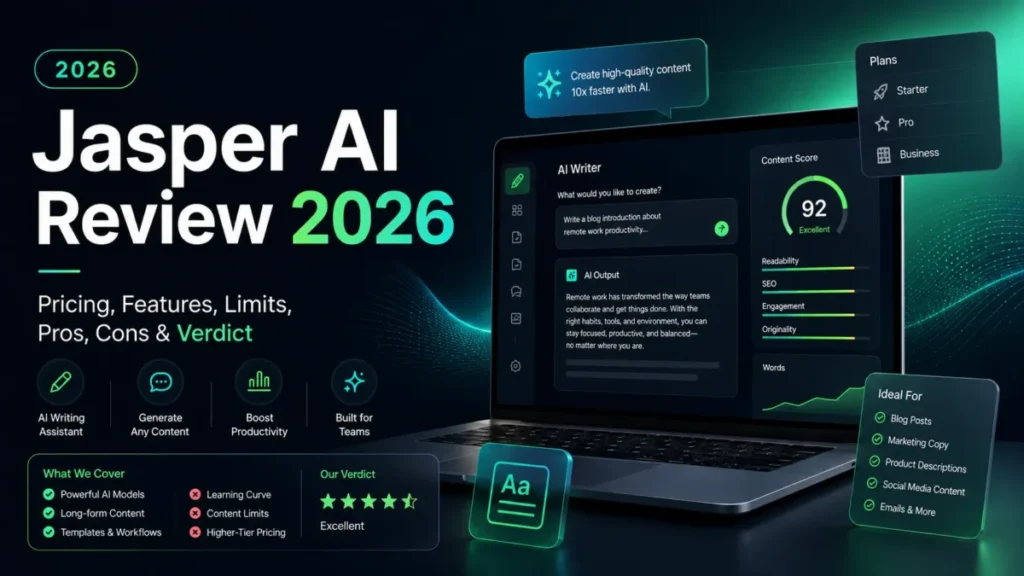
Jasper AI Review 2026: Quick Verdict
Jasper in 2026 is a marketing workflow platform with brand governance attached, not a cheaper or better general chatbot. Its main strength is structured marketing context that gets reapplied automatically, and its best fit is a team that reuses that context constantly.
Its defensible value is structured marketing context that gets reapplied automatically: brand voice, company knowledge, audience definitions, and style rules that reach into generation instead of sitting in a document nobody reads. The price is justified by repetition and control, not by raw prose quality, and nothing in the public documentation supports a claim that Jasper writes better sentences than a general assistant.
| Decision | Answer | The constraint that drives it |
|---|---|---|
| Solo marketer, one brand | Pro is viable | One seat, two brand voices, five knowledge assets |
| Two-person team | No public price exists | Pro is capped at one seat |
| Agency with three or more client brands | Business quote required | Two brand voices on Pro |
| Batch content operations | Business, with credit modelling | Grid costs 10 credits per generated row |
| Embedding generation in a CMS | Business, with throughput modelling | API is Business-only and rate limited per workspace |
| Buyer needing a published all-in team price | Poor fit | Business pricing is custom |
| Every row above resolves against the official Jasper plan comparison, checked August 12, 2026. |
Source: Jasper official pricing page, checked August 12, 2026 (view the plan comparison).
Pros and cons at a glance
| Pros | Cons |
|---|---|
| Brand voice, audiences, knowledge, and style rules apply automatically at generation time rather than as manual post-editing | Pro includes exactly one seat, so any second user moves the purchase to unpublished custom pricing |
| Published per-unit credit rates let a buyer size Grid and API workloads before requesting a quote | The dollar value of a credit, the included credit allowance, and the Business platform fee are all unpublished |
| Grid turns repeatable production into a spreadsheet workflow with ten free test rows before any spend | Premium features stop outright when credits run out, and per-user limits can pause an individual mid-month |
| Style rules extend into structured API responses, so governance survives the move from interface to integration | Pro caps Jasper IQ at two brand voices, five knowledge assets, and three audiences |
| Enterprise identity and compliance are specific and verifiable, including SOC 2 Type II, SAML 2.0 single sign-on, and SCIM provisioning | The browser extension supports Chrome and Edge only, with no Safari, Firefox, Opera, or Brave support |
| Documented rate limits and fallback ordering make API capacity planning possible before implementation | Priority support carries no publicly documented contractual response time |
What Jasper Is in 2026
Jasper describes itself as the AI built for marketing, and the current platform reflects that framing more literally than it did in earlier generations of the product. The workspace is organized around Canvas for drafting, Chat for conversational work, and Agents for repeatable tasks. Grid handles spreadsheet-style batch production and Studio builds custom agents without code. Jasper IQ is the governance layer holding brand voice, knowledge, audiences, style rules, and visual guidelines.
The practical consequence is that Jasper competes on the surrounding system rather than on the model. Jasper routes across multiple language models, which the pricing page presents as a reliability and quality decision rather than a single-vendor bet.
For a buyer already comfortable with a general assistant, the honest question is not whether Jasper’s sentences are better. It is whether a governed, reusable marketing context is worth a premium over a general tool, and how often that context gets used in practice.
If the concept layer is unfamiliar, the background pieces on generative AI fundamentals and prompt engineering cover the vocabulary this review assumes.
Jasper Pricing in 2026: The Public Numbers
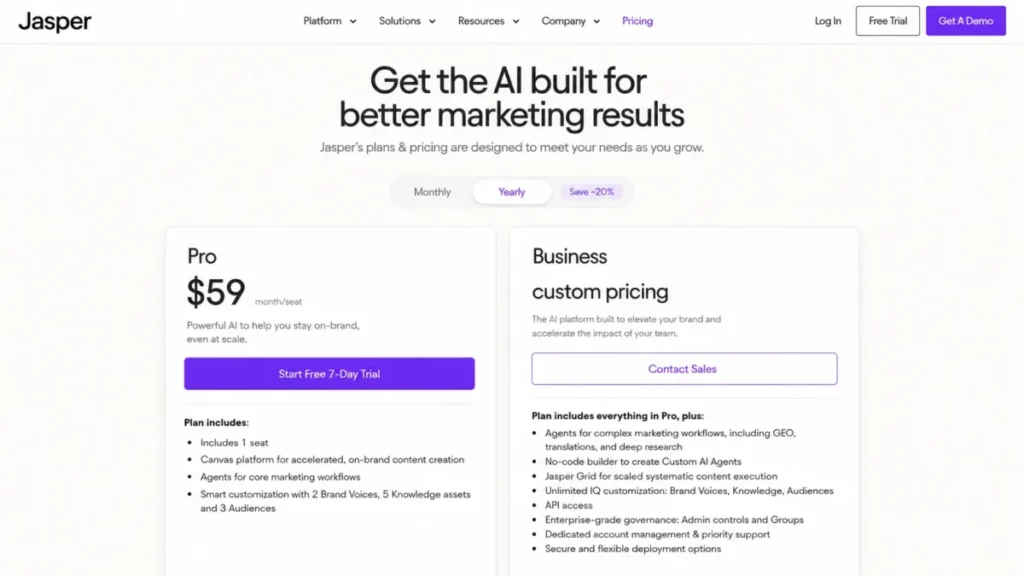
There are two publicly presented plans. Pro is self-serve, and Business is sales-led with no published figure.
| Plan | Monthly billing | Annual billing | Seats included | Purchase path |
|---|---|---|---|---|
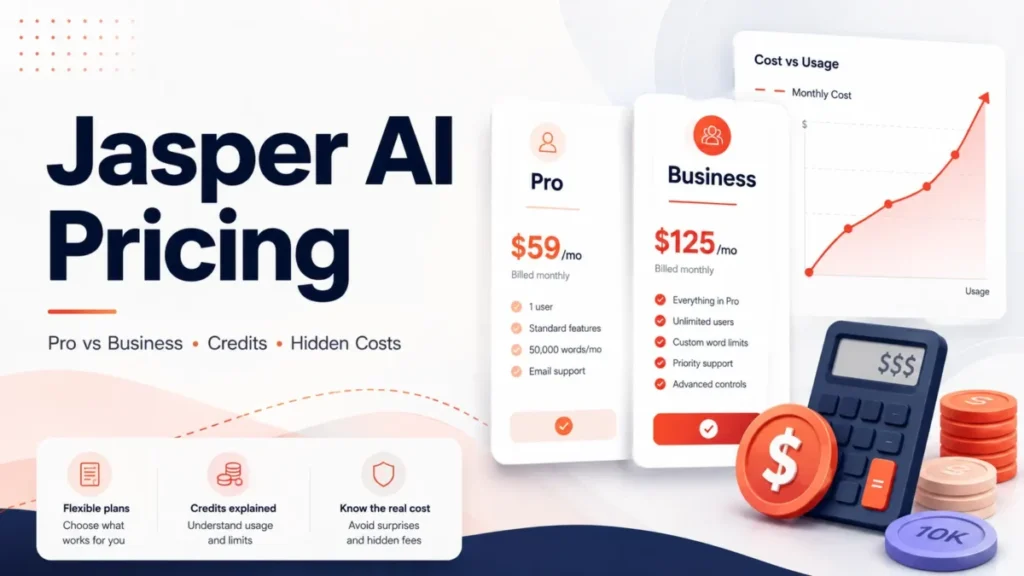
| Pro | 69 US dollars per month | 59 US dollars per month, billed yearly | 1 | Self-serve, 7-day free trial |
| Business | Not published | Not published, 12-month commitment | Purchased seats | Contact sales |
Twelve months of Pro on monthly billing totals 828 US dollars.
The annual option totals 708 US dollars at the published effective rate. The nominal difference is 120 US dollars per year.
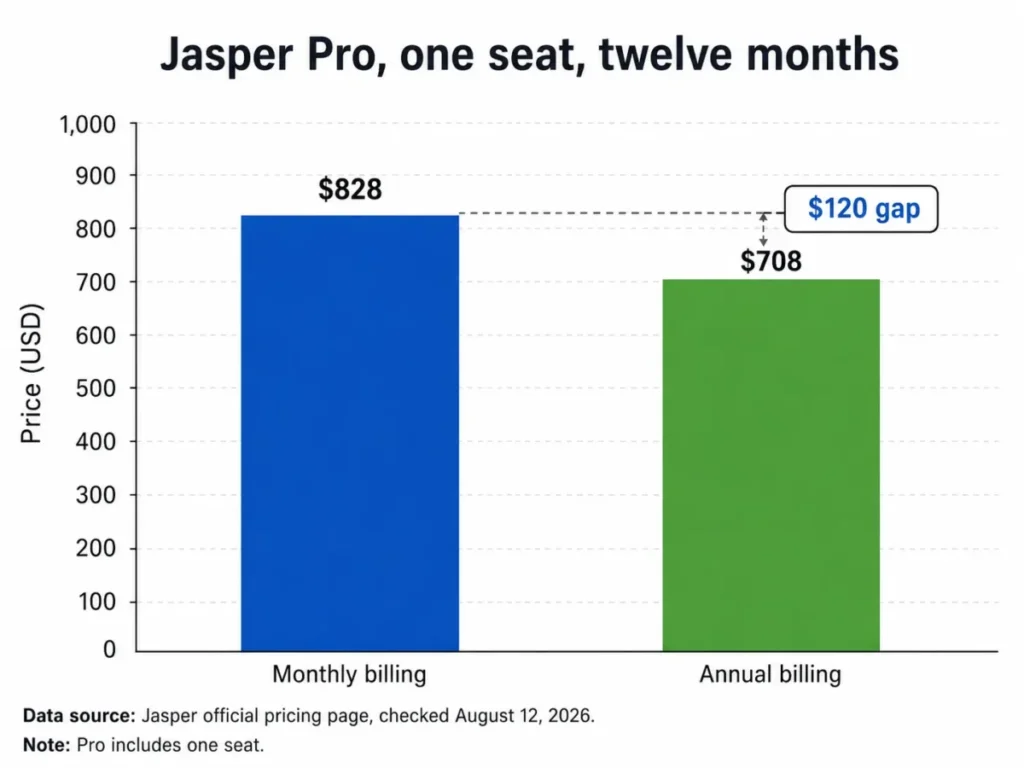
Accessible fallback for the chart above:
| Billing choice | Twelve-month total | Difference |
|---|---|---|
| Monthly, 69 US dollars per month | 828 US dollars | Baseline |
| Annual, 59 US dollars per month billed yearly | 708 US dollars | 120 US dollars lower |
Source: Jasper official pricing page, checked August 12, 2026 (view the current plans).
The discount math does not fully reconcile
Two official statements about the same annual plan do not line up, and buyers should notice before committing to a year.
The pricing page labels annual billing as a saving of roughly 20 percent. The arithmetic on the published figures gives 14.5 percent, because 708 divided by 828 leaves a 120 dollar reduction rather than a 165 dollar one.
Separately, the help center article on annual plans describes the offer as two free months in exchange for paying ten months upfront. Ten months at the monthly rate would be 690 US dollars, which is 18 dollars less than the 708 US dollars produced by the published annual rate.
Neither gap is large in absolute terms, and the help center page carries an older update stamp than the pricing page, which is the most likely explanation. The point for a buyer is narrower and more useful: the number to budget against is the one on the pricing page at the moment of purchase, not the marketing description of the discount.
Source: Jasper official annual plan documentation, checked August 12, 2026 (read the annual plan policy).
What the annual commitment locks
Annual billing is a one-year commitment.
Jasper documents a seven-day cancellation and refund period on annual plans, and states that after that window there are no refunds for unused time and the plan cannot be cancelled mid-year. Monthly billing carries no ongoing commitment and can be cancelled at any time, with access continuing to the end of the paid cycle.
That makes the 120 dollar saving a priced option on flexibility rather than a free win.
For a first Jasper year, especially for a solo buyer still deciding whether the governance layer earns its keep, monthly billing plus the documented ability to pause a monthly plan for 30 days is the lower-risk configuration. A deeper breakdown of tier-by-tier costs lives in the companion Jasper AI pricing guide.
Two smaller public facts are easy to miss and worth acting on. Jasper documents a 7-day free trial of Pro. It also publishes a 20 percent nonprofit discount, requested by email after starting a trial rather than applied at checkout.
The One-Seat Cliff That Decides Most Purchases
Jasper’s help center is unambiguous. The Pro plan is limited to one seat, and Business workspaces add users according to purchased seats, with additions prorated against the remaining billing period.
This is the single most consequential fact in the 2026 evaluation, and it is the one most frequently misstated across current search results.
Several pages that present themselves as 2026 reviews still describe multi-seat Pro allowances or older Creator-era plan structures. Building a budget on those figures produces a number that cannot be purchased.
The correct reading is that Jasper’s published price answers exactly one question: what one person pays. Every other configuration is a quote.
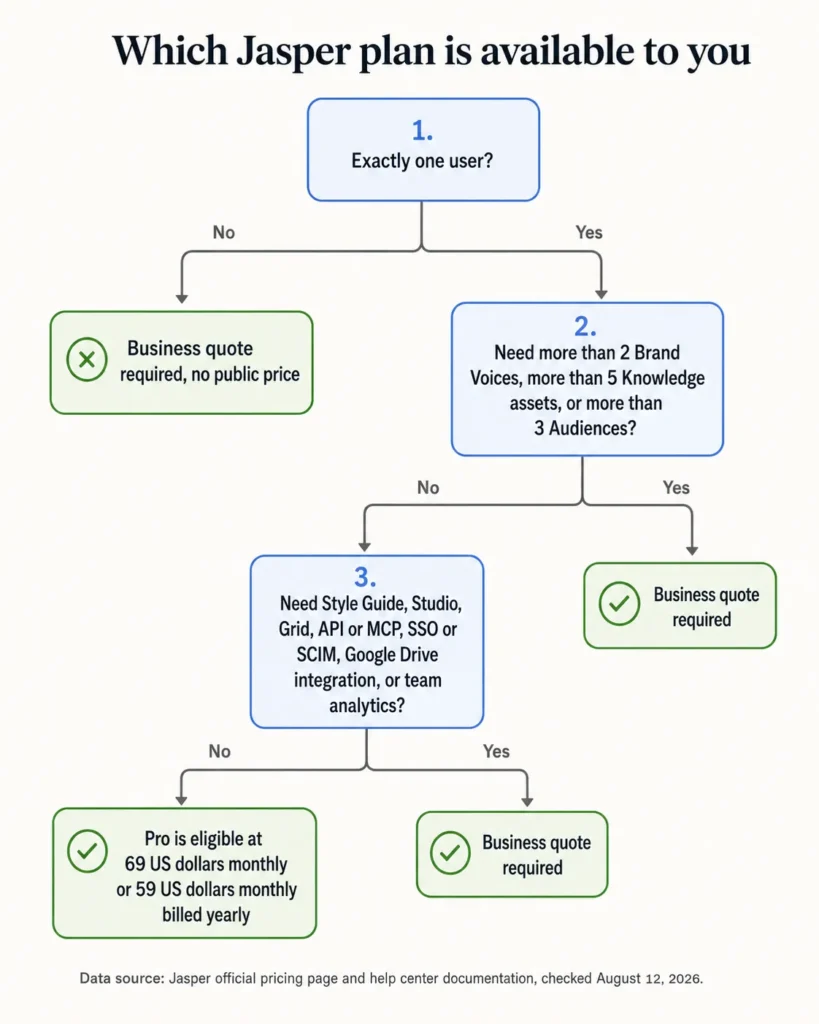
Source: Jasper official documentation on adding team members, checked August 12, 2026 (read the seat policy).
The Second Jasper Business Bill: Credits
Business pricing is not simply an unpublished subscription. Jasper documents it as a hybrid model that combines a platform fee with consumption-based billing through credits, and the distinction between the two matters more than the unpublished platform figure.
The reassuring half of that model is that core work is not metered.
Jasper states that Chat, standard Agents, Studio, and Jasper IQ remain unlimited and included, and the credit rate card lists ordinary prompt runs and non-advanced agent runs as unlimited. Everyday drafting does not tick a meter.
The half that changes procurement is what does consume credits.
| Metered action | Credit cost | Unit |
|---|---|---|
| Grid output row | 10 credits | 1 row |
| Research Agent | 40 credits | 1 run |
| Translation Agent | 40 credits | 1 run |
| Optimization Agent | 100 credits | 1 run |
| API or MCP content generation | 1 credit | 1 call |
| All rates above come from the official Jasper credit rate card, checked August 12, 2026. |
Two entries on the same card carry no fixed rate: the Image API and any custom solution or workflow are priced as custom credit pricing. Prompt runs and agent runs excluding advanced agents are listed as unlimited, with no credit charge attached.
The per-call API rate is the most useful published number for anyone planning an integration, and it is absent from every competing review checked for this article.
At one credit per generation call, a workflow issuing 10,000 API generations in a month consumes the same credits as 1,000 Grid rows. That single equivalence converts an abstract integration plan into a capacity conversation before a quote is requested.
One caution on completeness.
Jasper’s credits documentation lists GEO Hub and GEO Agent runs among the credit-consuming advanced tools, but the current rate card does not itemize a GEO Hub rate the way it prices Grid rows and the three named agents. Any GEO-heavy workload should therefore be priced from the quote rather than from a public figure.
Source: Jasper official credit rate card, checked August 12, 2026 (view the published rates).
Prepaid, pay-as-you-go, and expiry
Business workspaces receive a base number of credits with the platform fee, and Jasper does not publish that base quantity, because it is contract-specific. Additional credits come through the account team in two shapes.
Prepaid packs are usually discounted and expire at contract renewal or by a specified date. Pay-as-you-go charges monthly for overage above included credits and can carry a maximum monthly cap.
The expiry rule deserves emphasis.
Prepaid credits are not a permanent bank. A team that over-buys to secure a discount can lose the surplus at renewal, which makes the size of the first prepaid pack a real decision rather than a formality.
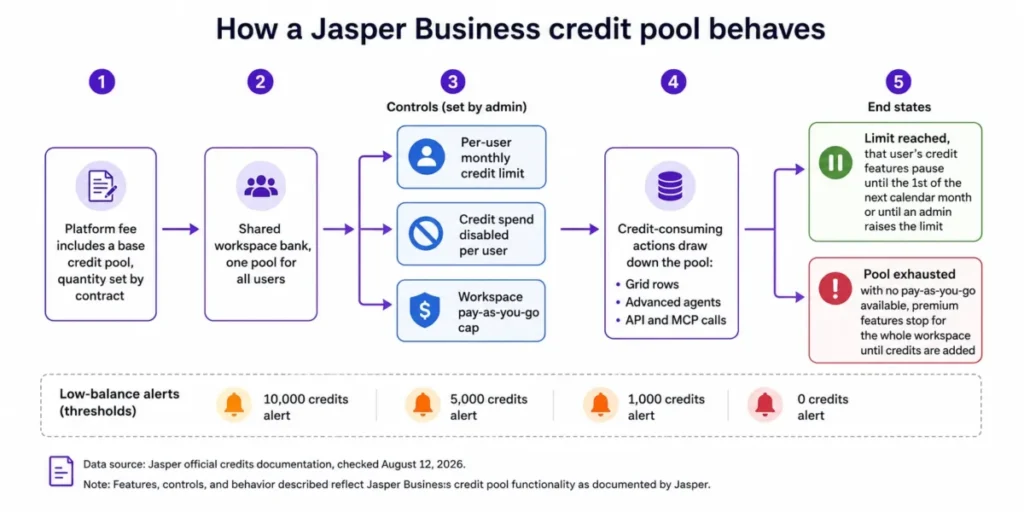
Source: Jasper official credits documentation, checked August 12, 2026 (read the credits policy).
The failure state buyers should plan for
Two stop conditions are documented, and they behave differently.
The first is individual. Administrators can set a monthly credit limit on any single user from team settings, apply the same limit to several users at once, or disable credit spending for a user entirely.
When a user reaches an assigned limit, credit-consuming features pause for the rest of the month while non-credit features stay available. Limits reset on the first of each calendar month, and mid-month adjustments take effect immediately.
The second is collective. If a workspace exhausts prepaid credits and has no pay-as-you-go headroom, advanced features stop functioning until credits are added or overage settings change.
As documented on August 12, 2026, administrators get a credit meter in Grid and Canvas, see the cost of an action before running it, and receive low-balance alerts at 10,000, 5,000, 1,000, and zero credits. Jasper also notes that changes to overage settings are not yet tracked in the audit log, which is a small but genuine governance gap for regulated teams.
The operational lesson is that credit governance is not a billing detail. It is a production continuity risk, and the mitigation is boring: set per-user limits deliberately, keep the pay-as-you-go cap above a realistic worst month, and give one named person responsibility for the alerts.
Jasper Grid: Credit Math You Can Do Before a Quote
Grid is the clearest example of Jasper’s platform ambition.
It presents a spreadsheet-style surface with input columns, processing columns, and output columns, so a single configured workflow runs across many rows instead of prompting one asset at a time. Data arrives as a CSV upload, a converted Canvas table, or pasted content, and finished work exports to CSV or XLSX.
Because the row rate is published, row volume can be translated into credits before any sales conversation.
| Paid output rows | Credits consumed | Notes |
|---|---|---|
| 10 | 0 | First ten rows of a workflow are free test rows |
| 100 | 1,000 | |
| 500 | 5,000 | |
| 990 | 9,900 | A full 1,000-row workflow after the free test rows |
| 1,000 | 10,000 | Maximum billable rows in a single workflow |
The dollar value of those credits is contract-specific and is not published, so this table stops at credits deliberately. What it does deliver is the input a finance conversation needs: a monthly row forecast converted into a credit forecast, ready to test against whatever included allowance a quote proposes.
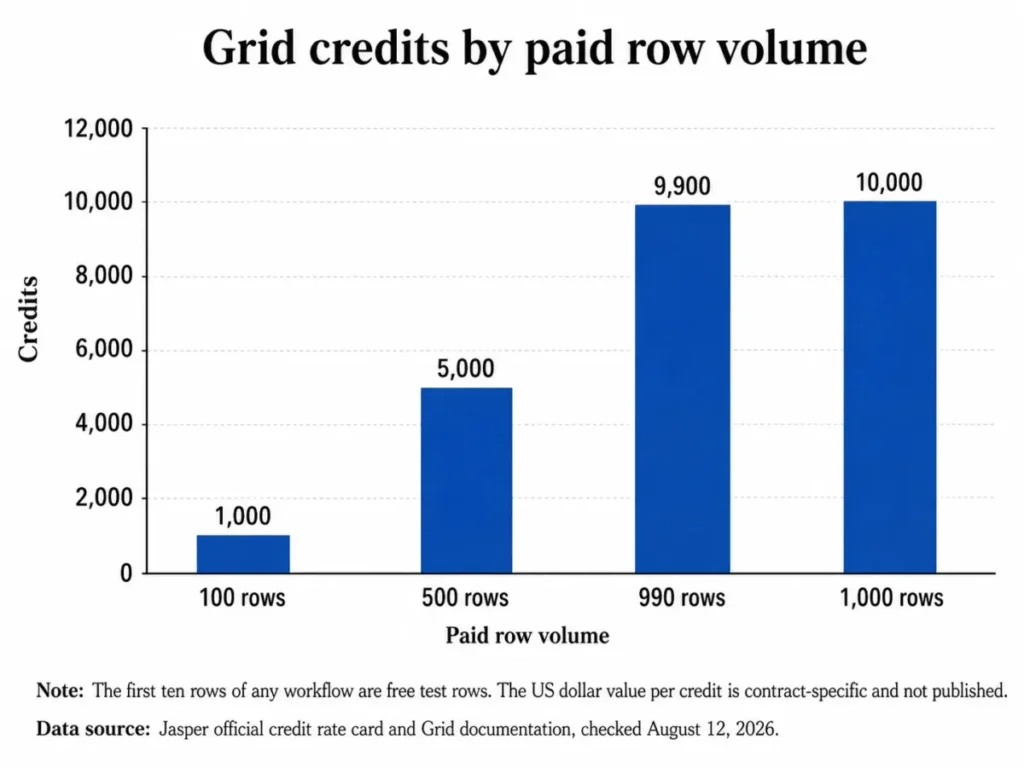
Accessible fallback for the chart above: 100 paid rows consume 1,000 credits and 500 paid rows consume 5,000 credits. At the ceiling, 990 paid rows consume 9,900 credits and 1,000 paid rows consume 10,000 credits. The first ten rows of each workflow are free test rows.
Source: Jasper official Grid documentation and credit rate card, checked August 12, 2026 (read the Grid limits).
The ten free rows are the control point
Jasper documents test mode explicitly: run the first ten rows free, review the output, adjust the configuration, and only then execute the full workflow. The interface also shows the credit cost of an action before it runs.
Treat that sequence as mandatory operating procedure rather than a convenience.
A misconfigured processing column discovered at row 900 has already cost roughly 9,000 credits at the published Grid row rate. Discovered at row 10, it costs nothing.
The 1,000-row ceiling is a design constraint
A single Grid supports up to 1,000 rows, and Jasper states that larger projects must be split into multiple Grids.
For a team localizing a 5,000-SKU catalogue, that means five workflows, five configurations kept in sync, and five sets of exports to reconcile. Grid templates reduce that overhead, since any Grid can be saved as a reusable template with optional sample data and published to the workspace, and a CSV can be mapped into an existing template either replacing rows or appending them.
Grid is also text-first.
Jasper’s Grid documentation, checked August 12, 2026, states it is optimized for text generation, though it handles workflows that produce copy such as image alt text and descriptions. Buyers expecting bulk image production from Grid are reading the wrong feature.
Scheduling exists, with real gaps
Grid Scheduler allows recurring daily, weekly, or monthly runs across all columns or selected columns, and the schedule page displays the credit cost per run before it executes. Three limitations are documented for the current version: no exact time-of-day scheduling, no specific weekday or calendar-day scheduling, and no automated export to integrated platforms after a run.
For an operations team, the third gap is the one that bites. A scheduled run still needs a human to collect the output, which caps how unattended the pipeline can become.
A documentation contradiction worth flagging
Jasper’s own Grid article states that Grid is available as part of Business plan offerings, with access granted by request through the account team, and separately states that Grid Scheduler and agent columns in Grid are Business features. In the same article, the Grid History section states that Grid History is available for all customers on Business and Pro plans.
Those statements cannot all be straightforwardly true unless some form of Grid access reaches Pro. The safe interpretation for a buyer is the restrictive one: treat Grid as a Business capability, and if Grid on Pro is decision-critical, get the entitlement confirmed in writing rather than inferred from a help article.
Jasper IQ: Where the Plan Gates Bite
Jasper IQ is the governance layer, and it is where most upgrade triggers originate. The public plan comparison sets three capacity limits on Pro, not the two that most reviews mention.
| Jasper IQ asset | Pro | Business |
|---|---|---|
| Brand Voices | 2 | Unlimited |
| Knowledge assets | 5 | Unlimited |
| Audiences | 3 | Unlimited |
| Style Guide | Not available | Available |
| Visual Guidelines | Not available | Unlimited |
The audience cap is the one competing reviews consistently omit, and it matters for personalization-led teams that maintain a persona per segment rather than a single house voice.
Source: Jasper official pricing page, checked August 12, 2026 (compare the plan limits).
Brand Voice is the agency upgrade trigger
A Brand Voice is derived from up to eight representative examples, supplied as text, documents, or URLs, previewed against sample content types, then saved for reuse across generation surfaces.
Two voices is workable for a solo consultant with one brand and perhaps a personal byline. It stops working the moment a third client arrives.
An agency managing three or more brands crosses into custom Business pricing on capacity grounds alone, before governance, seats, or automation enter the conversation. That is a materially different upgrade story from the usual one about needing enterprise features.
Source: Jasper official Brand Voice documentation, checked August 12, 2026 (read the Brand Voice setup).
Library size is not context capacity
This distinction is the most commonly misread part of Jasper IQ.
Business offers unlimited knowledge assets. It does not offer unlimited context per generation.
Jasper documents that up to five pieces of knowledge or source material can be included to guide a single generation. Knowledge can be attached in Chat, configured in an agent’s settings so it applies to that agent, or set at project level so it applies to every asset in the project.
So the workspace library can hold a thousand documents, and each generation still draws on a selected five. Teams designing complex grounded workflows should plan for curation, not accumulation, and should consider project-level defaults as the mechanism that keeps the right five attached without manual selection each time.
Knowledge maintenance depends on the source type
| Source type | Editable later | Downloadable later |
|---|---|---|
| Text entered directly | Yes | Not applicable |
| Uploaded document | No | Yes |
| URL | No | No |
The practical implication is a small governance decision made at upload time.
Facts that change, such as positioning statements or pricing summaries, are better entered as editable text than pasted as a URL, because a URL asset can only be deleted and recreated. Jasper also notes that video files can take up to ten minutes to process, which matters when a launch-day knowledge refresh is on a deadline.
Source: Jasper official Knowledge Base documentation, checked August 12, 2026 (read the knowledge asset rules).
Style Guide: More Flexible Than the Headline Constraint Suggests
Style Guide is Business-only, and the documentation is explicit that Pro does not have access. It applies rules at generation time rather than as post-hoc suggestions, covering grammar and punctuation presets, replacement and abbreviation rules, case-sensitivity behavior, and custom instructions that cannot be expressed as find-and-replace.
The commonly repeated criticism is that only one Style Guide can be active at a time, which sounds like a hard blocker for multi-brand teams. The current documentation makes that reading incomplete.
A workspace can create and manage multiple style guides, set a workspace-level default, set a per-project default in Canvas, and configure a specific guide inside custom or Studio agent settings. Only one is active for a given generation, in the same way that Brand Voice and Audiences work.
For an agency, that is a meaningful difference.
Separate client projects can carry separate defaults without manual switching. The genuine constraint is that a single piece of content cannot be governed by two style systems at once, which is a reasonable design rather than a limitation.
Two details are worth carrying into an evaluation.
As documented on August 12, 2026, style rules apply to string values in structured JSON responses returned by the public API, including nested fields, so governance survives the move from interface to integration. The automatic setup path, published as an open beta, extracts rules from one to three source documents in roughly four to five minutes. Jasper states plainly that the result is a recommended starting point to review rather than a complete import.
One incidental signal in that same article is worth noting for anyone comparing reviews: Jasper’s own documentation still references the retired Creator plan when describing who lacks Style Guide access. Some of the stale plan information circulating in search results traces back to the vendor’s own pages, not only to lazy publishers.
Source: Jasper official Style Guide documentation, checked August 12, 2026 (read the Style Guide rules).
Studio and Custom Agents: Confirm Publishing, Not Just Access
Studio is the no-code environment for building custom agents, and it is a Business capability. The pricing page separates two related lines, custom agents and the no-code builder, and its role-based permissions description explicitly includes permission to publish Studio agents as something an administrator grants.
That separation is the procurement point.
Access to build is not identical to the right to publish across a workspace, and Jasper’s Studio documentation notes that publishing availability can depend on the Business plan tier. A team buying Studio specifically to distribute a standardized agent to fifty marketers should confirm publishing entitlement in the quote, because discovering the difference after implementation is an expensive way to learn it.
Source: Jasper official Studio documentation, checked August 12, 2026 (read the Studio permissions).
The API: Three Separate Constraints, Not One Checkbox
Most reviews record API access as a yes or no feature. Jasper’s documentation makes clear it is three independent questions.
The first is eligibility. API access is Business-only, and requests can reference brand voice, knowledge, style guide, audience, and agent identifiers so integrated output inherits the same governance as interface work.
The second is budget. API and MCP calls draw on the shared workspace credit pool at one credit per content generation call.
The third is throughput. Rate limits are set per workspace and differ sharply by endpoint group.
| Endpoint group | Rate limit | Hourly equivalent |
|---|---|---|
| Generation and task runs, including commands, template runs, keep-writing, task runs, and knowledge search | 105 requests per minute | 6,300 per hour |
| Asset reads and management, including tasks, templates, knowledge, tones, and usage | 200 requests per minute | 12,000 per hour |
| Styles | 60 requests per minute | 3,600 per hour |
| Image operations, including upscale, uncrop, background removal and replacement, text removal, cleanup, decompose, and packshot compositing | 30 requests per minute | 1,800 per hour |
Every ceiling above is published in the official Jasper rate limit reference, checked August 12, 2026.
The image tier is the constraint most likely to surprise a team, at roughly a third of the generation ceiling and a seventh of the read ceiling. A catalogue pipeline processing thousands of product images needs queueing designed around 1,800 operations per hour, not around the headline generation figure.
Jasper directs teams expecting to scale past these defaults to their customer success manager so limits can be raised, which is a documented path rather than a guarantee.
The documentation also describes fallback ordering across model providers per endpoint, intended to keep integrations working when an upstream provider degrades. Teams building the integration layer should read that alongside the general background on how an API works. Jasper also publishes MCP quickstart guides for several agent clients.
For lighter automation without custom code, the same workflows often run through the tools covered in the Zapier automation review.
Source: Jasper official developer rate limit documentation, checked August 12, 2026 (view the endpoint limits).
Security, Identity and Admin Governance
Jasper publishes a substantial compliance position. It states SOC 2 Type II certification, compliance with GDPR, CCPA, PCI, and DPA requirements, and annual third-party penetration testing. It also states US-based data centers, encryption in transit at TLS 1.2 or higher and at rest with AES-256, and a commitment not to use customer data to train AI models.
Reports and supporting documentation are available through a compliance portal. Single sign-on is a Business feature supporting SAML 2.0 with Okta, Azure AD, and Google Workspace named, alongside role-based access control and an in-app AI audit log.
These are vendor-published statements. They are specific enough to verify during procurement, which is the appropriate next step rather than treating them as independently audited within a documentation review.
One identity nuance deserves attention from IT.
SCIM is Business-only and automates provisioning and deprovisioning, but role assignment remains managed inside Jasper rather than driven by identity-provider group membership. Lifecycle and authorization therefore live in two different systems, which is a workable arrangement as long as it is planned for rather than discovered during rollout.
The wider administrative layer is also a Business boundary.
Team usage analytics, advanced admin controls, document sharing with status labels, user-level permission settings, and role-based permissions across groups, brand voices, audiences, knowledge, style rules, and visual guidelines all sit on the Business side of the plan comparison. A team that needs to see who is generating what does not have that visibility on Pro.
Source: Jasper official SCIM documentation, checked August 12, 2026 (read the provisioning limits).
Integrations: Breadth Is Not Depth
Jasper’s integration index covers Google Search Console, Semrush, Wrike, Jira, Google Drive, Asana, Monday.com, SharePoint, Adobe Workfront, Slack, Microsoft Word, Google Docs, Webflow, Zapier, and Make. That is a credible ecosystem for marketing operations.
A logo list, however, proves that documentation exists rather than that every connector behaves the same way.
The Google Drive integration is the clearest worked example: it is Business-only, a workspace administrator enables it in team integrations, and then each individual user connects a Google account before anything works for them. Connected users can reach permitted personal, shared with me, and shared drive content, export Canvas or Grid work, and synchronize selected Drive content into the knowledge base.
Two authorization layers means rollout planning includes a per-user step, and adoption stalls quietly if nobody owns that step. Treat the same question as open for every connector on the shortlist: which plan, who enables it, who authorizes it, and which direction data flows.
Source: Jasper official Google Drive integration documentation, checked August 12, 2026 (read the setup requirements).
Limitations Worth Knowing Before You Buy
Beyond the plan gates already covered, five documented constraints are the ones most likely to disqualify Jasper for a specific team.
The browser extension supports Chrome and Edge only.
Safari, Firefox, Opera, and Brave are not supported. For an organization standardized on Safari, the extension is unavailable, which removes a significant part of the everyday convenience story.
Grid is capped at 1,000 rows per workflow and optimized for text rather than image generation.
Credit exhaustion pauses premium features rather than degrading them gracefully, and per-user limits can stop an individual mid-month.
Prepaid credits expire at contract renewal or cancellation rather than banking indefinitely.
Business includes dedicated account management and priority support, but no universal contractual response-time commitment appears in the public material.
Jasper’s help center states support availability as Monday to Friday, 9am to 4am Central Time, which is a coverage window rather than a service-level agreement. Buyers who need a committed response time should get it written into the contract instead of inferring it from the phrase priority support.
Source: Jasper official browser extension documentation, checked August 12, 2026 (check the supported browsers).
Jasper Compared With General-Purpose AI Assistants
The honest comparison is narrower than most published versions of it.
Nothing in the public documentation supports a claim that Jasper produces better prose than a leading general assistant, and this review ran no comparative output test that could establish one. What Jasper documents, and what general assistants do not offer in the same governed form, is the surrounding apparatus. That means brand voice and audiences applied automatically at generation time, style rules that reach into API responses including nested JSON fields, and a knowledge layer with defined attachment behavior. It also means batch execution with published per-row costs and workspace-level administration with SSO, SCIM, and role-based permissions.
Set against that, a general assistant is dramatically cheaper per seat, has no seat cliff, and for many solo users covers the actual job. A marketer whose real need is drafting and ideation is unlikely to recover Jasper’s premium.
The review of ChatGPT for marketing work sets out what that cheaper path covers, and the same ground is worked from a different angle in the Claude writing assistant review.
The decision rule that follows from the evidence is simple.
Buy Jasper when the same brand context has to be applied repeatedly, by more than one person or across more than one asset type, with control over how it is applied. Do not buy Jasper for better sentences.
Alternatives Worth Shortlisting
Direct competitors in marketing-focused AI writing include the Copy AI marketing platform and the lower-cost Rytr writing assistant.
A head-to-head breakdown sits in Jasper versus Copy AI, and the Writesonic content suite review covers the third option.
Teams whose bottleneck is visual production rather than copy governance should look at Canva AI instead. Teams whose real problem is orchestration rather than generation may find that a workflow layer plus a cheaper model solves more of the job, which is the argument set out in the primer on marketing automation.
The requirement that should drive the shortlist is not feature parity. It is whether governed reuse of brand context is genuinely part of the workflow, because that is the only axis on which Jasper’s price is defensible.
How to Buy: Questions the Quote Must Answer
For a Business evaluation, the public material leaves specific gaps that only a quote can close. Ask for each of these in writing.
The platform fee and how seats are counted and priced. The number of base credits included, and what happens to them at renewal.
The price of a prepaid credit pack and the pay-as-you-go rate per credit, since neither is published. The maximum monthly pay-as-you-go cap available.
Whether Studio agent publishing is included at the proposed tier. Which integrations on the shortlist are enabled at that tier, and what each requires from administrators and end users.
Whether the default API rate limits fit the intended workload, and what the process is to raise them.
Any contractual support response-time commitment. Onboarding or implementation fees.
For a Pro evaluation the list is shorter, because the plan is transparent, and the only real decision is monthly flexibility against a 120 dollar annual saving that locks a year after seven days.
Methodology: How This Jasper AI Review Was Built
This review is documentation-based and follows a fixed source hierarchy. Primary weight goes to Jasper’s official pricing page, credit rate card, help center, and developer documentation.
Vendor marketing claims are labelled as vendor claims. Third-party commentary is not used as proof of product behavior.
Every plan, price, limit, and workflow statement was verified against that official material on August 12, 2026, covering plans and billing, credits, seats, Grid, Knowledge Base, Style Guide, Studio, SCIM, the browser extension, the Google Drive integration, and API rate limits.
The buyer-focused criteria are applied in the same order throughout: which plan a requirement forces, what a documented limit does to a real workflow, which costs are published and which are contract-specific, and which constraints disqualify a team outright.
Where two official pages disagree, the disagreement is reported at the point of the claim. Where a figure is contract-specific, the article stops at the published unit.
No authenticated Jasper session was used, so this article contains no timing data, no output-quality measurement, and no interface interaction claims. Workflow descriptions are reconstructions of documented paths.
Aggregated user ratings are excluded because no reproducible tally was available from the sources examined. Prices are US list prices, exclude taxes and conversion, and can change after the checked date.
Frequently Asked Questions
Is Jasper AI worth it in 2026?
It is worth it for a buyer who repeatedly applies the same brand context and needs control over how it is applied. It is hard to justify for occasional general-purpose writing, where a general assistant costs a fraction of 69 US dollars per month and covers the same drafting work.
How much does Jasper AI cost per month?
Pro is 69 US dollars per month on monthly billing, or 59 US dollars per month billed yearly, and includes one seat. Business pricing is custom and is not published.
Does Jasper AI have a free plan?
No. Jasper offers a 7-day free trial of the Pro plan rather than a permanently free tier.
Can two people share a Jasper Pro plan?
No.
Jasper documents Pro as limited to one seat. A second user requires a Business quote, and Jasper’s own pricing FAQ directs buyers with more than one user to contact sales.
How do Jasper credits work?
Credits apply on Business plans alongside the platform fee. Chat, Canvas, standard agents, Studio, and Jasper IQ are not metered.
Grid rows cost 10 credits each, Research and Translation Agent runs cost 40 credits, Optimization Agent runs cost 100 credits, and API or MCP content generation costs 1 credit per call on the official credit rate card. The dollar value of a credit is contract-specific.
What happens when a Jasper workspace runs out of credits?
Premium credit-consuming features pause until credits are added or overage settings change. Separately, an individual who hits an assigned monthly limit loses access to credit-consuming features for the rest of the month while everything else keeps working, with limits resetting on the first of the calendar month.
Does Jasper include API access?
API access is a Business-only feature. Calls consume credits and run under per-workspace rate limits that vary by endpoint group. The published ceilings run from 105 requests per minute for generation endpoints down to 30 for image operations, as set out in the official rate limit documentation.
Does Jasper support SSO and SCIM?
Both are Business features.
SSO supports SAML 2.0 with Okta, Azure AD, and Google Workspace named in Jasper’s documentation. SCIM automates provisioning and deprovisioning, though Jasper role assignment is still managed inside Jasper rather than through identity-provider groups.
How many rows can Jasper Grid process at once?
Up to 1,000 rows per workflow, with the first ten rows free as test rows. Larger datasets must be split across multiple Grids.
What are the main limitations of Jasper AI?
The one-seat Pro cap, unpublished Business pricing, and a credit layer on premium features with prepaid expiry. Also a 1,000-row Grid ceiling with text-first output, five knowledge sources per generation regardless of library size, extension support limited to Chrome and Edge, and no published contractual support response time.
Final Verdict
Jasper’s best fit is narrow and identifiable: governed, repeatable marketing production. Its documented strength is that brand voice, audiences, knowledge, and style rules apply automatically at generation time, extended by batch execution in Grid, custom agents in Studio, and a governed API.
The decision chain runs in one direction, and each stage causes the next. Every capability named here is a documented capability drawn from official documentation, so seat count decides plan eligibility, plan eligibility decides which supported feature set exists, and feature choice decides consumption. Because of that, the affected buyer is any team beyond one person, and the trade-off is that each plan gate reached converts a published price into a quote. The workflow consequence is that a second user removes every published price from the conversation. The operating consequence is that Grid, advanced agents, and API traffic draw on a shared credit pool that pauses premium features when it empties. The setup consequence is that governance features such as Style Guide, SCIM, and the Google Drive integration each require an administrator step before anyone can use them.
That chain produces three clean actions rather than a single score.
Choose Jasper Pro if exactly one person needs it and two brand voices, five knowledge assets, and three audiences are enough. Monthly billing is the safer first year at the published Pro rate of $69 per month.
Request Business pricing if a second seat, a third brand, Style Guide, Studio, Grid, API access, SSO, or SCIM is decision-critical. Take the procurement checklist above into that conversation so the platform fee, the included credit allowance, and the credit unit price arrive in the same quote.
Reject Jasper if the requirement is mainly drafting help, if procurement needs a published team price before engaging sales, if the extension must run on Safari or Firefox, or if unlimited batch generation without a credit meter is the expectation.