
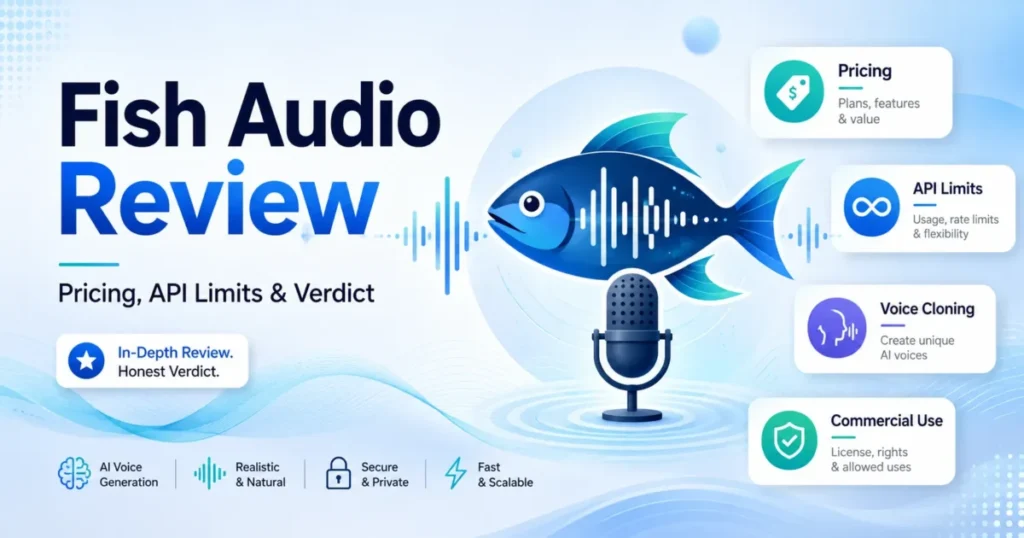
Fish Audio is worth using for multilingual creators and developers who can judge output against their own scripts and who will pay for a plan before publishing anything commercially. It is the wrong purchase for regulated teams, for anyone who needs a published support commitment, and for anyone who wants free commercial rights confirmed in writing.
Paid plans start at $15 per month on Plus, and the hosted API is metered separately at $15 per 1 million UTF-8 bytes. That split between studio credits and API bytes is the most misread part of the product, and buying the wrong side of it is the most common budgeting mistake I see in this category.
This review works through the 2026 plan limits, the feature gates, the API concurrency tiers, and the licensing conflict sitting on the Free plan. If you are still shortlisting vendors, the wider roundup of best text to speech tools is the better starting point.
Source: Fish Audio official pricing page, checked 2026-07-31. Billing basis: per account, USD, US market.
In This Article (17 sections)
Fish Audio Review: Quick Verdict
| Category | Verdict |
|---|---|
| Best for | Multilingual creators, consented voice cloning, and developers prototyping speech features |
| Not ideal for | Regulated teams, confidential voice assets, and buyers who need a published support commitment |
| Starting price | $0 Free plan; $15 per month for Plus; hosted API billed separately |
| Best practical plan | Plus, because commercial licensing, private voice slots, and Voice Design all start there |
| Free plan or trial | Free plan with 8,000 monthly credits and 500 characters per generation |
| Setup difficulty | Low for the web studio, medium for the API once concurrency and error handling matter |
| Main strength | Same model quality on a $0 API tier as on the paid production tier, across 83 languages |
| Main limitation | Commercial-use wording conflicts between the Free plan card and the Terms of Use |
| Best alternative | ElevenLabs, when a more established enterprise ecosystem outranks unit price |
Source: Fish Audio official pricing page and Terms of Use, checked 2026-07-31.
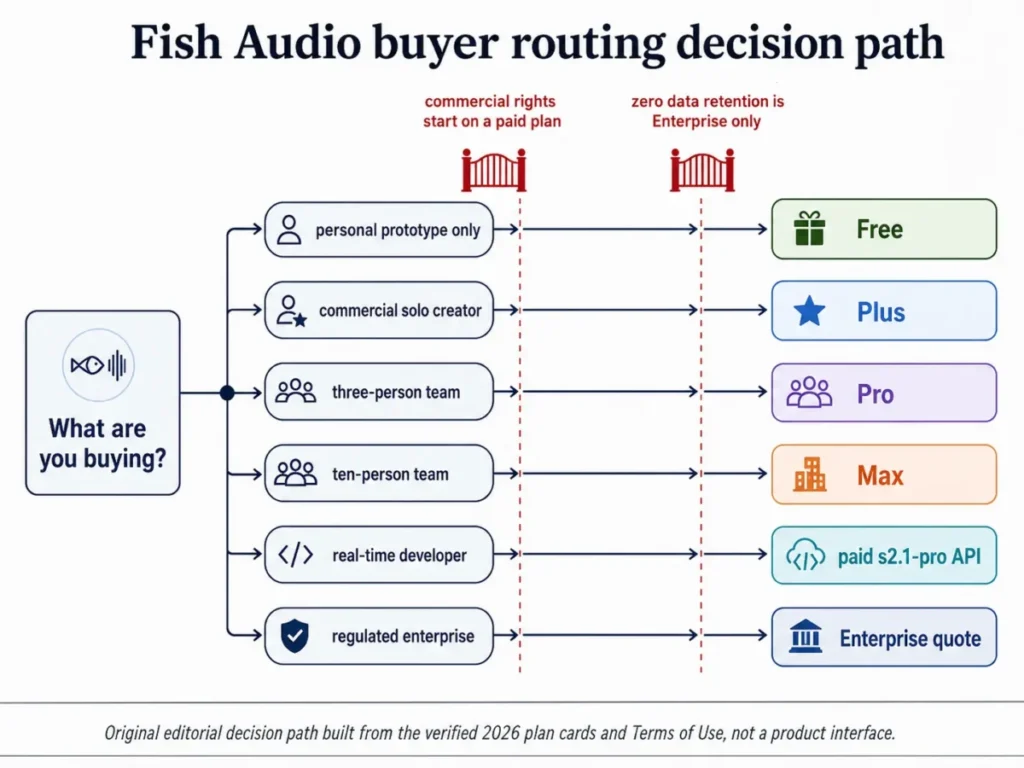
The routing above is the short answer, and the rest of this review is the evidence behind each branch. Every branch turns on one of four things: commercial rights, seat count, monthly output volume, or privacy tolerance.
Fish Audio Pros and Cons
| Pros | Cons |
|---|---|
| The free API model runs the same s2.1-pro quality and 83-language coverage as the paid production model | The Free plan card advertises commercial use while the Terms restrict free use to personal and noncommercial purposes |
| Hosted API billing is pay-as-you-go with no subscription and no minimum commitment | Concurrency is raised by prepaid balance, so a bursty app needs cash on account before it can scale requests |
| Voice cloning needs only about 10 seconds of clean single-speaker audio, with a written-permission requirement stated in the docs | Subscription credits reset every month and unused credits do not carry forward |
| Annual billing cuts the Plus and Pro price by more than 60% against twelve monthly payments | Zero data retention and on-premises deployment are listed only for Enterprise, not for Plus, Pro, or Max |
| Official integrations cover a Python SDK, WebSocket streaming, and a LiveKit plugin for real-time voice | The Terms allow content and usage data to support AI model development, which rules out confidential voice assets on self-serve plans |
| Voice Design, private voice slots, and professional voice slots give agencies a clear upgrade path | Seat counts stop at three on Pro and ten on Max, with no published price for the next seat |
Source: Fish Audio official pricing page, Terms of Use, and voice cloning documentation, checked 2026-07-31.
What Is Fish Audio?
Fish Audio is a hosted text-to-speech, voice-cloning, speech-recognition, and voice-API platform operated by Hanabi AI Inc., a Delaware corporation named in the Terms of Use. The company positions it as expressive, emotionally controllable speech for creator workflows and real-time voice applications.
The public site markets a library of more than 2 million voices. Treat that as a vendor claim rather than an audited count, because no independent verification of the number is published anywhere I could reach.
One naming trap matters before you compare anything. Fish Audio the hosted service and Fish Speech the open-source model family are not the same purchase, and the hosted pricing, support, and licensing terms in this review do not transfer to a self-hosted deployment.
If the underlying model category is new to you, the primer on generative AI explained covers how these systems are trained and priced.
The product splits into two commercial systems that share a brand and almost nothing else. The web studio sells monthly credits against plan limits, while the hosted API sells UTF-8 bytes with its own models, its own concurrency tiers, and its own guarantees.
How We Researched Fish Audio
This review is based on Fish Audio’s official pricing page, Terms of Use, Privacy Policy, help center, developer documentation, API reference, integration guides, model changelog, deprecation notice, and selected company blog posts. Pricing, plan limits, and model availability were checked on 2026-07-31 for the US market in USD.
Fish Audio was assessed against the same buyer-focused criteria this site applies to every voice platform: workflow fit, plan gates, usable entry pricing, output and input limits, commercial-use terms, privacy and data-handling terms, integration maturity, and documented failure behavior. The site-wide review methodology sets how those criteria are weighted.
Greater weight was given to the factors that change a purchase: licensing rights, upgrade triggers, credit economics, concurrency ceilings, and data-use terms. Independent review pages and forum posts were used only to identify recurring buyer questions, never to establish a product fact.
Claims that could not be verified from official evidence were excluded, and conflicts between two official Fish Audio pages are reported in the body rather than resolved silently. Workflow descriptions are reconstructed from documented product behavior and published limits.
Fish Audio Pricing and Plan Limits
Pricing here is two separate systems, and the plan cards only describe one of them. The three subsections below cover the plan ladder, the credit economics behind it, and what a real team pays once seats are counted.
What each plan costs
| Plan | Monthly | Billed annually | Effective monthly | Reduction vs 12 monthly payments |
|---|---|---|---|---|
| Free | $0 | $0 | $0 | Not applicable |
| Plus | $15 | $66 | $5.50 | 63.3% |
| Pro | $100 | $450 | $37.50 | 62.5% |
| Max | $999 | $8,988 | $749 | 25.0% |
| Enterprise | Custom | Custom annual | Not published | Not published |
Plan prices verified against the Fish Audio official pricing page on 2026-07-31. Region: US. Currency: USD. Billing basis: per account.
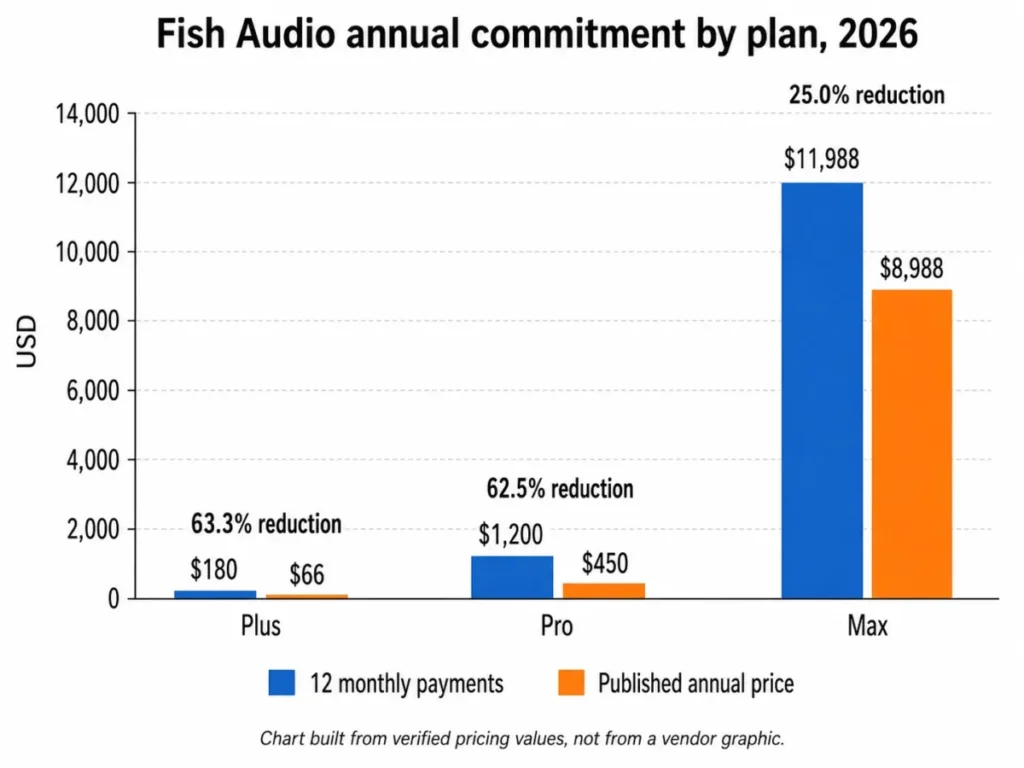
The pricing FAQ describes annual billing with a single figure of about 33%, and the plan cards do not support that as a general rule. Plus and Pro both fall more than 60% below twelve monthly payments, while Max falls only 25.0% below, so the annual commitment is a much weaker deal at the top of the ladder.
That gap has a practical consequence. A solo creator locking in Plus for a year is buying the largest reduction on the page, while a studio locking in Max is paying a real premium for the same commitment length.
Credits, minutes, and the no-rollover rule
| Plan | Monthly credits | Estimated minutes | Characters per generation | Voice slots |
|---|---|---|---|---|
| Free | 8,000 | About 7 | 500 | 3 public |
| Plus | 250,000 | About 200 | 15,000 | 10 private, 1 professional |
| Pro | 2,000,000 | About 1,620 | 30,000 | Unlimited, 5 professional |
| Max | 25,000,000 | About 6,250 | 30,000 | Unlimited, 15 professional |
Credit and limit figures come from the Fish Audio plan comparison, read on 2026-07-31. Evidence status: vendor claim for the minute estimates.
Fish Audio states that roughly 600 to 625 credits produce one minute of audio, which is why every minute figure above is an estimate rather than a guarantee. Budget against credits, not against minutes, because the conversion moves inside a stated range.
Subscription credits reset monthly and unused credits do not carry forward. For a creator whose output swings between a heavy launch month and a quiet one, that rule quietly converts part of the subscription into unused capacity.
The 500-character ceiling on Free is the limit that ends most serious evaluations early. A single 90-second script runs past it, so a Free-plan test tells you how one paragraph sounds and almost nothing about how a chapter holds together.
What a ten-person team pays
| Team size | Cheapest published path | Monthly cost | Annual cost | Constraint that forces it |
|---|---|---|---|---|
| 1 person, commercial | Plus | $15 | $66 | Commercial licensing starts on a paid plan |
| 3 people | Pro | $100 | $450 | Pro includes three seats |
| 4 people | No published self-serve path | Not published | Not published | Pro stops at three seats, Max is the next listed tier |
| 10 people | Max | $999 | $8,988 | Max includes ten seats |
| 11 people | Enterprise quote | Custom | Custom | Max stops at ten seats |
Seat counts and prices read from the Fish Audio plan cards on 2026-07-31. The cost column is editorial arithmetic on those published values.
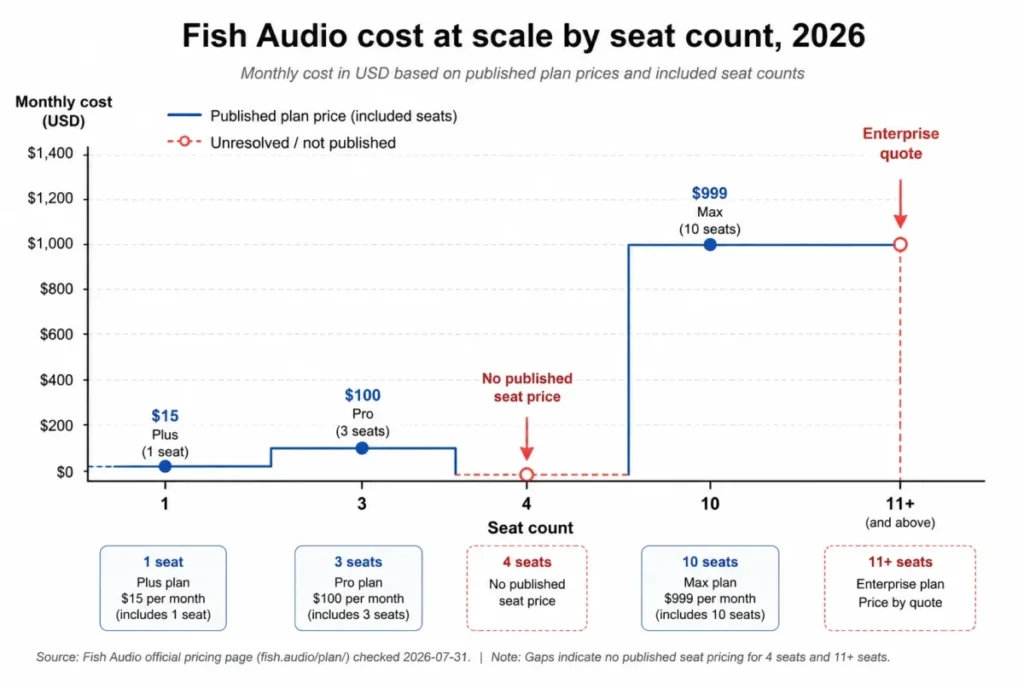
The fourth seat is the real budget cliff in this product. Pro includes three seats, Max includes ten, and the pricing page publishes no price for adding a single seat in between, so a four-person studio either buys the $999 tier or opens a sales conversation.
I would treat that as a question for Fish Audio before any annual commitment, not as something to model with an assumed add-on rate. Guessing at a seat price is how a $450 budget quietly becomes an $8,988 one.
The hidden cost most buyers miss
Commercial rights are the cost that does not appear in any credit table. The Terms license paid users for commercial use and restrict free use to internal, personal, and noncommercial purposes, while the Free plan card on the pricing page advertises commercial use.
Those two official pages disagree, and I am not going to resolve that in Fish Audio’s favor. Until the company confirms the position in writing, the defensible reading is that monetized output needs a paid plan, which makes Plus the genuine entry price for anyone publishing client work or ad-supported content.
Pro advertises a seven-day money-back guarantee on its plan card. The detailed eligibility conditions are not published on the pages I could reach, so ask for them in writing before treating that guarantee as a safety net on an annual purchase.
Feature Gates: What You Get on Each Plan
| Capability | Free | Plus | Pro | Max | Enterprise |
|---|---|---|---|---|---|
| Commercial use under the Terms | No | Yes | Yes | Yes | Yes |
| Voice Design | Not listed | Yes | Yes | Yes | Yes |
| Private voice slots | No, public only | 10 | Unlimited | Unlimited | Custom |
| Professional voice slots | Not listed | 1 | 5 | 15 | Custom |
| Included seats | 1 | 1 | 3 | 10 | Custom |
| Characters per generation | 500 | 15,000 | 30,000 | 30,000 | Custom |
| Zero data retention | No | No | No | No | Yes |
| On-premises deployment | No | No | No | No | Yes |
| SOC 2 positioning and org controls | No | No | No | No | Yes |
Gate rows verified against the Fish Audio plan comparison page and the Hanabi AI Terms of Use on 2026-07-31.
Three gates decide most purchases here, and none of them is voice quality. Commercial rights and private voice slots both open at Plus, professional voice slots scale from one to fifteen across the paid tiers, and every privacy control that a security review will ask about sits behind an Enterprise contract.
The private-slot gate is the one agencies hit first. On Free, cloned voices live in public slots, and the Terms allow public submissions to be used for marketing, so a client voice on the Free plan is not a confidential asset.
Voice Quality, Cloning, and Controls
Output quality here depends on three choices a buyer makes before hearing a single line: the model generation, the source audio behind a cloned voice, and the control settings applied per script. Each one is documented, and each one has an operating consequence.
The model generation you should be building on
Fish Audio’s developer changelog records the S2 generation arriving in March 2026, and the models overview names s2.1-pro as the recommended production model. It supports 83 languages, natural-language cues written in brackets, multi-speaker output, and production options covering latency and data-processing guarantees.
The previous generation, s2-pro, covers more than 80 languages and is described with a time to first audio of roughly 100 milliseconds. It also has an open-source counterpart, which is the practical reason a self-hosting team would still care about it.
The older s1 model supports 13 languages and more than 64 emotions, but it uses a legacy control syntax. Starting a 2026 integration on s1 means writing to a control system you will migrate off.
There is a documentation conflict worth knowing about before you pick. The deprecations page still recommends S1, while the models overview recommends s2.1-pro, and the changelog dates support the models overview, so build on s2.1-pro and treat the deprecations wording as stale.
Source: Fish Audio models overview and developer changelog documentation, checked 2026-07-31.
Voice cloning and what makes a clone usable
The documented cloning requirement is short: at least 10 seconds of quiet, single-speaker audio at a steady volume. Fish Audio also requires that you clone only voices you own or have written permission to use.
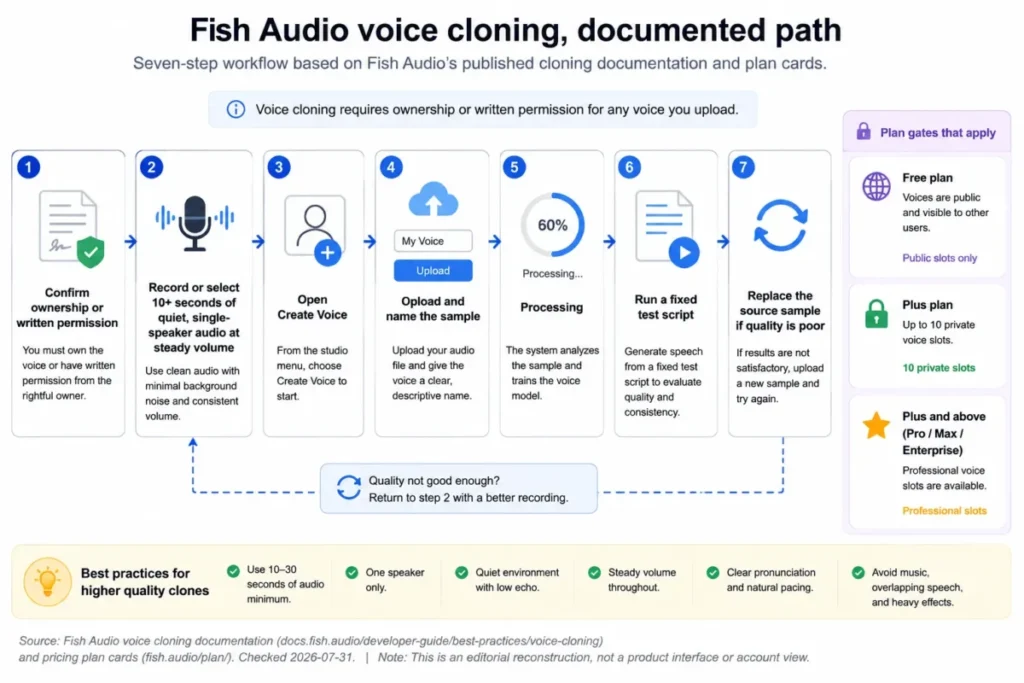
Those two lines carry more weight than the 10-second headline suggests. A clone built from a noisy Zoom recording will underperform one built from 15 seconds of clean booth audio.
The permission requirement has its own operating consequence. A consent record belongs in your project file before the upload, not after a client asks for it.
I would keep every original sample outside the platform as well. The Terms warn that account termination may destroy associated content and recommend downloading content beforehand, with no recovery guarantee attached.
Source: Fish Audio voice cloning documentation and Terms of Use, checked 2026-07-31.
Emotion, pronunciation, and the normalization trade-off
The s2.1-pro control system uses natural-language cues in brackets rather than a separate markup language, which is the practical reason it replaced the s1 emotion syntax. Multi-speaker output is documented for the S2-Pro generation, so a two-voice dialogue is a supported request rather than a stitching job in an editor.
Fine-grained control also covers text normalization, phonemes, and pauses. Disabling normalization preserves the surrounding text as written but can reduce stability on numbers, dates, and URLs, which is exactly the content an audiobook or a product demo script is full of.
The practical rule I would apply: leave normalization on for anything with prices, dates, or links in it, and turn it off only for passages where the literal text matters more than the read. Test that decision per script rather than setting it once for a whole project.
Source: Fish Audio fine-grained control documentation, checked 2026-07-31.
Long-form work and the character ceiling
Per-generation input caps at 500 characters on Free, 15,000 on Plus, and 30,000 on Pro and Max. For long-form narration, that ceiling decides how often a script gets split, and splitting is where consistency problems appear.
Split at scene or section boundaries rather than at the character count. A break that lands mid-paragraph produces two reads with different momentum, and that seam is audible in a way a chapter break is not.
Ease of Use and Setup
Setup difficulty splits cleanly by path. The web studio needs an account, a voice selection, and text, which puts it in reach of a non-technical creator on day one.
The API path is a different setup consequence. It needs an account, an API key, a model choice, and error handling before it is production-shaped.
The developer quickstart documents the shorter of the two: create an API key, send an authenticated request to the text-to-speech endpoint, and pass a reference_id when you want a custom voice instead of a library one. That is a genuinely small first integration.
There is an access question the official pages do not answer cleanly. The pricing FAQ describes API access as a premium subscriber benefit, while the developer quickstart instructs any account holder to create an API key, so a paid studio plan should not be assumed mandatory for pay-as-you-go API use.
I would confirm that in writing before designing a budget around it. Buying a Plus subscription purely to access an API that bills separately would be a costly misreading of a document conflict.
Source: Fish Audio developer quickstart documentation and the pricing page FAQ, checked 2026-07-31.
Fish Audio API and Integrations
The hosted API is a separate product from the studio subscription, with its own billing unit, its own models, and its own ceilings. What follows covers price, throughput, documented failure behavior, and the supported integration paths.
API pricing, concurrency, and prepaid tiers
| API model | Price | Billing basis | What it covers |
|---|---|---|---|
| s2.1-pro | $15 | Per 1 million UTF-8 bytes | Recommended production model, 83 languages |
| s2.1-pro-free | $0 | Per 1 million UTF-8 bytes under fair use | Same model quality and language coverage, no latency or data-processing guarantees |
| s2-pro | $15 | Per 1 million UTF-8 bytes | Previous generation, open-source counterpart |
| s1 | $15 | Per 1 million UTF-8 bytes | Legacy control syntax, 13 languages |
| transcribe-1 | $0.36 | Per audio hour, rounded to the nearest second | Speech recognition |
| voice-design-1 | $0.01 | Per successful request | Voice design, with specified error classes not billed |
Source: Fish Audio API pricing and rate limits documentation, checked 2026-07-31. Currency: USD. Billing basis: usage-based, no subscription or minimum commitment.
| Concurrency tier | Concurrent requests | What raises it |
|---|---|---|
| Starter | 5 | Below $100 prepaid |
| Elevated | 15 | At least $100 prepaid |
| High Volume | 50 | At least $1,000 prepaid |
| Enterprise | Custom | Custom terms |
Source: Fish Audio API rate limits documentation, checked 2026-07-31.
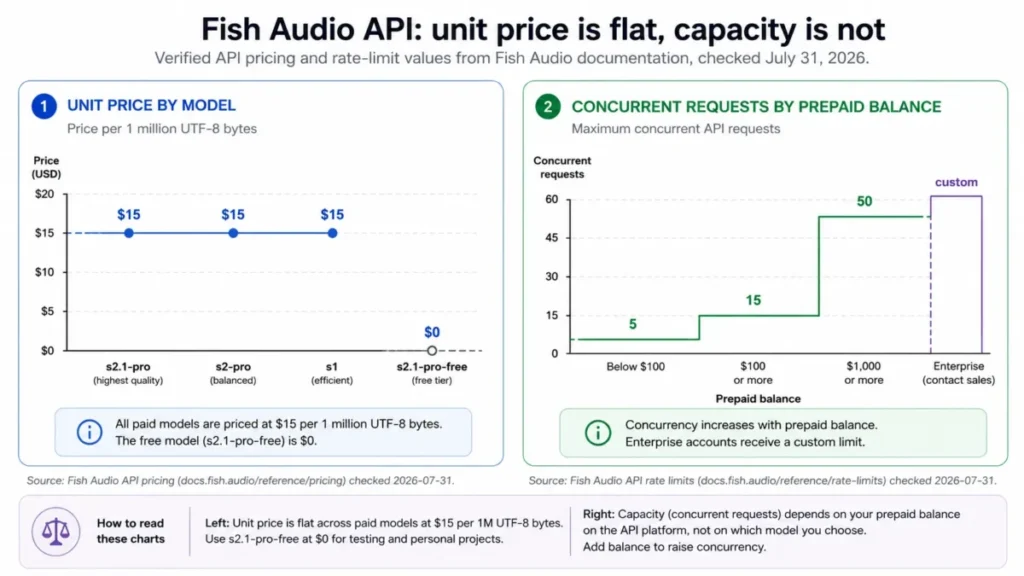
The per-byte price is the boring half of this. Concurrency is the half that decides whether an application survives a traffic spike, and it is raised by how much money you have prepaid rather than by how much you have consumed.
For a bursty voice agent, that means the binding constraint arrives as a cash-timing problem rather than a cost problem. A team expecting more than five simultaneous requests needs at least $100 sitting on the account before launch, and more than fifteen needs at least $1,000.
The free model deserves a separate warning. Fish Audio’s launch blog described the free API as having no hard usage cap, while the model documentation states that fair-use limits apply, and no numeric threshold, reset cycle, or overflow behavior is published anywhere.
Use s2.1-pro-free to prove that the model fits your content, and price production capacity on the paid s2.1-pro. A capacity plan built on an undisclosed fair-use ceiling is not a plan.
What breaks first: errors, retries, and formats
| Documented failure | Where it appears | What the application should do |
|---|---|---|
| 401 authentication | Endpoint and SDK | Rotate or repair the key, do not retry blindly |
| 402 payment or balance | Text-to-speech endpoint | Top up before retrying, since the request is not billable capacity |
| 422 validation | Text-to-speech endpoint | Fix the payload, retry is pointless until it changes |
| 429 rate limit | SDK | Back off, and check whether the concurrency tier is the real ceiling |
| 5xx server | SDK | Retry with backoff and keep a fallback path |
| WebSocket failure | SDK streaming | Reconnect, and treat a partial stream as a failed generation |
Source: Fish Audio text-to-speech endpoint and Python SDK exception documentation, checked 2026-07-31.
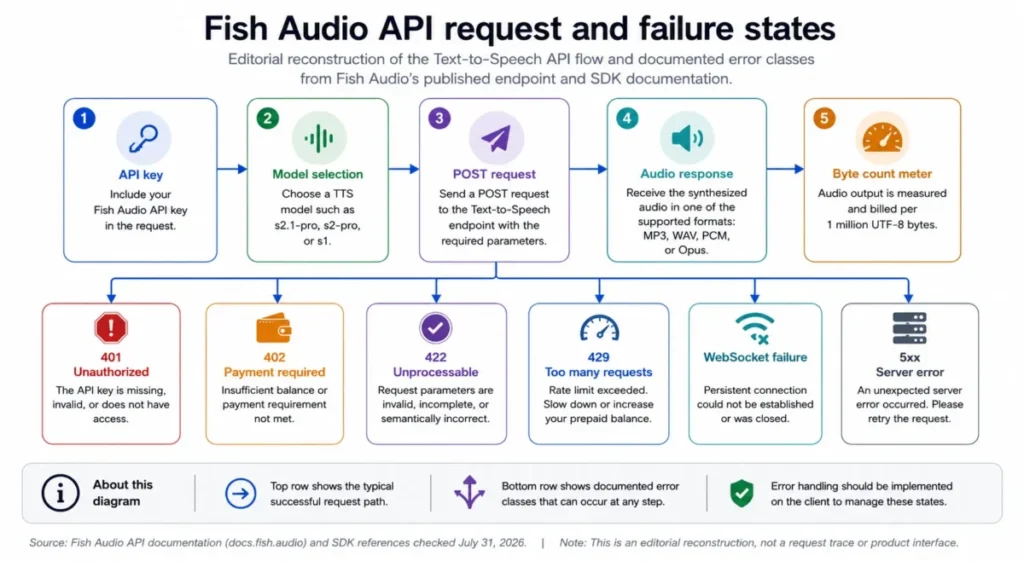
Documentation covers which errors exist, and it does not specify whether requests past the concurrency ceiling queue or fail outright. Treat a 429 as a failed request rather than a delayed one until Fish Audio publishes the queuing behavior, because building on the optimistic reading is how a launch-day spike turns into silent dropped audio.
The endpoint supports MP3, WAV, PCM, and Opus output. Multi-speaker generation is documented for S2-Pro, so a dialogue feature is a model-selection decision rather than a post-processing one.
Integrations: SDK, streaming, n8n, and LiveKit
The API surface covers model creation, text-to-speech, voice design, and WebSocket streaming, with an official Python SDK on top. The SDK handles text-to-speech, speech-to-text, streaming, voice cloning, resource clients, and account package or credit retrieval, and the documentation flags a 1.0.0 package transition worth pinning against.
Real-time work has an official path through the LiveKit plugin, which supports both chunked and real-time WebSocket text-to-speech. For a conversational agent, that removes the most annoying part of the build.
Automation is a different story. The n8n path uses a community package called n8n-nodes-fishaudio, and installing it requires accepting n8n’s community-node risk warning and configuring an API key, so it is availability rather than enterprise readiness.
I would pin the package version, store the key in n8n credentials rather than in a node, and add explicit error branches for rate limits and insufficient balance. An operations team with a package-review policy should route this through that policy rather than treating the integration as native.
The n8n review on this site covers how community nodes behave in production workflows, and the primer on what an API is is useful background if this is your first voice integration.
Source: Fish Audio n8n integration and LiveKit integration documentation, checked 2026-07-31.
Commercial Use, Privacy, and Data Risk
The Privacy Policy describes collection across contact details, user content, payment data, IP and device data, analytics, social data, geolocation, sensory data, and inferred data. It also describes sharing with service providers, advertising partners, analytics partners, business partners, and other authorized partners.
The Terms go further in the way that matters to a security reviewer. They state that usage data and content may be used to develop, train, or enhance AI and machine-learning models.
For a company uploading a founder’s voice, an unreleased script, or a client’s talent recording, that single clause is the disqualifier. Voice is biometric-adjacent data, and a self-serve plan with model-development rights attached is not where a confidential voice asset belongs.
Zero data retention, on-premises deployment, SOC 2 positioning, and organization controls are listed under Enterprise, with custom SSO marked as coming soon. None of those controls is advertised on Plus, Pro, or Max, so a regulated buyer has exactly one path here and it runs through sales.
Source: Fish Audio Privacy Policy and Terms of Use, checked 2026-07-31.
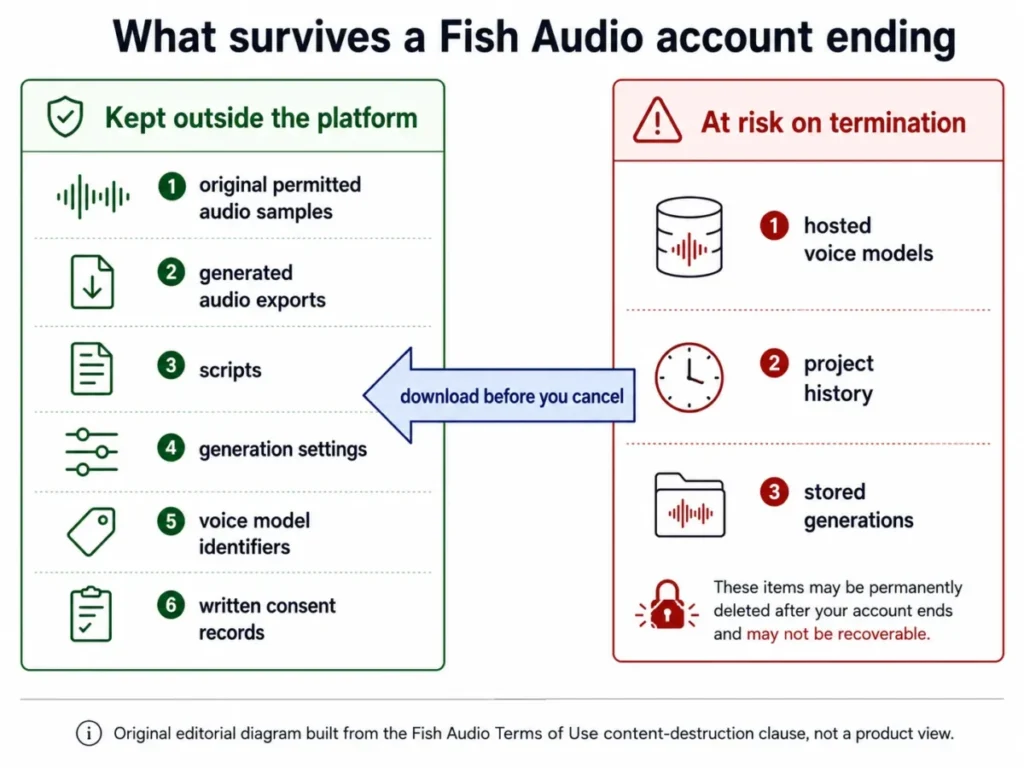
The backup discipline follows directly from the Terms. Account termination may destroy associated content, and the Terms recommend downloading content beforehand without promising recovery. The six items in the left column belong in your own storage from the first day of the project.
Migration is the related gap. No official bulk migration or import path for voice models, project histories, or automations is published, so switching platforms means rebuilding clones from source audio you kept, which is only possible if you kept it.
Support and Reliability
Support runs through a help center with a ticket route and topic paths covering credits, renewals, running out of credits, subscriptions, plan changes, cancellation, and password problems. That covers the billing questions a self-serve buyer files most often.
What is not published is a support commitment. No response-time target, escalation path, or plan-tiered service level appears on the pages I could reach, which matters more for a team putting a voice agent in front of customers than for a creator producing videos on a Tuesday.
Source: Fish Audio help center, checked 2026-07-31.
Reliability language is similarly split by model. The paid s2.1-pro offering carries production options for latency and data-processing guarantees, while the free model explicitly carries neither.
Third-party sentiment is thin and mixed, and I would not build a purchase on it. Public review profiles carry a small, self-selected sample with praise for naturalness and cloning speed alongside complaints about support responsiveness and credit handling, which is directional context rather than a measured reliability finding.
Fish Audio Limitations
The Free plan’s commercial rights are contradictory. The plan card says commercial use, the Terms restrict free use to personal and noncommercial purposes, and until that is clarified in writing every monetized project needs a paid plan.
Credits expire monthly. Unused capacity does not carry forward, so seasonal producers pay for months they do not use, and the API’s usage-based billing is the better structural fit for irregular workloads.
The free API has no published ceiling. Fair-use limits apply according to the model documentation, no threshold or reset cycle is disclosed, and the launch blog’s no-hard-cap wording pulls in the opposite direction.
Concurrency is bought, not earned. Five concurrent requests below $100 prepaid is a low ceiling for anything customer-facing, and the tier depends on prepaid amount rather than on usage history.
Team capacity stops without a published next step. Pro includes three seats and Max includes ten, and the pricing page publishes no price for the fourth or the eleventh user.
Self-serve privacy controls are absent. Zero data retention and on-premises deployment are Enterprise-only, while the Terms permit content and usage data to support model development on every tier.
Portability is undocumented. No bulk migration path exists for voice models or project history, and the Terms warn that termination may destroy content with no recovery guarantee.
Who Fish Audio Is Best For
Solo commercial creators with steady monthly output. Plus combines commercial licensing under the Terms, ten private voice slots, Voice Design, a 15,000-character input ceiling, and roughly 200 estimated minutes for $15 per month. That is a strong fit for a weekly video or podcast schedule.
Three-person localization or audiobook teams. Pro’s three seats, 30,000-character requests, five professional voice slots, and roughly 1,620 estimated minutes cover a real production pipeline, though I would validate consistency across a full chapter before committing annually.
Developers prototyping multilingual speech. The s2.1-pro-free model exposes production model quality and 83-language coverage at $0, which is the cheapest honest way to find out whether the voices work for your content.
Real-time voice-agent teams that can prepay. The paid s2.1-pro model, WebSocket streaming, and the LiveKit plugin cover the build, provided the team prepays into a concurrency tier that matches expected load and implements the documented error branches.
Agencies handling consented, non-confidential voices. Private and professional voice slots on Pro and Max support a managed voice program, as long as the client contract tolerates the platform’s model-development terms.
Who Should Avoid Fish Audio
Free-plan users publishing monetized work. The commercial-use conflict between the plan card and the Terms creates direct licensing exposure, and a paid plan or a vendor with unambiguous free commercial rights is the safer route.
Organizations that prohibit vendor model training. The Terms permit content and usage data to support AI model development, so a company with that restriction needs an Enterprise agreement or a different provider.
Teams that need a support commitment before signing. No published service level exists, and the seven-day Pro guarantee has no published eligibility conditions, which is a poor combination ahead of an annual payment.
Applications that need predictable free production capacity. An undisclosed fair-use ceiling with no latency or data-processing guarantees cannot carry a customer-facing workload.
Four- and eleven-person teams that need transparent seat pricing. The published seat ladder skips both counts, so a linear per-seat vendor removes a procurement conversation you do not need to have.
Fish Audio Alternatives
| Alternative | Better for | Why choose it instead |
|---|---|---|
| ElevenLabs | Buyers who need a more established enterprise ecosystem | A more mature workflow and support posture, at the cost of Fish Audio’s cheaper metered API |
| PlayHT | Teams that prefer its voice library or contracting model | Worth a direct comparison when the voice roster, not the price, is the deciding factor |
| Cartesia | Teams whose top requirement is low-latency conversational speech | A developer-first platform focused on real-time voice rather than creator subscriptions |
| Self-hosted Fish Speech | Teams that can run their own inference | Infrastructure control and no hosted data terms, in exchange for operating the models yourself |
Source: Fish Audio models overview documentation for the open-source counterpart, checked 2026-07-31. Alternative pricing and licensing terms require separate verification.
I have deliberately not published competitor prices or a quality ranking here. No controlled benchmark exists in this research set, and a comparative quality claim without one would be an opinion dressed as a measurement.
Choose ElevenLabs if procurement maturity and support commitments outrank unit cost. Choose Fish Audio if multilingual coverage, consented cloning, and metered API pricing matter more than vendor scale, and choose self-hosted Fish Speech if your infrastructure team would rather own the model than the contract.
For adjacent creator tooling, see the roundups of AI video generators and text to video AI generator tools. The roundup of AI tools for content creation covers what usually sits downstream of a voice track.
Final Verdict: Is Fish Audio Worth It?
Fish Audio is worth it for multilingual creators, consented voice-cloning workflows, and developers who want production model quality at a metered price. Plus at $15 per month is the honest entry point, because commercial rights, private voice slots, and Voice Design all start there and the Free plan cannot safely carry monetized work.
It is not worth it for regulated buyers, confidential voice assets, or applications that need a published support commitment. Those requirements point at an Enterprise contract, and an Enterprise contract turns this from a self-serve purchase into a procurement project.
Choose Pro if you have three people and real long-form volume, and price Max only when the tenth seat is genuinely occupied. Choose the paid s2.1-pro API over any studio plan if your output is bursty, because credits that expire monthly are a worse fit than bytes you pay for as you use them.
The evidence chain behind that verdict is short. Every documented capability above comes from Fish Audio’s official documentation or its pricing page, and each one carries an operating consequence for a named buyer.
The plan gate on commercial rights is the trade-off that decides the entry tier, so I recommend Plus for any monetized work and the paid API for bursty output. Choose Enterprise only when zero data retention is a hard requirement.
Before renewal, a buyer here should be able to answer one question: has the platform confirmed in writing what the Free plan’s commercial rights are, what the free API’s fair-use ceiling is, and what a fourth seat costs? If those three answers are still missing at renewal, the pricing you are committing to is not the pricing you can defend.
Frequently Asked Questions
The answers below repeat the evidence from the sections above rather than adding new facts.
Is Fish Audio free to use?
Yes, there is a Free plan at $0 with 8,000 monthly credits, roughly 7 minutes of audio, a 500-character limit per generation, and three public voice slots. The hosted API also lists a $0 model called s2.1-pro-free under fair-use limits.
Free is a real evaluation tier, but its commercial rights are contradictory across Fish Audio’s own pages.
Can I use Fish Audio commercially?
Not safely on the Free plan. The Terms of Use license paid users for commercial use and restrict free use to internal, personal, and noncommercial purposes, while the Free plan card advertises commercial use.
Until Fish Audio resolves that conflict in writing, treat Plus at $15 per month as the entry point for any monetized or client work.
How much does Fish Audio cost?
Plus is $15 per month or $66 billed annually, Pro is $100 per month or $450 billed annually, and Max is $999 per month or $8,988 billed annually. Enterprise uses custom annual pricing.
The hosted API is billed separately at $15 per 1 million UTF-8 bytes for the paid text-to-speech models, with no subscription attached.
Do Fish Audio credits roll over?
No. Subscription credits reset every month and unused credits do not carry forward.
Fish Audio states that roughly 600 to 625 credits produce one minute of audio, so budget in credits rather than minutes, and consider the metered API instead if your production volume swings between heavy and quiet months.
How much audio do I need to clone a voice?
At least 10 seconds of quiet, single-speaker audio recorded at a steady volume, according to Fish Audio’s cloning documentation. The same documentation requires that you only clone voices you own or have written permission to use.
Keep the consent record and the original file in your own storage, not only in the platform, because the Terms warn that termination may destroy hosted content.
Does Fish Audio have an API, and is the free one safe for production?
Yes, and no. The API covers text-to-speech, voice design, model creation, WebSocket streaming, and a Python SDK, billed pay-as-you-go with no subscription or minimum.
The free s2.1-pro-free model carries fair-use limits with no published threshold and no latency or data-processing guarantees, so use it for prototyping and price production capacity on paid s2.1-pro.
What happens when the Fish Audio API hits its concurrency limit?
The documentation defines a 429 rate-limit error but does not specify whether excess requests queue or fail. Concurrency is five requests below $100 prepaid, fifteen at $100 or more, and fifty at $1,000 or more.
Treat a 429 as a failed request, implement backoff, and prepay into the tier your expected load needs.
Does Fish Audio train on uploaded voices?
The Terms of Use state that usage data and content may be used to develop, train, or enhance AI and machine-learning models. Zero data retention is listed only for Enterprise.
For confidential voice assets or regulated data, that combination is a reason to negotiate an Enterprise agreement or choose another provider.
What languages does Fish Audio support?
The recommended production model, s2.1-pro, is documented for 83 languages, with the previous s2-pro generation covering more than 80. Legacy s1 covers 13 languages and more than 64 emotions on an older control syntax.
Fish Audio separately markets a library of more than 2 million voices, which is a vendor claim rather than a language count.
Is Fish Audio better than ElevenLabs?
No controlled benchmark in this research set supports a quality ranking either way. Fish Audio is the stronger fit for cost-sensitive multilingual work, consented cloning, and metered API usage.
ElevenLabs is the stronger fit when a more established enterprise ecosystem, procurement maturity, and support commitments outrank unit price.