

The right AI sales tool depends on the stage that slows your team down: Apollo.io for prospecting, Clay for enrichment, Instantly for cold email, Gong for calls and Salesloft for forecasting. This list covers AI sales tools that sit outside the CRM or plug into one, for small and mid-size business-to-business sales teams.
The deciding factor is the pricing unit: seat, account, credits, lead or quote. I built the ranking from each vendor’s pricing, plan and product pages, read in October 2026.
Quick verdict
Start with the tool for the stage that slows your team down most:
- Prospecting: Apollo.io, with a free plan and Basic at $49 per seat per month, billed annually
- Enrichment: Clay, with unlimited seats and CRM auto-sync from its Growth plan
- Cold email at volume: Instantly, with unlimited sending accounts on a $47-a-month plan
- Calls: Gong for coaching and deal analysis, Otter.ai for call notes on a budget
- Forecasting: Salesloft, which now sells Clari Forecast (clari.com/pricing lands on Salesloft as of October 2026)
- The trade-off: Gong, Outreach, Salesloft and ZoomInfo sell by quote, while the prospecting and email tools print their prices

Apollo.io
Best for: prospecting data and sequences in one seat
A contact database, sequences and a free plan come in the same account.
Limit: every seat on the account sits on the same plan

Clay
Best for: data enrichment workflows
Waterfall enrichment runs across 150+ data providers with unlimited seats.
Limit: CRM auto-sync starts on the Growth plan

Instantly
Best for: high-volume cold email
Unlimited email accounts and warmup come on a flat monthly plan.
Limit: 5,000 emails a month on the Growth plan

Gong
Best for: conversation intelligence
Calls, emails and meetings are captured and summarized, with CRM fields updated by AI.
Limit: per-user licenses plus a platform fee, priced by proposal
| Software | Best for | Starting price | Free plan or trial | Plan a 5-rep team needs | Key limitation |
|---|---|---|---|---|---|
| Apollo.io | Prospecting data and sequences | Basic $49 per seat per month, billed annually | Free plan; 14-day trial | Professional, $79 per seat per month, billed annually | All seats on one plan |
| ZoomInfo Copilot | Buyer intent signals | Custom quote | Free trial | Copilot Advanced, custom quote | Integrations carry a base cost |
| Hunter | Verified emails, unlimited users | Starter $34 a month, billed yearly | Free plan | Starter, $34 a month billed yearly, for 3 shared inboxes; Growth, $104 a month billed yearly, for one inbox per rep | 3 email accounts on Starter |
| HubSpot Prospecting Agent | AI prospecting inside HubSpot | $1 per recommended lead | No trial published | A paid HubSpot Hub plus credits | Needs HubSpot Credits |
| Clay | Data enrichment workflows | Launch $167 a month, billed annually | Free plan; 14-day trial | Launch, $167 a month billed annually; Growth, $446 a month billed annually, for CRM sync | Actions and data credits |
| Instantly | High-volume cold email | Growth Plan $47 a month, billed monthly | No trial published | Growth Plan, $47 a month | 5,000 emails a month |
| Lavender | Writing better sales emails | Starter $27 a month, billed annually | Free plan; 7-day trial | Team Plan, $89 per seat per month, billed annually | 5 free emails a month |
| Outreach | Sales engagement with AI agents | Custom quote | No trial published | Amplify Core, custom quote | AI credits meter agents |
| Gong | Conversation intelligence | Custom proposal | Trial on request | Custom proposal | Platform fee on top |
| Otter.ai | Budget call notes | Pro $8.33 per user per month, billed annually | Free Basic plan | Business, $19.99 per user per month, billed annually | Pro syncs CRM notes for 1 user |
| Salesloft | Sales forecasting | Talk to sales | No trial published | Custom quote | No published price |
| Salesforce Agentforce for Sales | Sales Cloud teams adding AI agents | From $125 per user per month | Sales Cloud 30-day trial | Core plus the add-on | Core and above only |
Sources: Apollo.io pricing, ZoomInfo pricing, Hunter pricing, HubSpot Prospecting Agent, Clay pricing, Instantly pricing, Lavender Email Coach pricing, Outreach pricing, Gong pricing, Otter.ai pricing, Salesloft pricing, Salesforce Sales Cloud pricing, checked Oct 2026.
In This Article (19 sections)
AI Sales Tools by Sales Stage
Each AI sales tool here works at one of five stages, and the stage tells you whether the AI writes for you or predicts and scores:
| Stage | What the AI does | Writes or predicts | Picks |
|---|---|---|---|
| Prospecting | Finds contacts, scores accounts against fit and intent signals | Predicts and scores | Apollo.io, ZoomInfo Copilot, Hunter, HubSpot Prospecting Agent |
| Enrichment | Fills missing emails, phones and company data from many providers | Predicts and researches | Clay |
| Outreach and writing | Drafts, scores and sends emails, answers replies | Writes | Instantly, Lavender, Outreach |
| Calls and conversation intelligence | Records, transcribes and summarizes calls, updates CRM fields | Writes and analyzes | Gong, Otter.ai |
| Forecasting | Predicts deal outcomes and rolls up the forecast | Predicts | Salesloft, Gong, Outreach |
Salesforce Agentforce for Sales spans every stage, but only inside Sales Cloud. An AI sales assistant at the prospecting stage works for the rep building lists; one at the forecasting stage works for the manager rolling up the number.
CRMs with AI built in are a different purchase, covered in my comparison of AI CRM software.
If the team still needs the process itself mapped, start with the guide to sales prospecting stages.
How I Chose These 12 AI Sales Tools
Besides the picks, I weighed the tools under Also Considered. A tool had to sit outside the CRM or plug into one, work at one of the five stages, and have an official pricing or packaging page. An AI add-on sold on a CRM counts, framed as an add-on.
The picks run in sales-stage order, from prospecting to forecasting, with Agentforce for Sales last because it spans every stage inside Sales Cloud.
| Software | Free plan or trial | Published price | CRM sync | Human control | Usage meter |
|---|---|---|---|---|---|
| Apollo.io | Free plan | Yes | Basic | Not listed | Credits |
| ZoomInfo Copilot | Free trial | No | Professional | Not listed | Credits |
| Hunter | Free plan | Yes | Yes | Not listed | Credits |
| HubSpot Prospecting Agent | Not listed | Yes | Native | Review emails | HubSpot Credits |
| Clay | Free plan | Yes | Growth | Not listed | Actions, data credits |
| Instantly | Not listed | Yes | Export | Not listed | Emails, contacts |
| Lavender | Free plan | Yes | Salesforce (Ora) | Not listed | Emails analyzed |
| Outreach | Not listed | No | Not listed | Not listed | AI credits |
| Gong | Trial on request | No | Yes | Not listed | Not listed |
| Otter.ai | Free plan | Yes | Pro (1 user) | Not listed | Minutes |
| Salesloft | Not listed | No | Not listed | Not listed | Not listed |
| Salesforce Agentforce for Sales | 30-day trial | Yes | Native | Not listed | Flex Credits |
Sources: Otter.ai pricing, Clay pricing, HubSpot knowledge base and the vendor pages under the comparison table, checked Oct 2026.
Every price, plan gate and limit comes from the vendors’ own pricing, product and help pages, read on October 26, 2026. Salesforce’s figures come from the Internet Archive’s copy of its pricing page dated October 10, 2026. Fit and cost math are my analysis.
Data quality, reply rates and note quality depend on your list and your calls. Test your top two on a sample of your own leads, compare bounce and reply rates, and ask quote-only vendors for a pilot on your own calls.
1. Apollo.io: Best for Prospecting Data and Sequences in One Seat

- Best for: founders and reps who find and email their own leads
- Starting price: Free; Basic $49 per seat per month, billed annually ($65 billed monthly)
- Free plan or trial: free plan with no time limit; 14-day trial on Basic and Professional
Apollo.io lets a rep search a contact database, enroll the lead in a sequence and track the deal from one seat, which makes it my pick for a small outbound team. The structural catch: all seats on an Apollo account sit on the same plan, so the rep with the heaviest needs sets the price for everyone.
Sending volume decides the plan. Free and Basic cap daily sends at 250 emails; Professional lists unlimited sends under a fair use policy. A rep who passes 250 sends a day has outgrown Basic.
AI and calls sit on Professional. Professional adds AI Lead Scoring and 4,000 minutes of call recordings with AI insights, against 150 minutes on Basic: five 30-minute discovery calls (5 x 30 = 150).
Credits expire. Credits are pooled across the team, granted at the start of each billing cycle and lost if unused, add-on credits included. An email costs 1 credit and a phone number 8, so a calling-heavy team drains the pool faster.
Against ZoomInfo Copilot, Apollo prints its prices and keeps a free plan; against Hunter, it costs more for a team but adds deals and a dialer. Apollo integrates with Salesforce, HubSpot, Outreach, Salesloft, Marketo, SendGrid and LinkedIn (no count published), and its free plan connects Gmail only.
Five reps on Professional pay $79 per seat per month, billed annually: $79 x 5 x 12 = $4,740 a year.
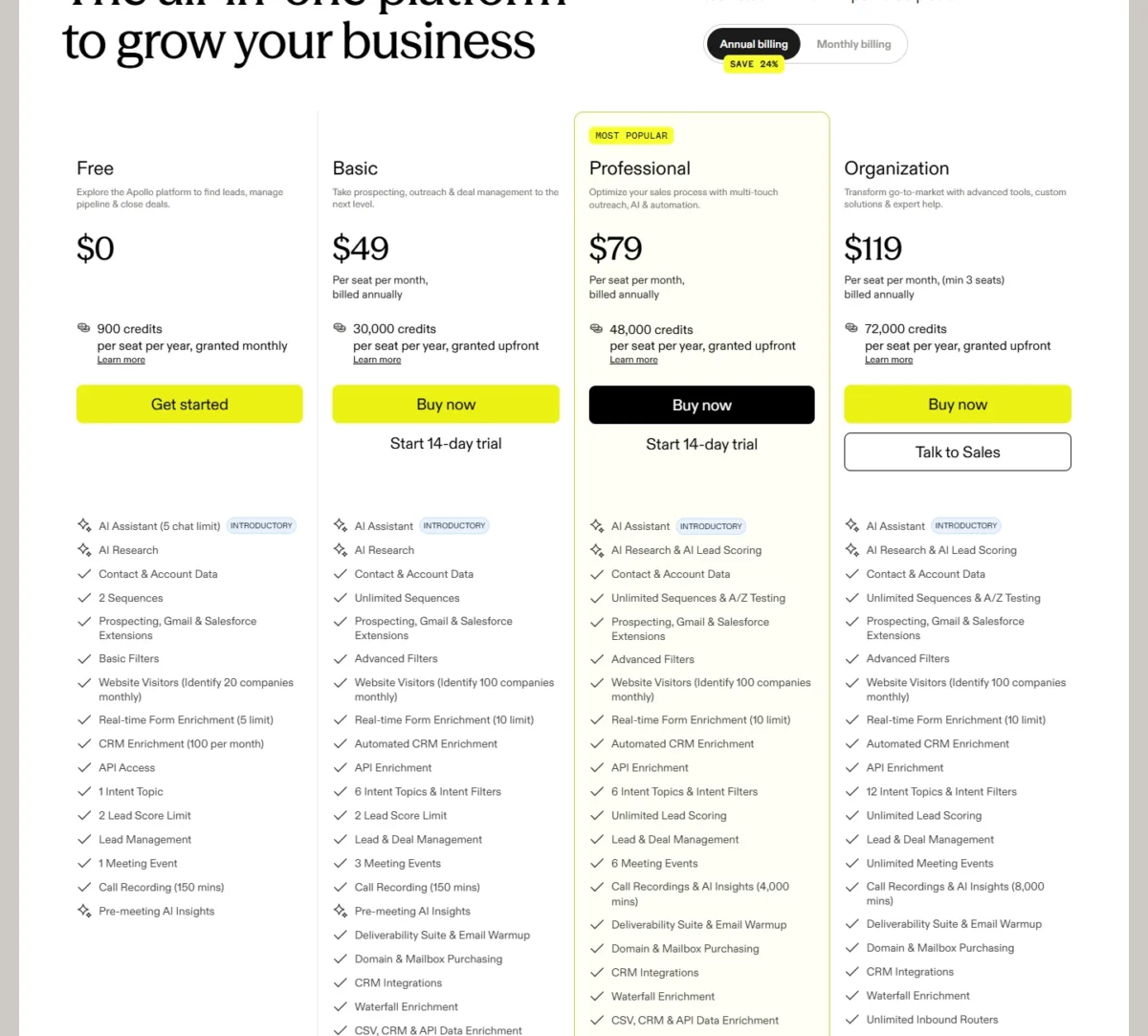
| Plan | Price | Billing | Key limit |
|---|---|---|---|
| Free | $0 | No charge | 2 sequences, 250 emails a day |
| Basic | $49 per seat per month ($65 monthly) | Annual or monthly | 150 call-recording minutes |
| Professional | $79 per seat per month ($99 monthly) | Annual or monthly | 4,000 call-recording minutes |
Sources: Apollo.io pricing page, annual and monthly billing views, checked Oct 2026.
Pros
- Contact data and unlimited sequences in one seat from Basic
- Free plan with 2 sequences and no time limit
- AI Lead Scoring and 4,000 call-recording minutes on Professional
Cons
- Every seat must sit on the same plan
- Credits expire at the end of each billing cycle
- Free and Basic cap sends at 250 emails a day
- Skip it if:
- you need intent signals on named enterprise accounts (go to ZoomInfo Copilot), or your team only needs verified emails without per-seat pricing (go to Hunter).
2. ZoomInfo Copilot: Best for Buyer Intent Signals and Account Priority
- Best for: mid-market and enterprise sellers working a list of target accounts
- Pricing: custom quote based on features, licenses and credit usage
- Intent data from: Copilot Advanced
ZoomInfo Copilot earns its place when the hard question is timing, not contact data. Copilot Advanced ranks target accounts with Buyer Intent signals, an Account Fit Score and website visitors, so reps call the accounts researching now. The price arrives as a quote, so buy it only with a defined account list.
Intent signals sit one tier up. Buyer Intent signals and AI talking points start on Copilot Advanced; real-time intent and Copilot chat need Copilot Enterprise.
Copilot does the research and the CRM work. ZoomInfo says Copilot researches accounts, writes emails, summarizes calls and updates CRM records, on what ZoomInfo describes as 300M+ contacts. Run the free trial on your own target accounts to check that claim.

Credits follow exports. Each export of a contact or company profile costs one credit. Pre-packaged integrations typically carry a base cost and a minimum purchase of bulk credits, so syncing to Salesforce or HubSpot adds to the quote.
Against Apollo.io, ZoomInfo Copilot trades a printed price for deeper account signals. ZoomInfo’s free entry point is ZoomInfo Lite, a permanent free tier with 10 monthly export credits. Copilot connects to Salesforce, HubSpot, Outreach, Salesloft and Gong; ZoomInfo does not publish an integration count.
ZoomInfo does not publish prices: its pricing page lists the packages and says the cost depends on features, the number of licenses and credit usage. Ask for a quote that names the credit allowance and the integration cost.
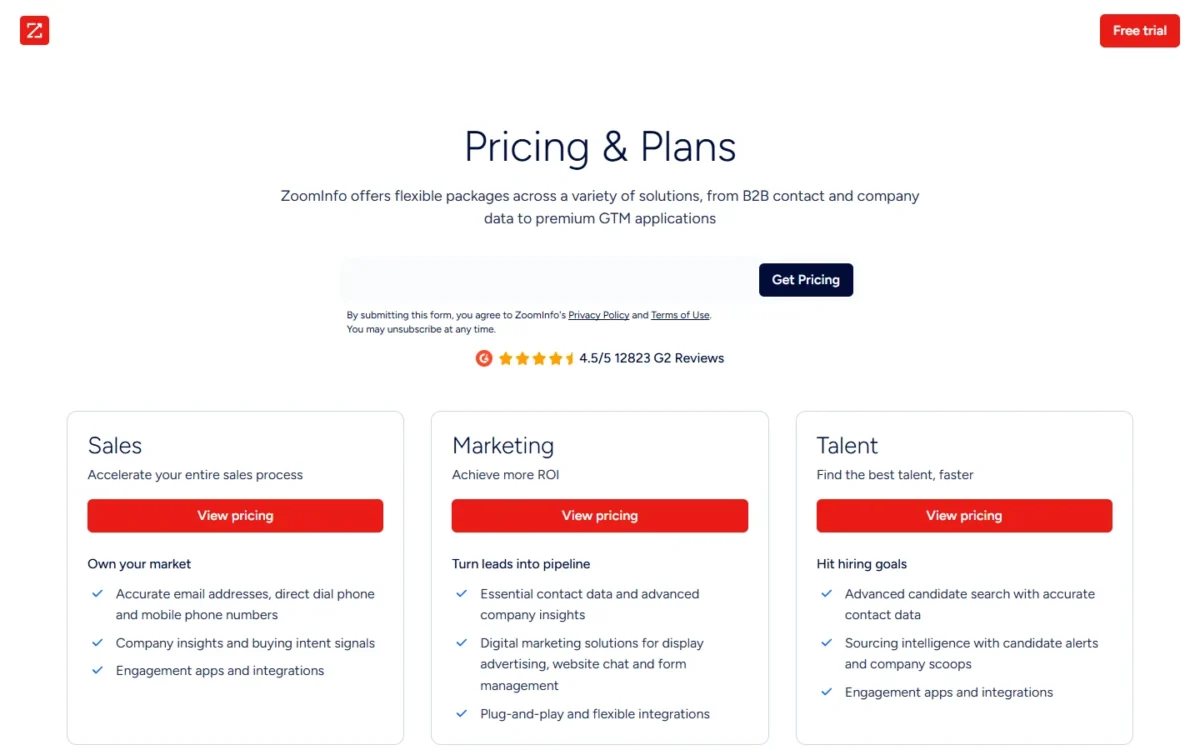
- ZoomInfo Professional: contact data, CRM integrations, AI email generation; custom quote
- Copilot Advanced: Buyer Intent signals, Account Fit Score, AI talking points; custom quote
- Copilot Enterprise: real-time buyer intent, Copilot chat; custom quote
Sources: ZoomInfo pricing page, checked Oct 2026.
Pros
- Buyer Intent signals and Account Fit Score on Copilot Advanced
- Copilot drafts emails, summarizes calls and updates CRM records
- Free trial before the contract
Cons
- No published price for any package
- Real-time intent needs Copilot Enterprise
- Integrations carry a base cost and a minimum credit purchase
- Skip it if:
- you need a printed price before you talk to sales (go to Apollo.io).
3. Hunter: Best for Finding and Verifying Emails With Unlimited Users
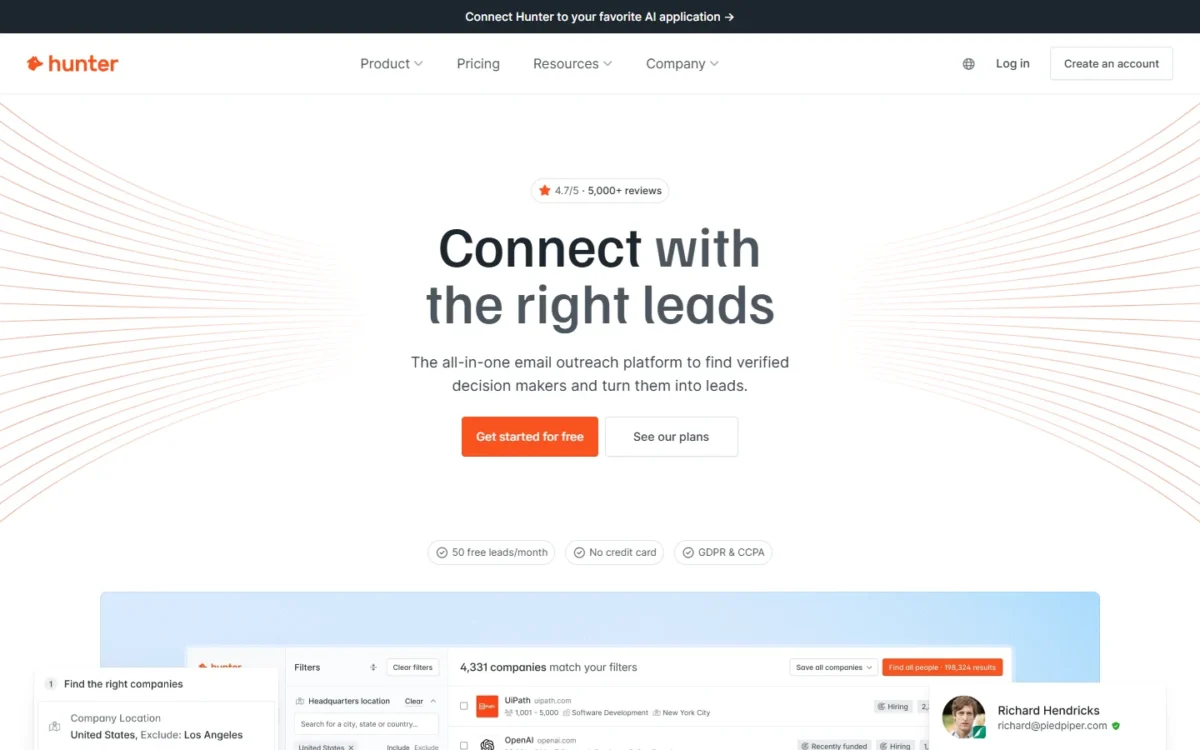
- Best for: small teams and agencies that need verified emails and light sequences
- Users: unlimited team members on every plan
- Credits: 1 per email found, 0.5 per email verified
Hunter prices the account, not the rep, which makes it my pick for a small team or agency that needs verified emails without paying per seat.
Five reps who can share 3 inboxes fit on one Starter plan, the lowest five-rep total in the cost table below. The trade-off is one shared pool of 2,000 credits a month.
Finding and verifying in one step. Paid plans add auto-verification and lead enrichment, and a search that finds nothing costs nothing. The AI Assistant in Discover runs 30 AI searches a month on Free and 150 on Starter.

Sequences are the ceiling. Starter connects 3 email accounts and sends to 2,500 recipients per sequence; Growth connects 10 and 5,000. A five-rep team sending from one inbox per rep needs Growth, at $104 a month billed yearly.
Against Apollo.io, Hunter wins on team cost but has no deal pipeline or dialer. It works through browser extensions, a Google Sheets add-on, CRM integrations, an API and MCP; Hunter does not publish an integration count.
The Hunter review covers the finder and verifier workflow in more depth.
Starter is $34 a month billed yearly, $408 for the year. Credits are shared by everyone on the account.
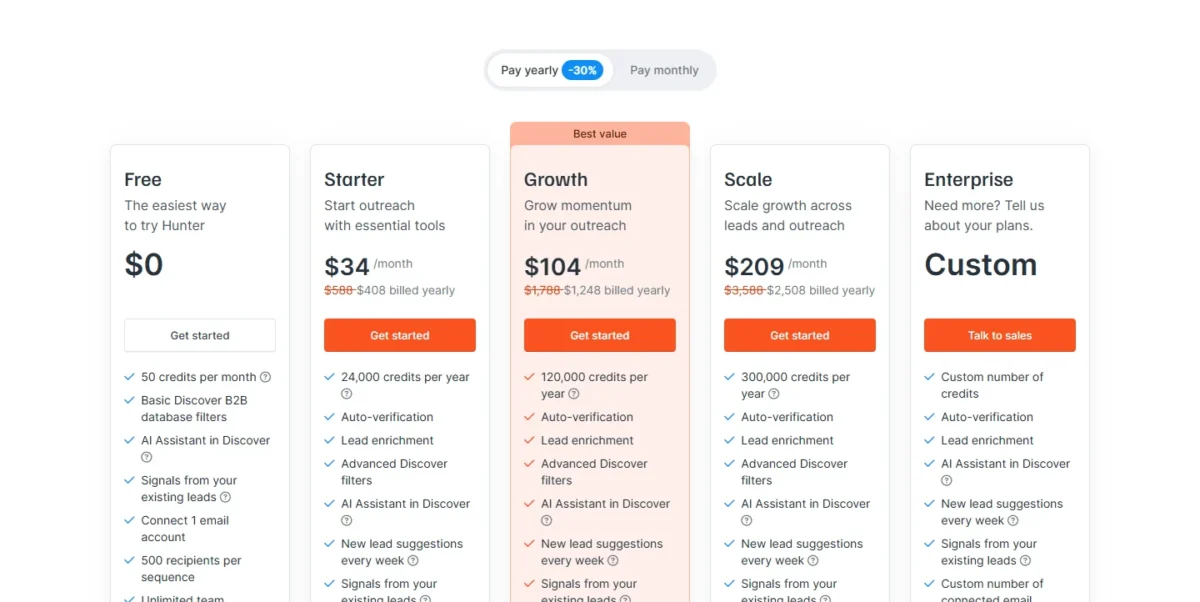
| Plan | Price | Billing | Key limit |
|---|---|---|---|
| Free | $0 | No charge | 50 credits a month, 1 email account |
| Starter | $34 a month ($49 monthly) | Yearly or monthly | 2,000 credits a month, 3 email accounts |
| Growth | $104 a month ($149 monthly) | Yearly or monthly | 10,000 credits a month, 10 email accounts |
Sources: Hunter pricing page, yearly and monthly views, checked Oct 2026.
Pros
- Unlimited team members on every plan, Free included
- Auto-verification and lead enrichment from Starter
- Searches that find no email cost no credit
Cons
- One shared credit pool for the whole team
- Starter connects only 3 email accounts
- No deal pipeline or dialer
- Skip it if:
- you send thousands of cold emails a month from many inboxes (go to Instantly).
Each Hunter plan gets its own walk-through in Hunter pricing explained.
4. HubSpot Prospecting Agent: Best for AI Prospecting Inside HubSpot
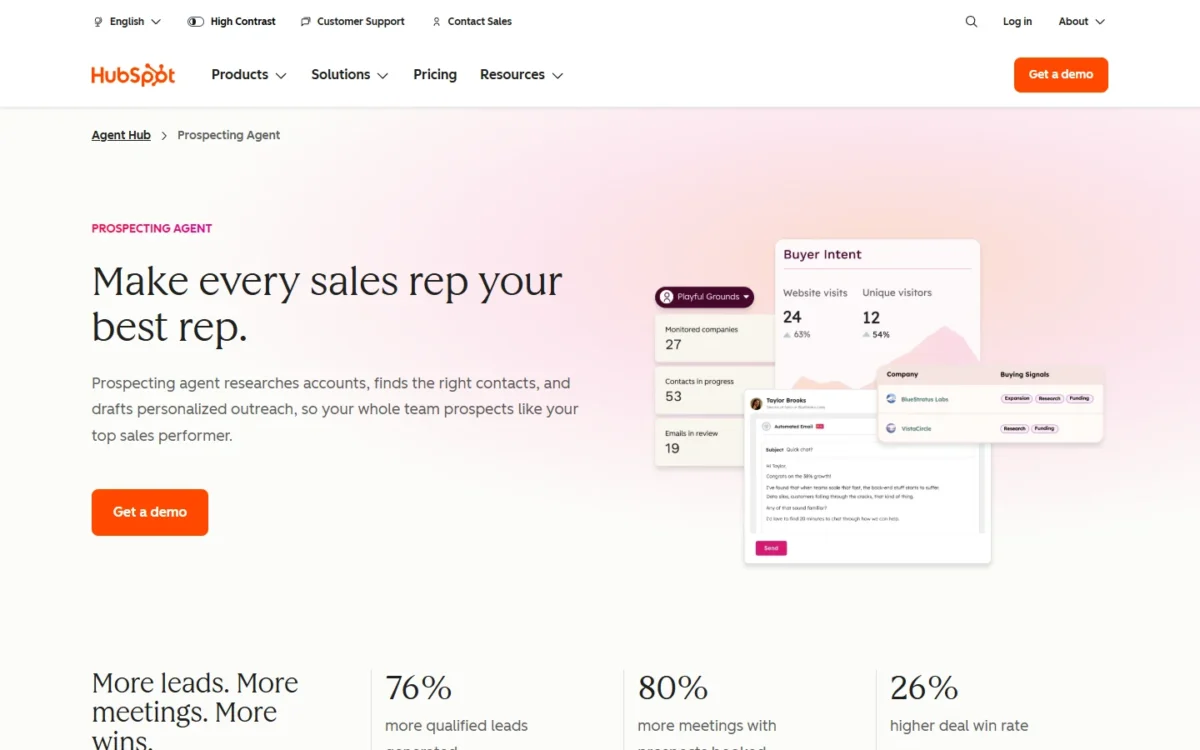
- Best for: teams already paying for a HubSpot Starter, Professional or Enterprise Hub
- Needs: a paid Hub or Smart CRM Professional or Enterprise, plus HubSpot Credits
- Human control: Review emails or Send without review
The HubSpot Prospecting Agent is an add-on, not a separate tool: it researches accounts, finds contacts and drafts outreach inside the CRM a HubSpot team already pays for. It is the only pick priced per recommended lead. The trade-off is lock-in, since it needs a paid HubSpot subscription and HubSpot Credits.
Signals pick the timing. The agent monitors buying signals such as funding rounds, leadership changes and site visits, scores accounts against your ideal customer profile and sources contacts with emails and phone numbers. A daily suggestion limit per play caps how many leads it surfaces.
You decide who presses send. Each play runs in Review emails mode, where a rep approves every message, or Send without review. Start in review mode, because the agent bills for every lead it recommends.
HubSpot says teams using the agent generate 76% more qualified leads, a figure from HubSpot’s agent page. Compare its picks with your reps’ own lists for a month before you trust it.
Credits come with the Hub. The agent uses HubSpot Credits when it writes outreach for a lead. Sales Hub Starter includes 500 credits a month and Professional 3,000, and unused credits do not roll over.
Against Salesforce Agentforce for Sales, the cost follows output rather than headcount. The Sales Hub plan underneath is a separate bill, laid out in the HubSpot pricing guide.
The agent costs $1 per lead it recommends outreach for, on top of a paid HubSpot subscription; extra HubSpot Credits cost $0.010 each. A team whose agent recommends 100 leads a month pays $1 x 100 x 12 = $1,200 a year for the agent.

| Item | Price | Billing | Key limit |
|---|---|---|---|
| Prospecting Agent | $1 per lead | When it recommends outreach | Needs a paid Hub and credits |
| Credits in Sales Hub Starter | 500 included | Monthly, no rollover | Not additive across products |
| Extra HubSpot Credits | $0.010 per credit | Packs or pay-as-you-go | Reset monthly |
Sources: HubSpot Prospecting Agent page, HubSpot Sales Hub pricing, checked Oct 2026.
Pros
- Charges per recommended lead, not per user
- Review emails mode keeps a rep in control of every send
- Finds contacts and drafts outreach without leaving HubSpot
Cons
- Needs a paid HubSpot subscription first
- Credit use grows with every lead the agent works
- Included credits do not roll over
- Skip it if:
- your team is not on HubSpot (go to Apollo.io for data and sequences, or Instantly for sending).
5. Clay: Best for Data Enrichment Workflows
- Best for: RevOps and growth teams building enrichment workflows
- Seats: unlimited seats and tables on every plan
- Trial: 14 days
Clay is enrichment plumbing rather than a contact database: it chains 150+ data providers so a row one source misses gets filled by the next. That makes it the pick for a team with someone who owns RevOps workflows. The trade-off is two usage meters, actions and data credits, and a CRM sync that waits for the Growth plan.
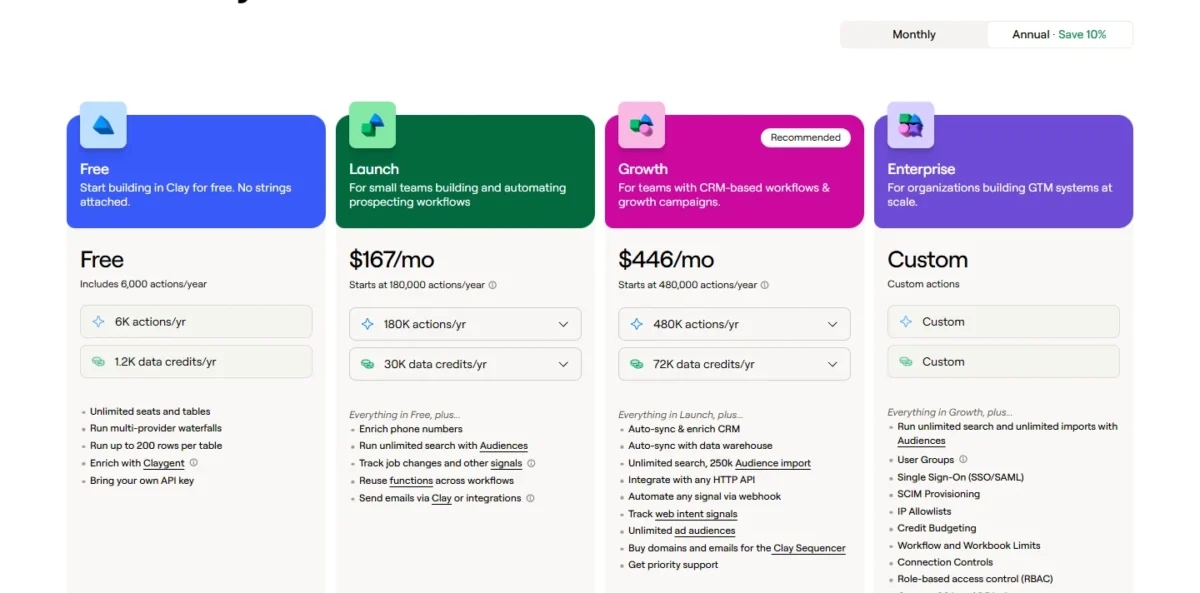
Waterfall enrichment and Claygent. Clay runs multi-provider waterfalls on every plan, and Claygent, its AI agent with web research, generates custom data points a provider does not sell. An enrichment that returns no result costs no actions or data credits.
CRM sync is the upgrade trigger. CRM integrations, HTTP API integrations and webhooks are not included on Free or Launch; they start on Growth.

Meters, not seats. Free includes 500 actions and 100 data credits a month and 200 rows per table. Data credits roll over up to 2x the monthly amount on Launch and Growth; actions reset each cycle.
Against ZoomInfo Copilot, Clay combines many providers instead of selling one database, and it prints its prices. On Growth it connects to Snowflake, BigQuery, Databricks, Postgres and Fivetran; Clay does not publish a CRM integration count.
Launch costs $167 a month on annual billing, with unlimited seats, so five reps pay $167 x 12 = $2,004 a year. Growth, the plan with CRM auto-sync, costs $446 a month billed annually.
| Plan | Price | Billing | Key limit |
|---|---|---|---|
| Free | $0 | No charge | 200 rows per table |
| Launch | $167 a month ($185 monthly) | Annual or monthly | No CRM integrations |
| Growth | $446 a month ($495 monthly) | Annual or monthly | 40,000 actions a month |
Sources: Clay pricing page, annual and monthly views, checked Oct 2026.
Pros
- Unlimited seats and tables, so the price does not grow with headcount
- Waterfall enrichment across 150+ providers
- Data credits roll over up to 2x on Launch and Growth
Cons
- CRM, HTTP API and webhook integrations start on Growth
- Two meters to watch: actions and data credits
- Free stops at 200 rows per table
- Skip it if:
- nobody on the team owns RevOps workflows and you want data and sequences ready to use (go to Apollo.io).
6. Instantly: Best for High-Volume Cold Email

- Best for: founders, agencies and SDR teams sending cold email at volume
- Included: unlimited email accounts and unlimited warmup
- AI writing: with an Instantly Credits plan
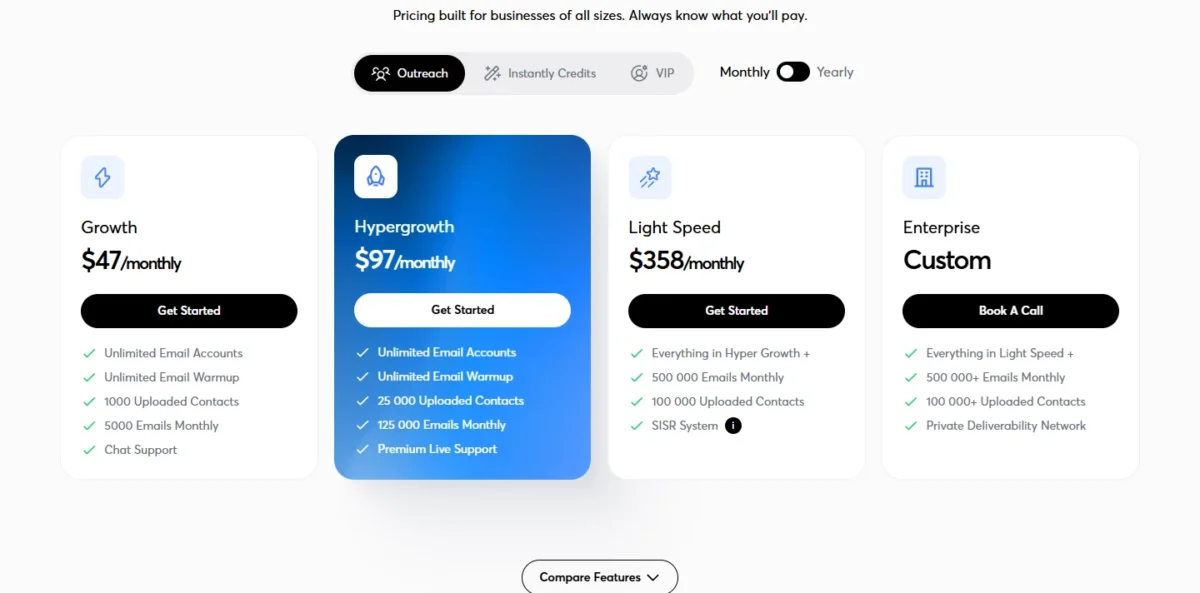
For a team whose problem is volume, Instantly connects and warms unlimited email accounts on one flat plan, so adding inboxes never adds cost. That makes it my pick for founders and agencies who run their own lists and copy. The trade-off is the monthly sending cap on the entry plan and AI writing sold separately.
Unlimited inboxes change the math. A team can spread sending across many warmed inboxes without paying per inbox. Hunter, by contrast, connects 3 accounts on Starter.
The AI sits in a separate credits plan. The AI Email Writer Agent, the Web Researcher Agent and a lead database Instantly puts at 450M+ contacts come with Instantly Credits, sold apart from the sending plan. The Starter bundle combines both.
Replies need the Scale bundle. Instantly lists its AI agent for replies, Unibox replies and advanced deliverability features in the Scale bundle, which also lifts sending to 100,000 emails and 25,000 uploaded contacts a month.
Instantly says campaigns run “completely on autopilot” once set up, and its pricing page lists no review step for AI-written emails. It exports to major CRMs and outreach tools and lists API and webhooks; Instantly does not publish an integration count.
The Instantly review covers deliverability settings and plan details before you buy.
The Growth Plan costs $47 a month for the plan on monthly billing, $47 x 12 = $564 a year for the whole team.
| Plan | Price | Billing | Key limit |
|---|---|---|---|
| Growth Plan | $47 a month | Monthly | 5,000 emails, 1,000 contacts a month |
| Starter bundle | $94 a month | Monthly | 1,500 Instantly Credits a month |
| Scale bundle | $194 a month | Monthly | 100,000 emails, 25,000 contacts a month |
Sources: Instantly pricing page, checked Oct 2026.
Pros
- Unlimited email accounts and warmup on the entry plan
- AI Reply Agent and Unibox replies in the Scale bundle
- A lead database with the credits plan
Cons
- Entry plan stops at 5,000 emails a month
- AI writing needs a credits plan on top of the sending plan
- No review step for AI-written emails on the pricing page
- Skip it if:
- your reps send a few hundred personal emails a week and each reply matters more than volume (go to Lavender).
7. Lavender: Best for Writing Better Sales Emails
- Best for: SDRs and AEs who write their own emails, and teams that want an email agent
- Email Coach: free Basic plan; paid plans from Starter, billed annually or monthly
- Ora agent: free to build, priced per agent at launch
Lavender coaches the human writer instead of replacing them, the opposite bet from Instantly. The Email Coach scores a rep’s email or template in the inbox and suggests fixes before it goes out, so the rep keeps the voice and the judgment. The trade-off is scale: the free tier analyzes 5 emails a month.
Scoring in the inbox. The coach integrates with Gmail, Outlook and the sales engagement tools on Lavender’s integration list, so reps keep their sending tool. The Personalization Assistant brings prospect data into the draft.
A dashboard for managers. The Team Plan adds the Coaching Dashboard, where a manager sees what works across the team’s emails and who needs help.

Ora sends for you. Ora, Lavender’s AI sales agent, takes leads by CSV upload or a Salesforce connection, researches the prospect, company and market, and writes the emails. At launch it sends 1k emails a month to 4k+ contacts a year per agent.
Against Instantly, Lavender optimizes each email rather than the number of inboxes. Lavender states it is SOC2-certified and GDPR-compliant, and it does not publish an integration count.
Five reps on the Team Plan pay $89 per seat per month billed annually, $89 x 5 x 12 = $5,340 a year, and one Ora agent costs $500 x 12 = $6,000 a year.
| Plan | Price | Billing | Key limit |
|---|---|---|---|
| Basic | $0 | Free | 5 emails analyzed a month |
| Starter | $27 a month ($29 monthly) | Annual or monthly | For individuals |
| Team Plan | $89 per seat per month ($99 monthly) | Annual or monthly | Coaching Dashboard included |
| Ora agent | $500 per agent per month | Monthly, no annual commitment | 1k emails a month per agent |
Sources: Lavender Email Coach pricing, yearly and monthly views, and Lavender Ora, checked Oct 2026.
Pros
- Coaches the rep’s own email inside Gmail, Outlook, Outreach and Salesloft
- Free Basic plan and a 7-day free trial with all integrations
- Ora takes leads from CSV uploads, with no annual commitment
Cons
- The free plan analyzes only 5 emails a month
- The coach has no sending infrastructure of its own
- Ora is priced per agent, not per email
- Skip it if:
- you need inboxes, warmup and sending capacity (go to Instantly).
8. Outreach: Best for Enterprise Sales Engagement With AI Agents

- Best for: mid-market and enterprise revenue teams
- Pricing: seats plus AI credits, custom quote
- Forecasting: Amplify Pro
Outreach suits a revenue team that wants sequences, call insights, deal management and (on its top package) forecasting from one vendor, with AI agents metered by credits. The trade-off: no price on the page, and AI use draws down a credit balance.
Agents by package. Amplify Core includes the Research, Personalization and Revenue agents with multi-channel sequences and 25,000 AI credits. Amplify Plus adds the Deal Agent and live coaching with 50,000 credits, and Amplify Pro adds AI Forecast Projection, Scenario Planner and Forecast Rollups with 100,000.
Credits meter the AI, seats meter access. Each AI action, such as generating a personalized message, deducts a set number of credits, and extra credit packs are sold on top. Size the credit package to the busiest month, not the average.
Outreach says Amplify Plus predicts deal outcomes “with 81% accuracy”, a figure from its pricing page. Ask to see it on your own closed deals.
Core and Plus list engagement, AI performance and revenue attribution reporting. Against Salesloft, Outreach publishes its package contents and credit counts, while Salesloft’s pricing page lists modules only. Outreach names Zoom, Teams, Meet, Webex and a Slack app; it does not publish an integration count.
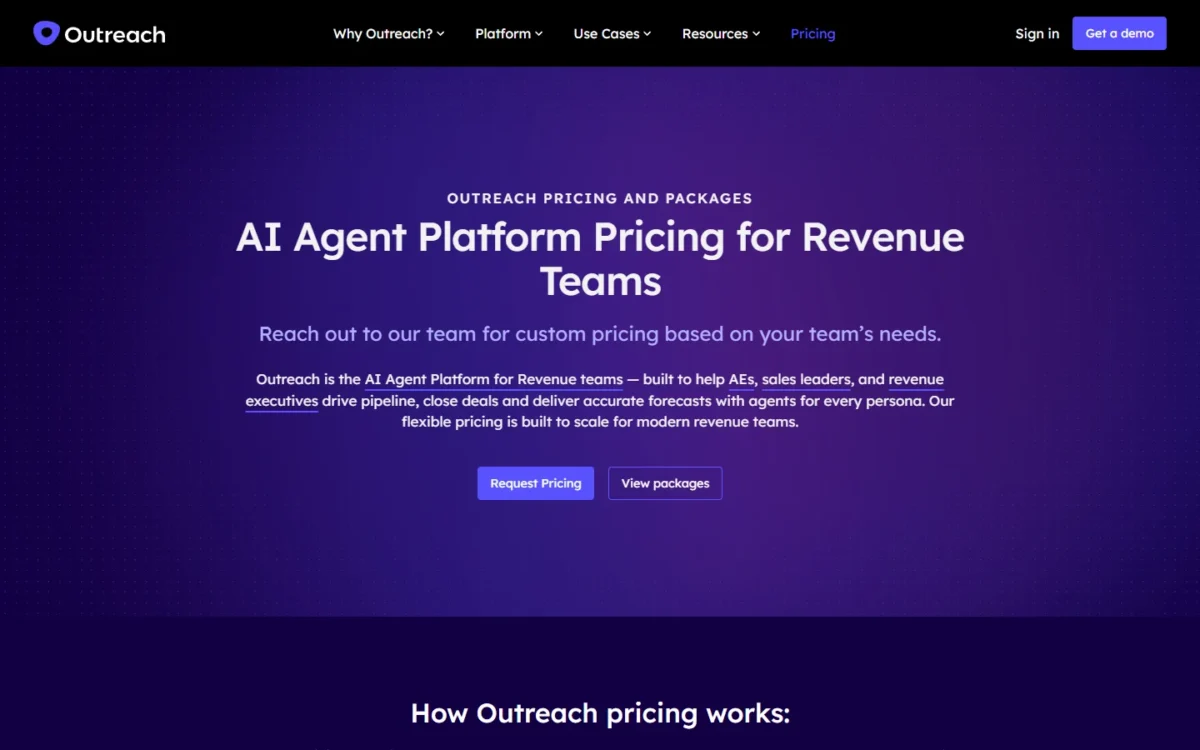
Outreach sells by custom quote: the price combines a seat for each user with a package of AI credits, and onboarding services are quoted separately. Ask for the credit cost of the actions your team will use most.
- Amplify Essentials: 10,000 AI credits, conversation intelligence and coaching; custom quote
- Amplify Core: 25,000 AI credits, AI agents and sequences; custom quote
- Amplify Plus: 50,000 AI credits, Deal Agent and live coaching; custom quote
- Amplify Pro: 100,000 AI credits, forecasting and managed services; custom quote
Sources: Outreach pricing page, checked Oct 2026.
Pros
- Sequences, conversation intelligence and deals in one platform
- Published package contents and AI credit counts
- Forecasting with Scenario Planner and Forecast Rollups on Amplify Pro
Cons
- No published price
- AI agents draw down credits, and extra packs are sold on top
- Forecasting only on the top package
- Skip it if:
- you need a printed price before a demo (go to Apollo.io or Instantly).
9. Gong: Best for Conversation Intelligence

- Best for: B2B teams whose managers coach from recorded calls
- Pricing: per-user licenses plus a platform fee, by custom proposal
- Trial: personalized demos, trial options on request
Gong is the pick when managers coach from real calls and want those signals to reach the deal and the forecast. It records and transcribes calls, meetings and emails, then lets AI agents write summaries and update CRM fields. The trade-off is a contract: per-user licenses plus a platform fee, with no published price.
Coaching from the record. Managers review real calls, find what top performers do differently and give feedback with the example attached.
Forecasting in two tiers. Forecast Essentials covers unlimited Deal Boards, Account Boards and the AI Deal Reviewer. Gong Forecast adds forecast submission, the AI Deal Predictor and the AI Revenue Predictor.
Gong says its model predicts deal outcomes with 20% more precision than algorithms based on CRM data, and that it is a Leader in the 2026 Gartner Magic Quadrant for Revenue Action Orchestration. Both claims come from Gong’s forecast page; a pilot on your own pipeline checks the first one.
Against Otter.ai, Gong adds deal and forecast analytics on top of notes. Gong names Salesforce and Zoom among its integrations and says integrating the existing stack is free; it does not publish an integration count.
Gong does not publish prices. The pricing page asks for team size and returns a custom proposal.

- Licenses: priced per user
- Platform fee: based on the number of users
- Integrations: free
Sources: Gong pricing page, checked Oct 2026.
Pros
- Records and transcribes calls, meetings and emails automatically
- AI agents write summaries and update CRM fields
- Forecast submission and deal prediction on Gong Forecast
Cons
- No published price, a proposal per team
- A platform fee on top of per-user licenses
- Trial options only on request
- Skip it if:
- you only need call notes synced to the CRM (go to Otter.ai).
10. Otter.ai: Best for Budget Call Notes
- Best for: small teams that need call notes in HubSpot or Salesforce
- Starting price: Basic free; Pro $8.33 per user per month, billed annually
- CRM note sync: 1 user on Pro, 5 on Business, unlimited on Enterprise
Otter.ai gets call notes into the CRM for a fraction of a conversation intelligence contract, which makes it the budget answer to Gong. It joins Zoom, Teams and Meet, writes summaries with action items, and syncs notes to Salesforce or HubSpot. The catch is a user limit on that sync, which pushes a team to Business.
The CRM sync limit decides the plan. Synced notes to Salesforce or HubSpot cover 1 user on Pro, 5 users on Business and unlimited users on Enterprise. A five-rep team on Pro gets one rep’s notes into the CRM.
Minutes and meeting length. Pro allows 1,200 minutes per user a month and 90 minutes per conversation; Business lifts meetings to unlimited and conversations to 4 hours. A Pro workspace holds up to 5 billed users, Business up to 25.
The sales features sit on Enterprise. The Otter Sales Notetaker and custom CRM and dialer integrations are listed on Enterprise, sold by demo.
Against Gong, Otter.ai prints its price and stops at notes. Otter lists Salesforce, HubSpot and Zapier integrations and an MCP server; it does not publish an integration count.
Business costs $19.99 per user per month on annual billing or $30 billed monthly, so five reps pay $19.99 x 5 x 12 = $1,199.40 a year.

| Plan | Price | Billing | Key limit |
|---|---|---|---|
| Basic | Free | No charge | 300 minutes per user a month |
| Pro | $8.33 per user per month ($16.99 monthly) | Annual or monthly | CRM note sync for 1 user |
| Business | $19.99 per user per month ($30 monthly) | Annual or monthly | CRM note sync for 5 users |
Sources: Otter.ai pricing page, annual and monthly views, checked Oct 2026.
Pros
- Printed per-user prices and a free Basic plan
- Notes sync to Salesforce or HubSpot for 5 users on Business
- Unlimited meetings and 4-hour conversations on Business
Cons
- Pro syncs CRM notes for only 1 user
- The Sales Notetaker needs Enterprise
- No deal risk or forecast analytics listed on any plan
- Skip it if:
- you need deal risk scoring or forecast analytics from your calls (go to Gong).
11. Salesloft: Best for Sales Forecasting
- Best for: revenue leaders who want forecasting and cadences from one vendor
- Forecasting: Clari Forecast, Inspect and Analytics
- AI: AI Forecast Agent, AI Agents and MCP
Salesloft is my forecasting pick because it now sells Clari Forecast next to its own cadences and call tools. As of October 2026, Clari’s pricing page lands on Salesloft’s talk-to-sales page, so a buyer comparing the two brands is comparing one vendor. The trade-off is a quote-only price.
Forecast and pipeline risk together. Clari Forecast predicts revenue, Inspect flags pipeline risk early, and Analytics supports revenue decisions. The AI Forecast Agent analyzes historical deal data and live rep activity, so the forecast reflects what reps did this week, not only CRM stages.
Execution in the same platform. Cadence engages buyers at scale and Conversation Intelligence turns calls into insight.
Against Gong Forecast, Salesloft pairs the forecast with a cadence tool; against Outreach Amplify Pro, it sells forecasting as its own module rather than the top package. Salesloft does not publish an integration list on its pricing or forecast pages.
Salesloft does not publish prices; its pricing page is a talk-to-sales form that lists the modules. Ask the quote to separate Clari Forecast from the Cadence and Conversation Intelligence seats.
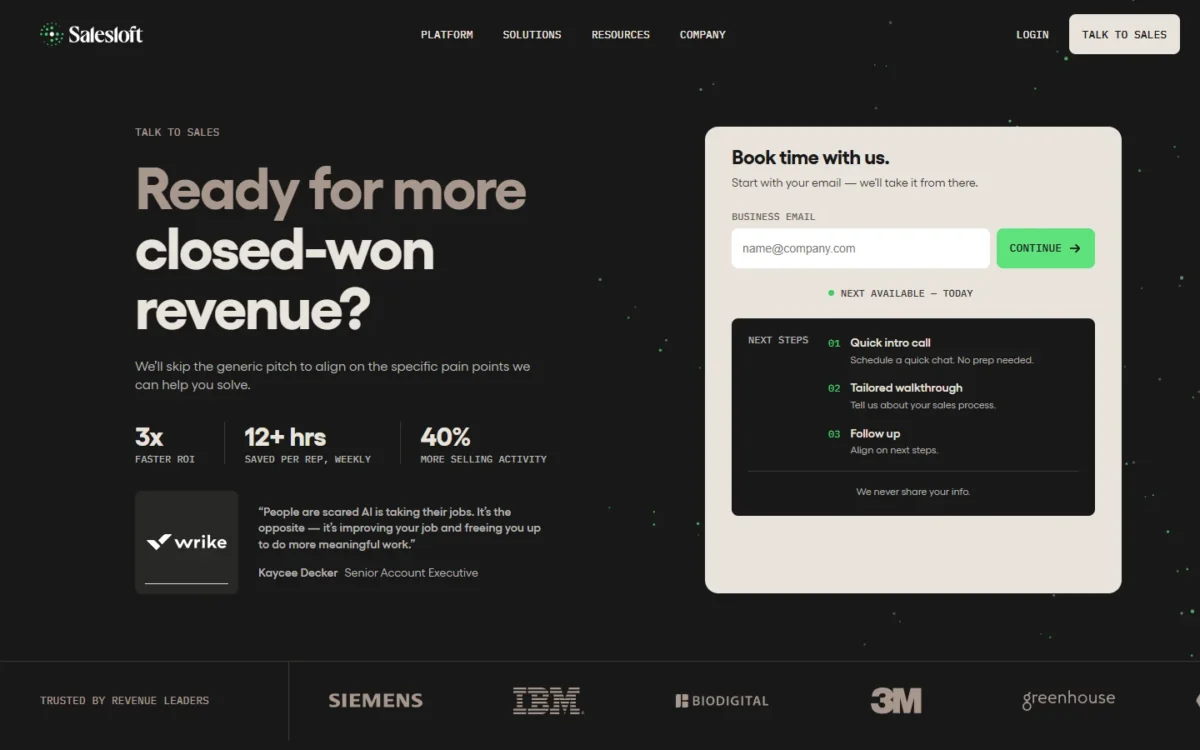
- Revenue execution: Cadence, Conversation Intelligence, Deals, Rhythm; custom quote
- Revenue intelligence: Clari Forecast, Inspect, Analytics; custom quote
- Platform: AI Agents, MCP, unified revenue data layer; custom quote
Sources: Salesloft pricing page, Salesloft forecast page, checked Oct 2026.
Pros
- Clari Forecast, Inspect and Analytics in one platform
- AI Forecast Agent uses deal history and live rep activity
- Cadence and Conversation Intelligence from the same vendor
Cons
- No published price
- No trial listed on the pricing page
- No integration list on its pricing or forecast pages
- Skip it if:
- you already run Gong for calls and want the forecast next to that data (go to Gong Forecast in Gong’s section).
12. Salesforce Agentforce for Sales: Best for Sales Cloud CRM Teams Adding AI Agents
- Best for: Sales Cloud customers on Core or above
- Included in: Max, with 2.75M Flex Credits per org per year
- Trial: Sales Cloud free for 30 days, no credit card
Agentforce for Sales only makes sense for a team already on Salesforce: AI can be added to Core and above. It brings predictive, generative and agentic AI to every step of the sales cycle inside Sales Cloud. The trade-off is that it is tied to Sales Cloud Core or above, with a per-user price stacked on the Core seat.
Stacked per-user pricing. The add-on price comes on top of the Core edition, so the AI layer is never bought alone. For a five-rep team that makes it the most expensive printed option on this list.
Max bundles it. Max includes Agentforce for Sales and Agentforce Coworker with 2.75M Flex Credits per org per year, and Salesforce notes that additional credits are available for purchase.
Against the HubSpot Prospecting Agent, Agentforce charges per user rather than per lead. The CRM edition prices underneath are laid out in the Salesforce pricing guide.
Agentforce for Sales starts at $125 per user per month on top of Core at $195 per user per month billed annually. For five reps, Core costs $195 x 5 x 12 = $11,700 a year and the add-on $125 x 5 x 12 = $7,500 a year.
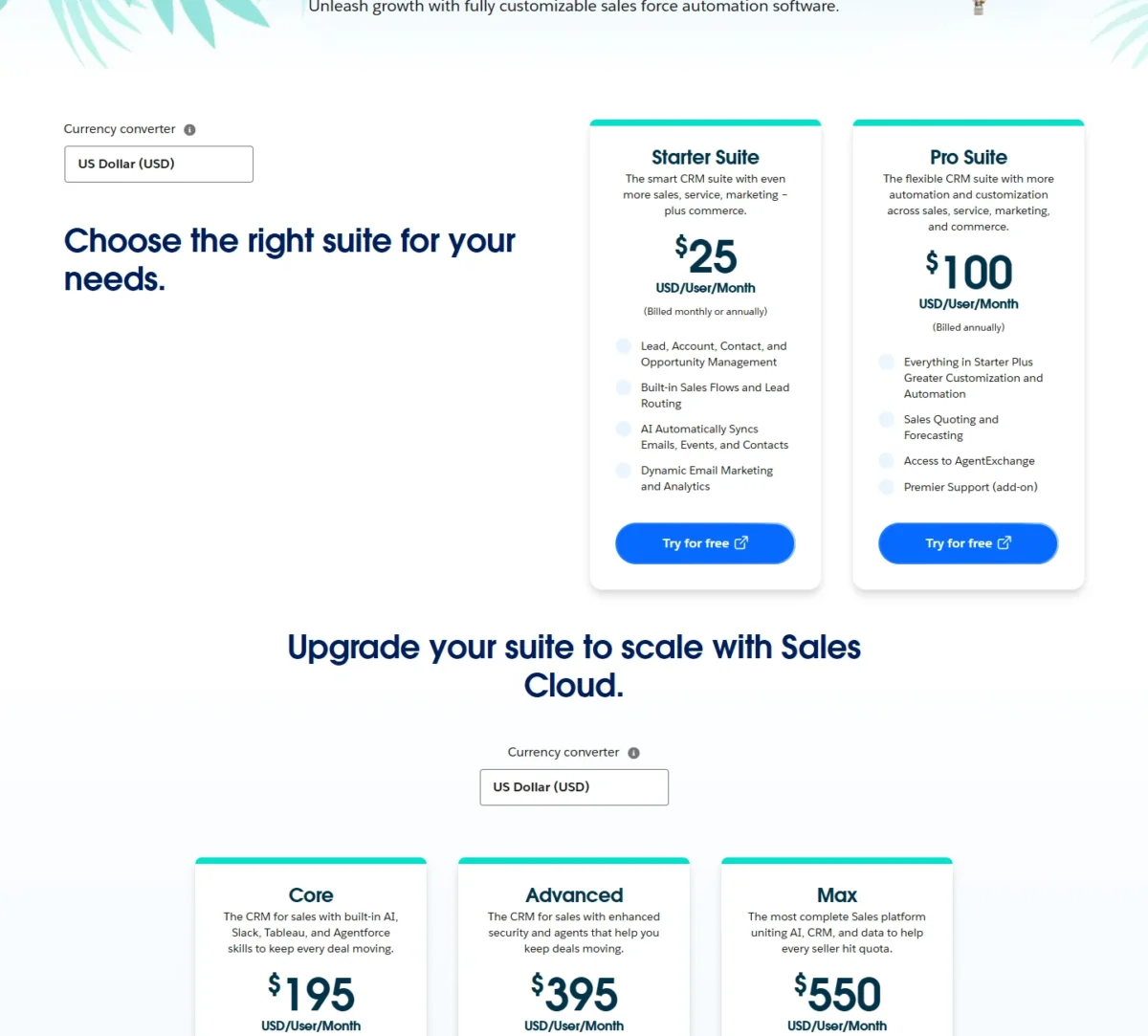
| Plan | Price | Billing | Key limit |
|---|---|---|---|
| Core | $195 per user per month | Annual | AI is an add-on |
| Agentforce for Sales add-on | From $125 per user per month | Sales quote | Core and above only |
| Max | $550 per user per month | Annual | Agentforce for Sales included |
Sources: Salesforce Sales Cloud pricing, Internet Archive copy of Oct 10, 2026, checked Oct 2026.
Pros
- Native to Sales Cloud, no extra vendor
- Predictive, generative and agentic AI across the sales cycle
- Max bundles the agents and the Flex Credits they draw on
Cons
- Only on Sales Cloud Core and above
- A per-user add-on on top of a per-user CRM seat
- Add-on pricing goes through a sales representative
- Skip it if:
- your team runs HubSpot (go to the HubSpot Prospecting Agent).
What a 5-Rep Team Pays per Year
A five-rep team pays from $408 a year (Hunter Starter, unlimited users sharing 3 inboxes) up to the Agentforce for Sales row on Sales Cloud Core, and four tools sell only by quote:
| Tool | Plan | Price used | 5-rep yearly total | What the total leaves out |
|---|---|---|---|---|
| Hunter | Starter, 3 shared inboxes | $34 a month for the account, billed yearly | $34 x 12 = $408 | One inbox per rep: Growth $104 x 12 = $1,248 |
| Instantly | Growth Plan | $47 a month for the plan, billed monthly | $47 x 12 = $564 | AI credits: Starter bundle $94 x 12 = $1,128 |
| Otter.ai | Business | $19.99 per user per month, billed annually | $19.99 x 5 x 12 = $1,199.40 | Sales Notetaker on Enterprise |
| HubSpot Prospecting Agent | Per lead | $1 per recommended lead, at 100 leads a month | $1 x 100 x 12 = $1,200 | The HubSpot subscription |
| Clay | Launch | $167 a month, billed annually, unlimited seats | $167 x 12 = $2,004 | CRM sync: Growth $446 x 12 = $5,352 |
| Apollo.io | Professional | $79 per seat per month, billed annually | $79 x 5 x 12 = $4,740 | Add-on credits; Basic is $49 x 5 x 12 = $2,940 |
| Lavender | Team Plan | $89 per seat per month, billed annually | $89 x 5 x 12 = $5,340 | Ora: $500 x 12 = $6,000 per agent |
| Salesforce Agentforce for Sales | Core plus add-on | $195 and $125 per user per month | $195 x 5 x 12 = $11,700 plus $125 x 5 x 12 = $7,500, which is $19,200 | Flex Credits |
| ZoomInfo Copilot, Outreach, Gong, Salesloft | Custom | Quote | Quote | Everything until the proposal |
Sources: Hunter pricing, Instantly pricing, Otter.ai pricing, HubSpot Prospecting Agent, Clay pricing, Apollo.io pricing, Lavender pricing, Salesforce pricing, checked Oct 2026. Totals exclude tax.
Hunter, Instantly and Clay price the account, so five reps cost the same as one. Per-seat tools (Apollo.io, Lavender, Otter.ai, Agentforce) scale with every hire: a team planning to double should budget those rows twice.
How to Choose an AI Sales Tool
Start from your slowest stage, then let your CRM and your budget decide between the picks for it:
| Your priority | Pick | Plan to start on | Trade-off |
|---|---|---|---|
| Prospecting data on a small budget | Apollo.io or Hunter | Free, then Basic or Starter | Apollo bills per seat; Hunter has no deal pipeline |
| Buyer intent signals | ZoomInfo Copilot | Copilot Advanced | Quote only |
| Already on HubSpot | HubSpot Prospecting Agent | A paid Hub plus credits | Works only in HubSpot |
| Enrichment across providers | Clay | Launch; Growth for CRM sync | Two usage meters |
| Cold email at volume | Instantly | Growth Plan | Monthly sending cap |
| Better emails from your reps | Lavender | Email Coach Starter or Team Plan | No sending of its own |
| Call notes in the CRM on a budget | Otter.ai | Business | Sales Notetaker on Enterprise |
| Call coaching and deal risk | Gong | Custom proposal | Platform fee |
| Forecasting | Salesloft, Gong or Outreach | Clari Forecast, Gong Forecast or Amplify Pro | All quote only |
| Already on Sales Cloud | Agentforce for Sales | Core and above | Add-on on top of Core |
Sources: the vendor pricing pages under the comparison table, including Instantly pricing and Otter.ai pricing, checked Oct 2026.
The tools combine: a common small-team stack is Hunter or Apollo.io for data, Instantly for sending and Otter.ai for call notes, with no quote-only contract. For the wider picture across the jobs a small business runs, see AI tools for small business.
An agent that prospects on its own is not the same as a hire, and what an AI SDR can and cannot do covers that decision.
If the CRM these tools plug into is still undecided, settle it first with my ranking of the best CRM for sales teams.
Also Considered
These tools fit part of the job but stayed off the list:
- Seamless.AI: prospecting data; its pricing page is an inquiry form, while Apollo.io prints prices.
- Clari: forecasting; clari.com/pricing now lands on Salesloft, so it is covered in the Salesloft section.
- Reply.io: multichannel sequences priced per user per month, where Instantly prices the plan, not the rep.
- Amplemarket: prospecting and sequences from $600 a month with 2 users included, well above Apollo.io’s entry price.
- Cognism: prospecting data in Standard and Pro packages with 5 seats included and no printed price.
- LinkedIn Sales Navigator: lead and account recommendations, with Account IQ, Lead IQ and Message Assist across its Core, Advanced and Advanced Plus plans; it pairs with a pick rather than replacing one.
- 6sense: multi-source intent and buying-group signals on target accounts, a job ZoomInfo Copilot already covers here.
- HubSpot Sales Hub: sales software on HubSpot’s CRM; its Prospecting Agent has its own section above.
- Salesforce Sales Cloud: a CRM; its AI add-on, Agentforce for Sales, has its own section above.
- Pipedrive: a CRM, so it belongs with the AI CRMs, not this list.
- Highspot: sales enablement content, a job outside the five stages here.
- SPOTIO: field-sales routing, a job outside the five stages here.
FAQ
Which AI tool is best for sales?
No single tool wins every stage, so pick by job: Apollo.io for prospecting, Clay for enrichment, Instantly for cold email, Gong for calls and Salesloft for forecasting. With one budget line, start where reps lose the most hours.
Are there free AI sales tools?
Yes: Apollo.io, Hunter (50 credits a month), Clay, Otter.ai (Basic) and Lavender’s Email Coach all have free plans. ZoomInfo offers a free trial and Sales Cloud a 30-day trial. Use the free tiers to test data and note quality on your own leads before you pay.
Do I need an AI sales tool if my CRM already has AI?
Only if your CRM edition does not cover the job. HubSpot’s agent and Agentforce for Sales are paid add-ons on top of the CRM, and data, sending and call tools still sit outside it. For marketing jobs next to sales, my guide to sales and marketing software covers the wider stack.
Final Verdict
By stage, pick Apollo.io for prospecting, Clay for enrichment, Instantly for cold email, Gong for calls and Salesloft for forecasting; no standalone tool covers all five, and Agentforce for Sales spans them only inside Sales Cloud.
By budget, Hunter and Instantly price the account, not the rep: Hunter Starter costs a five-rep team $408 a year if the reps share 3 inboxes, and Instantly’s Growth Plan $564 a year without AI writing.
Gong, Outreach, Salesloft and ZoomInfo Copilot need a proposal, so bring your own calls or account list to the pilot.
By CRM, a HubSpot team gets the Prospecting Agent at $1 per recommended lead, and a Sales Cloud team gets Agentforce for Sales as an add-on on Core or above. Budget the CRM plan underneath before comparing either with a standalone tool.



Pingback: Instantly.ai Review 2026: $47 Plan, Add-On Costs & Verdict
Pingback: Hunter.io Review: Hunter.io Email Finder, Verifier & Pricing