
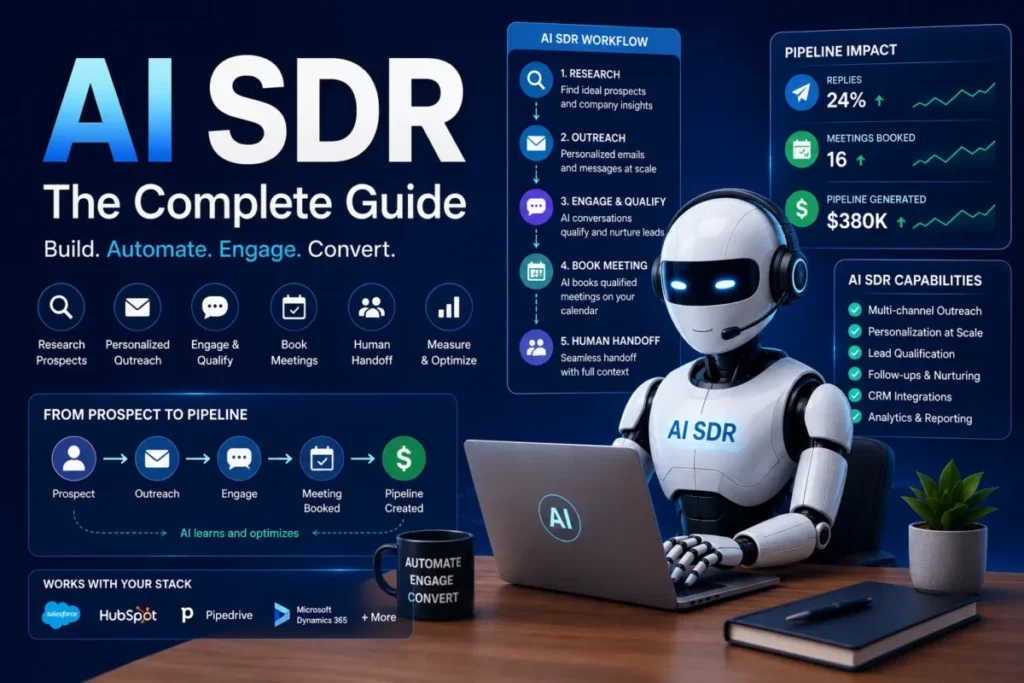
Most AI SDR budgets get approved on a demo that shows message volume, then get questioned four months later when nobody can prove the pipeline moved. An AI SDR is software that owns part of sales development work: identifying prospects, engaging them, qualifying them, and handing the qualified ones to a human rep.
That definition sounds narrow until you notice that inbound qualification, cold outbound, and CRM-grounded prospecting are three different builds sold under one label. I would settle which motion you are buying before comparing a single price.
Quick answer. An AI SDR automates top-of-funnel sales development: prospect research, outreach, qualification, meeting booking, and handoff. It differs from a sequencer because it owns the decision, not only the send. Deploy it once CRM ownership, suppression rules, and qualification criteria are defined, and keep a human on anything the approved evidence does not cover.
In This Article (27 sections)
Do You Need an AI SDR Yet?
Five conditions decide this, and none of them is the price. You need enough qualified demand or enough addressable accounts that a human cannot work the list, and you need a qualification definition that two people would apply the same way.
You also need a CRM whose ownership, lifecycle, and suppression fields can be trusted, because an agent scales whatever is already in those fields. If duplicate records and stale owners are normal in your instance, an AI SDR turns a quiet data problem into a loud buyer-experience problem.
The last condition is capacity on the human side. Booking more meetings helps nobody if the reps who receive them are already at capacity, and comparing AI CRM software options is a distraction until that is settled.
Skip the purchase for now if your inbound volume is small enough for one person, if nobody owns RevOps, or if your qualification rules exist only in a manager’s head.
What Is an AI SDR?
At the simplest level, an AI SDR is a software worker that does the repetitive front half of a sales development job. Salesforce describes the category as an AI-powered sales development representative aimed at automating top-of-funnel work such as qualification, outreach, and engagement, according to its official AI SDR overview.
Technically, it is an orchestration layer over a language model, a data layer, and an execution layer. The model drafts and classifies, the CRM and enrichment sources supply the facts, and the sending or chat infrastructure carries out the action while writing state back to the CRM.
Commercially, the product you are buying is a bundle of decisions: who to contact, what may be claimed, which channel to use, when to hand off, and when to stop. That last item is where most of the buyer risk sits.
The five-layer operating loop
I use five layers to separate what the agent decides from what it merely writes. Calling them TARGET, TRUST, TOUCH, TRANSFER, and TRACK keeps prompts, controls, and metrics attached to the same structure.
TARGET answers who should be worked and why now. TRUST fixes what the agent may believe and say.
TOUCH covers channel, sequence, personalization, and reply states. TRANSFER moves ownership to a human at the right moment.
TRACK measures qualified outcomes, safety, and cost against a baseline.
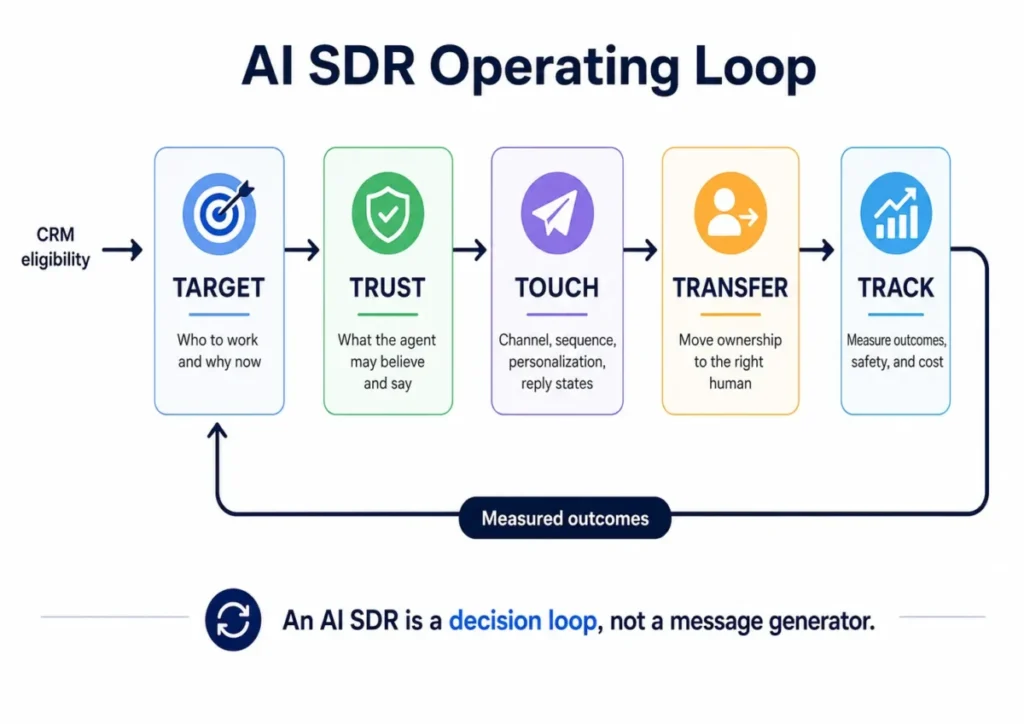
The loop matters because failures are almost always upstream of the text. A weak message is usually a TARGET or TRUST failure that arrived wearing a TOUCH costume.
AI SDR vs the Categories It Gets Confused With
Buyers compare an autonomous outbound agent against a sequencer against a chat widget and then wonder why the prices make no sense. These are different jobs.
| Category | When to use it | Key difference from an AI SDR |
|---|---|---|
| AI SDR | You want software to own targeting, outreach, qualification, and handoff | It makes the decision, not only the send |
| AI sales assistant | A human still owns the motion and wants research and drafting help | Output is prepared work, not executed work |
| Sales engagement platform | Reps need sequences, tasks, dialing, and analytics | It schedules human activity rather than replacing the judgment |
| Data and enrichment layer | Account and contact records need discovery, verification, or scoring | It supplies facts to an agent instead of acting on them |
| Sending infrastructure | Outbound needs mailboxes, domains, warmup, and bounce handling | It delivers messages and proves nothing about relevance |
A tool can sit in two of these rows at once, which is fine. The mistake is buying a row-four product and expecting row-one outcomes.
The AI SDR Workflow Map
Every AI SDR deployment runs the same eight stages, whether the vendor calls them agents, workers, or sequences. Mapping them once gives you a single sheet to configure against, audit against, and argue with a vendor demo against.
The first table covers what happens and who approves it. The second covers what the stage leaves behind in the CRM and how you know it is working.
| Stage | Trigger that starts it | What the agent does | Human gate |
|---|---|---|---|
| Eligibility | New lead, list load, signal, or CRM enrollment | Dedupes, checks customer and opportunity state, applies suppression, resolves owner | None once the rules are written; exceptions escalate |
| Evidence | A record clears eligibility | Enriches missing decision fields, finds a dated reason to engage, scores confidence | Review when confidence sits below the threshold |
| Message | A verified reason to engage exists | Drafts from the approved claim list only, selects channel and cadence | Approve before send until the segment is proven |
| Send | The draft clears the claim check | Sends through approved infrastructure, respects channel and volume policy | None inside a proven segment |
| Reply | Any inbound response | Classifies the state, runs the deterministic action first | Escalate objection, pricing, legal, security, ambiguous |
| Qualify | A substantive reply or inbound request | Applies explicit criteria, collects only permitted fields, offers a meeting when the threshold is met | Review disqualifications on a sample |
| Transfer | Qualification threshold met, or escalation triggered | Builds the handoff record, books the meeting, routes to the named owner | Rep accepts or rejects with a reason |
| Measure | End of each review cycle | Assembles cohort metrics against the baseline | Owner decides scale, hold, revise, or stop |
| Stage | What it writes to the CRM | Metric it produces | Stop rule |
|---|---|---|---|
| Eligibility | Exclusion reason, suppression state, owner | Eligible lead coverage, suppression failure rate | Any suppression breach halts the cohort |
| Evidence | Source, date, and confidence on each decision field | Data freshness pass rate, valid-contact rate | No verified reason means no outreach |
| Message | Draft version, claim references, approval state | Unsupported-claim rate | An unsupported claim blocks the send |
| Send | Activity log, channel, timestamp | Bounce rate, delivery volume | Bounce or complaint movement against baseline |
| Reply | Reply state, suppression events, routing decision | Positive, qualified, and negative reply rates | Misclassification rate that creates rep rework |
| Qualify | Qualification evidence, disqualifier, unanswered questions | Qualified lead rate, meeting-booked rate | Qualification drift against the written definition |
| Transfer | Handoff record, owner, next step, commitments made | Complete-handoff rate, rep acceptance rate | Acceptance rate falling below the human baseline |
| Measure | Cohort tags and attribution fields | Meetings held, opportunities, cost per held meeting | Cost per held meeting above the human baseline |
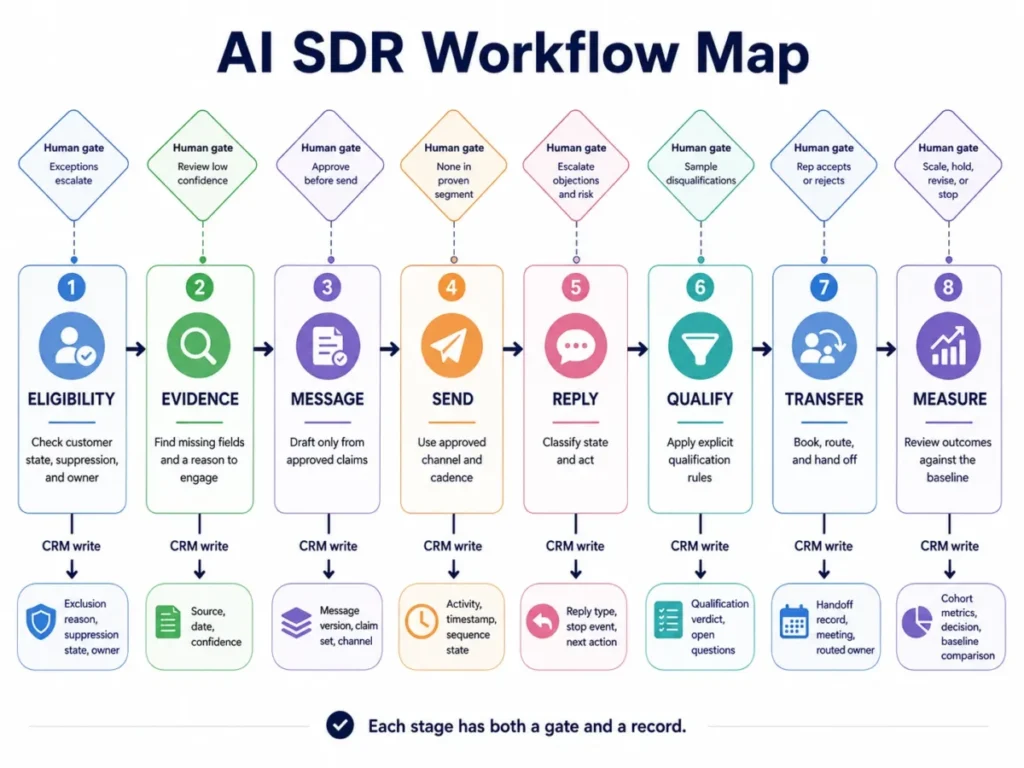
Read the two tables together as one contract. Each stage names its owner, its input, its output, its metric, and the failure mode that stops it.
If a stage has no CRM write, it produces no metric, and a stage with no metric is a stage nobody can govern.
Inbound and Outbound Are Different Builds
Salesforce draws the same line and notes that a fully autonomous end-to-end outbound motion is more complex than inbound qualification. Inbound starts from a known person who raised a hand; outbound starts from a hypothesis you have to defend.
| Decision dimension | Inbound motion | Outbound motion |
|---|---|---|
| Entry point | Form, chat, product signal, or CRM enrollment | Account list, intent signal, job change, or research |
| Primary data source | Session context plus existing CRM record | Enrichment plus signal evidence plus CRM history |
| Dominant risk | Slow or wrong routing, unsupported answers | Fabricated personalization, deliverability damage |
| First metric that matters | Response latency and handoff completeness | Qualified reply rate and suppression accuracy |
| Human control point | Escalation on unsupported questions | Approval before send until the segment is proven |
Inbound is the easier first deployment because the buyer already consented to a conversation, and because scoring rules built for how lead scoring works usually already exist.
Outbound is where autonomy costs money if it goes wrong. I would run outbound behind an approval gate until one narrow segment produces clean replies.
The inbound workflow, step by step
The documented pattern runs in six steps. Detect intent and retrieve approved context, collect only the permitted qualification fields, then evaluate fit against explicit criteria.
Answer routine questions from approved knowledge, offer a meeting and route to the correct owner, then write the qualification evidence and next action to the CRM.
Qualified positions Piper around exactly this surface area: website conversations, email, meeting scheduling, personalized offers, Slack collaboration, and top-of-funnel nurture, according to the Qualified AI SDR product page.
The failure points are stale CRM state, missing ownership, vague qualification criteria, and answers that wander outside approved knowledge. Each of those is a configuration problem, not a model problem, which is also why the fix belongs in the lead management workflow rather than in the prompt.
The outbound workflow, step by step
Outbound adds three steps that inbound does not need: negative eligibility checks, a reason-to-engage standard, and an approval gate that only relaxes after evidence. The sequence is qualify the account and person, gather verifiable facts, run suppression and ownership checks, pick channel and sequence, draft from approved claims only, gate the send, log the touch, then classify the reply.
AiSDR documents the CRM half of that loop directly: two-way HubSpot and Salesforce synchronization, CRM-triggered outreach, activity writeback, suppression-list use, and qualified-lead routing on its platform overview. 11x positions Alice around the signal half, using market signals, lead scoring, personalized multi-touch campaigns, and CRM data on the Alice product page.
Artisan states that Ava 2.0 can run outbound from lead research through booked meetings with configurable approval gates, reply handling, and objection handling, per its Ava 2.0 announcement. Treat that as vendor positioning for one product rather than proof that every agent can do it.
Data and CRM Prerequisites Before Launch
Targeting, suppression, routing, and attribution all resolve against the CRM, so what CRM software does in your stack decides what the agent can safely say. Regie.ai frames its own system around discovery, enrichment, sequencing, research agents, dialing, and CRM logging on its prospecting agents page, and every one of those steps reads from the same record layer.
| Preflight check | What to verify | What breaks if you skip it |
|---|---|---|
| Identity and dedupe | One record per person, one per account domain | The same buyer receives two sequences from two owners |
| Ownership | Territory rules resolve to a named owner | Meetings route to the wrong rep and get rebooked |
| Lifecycle and customer state | Customers and open opportunities are flagged | The agent prospects an account that is already in a deal |
| Suppression | Unsubscribes, do-not-contact, and partners are enforced | A compliance problem scales at machine speed |
| Freshness and provenance | Each decision field carries a source and a date | Nobody can explain where a personalized claim came from |
Source: AiSDR official platform documentation and Regie.ai official product page. Checked: 2026-08-08.
Records that arrived through a CRM migration are the usual source of duplicates and stale owners, so run the dedupe pass before the first send rather than after the first complaint.
Suppression deserves its own rule because it is a negative check, and negative checks are the ones agents skip. Customer status, open opportunity, active sequence, recent touch, partner, competitor, and do-not-contact all outrank any reason to engage.
Personalization Without Invented Facts
A reason to engage is only valid when it has a source, a date, business relevance, and a confidence level. If those four are missing, the honest output is no verified reason to engage rather than a confident sentence about a funding round nobody can find.
That standard is what separates personalization from fluent guessing. The agent should be able to show the field it read, when the field was captured, and how the fact became the sentence.
When no reason survives the check, the safe fallbacks are a truthful generic value hypothesis where policy allows one, or suppression. Neither is exciting, and both beat an apology email.
Reply Handling and the Human Handoff
Replies are where an AI SDR either saves rep time or creates hidden rework. The rule that keeps this safe is simple: deterministic actions run before any generated text.
| Reply state | Deterministic action first | Generated reply allowed |
|---|---|---|
| Unsubscribe or do-not-contact | Suppress immediately and stop the sequence | No |
| Wrong person | Stop the sequence and log the signal | Only a policy-approved referral request |
| Out of office | Pause or reschedule to the approved cadence | No |
| Open opportunity detected | Stop prospecting and brief the opportunity owner | No |
| Objection or question | Route to the approved knowledge boundary | Yes, from approved facts only |
| Ambiguous positive | Preserve context and prepare escalation | One bounded clarifying question |
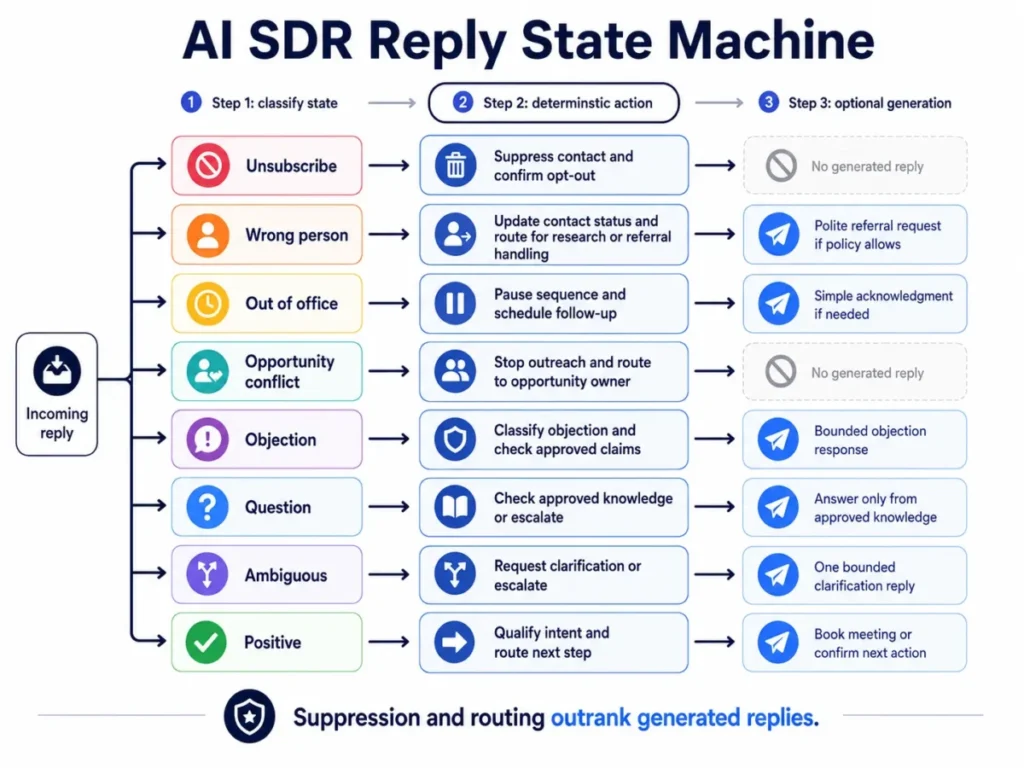
HubSpot builds the same idea into its product by letting users review and edit AI-drafted emails before sending, then switch to autonomous sending later, as described on its AI prospecting agent page. The review step is the control, not the training wheel.
Four question types should always reach a human: custom pricing, legal or contractual terms, security and data processing, and strategic objections that touch product roadmap. For each, the safe agent behavior is to preserve context, name the unanswered question, and route to the owner.
A handoff is complete when the rep does not have to re-ask anything the buyer already answered. Track that as a metric, because it is the difference between an AI SDR that adds capacity and one that moves work sideways.
Where Autonomy Should Stop
Human control is a gradient, not a switch. Salesforce implementation guidance covers customization, testing, monitoring, and human handoff, and Artisan documents configurable approval gates, which together describe a ladder rather than a binary.
| Autonomy level | What the agent may do | Evidence needed to advance |
|---|---|---|
| Draft only | Research, draft, and queue for a human | Grounding audit passes on a sample |
| Approve before send | Everything above, plus send after approval | Low correction rate across one segment |
| Bounded autonomy | Send routine touches inside one proven segment | Stable qualified-reply and complaint rates |
| Exception escalation | Handle routine replies, escalate defined risk tiers | Clean classification and routing audit |
| Scaled autonomy | Operate additional segments under monitoring | Repeat results after a volume increase |
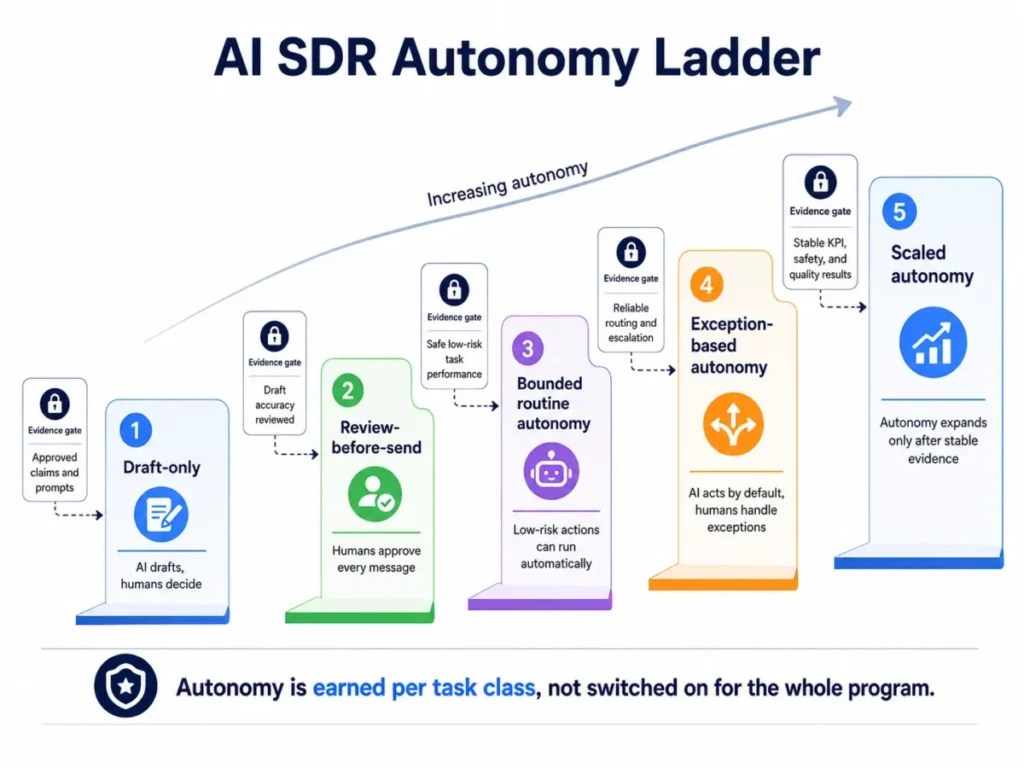
Each rung is per task class, not per product. An agent can be trusted to suppress an unsubscribe and still be untrusted to answer a security questionnaire.
The Cost of Getting It Wrong
These are the five situations that decide whether an AI SDR earns its budget, and each one has a correct answer that has nothing to do with copywriting.
A high-intent inbound demo request should be qualified against explicit criteria, answered from approved knowledge, scheduled, routed, and written back with the evidence attached. A visitor from a target account should be verified for account match, reason to engage, suppression, and owner before any follow-up fires.
A new cold-outbound segment should start with a small cohort, verified personalization, human review, and predefined stop conditions. A positive reply that asks a security question should be classified as a high-risk information request and escalated with context intact.
An existing customer appearing in a prospect list should be blocked, with the exclusion reason preserved and the signal routed to the account owner. Miss that one and finance hears about it before marketing does.
The recurring pattern is that every expensive failure is an eligibility or evidence failure. Prompt quality is the last variable to tune, not the first.
Common Misconceptions About AI SDRs
AI SDR means autonomous cold email. The category also covers inbound qualification and CRM-grounded prospecting, and those deployments carry different risks and different metrics.
More messages mean better performance. Qualified pipeline, handoff quality, buyer experience, and cost can all deteriorate while send volume climbs.
Human in the loop means approving every message. Control can be graduated by action risk and confidence, which is the point of the ladder above.
A better prompt fixes bad personalization. CRM state, provenance, suppression, and data freshness sit upstream of the prompt and decide what the prompt can honestly say.
Monthly prices are comparable. Vendors bill per lead, per contact volume, per seat, per worker, and per custom scope, which are not the same unit.
A booked meeting is the finish line. Meetings held, opportunities created, and cost per opportunity are the numbers that survive a budget review.
Human SDR vs AI SDR
The comparison that matters is not who writes a better email. It is which parts of the job survive being handed to software, and which parts get worse the moment they are.
| Dimension | Human SDR | AI SDR | Who should own it in a blended team |
|---|---|---|---|
| Throughput | Bounded by hours in the day | Bounded by contact allowance, seats, or credits | AI, with the volume ramped against deliverability |
| Ambiguous replies | Reads tone, hedges, and asks a good follow-up | Classifies into predefined states and escalates the rest | Human, on anything outside the approved answer set |
| Consistency | Drifts under quota pressure and after bad weeks | Applies the same rules to record one and record ten thousand | AI, provided the rules are written down first |
| Ramp time | Weeks of onboarding before quality stabilizes | Configuration time plus a proven-segment pilot | AI for speed, human for judgment that cannot be configured |
| Cost structure | Fixed payroll plus ramp, largely independent of volume | Per lead, per contact volume, per seat, or per worker | Model both against cost per held meeting, not per send |
| Data hygiene | Fixes records informally, often without logging it | Writes back every field it is permitted to touch | AI, with field ownership and provenance defined |
| Commercial questions | Can read the room and involve the right person | Should refuse and route to a named owner | Human, always |
| Relationship depth | Builds context that survives across quarters | Holds only what the CRM records | Human, once the buyer is in an active cycle |
Choose an AI SDR for the volume half of the job when the rules are written, the CRM is trustworthy, and a human still owns everything commercially sensitive. Keep a human SDR as the primary motion when the buying process is consultative, when qualification depends on judgment nobody has written down, or when the account list is small enough that personal context beats coverage.
The blended pattern is the one most teams land on: the agent works eligibility, evidence, first touch, and routine replies, while the rep owns nuanced conversations, exceptions, and the meeting itself. That split also gives you the only honest cost comparison, because both sides can be measured on cost per held meeting.
I would not frame this as a replacement decision at all. I would frame it as deciding which stages of the workflow map above a human should stop doing by hand.
How to Measure an AI SDR
Activity metrics are easy to move and easy to fake. The measurement model below runs from input health through economics, and every formula uses your own baseline rather than an industry number.
| Layer | Metric | Formula | Decision it informs |
|---|---|---|---|
| Input health | Eligible lead coverage | Eligible leads actioned divided by eligible leads available | Whether the agent is working the real list |
| Input health | Valid-contact rate | Contacts passing identity and delivery validation divided by contacts selected | Data-source quality |
| Input health | Data freshness pass rate | Records meeting the freshness policy divided by records evaluated | When to re-enrich |
| Engagement | Positive reply rate | Positive replies divided by delivered outreach | Message and offer fit |
| Engagement | Qualified reply rate | Qualified replies divided by delivered outreach | Whether replies are worth rep time |
| Engagement | Negative reply rate | Negative, irrelevant, or error-triggered replies divided by delivered outreach | Buyer-experience damage |
| Buyer experience | Unsubscribe rate | Unsubscribe events divided by delivered outreach | Whether to narrow targeting |
| Deliverability | Bounce rate | Bounced messages divided by attempted email deliveries | Sending-infrastructure health |
| Qualification | Qualified lead rate | Qualified leads divided by leads worked | Qualification criteria calibration |
| Conversion | Meeting-booked rate | Meetings booked divided by leads worked | Top-of-funnel throughput |
| Conversion | Meeting-held rate | Meetings held divided by meetings booked | Whether bookings are real |
| Pipeline | Meeting-to-opportunity rate | New opportunities divided by meetings held | Qualification honesty |
| Pipeline | Pipeline sourced | Sum of pipeline attributed to the agent cohort | Budget defense |
| Handoff | Complete-handoff rate | Handoffs with every required field divided by total handoffs | Rep rework volume |
| Handoff | Rep acceptance rate | Handoffs accepted without requalification divided by handoffs reviewed | Downstream trust |
| Handoff | Handoff correction rate | Handoffs needing factual or routing correction divided by handoffs reviewed | Grounding quality |
| Speed | Median lead response latency | Median time from eligible inbound signal to first useful response | Inbound competitiveness |
| Speed | Median time to human handoff | Median time from escalation trigger to owner-ready handoff | Escalation design |
| Economics | Cost per qualified conversation | Total program cost divided by qualified conversations | Unit economics |
| Economics | Cost per held meeting | Total program cost divided by held meetings | Realistic acquisition cost |
| Economics | Cost per opportunity | Total program cost divided by sourced opportunities | Comparison against a human rep |
| Economics | Pipeline per program dollar | Sourced pipeline divided by total program cost | Renewal decision |
| Autonomy | Human review rate | Items requiring approval divided by reviewable agent actions | Operating maturity |
| Autonomy | Escalation rate | Human escalations divided by substantive buyer conversations | Knowledge-boundary fit |
| Safety | Unsupported-claim rate | Outputs containing an unsupported factual claim divided by audited outputs | Stop condition |
| Safety | Suppression failure rate | Outreach attempts violating a suppression rule divided by attempts audited | Stop condition |
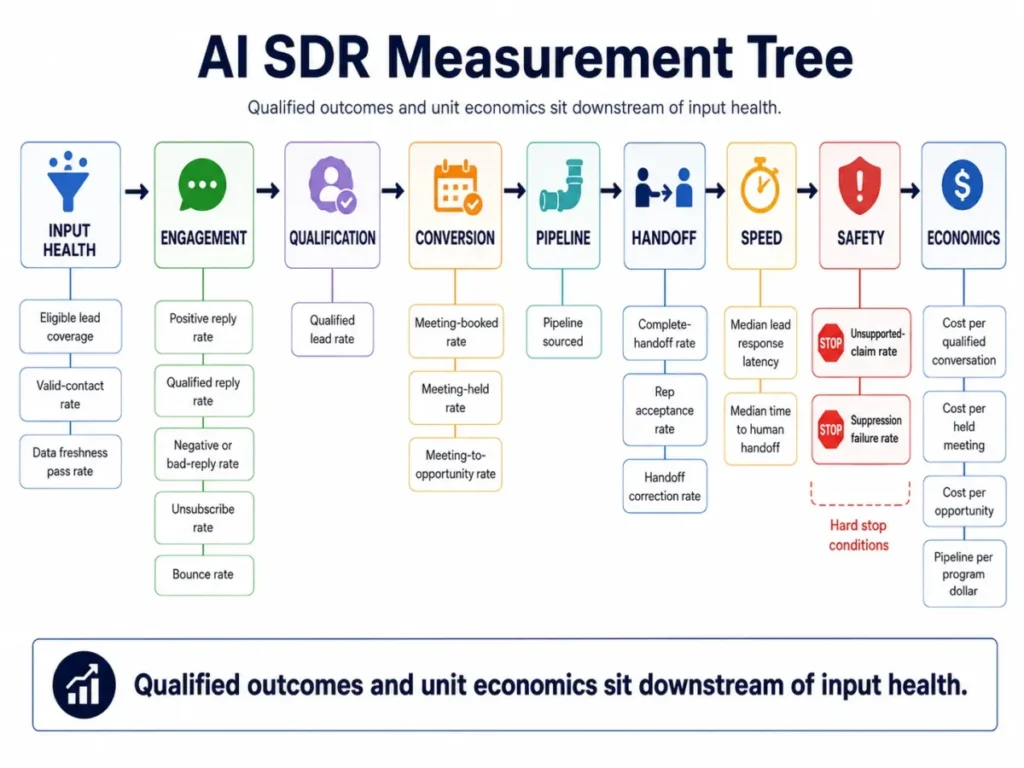
The two safety metrics are the ones to define thresholds for before launch, because they are the only two where the correct response to a bad number is stopping rather than tuning. Everything above them is a tuning decision; those two are a governance decision.
Handoff correction rate is the metric most teams never build, and it is the one that predicts whether reps will keep trusting the queue in month three.
The AI SDR KPI Dashboard
A metric list is not a dashboard. A dashboard decides what somebody looks at on Monday, what triggers a conversation, and what triggers a stop, so it needs panels, cadences, and owners rather than a wall of numbers.
| Panel | Metrics on it | Refresh cadence | Owner |
|---|---|---|---|
| Input health | Eligible lead coverage, valid-contact rate, data freshness pass rate | Weekly | RevOps |
| Delivery and engagement | Bounce rate, unsubscribe rate, positive reply rate, qualified reply rate | Daily during a pilot, weekly at steady state | Demand generation |
| Qualification and conversion | Qualified lead rate, meetings booked, meetings held, meeting-to-opportunity rate | Weekly | Sales manager |
| Handoff quality | Complete-handoff rate, rep acceptance rate, handoff correction rate | Weekly | Sales manager |
| Safety | Unsupported-claim rate, suppression failure rate | Daily, with an alert on any breach | RevOps |
| Unit economics | Cost per qualified conversation, cost per held meeting, cost per opportunity, pipeline per program dollar | Monthly | Revenue leader |
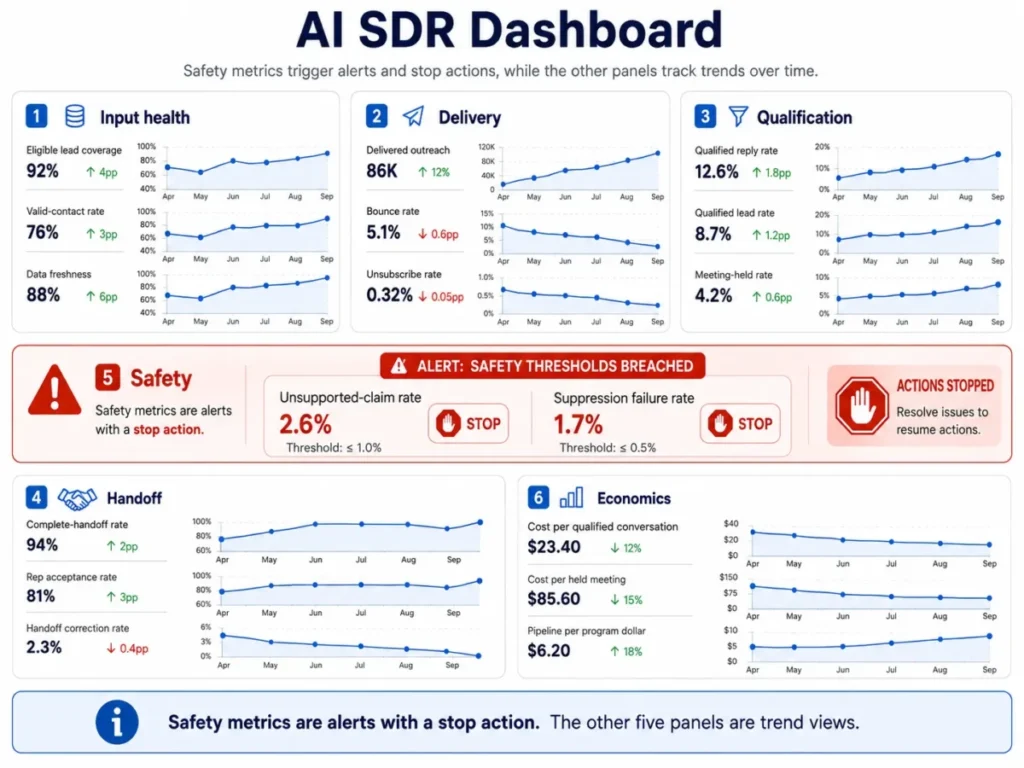
The safety panel is the one that behaves differently from the rest. Its two metrics carry an alert and a defined stop action rather than a trend line, because the correct response to a suppression breach is halting the cohort, not watching the curve.
Every panel compares against the baseline you captured from the human motion before launch. A dashboard with no baseline column shows activity, and activity is the thing this category is best at manufacturing.
The weekly ritual is short: read input health first, then handoff quality, then economics. If input health is degrading, nothing downstream is worth interpreting yet.
AI SDR Costs in 2026: Normalize the Billing Unit First
Published prices in this category are not comparable as written, because the vendors are not selling the same unit. One charges per lead the agent works, one charges per researched contact per month, one charges per seat with a minimum, one charges per worker on an annual commitment, and two keep the figure sales-led.
Billed by usage or by contact volume:
| Product | Published price, checked 2026-08-08 | Billing unit | Commitment |
|---|---|---|---|
| HubSpot Prospecting Agent | $1 per lead | Per lead recommended or drafted for outreach | Runs on HubSpot Credits inside Starter, Professional, or Enterprise |
| AiSDR Solo | $250 per month, or $2,400 per year | 200 AI-researched contacts per month, one user | Month to month |
| AiSDR Explore | $900 per month, or $8,640 per year | 800 AI-researched contacts per month | Quarterly contract |
| AiSDR Scale | $2,500 per month, or $24,000 per year | 2,500 AI-researched contacts per month | Quarterly contract |
| Source: official HubSpot Prospecting Agent and AiSDR pricing pages. Checked: 2026-08-08. |
Billed by seat or by worker:
| Product | Published price, checked 2026-08-08 | Billing unit | Commitment |
|---|---|---|---|
| 11x Alice Growth | $3,750 per month billed annually | Up to five end users and 2,000 new prospects per month | Annual |
| Regie.ai AI SEP | $180 per user per month | Per seat | Annual, ten-seat minimum |
| Regie.ai Force Multiplier Rep | $499 per user per month | Per seat, with 120,000 AI and enrichment credits described as 1,000 accounts and 4,000 contacts | Annual, five-seat minimum |
| Source: official 11x Alice pricing and Regie.ai pricing pages. Checked: 2026-08-08. |
Scoped by the vendor rather than published:
| Product | Published price, checked 2026-08-08 | Billing unit | Commitment |
|---|---|---|---|
| Qualified Piper | Not published | Custom scope across Premier, Enterprise, and Ultimate plans | Sales-led |
| Artisan Ava | Not published | Plan capacity, about 2,500 contacted leads per month on Team and about 6,000 on Scale | Sales-led |
| Source: official Qualified pricing and Artisan pricing pages. Checked: 2026-08-08. |
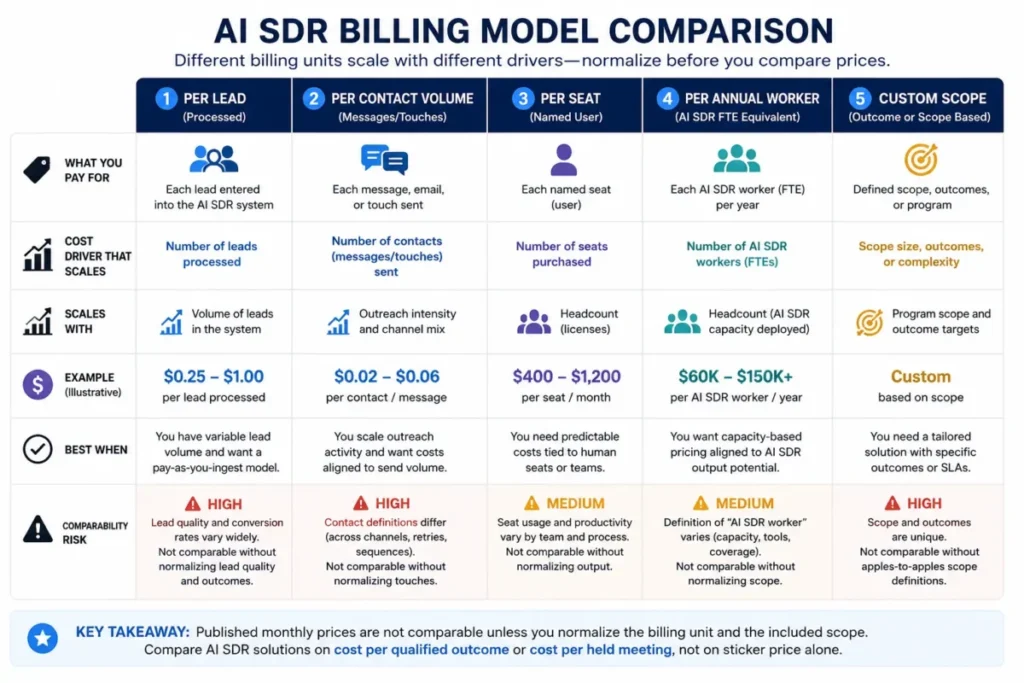
Read that table as five different cost curves. A per-lead model scales with how many leads the agent touches, a per-seat model scales with headcount whether or not the agent is busy, and a per-worker annual model is a fixed commitment regardless of either.
Seat minimums change the entry price
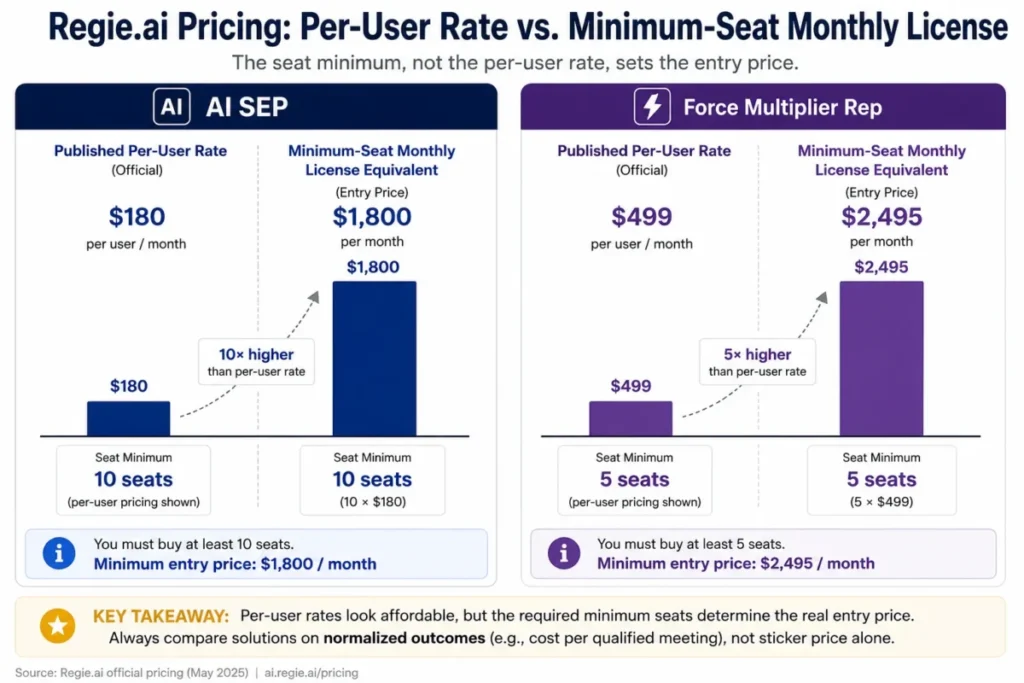
Per-user pricing looks affordable until the minimum applies. Regie.ai lists AI SEP at $180 per user per month on an annual contract with a ten-seat minimum.
The same official pricing page lists Force Multiplier Rep at $499 per user per month on an annual contract with a five-seat minimum.
| Plan | Published rate | Minimum monthly license equivalent |
|---|---|---|
| AI SEP | $180 per user per month | $1,800 at the ten-seat minimum |
| Force Multiplier Rep | $499 per user per month | $2,495 at the five-seat minimum |
| Source: Regie.ai official pricing. Checked: 2026-08-08. |
Both figures are simple arithmetic on the published list rate: rate multiplied by minimum seats. They exclude taxes, optional services, CRM licenses, and anything the vendor does not publish.
A four-person sales team cannot buy either plan at its headcount, which is a fit question rather than a value question.
The AiSDR annual rate is a real reduction
AiSDR publishes both cadences, which makes the arithmetic checkable. Annual plans are priced 20 percent below the quarterly cadence, and its official pricing page lists all plans as billed monthly, with Explore and Scale on quarterly contracts and Solo month to month.
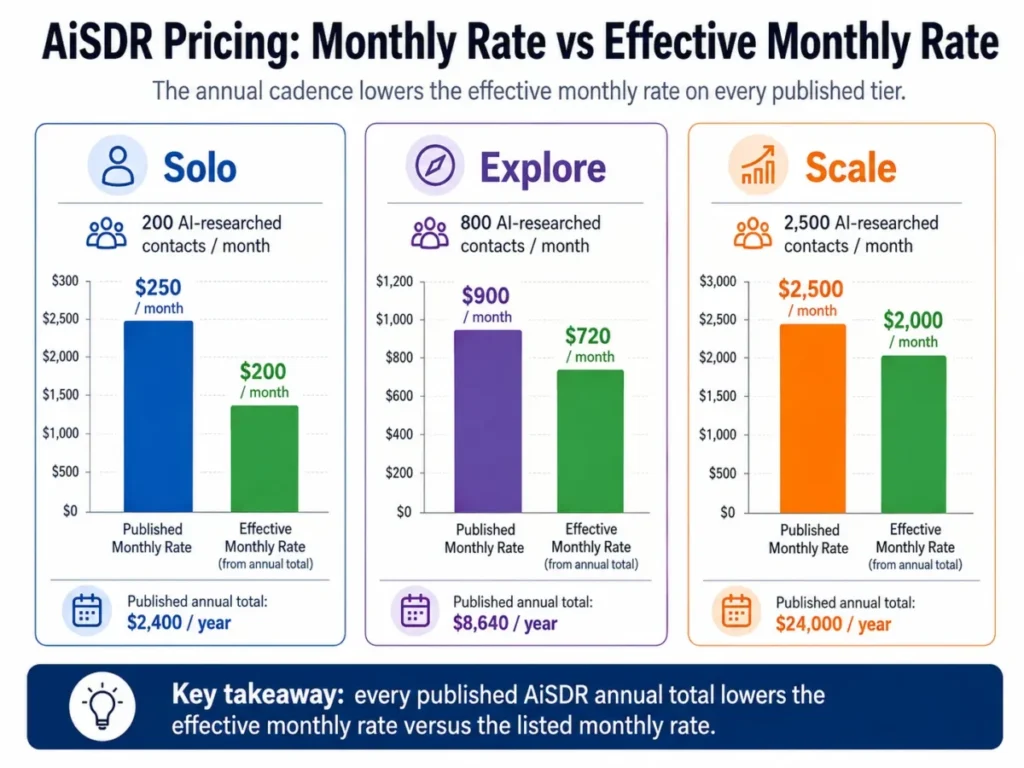
| Plan | Annual total | Effective monthly rate |
|---|---|---|
| Solo | $2,400 | $200 |
| Explore | $8,640 | $720 |
| Scale | $24,000 | $2,000 |
Each effective rate is the annual total divided by twelve.
On the same plan and add-on schedule, managed service on Explore is priced at $149 per campaign.
The fully managed Scale option is listed separately at $2,500 per month.
The buyer consequence is contract structure, not the headline. A quarterly or annual commitment means an unsuccessful pilot is still a paid pilot, which is why the pilot design in the next section matters more here than in a month-to-month tool.
One published price contradicts itself
The Alice pricing page displays Growth starting at $3,750 per month billed annually, for up to five end users and 2,000 new prospects per month.
The same page states in its FAQ that Growth starts at $36,000 per year. That is a different figure from the displayed monthly rate multiplied by twelve, and both representations sit on the one page.
I would not compute an annual total from that page. I would ask the vendor which figure governs the order form before signing anything, because the gap between the two representations is real money on a first-year commitment.
Qualified states that pricing is customized to pipeline needs across its Premier, Enterprise, and Ultimate plans on the Qualified pricing page. Artisan states that Team and Scale pricing is scoped on the plan, with an AI dialer offered as a per-seat add-on, on its plans and pricing page.
Custom is a valid pricing status, and filling it with a third-party estimate would be worse than leaving it blank.
HubSpot Credits sit inside the wider edition price, so the $1 per lead charged by the Prospecting Agent is incremental spend rather than the whole cost.
The edition itself is worth checking against current HubSpot pricing plans before you model a budget.
Cost per Meeting: The Comparison That Survives
Sticker price tells you almost nothing, because the same monthly figure buys different volumes on different billing units. Cost per held meeting is the one number that puts a per-lead agent, a per-seat platform, an annual worker, and a human rep on the same axis.
The model has one formula and one deliberate exclusion:
Cost per held meeting equals total monthly program cost divided by meetings held in that month. Total monthly program cost equals platform cost plus data and enrichment cost plus sending infrastructure cost plus human review hours multiplied by your loaded hourly rate.
| Input | Unit | Where it comes from | Sanity range |
|---|---|---|---|
| Platform cost | Dollars per month | The vendor’s published rate, normalized to a monthly figure | Anything above zero |
| Data and enrichment cost | Dollars per month | Separate enrichment contracts not bundled with the agent | Zero when the agent bundles it |
| Sending infrastructure cost | Dollars per month | Mailboxes, domains, and warmup not bundled with the agent | Zero when the agent bundles it |
| Human review hours | Hours per month | Time reviewing drafts, replies, and handoffs | Falls as autonomy is earned |
| Loaded hourly rate | Dollars per hour | Your own payroll figure, fully loaded | Your finance team supplies this |
| Meetings held | Count per month | Meetings that took place, not meetings booked | Use held, never booked |
AI SDR cost per meeting calculator
Sticker price cannot compare a per-lead agent, a per-seat platform, an annual worker, and a human rep. Cost per held meeting puts all four on one axis.
Your inputs
Start from a published price
Program cost
Your measured outcomes
Your result
Total program cost = platform + enrichment + sending infrastructure + (review hours × loaded hourly rate)Cost per held meeting = total program cost ÷ meetings heldYour cost per held meeting against six published-price scenarios
Platform costs are published vendor rates checked 2026-08-08. Meeting counts in the scenarios are illustrative inputs, not vendor performance claims.
Show the data table
| Scenario | Platform cost per month | Meetings held | Cost per held meeting |
|---|
Assumptions, edge cases, and limits
- Meeting counts are yours. No vendor publishes a meetings-per-month figure, and none is implied here. Every scenario volume is an illustrative input you replace with measured data.
- Zero held meetings makes the figure undefined. Fall back to cost per qualified conversation until the first meeting lands.
- The first month is not representative. Ramp and configuration effort never repeat, so exclude month one or label it separately.
- Amortize commitments. An annual or quarterly contract spreads across its full term rather than landing on the month it was signed.
- Review time is real cost. A draft-only autonomy level can add more hours than the platform fee.
- No-shows hide the truth. A good cost per booked meeting often conceals a poor cost per held meeting.
- This is a comparison, not a verdict. It tells you which option is cheaper per outcome at your volumes. Whether those meetings convert is what cost per opportunity answers.
Platform costs come from official vendor pricing pages checked 2026-08-08: HubSpot, AiSDR, 11x, Regie.ai. Re-verify before using any figure in a budget. Prices change without notice.
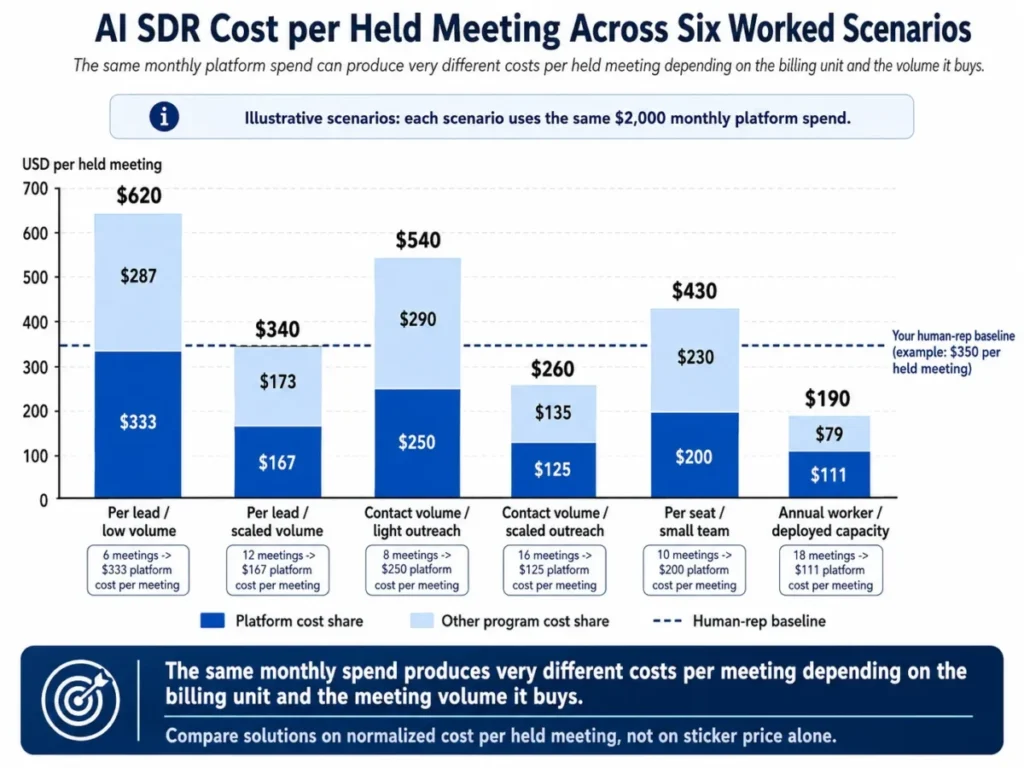
The scenarios below use published platform costs from the pricing section and meeting volumes that you replace with your own. The meeting counts are illustrative inputs, not vendor performance claims, and no vendor publishes a meetings-per-month figure.
| Scenario | Monthly platform cost | Meetings held, assumed input | Cost per held meeting |
|---|---|---|---|
| Scenario: AiSDR Explore on the annual cadence | $720 | 4 | $180.00 |
| Scenario: AiSDR Scale on the annual cadence | $2,000 | 12 | $166.67 |
| Scenario: Regie.ai AI SEP at its published entry commitment | $1,800 | 20 | $90.00 |
| Scenario: Regie.ai Force Multiplier at its published entry commitment | $2,495 | 25 | $99.80 |
| Scenario: 11x Alice Growth at the displayed monthly rate | $3,750 | 15 | $250.00 |
| Scenario: HubSpot Prospecting Agent at 1,000 leads worked | $1,000 | 8 | $125.00 |
| Source: platform costs from the official AiSDR, Regie.ai and 11x pricing pages, checked 2026-08-08. Cost per held meeting is editorial arithmetic on those rates and your own meeting count. |
Each result is the platform cost divided by the assumed meetings held, with enrichment, sending infrastructure, and review time set to zero so the arithmetic stays checkable. Add those three back from your own contracts before comparing anything to a human rep.
Five edge cases change the answer, and all five show up in real pilots. A month with zero held meetings makes the figure undefined, so fall back to cost per qualified conversation until the first meeting lands.
A first month carries ramp and configuration effort that will never repeat, so exclude it or label it separately. An annual or quarterly commitment should be amortized across its full term rather than charged to the month it was signed.
Review time is real cost, and a draft-only autonomy level can add more hours than the platform fee. No-shows are the most common reason a good cost per booked meeting hides a poor cost per held meeting.
Read the output as a comparison, not a verdict. It tells you which option is cheaper per outcome at your volumes, and it says nothing about whether those meetings convert, which is what cost per opportunity is for.
What Each Representative Product Owns
Ranking these against each other would be a category error, because they do not all solve the same job. Sorting them by the motion they own is more useful.
| Product | Motion it owns | Pricing status |
|---|---|---|
| Salesforce Agentforce | CRM-native agent workflows across inbound qualification and engagement | Not covered by the source cited here |
| HubSpot Prospecting Agent | CRM-grounded research and outreach with a review-first path | Published per lead |
| AiSDR | Outbound prospecting with bundled outreach infrastructure and reply handling | Published by contact volume |
| 11x Alice | Signal-based outbound with lead scoring and CRM revival | Published, with an internal page conflict |
| Regie.ai | Prospecting agents plus sequencing, dialing, and enrichment for existing SDR teams | Published per seat with minimums |
| Qualified Piper | Inbound conversion across website, email, meetings, and nurture | Custom |
| Artisan Ava | End-to-end outbound with configurable approval gates | Custom |
Salesforce Agentforce fits teams that want the agent to live inside the record system they already govern. The tradeoff is that the agent’s value is capped by how well that instance is maintained, which the Salesforce CRM review covers in more depth.
HubSpot Prospecting Agent is the low-commitment entry point because the per-lead unit means an idle agent adds no incremental charge, and because the review-then-autonomy path matches the ladder above. The constraint is that it is a HubSpot-resident workflow, not an independent outbound stack.
AiSDR publishes the clearest volume tiers among these examples, which makes modeling straightforward. The commitment structure is the thing to negotiate.
11x Alice targets signal-driven outbound on its published Growth tier. The contradiction on its own pricing page is a reason to get commercial terms in writing early.
Regie.ai suits an existing SDR organization rather than a solo operator, because the seat minimums assume a team. Qualified Piper is the inbound specialist here, and Artisan Ava is the outbound example whose approval gates are documented as configurable.
How to Run a Controlled Pilot
The pilot design matters more than the vendor choice, because most of the risk is in the operating decisions rather than the model. Start with one narrow segment and a volume a human can review line by line.
Audit grounding, audience fit, suppression accuracy, reply classification, routing, and handoff completeness on that cohort before touching volume. Track qualified conversations, held meetings, opportunities, pipeline, negative signals, and cost against the same cohort so the comparison stays honest.
Fix upstream data and instruction failures before increasing volume, and relax review gates only for the task classes that have shown stable behavior. Change one variable at a time or the results will not tell you anything.
| Stop signal | Threshold to define before launch | Action |
|---|---|---|
| Unsupported claims in audited output | Any occurrence above your agreed rate | Pause sends and repair the source of the claim |
| Suppression rule violated | Any occurrence | Stop the cohort and fix eligibility logic |
| Routing errors or wrong owner | Rate that creates rep rework | Pause autonomy and repair territory rules |
| Deliverability deterioration | Bounce or complaint movement against baseline | Reduce volume and diagnose infrastructure first |
| Cost per held meeting | Level where a human rep is cheaper | Renegotiate scope or end the pilot |
Two of those five are absolute rather than proportional, and that is deliberate. A single suppression failure is a policy event, not a performance datapoint.
The 30-day and 90-day checks are worth writing down in advance. By day 30 the agent should be producing handoffs reps accept without requalification; by day 90 those handoffs should be visible as opportunities, not just meetings.
Three Prompts to Start With
The library further down covers all five operating layers. These three carry the most weight in the first month, so they are written out in full with the guardrails inline.
Lead qualification prompt
ROLE: You are a sales development qualification agent.

INPUTS
- CRM record: <paste contact, account, lifecycle, owner, activity history>
- Qualification criteria: <paste your written criteria, one per line>
- Approved knowledge: <paste the claim whitelist>

TASK
1. Evaluate the record against each criterion separately.
2. Return PASS, FAIL, or INSUFFICIENT EVIDENCE for each one, and name the exact
   field or message that supports the decision.
3. Return an overall verdict: QUALIFIED, NURTURE, DISQUALIFIED, or ESCALATE.
4. List every question the buyer asked that you could not answer from the
   approved knowledge.
5. Output the handoff record: account context, contact role, reason to engage,
   qualification evidence, objections, unanswered questions, commitments made,
   recommended owner, next step.

RULES
- Never infer a criterion that has no supporting field. Missing evidence is
  INSUFFICIENT EVIDENCE, never a pass.
- A reply is not qualification. Only the written criteria qualify a record.
- Return ESCALATE for pricing exceptions, legal, security, procurement, and any
  intent you cannot classify with confidence.
- Do not restate a question the buyer already answered.
Cold email personalization prompt
ROLE: You are drafting one first-touch email for a named prospect.

INPUTS
- Verified account facts with source and date: <paste>
- Contact role and responsibilities: <paste>
- Approved claim list: <paste fact, source, date, scope for each>
- Prohibited claims: <paste>

TASK
1. Identify the single strongest verified reason to engage now. Score it on
   business relevance, recency, and confidence.
2. If no reason clears the bar, stop and return NO VERIFIED REASON TO ENGAGE.
3. Draft the email: one opening line built on that reason, one value point taken
   only from the approved claim list, one low-friction ask.
4. Under the draft, output a provenance table with one row per personalized
   sentence: sentence, source fact, source date, transformation.

RULES
- Every factual statement traces to a supplied source. No invented funding
  rounds, headcounts, tool stacks, hiring signals, or pain points.
- Do not claim familiarity, shared connections, or prior contact that the inputs
  do not show.
- Keep the ask reversible: a question, not a calendar demand.
- If a sentence cannot be traced, delete it rather than soften it.
Follow-up sequence prompt
ROLE: You are building a follow-up sequence after one delivered first touch.

INPUTS
- First-touch email and its reason to engage: <paste>
- Remaining verified facts not yet used: <paste>
- Channel policy and cadence limits: <paste>
- Stop events: reply, unsubscribe, customer status, open opportunity, wrong
  person, do-not-contact

TASK
1. Write three follow-ups. Each one introduces a different verified angle and
   never restates the first message.
2. Assign each touch a day offset and a channel permitted by the policy.
3. For each touch, state the stop condition that cancels the rest of the
   sequence.
4. Output a final row: what to do when the sequence completes with no reply.

RULES
- Never manufacture urgency, deadlines, or scarcity that the inputs do not
  support.
- One angle per touch. A follow-up that only adds pressure is not a follow-up.
- Any stop event cancels every remaining touch immediately, before any draft is
  generated.
- If fewer than three verified angles exist, write fewer touches and say so.
A workable default shape for that sequence, which you adjust to your own channel policy:
| Touch | Day offset | Angle to use | Cancels on |
|---|---|---|---|
| 1 | Day 0 | The verified reason to engage | Any stop event |
| 2 | Day 3 | A second verified fact, or a role-relevant consequence | Any stop event |
| 3 | Day 8 | Proof from the approved claim list, framed for the role | Any stop event |
| 4 | Day 15 | A different stakeholder-level angle, or a bounded clarifying question | Any stop event |
| Close | Day 22 | A short close that leaves the door open and suppresses further touches | Sends once, then suppress |
Notice what the table does not contain. There is no touch whose only content is asking again, because a follow-up with no new verified angle is the fastest way to convert a neutral prospect into an unsubscribe.
50 AI SDR Prompts, Grouped by Operating Layer
Prompt wording cannot repair bad data or a missing boundary, so each prompt below carries the guardrail that makes it safe. Adapt the bracketed inputs to your own fields and policies.
TARGET prompts
| Prompt | What to instruct the agent | Guardrail |
|---|---|---|
| ICP gate | Score this account and contact against each stated ICP criterion and return pass, fail, or insufficient evidence, citing the supplied field behind every decision | Never infer a missing requirement |
| Reason to engage | From the supplied signals and their dates, name the strongest verified reason to contact this account now, scored on relevance, recency, and confidence | Return no verified reason rather than inventing an event |
| Account research brief | Build a six-line brief covering business model, active initiative, trigger event, stack evidence, buyer implication, and one open question | Mark every unsupported field unknown |
| Persona fit | Map this contact’s role to the buying problem and label them user, influencer, economic buyer, technical evaluator, or unknown, with the evidence | A job title alone is not authority |
| Lead prioritization | Rank the eligible leads on ICP fit, trigger strength, data completeness, and contactability, showing each factor separately | No hidden scoring criteria |
| Eligibility check | Screen the list for duplicate identity, customer status, open opportunity, active sequence, recent touch, and suppression, returning an exclusion reason for every blocked record | Negative eligibility outranks message generation |
| Missing-data request | List only the missing fields that would change targeting, personalization, routing, or compliance | Do not request enrichment that changes nothing |
| Owner routing | Apply the territory rules and ownership fields to assign an owner, and return escalation required when the rules conflict | Never guess territory ownership |
| Segment hypothesis | Cluster eligible accounts into at most five segments by shared buying context and state the problem hypothesis behind each | Label hypotheses as hypotheses |
| Exclusion audit | Audit the target list against suppression, customer, partner, competitor, opportunity, do-not-contact, and duplicate rules and report exclusions by reason | Never relax an exclusion to raise volume |
TRUST prompts
| Prompt | What to instruct the agent | Guardrail |
|---|---|---|
| Claim whitelist | Convert the product documentation into an allowed-claim list carrying fact, source, date, scope, and required qualification | Anything off the list is not a fact |
| Claim risk check | Flag every factual statement in this draft that the supplied evidence does not support, and rewrite only those parts | Fluent writing is not evidence |
| Personalization provenance | For each personalized sentence, name the source fact, its date, and how the fact became the sentence | Reject guessed pain and invented metrics |
| Security boundary | Decide whether this security or privacy question is answerable from approved documentation or needs a named human owner | Never infer a certification |
| Pricing boundary | Answer only published pricing facts from the supplied knowledge set and escalate exceptions, custom quotes, and concessions | Never invent commercial terms |
| Legal escalation | Detect legal, regulatory, contractual, or data-processing questions, summarize them, and route them to the named owner | No commitments from the agent |
| Confidence gate | Return separate confidence values for data fit, claim grounding, and routing, then choose send, review, or stop | Do not average away one low dimension |
| Hallucination red team | Attack the targeting, personalization, offer, timing, and call to action for unsupported assumptions and propose the safer version | Prefer omission to invented specifics |
| Data minimizer | Strip any field not needed for targeting, personalization, routing, attribution, or compliance | Carry the minimum personal data |
| Knowledge-gap handoff | When the question sits outside approved sources, produce a handoff with the question, context, urgency, signal, and recommended owner | Unknown stays unknown |
TOUCH prompts
| Prompt | What to instruct the agent | Guardrail |
|---|---|---|
| First touch | Draft a short first email built on one verified reason to engage, one approved value point, and one low-friction ask | Every fact traces to supplied evidence |
| Follow-up sequence | Write three follow-ups where each adds a different verified angle instead of restating the first message | Stop on reply, unsubscribe, customer status, or open opportunity |
| Connection note | Draft a short professional-network note grounded in one supplied company or role signal | No invented familiarity or mutual context |
| Voicemail brief | Write a voicemail inside the stated time limit using the verified trigger, one labeled hypothesis, and a simple callback reason | Never state a hypothesis as fact |
| Call preparation | Prepare verified facts, recent signals, two discovery questions, one likely objection, and the claims the rep must not make | Separate facts from hypotheses |
| Channel selection | Choose email, phone, social, or no outreach from contactability, prior touches, channel policy, and urgency, and name blocked channels | Channel permission outranks optimization |
| Tone adaptation | Rewrite the approved message for this persona and relationship stage without changing facts, offer, or compliance meaning | Style may change; claims may not |
| Reply classification | Label the reply positive, neutral, objection, question, unsubscribe, wrong person, out of office, or ambiguous, then return the deterministic action before any draft | Suppression and routing run first |
| Objection response | Answer from approved evidence plus one clarifying question, or escalate when the objection touches price, legal, security, or product commitments | Never negotiate |
| Sequence stop audit | Read the CRM and conversation state and decide continue, pause, stop, suppress, or hand off, citing the rule and the data point | State rules outrank cadence |
TRANSFER prompts
| Prompt | What to instruct the agent | Guardrail |
|---|---|---|
| Qualification summary | Summarize qualification evidence in four buckets: confirmed facts, buyer-stated needs, hypotheses, and disqualifiers | Do not merge inference with buyer statements |
| Meeting readiness | Decide whether to offer a meeting against the stated threshold, or name the next question required | A reply is not qualification |
| Rep handoff | Produce a handoff with account context, contact role, reason to engage, qualification evidence, objections, open questions, commitments made, and next step | Only claims present in the interaction record |
| Routing exception | List the conflicting ownership rules and route the case to the named operations owner | Ambiguous ownership escalates |
| Escalation brief | Write five parts: trigger, buyer question, verified context, what the agent already said, and the exact decision needed | Do not pre-make the human decision |
| No-show follow-up | Draft a reschedule message that keeps the original business context and assigns no blame | No manufactured urgency |
| Wrong-person referral | Reply to a wrong-person signal and request a referral only where policy allows | Never guess the replacement contact |
| Opportunity conflict | Stop prospecting when an open opportunity exists and brief the opportunity owner on the new signal and contact history | Opportunity ownership wins |
| Nurture handoff | Record buying stage, the reason the buyer is not ready, the next meaningful trigger, the content need, and the owner | Use a condition, not an invented date |
| CRM writeback | Return the exact fields to update, their new values, their provenance, and the fields that must not be overwritten | Respect the system of record |
TRACK prompts
| Prompt | What to instruct the agent | Guardrail |
|---|---|---|
| Pilot scorecard | Build a scorecard from the supplied baseline and cohort covering qualified replies, held meetings, opportunity conversion, handoff quality, negative signals, cost, and safety errors | Do not invent thresholds |
| Funnel diagnosis | Find the earliest stage where conversion fell against the baseline and separate evidence from hypotheses | No cause without evidence |
| Deliverability diagnosis | Review bounces, complaints, unsubscribes, mailbox and domain health, and volume changes before blaming targeting or copy | Reply rate is not an inbox measurement |
| Targeting diagnosis | With delivery stable, rank ICP fit, role fit, trigger strength, and stale data as explanations for weak results | Rank by evidence, not by preference |
| Messaging diagnosis | With delivery and targeting stable, review relevance, clarity, proof, offer, call to action, and sequence repetition, then recommend one change | One controlled change at a time |
| Handoff audit | Sample handoffs for required context, factual accuracy, owner correctness, open questions, and rep acceptance, and report defect categories | Name the sample size |
| Cost normalization | Restate each vendor cost in its real billing unit: per lead, per seat, per contact volume, per worker, or custom scope | Never fill a missing price |
| Scale gate | Decide scale, hold, revise, or stop against the stated thresholds and list which gates passed and failed | Activity growth is not a pass |
| Failure-mode review | Cluster negative outcomes into data, targeting, deliverability, message, classification, routing, handoff, or policy failures and name the smallest upstream fix | Fix upstream first |
| Weekly operating review | Report cohort size, qualified outcomes, pipeline movement, handoff quality, safety exceptions, cost, changes made, open risks, and the next experiment | Separate results from recommendations |
When Software Is the Answer, and When It Is Not
Buy when qualified inbound arrives faster than a human can respond, when the addressable account list is larger than the team can work, when qualification criteria are written down, and when CRM ownership and suppression are enforced rather than aspirational.
Also buy when a human SDR’s cost per held meeting is already measured, because without that baseline you cannot tell whether the agent is cheaper or merely busier.
Wait when the CRM has unresolved duplicates or ownership gaps, when nobody owns the reply-handling policy, when reps have no capacity for more meetings, or when the only available contract is annual and the segment is unproven.
Wait as well when the real bottleneck is conversion after the meeting. An AI SDR adds top-of-funnel volume, and adding volume to a leaky funnel produces a bigger leak.
How to Choose Between Options
Match the billing unit to your own demand shape first: per-lead pricing suits variable inbound, contact-volume pricing suits steady outbound, and per-seat pricing suits an existing team that is staying the same size.
Check the CRM integration depth next, and be specific about it. Two-way synchronization, activity writeback, suppression enforcement, and trigger-based enrollment are different capabilities from a simple activity log.
Then check the human control surface: whether approval gates exist per task class, whether escalation rules can be defined, and what the handoff record contains by default. Ask what the agent does when it cannot answer, because that answer predicts your rep rework.
Finally, look at contract structure alongside the price. A quarterly or annual commitment on an unproven segment is the most common way this category loses money.
CRM Implementation Checklist
This is the sequence that keeps a launch from turning into a cleanup project. Work it top to bottom, because every later phase reads from the fields the earlier phase fixed.
| Phase | Step | Owner | Done when |
|---|---|---|---|
| Prepare | Write the qualification definition and have two people apply it to the same ten records | Sales manager | Both people reach the same verdict on at least nine |
| Prepare | Resolve duplicate contacts and accounts on the target segment | RevOps | One record per person and per account domain |
| Prepare | Confirm territory rules resolve to a single named owner | RevOps | No record in the segment has an empty or contested owner |
| Prepare | Capture the human baseline for reply rate, meetings held, and cost per held meeting | Revenue leader | Baseline signed off by finance and sales |
| Configure | Flag customers, open opportunities, partners, and competitors as suppression states | RevOps | Every state is queryable as a field, not a saved view |
| Configure | Load unsubscribe and do-not-contact lists into the agent’s eligibility check | RevOps | A test record on the list is blocked before drafting |
| Configure | Define field ownership, system of record, and freshness policy for decision fields | RevOps | Each decision field has an owner, a source, and a date |
| Configure | Build the approved-claim list with source, date, and scope on every claim | Product marketing | The agent refuses any claim outside the list |
| Configure | Map the agent’s writeback fields and the fields it must never overwrite | RevOps | Writeback tested on a sandbox record |
| Configure | Set two-way synchronization or confirm the integration only logs activity | RevOps | The behavior is documented, not assumed |
| Pilot | Name the four escalation categories and their human owners | Sales manager | Each category routes to a person, not a queue |
| Pilot | Set the required fields for a complete handoff record | Sales manager | Reps agree the record removes the need to re-ask |
| Pilot | Pick one narrow segment and start at approve-before-send | Sales manager | Segment size is reviewable by one person |
| Pilot | Write the stop conditions and the two safety thresholds | RevOps | Thresholds exist in writing before the first send |
| Pilot | Tag the cohort so attribution survives into opportunities | RevOps | Cohort filter returns meetings and opportunities |
| Scale | Run the 30-day review on handoff quality and safety | Sales manager | Rep acceptance is at or above the human baseline |
| Scale | Run the 90-day review on opportunities and cost per held meeting | Revenue leader | Cost per held meeting compares favorably to the baseline |
| Scale | Relax review gates one task class at a time | RevOps | Each relaxation has a documented evidence basis |
The two safety rows are the ones people skip because nothing has gone wrong yet. They are also the only rows whose absence turns a recoverable pilot into an apology to a customer list.
The Workflow Pack
Every asset in this playbook is packaged as one spreadsheet so you can configure against it rather than copy it out of a browser tab. Download the AI SDR workflow pack, which carries seven working tabs behind a short read-me.
The workflow map holds both halves of the eight-stage table, with the human gate and CRM write on each row. The inbound and outbound tabs break the same stages into the step sequences described earlier, one row per step, with the failure point beside it.
The calculator tab carries the cost-per-meeting model as live formulas, so you enter platform cost, enrichment, sending infrastructure, review hours, loaded hourly rate, and meetings held, and it returns cost per held meeting alongside your human baseline. The dashboard tab lists the six panels with their metrics, formulas, cadence, owner, and a baseline column to fill in.
The checklist tab is the CRM implementation sequence with owner and done-when columns you can tick off. The prompts tab holds all fifty prompts with their guardrails, filterable by operating layer.
Methodology and Evidence Standard
This playbook is built from official vendor product and pricing pages, with every price and plan limit checked on 2026-08-08. Third-party review platforms informed which questions buyers ask, and were not used to establish any product fact.
Each product was assessed against the same criteria: the motion it owns, the workflow it automates, the human controls it documents, its published billing unit, and its contract structure.
Greater weight went to facts that change a purchase decision, including billing unit, volume allowance, minimum seat commitments, contract length, and the point where a human must still approve an action.
Where a vendor page contradicted itself, both published values are shown rather than resolved. Claims without official evidence were excluded from the tables and from the recommendations.
Frequently Asked Questions
What is an AI SDR in plain terms?
An AI SDR is software that owns part of the sales development job: finding and researching prospects, reaching out, qualifying replies, and passing qualified buyers to a human. Salesforce frames the category around automating top-of-funnel work such as qualification, outreach, and engagement, and different vendors interpret how much of that loop runs without a human very differently.
How does an AI SDR work?
It runs a loop: select eligible targets from CRM and signal data, fix what it is allowed to claim, choose a channel and draft a grounded message, classify the reply, and transfer ownership to a rep with the evidence attached. Every step reads and writes CRM state, which is why data quality decides output quality more than model quality does.
Can an AI SDR replace a human SDR?
Not as a straight swap, and the honest answer varies by motion. Inbound qualification is the more contained deployment, and Salesforce notes that a fully autonomous end-to-end outbound motion is more complex. Most teams end up with an agent handling volume and routine replies, while humans keep nuanced conversations, exceptions, and anything commercially sensitive.
How much does an AI SDR cost?
There is no single figure, because the vendors do not sell the same unit. The cost section above carries every published rate against its own official pricing page, together with the billing unit and the commitment behind it.
Two of the seven vendors publish no dollar figure at all. Model your own total from the billing unit and your volume rather than from a sticker price, and compare options on cost per held meeting.
Which AI SDR tool is best?
There is no single answer, because these products own different jobs. Qualified Piper is positioned for inbound conversion, and Artisan Ava and 11x Alice for outbound execution. HubSpot Prospecting Agent and Salesforce Agentforce sit inside the CRM, AiSDR bundles outbound against published volume tiers, and Regie.ai suits existing SDR teams that need sequencing and dialing alongside the agent.
Should I start with inbound or outbound?
Inbound is the safer first deployment for most teams because the buyer already engaged, the data is better, and the failure modes are routing and latency rather than deliverability and fabricated personalization. Move to outbound once qualification, suppression, and handoff quality hold up on inbound traffic.
How do I measure whether it is working?
Measure qualified replies, meetings held rather than booked, meeting-to-opportunity rate, complete-handoff rate, rep acceptance rate, and cost per held meeting against a baseline from your human motion. Add unsupported-claim rate and suppression failure rate as safety metrics with predefined stop thresholds, because those two are governance rather than performance.
What should trigger a human handoff?
Custom pricing, legal and contractual questions, security and data-processing questions, strategic objections, and any ambiguous intent the agent cannot classify confidently. In each case the agent should preserve the conversation context, state the unanswered question, and route to a named owner rather than improvising an answer.
What CRM data does an AI SDR need?
At minimum, deduplicated contact and account identity, a resolvable owner, lifecycle and customer status, open-opportunity state, recent activity history, and enforced suppression lists, each with a source and a freshness date. Vendors differ in integration depth, so confirm whether the product does two-way synchronization and activity writeback or only logs activity.
What are the main risks of autonomous outreach?
The recurring ones are fabricated personalization, contacting customers or open opportunities, suppression failures, deliverability damage from volume increases, and handoffs so thin that reps requalify everything. Each risk maps to a control: provenance rules, negative eligibility checks, staged autonomy, volume ramps tied to deliverability signals, and a required handoff record.
Where to Start
Choose the motion first. Run inbound if qualified demand already arrives faster than a human answers it, and choose outbound only once suppression, ownership, and handoff hold up on that inbound traffic.
Then define a controlled pilot on one narrow segment, at approve-before-send, with the two safety stop conditions written down before the first send.
Select the KPIs from the dashboard above and capture the human baseline for each one. Normalize the cost models by billing unit, and compare the options on cost per held meeting rather than on the monthly sticker.
Adapt the prompt library to your own fields, claim whitelist, and escalation owners. An AI SDR is a set of operating decisions, and those five steps are the decisions.