
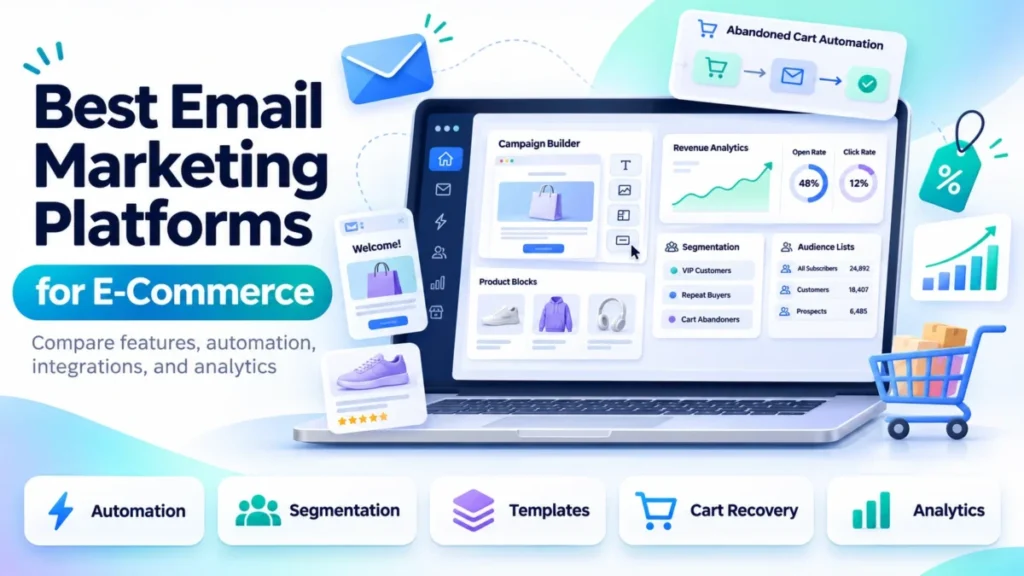
For an online store, the best email marketing platform for ecommerce is Klaviyo when Shopify data should drive every flow, Omnisend when email, SMS and push belong in one builder, Shopify Messaging when you want to start free, and Brevo when a big list mails rarely. The billing unit moves the bill most: Klaviyo charges by active profile, Omnisend and Mailchimp by contact, and Brevo, Sendlane and Shopify Messaging by emails sent.
I built this ranking from the vendors’ pricing, help and integration pages, read on November 2, 2026, and priced one example store at four list sizes. If you do not sell online, my full email marketing platform ranking covers general picks.
Quick verdict
For owners of Shopify, WooCommerce and BigCommerce stores choosing the tool that runs cart, browse, post-purchase and winback messages (prices checked November 2026):
- Flows driven by Shopify orders, catalog and browsing: Klaviyo, $20 a month at 500 active profiles.
- Email, SMS and web push in one builder: Omnisend, with SMS credits on Pro.
- New Shopify store on a $0 budget: Shopify Messaging, 10,000 free emails a month.
- Large list, light sending calendar: Brevo, priced by monthly email volume.
- SMS-first brand: Postscript. CRM plus store email: ActiveCampaign.
- The trade-off: profile and contact billing rewards small, engaged lists; send billing rewards big lists you mail less often.
In This Article (18 sections)
Top Picks at a Glance
These four platforms cover the four store jobs most buyers start from; the table below compares all 11 picks on price, billing unit and channels.

Klaviyo
Best for: Shopify stores that want the deepest store data in their flows
Its Shopify integration brings profiles, orders and Markets catalogs in and can send subscriptions and email and text events back to Shopify.
Limit: billed by active profile, from $20 a month at 500 profiles

Omnisend
Best for: email, SMS and web push in one builder
One automation builder mixes all three channels, and web push is unlimited from the Standard plan.
Limit: Standard’s monthly sends stop at 12 times your list; the Pro plan lists SMS credits

Shopify Messaging
Best for: new Shopify stores that want to start free
Every month includes 10,000 free emails, and abandoned checkout emails never count toward them.
Limit: works only for stores on Shopify

Brevo
Best for: large lists that send less often
Plans are priced by monthly email volume, and each volume tier includes a contact allowance.
Limit: marketing automation starts on Standard, not Starter
| Software | Best for | Starting price and trial | Billed by | SMS and push | Key limitation |
|---|---|---|---|---|---|
| Klaviyo | Stores that sync deep store data from Shopify | Free up to 250 active profiles; Email $20 a month at 500 | Active profiles | SMS $0.01 + carrier fees per US toll-free send; push in flows | Free plan stops sending above 250 profiles or 500 emails |
| Omnisend | Email, SMS and push in one builder | Free plan; Standard $48.00 per 3 months at 500 contacts | Contacts | SMS credits on Pro; unlimited web push from Standard | Standard caps sends at 12 times the list |
| Shopify Messaging | New Shopify stores starting free | 10,000 free emails a month, then $1 per 1,000 | Emails sent | US SMS $0.012 per message + $2.15 monthly number fee | Shopify stores only |
| Brevo | Large lists that send less often | Free plan; Starter $9 a month billed monthly | Emails sent | SMS credits sold separately | Automation needs Standard, from $18 a month |
| Mailchimp | Stores that also run general marketing | Free under 250 contacts; paid plans from $13 a month | Contacts | SMS on paid plans | Free plan pauses sending at its limits |
| Privy | Growing the list with pop-ups | Email from $30 a month; 15-day trial | Mailable contacts | SMS add-on, credits roll over | Store sync named for Shopify, BigCommerce and Wix |
| Postscript | SMS-led brands segmenting by Shopify data and integrations | Starter $0 a month, $49 monthly minimum spend | Messages sent | SMS from $0.007 to $0.009 + carrier fees | Email product sits behind a waitlist |
| Sendlane | Big lists paying by sends | $100 a month for 50,000 emails; 60-day trial | Emails sent | SMS from $0.009 per credit, carrier fees included | Dedicated support only on annual contracts |
| ActiveCampaign | Stores that also need a sales CRM | Starter $15 a month billed yearly; 14-day trial | Contacts | SMS on higher plans, sold separately | BigCommerce stores need Pro, $79 a month billed yearly |
| MailerLite | Small stores on a tight budget | Free up to 250 subscribers; Comfort $10.80 a month billed yearly | Subscribers | Not on the marketing plans | Comfort allows 5,000 sends a month at 500 subscribers; the cap rises with the list (see the cost table) |
| Moosend | Product-view triggers on a budget | Pro from $7 a month billed annually; 30-day trial | Contacts | Not listed on the pricing page | No free plan after the trial |
Sources: Klaviyo pricing, Omnisend pricing, Shopify Messaging email pricing, Brevo pricing, Mailchimp pricing, Privy pricing, Postscript pricing, Sendlane pricing, ActiveCampaign pricing, MailerLite pricing, Moosend pricing, checked Nov 2026.
Read the billing column first: two stores with the same list can pay very different bills depending on whether the tool counts people or sends.
How I Chose the Best Email Marketing Platforms for Ecommerce
A platform made the list only if its own pages document a store integration and prebuilt automations for store events such as an abandoned cart or checkout.
I ranked the 11 picks by six criteria, in order: store data the tool syncs, prebuilt store flows and the plan that holds them, billing unit and cost at a real list size, SMS and push in the same tool, store platforms supported, and a no-cost start to test the sync. My guide to how marketing automation works explains flows and triggers.
I also compared reporting and AI features plan by plan; the Klaviyo, Omnisend and ActiveCampaign sections below name the plan that holds each.
I considered 17 tools: the 11 picks below and Drip, Attentive, GetResponse, HubSpot, Constant Contact and Kit, which sit under Also Considered. Prices, limits and integrations come from the vendors’ pricing pages, help centers and integration pages, read on November 2, 2026; the “best for” labels are my judgment of those facts.
| Software | Store data synced | Prebuilt store flows | Free start |
|---|---|---|---|
| Klaviyo | Profiles, orders, Markets catalogs; data back to Shopify | 60+ templates incl. browse abandonment | Free plan |
| Omnisend | Contact and order data (BigCommerce) | Cart, product abandonment, post-purchase | Free plan |
| Shopify Messaging | Native to the Shopify admin | Abandoned checkout, welcome, winback | 10,000 emails a month |
| Brevo | Purchase and abandoned cart data (Shopify) | Standard plan workflows | Free plan, 300 emails a day |
| Mailchimp | Shopify segments, discount codes | Welcome, abandoned cart, back-in-stock | Free plan |
| Privy | Contacts to Shopify, BigCommerce, Wix | Welcome to win-back templates | 15-day trial |
| Postscript | Shopify data for segments | Cart and browse abandonment, welcome | $100 credit |
| Sendlane | Deep data: Shopify, WooCommerce | Pre-built automation funnels | 60-day trial |
| ActiveCampaign | Shopify, Square, WooCommerce | Abandoned cart on Starter | 14-day trial |
| MailerLite | Shopify customers and orders | Abandoned cart (Shopify) | Free plan |
| Moosend | Product views, carts, purchases | Cart abandonment (WooCommerce) | 30-day trial |
Sources: Klaviyo Shopify guide, Klaviyo flows, Omnisend for BigCommerce, Omnisend automation, Shopify Messaging automations, Brevo integrations, Mailchimp for Shopify, Privy, MailerLite for Shopify, Moosend integrations, checked Nov 2026.
Vendor pages do not show deliverability or how reliably an integration imports years of order history, so connect your store on the free plan or trial of your top two and check that orders and the product catalog arrive before you build a flow. With the criteria set, here is which platform wins each store job.
1. Klaviyo: Best for Shopify Stores That Want the Deepest Store Data in Their Flows
- Best for: Shopify stores that personalize flows by orders, catalog and browsing
- Starting price: free up to 250 active profiles; Email $20 a month at 500 active profiles
- Billed by: active profiles, the profiles Klaviyo can email
- SMS: $0.01 + carrier fees per US toll-free send
- Free plan: 500 email sends a month and $5 of mobile messages a month
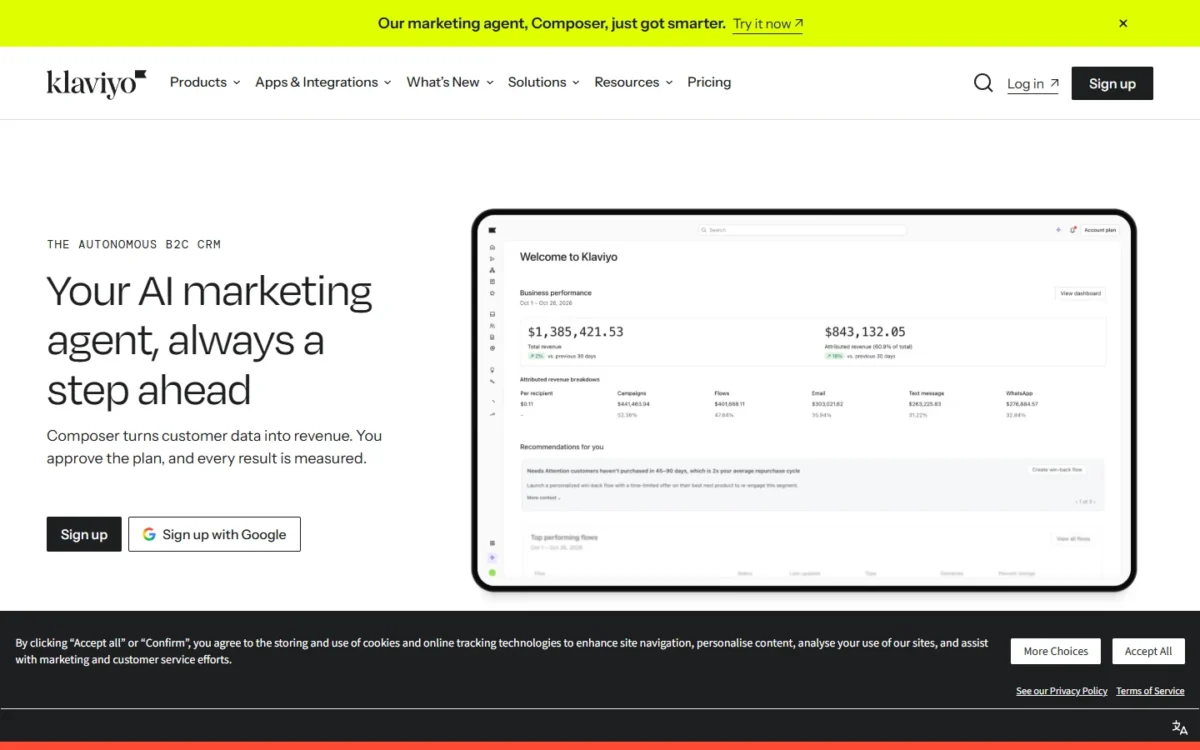
Klaviyo is my pick for a Shopify store that wants every flow to react to what a shopper bought, browsed or left in the cart. Its Shopify guide documents a sync that runs in both directions, and its flow library adds price-drop and predicted-next-order triggers. You pay for that depth per active profile, so each emailable subscriber raises the price whether they buy or not.
The two-way sync is why it ranks first. Klaviyo pulls profiles and order data from Shopify, adds shoppers who accept email or SMS marketing at checkout to a list you choose, and can import Shopify Markets catalogs. In return it can write contact info, subscriptions, email and text events and custom properties back to Shopify, which keeps consent data in one place for any app that reads Shopify customer records.
Two catches: Markets syncing works in one Klaviyo account at a time, and the Viewed Collection, Submitted Search and Added to Cart events need Shopify Network Intelligence turned on, or flows built on them may not trigger.
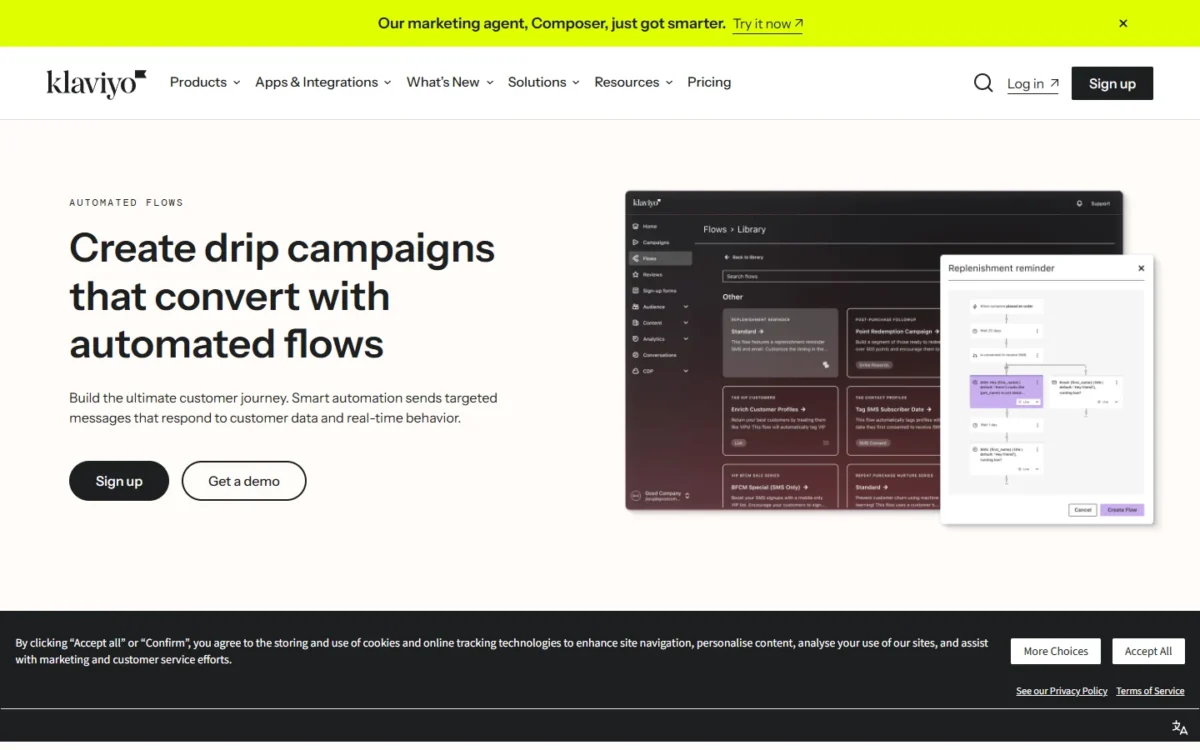
Klaviyo lists 60+ pre-built flows, including welcome, abandoned cart, browse abandonment, post-purchase, price drop and back-in-stock, and one flow can mix email, SMS and push. Post-purchase splits by order count, so a replenishment brand can treat a first order and a fifth order differently without building that personalization from scratch. Omnisend covers the core cart and post-purchase flows too; Klaviyo’s edge is the predictive and price-drop triggers.
Reporting and AI follow the plan ladder. The free plan includes reports and dashboards, generative AI for subject lines and $5 of Composer usage a month; Email adds audience and conversion dashboards. Predictive analytics and marketing and segment performance reports sit on the Marketing plan, an estimated $170 a month at 5,000 profiles, so a store that wants attribution by segment should price that tier.
One billing lever: profiles suppressed from email do not count toward the limit, so cleaning out unengaged subscribers can keep a store on a lower tier. When you switch tools, Klaviyo says to disconnect the old one from Shopify first, or existing subscribers can get double opt-in emails.
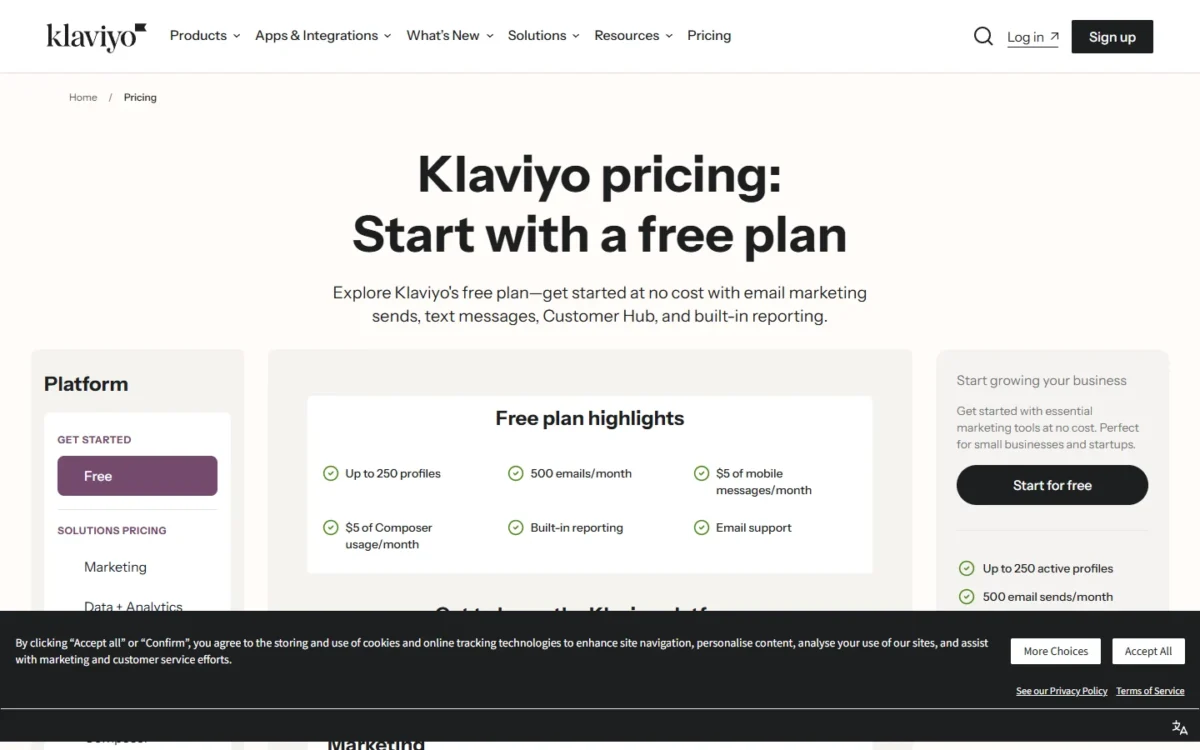
Klaviyo’s Email plan costs $20 a month at 500 active profiles with 5,000 emails, $60 a month at 2,500 profiles with 25,000 emails, an estimated $100 a month at 5,000 profiles with 50,000 emails, and $150 a month at 10,000 profiles with 100,000 emails. That is 10 emails per profile a month, enough for a weekly campaign plus flows. An offer on the pricing page takes $19 off the first month at 500 profiles only. Texts are not bundled: each US toll-free SMS adds $0.01 plus carrier fees.
| Plan | Price | Billing | Key limit |
|---|---|---|---|
| Free | $0 | Per month | 250 active profiles, 500 emails a month |
| Email, 500 profiles | $20 | Per month | 5,000 emails a month |
| Email, 2,500 profiles | $60 | Per month | 25,000 emails a month |
| Email, 5,000 profiles | $100 | Estimated, per month | 50,000 emails a month |
| Email, 10,000 profiles | $150 | Per month | 100,000 emails a month |
Sources: Klaviyo pricing, Klaviyo free and paid plans, checked Nov 2026.
Pros
- Two-way Shopify sync writes subscriptions and email and text events back to Shopify
- 60+ pre-built flows, including browse abandonment, price drop and back-in-stock
- Email, SMS and push can run inside one flow
- Suppressed profiles do not count toward the active-profile bill
Cons
- Every emailable profile counts toward the price, engaged or not
- The free plan stops sending above 250 profiles or 500 emails, and flow emails can be skipped at the send limit
- Free accounts get email support for the first 60 days only
- Behavioral events depend on a Shopify privacy setting
Choose Klaviyo when your store runs on Shopify and you plan to segment by order count, product and browsing from the first month. For the whole platform beyond store flows, read my Klaviyo review.
- Skip it if:
- your list is large, mostly unengaged and mailed only a few times a month. Sendlane bills by sends with unlimited profiles, so a dormant subscriber costs nothing until you email them. Brevo prices by email volume, and each tier carries a contact allowance: 500 contacts at 5,000 emails, 2,500 at 15,000 and 500,000 at 50,000.
2. Omnisend: Best for Email, SMS and Web Push in One Builder
- Best for: stores that want SMS and web push inside the same automations as email
- Starting price: free plan; Standard $48.00 per 3 months at 500 contacts
- Billed by: contacts, including non-subscribers who received automated messages
- SMS: sold by volume, from $0.009 down to $0.007 per US message
- Free plan: 250 contacts, 500 emails and 500 web push notifications a month
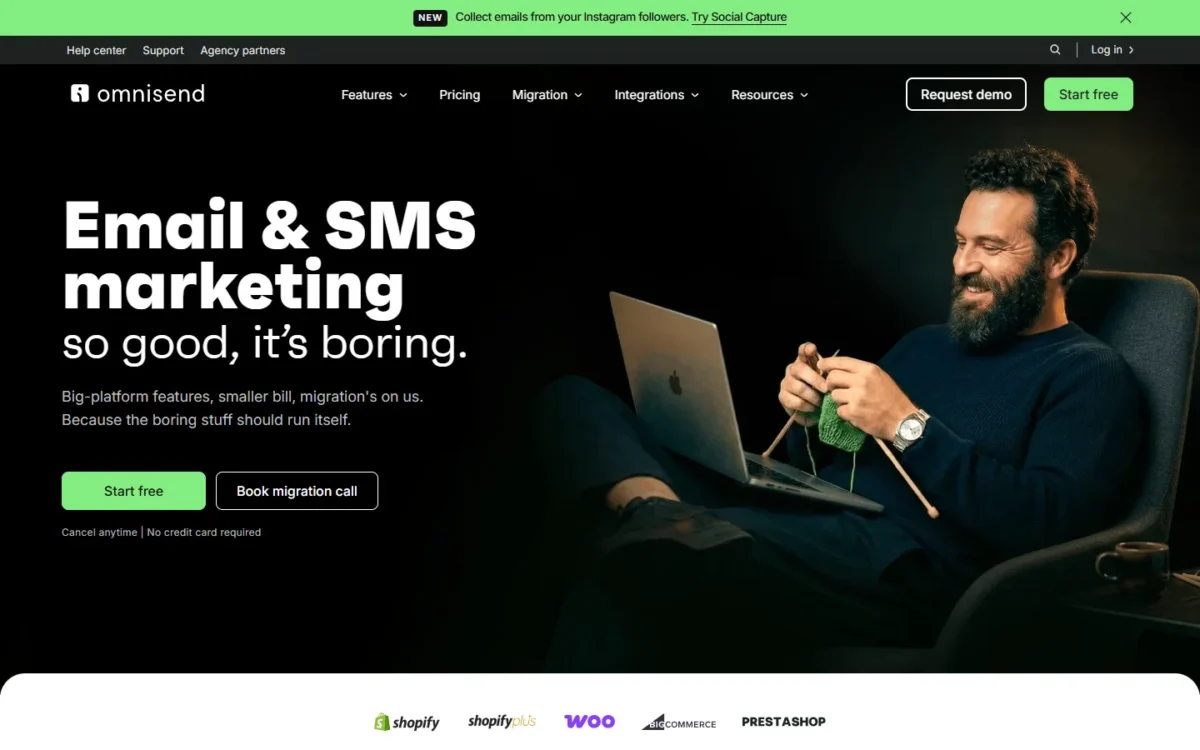
Omnisend fits a store that wants text messages and browser push in its cart and post-purchase flows without paying for a second app. One builder combines email, SMS and push, and unlimited web push starts on Standard. Sends on Standard top out at 12 times your list size a month, and SMS credits come with Pro, so a store that texts every week should price Pro from the start.
One workflow can move a shopper from an email to a text to a push notification, and Omnisend’s templates cover welcome, product abandonment, cart abandonment, order and shipping confirmation and cross-sell. Next to Klaviyo, the difference is how texts are sold: Omnisend sells US SMS credits in volume bands, from $0.009 per message for a $10 to $49.99 purchase down to $0.007 at $10,000 or more.
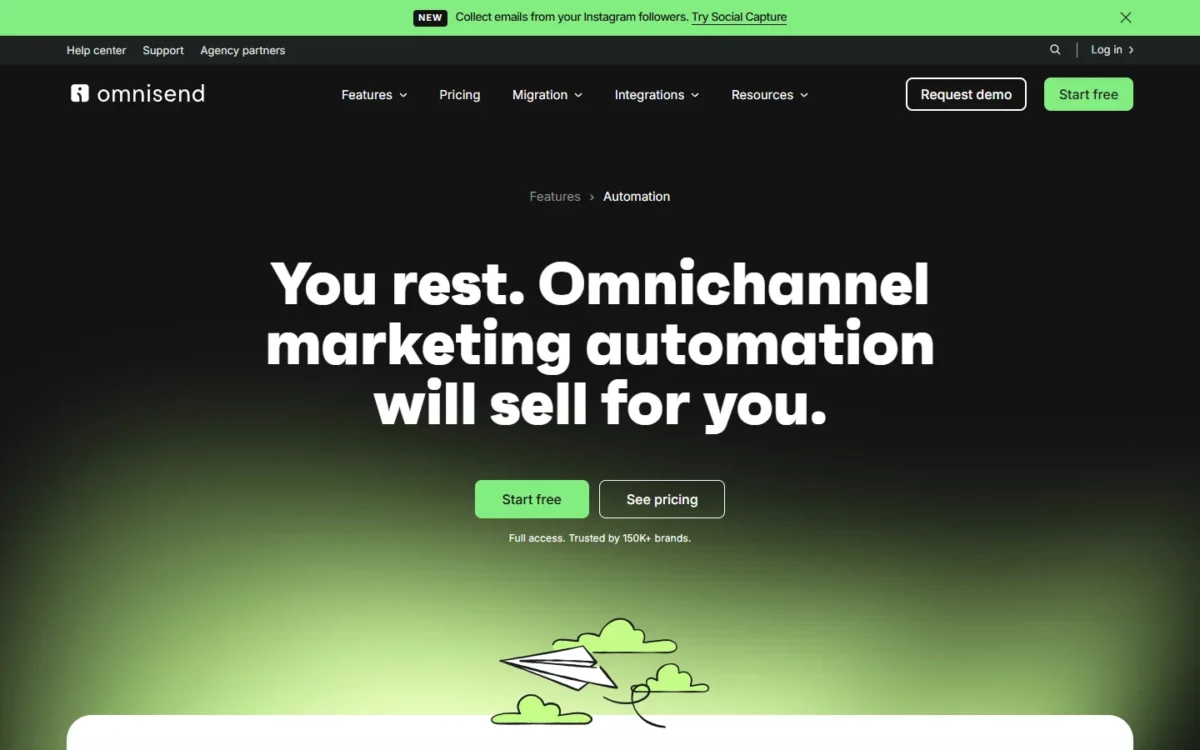
Switching help is the other draw. Omnisend’s team moves lists, segments, flows and templates for free within 5 days and says it rebuilds abandoned cart, post-purchase and win-back flows for stores coming from Klaviyo. Live chat and email support run 24/7 on every plan, including Free. Omnisend markets itself to Shopify stores, and its BigCommerce app syncs contact and order information automatically.
Reporting and AI lean toward Pro. Omnisend’s FAQ names advanced reporting among the reasons stores pick Pro over Standard, and the Pro card lists the product recommender agent, which inserts products into each email from browsing and purchase behavior.
Read the billing rule twice: Omnisend bills subscribers and non-subscribers who received automated messages, so order confirmations sent through it count buyers who never opted into marketing.
Omnisend assigns a free account expert to anyone paying at least $400 a month; smaller stores rely on the 24/7 live chat and email support that every plan includes.
Standard lists $48.00 for three months at 500 contacts with 6,000 emails a month, which is $48.00 / 3 = $16 a month. Paying the three months upfront brings that first charge down to $33.60, and after three months Omnisend bills monthly.
Pro lists $177.00 for three months at 2,500 contacts, which is $177.00 / 3 = $59 a month, and adds unlimited emails and bonus SMS credits equal to your monthly bill. Klaviyo’s 2,500-profile tier is $60 a month, so the two price a 2,500-person list a dollar apart before texts.
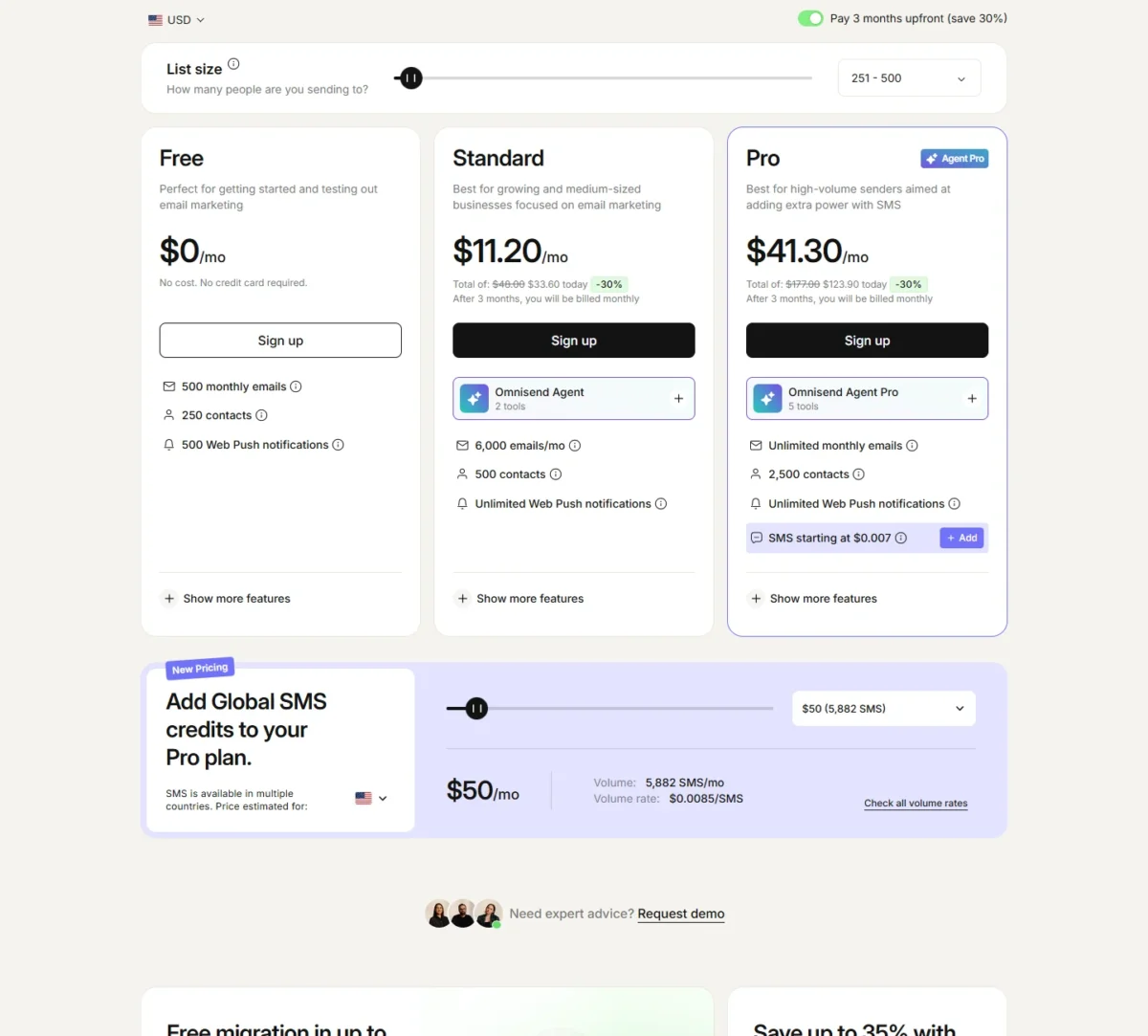
| Plan | Price | Billing | Key limit |
|---|---|---|---|
| Free | $0 | Per month | 250 contacts, 500 emails |
| Standard | $48.00 / 3 = $16 a month | Monthly; $33.60 for 3 months paid upfront | 500 contacts, 6,000 emails a month |
| Pro | $177.00 / 3 = $59 a month | Monthly; $123.90 for 3 months paid upfront | 2,500 contacts, unlimited emails |
Sources: Omnisend pricing, checked Nov 2026.
Pros
- Email, SMS and push in one automation builder
- Unlimited web push on Standard and Pro
- Free 5-day migration that rebuilds flows from Klaviyo
- Behavioral segmentation on browsing, buying and clicking data
Cons
- Standard caps sends at 12 times the list size a month
- SMS sends carry extra charges on top of the plan price
- Non-subscribers who receive automated messages count toward the bill
Choose Omnisend when SMS supports your email program rather than leading it and you want one tool. Move to Pro once texts or daily sends matter.
- Skip it if:
- text messages drive most of your revenue and you want SMS-specific options such as a dedicated short code; Postscript is built around that channel.
3. Shopify Messaging: Best for New Shopify Stores That Want to Start Free
- Best for: new Shopify stores that want email and SMS without another app
- Starting price: 10,000 free emails a month, then $1 per 1,000
- Billed by: emails sent, added to the Shopify bill
- SMS: $0.012 per US message, and a $2.15 monthly charge per toll-free number
- Available on: Shopify’s Basic, Grow, Advanced and Plus plans
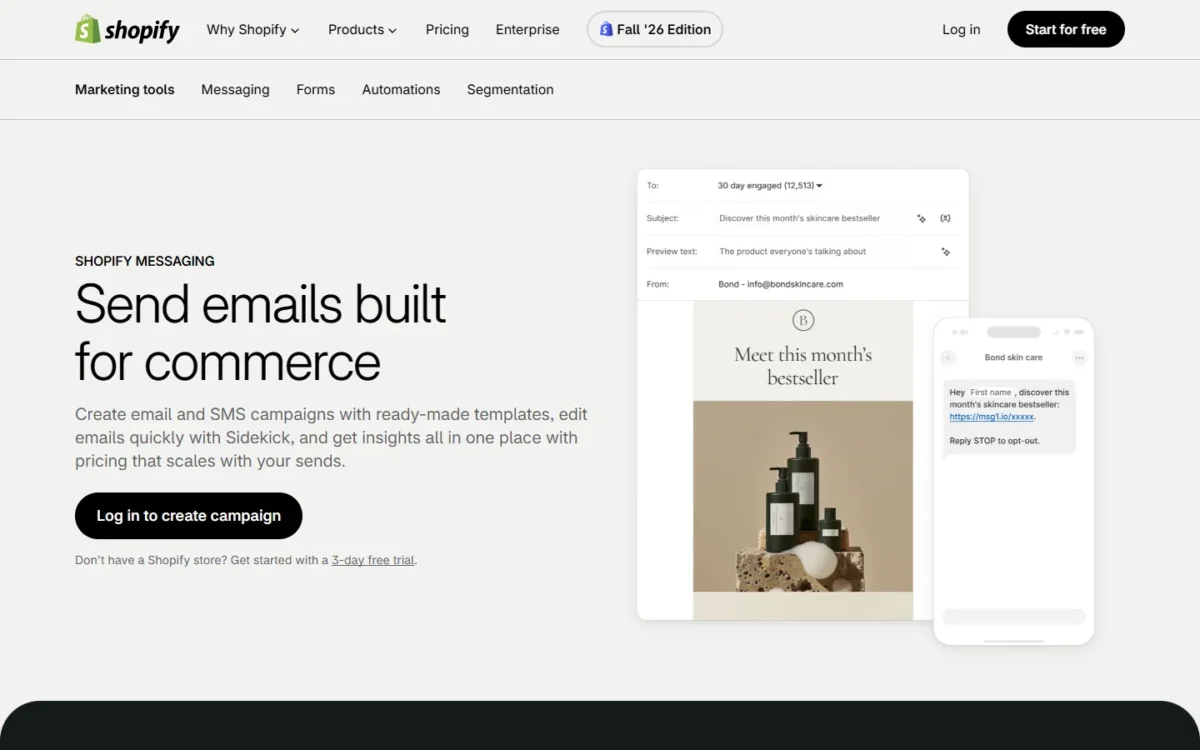
Shopify Messaging, the app formerly known as Shopify Email, is where a new Shopify store should start before paying anyone, while the plans behind it are priced in my Shopify pricing guide. Every month includes 10,000 free emails, abandoned checkout emails never count toward that allowance, and email, SMS and WhatsApp campaigns run from the Shopify admin. It works only for Shopify stores, and its automation pages name welcome, winback and upsell templates and abandoned checkout, while Klaviyo’s flow page also names browse abandonment and price drop.
Billing by sends rather than contacts suits a young store. Automations count toward the 10,000 free emails, except abandoned checkout emails, unused emails do not carry over, and a monthly spending threshold sends an alert once combined email, SMS and WhatsApp costs reach the amount you set.
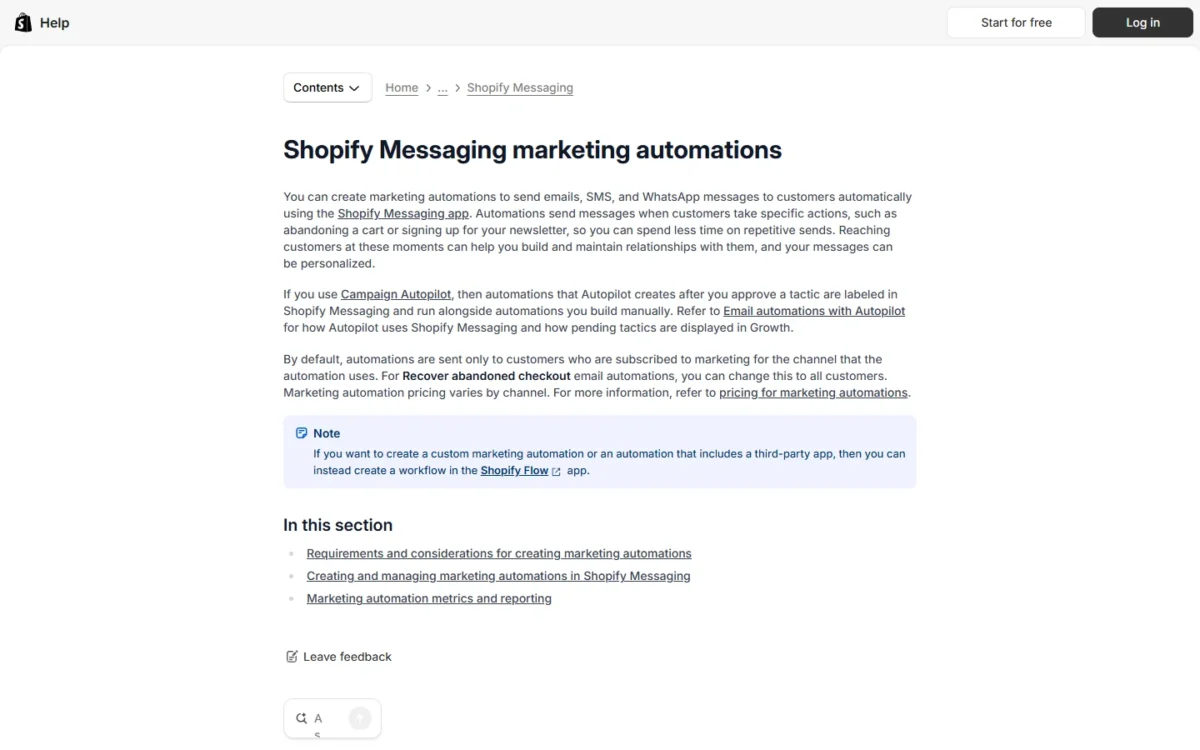
Automations fire on actions such as abandoning a cart or signing up for the newsletter, and Shopify lists ready-made welcome, winback and upsell templates. By default they reach only customers subscribed to that channel. On SMS, a long message is billed as several, and confirmation and double opt-in texts are billed too. Where Klaviyo’s free plan stops at 250 profiles, Shopify counts emails, not people.
After the first 10,000 emails, a store pays $1 per 1,000 extra emails up to 300,000, and abandoned checkout emails stay free at any volume. A store mailing 2,500 contacts five times a month sends 12,500 emails and pays 2.5 x $1 = $2.50 for the extra 2,500.
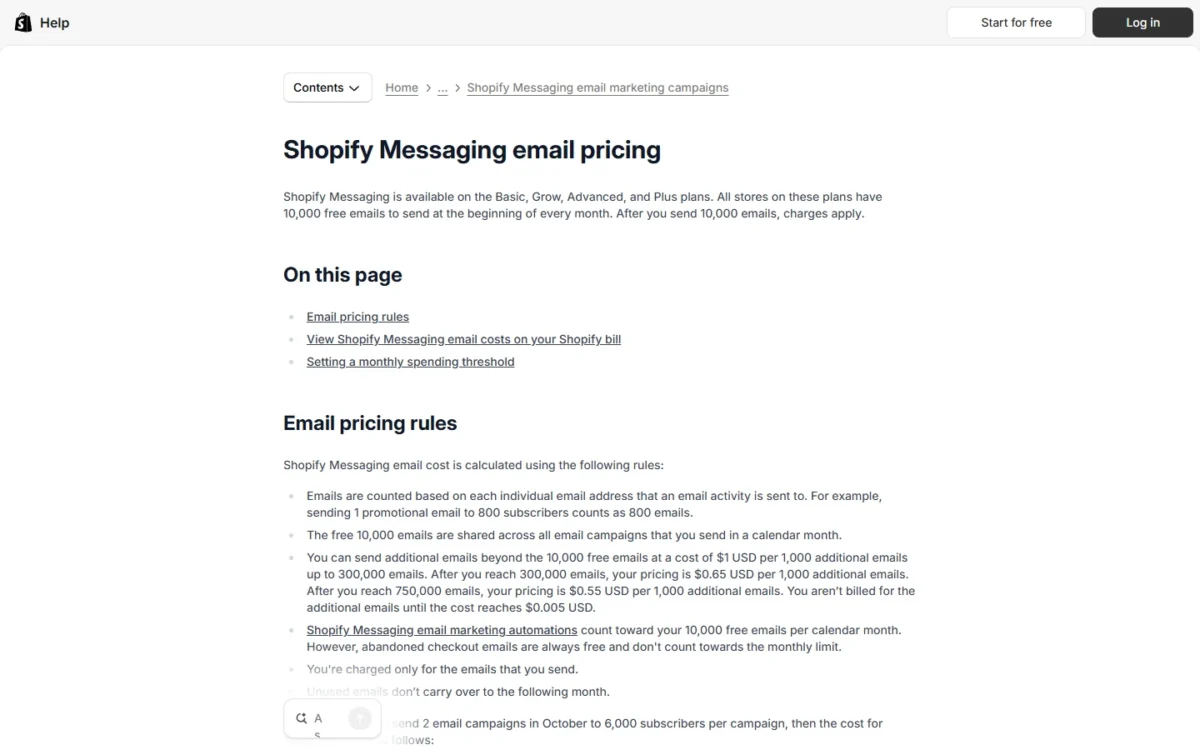
| Item | Price | Billing | Key limit |
|---|---|---|---|
| Emails 1 to 10,000 | $0 | Per calendar month | Unused emails do not carry over |
| Emails above 10,000 | $1 per 1,000 | Shopify bill | Up to 300,000 emails |
| US SMS | $0.012 per message | Billed monthly | $2.15 monthly charge per toll-free number |
Sources: Shopify Messaging email pricing, Shopify Messaging SMS pricing, checked Nov 2026.
Pros
- 10,000 free emails every month, with abandoned checkout emails always free
- Email, SMS and WhatsApp from the Shopify admin, billed on the Shopify invoice
- Monthly spending alerts across all three channels
- Templates pull products, prices and branding from the store
Cons
- Works only for stores on Shopify
- Shopify’s pages name welcome, winback and upsell templates; Klaviyo’s page names browse abandonment and price drop
- Long SMS messages are billed as several messages
- Unused free emails expire at month end
Start here if your store is new on Shopify; move to Klaviyo or Omnisend once you want segments built on browsing and order history.
- Skip it if:
- your store runs on WooCommerce or BigCommerce; Klaviyo, Omnisend, Mailchimp and Brevo document both, and ActiveCampaign supports BigCommerce on Pro.
4. Brevo: Best for Large Lists That Send Less Often

- Best for: stores with a big customer file and a light sending calendar
- Free plan: 300 emails a day
- Starting price: Starter, $9 a month billed monthly for 5,000 emails
- Plan the job needs: Standard, from $18 a month billed monthly, for marketing automation
- Billed by: monthly email volume, with a contact allowance per tier
- Store integrations: Brevo-built Shopify and WooCommerce apps, plus a BigCommerce integration
Brevo makes the most sense for a store whose list is large but whose sending calendar is light. Plans are sized by monthly email volume, and the contact allowance grows faster than the sends: the 50,000-email Starter tier includes 500,000 contacts. Starter has no marketing automation, though, so automated workflows start on Standard.
Brevo builds its own Shopify and WooCommerce integrations, and the Shopify app syncs purchase data and abandoned cart details to trigger recovery messages. Standard adds multi-step workflows, A/B testing and web and event tracking. Transactional email comes with every plan, so order confirmations can share the account.
The channel list is wide but tiered. SMS credits are sold separately, while WhatsApp and pop-ups sit on Professional, which starts at 150,000 emails a month. A store that wants web push at a small send volume gets it on Omnisend’s Standard plan instead.
Starter costs $9 a month billed monthly for 5,000 emails and 500 contacts, $25 for 15,000 emails and 2,500 contacts, and $56 for 50,000 emails with 500,000 contacts. A store with 20,000 past customers mailed 2.5 times a month needs that 50,000-email tier, while Klaviyo already charges $150 a month for 10,000 profiles. Those are Starter prices, so set the selector to your send count on Standard before you compare.
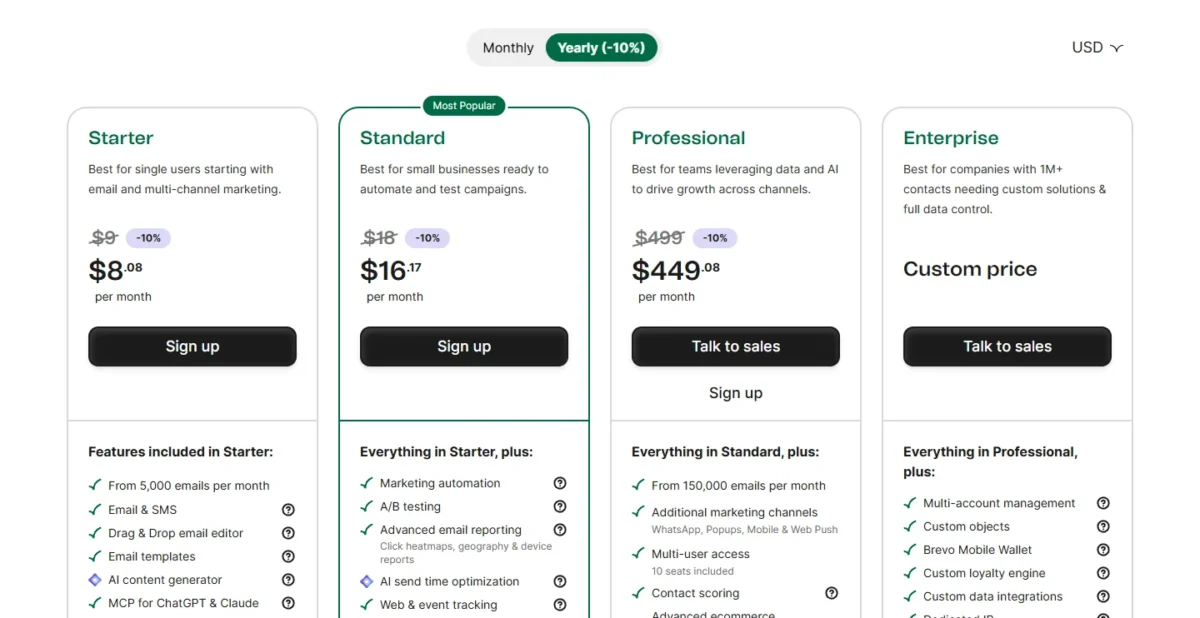
| Plan | Price | Billing | Key limit |
|---|---|---|---|
| Free | $0 | Per month | 300 emails a day |
| Starter | $9 | Per month, billed monthly | 5,000 emails, no marketing automation |
| Standard | $18 | Per month, billed monthly | Adds marketing automation |
| Professional | $499 | Per month, billed monthly | From 150,000 emails a month |
Sources: Brevo pricing, checked Nov 2026.
Pros
- Price follows email volume, with large contact allowances at higher tiers
- Brevo-built Shopify app syncs purchases and abandoned carts
- Transactional email on every plan
- Free plan to test the integration before paying
Cons
- Starter has no marketing automation, so store flows need Standard
- WhatsApp and pop-ups need Professional, which starts at 150,000 emails a month
- Frequent senders lose the advantage, because every send is billed
Choose Brevo when your list is far bigger than your sending calendar. My Brevo pricing breakdown covers every volume tier.
The broader platform, including its CRM, is in my Brevo review.
- Skip it if:
- you email your list several times a week; Omnisend Pro, with unlimited emails, keeps the bill flat as frequency rises.
5. Mailchimp: Best for Stores That Run General Marketing Alongside Store Flows
- Best for: stores that also send newsletters, events and other non-store email
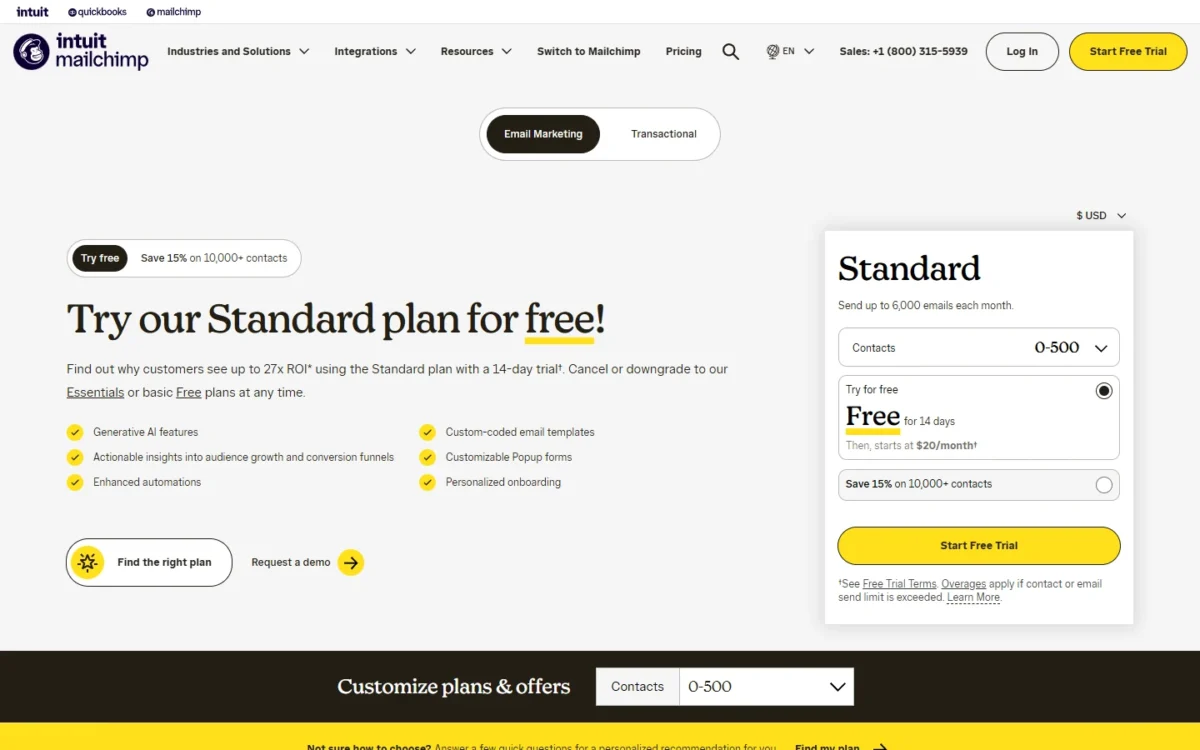
- Starting price: free under 250 contacts; paid plans from $13 a month
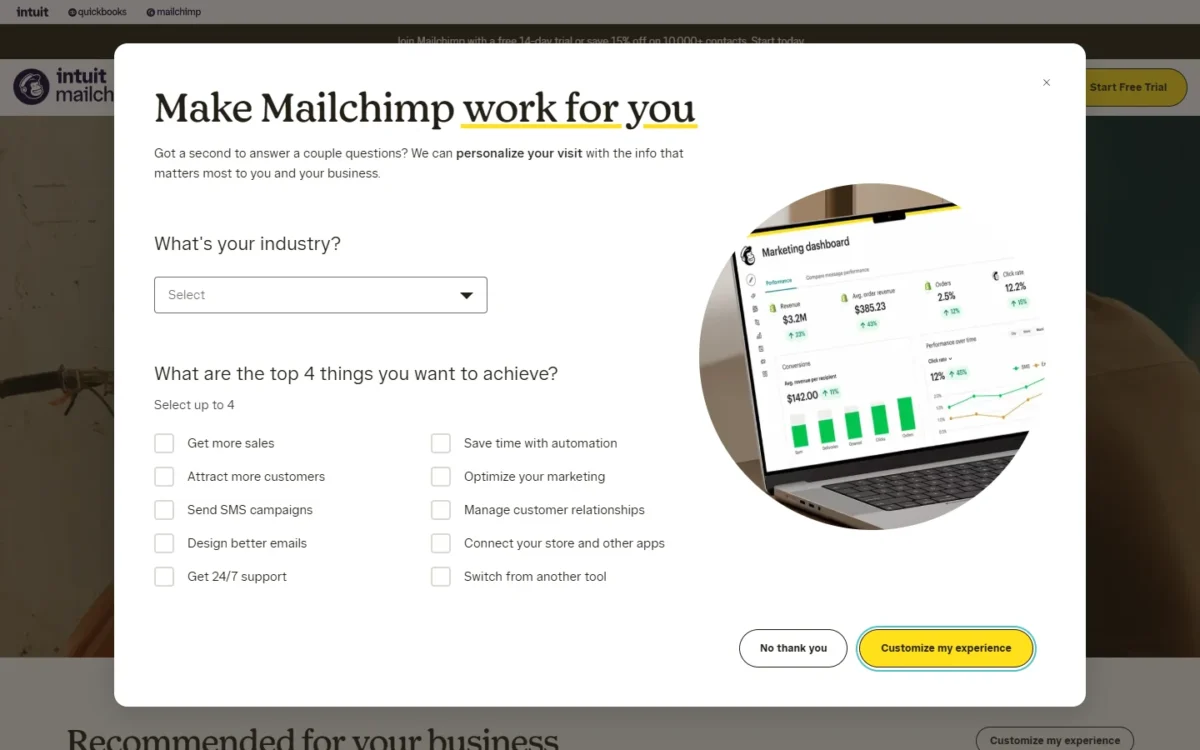
- Plan the job needs: Standard for predictive segments and dynamic content; free for 14 days, then from $20 a month
- Billed by: contacts, with sends capped at 10, 12 or 15 times the contact count
- Trial: the free trial of Standard or Essentials lasts 14 days
Mailchimp suits a store that also runs general marketing and wants its Shopify or WooCommerce data inside one familiar tool. The Shopify integration syncs segments, pushes unique discount codes back to Shopify and triggers welcome, abandoned cart and back-in-stock automations. Expect the price to rise with contacts, and the store features that matter most sit on Standard rather than Essentials.
Discount-code sync earns the place. Single-use codes created in Mailchimp sync to Shopify so customers can redeem them, in email, SMS and pop-up forms, and attributed campaign revenue shows in the Shopify dashboard. WooCommerce stores get customer and order data, abandoned cart reminders and post-purchase campaigns through Mailchimp’s own integration.
The gates decide the purchase. Marketing Automation Flows run only on paid plans, and predictive segments and dynamic content need Standard or Premium. SMS is a paid-plan add-on whose credits expire monthly, where Privy’s roll over.
Essentials and Standard each run free for 14 days, then start at $13 and $20 a month, and the price climbs with the contact selector. Stores with 10,000 or more contacts get 15% off their first 12 months, a promotion rather than the list price. Paid plans bill overages past a contact or send limit; on Free, sending pauses. My Mailchimp plans in detail walk through the contact tiers.
| Plan | Price | Billing | Key limit |
|---|---|---|---|
| Free | $0 | Per month | 250 contacts, 500 sends a month or 250 a day |
| Essentials | From $13 | Per month | Sends capped at 10 times contacts |
| Standard | From $20 | Per month | Sends capped at 12 times contacts |
Sources: Mailchimp pricing, checked Nov 2026.
Pros
- Unique discount codes sync to Shopify and work in email, SMS and pop-ups
- Campaign revenue appears in the Shopify dashboard
- WooCommerce integration covers abandoned cart and post-purchase campaigns
- Standard includes an onboarding session for new or upgraded accounts
Cons
- Automation flows are paid-plan only
- Predictive segments and dynamic content need Standard
- SMS credits expire monthly and do not roll over
Choose Mailchimp when one team sends store flows, newsletters and event invitations from one tool. The full verdict is in my Mailchimp review.
- Skip it if:
- store flows are your whole email program; Klaviyo or Omnisend build around store data from the free plan up.
6. Privy: Best for Growing a Store’s List With On-Site Pop-Ups
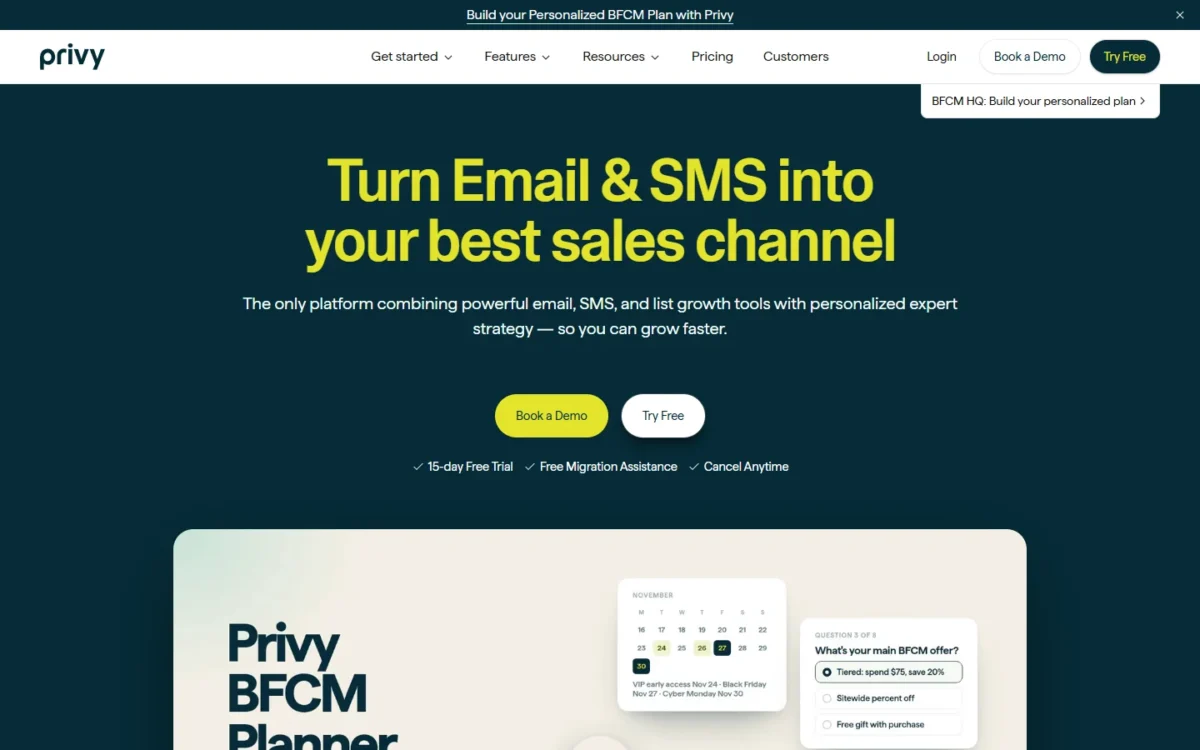
- Best for: stores whose first problem is too few subscribers
- Starting price: Email from $30 a month; Pop-ups & Displays only from $24 a month
- Billed by: mailable contacts, with unlimited email sends
- SMS: add-on credits that roll over to the next billing period
- Trial: 15 days, no credit card
Privy belongs on the list for a store whose bottleneck is list growth rather than flow logic. Its Email plan, from $30 a month with unlimited email sends, pairs email and SMS campaigns with advanced pop-up design and targeting. Depth is where it gives ground: its flows run from welcome to win-back on templates, and its pages describe syncing collected contacts to Shopify, BigCommerce or Wix.
The Pop-ups & Displays only plan is the useful twist. From $24 a month, priced by page views, it lists spin-to-win, cart saver and exit-intent pop-ups, collects contacts and syncs them to Shopify, BigCommerce or Wix and to select tools, including Klaviyo, so a Klaviyo store can keep its flows and use Privy only for capture.
On the full plan, contacts are billed only when mailable and sends are unlimited, so mailing more often does not raise the bill. Privy also now owns Sendlane, according to the banner on Sendlane’s pricing page.
Email starts at $30 a month for mailable contacts with unlimited sends; the SMS add-on starts at $0 a month. The price rises with your mailable-contact count, so set the selector to your list before you compare it with Omnisend’s Standard.
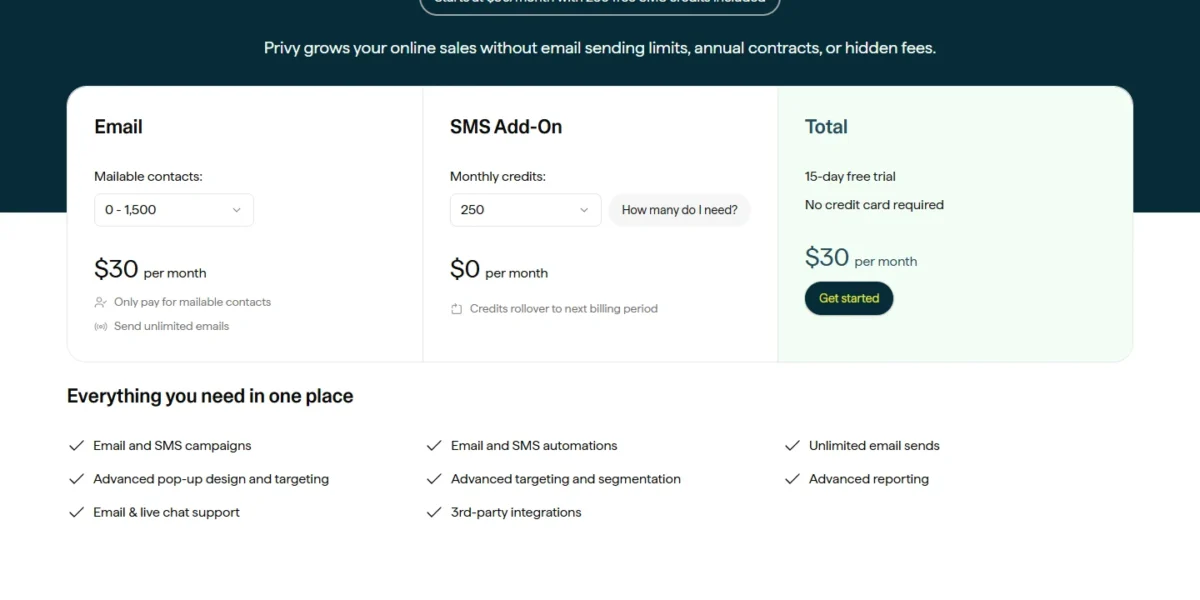
| Plan | Price | Billing | Key limit |
|---|---|---|---|
| From $30 | Per month | Priced by mailable contacts | |
| SMS add-on | From $0 | Per month | Credits roll over |
| Pop-ups & Displays only | From $24 | Per month | Priced by page views, no email |
Sources: Privy pricing, checked Nov 2026.
Pros
- Advanced pop-up design and targeting on the Email plan, beside email and SMS
- Unlimited email sends on the Email plan
- Pop-ups-only plan feeds Shopify, BigCommerce, Wix or Klaviyo
- SMS credits roll over
Cons
- Its pages describe syncing collected contacts, so check which order data reaches your flows
- Store sync named for Shopify, BigCommerce and Wix, not WooCommerce
- Tiers above the entry contact count need the pricing selector
Choose Privy when a small store needs subscribers before it needs complex flows, or put its pop-ups-only plan in front of Klaviyo.
- Skip it if:
- your list already grows and the gap is flow logic; Klaviyo’s browse abandonment and predictive triggers do more with the subscribers you have.
7. Postscript: Best for SMS-Led Shopify Brands
- Best for: Shopify brands that plan around text messages
- Starting price: Starter $0 a month with a $49 monthly minimum spend
- Billed by: messages sent, plus carrier fees; no profile fees
- SMS rates: $0.009 (Starter), $0.008 (Growth), $0.007 (Professional) per SMS
- Trial: a $100 credit for the first 30 days
Postscript is the pick when texts, not email, are the channel a Shopify brand plans around. It charges per message with no profile fees, segments on Shopify data, and includes cart abandonment, browse abandonment, welcome and upsell templates on every plan. The trade-off is a second tool: Postscript calls itself an SMS, RCS and email platform, but its pricing page puts email behind a waitlist.
The plan choice is a volume question. Growth’s rate is $0.001 per SMS lower than Starter’s, so its fee pays back at 100,000 messages a month: Starter costs 100,000 x $0.009 = $900 and Growth $100 + 100,000 x $0.008 = $900. Professional’s higher fee pays back only at 400,000 messages. Carrier fees sit on top: at the average US SMS fee Postscript lists, 100,000 texts add 100,000 x $0.0033 = $330.
Postscript assigns and verifies a dedicated toll-free number for free, while a dedicated short code costs $750 a month through the carriers. Contracts are optional; without one, billing is monthly.
Starter has no plan fee but a $49 monthly minimum spend at $0.009 per SMS; Growth is $100 a month at $0.008; Professional is $500 a month at $0.007; Enterprise is priced by sales. Carrier fees pass through at cost on their own invoice line.
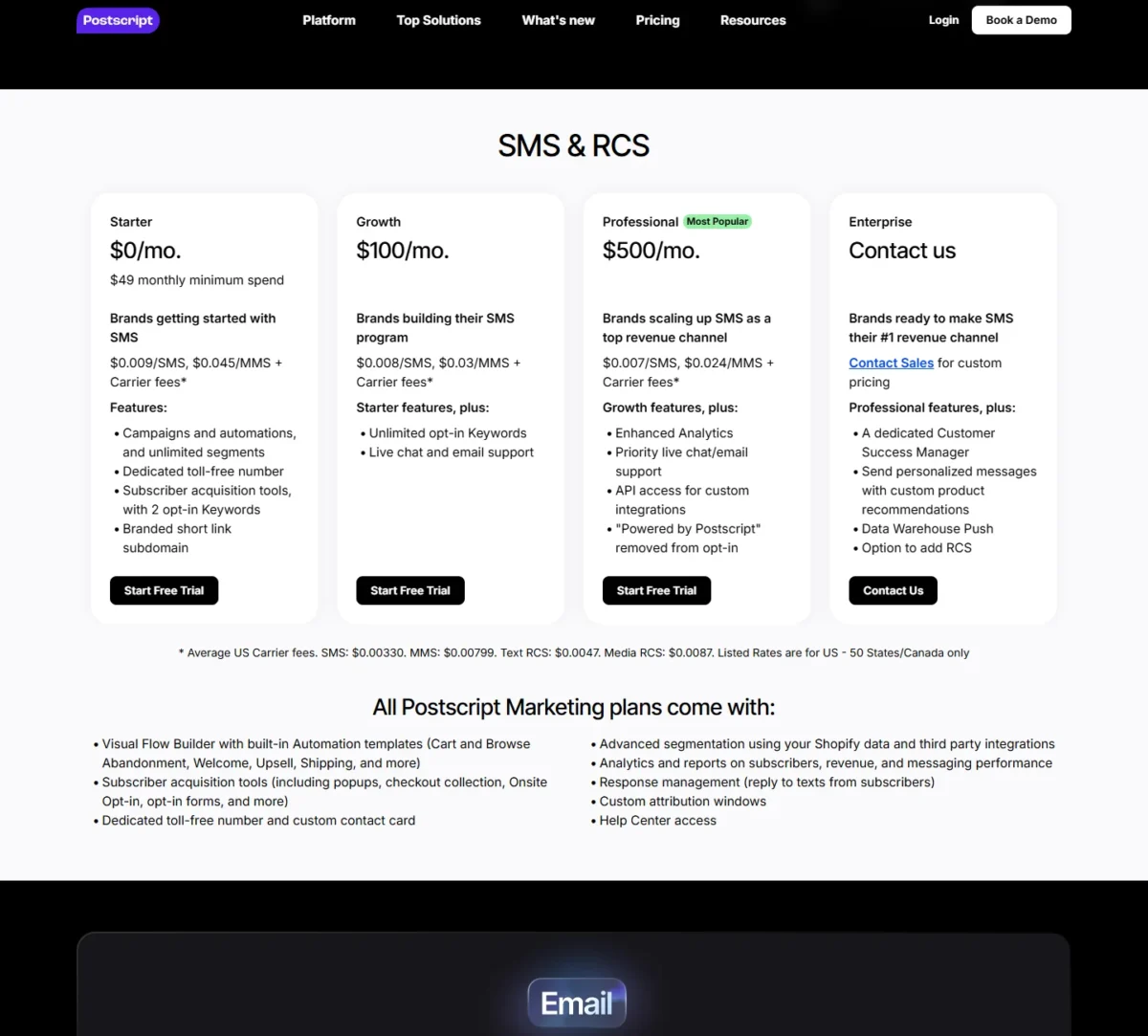
| Plan | Price | Billing | Key limit |
|---|---|---|---|
| Starter | $0 + $49 minimum spend | Per month | $0.009 per SMS + carrier fees |
| Growth | $100 | Per month | $0.008 per SMS + carrier fees |
| Professional | $500 | Per month | $0.007 per SMS + carrier fees |
| Enterprise | Contact sales | Custom | Custom pricing |
Sources: Postscript pricing, checked Nov 2026.
Pros
- No profile fees: you pay per message, not per subscriber
- Cart and browse abandonment templates on every plan
- Free dedicated toll-free number, verified by Postscript
- Segmentation on Shopify data and third-party integrations
Cons
- Email is behind a waitlist on the pricing page, so a second tool is likely
- Carrier fees come on top of every rate
- Starter carries a $49 monthly minimum spend
- A dedicated short code costs $750 a month
Choose Postscript when SMS revenue justifies its own platform; my comparison of SMS marketing platforms covers the SMS-only alternatives.
- Skip it if:
- texts are a side channel to email; Omnisend Pro or Klaviyo’s per-send SMS keep both channels in one flow.
8. Sendlane: Best for Large DTC Lists That Want to Pay by Sends, Not Profiles
- Best for: DTC stores with a large customer file and steady send volume
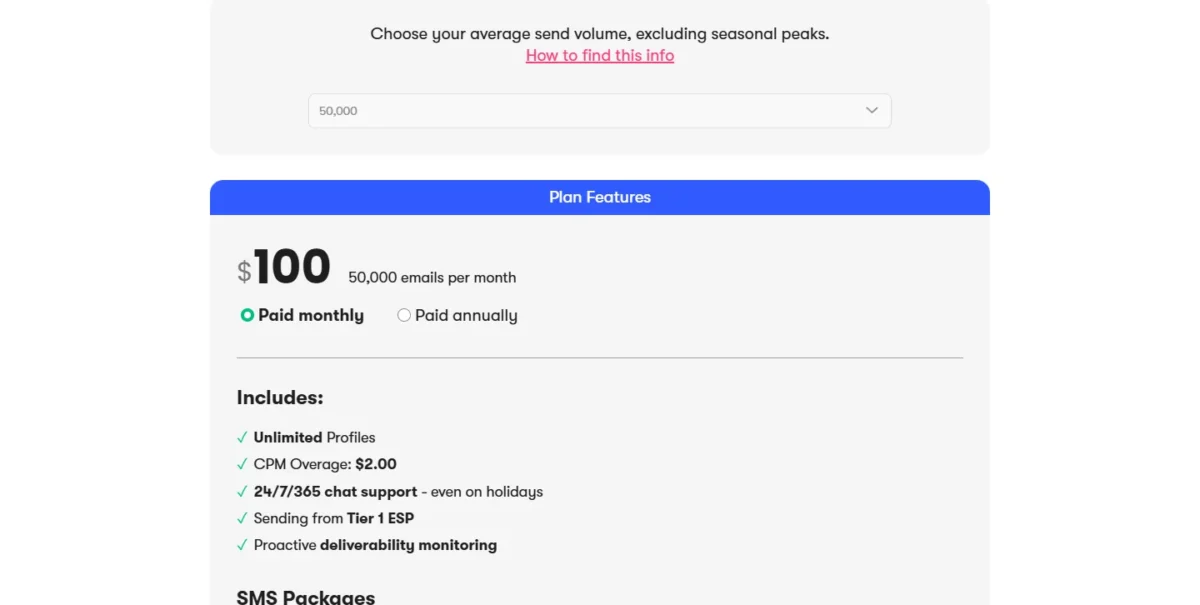
- Starting price: $100 a month for 50,000 emails, paid monthly
- Billed by: sends, with unlimited profiles
- SMS: from $0.009 per credit, carrier fees included
- Trial: 60 days, limited to 100 contacts and 500 email sends
Sendlane suits a store with a big customer file that wants the bill tied to sends, not to the people it keeps. Profiles are unlimited, the entry tier covers 50,000 emails a month, and its data integrations reach Shopify, WooCommerce and Smile.io. Two things to weigh: dedicated support and program reviews are reserved for annual contracts, and Sendlane’s pricing page now carries a banner saying Sendlane has been acquired.
The billing model is the reason to look. A store with 10,000 contacts mailing each one five times a month sends 50,000 emails, which fits Sendlane’s entry tier at a lower price than Klaviyo’s $150 for 10,000 profiles. At 5,000 profiles Klaviyo’s Email plan shows an estimated $100 a month, the same as Sendlane, and at 2,500 profiles Klaviyo is $60, so smaller lists pay less on profiles. Sends over the tier cost $2.00 per thousand.
Sendlane lists deep data integrations for Shopify, WooCommerce, ClickBank, Miva and Smile.io, plus pre-built automation funnels and website tracking on every plan. Its SMS credit price includes carrier fees, which makes a text budget easier to read than Postscript’s rate plus pass-through fees; SMS needs a paid account.
Sendlane’s first tier is $100 a month for 50,000 emails, paid monthly, with unlimited profiles; higher tiers follow average monthly send volume, excluding seasonal peaks.
| Plan | Price | Billing | Key limit |
|---|---|---|---|
| 50,000 emails | $100 | Paid monthly | $2.00 per thousand emails over the tier |
| SMS credits | From $0.009 per credit | Per credit | Carrier fees included |
Sources: Sendlane pricing, checked Nov 2026.
Pros
- Unlimited profiles: you pay for sends
- Deep data integrations for Shopify, WooCommerce and Smile.io
- SMS credit prices include carrier fees
- 60-day trial, the longest on this list
Cons
- At 2,500 profiles the entry tier costs $100 against Klaviyo’s $60; the two tie at 5,000
- Dedicated support and program reviews need an annual contract
- SMS is unavailable during the trial
Choose Sendlane once your list grows past 5,000 profiles: Klaviyo’s Email plan is an estimated $100 a month at 5,000, the same as Sendlane, and $150 at 10,000.
- Skip it if:
- your list is under a few thousand people; Klaviyo’s tier at 2,500 profiles or Shopify Messaging’s free allowance costs less.
9. ActiveCampaign: Best for Stores That Also Need a Sales CRM
- Best for: stores that also sell B2B or work a sales pipeline
- Starting price: Starter $15 a month billed yearly for 1,000 contacts
- Plan the job needs: Pro, $79 a month billed yearly, for BigCommerce, Magento or Shopify Plus
- Billed by: contacts, with sends capped at 10 to 15 times the contact count
- Trial: 14 days, no credit card
ActiveCampaign is the pick for a store that also runs a sales pipeline, such as wholesale accounts, and wants automation and CRM in one system. Abandoned cart and the Shopify, Square and WooCommerce integrations come on every plan, Starter included. Its plan gates decide the price more than the contact count does.
BigCommerce, Magento and Shopify Plus are premium integrations on Pro and Enterprise only, so a BigCommerce store’s real entry price is Pro’s, not Starter’s. Product catalog blocks and coupons start on Plus at $49 a month billed yearly. SMS is an add-on that works with Plus, Pro and Enterprise but not Starter.
The CRM side is an add-on too: Enhanced CRM, with pipelines and sales engagement, is available from Plus. For a store that only sells online, that is cost without use; for one with a wholesale team, it replaces a second subscription. Reporting is gated the same way: ecommerce reporting and generative AI start on Plus, and revenue attribution needs Pro. If the CRM matters more than email, my list of CRMs built for ecommerce is the better starting point.
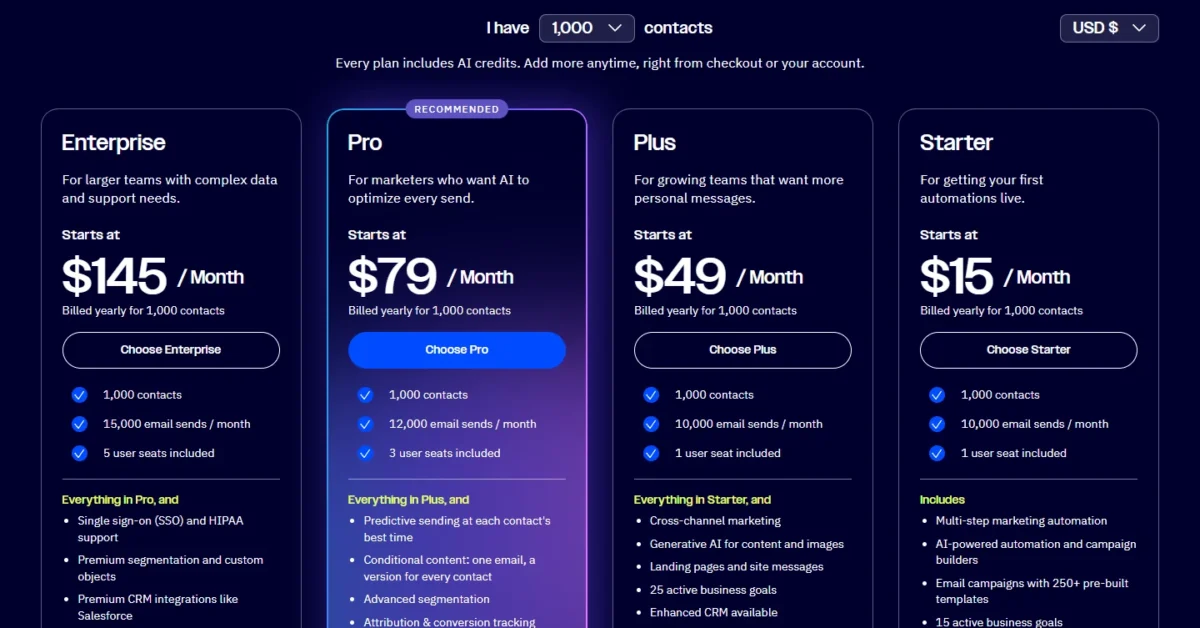
At 1,000 contacts, billed yearly, Starter is $15 a month, Plus $49, Pro $79 and Enterprise $145. Monthly sends are 10 times contacts on Starter and Plus, 12 times on Pro and 15 times on Enterprise. ActiveCampaign offers a full refund if you are not satisfied after 30 days. My ActiveCampaign pricing guide covers the larger contact tiers.
| Plan | Price | Billing | Key limit |
|---|---|---|---|
| Starter | $15 | Per month, billed yearly | No catalog blocks, coupons or SMS |
| Plus | $49 | Per month, billed yearly | No BigCommerce or Shopify Plus |
| Pro | $79 | Per month, billed yearly | 12,000 email sends a month at 1,000 contacts |
| Enterprise | $145 | Per month, billed yearly | 15,000 email sends a month at 1,000 contacts |
Sources: ActiveCampaign pricing, checked Nov 2026.
Pros
- Abandoned cart and Shopify, Square and WooCommerce integrations on every plan
- Optional CRM pipelines in the same account from Plus
- 30-day refund offer on top of the 14-day trial
- BigCommerce, Magento and Shopify Plus supported on Pro
Cons
- BigCommerce and Shopify Plus stores pay Pro prices
- Catalog blocks and coupons need Plus
- SMS is an add-on unavailable on Starter
Choose ActiveCampaign when email and a sales pipeline need to share one contact record. My ActiveCampaign review covers the automation builder in full.
- Skip it if:
- you run a store with no B2B pipeline; Klaviyo integrates with Shopify to bring in profile and order data, and its 60+ pre-built flows, including browse abandonment and price drop, are built around store data.
10. MailerLite: Best for Small Stores on a Tight Budget
- Best for: small Shopify or WooCommerce stores watching every dollar
- Starting price: free up to 250 subscribers; Comfort $10.80 a month billed yearly
- Billed by: subscribers
- Free plan limits: 2,500 emails a month, 3 active automations
- Trial: 14 days of premium features, no credit card
MailerLite fits a small store that wants Shopify or WooCommerce data in its emails at a low monthly price. Every paid plan gets the full feature set, ecommerce triggers included. What it lacks is SMS on the marketing plans: texting lives in MailerLite’s separate transactional product.
The Shopify integration does more than the price suggests. It syncs customers and subscribers with their order information, builds segments such as first-time customers, high spenders and repeat buyers automatically, imports products into the email editor and sends abandoned cart and purchase-triggered emails. MailerLite also lists a WooCommerce integration and e-commerce sales tracking.
The free plan is real but tight: 250 subscribers, 2,500 emails a month, and 3 active automations of up to 5 steps. Welcome, abandoned cart and post-purchase flows use all three slots on day one, which is the point to move to Comfort’s 50 automations.
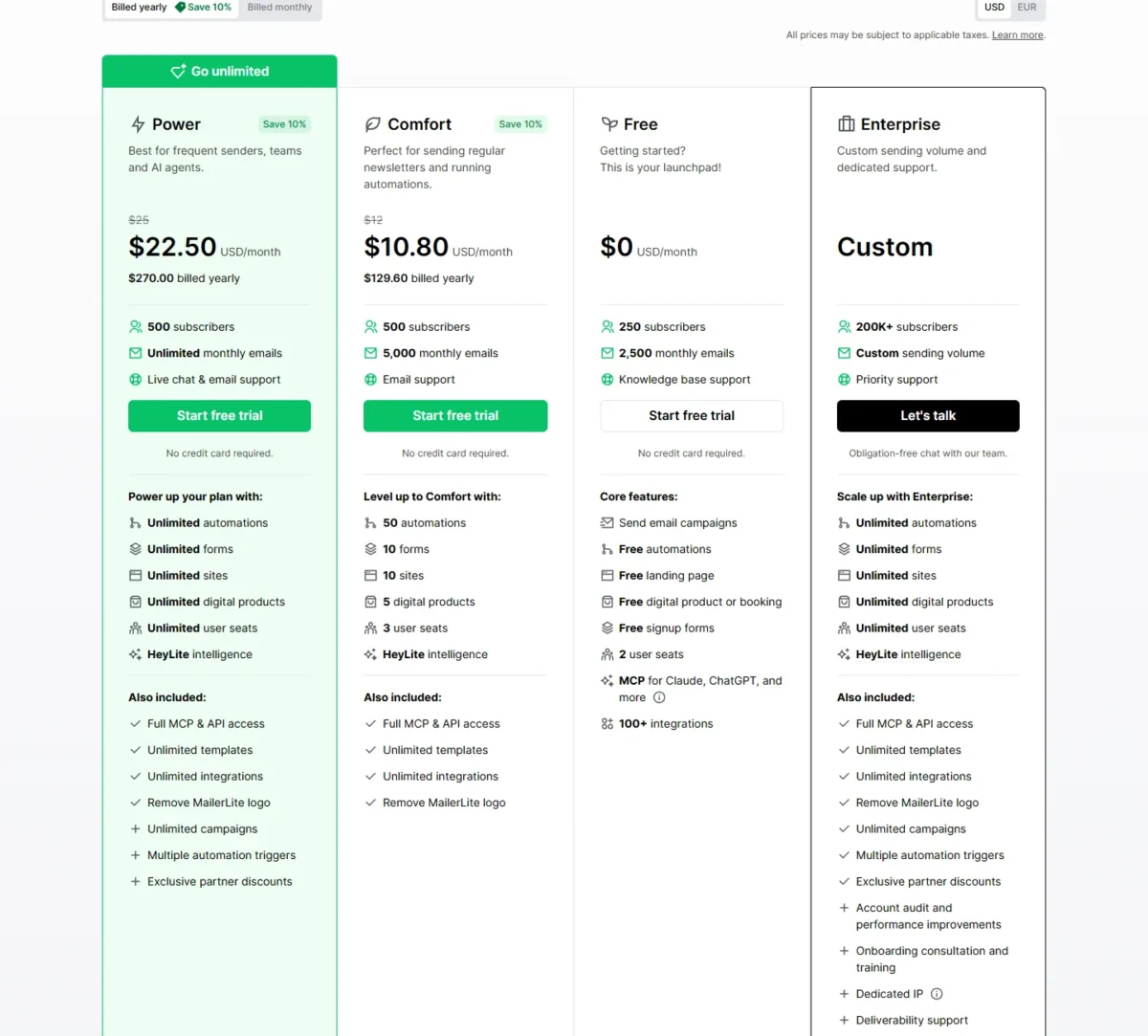
Comfort is $10.80 a month billed yearly ($129.60 a year) for 500 subscribers and 5,000 emails a month; Power costs $22.50 a month billed yearly and lists unlimited monthly emails. Against Moosend, MailerLite keeps a free plan to start on.
| Plan | Price | Billing | Key limit |
|---|---|---|---|
| Free | $0 | Per month | 250 subscribers, 2,500 emails |
| Comfort | $10.80 | Per month, billed yearly | 500 subscribers, 5,000 emails |
| Power | $22.50 | Per month, billed yearly | 500 subscribers, unlimited emails |
Sources: MailerLite pricing, checked Nov 2026.
Pros
- Shopify integration builds buyer segments and sends abandoned cart emails
- Every paid plan gets the full feature set
- Free plan with automations to test the store connection
- Product import into the email editor
Cons
- No SMS on the marketing plans
- Free plan allows 3 active automations of 5 steps
- Comfort allows 5,000 sends a month at 500 subscribers, and the cap rises with the list
Choose MailerLite when your store is small, your flows are simple and the budget is the constraint.
- Skip it if:
- you want texts in the same tool; Omnisend adds SMS and push to the same flows.
11. Moosend: Best for Product-View Triggers on a Small Budget
- Best for: budget stores that want to react to product views from the start
- Starting price: Pro from $7 a month on annual billing
- Billed by: contacts, with unlimited email sends
- Trial: 30 days, no credit card, unlimited email sends for up to 1,000 contacts
- Store integrations: WooCommerce and Magento
Moosend earns its place for a small store that wants to react to product views from day one without Klaviyo’s bill. Its builder has “views any product” and “browses any page” triggers, tracks product views, carts and purchases, and adds AI product recommendations; the WooCommerce integration adds cart abandonment and product recommendation emails. The catch is the start: there is no free plan after the 30-day trial, and its integrations page lists WooCommerce and Magento connectors, so check that your store platform is listed before the trial ends.
Moosend is now a Constant Contact company. Bi-annual billing saves 15%, and nonprofits get 25% off on top of the annual discount.
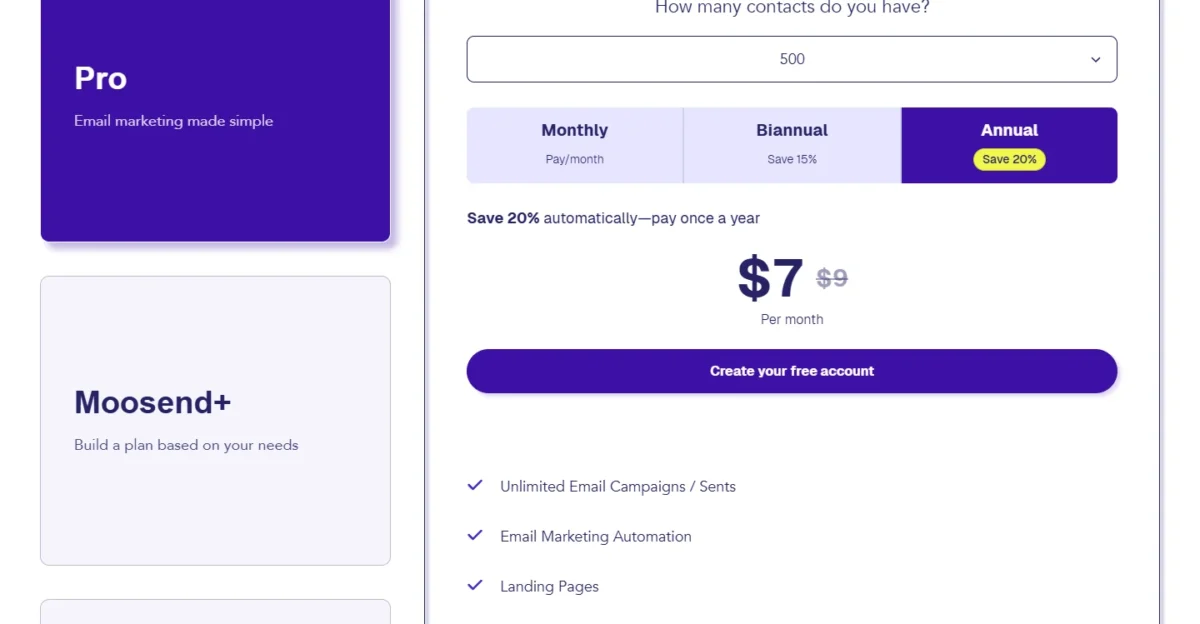
Pro starts at $7 a month with annual billing and includes unlimited email campaigns and sends; the price rises with the contact selector. Compared with MailerLite’s free plan, you pay from the first month after the trial.
| Plan | Price | Billing | Key limit |
|---|---|---|---|
| Free trial | $0 | 30 days | Unlimited email sends for up to 1,000 contacts |
| Pro | From $7 | Per month, billed annually | Price rises with contacts |
Sources: Moosend pricing, checked Nov 2026.
Pros
- “Views any product” and “browses any page” triggers listed in its plan comparison
- Unlimited email sends
- AI product recommendations
- Cart abandonment emails through the WooCommerce integration
Cons
- No free plan after the 30-day trial
- Shopify is not on its integrations list
- No SMS on the pricing page
Choose Moosend when you run WooCommerce on a tight budget and browse-based reminders matter more than SMS.
- Skip it if:
- you want a free plan to start; MailerLite and Shopify Messaging both have one.
How to Choose an Ecommerce Email Platform
Answer three questions in order: which store platform you run, whether SMS belongs in the same tool, and which billing unit is cheaper at your list size. The matrix narrows the first two.
| Software | Shopify integration | WooCommerce integration | BigCommerce integration | Abandoned cart flow | SMS |
|---|---|---|---|---|---|
| Klaviyo | Yes | Yes | Yes | Free plan | Add-on per send |
| Omnisend | Yes | Yes | Yes | Automations on Free | Pay per SMS; bonus credits on Pro |
| Shopify Messaging | Yes | Not listed | Not listed | Free | Per message |
| Brevo | Yes | Yes | Yes | Marketing automation from Standard | Credits |
| Mailchimp | Yes | Yes | Yes | Paid plans | Add-on |
| Privy | Yes | Not listed | Yes | Not listed | Add-on |
| Postscript | Yes | Not listed | Not listed | Starter | Yes |
| Sendlane | Yes | Yes | Not listed | Not listed | Paid plans |
| ActiveCampaign | Yes | Yes | Pro | Starter | Add-on from Plus |
| MailerLite | Yes | Yes | Not listed | Yes | Not listed |
| Moosend | Not listed | Yes | Not listed | Yes | Not listed |
Sources: Klaviyo pricing, Omnisend for BigCommerce, Omnisend for WooCommerce, Brevo for BigCommerce, Shopify Messaging, Mailchimp for WooCommerce, Mailchimp for BigCommerce, Privy pricing, ActiveCampaign pricing, MailerLite pricing, checked Nov 2026.
“Not listed” means the vendor pages read for this list do not name it, so check the vendor’s integration directory before ruling a tool out.
Start from your store platform
Shopify stores have the most choice: every pick except Moosend documents a Shopify connection. WooCommerce stores should look at Klaviyo, Omnisend, Brevo, Sendlane, ActiveCampaign, MailerLite, Mailchimp and Moosend. BigCommerce stores have Klaviyo, Omnisend, Brevo, Mailchimp and Privy, or ActiveCampaign on Pro, the same gate Shopify Plus stores face there.
Email and SMS in one tool or two
Bundle SMS when it supports email: Omnisend Pro, Klaviyo’s per-send texts and Shopify Messaging keep both channels in one flow and one bill. Use a specialist such as Postscript when SMS drives most of the revenue and plan rates, keywords and a short code option matter.
Each tool prices texts on a different basis: Klaviyo adds carrier fees to its per-send rate, Shopify adds a $2.15 monthly number fee, Sendlane includes carrier fees in its credits, and Postscript passes them through at cost.
Security and compliance belong in the same decision. Shopify Messaging automations reach only customers subscribed to that channel by default, Omnisend’s forms include TCPA and GDPR consent collection, Postscript verifies a dedicated toll-free number for every merchant at no charge, and MailerLite lists ISO 27001 certification and GDPR compliance on its pricing page.
Price it at your list size, not the entry tier
Profile and contact billing favors small, engaged lists; send billing favors big lists that mail less often. Klaviyo’s price follows active profiles, Omnisend’s and Mailchimp’s follow contacts, and Brevo’s, Sendlane’s and Shopify Messaging’s follow emails sent. The next table puts one store through each model.
What Each Platform Costs at 500, 2,500, 5,000 and 10,000 Contacts
Take an illustrative store that mails each contact five times a month, at four example list sizes: 500, 2,500, 5,000 and 10,000 contacts. At five emails per contact it sends 500 x 5 = 2,500, 2,500 x 5 = 12,500, 5,000 x 5 = 25,000 or 10,000 x 5 = 50,000 emails a month. The table prices that store wherever the vendor’s pricing page prints the tier it needs and leaves the other sizes to the vendor’s selector, so swap in your own list size and send count.
| Software (billed by) | 500 contacts | 2,500 contacts | 5,000 contacts | 10,000 contacts | Assumption |
|---|---|---|---|---|---|
| Klaviyo Email (active profiles) | $20 | $60 | $100 | $150 | Profile tiers include 5,000, 25,000, 50,000 and 100,000 emails |
| Shopify Messaging (emails sent) | $0 | $2.50 | $15 | $40 | 10,000 free, then 2.5 x $1, 15 x $1 and 40 x $1 per 1,000 |
| Brevo Starter, no flows (emails sent) | $9 | $25 | Set the selector | $56 | Billed monthly; 5k, 15k and 50k tiers; flows need Standard, from $18 a month |
| Sendlane (emails sent) | $100 | $100 | $100 | $100 | 50,000-email tier, paid monthly |
| Omnisend (contacts) | $48.00 / 3 = $16 | $177.00 / 3 = $59 | Set the selector | Set the selector | Standard at 500, Pro at 2,500; 3-month totals shown per month |
| MailerLite Comfort (subscribers) | $10.80 USD/ | $29.70 USD/ | $44.10 USD/ | $80.10 USD/ | Billed yearly; 5,000, 25,000, 50,000 and 100,000 monthly emails at 500, 2,500, 5,000 and 10,000 subscribers |
Sources: Klaviyo pricing, Shopify Messaging email pricing, Brevo pricing, Sendlane pricing, Omnisend pricing, MailerLite pricing, checked Nov 2026.
Shopify Messaging stays close to free at every size, and Klaviyo grows with the list. Sendlane’s flat $100 costs more than Klaviyo at 2,500 profiles ($100 against $60), ties with Klaviyo’s estimated $100 at 5,000 profiles and costs less at 10,000 ($100 against $150).
Among the plans with a fixed monthly fee, Brevo Starter is the lowest in every column that shows its tier, but it runs no marketing automation, so treat it as a floor: flows start on Standard.
Moosend prices every list size through a contact selector, as do Omnisend above the tiers shown and ActiveCampaign, whose Starter price at 1,000 contacts is in its own section; the plan each store job needs is there too. Postscript prices texts instead: 10,000 SMS a month cost 10,000 x $0.009 = $90 on Starter before carrier fees.
Also Considered
Each of these fits a store job, but a fact below kept it off the ranked list:
- Drip: built for ecommerce, with a 14-day trial and integrations for Shopify, BigCommerce and WooCommerce; it bills by active people and monthly email volume, and its store job overlaps Klaviyo’s and Omnisend’s. See Drip’s pricing page for the figure at your list size.
- Attentive: an SMS-led platform that prices by message volume, list size, channels and AI products, with a free trial requested through a form; it publishes no list price, so it has no row in the cost table.
- GetResponse: abandoned cart recovery is listed from Marketer, the plan aimed at marketers and ecommerce businesses, at $59 a month, and GetResponse offers a 14-day trial; Creator leans to courses, with up to 500 students.
- HubSpot: Marketing Hub is part of HubSpot’s customer platform and works from its CRM data; its cost is covered in my HubSpot pricing guide.
- Constant Contact: Lite starts at $12 a month, and Moosend’s page says Moosend is now a Constant Contact company; the list keeps Moosend, whose WooCommerce integration runs cart abandonment emails.
- Kit: a creator newsletter platform; my newsletter tools comparison is where it fits.
Sources: Drip pricing, Attentive pricing, GetResponse pricing, HubSpot Marketing Hub, Constant Contact pricing, checked Nov 2026.
FAQ
What is the best email platform for e-commerce?
No single platform wins every store job. Klaviyo fits Shopify stores that want flows built on orders and browsing, Omnisend fits email, SMS and push in one builder, Shopify Messaging fits new Shopify stores on a $0 budget, and Brevo fits big lists mailed a few times a month. Pick by store platform and billing unit first.
Why are people leaving Mailchimp?
The pressure points show in Mailchimp’s plan rules. The free plan pauses sending at 250 contacts or 500 sends a month, paid plans bill overages past contact or send limits, and predictive segments need Standard. Compare your contact tier with a send-billed tool such as Brevo before moving.
Can I run ecommerce email marketing for free?
Yes, at small scale. Shopify Messaging includes 10,000 emails a month on Shopify’s paid plans, and Klaviyo, Omnisend, Mailchimp and MailerLite have free plans for up to 250 contacts or subscribers. Klaviyo and Omnisend cap free sends at 500 a month, so a free plan suits testing the store sync more than running a growing program.
Final Verdict
Start with your store platform and your send pattern, then trial two tools side by side.
- Shopify store that wants flows on orders, catalog and browsing: Klaviyo, accepting a bill that grows with every emailable profile.
- Email, SMS and push in one place: Omnisend, on Pro once texts matter.
- New store with no budget: Shopify Messaging, or MailerLite’s free plan off Shopify.
- Big list, light calendar: Brevo on Standard.
- Big list, steady sends: Sendlane once your list passes 5,000 profiles, where Klaviyo’s Email plan reaches the same $100 a month.
- SMS-first brand: Postscript, paired with an email tool from this list.
- Store with a sales pipeline: ActiveCampaign, on Pro for BigCommerce or Shopify Plus.
- Store that also sends general marketing: Mailchimp on Standard.
- List growth first: Privy, alone or in front of Klaviyo.
- Product-view reminders on WooCommerce for little money: Moosend.
Then connect your store to the free plan or trial of your top two and check that orders and products arrive before you build the first flow.