


ChatGPT is the closest all-round Claude alternative, and Google AI Plus at $4.99 a month is a paid plan $15.01 below Claude Pro’s $20 monthly price. Teams already paying for Microsoft 365 should price Microsoft 365 Copilot first, and cited web research belongs in Perplexity. Developers who bought Claude mainly for Claude Code should compare Cursor and GitHub Copilot.
Claude’s own ladder is the bar each pick has to beat. Pro costs $17 a month on annual billing ($200 up front) or $20 month to month. Max starts at $100 a month, and a Team standard seat is $20 a month billed annually or $25 billed monthly.
The quick picks, one line each:
- ChatGPT: one plan for chat, images, voice and the Codex coding agent; Plus is $20 a month.
- Gemini: AI Plus at $4.99 a month, with 400 GB of cloud storage across Gmail, Drive and Photos.
- Microsoft 365 Copilot: $18 per user per month on yearly billing for the first year of a commitment bought by December 31, 2026 ($21 regular), for Microsoft 365 shops.
- Perplexity: cited answers and a model picker; Pro is $17 a month billed annually.
- Mistral Vibe: Pro at $14.99 a month with coding in the terminal, IDE and web.
- Grok: live web and X search, plus image and video generation, free to try.
- DeepSeek: API tokens from $0.15 per million cache-miss input tokens off-peak, with an Anthropic-format endpoint.
- Cursor: Cursor’s own Plus plan at $8 a month includes Grok models only; from Premium at $30, third-party models such as Claude bill at API list price.
- GitHub Copilot: Pro at $10 a month with unlimited code completions.
- Jasper: brand voices for marketing teams on Business, at custom pricing; Pro, a single seat, is $59 a month billed yearly.
In This Article (19 sections)
Why Teams Leave Claude: Limits, Price Steps and Missing Jobs
Three reasons push people off Claude. Anthropic publishes no fixed message count for its usage limits, and nothing sits between Pro at $20 a month and Max at $100. Claude’s plans also include no image generation, a job several picks here sell.
Free Claude is narrower than it looks: Opus is not available on Free and starts on Pro. A Free user who wants Anthropic’s top model has to pay.
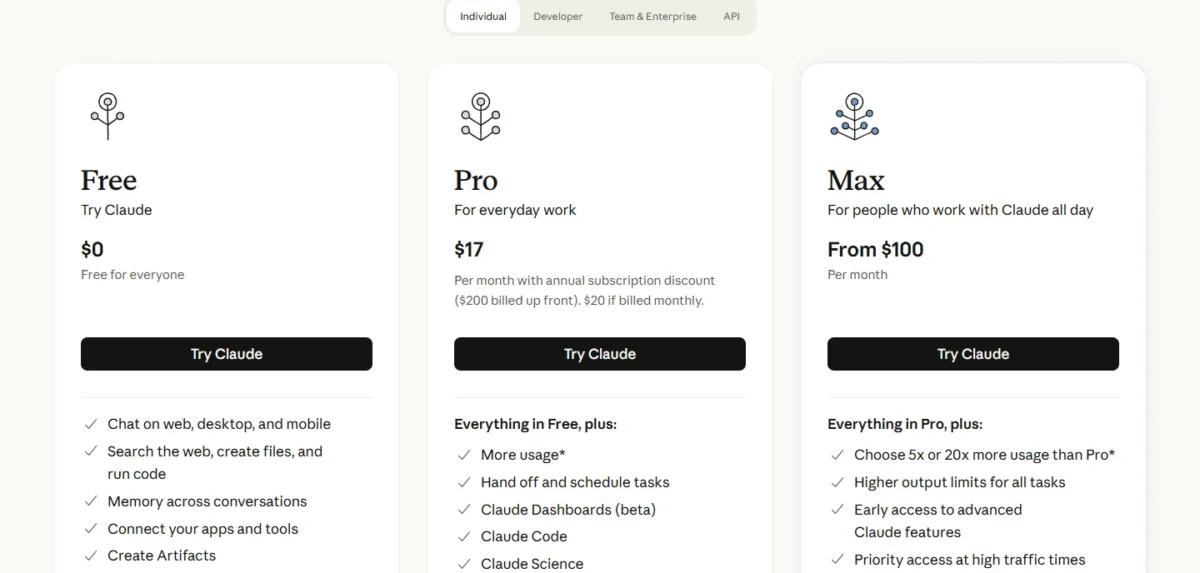
The limits complaint is real but specific. Every Claude plan has usage limits that reset on a rolling five-hour window, paid plans add weekly limits on top, and there is no fixed message count. Max is sold as 5x or 20x more usage than Pro per five-hour session, not as a number of messages.
That makes Claude hard to budget for a heavy user. You cannot tell before paying whether Pro covers your week, and the next step is a $100 plan billed monthly. Before leaving, check one escape hatch: paid plans can turn on usage credits at standard API rates when a limit hits.
If you want the full limit and API detail first, start with Claude’s plans and limits in detail. The top Google result for this search is a Reddit thread asking for alternatives. Your reason for leaving decides the pick:
- Weekly limits on everyday chat: ChatGPT, whose Free and Go plans include unlimited everyday text chats subject to abuse guardrails.
- Price: Gemini, whose AI Plus plan at $4.99 a month is a cheaper first paid plan. For coding only, Cursor Premium ($30) and GitHub Copilot Pro+ ($39) sit inside Claude’s $20-to-$100 gap.
- A missing job (images, video, live news): ChatGPT or Grok.
- Claude Code costs: GitHub Copilot, which lists Claude models from Pro, or Cursor, which bills them at API list price on top of the plan.
Knowing your reason narrows the field. The next question is what each of the ten costs to start.
Claude Alternatives at a Glance: Who Should Pick Each, Pros and Cons
Seven of the ten picks list a free plan or a free tier, and Microsoft includes Copilot Chat at no additional cost with eligible Microsoft 365 plans.
Gemini, Mistral, Cursor and GitHub Copilot price their first paid plan below Claude Pro’s $17 annual rate. The table shows who each pick is for, its main pros and cons against Claude, and its entry price.
| Product | Who it is for | Pros vs Claude | Cons vs Claude | Free option | Entry paid plan (per month) |
|---|---|---|---|---|---|
| ChatGPT | Claude Pro users who want one tool | Images, voice and Codex in one plan | Smaller context window on Plus | Free | Go (US price not captured); Plus $20, billed monthly |
| Gemini | Gmail and Drive users | AI Plus at $4.99 with 400 GB storage | Same five-hour and weekly limits | Free | AI Plus $4.99 |
| Microsoft 365 Copilot | Microsoft 365 companies | Answers grounded in work data | Needs a Microsoft 365 license | Copilot Chat with eligible Microsoft 365 plans; one-month trial | Copilot Business $18 yearly (first-year promotion, $21 regular) |
| Perplexity | Analysts and researchers | Cited answers, model picker | Personal use only | Free | Pro $17, billed annually |
| Mistral Vibe | Solo users on a budget | A cheaper Pro seat with coding | Team seat costs more | Free | Pro $14.99 |
| Grok | News and social media watchers | Live web and X search, video | No published price | Free to try | SuperGrok, price not published |
| DeepSeek | API buyers | Cheap tokens, Anthropic-format endpoint | No vision on V4 Pro | Not published | API, pay per token |
| Cursor | Developers who want cloud agents and code review | Cloud agents and Bugbot from Premium | Cursor lists Plus with Grok models only; third-party models such as Claude bill at API list price from Premium | Free | Plus $8 (Cursor lists Grok models only) |
| GitHub Copilot | Developers on GitHub | Unlimited completions | Code only | Free | Pro $10 |
| Jasper | Marketing teams | Brand voices and admin controls | $59 a seat, yearly | 7-day Pro trial | Pro $59 yearly, $69 monthly |
Sources: Claude, ChatGPT Plus help, ChatGPT Business help, Google AI plans, Google Workspace, Microsoft 365 Copilot, Perplexity, Mistral, Grok, DeepSeek API, Cursor, GitHub Copilot, Jasper pricing pages, checked October 2026.
Claude’s own entry plan, Pro at $17 annual or $20 monthly, is the price each row competes with. For teams, the entry price matters less than the seat price, which the 10-seat section compares later.
How I Chose These 10 Claude Alternatives
A tool made the list only if it passed three filters. It had to replace at least one Claude job: chat, writing, research or coding. It also had to sell self-serve with a published price or a free plan, and be available to US buyers.
I considered every tool ranked below plus the ones under Also Considered. The first ranking criterion is how many Claude jobs one plan covers. Then come the first paid price against Claude Pro, a team plan, an included coding agent and data export.
The evidence is documentation only. Every cell below names the cheapest plan whose official page lists the feature, or “Not listed”.
| Product | Free plan | Plan with the top model | Team or business plan | Coding agent included | Data export |
|---|---|---|---|---|---|
| Claude (reference) | Free | Pro (Opus) | Team | Pro (Claude Code) | Free |
| ChatGPT | Free | Plus (GPT-6.1 Sol) | Business | Free (Codex) | Free (not Business) |
| Google Gemini | Free | AI Pro (Gemini 4 Argon) | Workspace Business Starter | AI Pro (Jules) | Not listed |
| Microsoft 365 Copilot | Copilot Chat (no added cost with eligible Microsoft 365 plans) | Copilot Business (LLM model choice) | Copilot Business | Not listed | Not listed |
| Perplexity | Free | Max (frontier models) | Enterprise (price not published) | Not listed | Not listed |
| Mistral Vibe | Free | Free | Team | Free (limited sessions) | Team |
| Grok | Free to try | SuperGrok | Not listed | Not listed | Not listed |
| DeepSeek | Not listed | API (deepseek-v4-pro) | Not listed | Not listed | Not listed |
| Cursor | Free | Premium (latest Grok models) | Teams | Free (Agent) | Not listed |
| GitHub Copilot | Free | Pro+ (“Access to premium models”), Max (“Priority access to premium models”) | Business | Free (agent mode, CLI) | GitHub plan pages do not mention export |
| Jasper | Not listed | Not listed | Business | Not listed | Not listed |
Sources: the pricing and help pages linked under the table above, plus Cursor’s model docs, Claude’s export help page and OpenAI’s export help page, checked October 2026.
ChatGPT ranks first because its Free plan already includes Codex and its Business seat costs exactly what Claude Team costs. Gemini ranks second on price.
Microsoft 365 Copilot earns its place on team reach. It grounds answers in work data inside Word, Excel, PowerPoint, Outlook and Teams, and the add-on covers up to 300 users. Its $18 first-year seat also sits under Claude Team’s $20 annual seat.
Perplexity, fourth, sells Pro and Max for personal use only, and Mistral’s $24.99 Team seat costs more than Claude Team’s $20 annual seat, so both fall below it despite their free plans.
1. ChatGPT: Better for Teams That Want One Tool for Chat, Images and Coding
ChatGPT is the closest like-for-like swap for a Claude Pro user, because one plan covers chat, image creation, voice and a coding agent. Codex is included across ChatGPT plans, including Free and Go, with usage limits that vary by plan.
That changes the math for a Claude user who pays $20 mainly for Claude Code. On ChatGPT, the coding agent starts on the free tier, and Plus expands Codex usage. The full seat-price comparison is in my ChatGPT vs Claude for business breakdown.
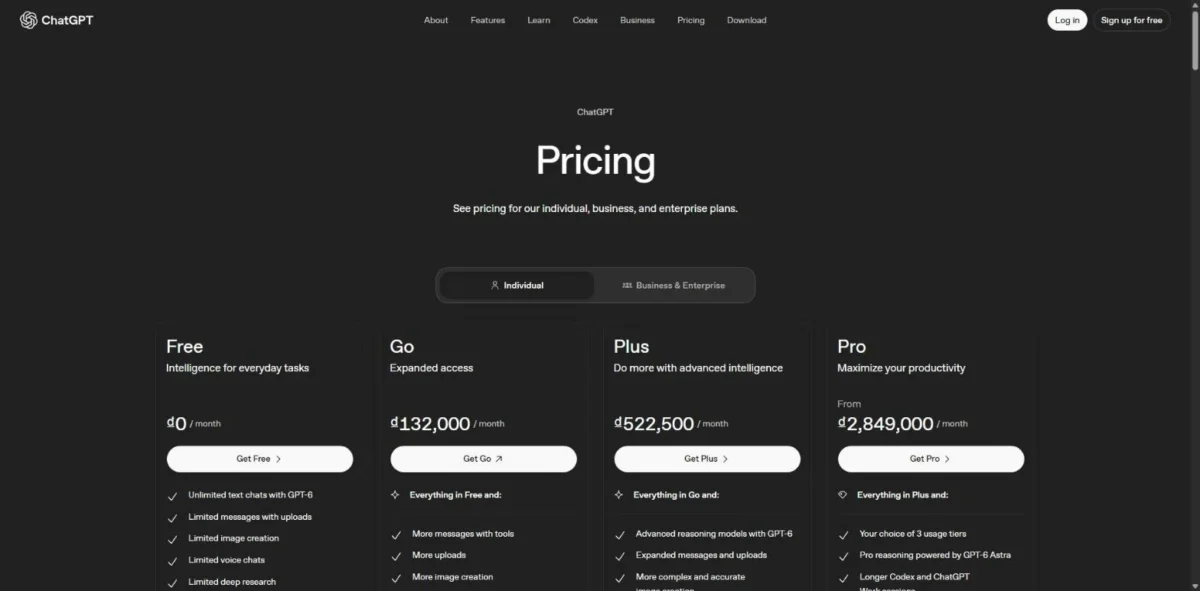
The plan list runs Free, Go, Plus, Pro and Business, plus Enterprise through sales. Free includes unlimited text chats with GPT-6, subject to abuse guardrails.
Go may include ads. Plus adds advanced reasoning with GPT-6, projects, scheduled tasks and custom GPTs. Integrations: Plus adds apps that connect to internal tools, plus Excel, Word, PowerPoint and Google Sheets extensions; OpenAI publishes no integration count.
Who it is for: a Claude Pro user who wants chat, image creation, voice and a coding agent in one plan, and a team that wants a Business seat at Claude Team’s price.
- Better than Claude for:
- collaboration on cheap plans. Shared projects are included from ChatGPT Free upward, while Claude includes project sharing only from Team. Image creation is also built in, with limited image creation on Free.
- Worse than Claude for:
- long documents. Plus has a 256K reasoning context window and an input maximum of about 320 pages; Claude’s plans reach up to 1M tokens, varying by model. My ChatGPT review covers where else the two differ.
- Pricing:
- Plus is $20 a month, billed monthly. Pro comes in Pro 200 at $200 a month and Pro 500 at $500 a month, billed monthly with no annual option. Business costs $20 per user per month billed annually or $25 monthly, with a 2-seat minimum.
That Business price mirrors Claude Team exactly, down to the $100 annual and $125 monthly premium seat with 5x usage. Switching a team between the two saves nothing per seat; it buys image creation and a different model family. For the plan-by-plan detail, see my ChatGPT pricing and plans guide.
- Skip it if:
- your work is long-document analysis already organized in Claude Projects, or your team needs self-service exports. Self-service export is not available in ChatGPT Business and Enterprise workspaces.
ChatGPT fixes the missing-jobs problem. If your problem is price, not features, Gemini’s AI Plus plan costs $4.99 a month.
2. Gemini: Better for a $4.99 Paid Plan and Gmail or Drive Users

Google AI Plus costs $4.99 a month, $15.01 less than Claude Pro’s $20 monthly price, and the ladder above it mirrors Claude’s. AI Pro is $19.99, and AI Ultra is $99.99 for 5x AI Pro’s limits or $199.99 for 20x. The buyer is someone who already lives in Gmail and Drive.
The model you get depends on the plan. Free runs Google’s Flash-Lite model, Plus the Flash model, and AI Pro both Gemini 4 Argon and the Pro model. A Claude Pro user expecting a top model on Plus will not get one; AI Pro is the real Claude Pro equivalent.
My Gemini review has the full verdict.
Storage is the bundle Claude cannot match. Free includes 15 GB, Plus 400 GB, AI Pro 5 TB, and Ultra starts at 20 TB across Gmail, Drive and Photos. AI Pro also adds Jules, Google’s asynchronous coding agent, and entry rate limits in Google Antigravity.
Who it is for: people who already live in Gmail and Drive and want a paid plan below Claude Pro’s price, and companies on Google Workspace.
- Better than Claude for:
- paying less and getting storage plus Gemini inside Google apps. Integrations: Plus puts Gemini in Gmail and Vids, and AI Pro adds Docs and Chrome; Google publishes no integration count.
Same as Claude on: usage limits. Gemini app limits are compute-based and refresh every 5 hours until you reach a weekly limit, the same shape as Claude’s five-hour window with weekly caps. Gemini also lets you extend your limits by purchasing AI credits, much as Claude’s paid plans offer usage credits.
- Pricing:
- for a team, Google Workspace is the route. Business Standard costs $14 per user per month, with Gemini in Gmail, Docs and Meet and expanded Gemini app access.
Business Standard is $8.40 per user per month for the first 20 users for 12 months, an offer for new Google Workspace customers only. Google Workspace caps its Business Starter, Standard and Plus plans at 300 users, while Enterprise plans have no user limit.

- Skip it if:
- your main complaint about Claude is the weekly limit. Gemini resets on the same five-hour and weekly pattern, so you would pay to move the wall, not remove it.
Google’s bundle suits Google shops. Teams that run on Microsoft 365 have a different price to beat.
3. Microsoft 365 Copilot: Better for Teams Already Paying for Microsoft 365
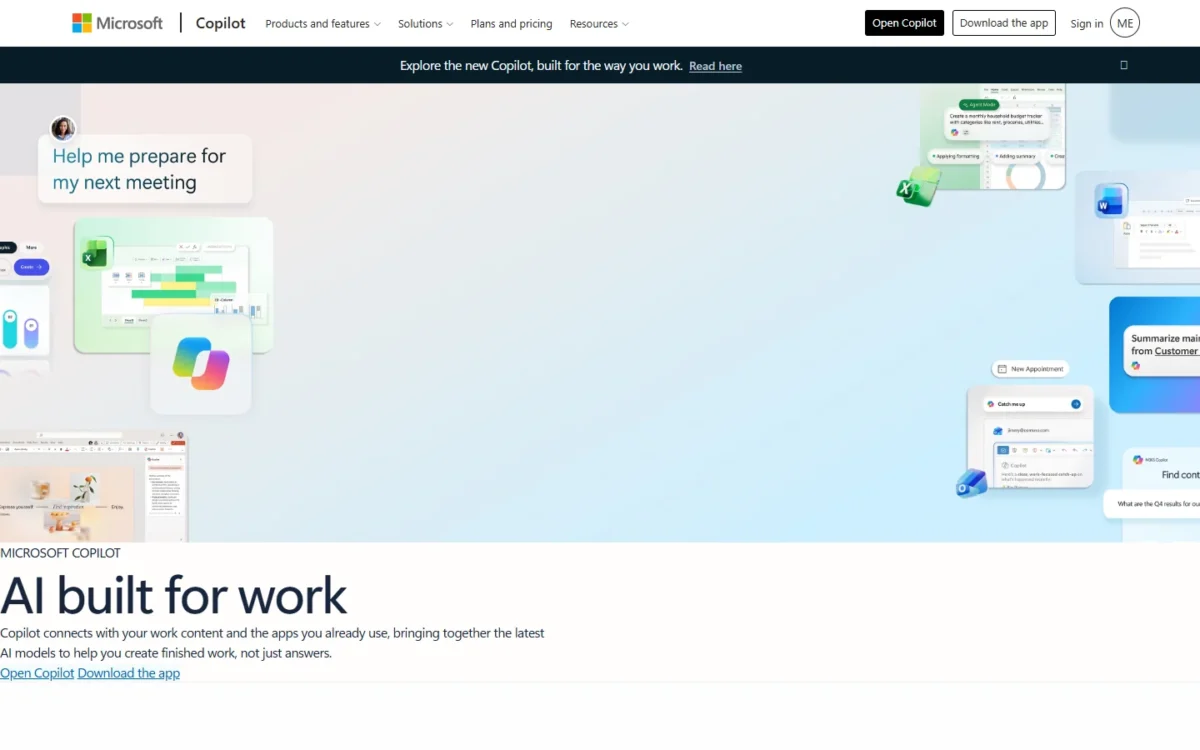
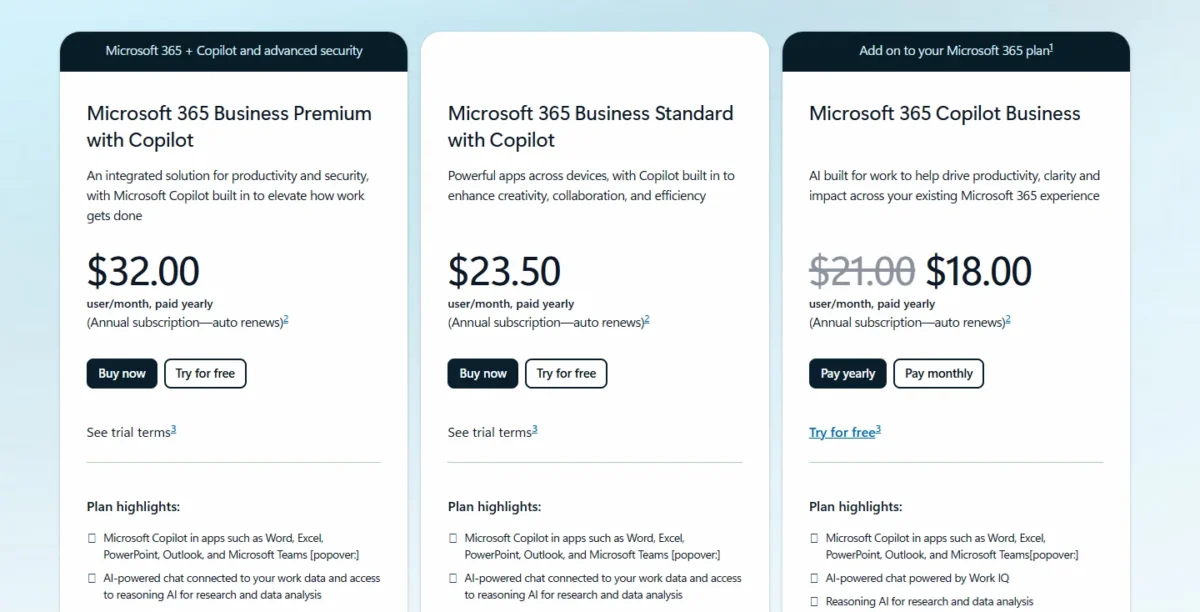
Microsoft 365 Copilot Business is cheaper than Claude Team’s $20 annual seat for the first year of a commitment bought by December 31, 2026, but only for existing Microsoft 365 customers. The Copilot Business add-on costs $18 per user per month paid yearly, down from $21.00.
The $18 is a promotion. The offer is available between July 1, 2026, and December 31, 2026, requires an annual commitment, and its promotional pricing applies to the first year only.
A purchase after the window, or the second year of a promotional commitment, falls back to the $21 yearly price, $1 more per seat than Claude Team. Paying monthly costs $25.20.
The add-on needs a separate qualifying Microsoft 365 license, for up to 300 users. A team without Microsoft 365 can buy a bundle instead: Business Standard with Copilot at $23.50 per user per month paid yearly, or Business Premium with Copilot at $32.00.
Who it is for: a company that already holds a qualifying Microsoft 365 license, up to 300 users on the add-on, and wants an assistant inside Word, Excel, PowerPoint, Outlook and Teams.
- Better than Claude for:
- answers grounded in your own work files. Work IQ draws on Microsoft 365 content and metadata, and licensed users get prebuilt agents such as Researcher and Analyst. Claude Pro also includes Claude for Microsoft 365 and Outlook, so app presence alone does not decide this.
Integrations: Copilot works in Word, Excel, PowerPoint, Outlook and Teams, and Copilot connectors bring in external data sources; Microsoft publishes no connector count.
- Worse than Claude for:
- work outside Microsoft 365. The add-on requires a qualifying Microsoft 365 license, so the assistant comes tied to the suite rather than sold on its own.
- Pricing:
- a one-month free trial converts to a paid subscription unless you cancel, and a credit card is required. The promotion is not available on trial subscriptions, and Microsoft gives a 7-day cancellation window for a prorated refund.
- Skip it if:
- your company is not on Microsoft 365. The cheapest bundle, at $23.50, costs $3.50 more per seat per month than Claude Team’s $20 annual seat.
Office work is one job. Research you can check line by line is another, and Perplexity is built for it.
4. Perplexity: Better for Cited Web Research
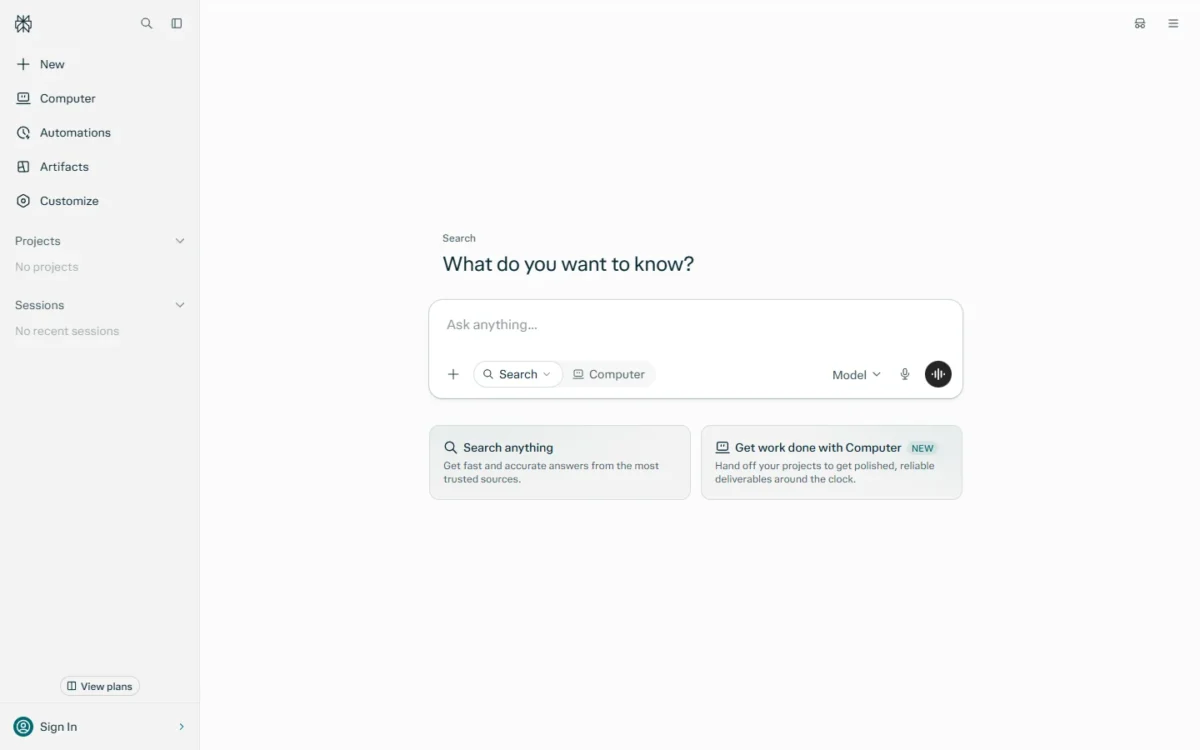
Perplexity is the pick when most of what you asked Claude was a question about the web. Every Perplexity answer includes inline citations from trusted sources, so you check a claim instead of trusting it.
The model picker is the second reason. Pro lets you select between AI models, with Claude Sonnet 5.5, GPT-6.1 Sol, Gemini 3.8 Flash, Grok 4.7 and Kimi K3 on the menu. A Claude fan can keep a Claude model and add search with sources.
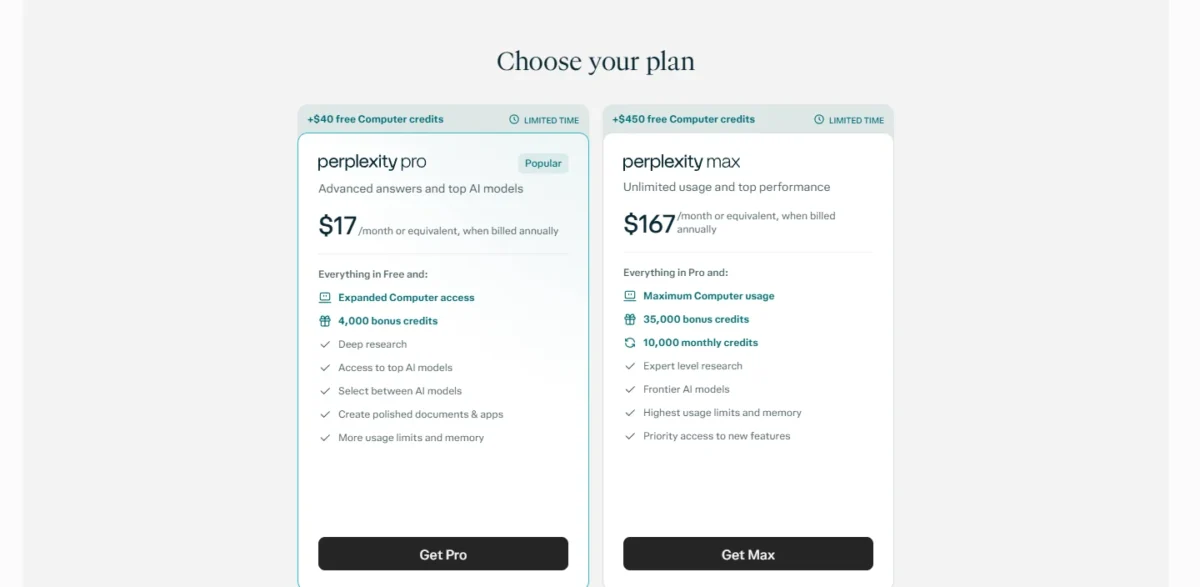
Pro adds deep research, expanded Computer access for building documents and apps, and 4,000 bonus credits. The extra $40 in free Computer credits is a limited time offer, so do not budget on it. Integrations: Perplexity connects to 400+ apps through its app connectors.
Who it is for: one person who mostly asks Claude questions about the web and wants to check each claim; Pro and Max are for personal use only.
- Better than Claude for:
- sourced answers and switching between rival models in one subscription. My Perplexity review covers the rest of the product.
- Worse than Claude for:
- team buying. Pro and Max are for personal use only, and Perplexity publishes no price for its Enterprise plan.
- Pricing:
- Pro costs $17 a month or equivalent, billed annually, which is $204 a year ($17 x 12) against Claude Pro’s $200 up front. Max costs $167 a month billed annually and adds 10,000 monthly credits.
- Skip it if:
- you need a shared team workspace at a published price. Pro and Max are personal-use plans, Enterprise has no public price, and my ranking of AI tools for research is the next place to look.
Perplexity costs about what Claude Pro does. If you want a general assistant that undercuts Claude Pro, look at Mistral.
5. Mistral Vibe (Le Chat): Better for a Cheaper Pro Seat With Coding Included
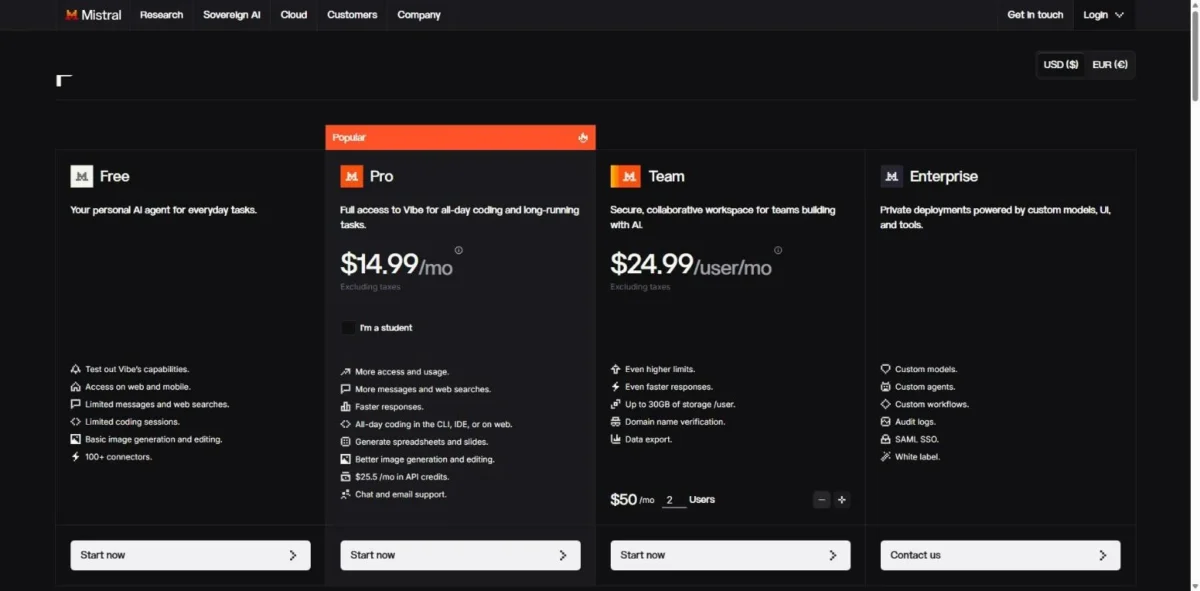
Mistral Pro costs $14.99 a month, $5.01 less than Claude Pro’s $20 monthly price, and it still includes a coding agent. Pro includes all-day coding in the CLI, IDE or on the web, through Vibe CLI and a VS Code and JetBrains plugin.
Mistral’s FAQ refers to the assistant as “Vibe (or Le Chat)”. Pro also generates spreadsheets and slides and adds chat and email support. Integrations: Free already includes 100+ connectors, custom MCP connectors are in beta, and the coding connectors name Notion, Slack, Linear and Drive.
The overflow rule is friendlier than a hard wall. Mistral lets you keep going past your plan limit by paying for the extra use at API rates. Claude offers the same idea through usage credits on paid plans, so neither tool strands you mid-task.
Who it is for: a solo user who wants a Pro seat under Claude’s price with a coding agent included, and a buyer who wants open-weight models they can self-host.
- Better than Claude for:
- a lower Pro price and open-weight models. You can self-host Mistral’s models, and open-weight ones such as Mistral 7B are Apache 2.0 licensed for research and individual use. Commercial deployments need a Mistral license.
- Worse than Claude for:
- an annual team seat. Team costs $24.99 per user per month, $4.99 more than Claude Team’s $20 annual seat, and only a cent below Claude Team’s $25 monthly seat.
- Pricing:
- Pro is $14.99 a month excluding taxes; verified students pay $5.99 a month for up to 12 months. Team adds up to 30 GB of storage per user, domain verification and data export. Enterprise adds audit logs, SAML SSO, white labeling and self-hosted deployments.
- Skip it if:
- your team already pays for Claude Team annually. Moving costs more per seat, and the gain is a coding agent your Claude seats already include.
Mistral competes on price. Grok competes on something Claude’s plans page does not list: what is happening right now.
6. Grok: Better for Real-Time News, X Search and Image or Video
Grok is built around live search: it searches the web and X live, with citations from primary sources. For anyone tracking breaking news, launches or market chatter, that is the reason to pick it.
Media generation is the second reason. Grok Imagine generates images and video from text prompts or reference photos, up to 2K resolution. SuperGrok is the paid plan the x.ai Grok page names, and its card on the grok.com plans page lists HD 720p, 30-second video and longer voice conversations.
Multi-agent mode runs several agents in parallel on a hard question, shows each agent’s reasoning, and merges the results into one cited answer. You sign in with an X or email account, and the same models are available through an API.
Who it is for: an individual who tracks breaking news, launches or market chatter and wants live web and X search with citations, plus image and video generation.
- Better than Claude for:
- live X data, image creation and video. Integrations: the live X integration is the one xAI names; it publishes no integration count. My Grok review covers the product in full.
- Worse than Claude for:
- budgeting. xAI does not print a SuperGrok price on its Grok page, while Claude’s pricing page prints the Pro and Team prices and a starting price for Max.
- Pricing:
- Grok is free to try on the web and in the apps, and SuperGrok raises limits and adds priority access and multi-agent reasoning. Grok also ships inside Cursor’s paid plans, covered in pick 8.
- Skip it if:
- your team needs central billing, SSO and admin controls. xAI’s Grok page lists none of them for Free or SuperGrok.
Grok and the chat apps above serve app users. If you call Claude through the API, the price per token matters more than any plan.
7. DeepSeek: Better for Cheap API Tokens With a Claude-Compatible Endpoint
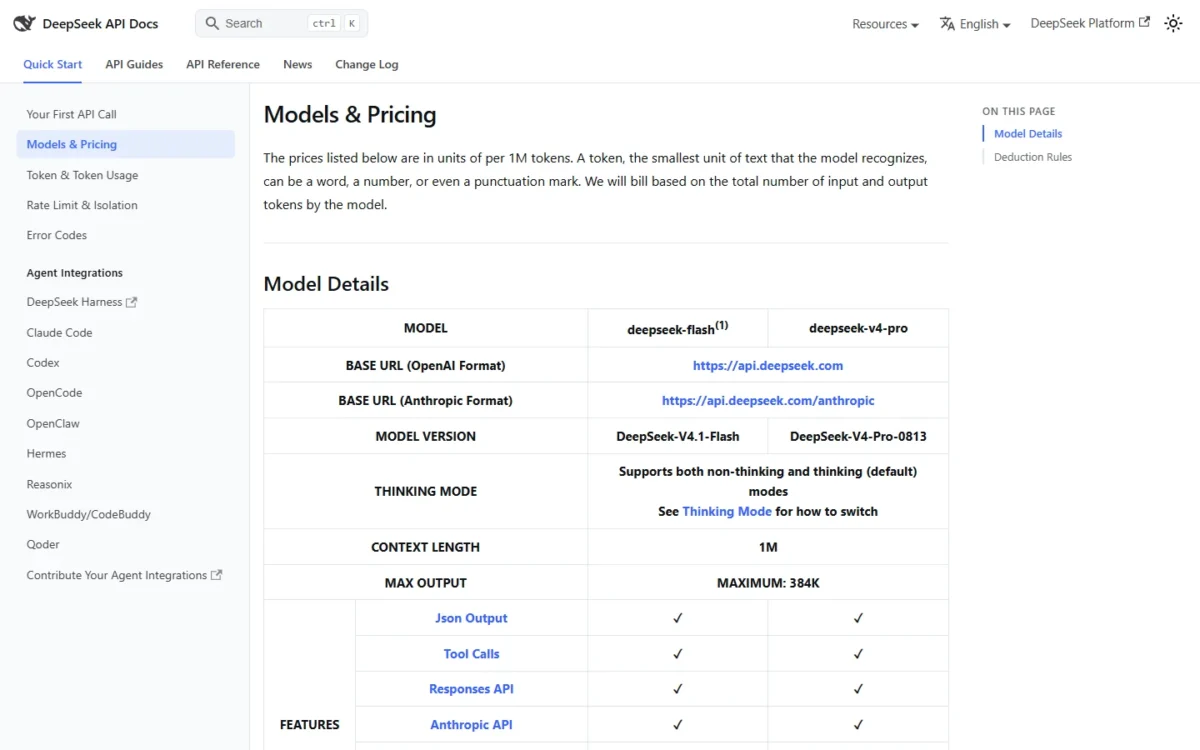
DeepSeek publishes an Anthropic-format base URL, https://api.deepseek.com/anthropic, so code written for Claude’s API can point at it. At peak hours, deepseek-v4-pro costs $1.32 per million input tokens against Sonnet 5.5’s $2, and $3.96 per million output tokens against $10.
Off-peak rates are half of peak. Peak hours run 01:00–04:00 and 06:00–10:00 UTC, Monday to Friday; all other hours, weekends included, are off-peak. Both models have a 1M context length and a 384K maximum output.
Take an illustrative workload of 10 million input tokens and 2 million output tokens a month, all cache misses. Each cell shows its math: millions of tokens times the per-million price.
| Model | Input: 10M tokens | Output: 2M tokens | Monthly total |
|---|---|---|---|
| Claude Opus 5.5 | 10 x $4 = $40.00 | 2 x $20 = $40.00 | $40.00 x 2 = $80.00 |
| Claude Sonnet 5.5 | 10 x $2 = $20.00 | 2 x $10 = $20.00 | $20.00 + $20.00 = $40.00 |
| deepseek-v4-pro, peak | 10 x $1.32 = $13.20 | 2 x $3.96 = $7.92 | $13.20 + $7.92 = $21.12 |
| deepseek-v4-pro, off-peak | 10 x $0.66 = $6.60 | 2 x $1.98 = $3.96 | $6.60 + $3.96 = $10.56 |
| deepseek-flash, peak | 10 x $0.30 = $3.00 | 2 x $1.20 = $2.40 | $3.00 + $2.40 = $5.40 |
| deepseek-flash, off-peak | 10 x $0.15 = $1.50 | 2 x $0.60 = $1.20 | $1.50 + $1.20 = $2.70 |
| Claude Haiku 5.5 | 10 x $0.10 = $1.00 | 2 x $0.50 = $1.00 | $1.00 + $1.00 = $2.00 |
Sources: illustrative example workload; prices from the Claude pricing page and DeepSeek’s pricing docs, checked October 2026.
In this example, moving Sonnet-class work to V4 Pro at peak cuts the bill by close to half. Light work goes the other way: Claude Haiku 5.5 (prompts up to 100K tokens) costs less than deepseek-flash even at DeepSeek’s off-peak rate.
Claude’s API also lists a 50% saving with batch processing. Jobs that can wait for a batch narrow the gap without changing providers.
Who it is for: a developer or team that calls Claude through the API and can point existing code at an Anthropic-format endpoint. Chat-app users are better served by the picks above.
- Better than Claude for:
- Sonnet- and Opus-class API volume, especially if it can run off-peak. Integrations: both models support tool calls, JSON output, the Responses API and the Anthropic API format.
- Worse than Claude for:
- vision on the larger model. Vision is not supported on deepseek-v4-pro, while deepseek-flash supports it. DeepSeek also runs a web chat, with no chat-plan price published.
- Skip it if:
- most of your volume is Haiku-class work, where Claude’s own Haiku 5.5 is already cheaper.
API buyers count tokens. Developers who paid for Claude mainly to run Claude Code count something else: what the coding tool bills on top.
8. Cursor: Better for Developers Who Bought Claude for Claude Code
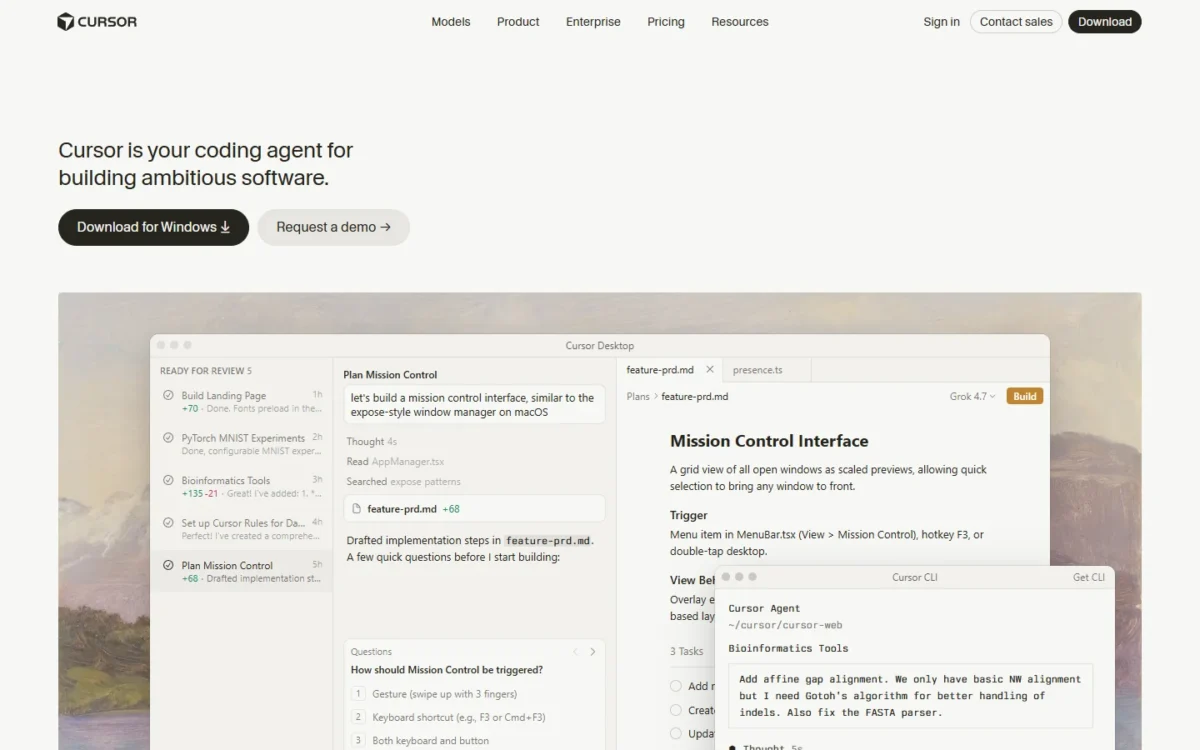
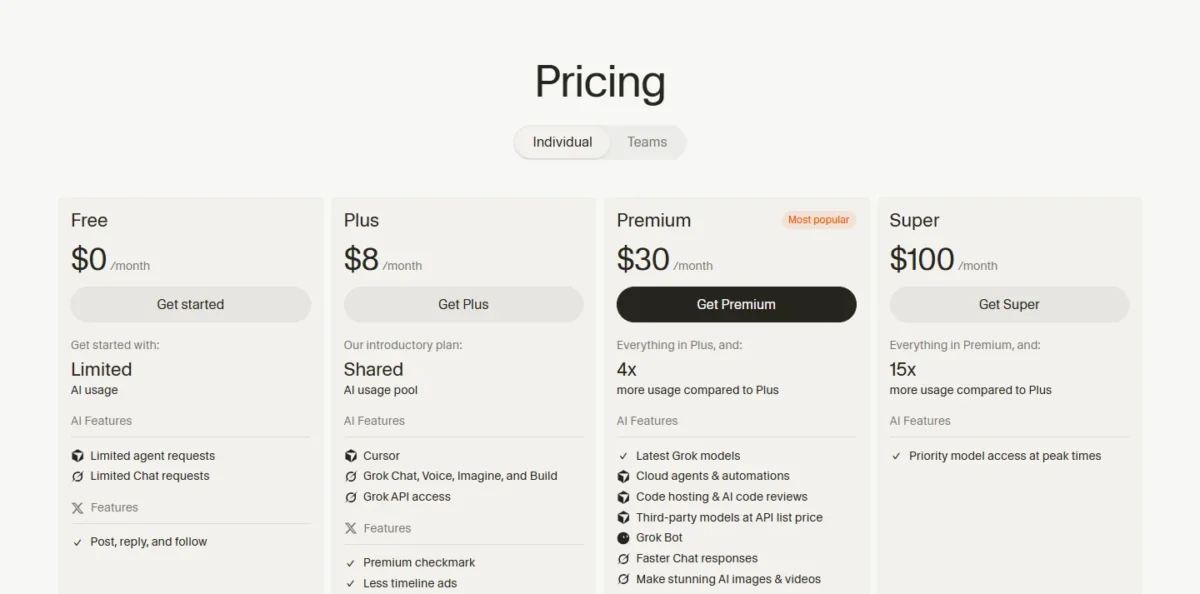
Cursor’s paid ladder runs $8, $30, $100 and $200 a month, but a Claude-model user pays for the plan and for the model. On Plus, only Grok models are available. Cursor’s pricing page says Premium and above include generous usage of Grok models but no allowance for third-party models, which remain available at API list price.
Cursor’s model docs list Claude Opus 5.5, Sonnet 5.5 and Haiku 5.5 among those third-party models, with Sonnet 5.5 at $2 per million input tokens and $10 per million output tokens. On Premium at $30, that usage comes on top of the plan.
Claude Pro at $20 a month includes Claude Code and shares one usage pool between the terminal and chat.
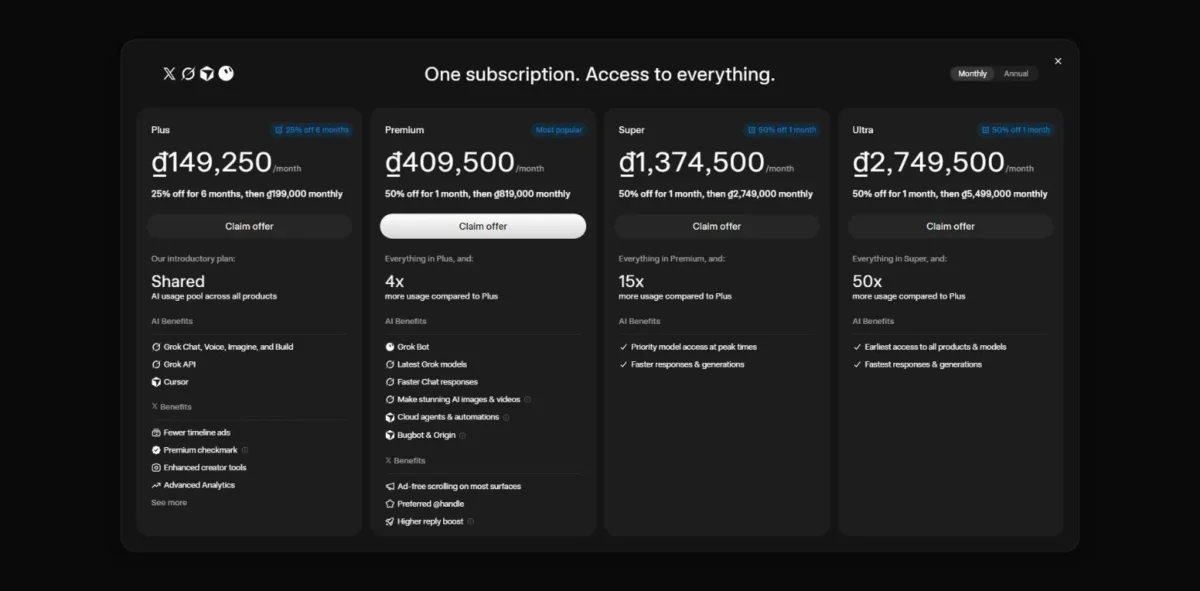
The Grok emphasis is part of the plan design. Cursor’s plans bundle Grok Chat, Imagine, Build and API access, plus X perks such as a premium checkmark and ad-free scrolling. Subscriptions are sold through X Subscription Corp, while the site itself is © 2026 Anysphere, Inc.
Integrations: Enterprise adds repository, model and MCP access controls; Cursor publishes no integration count.
Who it is for: a developer who accepts Cursor’s plan terms: Grok models only on Plus, and third-party models at API list price from Premium up.
- Better than Claude for:
- my pick for a buyer who wants the agent, the code host and the reviewer on one bill: Premium and up list cloud agents, code hosting via Origin and AI code reviews via Bugbot. If prompt-driven coding is new to you, what vibe coding is explains the idea.
- Worse than Claude for:
- using Claude models at a flat price, and predictability. Usage allowances refresh weekly, and third-party model use is purchased separately.
- Pricing:
- Free is $0, Plus $8, Premium $30 (4x Plus usage), Super $100 (15x) and Ultra $200 (50x) a month. Teams starts at $30 per user per month and adds central billing, usage analytics and SAML/OIDC SSO.
- Skip it if:
- Claude models are the reason you code with Claude. Stay on Claude Pro, or compare terminal agents in Codex vs Claude Code.
Cursor bills Claude models at API list price on top of the plan. GitHub Copilot Pro lists them inside its $15 in monthly credits, for $10 a month.
9. GitHub Copilot: Better for a $10 Coding Seat Inside GitHub
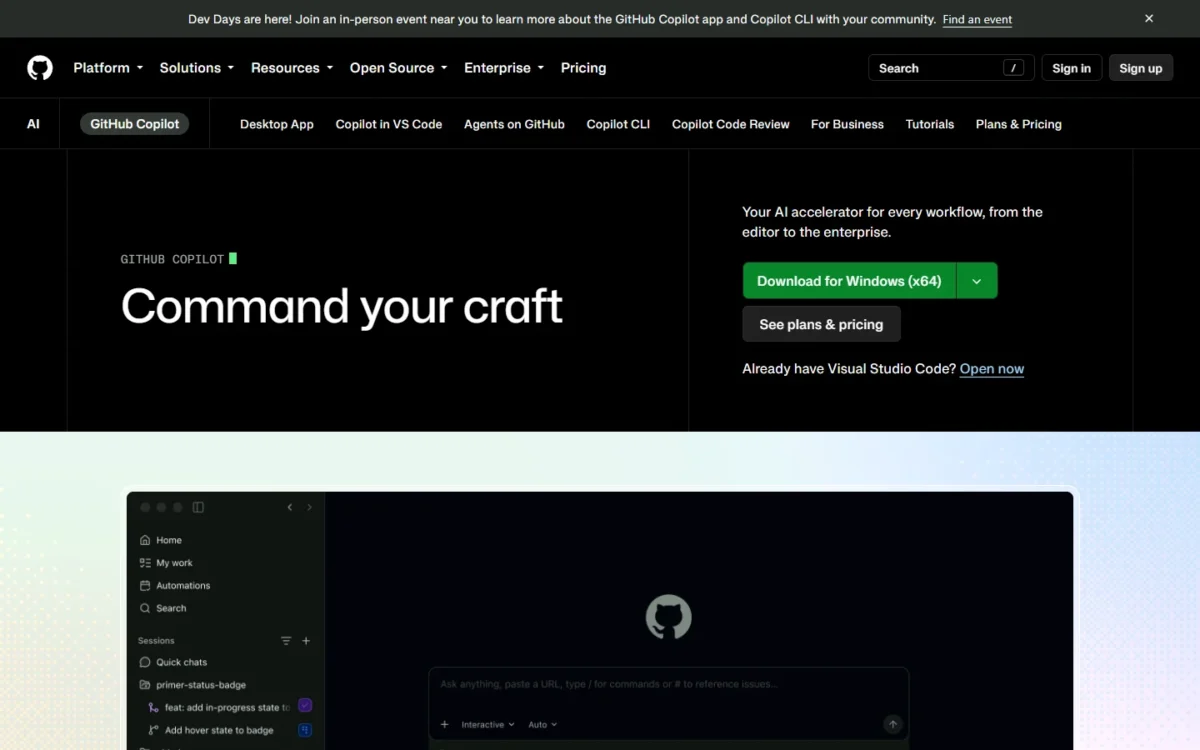
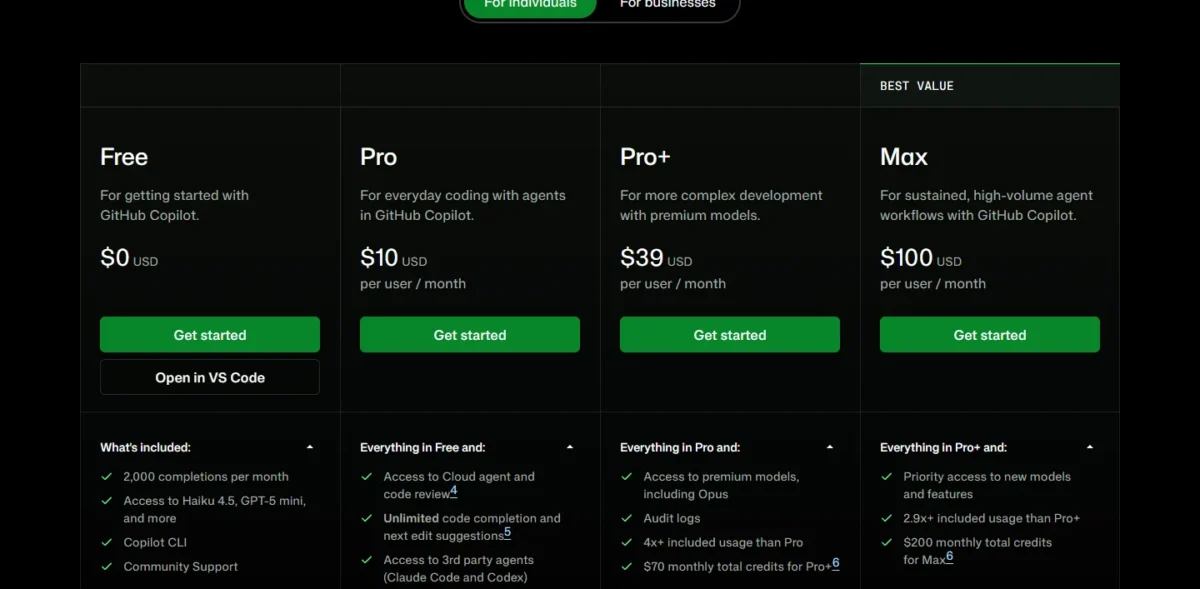
GitHub Copilot Pro costs $10 a month, half of Claude Pro’s $20 monthly price, and its code completions never draw from a credit pool. Completions and next edit suggestions stay unlimited on every paid plan.
Everything else runs on GitHub AI Credits at $0.01 each: chat, agent mode, code review, the cloud agent and Copilot CLI. Pro’s $10 includes $15 a month in total credits ($10 base plus a $5 flex allotment). Pro+ at $39 includes $70.
Claude users can keep Claude here. Copilot’s plan docs list Claude Opus 5.5, Sonnet 5.5 and Haiku 5.5 from Pro up, with credit use varying by model; on Copilot Free, access to models is through auto model selection only. Pro+ can also delegate tasks to third-party coding agents such as Claude.
Who it is for: a developer who already works in GitHub issues and pull requests and wants unlimited completions at $10 a month.
- Better than Claude for:
- unlimited completions and staying inside GitHub issues and pull requests. Integrations: Pro connects to MCP servers and third-party project management tools; GitHub publishes no integration count.
- Worse than Claude for:
- anything that is not code. Copilot’s credits pay for chat, agents, code review and the CLI, all aimed at a repository.
- Pricing:
- Free is $0 and limited to 2,000 completions per month. Max costs $100 a month with $100 in monthly AI credits. Business costs $19 per granted seat per month, where admins set usage limits and decide whether paid overage is allowed.
- Skip it if:
- you also use Claude for writing, research or analysis. A $10 Copilot seat plus a general assistant can cost more than Claude Pro alone.
Coding is one reason to leave. Marketing teams who used Claude for copy have a narrower need, and Jasper prices for it.
10. Jasper: Better for Marketing Teams Writing On-Brand Content

Jasper sells brand control, not a bigger chat window. It makes sense for a marketing team that needs every writer, product page and campaign to sound like one company; for a solo writer it is a $708-a-year drafting tool. My guide to AI writing tools matched to the job is the better starting point for one writer.
Pro includes 1 seat with 2 Brand Voices, 5 Knowledge assets and 3 Audiences. Business lifts those to unlimited and adds SSO with SAML 2.0, role-based access, an AI audit log and API access. Agents and the GEO Hub run on credits alongside Business seats.
Who it is for: a marketing team that needs many writers on one brand voice; one Pro seat covers a single user, and a team moves to Business through sales.
- Better than Claude for:
- keeping many writers on one brand voice, with admin controls over who edits voices and guidelines. Integrations: SSO supports Okta, Azure AD and Google Workspace; Jasper publishes no integration count. My Jasper review has the full verdict.
- Worse than Claude for:
- price per seat. Jasper Pro is $59 a month billed yearly, against $17 for Claude Pro on annual billing. Jasper’s plans are built around marketing agents and brand assets.
- Pricing:
- Jasper Pro costs $59 a month billed yearly or $69 billed monthly. One Pro seat on yearly billing is a $708 commitment ($59 x 12), $508 more than Claude Pro’s $200 annual price. Business uses custom pricing with a 12-month commitment.
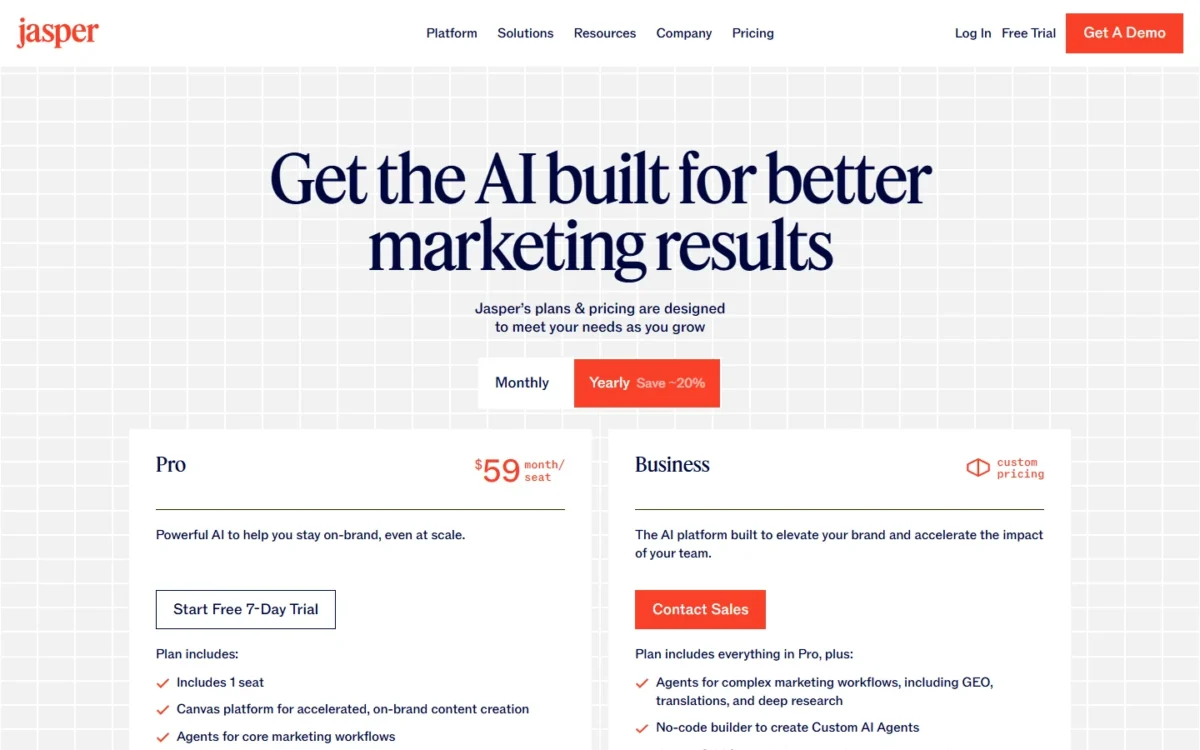
A 7-day free trial of Pro lets you test the brand-voice setup before paying. More than one user on Pro means moving to Business through sales.
- Skip it if:
- you work alone, or most of your Claude use is not marketing copy. Teams weighing Jasper against its closest marketing rival should compare Jasper vs Copy.ai first.
With ten options priced one by one, the real test is what each costs a 10-person team against Claude Team.
What 10 Seats Cost: Claude Team vs the Alternatives
A 10-person team pays $2,400 a year on Claude Team standard seats with annual billing, or $3,000 billed monthly. Google Workspace Business Standard comes in lowest at $1,680 a year, and Microsoft 365 Copilot Business costs $2,160 for a first year bought inside its 2026 promotion, plus the Microsoft 365 license it requires.
| Product and plan | Seat price | Billing | 10 seats, per month | 10 seats x 12 months | Condition |
|---|---|---|---|---|---|
| Claude Team, standard | $20 | Annual | $200 | $2,400 | 2 to 150 users |
| Claude Team, standard | $25 | Monthly | $250 | $3,000 | 2 to 150 users |
| ChatGPT Business, standard | $20 | Annual | $200 | $2,400 | 2-seat minimum |
| ChatGPT Business, standard | $25 | Monthly | $250 | $3,000 | 2-seat minimum |
| Google Workspace Business Standard | $14 | Billed monthly | $140 | $1,680 | $8.40 intro for new customers, 12 months |
| Microsoft 365 Copilot Business (promotion) | $18 | Yearly | $180 | $2,160 | Needs Microsoft 365; first year of a commitment bought by Dec 31, 2026 |
| Microsoft 365 Copilot Business (regular) | $21 | Yearly | $210 | $2,520 | Needs Microsoft 365 |
| Microsoft 365 Business Standard with Copilot | $23.50 | Yearly | $235 | $2,820 | Includes the Office apps |
| GitHub Copilot Business | $19 | Per granted seat | $190 | $2,280 | Coding only |
| Mistral Team | $24.99 | Per user, excl. taxes | $249.90 | $2,998.80 | SAML SSO is Enterprise |
| Cursor Teams | $30 (from) | Per user | $300 | $3,600 | Third-party models extra |
| Claude Enterprise | $20 | Annual | $200 + usage | $2,400 + usage | Usage at API rates |
| Perplexity, Grok, Jasper Business | Not published | Not published | Not published | Not published | Not published |
Sources: Claude, ChatGPT Business help, Google Workspace, Microsoft 365 Copilot, GitHub Copilot docs, Mistral, Cursor pricing pages, checked October 2026.
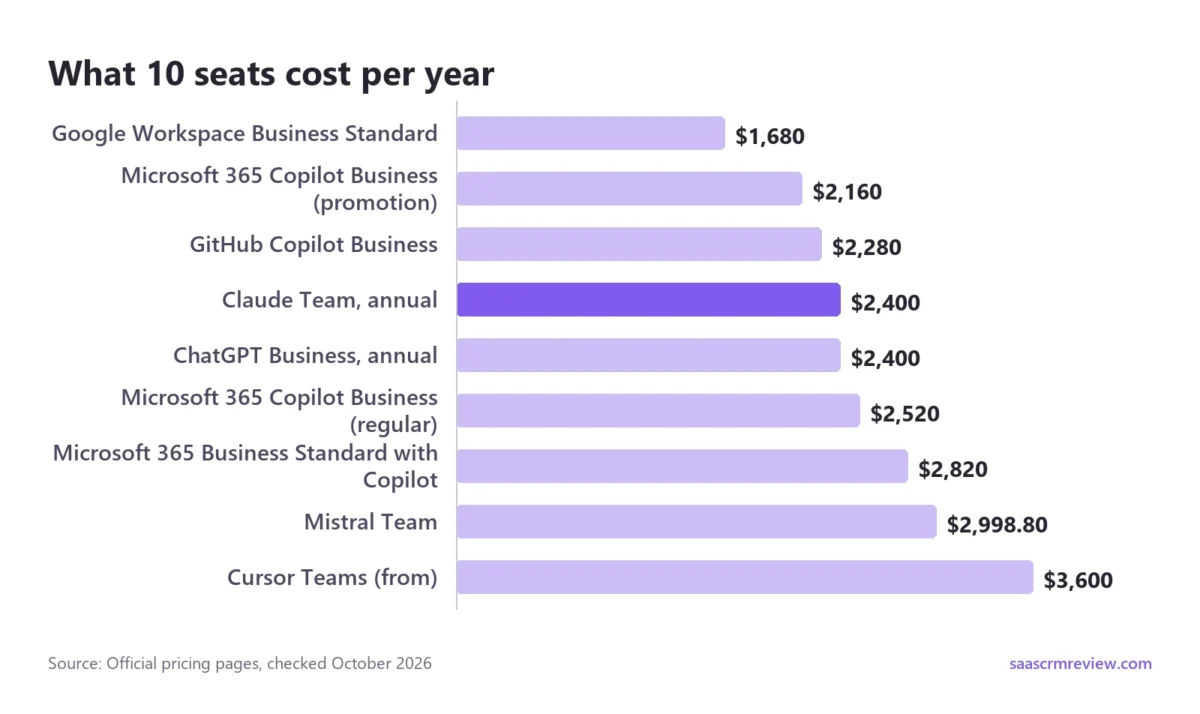
Claude Team sits mid-pack, not at the top. On annual billing it ties ChatGPT Business and costs $598.80 a year less than Mistral Team and $1,200 less than Cursor Teams for 10 seats.
The cheaper rows carry conditions. Workspace’s $14 seat buys Gemini inside Gmail, Docs and Meet plus the Gemini app, and new customers pay $8.40 per user for 12 months: $8.40 x 10 x 12 = $1,008.
Copilot’s $18 seat needs a Microsoft 365 license underneath; the $23.50 bundle includes the apps and costs $420 a year more than Claude Team for 10 seats.
Power-User Tiers: Claude Max vs $100–$200 Plans
One heavy user who would otherwise buy Claude Max has five ways to spend about $100 to $200 a month elsewhere. Claude Max starts at $100, billed monthly, for 5x or 20x Pro’s usage.
| Product | Plan | Price per month | Billing | What the extra money buys |
|---|---|---|---|---|
| Claude Max | Max 5x or Max 20x | From $100 | Monthly | 5x or 20x Pro usage, $100 to $200 in monthly API credits |
| Google AI Ultra | 5x or 20x | $99.99 or $199.99 | Not stated | 5x or 20x AI Pro limits, 20 TB+ storage |
| Cursor | Super or Ultra | $100 or $200 | Not stated | 15x or 50x Plus usage |
| GitHub Copilot | Max | $100 | Not stated | $100 in monthly AI credits |
| Perplexity | Max | $167 | Annual | 10,000 monthly credits |
| ChatGPT | Pro 200 or Pro 500 | $200 or $500 | Monthly only | Pro reasoning with GPT-6 Astra |
Sources: Claude, Google AI plans, Cursor, GitHub Copilot, Perplexity, ChatGPT Pro help, checked October 2026.
Claude Max and Google AI Ultra are the same product shape: a 5x tier near $100 and a 20x tier above it. Perplexity Max is the commitment trap here, since annual billing turns $167 into $2,004 a year ($167 x 12) before you know whether you use it daily.
Pick by Your Reason for Leaving Claude
Match the pick to the problem, then check the condition that would flip it:
- Weekly limits on chat: ChatGPT Free or Go, with unlimited everyday text chats. It flips if your heavy use is Codex or deep research, which still have plan limits.
- Price: Google AI Plus at $4.99 a month. It flips if you need Gemini 4 Argon, which starts on AI Pro at $19.99.
- A Microsoft 365 company: Copilot Business at $18 per user per month, yearly. It flips for a purchase after December 31, 2026, when the offer window closes, and in the second year of a commitment, when the $21 price applies.
- A Google Workspace company: Business Standard at $14 per user per month. It flips if your team has no use for Gmail, Drive and Meet.
- Research with sources: Perplexity Pro at $17 a month, billed annually. It flips if the team needs shared seats.
- API cost: DeepSeek V4 Pro at $1.32 in and $3.96 out per million tokens at peak. It flips for Haiku-class work, where Claude Haiku 5.5 is cheaper.
- Coding: GitHub Copilot Pro at $10 for unlimited completions, with Claude Opus, Sonnet and Haiku 5.5 inside its $15 in monthly credits, or Cursor Premium at $30 for cloud agents. Cursor flips if you want Claude models at a flat price, since it bills them at API list price on top.
- Marketing copy: Jasper Business for a marketing team, at custom pricing with a 12-month commitment, or Jasper Pro at $59 a month, yearly, for one marketer. Pro flips for a writer who needs no brand controls, where $708 a year is hard to justify.
If none of these fits, the field is wider than Claude replacements, and my list of best AI chatbots compared widens the choice.
How to Switch from Claude: What Moves and What You Rebuild
You can export your Claude chat history from Settings > Privacy on the web app or Claude Desktop, but the export is a download, not a migration. Exported data cannot be imported into another personal Claude account, so the file is an archive, not a transfer.
Claude exports include conversation data and account user data, and cannot be started from the iOS or Android apps. On Team and Enterprise plans, only the organization’s Primary Owner can export.
A four-step switch:
- Export from Settings > Privacy on the web or desktop app. The download link arrives by email and expires 24 hours after delivery.
- Copy each Project’s instructions and key files by hand. The export covers conversation and account data, so plan to rebuild Projects, Skills, connectors and Artifacts in the new tool.
- Run both tools for a cycle. Canceling Claude does not delete your data; Pro and Max accounts drop to Free with chats, projects and files kept.
- Cancel at least 24 hours before renewal in Settings > Billing, or in the App Store or Google Play if you subscribed there.
The reverse trip is slower. ChatGPT exports can take up to 7 days to arrive, and Business and Enterprise workspaces have no self-service export. Canceling a Microsoft 365 subscription deletes all associated data, so export before you leave either one.
When to Stay with Claude
Stay with Claude when the seat math or the models favor it; my full Claude review has the complete verdict.
Is Claude actually the best AI? For long context and coding with Claude models, its plans favor it; for images, live X search or a $4.99 entry price, they do not. Three cases favor staying:
- Your team is on annual Claude Team. At $20 a seat it ties ChatGPT Business and costs less than Mistral Team ($24.99) and Cursor Teams (from $30).
- You code with Claude models. Claude Pro at $20 includes Claude Code; Cursor’s model docs list the same Claude models, billed at API list price on top of the plan.
- Your work fits long context and Projects. Claude’s plans list a context window of up to 1M tokens, and Team adds project sharing.
If limits are the only complaint, fix the setup before you switch: the usage credits mentioned above keep a paid plan running past a limit. My guide on how to set up Claude so it works is the place to start.
Also Considered
These 16 tools came up in the top results or in my research but did not make the ten:
- OpenAI Codex: included across ChatGPT plans, so pick 1 covers it.
- Windsurf: a coding-agent tool; it replaces Claude Code rather than the assistant, which the Codex vs Claude Code comparison covers.
- Cline: same reason as Windsurf; Cursor and GitHub Copilot are this list’s standalone coding tools.
- Aider: same reason; a terminal coding agent belongs in the coding-agent comparison.
- OpenCode: same reason as Aider.
- Amazon Q Developer: a developer tool, outside a general Claude replacement.
- Copy.ai: covers a single writing job; Jasper covers marketing copy here.
- Writesonic: a single writing job, covered by the writing-tools ranking.
- QuillBot: an editing and paraphrasing job, not a Claude replacement.
- Qwen: no official US pricing page saved in this job; DeepSeek covers the Chinese-model option with published prices.
- Kimi: Perplexity offers Kimi K3 as a model choice, so Perplexity is the route to it here.
- Gumloop, Relay.app, Notion Agent, Figma Make and Ollama: I saved no official page for any of these five in this job, so I neither rank nor describe them here.
For task automation, Claude’s Team plan lists Claude Code and Claude Cowork. Inside this list, ChatGPT lists scheduled tasks from Go up, and Cursor Premium lists cloud agents and automations.
FAQ
Is there any AI better than Claude?
For specific jobs, yes: ChatGPT includes image creation and Codex on its Free plan, Grok searches X live, and Perplexity cites every answer. For long documents, Claude reaches up to 1M tokens of context, while ChatGPT Plus has 256K for reasoning models. Pick the tool that wins your main job.
Are there any free alternatives to Claude?
Yes, and the free tiers differ in what they keep. ChatGPT Free lists unlimited everyday text chats, Gemini Free includes 15 GB of storage, and Mistral Free includes 100+ connectors.
GitHub Copilot Free caps code completions at 2,000 per month, and Cursor Free limits agent and chat requests.
What are the top 3 AI right now?
By breadth of jobs covered, ChatGPT, Google Gemini and Microsoft 365 Copilot are the three broadest Claude replacements on this list. Each sells a business tier: ChatGPT Business from 2 seats, and Google Workspace and Microsoft 365 Copilot for up to 300 users. This is a job-based pick, not a usage ranking.
Are there open-source Claude alternatives?
Mistral is the closest on this list. Its open-weight models, such as Mistral 7B, are Apache 2.0 licensed for research and individual use, while commercial deployment needs a Mistral license. Mistral Enterprise also offers self-hosted or on-premises deployments, so your data stays in your environment.