

A three-person product team already pays for ChatGPT. One engineer wants Claude Code on the terminal, another wants Codex in the IDE, and the lead has to decide whether either one justifies a second subscription line.
In This Article (27 sections)
That decision looks like a price comparison and is not one. At the September 2026 list prices, the two products tie at almost every rung a buyer actually shops: the 20-dollar, 100-dollar and 200-dollar individual rungs, and both team seat tiers.
What separates them is which tier a new buyer can still purchase, what happens to a running task when the allowance runs out, how much control a security lead gets over shell commands, and whether the developer’s machine runs Windows.
Choose Codex for native Windows, for a budget already committed to ChatGPT, or for a free on-ramp. Choose Claude Code to buy the top tier this month, for repository-scoped permission rules, or for extra usage at published prices.
Quick Verdict: Codex vs Claude Code
| Decision Category | Better Fit | Why |
|---|---|---|
| Buying the top $200 individual tier now | Claude Code | Max 20x is listed at $200 with no pause notice, while OpenAI has temporarily paused new sign-ups and upgrades to Pro $200 |
| Monthly entry price | Tie | ChatGPT Plus and Claude Pro both list at $20 per month |
| Annual prepayment option for one person | Claude Code | Claude Pro lists a $200 yearly option; the verified OpenAI Pro page states monthly billing only |
| Team list price at matching seat tiers | Tie | Standard and Premium seats carry the same published rates at both vendors |
| Running on native Windows | Codex | Claude Code’s Bash sandbox has no native Windows support; OpenAI documents Windows tooling, though its own Windows execution boundary was not established here |
| Repository-scoped permission rules | Claude Code | Per-tool approval behaviour, deny-ask-allow precedence and managed settings are documented |
| Documented free on-ramp | Codex | OpenAI states outright that Codex is included on Free and Go; no equivalent statement appears in the Claude sources checked |
| Paid extra usage with published prices | Claude Code | Bundle values, prices and monthly caps are published; no OpenAI credit price was established here |
| Finishing a task that hits the ceiling | Incomparable | Codex can keep working on an active turn, subject to fair use; the Claude sources checked state no in-progress-turn behaviour |
| Moving a cloud task into the terminal | Incomparable | Documented end to end for Claude Code; no Codex equivalent was established in the sources checked |
| Code quality, speed and task success | Incomparable | No vendor source checked here establishes comparative code quality or task success |
Source: official ChatGPT Pro tiers and the Claude plan comparison.
Three of those rows are marked incomparable because the published evidence covers one side only, or covers neither.
Codex vs Claude Code at a Glance
| Dimension | OpenAI Codex | Claude Code |
|---|---|---|
| Lowest plan that includes it | Free and Go, stated by OpenAI | Pro at $20 per month; Free eligibility not settled by the sources checked |
| Client surfaces | ChatGPT desktop app Codex mode, CLI, IDE extension, web | Terminal, supported IDEs, desktop, and web in research preview |
| Native Windows | Windows tooling documented, including WSL distribution selection | Bash sandbox unsupported; Windows use runs inside WSL2 |
| Execution boundary | Sandbox plus approval policy, documented as OpenAI’s own deployment | Permission rules for every tool, plus a built-in OS-enforced Bash sandbox |
| What else drains the allowance | ChatGPT Work, ChatGPT for Excel and Workspace Agents, where available on your plan | A bundle balance spans Claude, Claude Desktop, Claude Mobile, Claude Code and Cowork |
| Behaviour at the ceiling | The active turn can continue, subject to fair use | A weekly limit needs a reset or an upgrade; a model-specific limit allows switching models |
| Paid extra usage | Workspace credits documented for Business seats | Bundles at $50, $250 and $1,000 face value with published prices |
| Top individual tier | Pro $200 temporarily paused for new sign-ups and upgrades | Max 20x listed at $200 per month |
| Team entry | 2 seat minimum per workspace | 2 member minimum, up to 150 seats |
Source: official OpenAI Codex plan documentation and the Claude Code web documentation. Source: official Claude Code sandboxing documentation and the Claude usage bundle page.
Methodology: How We Compared
This comparison was built on September 13, 2026 from official OpenAI and Anthropic pricing pages, help-centre articles and product documentation.
Every claim is assessed against the vendor’s own page that states it, with prices taken from the pricing or billing page and product behaviour from the documentation or help-centre page.
Prices were normalised to United States dollars at list rates, and every multi-seat total is arithmetic over published seat prices.
Where a vendor page describes that vendor’s own internal deployment rather than a default every customer inherits, the article says so at the point of use.
Claims stay inside what those sources establish. Code quality, speed and any absolute count of coding tasks per plan sit outside documentary evidence, so this article names no winner on them.
How the Winners Were Decided
Six criteria decided the verdicts below: purchase availability at each tier, published price and multi-seat cost, documented usage mechanics, documented behaviour at the usage ceiling, published permission and execution controls, and platform support.
Each decision criterion is applied the same way on both sides. The first product is assessed on OpenAI’s own pages and the second product on Anthropic’s own pages, because official documentation is the only evidence class available symmetrically here.
A dimension becomes a plan difference only if the two pages state different things about the same buyer condition. If they do not, the row records a tie or names the gap.
The winner by scenario is stated wherever the buyer variable that decides it is knowable, which is why most of the headings below name a condition rather than a feature.
If You Are Buying the Top Individual Tier This Month, Choose Claude Code
Both vendors list a 200-dollar individual tier. Only one of them is open to a new buyer this month.
OpenAI has temporarily paused new sign-ups and upgrades to the ChatGPT Pro $200 plan since September 10, 2026, and the pause covers upgrades from Free, Go, Plus and Pro $100. Existing Pro $200 subscriptions continue renewing normally, and Pro $100 remains available for purchase.
The Claude plan comparison still lists Max 20x at $200 per month, with no equivalent notice attached to it.
OpenAI describes Pro as being for high-stakes, complex work, and Anthropic describes Max 20x as being for daily users who collaborate often with Claude for most tasks. Only one of those two descriptions can be acted on by a new buyer this month.
This verdict is the most time-sensitive claim in the article. OpenAI calls the pause temporary and the page checked here names no end date, so an existing Pro $200 subscriber and a new buyer are in different positions and should read the row differently.
If the Work Runs on Native Windows, Choose Codex
Claude Code’s built-in Bash sandbox runs on macOS, Linux and WSL2. Native Windows is not supported, and the documentation directs Windows users to run Claude Code inside a WSL2 distribution.
The constraint is narrower than “Claude Code does not run on Windows”, and the two are easy to conflate. What requires WSL2 is the operating-system-enforced sandbox, which relies on bubblewrap, the same primitive used on Linux.
WSL1 is ruled out explicitly, because bubblewrap needs kernel features that only WSL2 provides. A team that standardised on the earlier subsystem has an upgrade to schedule before the sandbox becomes available at all.
OpenAI documents Windows-specific Codex tooling, including Codex Doctor, Remote Control and WSL distribution selection.
A team that has already standardised on WSL2 loses nothing here. A team with a hard policy against WSL2 cannot use the Claude Code Bash sandbox at all, because the documentation supports it only on macOS, Linux and WSL2.
If a Security Reviewer Has to Sign Off, Compare the Control Models Rather Than Picking a Winner
The two vendors document control at different layers, and a blanket winner would flatten a distinction that matters to the person doing the sign-off.
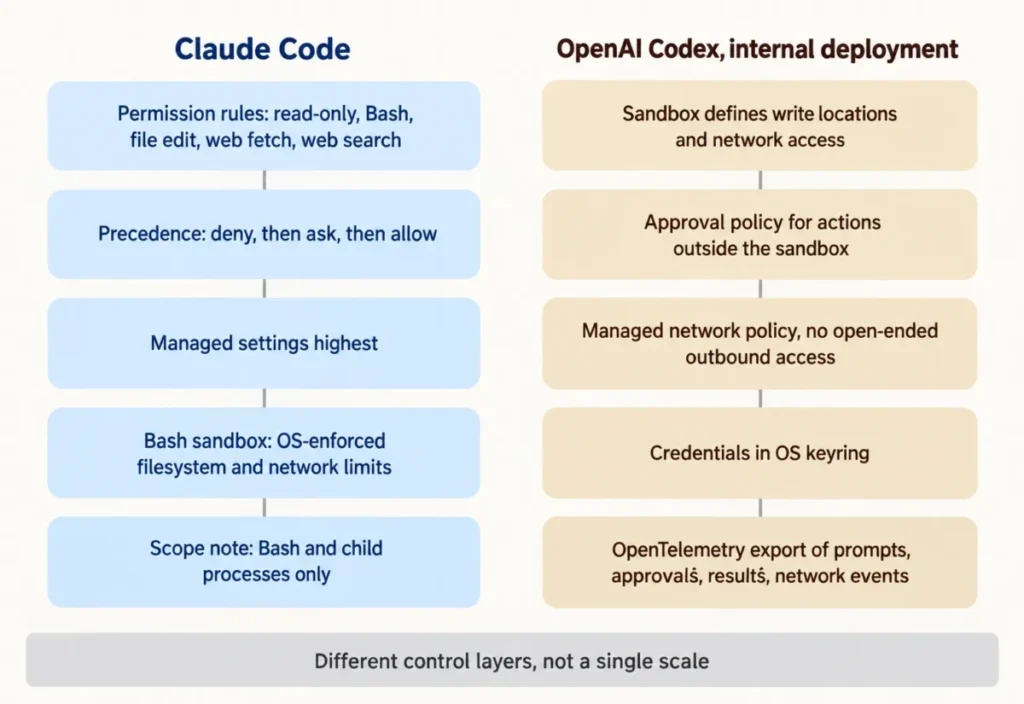
Claude Code publishes a per-tool approval table. In Manual mode, read-only file operations run without approval inside the working directory and additional directories, while Bash commands, file modifications, web fetch and web search require approval.
Two of those four carry documented exceptions. A built-in set of read-only shell commands runs without a Bash prompt, and a set of preapproved documentation domains does the same for web fetch, while file modification and web search carry none.
How long an approval lasts also varies by tool. A Bash approval saves permanently per repository and command, a web-fetch approval per repository and domain, while a file-modification approval lasts only until the session ends.
Rules are evaluated deny, then ask, then allow, and a deny at any settings level cannot be overridden by an allow at another. Managed settings sit highest, and no other level, including command line arguments, can override a managed permission rule.
Anthropic also states that permission rules are enforced by Claude Code rather than by the model, and that instructions in a prompt or a project file shape what Claude tries to do without changing what Claude Code allows. That is the sentence a security reviewer should anchor on.
Separately, the Bash sandbox adds operating-system enforcement over filesystem and network access for shell commands and their child processes. Anthropic is explicit that it is not a complete isolation boundary.
OpenAI’s published security material describes sandbox boundaries and an approval policy for actions crossing them. It also documents a managed network policy that does not run Codex with open-ended outbound access, credential storage in OS keyrings, and OpenTelemetry export of prompts, approvals, results and network events.
The boundary on that evidence matters. The page documents how OpenAI deploys Codex internally, not a default configuration every customer account inherits, and it should be read as a demonstration of supported controls rather than a guarantee about a given workspace.
Read side by side, the two describe different layers rather than different amounts of safety. One publishes the rule engine a developer configures per repository; the other publishes a deployment pattern an organisation would have to reproduce.
If Work Comes in Bursts and Finishing Matters, Read the Ceiling Behaviour Carefully
The two products behave differently at the moment the allowance runs out, and the difference changes what a long-running task costs in interruptions.
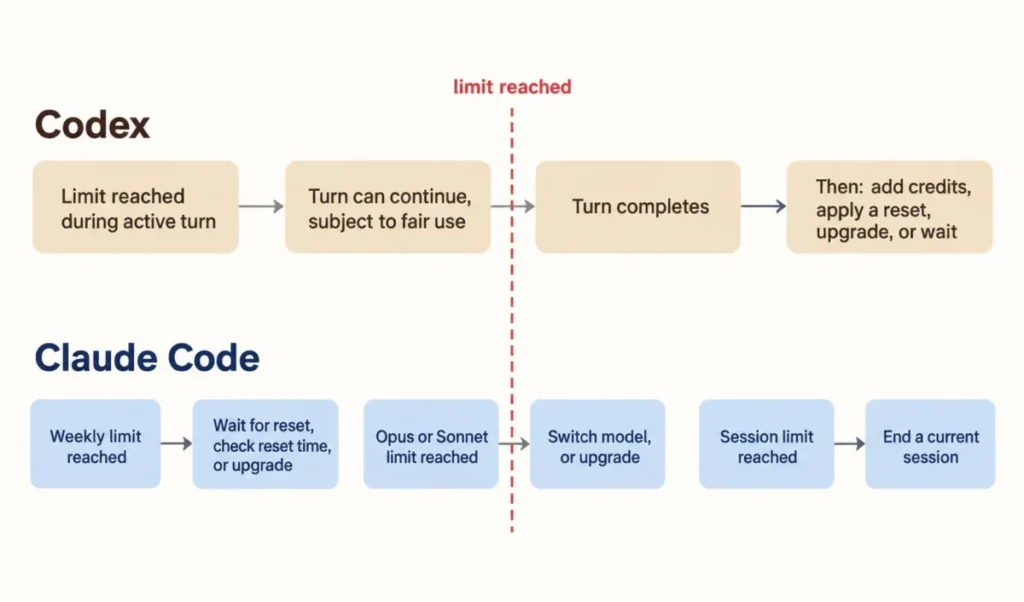
On the Codex side, reaching a usage limit during an active turn does not necessarily kill the turn. OpenAI states that Codex can continue working on that turn, subject to fair-use limits, and that the options after it completes can include adding credits, applying an available reset, upgrading, or waiting.
On the Claude Code side, the documented recovery paths differ by which limit was reached. A weekly limit means waiting for the reset, checking the reset time with the usage command, or upgrading for higher limits.
A model-specific limit behaves differently again. Exhausting the Opus or Sonnet allowance specifically leaves switching to a different model as a documented recovery path, which a weekly limit does not.
The documented session limit is a third thing entirely, and it is easy to read as a fourth kind of weekly cap. It describes a maximum number of concurrent sessions in the current period, and its recovery step is ending a current session rather than waiting for an allowance to refill.
One more ceiling sits beside those three. Using the one-million-token context window requires usage credits beyond the plan’s base allowance, so a long-context run can stop for a reason unrelated to how much work was done that week.
If Extra Usage Has to Be Budgeted in Advance, Choose Claude Code
Anthropic publishes what additional usage costs before a buyer commits, and that is the clearest asymmetry in the pricing evidence.
Prepurchased usage bundles are sold at three face values: $50 for $45, $250 for $200, and $1,000 for $700. The largest bundle therefore lands 30 percent below its face value.
Individual Pro and Max subscribers can buy up to $2,000 of bundle value per month at those below-face-value rates, and Team Owners and Primary Owners up to $3,000 per month. Credits remain purchasable at standard rates beyond the cap.
Usage credits must be enabled before bundles can be purchased, and bundle credits apply only once the plan’s limits are exceeded and usage credits are in use.
The balance is a single pool spanning Claude, Claude Desktop, Claude Mobile, Claude Code, Cowork and third-party products signed in with the same account.
That pooling cuts both ways for a buyer modelling a month. A balance bought to finish a refactor is the same balance the chat app spends, so heavy non-coding use quietly shortens the runway.
OpenAI documents that Business seats can purchase workspace credits to extend usage beyond included rate limits. A current published per-unit price for those credits was not established in this research pass, so no equivalent cost comparison is offered here.
That asymmetry is a gap in the evidence rather than a finding about OpenAI. A buyer who needs the number should confirm it in the billing settings of an existing workspace before modelling burst months.
If the Budget Is Already Committed to ChatGPT, Choose Codex
Codex is included across ChatGPT plans, including Free and Go, with usage limits that vary by plan. For a developer already paying for Plus, that makes the marginal cost of an agentic coding workflow zero.
That is only half the budget question, because the seat is still being bought for everything else the assistant does; the ChatGPT review covers that wider value, which is what the second subscription line has to beat.
The Claude side of that question is not symmetric on the evidence collected. The plan comparison page lists Free, Pro, Max 5x and Max 20x with usage-capacity labels. Claude Code on the web is separately documented as a research preview for Pro, Max and Team users plus qualifying Enterprise seats.
What the checked sources do not settle is whether Claude Code itself is usable on the Claude Free plan.
An open row is not proof of absence. It means the question deserves a direct check in the product before a pilot plan is built around the answer.
If a Task Starts in the Cloud and Finishes on the Laptop, Choose Claude Code
Both products run in more than one place, and the old framing of Codex as the cloud agent and Claude Code as the terminal agent no longer describes either of them.
Codex clients include the ChatGPT desktop app in Codex mode, the Codex CLI, a Codex IDE extension and Codex web.
Claude Code documents the handoff in detail. Cloud sessions run on Anthropic-managed cloud infrastructure, or on an organisation’s self-hosted environment when routed there, persist after the browser closes, and can be monitored from the mobile app.
Pulling one into the terminal is a documented operation: the session is verified against the correct repository, the cloud branch is fetched and checked out, and the full conversation history loads locally. Handoff from the CLI is one-way, so an existing terminal session cannot be pushed to the web the same way.
The stated teleport requirements include a clean git state, a checkout of the same repository rather than a fork, a branch already pushed to the remote, and the same claude.ai account.
Anthropic also states that the terminal gets its own copy of the session, so work done locally after the handoff does not flow back to the cloud session. A team treating the cloud session as the shared record needs to know the record stops updating at that point.
Codex surfaces are documented; an equivalent cloud-to-terminal handoff for Codex was not established in the sources checked, so none is claimed.
Pricing Comparison: Starting Price vs Practical Tier
| Tier | OpenAI, Codex included | Anthropic, Claude Code |
|---|---|---|
| Free entry | Codex included on the Free plan, and on Go, whose price the sources checked do not state | Claude Free at $0, usage capacity labelled Limited |
| Entry paid | ChatGPT Plus, $20 per month, billed monthly | Claude Pro, $20 per month or $200 per year |
| Middle tier | ChatGPT Pro $100 per month, 5x Plus usage | Claude Max 5x, $100 per month, 5x Pro capacity per session |
| Top individual tier | ChatGPT Pro $200 per month, 20x Plus usage, temporarily paused for new sign-ups and upgrades | Claude Max 20x, $200 per month |
Source: official ChatGPT Plus pricing and ChatGPT Pro tiers, checked 2026-09-13. Source: official Claude plan pricing.
At the 100-dollar rung both vendors publish a 5x label. Those two labels are not interchangeable.
OpenAI’s 5x is relative to Plus, while Anthropic’s 5x is relative to Pro capacity per session.
Neither figure converts into a promised number of coding tasks.
OpenAI states plainly that how much of the allowance a task consumes depends on the model, where the task runs, task complexity, context, reasoning, speed and tools. A buyer who reads 5x as five times the tasks has read a capacity ratio as a volume guarantee.
Annualised, ChatGPT Plus at its monthly rate comes to 240 dollars a year, and Claude Pro at its monthly rate comes to the same. Claude Pro’s yearly option at $200 works out near 16.67 dollars a month, which is the only single-seat annual saving either vendor publishes in the sources checked.
Team Cost at Matching Seat Tiers
| Team scenario, annual billing | List cost per year, either vendor | What the money does not settle |
|---|---|---|
| Three Standard seats | 720 dollars | Usage mechanics and governance still differ |
| Two Standard seats plus one Premium seat | 1,680 dollars | Which power user needs the higher-capacity seat |
| Ten Standard seats | 2,400 dollars | Per-member limits still apply individually |
| Three Premium seats | 3,600 dollars | Whether the whole team needs Premium capacity |
Source: official ChatGPT Business seat pricing and the Claude Team plan page.
Every figure in that table is arithmetic over published seat prices, and the arithmetic lands in the same place for both vendors. Standard seats list at $25 per seat per month billed monthly or $20 billed annually, and Premium seats list at $125 monthly or $100 annually.
Both vendors require a minimum of two seats, and OpenAI further documents that a workspace can mix and match Standard and Premium seats. The Claude Team page adds one structural fact the OpenAI page checked here does not state: a maximum of 150 seats.
A team expecting to pass that number should confirm the upgrade path before standardising.
Ten Standard seats billed monthly rather than annually comes to 3,000 dollars a year at either vendor, so the annual commitment is worth 600 dollars on a ten-person team.
Because list price ties, the tie-breakers are the ones in the scenario sections above: purchase availability at the top tier, extra-usage transparency, Windows support, and the permission model a security reviewer will actually read.
Read as text, the chart says three Standard seats cost 720 dollars a year and two Standard seats plus one Premium seat cost 1,680 dollars. Ten Standard seats cost 2,400 dollars and three Premium seats cost 3,600 dollars, at the same list price from either vendor.
Feature-by-Feature Comparison
| Dimension | Better Fit | Basis |
|---|---|---|
| Plan access and free on-ramp | Codex | Inclusion on Free and Go is stated outright; no equivalent statement appears in the Claude sources checked |
| Client surfaces | Tie | Both span local, IDE, desktop and cloud or web surfaces |
| Cloud-to-terminal handoff | Incomparable | Documented for Claude Code, including its stated requirements; no Codex equivalent was established here |
| Usage-pool transparency | Depends on what else you run | Each vendor pools coding usage with different products, and neither pool maps to a task count |
| Behaviour at the ceiling | Incomparable | Only the OpenAI sources checked state what happens to a turn already in progress |
| Recovery after the ceiling | Depends | Claude Code’s recovery differs by limit type and model limits permit switching; Codex lists credits, a reset, an upgrade or waiting |
| Paid extra usage pricing | Claude Code | Bundle values, prices and monthly caps are published; the OpenAI credit price was not established here |
| Permission granularity | Claude Code | A per-tool approval table with documented rule precedence |
| Shell execution boundary | Depends on the operating system | Claude Code’s sandbox is OS-enforced on macOS, Linux and WSL2 only, and the OpenAI material documents its own internal deployment rather than a customer default |
| Platform support on native Windows | Codex | Claude Code’s Bash sandbox has no native Windows support, and no equivalent Codex constraint appears in the sources checked |
| Model availability disclosure | Claude Code | Anthropic’s announcement is dated and names Claude Code among the surfaces; the GPT-6 Astra page carries no date and does not settle Codex CLI or IDE access |
| Programmatic-usage billing | Depends on how you automate | OpenAI states API usage is billed separately, while Anthropic states SDK usage still draws on the subscription allowance |
| Code quality and task success | Incomparable | No documentary source establishes either, on either side |
Models and AI Behaviour Controls
Model availability moved twice on the OpenAI side during 2026 and once on Anthropic’s, which makes it the fastest-dating dimension in this comparison.
GPT-5.4 and GPT-5.4 mini were scheduled to stop being available in Codex on August 31, 2026 for users signing in with a ChatGPT account. OpenAI directs those users to GPT-5.6 Terra and GPT-5.6 Luna, and the change does not apply to Codex used with an API key.
OpenAI has since announced GPT-6 Astra. The announcement says the model is rolling out to a limited set of organisations and will become available over the coming days to all ChatGPT Plus, Pro, Business and Enterprise users, as well as through the API, Azure and Bedrock.
Those four tiers are the only ones the announcement names. Free and Go are not among them, which is a different boundary from the one that decides whether Codex itself is included on a plan.
Two details in that announcement matter to a buyer rather than to a reader of benchmarks. OpenAI states that “Astra usage is included within the existing subscription allowances”, so the model arrives without a separate allowance to budget for, and it describes a new way for Codex to preserve and retrieve context.
What the announcement does not settle is Codex client access. It does not say whether the Codex CLI or the IDE extension gets the model, and the Codex plan page names only the GPT-5.4 retirement and its GPT-5.6 replacements, pointing readers to the Codex documentation for available models.
Anthropic moved in the same month. Its Claude Fable 5.1 release announcement says the model is available on all platforms, and it names Claude Code among the surfaces.
The companion Mythos 5.1 is reachable only through trusted access programs. The page names those as the Cyber Verification Program and the Life Sciences Verification Program, open to a set of US organisations at the time of this check.
The current Claude model list is Claude Fable 5.1, Claude Opus 5, Claude Sonnet 5 and Claude Haiku 4.5, with Opus 5 named as the default starting point.
That overview does not state which of those models are selectable inside Claude Code. What Claude Code’s own error reference does document is separate Opus and Sonnet limits.
So the model a developer selects decides which ceiling they meet first, and whether switching models is a recovery path at all.
The practical consequence differs by side. A comparison anchored to a GPT-5.4-era Codex describes a configuration a ChatGPT-account buyer can no longer select.
One anchored to a pre-Fable Claude Code is merely missing the top of the range, because Opus 5, Sonnet 5 and Haiku 4.5 all remain listed.
Subscription, API and SDK Billing
Subscription price and programmatic usage are separate questions, and merging them produces a cost comparison that is wrong for both products.
A reader who is not sure what an API is should settle that before the two positions below, because the whole distinction rests on calling a model from code rather than from a signed-in client.
OpenAI states that API usage is separate and billed independently from a ChatGPT Plus subscription.
Anthropic’s position is a correction rather than a rule. A previously announced change separating Claude Agent SDK usage from subscription limits has been paused.
The Agent SDK, the non-interactive command-line mode and third-party app usage therefore still draw from the subscription’s usage limits, and the previously announced monthly credit is not available at the time of this check.
That Anthropic page preserves the original announcement below the pause notice, so the superseded text is easy to quote as though it were live. Anthropic describes the change as paused rather than cancelled, which is a different thing again.
The practical consequence lands on anyone scripting the agent. Pipeline runs and interactive coding compete for the same allowance, so an automated job scheduled overnight can consume the capacity a developer expects in the morning.
Data Flow and Where Code Actually Runs
Running locally and sending nothing to a model are different claims, and only the first one is true of a local coding agent.
Anthropic states that Claude Code runs locally and sends data over the network to interact with the model, including all user prompts and model outputs, encrypted in transit.
Cloud sessions move execution as well. By default, and in Anthropic-hosted environments, the repository is cloned to an isolated virtual machine, GitHub credentials stay outside the sandbox behind a proxy, and outbound traffic passes through a security proxy for audit logging.
Retention then follows the account type rather than the execution location. Commercial accounts sit at a 30-day standard retention period, while a consumer account that allows data use for model improvement sits at five years.
A reviewer asking whether code leaves the machine should therefore ask two separate questions of either product: what executes locally, and what is transmitted to the model. The answers are not the same.
Ease of Use and Setup
Both products are reached from a client a working developer is likely to have already.
Codex is entered through the ChatGPT desktop app, the CLI, an IDE extension or the web, and plan inclusion rather than tier purchase is what opens it. What installing the CLI or the IDE extension involves was not covered by the sources checked here.
Claude Code’s sandbox setup is the one step with a real platform dependency. On macOS nothing is installed because sandboxing uses the built-in Seatbelt framework, while Linux and WSL2 rely on two packages, and the in-product sandbox panel reports what is missing.
That burden is nil on macOS and real on Windows, which is the same platform split that runs through the rest of this comparison.
Setup is also the point where a buyer usually asks what else the subscription carries, since the same plan opens more than the coding agent. The Claude review covers that surrounding product.
Automation and Workflow Comparison
Automation is where the cloud surfaces earn their keep, and the documented capabilities differ in shape rather than in ambition.
This is also the behaviour that separates an agent from an autocomplete plugin, and a team meeting it for the first time can read the vibe coding primer before judging the two automation models below.
Claude Code cloud sessions can be started from the terminal for a repository, run in parallel as independent sessions, and receive follow-up messages from any machine signed in to the same account. Claude can also watch a pull request and respond to CI failures and review comments, which requires the GitHub App installed on the repository.
Anthropic draws a useful line inside that feature. A change the agent is confident about is pushed with an explanation, while an ambiguous review comment or an architecturally significant request is brought back to a person before anything moves.
There is one gap worth planning around. GitHub emits no webhook when the base branch advances into a merge conflict, so automatic fixing cannot react to conflicts and a person has to reopen the session and ask for a rebase.
For Codex, the verified evidence in this pass establishes the client surfaces and the shared allowance rather than an equivalent automation contract. No matching pull-request automation is claimed here, because none was verified.
That is an evidence gap and should be read as one. A team evaluating Codex for CI-triggered work should confirm the current capability directly rather than infer it from surface parity.
Usage Reporting and Limit Visibility
OpenAI states that consumption varies by model, location and complexity, and no task-count commitment appears in the Anthropic sources checked, so the reporting question becomes how clearly a buyer can see where the allowance stands.
Claude Code exposes plan limits and reset timing through an in-product usage command, and a separate usage-credits command covers adding extra usage or upgrading. Team limits apply per member rather than to the team as a whole, and weekly limits reset at a fixed time assigned to the account.
A fixed weekly reset assigned per account is more useful operationally than it first sounds. It means the reset is predictable enough to schedule heavy work around, rather than floating with whenever the allowance happened to be consumed.
On the Codex side, OpenAI states that usage limits reset automatically and that Support cannot override them, which sets expectations for what an escalation can achieve when a deadline collides with a ceiling.
Per-member enforcement is the detail a team lead should carry away. One heavy user cannot exhaust a shared team pool on Claude Team, and one light user cannot subsidise a heavy one either.
One practical caveat for either vendor: a developer who also runs the assistant somewhere other than the terminal is reading one allowance across two surfaces, not two separate budgets. The Claude in Chrome guide covers that second surface on the Anthropic side.
Integrations and Ecosystem
Both products sit inside a larger subscription rather than standing alone, and the surrounding ecosystem is part of what the money buys.
On the OpenAI side, the shared allowance is itself the integration story. Codex, ChatGPT Work, ChatGPT for Excel and Workspace Agents draw on a shared allowance and credit pool where those features are available on the plan.
On the Anthropic side, the bundle balance spans Claude, Claude Desktop, Claude Mobile, Claude Code, Cowork and third-party products signed in with the same account, and Team seats include workplace connectors and a 200k context window.
Repository integration is where Claude Code is most specific and most constrained. Repository cloning and pull request creation require GitHub, and a GitLab or Bitbucket repository can be sent to a cloud session as a local bundle without the session pushing results back to that remote.
A shop running GitLab as its primary remote should treat that as a live constraint on the cloud workflow rather than a footnote. For a broader view of how these two vendors compare outside coding work, the best AI chatbots roundup covers the assistant layer above both agents.
Support, Security, and Admin Controls
Admin control is the dimension where the two vendors publish the most different material, and where a procurement reviewer will spend the most time.
Claude Code documents managed settings that user and project settings cannot override, plus a setting that makes managed settings the only source of permission rules. Precedence runs the same way throughout: a deny at any level defeats an allow at any other.
The sandbox adds its own network controls. A strict allowlist settable at user, managed or command-line level denies sandboxed commands any host outside the allowlist instead of prompting, and a managed-only lockdown mode honours managed-settings domains alone.
Anthropic also publishes the limits of that boundary, including that the built-in proxy does not terminate or inspect TLS by default, so broad domain allowances can create exfiltration paths. A vendor stating the weakness of its own control is more useful to a reviewer than one that does not.
OpenAI’s published controls, again in the context of its own deployment, cover the approval policy, the managed network policy, credential handling and activity logs available through its compliance platform for Enterprise and Edu customers.
Data retention differs by account type on the Claude side, at 30 days for commercial accounts and longer for consumer accounts that allow data use for model improvement. A team that has not checked which category its seats fall into is guessing at its own retention position.
Migration and Setup Difficulty
| Direction | Difficulty | Main friction |
|---|---|---|
| Adopting Codex with an existing ChatGPT plan | Low | Included on the plan already being paid for |
| Adopting Claude Code on macOS or Linux | Low | Sandbox packages on Linux, nothing to install on macOS |
| Adopting Claude Code on native Windows | Medium | The Bash sandbox requires running inside WSL2 |
| Moving project instructions between the two | Medium | No official conversion path was established in the sources checked |
Claude Code reads a project instruction file, and a team trialling one product alongside the other will want its instructions to travel. Whether Codex has an equivalent file, and whether any official conversion exists between the two, was not established in the sources checked.
Until that is confirmed directly, treat the move as manual rewriting plus validation rather than an export. Instructions that encode one product’s permission vocabulary will not mean the same thing in the other’s.
Where Codex Wins
Codex holds the top individual tier for anyone already on Pro $200, whose subscription is unaffected by the pause and continues renewing normally.
It wins on the documented free on-ramp, because inclusion on the Free plan is stated outright rather than inferred, which lets a team pilot without a procurement conversation.
It wins on native Windows, where OpenAI documents Windows tooling and Anthropic documents no native-Windows support for its Bash sandbox, which removes a real blocker in Windows-standardised estates.
Only Codex documents what happens to a turn already in progress: it can keep working after the limit is reached, subject to fair use. That is a documentation advantage rather than a measured one, because the Anthropic sources state nothing either way.
It wins on marginal cost for any organisation already standardised on ChatGPT Business, where both seat types include Codex and no second vendor relationship is needed.
Where Claude Code Wins
Claude Code wins on purchasability, because Claude Max 20x at $200 per month is open to a new buyer for as long as the OpenAI pause holds.
It wins on permission granularity, because the approval behaviour of each tool and the precedence between rules are documented rather than described in general terms.
It wins on extra-usage budgeting, because bundle values, prices and monthly caps are published and can be modelled before the month starts.
It wins on cloud-to-terminal continuity, where the handoff, its requirements and its one-way constraint are all documented.
It wins on billing candour, because the paused SDK change is stated at the top of the page instead of leaving a superseded announcement to be read as current.
It wins on annual prepayment for a single seat, which the verified OpenAI Pro page does not offer.
Who Should Choose Codex?
A developer already paying for ChatGPT Plus should choose Codex, because it is included with the plan they already pay for.
A native-Windows team that will not adopt WSL2 should choose Codex, because that constraint disqualifies the Claude Code sandbox rather than merely inconveniencing it.
An organisation standardising on ChatGPT Business should choose Codex, because Standard and Premium seats both include it under one workspace and one seat model.
A team that needs a zero-commitment pilot should choose Codex, because inclusion on the Free plan gives an evaluation path that needs no purchase order.
A team running long unattended turns should choose Codex, because it can continue an active turn after the limit is reached, subject to fair-use limits.
Who Should Choose Claude Code?
A new buyer who specifically wants Claude Max 20x at $200 per month should choose Claude Code, because it can be bought.
A developer or reviewer should choose Claude Code for repository-scoped, checked-in permission rules and an explicit precedence order of deny, then ask, then allow.
A team with bursty months should choose Claude Code, because it can prepay extra usage at a published price rather than throttle work until a reset.
A GitHub-centric team should choose Claude Code for long-running cloud sessions it can pull into the terminal without losing conversation history.
A single seat willing to prepay annually should choose Claude Code, because its yearly option is the only published single-seat annual saving in the sources checked.
Who Should Avoid Both?
A buyer who needs a contractual number of coding tasks per month should avoid both. OpenAI states outright that consumption varies with model, execution location, complexity, context, reasoning, speed and tools, and no task-count commitment appears in the Anthropic sources checked here.
A team whose primary remote is GitLab or Bitbucket and whose value case rests on cloud sessions pushing results back should look elsewhere or keep the work local, given the documented GitHub requirement on the Claude Code side.
A buyer choosing on published code-quality benchmarks alone should wait. No symmetric benchmark for this pairing was verified in the sources checked, so no published table here supports a winner.
An organisation that requires TLS-inspecting egress control as a hard condition has homework on both sides. Anthropic states its built-in sandbox proxy does not terminate or inspect TLS by default, and the OpenAI sources checked state no TLS-inspection position at all.
Alternatives to Codex and Claude Code
| Route | When it fits | Evidence status in this article |
|---|---|---|
| Codex with an API key rather than a ChatGPT sign-in | Model availability tied to the API rather than to plan sign-in | Verified for the model-retirement exclusion only |
| Claude Agent SDK or non-interactive command-line mode | Building an agent into an existing pipeline | Verified; still draws on subscription usage limits |
| A managed workspace rather than individual seats | Centralised policy, seat control and admin visibility | Verified seat pricing and inclusion at both vendors |
| A self-hosted Claude Code environment | Sessions must run on infrastructure the organisation controls | Documented as an option, not evaluated here |
Source: official Codex API-key exclusion note and the Claude Agent SDK notice.
Third-party coding agents from other vendors sit outside the verified source set used here. They are not ruled out as alternatives, and no claim is made about their pricing, capabilities or limits, because none was verified in this pass.
For the wider plan context behind each vendor, the ChatGPT pricing and Claude pricing breakdowns cover tiers that reach beyond coding work.
Final Verdict by Buyer Cohort
A single overall winner would misrepresent what the evidence supports. List prices tie at five separate rungs, and the dimensions that break the tie point in different directions for different buyers.
For a new individual buyer shopping the 200-dollar tier in September 2026, Claude Code is the better fit, because new sign-ups to the competing tier are temporarily paused.
For a solo developer at 20 or 100 dollars a month, the choice is not a price decision at all. Both vendors list the same numbers, so it resolves on operating system, permission expectations and whatever subscription is already being paid for.
For a native-Windows team unwilling to adopt WSL2, Codex is the better fit, because the Claude Code sandbox is unsupported there. That is a platform verdict rather than a quality one.
For a security-reviewed deployment, the answer is that the two control models are different rather than ranked. Claude Code offers finer documented per-tool control; the OpenAI material demonstrates strong controls in a deployment pattern that a given workspace does not automatically inherit.
For a team inside Claude Team’s documented 150-seat maximum, list price is a tie, and the decision should move to usage mechanics, extra-usage economics, platform fit and governance.
For anyone asking which one writes better code, this article declines to answer. That verdict needs a same-repository, same-task, same-rubric test on both products, and it will be published as a separate addendum when one exists rather than borrowed from benchmarks whose symmetry was never established.
The honest summary is that the two products have converged on price and diverged on mechanics. Pick the mechanics that match how the work actually runs, and recheck the 200-dollar availability row before committing, because it is the claim in this article most likely to change first.
Frequently Asked Questions
These are the questions buyers tend to ask after the pricing, limit and platform sections above.
Is Codex better than Claude Code?
Not as a general statement. Codex is the better fit for native Windows, for a documented free on-ramp and for an existing ChatGPT budget, while Claude Code is the better fit for buying the top tier this month, for permission control and for budgeting extra usage.
Which is cheaper, Codex or Claude Code?
At list price they cost the same at the 20-dollar, 100-dollar and 200-dollar individual rungs, and the same at both Standard and Premium team seat rates. Only Anthropic’s extra-usage prices were established in the sources checked, so the two cannot be compared on that dimension here.
Does ChatGPT Plus include Codex?
Yes. OpenAI states that Codex is included across ChatGPT plans, including Free and Go, with usage limits varying by plan.
Does Claude Pro include Claude Code?
Claude Code on the web is documented as being in research preview for Pro, Max and Team users, plus Enterprise users with premium or Chat and Claude Code seats. Whether Claude Code is usable on the Claude Free plan was not settled by the sources checked for this article.
What happens when Codex or Claude Code hits a usage limit?
A Codex turn already in progress can continue working, subject to fair use. A Claude Code weekly limit leaves waiting for the reset, checking the reset time, or upgrading as the documented paths, while an Opus or Sonnet limit adds switching models.
Does Claude Code work on Windows?
The Bash sandbox does not support native Windows and runs inside WSL2 instead. That is a constraint on the sandbox layer specifically rather than a statement that the product is unavailable on Windows.
Can I move a Claude Code task between the cloud and my terminal?
Pulling a cloud session into the terminal is documented, with requirements covering a clean git state, the correct repository, a pushed branch and the same account. Pushing an existing terminal session to the web is not supported from the CLI.
Does Claude Max include a separate monthly Agent SDK credit?
No. Anthropic has paused that change, so SDK and non-interactive command-line usage still draw on subscription limits and the previously announced credit is not available.
Which is better for teams?
On list price, neither, because the seat rates match. The decision moves to per-member limit enforcement, extra-usage purchasing, seat maximums and the admin controls each vendor documents.
Should a team subscribe to both?
That is a budget question rather than a product one, and this article does not recommend it by default. Running both doubles the seat cost without resolving the platform and governance questions that actually decide the primary choice.
About the author

Macedona is the founder and lead reviewer at SaaS CRM Review, where he has published 175+ in-depth reviews, pricing guides, and comparisons of CRM and SaaS tools. Each review is based on hands-on testing or verified documentation, and every article states clearly which method was used. Pricing and features are checked against official vendor sources, with the verification date noted in the article. Macedona follows a published review methodology and editorial policy. SaaS CRM Review earns affiliate commissions from some links, which never influence ratings or rankings. Read the full affiliate disclosure.