
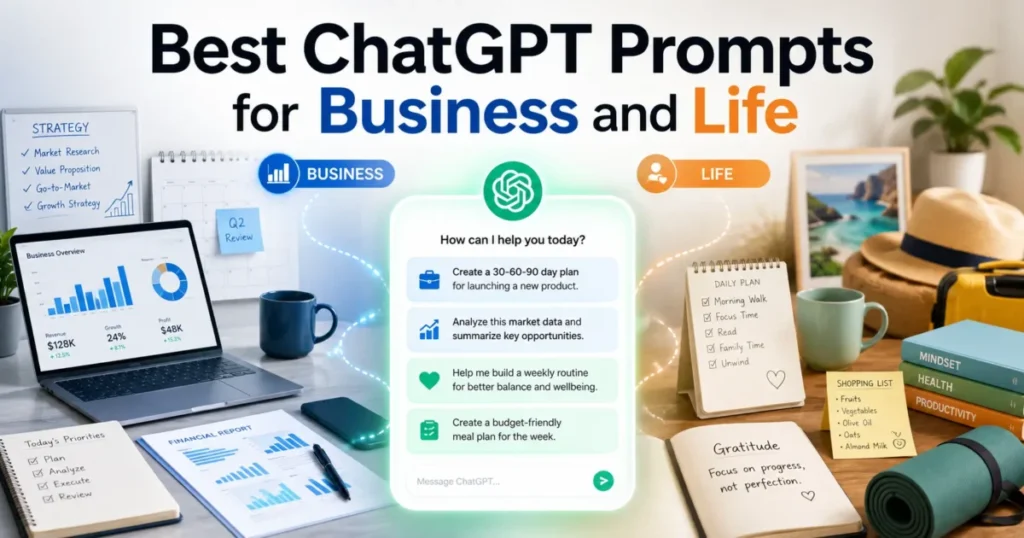
Vague requests tend to produce interchangeable answers. This guide gives you 150 core ChatGPT prompts for work and life, plus 50 focused templates for business strategy, career planning, coding, data analysis, and cross-category work.
Each prompt names a task, supplies useful context, and defines the output. The notes explain who should use it and what to check before relying on the result.
Prompting behavior can shift between model versions, so re-check a reused prompt after a major update.
In This Article (25 sections)
Quick Answer
Start with the prompt closest to the result you need. Replace each placeholder, add relevant facts, and state any limit that changes the answer.
The 200 templates cover operations, marketing, sales, productivity, life admin, learning, editing, strategy, careers, coding, data, and cross-category work. Human review remains necessary whenever an answer depends on facts, policy, calculations, code, or personal consequences.
Quick Picks: Best Prompts by Outcome
| Use case | Top prompt | Section |
|---|---|---|
| Work operations | SOP Generator (#1) | Business Operations |
| Marketing | Social Media Repurposing Engine (#32) | Marketing and Content |
| Sales and research | Buyer Persona Builder (#61) | Sales and Research |
| Productivity | Weekly Planning Reset (#81) | Productivity |
| Life admin | Difficult Conversation Prep (#102) | Life Admin |
| Learning | Teach-Back Verifier (#122) | Learning |
| Editing | Clarity Sharpener (#136) | Editing |
| Business strategy | Strategy Memo (#151) | Business Strategy |
| Career and job search | Resume Tailoring (#166) | Career and Job Search |
| Coding and data | Bug Triage (#181) | Coding and Data |
| Cross-category work | Prompt Builder (#196) | Utility Prompts |
Category Table of Contents
- Business Operations
- Marketing and Content
- Sales, Research, and Customer Insight
- Productivity and Mental Load
- Life Admin and Personal Clarity
- Learning, Thinking, and Explaining
- Editing, Rewriting, and Polishing
- Business Strategy
- Career and Job Search
- Coding and Data
- Utility Prompts That Work in Every Category
Why Most ChatGPT Prompt Lists Do Not Help
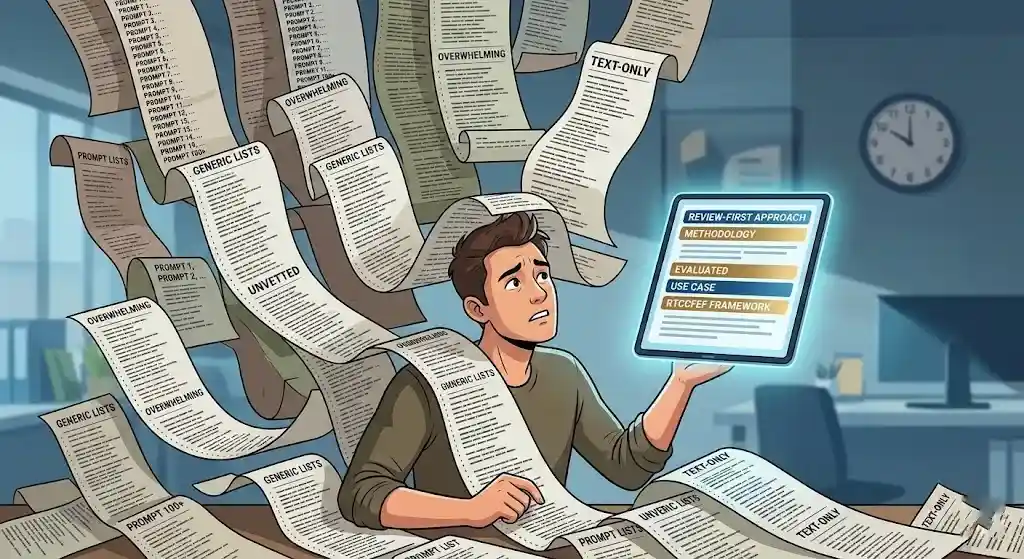
The internet has many prompt lists. The missing element is judgment about which details shape the answer and which outputs need checking.
Common problems include vague tasks, missing context, undefined audiences, and no requested format. A meal plan and a sales page also need different review standards.
Specificity turns a generative AI request from an open guess into a defined assignment. Role, task, context, constraints, format, examples, and follow-up questions give the model useful boundaries.
Editorial Selection Method
This guide selects prompts by editorial fit. Each template must name an outcome, provide enough context, set a usable output shape, allow meaningful adjustment, and expose claims that require checking.
The source set includes current OpenAI prompting guidance, recurring business workflows, documented writing and analysis patterns, and public documentation for linked tools. Prompts are grouped by the decision or deliverable they support.
Each template is reviewed for ambiguity, privacy risk, factual dependence, and human review needs. Open-ended goals, missing evidence, and unsupported claims are narrowed or moved to the pattern-analysis section.
Prompting behavior can shift between model versions. Re-check a saved prompt after a major model update, especially when the task depends on a strict format or repeatable classification.
Sources checked August 15, 2026: OpenAI prompt engineering best practices and OpenAI guidance for creating a good prompt.
What Makes a Good ChatGPT Prompt?
“Be specific” is sound advice, but it needs a working structure. The RTCCFEF framework provides one.
The RTCCFEF Framework
| Component | Purpose | Example |
|---|---|---|
| Role | Sets the expertise and viewpoint | “Act as a senior operations manager” |
| Task | States the required result | “Create a standard operating procedure” |
| Context | Supplies relevant background | “For a 10-person agency using Asana” |
| Constraints | Sets limits and quality bars | “Under 500 words. Use bullet points.” |
| Format | Defines the output shape | “Numbered checklist with headers” |
| Examples | Shows the desired standard | “Follow this sample structure: (paste)” |
| Follow-up | Supports useful iteration | “Ask three questions that change the answer” |
Not every request needs all seven fields. Most useful prompts include a clear task, enough context, a meaningful constraint, and an output format.
A vague request such as “Write a marketing email” leaves the audience, offer, length, tone, and call to action undefined. Adding those fields gives the response a target.
The same principle applies to meeting notes. Ask for decisions, action items, owners, deadlines, open questions, and parking-lot items instead of requesting an unspecified summary.
This structure is central to prompt engineering. It also makes a weak response easier to repair because you can identify the missing field.
Sources checked August 15, 2026: OpenAI prompt engineering best practices and OpenAI guidance for creating a good prompt.
30 ChatGPT Prompts for Business Operations
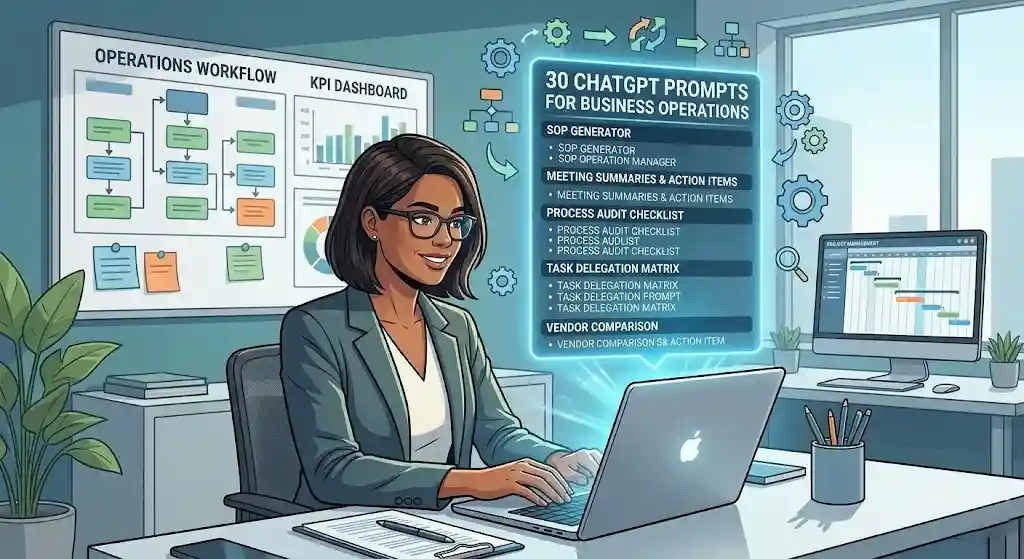
These prompts turn recurring operational work into defined documents, decisions, and handoffs. Confirm names, deadlines, policies, calculations, and any step that affects customers or staff.
Review risk: Medium. A human must confirm that each output matches the real workflow, policy, owner, and deadline.
1. SOP Generator
- Best for:
- Small business owners and team leads documenting repeatable work.
Act as a senior operations consultant. Create a detailed standard operating procedure (SOP) for [process name] at [company type]. Include: purpose, scope, roles involved, step-by-step instructions, tools used, common mistakes, and a quality checklist. Format with headers, numbered steps, and a summary box at the top. Keep the language clear enough for a new hire to follow without additional training.Quick note: Add the tools, owners, exceptions, and a sample SOP. Review every step with the person who performs the process.
2. Meeting Summary with Action Items
- Best for:
- Managers and consultants who need structured notes.
I am going to paste the transcript or my raw notes from a meeting. Summarize it in this format: (1) Key decisions made, (2) Action items with owners and deadlines, (3) Open questions, (4) Parking lot items. Keep bullet points concise. Flag anything that sounds like a commitment or a deadline. Here are my notes: [paste notes]Quick note: Clarify names and dates before sharing. Loom can support recorded asynchronous updates when a meeting is unnecessary.
3. Decision Memo Drafter
- Best for:
- Founders and executives documenting a choice.
Act as a chief of staff. Draft a one-page decision memo for the following decision: [describe the decision]. Include: background context, options considered (at least 3), pros and cons of each, recommended option with rationale, risks, and next steps. Format with clear headers. Tone: professional, concise, suitable for a board or leadership audience.Quick note: Add budget, timing, and team constraints. Verify every financial, market, and legal claim.
4. Process Audit Checklist
- Best for:
- Operations managers examining bottlenecks.
Act as a process improvement consultant. I am going to describe a business process. Audit it and produce: (1) A step-by-step map of the current process, (2) Identified bottlenecks or redundancies, (3) Suggested improvements with estimated impact (low, medium, or high), (4) A prioritized action list. Here is the process: [describe your workflow].Quick note: Supply headcount, tools, timing, and known constraints. Treat impact labels as hypotheses until measured.
5. Task Triage and Delegation Matrix
- Best for:
- Founders sorting an overloaded task list.
Act as a productivity consultant. I am going to give you my current task list. Sort each task into one of four categories: (1) Do Now, high urgency and high importance, (2) Delegate, important but someone else can handle it, (3) Schedule, important but not urgent, (4) Drop or Defer, low impact. For each task, give a one-sentence rationale. Here is my list: [paste tasks].Quick note: Add real deadlines, available people, and the quarter’s main objective before accepting the ranking.
6. Vendor Comparison Table
- Best for:
- Procurement decisions.
Create a comparison table for [3 vendors] across: price, features, support, integration options, and contract terms. Add a best-for recommendation.Quick note: Paste current vendor documentation and verify every term before purchase.
7. Client Onboarding Checklist
- Best for:
- Service businesses.
Create a client onboarding checklist for [business type]. Include pre-kickoff tasks, first-week deliverables, communication setup, and a 30-day check-in plan.Quick note: Adjust the timeline, owners, and required access for your service.
8. Weekly Team Update Email
- Best for:
- Managers sharing concise progress.
Draft a weekly team update with wins this week, priorities next week, blockers, and one team shoutout. Tone: positive but direct. Keep it under 200 words. Use these notes: [paste].Quick note: Confirm every name, status, and commitment before sending.
9. Risk Assessment Brief
- Best for:
- Project managers.
Identify the top 5 risks for [project]. For each, provide the risk, likelihood (low, medium, or high), potential impact, and mitigation strategy.Quick note: Validate likelihood and impact with project evidence and domain specialists.
10. Job Description Writer
- Best for:
- Hiring managers.
Write a job description for [role] at [company type]. Include responsibilities, required skills, nice-to-haves, compensation placeholder, and culture summary. Tone: professional and welcoming.Quick note: Remove placeholders and confirm employment-law requirements before posting.
11. Performance Review Draft
- Best for:
- Managers preparing employee reviews.
Draft a performance review for [role]. Strengths: [list]. Areas for growth: [list]. Include specific language and 2 to 3 development goals.Quick note: Ground every statement in documented work and personalize the draft before use.
12. Internal FAQ Generator
- Best for:
- Teams reducing repeat questions.
Based on these common questions: [paste], create an internal FAQ with clear answers. Group questions by topic.Quick note: Have each policy owner verify the answers.
13. Project Brief Template
- Best for:
- Agencies and internal teams.
Create a project brief for [project type]. Include objective, scope, stakeholders, timeline, deliverables, budget placeholder, success metrics, and risks.Quick note: Adapt the fields to your project system and replace every placeholder.
14. Quarterly Planning Facilitator
- Best for:
- Small teams planning the next quarter.
Act as a strategic planning facilitator. Based on these goals: [paste], create a 90-day plan with 3 priorities, supporting initiatives, milestones, and owners.Quick note: Add the prior quarter’s results, current capacity, and known dependencies.
15. Contract Review Checklist
- Best for:
- Non-lawyers preparing questions about an agreement.
Create a 15-point checklist for reviewing a [type] contract. Cover payment terms, termination, liability, intellectual property, confidentiality, and auto-renewal.Quick note: This checklist is not legal advice. Ask a qualified attorney to review the agreement.
16. Expense Policy Draft
- Best for:
- Growing teams.
Draft an expense report policy for [company size]. Cover eligible expenses, approval workflow, receipts, reimbursement timeline, and exceptions.Quick note: Add real thresholds and confirm tax, payroll, and employment requirements.
17. Change Management Communication
- Best for:
- Teams rolling out a tool or process.
Draft an internal announcement for [change]. Cover what is changing, why, impact, timeline, and contact for questions. Tone: transparent and empathetic.Quick note: Ask the responsible team lead to verify impact and timing.
18. Board Update Summary
- Best for:
- Startup founders.
Draft a board update with key metrics, wins, challenges, cash-position placeholder, hiring, and strategic priorities. Use an executive-summary style and keep it under 500 words.Quick note: Replace all placeholders and follow the organization’s rules for confidential financial data.
19. Workflow Automation Finder
- Best for:
- Operations managers identifying automation candidates.
Review these recurring tasks: [paste]. Identify which could be automated with tools such as Zapier, Make, or AI. Suggest a specific approach for each.Quick note: Verify access, data handling, and tool compatibility. See the Zapier review for related context.
20. Customer Complaint Response
- Best for:
- Support teams and small businesses.
Write 3 response templates for these complaints: [list]. Tone: empathetic and solution-oriented. Include acknowledgment, explanation, and a next-step offer.Quick note: Personalize the response and confirm the remedy is authorized before sending.
21. Retrospective Facilitator
- Best for:
- Project and agile teams.
Based on these retrospective notes: [paste], summarize what went well, what did not, and 3 actionable improvements with owners.Quick note: Confirm that owners accept the actions and deadlines.
22. Partnership Evaluation Framework
- Best for:
- Business development teams.
Create a partnership evaluation framework. Criteria: strategic fit, revenue potential, risk, resources, and cultural alignment. Format it as a scoring rubric.Quick note: Define the weights and evidence standards before scoring candidates.
23. KPI Dashboard Summary
- Best for:
- Weekly and monthly reporting.
Based on these KPIs: [paste data], write a narrative highlighting trends, anomalies, wins, and areas needing attention. Audience: leadership.Quick note: Add benchmarks and verify the source data before sharing the narrative.
24. Offboarding Checklist
- Best for:
- HR and IT teams.
Create an employee offboarding checklist for [company type]. Cover IT access removal, knowledge transfer, exit interview, final payroll, and equipment return.Quick note: Cross-check the checklist with legal, payroll, security, and records requirements.
25. Escalation Procedure
- Best for:
- Customer support teams.
Write an escalation procedure for [issue type]. Include trigger criteria, escalation levels, response timeframes, responsible parties, and communication templates.Quick note: Align the procedure with real service commitments and on-call coverage.
26. Reorder Point Calculator
- Best for:
- E-commerce and inventory teams.
Create a reorder-point template for [product type]. Include a safety-stock formula, lead-time variables, and a seasonal-adjustment decision table.Quick note: Verify formulas and inputs with current supply-chain data.
27. Daily Standup Template
- Best for:
- Remote teams.
Create a standup template covering work completed yesterday, work planned today, and blockers. Add a short team-health check. Format it for Slack or Teams.Quick note: Keep the health question optional and avoid collecting sensitive personal information.
28. Knowledge Base Article
- Best for:
- Self-service documentation.
Write an internal knowledge-base article on [topic]. Include a summary, step-by-step instructions, screenshot placeholders, troubleshooting, and related articles. Audience: non-technical readers.Quick note: Add current screenshots and have a subject expert verify the procedure.
29. Budget Proposal Outline
- Best for:
- Department heads requesting funds.
Create a budget proposal for [initiative]. Include an executive summary, itemized costs, expected return, timeline, risks, and low, mid, and high scenarios.Quick note: Replace estimates with approved figures from QuickBooks or the organization’s accounting source.
30. Cross-Department Handoff Protocol
- Best for:
- Teams with recurring handoff problems.
Design a handoff protocol between [department A] and [department B] for [process]. Include trigger points, required information, responsible parties, service expectations, and a feedback loop.Quick note: Review the protocol with both departments before adoption.
30 ChatGPT Prompts for Marketing and Content
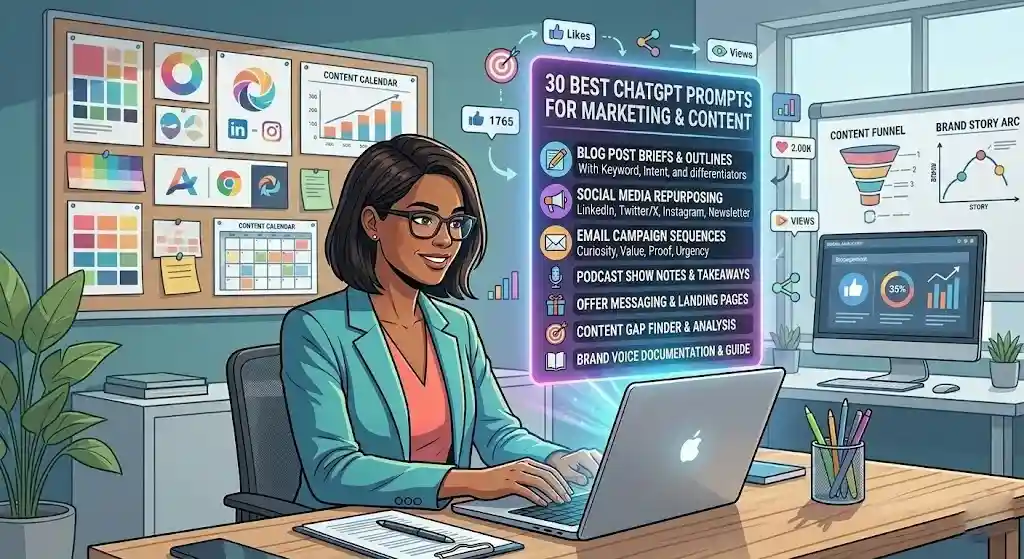
These prompts cover briefs, campaigns, brand voice, repurposing, and content decisions. Human review should protect voice, evidence, permissions, and factual accuracy.
Review risk: Medium. A human must confirm claims, source quality, brand fit, permissions, and compliance before publication.
31. Blog Post Brief Generator
- Best for:
- Content marketers preparing an assignment.
Act as a senior content strategist. Create a detailed blog post brief for an article titled "[title]" targeting the keyword "[keyword]." Include target audience, search intent, angle or hook, H2 and H3 outline, key points, internal-link placeholders, CTA recommendation, tone guidance, word-count target, and 3 differentiators. Format with headers.Quick note: Add brand guidance, existing URLs, and current search research. The model cannot replace live search-result analysis.
32. Social Media Repurposing Engine
- Best for:
- Creators adapting long-form work for several channels.
I am going to paste a blog post. Repurpose it into: (1) a LinkedIn post with hook, insight, and CTA under 250 words, (2) a Twitter or X thread of 5 to 7 posts with a concise opener, (3) two Instagram captions with a casual tone, (4) one email newsletter introduction. Adapt the tone for each platform. Here is the post: [paste content]Quick note: Edit every opening and CTA to match the author’s voice and each platform’s current rules.
33. Email Campaign Sequence
- Best for:
- Small businesses and creators planning a launch or nurture sequence.
Act as a direct-response email copywriter. Write a 5-email sequence for [goal]. Target audience: [describe]. For each email, provide 2 subject lines, preview text, body copy under 200 words, CTA, and send timing. Tone: [specify]. Sequence arc: curiosity, value, social proof, urgency, last chance.Quick note: Replace unsupported proof, confirm the offer, and rewrite any line that does not sound like the sender.
34. Brand Voice Documentation
- Best for:
- Teams defining a consistent writing voice.
Act as a brand strategist. Based on these content samples from our brand: [paste 3 to 5 samples], create a brand voice guide. Include 3 to 5 voice attributes with definitions, tone variations by context, examples of what to do and avoid, sentence preferences, vocabulary to use or avoid, and a sounds-like-us comparison.Quick note: Use representative samples from several content types and resolve inconsistencies before adoption.
35. Content Gap Finder
- Best for:
- Content planners looking for uncovered audience questions.
Act as an SEO content analyst. My niche: [describe]. Topics I cover: [paste or list]. Based on common subtopics and search-intent patterns, identify 15 possible content gaps. For each, provide a title, probable intent, and estimated difficulty as easy, medium, or hard.Quick note: Treat difficulty as directional and verify demand with current search data.
36. Offer Messaging Framework
- Best for:
- Clarifying a value proposition.
Write 3 offer messages for [product or service]. Lead each with a different angle: pain point, outcome, or comparison. Keep each under 50 words.Quick note: Check each promise against product evidence and audience research.
37. Landing Page Headlines
- Best for:
- Creating headline options.
Give me 10 headline options for [product]. Use benefit, curiosity, social proof, and urgency approaches. Audience: [describe].Quick note: Remove unsupported proof or urgency and compare the strongest options with real audience feedback.
38. Case Study Outline
- Best for:
- B2B marketers.
Create a case-study outline for [client result]. Structure it as challenge, solution, implementation, results, testimonial placeholder, and CTA.Quick note: Use approved customer facts and obtain permission before publication.
39. Content Calendar
- Best for:
- Solo marketers planning a month.
Create a 4-week content calendar for [brand or niche]. Include a blog post, LinkedIn post, Instagram post, email, and one video idea each week. Give each week a theme.Quick note: Remove channels you do not use and align dates with real campaigns.
40. Meta Description Writer
- Best for:
- SEO editors.
Write 3 meta descriptions for "[title]" targeting "[keyword]." Keep each under 155 characters, include the keyword naturally, and give the reader a specific reason to click.Quick note: Check the final character count and ensure the description matches the page.
41. Blog Introduction Rewriter
- Best for:
- Articles with weak openings.
Rewrite this introduction to engage the reader: [paste]. Open with a specific observation, verified statistic, or useful question. Keep it under 80 words.Quick note: Supply the source for any statistic and reject generic rhetorical questions.
42. Social Proof Compiler
- Best for:
- Testimonial pages.
Organize these customer-feedback excerpts into themed groups: [paste]. Suggest a heading and identify the strongest quotation in each group.Quick note: Keep quotations exact and obtain permission before publishing them.
43. Product Description
- Best for:
- E-commerce and software pages.
Write a product description for [product]. Lead with the main benefit, explain 3 features through their user benefits, and finish with a CTA. Tone: [specify]. Keep it under 150 words.Quick note: Verify every specification and claim against the product source.
44. Newsletter Ideas
- Best for:
- Creators planning an email series.
Suggest 12 newsletter topics for [niche]. Give each a specific angle and a one-sentence hook. Avoid broad category labels.Quick note: Align topics with reader questions and planned promotions.
45. Ad Copy Variants
- Best for:
- Paid search and social advertising.
Write 5 ad-copy variants for [product or offer]. Platform: [specify]. Limit: [character limit]. Include a hook, value proposition, and CTA. Use direct, playful, and urgent tones.Quick note: Confirm platform limits, offer terms, targeting rules, and landing-page consistency.
46. Webinar Promotion Email
- Best for:
- Event promotion.
Write a promotion email for a free webinar on [topic]. Include a subject line, 3 takeaways, speaker credibility, CTA, and deadline. Keep it under 200 words.Quick note: Verify the schedule, speaker claims, and registration details.
47. Podcast Show Notes
- Best for:
- Podcasters.
Write show notes for "[title]." Include a 2 to 3 sentence summary, topics with timestamp placeholders, a guest-bio placeholder, and links.Quick note: Add the real timestamps, approved bio, and checked links.
48. Win-Back Email Sequence
- Best for:
- E-commerce and subscription businesses.
Write a 3-email win-back sequence for customers inactive for 90 days. Keep the tone friendly and measured. Put a special offer in email 2 and a final reminder in email 3.Quick note: Confirm eligibility, consent, offer terms, and suppression rules before sending.
49. Pricing Page Copy
- Best for:
- Software and service businesses.
Draft a pricing page for [product] with [2 to 4 tiers]. For each tier, provide a name, tagline, 5 to 7 features, ideal user, and CTA. Add an FAQ addressing pricing objections.Quick note: Pricing and limits vary. Replace every placeholder with current, approved plan information.
50. Press Release
- Best for:
- Launches and company milestones.
Draft a press release for [announcement]. Include headline, subheadline, dateline, lead covering the main facts, 2 body paragraphs, a quotation placeholder for [name and title], and boilerplate.Quick note: Replace the quotation placeholder with approved language and verify every factual claim.
51. Brand Story Framework
- Best for:
- About pages.
Write a brand story for [company]. Structure it as origin, problem observed, mission, how the company responds, and future vision. Tone: authentic and restrained.Quick note: Begin with verified company history and remove generic mission language.
52. Competitor Content Analysis
- Best for:
- Content planning.
Analyze this competitor content: [paste or describe]. Identify topics covered, angle, missing questions, and ways my article could be more useful. Do not copy the source.Quick note: Provide current source material and compare substance rather than wording.
53. Video Script
- Best for:
- Short-form creators.
Write a 60-second video script on [topic]. Include a brief hook, problem, solution, proof, and CTA. Platform: [specify].Quick note: Read it aloud, verify the timing, and remove any unsupported proof.
54. Affiliate Review Framework
- Best for:
- Affiliate publishers.
Create a review outline for [product]. Include introduction and verdict, intended user, features, pros and cons, pricing, alternatives, and recommendation.Quick note: Base the review on verifiable evidence and keep commercial relationships separate from the verdict.
55. Thought Leadership Post
- Best for:
- LinkedIn authors.
Draft a LinkedIn post with a contrarian insight on [topic]. Include a concise opener, observation, personal-evidence placeholder, and takeaway. Tone: confident and grounded. Keep it under 200 words.Quick note: Replace the placeholder with genuine experience and remove any claim you cannot support.
56. Infographic Content
- Best for:
- Visual content planning.
Draft text for an infographic on [topic]. Include a headline, 5 to 7 data-point placeholders with labels, a key takeaway, and source fields.Quick note: Never let the model supply unsourced statistics. Fill every data point from a checked source.
57. SEO FAQ Section
- Best for:
- Bloggers answering related questions.
Write a 6-question FAQ for an article about [topic]. Keep each answer to 2 or 3 sentences and use natural language with relevant terms.Quick note: Match questions to real reader intent and verify factual answers.
58. Seasonal Campaign Brainstorm
- Best for:
- Retail and e-commerce teams.
Suggest 8 campaign ideas for [brand type] for [season]. For each, give a theme, tagline, channel, secondary format, and differentiator.Quick note: Check timing, inventory, permissions, and cultural context.
59. Testimonial Request Email
- Best for:
- Service businesses.
Write a short email asking a client for a testimonial. Include 3 guiding questions. Tone: grateful and low-pressure.Quick note: Send only to an appropriate client and explain how the testimonial may be used.
60. Content Audit Summary
- Best for:
- Content managers.
Based on this post list with traffic notes: [paste], categorize each item as update, keep, consolidate, or retire. Give a one-line recommendation for each.Quick note: Add current traffic, conversion, backlink, and business-priority data before deciding.
20 ChatGPT Prompts for Sales, Research, and Customer Insight
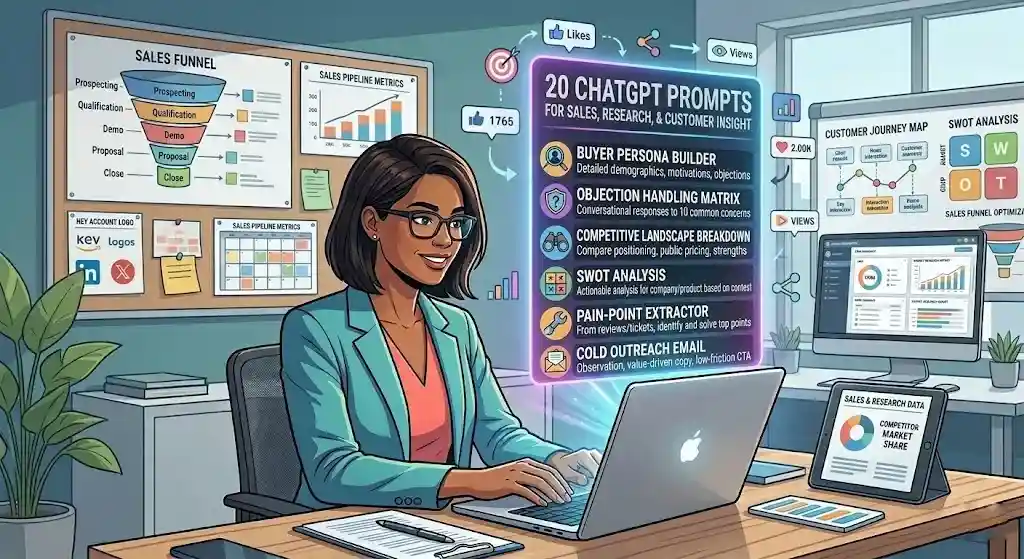
These prompts support buyer research, positioning, outreach, and sales preparation. Use a sourced research tool such as the one discussed in the Perplexity review when the answer depends on current external information.
Review risk: Medium. A human must confirm customer evidence, competitor facts, market data, claims, and communication tone.
61. Buyer Persona Builder
- Best for:
- Founders and marketers creating a working customer hypothesis.
Act as a market research analyst. Create a detailed buyer persona for [product or service]. Include demographics, psychographics, daily frustrations, goals, buying objections, preferred content formats, online channels, decision triggers, and a day-in-the-life narrative. Base it on typical patterns for [industry]. Name the persona.Quick note: Treat the persona as a hypothesis. Validate it with surveys, interviews, support tickets, and sales notes.
62. Objection Handling Matrix
- Best for:
- Sales teams preparing for buyer concerns.
Act as a sales enablement expert. For [product or service], list 10 common objections. For each, provide the objection, underlying concern, a conversational response, and a follow-up question that advances the discussion.Quick note: Use real objection data from HubSpot, Pipedrive, or your CRM. Never read the response as a script.
63. Competitive Market Breakdown
- Best for:
- Founders and strategists comparing positioning.
Act as a competitive intelligence analyst. Create a market summary for [product] in [industry]. Compare 5 named competitors by positioning, public pricing, strengths, weaknesses, and differentiation from [my product]. Return a comparison table and a narrative summary.Quick note: Name the competitors and supply current source material. Verify every price, feature, and claim.
64. SWOT Analysis
- Best for:
- Strategic planning discussions.
Create a SWOT analysis for [company or product] using this context: [paste]. Avoid generic items that could describe any company. Format it as a 2-by-2 grid with concise bullets.Quick note: Label unsupported points as assumptions and confirm them with evidence.
65. Customer Pain-Point Extractor
- Best for:
- Product and customer-experience teams.
From these reviews, tickets, or survey responses: [paste], identify the top 10 pain points. Rank them by frequency and severity, quote representative language, and suggest possible responses.Quick note: Remove personal data, preserve quotation wording, and check the counting method.
66. Cold Outreach Email
- Best for:
- Founders and sales representatives.
Write a cold email for [product] targeting [persona]. Lead with a relevant observation rather than a pitch. Include a one-line value proposition, evidence placeholder, and low-friction CTA. Keep it under 100 words.Quick note: Personalize the first line, replace the evidence placeholder, and follow applicable outreach rules.
67. Sales Follow-Up Sequence
- Best for:
- Post-demo communication.
Write a 3-email sequence after a demo of [product]. Email 1 should recap and thank the buyer. Email 2 should address the stated hesitation. Email 3 should offer a measured next step with a real deadline. Tone: professional and not pushy.Quick note: Use the buyer’s real concerns and only include an authentic deadline.
68. Market Sizing Estimate
- Best for:
- Founders preparing a research plan.
Create a framework for estimating total, serviceable, and obtainable market for [product] in [market]. List the data required, calculation steps, assumptions, and validation sources. Do not invent figures.Quick note: Replace every input with sourced data and have a qualified reviewer check the model.
69. Customer Interview Questions
- Best for:
- Discovery interviews.
Write 12 customer interview questions for [product]. Focus on buying behavior, pain points, current alternatives, decision criteria, and past actions. Avoid leading questions.Quick note: Begin broadly and ask follow-ups about specific past behavior.
70. Value Proposition Variants
- Best for:
- Product marketing teams.
Write 5 value-proposition statements for [product]. Use these angles: time saved, cost reduced, risk removed, simplicity, and competitive advantage. Keep each under 25 words.Quick note: Remove any benefit that lacks product or customer evidence.
71. Ideal Customer Profile Refiner
- Best for:
- Sales and marketing alignment.
Based on these customer characteristics: [paste], refine our ideal customer profile. Identify patterns in industry, size, buyer role, budget, trigger events, and disqualifying factors.Quick note: Use representative customer data and revisit the profile as the market changes.
72. Proposal Executive Summary
- Best for:
- Consultants and agencies.
Write an executive summary for a proposal to [client] for [project]. Cover the problem, proposed response, expected outcomes, timeline, and investment-range placeholder. Tone: confident and professional. Keep it under 250 words.Quick note: Replace every placeholder and avoid promising an outcome without evidence.
73. Feature-to-Benefit Translator
- Best for:
- Product managers and marketers.
For each feature in this list: [paste], write a benefit statement for [target user]. Format each line as Feature to Benefit and explain the user consequence.Quick note: Confirm that the claimed benefit follows from the feature.
74. Win-Loss Analysis Template
- Best for:
- Sales managers.
Create a win-loss analysis template with sections for deal context, decision factors, competitor involvement, our strengths and weaknesses, buyer feedback, and improvement actions.Quick note: Separate buyer statements from team interpretation.
75. Customer Journey Map
- Best for:
- Customer-experience teams.
Create a customer journey map for [product]. Use the stages awareness, consideration, decision, onboarding, retention, and advocacy. For each stage, list actions, emotions, touchpoints, pain points, and opportunities.Quick note: Validate the map with interviews, support data, product analytics, and sales evidence.
76. Sales Deck Outline
- Best for:
- Teams preparing a pitch.
Create a 10-slide sales-deck outline for [product]. For each slide, provide a title, key message, visual suggestion, and 3 talking points. Audience: [describe].Quick note: Verify claims, tailor the sequence to the audience, and use approved visuals.
77. Pricing Strategy Options
- Best for:
- Teams preparing pricing research.
Create 3 pricing-strategy options for [product] using this context: [paste]. For each, give a name, structure, advantages, drawbacks, evidence needed, and suitable use case. Do not recommend a price without market data.Quick note: Pricing requires current customer, cost, and market evidence.
78. Industry Trend Research Plan
- Best for:
- Strategists studying current change.
Create a research plan for identifying current trends in [industry]. For each candidate trend, require evidence, affected groups, decision impact, uncertainty, and one question to investigate next.Quick note: Ask ChatGPT to search and cite when available, then open and verify every source.
79. Referral Program Design
- Best for:
- Growth teams.
Design a referral program for [product]. Include incentive options, messages for referrers and referred customers, tracking needs, abuse risks, and a launch plan.Quick note: Check unit economics, eligibility, fraud controls, and legal requirements.
80. Post-Purchase Survey
- Best for:
- E-commerce and software teams.
Write 8 post-purchase survey questions for [product]. Cover satisfaction, purchase blockers, discovery source, recommendation likelihood, and one open-ended response. Keep the survey short enough to complete quickly.Quick note: Collect only necessary data and confirm how responses will be stored and used.
20 ChatGPT Prompts for Productivity and Mental Load
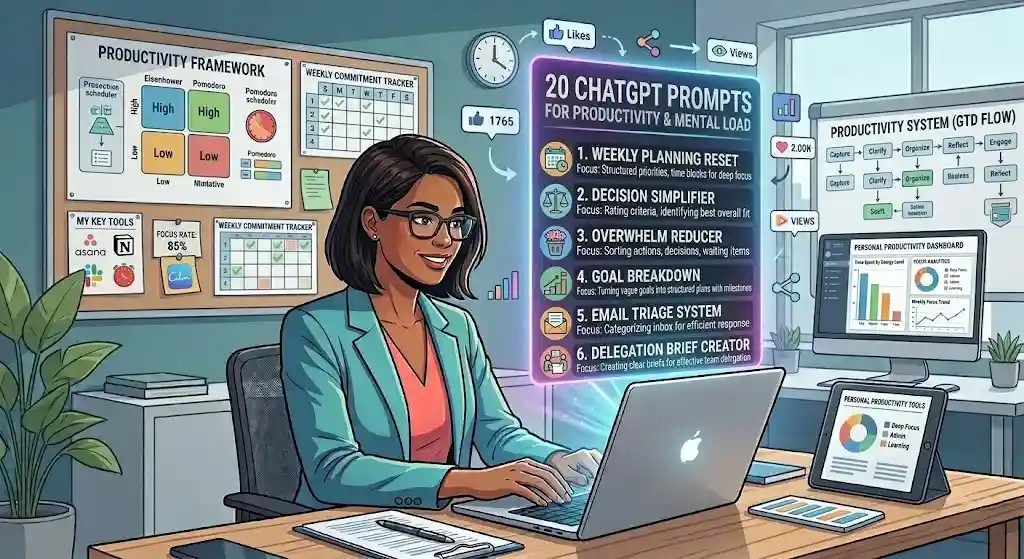
These prompts organize priorities, decisions, calendars, and follow-ups. They work best when you provide real deadlines, capacity, and dependencies.
Review risk: Medium. A human must confirm urgency, commitments, available time, and personal consequences.
81. Weekly Planning Reset
- Best for:
- Founders, freelancers, and professionals planning a crowded week.
Act as a productivity coach. I am going to list everything on my plate this week. Create a plan with: (1) my top 3 priorities, (2) tasks grouped by day, (3) time blocks for focused work, (4) one item to drop or delegate. If the list exceeds my capacity, say so. Available hours and commitments: [paste]. Task list: [paste].Quick note: Add fixed meetings, energy patterns, and non-negotiable deadlines.
82. Decision Simplifier
- Best for:
- Medium-stakes choices with a defined set of options.
I am deciding between these options: [describe]. Help me decide by listing key criteria, rating each option as high, medium, or low, identifying the best fit, and flagging missing information. Be direct and do not add new options unless a stated constraint makes every option unsuitable.Quick note: Add budget, timing, values, and deal-breakers. Use qualified advice for legal, medical, or financial decisions.
83. Overwhelm Reducer
- Best for:
- People sorting a large brain dump.
Here is everything on my mind: [brain dump]. Sort it into Actions, Decisions, Waiting On, and Not Actionable Now. From the Actions list, identify 3 items that can be completed in under 30 minutes.Quick note: Check whether any urgent commitment was buried in the notes.
84. Morning Priority Setter
- Best for:
- Daily planning.
From today's tasks: [paste], select the top 3 and explain the priority order. Use these deadlines and goals: [paste].Quick note: Review the order before opening email or chat.
85. Calendar Audit
- Best for:
- Overbooked professionals.
Review this schedule: [paste]. Identify meetings that could become an email, blocks that are too short, missing preparation time, and focus periods worth protecting. Suggest revisions without canceling commitments automatically.Quick note: Confirm stakeholder needs before changing any meeting.
86. Follow-Up Drafter
- Best for:
- Professional follow-ups.
Write a polite follow-up for [context]. Last contact: [date]. Include the reason for reconnecting and a clear request. Tone: professional and measured.Quick note: Customize the opening and verify the requested action.
87. Focus Session Planner
- Best for:
- Structuring a concentrated work block.
Structure a 2-hour focus session for [task]. Include a 10-minute setup, 80 minutes of core work with milestones, a short break, a 10-minute wrap-up, and a fallback if I get stuck.Quick note: Adjust the timing to your attention and the task’s real complexity.
88. End-of-Day Review
- Best for:
- Daily reflection.
Review my day from these notes: [paste]. Summarize what I completed, what remains, what blocked progress, and what deserves priority tomorrow.Quick note: Add any new commitment to the correct calendar or task system.
89. Goal Breakdown
- Best for:
- Turning a broad goal into milestones.
Break this goal into milestones: [goal]. Give each milestone an estimated effort range, 2 to 3 tasks, dependencies, and a proposed sequence.Quick note: Adjust the sequence for actual capacity and external dependencies.
90. Email Triage
- Best for:
- Sorting an overloaded inbox.
Using these email subjects and senders: [paste], categorize each as respond now, respond later, delegate, archive, or delete. Give a one-line reason. Flag any item that cannot be classified from the subject alone.Quick note: Do not paste sensitive email content. Open messages before deleting or delegating them.
91. Meeting Prep Brief
- Best for:
- Important meetings.
Prepare a meeting brief for a discussion about [topic] with [person or role]. Include key points, questions, possible concerns, evidence to bring, and the desired outcome.Quick note: Add relationship context and verify every fact in the brief.
92. Reverse Timeline
- Best for:
- Projects with a fixed deadline.
Build a reverse timeline for [project] due on [date]. Include milestones, dependencies, review time, and buffer days. Flag any date that appears unrealistic.Quick note: Confirm lead times and owner availability before committing.
93. Polite Decline Email
- Best for:
- Declining requests while preserving a relationship.
Write a concise decline email for [request]. Include acknowledgment, a clear no, a brief truthful reason, and an alternative suggestion if one exists.Quick note: Avoid over-explaining and do not offer an alternative you cannot support.
94. Weekly Reflection
- Best for:
- Reviewing progress and energy.
Ask me 5 reflective questions about my work week. Cover progress, energy, blockers, what to repeat, and what to change. Ask one question at a time.Quick note: Convert the final insight into one specific adjustment for next week.
95. Batch Task Grouper
- Best for:
- Reducing context switching.
Group these tasks by work type, such as writing, calls, administration, creative work, and research: [paste]. Suggest a daily theme and flag tasks that still need a deadline.Quick note: Keep urgent work ahead of the preferred batching scheme.
96. Delegation Brief
- Best for:
- Managers assigning work.
Create a delegation brief for [task]. Include objective, context, deliverable, deadline, quality criteria, decision authority, and who to ask when blocked.Quick note: Confirm that the assignee has capacity, access, and authority.
97. Energy Scheduling
- Best for:
- Planning around predictable energy changes.
Assign these tasks to time blocks by energy level: [paste]. Use high-energy, medium-energy, and low-energy periods. My usual pattern is: [describe].Quick note: Treat the schedule as a draft and adjust it after observing your own pattern.
98. Status Update Template
- Best for:
- Asynchronous project communication.
Write a 3-sentence status update on [project]. State current position, next step, and blockers. Use these facts: [paste].Quick note: Confirm status and owner details before posting in ClickUp, Todoist, or another work system.
99. Someday-Maybe Organizer
- Best for:
- Parking ideas without losing them.
Organize these ideas that are not ready to start: [paste]. Sort them into next quarter, future exploration, or archive. Suggest a review date for each active group.Quick note: Remove duplicates and assign no work until a review decision is made.
100. Quarter Review
- Best for:
- Solopreneurs and small teams.
Review these goals and outcomes: [paste]. Mark each complete, partial, or missed. Identify lessons supported by the notes and propose 3 priorities for the next quarter.Quick note: Separate recorded outcomes from interpretation and confirm the next-quarter capacity.
20 ChatGPT Prompts for Life Admin and Personal Clarity
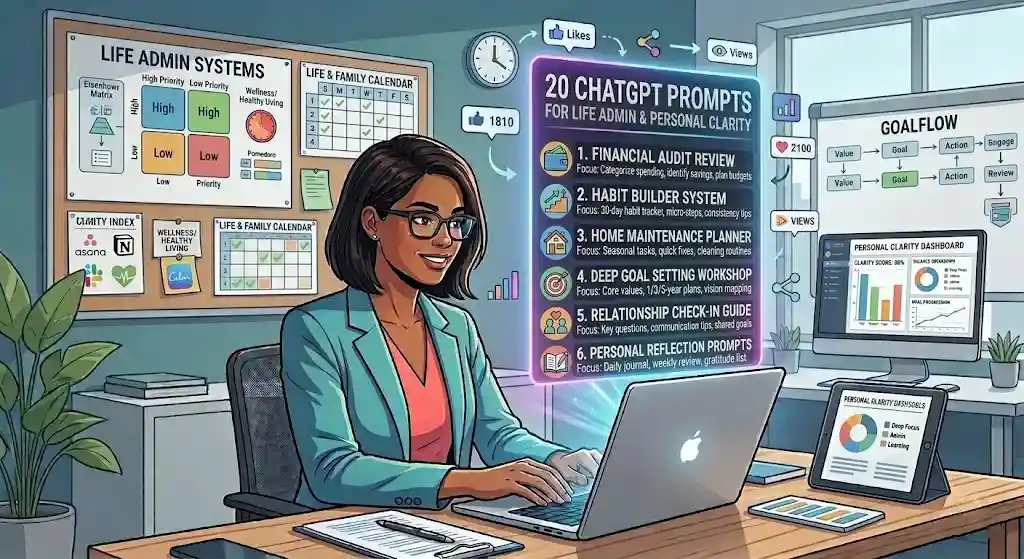
These prompts reduce the planning load behind meals, routines, travel, conversations, and household decisions. Personal context changes the answer, so review health, safety, cost, and relationship consequences.
Review risk: Medium. A human must confirm personal facts, current local information, safety, and professional-advice boundaries.
101. Weekly Meal Planner
- Best for:
- Busy households planning meals and shopping.
Act as a meal-planning assistant. Create a 7-day meal plan for [family size]. Dietary preferences: [list]. Budget: [amount or range]. Include breakfast, lunch, dinner, and 2 snacks, plus a grocery list grouped by store section. Prioritize meals that take under 30 minutes.Quick note: Verify allergens, nutrition needs, and medical restrictions with a qualified professional.
102. Difficult Conversation Prep
- Best for:
- Preparing for a tense discussion.
I need to discuss [topic] with [person or role]. Help me identify my key message, anticipate possible reactions, open without putting them on the defensive, prepare 2 to 3 calm phrases for tense moments, and close constructively. Desired outcome: [describe].Quick note: For HR, legal, medical, or safety-sensitive situations, prepare with the appropriate professional.
103. Travel Itinerary
- Best for:
- Planning a trip.
Create a [number]-day itinerary for [destination] for [travelers]. Include daily activities, restaurant criteria, transit options, cost placeholders, and a packing list. Travel style: [budget, moderate, or luxury].Quick note: Ask the model to search for current information, then verify hours, prices, closures, reservations, and safety guidance.
104. Morning Routine
- Best for:
- Designing a realistic start to the day.
Create a 60-minute morning routine for [role] that prioritizes [energy, focus, or calm]. Give time blocks, a reason for the sequence, and a shorter version for busy days.Quick note: Start with the minimum version and adjust from experience.
105. Big Decision Framework
- Best for:
- Personal crossroads with several options.
Help me evaluate this decision: [describe]. Define 5 weighted criteria, rate each option using my facts, flag missing information, and summarize the tradeoffs. Do not make the decision for me.Quick note: Use professional advice when health, law, or finances are involved.
106. Personal Learning Roadmap
- Best for:
- Building a new skill.
Create a 12-week plan for learning [skill]. Include weekly milestones, free-resource placeholders, practice exercises, and progress checks. Available time: [hours per week].Quick note: Verify every resource link and adapt the pace to prior knowledge.
107. Gift Idea Generator
- Best for:
- Finding relevant gift options.
Suggest 10 gifts for [person description]. Budget: [range]. Mix practical and thoughtful options. Avoid these items or themes: [list].Quick note: Check availability, delivery, preferences, and cultural context.
108. Home Maintenance Schedule
- Best for:
- Homeowners planning seasonal tasks.
Create a seasonal maintenance checklist for [home type] in [climate]. Cover heating and cooling, plumbing, exterior, and safety. Organize it by quarter.Quick note: Adjust for home age, local conditions, warranties, and licensed-work requirements.
109. Household Budget
- Best for:
- Drafting a monthly spending plan.
Create a monthly household-budget template for [income]. Include needs, wants, savings, debt, irregular expenses, and an emergency buffer. Use these current costs: [paste].Quick note: Verify figures and seek qualified advice for major financial decisions.
110. Moving Checklist
- Best for:
- Planning a relocation.
Create a moving checklist for 8 weeks before, 4 weeks before, 1 week before, moving day, and the first week after. Cover utilities, address changes, packing, records, and essential items.Quick note: Add local requirements, lease terms, school records, pets, and accessibility needs.
111. Apology Message
- Best for:
- Preparing a sincere personal apology.
Draft an apology for [situation]. Acknowledge the impact, explain without making excuses, state what I will do differently, and leave room for the other person's response. Tone: sincere and natural.Quick note: Replace generic language with your own words and do not pressure the recipient to forgive.
112. Parent-Teacher Meeting Prep
- Best for:
- Parents preparing for a school discussion.
Help me prepare for a parent-teacher meeting. Student level: [grade]. Concerns and observations: [list]. Suggest 5 questions, 2 points to listen for, and a constructive way to frame each concern.Quick note: Keep the focus on observed behavior and the student’s support needs.
113. Subscription Audit
- Best for:
- Reviewing recurring spending.
Review these subscriptions: [list with cost and last-used date]. For each, ask whether it is essential, identify a possible free alternative, and recommend keep, downgrade, review, or cancel.Quick note: Confirm contract terms and data export needs before cancellation.
114. Networking Event Prep
- Best for:
- People who prefer a plan for social events.
Prepare me for a [type] networking event in [industry]. Give 5 conversation starters, a 30-second introduction, 3 polite exit lines, and follow-up suggestions.Quick note: Practice the introduction aloud and keep questions relevant to the setting.
115. Habit Tracker
- Best for:
- Starting a small set of habits.
Create a tracker for these habits: [list]. For each, define frequency, minimum viable version, a 2-minute starter, and a 30-day milestone.Quick note: Track only a few habits at once and adjust goals from recorded behavior.
116. Insurance Review Guide
- Best for:
- Preparing for an annual coverage discussion.
Create a checklist for reviewing [type] insurance. Include questions for the agent, possible coverage gaps, exclusions to examine, renewal terms, and information to compare before switching.Quick note: This is not insurance advice. Confirm coverage with a licensed professional.
117. Exercise Routine
- Best for:
- Beginners discussing a basic plan.
Draft a 3-day beginner exercise routine. Equipment: [list]. Goals: [specify]. Include warm-up, exercises with sets, cool-down, and a gradual progression placeholder.Quick note: Consult a qualified clinician or trainer when health, injury, pregnancy, or disability changes the plan.
118. Negotiation Prep
- Best for:
- Salary, rent, or vendor discussions.
Prepare a negotiation for [topic]. Define ideal outcome, walk-away factors, opening statement, 3 evidence-based arguments, questions, and a concession plan.Quick note: Use current evidence, rehearse the opening, and confirm legal or contractual boundaries.
119. Emergency Information Sheet
- Best for:
- Households organizing essential contacts.
Create an emergency-information sheet template with contacts, medical-information fields, insurance fields, pet information, home systems, and neighbor contacts. Mark sensitive fields that should not be posted publicly.Quick note: Store and display the completed sheet according to its sensitivity and update it regularly.
120. Annual Personal Review
- Best for:
- Year-end reflection.
Ask me 10 reflective questions about accomplishments, setbacks, relationships, health, finances, learning, and changes for next year. Ask one question at a time and summarize only my stated facts.Quick note: Turn the final reflection into a small number of specific next steps.
15 ChatGPT Prompts for Learning, Thinking, and Explaining
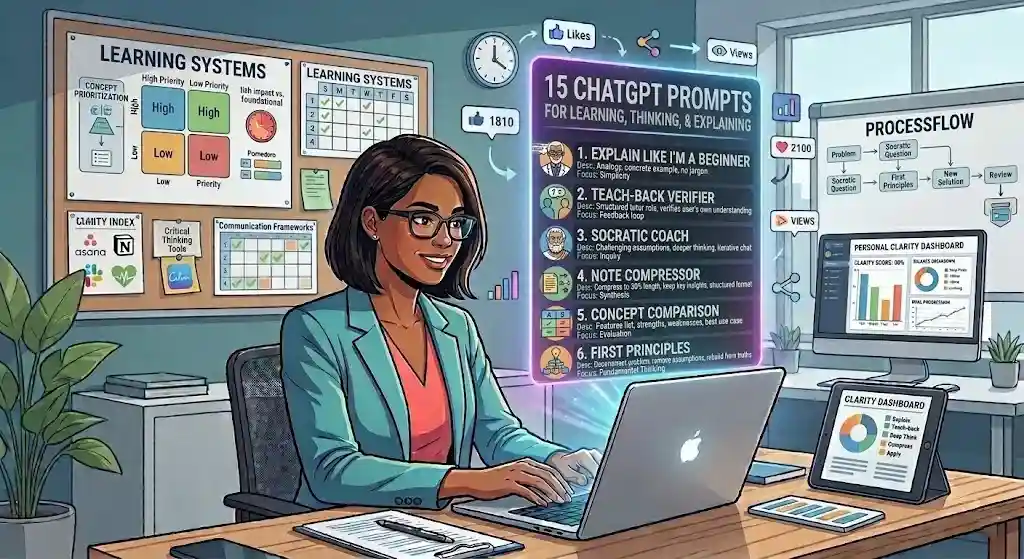
These prompts help explain, compare, question, and practice ideas. For source-grounded learning from your own documents, see the Google’s NotebookLM review.
Review risk: Medium. A human must confirm factual accuracy, source quality, level, and whether simplification removed an essential condition.
121. Explain Like I Am a Beginner
- Best for:
- Professionals learning outside their field.
Explain [concept] as if I am a capable professional who is new to [field]. Use simple language, one analogy, and one concrete example. Avoid unexplained jargon. After the explanation, ask whether I want a deeper level.Quick note: Verify the explanation against a trusted source and watch for oversimplification.
122. Teach-Back Verifier
- Best for:
- Checking your own understanding.
I am going to explain [concept] in my own words. Tell me: (1) what I got right, (2) what may be wrong or missing, (3) one point to add, (4) one question that checks understanding. Depth: [introductory or expert]. My explanation: [paste].Quick note: Compare the feedback with course materials or an expert source.
123. Socratic Coach
- Best for:
- Examining assumptions.
Ask Socratic questions about [topic], one at a time. Challenge my assumptions, ask for evidence, and wait for my answer before continuing.Quick note: Stop the sequence and verify facts when the discussion depends on external evidence.
124. Analogy Generator
- Best for:
- Explaining a concept to a defined audience.
Create 3 analogies for [concept] for [audience]. Use different domains: everyday life, business, and sports. State where each analogy breaks down.Quick note: Check the analogy with a subject expert before teaching from it.
125. Note Compressor
- Best for:
- Reviewing conference or course notes.
Compress these notes to about 30 percent of their current length. Keep key insights, remove repetition, and format with headers and bullets: [paste].Quick note: Compare the result with the source for missing qualifications and action items.
126. Topic Map
- Best for:
- Understanding the shape of a new subject.
Create a topic map for [subject]. Show subtopics, relationships, prerequisites, and a beginner-to-advanced learning sequence.Quick note: Verify prerequisites and add current source material for changing fields.
127. Book Summary
- Best for:
- Preparing an application-focused reading guide.
Using only these notes or excerpts from [book] by [author]: [paste], summarize 3 key ideas, the core argument, application to [my role], and one criticism. Flag anything the supplied material does not establish.Quick note: Read the original for context and do not rely on invented quotations.
128. Concept Comparison
- Best for:
- Distinguishing similar ideas.
Create a comparison table for [A] and [B]. Include definition, features, strengths, weaknesses, best use case, and common misconceptions. Add a decision row using these criteria: [paste].Quick note: Define the audience and verify technical distinctions.
129. Mental Model Explainer
- Best for:
- Applying a reasoning model.
Explain [mental model]. Include definition, mechanism, a business example, a personal example, and a case where it should not be used.Quick note: Check whether the examples preserve the model’s limits.
130. Research Summary
- Best for:
- Structuring a source-based synthesis.
Summarize the supplied research on [topic]: [sources or excerpts]. Cover findings, methods, limitations, practical implications, and questions newer evidence may change. Cite each source used.Quick note: Open every citation and verify that it supports the associated claim.
131. Debate Partner
- Best for:
- Stress-testing an argument.
I believe [position]. Present the strongest case against it using my evidence: [paste]. Then give 2 ways to strengthen my original argument without ignoring the counterargument.Quick note: Separate factual disputes from differences in values or priorities.
132. Jargon Translator
- Best for:
- Cross-functional communication.
Translate these terms for [non-technical audience]: [list]. For each, give a simple definition, example, and reason it matters. Keep any term that cannot be simplified and explain it briefly.Quick note: Ask a subject expert to check terms with legal or technical meanings.
133. First-Principles Breakdown
- Best for:
- Reconsidering a problem with inherited assumptions.
Break down [problem] using first principles. Identify fundamental facts, separate assumptions, rebuild possible approaches, and describe the ideal result under these constraints: [paste].Quick note: Verify that each claimed fact is evidence rather than another assumption.
134. Flashcard Creator
- Best for:
- Study and recall practice.
Create 15 flashcards for [topic] from these materials: [paste]. Front: question. Back: concise answer plus one supporting detail. Focus on concepts emphasized in the materials.Quick note: Check every answer before importing the cards into a study system.
135. Beginner to Expert Explainer
- Best for:
- Comparing levels of explanation.
Explain [concept] at 5 levels: child, high-school student, college graduate, professional, and expert. Keep each level under 50 words and state which details are simplified.Quick note: Use the next level above your current understanding, then verify it with a trusted source.
15 ChatGPT Prompts for Editing, Rewriting, and Polishing
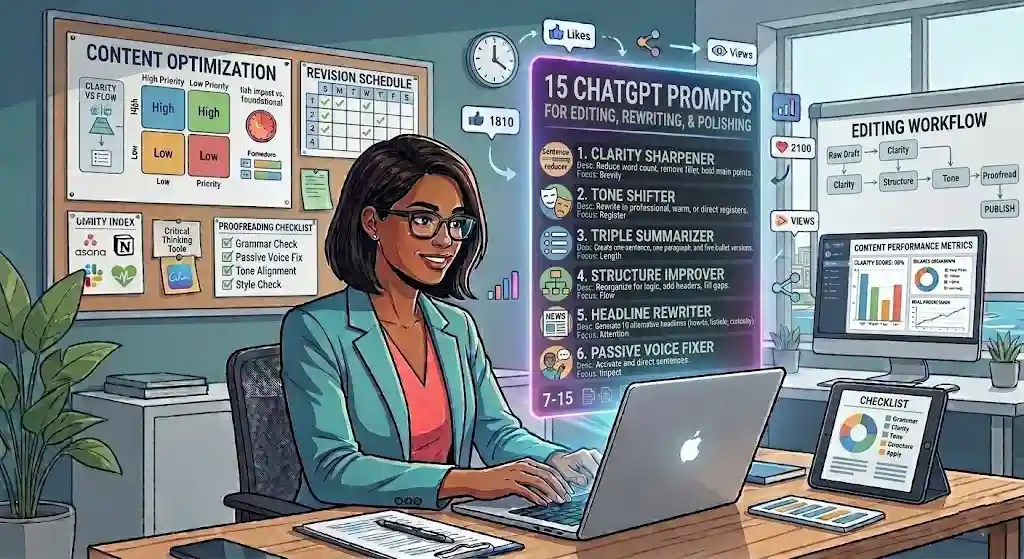
These prompts tighten, reorganize, and adapt drafts while keeping the author’s meaning visible. Always compare the revision with the source when nuance or accountability matters. If the draft itself is AI-generated and you want a dedicated rewriting workflow rather than another prompt, compare AI text humanizers and check the result against the source.
Review risk: Medium. A human must confirm preserved meaning, voice, factual accuracy, permissions, and intended audience.
136. Clarity Sharpener
- Best for:
- Writers who tend to over-explain.
Rewrite this text 30 percent shorter without losing key information. Improve clarity, remove filler, bold the main point in each paragraph, and keep the original tone. Text: [paste].Quick note: Compare the revision with the original for missing nuance.
137. Tone Shifter
- Best for:
- Adapting one message for different audiences.
Rewrite this text in 3 tones: (1) professional and formal, (2) conversational and warm, (3) direct and assertive. Preserve the same meaning. Text: [paste].Quick note: Tone changes can alter meaning. Check every version before use.
138. Triple Summarizer
- Best for:
- Long documents with several audiences.
Summarize this text in 3 forms: one sentence, one paragraph, and 5 bullets. Preserve the main conclusion and limitations. Text: [paste].Quick note: Select the version that matches the reader’s decision and available time.
139. Structure Improver
- Best for:
- Drafts with weak logical flow.
Reorganize this draft for clearer logic. Improve headings, reorder paragraphs, add transition placeholders, and flag missing evidence. Do not add new facts. Text: [paste].Quick note: Confirm that the new order preserves the author’s intended argument.
140. Passive Voice Review
- Best for:
- Corporate and instructional writing.
Review this text for unnecessary passive voice. Rewrite only the sentences that become clearer in active voice and explain each change. Text: [paste].Quick note: Keep passive voice where the actor is unknown or the action deserves emphasis.
141. Opening Line Rewriter
- Best for:
- Improving an introduction.
Rewrite this opening line in 5 ways: [paste]. Make each alternative more specific, engaging, or thought-provoking without adding unsupported facts.Quick note: Choose the opening that best matches the article’s promise and evidence.
142. Redundancy Remover
- Best for:
- Overwritten drafts.
Identify and remove redundant phrases, repeated ideas, and unnecessary qualifiers from this text. Show what you cut and preserve the original meaning: [paste].Quick note: Review cuts that remove emphasis, legal qualification, or emotional tone.
143. Jargon Simplifier
- Best for:
- Writing for non-experts.
Rewrite this text in plain language. Replace unnecessary jargon and add a brief parenthetical explanation for terms that must remain. Audience: [describe]. Text: [paste].Quick note: Confirm that simplification does not change the technical meaning.
144. CTA Strengthener
- Best for:
- Landing pages and emails.
Rewrite this CTA in 5 ways: [paste]. Use benefit, curiosity, social proof, simplicity, and time-sensitive approaches. Do not invent proof or false urgency.Quick note: Test only options that match the offer and page context.
145. Headline Rewriter
- Best for:
- Content marketing.
Rewrite this headline 10 ways: [paste]. Use how-to, list, question, benefit, curiosity, and specificity structures. Do not exaggerate the article's evidence.Quick note: Choose a headline the article fully satisfies.
146. Email Shortener
- Best for:
- Wordy business email.
Shorten this email to under [word count] words. Make the required action and deadline easy to find. Preserve the sender's tone and all necessary context. Email: [paste].Quick note: Check names, dates, attachments, and the requested action before sending.
147. Paragraph-to-Bullets Converter
- Best for:
- Reports and presentations.
Convert these paragraphs into concise bullets. Use one point per bullet, group related points by theme, and keep parallel grammar. Text: [paste].Quick note: Restore context when a bullet becomes ambiguous on its own.
148. Grammar and Style Check
- Best for:
- Final editorial review.
Proofread this text for grammar, punctuation, style consistency, and clarity. List every proposed change with a reason before showing the revised version. Text: [paste].Quick note: Apply the publication’s style guide and reject changes that alter meaning.
149. Executive Summary
- Best for:
- Long reports and proposals.
Write a 200-word executive summary of this document. Put the main conclusion first, then supporting points, risks, and next steps. The summary must stand alone. Document: [paste].Quick note: Confirm that decision-critical limitations remain visible.
150. Conciseness Scorer
- Best for:
- Practicing tighter writing.
Score this text for conciseness from 1 to 10 and explain the score. Rewrite it at a 9 while preserving meaning, tone, and necessary qualifications. Text: [paste].Quick note: Compare both versions to identify repeated writing habits.
15 ChatGPT Prompts for Business Strategy

Strategy prompts often fail by filling evidence gaps with polished assumptions. A tidy recommendation can hide weak market data, unclear economics, or a decision that was never defined.
The prompts below require evidence, assumptions, tradeoffs, and decision triggers. They are designed to make uncertainty visible rather than bury it in confident prose.
Review risk: High. A human must confirm evidence, assumptions, economics, operational impact, risk, and decision authority. These outputs are not legal, financial, or compliance advice.
151. Strategy Memo
- Best for:
- Structuring a decision for leadership review.
Create a strategy memo for this decision: (decision and context). Include objective, current state, options, assumptions, evidence, tradeoffs, recommendation, risks, milestones, and what would change the recommendation.Quick note: Supply the decision context and evidence, then confirm what would reverse the recommendation.
152. SWOT with Evidence
- Best for:
- Building a SWOT that separates facts from interpretation.
Build a SWOT for (business or plan) using only this evidence: (evidence). Label each point as verified fact or inference and avoid generic items that could apply to any company.Quick note: Check every fact label against the supplied evidence.
153. Business Model Stress Test
- Best for:
- Finding fragile assumptions in a business model.
Stress-test this business model: (model). Examine customer value, acquisition, retention, margins, dependencies, operational bottlenecks, regulation, and failure modes. Rank the top five assumptions to validate.Quick note: Validate high-impact assumptions with customer, financial, operational, and regulatory evidence.
154. Pricing Research Questions
- Best for:
- Preparing evidence collection before a pricing decision.
Create a research plan for evaluating pricing of (offer). Include willingness-to-pay questions, alternatives, value metric, packaging, discount risks, and data needed. Do not recommend a price without evidence.Quick note: Use the questions to collect evidence before making a price recommendation.
155. Market Entry Framework
- Best for:
- Assessing a proposed market entry.
Assess entry into (market) using this research: (research). Cover customer need, competition, distribution, regulation, economics, local adaptation, risks, and a staged validation plan.Quick note: Confirm the research date, local rules, channel assumptions, and economics.
156. Scenario Planning
- Best for:
- Comparing possible futures around a decision.
Create three plausible scenarios for (decision): conservative, base, and upside. Use supplied assumptions: (assumptions). Show triggers, implications, actions, and which assumptions matter most.Quick note: Review the assumptions and define observable triggers for each scenario.
157. Goal to KPI Tree
- Best for:
- Connecting a business goal to measurable drivers.
Turn this business goal into a KPI tree: (goal). Separate outcome metrics, driver metrics, and guardrail metrics. Define each metric, owner, cadence, and how it informs a decision.Quick note: Confirm definitions, data availability, owners, and the decision tied to each metric.
158. Quarterly Business Review
- Best for:
- Turning quarterly inputs into a decision-oriented review.
Create a quarterly review structure from these inputs: (metrics and notes). Include performance versus plan, drivers, customer signals, wins, misses, risks, decisions, next-quarter priorities, and owners.Quick note: Separate recorded performance from explanations and assign real owners.
159. Assumption Register
- Best for:
- Finding and ranking hidden assumptions in a plan.
Extract all assumptions from this plan: (plan). Classify by desirability, feasibility, viability, or external dependency. Rank by impact and uncertainty and propose the cheapest test for each.Quick note: Confirm that each proposed test is ethical, feasible, and able to change a decision.
160. Prioritization Framework
- Best for:
- Comparing initiatives with visible criteria.
Prioritize these initiatives: (initiatives). Criteria: (criteria). Build a transparent scoring model, show scores and evidence, run a sensitivity check, and explain where judgment still matters.Quick note: Review weights, evidence, and sensitivity before treating the ranking as a decision.
161. Operating Cadence
- Best for:
- Designing recurring team decisions and communication.
Design a weekly and monthly operating cadence for (team). Include meetings, inputs, outputs, owners, decisions, dashboards, escalation paths, and what should be asynchronous.Quick note: Confirm team capacity, owner authority, and which work does not need a meeting.
162. Vendor Evaluation
- Best for:
- Comparing vendors against stated requirements.
Create a vendor evaluation matrix for (category). Requirements: (requirements). Separate must-haves from weighted criteria, include implementation and exit risk, and identify evidence needed before purchase.Quick note: Obtain current contractual, security, implementation, and exit evidence from each vendor.
163. Build vs Buy
- Best for:
- Evaluating how to obtain a needed capability.
Evaluate build versus buy for (capability). Context: (context). Compare time, cost categories, control, integration, maintenance, security, talent, switching risk, and strategic differentiation.Quick note: Replace assumptions with internal cost, staffing, security, and integration evidence.
164. Postmortem
- Best for:
- Reviewing an incident or project without blame.
Facilitate a blameless postmortem for (incident or project). Use timeline, expected versus actual, contributing factors, detection, response, impact, root causes, corrective actions, owners, and follow-up dates.Quick note: Confirm the timeline with participants and assign actions to owners who accept them.
165. Executive Decision Brief
- Best for:
- Converting complex material into a decision document.
Summarize this complex issue for an executive decision: (material). Return a one-page equivalent with decision required, recommendation, evidence, alternatives, financial or operational impact, key risks, and open questions.Quick note: Verify that the brief preserves material risks, alternatives, and open questions.
15 ChatGPT Prompts for Career and Job Search
Career prompts often go wrong by turning modest facts into inflated achievements. Resume and interview drafts can also become generic when the model lacks a target role, job description, or evidence.
These templates keep claims tied to supplied materials and expose missing information. The model must never invent a skill, metric, job title, or experience.
Review risk: Medium. A human must confirm every biographical fact, employer detail, metric, skill, title, and experience before use.
166. Resume Tailoring
- Best for:
- Aligning an existing resume with a target job.
Tailor this resume to the job description using only truthful information from the resume: (resume and job description). Reorder and rewrite bullets for relevance. Do not invent skills, metrics, titles, or experience.Quick note: Compare the final version with the source resume and job description line by line.
167. Resume Bullet Upgrade
- Best for:
- Improving the structure of existing resume bullets.
Rewrite these resume bullets to emphasize action, scope, and measurable outcome: (bullets). Use only provided facts. Where a metric is missing, insert a note asking for it instead of fabricating one.Quick note: Replace each metric note with a verified figure or remove the metric claim.
168. Cover Letter
- Best for:
- Connecting genuine experience to a specific role.
Draft a concise cover letter for (role) using this resume and job description: (materials). Connect three genuine experiences to the employer's needs and avoid generic praise.Quick note: Confirm each experience and tailor the employer references.
169. Interview Question Bank
- Best for:
- Preparing for several interview question types.
Generate (number) likely interview questions for (role and level) based on this job description: (description). Group by behavioral, technical, situational, and role-specific. Explain what each question tests.Quick note: Verify the role requirements and add questions from the actual interview process when available.
170. Mock Interview
- Best for:
- Practicing answers through an interactive sequence.
Run a mock interview for (role). Ask one question at a time. After each answer, score clarity, evidence, relevance, and concision, then ask one follow-up before moving on.Quick note: Check feedback against the job description and trusted human input.
171. STAR Story Builder
- Best for:
- Turning a real experience into an interview story.
Turn this experience into a STAR story: (experience). Ask for missing facts first if needed. Keep the story truthful, specific, and suitable for a (duration)-minute interview answer.Quick note: Keep the situation, task, action, and result within your own role and evidence.
172. Networking Message
- Best for:
- Writing a respectful first message.
Draft a networking message to (person or role). Context: (connection). Goal: (goal). Keep it brief, specific, low-pressure, and easy to respond to. Avoid pretending I know them already.Quick note: Verify the connection and personalize the reason for contacting the person.
173. LinkedIn About
- Best for:
- Drafting a profile summary from verified facts.
Write a LinkedIn About section from these facts: (facts). Target roles: (roles). Use a confident but grounded voice, include relevant keywords naturally, and do not invent achievements.Quick note: Check every achievement, keyword, and target role before publishing.
174. Job Search Plan
- Best for:
- Organizing a focused month of job-search work.
Create a four-week job search plan for (target role). Constraints: (constraints). Include target-company research, applications, networking, interview preparation, portfolio work, and weekly metrics.Quick note: Set metrics that reflect available time and the target market.
175. Offer Comparison
- Best for:
- Comparing job offers against personal priorities.
Compare these job offers: (offers). My priorities: (priorities). Build a weighted matrix including compensation, role scope, manager, growth, stability, flexibility, commute, and risk. Flag missing information.Quick note: Confirm compensation, benefits, conditions, and missing information with each employer.
176. Salary Negotiation Prep
- Best for:
- Preparing an evidence-based compensation discussion.
Prepare a salary negotiation for (role). Evidence: (market data and offer). Define target, walk-away factors, value points, questions, concession strategy, and a respectful script. Do not invent market benchmarks.Quick note: Use current market evidence and check contractual or legal considerations.
177. Career Path Options
- Best for:
- Comparing plausible next roles.
Given my experience and goals: (profile), propose three plausible next roles. For each, explain fit, skill gaps, evidence needed, transition risk, and a 90-day preparation plan.Quick note: Validate role requirements with current job descriptions and people in the field.
178. Portfolio Case Study
- Best for:
- Presenting a project without overstating contribution.
Turn this project into a portfolio case study: (project facts). Structure it as problem, constraints, role, approach, decisions, outcome, lessons, and artifacts. Do not claim team results as solely mine.Quick note: Confirm permissions, confidential details, individual contribution, and outcome evidence.
179. Performance Review Prep
- Best for:
- Organizing accomplishments and support needs.
Help me prepare for a performance review from these accomplishments and feedback: (data). Group impact, growth, challenges, evidence, goals, and support needed. Keep claims grounded.Quick note: Link each claim to a record, example, or piece of feedback.
180. Career Decision Coach
- Best for:
- Comparing a career choice against values and constraints.
Help me decide whether to (career decision). Ask up to five questions that materially change the answer, then compare options against my values, constraints, opportunity cost, and reversible versus irreversible risks.Quick note: Use qualified advice when the decision includes immigration, contracts, taxes, or major financial consequences.
15 ChatGPT Prompts for Coding and Data
Coding prompts fail when the model guesses the runtime, schema, error path, or intended behavior. Data prompts fail when missing values, leakage, ambiguous definitions, or correlation are hidden behind a tidy analysis.
These templates ask for assumptions, validation steps, and minimal changes. Run code and queries in a safe environment, then compare outputs with tests and source data.
Review risk: High. A human must confirm correctness, security, privacy, data quality, calculations, environment, and production impact.
181. Bug Triage
- Best for:
- Diagnosing a failure before changing code.
Debug this code and error: (code and error). First reproduce the likely failure from the evidence, list hypotheses, then propose the smallest fix. Do not change unrelated behavior.Quick note: Reproduce the failure and run regression tests before accepting a fix.
182. Code Review
- Best for:
- Prioritizing issues in an existing change.
Review this code for correctness, readability, security, performance, and maintainability: (code). Prioritize issues by severity, cite exact locations, and propose minimal patches.Quick note: Verify each finding in the real codebase and environment.
183. Refactor Plan
- Best for:
- Planning behavior-preserving code improvements.
Create a refactor plan for this code: (code). Identify smells, coupling, duplication, and risky boundaries. Propose staged changes that preserve behavior, plus tests required before each stage.Quick note: Establish tests before editing risky boundaries.
184. Unit Tests
- Best for:
- Expanding coverage around a defined function.
Write unit tests for this function: (code and requirements). Cover happy path, boundaries, invalid inputs, and regressions. State assumptions and avoid testing implementation details unnecessarily.Quick note: Run the tests and confirm they fail for the intended regression.
185. API Design Review
- Best for:
- Reviewing an API before release.
Review this API design: (spec). Evaluate naming, resource model, errors, idempotency, pagination, auth, versioning, observability, and backward compatibility. Flag unresolved decisions.Quick note: Confirm security, compatibility, and operational decisions with responsible reviewers.
186. SQL Query
- Best for:
- Writing a query against a supplied schema.
Write a SQL query for this schema and question: (schema and goal). State the SQL dialect, explain joins and filters, handle nulls explicitly, and include a validation query for the result.Quick note: Run against a safe dataset and inspect duplicates, nulls, and row counts.
187. Data Cleaning Plan
- Best for:
- Preparing a dataset for analysis.
Create a data-cleaning plan for this dataset description: (data). Identify missingness, duplicates, type issues, outliers, inconsistent categories, leakage risk, and validation checks before analysis.Quick note: Preserve raw data and document every transformation.
188. Exploratory Analysis
- Best for:
- Planning an initial investigation of a dataset.
Design an exploratory analysis for (dataset and question). Separate descriptive checks, segmentation, relationships, anomalies, and visualizations. Do not infer causation from correlation.Quick note: Check definitions, sampling, missingness, and leakage before interpretation.
189. Dashboard Spec
- Best for:
- Defining a decision-focused dashboard.
Create a dashboard specification for (business question). Define audience, decisions, KPIs, dimensions, filters, refresh cadence, alerts, chart choices, and data quality checks.Quick note: Confirm metric definitions, ownership, refresh behavior, and alert action.
190. Regex Builder
- Best for:
- Creating and explaining a pattern match.
Create a regular expression for (pattern requirement). Provide the regex, explain each component, test it against these positive and negative examples: (examples), and note edge cases.Quick note: Test adversarial, Unicode, empty, and long inputs in the target engine.
191. Command-Line Help
- Best for:
- Preparing safe shell steps.
Give me the safest command-line steps to accomplish (task) on (operating system or shell). Explain destructive commands before using them, include a dry-run option when possible, and show how to verify the result.Quick note: Check paths, backups, shell syntax, and the dry run before any destructive command.
192. Architecture Options
- Best for:
- Comparing system designs against stated requirements.
Compare three architectures for (system). Requirements: (requirements). Evaluate scalability, reliability, cost drivers, operational complexity, security, and migration risk. State assumptions.Quick note: Validate assumptions with real workload, team, security, and cost data.
193. Incident Log Analysis
- Best for:
- Building a timeline and diagnostic hypotheses from logs.
Analyze these application logs: (logs). Build a timeline, group recurring errors, identify likely root-cause hypotheses, distinguish evidence from speculation, and propose next diagnostic checks.Quick note: Remove secrets and personal data, then confirm hypotheses with system evidence.
194. CSV to Insight
- Best for:
- Answering a defined question from tabular data.
Analyze this table description or CSV excerpt: (data). Answer (question). Show calculation logic, check data quality, identify limitations, and separate observed results from interpretation.Quick note: Recalculate key results and confirm that the excerpt represents the full dataset.
195. Technical Documentation
- Best for:
- Drafting documentation from supplied source material.
Write technical documentation for (code or system) from these sources: (sources). Include purpose, prerequisites, setup, usage, examples, failure modes, troubleshooting, and version-specific notes.Quick note: Run the setup and examples in the documented version before release.
5 Utility Prompts That Work in Every Category
These five do not belong to one job. They sit underneath the rest of the library: one builds prompts, one handles documents too long to read twice, one works from an attachment, one compares options, and one moves content into another market.
Review risk: medium. Four of them touch real source material, so the no-invention line in each prompt is the part worth keeping when you edit it.
196. Prompt Builder
- Best for:
- anyone who knows the outcome they want but not how to ask for it.
Turn this rough goal into a structured prompt: (goal). Build it with six labelled fields:
Goal, Context, Input, Constraints, Output, and Check. Fill in what you can reasonably infer
from my goal, and leave any field you cannot infer blank for me to complete. Then ask me only
for the information that would actually change the result, at most three questions. Do not
run the task yet.
Quick note: the last line does the work. Without it the model answers your goal instead of building the prompt you asked for.
197. Long Document to Decisions
- Best for:
- contracts, board packs, research reports, anything too long to read twice.
Read the document below and return only what a decision-maker needs: (document). Give me the
purpose, the decisions already made, the decisions still open, the obligations and deadlines,
the risks, and the figures that carry consequences. Use only what the document states. Mark
anything ambiguous as unclear rather than resolving it, and list any section you could not
interpret.
Quick note: “mark as unclear rather than resolving it” is what stops the model from smoothing over the exact clauses you needed to notice.
198. Work From an Attachment
- Best for:
- when the source is a screenshot, a PDF, or a spreadsheet rather than pasted text.
Work from the attached file, not from general knowledge: (what you want done). First list
what you can actually read in the file and what is unreadable, cut off, or ambiguous. Then
do the task using only the readable parts. If a figure, label, or column is illegible, say so
and leave it blank instead of guessing it.
Quick note: the “list what you can read first” step catches bad crops and low-resolution scans before they turn into invented data further down the answer.
199. Weighted Option Comparison
- Best for:
- choosing between tools, vendors, job offers, or plans.
Compare these options against my criteria: (options), and (criteria with weights). Build a
table with one row per criterion and one column per option. Score only where I have supplied
evidence, and write "no data" everywhere I have not. Total the weighted scores, name the
leader, then give the strongest argument against that leader and the single missing piece of
information most likely to change the ranking.
Quick note: “no data” beats a guessed score. A matrix full of invented numbers looks rigorous and decides nothing.
200. Localise Without Losing the Facts
- Best for:
- taking content into another market, another region, or another register.
Adapt this content for (target market or audience): (content). Keep every proper noun,
figure, date, price, and quoted line exactly as written. Change idioms, examples, cultural
references, units of measure, and formatting conventions to suit the target. Flag anything
that does not transfer, including any claim that may be regulated differently in that market.
Return the adapted version, then a short list of what you changed and why.
Quick note: locking the names and figures while unlocking the idiom is the whole trick. Ask for a straight translation and you get faithful text nobody in the target market wants to read.
Prompt Patterns That Usually Disappoint
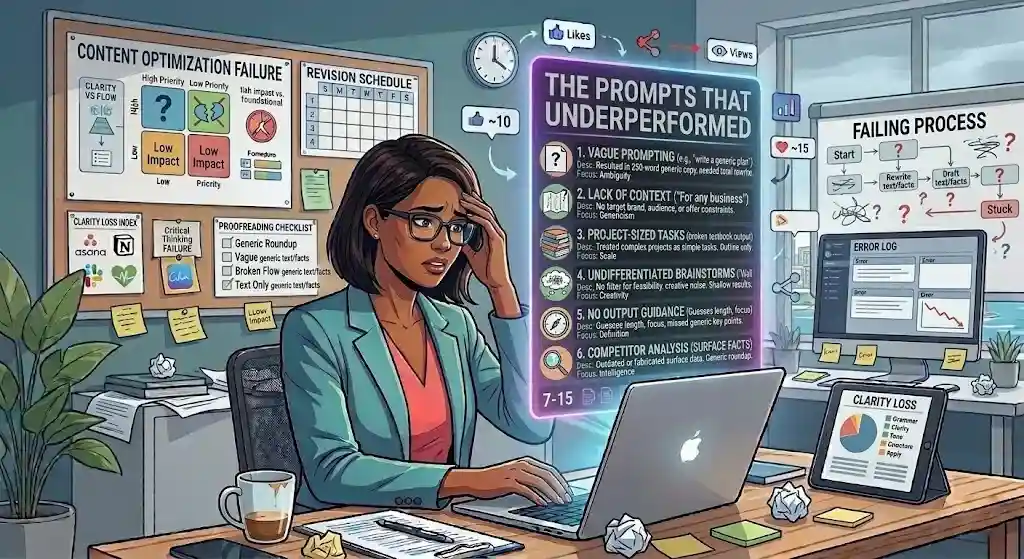
Weak results often follow a recognizable pattern. The request is broad, the evidence is absent, and the success condition is left for the model to guess.
1. “Give me a complete business plan.”
A business plan contains several different decisions. Without market, customer, operating, and financial inputs, the request invites a generic template.
Better approach: Divide the work into market analysis, offer design, operating plan, and financial assumptions. Give each task its own evidence and review standard.
2. “Be creative and brainstorm ideas.”
Creativity is not a selection rule. The answer has no way to distinguish an interesting idea from one that fits the budget, channel, audience, or deadline.
Better approach: State the audience, available channels, budget, timing, exclusions, and criteria for choosing an idea.
3. “Write a viral social media post.”
Virality is an outcome rather than an input. Asking for it tends to reward exaggerated hooks, empty urgency, and interchangeable calls to action.
Better approach: Define the platform, reader, topic, evidence, message, voice, and intended response.
4. “Summarize this document.”
A summary needs a reader, purpose, length, and priority. Without them, the model must guess what to keep.
Better approach: Specify who will read it, the decision it supports, the required length, and the facts or risks that cannot be omitted.
5. “Generate SEO content for my website.”
“SEO content” does not define a useful page. It can invite repetition, filler, and awkward keyword use that does not answer the reader’s question.
Better approach: Write for the reader’s task first, then add search intent, a natural keyword target, evidence needs, internal links, and editorial constraints. Google recommends people-first content in its helpful content guidelines.
6. “Analyze my competitors.”
Competitor analysis becomes shallow when the companies, comparison dimensions, research date, and evidence are missing. Current pricing and features also require current sources.
Better approach: Name the competitors, provide source material, define the decision, and request a fact-versus-inference label for every point.
The Common Pattern
Vague task, broad scope, missing context, and undefined output shape lead to generic answers. Repair the missing field before changing the whole request.
How to Fix a Prompt That Gives a Bad Answer
Do not rewrite the entire prompt first. Add the one missing field that explains the failure, then run it again.
| Symptom | Missing field | Repair line to paste | Why it works |
|---|---|---|---|
| Generic and interchangeable | Audience and context | “Use this audience and situation: [paste]. Make every recommendation specific to them.” | It gives the answer a defined reader and setting. |
| Confidently wrong | Evidence and uncertainty | “Use only these sources: [paste]. Label unsupported points as unknown and cite the source for each factual claim.” | It limits unsupported completion and exposes gaps. |
| Far too long | Length and priority | “Keep the answer under [length]. Preserve only the decision, evidence, risks, and next step.” | It defines what survives the cut. |
| Far too short | Depth and coverage | “Expand the answer to cover [topics]. Include reasoning, one example, limitations, and next steps.” | It names the missing depth without reopening the whole task. |
| Wrong output shape | Format | “Return the answer as [table, checklist, email, or outline] with these fields: [list].” | It replaces an inferred structure with an explicit one. |
| Drifted from my facts | Source boundary | “Treat my facts below as the source of truth. Do not add names, figures, events, or claims that are not present.” | It draws a boundary around supplied information. |
| Asked me endless questions | Question limit | “Ask at most [number] questions, and only when an answer would materially change the result. Then proceed with labeled assumptions.” | It limits clarification while preserving important unknowns. |
If two focused repairs fail, the task is unclear, not the wording. Define the decision, evidence, and acceptance test before trying again.
How to Customize Any Prompt for Better Results
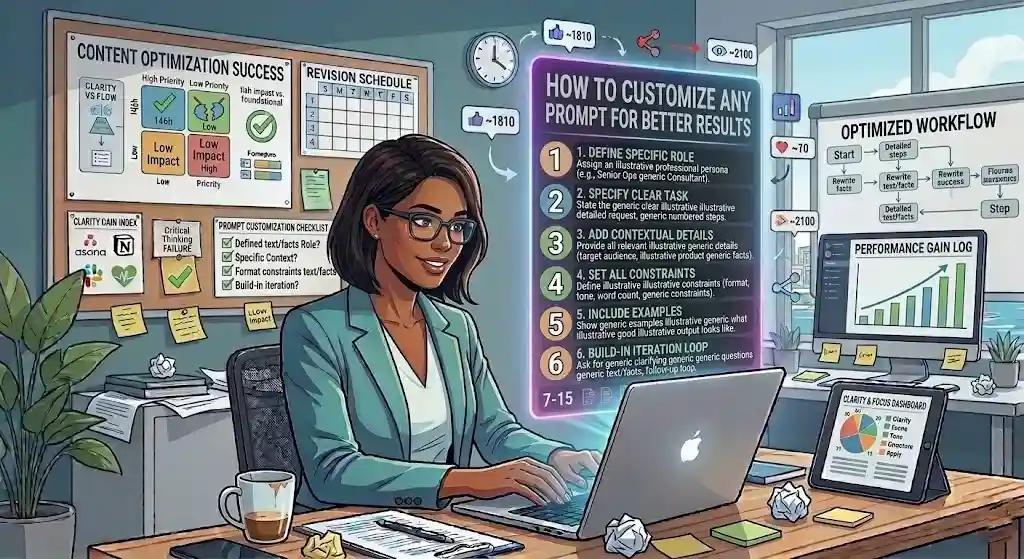
The templates are starting points. Replace placeholders and add the fields that change the answer.
| Question | Why it affects the result |
|---|---|
| Who is the audience? | A chief executive, new hire, and customer need different language and depth. |
| What is the specific goal? | “Improve this” is vague. “Cut it to 200 words” defines success. |
| What tone is appropriate? | Professional, casual, or empathetic language changes phrasing and emphasis. |
| What constraints apply? | Length, format, policy, tools, and exclusions reduce guesswork. |
| Do I have an example? | A relevant example can show structure and voice faster than abstract adjectives. |
| What output format is needed? | A table, checklist, email, or brief supports a different use. |
| How will it be verified? | A review plan makes factual and decision risk visible. |
Customization in Action
A generic request says, “Create an SOP for onboarding.” A customized version states the company type, role, tools, first-week goals, 30-60-90 day structure, owners, and checklist format.
The added context does not make the model smarter. It gives the response a narrower target and makes missing information easier to spot.
When to Iterate
Complex work often needs a short sequence rather than one oversized request.
- Request a first draft with a defined output.
- Correct missing or unsupported facts.
- Add one constraint that changes the result.
- Request alternatives only for the part still undecided.
- Ask for a self-check against your acceptance criteria.
This pattern works well for content briefs, sales messaging, and other drafts that need review. For tool context, see the best AI chatbots comparison and best AI tools for content creation.
When to Reuse Context Instead of Rewriting It
Keep details that change one assignment in the current prompt. Examples include the deliverable, audience, deadline, source material, and required format.
Put stable response preferences in custom instructions. Tone, preferred units, standing accessibility needs, and a recurring explanation style belong there when they should apply across chats.
Use a project for recurring work that relies on the same files, chats, and working instructions. A project can keep reference material and task-specific context together for an ongoing body of work.
Project instructions apply only inside that project and override global custom instructions. Keep the project rule narrower than your account-wide preferences so its purpose remains easy to audit.
Sources checked August 15, 2026: ChatGPT Custom Instructions and Projects in ChatGPT.
Privacy and Accuracy Guidance
In ChatGPT Data Controls, turning off Improve the model for everyone stops new conversations from being used to improve models. Signed-in conversations still appear in history unless they are temporary chats.
Temporary chats do not appear in history, do not create memories, and are not used to improve models. OpenAI may keep a copy for up to 30 days for safety, and enabled custom instructions still apply.
A temporary chat does not create a private boundary around third-party actions. If a GPT sends data through an action, the recipient’s privacy policy applies, and that recipient may retain or use the data outside ChatGPT.
Before pasting business information, remove customer personal data, credentials, confidential financials, private HR records, health information, proprietary code, and trade secrets unless the approved environment and policy permit them.
When an answer depends on current information, tell the model to search and cite. Open every citation yourself, confirm that it supports the statement, and check the date and original source.
ChatGPT plan limits vary by plan and can change. Check the limits shown in your own account instead of relying on a fixed number.
Review Risk by Category
| Category | Review risk | What a human must confirm |
|---|---|---|
| Business Operations | Medium | Workflow, policy, owner, deadline, and customer impact |
| Marketing and Content | Medium | Claims, sources, brand voice, permissions, and publication rules |
| Sales and Research | Medium | Customer evidence, competitor facts, market data, and outreach rules |
| Productivity | Medium | Priorities, capacity, deadlines, and commitments |
| Life Admin | Medium | Personal facts, local information, safety, and professional advice needs |
| Learning | Medium | Accuracy, sources, level, and missing qualifications |
| Editing | Medium | Meaning, voice, facts, and permissions |
| Business Strategy | High | Evidence, assumptions, economics, risks, and decision authority |
| Career and Job Search | Medium | Skills, metrics, titles, experience, employer facts, and offer terms |
| Coding and Data | High | Correctness, security, privacy, data quality, calculations, and production impact |
| Creative tasks | Low | Brief, originality, permissions, and audience fit |
Sources checked August 15, 2026: Data Controls FAQ, Temporary Chat FAQ, and What is ChatGPT FAQ.
Best Prompts by Use Case
For work operations, start with the SOP Generator, Meeting Summary, and Task Triage Matrix. They turn recurring work into a process, record, or priority decision.
For business strategy, use the Strategy Memo, Assumption Register, and Executive Decision Brief. Each keeps evidence and decision triggers visible.
For marketing and content, use the Blog Post Brief, Social Media Repurposing Engine, and Email Campaign Sequence. Add current research and brand examples before drafting.
For sales, use the Buyer Persona Builder, Objection Handling Matrix, and Customer Interview Questions. Treat generated personas and objections as hypotheses until customers confirm them.
For productivity, begin with the Weekly Planning Reset, Decision Simplifier, and Overwhelm Reducer. Add actual capacity and deadlines.
For career work, use Resume Tailoring, STAR Story Builder, and Mock Interview. Every claim must remain grounded in the candidate’s real experience.
For coding and data, use Bug Triage, SQL Query, and CSV to Insight. Run tests, validate calculations, and protect sensitive information.
For photo editing, see the dedicated ChatGPT prompts for photo editing guide. Its examples cover image-specific tasks that do not fit a text-only prompt list. For a styled photo rather than a corrected one, the 80s photo prompt library covers that request end to end.
ChatGPT Prompts FAQ
What are ChatGPT prompts?
Prompts are the instructions and context supplied to ChatGPT. They may include text, files, images, examples, constraints, and a requested output format.
How do I write a good ChatGPT prompt?
State the task, relevant context, constraints, and output format. Add a role or example when it changes the result, then refine one missing field at a time.
What are the best ChatGPT prompts for work?
The highest-value prompt depends on the bottleneck. Meeting summaries, task triage, SOPs, decision briefs, email drafts, and data checks cover common professional needs.
Can I reuse the same prompt?
Yes. Save stable templates, replace task-specific facts, and re-check the output after a major model update or workflow change.
How do I get more accurate answers from ChatGPT?
Provide source material, define what the sources do not establish, request citations for current information, and verify those citations. Ask the model to label assumptions and uncertainty.
Are ChatGPT prompts safe for business use?
The prompt structure is not the main privacy risk. The sensitive information entered, enabled data settings, connected actions, workspace policy, and recipient systems determine the exposure.
What should I avoid putting into ChatGPT?
Avoid credentials, customer personal data, confidential financials, private HR records, protected health information, trade secrets, and proprietary code unless an approved policy and environment permit them.
What is the difference between a generic prompt and a strong prompt?
A generic prompt leaves the audience, goal, evidence, and output undefined. A strong prompt supplies the fields that materially change the response and states how the result will be reviewed.
Can ChatGPT write prompts for me?
Yes. State your goal and ask for a reusable prompt with task, context, constraints, format, evidence requirements, and follow-up rules.
How do I customize prompts for my industry?
Add the business type, audience, tools, terminology, regulations, and examples of acceptable output. See the ChatGPT prompts for real estate agents guide for an industry-specific example.
Visual workflows need different instructions. The ChatGPT prompts for photo editing guide and Nano Banana Pro prompt frameworks cover image-focused work.
Are prompts for ChatGPT different from Claude or Gemini?
Keep the core fields when moving a prompt between tools, then review the result before relying on it. See Claude and Gemini for product-specific context.
See the ChatGPT review and Gemini review for product context.
How do I make ChatGPT sound more human?
Name the audience and tone, provide a short sample of your own writing, identify phrases to avoid, and edit the draft in your voice. Do not ask the model to imitate a living writer.
Can ChatGPT search for current information?
ChatGPT can search the web and cite sources in supported experiences. Ask it to search when freshness changes the answer, then verify each citation and date yourself.
Does ChatGPT have a fixed message or plan limit?
No single numeric limit applies across all plans and models. Limits vary by plan and can change, so check the information displayed in your own account.
Sources checked August 15, 2026: OpenAI prompt engineering best practices and What is ChatGPT FAQ.
Conclusion
The useful unit across this 200-prompt library is not a clever phrase. It is a defined task with context, constraints, evidence, and an output that a person knows how to review.
Start with the category closest to your current bottleneck. Replace the placeholders, run the prompt, repair one missing field, and verify the facts before using the result.
For current prompting guidance, consult OpenAI’s official prompting guide. For search and AI-assisted publishing, review Google Search Central’s guidance on AI features.