
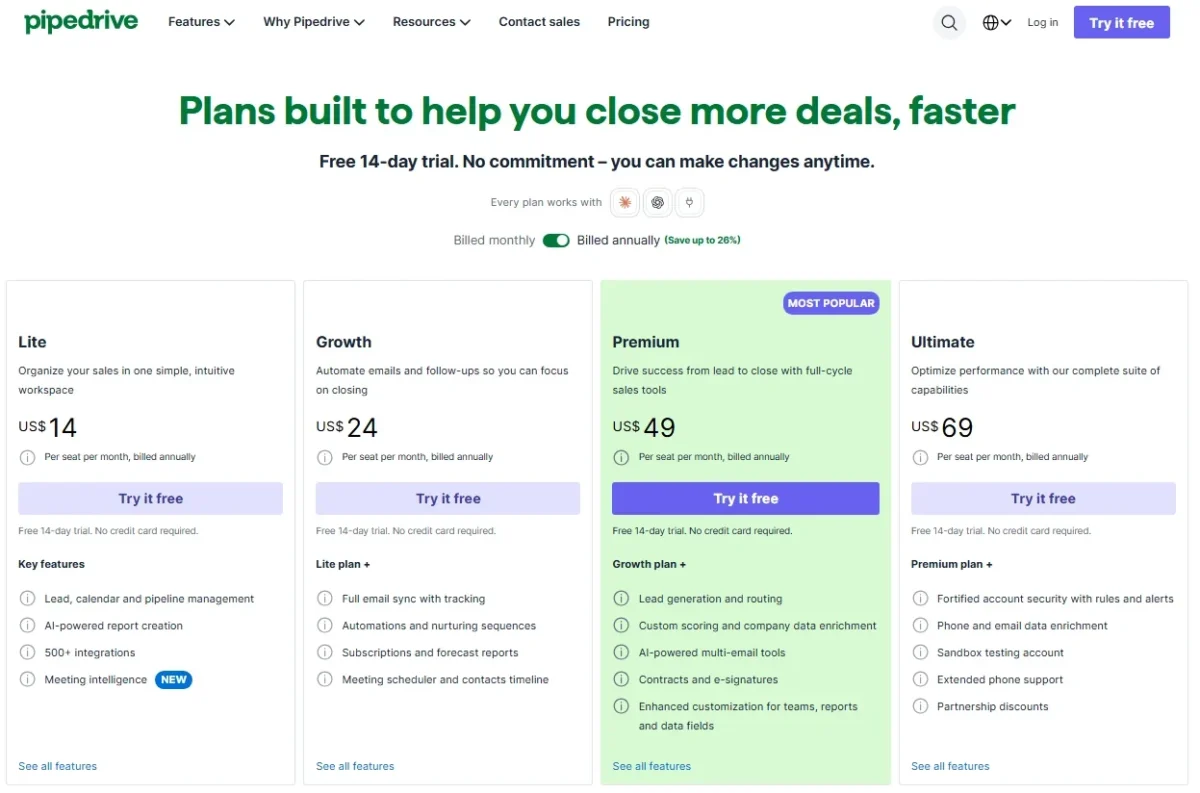
Pipedrive is the better fit for a pipeline-led sales team that pays per rep and wants email sequences: Growth costs $24 per seat per month, billed annually.
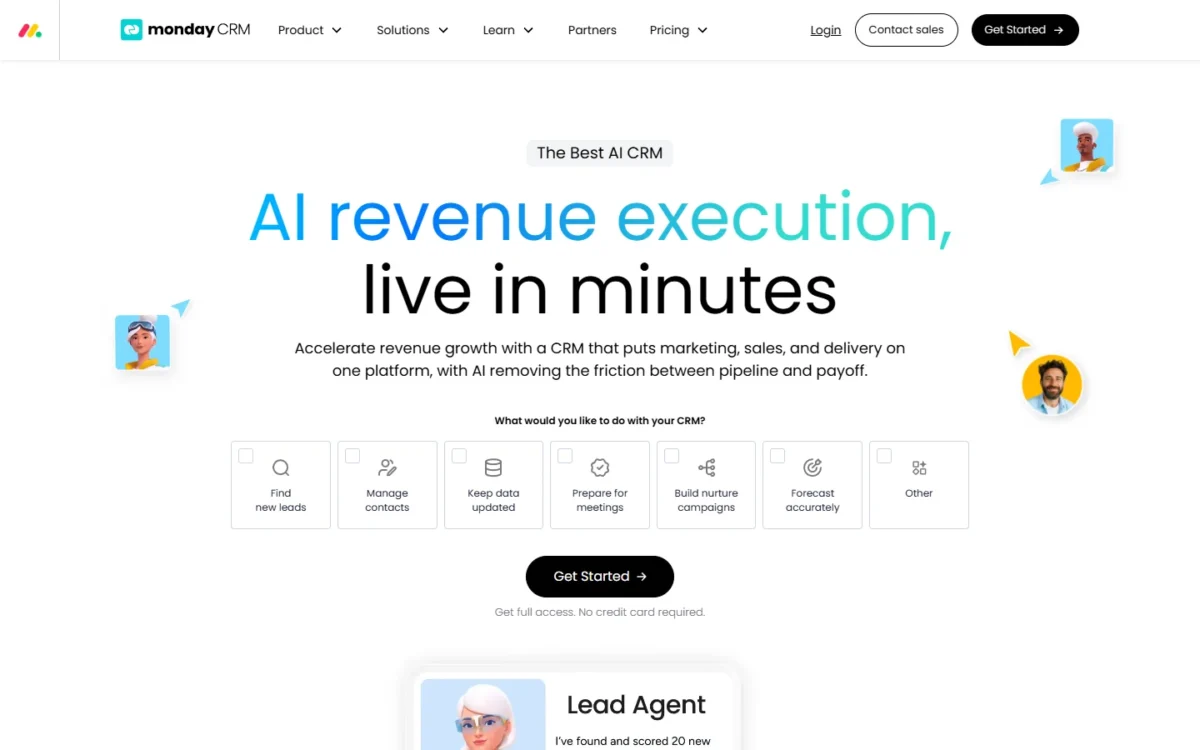
monday CRM fits a team that wants AI calling and lead-sourcing agents and boards shaped to its process. It starts at $12 per seat per month billed yearly, sold in seat bundles from 3 users.
That bundle rule settles most monday vs Pipedrive budgets for small teams. Six reps at the email-sequence tier pay $24 x 6 x 12 = $1,728 a year on Pipedrive Growth. monday sells no 6-seat plan, so the same team buys a 10-seat Pro bundle: $28 x 10 x 12 = $3,360 a year.
Quick verdict
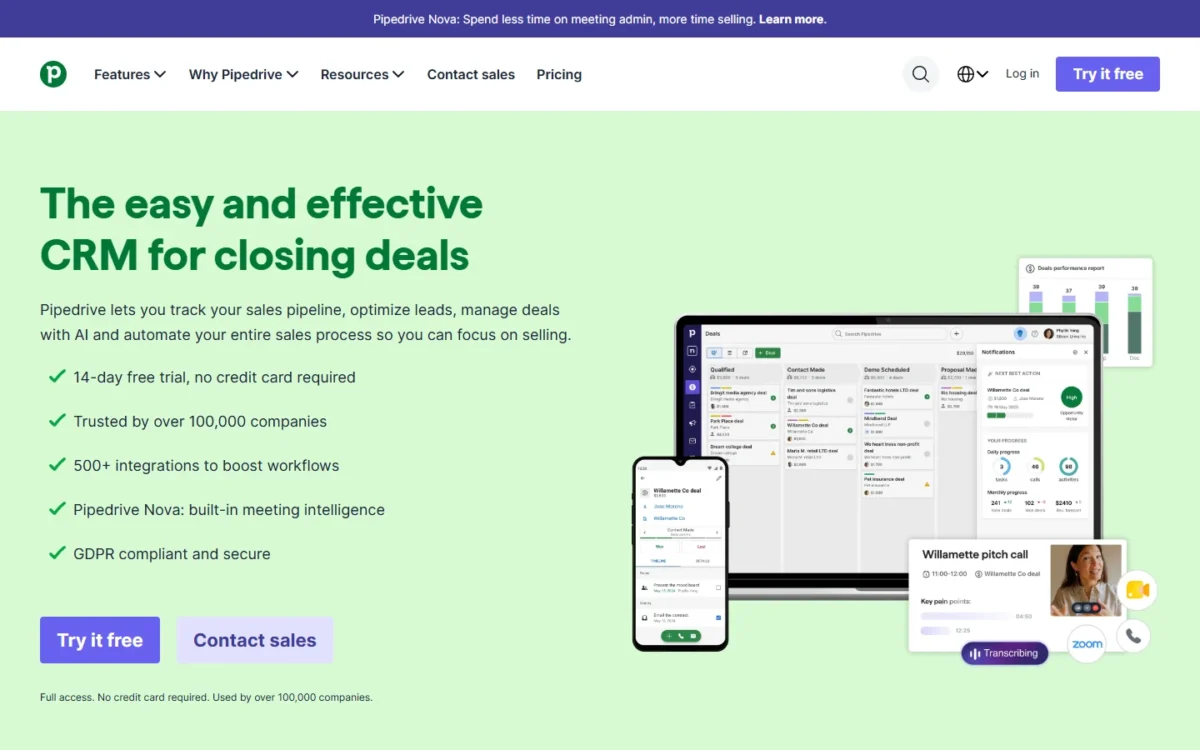
Pipedrive Growth is my pick for a sales team that lives in its deal pipeline: automations, email sequences, email sync and the forecast view all start there, and SSO and the mobile apps come with every plan.
monday CRM fits a team that wants AI agents, listed from Standard at $17 per seat per month billed yearly, and published plan limits. Step up to Pro when the team also needs email sequences, 75 columns per board or 15 workspaces.
Either way, monday’s pricing works per group of seats and not per seat: “Our pricing plans start at a minimum of 3 seats, and then ascend in multiples of 5.” A 6-rep team therefore buys the 10-seat plan.
The trade-off: Pipedrive puts web forms and the LeadBooster chatbot on Premium ($49 per seat per month, billed annually) or in the LeadBooster add-on, and automatic lead assignment on Premium and above.
Choose monday CRM if
- You want the outreach caller and lead sourcer agents, listed from Standard, and your team is 3 reps or a multiple of 5, the sizes monday’s seat buckets come in, so you pay for no unused seat
- Automations matter more than sequences: Standard runs 250 custom automations a month at $17 per seat, billed yearly
Choose Pipedrive if
- Your headcount falls between monday’s bundle sizes, because Pipedrive bills per seat
- You want email sequences at $24 per seat per month, billed annually, on Growth
- You need SSO and the mobile apps on the entry plan
In This Article (12 sections)
monday CRM vs Pipedrive at a Glance
Both are sales CRMs with a 14-day trial and no free plan; the split is per-seat billing with sequences on the second tier (Pipedrive) against seat bundles with AI agents from the second tier (monday CRM).
Plan names changed recently on both sides. Pipedrive’s plan-features article, last updated September 3, 2026, lists Lite, Growth, Premium and Ultimate as new plans and Essential through Enterprise as old ones. monday calls Ultimate “a new name for our Enterprise tier”.
| Attribute | monday CRM | Pipedrive |
|---|---|---|
| Best for | Teams that want AI agents and custom boards, at a bundle size | Pipeline-led teams that pay per rep |
| Entry plan | Basic: $12 per seat per month, billed yearly | Lite: $14 per seat per month, billed annually |
| First plan with email sequences | Pro: $28 per seat per month, billed yearly | Growth: $24 per seat per month, billed annually |
| Billing unit | Seat bundles: 3, 5, 10, 15, 20, 25, 30, 40, 50, 100, 200+ | Per seat |
| Free plan or trial | 14-day trial; no free CRM plan listed | 14-day trial, no credit card; no free version |
| AI included | Agents and AI meeting notetaker from Standard; “AI Usage” on Basic | Nova meeting intelligence on all plans |
| Main limitation | Basic caps 1,000 active contacts and deals; bundles round up | Lead capture needs Premium or an add-on; record caps not listed |
Sources: monday CRM pricing, Pipedrive pricing, Pipedrive plan features, checked October 2026.
The table shows where the products part ways, but not which gap matters for a given team. That depends on four differences.
Key Differences Between monday CRM and Pipedrive
Four differences change the choice: how seats are sold, where email sequences start, what “AI” means on each product, and how far each reaches beyond the deal pipeline.
- Billing unit: monday CRM sells bundles of 3, 5, 10, 15 or more seats; Pipedrive bills each seat
- Email sequences: monday CRM Pro against Pipedrive Growth, $28 against $24 per seat per month on annual billing
- AI: monday CRM lists agents from Standard; Pipedrive includes Nova meeting intelligence on every plan
- Beyond the pipeline: monday CRM meters workspaces, dashboards and board columns by plan; Pipedrive adds projects, documents and lead capture on Premium or as add-ons
Seats. monday calls its model “bucket pricing”: a team of 4 chooses the 5-seat option and a team of 6 selects the 10-seat plan. A 6-rep team on monday Pro therefore pays for four unused seats, $28 x 4 x 12 = $1,344 a year, where Pipedrive bills six.
If monday CRM is your front-runner, my monday.com review weighs the rest of the product.
Sequences. Pipedrive puts them one tier lower, next to email sync and open and click tracking on Growth. monday lists “Set email sequences” and “Send mass emails” on Pro, a tier above its first automations.
AI. monday lists an outreach caller agent, a lead sourcer agent and a meeting prep agent; Pipedrive’s plan-features article lists none of the three. Pipedrive answers with Nova meeting intelligence on every plan at no extra cost.
Reach. monday CRM grows sideways: Pro allows 15 workspaces, 50 custom dashboards and 75 columns per board. Pipedrive stays a sales pipeline and sells Projects, Smart Docs and LeadBooster as add-ons below Premium. The full Pipedrive review covers how far that pipeline focus carries a growing team.
Those differences point to specific features. The next question is whether they sit on the plan a team would actually buy.
monday CRM vs Pipedrive: Features Compared
Most of Pipedrive’s selling features sit on every plan or start at Growth, while monday CRM spreads numeric limits (records, columns, automations, dashboards) across all four tiers.
| Feature | monday CRM | Pipedrive |
|---|---|---|
| Contacts and deals | Limited: 1,000 on Basic, 10,000 on Standard, 100,000 on Pro | Not listed on the plan-features page |
| Automations | Standard: 250 custom automations a month; Pro: 25K | Growth and higher |
| Email sequences | Pro | Growth |
| Mobile apps | Listed on the Standard card | All plans |
| AI | Agents and AI meeting notetaker from Standard | Nova on all plans; AI email writing from Premium |
| Web forms and the LeadBooster chatbot | Not listed on the pricing page | Premium (LeadBooster); Add-on on Lite and Growth |
| Lead assignment | Not listed on the pricing page | Premium (automatic assignment) |
| Forecasting | Not listed on the pricing page | Growth (forecast view) |
| Dashboards | 1, 5, 50 or unlimited by plan | One on all plans; multiple from Premium |
| Quotes and documents | 20, 50, 250 or unlimited quotes and invoices a month | Premium (Smart Docs); Add-on below |
| SSO | Not listed on the pricing page | All plans |
| API | Ultimate: 25,000 calls a day; lower plans Not listed | All plans, with webhooks |
Sources: monday CRM pricing, Pipedrive plan features, checked October 2026.
Pipeline, contacts and board limits
monday Basic stops at 1,000 active contacts and deals and 5 columns per board; Standard raises that to 10,000 and 15, Pro to 100,000 and 75, and Ultimate lists both as unlimited. Pipedrive’s plan-features article lists customizable pipelines, deal card customization and custom fields on every plan, and names no record cap for the new plans.
Spread across 10 reps, Basic’s ceiling is 100 records per rep. A team that logs every lead and every deal should price monday from Standard, not Basic. Pipedrive says its new tiers changed “limits” without listing them, so ask for Growth’s caps in writing before an annual payment.
Verdict: Customization
monday CRM fits a team that wants boards, columns and dashboards shaped to its own process, from Standard upward. Pipedrive fits a team that wants a fixed deal pipeline with custom fields on every plan and no published column cap. Caveat: Pipedrive’s record caps are not published.
Automation and email sequences
monday automates from Standard ($17 per seat per month billed yearly, 250 custom automations a month), but sequences and mass email wait for Pro ($28, 25K custom automations a month). Pipedrive puts automations, delay and if/else steps, sequences, group emailing and email sync together on Growth ($24 per seat per month, billed annually).
The split creates two different bargains. A 10-rep team that only automates status changes and reminders pays $17 x 10 x 12 = $2,040 a year on monday Standard, against $24 x 10 x 12 = $2,880 on Pipedrive Growth. A team that runs multi-step follow-up email pays less per seat on Growth than on monday Pro.
Verdict: Follow-up automation
Pipedrive Growth fits sequence-led teams of any size: sequences, email tracking and automations arrive together at $24 per seat per month, billed annually. Caveat: Pipedrive does not publish Growth’s automation cap, while monday Pro states 25K custom automations a month.
AI: agents vs meeting intelligence
monday CRM lists the outreach caller agent, lead sourcer agent, meeting prep agent, a build-your-own agent and an AI meeting notetaker from Standard, and Pro adds an AI workflow builder. Every monday CRM plan includes a package of AI credits, but the pricing page does not say how many.
Pipedrive Nova covers the meeting itself: a pre-call brief, a recording and transcript, then drafted CRM updates the rep approves. AI report creation is on every Pipedrive plan, and AI email creation and summarization start on Premium.
The choice depends on use. monday’s agents aim at prospecting and outreach; Nova aims at the admin around calls. Output quality of either depends on your own calls and data, so run a week of real meetings through both 14-day trials before you commit.
Lead capture and routing
Pipedrive bundles LeadBooster (chatbot, live chat, web forms and Prospector) and automatic lead assignment into Premium, at $49 per seat per month billed annually. Below Premium, LeadBooster is a paid add-on “starting from $32.50”, and the pricing page does not state that figure’s unit or billing period.
monday CRM lists the lead sourcer agent from Standard, and its features page describes lead capture from web forms, events and imports without tying it to a plan. An inbound-heavy team should price Pipedrive at Premium, which costs $49 – $24 = $25 more per seat per month than Growth, or confirm monday’s form capture on the Standard trial.
Reporting and forecasting
Pipedrive gives every plan Insights reports and one Insights dashboard, adds the forecast view on Growth, and adds multiple dashboards, custom field reports and team goals on Premium. monday CRM meters custom dashboards (1 on Basic, 5 on Standard, 50 on Pro, unlimited on Ultimate) and describes forecasting on its product pages without naming the plan that holds it.
A manager who wants a dashboard per rep on a 10-rep team needs monday Pro, since Standard stops at 5.
Features decide whether a plan works. What that working plan costs at your headcount is the next question.
monday CRM vs Pipedrive Pricing
At the email-sequence tier, monday CRM Pro costs $28 per seat per month billed yearly and Pipedrive Growth costs $24 per seat per month billed annually, both in US dollars. monday’s seat bundles then decide how many seats you actually pay for.
| Job the plan does | monday CRM plan | monday yearly / monthly | Pipedrive plan | Pipedrive annual / monthly |
|---|---|---|---|---|
| Entry, no automations | Basic | $12 / $18 | Lite | $14 / $19 |
| First plan with automations | Standard | $17 / $25 | Growth | $24 / $34 |
| First plan with email sequences | Pro | $28 / $41 | Growth | $24 / $34 |
| Lead capture built in | Not listed on the pricing page | Not listed | Premium | $49 / $64 |
| Top tier | Ultimate | Contact sales | Ultimate | $69 / $89 |
Sources: monday CRM pricing (yearly and monthly views at 3, 5 and 10 seats), Pipedrive pricing (billed annually and billed monthly views), checked October 2026.
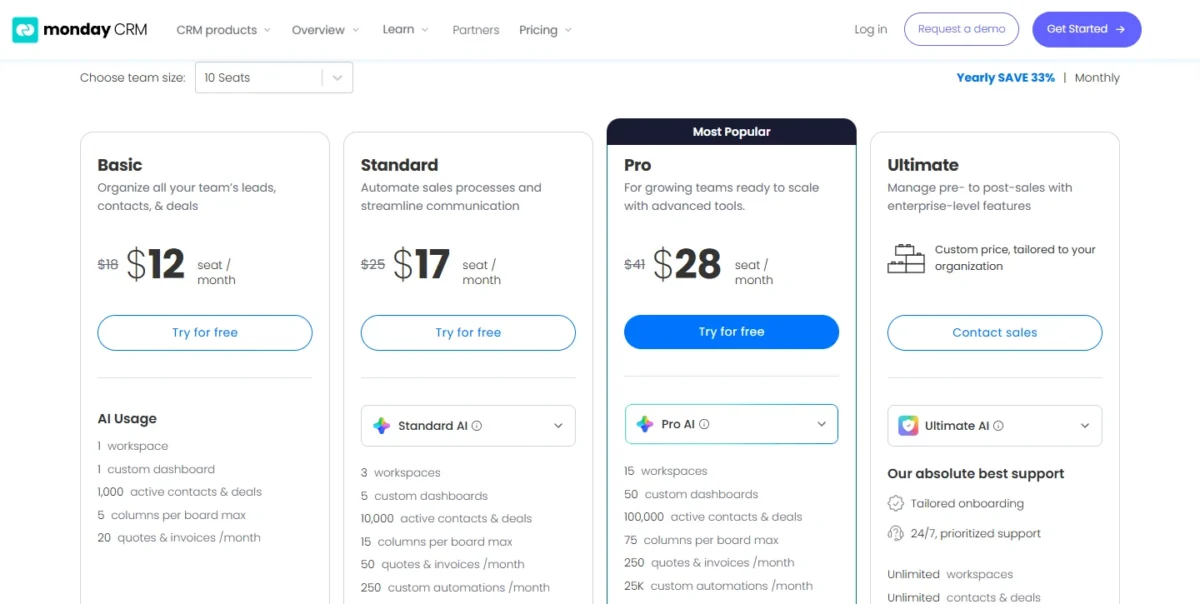
The billing rules differ as much as the prices:
- monday CRM: the per-seat price was the same at 3, 5 and 10 seats. A yearly plan is paid in one upfront installment, prices exclude tax and depend on the billing country, and a yearly purchase can be refunded pro rata within 30 days. More than 40 users means a sales quote.
- Pipedrive: each seat is billed on its own. Annual billing is one payment a year ($288 per seat on Growth), monthly billing charges the same day each month, and prices are VAT exclusive.
Paying monthly costs more on both. monday Pro billed monthly is $41 against $28, a $13 gap per seat per month; Pipedrive Growth is $34 against $24, a $10 gap. Every monday plan is broken down in my monday CRM pricing breakdown.
Pipedrive’s add-ons change the bill below Premium: LeadBooster from $32.50, Projects from $16, Campaigns from $13.33, Web Visitors from $41 and Smart Docs from $32.50, each without a stated unit. Before adding one, compare its cost with the step up to Premium in my breakdown of Pipedrive’s plans and add-ons.
What seat bundles do to the bill
The same team pays very different amounts depending on how its headcount meets monday’s bundle list.
| Team and tier | monday CRM | Pipedrive |
|---|---|---|
| 3 reps, sequence tier, annual | Pro: $28 x 3 x 12 = $1,008 | Growth: $24 x 3 x 12 = $864 |
| 5 reps, sequence tier, annual | Pro: $28 x 5 x 12 = $1,680 | Growth: $24 x 5 x 12 = $1,440 |
| 6 reps, sequence tier, annual | Pro, 10-seat bundle: $28 x 10 x 12 = $3,360 | Growth: $24 x 6 x 12 = $1,728 |
| 10 reps, sequence tier, annual | Pro: $28 x 10 x 12 = $3,360 | Growth: $24 x 10 x 12 = $2,880 |
| 10 reps, sequence tier, monthly | Pro: $41 x 10 x 12 = $4,920 | Growth: $34 x 10 x 12 = $4,080 |
| 10 reps, entry tier, annual | Basic: $12 x 10 x 12 = $1,440 | Lite: $14 x 10 x 12 = $1,680 |
| 10 reps, lead capture, annual | Not listed on the pricing page | Premium: $49 x 10 x 12 = $5,880 |
Sources: monday CRM pricing, monday plans and pricing help article, Pipedrive pricing, checked October 2026.
Assumptions: list prices in US dollars, annual billing unless the row says monthly, the 6-rep monday team selects the 10-seat plan as monday’s help article says, tax, add-ons and onboarding excluded.
At a bundle size, the sequence tier favors Pipedrive by $28 – $24 = $4 per seat per month. Between bundles, monday’s rounding makes the 6-rep bill almost twice Pipedrive’s.
In the comparable-plans table, monday’s yearly price is lower in two rows.
In the “Entry, no automations” row, Basic is $12 billed yearly and Lite is $14 billed annually. Basic undercuts Lite by $14 – $12 = $2 per seat per month, though Basic runs no automations and caps records at 1,000.
In the “First plan with automations” row, Standard is $17 billed yearly and Growth is $24 billed annually. Standard undercuts Growth by $24 – $17 = $7 per seat per month, though Standard lists no email sequences.
What forces an upgrade
On monday CRM, records and columns force the first upgrade; on Pipedrive, email and automation do. The triggers by plan:
- monday Basic to Standard: more than 1,000 active contacts and deals, more than 5 columns per board, any automation, or the iOS and Android apps, which the plan card lists from Standard.
- monday Standard to Pro: email sequences or mass email, more than 10,000 records, or more than 5 custom dashboards.
- monday Pro to Ultimate: HIPAA compliance, advanced permissions or advanced log rules.
- Pipedrive Lite to Growth: email sync and tracking, automations, sequences or the forecast view.
- Pipedrive Growth to Premium: LeadBooster, Projects, Smart Docs, automatic assignment, AI email writing, custom permission sets or phone support; below Premium, the first three are add-ons.
- Pipedrive Premium to Ultimate: security rules and alerts, a sandbox account, contact data enrichment or extended phone hours.
Once the cost is clear, the next question is whether each product passes your admin’s checks.
Integrations, Security and Admin Controls
Both connect to hundreds of apps: monday.com’s integrations directory lists 850+ integrations and apps, and Pipedrive’s Marketplace lists 500+. The bigger difference is where admin controls sit: Pipedrive gives SSO, two-factor authentication and API access on every plan, while monday CRM keeps advanced permissions, HIPAA compliance and its 25,000 API calls a day for Ultimate.
monday names Outlook, Gmail, Slack, Zoom, QuickBooks, Google Workspace and Docusign among its CRM integrations. Pipedrive names Google, QuickBooks, Asana, Slack, Zoom, Zapier and Lemlist. If marketing email should sit in the same tool as the pipeline, my HubSpot vs monday CRM comparison covers a suite that does both.
On security, Pipedrive lists the security dashboard, device history and audit log on every plan, custom visibility groups and permission sets on Premium, and security alerts and rules on Ultimate; it describes itself as GDPR compliant. monday cites ISO/IEC 27001 and ISO/IEC 27018 and annual security audits, and its pricing page does not list SSO for any plan.
Support follows the plans too. Pipedrive offers chatbot support on every plan, live chat from Growth, phone support from Premium and extended phone hours (Monday to Friday, 7:00 am to 11:00 pm CET/CEST) on Ultimate. monday’s help center says its team is available 24/7, and Ultimate adds tailored onboarding and prioritized 24/7 support.
Verdict: Admin and security
Pipedrive fits a small team that needs SSO and 2FA without paying for a top tier. monday CRM Ultimate fits a buyer that needs HIPAA compliance, which Pipedrive’s plan-features page does not list. Caveat: both are the vendors’ own statements.
Controls aside, how much setup does each ask before reps sell in it?
Setup Effort and Onboarding
Pipedrive takes spreadsheet imports of up to 200,000 rows and lists the mobile apps on every plan; monday CRM’s import takes files under 8,000 rows and 50 columns, and its pricing page lists the apps on the Standard card. In exchange, monday lets the team shape boards, columns and dashboards to its own process.
What each import wizard asks:
- Pipedrive: XLS, XLSX or CSV, one tab per import, under 50 MB, imported by a user with the right global permission; a wizard maps columns to fields and flags missing mandatory fields.
- monday CRM: one file at a time per board, 10 MB or less; you map each file column to a board column and choose whether duplicates are added, skipped or updated.
Help with setup costs differently. Pipedrive says implementation is free on a plan over $400 a year; one Growth seat billed annually is $288, so a solo rep falls under that line. monday lists white-glove migration on Ultimate and points other plans to paid partners.
Day-to-day feel is the one thing documents cannot settle, so load your own pipeline into both 14-day trials.
monday CRM vs Pipedrive: Pros and Cons
Each product’s strengths come with a condition, and each weakness hurts a specific team.
monday CRM
Pros
- Outreach caller, lead sourcer and meeting prep agents from Standard
- 250 custom automations a month on Standard at $17 per seat, billed yearly
- Published record, column and dashboard limits for each plan, so the upgrade point is known in advance
- HIPAA compliance and advanced permissions on Ultimate
Cons
- Seat bundles from 3 users: a 6-rep team pays for 10 seats
- Basic caps 1,000 active contacts and deals and 5 columns per board
- Email sequences and mass email wait for Pro at $28 per seat
- Ultimate has no published price
Pipedrive
Pros
- Per-seat billing, so any headcount pays only for its seats
- Sequences, automations and email tracking on Growth at $24 per seat, billed annually
- Nova briefs reps, transcribes calls and drafts CRM updates even on Lite
- SSO, 2FA, API access and mobile apps on every plan
Cons
- No free version, only a 14-day trial
- LeadBooster, Projects and Smart Docs are add-ons below Premium
- Record and automation caps of the new plans are not published
- Monthly billing on Growth costs $34 – $24 = $10 more per seat per month than annual billing
A team that rules Pipedrive out over its lack of a free version can see how a rival with another pricing model compares in Pipedrive vs Freshsales.
Which Is Better for Your Needs?
Your priority decides the pick; the matrix below gives the better fit per priority, the reason, and what you give up.
| Your priority | Better fit | Reason | Trade-off |
|---|---|---|---|
| A headcount between bundle sizes | Pipedrive | Billed per seat; monday sells 3, 5, 10, 15 and up | No AI calling or lead-sourcing agents listed |
| Email sequences on a budget | Pipedrive | Sequences on Growth at $24 per seat | Growth’s caps are not published |
| AI calling and lead sourcing | monday CRM | Agents listed from Standard | Sequences need Pro |
| Custom boards and several workspaces | monday CRM | 15 workspaces and 75 columns on Pro | Basic stops at 5 columns |
| SSO on the entry plan | Pipedrive | SSO and 2FA on all plans | Permission sets need Premium |
| HIPAA compliance | monday CRM | Listed on Ultimate | Ultimate is priced by quote |
| Inbound chat and web forms | Pipedrive | LeadBooster included on Premium | $49 per seat, billed annually |
| Exactly 10 reps, lowest entry seat | monday CRM | Basic at $12 per seat | 1,000 records, no automations |
Sources: monday CRM pricing, Pipedrive pricing, Pipedrive plan features, checked October 2026.
So which is better for you, monday or Pipedrive? A 10-rep team that needs automations without email sequences should take monday Standard; once it needs sequences, Pipedrive Growth costs less.
monday Basic suits only a team that needs no automation and stays under 1,000 records. A 6-rep team should start on Pipedrive unless monday’s agents are the reason to buy.
If monday is still your front-runner at this point, monday vs Freshsales shows how it stands against another sales CRM.
If HubSpot is also on your shortlist, see how Pipedrive compares with HubSpot.
A choice made today can be reversed, so the next question is what a switch involves.
Switching Between monday CRM and Pipedrive
Both directions run through spreadsheets, and the file limits differ by a factor of 25: monday CRM imports files of fewer than 8,000 rows and 50 columns, while Pipedrive takes up to 200,000 rows in one file under 50 MB. Spreadsheets carry records; automations, sequences and dashboards are rebuilt by hand on either side.
From Pipedrive to monday CRM
- A global admin exports each item type from Tools and apps > Export data as Excel or CSV. Activities, notes and files linked to deals export separately, and generated exports stay available for 28 days.
- Trim each file below 50 columns and split it below 8,000 rows; divide your export’s row count by 8,000 and round up to know how many files you need.
- Import one file at a time per board, at most 100 files per account per hour, and set duplicates to Skip or Update on the email or phone column.
- Rebuild sequences on Pro and automations on Standard or Pro, then recreate dashboards within the plan’s limit.
From monday CRM to Pipedrive
- Export each board from its menu with Export board to Excel; a board exports up to 100,000 items at a time, and only table views export.
- Map companies to organizations and give every deal a linked person or organization, or Pipedrive skips the row.
- Import up to 200,000 rows per file, check the skip file for rejected rows, and revert within 48 hours if the mapping went wrong.
- Rebuild boards as pipelines and stages, and recreate automations and sequences on Growth or higher.
monday’s export article notes that admins of an Enterprise plan, the tier monday CRM now calls Ultimate, can stop non-admins from exporting boards to Excel, so confirm export rights before you plan the move. Run both trials in parallel during the switch: each lasts 14 days.
Someone who is moving away from Pipedrive may want a second opinion from Pipedrive vs Nutshell.
How I Compared monday CRM and Pipedrive
I compared monday CRM and Pipedrive from their US pricing pages, plan-feature documentation and help-center import and export guides, read in October 2026, at the plans that do the same job.
For monday CRM, I read the pricing page in its yearly and monthly views at 3, 5 and 10 seats. For Pipedrive, I read the US-dollar pricing page in its billed-annually and billed-monthly views and the plan-features article.
I matched plans by job (entry, first automation, first sequence, lead capture, top tier), then calculated yearly totals for 3, 5, 6 and 10 reps with my own math.
monday does not publish Ultimate’s price or the size of its AI credit packages, and monday CRM’s pricing page does not list SSO or forecasting on any plan. Pipedrive does not publish its new plans’ record and automation caps or the unit behind its add-on prices.
FAQ
Is monday CRM the same as monday.com Work Management?
No. monday CRM is monday.com’s sales CRM, with its own Basic, Standard, Pro and Ultimate plans and its own pricing page. monday’s AI work platform is a separate product with its own plans, including a Free plan for up to two users. This comparison covers monday CRM only.
What are the downsides of using Pipedrive?
Pipedrive has no free version, only a 14-day trial. Web forms, the LeadBooster chatbot and projects sit on Premium or cost extra as add-ons on Lite and Growth, and contracts with e-signatures sit on Premium. The new plans’ record and automation caps are not published, so a fast-growing team should ask before paying a year upfront.
Can I use monday CRM with 2 users?
Not on a 2-seat plan: monday CRM plans start from 3 users. A two-person team on Pro billed yearly pays for three seats, $28 x 3 x 12 = $1,008 a year. On Pipedrive Growth, two seats cost $24 x 2 x 12 = $576 a year, billed annually.
Final Verdict: monday CRM or Pipedrive?
Pipedrive Growth is the default for a pipeline-led sales team that wants sequences billed per rep.
monday CRM is the pick for a team that wants AI agents, which start on Standard at $17 per seat per month, billed yearly. Pro is the step up for email sequences, 75 columns per board or 15 workspaces. On either plan, monday prices seats per group, not per seat, so a team of 6 pays for the 10-seat plan.
Skip monday CRM if: your team sits between bundle sizes, or it runs on email sequences and the budget is tight.
Skip Pipedrive if: you need HIPAA compliance or AI agents that place outreach calls.
Choose monday CRM if
- AI should prospect for you: the lead sourcer agent finds and scores contacts against your ideal customer profile
- You need more than one workspace or up to 50 dashboards on Pro
- Automations without sequences are enough and your team is 3 reps or a multiple of 5: Standard runs 250 custom automations a month at $17 per seat, billed yearly, and that team fills its seat bucket
- You need HIPAA compliance, listed on Ultimate
Choose Pipedrive if
- Your headcount falls between bundle sizes, such as 6 to 9 reps
- Your process runs on email sequences, available on Growth at $24 per seat, billed annually
- You want Nova meeting intelligence without upgrading
- Your admin needs SSO and 2FA on the entry plan
- You expect to import more than 8,000 rows in one file
The main trade-offs stay the same at every size. Pipedrive’s lead capture costs Premium or an add-on, and its plan caps are unpublished; monday’s bundles round small teams up, and its sequences start a tier later. Teams that fit neither can look at other Pipedrive alternatives.
If you are still deciding, open Pipedrive vs Salesflare to compare one more pairing.
For a wider shortlist, start from my ranked list of CRM software.