

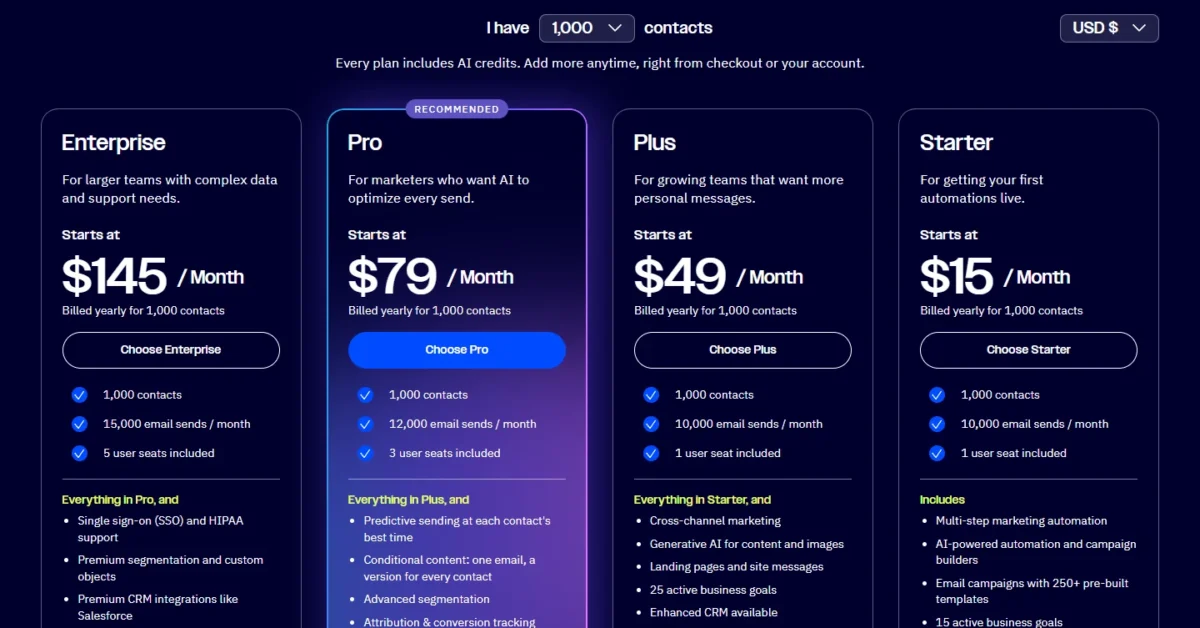
For a US small business whose main job is email marketing and automation, ActiveCampaign is the better buy in the HubSpot vs ActiveCampaign decision. Its Plus plan removes the cap on automation actions at $49 a month for 1,000 contacts, billed yearly.
HubSpot lifts its own cap on Marketing Hub Professional, at $800 a month on annual billing plus a required one-time $3,000 onboarding fee. HubSpot is the better buy when marketing and sales reps must share one CRM with deal pipelines and sequences.
Quick verdict
The deciding difference is where uncapped automation starts: ActiveCampaign Plus for one user, or HubSpot Marketing Hub Professional with its onboarding fee.
ActiveCampaign fits an email-led small business that wants branching nurture flows on a small budget. HubSpot fits a team that runs marketing and sales on one CRM.
The trade-off: ActiveCampaign’s deal pipelines need a separately sold add-on.
Choose HubSpot if
- Your reps already work deals and want marketing on the same records
- You want to start on free tools before paying anything
Choose ActiveCampaign if
- Nurture flows with more than 10 steps are the core job
- You would rather not pay an onboarding fee for uncapped automation
In This Article (11 sections)
HubSpot vs ActiveCampaign at a Glance
Both products price by contacts, but HubSpot also prices by seat and charges required onboarding on Professional and Enterprise, while ActiveCampaign states “no setup costs or hidden fees”.
| Attribute | HubSpot (Marketing Hub) | ActiveCampaign |
|---|---|---|
| Best for | Teams running marketing and sales on one CRM | Email-led small businesses that automate nurture flows |
| Entry plan | Starter: $7 per seat per month, Pay Annually, new-customer offer ($20 per seat without it) | Starter: $15 per month for 1,000 contacts, billed yearly |
| First plan without an automation action cap | Professional: $800 per month, Pay Annually, 3 Core Seats | Plus: $49 per month for 1,000 contacts, billed yearly, 1 user |
| Required onboarding | Professional $3,000; Enterprise $7,000 (one-time) | None: no setup costs stated |
| Free plan or trial | Free tools for up to 2 users and 1,000 contacts, no time limit | 14-day trial with up to 100 contacts and 100 emails |
| Main limitation | Workflows need Professional | Deal pipelines need the Enhanced CRM add-on on Plus or above |
Sources: HubSpot Marketing Hub pricing, HubSpot free tools, ActiveCampaign pricing, ActiveCampaign FAQ, checked October 2026.
Key Differences Between HubSpot and ActiveCampaign
Four differences decide the choice, and they do not all point the same way.
- Where full automation starts: ActiveCampaign Starter caps each automation at 5 actions and Plus removes the cap; HubSpot Starter allows up to 10 automated actions, and workflows start on Professional.
- CRM depth: HubSpot’s Smart CRM is the database under every HubSpot product; ActiveCampaign adds deals and pipelines only through an add-on on Plus or above.
- Cost of entry: HubSpot adds seats and a required onboarding fee on Professional and Enterprise; ActiveCampaign prices by contact band and migrates up to 10 objects free on qualifying plans.
- Free starting point: HubSpot’s free tools have no time limit for up to 2 users; ActiveCampaign lists no free plan, only a 14-day trial.
The CRM difference is HubSpot’s strongest argument, and my HubSpot CRM review covers it in depth.
The automation difference is ActiveCampaign’s, and the full ActiveCampaign review judges the platform beyond this pairing.
HubSpot vs ActiveCampaign: Features Compared
The plan that holds each feature decides most of this comparison, and the matrix shows it before the details.
| Feature | HubSpot | ActiveCampaign |
|---|---|---|
| Automation without an action cap | Professional (up to 300 workflows) | Plus and above |
| Actions on the entry plan | Limited: up to 10 automated actions on Starter | Limited: 5 actions per automation on Starter |
| Monthly email sends | 5x, 10x, 20x the marketing contact tier (Starter, Professional, Enterprise) | 10x, 10x, 12x, 15x the contact limit (Starter, Plus, Pro, Enterprise) |
| Inbox preview and testing | Not listed on the Marketing Hub pricing page | Plus and Pro: 5 per month; Enterprise: unlimited |
| Landing pages | Content Hub, free builder | Plus and above |
| Deal pipelines | Sales Hub Starter: up to 15 | Add-on: Pipelines Enhanced CRM, Plus and above |
| Revenue attribution | Enterprise (multi-touch) | Pro and above |
| Custom reports | Professional: up to 100 | Add-on on Plus and Pro; included on Enterprise |
Sources: HubSpot Marketing Hub pricing, HubSpot Sales Hub pricing, ActiveCampaign pricing, checked October 2026.
Marketing automation builder
ActiveCampaign gives a small team uncapped multi-step automation for less. Every ActiveCampaign plan has multi-step automation, and Plus removes Starter’s 5-action cap. On HubSpot, the workflows tool needs Professional or Enterprise. Both platforms also appear in my marketing automation platforms ranking.
HubSpot Professional holds up to 300 workflows, and they run on the same Smart CRM records as HubSpot’s sales tools. That shared record is what the higher price buys.
ActiveCampaign puts 950+ automation recipes, multiple triggers and an AI-powered automation builder on every plan. Rebuild one nurture sequence in both 14-day trials first.
Verdict: automation
ActiveCampaign fits a small team that needs branching nurture flows on a budget: Plus removes the action cap for one user. HubSpot Professional fits a team that needs workflows across contacts, deals and sales on one CRM.
Email marketing and deliverability
ActiveCampaign allows more sends on the entry plans. At 1,000 contacts, HubSpot Starter’s 5x limit means 5 x 1,000 = 5,000 sends a month, while ActiveCampaign Starter prints 10,000 sends a month.
HubSpot Enterprise sends 20x the marketing contact tier, and HubSpot sells a Dedicated IP add-on for unlimited sends. ActiveCampaign includes inbox preview and testing from Plus; Starter has none.
In EmailToolTester’s deliverability test, the January 2024 round put ActiveCampaign at 94.2%, its number 1 spot, and HubSpot at 77.7%. EmailToolTester counts rates above 89% as excellent.
That is a January 2024 result, so the page draws no deliverability verdict for 2026. ActiveCampaign’s trial allows 100 emails, enough for a seed-list test from both trials.
CRM and sales pipeline
HubSpot holds deals better for a team with sales reps. Sales Hub adds up to 15 pipelines on Starter and 100 on Professional, all on the same Smart CRM as marketing.
Sequences start on Sales Hub Professional at $90 per seat per month on annual billing, plus a required one-time $1,500 onboarding fee. A sales-first team can weigh HubSpot against Pipedrive for sales teams instead.
ActiveCampaign keeps contact profiles, custom fields and tags on all plans, and Starter allows up to 5 lists. Pipeline management, deal records and lead scoring come only in the Pipelines Enhanced CRM add-on; automated 1:1 email needs the Sales Engagement add-on.
If deal records are new to you, this guide to what a CRM does explains them.
Verdict: CRM
HubSpot fits better once reps work deals on the same Smart CRM records as marketing: pipelines come with Sales Hub plans (up to 15 on Starter) with no separate add-on.
Sales Hub has its own pricing page, and ActiveCampaign prints no price for its Enhanced CRM add-on, so this page cannot add either cost to the totals.
Landing pages and forms
HubSpot’s landing page builder belongs to Content Hub and starts free, with premium features in Content Hub’s paid editions. ActiveCampaign includes landing pages and site messages from Plus, while Starter is limited to standard and inline forms, so teams that mostly need pages may look at dedicated landing page builders instead.
Reporting and customization
ActiveCampaign puts revenue attribution and conversion tracking on Pro, at $79 a month for 1,000 contacts, billed yearly. HubSpot holds multi-touch revenue attribution for Enterprise, at $3,600 a month.
HubSpot lists 30 dashboards on Starter, 75 on Professional and 100 on Enterprise, and Professional includes up to 100 custom reports. ActiveCampaign sells custom reporting as an add-on on Plus and Pro and includes it on Enterprise, also its only plan with custom objects.
AI usage is metered differently. HubSpot includes 500, 3,000 and 5,000 HubSpot Credits by tier and sells more at $0.010 per credit. ActiveCampaign includes 500 AI credits on every plan, and core AI features keep working when they run out.
Verdict: reporting
Depends on plan: ActiveCampaign Pro is the budget route to revenue attribution, while HubSpot Professional fits a team that wants custom reports in the plan rather than as an add-on.
HubSpot vs ActiveCampaign Pricing
At the contact counts HubSpot includes in each plan, ActiveCampaign costs less at Professional and Enterprise, where HubSpot also adds required onboarding. At entry, for one seat and 1,000 contacts, ActiveCampaign Starter’s $15 a month is below HubSpot Starter’s $20 list price, but HubSpot’s $7 new-customer offer is below ActiveCampaign Starter.
| Plan tier | HubSpot Marketing Hub (Pay Annually) | ActiveCampaign (billed yearly) |
|---|---|---|
| Entry, 1,000 contacts | Starter: $7 per seat per month (new-customer offer), $20 per seat without it | Starter: $15 per month, 1 user |
| Full automation, 3 users | Professional: $800 per month, 3 Core Seats, 2,000 marketing contacts, plus $3,000 onboarding | Pro: $149 per month at 2,500 contacts, 3 users |
| Top tier, 5 users, 10,000 contacts | Enterprise: $3,600 per month, 5 Core Seats, plus $7,000 onboarding | Enterprise: $589 per month, 5 users |
| Extra user | Core Seat from $45 per month (Professional), $75 (Enterprise) | Not published on the pricing page |
| Monthly billing | Starter $10 per seat (offer); Professional $890 per month, still committed annually | Not published on the pricing page |
Sources: HubSpot Marketing Hub pricing (Pay Annually and Pay Monthly views), ActiveCampaign pricing (1,000, 2,500 and 10,000 contacts), checked October 2026.

HubSpot bills by marketing contacts, so contacts you never email can be set as non-marketing and are not charged. ActiveCampaign bills by contact band, with users included by plan.
HubSpot’s pricing page offers a “Calculate your price” tool, and this page compares at the contact counts each plan includes. My guide to ActiveCampaign pricing by contact tier lists every band.
The other hubs and add-ons are in HubSpot’s full pricing breakdown.
Year-one cost for the same team
The year-one gap is widest at the top tier, where HubSpot Enterprise adds its $7,000 onboarding fee to $43,200 of subscription, against $7,068 for ActiveCampaign Enterprise.
| Team | HubSpot plan and year-one math | ActiveCampaign plan and year-one math |
|---|---|---|
| 1 user, 1,000 contacts, simple automation | Starter: $20 x 1 seat x 12 months = $240 ($7 x 12 months = $84 on the offer) | Starter: $15 x 12 months = $180 |
| 3 users, 1,000 contacts, simple email automation | Starter: $20 x 3 seats x 12 months = $720 | Pro (first plan with 3 users included): $79 x 12 months = $948 |
| 3 users, about 2,000 contacts, uncapped automation | Professional: $800 x 12 months = $9,600, plus the $3,000 onboarding fee | Pro at 2,500 contacts: $149 x 12 months = $1,788 |
| 5 users, 10,000 contacts, top tier | Enterprise: $3,600 x 12 months = $43,200, plus the $7,000 onboarding fee | Enterprise: $589 x 12 months = $7,068 |
Sources: HubSpot Marketing Hub pricing, ActiveCampaign pricing, checked October 2026.
Assumptions: HubSpot on Pay Annually, ActiveCampaign billed yearly; contacts as each HubSpot plan includes them and ActiveCampaign’s matching or next band; before tax; no add-ons, extra contacts or extra credits.
ActiveCampaign Plus with bought seats may cost less than Pro for 3 users, but that seat price is not published.
HubSpot is cheaper in the three-user row at list price, and in the one-user row only on the offer. At 1,000 contacts, three Starter seats cost less than ActiveCampaign Pro, its first 3-user plan.
A solo marketer who outgrows five actions moves to Plus at $49 x 12 months = $588 a year.
The uncapped-automation row is where HubSpot is hard to justify for an email-led team: the onboarding fee alone is more than a year of ActiveCampaign Pro at 2,500 contacts. From year two that fee drops out.
Monthly vs annual billing and onboarding fees
On the Marketing Hub pricing page, Starter shows “Commit monthly” and Professional shows “Commit annually”. Starter on Pay Monthly is $10 per seat per month on the offer, and Professional on Pay Monthly is $890 a month.
Paying Professional monthly costs $890 x 12 months = $10,680 a year. HubSpot charges onboarding automatically on Professional and Enterprise either way; Starter needs none.
ActiveCampaign’s pricing page prints only “Billed yearly” prices, so its monthly-billed price is not published there. Its FAQ says monthly plans bill on your signup date, and the pricing page adds a 30-day money-back guarantee.
HubSpot will not let you lower a contact tier until the contract renews. ActiveCampaign does not raise your contact limit automatically and shows an alert as you approach it.
The limit that forces each upgrade
Each plan has one limit that tends to force the next purchase.
ActiveCampaign:
- Starter to Plus: a sixth action in one automation, a landing page, a sixth list or deal pipelines (the add-on needs Plus).
- Plus to Pro: more than one user without buying seats, revenue attribution or conversion tracking.
- Pro to Enterprise: custom objects, single sign-on, Salesforce or Microsoft Dynamics integrations, or unlimited inbox previews.
- Starter also stops at 25,000 contacts, and existing customers do not qualify for it.
HubSpot:
- Free to Starter: a third user or email without HubSpot branding (Free sends 2,000 emails a month with it).
- Starter to Professional: an eleventh automated action, workflows, custom reports or social media tools.
- Professional to Enterprise: more than 300 workflows, multi-touch revenue attribution or more than 75 dashboards.
Integrations, Onboarding and Support
HubSpot lists over 2,000 apps and ActiveCampaign 1,000+ integrations, so the specific apps matter more than the count. ActiveCampaign includes Gmail, Outlook, Zapier, API and webhooks on every plan; Salesforce and Microsoft Dynamics need Enterprise.
HubSpot builds a Data Sync app for ActiveCampaign that syncs contacts, companies and opportunities one way or both ways. Custom field mappings in it need Data Hub Starter or above.
ActiveCampaign includes free onboarding with all paid plans, and most sessions run 60 minutes.
HubSpot gives Marketing Hub Starter email support and adds phone support on Professional and Enterprise. ActiveCampaign lists Basic email and chat support on Starter and Plus, Priority on Pro and Enterprise, and a dedicated account team on Enterprise.
HubSpot vs ActiveCampaign: Pros and Cons
Each point carries the condition that makes it matter.
HubSpot, with Marketing Hub on the Smart CRM:
Pros
- Free tools for up to 2 users and 1,000 contacts with no time limit
- Sales Hub pipelines and sequences share the same CRM records as marketing
- Starter priced per seat, cheaper than ActiveCampaign Pro for 3 users on simple email automation at 1,000 contacts
- Phone support from Marketing Hub Professional
Cons
- Workflows need Professional and its required onboarding fee
- Professional commits annually even on Pay Monthly
- Starter sends 5x the contact tier, half of ActiveCampaign Starter’s 10x
- A contact tier cannot be lowered until the contract renews
ActiveCampaign, base Email plans:
Pros
- Uncapped automation actions from Plus for one user
- 950+ automation recipes on every plan
- No setup costs, and free migration of up to 10 objects on qualifying plans
- Revenue attribution and conversion tracking on Pro
Cons
- Deals, pipelines and lead scoring need the Enhanced CRM add-on on Plus or above
- Plus includes 1 user, and the extra-seat price is not published on the pricing page
- No free plan; the trial stops at 100 contacts and 100 emails
- Starter caps automations at 5 actions and is closed to existing customers
Which Is Better for Your Needs?
ActiveCampaign is better for email automation on a budget, and HubSpot for a shared marketing-and-sales CRM.
| Your priority | Better fit | Reason | Trade-off |
|---|---|---|---|
| Branching email automation on a small budget | ActiveCampaign | Plus removes the action cap at $49 a month for 1,000 contacts, billed yearly | Deals need a separately sold add-on |
| Marketing and sales reps on one CRM | HubSpot | Sales Hub adds pipelines and sequences on the same Smart CRM | Sequences need Sales Hub Professional and $1,500 onboarding |
| A free start for up to 2 people | HubSpot | Free tools hold 1,000 contacts with no time limit | Free emails carry HubSpot branding |
| Three users on simple email automation at 1,000 contacts | HubSpot | Starter is priced per seat; ActiveCampaign’s first 3-user plan is Pro | Starter allows up to 10 automated actions |
| Revenue attribution under $100 a month | ActiveCampaign | Pro includes attribution at $79 a month for 1,000 contacts | Pro at 2,500 contacts is $149 a month |
| Inbox placement in 2026 | Insufficient evidence | The latest side-by-side rating is from January 2024 | Send a seed-list test in each trial |
Sources: HubSpot Marketing Hub pricing, ActiveCampaign pricing, checked October 2026.
Skip HubSpot if: one or two marketers need branching automation and no sales pipeline, because Professional plus onboarding buys a CRM you will not use. Its competitors are in these alternatives to HubSpot.
If HubSpot is your pick but another rival is still on your list, open EngageBay vs HubSpot.
Skip ActiveCampaign if: reps need pipelines and deal reports from day one on marketing’s records. ActiveCampaign adds deals only through the Enhanced CRM add-on, which has no printed price.
If ActiveCampaign is the one you are leaning toward, see Keap vs ActiveCampaign before you decide.
Switching Between HubSpot and ActiveCampaign
Contacts leave HubSpot as an export file, and HubSpot’s Data Sync app can carry ActiveCampaign records the other way. ActiveCampaign’s HubSpot migration guide covers the first direction.
From HubSpot to ActiveCampaign:
- Export your contacts from HubSpot, which allows up to 300 exports in a rolling 24-hour window.
- ActiveCampaign’s migration guide says HubSpot has around 200 standard contact properties: pare them down to the fields you use, keep the original export, and import a clean CSV.
- Rebuild HubSpot workflows as automations, smart lists as segments and static lists as lists.
- Ask for the free migration of up to 10 objects; it excludes email history, reporting data, lead scoring, tasks and notes.
From ActiveCampaign to HubSpot:
- Set HubSpot’s Data Sync app to sync from ActiveCampaign to HubSpot, or both ways while you run the two.
- Import records into HubSpot for several objects from one file or several, with associations between them.
- Plan for Professional if you need association labels in the import or workflows to replace automations.
HubSpot’s own comparison page says HubSpot offers migration tools and dedicated support; treat that as the vendor’s claim.
How I Compared HubSpot and ActiveCampaign
I read both vendors’ US pricing pages in October 2026: HubSpot’s Pay Annually and Pay Monthly views, and ActiveCampaign’s yearly view at 1,000, 2,500, 5,000 and 10,000 contacts. I compared the plans that do the same job at the same seats.
For features, limits and migration, this comparison rests on both help centers, including ActiveCampaign’s plan overview, and HubSpot’s product catalog. The one deliverability figure is EmailToolTester’s.
ActiveCampaign’s pricing page does not print monthly-billed prices, extra-seat prices or the Enhanced CRM add-on price. On HubSpot, I priced each plan at its included contacts rather than through the “Calculate your price” tool.
FAQ
Does HubSpot integrate with ActiveCampaign?
Yes. HubSpot’s Data Sync app connects the two, and existing records sync right away at setup, with updates following as they happen. You can add a filter on any ActiveCampaign field or HubSpot list to sync only part of the data.
Can ActiveCampaign replace a CRM?
Partly. Deals arrive with the Pipelines add-on on Plus or above. ActiveCampaign also lists standard CRM integrations with Freshsales, Pipedrive and Zoho on all plans, so a team can keep a separate sales CRM, which my Freshsales vs Zoho CRM comparison weighs for two of them.
Is there a free plan or free trial?
HubSpot has free tools for up to 2 users and 1,000 contacts, and its marketing automation page offers a 14-day free trial. ActiveCampaign’s 14-day trial matches the feature set its FAQ calls the Professional tier, and you can request a one-time extension.
Final Verdict: HubSpot or ActiveCampaign?
Buy ActiveCampaign if email marketing and automation are the main job; buy HubSpot if marketing and sales must share one CRM and you can fund Professional plus onboarding.
Choose HubSpot if
- Reps need deal pipelines and sequences on the marketing CRM
- Two people want to start free with 1,000 contacts and no time limit
- Three users need simple email automation at 1,000 contacts, where Starter’s per-seat price beats ActiveCampaign Pro
- You can budget Professional plus its onboarding fee for workflows
Choose ActiveCampaign if
- A solo marketer needs uncapped automation at $49 a month for 1,000 contacts, billed yearly
- You want no setup fee and free migration of up to 10 objects
- You need revenue attribution on Pro at $79 a month for 1,000 contacts
- Your team of 5 needs 10,000 contacts on a top tier for $589 a month, billed yearly
Before you commit to HubSpot, compare it with another contender in HubSpot vs Keap.
If neither fits, because you need a sales-first CRM or a different budget, my best CRM software list covers a wider shortlist.


Pingback: HubSpot CRM Alternatives 2026: 10 Best Options Compared