Among the best AI voice generators in 2026, ElevenLabs fits the most creators: one account covers narration, voice cloning and dubbing, from $6 a month billed monthly.
We tested three of the seven picks hands-on in Free accounts on October 8, 2026, with one 189-character script. ElevenLabs used 94 credits on Eleven Flash v2.5 and 189 on Eleven v4; Fish Audio used 189. Typecast used none of its download credits across four takes, because it charges only for downloads.
Murf AI is the better buy for slide and course narration. WellSaid wins for English training produced at volume, because its paid plans charge for downloads, not retakes.
The other four picks serve narrower jobs: Fish Audio for low-cost voice cloning, Typecast for character voices, and Cartesia or Inworld for voice inside an app.
Evidence basis: hands-on tests in ElevenLabs, Fish Audio and Typecast Free accounts on October 8, 2026 (one 189-character script, default voices), plus the official pricing pages and documentation of all seven tools, checked October 2026. The other four tools were not tested.
Below the quick picks: what two hours of finished narration a month costs on each tool, and which tools bill you for every retake.
In This Article (18 sections)
Quick Picks
- ElevenLabs: best overall, for creators who need narration, cloning and dubbing from one credit balance
- Murf AI: best for narrating slide decks, e-learning and presentations
- WellSaid: best for English corporate training with many retakes
- Fish Audio: best budget pick for cloning your own voice
- Typecast: best for character voices and emotional delivery
- Cartesia: best for real-time voice agents
- Inworld: best per-character rate for high-volume apps
Three Kinds of AI Voice Creation Tools
The tools on this list fall into three groups, and the group decides which number you should compare.
- Voiceover studios (Murf AI, WellSaid, Typecast): write a script, pick a voice, export audio. Compare minutes or hours of finished audio per dollar.
- Creator platforms (ElevenLabs, Fish Audio): voice cloning on plans that meter usage in monthly credits. Compare what each credit buys.
- Voice APIs (Cartesia, Inworld): priced per character and built for apps and live agents. Compare the rate per million characters and the concurrency limits.
The Best AI Voice Generators Compared
| Tool | Best for | Paid plans from | Free option | Key limit |
|---|---|---|---|---|
| ElevenLabs | Narration, cloning and dubbing in one account | $6/month (Starter, billed monthly) | 10k credits a month, non-commercial, attribution required | One credit pool shared by every product |
| Murf AI | Slide, e-learning and presentation narration | $19/ | 10 minutes of generation, no downloads | 1 editor on Creator and Business |
| WellSaid | English training produced at volume | $10/ | 3 download minutes a month, no commercial rights | All languages on Enterprise; lower plans list English voices |
| Fish Audio | Low-cost voice cloning | $11/ | 8,000 credits a month, personal and non-commercial | Unused minutes do not roll over |
| Typecast | Character voices with emotion control | $5/month (Basic, billed monthly) | 3,000 lifetime download credits, attribution required | Emotion controls start on Pro at $29/ |
| Cartesia | Real-time voice agents | $5/month (Pro) | 20K credits a month | Pro voice cloning starts on Startup at $49/ |
| Inworld | High-volume speech in apps | $25/ | Up to 70 min of TTS on On-Demand | Pro voice cloning is an add-on from Developer at $300/ |
Sources: ElevenLabs pricing, ElevenLabs text to speech, Murf AI pricing, WellSaid pricing, Fish Audio plans, Typecast pricing, Cartesia pricing, Inworld pricing, checked October 2026.
Read the free column before the price column. ElevenLabs, WellSaid, Fish Audio and Typecast all restrict what free output can be used for, so treat a free tier as a voice audition, not a publishing plan.
What 2 Hours of Narration a Month Costs
Two hours a month is roughly one 30-minute episode or course module a week. This table shows the cheapest plan on each tool that covers 120 minutes with commercial rights.
| Tool | Cheapest plan covering 120 minutes | Monthly price | Yearly cost |
|---|---|---|---|
| Inworld | On-Demand, Realtime TTS-2 | About $3 of usage | $36 ($3 x 12 months) |
| Cartesia | Pro, about 133 TTS minutes | $5 | $60 ($5 x 12 months) |
| Fish Audio | Plus, up to 200 minutes | $15 billed monthly, $11 billed annually | $132 billed annually |
| ElevenLabs | Creator, about 121 TTS minutes | $22 billed monthly, $18.33 billed annually | $220 billed annually ($22 x 10 months) |
| Murf AI | Creator, 24 hours of generation a year | $19 billed annually | $228 billed annually |
| WellSaid | Pro, 180 downloaded minutes a month | $49 billed monthly, $33 billed annually | $396 billed annually |
| Typecast | Business, about 250 minutes | $69 billed monthly | $744 billed yearly |
Sources: Inworld pricing, Cartesia pricing, Fish Audio plans, ElevenLabs pricing, Murf AI pricing, WellSaid pricing, Typecast pricing, checked October 2026.
The Inworld row uses Inworld’s own assumption of about 1,000 characters per minute: 120 minutes is 120,000 characters, and at $25 per 1M characters that is $3.
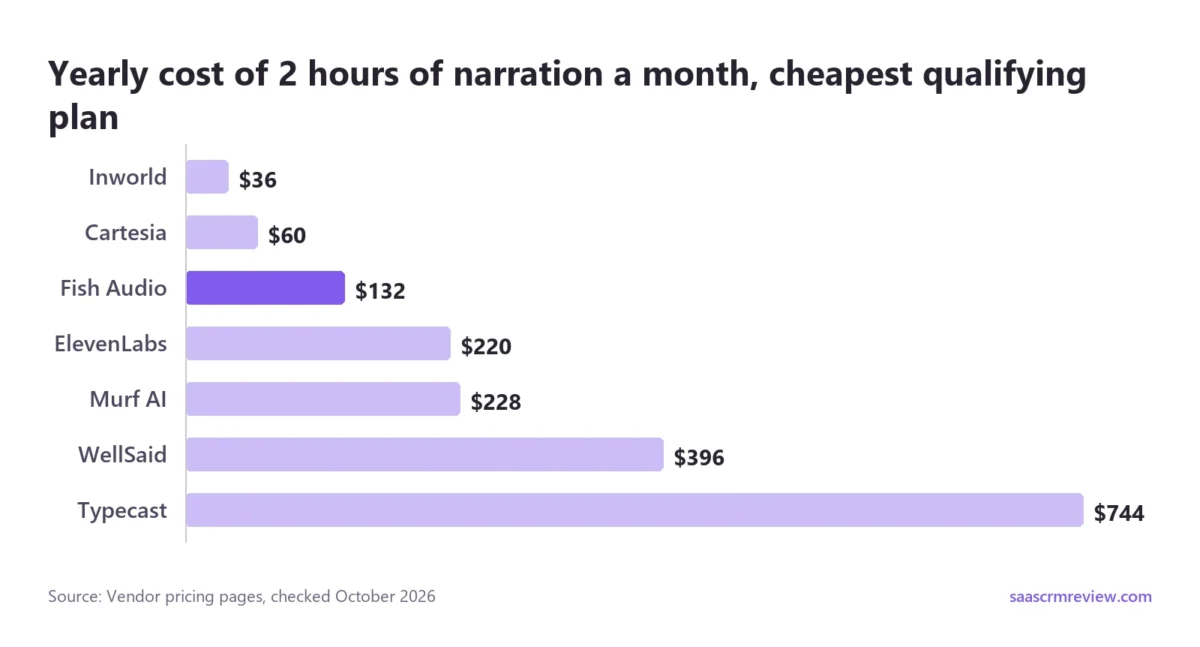
The two cheapest rows are developer platforms metered per character, so their low numbers assume you work through an API or a playground. For someone producing narration in a script editor, the real contest is Fish Audio at $132 a year against ElevenLabs at $220 and Murf AI at $228.
Typecast lands last for a structural reason. Pro’s roughly 90 minutes falls short of 120, and Typecast asks businesses, institutions and agencies to use the Business plan anyway.
Retakes: How Each Tool Counts Your Allowance
| Tool | What the allowance meters | Retakes |
|---|---|---|
| ElevenLabs | Credits, 1 per character for text to speech (half that on Flash v2.5) | Use credits, apart from a limited number of free regenerations |
| Murf AI | Hours of voice generation | Generation time is metered; downloads are unlimited |
| WellSaid | Minutes of downloaded audio | Free: generation is unlimited on paid plans |
| Fish Audio | Credits, roughly 600 to 625 per minute generated | Use credits |
| Typecast | Download credits | Free: generation and playback are free on every plan |
| Cartesia | Credits, 1 per character | Use credits |
| Inworld | Dollars per 1M characters | Use credits |
Sources: ElevenLabs pricing, Murf AI pricing, WellSaid pricing, Fish Audio plans, Typecast pricing, Cartesia pricing, Inworld pricing, checked October 2026.
If you rework a line five times before it sounds right, WellSaid and Typecast bill the one take you export. Fish Audio, Cartesia and Inworld bill all five generations.
ElevenLabs bills each generation, less any free regenerations. In our tests, ElevenLabs and Fish Audio each returned two takes per click but charged for one pass. On Eleven v4 and on Fish Audio S2.1 Pro, that was 189 credits for the 189-character script.
Typecast went further: four takes of the same script left its download credits at 0 used. For heavily directed scripts, these differences can matter more than the sticker price.
How This List Was Built
The ranking rests on each vendor’s official pricing pages and product documentation, checked October 2026. No product was scored. Four criteria set the order:
- Job coverage: how many voice jobs (narration, cloning, dubbing, live agents) one plan handles.
- Cost at real usage: what a realistic month of audio costs on published plans, including billing basis and caps.
- Rights and free-tier limits: whether output can be published, and what the free plan allows.
- Team and API fit: editor seats, shared workspaces, concurrency and cloning slots.
ElevenLabs beats Murf AI and WellSaid on the first criterion. It puts instant cloning on a $6 plan and runs Eleven v3 in 70+ languages, while Murf AI sells custom voice clones as an Enterprise add-on and WellSaid keeps “All languages” for Enterprise.
Tools whose pricing pages now sell something other than voice generation were dropped; they are listed after the seven picks.
Three picks also have a short hands-on test: ElevenLabs, Fish Audio and Typecast, described in the next section. The tests did not change the order, and the other four picks were not tested.
How We Tested ElevenLabs, Fish Audio and Typecast (3 of 7 Picks)
We ran three short tests on October 8, 2026, each in the site owner’s own account on the Free plan. The owner signed in to each account in their own Chrome browser.
An AI assistant, Claude in Chrome, clicked through the steps in that browser at the owner’s request. There is no automated test log: each result was read from the screen as the step finished.
Every tool got the same sample: one 189-character English script about a product update, read by a default voice. Credits were read from each account before and after.
| Tool and model | Default voice | Takes per click | Ready after the click | Credits used | Free-plan editor counter we saw (characters) |
|---|---|---|---|---|---|
| ElevenLabs, Eleven Flash v2.5 | Sarah | 2 | Both in 4 seconds | 94 of 10,000 a month | 5,000 |
| ElevenLabs, Eleven v4 | Sarah | 2 | Both within 5 seconds | 189 of 10,000 a month | 10,000 |
| Fish Audio, S2.1 Pro | Verity | 2 | First take playing within 5 seconds | 189 of 8,000 a month | 500 |
| Typecast | Chad | 1 on Play, then 3 from one Regenerate click | Playing within 5 seconds | 0 of 3,000 download credits, after 4 takes | Not recorded |
Sources: our Free-account tests, October 8, 2026; Free allowances from the ElevenLabs pricing page, Fish Audio plans and Typecast pricing, checked October 2026.
The split that matters is billing. ElevenLabs and Fish Audio charged every click, though for one pass rather than two takes. Typecast charged nothing for four takes, because it meters downloads.
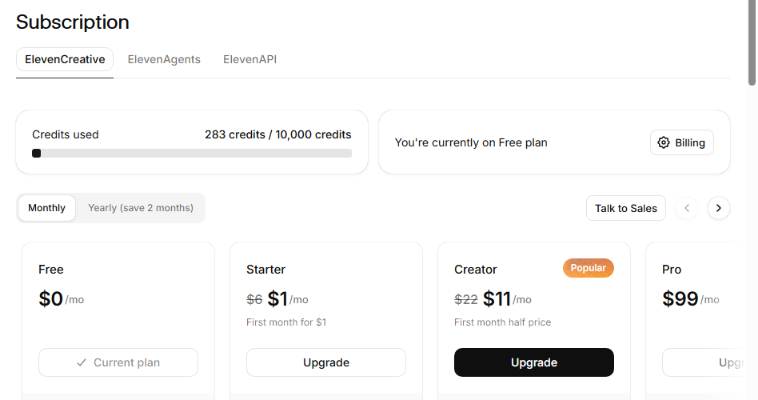
Credits came from each account itself. On ElevenLabs, the balance read 0 of 10,000 used before the test and 9,906 remaining after the Flash run. After the v4 run, the Subscription page showed 283 used, so v4 cost 283 − 94 = 189 credits.
The sample is small: one short English script and one default voice per tool, on one day, with two models on ElevenLabs and one on Fish Audio. Costs on longer scripts or other models may differ.
Audio quality was not rated, because the takes were not listened to, so nothing here says how natural any of them sound. No file was downloaded, so what a Typecast download costs in credits was not measured.
Voice cloning and the APIs were not tested on any of the three, nor were ElevenLabs’ Studio projects and dubbing or Fish Audio’s other models, such as Drama 3.
1. ElevenLabs: Best for Creators Who Need Narration, Cloning and Dubbing in One Account
ElevenLabs takes the top spot for breadth, not for any single feature. Text to speech, voice design, dubbing, sound effects and music all draw on one monthly credit balance, so a creator who narrates, clones and localizes pays one subscription instead of three.
The model choice is where the control lives. According to the ElevenLabs text to speech page, Eleven v3 accepts inline audio tags such as [whispers] and [laughs] in 70+ languages, and Eleven v4 lists 90+. For audiobooks and character reads, direction written into the script saves regenerating a line until the tone lands.
Model choice also sets what each line costs. In our Free-account test, the same 189-character script used 94 credits on Eleven Flash v2.5 and 189 on Eleven v4. Each click on Generate speech returned two takes, and those totals covered both.
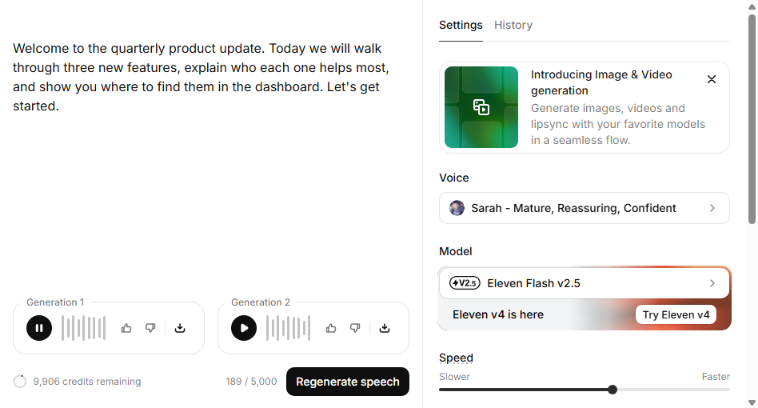
Flash’s half rate matches the text to speech page, which prices Flash/Turbo v2.5 50% lower per character. The same balance voices twice as much text on Flash.
Eleven v4 earns its full rate when you need direction: our v4 editor added Auto-tag and Add speaker buttons and suggested tags such as [laughs].
The editor counter also showed a different ceiling per generation: 5,000 characters on Flash v2.5 and 10,000 on Eleven v4. At ElevenLabs’ estimate of roughly 10 minutes of audio per 10,000 characters, that is about 5 and 10 minutes per generation.
The text to speech page lists 10,000 characters for Eleven v4, matching our counter, but 40,000 for Flash/Turbo v2.5 where ours showed 5,000. The pricing FAQ adds that the per-request maximum depends on your plan tier. Check your own counter before you split a long script.
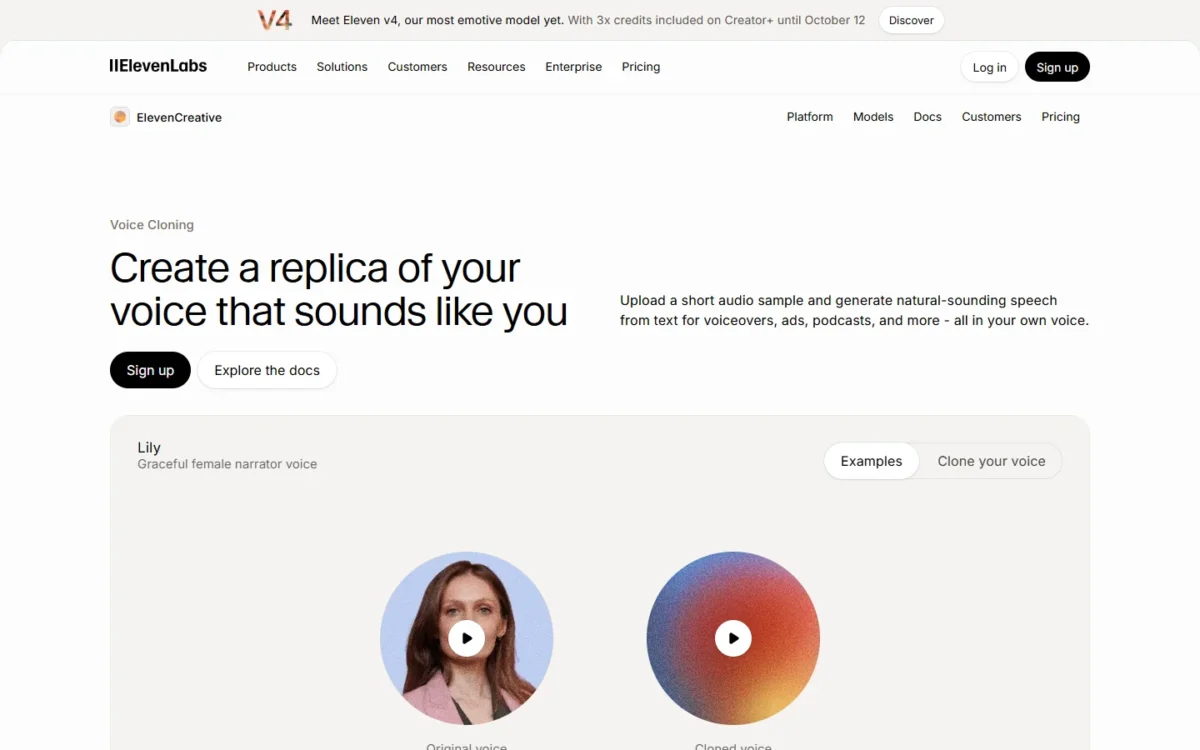
Cloning starts low: Instant Voice Cloning comes with Starter and Professional Voice Cloning with Creator. The ElevenLabs voice cloning page suggests 1 to 5 minutes of audio for an instant clone and at least 30 minutes for a professional one. A podcaster can trial a clone before recording half an hour of clean audio.
The tradeoff. The shared pool cuts both ways. Text to speech costs 1 credit per character or less, but watermark-free Dubbing Studio output costs 10,000 credits per minute. Creator’s 121,000 credits therefore buy about 12 minutes of that dubbing, so dubbing-heavy channels should budget from Pro upward.
- Pricing:
- Starter costs $6 a month, Creator $22 and Pro $99, billed monthly. Annual billing charges for 10 months, so Creator works out to $18.33 a month, or $22 x 10 = $220 a year. When checked, first-month promotions cut Starter to $1 and Creator to $11; regular prices apply after that.
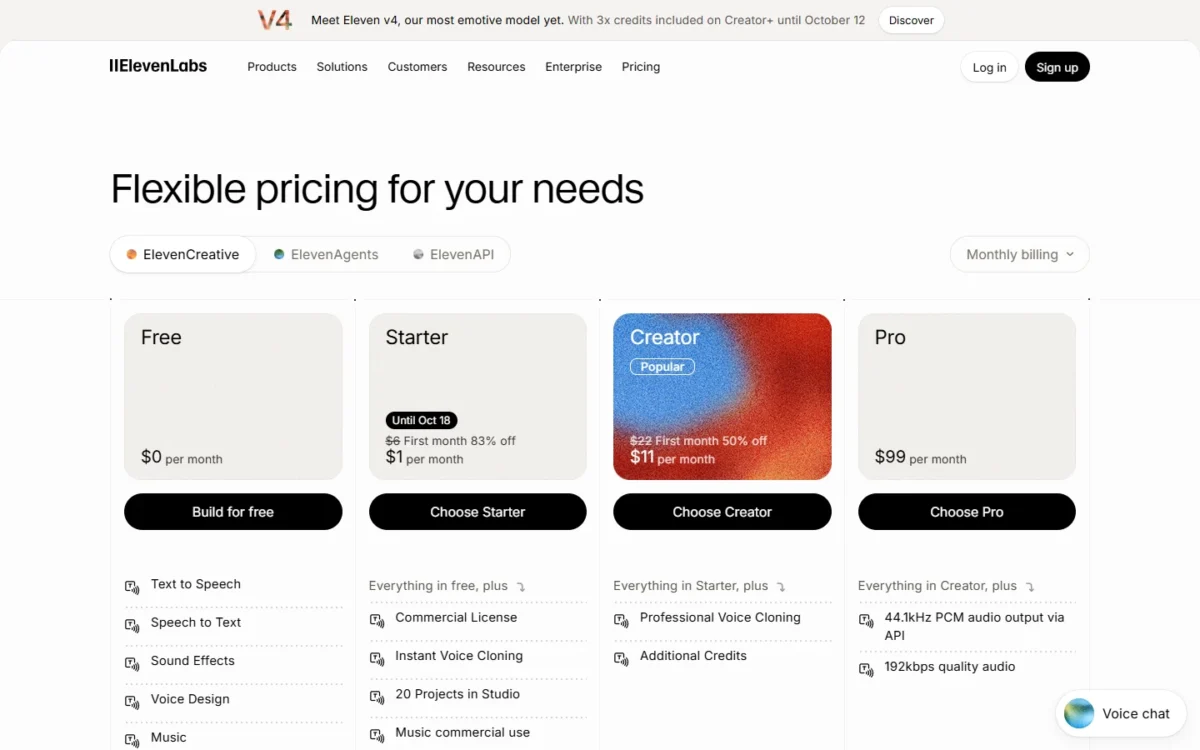
Unused credits on paid plans roll over for up to two months, which protects a creator whose output swings from month to month.
The free plan’s 10,000 monthly credits are for personal, non-commercial use with attribution. Our two test runs used 283 of them and hit no limit or upgrade prompt, so Free is enough to compare models on your own script before you pay.
- Skip it if:
- you narrate English training modules and rework lines many times. WellSaid bills only downloaded minutes, while every ElevenLabs regeneration beyond the free ones uses credits.
2. Murf AI: Best for Narrating Slide Decks, E-Learning and Presentations
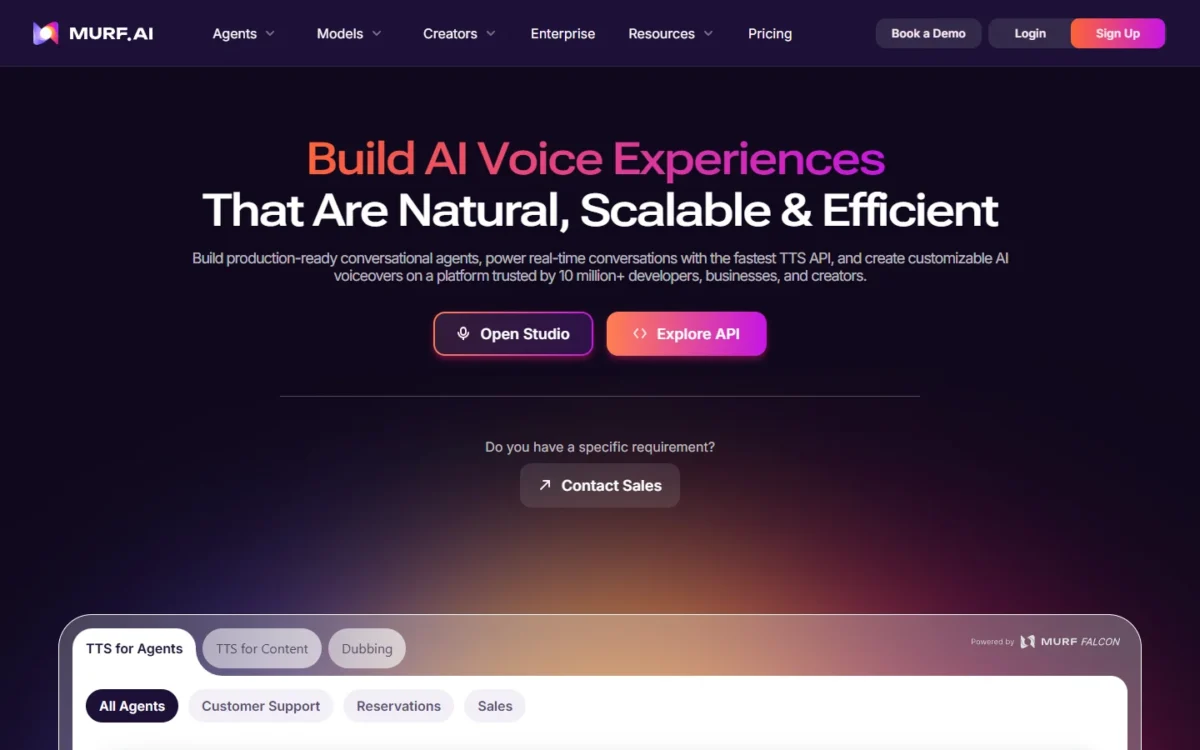
Murf AI makes the most sense when the audio ends up inside a deck. Creator connects to Canva, and Business adds PowerPoint and Google Slides integrations, so a trainer can voice slides where they are built instead of exporting audio and syncing it by hand.
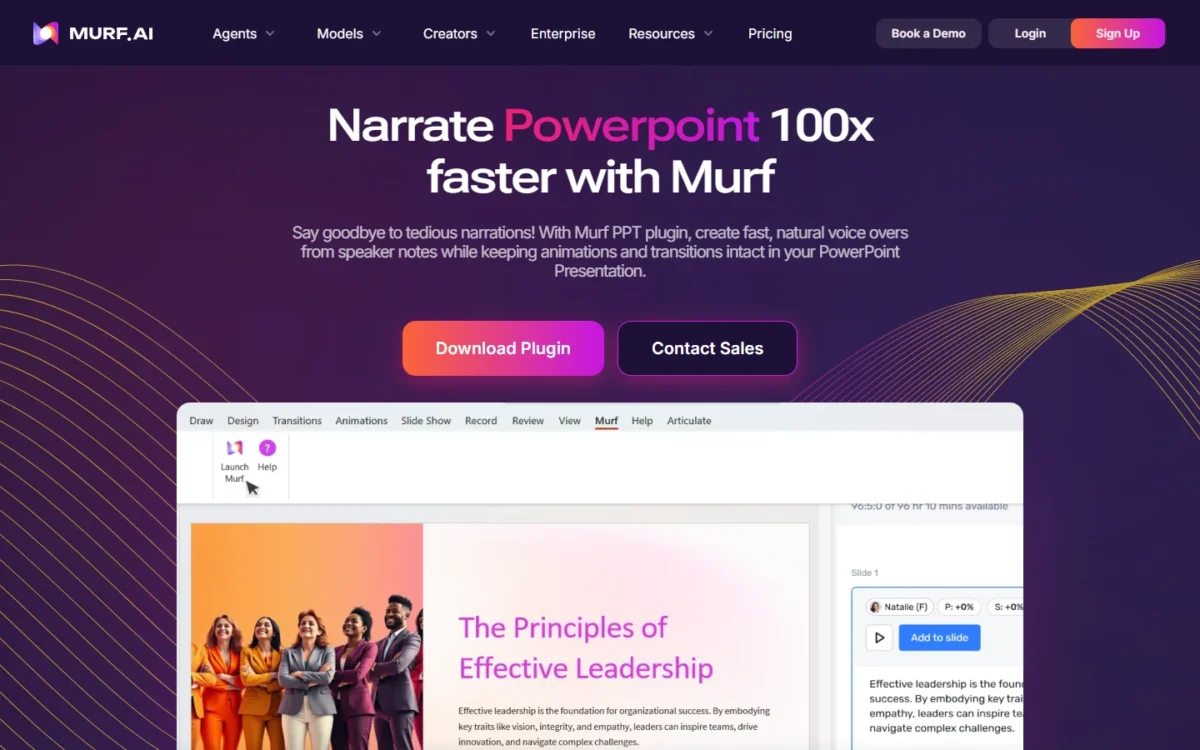
For most course builders, Murf AI ranks above WellSaid on two counts. Creator lists 200+ voices and 30+ languages and accents, where WellSaid keeps all languages for Enterprise. And two hours a month costs $228 a year on Murf AI against $396 on WellSaid Pro.
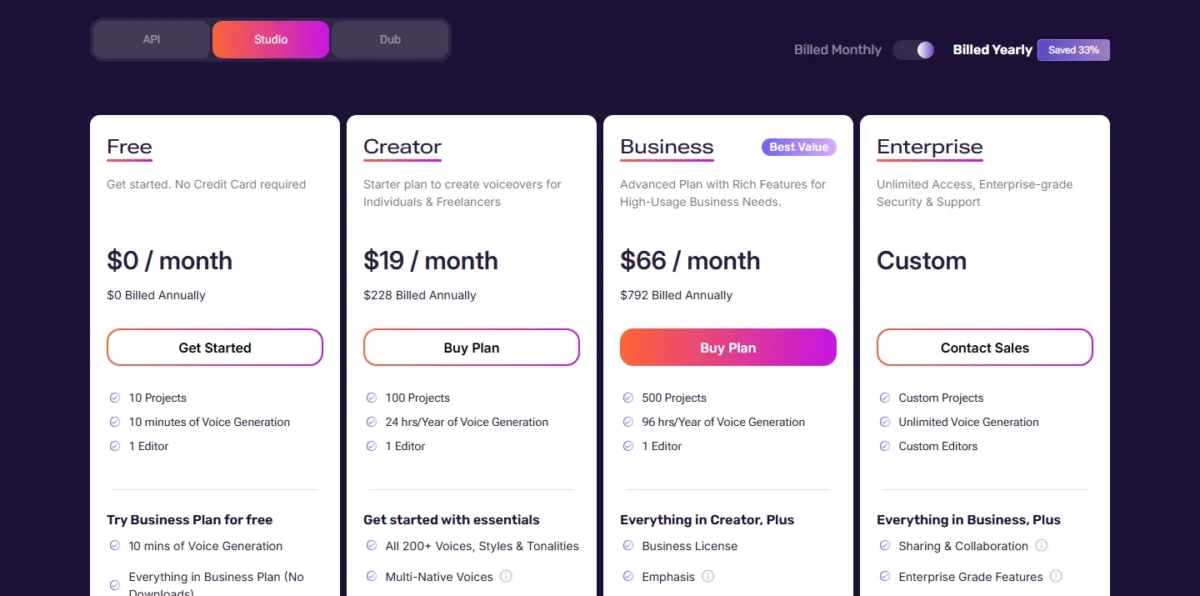
The meter is time, not downloads. Creator includes 24 hours of voice generation a year and Business 96 hours, with unlimited downloads. Twenty-four hours is 1,440 minutes, an average of 120 minutes a month.
Business also adds the direction controls Creator lacks (Emphasis, Variability and Say It My Way) and a Business License. Voice cloning sits on Enterprise as a custom add-on.
The tradeoff. Murf AI is a one-editor product until Enterprise. Creator and Business each list 1 editor, and Share Projects is an Enterprise feature. A three-person team buying Business separately pays $792 x 3 = $2,376 a year and still cannot share projects.
- Pricing:
- Creator costs $19 a month billed annually ($228 a year), and Business $66 a month billed annually ($792 a year). The free plan gives 10 minutes of generation with no downloads and no commercial rights, so it previews voices and nothing more.
- Skip it if:
- you want to clone your own voice without an Enterprise contract, or two people need to edit the same project. ElevenLabs puts cloning on its $6 Starter plan.
3. WellSaid: Best for English Corporate Training With Many Retakes
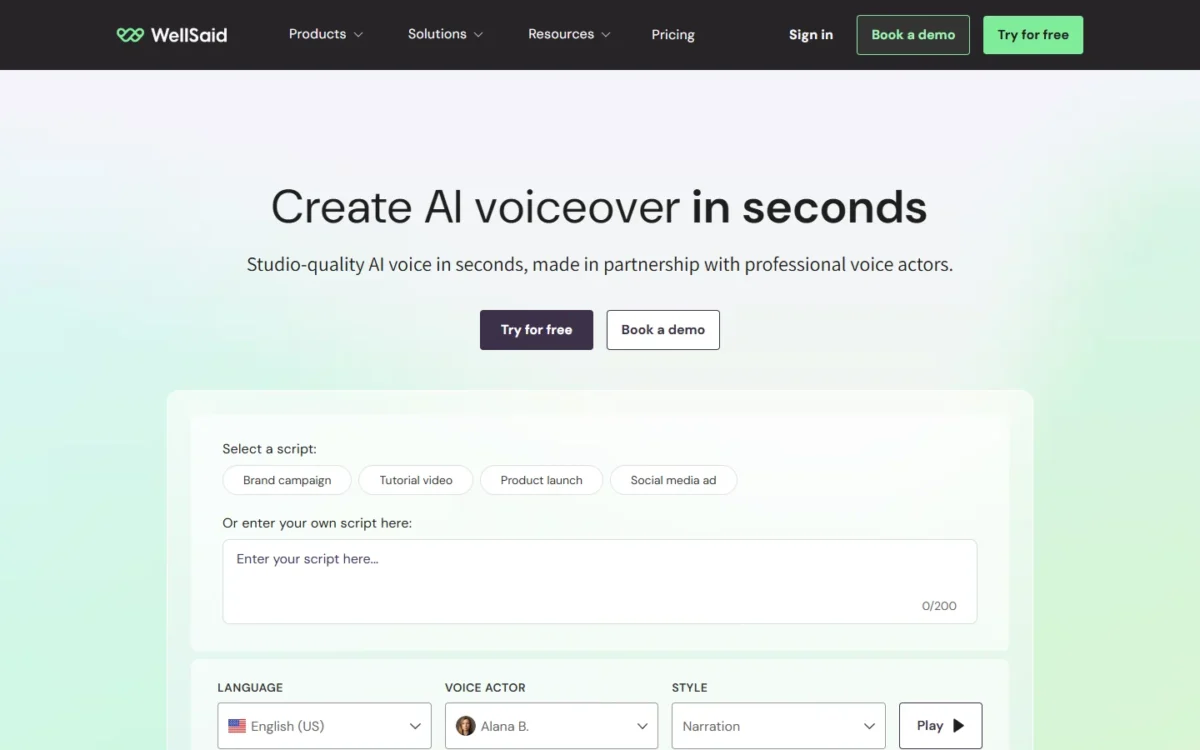
WellSaid’s pricing rewards perfectionists. Paid plans meter the minutes of audio you download, and generation is unlimited, so a narrator can rework a line ten times and pay for the one take that ships.
The catalog suits cautious buyers. WellSaid says its 280+ voices are each modeled on licensed recordings from real voice actors, and its pricing table answers “Training on your data” with “Never” on every plan. A legal team asking where a voice came from, and what happens to uploaded scripts, gets both answers in writing.
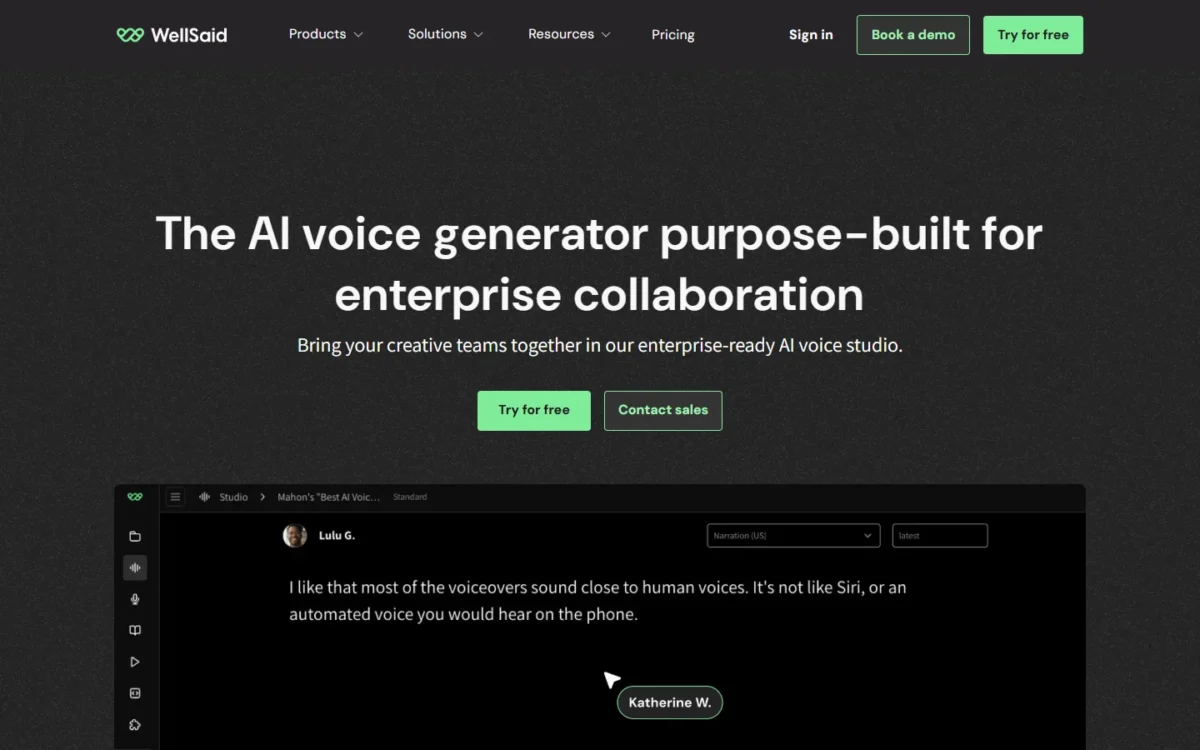
Team features arrive on Business: a team workspace, collaborator seats and an Adobe Premiere Pro integration, for up to 5 seats. WellSaid also pitches a shared pronunciation library to keep product names, acronyms and internal terms consistent across training modules.
The tradeoff. Starter and Pro list all English voices, while “All languages” and translation are Enterprise features. A team localizing training into Spanish or Japanese needs an Enterprise contract or a second tool.
- Pricing:
- Starter costs $10 a month billed annually ($120 a year) for 240 downloaded minutes a year, and Pro $33 a month billed annually ($396 a year) for 2,160 minutes. Monthly billing costs $19 and $49, so a year of monthly Pro is $49 x 12 = $588, $192 more than annual.
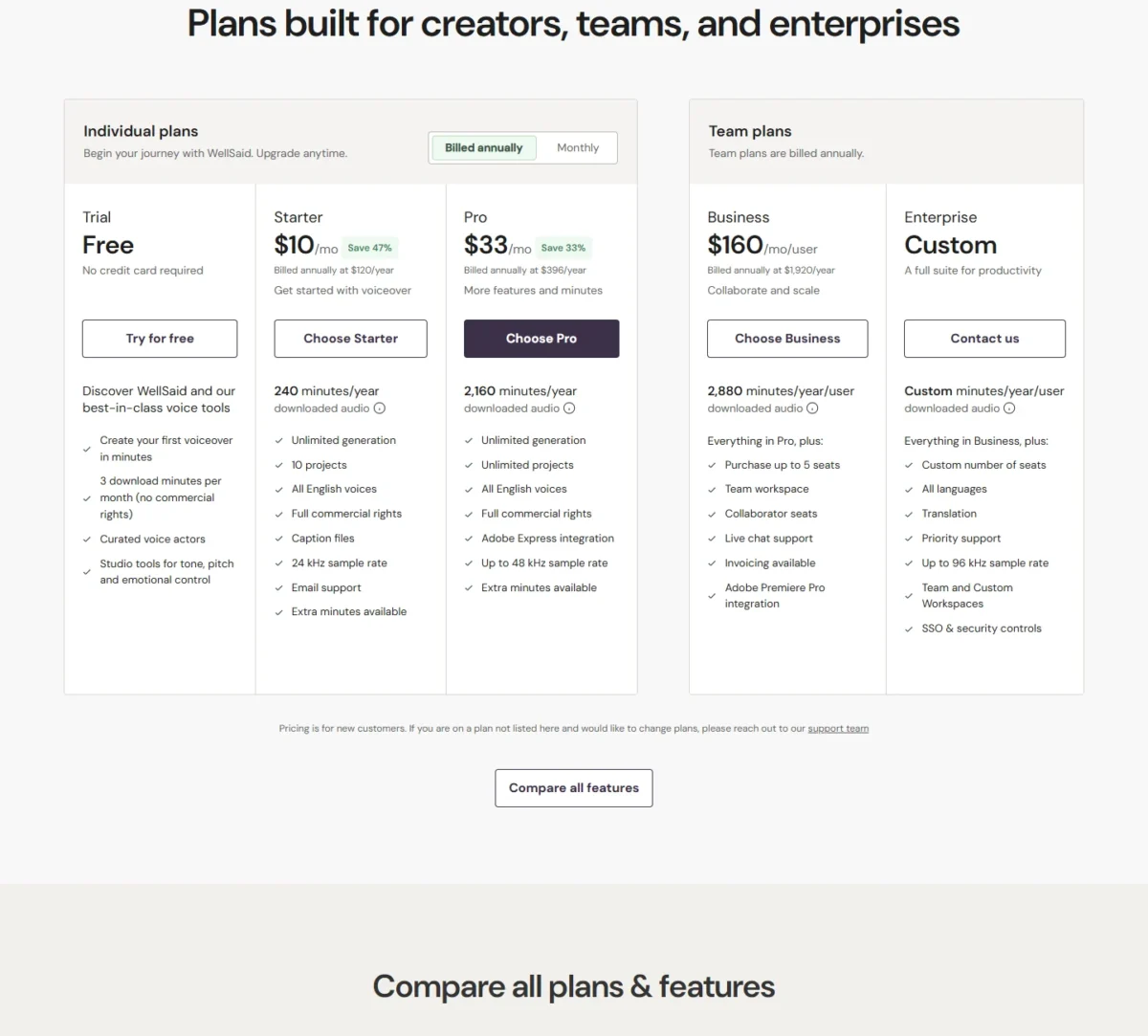
Starter’s 240 minutes a year is 20 a month: enough for a few short modules, gone after one long course. Business costs $160 per user a month billed annually ($1,920 a year per user), so three seats come to $1,920 x 3 = $5,760 a year.
- Skip it if:
- your training ships in several languages and Enterprise is not in the budget. Murf AI covers 30+ languages and accents from its $19 Creator plan.
4. Fish Audio: Best Budget Pick for Cloning Your Own Voice
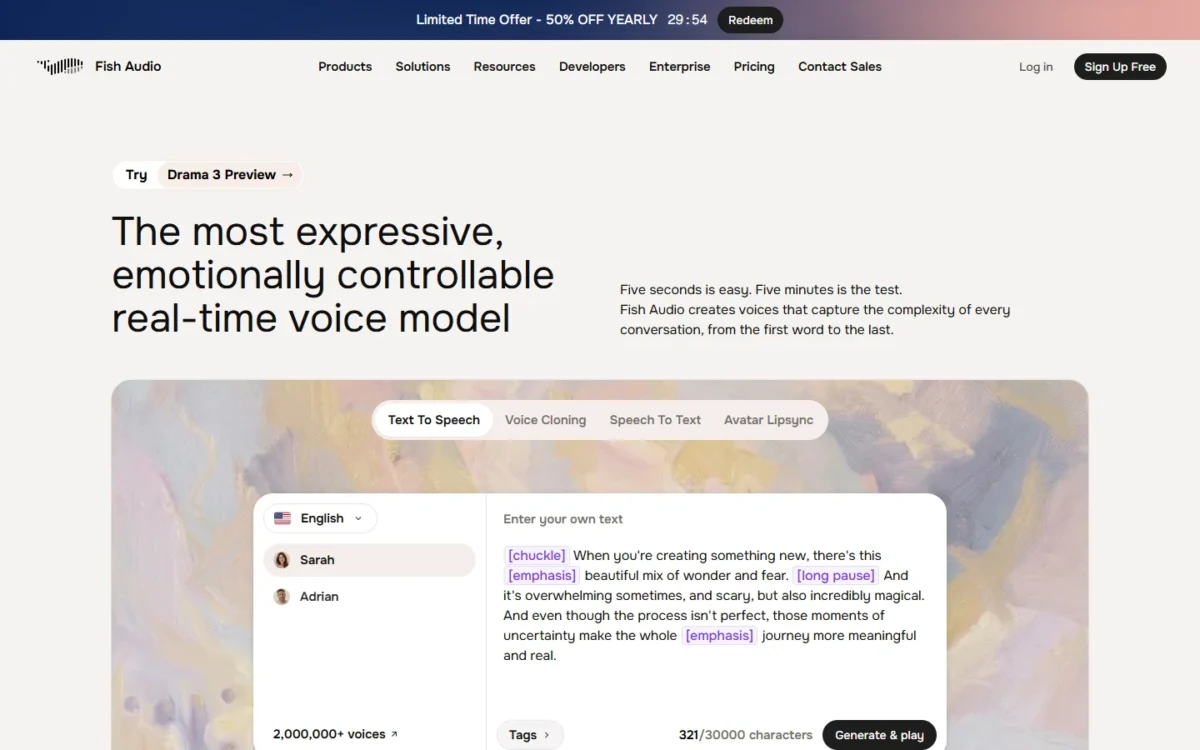
Fish Audio’s price is not its first limit; its rollover policy is. Plus buys up to 200 minutes of generation a month for $11 billed annually, against about 121 minutes for $18.33 on ElevenLabs Creator. Unused minutes do not roll over, though, so a quiet month is money spent on nothing.
Cloning is where the plan earns its place. Plus includes unlimited public and 10 private voice slots, 1 professional voice slot and access to Voice Design. Pro raises that to 5 professional voice slots and 3 team seats, which suits a small studio managing several narrators.
Our Free-account test showed how Fish Audio counts credits. One click on Generate Speech returned two takes of our 189-character script on Fish Audio S2.1 Pro. An on-screen notice said the two audio samples came “at no extra cost”.
The balance fell from 8,000 to 7,811 credits: 189 credits for 189 characters, both takes together. In our one run on S2.1 Pro, two reads cost what one read costs. We did not run Drama 3 or the other models.
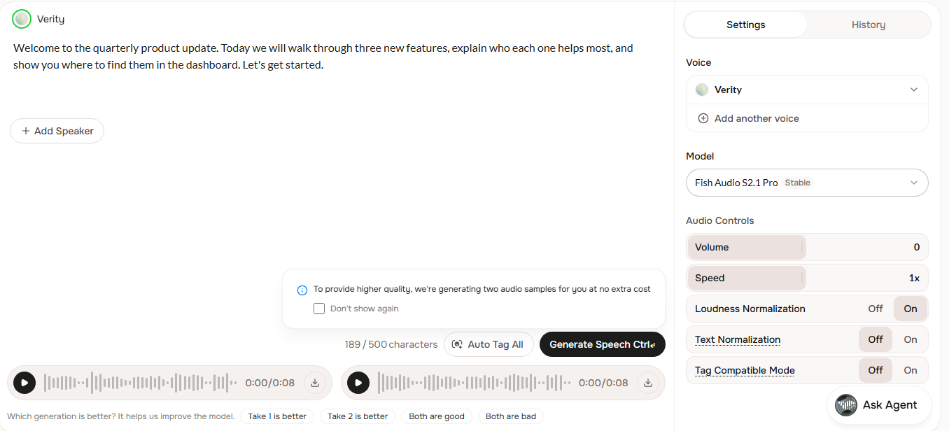
At 189 credits a run, the 8,000 monthly Free credits cover about 42 runs of our script (8,000 ÷ 189 = 42.3). The tighter Free limit is the editor’s cap of 500 characters per generation.
A 2,000-character script therefore takes four separate generations on Free (2,000 ÷ 500 = 4), while Plus raises the cap to 15,000 characters.
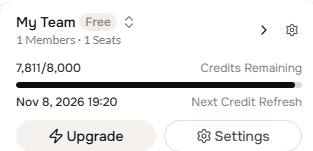
The tradeoff. The free tier is a sampler, not a publishing plan: Fish Audio says free users can only use generated content for personal, non-commercial projects.
- Pricing:
- Plus costs $15 a month billed monthly, or $11 a month billed annually ($132 a year). Pro costs $100 monthly or $75 a month billed annually ($900 a year) for up to 1,620 minutes, and Max costs $999 monthly or $749 billed annually ($8,988 a year).
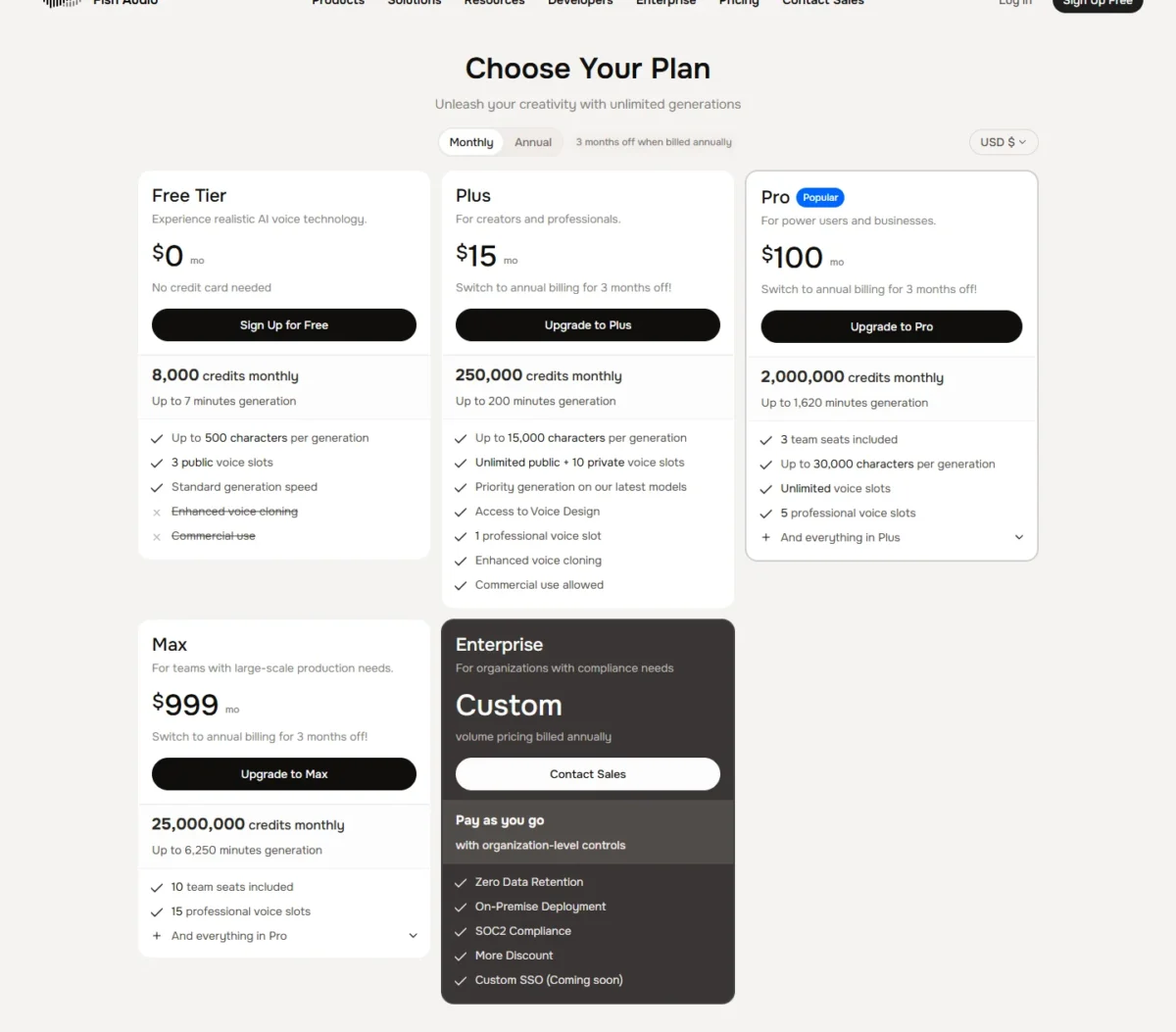
Paying monthly for Plus comes to $15 x 12 = $180 a year, $48 more than annual billing. If cloning quality is the deciding factor, our Fish Audio review covers the product and its plan limits in more detail.
- Skip it if:
- your monthly output swings widely. ElevenLabs rolls unused paid credits over for up to two months, and Cartesia lets credits accrue up to twice the monthly rate.
5. Typecast: Best for Character Voices and Emotional Delivery
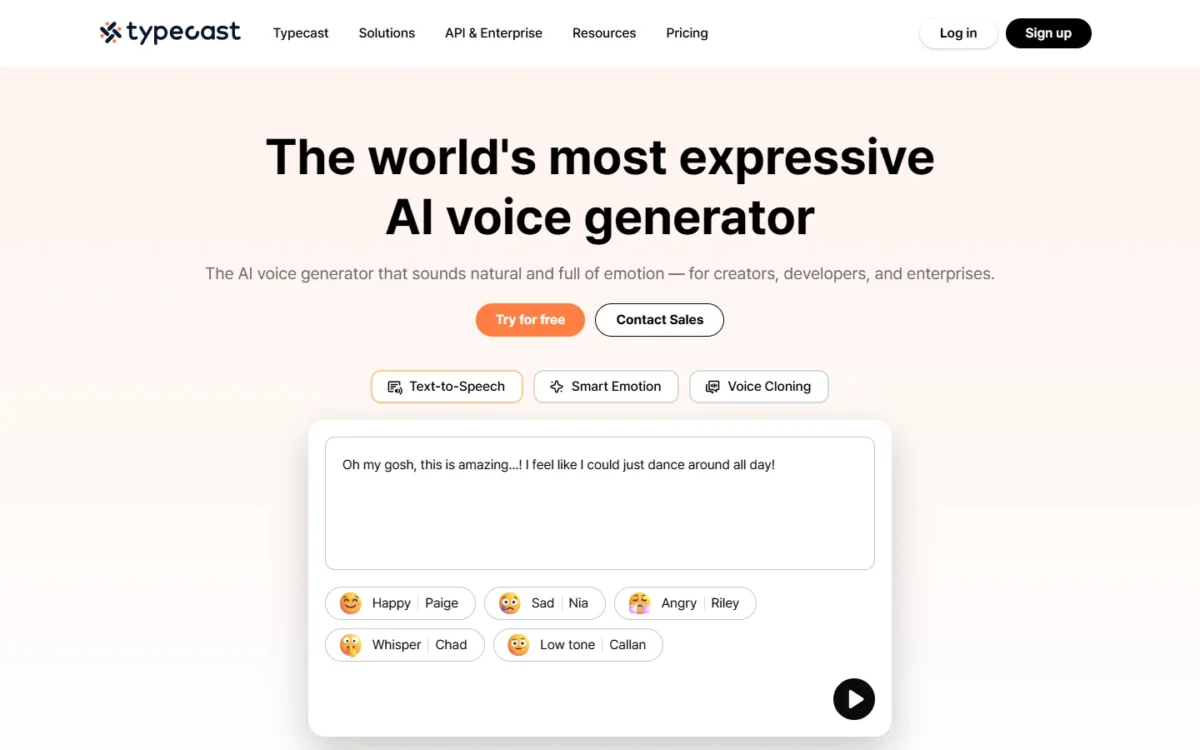
Typecast is built for directing a performance rather than reading a script. Pro adds emotion controls, including Smart Emotion’s one-click AI voice adjustment, plus intonation control, and the Typecast homepage lists 600+ voices in 35+ languages.
The billing model suits auditions. Generation and playback are free on every plan, and credits are used when you download audio. So a storyteller can audition several takes of a line and spend credits only on the one that fits the scene.
Our Free-account test bore that out. Clicking Play on our 189-character script generated the audio and started playback within 5 seconds, and one click on Regenerate added three more takes.
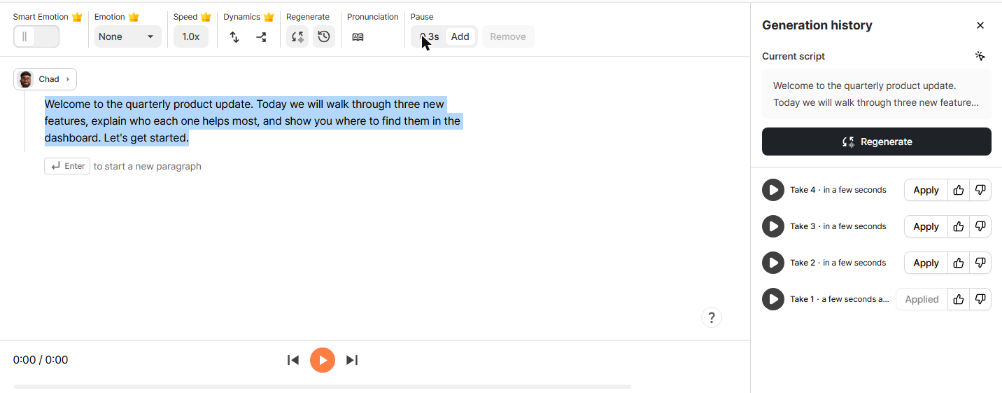
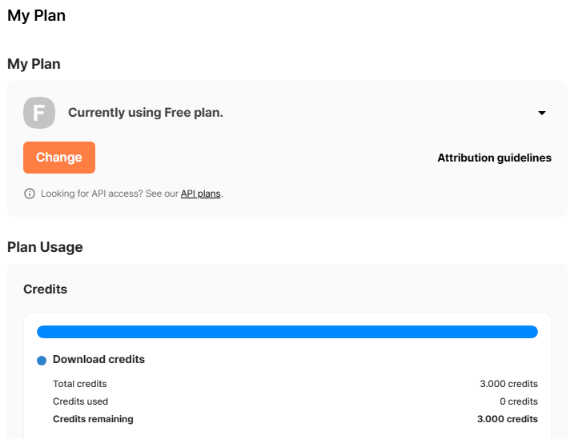
After all four takes, the My Plan page still showed 0 of 3,000 download credits used. On Free, that lifetime allowance, about 5 minutes by Typecast’s estimate, goes only to the takes you export.
The test also showed where Free stops. Smart Emotion, Emotion, Speed and Dynamics carried a crown icon in our editor, and Emotion stayed at None.
The pricing page lists speed control from Plus and emotion controls from Pro, so Free lets you choose a voice, not rehearse a performance.
Typecast also bundles a video editor and talking-avatar generations (up to 15 on Pro), useful for YouTube creators who want voice and visuals in one place. If the visuals matter more than the voice, our ranking of AI video generators compares tools built around video first.
The tradeoff. The feature you would choose Typecast for starts at Pro, $29 a month, with about 90 minutes of downloads. Additional credit purchases are listed on Business, not on Pro, so on Pro the monthly allowance is the ceiling.
- Pricing:
- Basic costs $5 a month for about 35 minutes, with a commercial license and one instant cloning slot. Pro costs $29 a month or $312 billed yearly, and Business $69 a month or $744 billed yearly for about 250 minutes.
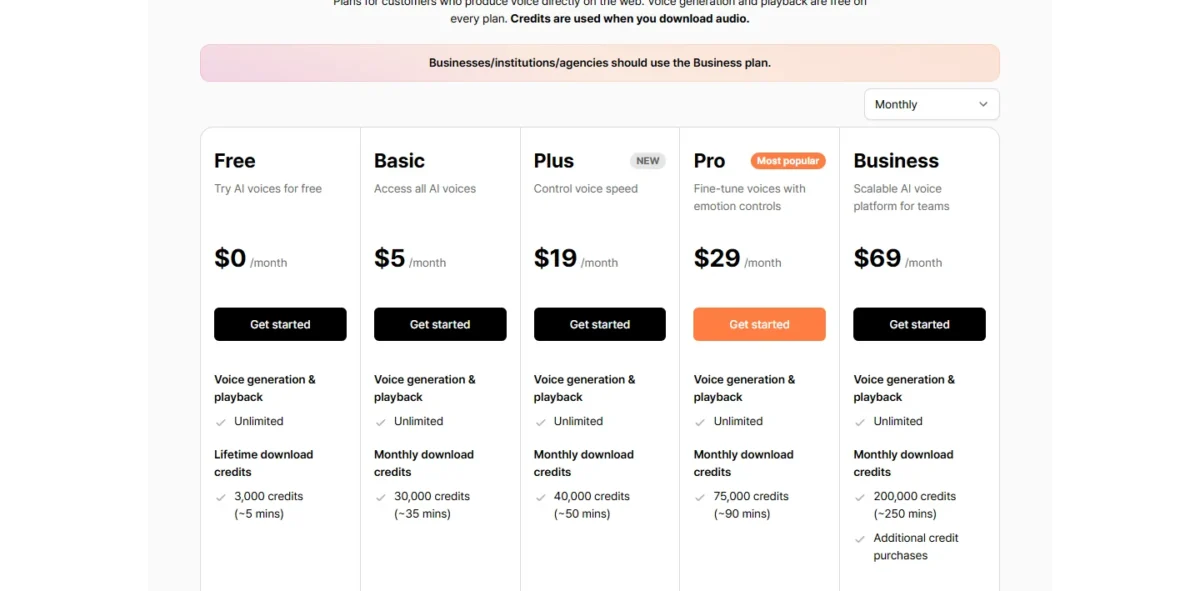
Typecast says businesses, institutions and agencies should use the Business plan, so a commercial studio should budget $744 a year from the start.
- Skip it if:
- you narrate long, even-toned material such as compliance courses. Pro’s roughly 90 minutes runs out fast, and Murf AI’s Creator plan includes 24 hours of generation a year for $228.
6. Cartesia: Best for Real-Time Voice Agents
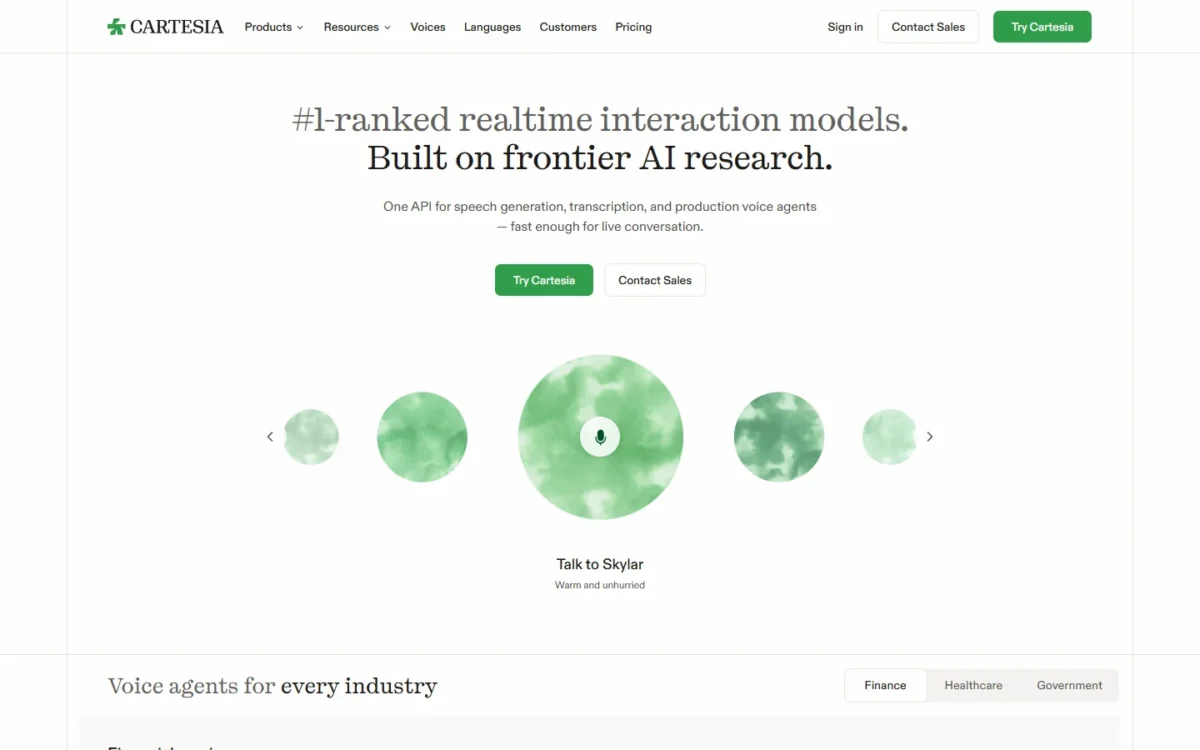
Cartesia is the pick when the voice has to answer back. Cartesia says its Sonic model delivers first audio in under 90ms in 44 languages, and every plan includes prepaid dollars for Managed Agents, billed at $0.06 per minute of calls.
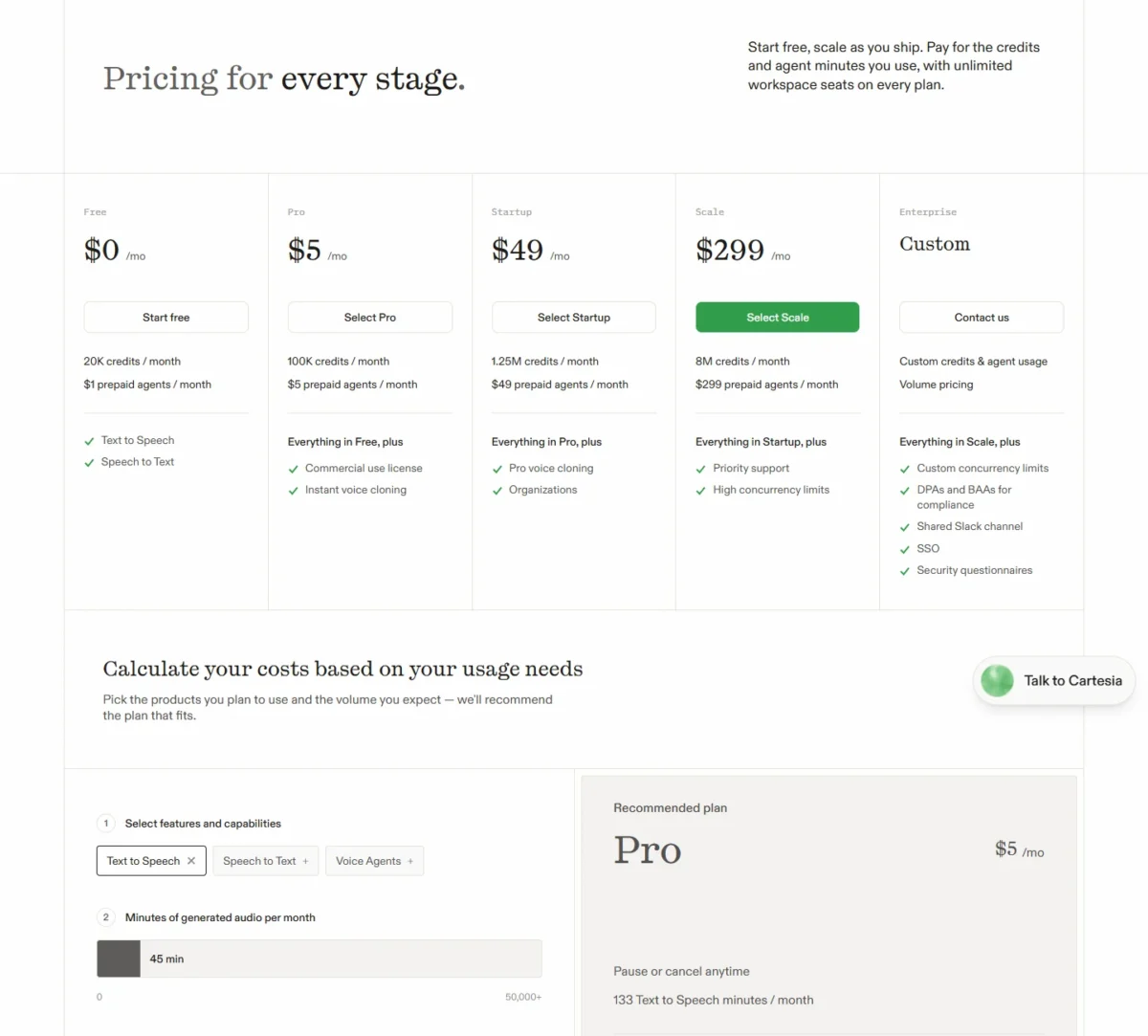
Pro costs $5 a month for 100K credits, about 133 minutes of speech, with commercial use and instant voice cloning. Typecast Basic, also $5 a month, covers about 35 minutes. Cartesia’s voice cloning guide says 10 seconds of audio is enough to get started.
Every plan includes unlimited workspace seats, which removes the per-seat math that WellSaid and Murf AI impose on teams.
The tradeoff. Overages are where Pro gets expensive. Extra credits cost $65 per 1M on Pro, $45 on Startup and $38 on Scale, so a growing app should move to Startup at $49 for 1.25M credits before it leans on overages. Professional voice cloning also starts on Startup, with 2 slots.
- Pricing:
- the free plan gives 20K credits a month (about 27 minutes), with the commercial use license starting on Pro. Pro costs $5 a month, Startup $49 and Scale $299 for 8M credits (about 10,667 minutes). Unused credits roll over up to twice the monthly rate.
A team that would rather buy a finished helpdesk than build a voice agent on an API should start with our ranking of customer service software.
- Skip it if:
- your job is finished narration files rather than live conversation. The agent dollars and concurrency you pay for would go unused, and ElevenLabs’ Studio projects suit long-form work better.
7. Inworld: Best Per-Character Rate for High-Volume Apps
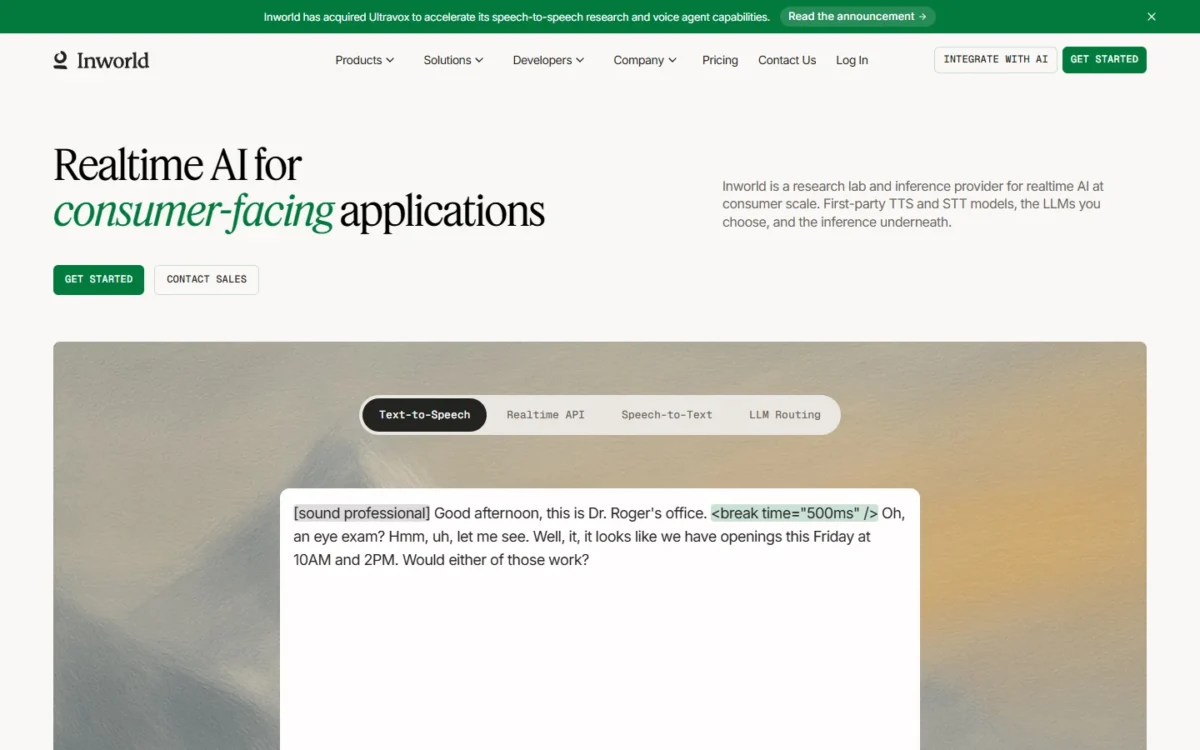
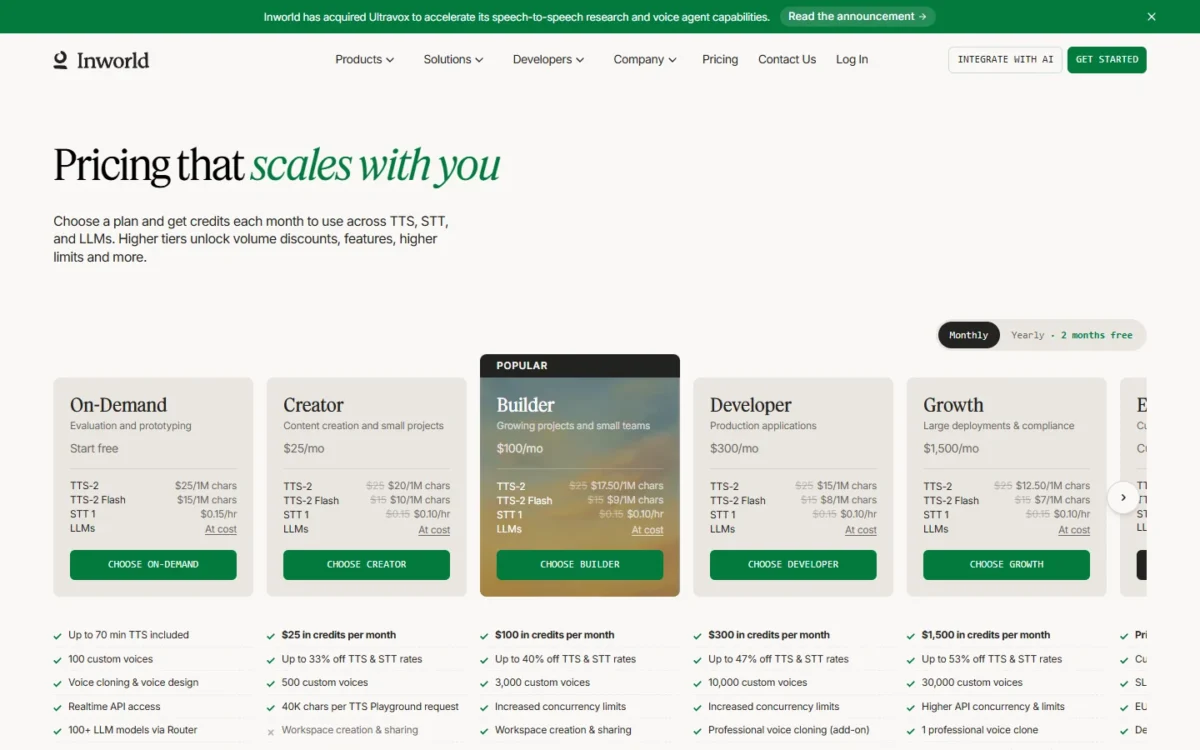
Inworld’s case is a rate card that keeps falling as volume grows. Realtime TTS-2 drops from $25 per 1M characters on demand to $12.50 on Growth, and Inworld says Enterprise goes as low as $5.
Inworld assumes about 1,000 characters per minute, so 1M characters is roughly 1,000 minutes of audio. Set against Cartesia’s $65 per 1M credits in Pro overages, Inworld is the cheaper place to grow once an app outgrows a bundled plan.
The paid plans are prepaid usage, not bundles: Creator’s $25 a month comes back as $25 in credits at a lower rate. That pays off only if you would spend the money anyway, and a 3-month rollover softens a slow month.
For developers, On-Demand is a generous free start: up to 70 minutes of TTS, voice cloning and voice design, with a commercial license listed on the plan. Inworld says its TTS-2 Flash model reaches a 25ms time to first byte.
The tradeoff. Professional voice cloning is an add-on from Developer at $300 a month, and one professional clone is included on Growth at $1,500 a month. A brand that wants its own trained voice pays far more here than on ElevenLabs Creator at $22.
- Pricing:
- On-Demand is free to start, then pay as you go. Creator costs $25 a month, Builder $100, Developer $300 and Growth $1,500, each granting its price in monthly credits, so pick the tier that matches your expected monthly spend.
- Skip it if:
- you want finished audio files for videos rather than a voice inside an app. The On-Demand playground caps requests at 2,000 characters, which turns a long script into many pastes.
Tools That Did Not Make the List
Four familiar names were left out, each for a reason a buyer should know before signing up.
Hume AI
Its pricing URL opens a page about measuring and improving voice AI performance, not a voice generator plan.
Resemble AI
Its pricing page is built around deepfake detection and AI security, with Team at $350 a month billed monthly. That is a security purchase, not a narration tool.
Speechify
Its main pricing page sells a listening app (5x speeds, Scan & Listen, AI summaries). Voiceovers sit in a separate Studio product, so the plan most people find first is a reader, not a generator.
Canva
The Canva AI voice generator includes a selection of free voices but takes up to 1,000 characters per conversion. That suits a social clip inside a design, not a full script.
How to Choose an AI Voice Generator
Start from the job, then check the meter that job will hit first.
- Your own voice on YouTube or a podcast: test an instant clone on ElevenLabs Starter at $6, then move to Fish Audio Plus if you need more minutes than Creator’s 121.
- English training with heavy revision: WellSaid Pro, where retakes do not touch your allowance.
- Slide decks or multilingual courses on a budget: Murf AI Creator, or Business for PowerPoint and Google Slides.
- Characters, audio drama or children’s stories: Typecast Pro for emotion controls.
- A live voice agent: Cartesia, moving to Startup once you pass 100K credits a month.
- Speech inside an app at scale: Inworld, with the TTS-2 rate falling from $25 to $12.50 per 1M characters as you commit more.
For a team of three, seat rules decide more than voice quality. The yearly bill for three seats:
- WellSaid Business, $160 per user per month billed annually: $1,920 x 3 = $5,760 a year
- ElevenLabs Scale, 3 seats included: $299 x 10 = $2,990 a year billed annually
- Fish Audio Pro, 3 team seats included: $900 a year billed annually
WellSaid is the costliest of the three because it charges per seat. ElevenLabs Scale and Fish Audio Pro each include three seats in one price. Cartesia has unlimited seats on every plan.
Voice is often one step in a bigger production line. When the script, thumbnails and video also need tools, our ranking of AI content creation tools covers the rest of that stack.
The Verdict
Choose ElevenLabs if you want one subscription for narration, cloning and dubbing and can accept that retakes use credits. Choose Murf AI if your audio lives in slides or must ship in several languages on a small budget.
Choose WellSaid if English training is the job and reviewers rework every line. Pick Fish Audio for the cheapest route to your own cloned voice, Typecast for performances, and Cartesia or Inworld when the voice runs inside an app.
FAQ
Which AI voice generator is the most realistic?
Realism is judged by ear, and no pricing page settles which voice sounds most human. The vendor pages do show control: Eleven v3 takes audio tags such as [laughs], Cartesia’s Sonic accepts laughter tags in the transcript, and WellSaid builds voices from licensed voice actor recordings. Run the same short script through the free tiers of your top two.
Can ChatGPT and OpenAI do voice AI?
Yes, for live conversation: OpenAI’s API pricing page lists realtime audio models such as gpt-realtime-2.1, plus GPT-Live voice sessions billed per second at $0.05 a minute. Those target live talk inside apps. For narration you edit and export as files, a voiceover studio from this list fits the job better.
Is there a free AI voice generator for commercial use?
Few free tiers allow it. ElevenLabs’ free plan is personal and non-commercial, Fish Audio’s free output is for personal projects, WellSaid’s trial carries no commercial rights and Typecast requires attribution. Inworld’s On-Demand tier lists a commercial license with up to 70 minutes of TTS, but you reach it through an API or playground.
Can I clone my own voice with an AI voice generator?
Yes, on most paid plans here: instant cloning starts on ElevenLabs Starter at $6 a month, Typecast Basic at $5 and Cartesia Pro at $5. Professional clones, trained on more audio, start on ElevenLabs Creator at $22 and Cartesia Startup at $49. ElevenLabs says you must have permission to clone any voice.
Are AI-generated voices legal to use in commercial content?
On paid plans, usually yes, within each vendor’s terms: ElevenLabs says paid plans include full commercial usage rights, subject to its Terms of Use and Prohibited Use Policy. Cartesia limits cloning to voices you have the right to clone. Free tiers are stricter, and none of this is legal advice for your situation.