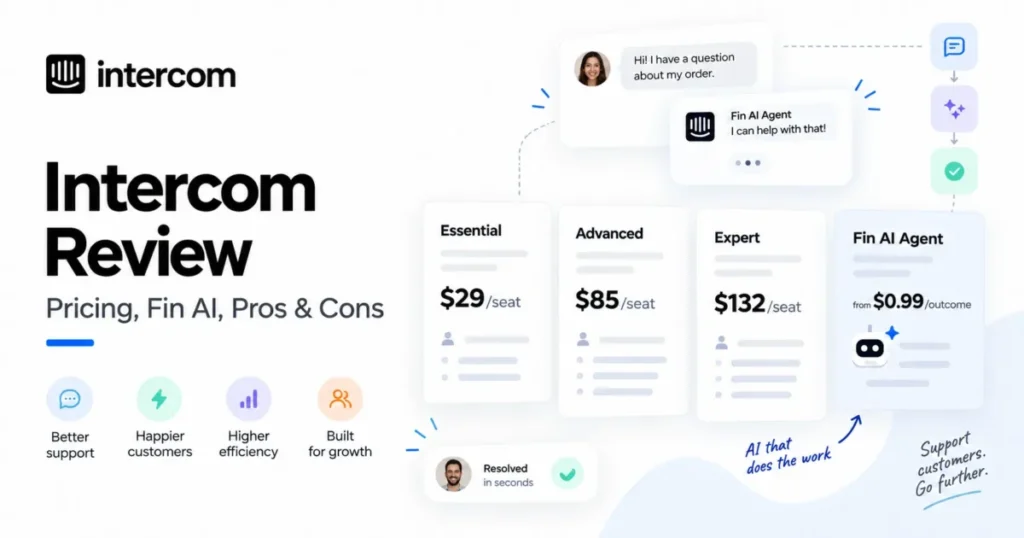

The best customer service software for a team of 20 to 500 agents depends on the job. Zendesk Suite fits an omnichannel team of 20 to 200 agents, Genesys Cloud CX voice-first contact centers, Intercom AI-first support inside a product, and Freshdesk Omni a budget suite.
Headcount sets the seat bill; the AI agent’s meter is the line that moves with volume, and these vendors bill it in different units. I ranked ten platforms from each vendor’s pricing and plan pages, read on October 27, 2026. A team keeping its help desk can add Aissist to it.
Quick verdict
For customer service leaders choosing a platform for a team of 20 to 500 agents. Price the AI meter first: most picks bill the AI agent apart from the seat, and Genesys, Salesforce and Microsoft print no per-unit AI rate.
- An omnichannel team of 20 to 200 agents: Zendesk Suite.
- Voice-first contact center: Genesys Cloud CX, or RingCX for a cheaper voice-plus-digital seat.
- AI-first support inside a SaaS product: Intercom.
- Budget suite under 100 agents: Freshdesk Omni Pro.
- Salesforce or Microsoft as the system of record: Service Cloud or Dynamics 365 Customer Service.
- A help desk that works but lacks AI: Aissist inside it.

Zendesk Suite
Best for: an omnichannel team of 20 to 200 agents
Suite Team adds messaging, live chat, help center and voice support to ticketing.
Limit: AI resolutions past the included 5 to 10 per agent cost $1.50 to $2.00

Genesys Cloud CX
Best for: voice-first contact centers
Four printed tiers, with voice from CX 1 and digital channels from CX 2.
Limit: AI tokens come from one pool per org, with no printed price for more

Intercom
Best for: AI-first, in-product SaaS support
Fin costs $0.99 per outcome on every plan, and every plan includes live chat and in-app chats.
Limit: no included Fin allowance

Freshdesk Omni
Best for: budget omnichannel suite under 100 agents
Pro adds intelligent routing at $79 per agent/month, billed annually.
Limit: skill-based routing, sandbox and audit logs wait for Enterprise
| Software | Best for | Starting price | Recommended plan (price) | AI agent billing | Key limitation |
|---|---|---|---|---|---|
| Zendesk Suite | An omnichannel team of 20 to 200 agents | $19 per agent/ | Suite Professional, $115 per agent/ | $1.50 committed or $2.00 pay-as-you-go per automated resolution | Copilot is a $50 add-on |
| Genesys Cloud CX | Voice-first contact centers | $75 per user/ | CX 2, $115 per user/ | AI Experience tokens; 250 named per org/ | No printed token price |
| Salesforce Service Cloud | Enterprise service on Salesforce data | $25 per user/ | Core, $195 per user/ | Flex Credits; 2.75M per org per year on Max | Contact center bought separately below Max |
| Intercom | AI-first, in-product SaaS support | $29 per seat/ | Advanced, $85 per seat/ | $0.99 per Fin outcome | No included Fin allowance |
| Freshdesk Omni | Budget omnichannel suite under 100 agents | $29 per agent/ | Pro, $79 per agent/ | $49 per 100 sessions; 500 free once per account | No native phone line listed |
| RingCX | Voice plus digital on a low-cost contact center seat | $65 per user/ | Standard, $65 per user/ | IVA partner or AI Receptionist: contact sales | No ticketing or knowledge base listed |
| Microsoft Dynamics 365 Customer Service | Microsoft 365 organizations | $50.00 per user/ | Premium, $195.00 per user/ | Copilot Credits; base capacity on Premium | No printed credit rate |
| Talkdesk | Digital-first teams adding voice later | $85 per user per month (Digital Essentials) | Elite, $165 per user per month, once voice joins | Autopilot: contact sales | Billing period not stated |
| Dixa | Flat per-conversation AI pricing for European teams | €89 per agent/ | Growth, €89 per agent/ | €0.40 per Mim conversation, EUR | No self-serve trial |
| Aissist | AI agent layer for teams keeping their help desk | Free, up to 1,000 tickets/ | Growth, $0.09 per AI interaction | Capped at $0.60 per resolution | No phone channel listed |
Sources: Zendesk, Salesforce, Genesys, Intercom, Freshdesk Omni, Microsoft, RingCX, Talkdesk, Dixa and Aissist pricing pages, checked October 2026.
In This Article (19 sections)
Platform, Help Desk or AI Agent Layer: Which Customer Service Software You Need
A team under about 20 agents on email and chat needs a help desk, a team routing calls and messages into one queue needs a platform, and a team whose desk works but lacks AI needs an AI agent layer. The base category is explained in what customer service software covers.
- Omnichannel suite: Zendesk Suite, Intercom, Freshdesk Omni, Dixa, Salesforce Service Cloud, Dynamics 365 Customer Service.
- Contact center: Genesys Cloud CX, RingCX, Talkdesk.
- AI agent layer: Aissist, and Intercom’s Fin sold without seats.
A team that only wants a chat widget is buying a different product, ranked in my list of live chat software.
When a Help Desk Like Zoho Desk, Help Scout or HubSpot Is Enough
A help desk is enough below about 20 agents with no phone queue. Zoho Desk’s Free edition includes 3 users, and Help Scout’s Free plan 5 users and 1 Inbox. HubSpot Service Hub sells Starter, Professional and Enterprise seats with 500 to 5,000 HubSpot Credits included.
Those teams should compare desks in my best help desk software ranking rather than pay for routing they will not use.
Features That Make It a Platform: Voice, Routing and Workforce Tools
Voice on the plan, routing by skill and workforce tools separate a platform from a help desk. Genesys adds workforce management at CX 3, Talkdesk and RingCX at Elite.
The plan that carries each one is the real price. Zendesk includes voice support from Suite Team but skills-based routing from Suite Professional; Dixa includes phone on Growth but skills-based routing on Ultimate.
When an AI Agent Layer Fits Better Than a New Support Suite
Yes, a team can add AI without migrating when its desk already works. Aissist runs inside eight named help desks, and Intercom sells Fin on another desk with no seats required.
The cost is a second vendor and invoice, not a ticket migration. Standalone bot builders are ranked in my guide to AI chatbot platforms.
How I Chose and Ranked These 10 Platforms
I considered 22 tools: 10 picks below and 12 tools under Also Considered. Prices, plan gates and AI billing units come from each vendor’s pricing or plan page, read on October 27, 2026; the cost math and fit judgments are my analysis.
Two must-haves removed tools first: a price published on the vendor’s own page, and either more than one channel on a plan or an AI agent that works on the help desk. The rest were judged on seven criteria:
- Channel coverage, including voice on the plan.
- The AI billing unit, and whether its rate is printed.
- Price at 25 agents on the plan that carries the workflow.
- Routing and workforce depth.
- Governance: SSO, sandbox and audit logs.
- Fit with the system of record, and integrations.
- Setup effort the vendor documents.
The criterion that puts each pick above the next:
- Zendesk over Genesys, channels: Suite Team carries ticketing, messaging, live chat and voice on one seat; Genesys adds digital at CX 2.
- Genesys over Salesforce, channels and price: voice starts on CX 1, and 25 agents on CX 2 cost $2,875 a month against $4,875 on Core, which buys the contact center separately.
- Salesforce over Intercom, system-of-record fit: Core includes Case Management, a Self-Service Help Center and Premier Success Plan support for a team whose customer record already lives in Salesforce; Intercom fits support inside a product.
- Intercom over Freshdesk Omni, channels: Intercom bills phone pay-as-you-go on every plan; Freshdesk Omni lists bring-your-own telephony.
- Freshdesk Omni over RingCX, AI billing: Freshdesk prints $49 per 100 AI Agent sessions; RingCX prices customer-facing AI through sales and lists no tickets.
- RingCX over Dynamics 365, channels and price: voice and digital start on the $65 Standard seat; Microsoft describes Premium as an integrated contact center and CRM service solution.
- Dynamics 365 over Talkdesk, AI billing: Premium includes base Copilot Credit capacity; Talkdesk prices Autopilot through sales.
- Talkdesk over Dixa, workforce depth and setup: Elite includes workforce management and Express starts on free credit; Dixa offers no self-serve trial.
- Dixa over Aissist, channels: Growth includes phone; Aissist lists no phone channel.
1. Zendesk Suite: Best for an Omnichannel Team of 20 to 200 Agents

- Best for: a support team of 20 to 200 agents running several channels or brands
- Free plan or trial: 14-day trial of Suite Professional
- AI agent billing: per automated resolution, with 5 or 10 included per agent each month
- Integrations: 1,000+ prebuilt apps in the Zendesk Marketplace
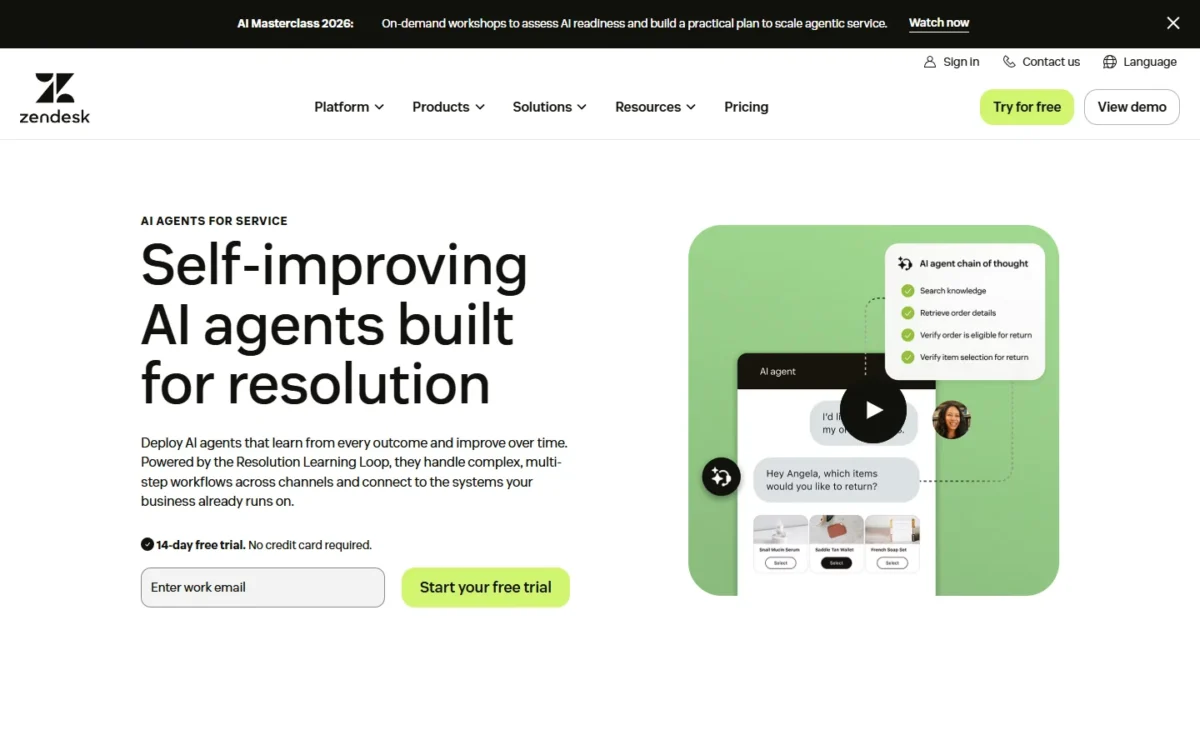
Zendesk Suite is my pick for a support team that has outgrown one channel but does not run a contact center. Its first Suite plan puts ticketing, messaging, live chat, help center and voice support in one workspace, and its pricing page prints the AI agent’s cost per resolution. The trade-off is the add-on layer.
AI agents come with every Suite plan, billed per automated resolution: a request resolved with no escalation to a person. Suite Team includes 5 per agent each month and Suite Professional 10, up to 10k a year.
For 25 agents on Suite Professional, 25 x 10 = 250 resolutions a month are included. Each one after that costs $2.00 pay-as-you-go or $1.50 committed.
Suite Professional is also where skills-based routing appears, and sandbox is an add-on there.
Freshdesk Omni Pro costs less per seat, but Zendesk includes voice in its Suite plans and ties its AI unit to a resolved request rather than a 24-hour session.
Support Team starts at $19 per agent/month paid yearly, an email-first ticketing plan. The platform plans start at Suite Team, $55 per agent/month paid yearly. For 25 agents, Suite Professional comes to 25 x $115 = $2,875 a month before extra resolutions and add-ons.
A voice-heavy team weighing Genesys should also price the Contact Center add-on, with customizable IVR and inbound and outbound calling.
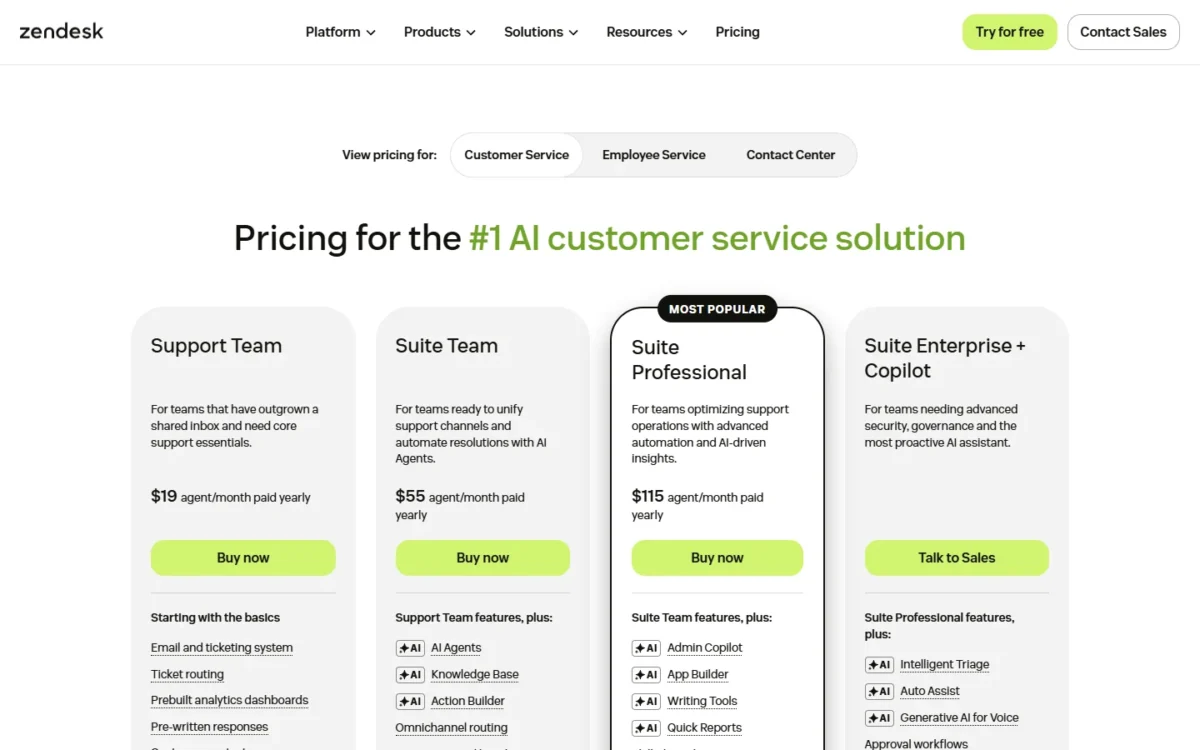
| Plan | Paid yearly | Paid monthly | Key limit |
|---|---|---|---|
| Support Team | $19 per agent/ | $25 per agent/ | Email-first ticketing |
| Suite Team | $55 per agent/ | $69 per agent/ | No skills-based routing |
| Suite Professional | $115 per agent/ | $149 per agent/ | Sandbox is an add-on |
| Suite Enterprise + Copilot | Talk to Sales | Talk to Sales | Price on request |
| Copilot add-on | $50 per agent/ | Not published | Professional and higher |
| Contact Center add-on | $83 per agent/ | Not published | Billed in addition to the plan |
Sources: Zendesk pricing, checked October 2026.
Pros
- Voice support in every Suite plan, from Suite Team
- Printed AI rates: $1.50 committed, $2.00 pay-as-you-go
- Included automated resolutions on every Suite plan
- The 14-day trial includes Copilot
Cons
- Skills-based routing waits for Suite Professional
- Copilot and the Workforce Engagement Bundle cost $50 per agent each
- Suite Enterprise + Copilot is priced through sales
- Voice usage above plan allowances is billed on consumption
Choose it when a team of 20 to 200 agents works across email, chat, messaging and phone, and finance wants an AI cost per resolution before signing.
- Skip it if:
- phone volume sets your staffing and workforce management must sit inside the seat price; Genesys Cloud CX 3 includes it.
My Zendesk review covers the add-on stack, and the Zendesk pricing guide prices every tier line by line.
2. Genesys Cloud CX: Best for Voice-First Contact Centers
- Best for: contact centers where the phone queue sets staffing
- Free plan or trial: none published
- AI agent billing: AI Experience tokens, 250 named or 350 concurrent per org/month included
- Integrations: AppFoundry Marketplace; prebuilt CX Cloud integration with Salesforce
Genesys Cloud CX prints all four of its tiers, so a voice-first center can budget before a sales call. Voice, IVR and outbound campaigns sit in CX 1, digital channels join at CX 2, and workforce management at CX 3. The weak spot is AI cost: tokens come from a pool per org.
The ladder lets a voice center grow channel by channel. Genesys sells a digital add-on license on CX 1 for the agents who need chat or email, so a 25-agent phone team can add digital for five agents instead of moving everyone to CX 2.
License type moves the bill as much as the tier. A named license covers one person, a concurrent license covers users signed in at once at a premium, and an hourly interacting license bills only time with customers. Named and concurrent licenses may not be mixed.
CX 1 to CX 3 share 250 named tokens per org per month, which is 250 / 25 = 10 tokens per agent at 25 agents. Bots consume tokens by session or by voice minute.
All four tiers are priced per user per month on an annual commitment, from CX 1 at $75 to CX 4 at $240. For 25 agents, CX 2 comes to 25 x $115 = $2,875 a month before usage charges.
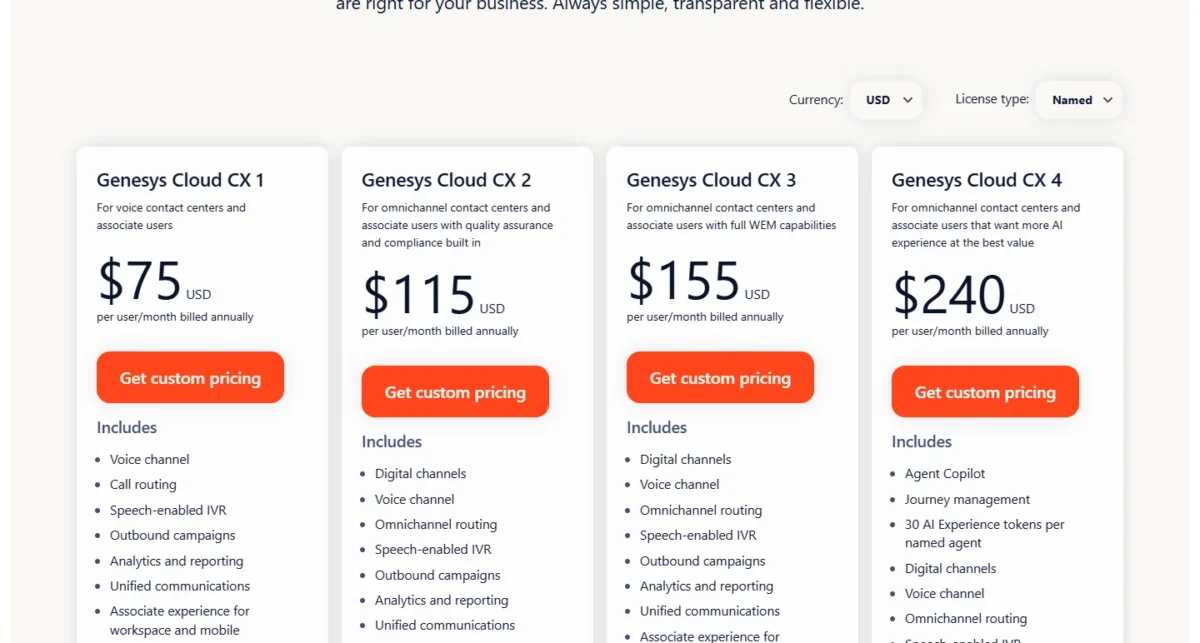
| Tier | Price | Billing | Key limit |
|---|---|---|---|
| CX 1 | $75 per user/ | Billed annually | Digital channels are an add-on |
| CX 2 | $115 per user/ | Billed annually | Workforce management is an add-on |
| CX 3 | $155 per user/ | Billed annually | Shares the org’s token pool |
| CX 4 | $240 per user/ | Billed annually | Adds 30 named tokens per agent |
Sources: Genesys Cloud CX pricing, checked October 2026.
Pros
- Four printed tiers, from voice-only CX 1 to CX 4
- Digital and workforce add-on licenses for a subset of users
- Named, concurrent and hourly interacting licenses
- Workforce management and forecasting from CX 3
Cons
- No printed price for extra AI Experience tokens
- Tokens on CX 1 to CX 3 are pooled per org
- Usage-based pricing may apply on top of the tier
- No free trial published
Choose it when phone volume drives the operation and the team wants a printed path from voice-only seats to workforce management.
- Skip it if:
- most contacts arrive by chat inside a product; Intercom includes live chat, support email and in-app chats on every plan.
3. Salesforce Service Cloud: Best for Enterprise Service on Salesforce Data

- Best for: organizations that already run Salesforce as the system of record
- Free plan or trial: 30-day free trial, no credit card
- AI agent billing: Flex Credits; Max includes 2.75M per org per year
- Integrations: AgentExchange access from Pro Suite; count not published
Service Cloud makes sense only when Salesforce already holds the customer record. Case management, entitlements and the service console then sit on the data the sales team uses. The catch is the purchase list: below Max, contact center, digital channels and Agentforce for Service are marked “Available for purchase” with no printed price.
Core includes Case Management, a Self-Service Help Center and Slack Business+, and Premier Success Plan support comes with Core, Advanced and Max. Advanced adds full sandbox and Backup & Recover, which a regulated team needs before it changes a live process.
Max bundles the platform: Agentforce for Service, digital channels, Partner Contact Center, workforce and quality management, and 2.75M Flex Credits per org per year.
For 25 agents, Max comes to 25 x $550 = $13,750 a month, against 25 x $195 = $4,875 on Core.
Starter Suite and Pro Suite are CRM suites rather than service editions, so Core at $195 per user/month, billed annually, is the realistic floor for a service team.
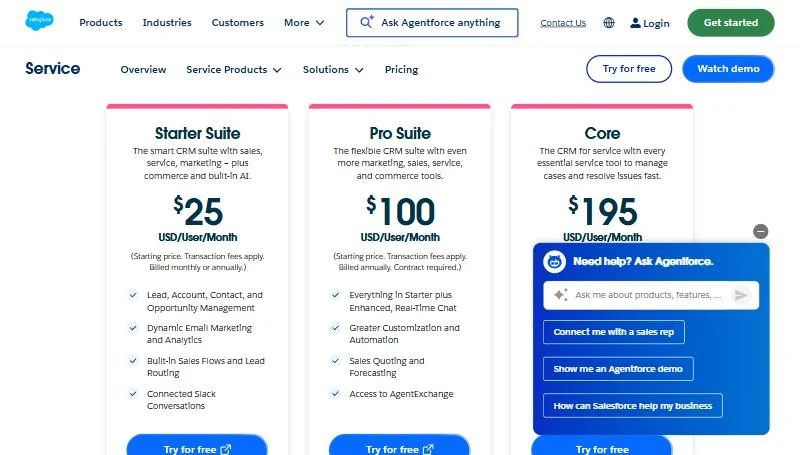
| Edition | Price | Billing | Key limit |
|---|---|---|---|
| Starter Suite | $25 per user/ | Monthly or annually | Transaction fees apply |
| Pro Suite | $100 per user/ | Annually, contract | CRM suite |
| Core | $195 per user/ | Annually | Contact center bought separately |
| Advanced | $395 per user/ | Annually | Adds full sandbox |
| Max | $550 per user/ | Annually | 2.75M Flex Credits per org per year |
Sources: Salesforce Service Cloud pricing, US view, checked October 2026.
Pros
- Service cases on the same Salesforce record as sales data
- Premier Success Plan included with Core, Advanced and Max
- Full sandbox on Advanced
- Max bundles Agentforce, contact center and workforce management
Cons
- Below Max, contact center and Agentforce carry no printed price
- No printed Flex Credit rate beyond the Max allowance
- Core at $195 is the floor for a service team
Choose it when Salesforce is the system of record and the budget covers Core plus the add-ons the service team needs in year one.
- Skip it if:
- your CRM is not Salesforce; Zendesk Suite carries voice and messaging on Suite Team, and a Microsoft 365 organization should price Dynamics 365 Customer Service.
My Salesforce CRM review shows the same edition logic on the sales side, and the Salesforce pricing guide prices the whole estate.
4. Intercom: Best for AI-First, In-Product SaaS Support
- Best for: product-led SaaS teams supporting customers inside the product
- Free plan or trial: 14-day free trial, no credit card, Fin included
- AI agent billing: Fin AI Agent, per outcome
- Integrations: Fin also runs on Salesforce, HubSpot or Freshdesk; count not published
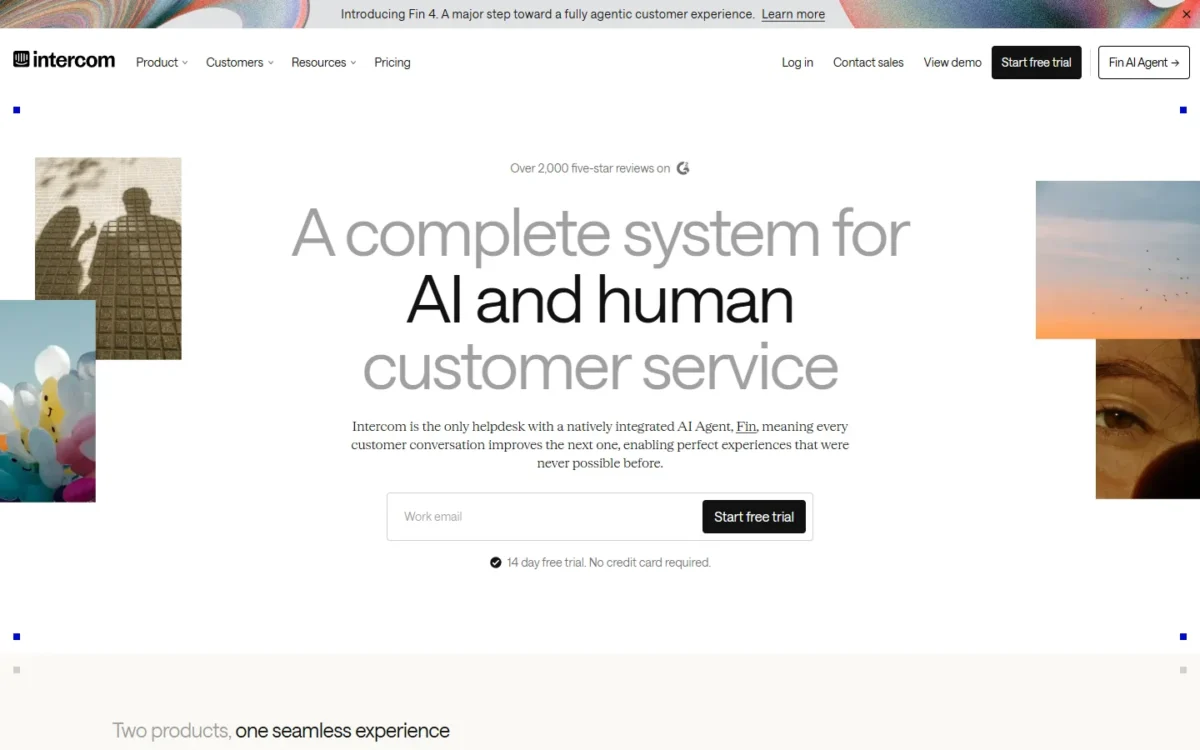
Intercom is the pick when support happens inside the product and the AI agent should answer first. Fin works on every plan at one printed rate, and live chat, support email and in-app chats come free and unlimited on every plan. The trade-off is a bill that moves with Fin’s success, because no outcome allowance is included.
The outcome rule makes the meter workable. Intercom counts an outcome when a customer confirms the fix, asks for nothing more, or Fin completes a workflow, handoffs included. It charges at most once per conversation and nothing if the customer asks for a human.
Spending limits and alerts let finance cap that line. At 500 Fin outcomes a month, Fin adds 500 x $0.99 = $495 to the seat bill, so the limit belongs in the launch plan.
Advanced is the plan most teams need. It adds the workflow automation builder, multiple team inboxes, round robin assignment and 20 free Lite seats.
Fin is also sold on another help desk with no seats, with a minimum monthly commitment of, for example, 50 outcomes. Against Aissist on the same desk, compare Fin’s per-outcome rate with Aissist’s $0.60 cap per chat resolution.
On annual billing, Essential lists $29 per seat/month, shown at $19 for new customers who save 35%. For 25 agents, Advanced comes to 25 x $85 = $2,125 a month before Fin outcomes.
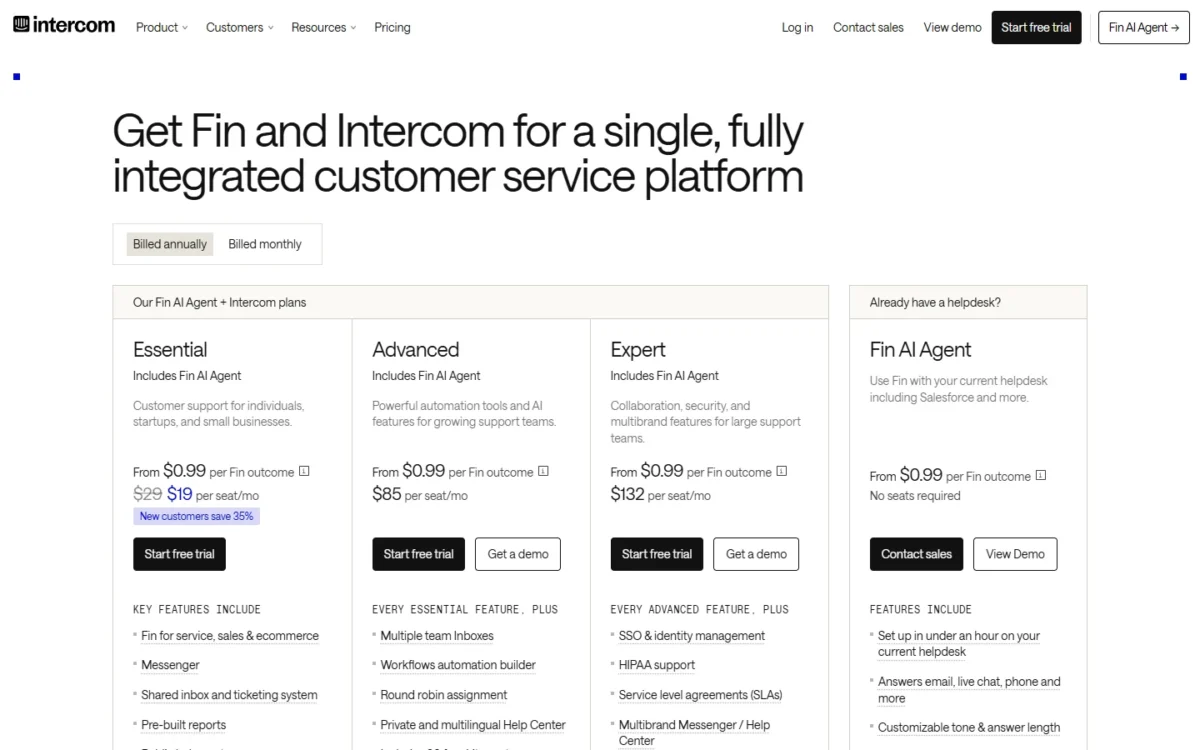
| Plan or add-on | Price | Billing | Key limit |
|---|---|---|---|
| Essential | $29 per seat/ | Annual | Basic automation |
| Advanced | $85 per seat/ | Annual | SSO waits for Expert |
| Expert | $132 per seat/ | Annual | Top listed plan |
| Fin AI Agent | $0.99 per outcome | Usage | No included allowance |
| Copilot | $29 per agent/ | Billed annually | 10 free conversations per agent/ |
Sources: Intercom pricing, annual view, checked October 2026.
Phone is a usage line here. SMS, WhatsApp and phone are pay-as-you-go on every plan, and Fin Voice is sold through sales at $1.99 per voice outcome.
Pros
- One outcome per conversation at most, refunded if the conversation reopens
- No charge when the customer asks for a human
- Free Lite seats: 20 on Advanced, 50 on Expert
- Fin runs on another help desk with no seats
Cons
- No included Fin outcome allowance
- Phone, SMS and WhatsApp are usage-billed
- SSO and HIPAA support only on Expert
- The $19 Essential price is a new-customer offer
Choose it when support is part of the product, most contacts are chat, and finance accepts a variable AI line with a hard limit.
- Skip it if:
- phone calls are a large share of contacts; RingCX Standard includes voice and 20+ digital channels.
My Intercom review goes deeper on Fin and the seat ladder.
A team torn between an outcome meter and a resolution meter can read Zendesk vs Intercom.
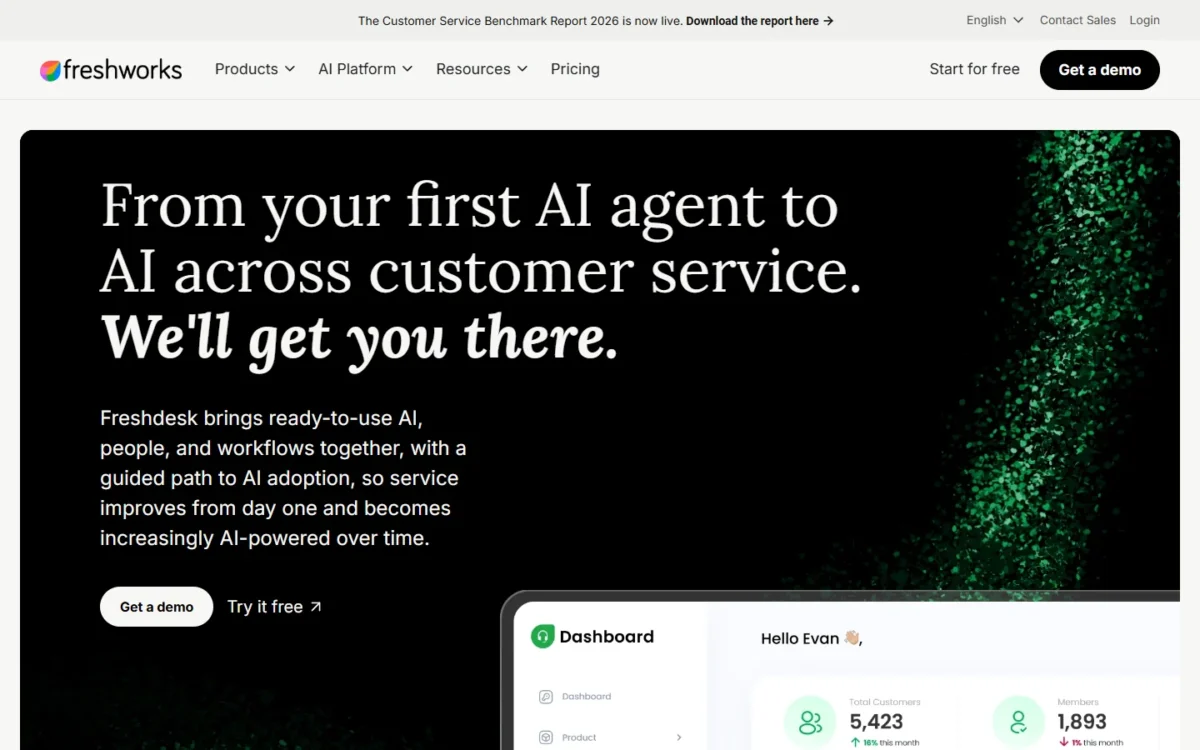
5. Freshdesk Omni: Best Budget Omnichannel Suite Under 100 Agents
- Best for: teams under 100 agents that want one omnichannel workspace on a budget
- Free plan or trial: 14-day trial with Enterprise plan access
- AI agent billing: Freddy AI Agent sessions in packs of 100
- Integrations: agentic workflows for Shopify, Stripe, PayPal and Wix; count not published
Freshdesk Omni gives a budget-led team one omnichannel workspace without a contact center contract. Pro is the plan to budget from because intelligent routing starts there, and single sign-on is listed on every plan, with Freshdesk pricing laying out what each plan adds. The trade-off sits at the top: skill-based routing, sandbox and audit logs are Enterprise features.
Freshworks sells two similar names. Freshdesk is the help desk for service over email, and Freshdesk Omni is the suite across channels, so check which one a quote names.
The AI allowance is smaller than it looks. The 500 free Freddy AI Agent sessions are limited to once per account, not granted each month, and later packs expire with the payment cycle.
A session is not a resolution. A chat session covers every interaction within 24 hours, and an email session one 72-hour window.
Phone is the gap to check. The plan comparison lists bring-your-own telephony on Pro and Enterprise and does not list a native phone line, while Zendesk’s Suite plans include voice support.
Growth costs $29 per agent/month, Pro $79 and Enterprise $119, all billed annually. For 25 agents, Pro comes to 25 x $79 = $1,975 a month.
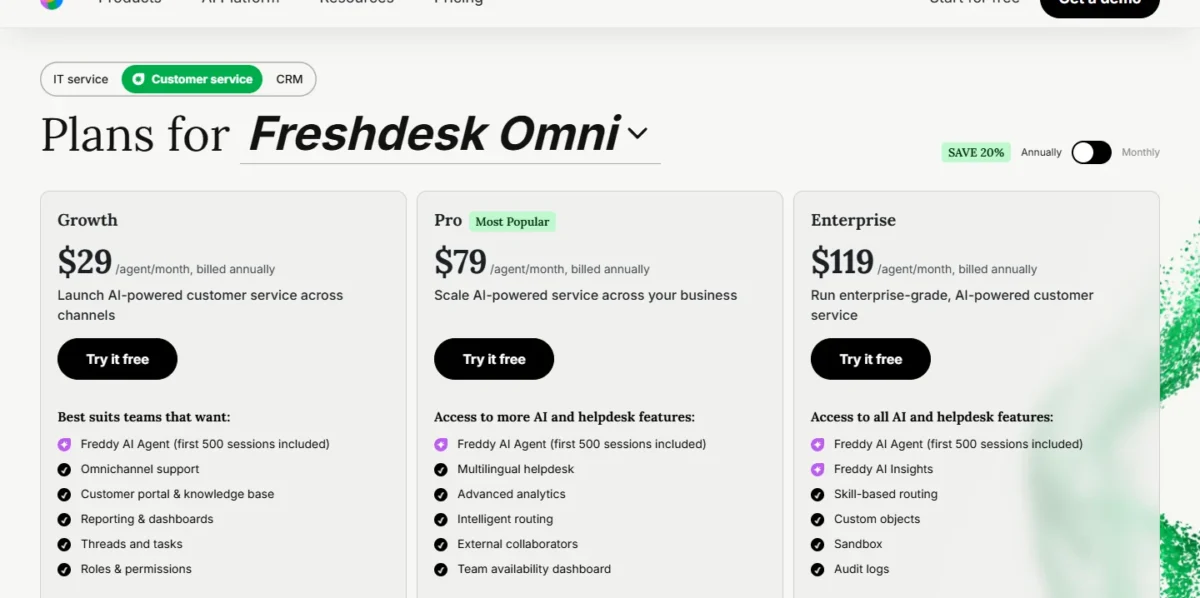
| Plan or add-on | Price | Billing | Key limit |
|---|---|---|---|
| Growth | $29 per agent/ | Billed annually | No Copilot |
| Pro | $79 per agent/ | Billed annually | No skill-based routing |
| Enterprise | $119 per agent/ | Billed annually | Top plan |
| AI Agent sessions | $49 per 100 sessions | Per payment cycle | 500 free, once per account |
| Freddy AI Copilot | $29 per agent/ | Billed annually | Pro and Enterprise |
Sources: Freshdesk Omni pricing, checked October 2026.
Pros
- Pro undercuts Zendesk Suite Professional per seat
- Single sign-on listed on Growth, Pro and Enterprise
- AI sessions sold in packs of 100 at $49
- 14-day trial with Enterprise plan access
Cons
- The 500 free sessions come once per account
- Skill-based routing, sandbox and audit logs only on Enterprise
- No native phone line listed
- Copilot is not offered on Growth
Choose it when the team is under 100 agents, works mostly in email, chat and messaging, and wants a low suite seat that still routes intelligently.
- Skip it if:
- you need native voice in the plan; Zendesk Suite includes voice support from Suite Team, and Dixa includes phone on Growth.
My Freshdesk review covers the help desk edition that Omni builds on.
6. RingCX: Best Low-Cost Contact Center Seat for Voice Plus Digital
- Best for: voice-heavy teams that want digital channels on the same seat
- Free plan or trial: none published
- AI agent billing: customer-facing AI through an IVA partner or AI Receptionist, contact sales
- Integrations: count not published on the pricing page
Among the three contact center platforms here, RingCX prints the lowest seat price that carries voice and digital channels together. Standard lists voice, 20+ digital channels, ACD, IVR and skills-based routing. It is not a help desk: the plan cards list no tickets or knowledge base, so it pairs with the desk a team already runs.
A 25-agent voice team adds digital channels on Standard without a second license, at 25 x $65 = $1,625 a month on annual billing. Genesys charges $115 per user/month for the same pairing on CX 2.
The AI on the plan cards is agent-side. Professional adds AI Quality Management and AI Agent Assist; Elite adds AI Supervisor Assist, AI Interaction Analytics and AI Workforce Management.
As add-ons, the first four start at $25 per user/month. Standard plus one comes to $65 + $25 = $90, close to Professional at $95 with two included, so a team that wants both should buy Professional.
Customer-facing automation is the open item. Self-service runs through an IVA partner or the AI Receptionist add-on, both priced by sales, so get that quote before comparing with Intercom or Aissist.
Standard costs $65, Professional $95 and Elite $145 per user/month, paid annually, and RingCentral says annual payment saves up to 15%. Enterprise Contact Center, with 30+ digital channels, is priced on request.
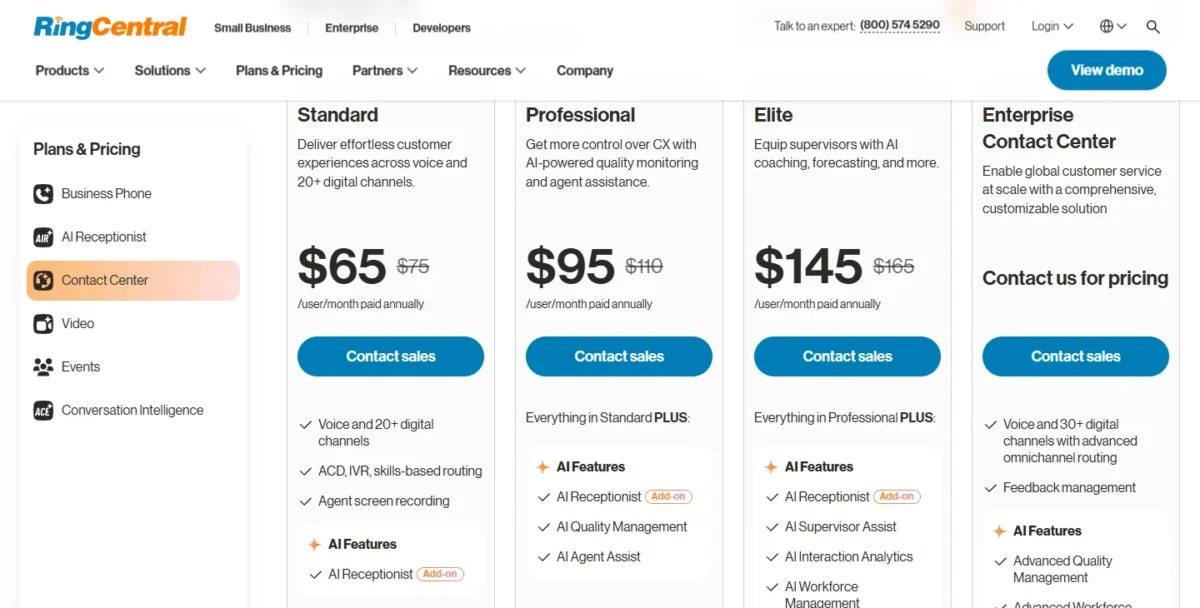
| Plan | Price | Billing | Key limit |
|---|---|---|---|
| Standard | $65 per user/ | Paid annually | AI Receptionist is an add-on |
| Professional | $95 per user/ | Paid annually | No AI Workforce Management |
| Elite | $145 per user/ | Paid annually | IVA partner priced by sales |
| Enterprise Contact Center | On request | Not published | Price on request |
Sources: RingCX pricing, Annually view, checked October 2026.
Pros
- Voice and 20+ digital channels on the Standard seat
- ACD, IVR and skills-based routing included on Standard
- Agent-side AI add-ons from $20 to $25 per user/month
Cons
- No ticketing or knowledge base on the plan cards
- Customer-facing AI priced only by sales
- Integration count not published on the pricing page
Choose it when a voice-heavy team needs digital channels on the same seat and keeps its help desk for tickets and knowledge.
- Skip it if:
- you want tickets, knowledge and voice in one product; Zendesk Suite holds all three on Suite Team.
7. Microsoft Dynamics 365 Customer Service: Best for Microsoft 365 Organizations
- Best for: service organizations on Microsoft 365, Teams and Power Platform
- Free plan or trial: free trial listed on the pricing page
- AI agent billing: Copilot Credits, pay-as-you-go or prepaid Commit Units
- Integrations: Microsoft 365, Teams, Power BI, Power Apps and Power Automate
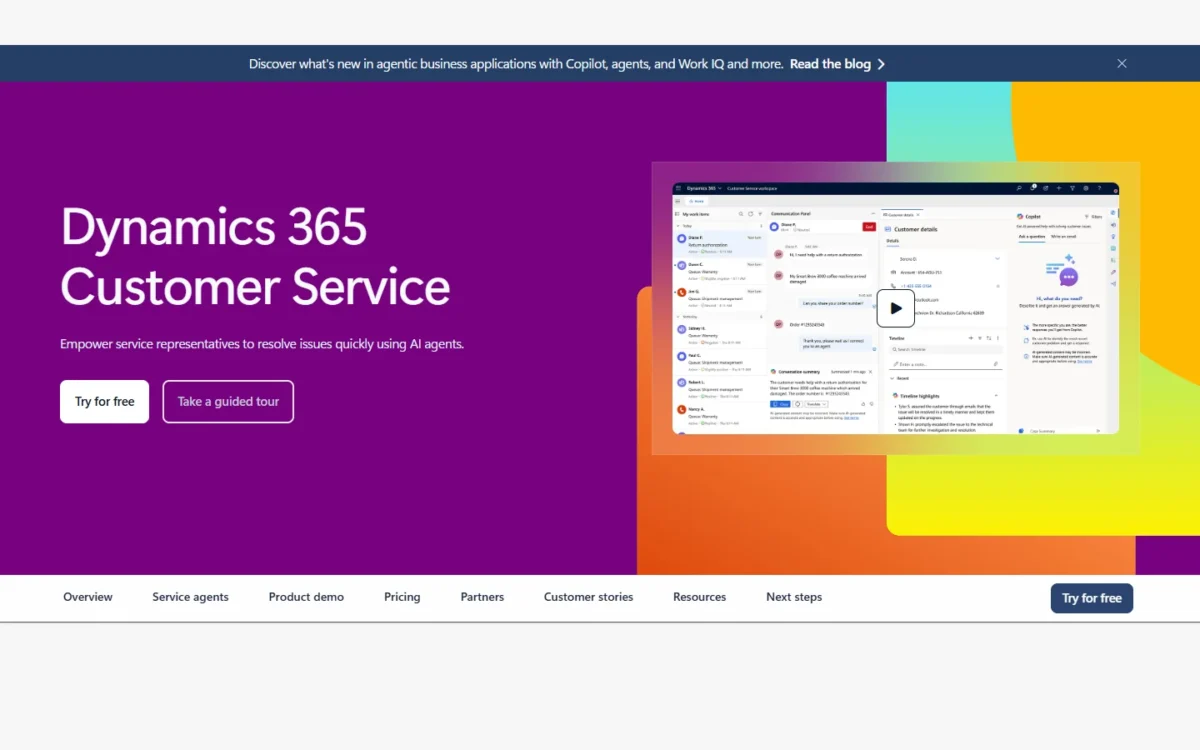
Dynamics 365 Customer Service belongs on the shortlist only when the organization already lives in Microsoft 365. Case management, knowledge, Teams and Power Platform automation then sit in a tenant IT already governs, and Premium adds an integrated contact center. The trade-off is that service agents run on Copilot Credits, with no printed rate.
The plan table lists a Dynamics 365 Contact Center group with self-service chatbots and IVR, chat on messaging and social channels, and voice with inbound routing and outbound calling; confirm in the quote which plan carries voice. Digital messaging capacity is bought through Microsoft Copilot Studio, and Azure Communication Services pricing is separate.
The AI agents split the plans. The Customer Intent, Customer Knowledge Management, Case Management and Quality Evaluation agents need Copilot Credits bought separately on Professional and Enterprise, and come with included capacity on Premium.
Credits are paid as you go at month end, which needs an active Azure subscription, or prepaid as Copilot Credit Commit Units that save up to 20%.
Premium matches Salesforce Core’s seat price but includes base Copilot Credit capacity, while Core buys Agentforce and the contact center separately.
Professional costs $50.00 per user/month, Enterprise $105.00 and Premium $195.00, all paid yearly. For 25 agents, Premium comes to 25 x $195.00 = $4,875 a month before credits, messaging capacity and voice usage.
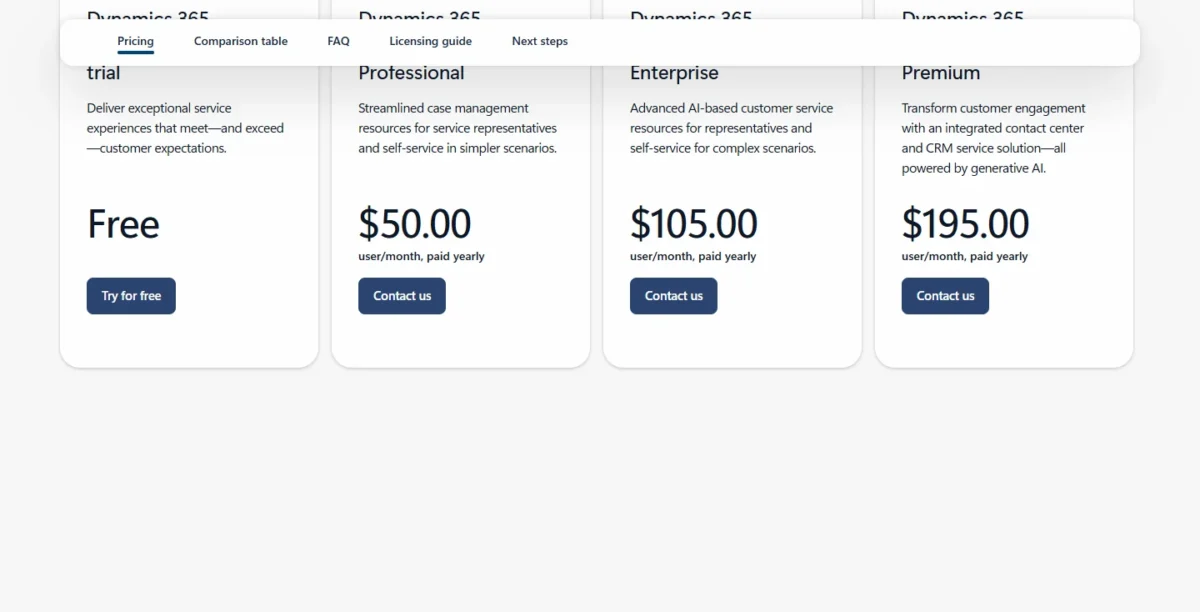
| Plan | Price | Billing | Key limit |
|---|---|---|---|
| Professional | $50.00 per user/ | Paid yearly | Agents need Copilot Credits |
| Enterprise | $105.00 per user/ | Paid yearly | Agents need Copilot Credits |
| Premium | $195.00 per user/ | Paid yearly | Base Copilot Credit capacity included |
Sources: Dynamics 365 Customer Service pricing, US view, checked October 2026.
Pros
- Teams and Microsoft 365 interoperation inside the tenant
- Premium includes base Copilot Credit capacity for its AI service agents
- Prepaid Commit Units lower the credit bill
- Power Apps and Power Automate for custom workflows
Cons
- No printed Copilot Credit rate
- Professional and Enterprise buy agent credits separately
- Voice and messaging capacity are billed outside the seat
Choose it when Microsoft 365 is already the workplace and IT wants service data, Teams and automation in one tenant.
- Skip it if:
- the organization does not run on Microsoft 365; Zendesk Suite reaches voice and messaging on Suite Team without a Power Platform project.
Sales teams can read my review of Microsoft’s sales CRM.
8. Talkdesk: Best for Digital-First Teams Adding Voice Later
- Best for: teams that start on email, chat, SMS and social and add voice within a year
- Free plan or trial: Talkdesk Express for US and Canadian businesses under 50 employees
- AI agent billing: Autopilot, Copilot and Navigator through sales
- Integrations: count not published on the pricing page
Talkdesk lets a team choose its channel family first. Digital Essentials covers email, chat, SMS and social messaging, Voice Essentials covers the phone, and Elite merges both with workforce management. The trade-off: Autopilot and Copilot, the AI agents a buyer compares, carry no printed price.
The split entry plans change the upgrade math. Both Essentials plans for one agent cost $85 + $105 = $190, more than Elite at $165, so a team that needs both channels should go straight to Elite.
Elite adds performance management, workforce management and screen recording to the Essentials features.
Small companies can start on credit. Talkdesk Express includes 25 licenses and $100 in free credit with no contract; RingCX’s pricing page lists no free tier.
Genesys sells one ladder where voice comes first and digital is added. For a team that is digital today, Talkdesk’s order matches the roadmap better.
Talkdesk prints Digital Essentials at $85, Voice Essentials at $105, Elite at $165 and Industry Experience Clouds at $225, each per user, per month. The page states no billing period or seat minimum, so ask for both in the quote.
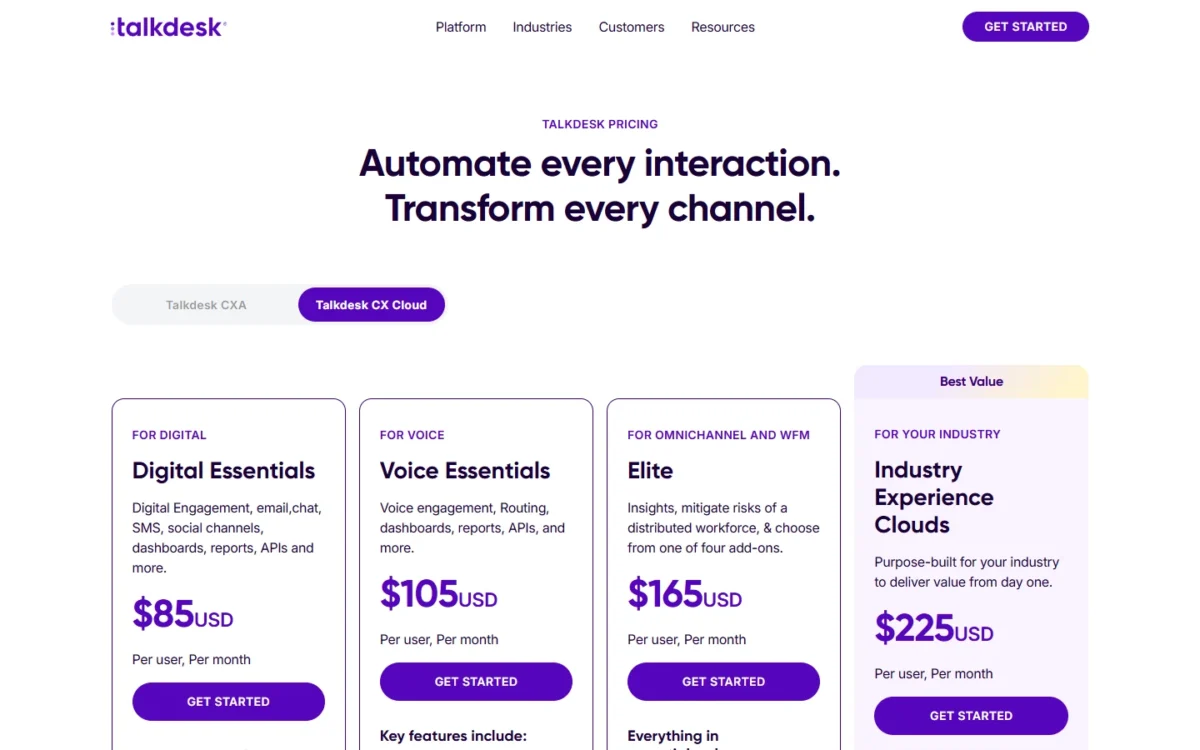
| Plan | Price | Billing | Key limit |
|---|---|---|---|
| Digital Essentials | $85 per user per month | Not stated | No voice |
| Voice Essentials | $105 per user per month | Not stated | Digital engagement not listed |
| Elite | $165 per user per month | Not stated | AI agents priced by sales |
| Industry Experience Clouds | $225 per user per month | Not stated | Government is custom-priced |
Sources: Talkdesk pricing, checked October 2026.
Pros
- Digital-only entry plan with email, chat, SMS and social messaging
- Elite merges voice, digital and workforce management
- Talkdesk Express includes $100 in free credit
- Industry Experience Clouds for seven named industries
Cons
- Voice and digital on one plan only from Elite
- Autopilot, Copilot and Navigator carry no printed price
- Billing period and seat minimum not stated
Choose it when the channel roadmap starts digital and adds voice later, and budget Elite from the start if both are due within a year.
- Skip it if:
- you need voice and digital on day one at the lowest seat price; RingCX Standard lists both.
9. Dixa: Best Flat Per-Conversation AI Pricing for European Teams
- Best for: consumer brands that want phone on the entry plan and a flat AI rate
- Free plan or trial: no self-serve trial; most teams are live in 2-4 weeks
- AI agent billing: Mim, per conversation, usage only
- Integrations: native Shopify and Klaviyo, plus 35 more
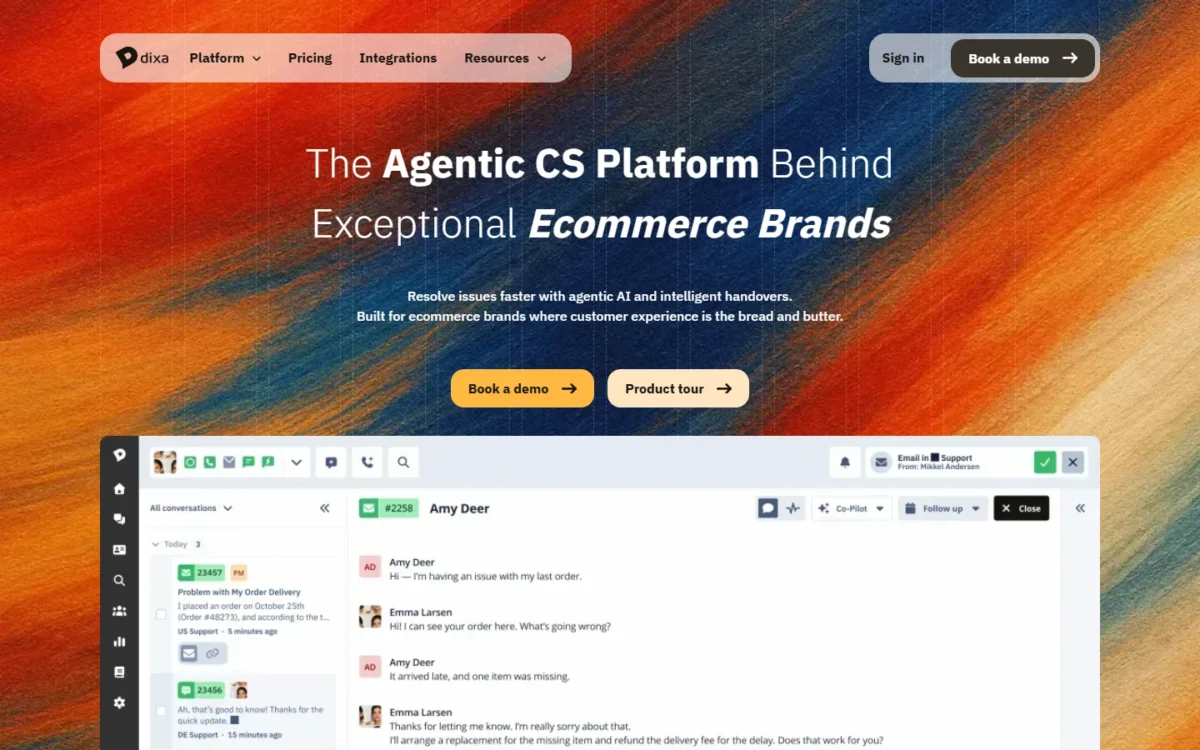
Dixa is the pick for a consumer brand that wants phone on the entry plan and an AI bill it can predict from conversation volume. Growth includes phone, IVR, call recording, callback, SLAs, a knowledge base and Mim, the AI agent. The trade-offs are a euro price list and no self-serve trial.
Dixa’s pricing page shows prices in euros or pounds outside the US, and US prices may differ.
The contact center comes in every plan. For 25 agents, Growth comes to 25 x €89 = €2,225 a month on annual billing, and that seat already carries the phone queue Freshdesk Omni leaves to a carrier.
Mim is priced per conversation at a flat €0.40, usage only, with no allowance cap; Dixa marks that rate “Updated July 2026”. The rate applies whether Mim resolves or hands over, while Intercom charges nothing when a customer asks for a human.
Ultimate adds skills-based routing, sandbox access and advanced automations; Prime adds SSO, an add-on below it. AI Co-Pilot and Quality Assurance are seat-based add-ons on every plan.
On annual billing, Growth costs €89, Ultimate €139 and Prime €179 per agent/month, in euros, and Dixa says annual billing saves 20%.
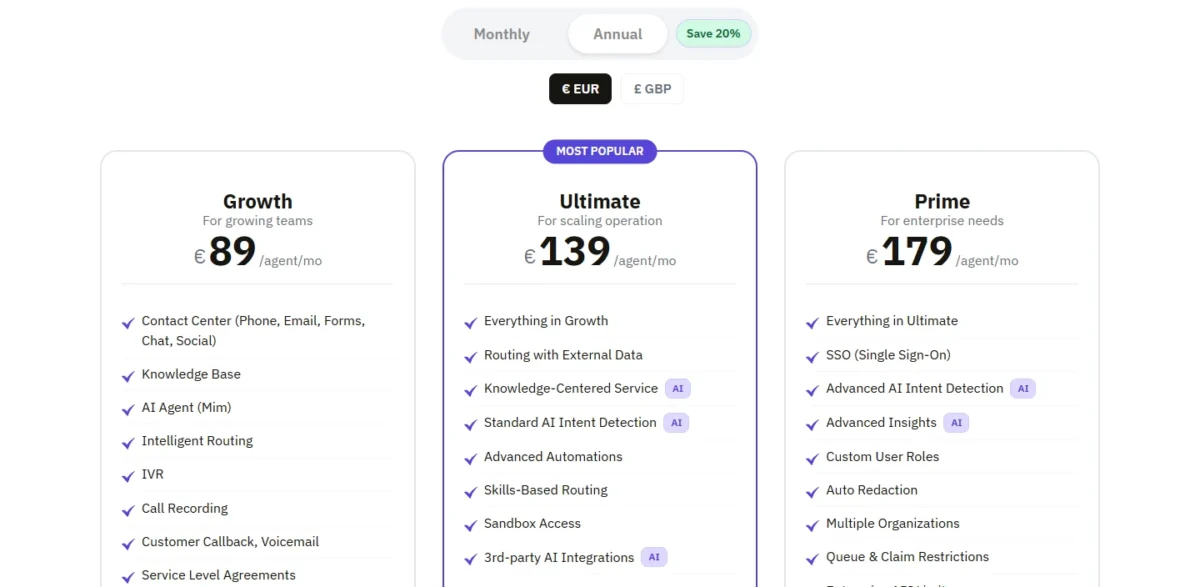
| Plan | Price (EUR) | Billing | Key limit |
|---|---|---|---|
| Growth | €89 per agent/ | Annual | No skills-based routing |
| Ultimate | €139 per agent/ | Annual | SSO is an add-on |
| Prime | €179 per agent/ | Annual | Top plan |
| Mim AI agent | €0.40 per conversation | Usage only | Handovers billed too |
Sources: Dixa pricing, euro prices, annual view, checked October 2026.
Pros
- Phone, IVR, call recording and callback on Growth
- Mim at a flat rate per conversation, with no allowance cap
- Skills-based routing and sandbox on Ultimate
Cons
- Prices here were read in euros, and US prices may differ
- Mim bills handovers as well as resolutions
- No self-serve trial
Choose it when the team sells to consumers, wants voice on the cheapest tier, and prefers a flat AI conversation rate to a resolution meter.
- Skip it if:
- you want a self-serve trial before any demo; Freshdesk Omni offers a 14-day trial with Enterprise plan access.
10. Aissist: Best AI Agent Layer for Teams Keeping Their Help Desk
- Best for: SMB and mid-market support teams that keep their current help desk
- Free plan or trial: Free, up to 1,000 tickets/month, no credit card
- AI agent billing: per AI interaction, capped per resolution; handoffs free
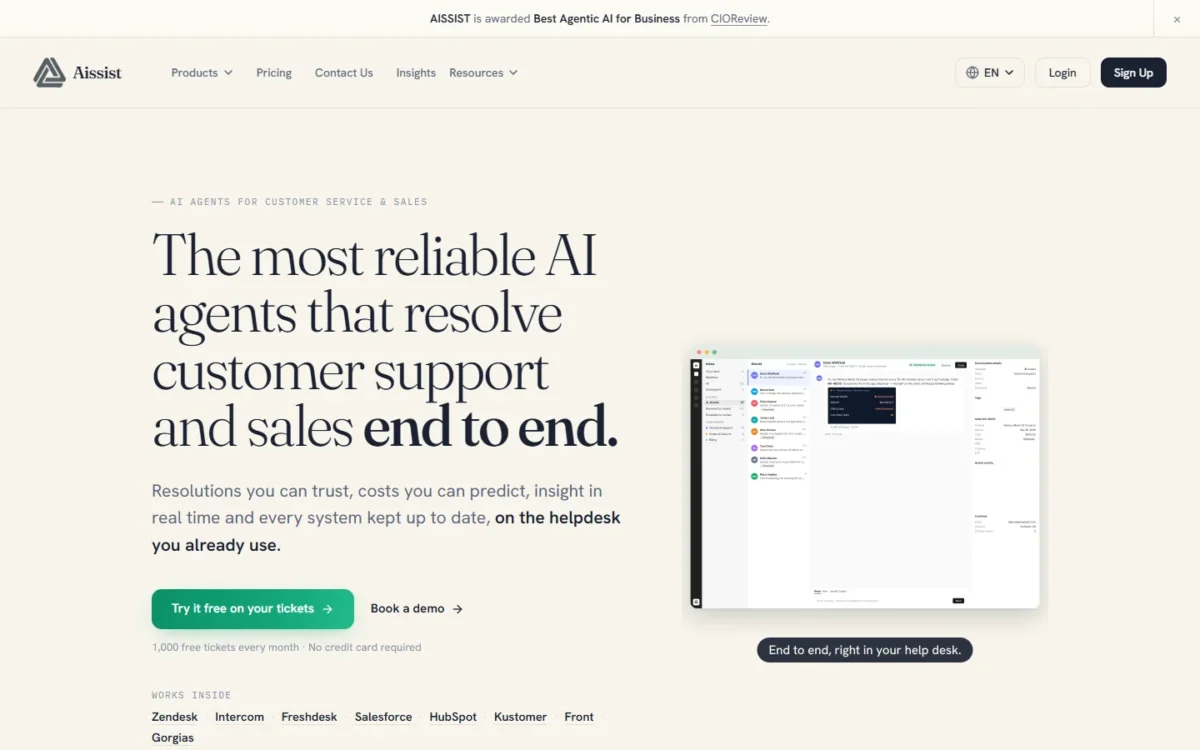
- Help desks: Zendesk, Intercom, Freshdesk, Salesforce, HubSpot, Kustomer, Front and Gorgias
Aissist is not a customer service platform; it is an AI agent inside the help desk a team already runs. That makes it the pick when the desk works and AI resolution is the gap. It ranks tenth because it sells no seats and lists no phone channel, but it caps each resolution’s cost.
The no-migration point is why it is on this list. Aissist calls itself help desk agnostic: it works inside eight named desks and moves with the team if it switches. A Zendesk team paying $2.00 per pay-as-you-go resolution can set that against Aissist’s $0.60 chat cap.
It acts as well as replies. Aissist works in a team’s CRM, order, billing and internal tools to finish multi-step tasks, then closes the case; the homepage names orders and refunds, subscriptions and account changes.
The saved pages do not list which order or billing systems it connects to, so ask for the connector list before a trial. A team sets the guardrails, such as refund limits, verification steps and brand tone.
Handoff is built into the price. Aissist hands a case over with the full conversation attached and says customers can always reach a human in one step.
The Aissist homepage states an 83% average resolution rate and a combined S0 to S2 error rate below 1%. Those are the vendor’s figures; measure your own rate on the Free tier. Aissist also states ISO 27001 certification, GDPR compliance and SOC 2 alignment.
The Free tier covers up to 1,000 tickets a month on an engine scoped to FAQs and basic procedures. Growth meters $0.09 per AI interaction, capped at $0.60 per resolution, whichever is lower, with no contract. Each resolution is capped at $0.20 for email, forms and social, so email-heavy queues cost least.
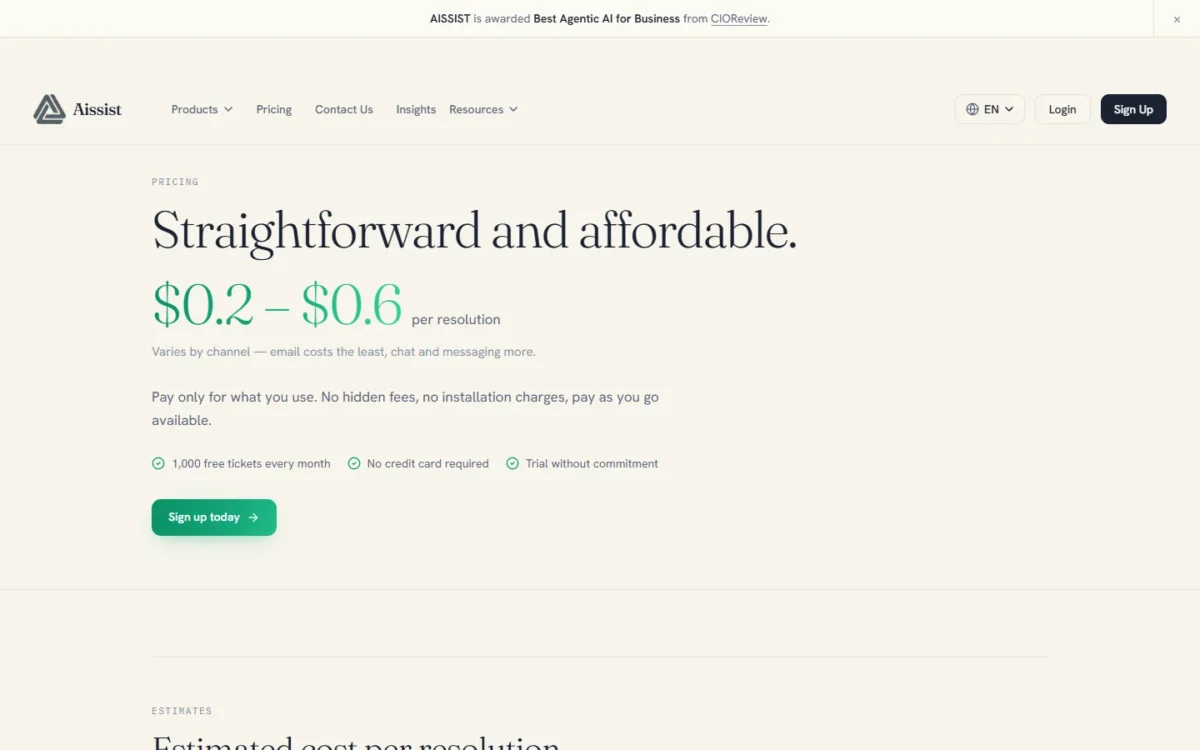
| Tier | Price | Billing | Key limit |
|---|---|---|---|
| Free | Up to 1,000 tickets/ | No credit card | Engine scoped to FAQs and basic procedures |
| Growth | $0.09 per AI interaction | Pay per use, post-usage | Capped at $0.60 per resolution |
| Enterprise | Volume discount | Contract | Priced through sales |
Sources: Aissist pricing, checked October 2026.
For 500 chat resolutions a month at the chat cap, Aissist costs at most 500 x $0.60 = $300 on top of the help desk seats.
Pros
- Works inside eight named help desks, so tickets stay where they are
- Each resolution capped by channel, and handoffs are free
- Free tier of up to 1,000 tickets a month
- Acts in CRM, order and billing tools, then closes the case
Cons
- A second vendor and invoice beside the help desk
- No phone channel listed
- SOC 2 is stated as aligned, not certified
Choose it when the help desk already works and the gap is AI resolution: run the Free tier on real tickets, then move to Growth once your resolution rate justifies the meter.
- Skip it if:
- the AI must answer phone calls, or you are replacing your desk anyway; Intercom sells Fin Voice through sales, and Freshdesk Omni bundles the desk and its AI agent.
What Customer Service Software Costs at 25 Agents
On each section’s recommended plan, 25 agents cost from $1,625 a month on RingCX Standard to $4,875 on Salesforce Core or Dynamics 365 Premium, before AI and usage.
Among the recommended suite plans of Zendesk, Intercom and Freshdesk Omni, Freshdesk Omni Pro costs the least at 25 x $79 = $1,975.
| Platform | Entry plan x 25 | Recommended plan x 25 |
|---|---|---|
| Zendesk Suite | 25 x $55 = $1,375 (Suite Team) | 25 x $115 = $2,875 (Suite Professional) |
| Genesys Cloud CX | 25 x $75 = $1,875 (CX 1) | 25 x $115 = $2,875 (CX 2) |
| Salesforce Service Cloud | 25 x $25 = $625 (Starter Suite) | 25 x $195 = $4,875 (Core) |
| Intercom | 25 x $29 = $725 (Essential) | 25 x $85 = $2,125 (Advanced) |
| Freshdesk Omni | 25 x $29 = $725 (Growth) | 25 x $79 = $1,975 (Pro) |
| RingCX | 25 x $65 = $1,625 (Standard) | 25 x $65 = $1,625 (Standard) |
| Microsoft Dynamics 365 Customer Service | 25 x $50.00 = $1,250 (Professional) | 25 x $195.00 = $4,875 (Premium) |
| Talkdesk | 25 x $85 = $2,125 (Digital Essentials) | 25 x $165 = $4,125 (Elite) |
| Dixa (EUR) | 25 x €89 = €2,225 (Growth, EUR) | 25 x €89 = €2,225 (Growth, EUR) |
| Aissist | No seat price | No seat price |
Sources: seat prices from the Zendesk, Salesforce, Genesys, Intercom, Freshdesk Omni, Microsoft, RingCX, Talkdesk and Dixa pricing pages, checked October 2026; totals are my arithmetic.
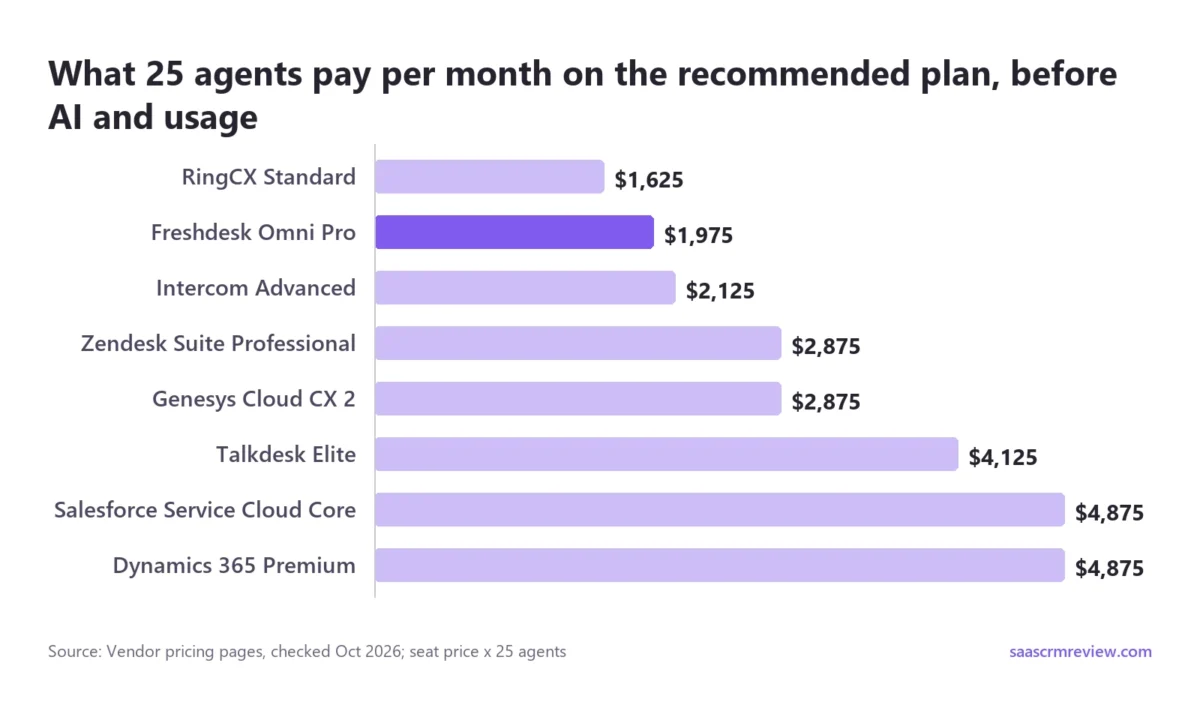
Dixa stays out of the chart because it prices in euros, and Aissist because it charges no seat.
How AI Agents Are Billed: Resolution, Outcome, Session, Conversation, Credit, and Token
The ten picks bill AI in seven units, counting Aissist’s per-interaction meter, and five print a rate.
| Platform | AI billing unit | Printed rate | Included or stated |
|---|---|---|---|
| Zendesk Suite | Automated resolution | $1.50 committed, $2.00 pay-as-you-go | 5 or 10 per agent/ |
| Intercom | Fin outcome | $0.99 per outcome | No allowance |
| Freshdesk Omni | AI Agent session | $49 per 100 sessions | 500 free, once per account |
| Dixa | Mim conversation | €0.40 per conversation, EUR | Handovers billed too |
| Aissist | AI interaction | $0.09 per interaction | Capped per resolution; handoffs free |
| Genesys Cloud CX | AI Experience token | Not published | 250 named tokens per org/ |
| Salesforce Service Cloud | Flex Credit | Not published | 2.75M per org per year on Max |
| RingCX | IVA partner or AI Receptionist | Contact sales | Agent-side add-ons from $20 |
| Microsoft Dynamics 365 Customer Service | Copilot Credit | Not published | Base capacity on Premium |
| Talkdesk | Autopilot | Contact sales | CXA listed on Essentials plans |
Sources: the AI terms on the Zendesk, Intercom, Freshdesk Omni, Dixa, Aissist, Genesys, Salesforce, Microsoft, RingCX and Talkdesk pricing pages, checked October 2026.
The units are not interchangeable. A Freshdesk session spans 24 hours of chat, a Dixa conversation bills even when Mim hands over, and a Zendesk automated resolution excludes anything escalated to a person.
Take an illustrative month for a 25-agent team in which the AI agent resolves 1,000 chats, each inside one session:
- Intercom: 1,000 x $0.99 = $990.
- Zendesk Suite Professional: 25 x 10 = 250 included, then 750 x $2.00 = $1,500 pay-as-you-go, or 750 x $1.50 = $1,125 committed.
- Freshdesk Omni, once the one-time free 500 are used: 10 x $49 = $490.
- Aissist Growth: at most 1,000 x $0.60 = $600.
- Dixa, in euros: 1,000 x €0.40, plus any conversation Mim hands over.
Among the dollar meters, Zendesk’s pay-as-you-go resolution carries the highest unit price. AI performance, measured as resolution rate, matters more than unit price. Zendesk says its AI agents resolve “up to 80%+” of service issues, and Aissist states an 83% average; both are vendor claims, so test your own tickets.
What the AI agent should do before a person sees the thread is covered in my guide to AI customer service workflows.
Setup and Migration Difficulty
Setup effort follows from what each vendor asks a team to configure. Three state a go-live claim: Aissist connects a help desk in about 10 minutes, Intercom sets Fin up in under an hour on a current desk, and Dixa has most teams live in 2-4 weeks.
| Platform | What the vendor states | What to plan for |
|---|---|---|
| Zendesk Suite | 14-day trial; startups get a 6-month trial for up to 50 agents | Routing and help center content |
| Genesys Cloud CX | Named and concurrent licenses may not be mixed | The license model before the quote |
| Salesforce Service Cloud | 30-day free trial, no credit card | Pricing each add-on below Max |
| Intercom | 14-day trial with Fin; Fin on another desk in under an hour | The content Fin learns from |
| Freshdesk Omni | 14-day trial with Enterprise access | Features Pro will not keep |
| RingCX | Plan cards list no tickets or knowledge base | The help desk it pairs with, plus queue and IVR design |
| Microsoft Dynamics 365 Customer Service | Pay-as-you-go credits need an Azure subscription | Azure billing before agents run |
| Talkdesk | Express gets started in minutes, no contract | Digital or Voice Essentials first |
| Dixa | No self-serve trial; most teams live in 2-4 weeks | A demo before hands-on access |
| Aissist | Builds from your help center and past tickets | Guardrails such as refund limits |
Sources: the vendors’ pricing pages linked under the comparison table and the Aissist homepage, checked October 2026.
The knowledge base feeds every AI agent here, so my ranking of help center software covers that layer too.
Ask each vendor in writing which objects import, how duplicates resolve, whether attachments and notes survive, and what happens if an import fails halfway. The CRM migration checklist covers the CRM side.
How to Choose the Best Customer Service Software
The first hard constraint decides the shortlist: voice on day one, the system of record, the AI unit, the governance gate, then the 25-agent total.
| Your priority | Pick | Reason | Trade-off |
|---|---|---|---|
| One queue for email, chat, messaging and phone | Zendesk Suite | Suite Team includes all four with ticketing | Skills-based routing on Suite Professional |
| Voice-led contact center | Genesys Cloud CX | Voice from CX 1, workforce management from CX 3 | No printed token price |
| AI answers most conversations | Intercom | Charged once per conversation at most | No outcome allowance |
| Lowest price per agent among Zendesk Suite Professional, Intercom Advanced and Freshdesk Omni Pro | Freshdesk Omni | Pro at $79 per agent/ | Audit logs and Sandbox are on Enterprise |
| Salesforce or Microsoft holds the record | Salesforce Service Cloud or Microsoft Dynamics 365 Customer Service | Service data in the existing CRM or tenant | AI credits without a printed rate |
| Digital now, voice next year | Talkdesk | Elite merges both channels | Billing period not stated |
| Keep the current help desk | Aissist | Works inside eight named desks | A second vendor |
Sources: the Freshdesk Omni pricing page and the other vendors’ pages linked under the comparison table, checked October 2026.
Channel and Governance Gates: Which Plan Turns Each One On
| Platform | Voice | Skills-based routing | Sandbox | SSO | Workforce management |
|---|---|---|---|---|---|
| Zendesk Suite | Suite Team | Suite Professional | Add-on | Support Team | Add-on |
| Genesys Cloud CX | CX 1 | Not listed | Not listed | Not listed | CX 3 |
| Salesforce Service Cloud | Max | Not listed | Advanced | Not listed | Max |
| Intercom | Pay-as-you-go | Not listed | Not listed | Expert | Not listed |
| Freshdesk Omni | Bring your own telephony | Enterprise | Enterprise | Growth | Not listed |
| RingCX | Standard | Standard | Not listed | Not listed | Elite |
| Microsoft Dynamics 365 Customer Service | Listed, plan not shown | Not listed | Not listed | Not listed | Listed, plan not shown |
| Talkdesk | Voice Essentials | Not listed | Not listed | Not listed | Elite |
| Dixa | Growth | Ultimate | Ultimate | Prime | Not listed |
| Aissist | Not listed | Not listed | Not listed | Not listed | Not listed |
Sources: plan cards and comparison tables on the vendors’ pricing pages linked under the comparison table, checked October 2026.
“Not listed” means the pricing page does not place the control on a plan, not that the product does not have it; ask those vendors for security documentation before the shortlist is final.
Common Mistakes When Choosing a Customer Service Platform
Treating AI prices as one unit. A session, an outcome, a conversation and a resolution count different events; convert each to cost per resolved conversation.
Skipping the migration questions. Get import coverage and rollback in writing before the contract.
Shortlists by Team and Job
- Teams that need a shared queue rather than routing: best ticketing systems.
- IT teams handling employee requests: best ITSM software.
- Teams measuring satisfaction after each contact: best customer feedback tools.
Also Considered: Platforms Reviewed but Not Ranked
Twelve more tools were reviewed and left out, for lack of a published price or because they are help desks ranked on my help desk list.
- Five9: its homepage routes buyers to a demo and to sales rather than to plan prices.
- Kustomer: its pricing page says it does not post “one-size-fits-all pricing”.
- Gladly: its pricing URL serves a product page with no plan prices.
- Zoho Desk: a help desk with a 3-user Free edition; see my Zoho Desk review.
- Help Scout: a help desk with AI Answers at $0.75 per resolution; see my Help Scout review.
- Freshdesk: the email-first help desk edition, from $19 per agent/month billed annually.
- HubSpot Service Hub: a seat-priced help desk with HubSpot Credits included by edition.
- Gorgias: an e-commerce help desk, covered in my Gorgias review.
- LiveAgent: an AI-powered help desk with live chat, ticketing and a call center, which places it with the help desks rather than these ten.
- Front: a customer service platform across email, chat, SMS and WhatsApp; as one of the desks Aissist runs inside, it sits on the help desk side.
- Hiver: sold as Hiver Omni, an omnichannel platform, and as Hiver in Gmail, a Gmail-native help desk.
- Groove: its maker now sells Helply, an AI-native customer support platform with unlimited users on every plan; I weigh Groove against help desks.
Frequently Asked Questions
Is there free customer service software?
Yes, with limits. Aissist’s Free tier covers 1,000 tickets a month on a desk you already run, and Zoho Desk and Help Scout offer free help desk plans for small teams. Talkdesk Express gives US and Canadian businesses under 50 employees $100 in free credit rather than a free plan.
What are the top ticketing tools?
For a ticket queue without voice routing, I would start with Zoho Desk, Help Scout, Freshdesk, Zendesk or HubSpot Service Hub. They are help desks rather than platforms, and what a ticketing system is explains where tickets end and a contact center begins.
Is Zendesk Suite better than Freshdesk Omni?
For a team that needs voice in the plan, yes: Zendesk’s Suite plans include voice support, while Freshdesk Omni lists bring-your-own telephony. For chat and email under 100 agents, Omni Pro at $79 per agent/month costs less than Suite Professional at $115, both billed annually.
Do I need a contact center or a customer service suite?
Choose a contact center (Genesys, RingCX or Talkdesk) when phone volume sets staffing and tickets live elsewhere. Choose a suite (Zendesk Suite, Freshdesk Omni, Intercom or Dixa) when one team owns tickets, knowledge and chat.
Final Verdict
For a team of 20 to 200 agents across several channels, Zendesk Suite is my pick: budget from Suite Professional and model resolutions past the included 10 per agent. For a voice-first center, Genesys Cloud CX gives the clearest tier path, and RingCX the cheaper seat when tickets live in another desk.
For AI-first support inside a SaaS product, choose Intercom and set Fin’s spending limit before launch. On a budget under 100 agents, choose Freshdesk Omni Pro, and pay for Enterprise only if sandbox and audit logs are required.
When Salesforce or Microsoft 365 holds the customer record, price Service Cloud from Core or Dynamics 365 Premium. Talkdesk fits a team that is digital today, and Dixa a consumer brand that wants phone on the entry plan and a flat AI rate.
If the help desk works and only AI resolution is missing, try Aissist on the Free tier before switching platforms. Whatever the shortlist, price the plan that carries voice at real headcount and convert the AI meter into a price per resolved conversation.