
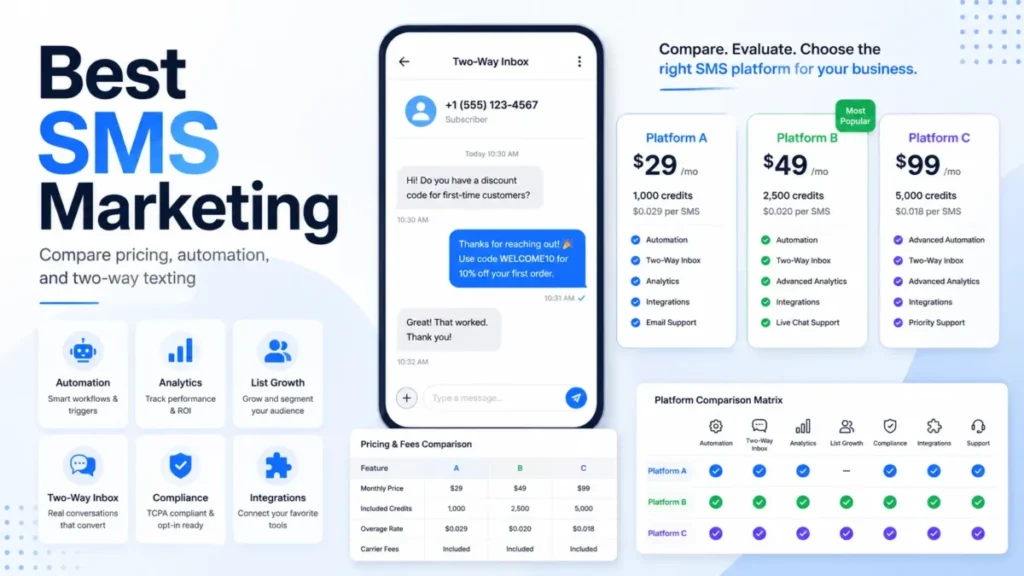
The hardest part of picking the best SMS marketing platform is not the feature list. It is that no two vendors bill the same way.
One charges a platform fee. One charges credits.
One charges $0 and then holds you to a $49 monthly minimum spend. One charges per message segment and adds a carrier fee on top.
I pulled every US price on this page from official pricing pages on July 13, 2026, then rebuilt them into one cost model. The result changes the ranking most roundups give you.
For US and Canadian teams running campaigns without a developer, SimpleTexting is the safest first choice. Klaviyo wins when SMS must share a customer profile with email, the same logic that shapes our ranking of the best email marketing platforms.
Attentive is the enterprise retail pick, Postscript is the Shopify pick, and Twilio has the lowest published transport rate here, but it can become expensive to own for teams without in-house engineering.
Here is a cost detail many comparison tables understate in the comparison table: the $29 plan is rarely $29, and the message you send is rarely one billable unit.
In This Article (33 sections)
Quick Verdict: Best SMS Marketing Platform by Use Case
| Use case | Best pick | Why it fits |
|---|---|---|
| Best overall for self-service teams | SimpleTexting | Broad SMS-native toolset, transparent credit config, API included |
| Best for ecommerce data, email and SMS in one profile | Klaviyo | One behavioral profile drives email flows and mobile credits |
| Best for enterprise retail and DTC programs | Attentive | Custom quote bundles strategy, onboarding and deliverability support |
| Best for Shopify-first stores | Postscript | Native Shopify order and customer events drive segmentation |
| Best full feature access at a low tier | SlickText | Core tools open by volume, not by plan gate |
| Best ecommerce suite with push and email | Omnisend | Pro tier runs email, SMS and push in shared automations |
| Best for beginners and local organizations | EZ Texting | Guided setup with A2P carrier registration support included |
| Best budget pick for large contact lists | Textedly | Unlimited contacts and message-volume tiers |
| Best pay-as-you-go and international option | Textmagic | Prepaid credit, global reach, unlimited users and contacts |
| Best for developer-built messaging | Twilio | $0.0083 per US segment with full programmable control |
Two picks need a caveat before you shortlist from this table. Textedly’s $29 entry becomes $37 once the mandatory telecom surcharge lands, and Twilio’s rate excludes the campaign software you would have to build.
How We Chose and Ranked These SMS Marketing Platforms
We evaluated 10 platforms using official product pages, official pricing pages, help centers, API documentation, and compliance pages. Pricing was verified on July 13, 2026.
No account-level hands-on testing was performed for this article. Where user experience appears below, it is labeled as reviewer patterns from G2, Capterra and TrustRadius, not as our own usage.
Ranking weight went to evidence a buyer can act on: total cost after mandatory fees, plan gates, credit mechanics, launch timelines, two-way workflow, integration depth, geographic reach, and documented limitations.
We did not rank by brand popularity or affiliate payout. A product that is weak for a given buyer intent sits lower, and every platform on this page carries at least one real disqualifier.
The method has one limit worth stating. Attentive quotes custom pricing, Klaviyo and Omnisend use dynamic calculators, and carrier pass-through fees move with your recipient mix, so treat every total here as a modeling input rather than a quoted invoice.
The Three Problems Every SMS Marketing Buyer Faces
Every buyer in this category hits the same three walls, and Many of them are easy to miss on a vendor pricing page.
Problem 1: the advertised price is not the invoice. Entry prices exclude some mix of phone numbers, carrier pass-through fees, A2P 10DLC registration, telecom surcharges, extra seats, and minimum spend.
Problem 2: one message is not one billable unit. A single campaign text can consume two or three credits depending on characters, emoji, message type, and recipient count.
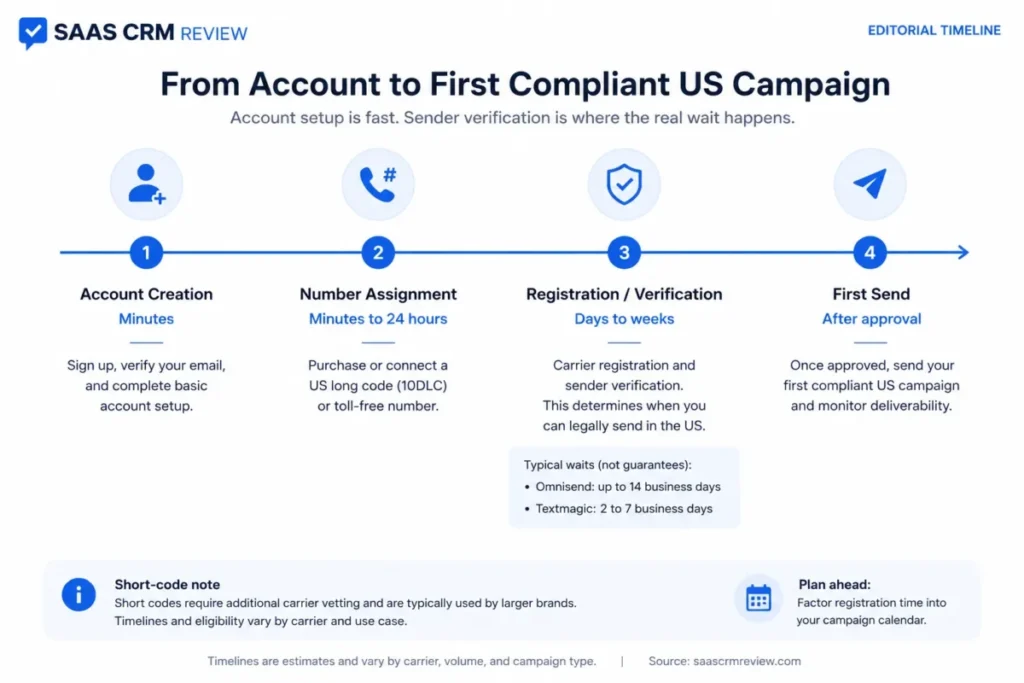
Problem 3: signing up is not launching. Carrier registration and sender verification sit between your account and your first legal US campaign, and documented waits run from same-day to 14 business days.
The rest of this guide follows those three problems, then the ranked reviews, then the implementation and switching decisions that arrive after you sign.
SMS automation obeys the same triggers, segments and timing logic as every other channel, so read up on how marketing automation works if this is your first lifecycle program.
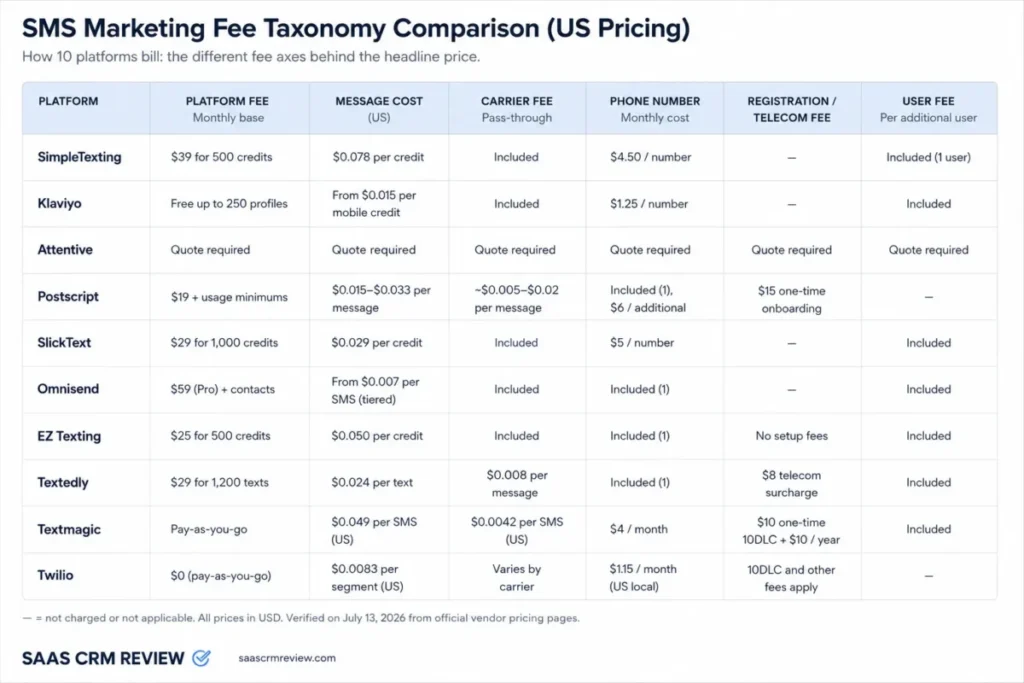
The SMS Marketing Fee Taxonomy: What You Pay Beyond the Plan
Ten vendors, ten billing models. This is the layer most comparison tables skip.
| Platform | Base platform cost | Message cost | Carrier fees | Phone number | Registration or telecom fee | Extra user fee |
|---|---|---|---|---|---|---|
| SimpleTexting | $39/mo at 500 credits | Included credits, then $0.055 | Apply on top | $10/mo per extra number | $4 one-time local-number registration | $20/ |
| Klaviyo | Free to 250 profiles, then dynamic | Mobile credits, bought separately | Handled inside credit model | Free toll-free path, short code by application | Included in credit model | Not disclosed on reviewed pages |
| Attentive | Custom quote | Included in quote | Included in quote | Included in quote | Included in quote | Custom |
| Postscript | $0 platform fee, $49/mo minimum spend | $0.009 SMS, $0.045 MMS | Passed through, avg $0.00418 SMS | Free verified toll-free, short code $750/mo | Included | Not disclosed on reviewed pages |
| SlickText | $29/mo at 500 credits | Included credits by tier | Apply on top | One premium number included | Included | Not disclosed on reviewed pages |
| Omnisend | Pro from $59/ | Separate SMS subscription, from $0.007 | Handled inside SMS subscription | Toll-free number | Included | Not disclosed on reviewed pages |
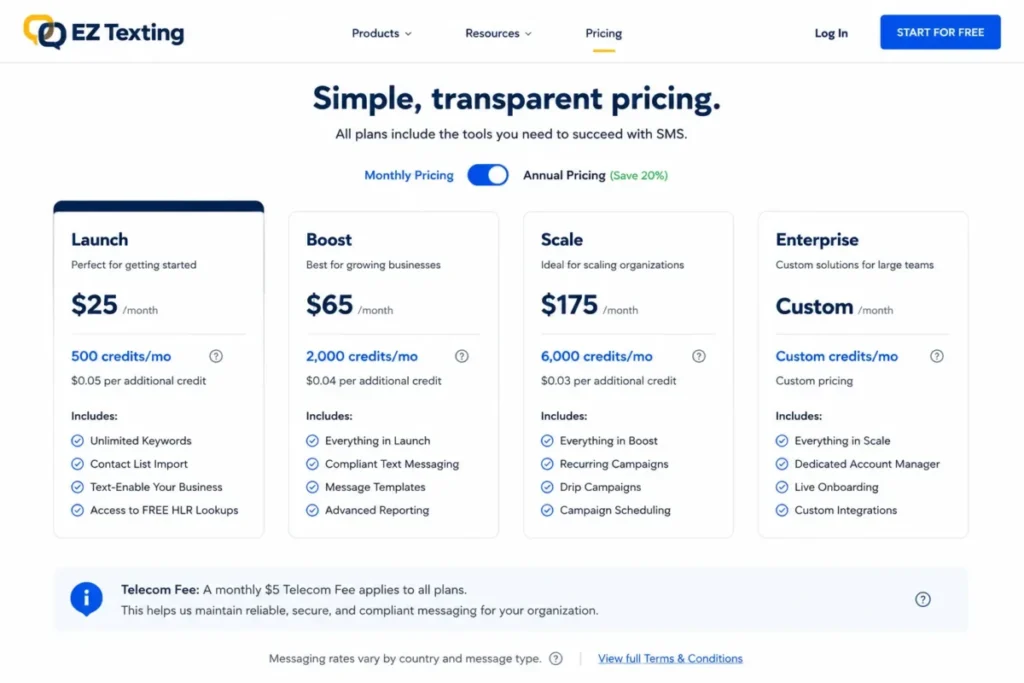
| EZ Texting | $25/mo Launch, $20/mo annual | 500 credits, then $0.04 | Apply on top | Local number included | $5/mo Telecom Fee on Launch | Launch includes one user |
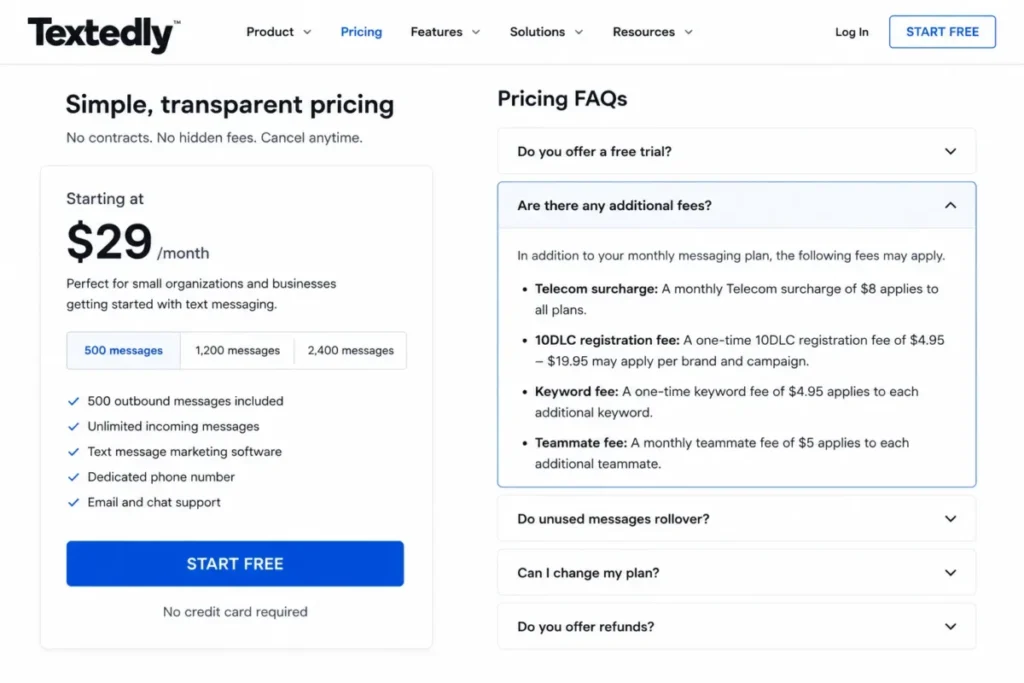
| Textedly | $29/mo at 500 messages | 500 included, $30 per extra 500 | Apply on top | Included | $8/mo Telecom surcharge, plus $4 to $44 10DLC | $10 per teammate |
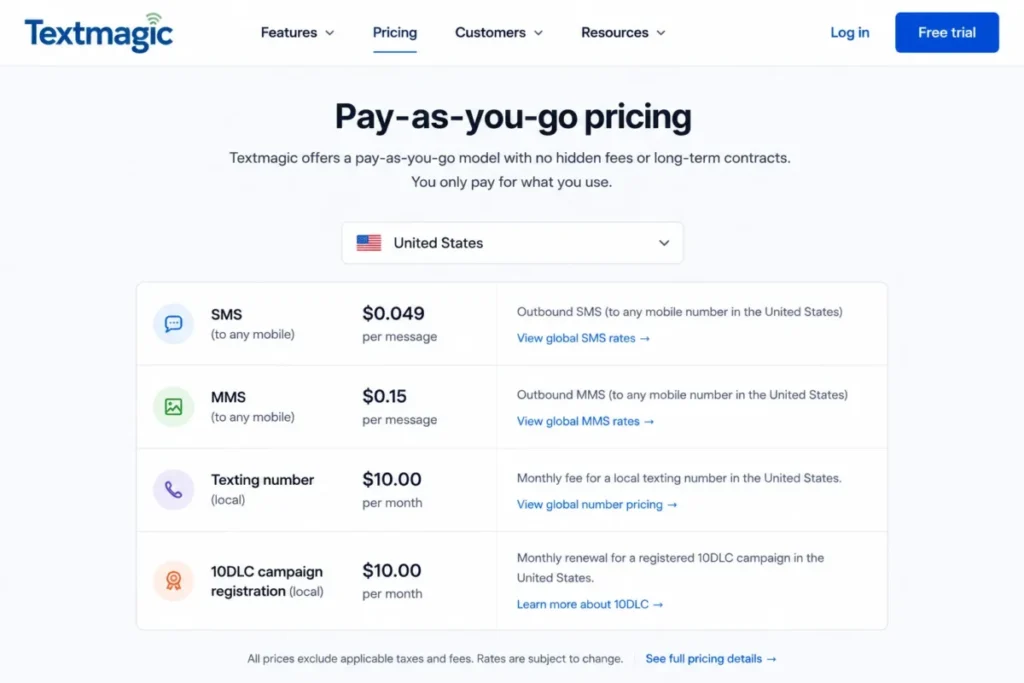
| Textmagic | None, prepaid credit | $0.049 SMS, $0.08 MMS | Apply on top | $10/mo after first month | $10/mo local-number 10DLC renewal | Unlimited users |
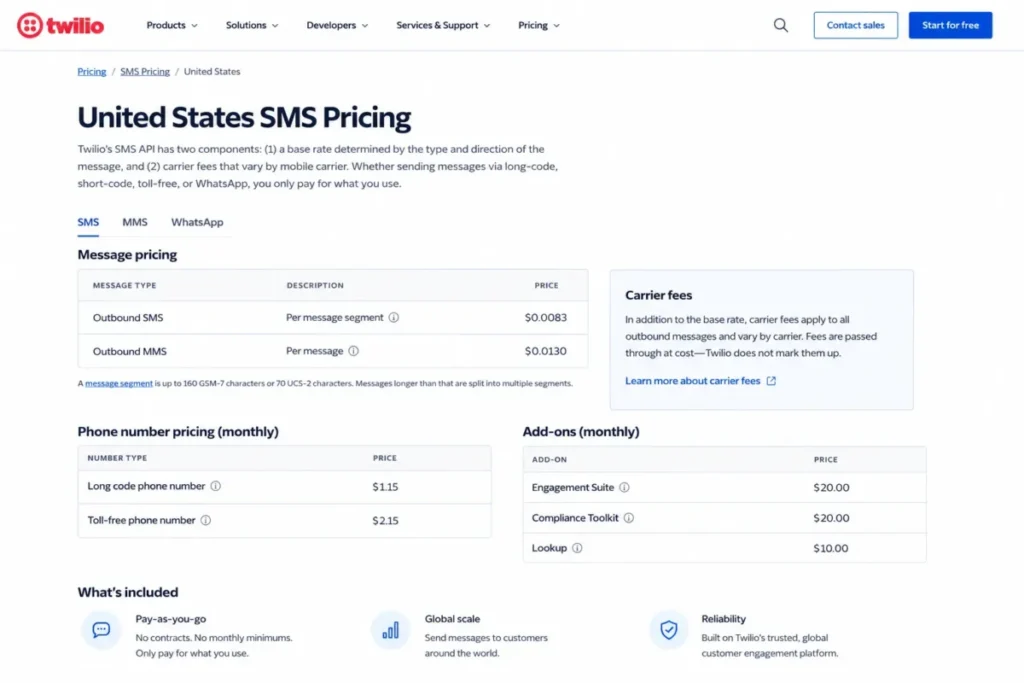
| Twilio | None, usage-based | $0.0083 per US segment | Apply on top, varies by carrier | $1.15/mo long code, $2.15 toll-free | A2P registration fees apply | No seat model |
Read the fee columns before the base column. Postscript’s “$0” and Textedly’s “$29” are the two lines most likely to mislead a first-time buyer, because one carries a minimum spend and the other carries a mandatory surcharge.
Pricing checked: July 13, 2026. Carrier fees, taxes and negotiated terms change, so confirm your exact configuration at checkout.
How SMS Pricing Units Work: Credits, Messages and Segments
A billable unit is not a campaign. Use this formula before you choose a tier.
Billable units = recipients x segments per message x message-type multiplier.
A standard SMS holds 160 GSM-7 characters. Klaviyo and Omnisend both document that one emoji or special character drops that ceiling to 70 characters, which pushes a normal-length text into a second segment.
Send a 150-character promo to 5,000 subscribers and you use 5,000 units. Add one emoji and the 70-character limit applies, so the same message splits into multiple segments per recipient and the bill rises with it.
MMS is the other multiplier. SimpleTexting, Klaviyo, SlickText and EZ Texting all document MMS consuming up to three credits per recipient, so a picture message to 5,000 people is closer to 15,000 units.
| Unit rule | SimpleTexting | Klaviyo | SlickText | EZ Texting | Twilio |
|---|---|---|---|---|---|
| Standard SMS | 1 credit | 1 mobile credit | 1 credit | 1 credit | 1 segment |
| Emoji or Unicode | Extended message can bill 2 credits | Extra segments consume extra credits | Extra credits by length | Extra credits by length | Extra segments billed |
| MMS | 3 credits | 3 mobile credits | 3 credits | Up to 3 credits | Separate $0.022 rate |
| Inbound reply | Free | Requires a customer-initiated conversation | Free | Counted by plan rules | $0.0083 per segment |
The budgeting rule I use: take your subscriber count, multiply by planned monthly sends, then add 40% for segment overflow and MMS before choosing a credit tier. A tier that fits on paper fails in December.
SMS Marketing Cost at Scale: 1,000 to 25,000 Segments
Entry-price rankings collapse under volume. This table models monthly US cost from publicly documented rates only, holding message type to plain SMS and excluding tax.
| Platform | 1,000 segments | 5,000 segments | 10,000 segments | 25,000 segments | Model basis |
|---|---|---|---|---|---|
| SimpleTexting | $66.50 | $286.50 | $561.50* | $1,386.50* | $39 base plus $0.055 extra credits |
| Klaviyo | Calculator | Calculator | Calculator | Calculator | Profiles plus mobile credits |
| Attentive | Quote | Quote | Quote | Quote | Custom usage-based |
| Postscript | $49.00 | $65.90 | $131.80 | $329.50 | $49 minimum, then $0.009 plus $0.00418 carrier |
| SlickText | $29 tier plus overage* | Volume tier | Volume tier | Volume tier | $29 at 500 credits, higher tiers by volume |
| Omnisend | About $66 | About $94 | About $129 | About $234 | Pro floor $59 plus SMS from $0.007 |
| EZ Texting | $50.00 | $210.00 | $410.00* | $1,010.00* | $25 plus $5 fee plus $0.04 overage |
| Textedly | $67.00 | $307.00 | $607.00* | $1,507.00* | $37 base plus $30 per extra 500 |
| Textmagic | $69.00 | $265.00 | $510.00 | $1,245.00 | $20 fixed plus $0.049 per SMS |
| Twilio | $9.45 plus carrier | $42.65 plus carrier | $84.15 plus carrier | $208.65 plus carrier | $1.15 number plus $0.0083 per segment |
*Upper bound. SimpleTexting, SlickText, EZ Texting and Textedly all publish higher-volume tiers whose per-unit rates live inside the official configurator, so real cost at 10,000 and 25,000 segments sits below this entry-rate extrapolation. Omnisend’s row assumes the $59 Pro floor and the advertised $0.007 rate, both of which move with contact count and spend tier.
Confirm your tier before you budget.
Two findings survive the caveats. Postscript is the cheapest fully published turnkey option at 1,000 and 5,000 segments, and Omnisend overtakes it around 10,000 segments if your spend tier holds the advertised $0.007 rate.
That crossover is fragile. At Omnisend’s alternative documented rate of $0.009, the same 10,000 segments cost about $149 and Postscript wins again, so confirm your tier in the calculator before you switch on that basis.
Twilio’s $84.15 at 10,000 segments is transport only. Postscript’s published average US carrier fee of $0.00418 per SMS, used here purely as a reference figure and not as Twilio’s own rate, would add roughly $42 to that number and close most of the gap to Postscript’s $131.80.
Postscript’s own tiers hide a third finding. Growth costs $100 per month and cuts the rate to $0.008, so on rate alone ($100 divided by the $0.001 saving) that fee only repays itself near 100,000 monthly segments.
Buy Growth for unlimited keywords and live support, not for the message discount.
Best SMS Marketing Platforms at a Glance
| Rank | Platform | Best for | Starting price | Free plan or trial | Key limitation |
|---|---|---|---|---|---|
| 1 | SimpleTexting | Self-service US and Canada teams | $39/mo at 500 credits | Free trial, no card | US and Canada only |
| 2 | Klaviyo | Ecommerce email plus SMS in one profile | $0 free plan | Free to 250 profiles | Credits never roll over |
| 3 | Attentive | Enterprise retail and DTC | Custom quote | Trial via sales | No public pricing |
| 4 | Postscript | Shopify-first stores | $0 fee, $49/mo minimum | $100 trial credit | Shopify-centered data model |
| 5 | SlickText | Teams that want features without tier gates | $29/mo at 500 credits | 14-day trial | Campaign fails on low credits |
| 6 | Omnisend | Ecommerce email, SMS and push | Pro from $59/mo | Free platform tier | New accounts need Pro for SMS |
| 7 | EZ Texting | Beginners and local organizations | $25/mo plus $5 fee | 14-day trial | Launch includes one user |
| 8 | Textedly | Large lists, simple campaigns | $29/mo plus $8 surcharge | 14-day trial | Surcharge and 10DLC fees stack |
| 9 | Textmagic | Pay-as-you-go and international | $0.049 per SMS | Test credit, no card | Number and 10DLC renewals |
| 10 | Twilio | Developer-built messaging | $0.0083 per segment | Trial account | No marketing application |
Rank order reflects fit for a general US buyer shopping for SMS marketing software. If you run a Shopify store or an enterprise retail program, read ranks 3 and 4 first, because category fit beats general fit every time.
1. SimpleTexting: Best Overall SMS Marketing Platform

- Best for:
- one-to-five-person US and Canadian marketing, nonprofit and local-service teams that want no-code campaigns, a two-way inbox and API access without a developer.
- Not best for:
- programs with subscribers outside the US and Canada, or teams optimizing purely for the lowest per-message rate.
SimpleTexting, part of Sinch since 2021, is the safe default on this list. It earned rank one on balance, not on any single feature: SMS-native depth, an included API, three published seats and a two-way inbox at a transparent credit price.
- Starting price:
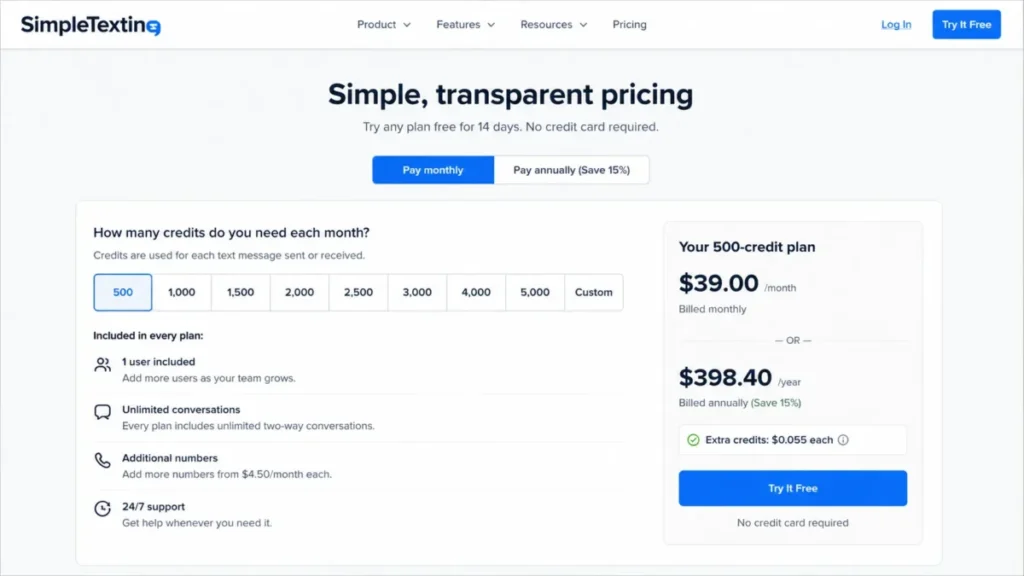
- $39 per month for the 500-credit configuration, or $398.40 billed annually, which works out to $33.20 per month.
Pricing checked: July 13, 2026 on the SimpleTexting pricing page.
The budget pressure point sits under that number. Extra credits cost $0.055, extra teammates $20 monthly, extra numbers $10 monthly, and carrier fees apply on top.
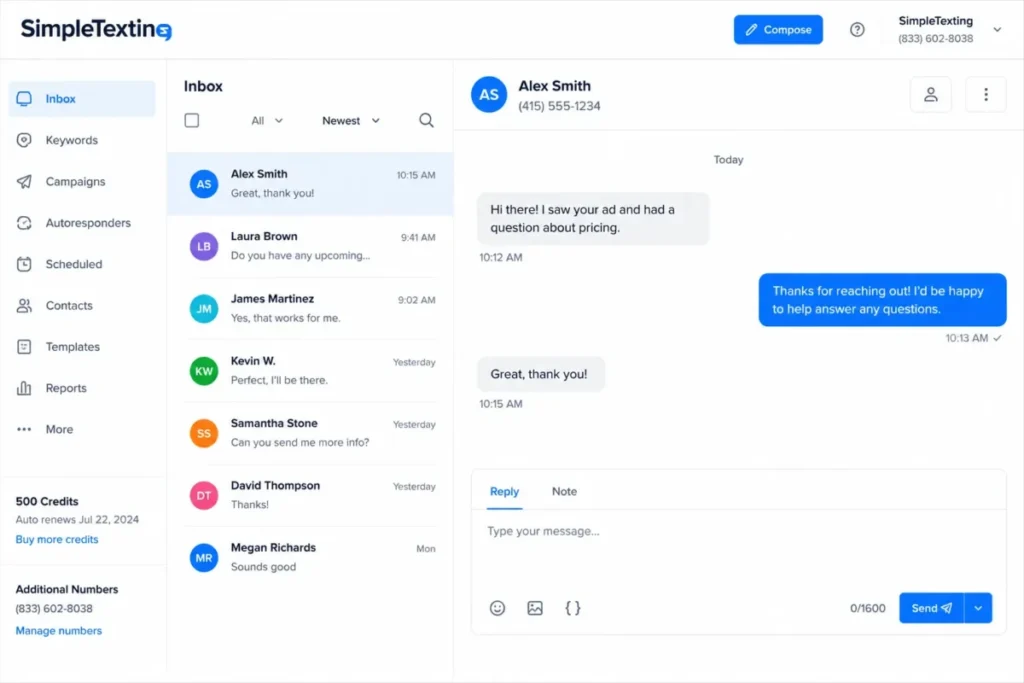
MMS costs three credits and extended SMS can cost two, so a 4,000-recipient picture campaign burns 12,000 credits. Reviewer patterns on G2 praise setup speed and support while repeatedly flagging MMS cost.
| Pros | Cons |
|---|---|
| Three users and unlimited contacts included on paid plans | Extra teammates cost $20 each per month |
| API access included rather than gated to a premium tier | MMS consumes three credits per recipient |
| Free inbound texts and a native two-way inbox | Service covers the US and Canada only |
| Mobile apps let a manager approve and reply off-desk | Carrier fees are charged on top of credits |
- Setup difficulty:
- Low. Number and 10DLC registration are handled inside the product.
- Avoid if:
- your list is international, or more than three people need seats.
- Verdict:
- Choose SimpleTexting if you want capable no-code SMS software for a small US team. Skip it if your list crosses borders.
2. Klaviyo: Best for Unified Ecommerce Data, Email and SMS

- Best for:
- Shopify and other B2C ecommerce teams already running behavior-based email that want SMS, forms and attribution on the same customer profile.
- Not best for:
- buyers who want a flat SMS-only bill, or programs sending to Puerto Rico and other US territories.
Klaviyo is the ecommerce pick, and it earned rank two on data rather than messaging features. Every SMS flow reads the same behavioral profile that drives your email flows, as our full Klaviyo review explains.
- Starting price:
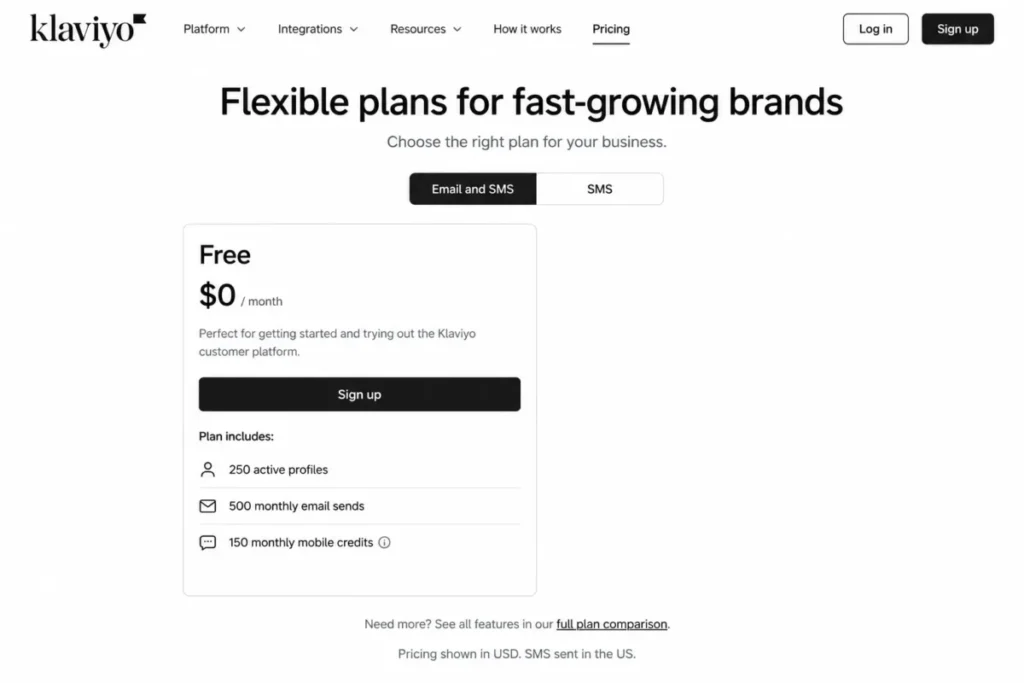
- $0 on the free plan, covering 250 active profiles, 500 monthly emails and 150 mobile credits. Paid pricing is set dynamically by profiles and credits.
Pricing checked: July 13, 2026 on the Klaviyo pricing page.
That dynamic model is the buyer risk. Cost climbs on two axes, so contact growth raises the bill in a month when you sent fewer texts.
Official documentation shows US SMS at one mobile credit and MMS at three, with credits renewing monthly and never rolling over. Two-way support is narrower than it looks: the subscribed customer must text first.
| Pros | Cons |
|---|---|
| Email and SMS share one profile and one attribution model | Mobile credits expire monthly with no rollover |
| Free plan includes 150 mobile credits for a pilot | Billing scales on profiles and credits |
| Deep Shopify integration ecosystem | Conversations need the customer to text first |
| Forms and consent capture are native, not bolted on | US coverage excludes Puerto Rico and other territories |
- Setup difficulty:
- Medium. Flows reward a marketer who already thinks in events.
- Avoid if:
- you send irregularly and cannot absorb credits that vanish each billing month.
- Verdict:
- Choose Klaviyo if email is already your revenue engine and SMS should inherit that data. Skip it if you want a standalone SMS bill.
3. Attentive: Best for Enterprise Retail and DTC Programs

- Best for:
- retail, DTC, food and travel brands with large subscriber programs that want strategy, managed onboarding and deliverability support alongside the software.
- Not best for:
- small brands that need a transparent self-serve price, or teams that want to launch this week without a sales call.
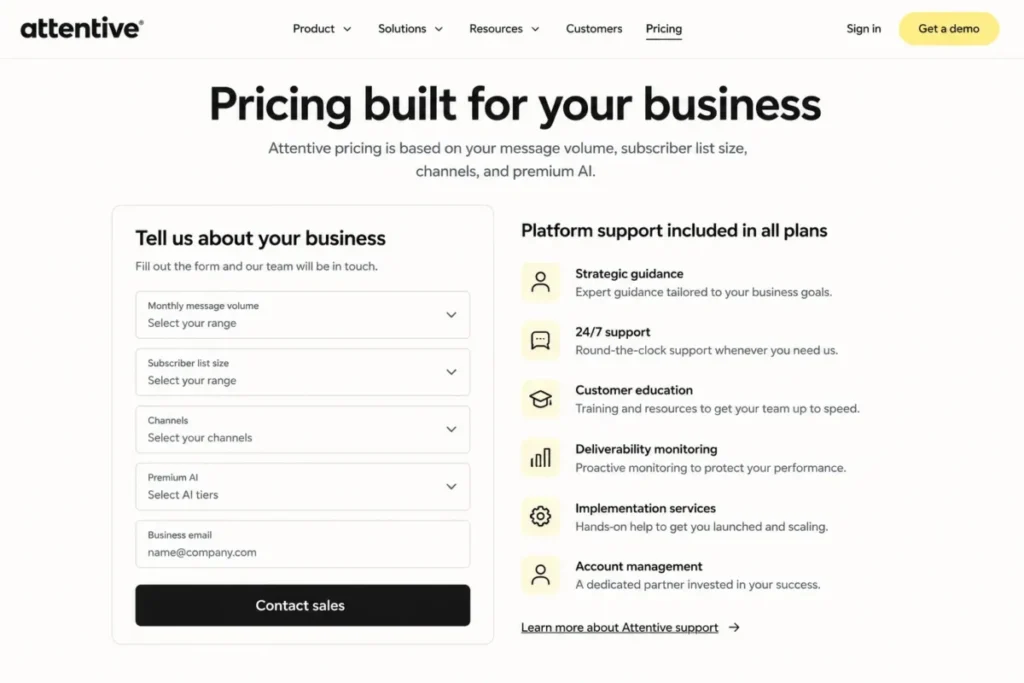
Attentive is the enterprise pick, and it earns rank three by selling a program rather than a tool. Official pricing states every plan includes strategy, onboarding, deliverability support and 24/5 service.
- Starting price:
- custom. Pricing is not publicly disclosed.
Treat this as a sales-led option and confirm the quote before shortlisting it. The quote is built from message volume, list size, channels and premium AI.
Pricing checked: July 13, 2026 on the Attentive pricing page.
List growth is the product strength. Attentive documents a patented two-tap sign-up experience, sign-up units with compliance templates, and SMS, MMS, RCS, email and push in one builder.
Here is the limitation nobody in the current top ten prints. Attentive’s quiet-hours documentation states campaigns do not automatically respect quiet hours by default, so send-time governance stays with your team.
| Pros | Cons |
|---|---|
| Strategy and onboarding support in every plan | No public pricing at any tier |
| Two-tap sign-up units built for retail list growth | Campaigns ignore quiet hours by default |
| SMS, MMS, RCS, email and push in one builder | AI Pro, AI Grow and AI Journeys cost extra |
| Large prebuilt integration ecosystem plus APIs | Procurement blocks a fast launch |
- Setup difficulty:
- High. Expect a sales process and an onboarding plan.
- Avoid if:
- you need a price before a sales call.
- Verdict:
- Choose Attentive if SMS is a revenue channel with a named owner and a quarterly plan. Skip it if you are still testing the channel.
4. Postscript: Best for Shopify-First SMS Marketing

- Best for:
- Shopify merchants with a named retention marketer who want native order and customer events driving cart, browse, welcome and upsell flows.
- Not best for:
- WooCommerce or custom-commerce brands expecting the same native depth, and anyone who reads “$0 platform fee” as free.
Postscript takes rank four because its cost model is the most honest at volume while its platform fit is the narrowest. The data model, install flow and segmentation are built around Shopify, and the SDK path for other stores adds work.
- Starting price:
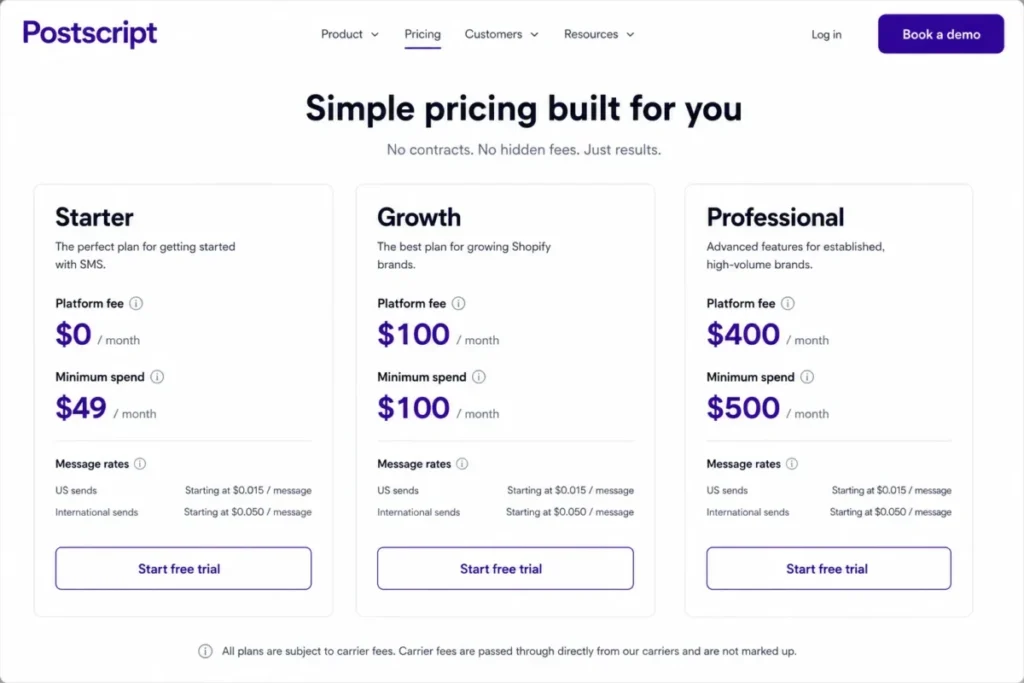
- $0 platform fee with a $49 monthly minimum spend on Starter, plus $0.009 per US SMS and $0.045 per MMS, with carrier fees passed through at an average $0.00418 per SMS.
Pricing checked: July 13, 2026 on the Postscript pricing page.
Starter is not a free plan, whatever the comparison tables say. It is a usage plan with a floor.
Plan gates matter more than the rate. Starter caps you at two opt-in keywords, Growth at $100 adds unlimited keywords and live support, and Professional at $500 opens API access.
| Pros | Cons |
|---|---|
| Cheapest transparent turnkey cost above 1,000 segments | $49 minimum spend applies even at zero sends |
| Native Shopify order and customer events drive segments | API access is gated to the $500 tier |
| Free verified toll-free number included | Starter allows only two opt-in keywords |
| $100 usage credit during the first 30 days | Non-Shopify stores need the SDK and build work |
- Setup difficulty:
- Low on Shopify, High elsewhere. List migration can require a compliance review.
- Avoid if:
- you are not on Shopify, or you need API access without a $500 commitment.
- Verdict:
- Choose Postscript if your store runs on Shopify and SMS revenue needs attribution. Skip it if your catalog lives anywhere else.
5. SlickText: Best for Full Feature Access Across Volume Tiers

- Best for:
- US and Canadian marketing teams of two to ten people that want workflows, list-growth tools, an inbox and live support without paying for a higher tier.
- Not best for:
- international senders, or low-volume accounts that expect a dedicated success manager.
SlickText is the pick for buyers who resent plan gates. It earned rank five because feature access is driven by message volume, not by withholding automation or analytics from cheaper tiers.
- Starting price:
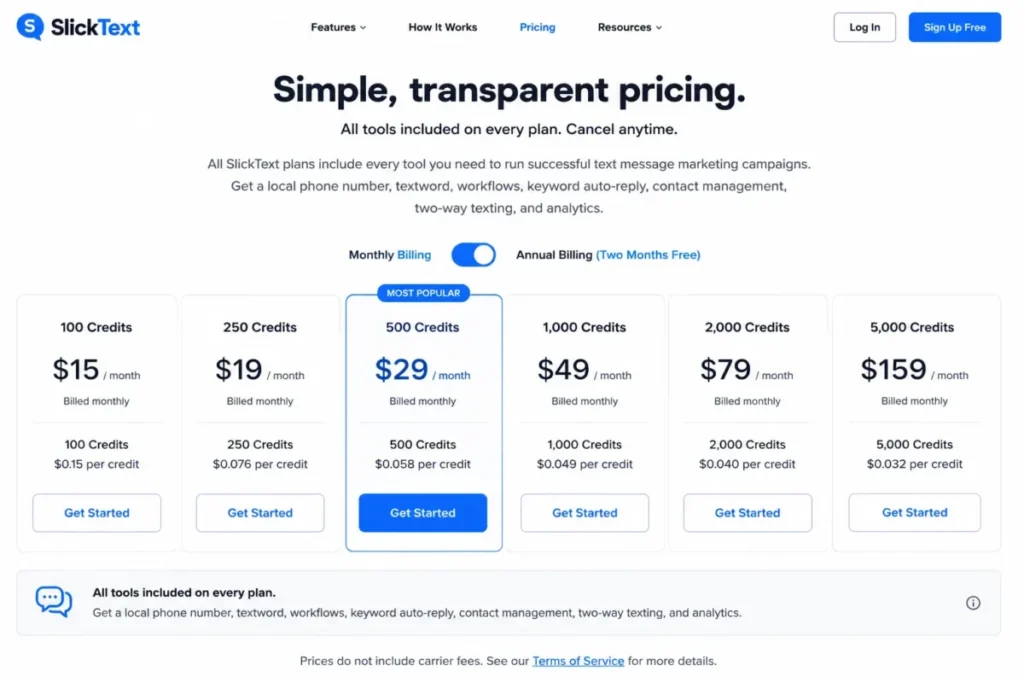
- $29 per month for 500 credits, with two months free on annual billing and carrier fees on top.
Pricing checked: July 13, 2026 on the SlickText pricing page.
Official documentation shows campaigns, workflows, keywords, text-to-join, forms, segmentation, analytics, unlimited contacts and free inbound texts on paid plans.
The failure mode belongs on a sticky note. SlickText credit documentation states a campaign can fail outright when credits run short, which turns a billing oversight into a missed promotion.
RCS costs a $500 one-time setup fee plus $200 annually, so treat it as a project rather than a feature toggle.
| Pros | Cons |
|---|---|
| Core marketing tools are included on every paid tier | A campaign can fail entirely when credits run short |
| Unlimited contacts and free inbound texts | Coverage is US and Canada only |
| One premium sending number included on paid plans | Dedicated success manager appears only on higher tiers |
| Two months free on annual billing | RCS costs $500 setup plus $200 per year |
- Setup difficulty:
- Low. One-to-one onboarding begins at higher volume tiers.
- Avoid if:
- you send unpredictably and cannot guarantee a credit balance before a campaign fires.
- Verdict:
- Choose SlickText if you want every feature at a small-team price. Skip it if a failed send during a sale is unforgivable.
6. Omnisend: Best for Ecommerce Teams Combining Email, SMS and Push

- Best for:
- small and mid-sized Shopify, WooCommerce or BigCommerce teams that want email, SMS and push in shared automations and can justify Pro.
- Not best for:
- new buyers hoping to send SMS on Free or Standard, or teams needing a native two-way inbox.
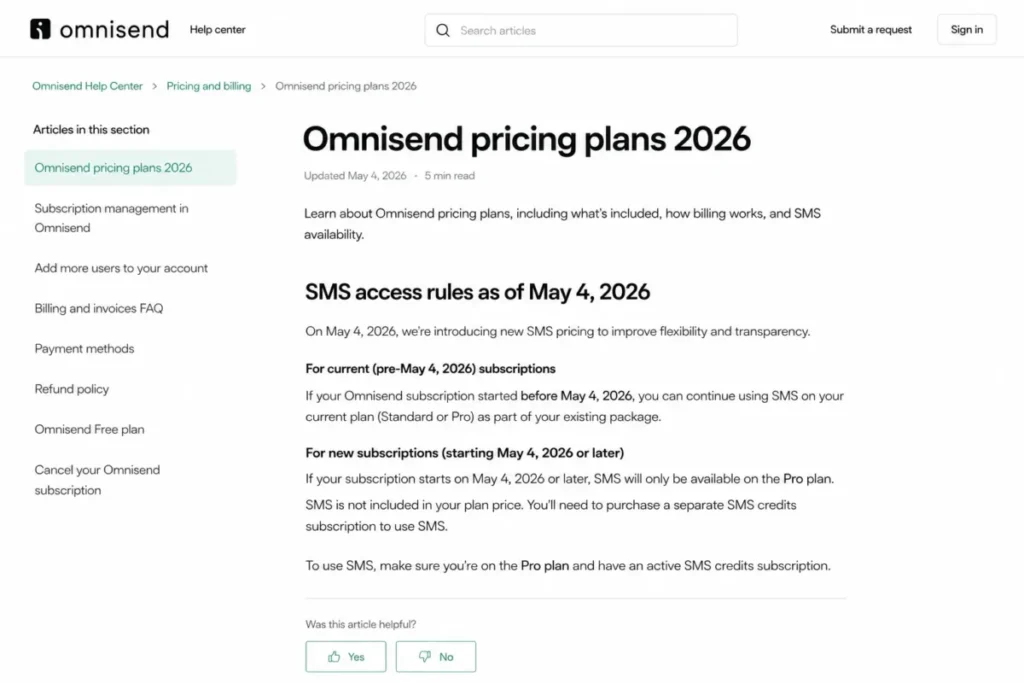
Omnisend takes rank six, and it carries the most decision-changing 2026 pricing change here. For subscriptions started on or after May 4, 2026, SMS is Pro-only, includes no credits by default, and needs a separate SMS credits subscription.
Older roundups showing SMS on cheaper Omnisend plans describe legacy accounts only, as the Omnisend 2026 pricing rules confirm.
- Starting price:
- Pro from $59 per month plus a separate volume-based SMS subscription. Official help content advertises US and Canada SMS from $0.007, with the effective rate set by spend tier.
Pricing checked: July 13, 2026 on the Omnisend pricing page.
Two billing details deserve a hard look. Omnisend documentation says some non-subscribed contacts who received automations count as billable contacts, and unused SMS credits expire after 60 days.
Replies are conditional too. Two-way messaging routes through a Gorgias integration for US recipients only, so a help desk is a prerequisite.
| Pros | Cons |
|---|---|
| Email, SMS and push in one automation | New accounts must buy Pro before sending SMS |
| Advertised US and Canada rates from $0.007 | SMS credits expire after 60 days |
| 24/7 chat and email support on paid plans | Two-way replies need a Gorgias integration |
| Ecommerce segmentation and product data are native | Billable contacts can include non-subscribers |
- Setup difficulty:
- Medium. Toll-free verification runs up to 14 business days.
- Avoid if:
- you want SMS without a platform subscription.
- Verdict:
- Choose Omnisend if three channels in one builder justify Pro. Skip it if SMS is your only channel.
7. EZ Texting: Best for Beginners and Local Organizations

- Best for:
- churches, nonprofits, schools, local service businesses and event teams sending their first SMS campaigns with one administrator.
- Not best for:
- teams optimizing for the lowest effective invoice, or organizations needing several seats.
EZ Texting, operated by CallFire, is the beginner pick at rank seven. It earns that place on guided setup: A2P registration support is included, workflows are drag-and-drop, and it assumes you have never run a text campaign.
- Starting price:
- Launch at $25 per month, or $20 billed annually, with 500 credits and $0.04 overage. Launch also carries a $5 monthly Telecom Fee.
Pricing checked: July 13, 2026 on the EZ Texting pricing page.
That fee is the point most comparison tables miss. Launch is a $30 plan before tax, and Boost and Scale waive the fee while cutting overage rates.
Official documentation shows mass SMS and MMS, a team inbox, drip campaigns, keyword auto-replies, unlimited contacts, AI Compose and an open API.
The constraints are seats and rollover. Launch includes one user, rollover lasts only one extra billing cycle, and MMS can consume three credits.
Reviewer patterns on Capterra call scheduling easy while noting mobile discoverability issues.
| Pros | Cons |
|---|---|
| A2P carrier registration support is included | $5 monthly Telecom Fee on the Launch tier |
| Drag-and-drop workflows suit first-time senders | Launch includes only one user |
| Unlimited contacts and custom fields at entry | Rollover credits expire after one extra cycle |
| Boost and Scale waive the fee and cut overage | MMS can consume three credits |
- Setup difficulty:
- Low. Included registration support is why it stays low.
- Avoid if:
- more than one person needs to send campaigns.
- Verdict:
- Choose EZ Texting if this is your first SMS program. Skip it if you already know how 10DLC works.
8. Textedly: Best for Large Lists and Simple Campaigns

- Best for:
- US organizations with very large contact lists but simple campaign, keyword and drip needs that prefer message-volume tiers over contact-based pricing.
- Not best for:
- buyers who expect the $29 headline to be the whole invoice, or teams needing several teammates.
Textedly is the budget pick at rank eight, and the clearest case here of a headline price that does not survive checkout. The base plan is $29 per month for 500 messages, plus a mandatory $8 monthly Telecom surcharge.
- Starting price:
- $29 per month at 500 messages, plus the $8 Telecom surcharge, with 10DLC registration at $4 to $44 by volume.
Pricing checked: July 13, 2026 on the Textedly pricing page.
Annual billing behaves differently. Paying yearly adds 20% more texts per month instead of cutting the price.
Account costs stack quietly. Extra 500-text packs cost $30, extra keywords $10, and each added teammate $10 per month.
What you get in return is reach economics. Contacts are unlimited, inbound texts are free, and the product covers bulk SMS and MMS, drip campaigns, webforms, link tracking, Text-to-Pay and review requests, plus integrations with Shopify and the tools in our Mailchimp review.
| Pros | Cons |
|---|---|
| Unlimited contacts, pricing tied to message volume | Mandatory $8 monthly Telecom surcharge |
| Free inbound texts and two-way texting | 10DLC registration adds $4-$44 |
| Text-to-Pay and review requests on eligible tiers | Each teammate costs $10 per month |
| Annual payment adds 20% more texts | Extra keywords cost $10 each |
- Setup difficulty:
- Low. Registration is a paid step, not a technical one.
- Avoid if:
- several people need to send, or you compare vendors on headline price.
- Verdict:
- Choose Textedly if you hold a huge list and send simple campaigns. Skip it if seats or automation drive the decision.
9. Textmagic: Best Pay-as-You-Go Option for International Messaging

- Best for:
- international small businesses, agencies and operations teams with irregular volume that want prepaid billing, unlimited users and one shared inbox.
- Not best for:
- high-volume US-only marketers hunting the lowest per-message rate, or anyone launching tomorrow.
Textmagic is the flexible pick at rank nine. It is the only platform here pairing prepaid message credit with unlimited users and contacts, plus a Bring Your Own CPaaS path.
- Starting price:
- $0.049 per US SMS and $0.08 per MMS on pay-as-you-go, with a texting number at $10 per month after the first month.
Pricing checked: July 13, 2026 on the Textmagic pricing page.
Pay-as-you-go does not mean zero recurring cost, and this is where buyers misread the label. A local US number also carries a documented $10 monthly 10DLC renewal, so the fixed floor is $20 before a single text.
Two facts belong in your plan. North American brand approval is documented at 2 to 7 business days, and messages sent but not delivered can still be charged.
Official pages show scheduled SMS and MMS, a flow builder, sales pipelines, mobile apps, plus public GDPR and SOC 2 positioning.
| Pros | Cons |
|---|---|
| Unlimited users and contacts, no platform fee | $10 monthly number fee after the first month |
| Global reach beyond the US and Canada | $10 monthly 10DLC renewal on a local US number |
| Bring Your Own CPaaS support | Sent-but-undelivered messages can still be charged |
| Shared inbox spans SMS, email, chat and social | $0.049 per US SMS is far above Postscript’s $0.009 |
- Setup difficulty:
- Medium. US onboarding runs 2 to 7 business days.
- Avoid if:
- your volume is high and US-only.
- Verdict:
- Choose Textmagic if you send across borders in bursts. Skip it if you send 25,000 US texts a month.
10. Twilio: Best for Developers Building a Custom Messaging Stack

- Best for:
- developer-led SaaS, marketplace and product teams that need programmable messaging, sender-pool control, webhooks and custom consent logic in their own application.
- Not best for:
- nontechnical marketing teams that want a campaign builder and lifecycle automation out of the box.
Twilio is the infrastructure pick at rank ten, and the position says nothing about quality. It sits last because this page ranks SMS marketing software.
- Starting price:
- $0.0083 per outbound US SMS segment before carrier fees, with long-code numbers from $1.15 monthly and toll-free from $2.15.
Pricing checked: July 13, 2026 on the Twilio US SMS pricing page.
That rate is transport, not ownership. Carrier fees, A2P registration, failed-message processing at $0.001, Engagement Suite at $0.015 with 1,000 free monthly, and the Compliance Toolkit at $0.015 sit on top.
Then comes the part with no invoice. Segmentation, consent capture, scheduling and reporting become your engineering backlog, and no roundup calling Twilio “cheapest” prices that work.
If your team is unsure what an API does, that uncertainty is your answer here.
You get control in exchange. Messaging Services provide sender pools, delivery callbacks, Smart Encoding and Advanced Opt-Out.
| Pros | Cons |
|---|---|
| $0.0083 per US segment is the lowest rate here | No campaign UI, audience manager or lifecycle builder |
| Messaging Services give sender-pool control | Carrier fees and add-ons stack on top |
| Smart Encoding and Advanced Opt-Out cut segment risk | Engineering time is the largest unpriced cost |
| Global routing and committed-use discounts | Failed messages are billed $0.001 each |
- Setup difficulty:
- High. Registration plus build effort.
- Avoid if:
- nobody writes code, or a marketer must send without a ticket.
- Verdict:
- Choose Twilio if messaging is a product feature you are building. Skip it if messaging is a campaign you are sending.
Pricing Comparison: Starting Price vs Practical Tier
Nobody stays on the entry plan. This table shows the tier most teams land on and what a ten-person team pays in seat fees on top.
| Platform | Starting price | Practical tier for most teams | Extra cost for 10 users | Free plan or trial | Hidden costs |
|---|---|---|---|---|---|
| SimpleTexting | $39/ | 500-credit config plus overage | Plus $140/mo (7 extra seats at $20) | Free trial, no card | Extra credits, numbers, carrier fees |
| Klaviyo | $0 free plan | Paid profile tier plus mobile credits | Seat pricing not disclosed on reviewed pages | Free to 250 profiles | Credits expire monthly, dual billing axes |
| Attentive | Custom quote | Custom quote | Custom | Trial through sales | Premium AI tiers priced separately |
| Postscript | $0 fee, $49 minimum | Starter until keywords or API force Growth | No published per-user fee | $100 trial credit | Carrier fees, $750/mo short code |
| SlickText | $29/ | Next volume tier up | No published per-user fee | 14-day trial | Carrier fees, RCS setup and maintenance |
| Omnisend | Pro from $59/mo | Pro plus SMS credits subscription | No published per-user fee | Free platform tier | Billable non-subscribers, 60-day credit expiry |
| EZ Texting | $25/mo plus $5 fee | Boost or Scale to drop the fee | Launch includes one user only | 14-day trial | Telecom Fee, overage credits |
| Textedly | $29/mo plus $8 fee | Higher message-volume tier | Plus $90/mo (9 teammates at $10) | 14-day trial | Telecom surcharge, 10DLC, keywords |
| Textmagic | $0.049 per SMS | Monthly plan at steady volume | $0, users are unlimited | Test credit, no card | Number fee, 10DLC renewal |
| Twilio | $0.0083 per segment | Usage plus Messaging Services | No seat model | Trial account | Carrier fees, registration, engineering |
Pricing checked: July 13, 2026 against each vendor’s official pricing page. Prices, carrier fees and taxes change, so treat this as a shortlist filter, not a quote.
Seat cost is the quiet separator here. A ten-person team pays SimpleTexting $140 per month in extra seats and Textmagic nothing, which can outweigh a two-cent difference in message rate.
Feature Gate Comparison: What Opens at Which Plan
Plan gates decide whether the cheap tier is a real option or a demo.
| Platform | Automation | API access | Analytics depth | Priority or live support | Notable gate |
|---|---|---|---|---|---|
| SimpleTexting | Included | Included | Included | Higher-volume plans | Extra seats and numbers billed per unit |
| Klaviyo | Included | Included | Included | Scales with plan | Mobile credits sold separately |
| Attentive | Included | Included | Included | Included in all plans | Premium AI priced separately |
| Postscript | Included | Professional at $500/mo | Enhanced on Professional | Growth at $100/mo | Two keywords on Starter |
| SlickText | Included on all paid plans | Included | Included | Live phone, chat and email | Success manager on larger tiers |
| Omnisend | Included | Included | Advanced reporting on Pro | 24/7 chat and email | SMS itself is Pro-only for new accounts |
| EZ Texting | Included | Open API | Included | Onboarding specialist on Scale | One user on Launch |
| Textedly | Included | Available | Included | Premium support on higher tiers | Text-to-Pay and reviews on eligible tiers |
| Textmagic | Flow builder included | Included | Included | Standard support | Numbers and registration billed separately |
| Twilio | Build it yourself | Native | Build it yourself | Paid support plans | Everything above transport is your build |
Postscript is the clearest gate on this page. If your stack needs API access, the real entry price is $500 per month, not $49.
Credits, Rollover and Seasonal Sending
Unused credits are where effective price diverges from advertised price. A brand that sends hard in November and quietly in July pays very differently across these vendors.
| Platform | Rollover rule | What happens to unused units |
|---|---|---|
| SimpleTexting | Rollover credits documented | Retained per the rollover policy on your plan |
| Klaviyo | No rollover | Mobile credits renew monthly and expire |
| Postscript | Usage-based | $49 minimum spend is lost if unused |
| SlickText | Rollover documented | Retained, but a short balance can fail a campaign |
| Omnisend | Credits expire after 60 days | Lost after the expiry window |
| EZ Texting | One extra billing cycle | Lost after that cycle |
| Textedly | Volume tier per month | Extra packs bought at $30 per 500 |
| Textmagic | Prepaid balance | Credit stays until used |
| Twilio | Pure usage | Nothing to lose, nothing to bank |
For a seasonal retailer, prepaid or rollover models protect budget better than monthly-expiry credits. Klaviyo and Omnisend both bill you for the quiet months anyway.
Then there is the failure mode that costs more than money. SlickText documents that a campaign can fail when credits run short, and Omnisend SMS steps depend on credit availability, so a low balance can silently break an automation.
Run this check before every large send: estimate segments, confirm balance, set an auto-top-up or alert, and verify what the platform does when the balance hits zero.
Two-Way Messaging Is Not One Feature
Every vendor lists two-way texting. Almost none of them mean the same thing.
| Platform | Native shared inbox | Who can start a conversation | Requirement |
|---|---|---|---|
| SimpleTexting | Yes | Either side | None, inbound is free |
| Klaviyo | Conversations view | Customer must text first | Subscribed customer, capable number |
| Attentive | Yes, within the program | Either side | Enterprise program setup |
| Postscript | Response management | Either side | Shopify-connected account |
| SlickText | Yes | Either side | None, inbound is free |
| Omnisend | No native inbox | Customer replies routed out | Gorgias integration, US recipients only |
| EZ Texting | Yes, team inbox | Either side | None |
| Textedly | Yes | Either side | None, inbound is free |
| Textmagic | Yes, multichannel inbox | Either side | Paid number |
| Twilio | No | Whatever you build | Webhooks and your own application |
If a support agent has to answer customers by text, Omnisend and Twilio are not two-way tools without another product behind them. Omnisend’s reply path assumes you already run a help desk, which is why our Gorgias help desk review is worth reading before you commit.
That single row moves the shortlist for any team where SMS doubles as service.
Integrations and API Access
“Integrates with” hides four very different levels of effort: native app, connector marketplace, request-based API, and build-it-yourself.
| Platform | Native integrations | Connectors | API access |
|---|---|---|---|
| SimpleTexting | Mailchimp and others | Zapier and broader connectors | Included |
| Klaviyo | Deep ecommerce ecosystem | Broad marketplace | Included |
| Attentive | Large prebuilt catalog | Partner ecosystem | Flexible APIs |
| Postscript | Shopify-native | Ecosystem apps | Professional tier only |
| SlickText | Native integrations | Zapier and Make | Included |
| Omnisend | Ecommerce platforms, Gorgias | Connector apps | Included |
| EZ Texting | Documented integrations | Connectors | Open API |
| Textedly | Mailchimp, Shopify and more | Zapier | Available |
| Textmagic | Business tools | Connectors | Included, plus BYO CPaaS |
| Twilio | None needed | Not applicable | The product is the API |
Check the connection type, not the logo wall. A connector bridge between your CRM and your SMS tool is a dependency you own, and it breaks on the day your campaign matters most.
Our Zapier automation review covers where those bridges hold up under real campaign volume.
Teams running heavy task volume through a connector should read the Make workflow review before standardizing on one.
Support and Onboarding: Software, or a Program?
Support is where a higher price can be the cheaper option for a lean team.
| Platform | Support model | Onboarding |
|---|---|---|
| SimpleTexting | Self-service plus responsive support | Guided in-product setup |
| Klaviyo | Support scales with plan | Docs, academy, partner network |
| Attentive | 24/5 service and a dedicated team | Managed onboarding and strategy in every plan |
| Postscript | Live chat and email from Growth | Launch support at Enterprise |
| SlickText | Live phone, chat and email | One-to-one onboarding on higher tiers |
| Omnisend | 24/7 chat and email | Account Expert access tied to spend |
| EZ Texting | Standard support | Onboarding specialist on Scale |
| Textedly | Premium support on higher tiers | Self-service |
| Textmagic | Standard support | Self-service |
| Twilio | Paid support plans | Documentation and your engineers |
A one-marketer team with no SMS experience often gets more value from Attentive’s included strategy and deliverability support than from saving $200 a month on a self-service tool nobody has time to configure. That is a real trade, not a sales line.
Setup and Verification Timeline: When Can You Send?
Account creation takes minutes. Legal, deliverable US sending does not.
| Platform | Setup difficulty | Documented wait before sending |
|---|---|---|
| SimpleTexting | Low | Registration handled in-product, $4 local-number fee |
| Klaviyo | Medium | Toll-free setup path, short code by application |
| Attentive | High | Sales, onboarding and program setup |
| Postscript | Low on Shopify | List migration may need a compliance review |
| SlickText | Low | Number included, registration handled by the vendor |
| Omnisend | Medium | Toll-free verification up to 14 business days |
| EZ Texting | Low | A2P registration support included |
| Textedly | Low | 10DLC registration billed at $4 to $44 |
| Textmagic | Medium | Brand approval 2 to 7 business days in North America |
| Twilio | High | A2P registration plus your own build |
A short code adds another layer: Postscript lists a dedicated short code at $750 per month, and Twilio lists a random short code at $1,000, with carrier approval on top. Nobody launches a short-code program in a week.
Plan backwards from the campaign date, not forward from signup. If Black Friday is the target, toll-free verification and 10DLC registration belong in September, not November.
Geographic Coverage and Sender Types
Geography disqualifies platforms faster than features do.
SimpleTexting and SlickText both focus on the US and Canada, which ends the conversation for a brand with subscribers in Europe or Asia.
Klaviyo supports a defined country list, and its documentation defines the United States as the 50 states, excluding Puerto Rico and other territories. A brand shipping to San Juan needs to know that before migration, not after.
Textmagic is the international option here, built for global sending with prepaid credit. Twilio routes globally as well, though you own the routing logic.
Sender type matters just as much. Toll-free numbers verify faster and cost little, local 10DLC numbers carry registration fees, and short codes cost hundreds to thousands per month with a longer approval path.
SMS Compliance: What the Platform Handles and What You Still Own
Buying a “TCPA-compliant” platform does not make your program compliant. This is a shared-responsibility model, and the sender carries the legal weight.
| The platform can automate | You still own |
|---|---|
| Opt-in capture forms and keywords | Whether consent was lawfully obtained |
| Automatic opt-out and stop handling | Message content, offers and frequency |
| A2P 10DLC and toll-free registration support | Accuracy of the brand and use case you register |
| Quiet-hour settings where offered | Send times, including campaign scheduling |
| Deliverability tooling and content checks | Program design and jurisdiction-specific rules |
Attentive’s documentation is the sharpest example. Campaign messages do not automatically respect quiet hours by default, so an automated platform still lets a well-meaning marketer schedule a 10pm blast.
None of this is legal advice, and none of these vendors accept your legal risk. Before launch, confirm consent language, opt-out handling, sending windows and record-keeping with counsel who knows your industry.
One Platform for Email and SMS, or Two Specialists?
This is the question ecommerce buyers ask most often, and the honest answer depends on where your data already lives.
Choose one unified platform if email is already the revenue engine, your flows depend on browse, cart and order events, and one team owns both channels. Klaviyo and Omnisend both pay off here because the segment you build for email works for SMS immediately.
Choose two specialists if SMS volume is high enough that message economics dominate, if your email tool is working and you have no appetite for migration, or if you need a native shared inbox that a suite does not provide.
Understand the second billing axis before consolidating. A unified suite charges for contacts or profiles and then charges again for message credits, so your bill can rise in a month when your list grew and your sends fell.
The Reddit-favorite pairing, Klaviyo for email plus Postscript for SMS, exists for a reason. It costs more tooling overhead and buys sharper SMS economics and Shopify-native flows.
If your CRM is the system of record instead of your store, start from the best CRM for marketing automation and let SMS attach to it.
Which SMS Marketing Tool Should You Avoid?
Every platform here is good for somebody. Each one is wrong for somebody else, and this is the section most roundups skip.
Avoid Twilio if your marketer cannot ship a campaign without an engineer. The low transport rate can produce high ownership cost for a small team without engineering resources.
Avoid Postscript if you are not on Shopify. The SDK exists, but you are paying for a Shopify-shaped product and rebuilding the part that made it good.
Avoid Omnisend if you expected SMS on a cheap plan. New accounts need Pro plus a separate SMS subscription, and that changes the budget conversation.
Avoid Attentive if you need a price today. Custom quoting is a feature for enterprise buyers and a blocker for everyone else.
Avoid SimpleTexting and SlickText if your subscribers live outside the US and Canada. Coverage is a hard gate, not a soft preference.
Avoid Textedly and EZ Texting if seat count matters. Paying $10 or $20 per extra sender adds up faster than the message rate you were comparing.
How to Choose the Right SMS Marketing Platform
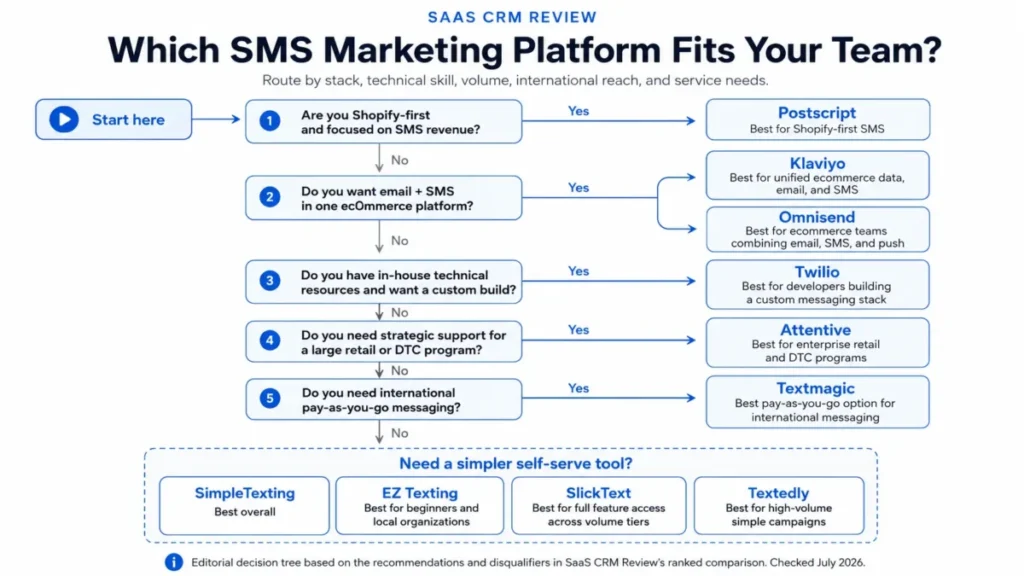
Work through these seven questions in order. The answers usually eliminate seven of the ten platforms above.
- Where does your customer data live? Shopify points to Postscript, an existing email suite points to Klaviyo or Omnisend, and a CRM-first stack points to SimpleTexting or SlickText.
- How many billable units will you send monthly? Multiply subscribers by sends, then add 40% for segments and MMS.
- What is the real total at that volume? Add platform fee, message cost, carrier fees, number fees and registration before comparing anything.
- Who needs to send? Count seats now, because $20 per user turns a cheap plan into an expensive one at ten people.
- Does anyone reply? If SMS doubles as support, you need a native shared inbox, which rules out two options here immediately.
- Where do your subscribers live? US and Canada only tools disqualify themselves for international lists.
- When must the first campaign land? Work backwards through registration and verification, then choose a platform that fits the calendar.
Answer those and the shortlist writes itself. A Shopify brand with a lifecycle marketer, 20,000 monthly segments and no developer lands on Postscript, and a five-person US nonprofit with a shared inbox requirement lands on SimpleTexting.
Common Mistakes When Choosing SMS Marketing Software
Comparing headline prices. The $25 plan carries a $5 fee, the $29 plan carries an $8 surcharge, and the $0 plan carries a $49 minimum, so none of those numbers are comparable as printed.
Budgeting messages instead of segments. One emoji cuts the character limit from 160 to 70 and can double your bill overnight.
Treating “two-way SMS” as a checkbox. In one platform it means a shared inbox, in another it means the customer has to text you first.
Buying the cheapest rate and inheriting a build. Twilio’s $0.0083 is real, and so is the campaign builder your team now has to write and maintain.
Ignoring credit expiry. Monthly-expiry credits punish seasonal senders, and a low balance can fail a campaign outright rather than sending partially.
Forgetting the seat model. Ten senders cost $140 per month extra on one platform and nothing on another.
Planning launch from signup date. Toll-free verification runs up to 14 business days, and short codes take longer, so the campaign date drives the purchase date.
Switching, Cancellation and Renewal Checklist
The purchase is not the last decision you make, and a few of these platforms are quietly hard to leave.
Before you migrate a subscriber list, confirm the new vendor’s consent evidence requirements. Postscript documents that list migration can require a compliance review, and Vendors may review or reject lists without defensible consent records.
Treat the move with the same discipline as any CRM migration plan, including a field map, a consent audit and a rollback date.
Before you cancel, check whether the SMS add-on is a separate subscription. Omnisend documents that canceling the main plan does not cancel the SMS credits subscription, which is exactly how a “canceled” tool keeps billing.
Before renewal, answer four questions: what did SMS earn, what did the invoice total after fees, who owns the phone number, and can the subscriber list leave with you.
Keep the number question on the list. A dedicated toll-free or short-code number that lives with the vendor is a switching cost most buyers discover at the worst moment.
Final Verdict: The Best SMS Marketing Platform for 2026
SimpleTexting is the best SMS marketing platform for most US and Canadian teams that want to run campaigns without a developer.
It combines SMS-native depth, an included API, three published seats and a two-way inbox at a credit price you can read off the page.
If you sell on Shopify, ignore that verdict. Postscript’s Shopify-native events and published usage pricing beat the general-purpose tools here for a store, provided you never need API access below $500 per month.
If your email program already drives revenue, Klaviyo is the better architecture, because SMS inherits the segments and attribution you already built. Accept the two billing axes and the credits that expire.
If SMS is a serious retail channel with a named owner, Attentive buys strategy, onboarding and deliverability support that lean teams cannot staff. If SMS is a product feature, Twilio is the clearest fit among the products ranked here.
The rest are strong specialists. SlickText for feature access without plan gates, Omnisend for three channels on Pro, EZ Texting for guided first programs, Textedly for very large lists, and Textmagic for international pay-as-you-go sending.
Whatever you shortlist, price the invoice, not the plan. Add the fees, count the segments, check the seats, and book the registration window before you promise anyone a launch date.
FAQ
What is the best SMS marketing platform overall?
SimpleTexting is the best SMS marketing platform for most US and Canadian teams in 2026. It combines campaigns, a two-way inbox, automation, unlimited contacts, three included users and API access at $39 per month for 500 credits. Shopify stores should choose Postscript instead, and ecommerce brands running behavior-based email should look first at Klaviyo.
How much does SMS marketing software cost?
Entry plans run from $25 to $59 per month, and pay-as-you-go rates run from $0.0083 to $0.049 per US message. The real invoice adds carrier fees, phone-number fees, 10DLC registration, telecom surcharges and extra seats. At 5,000 monthly segments, our modeling puts most turnkey platforms between $65 and $310 per month.
What is the best SMS marketing software for small business?
For a small US business with one or two senders, SimpleTexting and SlickText are the strongest picks, because core features are not locked behind higher tiers. EZ Texting is better if nobody on the team has run a text campaign and you want included A2P registration support. Skip Twilio unless you have a developer.
Which SMS marketing platform is best for Shopify?
Postscript is the Shopify pick. Its data model, install flow and segmentation are built on Shopify order and customer events, and its published usage pricing is the cheapest turnkey option at 1,000 and 5,000 monthly segments. The catch is the $49 monthly minimum spend and API access gated at $500 per month.
Is SMS marketing software with a free plan worth using?
Klaviyo’s free plan is the only one on this list that includes SMS credits, covering 250 profiles, 500 emails and 150 mobile credits per month. That is enough to pilot a flow, not to run a program. Postscript’s “$0 platform fee” is not a free plan, because a $49 monthly minimum spend still applies.
Does SMS marketing require A2P 10DLC registration?
It depends on the sender type.US application-to-person traffic sent through a local ten-digit number generally uses A2P 10DLC registration. Toll-free numbers use a separate verification process, while short codes follow their own approval path.
How many characters count as one SMS message?
A standard SMS holds 160 GSM-7 characters. Add one emoji or special character and the limit drops to 70, which pushes an ordinary text into two billable segments. MMS is billed separately and can consume three credits per recipient on SimpleTexting, Klaviyo, SlickText and EZ Texting.
Which SMS marketing tools include real two-way texting?
SimpleTexting, SlickText, EZ Texting, Textedly and Textmagic all provide a native inbox where either side can start the conversation. Klaviyo requires the subscribed customer to text first. Omnisend routes replies through a Gorgias integration for US recipients only, and Twilio requires you to build the inbox yourself.
Can I use SMS marketing software without a monthly contract?
Yes, if you choose a usage-based model. Textmagic sells prepaid credit with no platform subscription, and Twilio bills purely on usage. Both still carry recurring costs: Textmagic charges $10 monthly for a number plus a $10 10DLC renewal, and Twilio charges from $1.15 monthly per long-code number.
What happens to unused SMS credits?
It depends entirely on the vendor, and it changes your effective price. Klaviyo mobile credits expire monthly with no rollover, Omnisend SMS credits expire after 60 days, and EZ Texting rollover lasts one extra billing cycle. SimpleTexting and SlickText document rollover, and Textmagic prepaid credit stays until spent.