

Claude pricing looks like a four-row table until you try to build a budget from it. Then the seat price stops being the number that matters.
The paid entry point is $20 a month. The Enterprise seat is $20 a month too, and those two twenties buy completely different things: one includes your usage, the other explicitly does not.
That gap is where most Claude budgets go wrong. A finance team that annualizes the seat price and stops there will underbook an Enterprise rollout by a factor that depends entirely on which model the organization ends up using.
This guide prices every public plan. Then it prices what the plan page does not add up for you: the model that bills separately on cheaper tiers, the API a subscription never covers, the credits that continue work after a limit, and the residency multiplier.
Claude also sits in a market where the best AI chatbots cluster tightly around one price point for individuals, so the plan you pick matters more than the vendor you pick.
In This Article (23 sections)
Quick Answer: How Much Does Claude Cost in 2026?
Claude is free on the Free plan, with no time limit and no trial clock. Paid individual plans are Pro at $20 a month or $200 a year, Max 5x at $100 a month and Max 20x at $200 a month, both billed monthly only. Team seats cost $25 a month for a Standard seat and $125 for a Premium seat, falling to $20 and $100 on annual billing, with a two member minimum and a 150 seat ceiling. Usage-based Enterprise is $20 per seat per month billed annually, and that seat fee buys access only: every token your team uses is billed on top at standard API rates.
API pricing runs from $1 and $5 per million input and output tokens on Claude Haiku 4.5 up to $10 and $50 on Claude Fable 5.1. Prices verified 14 September 2026 for the United States in USD, excluding tax.
Key Takeaways
- The cheapest serious way to use Claude is Pro on annual billing at $200 a year, which the pricing page displays as $17 a month and which divides to $16.67 in a budget.
- Two plans advertise $20 and mean opposite things. Pro at $20 includes your usage. A usage-based Enterprise seat at $20 includes none of it.
- Team capacity is 1.25x Pro on a Standard seat and 6.25x Pro on a Premium seat. At the annual rate a Premium seat costs the same $100 a month as Max 5x, carries more session capacity, and adds SSO and central billing.
- Max is billed monthly only, so there is no annual discount to chase at the top of the individual range.
- On a usage-based Enterprise plan, the model your team defaults to moves the annual bill further than the entire seat commitment does, and it is a setting rather than a contract.
- Bulk usage bundles cut overage by up to 30 percent: $1,000 of usage costs $700, capped at $2,000 of discounted bundles a month for Pro and Max and $3,000 for Team owners.
- A Claude subscription never includes the Claude API or Console. They are separate products with separate invoices.
Claude Pricing 2026: Plans, Limits, Hidden Costs and Total Cost
The quick pricing verdict below resolves one decision: the cheapest Claude tier that still covers your usage, governance and model needs.
| Question | Answer |
|---|---|
| Starting price | $0 on Free; $20 per month for Pro billed monthly |
| Free plan or trial | Free plan, no time limit |
| Best plan for most individuals | Pro at $200 per year |
| Best plan for most teams | Team with mixed Standard and Premium seats |
| Plan to avoid | Team Premium assigned to every member by default |
| Biggest hidden cost | Enterprise token consumption, billed on top of the seat fee |
| Cheaper alternative if Max is too much | Pro plus discounted usage bundles |
| Pricing verified | 2026-09-14, US, USD |
Source: Claude plans and pricing, checked 2026-09-14.
The Advertised Price vs the Real Price
Every Claude tier advertises one number. Only two of them are the whole bill.
Free, Pro and Max are honest as displayed, provided you never touch Fable 5 on Pro or the API on any of them. Team is honest per seat, but the seat mix is yours to design.
Enterprise is the outlier, because the seat fee only covers access to the platform and doesn’t include any usage.
| Plan | Advertised | What the advertised price excludes | Realistic annual budget |
|---|---|---|---|
| Free | $0 | Nothing | $0 |
| Pro | $20 per month | Fable 5 usage, any API usage | $240 monthly, or $200 annual |
| Max 5x | $100 per month | Any API usage | $1,200 |
| Max 20x | $200 per month | Any API usage | $2,400 |
| Team Standard | $20 per seat per month annual | Fable 5 usage, two-seat minimum | $480 for the minimum two seats |
| Team Premium | $100 per seat per month annual | Two-seat minimum | $2,400 for the minimum two seats |
| Enterprise, usage-based | $20 per seat per month | All chat, Claude Code and Cowork tokens | $4,800 seat access at the 20-seat floor, plus usage |
Sources: Claude plans and pricing and the Team plan documentation. Annual figures are this guide’s arithmetic over those published rates, not vendor-quoted totals.
The last row is the one to sit with. At the 20-seat self-serve minimum, $4,800 a year buys the right to log in and nothing else.
How Claude’s Usage Limits Actually Work
There is no published message count for any Claude plan, and any article that gives you one has invented it. Anthropic states that the number of messages you can send will vary based on message length, attachment size, conversation length, and the model or feature in use.
What is published is the shape of the limit, and that is the part you can budget against. Paid plans run two clocks at once.
The first is a session clock. Your session-based usage limit resets every five hours on Pro and on Max alike.
The second is a weekly clock that applies across all models and resets at a fixed time assigned to your account. Hitting the weekly ceiling is what turns a productive Thursday into a wait, and it is the single most common reason a Pro user starts pricing Max.
Capacity between tiers is stated as a multiple of Pro, which makes the comparison unusually clean:
| Tier | Session capacity versus Pro | Monthly cost at the cheapest cadence |
|---|---|---|
| Free | Limited | $0 |
| Pro | Baseline | $16.67 effective on annual billing |
| Team Standard | 1.25x | $20 per seat annual |
| Max 5x | 5x | $100 |
| Team Premium | 6.25x | $100 per seat annual |
| Max 20x | 20x | $200 |
Sources: Team seat usage capacity and Max plan usage multipliers.
Read the Max 5x and Team Premium rows together. At the annual rate they cost the same $100 a month, and the Team Premium seat carries 6.25x Pro capacity against Max 5x’s 5x, plus single sign-on and central billing.
The catch is the floor: Team plans require a minimum of two members, so a solo buyer cannot reach that rate. Two people who both need heavy capacity can, and they get admin controls thrown in. There is a ceiling as well: Team supports up to 150 seats, and an organization that needs more moves to Enterprise whether or not it needs the governance.
The Five Hidden Costs Nobody Mentions
None of these appear on the plan card. All five change what a Claude deployment actually costs.
1. Fable 5 and Fable 5.1 are pay-as-you-go on Pro and Team Standard
Max plans and Team Premium seats carry Claude Fable 5 and Claude Fable 5.1 as a standard part of your plan, and can spend up to 50% of the weekly usage limit on them at no extra cost.
Pro plans and Team Standard seats do not. They reach both Fable models through usage credits from the first message, billed at standard API rates. Anthropic ran a one-time credit when Fable 5 moved to usage credits in July 2026, and states there is no equivalent credit for Fable 5.1.
That is Claude Fable 5 and Claude Fable 5.1 at $10 per million input tokens and $50 per million output tokens, sitting behind a $20 Pro subscription. A Pro user who makes a Fable model their default has converted a fixed bill into a variable one without changing plans.
2. Enterprise seats buy access, not tokens
The $20 Enterprise seat is not a smaller version of the $20 Pro seat. Enterprise usage across Claude, Claude Code and Cowork is billed separately at standard API rates, based on actual token consumption.
Seats are priced per user per month and billed annually at the start of the cycle, so the fixed half of the bill is committed a year at a time. The variable half is not committed at all, which is why Enterprise ships with organization and per-user spend limits.
I would treat those spend limits as a required configuration step, not a feature. An Enterprise rollout with no per-user ceiling is an uncapped invoice.
3. A Claude subscription never includes the API
This one costs people real money because it looks like it should be free. A paid Claude subscription enhances your chat experience but doesn’t include access to the Claude API or Console.
Pro, Max, Team and Enterprise subscriptions and Console billing are separate products with separate invoices. A team that pays $2,400 a year for Max 20x and then builds an integration is starting a second bill from zero.
There is no partial exception for SDK work either, and the reason is a change that was announced and then withdrawn.
Anthropic announced a monthly Agent SDK credit in June 2026, then paused it before it took effect. The Help Center now states that the previously announced credit is not available, and that Agent SDK usage, the non-interactive claude -p command and third-party apps built on the SDK still draw from your subscription usage limits.
The practical effect is that SDK work competes with your interactive work for the same pool rather than arriving with its own budget. Plan on API billing through the Console for anything programmatic that pool cannot absorb.
4. Usage credits and bundles have their own ceilings
When a paid individual plan runs out of included capacity, usage credits let Pro, Max 5x and Max 20x subscribers keep working at standard API rates, charged separately from the subscription.
Bought in bulk, that overage gets cheaper. The standard price for usage credits is face value. A $50 usage bundle costs $45, a $250 usage bundle costs $200, and a $1,000 usage bundle costs $700, a saving of 10, 20 and 30 percent respectively.
These are standing bundle tiers rather than a time-boxed offer, so no expiry applies to the rates themselves.
The discount stops at a monthly ceiling. Pro and Max subscribers can buy up to $2,000 of discounted bundles per month, Team owners up to $3,000, and anything past that bills at standard rates.
For bursty work, that 30% tier is a genuine alternative to a permanent upgrade. A month with a $700 usage bundle is cheaper than a year of Max 20x you only need in March.
5. Residency and tool calls both add to the token bill
Two API-side costs follow you into Enterprise. Turning on US-only inference bills usage at 1.1x standard API rates for Claude Opus 4.6, Sonnet 4.6 and later models.
Tool calls add their own line. API web search costs $10 per 1,000 searches on top of the tokens the results generate.
Standalone code execution costs $0.05 per container hour after 1,550 free container hours per organization a month, with a five-minute minimum per run. It is free when it runs alongside web search or web fetch, which is the cheapest optimisation on this page and the one most teams miss.
A 10% residency premium sounds small until it multiplies a five-figure token bill. On the 20-seat scenario below it adds $960 a year, which is a fifth of the entire seat commitment.
Claude Pricing Plans Compared
| Plan | Monthly | Annual | Billing basis | Best for | Key limit |
|---|---|---|---|---|---|
| Free | $0 | $0 | Per person | Occasional use | Limited capacity, no Claude Code |
| Pro | $20 | $200 billed up front | Per person | Regular solo use | Fable 5 needs usage credits |
| Max 5x | $100 | Monthly billing only | Per person | Heavy solo use | Weekly limit still applies |
| Max 20x | $200 | Monthly billing only | Per person | Claude as a primary work surface | Weekly limit still applies |
| Team Standard | $25 per seat | $20 per seat per month | Per member, two-member minimum | Most team members | 1.25x Pro capacity per member |
| Team Premium | $125 per seat | $100 per seat per month | Per member, two-member minimum | Designated heavy users | 6.25x Pro capacity per member |
| Enterprise, usage-based | $20 per seat, billed annually | $240 per seat per year | Per seat plus metered usage | 20+ seats needing governance | No included token allowance |
Sources: Anthropic’s published plan prices, the individual plan comparison, and Enterprise billing, for US pricing in USD.
Two structural notes matter more than any single number here. Max is billed monthly only, so there is no annual discount to chase at the top of the individual range.
And Team lets you mix and match seat types inside one organization, which is the single largest lever on team cost.
Claude Pricing Plans Explained: What Each Plan Includes
Each plan below carries its price, what it adds over the tier beneath it, and the condition that should send you elsewhere.

Claude Free Plan: $0
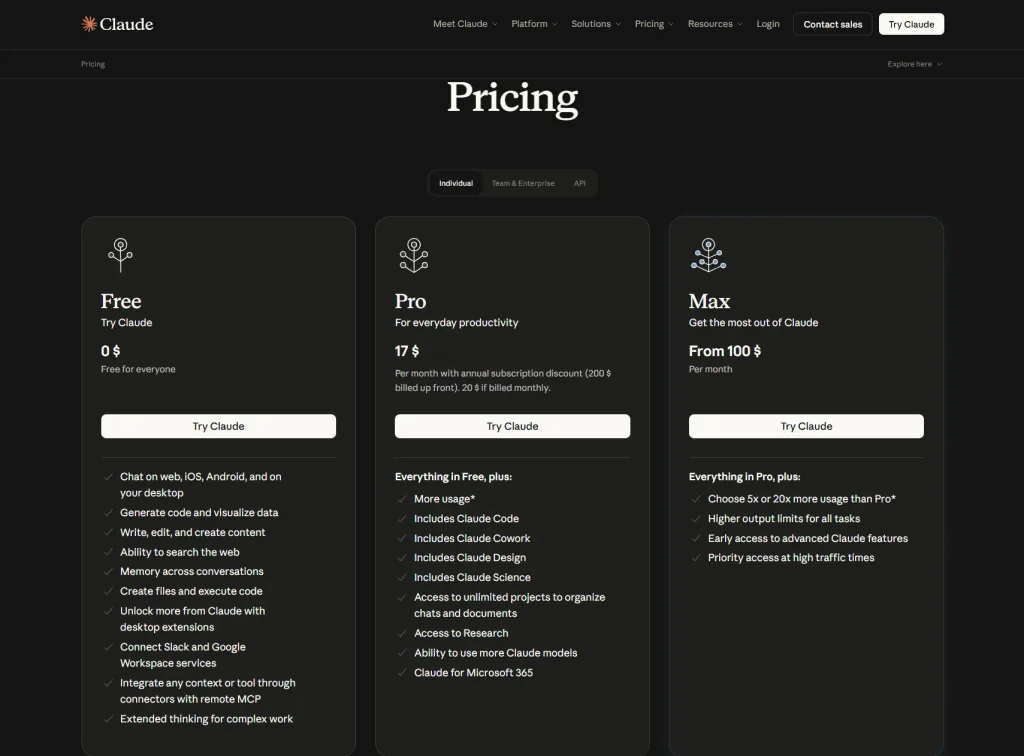
Free is more capable than most free tiers in this category. It covers chat across web, mobile and desktop, web search, memory across conversations, file creation and code execution, extended thinking, Slack and Google Workspace connections, and remote MCP connectors.
What it does not include is the developer and workspace layer. Claude Code, Cowork, Design, Science, Research and unlimited projects all sit behind Pro.
Avoid Free if you write code with Claude, run multi-step work sessions, or need more than occasional capacity.
Claude Pro Pricing: $20 Monthly, $200 Annual
Pro is the practical default for a single professional user. It adds Claude Code, Cowork, Design, Science, Research, unlimited projects, broader model access and Claude for Microsoft 365 on top of everything in Free.
The gap Pro leaves is Fable 5, which bills through usage credits rather than the plan. Anyone who wants the top model as a daily driver is on the wrong tier, not just paying a bit more.
Avoid Pro if you hit the weekly ceiling most weeks, or if Fable 5 is central to how you work.
Claude Max Pricing, 5x Tier: $100 Monthly
Max 5x is a capacity purchase with two extras attached: higher output limits on all tasks and priority access at high traffic times. Fable 5 comes inside the plan, up to half the weekly allowance.
The honest framing is that this is five Pros’ worth of session capacity for five Pros’ worth of money, plus priority and Fable access. It is worth it when interruptions cost you more than $80 a month of working time.
Avoid Max 5x if you reach Pro limits only occasionally. Bundled usage credits are cheaper for occasional overflow.
Claude Max Pricing, 20x Tier: $200 Monthly
Its ceiling is capacity alone. Agent SDK and claude -p work draws from that same pool rather than from a separate credit, so 20x session capacity is the whole of what the extra $100 a month buys over Max 5x.
It is still not unlimited. The five-hour session reset and the weekly all-model limit both apply, and Anthropic states the weekly limit resets at a fixed account-specific time rather than on demand.
Avoid Max 20x if Max 5x rarely constrains you. The step is $1,200 a year.
Claude Team Pricing, Standard Seat: $25 Monthly, $20 Annual
Standard is the default seat for most members of an organization. It brings Claude Code, Cowork, Design and Science, plus the organization layer: central billing, single sign-on, connector admin controls, enterprise search, desktop deployment, and no model training on your content by default.
Capacity is only 1.25x Pro per member, which surprises buyers who assume a business plan means more room. It does not; it means governance.
Avoid Standard for members whose work is genuinely heavy. They will exhaust it at roughly Pro speed.
Claude Team Pricing, Premium Seat: $125 Monthly, $100 Annual
Premium is the same organization, five times the seat price, 6.25x Pro capacity, and Fable 5 inside the plan. It is a capacity and model upgrade, not a governance upgrade.
That distinction is the money. Nothing about Premium enables an admin control that Standard lacks, so assigning it broadly buys capacity nobody uses.
Avoid Premium as a default seat type. Assign it to named heavy users and review the list each quarter.
Claude Enterprise Pricing: $20 Per Seat Per Month Plus Usage
Enterprise adds the controls a regulated or centrally governed organization needs: org and per-user spend limits, role-based access with fine-grained permissioning, SCIM, audit logs, a Compliance API, custom data retention, network-level access control, IP allowlisting, and a HIPAA-ready offering. Entry requires 20 seats self-serve or 50 seats sales-assisted.
The trade is billing shape. You leave a predictable per-seat bill and enter a fixed-plus-variable one.
Two older Enterprise billing models still exist in the wild: Chat and Chat plus Claude Code seats, and Standard and Premium seats with per-seat usage limits. Neither is available for new contracts, and Anthropic states both transition to the single usage-based Enterprise seat at the organization’s next renewal. If you are inheriting one of those, the renewal is a repricing event rather than a rollover.
Feature Gates: What You Actually Get by Plan
| Capability | Free | Pro | Max | Team | Enterprise |
|---|---|---|---|---|---|
| Session capacity | Limited | Baseline | 5x or 20x Pro | 1.25x or 6.25x Pro per member | Metered, no fixed allowance |
| Product surfaces | Chat, search, memory, files, MCP | Adds Claude Code, Cowork, Design, Science, Research | Pro set plus higher output limits | Pro set plus enterprise search | Team set |
| Fable 5 inside plan limits | Not available | Usage credits from first message | Up to 50% of weekly limit | Premium seats only | Seat-type dependent |
| Peak-time behaviour | Free-tier capacity | No stated priority | Priority access at high traffic | No stated priority | No stated priority |
| Organization controls | None | None | None | SSO, central billing, connector admin | Adds SCIM, audit logs, Compliance API, retention, spend limits, IP allowlisting |
Sources: the Claude plan feature lists, Fable 5 plan availability, and Agent SDK plan status.
Every row above is a feature gate, and the governance line is the cleanest upgrade trigger on this page. Team is where central billing, SSO and connector control begin, and Enterprise is where identity provisioning, auditability and retention policy begin.
Company size is a poor proxy for either. A 12-person clinic with a compliance obligation needs the Enterprise row; a 60-person agency with no audit requirement does not.
Context is a separate axis that does not follow plan tiers at all. Claude Fable 5.1, Opus 5 and Sonnet 5 carry a 1M token context window on all paid plans in chat, Opus 4.8, 4.7, 4.6 and Sonnet 4.6 carry 500K, and other models carry 200K. Anthropic’s own comparison grid on the pricing page still lists a flat 200K for Free, Pro, Max and Team, and 500K on the default model for Enterprise. The Help Center page dedicated to context windows is the more specific source and the one used here, so check your settings before sizing a workload around 1M tokens.
When the Free Plan Stops Working
Free breaks at three specific points, and none of them is a message count.
The first is code. Claude Code and Cowork are Pro-and-above, so the moment your work moves from asking questions to running tasks, Free is finished.
The second is project structure. Unlimited projects for organizing chats and documents sit behind Pro, which matters as soon as you have more than one ongoing workstream.
The third is capacity during peak hours. Anthropic describes Pro as offering at least five times the usage per session compared to the free service during peak hours, which is a fair statement of how much room Free actually has.
If none of those three has bitten yet, stay on Free. Upgrading before a limit interrupts you is paying for headroom you are not using.
Claude API Pricing and Where the Extras Hide
API pricing is separate from every subscription above and is worth modeling on its own.
| Model | Input per million tokens | Output per million tokens |
|---|---|---|
| Claude Fable 5.1 | $10 | $50 |
| Claude Mythos 5.1 (limited availability) | $10 | $50 |
| Claude Fable 5 | $10 | $50 |
| Claude Opus 5 | $5 | $25 |
| Claude Sonnet 5 | $2 | $10 |
| Claude Sonnet 4.6 | $3 | $15 |
| Claude Haiku 4.5 | $1 | $5 |
Source: Claude Platform pricing documentation.
One correction is worth making explicitly, because current-looking articles still carry the old figure. The $2 and $10 Claude Sonnet 5 rates were announced at launch as a temporary rate through 2026-08-31. Anthropic now states that this is the standard price and that the increase scheduled for 2026-09-01 will not occur.
Claude Sonnet 5 is therefore cheaper per token than Claude Sonnet 4.6 at $3 and $15, which is unusual and worth checking in any model-selection logic written earlier this year.
Base token rates are not the whole API bill. Four adjustments move the real number in both directions:
- Prompt cache reads cost 10% of the base input price on every model except Claude Fable 5.1 and Claude Mythos 5.1, where a cache hit costs 2.5% of base input, or $0.25 per million tokens. A five-minute cache write costs 1.25x base input, and a one-hour write costs 2x base input.
- The Batch API discounts both input and output tokens by 50% for asynchronous work.
- US-only inference multiplies all token categories, including cache reads and writes, by 1.1x on Claude 4.6 and later models.
- Fast mode on Opus 5 and Opus 4.8 costs $10 input and $50 output per million tokens.
There is also a forecasting trap that has nothing to do with price changes. Claude 4.7 and later models use a newer tokenizer that produces approximately 30% more tokens for the same text than the tokenizer used by Sonnet 4.6 and earlier.
Estimate from measured token counts, not from page counts or character counts. A model migration that looks like a per-token price cut can still raise the invoice.
Real Cost Scenarios: 5, 10 and 20 Users
These are calculations over the published rates above, not vendor quotes. Assumptions are stated so you can change them.

| Team size | Recommended shape | Annual cost | Notes |
|---|---|---|---|
| 5 users | 5 Team Standard seats, annual billing | $1,200 | 5 x $20 x 12. Monthly billing is $1,500 |
| 10 users | 8 Team Standard plus 2 Team Premium seats, annual | $4,320 | (8 x $20 + 2 x $100) x 12. Monthly billing is $5,400 |
| 20 users | 20 Team Standard seats, annual | $4,800 | 20 x $20 x 12, fully predictable |
| 20 users | Usage-based Enterprise, Sonnet 5 workload | $14,400 | $4,800 seat access plus $9,600 usage |
| 20 users | Usage-based Enterprise, Opus 5 workload | $28,800 | Same workload, different model |
| 20 users | Usage-based Enterprise, Fable 5 workload | $52,800 | Same workload, top model |
Sources: Claude plan prices and Claude Platform token rates. Every total is this guide’s arithmetic over those rates.
The Enterprise rows use one illustrative workload: 10 million input tokens and 2 million output tokens per user per month. On Sonnet 5 that is $40 per user per month, or $9,600 a year across 20 seats.
The same workload on Opus 5 is $100 per user per month, and on Fable 5 it is $200. Nothing about the seat price changed across those three rows.
That is the headline finding of this whole page. On a usage-based Enterprise plan, model selection moves the annual bill by more than three times the entire seat commitment, and it is a setting rather than a contract.
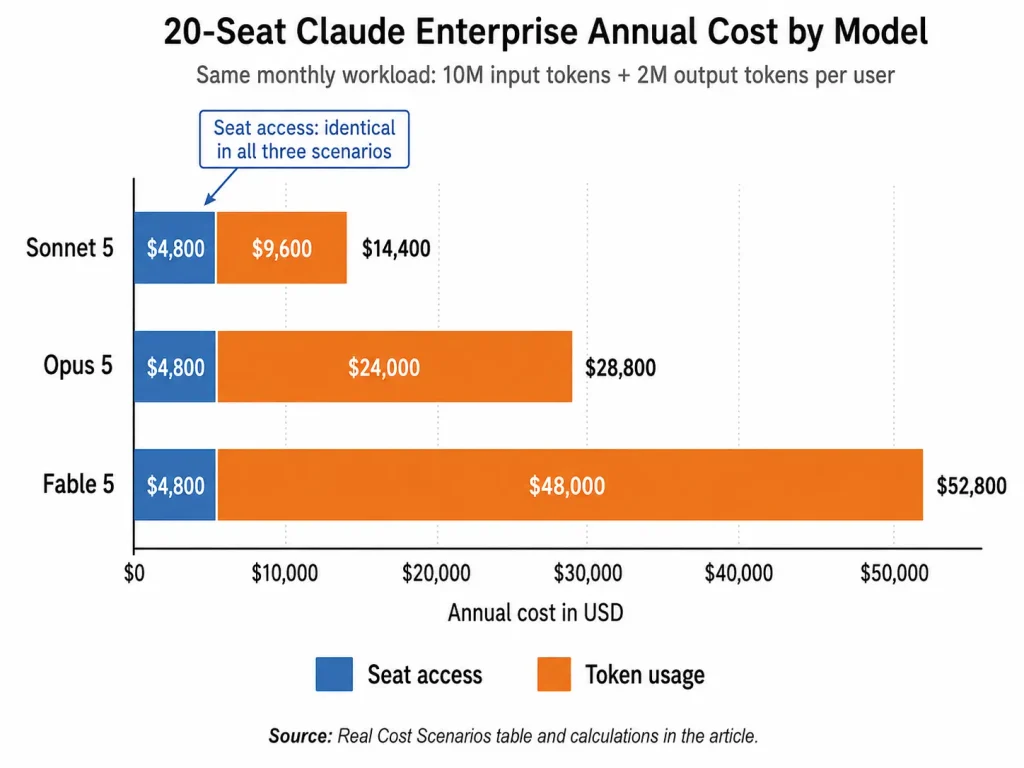
Read as a stacked bar, the fixed seat segment is identical across all three scenarios at $4,800, while the usage segment runs $9,600, $24,000 and $48,000. The seat commitment is about a third of the Sonnet 5 total and under a tenth of the Fable 5 total.
Add US-only inference to the Sonnet 5 scenario and token spend rises from $9,600 to $10,560, taking the total to $15,360. Taxes are excluded from every figure here, and Anthropic notes that prices shown are for US customers and exclude applicable taxes.
Monthly vs Annual Billing
Annual billing is available on Pro and on both Team seat types. It is not available on Max, which bills monthly: Max 5x at $100 and Max 20x at $200.
| Scenario | Monthly billing per year | Annual billing per year | Saving |
|---|---|---|---|
| Pro, one user | $240 | $200 | $40, or 16.67% |
| Team Standard, two seats | $600 | $480 | $120 |
| Team Premium, two seats | $3,000 | $2,400 | $600 |
| Team, 8 Standard plus 2 Premium | $5,400 | $4,320 | $1,080 |
Sources: Pro plan pricing and Team seat pricing. Savings are calculated from those rates.
Claude’s pricing page displays annual Pro as $17 per month with $200 billed up front. The exact division is $16.67, and the $200 up-front figure is the number to put in a budget.
The saving scales with seat count, which makes annual billing look obvious at ten seats. It is less obvious if headcount is moving, because removing a member does not produce an immediate credit or refund; the seat becomes available to reassign.
Adding or upgrading a seat charges the prorated amount immediately. So Team billing is asymmetric by design: it flexes up on the day and flexes down only at renewal.
I would commit annually for a stable core headcount and keep a small monthly buffer for contractors and short-term hires.
What Switching Plans Actually Costs You
Plan changes at Claude carry operational cost that never appears in a price comparison, and one of them is irreversible.
Moving a personal account into a Team or Enterprise organization is one-way; once content has been moved, it can’t be moved back to a personal account. Chats, artifacts, projects and their files, uploaded attachments, project sync configurations, Claude memory, and Claude Code memory and personal settings all move across.
Several things do not. Custom skills, sign-ins to connected apps, custom connectors, published artifacts, pending share invites, Cowork desktop and cloud sessions, and Claude Code cloud sessions stay behind.
Public share links are the sharp edge. They stop working permanently, so anything you have circulated to clients or teammates by link needs re-sharing before the move.
Team to Enterprise keeps your data but is disruptive on the day. Chat history, projects and shared content, and user memberships and roles are preserved, but users cannot access Claude while provisioning runs, and everyone should sign out and back in afterwards to clear cached legacy settings.
The part that generates support tickets is what arrives switched off. Skills and skill creation and sharing, code execution and file creation, interactive artifact content, Claude Design, and Claude in Chrome are disabled or off by default on Enterprise after migration.
Budget a post-cutover checklist alongside the price difference. Verifying capability toggles, seat assignments, roles and spend limits is a half day of admin work, and skipping it looks exactly like an outage to your users.
Which Claude Plan Should You Choose?
Pick by usage pressure and governance need, in that order. Feature lists are a poor guide here because the expensive tiers mostly sell capacity.
| Buyer | Plan | Annual cost | Why |
|---|---|---|---|
| Occasional user | Free | $0 | Nothing in the paid tiers has bitten yet |
| Solo professional | Pro, annual | $200 | Full feature access; upgrade only when limits interrupt work |
| Daily coder hitting weekly limits | Max 5x | $1,200 | 5x session capacity plus Fable 5 in-plan |
| Claude as primary work surface | Max 20x | $2,400 | 20x session capacity, with SDK work drawing from the same pool |
| Two-person shop, both heavy | Team Premium, 2 seats | $2,400 | 6.25x capacity each, plus SSO and central billing |
| Any team of 2 or more, mixed intensity | Team, mixed seats | From $480 | Standard by default, Premium by exception |
| Regulated or centrally governed, 20+ seats | Enterprise, usage-based | $4,800 seats plus usage | SCIM, audit logs, retention, spend limits |
The upgrade trigger inside a Team is worth naming precisely. Move a member from Standard to Premium when they exhaust a session most working days, not when they ask for the better model.
The upgrade trigger from Team to Enterprise is a control you cannot satisfy any other way: identity provisioning through SCIM, audit logs, a Compliance API, custom retention, network access control, or a HIPAA-ready configuration. If none of those is a requirement, Enterprise is a billing change with no benefit.
One caveat on compliance claims. Anthropic documents HIPAA-ready configuration, ISO 27001:2022, ISO/IEC 42001:2023, and SOC 2 Type I and Type II for commercial products such as Claude for Work and the Anthropic API.
That page scopes those credentials to commercial products and routes consumer Free, Pro and Max users to a separate page, so nothing on it extends them to a personal plan. Do not carry them into a personal-plan procurement answer.
Which Claude Plan Should You Avoid?
Three specific configurations waste money, and each has an exception.
Team Premium for everyone. Premium costs five times Standard at either cadence and adds no admin capability, so on ten seats the difference between all-Premium and eight Standard plus two Premium is $7,680 a year at annual rates.
The exception is a small team where every member genuinely runs long daily sessions.
Max when Pro limits are rare. Max 5x costs $100 a month against Pro’s $200 a year, and if you hit the wall a few times a quarter, a $700 usage bundle covers far more overflow than a permanent upgrade does.
The exception is work where waiting out a five-hour reset has a real cost, such as client-deadline delivery.
Usage-based Enterprise for a fixed-budget buyer. If your finance function cannot approve a variable line item, the $20 seat headline will not survive contact with the first invoice.
The exception is an organization willing to enforce per-user spend limits from day one and treat them as the real budget.
Claude Pricing vs ChatGPT and Perplexity
Consumer AI pricing has converged hard: Claude Pro and ChatGPT Plus both list $20 a month. Where the vendors differ is what happens above and below that line, as my ChatGPT vs Claude for business comparison shows.
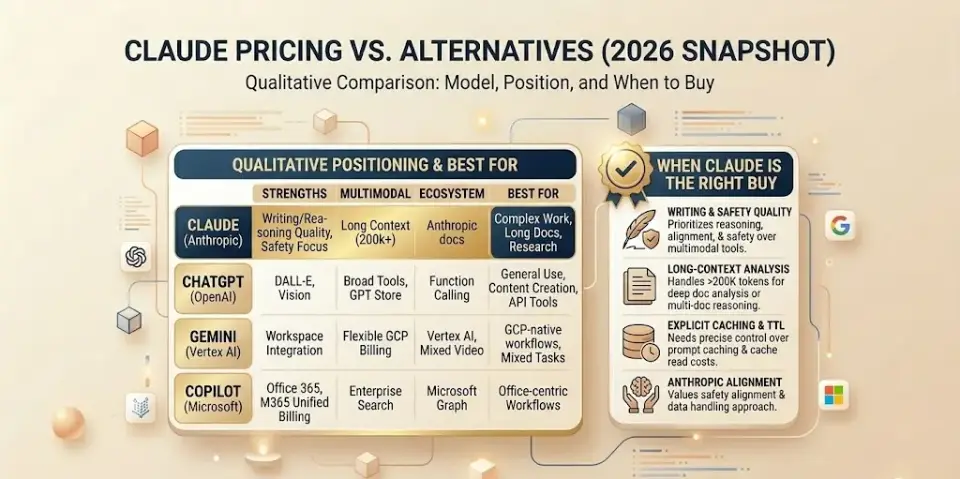
| Product | Entry paid price | Power tier | Team or enterprise seat | Notable difference |
|---|---|---|---|---|
| Claude Pro | $20 monthly | Max 5x $100 monthly | Enterprise $20 plus usage | Two-member Team minimum; Enterprise meters usage separately |
| ChatGPT Plus | $20 per month | Not compared here | Not compared here | Same consumer entry price |
| Perplexity Enterprise Pro | Not compared here | Not compared here | $40 per seat monthly, $400 per year | Higher fixed seat, no separate usage meter documented on that page |
Only directly comparable figures are shown. Rows marked as not compared were outside the sources verified for this guide, and a blank is more useful to you than a number I cannot stand behind.
One caveat on dates. The Claude and Perplexity figures in this table were re-checked on 14 September 2026. The ChatGPT Plus price was last checked on 26 August 2026 and is carried forward, because the current check could not be run from a United States session and this guide does not restate a price it has not retrieved itself.
Perplexity Enterprise Pro is $400 per seat per year.
Claude’s usage-based Enterprise seat is $20 per seat a month plus consumption, so Claude is cheaper at the seat and open-ended above it. That favours predictable light usage and punishes heavy Opus or Fable workloads.
Because Claude Pro and ChatGPT Plus both land on $20, the deciding factor is rarely the invoice. The plan-level detail in ChatGPT pricing plans is the closest like-for-like read on the cost side.
The capability side belongs in a product review rather than a pricing table, and the ChatGPT review is where that comparison actually gets settled.
Is Claude Worth the Price?
Claude is worth it if your work is long-context, code-adjacent, or document-heavy, and if you can name which tier your usage actually reaches. The $200 annual Pro plan is one of the better-value paid tiers in this category because it withholds almost no features, only capacity and one model.
It is not worth it if you are buying Max for prestige rather than for interruptions, or buying Enterprise for a governance control you cannot name. Both are expensive versions of a decision you could have made one tier down.
The honest weakness is billing complexity. Between plan capacity, usage credits, bundles, Agent SDK credits, API billing and Enterprise metering, Claude has six separate ways to charge you, and only two of them appear on the pricing page.
For a fuller picture of what the product does with that money, the Claude review covers capability rather than cost.
How to Avoid Overpaying for Claude
- Start from your usage screen, not the plan grid. Upgrade when session or weekly limits interrupt work repeatedly, not when a tier looks better on paper.
- Default every Team member to Standard. Promote to Premium by name, review quarterly, and demote at renewal rather than carrying unused capacity.
- Price bursty overflow as bundles first. A $700 usage bundle buys $1,000 of usage at the top discount tier, and that beats a permanent upgrade for work that spikes a few months a year.
- Set Enterprise spend limits before you set seat counts. Org and per-user ceilings are the only part of a usage-based Enterprise plan that behaves like a budget.
- Pick the model deliberately. On the 20-seat scenario above, moving the default from Claude Fable 5 to Claude Sonnet 5 cuts the illustrative annual token bill by four fifths on identical usage.
- Enable US-only inference only where residency is a requirement. It costs 10% on every token category, including cache reads.
- Count the rest of the stack. If Claude is joining a bill that already carries Google Workspace pricing and a CRM seat, the marginal per-person cost of Team Premium is larger than it looks in isolation.
Claude Pricing Change Log
Pricing on this page is re-checked against Anthropic’s own pages rather than against other articles. These are the changes that moved a number or a rule since this guide first published.
| Date | What changed | What it does to your bill |
|---|---|---|
| 15 June 2026 | Anthropic announced a monthly Agent SDK credit, then paused the change before it took effect. The Help Center states the credit is not available. | Agent SDK, the non-interactive claude -p command and third-party SDK apps still draw from your plan’s usage limits. |
| 19 July 2026 | The promotion that allowed 50 percent of the weekly limit on Claude Fable 5 at no extra cost ended. | Pro plans and Team Standard seats reach Fable 5 and Fable 5.1 through usage credits from the first message. |
| 1 September 2026 | The scheduled Claude Sonnet 5 increase to $3 and $15 per million tokens did not happen. The launch rate is now the standard rate. | Sonnet 5 at $2 and $10 stays cheaper per token than the older Sonnet 4.6 at $3 and $15. |
| Ongoing | Chat-only Enterprise seats and Standard and Premium Enterprise seats are closed to new contracts and move to the single usage-based Enterprise seat at each organization’s next renewal. | For anyone on a legacy Enterprise seat, renewal is a repricing event rather than a rollover. |
Last updated 14 September 2026.
How These Prices Were Verified
This analysis is based on Anthropic’s published pricing page, Help Center plan and billing documentation, Claude Platform API pricing documentation, and Anthropic’s privacy and compliance pages. Every Claude price, seat minimum and usage limit quoted here was checked against those sources on 2026-09-14 for the US market in USD, reading the rendered pages rather than a summary of them. The Perplexity seat price was re-checked on the same date. The ChatGPT Plus price carries its earlier 2026-08-26 check, as noted beside the comparison table.
Each plan was assessed against the same buyer-focused criteria: usable entry price, capacity per tier, feature and model gates, billing cadence and minimums, overage mechanics, migration consequences, and governance controls.
Greater weight was given to the factors that change a purchase decision rather than a feature checklist: what the advertised price excludes, which limit forces an upgrade, and how cost behaves as seats and token volume grow. Cost scenarios are labelled calculations over published rates, with their inputs and assumptions shown.
Claims that could not be verified from a current official source were excluded. Where a figure appears on more than one Anthropic page, the page dedicated to that claim was treated as authoritative.
Frequently Asked Questions
The questions below cover the price answers people search for on their own, then four edge cases the sections above deliberately leave to the end because each one turns on a condition rather than a headline price.
How much does Claude cost?
Claude costs nothing on the Free plan. Paid plans are Pro at $20 a month or $200 a year, Max 5x at $100 a month, Max 20x at $200 a month, Team Standard at $25 per seat monthly or $20 annually, Team Premium at $125 or $100, and usage-based Enterprise at $20 per seat per month plus token usage billed at API rates. Max is billed monthly only, so the $100 and $200 figures are the whole range at the top of the individual tiers.
Is Claude free?
Yes. The Free plan has no time limit and covers chat on web, mobile and desktop, web search, memory across conversations, file creation with code execution, extended thinking, Slack and Google Workspace connections, and remote MCP connectors. What it does not cover is the working layer: Claude Code, Cowork, Design, Science, Research and unlimited projects all start at Pro.
What is the difference between Claude Pro and Claude Max?
Capacity and model access, not features. Max gives 5x or 20x the session capacity of Pro, higher output limits on all tasks, and priority access at high traffic times. Claude Fable 5 and Fable 5.1 are included inside Max plan limits for up to half of the weekly allowance, while Pro reaches the same models through usage credits from the first message. Pro can be billed annually. Max cannot.
Is Claude Max worth it?
It is worth it when session or weekly limits interrupt your work repeatedly, not when a tier looks better on paper. If you hit the wall a few times a quarter, a discounted usage bundle is cheaper: $700 buys $1,000 of usage, against $1,200 a year for Max 5x. If waiting out a five hour reset costs you a client deadline, Max pays for itself on the first missed afternoon.
How much does Claude Team cost per user?
A Standard seat is $25 per member per month billed monthly, or $20 billed annually. A Premium seat is $125 monthly or $100 annually. Team plans require a minimum of two members and support up to 150 seats. You can mix seat types inside one organization, which is the single largest lever on what a team actually pays.
What does Claude Enterprise include?
Everything in Team, plus organization and per-user spend limits, role-based access with fine grained permissioning, SCIM, audit logs, a Compliance API, custom data retention controls, network level access control, IP allowlisting, a HIPAA-ready offering and Claude Security. Entry is 20 seats self-serve or 50 seats sales-assisted, billed annually. The seat fee covers access only, and usage is billed separately at standard API rates.
How is Claude API pricing calculated?
By tokens, per model, in both directions. You pay a base input rate and an output rate per million tokens, then adjustments on top: prompt cache writes at 1.25x base input for a five minute cache or 2x for a one hour cache, cache reads at a fraction of base input, the Batch API at half price on both directions, and server-side tools such as web search charged per use in addition to the tokens they generate.
What is a token, and how many tokens are in a word?
A token is the unit Claude bills on, and there is no stable word ratio to convert with. Anthropic states that Claude 4.7 and later models use a newer tokenizer that produces approximately 30 percent more tokens for the same text than the tokenizer used by Sonnet 4.6 and earlier. Estimate from measured token counts rather than from page or character counts, because a model migration that looks like a per-token price cut can still raise the invoice.
Which Claude model is cheapest?
Claude Haiku 4.5, at $1 per million input tokens and $5 per million output tokens. The more useful answer for most production workloads is Claude Sonnet 5 at $2 and $10, which is cheaper than the older Claude Sonnet 4.6 at $3 and $15. A newer model being the cheaper one is unusual, and it is worth re-checking any model selection logic written earlier this year.
How can I reduce Claude API costs?
Five levers, in order of size. Pick the cheapest model that clears your quality bar. Send asynchronous work through the Batch API for 50 percent off both directions. Cache anything you send repeatedly, because a cache hit costs a fraction of base input. Bundle code execution with web search or web fetch, which removes the code execution charge entirely. Leave US-only inference off unless data residency is a requirement, because it multiplies every token category by 1.1x.
Does Claude charge for web search?
On the API, yes: $10 per 1,000 searches, plus the standard token cost of the content each search returns into your context. Web fetch carries no additional charge beyond tokens. On the chat plans, web search is included on Free and on every paid tier at no separate cost.
What is prompt caching in Claude, and what does it cost?
Prompt caching reuses an already processed chunk of your prompt instead of charging full input price for it again. A five minute cache write costs 1.25x base input, a one hour write costs 2x, and a cache read costs 0.1x base input on most models, or 0.025x on Claude Fable 5.1 and Claude Mythos 5.1. The five minute cache pays for itself after a single read, the one hour cache after two.
What is the Claude Batch API discount?
Fifty percent off both input and output tokens for asynchronous processing. On Claude Sonnet 5 that turns $2 and $10 into $1 and $5, and on Claude Fable 5.1 it turns $10 and $50 into $5 and $25. The discount stacks with prompt caching and with the data residency multiplier, but it cannot be combined with fast mode.
Does long context cost more with Claude?
No. Claude 4.6 and later models include the full 1M token context window at standard pricing, so a 900,000 token request is billed at the same per-token rate as a 9,000 token one, and prompt caching and batch discounts apply across the whole window. What changes with context size is latency and the risk of hitting a limit specific to the surface you are working in, not the rate you pay.
Should I use Claude Pro or the Claude API?
Both, if you do both kinds of work, because neither one covers the other. A paid subscription enhances the chat experience and does not include access to the Claude API or Console, and the two arrive as separate invoices. Pro is the right buy for interactive work. The API is the right buy for anything programmatic, and a team paying $2,400 a year for Max 20x and then building an integration is starting a second bill from zero.
What happens to my Claude Pro subscription if my company moves me onto a Team plan?
It is cancelled for you. When a personal account closes as part of the move, a directly purchased Pro or Max subscription is cancelled automatically with a prorated refund for unused time.
The exception is a subscription bought through the Apple App Store, which must be cancelled manually because Apple does not permit third-party cancellation. Left alone, it keeps billing after the account has moved.
Is there a cap on how many Claude usage credits I can buy?
Yes, in two places. Discounted bundles are capped at $2,000 of face value per month for individual Pro and Max subscribers and $3,000 for Team owners, with anything beyond that billed at standard rates.
Separately, usage credits carry a daily redemption limit of $2,000. The bundle cap limits the discount rather than the spend; the daily limit is a ceiling on redemption itself.
Do Anthropic’s SOC 2 and HIPAA credentials cover Claude Pro?
No. Anthropic’s compliance page scopes HIPAA-ready configuration, ISO 27001:2022, ISO/IEC 42001:2023 and SOC 2 Type I and Type II to its commercial products such as Claude for Work and the Anthropic API, and routes consumer Free, Pro and Max users to a separate page. If a compliance questionnaire is driving your purchase, that alone rules out individual plans regardless of price.
If a compliance questionnaire is driving your purchase, that alone rules out individual plans regardless of price.
Which Claude models get the 1M token context window?
In chat on paid plans, Fable 5.1, Opus 5 and Sonnet 5 do. In Claude Code, Fable 5.1, Sonnet 5, Fable 5, Opus 5, Opus 4.8, Opus 4.7 and Opus 4.6 all support 1M, though Pro users need usage credits enabled to reach 1M on Opus models, and Sonnet 4.6 needs usage credits on every paid plan except usage-based Enterprise.
Cowork is narrower: Fable 5.1, Fable 5, Opus 5, Opus 4.8, Opus 4.7 and Sonnet 5 reach 1M there, and Sonnet 5 automatically compacts the conversation at 500K tokens. Sonnet 4.6, Opus 4.6 and Haiku 4.5 are capped at 200K in Cowork. Context size follows the model and the surface, not the price of your plan.
Final Decision: Which Claude Plan to Buy
Select the lowest Claude tier that covers your required usage, governance, model access and compliance needs, and refuse to pay for capacity you will not reach.
If your usage stays inside one session most days, Pro at $20 a month is the practical cost, because the only feature gate above it that matters to a solo user is Fable 5.
The upgrade trigger is interruption, not appetite: when team size grows past one and weekly limits bite, Team Standard seats with Premium by exception carry a lower total cost than upgrading everyone.
Enterprise is justified by a governance control you can name rather than by headcount, and its realistic buyer cost is the seat fee plus whatever the chosen model consumes.