
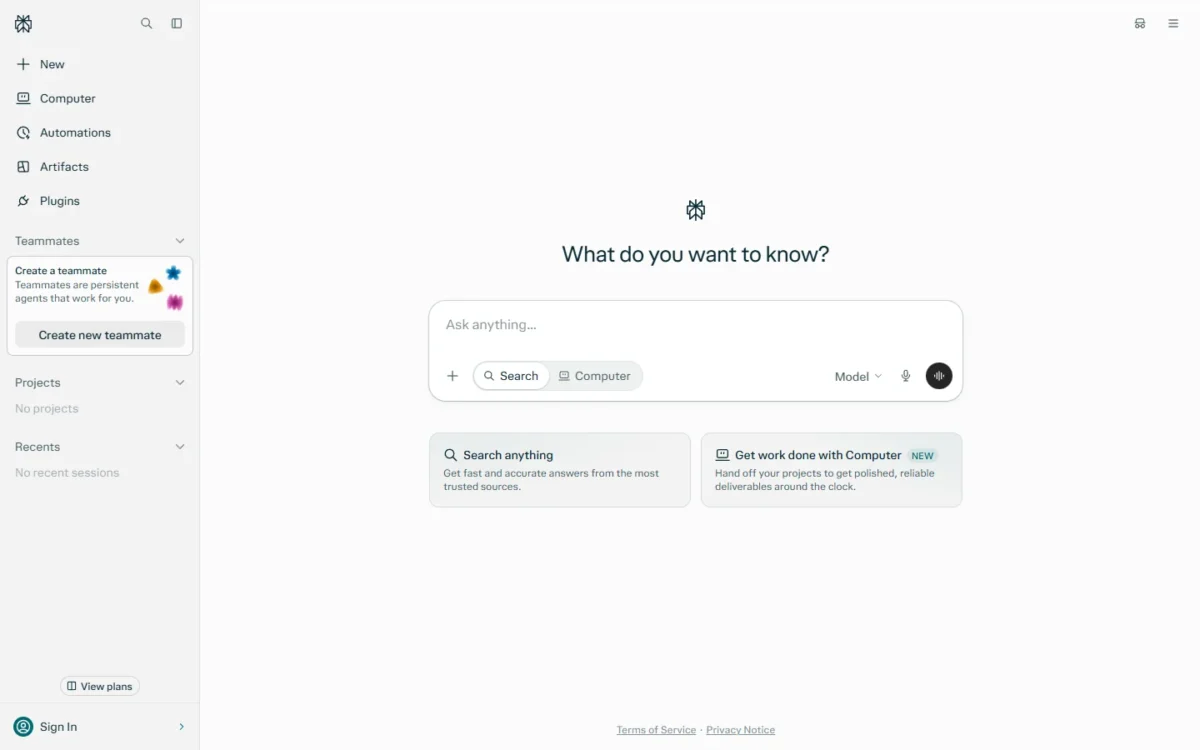
Perplexity vs Claude is a choice of job: pay for Perplexity when your work is web research you have to cite, and pay for Claude when you draft, work inside long files or write code. Perplexity is an AI answer engine that runs several vendors’ models, Claude among them. Claude is Anthropic’s own AI assistant, and it searches the web when a question needs it.
Price does not separate them at the entry level. Perplexity Pro is $20 a month, or $200 a year. Claude Pro is $17 a month on annual billing ($200 up front) or $20 billed monthly.
The catch is the model. Perplexity Pro’s Claude model is Claude Sonnet 5.5, while Claude Opus 5.5 and Claude Fable 5.1 sit on Perplexity Max at $2,000 a year on annual billing or $200 billed monthly.
Researchers and analysts who live in sources get more from Perplexity; writers, developers and teams get more from Claude. Perplexity Pro is “For personal use only”, so a team seat moves to Enterprise Pro at $400 a year, against $20 x 12 months = $240 a year for a Claude Team Standard seat on annual billing.
Quick verdict
Perplexity is the better seat for sourced web research: its plans promise “Citations in every answer”, and Pro lets you pick GPT, Gemini, Grok and Claude models in one search box.
Claude is the better seat for drafting, long files and code: a context window of up to 1M tokens (varies by model), Projects, and Claude Code on every paid plan.
The trade-off on Perplexity is scope: Pro is for personal use and stops at Claude Sonnet 5.5. The trade-off on Claude is research on the free tier, where Research is not included.
Choose Perplexity if
- Most of your questions need a cited answer from the live web
- You want several vendors’ models in one Perplexity Pro seat at $20 a month
Choose Claude if
- You draft, analyze long files or write code most of the day
- You buy for a team of 2 or more
In This Article (10 sections)
Perplexity vs Claude at a Glance
| Attribute | Perplexity | Claude |
|---|---|---|
| Best for | Cited web research, several vendors’ models | Drafting, long documents, analysis and coding |
| Free plan | $0: practically unlimited basic searches, 3 Pro Searches a day, 1 Research query a month | $0: limited usage every 5 hours and every week, web search, files, code execution |
| Entry paid plan, annual billing | Pro: $200/ | Pro: $17/ |
| Entry paid plan, monthly billing | Pro: $20/ | Pro: $20/ |
| Top individual plan | Max: $200/ | Max: $100/ |
| Team seat | Enterprise Pro: $40/ | Team, Standard seats: $20 per member per month, billed annually; $25 billed monthly |
| Claude models on the entry plan | Claude Sonnet 5.5 (Search) | Opus, Sonnet and Haiku; Fable paid with usage credits |
| Main limitation | Pro and Max are for personal use only | No Research and no Claude Code on Free |
Sources: Perplexity Pro and Max plans, Perplexity Connector for Slack plan prices, Perplexity plan comparison, Perplexity Enterprise pricing FAQ, Claude plans and pricing, checked November 2026.
The same Pro price, $20 a month or $200 a year, hides two different products, and the differences below explain why one of them will feel wrong for your work.
Key Differences Between Perplexity and Claude
Perplexity answers from the web with sources attached, while Claude works through a task with you and reaches for the web only when the task needs it. Four differences follow:
- Citations: Perplexity’s free plan is “Search only with accurate answers and citations”, and Pro adds “10x as many citations per answer”. Claude searches on every plan, and then “Every response includes citations”.
- Models: Perplexity Pro’s Search lists models from OpenAI, Google, Anthropic, Moonshot AI, Z.ai, xAI and NVIDIA. Claude’s pricing page lists Anthropic’s Fable, Opus, Sonnet and Haiku.
- Agents: Perplexity Computer “Requires an active subscription and available credits”. Claude Code is included in all paid Claude plans and shares the plan’s usage limits.
- Seats: Perplexity Pro and Max are for personal use, and the team tier is Enterprise Pro. Claude Team is sold “For teams of 2 to 150”.
My take
Pick Perplexity if the thing you hand in is a sourced brief: citation-first answers save the step of checking where each claim came from. Pick Claude if you hand in a draft, an analysis or a pull request, because its working space matters more to that job than the search box.
Perplexity on its own, with its limits and who should skip it, gets a full treatment in my Perplexity review. The model question comes next, because Perplexity offers Claude as a third-party model and the version you get depends on the plan.
Which Claude Models Each Plan Gives You
Perplexity Pro does include Claude, but only Claude Sonnet 5.5; Claude Opus 5.5 and Claude Fable 5.1 need Perplexity Max. Perplexity’s Search table, dated October 27, 2026, still lists Claude Fable 5.1 on Max, while Anthropic’s current Fable model is Fable 5.2. Claude Pro includes Opus, and Fable there is “paid with usage credits”.
| Plan level | Perplexity | Claude |
|---|---|---|
| Free | Best only (automatic model choice) | Sonnet and Haiku |
| Entry paid | Pro: Claude Sonnet 5.5, GPT-6.1 Sol, Gemini 3.8 Flash, Kimi K3, GLM 5.3, Grok 4.7, Nemotron 3.5 Super VL | Pro: Opus, Sonnet, Haiku; Fable paid with usage credits |
| Top individual | Max: adds Claude Opus 5.5, Claude Fable 5.1, GPT-6 Astra, Gemini 4 Argon | Max and Ultra: Fable up to 50% of weekly limits |
| Team | Enterprise Pro: the Pro list; Enterprise Max: the Max list | Team: Opus, Sonnet, Haiku; Fable on Premium seats |
Sources: Perplexity model list by plan, Claude plans and pricing, Claude models overview, checked November 2026.
Anthropic’s model documentation names the current versions Claude Fable 5.2, Claude Opus 5.5, Claude Sonnet 5.5 and Claude Haiku 5.5. Perplexity dates its Search table to October 27, 2026 and calls the model selector “the source of truth for your account”.
If Opus is the reason you want Claude, Perplexity Pro at $200 a year is the wrong plan. Claude Opus 5.5 through Perplexity means Perplexity Max at $2,000 a year on annual billing or $200 billed monthly, while Claude Pro includes Opus for $200 a year on annual billing. Fable’s usage credits are broken down in my Claude plan-by-plan pricing.
Perplexity vs Claude: Features Compared
Perplexity puts citations in every answer and lets Pro subscribers pick Search models from seven providers; Claude offers a context window of up to 1M tokens and includes Claude Code on every paid plan. On data controls the two match once you pay for the team tier.
| Criterion | Perplexity | Claude |
|---|---|---|
| Citations | Every answer, all plans | Every response that uses web search, all plans |
| Deep research | Free: 1 query/ | Research: Pro and up; not on Free |
| Model choice | Free: Best only; Pro: 7 Search models from 7 providers | Anthropic models only; Opus from Pro |
| Context window | Not published | Up to 1M tokens, varies by model |
| Files and projects | Pro: up to 50 file uploads per project | Projects: up to 5 on Free, included on Pro |
| Coding tool | Computer agent, uses credits | Claude Code, all paid plans |
| Training default | Pro and Max: opt-out available; Enterprise: never used | Free to Ultra: opt-out; Team: none by default |
Sources: Perplexity plan comparison, Claude plans and pricing, checked November 2026.
Research and citations
For sourced web research, Perplexity fits better: citations come with every answer on every plan, and the free plan carries 3 Pro Searches a day and 1 Research query a month. Claude searches the web with citations on every plan too, but keeps Research for Pro and up.
The difference shows at volume. A Perplexity Enterprise Pro seat lists 400 Pro Searches a week and 50 Research queries a month, so a research team can plan around published numbers. Claude’s help center says web search and web fetch count toward your usage limits, so heavy searching on Claude draws down the pool you need for drafting.
Claude can fetch a page from a URL you give it and work on the full text, which helps when research starts from documents you already have. For tools built only for papers and sources, see the best AI tools for research.
Verdict: Research and citations
Perplexity fits better for anyone whose output is a cited answer or brief, starting on the free plan. Claude Pro is enough when research feeds a draft.
Writing and long documents
Claude fits better for long drafts and large files: its pricing page lists a context window of up to 1M tokens (varying by model), plus Artifacts, Claude Docs and Claude Slides on every plan. Perplexity’s plan comparison table lists no context window size, and Pro lists up to 50 file uploads per project.
That matters for work that has to hold a whole contract or report in view at once. Perplexity Pro does “Create polished documents & apps”, but its plans describe output volume, not how much of your own material stays in context. My full Claude review judges Claude on its own terms.
Verdict: Writing and long documents
Claude fits better for writers and analysts working inside large files. Perplexity is the better drafting tool only when every paragraph has to carry a source.
Coding and agents
Claude fits better for coding: Claude Code is included in all paid plans and shares the plan’s usage limits, so terminal work and chats draw from one pool. The Claude Team plan includes Claude Cowork.
Perplexity’s agent is Computer, which can “research, code, create documents, and use connected tools” on credits: Pro carries 4,000 bonus credits, and Max adds 10,000 monthly credits. Comet Assistant, its browser agent, runs on monthly limits on Pro and is not on the free plan.
The economics differ. Claude Code costs nothing extra until you hit the plan limit; then you wait, upgrade or turn on usage credits at standard API rates. Perplexity Computer spends credits per task. If you pick Claude for code, start with getting started with Claude Code.
Verdict: Coding and agents
Claude fits better for developers who code daily. Perplexity Computer fits a researcher who wants findings turned into a document or a small app.
Team use and data controls
Both need their team tier to pass a client-data review. Perplexity Enterprise Pro states that data is “never used for training” and adds seat management, shared Projects and admin-managed billing. Claude Team lists “No model training on your content by default”, single sign-on, central billing and project sharing.
On individual plans the defaults are close: Perplexity Pro and Max offer an opt-out from AI training, and Claude Free through Ultra list model training as opt-out. A consultant on a personal plan can opt out of AI training on either one.
Verdict: Team use and data controls
Comparable at the team tier. Claude Team costs less per seat and its Standard seat includes Opus; Perplexity Enterprise Pro brings several vendors’ models and published research limits.
Perplexity vs Claude Pricing
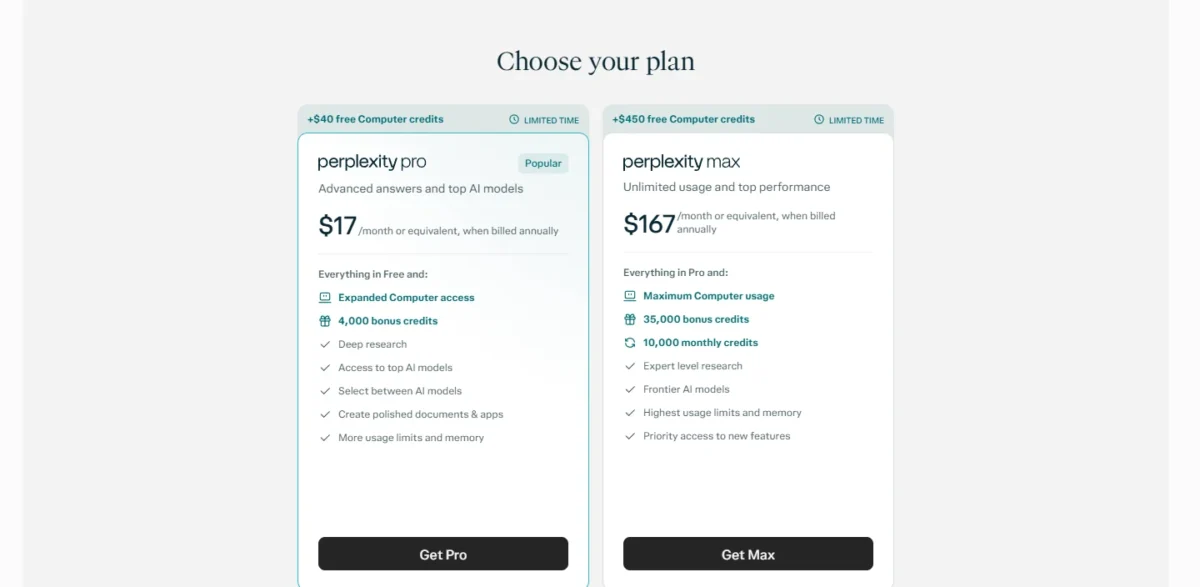
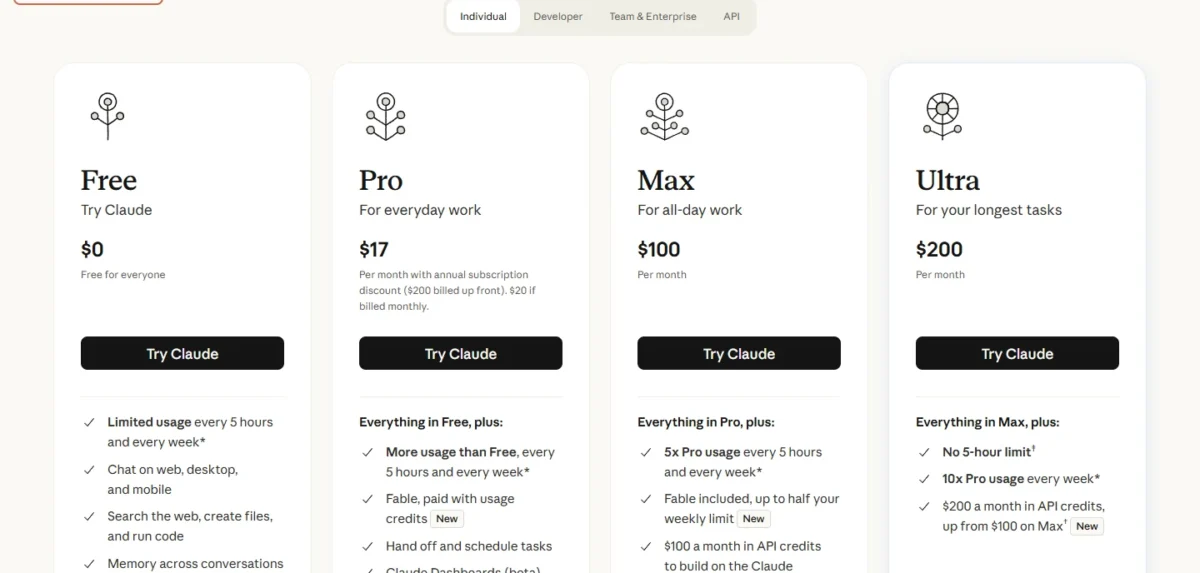
The entry plans tie: Perplexity Pro and Claude Pro are each $200 a year on annual billing or $20 billed monthly, but the team seat does not: Claude Team Standard seats are $20 per member per month, billed annually, while Perplexity Enterprise Pro is $400 a seat a year. At the top, Perplexity Max is $200 billed monthly or $2,000 a year, against Claude Max at $100 and Claude Ultra at $200 a month.
| Tier | Perplexity | Claude |
|---|---|---|
| Free | Free: $0 | Free: $0 |
| Entry individual, annual billing | Pro: $200/ | Pro: $17/ |
| Entry individual, monthly billing | Pro: $20/ | Pro: $20/ |
| Top individual | Max: $200/ | Max: $100/ |
| Team seat | Enterprise Pro: $40/ | Team, Standard seats: $20 per member per month, billed annually; $25 billed monthly |
| Power-user team seat | Enterprise Max: $325/ | Team Premium: $100/ |
| Large organization | Enterprise Pro and Max; no self-serve trial | Enterprise: $20/ |
Sources: Perplexity Pro and Max plans, Perplexity Connector for Slack plan prices, Perplexity Enterprise pricing FAQ, Claude plans and pricing, Claude Team plan, checked November 2026.
Perplexity’s help center lists Pro at $20 per month or $200 per year, and its plans page shows Max at $167 per month on annual billing. The full prices are in the table above.
Claude bills Max and Ultra monthly only, so Claude Max at $100 a month costs half of Perplexity Max billed monthly. Claude Max at $100 x 12 months = $1,200 a year still costs less than Perplexity Max on annual billing.
The top tiers do not convert into each other: Claude Max gives 5x Pro usage every 5 hours and every week, while Perplexity Max gives its highest usage limits plus monthly Computer credits. Buy the top tier for the model or the agent you need.
Every Perplexity plan and its limits are laid out in Perplexity’s plans in detail.
Cost for a 5- and 10-Person Team
On annual billing, 5 seats cost $2,000 a year on Perplexity Enterprise Pro ($400 x 5 seats) against $1,200 on Claude Team Standard ($20 x 5 seats x 12 months). At 10 seats the gap doubles to $1,600 a year.
| Team size and billing | Perplexity Enterprise Pro | Claude Team Standard | Difference |
|---|---|---|---|
| 5 seats, annual | $400 x 5 = $2,000 | $20 x 5 x 12 = $1,200 | $800 |
| 10 seats, annual | $400 x 10 = $4,000 | $20 x 10 x 12 = $2,400 | $1,600 |
| 5 seats, monthly | $40 x 5 x 12 = $2,400 | $25 x 5 x 12 = $1,500 | $900 |
| 10 seats, monthly | $40 x 10 x 12 = $4,800 | $25 x 10 x 12 = $3,000 | $1,800 |
Sources: Perplexity Enterprise pricing FAQ, Claude plans and pricing, checked November 2026. Assumptions: list prices, standard seats only, no tax, no usage credits, no discounts.
The cheaper seat also carries more Claude: a Claude Team Standard seat includes Opus, while a Perplexity Enterprise Pro seat stops at Claude Sonnet 5.5. What Perplexity’s seat buys instead is citations, several vendors’ models and 400 Pro Searches a week.
Power users widen the gap. On Claude, four Standard seats and one Premium seat cost $20 x 4 seats x 12 months + $100 x 1 seat x 12 months = $2,160 a year. On Perplexity, four Enterprise Pro seats and one Enterprise Max seat cost $400 x 4 seats + $3,250 x 1 seat = $4,850 a year.
What Forces an Upgrade
On Perplexity Free, the wall is 3 Pro Searches a day and 1 Research query a month; on Claude Free, it is the usage limit every 5 hours and every week, with no Research and no Claude Code.
On the paid plans the triggers split. Perplexity Pro’s Pro Searches run on “Weekly limits (average use)”, and the reason to move to Max is mostly models: Claude Opus 5.5, Claude Fable 5.1 and Model Council sit there. Claude Pro’s limits cover chat and Claude Code together, so a developer is the user most likely to need Claude Max at $100 a month or usage credits.
Perplexity vs Claude: Pros and Cons
Perplexity
Pros
- Citations in every answer, on the free plan as well
- One Pro seat covers models from OpenAI, Google, Anthropic and xAI
- Enterprise Pro publishes its limits: 400 Pro Searches a week, 50 Research queries a month
Cons
- Pro reaches Claude Sonnet 5.5 only; Opus 5.5 needs Max
- Pro and Max are for personal use, so teams pay $400 a seat a year
- No published context window size
Claude
Pros
- Claude Code on every paid plan, inside the plan’s usage pool
- Context window of up to 1M tokens, varying by model
- Opus on Claude Pro, the entry plan: $17 a month on annual billing, $20 billed monthly (claude.com/pricing)
Cons
- No Research and no Claude Code on the free plan
- Web search draws on the same usage limits as drafting and coding
- Max and Ultra are billed monthly only
Pick Perplexity if you work alone and research comes first, because its personal-use rule hurts a team lead most. Pick Claude if you buy for a team or write code: its shared usage pool matters less to a team lead or a developer, and the heavy researcher is the reader who should weigh it.
Which Is Better for Your Needs?
Pick by the priority that fills most of your week.
| Your priority | Better fit | Reason | Trade-off |
|---|---|---|---|
| Cited web research | Perplexity | Citations in every answer; Research even on Free | Claude Opus 5.5 needs Perplexity Max |
| Long drafts and large files | Claude | Up to 1M-token context, Projects, Docs | Web search uses the same usage limits |
| Coding | Claude | Claude Code on all paid plans | Shares the 5-hour and weekly limits with chat |
| GPT, Gemini and Claude in one seat | Perplexity | Pro lists 7 Search models from 7 providers | Claude Sonnet 5.5 only on Pro |
| A small team on a budget | Claude | 5 seats: $1,200 vs $2,000 a year on annual billing | Team needs at least 2 seats |
| No training on client data | Tie | Enterprise Pro: never used; Claude Team: none by default | Both require the team tier |
Sources: Perplexity Enterprise pricing FAQ, Claude Team plan, checked November 2026.
A researcher or journalist should start on Perplexity Pro and add Claude only if the week turns into drafting. A writer or developer should start on Claude Pro and keep Perplexity’s free plan for quick sourced lookups. A team lead buying 5 or more seats should start with Claude Team, unless the team’s main output is cited research.
If ChatGPT is on your shortlist too, see how Perplexity compares with ChatGPT for the research side.
For the drafting side, ChatGPT vs Claude for business sets the same seat prices against different limits.
How I Compared Perplexity and Claude
I compared both on the vendors’ own pages, read on November 7, 2026: Perplexity’s plans page, enterprise pricing page, plan comparison, model list and Enterprise billing FAQ; Claude’s pricing page, Anthropic’s model overview, and Claude help articles on the Pro, Max and Team plans, web search and data export.
The plans compared are Free against Free, Perplexity Pro against Claude Pro, Perplexity Max against Claude Max and Ultra, and Perplexity Enterprise Pro against a Claude Team Standard seat. The criteria are research, writing, coding, data controls, models per plan and cost.
Perplexity publishes no context window size. Claude says there is “no fixed message count” and gives no Research query count. Answer quality depends on your own questions, so run the same three research questions through both free plans before you pay.
FAQ
Is Perplexity AI based on Claude?
No. Perplexity combines web search with models built by Perplexity and by third-party providers, and Claude Sonnet 5.5 is one of the Search models a Pro subscriber can pick. On Best, the default, Perplexity picks a suitable model for each query, so a given answer may not come from Claude at all.
Can I use Perplexity and Claude together?
Yes, as two subscriptions. Perplexity Pro at $200 a year plus Claude Pro at $200 billed up front comes to $200 + $200 = $400 a year on annual billing. That pairing suits someone who researches with sources in the morning and drafts in Claude in the afternoon.
Which free plan does more?
It depends on the job. Perplexity Free gives practically unlimited basic searches, 3 Pro Searches a day and 1 Research query a month, but no manual model choice. Claude Free gives Sonnet and Haiku, file creation, code execution, Artifacts and up to 5 Projects, within limits that reset every 5 hours and every week.
Can I export my Claude chats if I switch?
Yes, on Free, Pro, Max and Ultra: go to Settings > Privacy on the web app or Claude Desktop and choose Export data. The export holds your chats, projects, memory and account data, but not the original files you uploaded. The emailed download link expires 24 hours after it is created.
Final Verdict: Perplexity or Claude?
Pay for Perplexity if your work is research that has to show its sources, pay for Claude if your work is writing, analysis or code, and pay for both if you do each every day.
Choose Perplexity if
- Your deliverable is a cited answer, brief or report
- You want GPT-6.1 Sol, Gemini 3.8 Flash, Grok 4.7 and Claude Sonnet 5.5 behind one Pro subscription
- Your team needs published limits: 400 Pro Searches a week on Enterprise Pro
Choose Claude if
- You draft or analyze long documents, up to a 1M-token context depending on the model
- You write code and want Claude Code included in the plan
- You buy for 2 to 150 people: 5 Team Standard seats cost $1,200 a year on annual billing
Skip Perplexity if: you need Claude Opus 5.5 on a budget, or a team seat that costs less than Perplexity Enterprise Pro at $400 a seat a year. Claude Pro includes Opus, and a Claude Team Standard seat costs $20 x 12 months = $240 a year on annual billing.
Skip Claude if: your main job is cited research and you do not want a paid plan for it. Perplexity Free includes 1 Research query a month and 3 Pro Searches a day, while Claude Free does not include Research.
If neither fits because you need something Claude does not do, my list of Claude alternatives is the next place to look.