

Dynamics 365 Sales is the better fit for a sales team that already works in Microsoft 365 and Teams. SugarCRM’s Sugar Sell fits B2B account sellers whose revenue sits in ERP purchase data. On the first tier with forecasting, Sugar Advanced+ costs $98 and Dynamics 365 Sales Enterprise $105 per user per month, billed annually.
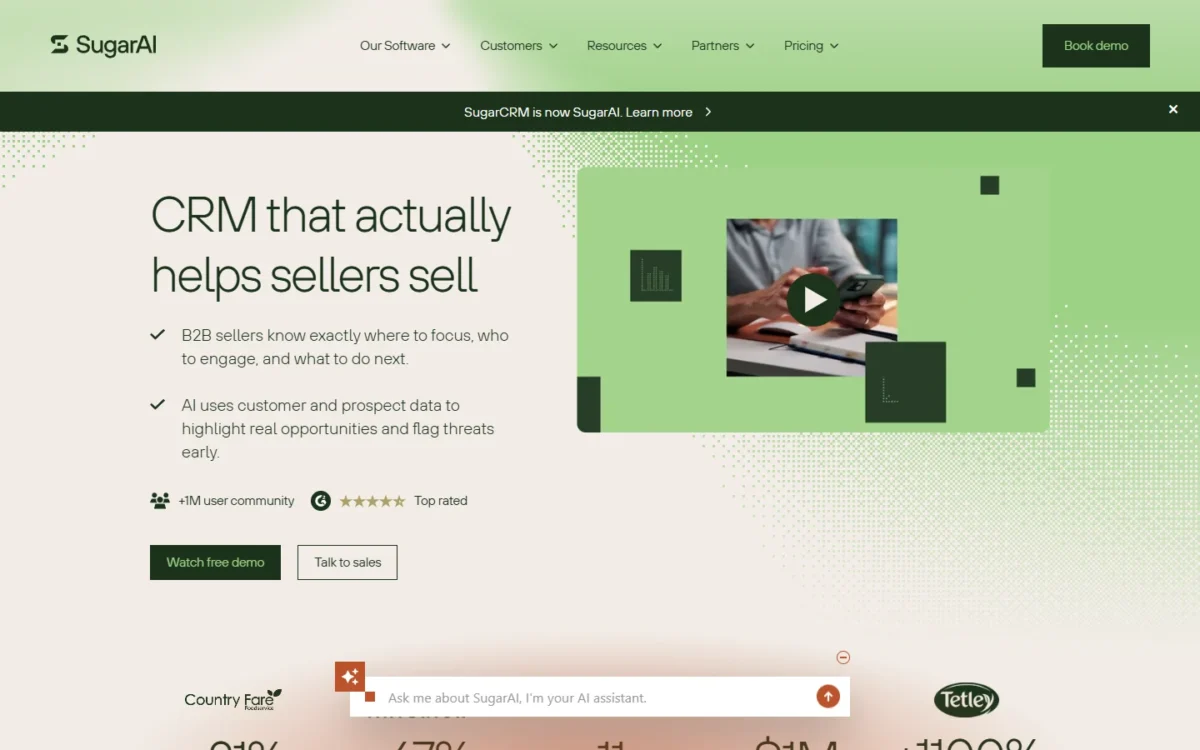
SugarCRM now trades as SugarAI, and Sugar Sell 26.2 went live on its October 2026 Release Central page. I checked both vendors’ US pricing pages and documentation that month.
Quick verdict
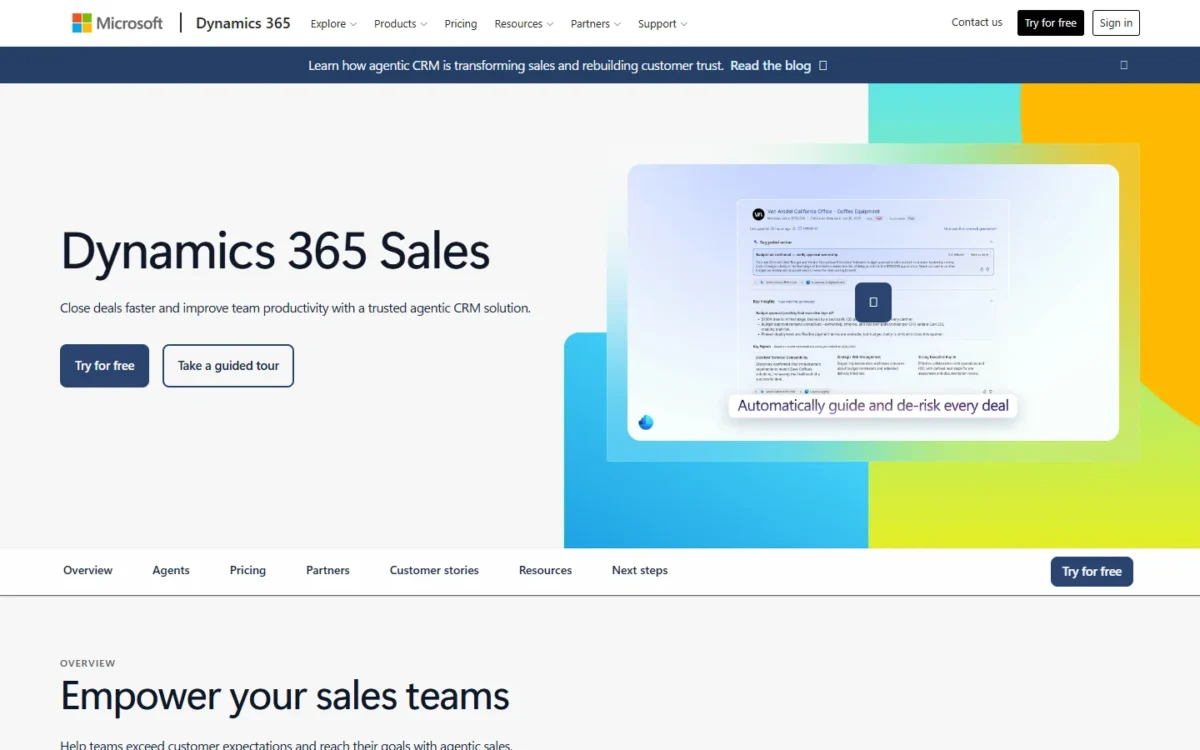
The deciding difference is the stack: Dynamics 365 Sales plugs into Outlook, Teams and LinkedIn Sales Navigator, while SugarCRM ties CRM records to ERP purchase data.
Pick Dynamics 365 if your company runs on Microsoft 365 and wants a 30-day trial first. Pick SugarCRM if repeat orders from existing accounts drive revenue. Its reorder and cross-sell signals come from Sugar Predict on Precision+, priced on request; Advanced+ at $98 is the cheaper forecasting tier, without Sugar Predict.
The trade-off: Dynamics bills Power Apps, Power Automate and Copilot Credits outside the seat, while SugarCRM lists no trial and quotes Precision+ on request.
In This Article (10 sections)
SugarCRM vs Dynamics 365 at a Glance
The comparable tiers land close on price ($68 vs $65 at entry, $155 vs $150 at the top), so the stack decides more than the seat price.
| Attribute | SugarCRM (Sugar Sell) | Dynamics 365 Sales |
|---|---|---|
| Best for | B2B account selling tied to ERP data | Sales teams on Microsoft 365 and Teams |
| Vendor | SugarAI (formerly SugarCRM) | Microsoft |
| Starting price | Standard+: $68 per user per month, billed annually | Sales Professional: $65 per user per month, paid yearly |
| First tier with forecasting | Advanced+: $98 per user per month, billed annually | Sales Enterprise: $105 per user per month, paid yearly |
| Free trial | Not listed on sugarai.com/ | 30-day trial |
| Main strength | 180+ ERP integrations; Sugar Predict on Precision+ | Microsoft 365 interoperation from the entry plan |
| Main limitation | Precision+ priced on request only | Power Apps and Power Automate need additional licenses |
Sources: Sugar Sell pricing (SugarCRM pricing), Dynamics 365 Sales pricing and Dynamics 365 Sales overview, checked October 2026.
Key Differences Between SugarCRM and Dynamics 365
The deciding difference is the stack each one is built around: Microsoft 365 for Dynamics 365, ERP data for SugarCRM.
- Target market: SugarAI aims SugarCRM at mid- to large organizations that rely on repeat sales, naming manufacturing and wholesale distribution. Microsoft describes every Dynamics 365 Sales plan as ideal for enterprises.
- Stack: Dynamics 365 Sales Professional includes Microsoft 365 interoperation. SugarCRM connects to ERP systems, and Sugar Predict on Precision+ reads what customers actually buy.
- How extras are bought: SugarCRM lists one add-on, Sugar Connect+, at +$20 per user per month, billed annually. Dynamics 365 bills Power Apps, Power Automate, Copilot Credits and an Azure subscription outside the seat.
- Trying it: Microsoft offers a 30-day Dynamics 365 Sales trial; SugarCRM’s pricing page offers a demo and a quote request.
Both cover the core of what a CRM system does for sales (accounts, contacts, leads, opportunities), so the stack split decides more than any single feature.
SugarCRM vs Dynamics 365: Features Compared
Forecasting and built-in AI start on the middle tier of both: Sugar Advanced+ and Dynamics 365 Sales Enterprise. Neither entry plan’s card lists forecasting.
| Feature | SugarCRM (Sugar Sell) | Dynamics 365 Sales |
|---|---|---|
| Pipeline and opportunity management | Standard+ | Sales Professional |
| Forecasting | Advanced+ | Sales Enterprise |
| AI summaries and assistant | Advanced+ | Sales Enterprise (Copilot) |
| Sequences and predictive scoring | Not listed on the Sugar Sell plan cards | Limited: 1,500 records per month on Sales Enterprise |
| Email and calendar | Advanced+ | Sales Professional (Microsoft 365 interoperation) |
| Call and meeting transcripts | Add-on: Sugar Connect+ | Sales Enterprise (conversation intelligence) |
| Custom workflows | Standard+ (business process management) | Add-on: Power Automate license |
Sources: Sugar Sell pricing (SugarCRM pricing), Sugar supported platforms, Dynamics 365 Sales pricing, Sales Enterprise capacity and Customer Engagement (on-premises), checked October 2026.
The matrix shows where each bill grows: SugarCRM moves features up its tiers, while Dynamics 365 moves them into separate licenses.
Pipeline, forecasting and reporting
Both SugarCRM and Dynamics 365 hold forecasting back to the middle tier, and both measure sellers against quotas.
SugarCRM’s Forecasts module builds worksheets from opportunities, and managers aggregate their team’s commitments against a quota per period. Dynamics 365 Sales Enterprise tracks seller performance against quotas, and Sales Premium adds predictive forecasting.
Reports start on the entry plan of both: SugarCRM Standard+ includes Analytics (AI Analytics on Advanced+), and Dynamics 365 includes reporting, dashboards and analytics with Microsoft Power BI.
Verdict: Forecasting and reporting
Comparable at the middle tier. Dynamics 365 reserves predictive forecasting for Sales Premium, and SugarCRM’s plan cards list no predictive forecast, so ask SugarAI about it in the demo.
AI and Copilot
SugarCRM puts AI Summaries, the Sugar Cube AI Assistant and Smart Prompts in Advanced+, with Smart Guides and meeting preparation in Premier+. Its pricing page names no credit allowance for them.
Dynamics 365 meters more of its AI. Sales Enterprise includes Copilot (opportunity summaries, email and meeting assistance), and Sales Premium adds 1,000 Copilot Credits per user per month to run agents, which also need an Azure subscription.
The cap that forces an upgrade sits on Sales Enterprise: 1,500 sequence-connected records per month in the sales accelerator and 1,500 records per month of predictive scoring. Sales Premium has no limit; my Dynamics 365 Sales review weighs that upgrade in full.
Verdict: AI and Copilot
Depends on your stack. Dynamics 365 fits a team that wants AI inside Outlook and Teams and will budget for Credits; SugarCRM fits a team that wants AI summaries with no meter on the price card. Judge output on your own accounts in the trial and the demo.
Customization and automation
SugarCRM includes business process management from Standard+, and SugarAI says many configuration options are free of charge. Dynamics 365 marks customization “Limited” on Sales Professional and builds flows and custom apps with Power Automate and Power Apps, each needing additional licenses.
Microsoft’s Sales pricing page prints no price for those licenses, so get them priced before you compare totals. My SugarAI (SugarCRM) review gives the full verdict on the Sugar side.
Verdict: Customization and automation
Depends on use. SugarCRM fits a team that wants process automation inside the seat; Dynamics 365 fits a company that already licenses Power Platform. Ask SugarAI which changes need paid services before you sign.
Integrations: ERP data vs the Microsoft 365 stack
Dynamics 365 Sales runs on Microsoft Dataverse and connects to the Outlook app, Teams chats and dialer, softphones and LinkedIn Sales Navigator. SugarCRM lists 180+ ERP integrations, marketplace add-ons, and REST and SOAP APIs.
SugarCRM’s Precision+ turns that ERP purchase data into cross-sell recommendations, reorder windows and early churn signals. Microsoft’s Sales pricing and overview pages list no ERP integration count.
Verdict: Integrations
Dynamics 365 fits Microsoft 365 shops, where Outlook, Teams and LinkedIn are first-party links. SugarCRM fits ERP-led account selling. Price Precision+ before it becomes the reason to buy.
Deployment, security and support
SugarAI’s supported platforms page lists server requirements for Sugar 26.1 and makes Sugar 26.2 available to SugarCloud customers only. SugarAI supports DB2 and Oracle databases on Sugar 26.1 for Sugar Enterprise only. Ask SugarAI about deployment options before you plan on a server install.
Microsoft still documents Dynamics 365 Customer Engagement (on-premises), version 9.1.
SugarAI claims ISO 27001, SOC 2 Type 2 and GDPR compliance on AWS hosting. Microsoft lists Dynamics 365 in scope for ISO/IEC 27001 and its SOC 2 Type 2 report. Dynamics 365 Sales also encrypts sensitive columns by default.
SugarCRM’s support ranges from online-only to 24/7 global response, depending on the Sugar solution. Microsoft gives billing and technical break-fix support at all support levels, and its Professional Direct and Unified levels add advisory help. Service desk buyers belong on my list of help desk ticketing systems.
Verdict: Deployment, security and support
Comparable on certifications. The vendor pages give no basis for rating service quality. Microsoft’s initial response time depends on the support plan and the request’s severity, so get each vendor’s response terms in writing with the quote.
SugarCRM vs Dynamics 365 Pricing
Tier for tier, Sugar Sell costs $68, $98 and $155 and Dynamics 365 Sales $65, $105 and $150 per user per month, billed annually. Neither prints a monthly-billing price or lists a free plan.
| Plan tier | SugarCRM (Sugar Sell) | Dynamics 365 Sales |
|---|---|---|
| Entry | Standard+: $68 | Sales Professional: $65 |
| First with forecasting | Advanced+: $98 | Sales Enterprise: $105 |
| Full AI tier | Premier+: $155 | Sales Premium: $150, with 1,000 Copilot Credits per user per month |
| Quote-only tier | Advanced or Premier Precision+: Contact sales | Relationship Sales: Contact sales, 10-seat minimum |
| Add-on | Sugar Connect+: +$20 | Copilot Credits: pay-as-you-go or pre-purchase |
Sources: Sugar Sell pricing (SugarCRM pricing) and Dynamics 365 Sales pricing, US prices, checked October 2026.
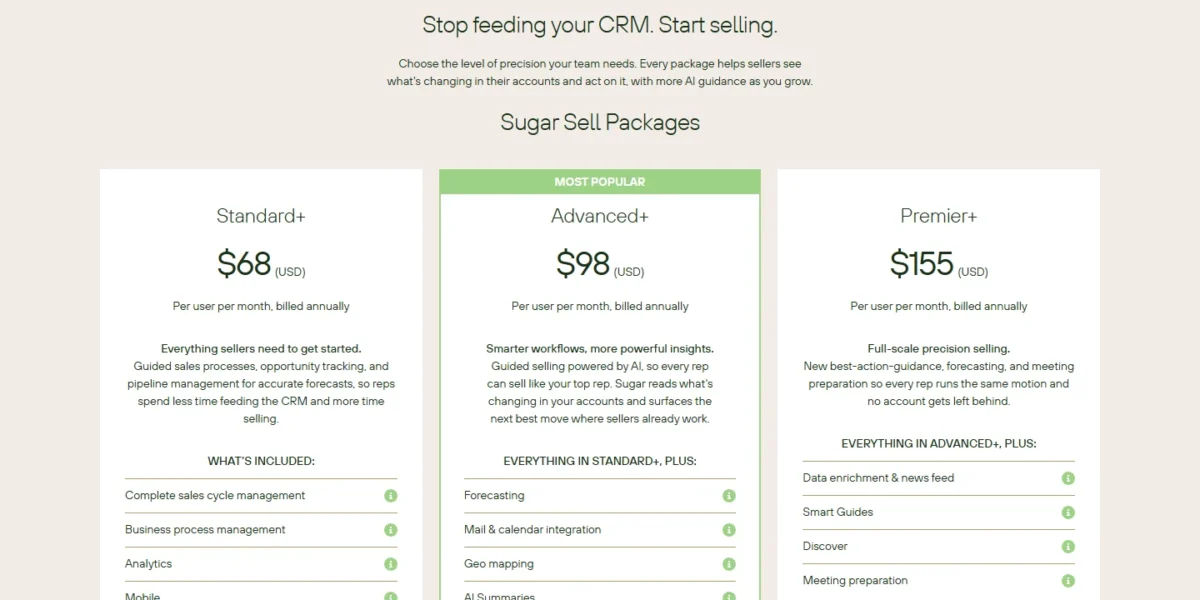
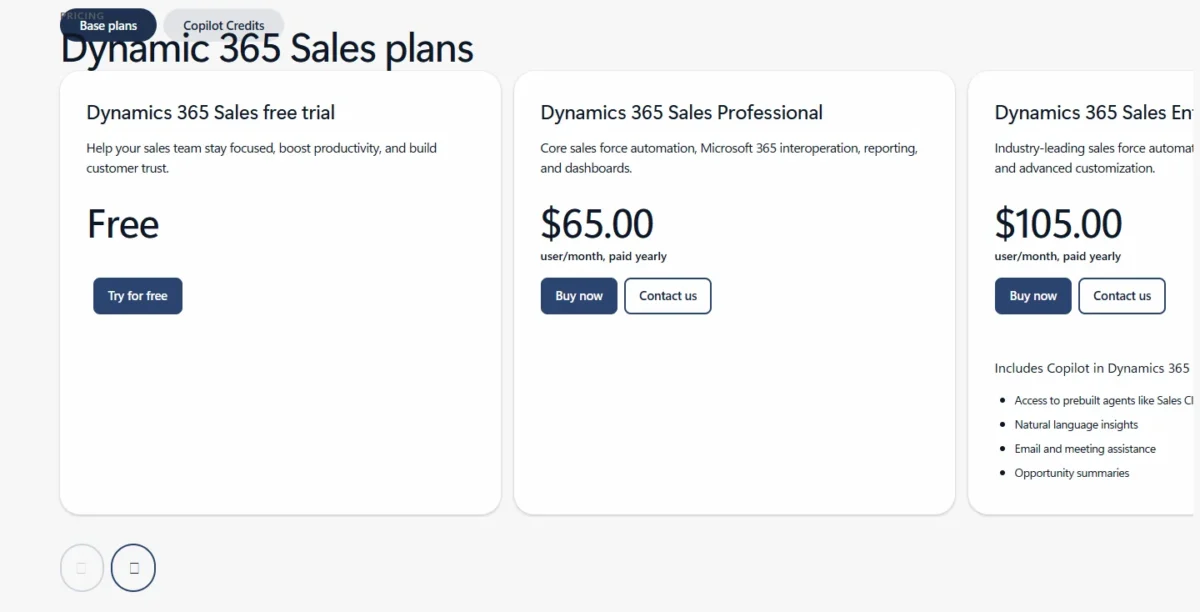
Both prices assume a yearly commitment (“billed annually”, “paid yearly”). SugarAI builds each offer from license count and contract length, so its list price opens a negotiation.
The upgrade trigger differs. On SugarCRM, forecasting and mail and calendar integration are the reasons to leave Standard+; on Dynamics 365, sequences on more than 1,500 records a month push a team from Sales Enterprise to Sales Premium.
Cost for a 10- and 25-seat team
Ten sellers on the forecasting tier cost $98 x 10 x 12 = $11,760 a year on Sugar Advanced+ and $105 x 10 x 12 = $12,600 on Sales Enterprise.
| Tier pair | SugarCRM, 10 seats | Dynamics 365, 10 seats | SugarCRM, 25 seats | Dynamics 365, 25 seats |
|---|---|---|---|---|
| Entry: Standard+ vs Sales Professional | $68 x 10 x 12 = $8,160 | $65 x 10 x 12 = $7,800 | $68 x 25 x 12 = $20,400 | $65 x 25 x 12 = $19,500 |
| Forecasting: Advanced+ vs Sales Enterprise | $98 x 10 x 12 = $11,760 | $105 x 10 x 12 = $12,600 | $98 x 25 x 12 = $29,400 | $105 x 25 x 12 = $31,500 |
| Full AI: Premier+ vs Sales Premium | $155 x 10 x 12 = $18,600 | $150 x 10 x 12 = $18,000 | $155 x 25 x 12 = $46,500 | $150 x 25 x 12 = $45,000 |
Sources: Sugar Sell pricing (SugarCRM pricing) and Dynamics 365 Sales pricing, checked October 2026.
Assumptions: US list prices per user per month, annual billing, every seller on one tier, no discount. Excluded: tax, implementation services, Precision+ and Relationship Sales (quote only), Power Platform licenses, extra Copilot Credits and Azure usage.
The forecasting tier is the only pair where SugarCRM lists lower, and the gap widens with seats. It disappears once a Sugar team adds meeting transcripts: Sugar Connect+ costs $20 x 10 x 12 = $2,400 a year for ten sellers, and Advanced+ at $98 plus Connect+ at $20 per seat lands above Sales Enterprise at $105.
What each price leaves out
The seat totals leave out the costs that decide the real budget:
- Dynamics 365: Power Automate and Power Apps licenses; Copilot Credits beyond Sales Premium’s allowance; the Azure subscription agents need; additional licenses for Copilot in Teams.
- SugarCRM: Precision+ (contact sales); Sugar Connect+; migration, onboarding and professional services from SugarAI or a partner.
The cheaper seat is not always the better value. A Microsoft 365 company on Sugar Standard+ gets no mail and calendar integration until Advanced+, while Dynamics 365 includes Microsoft 365 interoperation from Sales Professional.
SugarCRM vs Dynamics 365: Pros and Cons
Each product’s strongest argument is also where its extra cost hides.
SugarCRM pros and cons
SugarCRM’s case rests on its middle tier and ERP data.
Pros
- Forecasting, AI Summaries and mail and calendar integration arrive together on Advanced+
- 180+ ERP integrations, plus Sugar Predict on Precision+ for reorder and cross-sell plays
- Business process management from Standard+, with no separate automation license on the price card
- ISO 27001 and SOC 2 Type 2 claims, with data kept inside its AWS region
Cons
- No free trial or monthly billing listed on the pricing page
- Precision+, the ERP-intelligence tier, is priced only on request
- SugarAI makes Sugar 26.2 available to SugarCloud customers only
- Zoom and Teams meeting transcripts need Sugar Connect+ at +$20 per user per month
Dynamics 365 pros and cons
Dynamics 365 wins on Microsoft integration and loses on extra licenses.
Pros
- 30-day trial before any contract
- Microsoft 365 interoperation from Sales Professional, plus the Outlook app and Teams integration
- Sales Premium includes 1,000 Copilot Credits per user per month for agents
- LinkedIn Sales Navigator through Relationship Sales
Cons
- Power Automate flows and Power Apps custom apps need additional licenses
- Sales Enterprise caps the sales accelerator and predictive scoring at 1,500 records per month
- Copilot in Teams requires additional licenses, and agents need an Azure subscription
- Relationship Sales requires a 10-seat minimum and a sales quote
Which Is Better for Your Needs?
Pick by stack and selling model first, then by seat price; the matrix gives the better fit for each priority.
| Your priority | Better fit | Reason | Trade-off |
|---|---|---|---|
| Microsoft 365 and Teams already in place | Dynamics 365 | Microsoft 365 interoperation from Sales Professional | Copilot in Teams needs additional licenses |
| Reorder and cross-sell from ERP data | SugarCRM | 180+ ERP integrations; Sugar Predict on Precision+ | Precision+ is priced only on request |
| Lowest seat price with forecasting | SugarCRM | Advanced+ lists below Sales Enterprise | Adding Sugar Connect+ erases the gap |
| A trial before a contract | Dynamics 365 | 30-day trial | SugarCRM offers a demo instead |
| Custom apps and flows on a budget | Depends | SugarCRM includes process management; Dynamics 365 bills Power Apps and Power Automate separately | SugarCRM’s free configuration is a vendor claim |
| A team under 10 sellers | Insufficient evidence | SugarAI targets mid- to large organizations; Microsoft frames its Sales plans for enterprises | The Dynamics 365 trial is the quicker way to find out |
A Microsoft 365 company should start with Dynamics 365 and switch to SugarCRM only if ERP-driven account plays matter more than Outlook and Teams. A manufacturer or distributor should start with SugarCRM, and pick Dynamics 365 if Copilot agents and LinkedIn data outweigh reorder intelligence.
A buyer who is also weighing Salesforce can open Salesforce vs Microsoft Dynamics.
Switching Between SugarCRM and Dynamics 365
Moving in either direction is a file import plus a rebuild: records travel as files, while workflows and integrations are set up again.
- Into SugarCRM: the Import Wizard takes CSV or other delimited files, with no import limit by default. Import accounts before contacts.
- Into Dynamics 365: fill the Excel template for each table without changing its columns. Files can be .xlsx, .csv or XML Spreadsheet 2003, up to 8 MB each (32 MB for .zip).
- Rebuild the logic: SugarBPM processes become Power Automate flows (licensed separately), or the reverse, and ERP or Microsoft 365 links are configured again.
SugarAI puts implementation at “a couple of weeks to a few months”, directly or through a partner. For Dynamics 365, ask your Microsoft partner for a timeline before you plan the cutover.
Before you commit to leaving SugarCRM, compare Salesforce vs SugarCRM.
How I Compared SugarCRM and Dynamics 365
In October 2026 I read both vendors’ US pricing pages, product docs, import guides and compliance pages, and compared the tiers that do the same job at annual billing.
The criteria were stack fit, forecasting and AI gates, licenses for custom workflows, deployment, year-one spend at 10 and 25 seats, and switching. Facts come from vendor pages; the cost math and verdicts are my analysis.
SugarAI does not publish a trial, monthly price, seat minimum or Precision+ price. Microsoft’s pricing page lists Relationship Sales as “Variable” and sends buyers to a Dynamics 365 sales specialist for pricing.
FAQ
Is SugarCRM still around?
Yes. SugarCRM now operates as SugarAI, whose site footer reads “SugarCRM is now SugarAI”, and Sugar Sell 26.2 went live in October 2026. The pricing page still sells Sugar Sell, Sugar Serve and Sugar Market under separate tabs.
Is SugarCRM or Dynamics 365 better for a small sales team?
Neither is built around small teams. SugarAI pitches SugarCRM at mid- to large organizations, while Microsoft offers a 30-day Dynamics 365 Sales trial. That makes Dynamics 365 the easier one for a small team to test before talking to sales.
Who are Dynamics 365’s main competitors?
Salesforce and HubSpot are the two rivals SugarAI names in its own pricing FAQ, next to Dynamics 365 here. For a wider shortlist with prices and plan gates, my ranking of the best CRM software for growing teams covers the field beyond these two.
Final Verdict: SugarCRM or Dynamics 365?
Buy Dynamics 365 Sales if Microsoft 365 is your workplace: Outlook, Teams and Copilot sit inside it, and the 30-day trial lets your team prove it first. Buy SugarCRM’s Sugar Sell if revenue comes from repeat orders recorded in an ERP and you want forecasting without separate platform licenses.
Choose SugarCRM if
- ERP purchase data should drive reorder windows, cross-sell and churn signals (Precision+, priced on request)
- You want forecasting on the cheaper middle tier: Advanced+ lists below Sales Enterprise
- Process automation should come with the seat, from Standard+
- You need a self-hosted install: SugarAI lists server requirements for Sugar 26.1 (confirm which license covers it)
Choose Dynamics 365 if
- Microsoft 365 and Teams are where sellers work, with interoperation from Sales Professional
- You want a 30-day trial before a contract
- LinkedIn Sales Navigator matters, through Relationship Sales and its 10-seat minimum
- You will budget metered Copilot agents beyond the Sales Premium allowance
Skip SugarCRM if: you must trial a CRM before talking to sales, or your sellers live in Outlook and Teams.
Skip Dynamics 365 if: you will not fund Power Platform licenses for custom processes.
Either way, get both quotes at your real seat count before you compare.
If HubSpot is also on your shortlist, read HubSpot vs SugarCRM.


Pingback: Salesforce vs Dynamics 365 (2026): Price, AI and Fit