
Buying Instagram followers changes one visible number. The first week after the purchase can tell you a great deal more than that number does.
In This Article (12 sections)
The useful questions are whether delivery completes as ordered, how much of the increase is still there a week later, and whether anything else on the account moves at the same time. A follower count taken immediately after an order is only a starting point. The next seven days are the window that actually answers those questions, and most of what makes that window readable has to be set up before the order is placed.
One option for this kind of paid growth is GoreAd, which sells Instagram followers alongside likes, views, comments and Story views. Someone considering Instagram followers from real accounts can use GoreAd to increase the visible follower count on an existing public profile. The service states that no Instagram password is required and that orders can be tracked while they are delivered. This guide is not a test of that service. It is a measurement plan, built around what GoreAd’s own terms commit to and what Instagram’s tools will and will not show you.
What this guide measures
Three separate things get confused after a follower purchase, and keeping them apart is most of the work.
The first is delivery. Did the quantity ordered arrive, and over what period? This is a question about the vendor.
The second is retention. How much of that increase is still present after a week? This is also a question about the vendor, and it is the one that a vendor’s refill policy is written to address.
The third is account performance. Did reach, views, interactions or profile actions change during the same period? This is a question about Instagram and about your content. A paid follower order does not make it a question about the vendor, however tempting the timing makes that look.
Nearly every disappointed write-up about buying followers collapses these three into one verdict. Keep them in three columns and the week produces something you can actually use.
Before you order: the numbers to write down
Record the count and the timestamp
Write down the follower count and the exact time you recorded it, before you place the order. This sounds trivial. It is the single record that everything else in the week is measured against, and it is also the number that governs whether a refill claim is valid later. GoreAd’s terms state that the account’s start count is recorded at the beginning of an order, and that a refill can only restore the account to that start count plus the ordered amount.
If your own record and the vendor’s disagree later, you will want to be the party that wrote a timestamp down.
Capture the Insights baseline while it is still there
Instagram’s Insights only cover the past 90 days. Anything older is gone, so a baseline you meant to collect later is a baseline you will not get.
For a public account, record the account level numbers Instagram currently reports: Views, Viewers, Interactions, Accounts engaged and Total followers. Then pick three or four ordinary posts from the previous fortnight and record their individual figures too. Ordinary is the operative word. A carousel that did unusually well is the worst possible comparison point for the week that follows, because the natural direction from an outlier is down.
Two limits are worth knowing before you plan around them. Audience demographics such as top locations and age ranges only appear once you have reached or engaged more than 100 accounts, and they only appear on preset timeframes. Follower level trends such as growth, top locations and active times require at least 100 followers on the account. A small profile buying its first package will often not have these panels available at all in the first week.
Write down everything else happening this week
Note any collaboration, paid promotion, giveaway, product launch or unusually strong Reel that overlaps the measurement window. Without that list, every movement in the week gets attributed to the one thing you paid for.
There is a second reason to keep this list, and it is specific to GoreAd. The terms state that a customer must not use another follower service at the same time, or gain followers by other methods such as giveaways or friends, and that doing so makes the order ineligible for a free refill. A giveaway you ran in the same week is not just a measurement problem. On GoreAd’s stated terms it is a warranty problem.
Related reading on measuring an audience you own rather than one you rent: our roundup of email marketing platforms covers the reporting side of owned channels.
What GoreAd’s terms actually commit to
Vendor marketing pages and vendor legal pages often describe different products. On goread.io they do, and the differences matter for anyone planning to measure a week.
| Topic | What the vendor’s pages state | Why it matters for your week |
|---|---|---|
| Password | No Instagram password required, username only, profile must be public | You can measure without handing over account access, but a switch to private during the order is explicitly not reimbursed |
| Delivery speed | “Instant delivery” on the sales pages, and elsewhere that a boost lands in less than 48 hours | Treat 48 hours as the checkpoint, not minutes. The terms separately state that late delivery can be normal and does not trigger a refund |
| Quantity | The purchased amount is not guaranteed, may be slightly more, and shortfalls are a support ticket | A day 7 total slightly above the ordered figure is within the vendor’s stated behaviour |
| Refill window | 30 day refill guarantee, last order only, original username only | Changing your Instagram handle during the window voids the refill on GoreAd’s stated terms |
| Refill ceiling | Refills restore start count plus ordered amount, and nothing above that | This is why the pre-order count is the number that matters |
| Refill exclusion | No refill if the follower count has dropped below the start count of the last order | A large organic unfollow wave can move you outside the policy |
| Refund window | Full refund within 24 hours and only before the order has been started | Once delivery begins there is no refund, only the refill path |
| Platform risk | Not affiliated with Instagram or Meta, compliance is the customer’s responsibility, no liability for platform action | The account holder carries the enforcement risk, in the vendor’s own words |
Sources for the table: the GoreAd Instagram followers page for the tier structure, delivery language and the two guarantees, and the GoreAd terms of service, last updated 27 May 2025, for the refill conditions, refund window and liability wording.
Three specifics are worth pulling out of that table.
The refill belongs to a tier, not to the service. The followers page offers two options. A High Quality tier lists fast delivery, no password and support. An Active tier lists guaranteed delivery, 30 day refills, no password and support. The 30 day refill is a feature of the second one. Someone who buys the cheaper tier and expects a refill in week two has bought a different product from the one they were measuring against.
The refund promise is not consistent across the site. The homepage describes a 30-day guarantee with refund protection and a money back promise. The followers page describes a 24 hour refund policy. The terms of service state that a full refund is available only within the first 24 hours and only before the order has started, and that there are no refunds once an order is delivered. Where a vendor’s pages disagree, the terms of service is the document that will be applied to your ticket. Check whether the wording has changed since the date above before you rely on any of it.
Prices sit behind a countdown. At the time of checking, goread.io displayed a 50 percent flash sale on a running timer, with Instagram follower packages listed from 50 followers at $1.29 up to 50,000 at $229.99. A countdown that is present on arrival is worth re-checking on a later visit before treating the discount as a deadline.
First 24 hours: confirm delivery, not success
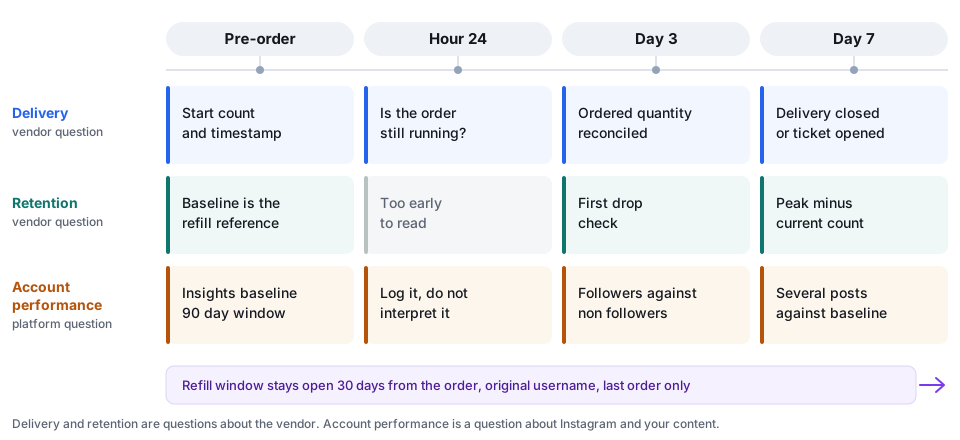
The first check is deliberately narrow. Compare the current follower total against the number you recorded before the order, and note the time. That is the whole task.
If the count is still climbing, the order is probably still running, which is normal for larger packages. Record the ordered quantity, the starting count, the current count and the timestamp in four separate fields rather than one summary sentence. Organic followers arrive during the same period and the visible total cannot attribute any individual follow to a source, so the record is a measure of account change over a window, not a measure of vendor output. That is still the most useful thing available at this stage.
Resist reading anything into reach yet. Reach moves within a day for ordinary reasons: a Reel finds a new audience, a post gets shared into a group chat, an older piece of content resurfaces. None of that demonstrates that the purchase caused anything. Log content performance in its own column, note whether it rose or stayed flat, and leave the interpretation for later in the week.
One practical note. Instagram describes several of these metrics as estimated and in development, which means small day to day movements are not always signal. Look for direction over the week rather than precision on any single day.
Day 3: separate the count from the content
By the third day there is enough distance for a real comparison. Record the follower count again, then record Views, Viewers, Interactions and Accounts engaged for the period, plus the performance of anything published since the order.
The common day 3 result is a noticeably larger audience number sitting alongside content metrics that are close to where they were. That is not a failure. It is a finding, and a precise one: it tells you the change is concentrated in the follower count and has not propagated into distribution. Write it down in those words rather than as good or bad.
The single most informative panel at this stage is the Accounts engaged breakdown. For posts, Stories and Live, Instagram splits that metric into followers and non followers. If a follower package has landed and the follower share of engagement has not moved, that comparison is doing more work than any other number in the week.
The demographics check most guides get wrong
Plenty of advice tells you to open audience demographics on day 3 and check whether the new followers match your market. For most accounts buying a first package, that panel will not be populated. Instagram requires that you have reached or engaged more than 100 accounts before demographics appear, and it requires a preset timeframe. Instagram’s own help documentation suggests switching to a 30 day or 90 day preset when the 7 day view shows nothing, which for this purpose means the panel you wanted is averaging in the period before your order.
If the panel is available, it is genuinely worth reading, and what to read depends on the account. A local business should care about top locations. A creator chasing brand deals should care about age ranges and about the follower and non follower split above. A broad entertainment account may reasonably care about neither. Decide which metric matters before the week starts, or the week will supply an answer to a question you never asked.
For accounts where the audience is meant to convert rather than accumulate, the reporting in social media CRM tools will tell you more about the week than the follower count will.
Day 7: measure what stayed
Do the retention arithmetic
Note the highest follower count you observed after delivery and compare it against today’s total. Subtract, do not estimate from memory. The difference between the peak and the day 7 count is your early retention figure, and it is the number a refill policy exists to address.
Then compare it against the pre-order baseline as well, because those are two different measurements. Peak minus current tells you about drop. Current minus baseline tells you what the week actually bought.
Check where you sit in the refill window
Day 7 is roughly a quarter of the way through GoreAd’s stated 30 day refill window, and the conditions are specific enough to be worth checking against your own log rather than against an impression. The refill applies to the last order and to the original username. It restores the count to start plus ordered amount and no further. It does not apply if the count has fallen below the start count of that order. After 30 days the terms state there are no refills or refunds in any case.
If your log shows a drop and you intend to claim, the pre-order timestamp and count you wrote down in step one is the evidence that makes the claim straightforward.
Compare several posts, not the best one
Run the same comparison on content. Take several posts from the week rather than the one that performed unusually well, and set them against the ordinary posts you baselined before the order.
If the follower count is still elevated and reach and interactions are near their previous range, both of those facts belong in the conclusion. A larger audience number and stronger organic performance are different results and they are measured by different metrics. Reporting only the flattering one is how people end up buying the same package twice.
Where Instagram’s rules sit
This part belongs in any honest write-up of the week, because it is the risk that no measurement will surface until it arrives.
Meta’s Community Standards on spam, which apply to Instagram, prohibit “selling, buying, or exchanging for engagement, such as likes, shares, views, follows, clicks”. The policy covers the attempt as well as the completed transaction, and it sits alongside a broader rule against content designed to artificially increase viewership.
GoreAd’s own FAQ addresses this directly and draws the line at authenticity, answering that buying followers goes against Instagram’s guidelines if the followers are fake, and positioning its own service as one that verifies the followers it sells are real. Meta’s published policy does not draw that distinction. It is written against the transaction.
The terms of service are unambiguous about who carries the outcome. They state that compliance with Instagram’s rules is the customer’s sole responsibility, that the service is used at the customer’s own risk, and that the vendor is not to blame if an account is banned for any reason. They also state that the vendor cannot guarantee the quality of what is delivered and is not liable for actions a platform may take.
None of that makes the seven day measurement pointless. It means the measurement should include a column for account status, and that anyone running this exercise on an account that carries real commercial weight should understand what they are putting at risk before the first checkpoint, not after the last one. If the account is the front door to a business, the sturdier version of this project is building reach on channels you own, using something like AI content creation tools to raise output, and tracking inbound through a CRM built for small business rather than through a follower count.
A seven day log you can copy
Ten fields, recorded at four checkpoints, produce a week you can actually read.
- Pre-order follower count, with date and time
- Ordered quantity, tier purchased and order ID
- Baseline Views, Viewers, Interactions and Accounts engaged for the previous 7 days
- Three ordinary posts from the previous fortnight, with their individual figures
- Concurrent events: collaborations, ads, giveaways, launches, unusual Reels
- Hour 24 follower count, with time
- Day 3 follower count, plus the four account metrics and the follower against non follower engagement split
- Highest follower count observed at any point
- Day 7 follower count, plus the same four metrics and several posts from the week
- Account status notes: any warnings, restrictions or support tickets opened
What the week cannot tell you
A seven day window is short and this method has real limits, which are worth stating rather than glossing.
It cannot attribute any individual follow to a source, because Instagram does not expose that. It cannot separate a vendor’s delivery from organic arrivals during the same window. It cannot establish causation between the follower count and any change in reach, only correlation in time. Seven days is too short to observe the full 30 day drop pattern that a refill policy is priced around, which means a clean day 7 result is not a final result. And it says nothing about the durability of the account itself, which is a longer and less measurable question.
What it does produce is a defensible record instead of a before and after screenshot, which is a meaningfully better basis for deciding whether to do it again.
Methodology note
This guide is documentation based, not hands on. No follower package was purchased and no account was used for testing, so nothing here should be read as a verified account of GoreAd’s delivery speed, retention or follower quality.
Every vendor claim above is attributed to a specific live page on goread.io and was checked on 16 September 2026. Where the vendor’s marketing pages and terms of service disagree, both versions are reported and the disagreement is named. Platform behaviour is sourced to Meta and Instagram’s own published documentation. No search volume, ranking, retention percentage or delivery figure has been estimated or invented anywhere in this article.
Our full review methodology explains how we label evidence quality, and our affiliate disclosure covers commercial relationships.
Frequently asked questions
How long should a GoreAd follower order take?
The sales pages describe instant delivery and state that a boost lands in less than 48 hours, with the count starting to move within hours. The terms of service add that delivery can sometimes run later than the date shown on the order page, that this can be completely normal, and that a late delivery does not entitle you to a refund. Use 48 hours as your checkpoint and open a support ticket rather than a dispute if it passes.
Does GoreAd need my Instagram password?
No. The service states repeatedly that only a username is required and that login credentials are never requested. The profile does have to be public for the order to run, and the terms state that any downtime caused by switching the profile to private is not reimbursed.
What exactly does the 30 day refill cover?
On the vendor’s stated terms, it covers the last order placed and only the original Instagram username. It restores the account to the recorded start count plus the ordered amount and no higher. It does not apply if the follower count has dropped below that start count, and it is void if another growth service, a giveaway or another follower source was used during the same period. Refills are also listed as a feature of the Active followers tier rather than the High Quality tier.
Can I get a refund after delivery has started?
The terms of service say no. A full refund is available within the first 24 hours of purchase and only before the order has been started, there are no refunds once an order is delivered, and none for running orders. The homepage describes a broader money back promise, but the terms are the document that governs the transaction.
Does buying Instagram followers break Instagram’s rules?
Meta’s Community Standards on spam prohibit buying or exchanging for engagement including follows, and the rule covers the attempt as well as a completed purchase. GoreAd’s FAQ frames the violation as applying to fake followers specifically. Meta’s published policy does not make that distinction, and GoreAd’s own terms place compliance and any consequence on the account holder.
Why did my reach not move when my follower count did?
Because they measure different things. Follower count is a stored number on the profile. Views and Viewers describe how many times content was displayed and to how many unique accounts. The follower against non follower split inside Accounts engaged is the panel that shows whether a larger audience is doing anything, and a week where the count rises while that split stays flat is a legitimate and fairly common outcome rather than a measurement error.
The week is about keeping the numbers apart
By the end of seven days you should hold a starting follower count with a timestamp, a delivery record, a day 3 total, a day 7 total, a peak, the four account metrics at each checkpoint, and a list of everything else that happened in the same window.
That record answers the questions worth asking. Did the order deliver what was bought. How much of it stayed. Did anything else on the account move, and can that movement be explained by something other than the purchase. A vendor is easier to evaluate against those four answers than against a single larger number, and so is the decision about whether the exercise was worth repeating.
About the author

Macedona is the founder and lead reviewer at SaaS CRM Review, where he has published 175+ in-depth reviews, pricing guides, and comparisons of CRM and SaaS tools. Each review is based on hands-on testing or verified documentation, and every article states clearly which method was used. Pricing and features are checked against official vendor sources, with the verification date noted in the article. Macedona follows a published review methodology and editorial policy. SaaS CRM Review earns affiliate commissions from some links, which never influence ratings or rankings. Read the full affiliate disclosure.