
Seedance 2.5 has no seat price and no monthly plan, so the budget question works nothing like a CRM purchase. What a buyer purchases is generated seconds, and the same model carries at least three different prices depending on which door the request goes through.
BytePlus bills it two different ways on its own infrastructure. Third-party resellers bill it a third way with their own margin on top, and the spread between the cheapest and the most expensive route for identical output is close to three times.
This guide prices every route that could be verified on 2026-08-23, shows the arithmetic behind each number, and names the workload each route actually suits. The figures below are list rates, not negotiated ones.
In This Article (15 sections)
Quick Pricing Verdict
| Quick pricing verdict | Answer |
|---|---|
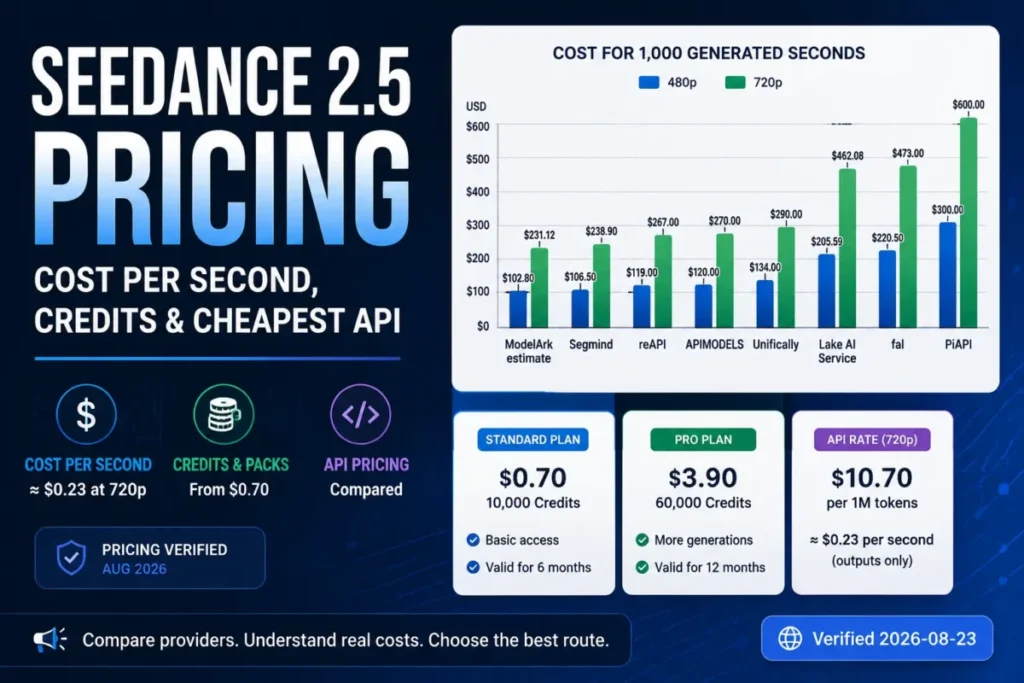
| Cheapest official route | BytePlus ModelArk token billing, $10.70 per million tokens without video input |
| Per-second equivalent, estimated | About $0.10 per second at 480p and about $0.23 per second at 720p, 16:9 |
| Second official route | BytePlus Lake AI Service at $0.303 per second before the model conversion factor |
| Best route for most teams | A reseller with published per-second rates, if engineering time matters more than the last cent |
| Route to avoid | Any route at or above the $0.30 per output second PiAPI lists at 480p |
| Biggest hidden cost | Reference-video seconds, which enter the billed duration on half the routes compared here |
| Free access | None published for this model on the official surfaces |
| Rates verified | 2026-08-23, list rates in USD |
Seedance 2.5 Pricing and Cost per Second
There is no single correct answer to “what does Seedance 2.5 cost per second”, and that is the first thing most competing pages get wrong. BytePlus operates two separate billing surfaces for the same model, and they do not use the same unit.
The first is token billing on ModelArk. The BytePlus model catalogue lists Dreamina Seedance 2.5 token pricing at $10.70 per million tokens without video input and $6.40 per million tokens when the request includes video input.
The second is per-second billing through Lake AI Service. Its enhanced video generation documentation sets a base rate of $0.303 per second and then multiplies the duration by a model and resolution conversion factor.
Seedance 2.5 runs on the enhanced tier, so the cheaper $0.242 basic rate on that page is not available to it. That rate covers the faster Seedance 2.0 variants only.
| Official BytePlus billing path | Unit | Rate without video input | Rate with video input | Billing basis |
|---|---|---|---|---|
| ModelArk model API | Tokens | $10.70 per million tokens | $6.40 per million tokens | Billed per token, with the token count not published on the price page |
| Lake AI Service, enhanced | Seconds | $0.303 per second, factor applied | $0.303 per second, factor applied | Video duration multiplied by conversion factor |
Those two rows are not alternative descriptions of one price. They are two products, and a buyer who compares a token rate against a per-second rate without normalizing them will pick the wrong one.
no video input
with video input
times conversion factor
credits, or markup
The Lake AI Service rate, calculated
Lake AI Service is the easier of the two to price, because BytePlus publishes the multiplier directly. The documented formula is total cost equal to unit price multiplied by video duration multiplied by the duration conversion factor.
The Seedance 2.5 conversion factors are 0.6785 at 480p and 1.525 at 720p without input video, then 0.406 and 0.9125 with input video.
| Lake AI Service scenario | Conversion factor | Effective rate | What the rate is charged on |
|---|---|---|---|
| 480p, no input video | 0.6785 | $0.2056 per second | Output duration only |
| 720p, no input video | 1.525 | $0.4621 per second | Output duration only |
| 480p, with input video | 0.406 | $0.1230 per second | Input duration plus output duration |
| 720p, with input video | 0.9125 | $0.2765 per second | Input duration plus output duration |
BytePlus labels this formula a cost estimate and says actual charges are determined by the bill, so the rates above are a planning figure rather than a quote.
The 720p line costs about 2.25 times the 480p line for the same clip. That ratio is the single most useful number in this guide for anyone iterating on prompts, and I return to it in the cost-control section.
| Output length | 480p total | 720p total |
|---|---|---|
| 5 seconds | $1.03 | $2.31 |
| 10 seconds | $2.06 | $4.62 |
| 30 seconds | $6.17 | $13.86 |
| Each total is the output duration multiplied by the documented conversion factor and the base rate. |
Turning the ModelArk token rate into a per-second number
The token rate is the harder one, because BytePlus publishes a price per million tokens without publishing the token count of a video on the same page. The formula is public elsewhere.
The fal model page for Seedance 2.5 states that tokens are a function of output frame area, duration and frame rate. The published formula is output height multiplied by output width multiplied by duration in seconds multiplied by 24, divided by 1,024.
Applying that formula to standard 16:9 frames gives 9,607.5 tokens per second at 854 by 480, and 21,600 tokens per second at 1,280 by 720. At the official $10.70 per million tokens, that works out to roughly $0.1028 per second at 480p and $0.2311 per second at 720p.
One independent check says the derivation holds. Segmind, which resells the same model, publishes a Seedance 2.5 output token rate of $10.97 per million.
Its per-second rates of $0.1065 at 480p and $0.2389 at 720p land within about one percent of the same arithmetic at its own token price.
A second observation follows from the same token counts. Dividing the Lake AI Service effective rates by them implies a token price of about $21.40 per million without video input and about $12.80 per million with video input, close to twice the ModelArk figures in both cases.
That comparison is the per-second comparison restated, not a second check on it. Both sides divide by the same assumed token counts, so the roughly 2.00 multiple stands or falls with them.
| Route | Implied token price | 480p per second | 720p per second | Multiple of ModelArk |
|---|---|---|---|---|
| ModelArk, no video input | $10.70 per million | $0.1028 | $0.2311 | 1.00 |
| Lake AI Service, no video input | $21.40 per million | $0.2056 | $0.4621 | 2.00 |
| ModelArk, with video input | $6.40 per million | $0.0615 | $0.1382 | 1.00 |
| Lake AI Service, with video input | $12.80 per million | $0.1230 | $0.2765 | 2.00 |
| Implied token prices divide each effective rate by the token counts above, starting from the documented per-second base rate. The with-video rows assume the lower token price applies to output tokens only, which the BytePlus price page does not state. |
Read that as a managed-service premium rather than a pricing error, and note that Seedance 2.5 cannot use the cheaper basic tier. Lake AI Service wraps the model in format conversion, segmentation, inpainting, subtitle generation, audio merging and super resolution, and a buyer who needs none of those is paying twice the model price for pipeline features that sit unused.
The per-second ModelArk figures are my estimate, not a published BytePlus rate. They depend on the published token formula being the same one BytePlus applies and on the exact frame dimensions the request returns, so treat them as a planning baseline that a first invoice should confirm.
One caution sizes the error bar. fal’s own published per-second equivalents sit about 7 percent above what its own formula returns at 480p and about 2 percent above at 720p.
The page does not explain the gap, so treat any formula-derived per-second figure as accurate to within about 10 percent.
Executive Summary: Seedance 2.5 Cost at 5, 10, and 30 Seconds
A finance reviewer usually wants three numbers: the cost of a short social cut, the cost of a standard ad beat, and the cost of the longest single clip the model will produce. Seedance 2.5 caps that last one at 30 seconds in a single pass.
| Workload | ModelArk estimate, 480p | ModelArk estimate, 720p | Lake AI Service, 480p | Lake AI Service, 720p |
|---|---|---|---|---|
| 5-second clip | $0.51 | $1.16 | $1.03 | $2.31 |
| 10-second clip | $1.03 | $2.31 | $2.06 | $4.62 |
| 30-second clip | $3.08 | $6.93 | $6.17 | $13.86 |
| 100 clips of 10 seconds | $102.80 | $231.12 | $205.59 | $462.08 |
| Every figure multiplies the clip duration by the route rate above, with no reference video in the request. The linked cells point to the published rate each column pair is derived from. |
The bottom row is where the decision usually gets made. A campaign that needs 1,000 finished seconds at 720p costs an estimated $231 through the direct model API and about $462 through the managed service, and neither figure includes the clips that get discarded.
I would budget the 720p column and treat the 480p column as the drafting line, not the delivery line. Teams that plan at 480p and deliver at 720p almost always underestimate by roughly the 2.25 times factor between them.
Line-Item Cost Breakdown: Every Billable Input
Five things move a Seedance 2.5 invoice, and only two of them are obvious.
Output resolution. The token count scales with frame area, so 720p carries about 2.25 times the tokens of a 16:9 480p frame of the same length. Nothing else in the bill moves that hard.
Output duration. Billing is linear in seconds within the documented 4 to 30 second range at 24 fps, so a 30-second clip costs six times a 5-second clip at the same resolution.
Reference video duration. On four of the eight routes compared here, including the documented BytePlus one, the input seconds join the billed duration. The per-unit rate drops, but the quantity rises, and that trade is examined in the hidden-cost section below.
Access route. The same 10-second 720p clip ranges from an estimated $2.31 on the direct model API to $6.00 on the most expensive reseller in this comparison. Route choice is the largest controllable line item.
Aspect ratio. Because tokens follow frame area, a square or vertical frame at the same nominal resolution changes the token count. The ModelArk, Segmind and fal figures here are quoted or derived at 16:9, while the flat per-second resellers state no aspect ratio at all.
What does not appear anywhere in the verified evidence is a seat fee, an onboarding fee, a platform minimum, or a support tier surcharge on the pay-as-you-go route. Lake AI Service is documented as pay-as-you-go in USD per second, billed hourly on actual usage, and that is the whole contract for that surface.
Resolution and Reference Gates: What Each Route Actually Allows
Capability is gated by route, not only by price, and this is where a cheap rate can turn out to be the wrong purchase. The documented Lake AI Service model entry for Seedance 2.5 lists 480p and 720p output at 24 fps with a 4 to 30 second duration, and its conversion-factor table carries no 1080p or 4K row for this model.
| Capability | BytePlus Lake AI Service | Third-party routes |
|---|---|---|
| 480p output | Documented | Published by every provider compared here |
| 720p output | Documented | Published by every provider compared here |
| 1080p output | No documented rate for this model | Published by one route covered later in this guide |
| Single-pass duration | 4 to 30 seconds | 4 to 30 seconds where stated |
| Image references | 1 to 30 images | Varies by provider |
| Audio references | Up to 10 segments, 30 seconds total | Varies by provider |
Resolution is the plan gate on this model. Anyone who needs 1080p delivery should confirm the route before committing, because that feature gate differs between BytePlus surfaces and resellers. Treating a reseller’s 1080p listing as proof that every Seedance 2.5 endpoint supports 1080p is a common and expensive error.
The reference limits are generous by category standards. ByteDance describes the model as accepting up to 30 images, 10 video clips and 10 audio clips as reference materials in a single pass, with multi-round extension on top of a 30-second first generation.
That matters for cost because reference-heavy work is exactly the work that pulls input seconds into the bill. A team building character-consistent sequences will use the video reference path constantly, and that path prices differently from a plain text prompt.
Prepaid Credits vs Pay-as-You-Go: The Real Savings Math
Searches for Seedance 2.5 credits usually come from consumer platforms, and the answer is that BytePlus itself does not sell the model in credits. Both official surfaces bill usage directly, one in tokens and one in seconds.
Credits are a reseller construct, and the exchange rate is worth reading before it is trusted. reAPI publishes a Seedance 2.5 credit rate of one credit to $0.001, which makes its 480p rate 119 credits per second and its 720p rate 267 credits per second.
That transparency is the exception. A credit balance whose dollar value is not published cannot be compared against a per-second rate at all, and any platform that sells generation credits without stating the conversion has made its price uncheckable by design.
| Purchasing model | Where it applies | What a buyer gains | What a buyer gives up |
|---|---|---|---|
| Pay-as-you-go seconds or tokens | Both BytePlus surfaces | No commitment, no expiry, billed hourly on actual usage | No volume rate improvement |
| Prepaid provider credits | Most resellers | Simpler budgeting, sometimes a bulk rate | Expiry risk and an exchange rate set by the seller |
My default for a first project is pay-as-you-go on whichever route wins the per-second comparison. Prepaid credits only earn their place once monthly volume is stable enough that an unused balance is not a real risk.
Hidden Costs: Reference Video Billing, Rerolls, and Rounding
The reference-video rate is the trap in this category. Most routes that accept a source video quote a lower headline number for it, and on half of them the billed quantity goes up more than the rate goes down.
The Lake AI Service billing rule states it plainly: with input video, the billed duration is the input video duration plus the output duration, at the lower conversion factor.
A 10-second reference driving a 10-second output at 720p therefore bills 20 seconds at $0.2765, or about $5.53, against $4.62 for the same output generated from a text prompt.
“`htmlThere is a clean break-even for this. On the documented conversion factors, 0.406 against 0.6785, adding a reference pays for itself only while the reference is shorter than about 0.671 times the output length.
APIMODELS reaches the same conclusion from its own numbers, stating that break-even sits at input equal to output multiplied by 0.667. Its page adds that editing a clip as long as the output costs about 20 percent more than generating the same length from scratch.
Two independent routes converging on the same ratio is about as close to a verified rule as this category offers.
The second hidden cost is the reroll. Lake AI Service charges only tasks that succeed, and failures caused by review or other operational reasons are not billed, which sounds more protective than it is.
A generation that completes is billed even when the result is unusable, and ByteDance is direct about where that happens:
we recognize there is still room for improvement, particularly regarding the physical plausibility of complex motions and the stability of scenes involving interactions among multiple subjects
Complex motion and multi-subject interaction are the two things advertising work asks for most. I would carry an iteration buffer on any shot with more than one interacting subject rather than budgeting one paid generation per delivered shot, and no evidence supports treating a technically successful but creatively unusable clip as refundable.
The third cost is rounding. reAPI documents a billable-seconds floor that takes the greater of output seconds plus the rounded-up source duration, or the ceiling of five-thirds of the output seconds, which quietly sets a minimum under short edits.
Cheapest Seedance 2.5 API Options Compared
None of the rates below are BytePlus prices. Each provider sets its own tariff, its own credit conversion and its own billing rules, and a reseller number quoted as “the Seedance 2.5 price” is a common error in the search results for this term.
| Provider | Billing basis | 480p rate | 720p rate | Reference-video rate | Published rate page |
|---|---|---|---|---|---|
| ModelArk estimate | Derived from token price | $0.1028 per second | $0.2311 per second | Basis not published on the price page | BytePlus model catalogue |
| Segmind | Per output second, 16:9 | $0.1065 per second | $0.2389 per second | Inputs not billed | Segmind rate breakdown |
| reAPI | Credits at $0.001 each | $0.119 per second | $0.267 per second | $0.072 and $0.161 plus input seconds | reAPI model pricing |
| APIMODELS | Per output second | $0.120 per second | $0.270 per second | Input seconds also billed | APIMODELS access page |
| Unifically | Per output second | $0.134 per second | $0.290 per second | $0.082 and $0.177, output only | Unifically rate list |
| Lake AI Service | Per second with factor | $0.2056 per second | $0.4621 per second | $0.1230 and $0.2765 plus input seconds | BytePlus billing documentation |
| fal | Tokens at $0.0214 per 1,000 | $0.2205 per second | $0.4730 per second | Priced from the same token model | fal model page |
| PiAPI | Per output second | $0.30 per second | $0.60 per second | Input billed at half the output rate | PiAPI specifications |
Segmind published the lowest verified reseller rate at both resolutions on 2026-08-23. Its published billing rule treats prompts, first-frame images and reference images as free inputs, with charges falling only on output tokens.
That combination is unusual enough to be worth confirming against a first invoice.
The Pika API rate card prices in tokens rather than seconds, and charges only successful runs. It lists $11.235 per million tokens for 480p and 720p, and $6.72 per million tokens for reference-to-video with video input.
It is also the only route in this set publishing a 1080p tier, at $9.36 per million tokens under a reduced rate that runs through 2026-09-16, so the standard 1080p figure is not the one on display. Anyone weighing that route can also read the Pika platform review for the wider product context.
| 1,000 generated seconds | 480p total | 720p total |
|---|---|---|
| ModelArk estimate | $102.80 | $231.12 |
| Segmind | $106.50 | $238.90 |
| reAPI | $119.00 | $267.00 |
| APIMODELS rate page | $120.00 | $270.00 |
| Unifically | $134.00 | $290.00 |
| Lake AI Service | $205.59 | $462.08 |
| fal | $220.50 | $473.00 |
| PiAPI | $300.00 | $600.00 |
Route choice moves the same 1,000 seconds by nearly $370 at 720p. That is larger than most of the feature differences buyers spend their evaluation time on, and it is the reason I price the route before choosing the integration.
Which Seedance 2.5 Route Should You Choose?
The upgrade trigger here is volume rather than features, because every route ships the same model. A team outgrows the reseller route at the point where the total cost of the markup exceeds the integration work.
The right answer changes with volume, engineering capacity and the reference workflow, so here is the split I would apply.
Solo creators and small studios under 500 seconds a month. Take the reseller with the lowest published per-second rate and the simplest billing rule, and accept the small premium over direct access. At that volume the difference between $106 and $120 per 1,000 seconds is not worth an integration project.
Product and marketing teams running 1,000 to 5,000 seconds a month. Price the direct BytePlus token route seriously. Against a $0.270 reseller rate, the direct route saves an estimated $1,400 a year at 3,000 seconds a month in 720p, which is enough to fund the integration work.
Teams whose workflow is reference-driven editing and extension. Compare total billed duration, never the headline rate. A route with a lower reference multiplier and a higher effective floor can lose to a route with a plain output-only rate once source clips are counted.
Teams that need 1080p delivery. Start from the route that documents 1080p rather than the cheapest 480p rate, because the resolution ceiling differs between surfaces and no amount of savings fixes a route that cannot produce the deliverable.
Anyone already committed to a managed media pipeline. The enhanced Lake AI Service tier costs about twice the model rate, and that premium is defensible only if the format conversion, segmentation, subtitle and super-resolution features are genuinely in use.
For teams still choosing between models rather than routes, the wider AI video generator comparison covers the alternatives that compete with Seedance on price per second.
Which Seedance 2.5 Route Should You Avoid?
I would avoid any route quoting $0.30 or more per output second at 480p unless it bundles something the project actually needs. PiAPI’s published $0.30 and $0.60 rates are roughly 2.9 times the ModelArk estimate at 480p and 2.6 times at 720p, and the input-video charge at half the output rate sits on top of that.
The exception is real. A provider with a higher rate can still win when it supplies orchestration, queueing, storage or a compliance posture that the buying team would otherwise build, and that judgement belongs to whoever owns the engineering budget.
The second thing to avoid is a consumer subscription bought to answer an API question. A monthly plan that bundles credits sets its own exchange rate, which makes it a different product from metered model access even when the model name on the page is identical.
Is Seedance 2.5 Free?
No standing public free allowance for Seedance 2.5 was verified on the BytePlus surfaces reviewed here. The model catalogue publishes token prices, and the Lake AI Service documentation describes pay-as-you-go billing with no free quota attached to this model.
What does exist is a different thing wearing the same word. Where free credits are advertised, they belong to the third-party platform offering them and carry that platform’s terms and expiry, not Seedance 2.5’s.
Two related facts do reduce spend without being a free tier. Lake AI Service does not charge for generations that fail review or fail for operational reasons, and Segmind treats prompts, first-frame images and reference images as free inputs while charging only output tokens.
Anyone planning around a free allowance should confirm it in the console before it becomes a budget assumption, because neither BytePlus surface documents one for this model.
How to Avoid Overpaying for Seedance 2.5
Six habits account for most of the waste I can see in this pricing structure.
- Draft at 480p and finish at 720p. The 2.25 times factor between them means nine 480p iterations cost about the same as four at 720p, and composition, timing and camera motion are all judgeable at the lower resolution.
- Measure reference clips against the 0.671 rule. Trim a source video below roughly two-thirds of the intended output length, or accept that the reference is costing more than it saves.
- Normalize every quote to dollars per second before comparing. Token prices, credit balances and per-second rates are not comparable as published, and one provider in this comparison charges nearly three times another for identical output.
- Price the whole request, not the clip. Reference-driven edits bill input plus output on half the routes here, so a 10-second deliverable can be a 20-second invoice.
- Keep an iteration buffer for multi-subject shots. ByteDance names complex motion and multi-subject interaction as weak points, and those shots are the ones that get regenerated.
- Re-price the route before each campaign. Treat every rate here as a list price on the day it was read rather than a commitment, because none of these pages carries a term.
Teams doing this properly also cut spend on the prompt side, where a tighter brief reduces regeneration. The Seedance prompt guide covers that half of the problem.
Final Verdict: Is Seedance 2.5 Worth the Price?
At an estimated $0.23 per second for 720p output through the direct token route, a finished 30-second 720p shot costs about $6.93 before rerolls. For advertising, previsualization and product marketing, a single-pass clip of that length with up to 30 image references at that price is worth the money.
It is not worth the money for buyers who need a fixed price per finished video, or who require 1080p from any endpoint they happen to pick. Those two requirements collide with how this model is sold, and no route in this comparison resolves them.
The honest framing is that Seedance 2.5 is competitively priced and awkwardly packaged. The model earns its rate; the routes to it are where buyers lose money.
Methodology: How These Seedance 2.5 Rates Were Verified
Every rate here comes from a published price page, billing document or vendor rate page opened on 2026-08-23. Official BytePlus and ByteDance sources are treated as canonical for the model, and provider pages count as evidence only for that provider’s own tariff.
Routes were assessed against three criteria: dollars per generated second at 480p and 720p in 16:9, how reference-video duration enters the billed quantity, and which resolutions each route documents.
Derived figures are labelled as estimates and shown with their arithmetic, so any reader can reproduce them from the published token formula and the official token price. Where a value could not be confirmed on a source page, it is omitted rather than approximated.
FAQ
These are the questions a buyer still has after choosing a route.
How much does Seedance 2.5 cost?
BytePlus lists $10.70 per million tokens without video input and $6.40 per million tokens with video input, which works out to an estimated $0.10 per second at 480p and $0.23 per second at 720p in 16:9. The enhanced Lake AI Service route costs about twice that.
How much is Seedance 2.5 per second?
At 480p, published and derived rates range from about $0.10 to $0.30 per second depending on route. At 720p the same range runs from about $0.23 to $0.60 per second.
Is Seedance 2.5 free?
Not on the official BytePlus surfaces reviewed here. Where free credits are advertised elsewhere they belong to that platform and carry its terms, and failed generations going unbilled on Lake AI Service is a billing rule rather than a free tier.
How many credits does Seedance 2.5 use?
BytePlus does not sell the model in credits. Where credits exist they are a reseller currency, and reAPI is the clearest example at one credit to $0.001, which prices 480p at 119 credits per second.
What is the cheapest Seedance 2.5 API?
Among the routes verified on 2026-08-23, the direct BytePlus token rate is the lowest, and Segmind published the lowest reseller rate at both resolutions. Neither position is fixed, so re-price before committing.
How much does a 30-second Seedance 2.5 video cost?
About $3.08 at 480p and $6.93 at 720p on the direct token estimate, rising to $6.17 and $13.86 through Lake AI Service. On Lake AI Service, reference-driven versions of the same clip cost more because input seconds join the billed duration.
Does Seedance 2.5 support 1080p?
The Lake AI Service documentation for this model lists 480p and 720p only, while Pika API publishes a 1080p token rate. Resolution support depends on the route, so confirm it with the provider before planning a 1080p deliverable.
Does Seedance 2.5 charge for failed generations?
Lake AI Service documents that only successful generations are billed and that failures from review or operational causes are not charged. A generation that completes but misses the creative brief is still billed.
Does a reference video make Seedance 2.5 cheaper?
Only when the reference is shorter than about 0.671 times the output length. On the routes that bill input seconds, including Lake AI Service, the per-unit rate drops while reference seconds join the billed duration, so a reference as long as the output costs roughly 20 percent more than generating from scratch.
Does Seedance 2.5 have an API?
Yes, through BytePlus ModelArk and Lake AI Service, with several third-party platforms reselling it. If the difference between a model API and a reseller API is unfamiliar, start with this API primer.