
Most founders open a gallery of pitch deck examples, admire Airbnb’s problem slide, and then rebuild a 2008 consumer marketplace story for a 2026 SaaS round. That copying error costs more meetings than bad design ever will.
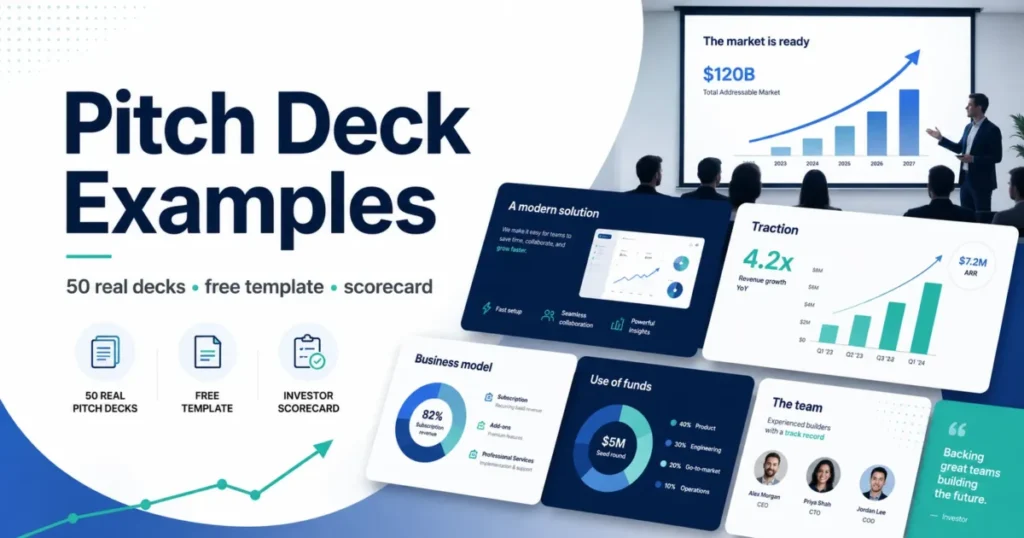
This library does three jobs instead of one. It shows you 50 real decks you can open, labels how strongly each deck is tied to its company, and tells you what has aged badly in every single one.
Then it hands you the build kit: a free 12-slide SaaS template, one evidence-safe AI prompt per slide, and a 100-point scorecard that shows exactly where your draft loses points.
Written for pre-seed, seed, and early Series A founders who need the deck finished this week.
In This Article (19 sections)
50 Pitch Deck Examples From Funded Startups
Every row carries a provenance tier: A means the founder or company published the deck, B means a public copy exists but the uploader is not the company, and C means a third-party gallery supplies both the deck and the financing context. The full method sits under How We Selected below.
The five tables below hold the full library. Read the fourth column as carefully as the third, because that is where most copying errors start.
Classic Startup Pitch Deck Examples
| Company | Stage and tier | Slide worth studying | What not to copy in 2026 |
|---|---|---|---|
| Airbnb | Seed, Tier B | Problem to solution sequencing in three slides | Its market assumptions and its funding label |
| Uber (UberCab) | Early, Tier B | Turning a familiar annoyance into a large market claim | Public sources disagree on which round this deck served |
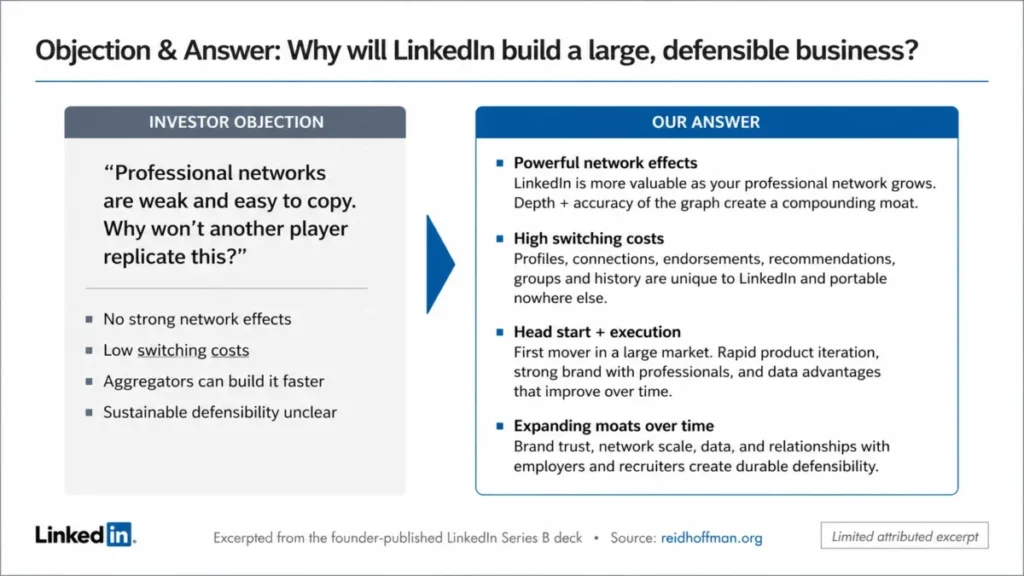
| Series B, Tier A | Answering investor objections on the slide itself | The density, which is wrong for a seed deck | |
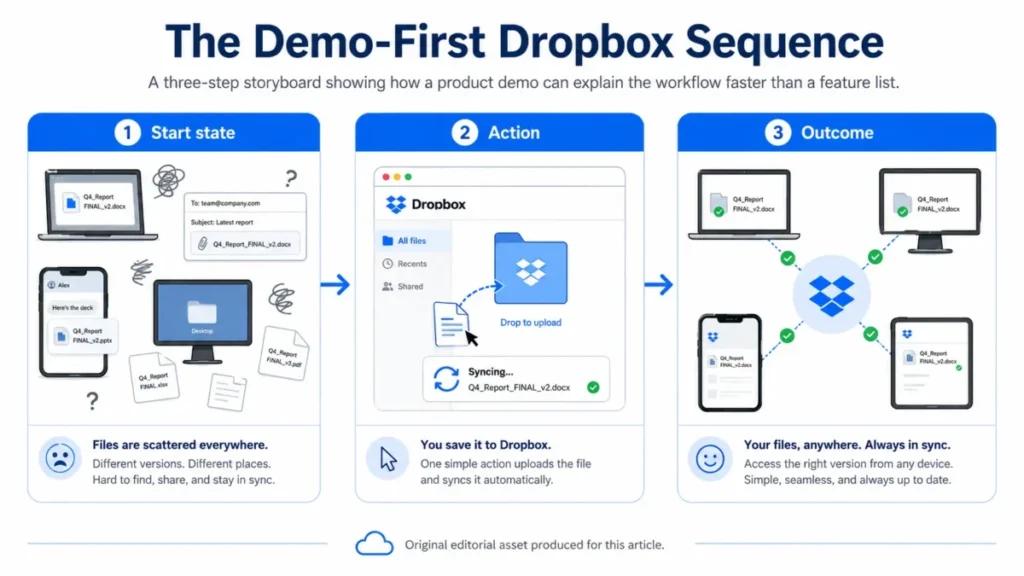
| Dropbox | Early, Tier B | Product-led storytelling where a demo beats paragraphs | Cloud market assumptions from that era |
| YouTube | Early, Tier B | Plain slides carrying clear product logic | A distribution environment that no longer exists |
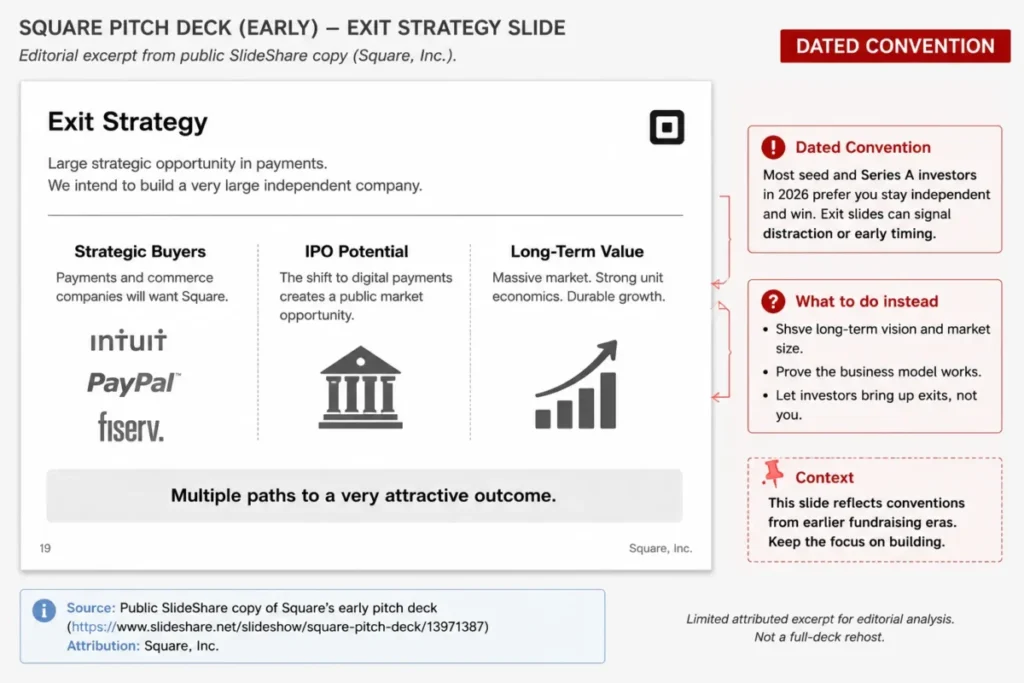
| Square | Early, Tier B | Explaining a hardware plus payments model in twenty slides | It closes on exit strategy, which reads badly to most seed investors now |
| Crew (Ooomf) | Seed, Tier A-minus | Marketplace traction tied to a stated vision | Historical marketplace economics |
| Coinbase | Seed, Tier B | Explaining an unfamiliar category quickly | Regulatory and adoption assumptions of that period |
| Postmates | Early, Tier C | Category creation around on-demand local delivery | Funding linkage is curator evidence only |
| Peloton | Early, Tier C | Pitching a content ecosystem rather than hardware | Public summaries conflict on the early financing figure |
Open these decks:
- Airbnb original pitch deck
- UberCab 2008 deck
- LinkedIn Series B deck annotated by Reid Hoffman
- Dropbox original deck
- YouTube deck
- Square early deck
- Crew investor presentation
- Coinbase seed deck
- Postmates deck
- Peloton deck
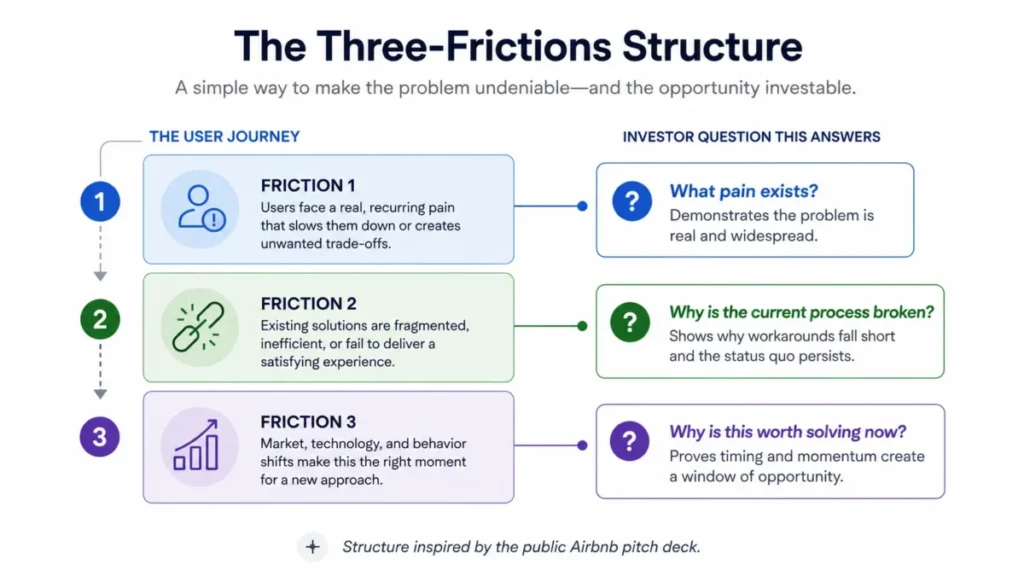
Airbnb earns its reputation because the argument survives without the founders in the room. Every slide answers one question and then stops.
That restraint is the copyable part. Treat the travel market sizing on those slides as a historical artifact and rebuild your own from current, dated inputs.
Four of these repay a slide-by-slide read.
Airbnb’s problem slide states three frictions in three lines and stops, which is why it still reads cleanly without a narrator.
LinkedIn’s deck answers objections inside the slides instead of waiting for the meeting, which is the single most transferable habit in the classic group.
Dropbox leans on a demo because the product was easier to show than to describe, a test worth applying to your own slide 5.
Square closes on exit strategy, which is the clearest dated artifact in this group and the one thing not to carry into a seed deck now.
SaaS and B2B Pitch Deck Examples
| Company | Stage and tier | Slide worth studying | What not to copy in 2026 |
|---|---|---|---|
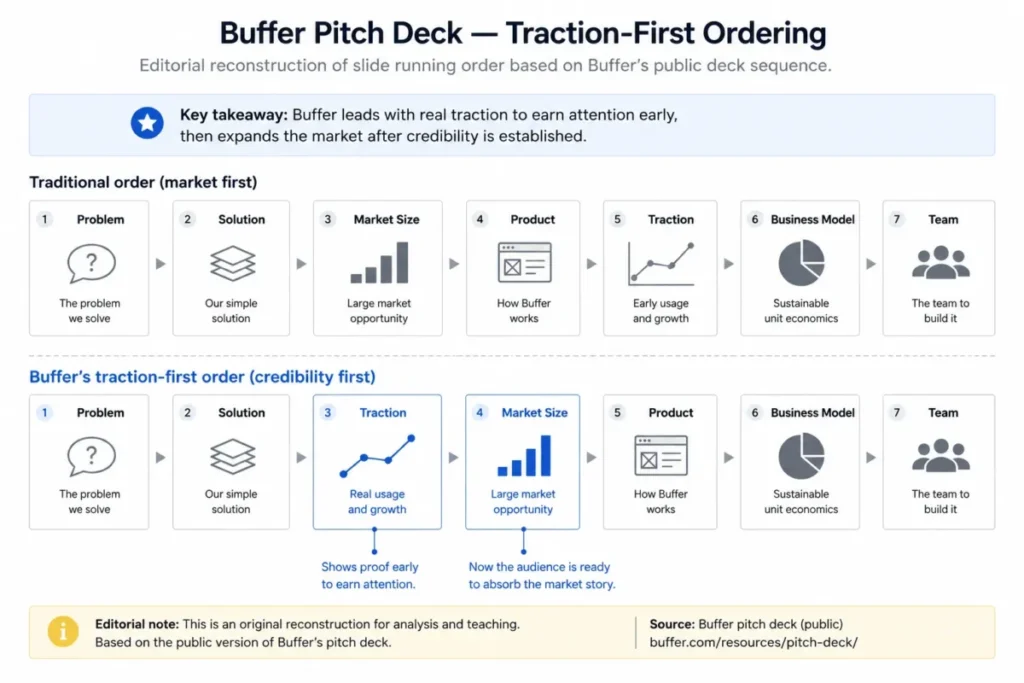
| Buffer | Seed, Tier A | Traction-first ordering with unusually open metrics | Metrics you cannot substantiate from your own systems |
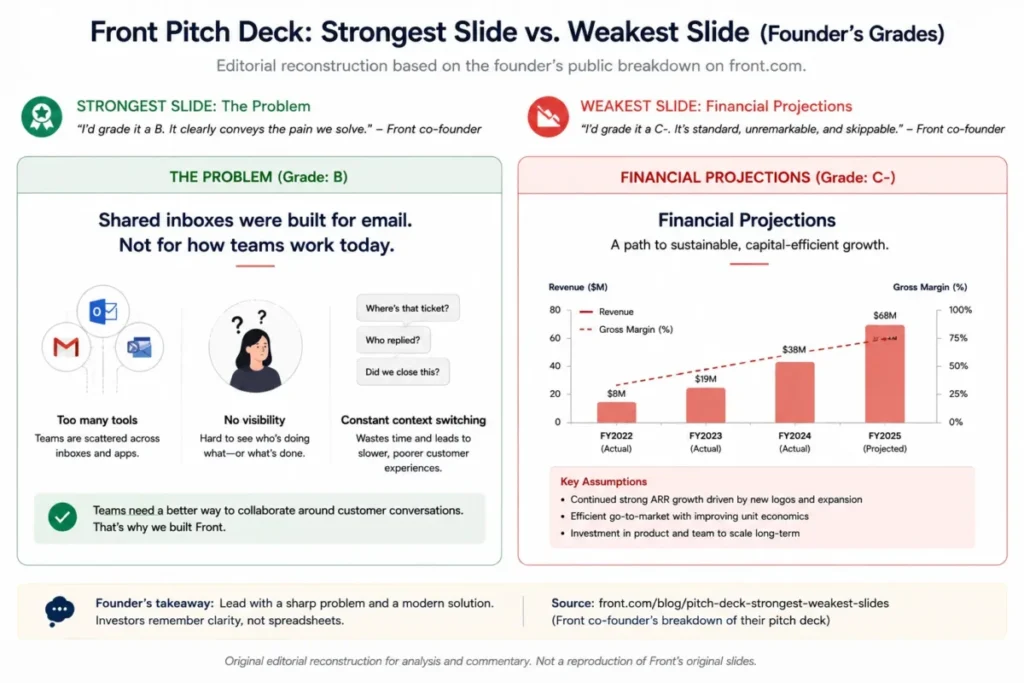
| Front | Series A, Tier A | Capital efficiency and expansion revenue as headline proof | Its own author flags weak acquisition and projection slides |
| Mattermark | Series A, Tier A | Positioning a data product for a business audience | The idea that a deck alone closes a round |
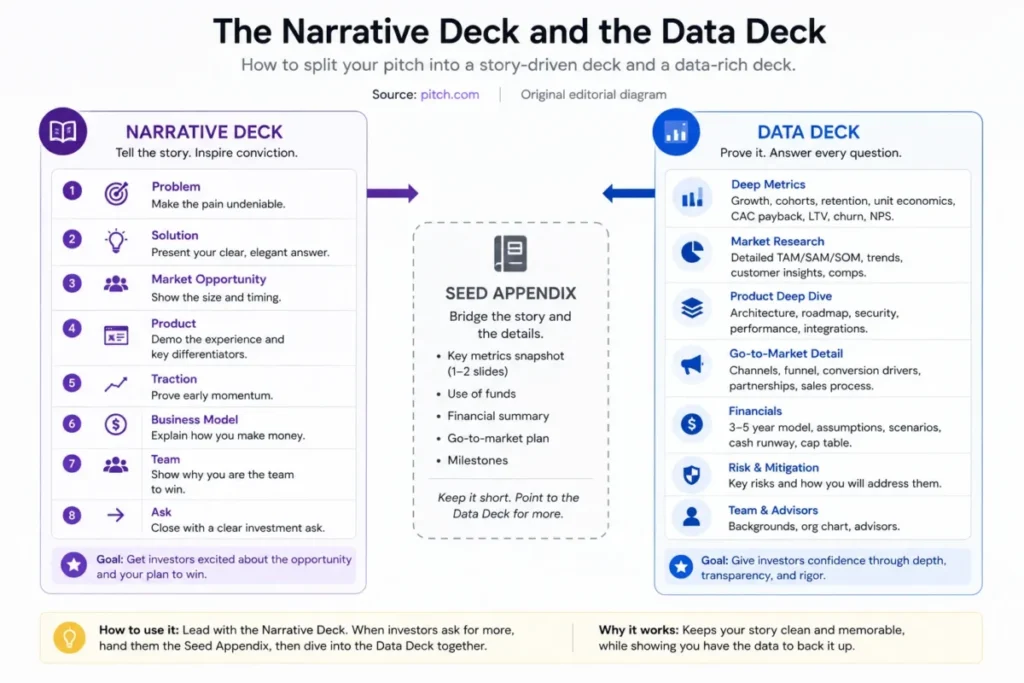
| Pitch | Series B, Tier A | Splitting a narrative deck from a separate data deck | The split is a later-stage practice, not a seed default |
| Figma | Early, Tier C | A long-range vision for browser-native collaboration | Do not confuse this with Figma’s template resource pages |
| Loom | Early, Tier C | Framing async video as a repeated work behavior | Category-creation framing in a now-crowded market |
| Databricks | Series A, Tier C | Technical substance outweighing presentation polish | Rough design only works with matching technical credibility |
| Vercel | Growth, Tier C | A concrete shift in how the web gets built | Ecosystem adoption claims need current dated evidence |
| Replit | Early, Tier C | A very small deck supporting a very large vision | Minimalism that omits decision-critical evidence |
| Amplitude | Growth, Tier C | Connecting analytics capability to growth outcomes | Growth-stage metrics forced into a pre-seed deck |
| Pigment | Growth, Tier C | Making decision speed the headline benefit | Enterprise proof requirements differ at seed |
| Common Room | Early, Tier C | Turning scattered go-to-market signals into one revenue use case | Category vocabulary that hides the buyer and workflow |
| Talkdesk | Seed, Tier C | A clear contact-center wedge | Its competitive context predates AI contact-center positioning |
| Pendo | Series B, Tier B | A twenty-five slide deck that still keeps one job per slide | Series B proof density does not transfer to a seed raise |
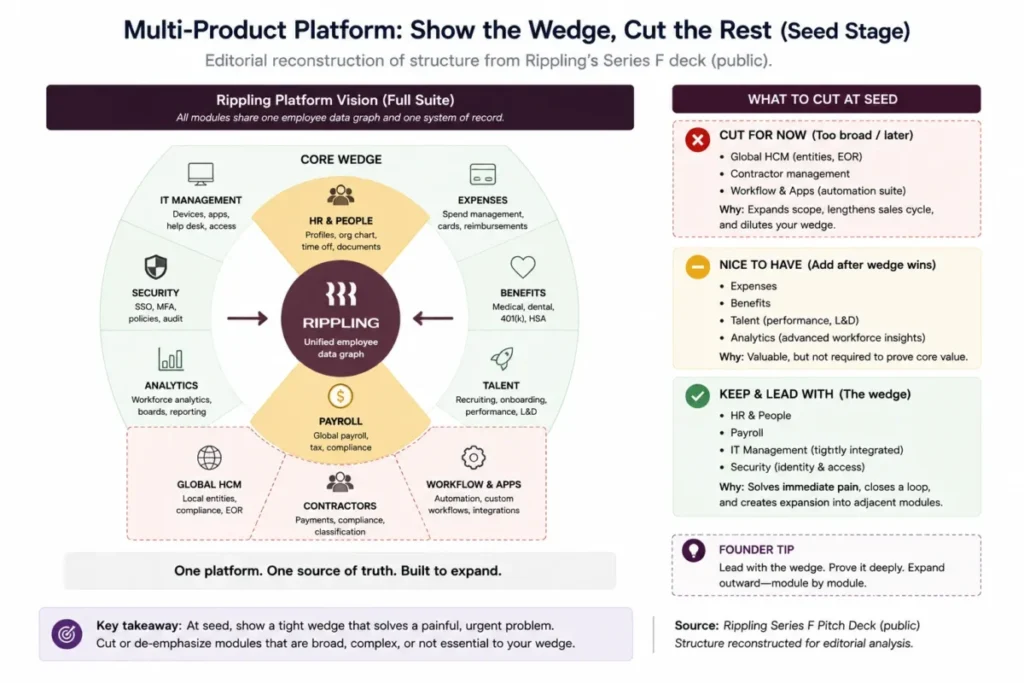
| Rippling | Series F, Tier C | Showing a multi-product platform without losing the core wedge | Late-stage multi-product framing hides a seed company’s focus |
| GitLab | Seed 2015, Tier C | An open-source project arguing its way into a commercial model | Open-source adoption is not the same evidence as revenue |
| ngrok | Series A, Tier C | A developer tool that pitches an existing usage base | Bottom-up adoption still needs a stated monetization path |
| CommandBar | Seed, Tier C | A narrow product wedge stated without category jargon | Seed-stage narrowness reads as small if the expansion path is missing |
| Anrok | Series B, Tier C | Turning a compliance obligation into a recurring product | Its page carries two different dates for the same round |
Open these decks:
- Buffer seed round deck
- Front Series A deck
- Mattermark Series A deck
- Pendo Series B investor deck
- Figma early deck
- Loom deck
- Databricks Series A deck
- Vercel deck
- Replit deck
- Amplitude deck
And the rest of the B2B group:
- Pigment deck
- Common Room deck
- Talkdesk deck
- Rippling Series F deck
- GitLab seed deck
- ngrok Series A deck
- CommandBar seed deck
- Anrok Series B deck
Buffer is the rare seed example where the company published the deck and the story around it. In Buffer’s own post about that raise, the presentation is described as the one behind half a million dollars of funding, and the same post records a $450K seed round from 18 investors.
Front is more useful than any polished example, because its founder published what did not work. Front’s retrospective on its announced $10M Series A deck names capital efficiency and expansion revenue as the strong slides, calls acquisition channels and projections the weak ones, and lists buyer definition and engagement data as the gaps.
Treat that as permission to ship a deck with known gaps. Its own author graded those slides harshly after the round closed.
Mattermark supplies the counterweight to “this deck raised X” storytelling. Its founder’s one-year retrospective describes the deck as an exercise that organized the company’s own thinking, and credits an investor conversation and a handful of key questions as the actual pitch.
Pitch documents the workflow rather than only the artifact. The company’s account of its $85 million Series B deck describes keeping a main deck for the presentation itself and preparing a separate data deck holding the business fundamentals investors needed to assess the opportunity.
At seed you rarely need two documents. You do need an appendix, and the discipline that puts every dense chart there instead of in slide 7.
Four of these carry lessons the tables cannot hold.
Buffer put transparent metrics early, which is only safe because the company could reproduce every figure on request.
Front’s capital-efficiency slide is the strongest single argument in this group, and its author still rated the projections slide the weakest.
Pitch is the clearest published example of splitting a narrative deck from a data deck, which is what an appendix does at seed.
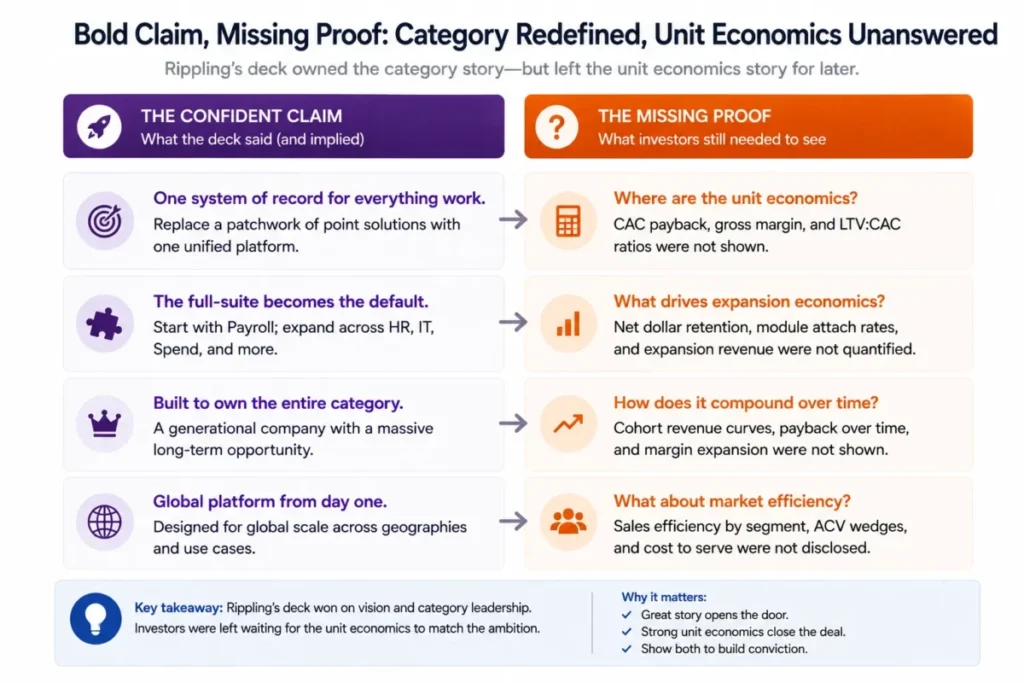
Rippling shows a multi-product platform without losing the wedge that started it, which is the hardest thing to do on one slide.
Fintech Pitch Deck Examples
| Company | Stage and tier | Slide worth studying | What not to copy in 2026 |
|---|---|---|---|
| Revolut | Seed 2015, Tier C | A pain-led fintech wedge on cross-border spending | The larger figure another gallery attaches to this deck |
| Monzo | Later stage, Tier C | Trust and transparency as product positioning | Later-stage proof density at pre-seed |
| N26 | Early, Tier C | Single-market mobile banking focus | Geographic and regulatory assumptions are market-specific |
| Wise (TransferWise) | Early, Tier C | Making hidden cost the villain | Current cross-border economics differ from the deck |
| Wealthsimple | Early, Tier C | Simplicity and trust for first-time users | Consumer trust tactics do not transfer to enterprise buyers |
| Carta | Series D, Tier C | Selling infrastructure by showing who already runs on it | Network-effect proof at Series D is unavailable to a seed company |
Open these decks:
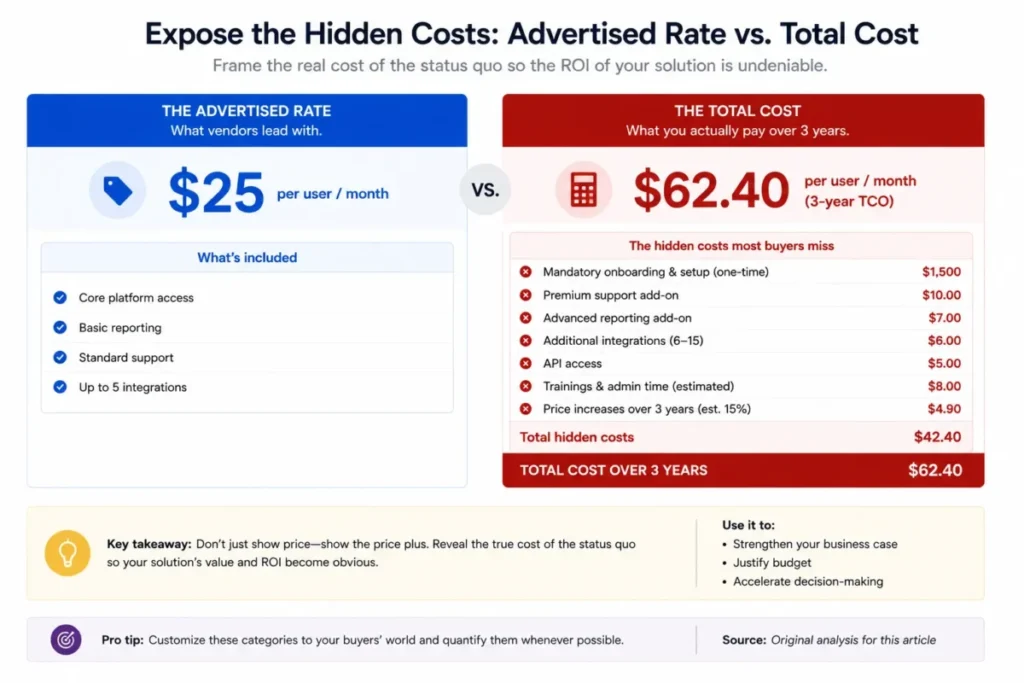
Wise is the clearest of the group for one specific move.
It makes the hidden cost the villain rather than the competitor, which lets the product enter as the honest option instead of the cheaper one.
AI Startup Pitch Deck Examples
| Company | Stage and tier | Slide worth studying | What not to copy in 2026 |
|---|---|---|---|
| Perplexity AI | Early, Tier C | A sharp wedge against an incumbent behavior plus usage growth | Market claims in this category need explicit dates |
| ElevenLabs | Early, Tier C | A demo that makes a new capability tangible fast | A demo does not replace defensibility or distribution |
| Charta Health | Seed, Tier C | Narrow administrative pain, why now, product, customer evidence | Healthcare claims need stricter evidence and compliance care |
| Supernormal | Seed, Tier C | A daily-workflow wedge for meeting notes | Feature novelty is not a moat |
| Quantexa | Late stage, Tier C | Translating a data platform into business outcomes | Series E proof density at seed |
| AI Rudder | Series B, Tier C | Eight slides connecting voice automation to operational return | Length alone did not cause the outcome |
| Recraft | Series A, Tier C | Differentiating on brand-consistent professional output | Model claims that change monthly need dates |
| Flick | 2026 seed, Tier C | A generative AI story tied to one creator workflow | Read it as dated 2026 evidence and rebuild the claims from your own inputs |
| Artisan | Series A, Tier C | Selling an AI worker that owns an outbound sales job end to end | Agent autonomy claims need a stated human-in-the-loop boundary |
| Aisera | Series D, Tier C | Enterprise AI service desk framed as headcount deflection | Late-stage enterprise proof at seed |
| Vapi | Series A, Tier C | A voice-agent developer platform pitched to builders, not buyers | Developer love still needs a revenue path on the slide |
| Humane AI | Series B, Tier C | Ambitious hardware vision presented before public launch | The curator labels this a leaked deck, and the company outcome was poor |
| Profound | Series A, Tier C | A 2025 wedge on how brands appear inside AI answers | The newest category framing dates fastest |
Open these decks:
- Perplexity AI deck
- ElevenLabs deck
- Charta Health deck
- Supernormal deck
- Quantexa deck
- AI Rudder deck
- Recraft deck
And the newer AI group:
- Flick deck
- Artisan Series A deck
- Aisera Series D deck
- Vapi Series A deck
- Humane AI deck
- Profound Series A deck
The AI decks share one structural habit worth stealing. Each one names a specific job a person does repeatedly, then shows the model doing that job, instead of describing a capability in the abstract.
The habit worth avoiding is equally consistent. Several of these decks lean on a strong demo where a defensibility or distribution slide belongs.
Two of these are worth opening before the rest.
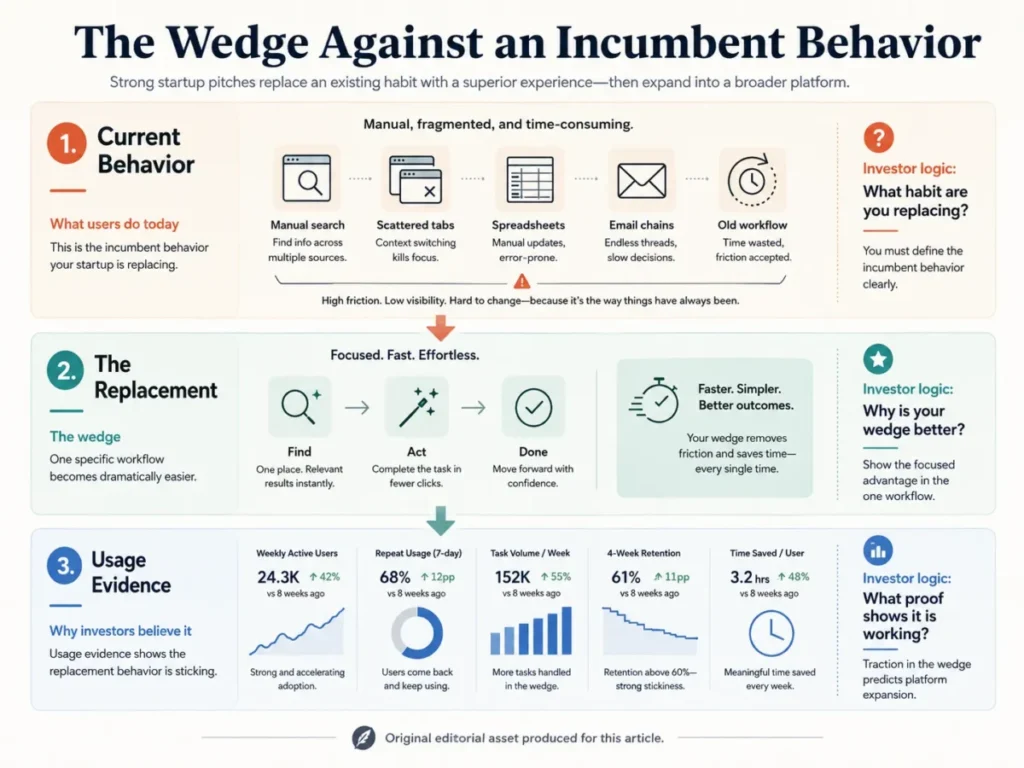
Perplexity names an existing behaviour it wants to replace, then shows usage rather than model capability, which is the pattern most AI decks miss.
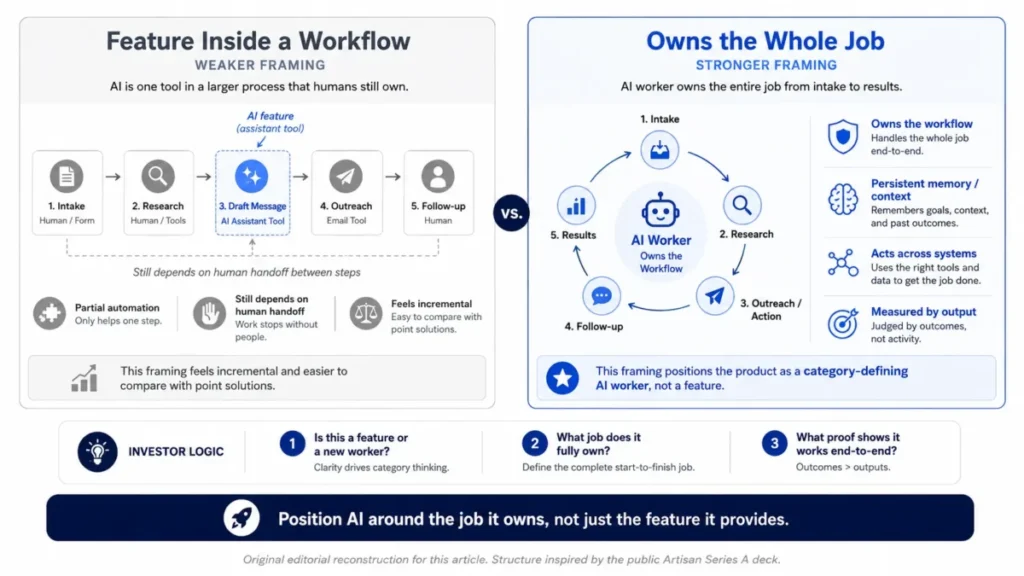
Artisan is the most relevant example for a revenue team, because it pitches an AI worker that owns an outbound sales job rather than a feature inside one.
Bonus, and the reason this library has a fiftieth slot rather than a fifty-first: the curator page for Mistral AI carries no deck at all. It records the raise as a memo written in a document, which is the clearest available reminder that the artifact is not the argument.
Read it after the fifty decks, not instead of them. A first-time founder without Mistral’s founding team does not get the memo option.
Cautionary Pitch Deck Examples
| Company | Stage and tier | Slide worth studying | What not to copy in 2026 |
|---|---|---|---|
| WeWork | Series D, Tier B | Thirty-six slides of confident category redefinition | The category language outran the unit economics, and the business later collapsed |
| FTX | Series B, Tier C | A clean institutional narrative for a regulated-adjacent product | A persuasive deck is not diligence, and this company failed criminally |
Open these decks:
Both decks are well built and both companies ended badly. That is the point of including them.
A deck is a claim about a business, not evidence that the business works. Study these two for craft, then remember that craft is what makes an unexamined claim persuasive.
WeWork is the one to study most carefully.
Its category language is confident and well built, and that confidence is exactly what carried an unexamined unit-economics claim past a lot of readers.
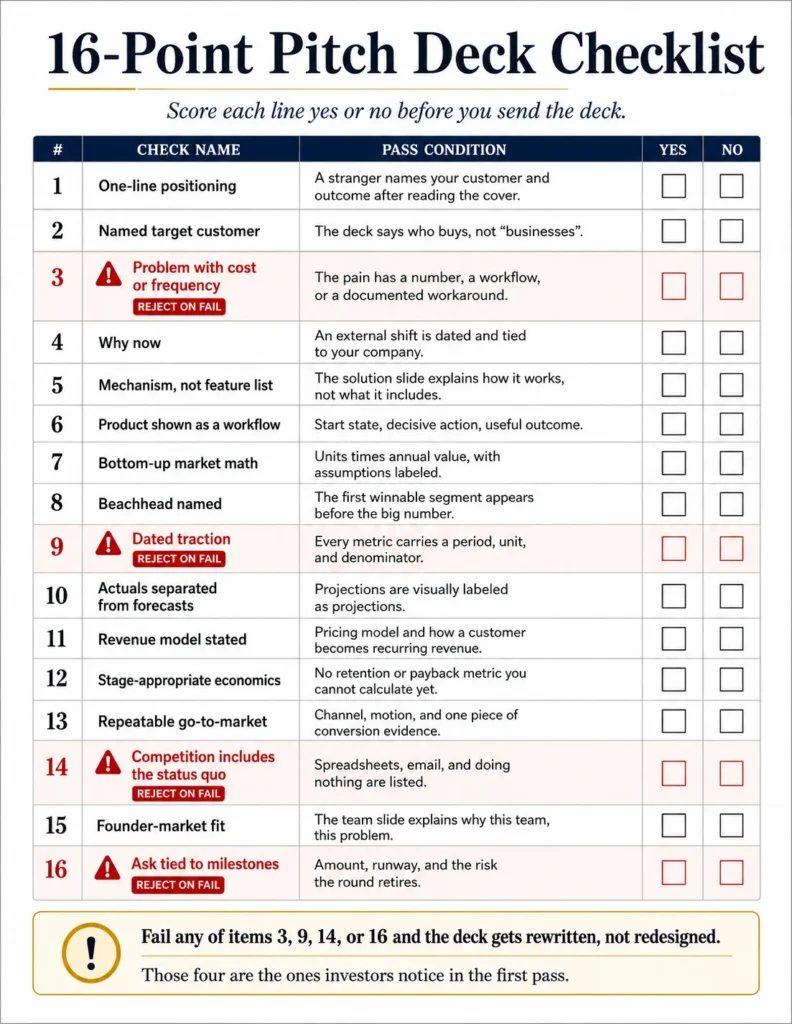
Quick Copy: The 16-Point Pitch Deck Checklist
Copy this table into your notes and score each line yes or no before you send anything.
| # | Check | Pass condition |
|---|---|---|
| 1 | One-line positioning | A stranger names your customer and outcome after reading the cover |
| 2 | Named target customer | The deck says who buys, not “businesses” |
| 3 | Problem with cost or frequency | The pain has a number, a workflow, or a documented workaround |
| 4 | Why now | An external shift is dated and tied to your company |
| 5 | Mechanism, not feature list | The solution slide explains how it works, not what it includes |
| 6 | Product shown as a workflow | Start state, decisive action, useful outcome |
| 7 | Bottom-up market math | Units times annual value, with assumptions labeled |
| 8 | Beachhead named | The first winnable segment appears before the big number |
| 9 | Dated traction | Every metric carries a period, unit, and denominator |
| 10 | Actuals separated from forecasts | Projections are visually labeled as projections |
| 11 | Revenue model stated | Pricing model and how a customer becomes recurring revenue |
| 12 | Stage-appropriate economics | No retention or payback metric you cannot calculate yet |
| 13 | Repeatable go-to-market | Channel, motion, and one piece of conversion evidence |
| 14 | Competition includes the status quo | Spreadsheets, email, and doing nothing are listed |
| 15 | Founder-market fit | The team slide explains why this team, this problem |
| 16 | Ask tied to milestones | Amount, runway, and the risk the round retires |
Fail any of items 3, 9, 14, or 16 and the deck gets rewritten, not redesigned. Those four are the ones investors notice in the first pass.
How to Use This Pitch Deck Library
Seven steps take you from browsing examples to a scored, sendable deck.
- Pick three examples that match your stage and your SaaS business model, not your favorite brand.
- Extract the argument, not the wording. Note which question each slide answers.
- Read the “what not to copy” column before you borrow anything.
- Fill the 12-slide template using only numbers you can defend in a data room.
- Run the AI prompts after you supply your own facts, never before.
- Score the draft on the 100-point rubric and fix every red flag.
- Export, inspect, and send using the pre-send test in step 6 below.
One person owns the score. Two founders scoring the same deck separately, then reconciling the gaps, surfaces more problems than either would alone.
How We Selected and Verified These Pitch Decks
These 50 examples were chosen on four criteria: the deck is publicly openable, the company is instructive for founders building SaaS and AI products now, the stage is identifiable, and at least one slide teaches a transferable argument.
Sources are ranked. Founder or company publications outrank public deck hosts, and public deck hosts outrank curated gallery pages.
Every entry carries that tier so you know how much weight its funding label deserves.
Funding amounts are treated as context, not as the lesson. Current galleries disagree with each other on several of these companies, so this library headlines the argument on the slide and qualifies the money.
Investor frameworks from Sequoia Capital, Y Combinator, and Bessemer Venture Partners set the structural criteria used in the template and the scorecard.
| Tier | What it means | How much to trust the funding label |
|---|---|---|
| A | Founder or company published the deck or wrote about using it | Strong |
| A-minus | Public deck published under a founder identity, thinner context | Good |
| B | Public copy exists, uploader is not the company | Treat the round as unconfirmed |
| C | Third-party gallery supplies the deck and the financing context | Qualify every number |
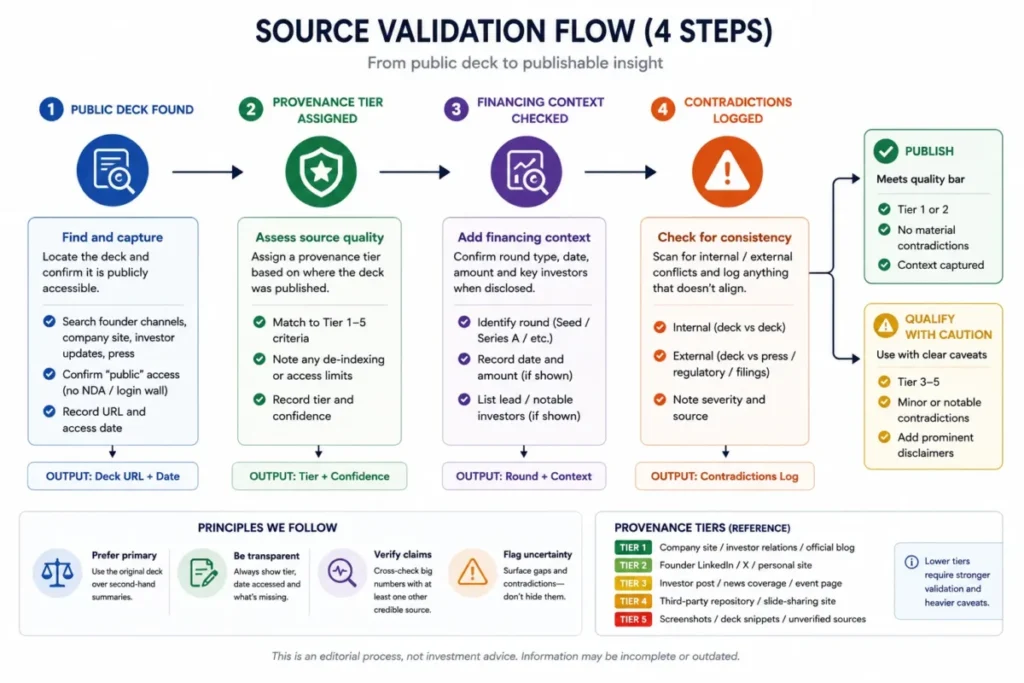
Source: official documentation pages from Sequoia Capital, Y Combinator, Bessemer Venture Partners, Microsoft, and Google, plus company posts from Buffer, Front, Mattermark, and Pitch, all checked on August 14, 2026.
Step 1: Define the Round Before You Design a Slide
Fill this in before touching a template. Every later decision, including which metrics belong on the traction slide, follows from these six fields.
| Field | Your entry | Why it drives the deck |
|---|---|---|
| Round and target amount | Sets the proof bar for traction and economics | |
| Runway the round buys | Determines which milestones are credible | |
| Milestone that retires the biggest risk | Becomes the spine of the ask slide | |
| Ideal customer profile | Controls the problem, market, and go-to-market slides | |
| Strongest verifiable proof point | Decides what moves to the front of the deck | |
| Weakest area you expect to be challenged on | Tells you what belongs in the appendix |
Founders skip the last row and pay for it in the meeting. Naming your weakest area in advance lets you prepare an answer instead of improvising one.
Step 2: Separate Must-Have Slides From Nice-to-Have Slides
Two investor frameworks converge on the same core. Sequoia’s guide to writing a business plan asks for company purpose, problem, solution, why now, market potential, competition and alternatives, business model, team, financials, and vision.
Y Combinator’s guide to seed fundraising lists twelve parts covering company, vision, problem, customer, solution, market, competitive market context, traction, business model, team, summary, and fundraising.
| Slide | Must-have or optional | Reject rule |
|---|---|---|
| Cover and positioning | Must-have | No named customer or outcome means rewrite |
| Problem | Must-have | No evidence of cost or frequency means rewrite |
| Why now | Must-have | An undated shift means rewrite |
| Solution | Must-have | A feature list with no mechanism means rewrite |
| Product | Must-have | No visible workflow means rewrite |
| Market and ideal customer profile | Must-have | Top-down number only means rewrite |
| Traction | Must-have | Undated or denominator-free metrics mean rewrite |
| Business model | Must-have | No stated pricing model means rewrite |
| Go-to-market | Must-have at seed and later | No conversion evidence means flag |
| Competition and alternatives | Must-have | Claiming no competition means reject |
| Team | Must-have | Prestige without problem relevance means rewrite |
| Ask and use of funds | Must-have | No milestone attached means reject |
| Vision | Optional | Cut if it repeats the market slide |
| Roadmap | Optional | Cut beyond six quarters |
| Detailed financial model | Appendix | Never in the main narrative at seed |
A missing must-have is a rebuild, not a polish. Any deck failing two or more must-haves goes back to plain-text outlining before it gets designed again.
Step 3: Score Your Deck on the 100-Point Rubric
This is an editorial self-assessment rubric, not a validated predictor of funding outcomes. Its value is that every weight is visible, so you can argue with it.
The methodology is straightforward. Twelve criteria map one-to-one to the twelve template slides, each criterion carries a published weight and its own evidence test, and the weighted total is the sum of the points you award.
| # | Criterion | Weight | Evidence test for full points |
|---|---|---|---|
| 1 | Cover and positioning | 5 | Customer and outcome legible in one read |
| 2 | Problem clarity and urgency | 10 | Pain is specific, costly, and documented |
| 3 | Why now | 7 | External shift is dated and causally linked |
| 4 | Solution logic | 8 | Mechanism maps to the stated problem |
| 5 | Product proof and comprehension | 9 | Three-step workflow with real product visuals |
| 6 | Market and ICP rigor | 9 | Bottom-up math with labeled assumptions |
| 7 | Traction quality | 14 | Dated actuals with units and denominators |
| 8 | Business model and economics | 10 | Stage-appropriate metrics, actuals split from targets |
| 9 | Go-to-market repeatability | 7 | Channel, motion, and conversion evidence |
| 10 | Competition and defensibility | 5 | Direct, indirect, and status quo all present |
| 11 | Team and founder-market fit | 7 | Relevant access, insight, or track record |
| 12 | Ask, runway, and milestones | 9 | Capital tied to a risk-retiring milestone |
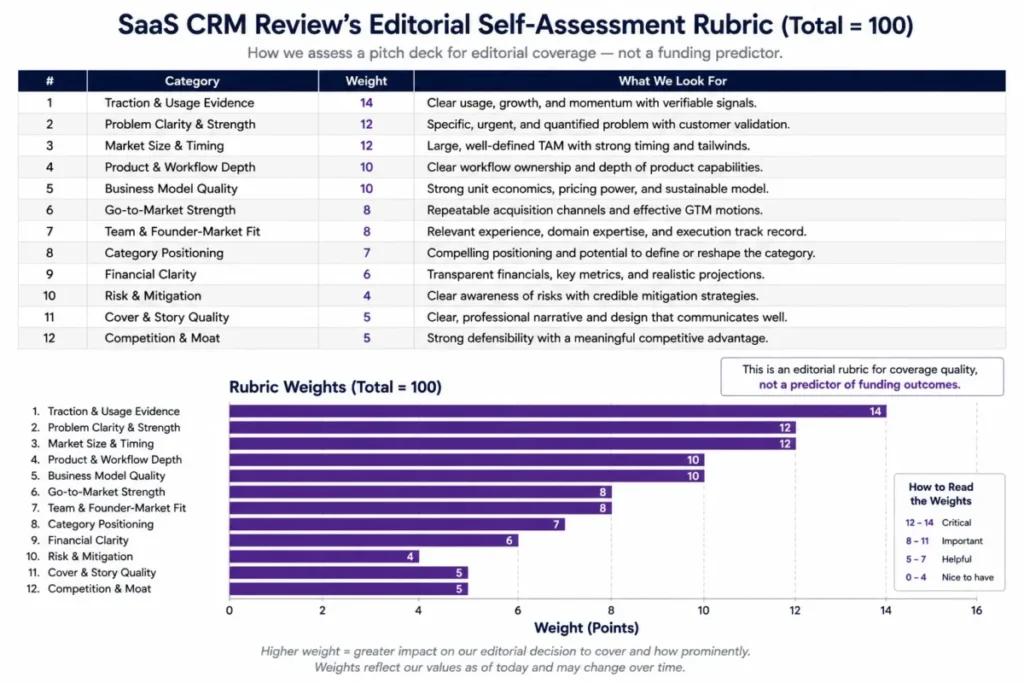
Score each criterion from zero to its full weight, then add them up.
The interactive scorecard below does the arithmetic, applies the red-flag overrides, and names the band for you. Bands: 85 and above is ready for a serious read after evidence checks, 70 to 84 needs specific slide work, 55 to 69 has material gaps, and below 55 needs a rebuilt argument.
Pitch Deck Scorecard Calculator
Twelve weighted criteria, six red-flag overrides, 100 points total.
Score each criterion from zero up to its full weight. This is SaaS CRM Review’s editorial self-assessment rubric, not a validated predictor of funding outcomes. Every weight is shown so you can disagree with it.
Red-flag overrides
Any one of these caps the deck below the sendable band no matter what the total says.
BIGGEST POINT LOSSES
Bands: 85 and above is ready for a serious read after evidence checks, 70 to 84 needs specific slide work, 55 to 69 has material gaps, below 55 needs a rebuilt argument.
Six red flags override the total. Invented or unverifiable claims, actuals blended visually with forecasts, no defined target customer, a “no competition” claim, a missing or unexplained ask, and major metrics with no date or denominator each cap the deck below the sendable band regardless of points.
Step 4: Pressure-Test the Ask, the Runway, and the Hidden Costs
The ask slide fails more often on arithmetic than on ambition. Work the chain from amount to milestone and check that each row survives a follow-up question.
| Line item | What to state | Common hidden cost |
|---|---|---|
| Amount sought | The number and instrument | Bridge or extension you have not disclosed |
| Runway purchased | Months at planned burn | Hiring ramp that starts before revenue does |
| Use of funds | Grouped by outcome, not department | Recruiting fees, tooling, and cloud spend |
| Hiring plan | Roles and start quarters | Fully loaded cost, not base salary |
| Milestone | The evidence the round produces | Sales cycles longer than the runway |
| Next-round proof | The metric that unlocks the next raise | A metric your systems cannot yet measure |
The last row is the one to labor over. If the milestone you promise cannot be measured by the instrumentation you have, the round buys you a number you cannot report.
Step 5: Match Your Metrics to Your Stage
Forcing late-stage SaaS metrics into an early deck reads as unfamiliarity with your own business.
Bessemer’s guidance on scaling to 100 million defines CAC payback as the rate at which the costs spent to acquire a customer are repaid by that customer, and measures it against gross margin-adjusted recurring revenue.
That definition is the reason the metric belongs in a Series A deck rather than a pre-seed one. Without stable acquisition spend and a known gross margin, there is nothing stable to divide.
| Stage | Lead with | Include when the data is real | Leave out |
|---|---|---|---|
| Pre-seed | Design partners, activation, usage frequency, qualitative validation | Early revenue, signed pilots | Net revenue retention, CAC payback, burn multiple |
| Seed | Recurring revenue, growth rate, retention, customer count, usage depth | Gross margin, acquisition efficiency, pipeline | Cohort expansion curves you cannot populate |
| Series A and B | Revenue growth, retention or net revenue retention, gross margin, CAC payback, average contract value | Sales efficiency, cohort behavior, expansion | Vanity reach metrics |
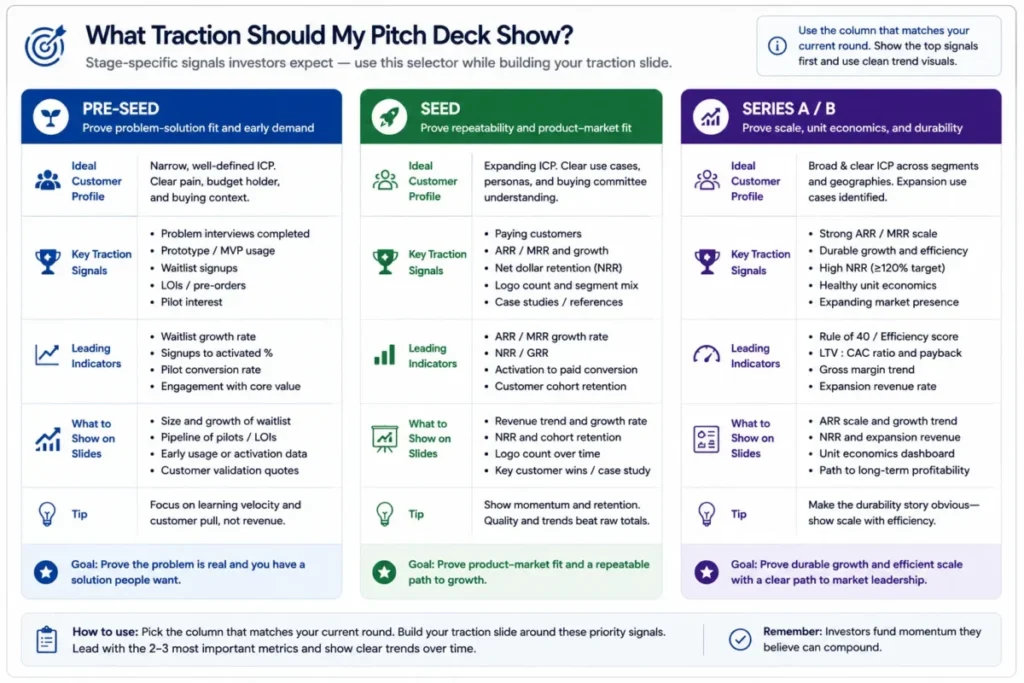
Define every metric on the slide itself. An undated percentage with no denominator is treated as a rounding error by anyone who has read a thousand decks.
Step 6: Run the Pre-Send Test
Six checks, run in order, catch most of what a founder stops seeing after the fortieth revision.
| # | Test | Pass condition |
|---|---|---|
| 1 | Headline-only read | Reading only the slide headlines tells a coherent investment story |
| 2 | Stranger test | Someone outside your market names your customer and product after one pass |
| 3 | Proof audit | Every headline has supporting evidence on the same slide |
| 4 | Number audit | Every figure has a date, unit, period, and source you can produce |
| 5 | Export check | The exported file keeps its fonts, charts, image crops, and 16:9 aspect ratio |
| 6 | Appendix check | Every dense chart cut from the narrative is findable in the appendix |
Test 1 does the most work for the least effort. If the headlines alone do not argue the case, the deck depends on you being in the room, which a forwarded file never is.
Step 7: Apply the Final Decision Rules
| Outcome | Rule | Next action |
|---|---|---|
| Send | 85 or above with zero red flags | Send with a short email that repeats the ask |
| Revise | 70 to 84, or one red flag | Fix the named slides, rescore, then send |
| Rebuild | 55 to 69, or two or more red flags | Rewrite the argument in plain text first |
| Delay | Below 55 | Raise later or change the round you are raising |
Sending a deck that scores 62 to your best-fit investor is the expensive mistake. Warm introductions are finite, and a weak first read is hard to reverse.
The Free 12-Slide SaaS Pitch Deck Template
Download it here: free 12-slide SaaS pitch deck template. Every slide carries its field labels, its single job, and its reject rule, so the file works as a checklist as well as a design starting point.
The template ships as a .pptx file, which Microsoft’s supported file formats documentation describes as a presentation you can open on a PC or a Mac.
The same file works in Google Slides, which Google documents as able to edit, download, and convert Microsoft Office files, listing .pptx among its compatible presentation formats.
Every slide below carries one job and a fixed set of fields. Fill the fields in plain text before you open a design tool.
Work the template in six stages, because each stage decides what the next one is allowed to contain.
| Stage | What it means for this template |
|---|---|
| Use case | The round you are raising and the investor question you must answer first |
| Required input | The verified numbers, dates, customer names, and product screens you can defend in a data room |
| Template section | The slide that owns that question, one job per slide |
| Apply and customize | Cut any field your stage cannot support, and reorder when your strongest proof is not traction |
| Example output | The filled scorecard below, which shows what a 74 out of 100 draft looks like before revision |
| Common error | Filling a field with an estimate because the slot exists, when omitting it and naming the missing data reads better |
If your strongest evidence is a signed pilot rather than revenue, customize the order so slide 7 leads with it.
| Slide | One job | Required fields |
|---|---|---|
| 1. Cover and positioning | Make the company legible in one line | Company name, positioning line, target customer, round context |
| 2. Problem | Prove a costly, frequent pain | Target user, pain, frequency, current workaround, evidence |
| 3. Why now | Explain the timing | Market shift, date, evidence, consequence |
| 4. Solution | State the mechanism | Solution statement, mechanism, mapping back to the problem |
| 5. Product | Show the shortest believable workflow | Start state, key action, output, product visual |
| 6. Market and ICP | Show who buys and how big that is | ICP, market units, annual value per unit, beachhead, assumptions |
| 7. Traction | Present the strongest evidence | Dated metrics, growth, revenue or usage, retention, customer proof |
| 8. Business model | Show how customers become durable revenue | Pricing model, contract value, gross margin, retention, payback |
| 9. Go-to-market | Prove repeatability | ICP, channel, sales motion, funnel evidence, cycle length |
| 10. Competition | Show why you win | Direct competitors, indirect alternatives, status quo, difference |
| 11. Team | Prove founder-market fit | Founders, relevant experience, unique access, known gap |
| 12. Ask | Connect capital to milestones | Amount, use of funds, runway, milestones, next-round proof |
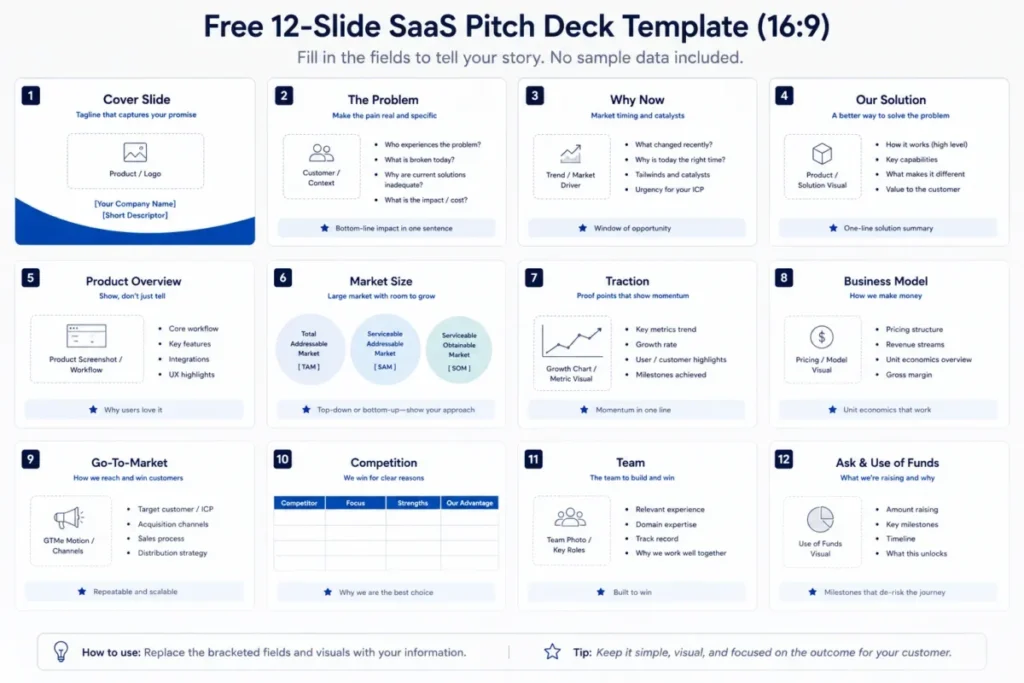
Nine rules govern how you fill it. Draft in plain text first, give each slide exactly one job, and use dated evidence throughout.
Separate actuals from forecasts, move unusually strong traction earlier, and prefer bottom-up market math. Include the status quo in competition, tie the ask to milestones, and push dense material to the appendix.
12 AI Prompts to Build Your Pitch Deck
Every prompt below forbids invented facts. Supply your own research first, then paste the prompt.
Slide 1, cover. Act as a seed-stage fundraising editor. Using only the supplied company facts, write five positioning lines under 12 words each, where each option makes the target customer and outcome understandable. Do not invent traction, customers, technology claims, or market leadership.
Slide 2, problem. Turn the supplied research into one investor problem slide stating who has the problem, what happens, how often or how severely when evidence exists, and what people already do instead. Produce one headline and no more than three supporting points, and mark any unsupported statement for removal instead of guessing.
Slide 3, why now. Build a why-now slide from the supplied dated evidence, pairing each external shift with the specific reason it makes this company possible or urgent now. Reject generic statements such as rapid AI growth unless the supplied evidence makes the causal link explicit.
Slide 4, solution. Write one solution statement and three short proof points showing how the product mechanism maps to the documented customer problem. Prioritize outcomes and mechanism over feature names, and add no capability absent from the supplied product facts.
Slide 5, product. Convert the supplied product workflow into a three-step demo narrative covering starting state, decisive action, and useful outcome, and suggest which real product visual belongs at each step. Claim no clicks, speed, automation, or outcome that the supplied evidence does not support.
Slide 6, market. Build a bottom-up market-size explanation from the supplied units and values, showing the calculation explicitly and separating verified inputs from assumptions. Identify the beachhead market before the broader opportunity, and manufacture no total addressable market figure.
Slide 7, traction. Rank the supplied traction metrics by investor relevance and choose the three to five strongest signals, preserving dates, units, periods, and denominators. Prefer revenue, retention, growth, repeat usage, or strong customer validation over reach metrics, and do not extrapolate future growth unless asked for a labeled forecast.
Slide 8, business model. Create a SaaS business-model slide from the supplied actual data, including only metrics meaningful at this company’s stage and separating actuals from targets. If retention, payback, margin, or lifetime-value ratios cannot be calculated from supported inputs, omit the metric and state which data would be required.
Slide 9, go-to-market. Turn the supplied evidence into a repeatability argument stating who is targeted, how they are reached, how they convert, and what suggests the motion can scale. Flag channel concentration or missing conversion data rather than hiding it.
Slide 10, competition. Create an honest competition slide including direct competitors, indirect alternatives, and the customer’s current status quo. Recommend comparison axes only where supplied evidence supports them, never claim no competition, and never manufacture a competitor weakness.
Slide 11, team. Write a founder-market-fit slide explaining why this team is unusually equipped to solve this specific problem, removing generic prestige and unrelated biography. Invent no exits, employers, credentials, patents, awards, or domain experience.
Slide 12, ask. Create a fundraising ask connecting the capital amount to runway and measurable milestones, grouping use of funds by the outcomes the spending enables rather than by department. Make clear which milestone should materially reduce risk before the next financing.
If you already keep a prompt library, these slot in beside your existing ChatGPT prompt collection and follow the same discipline covered in our guide to prompt engineering fundamentals.
Example Filled-In Scorecard
A worked example makes the bands concrete. This is an illustrative seed-stage SaaS company, not a real one, scored against the twelve criteria above.
Profile: eight-person team, revenue-operations software, 14 paying customers, nine months of revenue history, raising a seed round.
| # | Criterion | Awarded of weight | Reason for the gap |
|---|---|---|---|
| 1 | Cover and positioning | 5 of 5 | Customer and outcome legible |
| 2 | Problem clarity | 8 of 10 | Pain named, cost per week not quantified |
| 3 | Why now | 4 of 7 | Shift asserted without a date |
| 4 | Solution logic | 7 of 8 | Mechanism clear, one feature detour |
| 5 | Product proof | 8 of 9 | Workflow shown in three real screens |
| 6 | Market and ICP | 5 of 9 | Top-down number only, no beachhead |
| 7 | Traction quality | 11 of 14 | Revenue dated, retention undated |
| 8 | Business model | 8 of 10 | Pricing clear, margin absent |
| 9 | Go-to-market | 4 of 7 | One channel, no conversion evidence |
| 10 | Competition | 3 of 5 | Status quo missing |
| 11 | Team | 6 of 7 | Relevant background, gap unnamed |
| 12 | Ask and milestones | 5 of 9 | Amount stated, milestone vague |
Weighted total for the example deck = 74 out of 100, which lands in the revise band.
The fix list writes itself from the gap column. Date the why-now shift, replace top-down sizing with bottom-up math, add the status quo to competition, and attach one measurable milestone to the ask, and the same deck moves into the high eighties without a single new design element.
Red Flags That Stop an Investor Read
| # | Red flag | Why it stops the read |
|---|---|---|
| 1 | “No competition” | Signals the founder has not talked to buyers |
| 2 | Undated metrics | Makes every other number suspect |
| 3 | Forecasts styled like actuals | Reads as intentional, not sloppy |
| 4 | Customer logos without a commercial relationship | Fails the first reference check |
| 5 | Top-down market size only | Suggests the beachhead is undefined |
| 6 | An ask with no use of funds | Implies no operating plan |
| 7 | Team slide of prestige logos with no problem link | Answers the wrong question |
| 8 | A single acquisition channel with no conversion data | Raises a scalability question you cannot answer |
| 9 | Twelve slides of features and no mechanism | Confuses the product with the argument |
| 10 | Percentages with no denominator | Hides a small absolute number |
| 11 | Regulatory or clinical claims without evidence | Creates diligence risk beyond the round |
| 12 | A deck that only works when narrated | Fails the moment it is forwarded |
Any two of these together move the deck from revise to rebuild. Items 3, 4, and 11 are the ones that damage trust rather than just points.
Common Pitch Deck Mistakes
Copying a famous deck’s structure instead of its argument. Those decks were built for different stages, markets, and information environments, so borrow the question each slide answers and rebuild the answer with your own evidence.
Treating the deck as the whole pitch. Mattermark’s founder credits a conversation and a short list of questions as the real pitch, which means your follow-up answers deserve as much preparation as slide 7.
Hiding the strongest proof at the end. If your retention curve is your best asset, it belongs before the market slide, not after the team slide.
Shipping a deck that only survives narration. Investors forward decks, and a deck whose headlines do not argue the case loses every meeting it was not present for.
Padding the narrative with diligence material. Pitch kept a separate data deck for exactly this reason, and at seed an appendix does the same job.
Publishing metrics you cannot reproduce. Every number on a slide becomes a data-room question, and one figure you cannot rebuild costs more credibility than the figure was worth.
Designing before the argument is settled. Plain text first is slower for a day and faster for a month, because layout work done on a broken argument gets thrown away.
What to Do After You Score Your Deck
If you scored 85 or above, move to distribution: build a target list, sequence warm introductions, and keep the appendix updated as questions arrive.
If you scored 70 to 84, fix only the named slides. Rescore before touching design, because most of those gaps are argument problems wearing a layout costume.
If you scored below 70, go back to the plain-text outline. Define each stage of the argument, define what proves that stage, then write the slide.
Founders raising for revenue tooling should also pressure-test their own numbers before an investor does. A defensible retention story starts with clean pipeline data in a real system.
That is why early teams often pair this work with CRM software built for startups or a structured CRM spreadsheet template.
If you are pre-revenue and still validating, a lightweight Google Sheets CRM template is enough to produce the pipeline evidence slide 9 needs. The point is that the number on the slide exists somewhere you can export it from.
Frequently Asked Questions
What should a pitch deck include?
Twelve slides cover the questions investors ask: positioning, problem, why now, solution, product, market and ICP, traction, business model, go-to-market, competition, team, and the ask. Sequoia’s and Y Combinator’s public frameworks converge on the same core, with wording differences rather than structural ones.
How many slides should a pitch deck have?
Ten to fifteen for the narrative deck, with everything else in an appendix. Length matters less than whether each slide has exactly one job.
What do investors look for in a pitch deck?
Evidence that the market is responding, a credible reason this team wins, and a clear connection between the money and the risk it removes. Traction carries the most weight in the rubric above for that reason.
Is my pre-seed deck supposed to look like a Series B deck?
No, and copying one is a common failure. Later-stage decks assume proof density that a pre-seed company cannot produce, so study individual techniques from them rather than their structure.
What goes on a traction slide when there is no revenue?
Design partners, activation rates, usage frequency, retention of early cohorts, signed pilots, and specific qualitative validation. Pick the three strongest, date them, and put the rest in the appendix.
How do you show market size without inflating it?
Multiply a defensible number of target accounts by a defensible annual value per account, label every assumption, and name the beachhead before the total. Bottom-up math survives questioning in a way a large industry figure does not.
Can AI write my pitch deck?
It can draft every slide well once you supply verified facts, and it will invent plausible traction and market numbers if you do not. The twelve prompts above are written to refuse fabrication and flag missing evidence instead. Once the slide text holds up, our free AI presentation makers guide shows which free plans turn it into a deck you can export as an editable PPTX.
How much should I ask for on the fundraising slide?
State an amount tied to a runway and a milestone rather than a round-number convention. An editorial template cannot set the right figure for your business, but it can tell you the ask is wrong when no milestone is attached.
What are the biggest pitch deck mistakes?
Claiming no competition, publishing undated metrics, blending forecasts with actuals, and asking for money without saying what it buys. Each one appears in the red-flag table because each one caps the deck below the sendable band.
Do these pitch deck examples prove the deck raised the money?
No, and treating them that way is the error this library is built to prevent. A deck is one artifact in a process that also includes conversations, references, diligence, timing, and the business itself.