

Two faces is a harder problem than one. A couple photo asks the model to hold two separate likenesses steady while it changes the clothing, the light and the background, and either person can drift while the other stays perfect.
In This Article (18 sections)
That is the failure this library is built around. Every one of the fifty Gemini couple photo prompts below names what must stay recognizable, draws a boundary around what the model may change, and ends with the specific thing to look at before you keep the result.
Nothing here promises the faces will come back exactly right, because Google’s own documentation does not promise that either. What the prompts do is remove the ambiguity that makes a two-person image fail for reasons you could have prevented.
How this library was tested 50 prompts tested • Gemini Apps • Gemini model set to Pro • Google AI plan • September 2026 • Outputs shown unretouched Every image below is the output of the prompt directly above it, not a stock photo and not an illustration. Source photographs are of real people, used with both people’s permission.
Quick Copy: The Couple Photo Pre-Flight Checklist
Copy this block and run it before you paste any prompt. It takes about a minute, and most of it is decisions that are cheaper to make now than after the first result.
- [ ] I have permission from the other person to use their photo for this.
- [ ] I am 18 or over, the age Gemini Apps states for generating and editing images.
- [ ] Both faces in my source photos are unobstructed, in focus and reasonably lit.
- [ ] Nobody is wearing sunglasses, a mask or a hat brim that hides the eyes.
- [ ] I know whether I have one photo of both people or two separate portraits.
- [ ] My Gemini model setting is Flash or Pro rather than Flash-Lite, which Google says is designed for neither multiple references nor multiple edits.
- [ ] I picked one prompt, not three merged together.
- [ ] I know which aspect ratio the finished image is actually for.
- [ ] After the first result, I will change one thing per turn rather than rewriting the scene.
- [ ] I will inspect each person separately, not the image as a whole.
- [ ] I will fix a single wrong element with a follow-up edit rather than starting over.
- [ ] I know Gemini attaches an invisible AI provenance marker to what it creates.
The two easiest items to skip are the model setting and the permission line. The first costs you a turn; the second cannot be put right afterward.
50 Gemini Couple Photo Prompts to Copy & Paste
The library is split by what you are making, and by what you have to work with.
Prompts 1 to 40 all start from one photo that already contains both people. Prompts 41 to 50 start from two separate portraits, usually a selfie of each person.
That second group asks Gemini to build a shared scene from scratch, which is a different and harder job.
Within the first group: prompts 1 to 10 are romantic and cinematic, 11 to 20 are everyday and candid, 21 to 30 are retro and editorial, and 31 to 40 cover anniversaries, engagements, holidays and other milestones.
Each prompt is filled in. Prompts 1 to 40 carry a preserve clause, a change scope, an output request and an exclusion line.
Prompts 41 to 50 swap the change scope for a role assignment and a non-blending constraint, because they have no existing image to bound.
Two short things are worth reading before you paste: the pre-flight checklist above, and the model-setting section below. The rest of the page explains why each field is there and what to do when a result comes back wrong.
If you are working with a single person rather than a couple, the AI headshot prompt library is the closer fit. For image jobs that have nothing to do with people, start from the broader Nano Banana prompt hub instead.
Romantic and Cinematic Prompts (1 to 10)
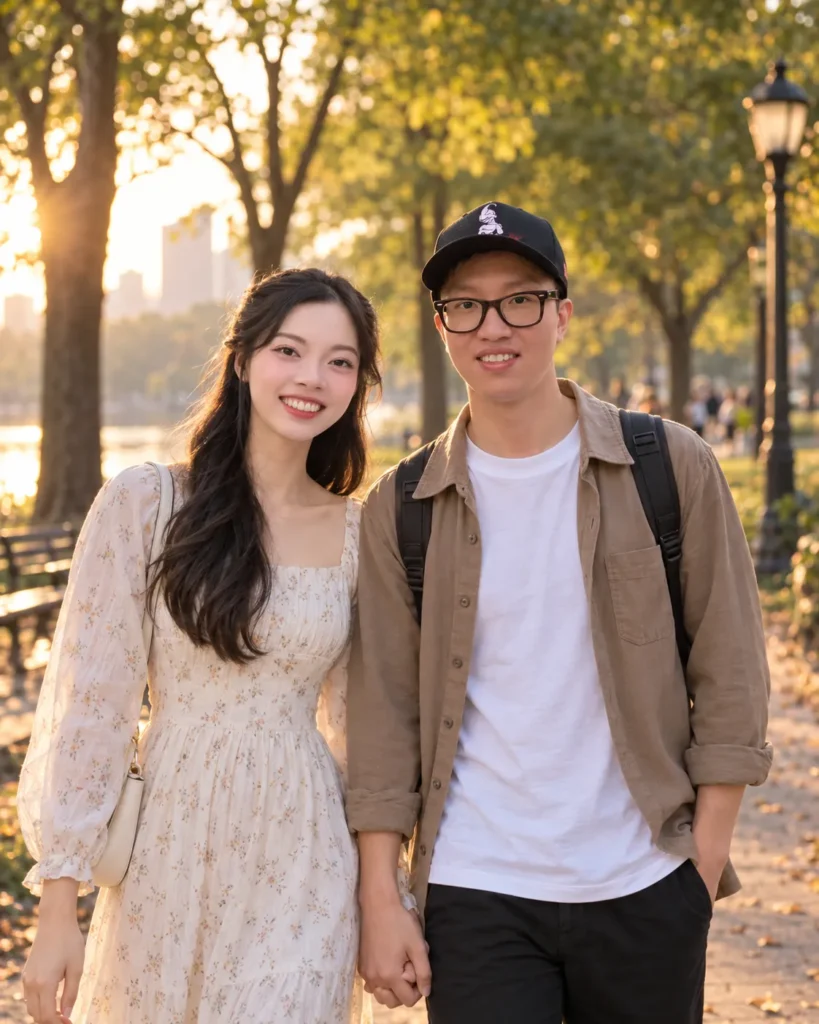
1. Golden Hour Park Walk
Use it for: an anniversary post built from a photo you already like. Input: one photo of both people.
Use the uploaded couple photo as the identity reference for both people. Keep both faces recognizable, keep their relative positions and their natural proportions, and restyle the scene as a quiet park walk at golden hour. Add warm backlight through the trees, long soft shadows, relaxed hand holding, natural smiles and shallow depth of field with realistic skin texture. Change only the background, the lighting, the color grade and small adjustments to pose direction. Output 4:5. Add no extra people and no readable text.
Check first: both faces, the hand contact, and whether the frame came back at the ratio you asked for.
2. Rooftop at Blue Hour
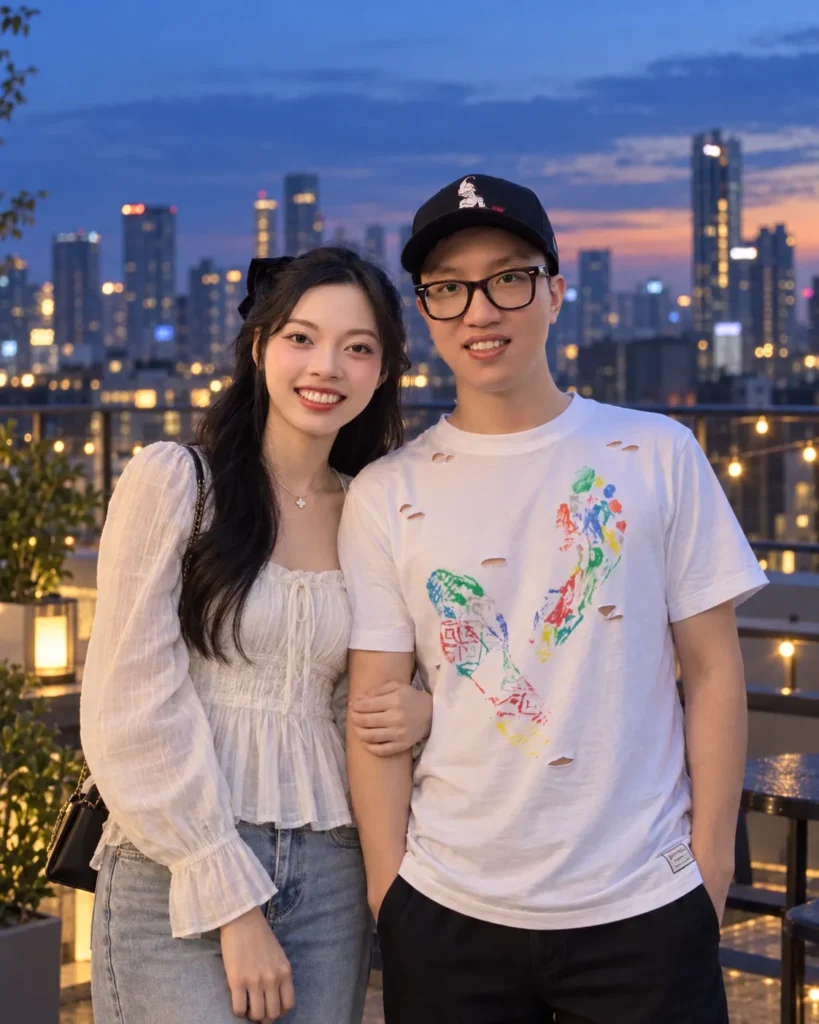
Use it for: a city couple portrait with depth behind it. Input: one photo of both people.
Edit the uploaded couple photo into a rooftop portrait at blue hour. Preserve both recognizable faces, both hairstyles, both skin tones and the overall proportions of each person. Keep the couple close together and shoulder to shoulder, both fully visible and looking toward the camera with calm expressions. Add a softly blurred skyline, warm practical lights, a cool evening sky and cinematic contrast that still looks like a photograph. Change only the setting, the lighting and the color treatment. Output 4:5. Render no readable signage.
Check first: that neither face has borrowed features from the other, and that no skyline signage rendered as garbled lettering.
3. Rain and Neon Street
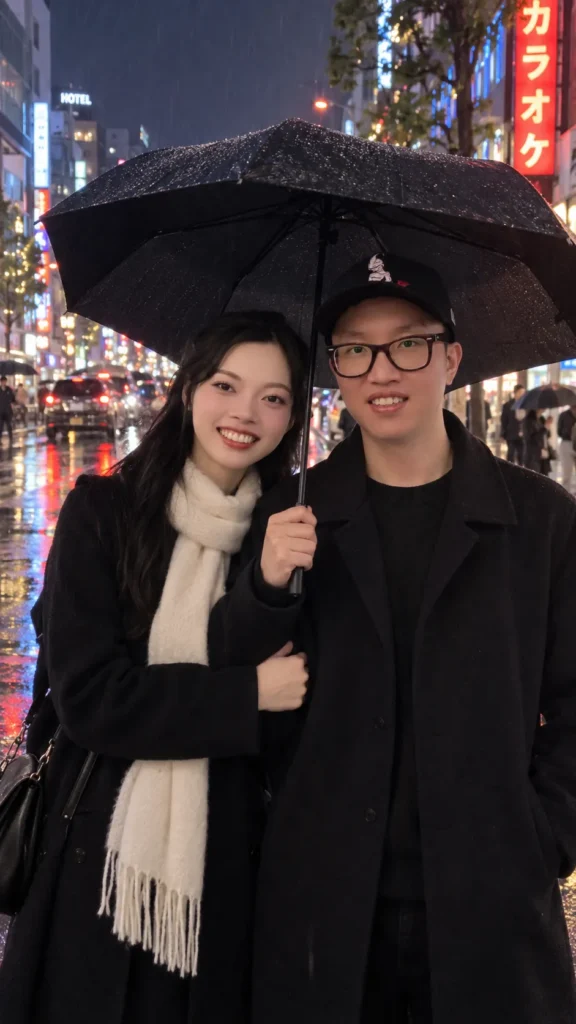
Use it for: a moody image that hides a plain original background. Input: one photo of both people.
Use the uploaded couple photo as the identity reference. Keep both people recognizable and preserve their basic pose and clothing silhouette. Place them under one dark umbrella on a rain-wet city street at night, with soft neon reflections on the pavement, gentle side light falling on both faces, realistic raindrops and a restrained cinematic color grade. Change only the environment, the lighting and the weather. Output 9:16 for a vertical story frame. Add no extra people in the foreground.
Check first: umbrella geometry, both sets of hands, and whether the reflections invented a third figure.
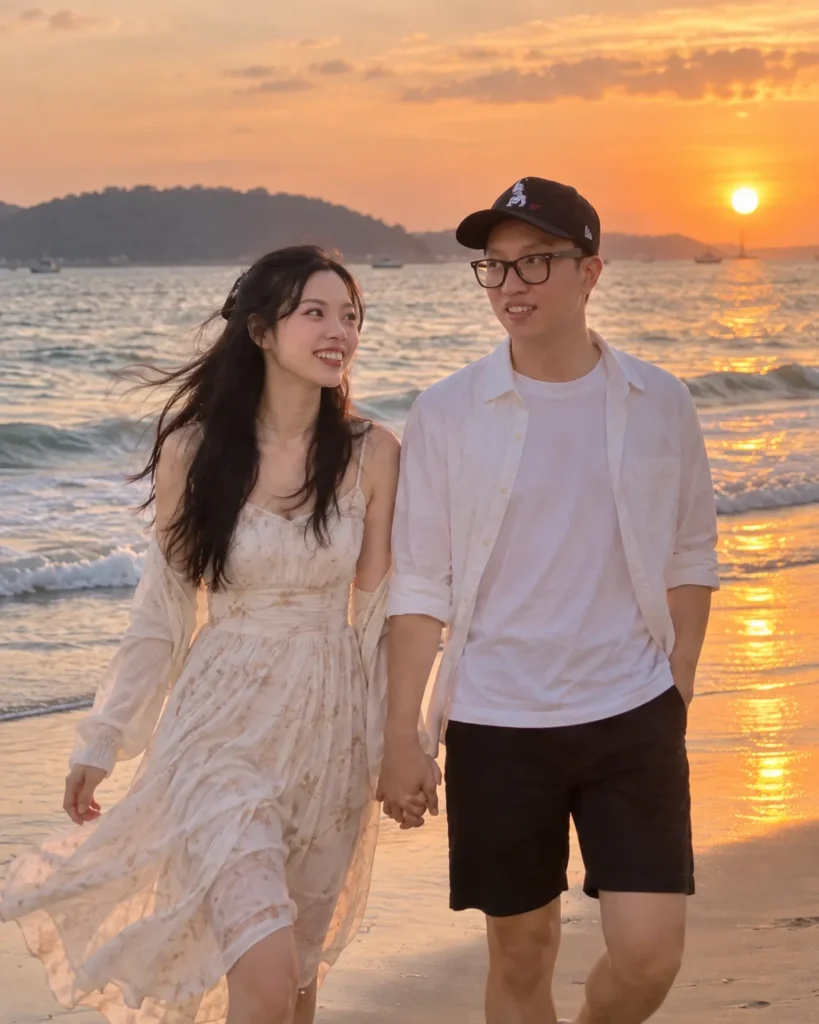
4. Beach Walk at Sunset
Use it for: a warm travel-style image without a real trip. Input: one photo of both people.
Restyle the uploaded couple photo as a quiet beach walk at sunset. Preserve both recognizable faces, both hairstyles, both skin tones and natural proportions. Show the couple walking side by side near the waterline with hands loosely connected, low warm sunlight, gentle reflections on wet sand, wind moving their clothing naturally and a soft cinematic background. Change only the pose direction, the environment and the lighting. Output 4:5. Add no extra people.
Check first: hands, feet and both faces, because the pose change is the part of this prompt that touches likeness.
5. Candlelit Dinner
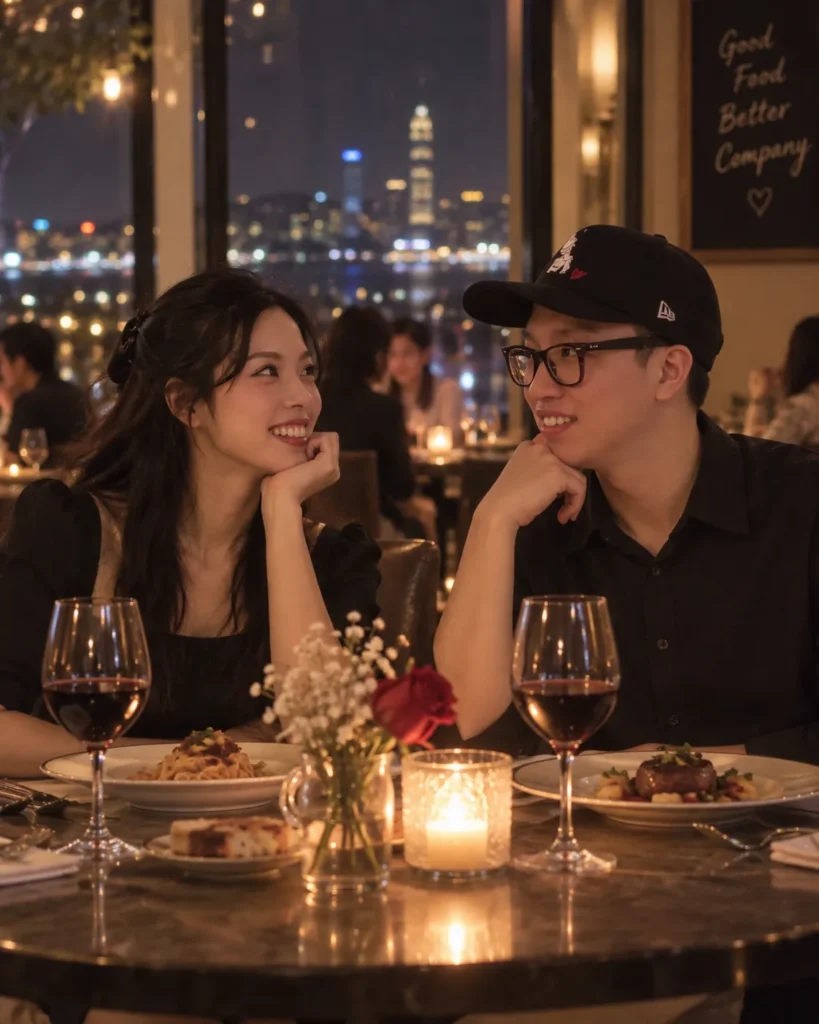
Use it for: a date-night image with a controlled, flattering light source. Input: one photo of both people.
Edit the uploaded couple photo into an intimate restaurant dinner portrait. Keep both people recognizable, preserve their apparent ages and natural facial proportions, and seat them across a small table turning slightly toward each other. Add warm candlelight, soft window reflections behind them, a dark neutral background, shallow depth of field and realistic skin texture. Change only the setting, the seated pose, the lighting and the clothing, which should read as understated evening wear. Output 4:5. Keep menus and labels free of readable text.
Check first: fingers near glassware or cutlery, and any lettering that appeared on menus or labels.
6. Soft Studio Embrace
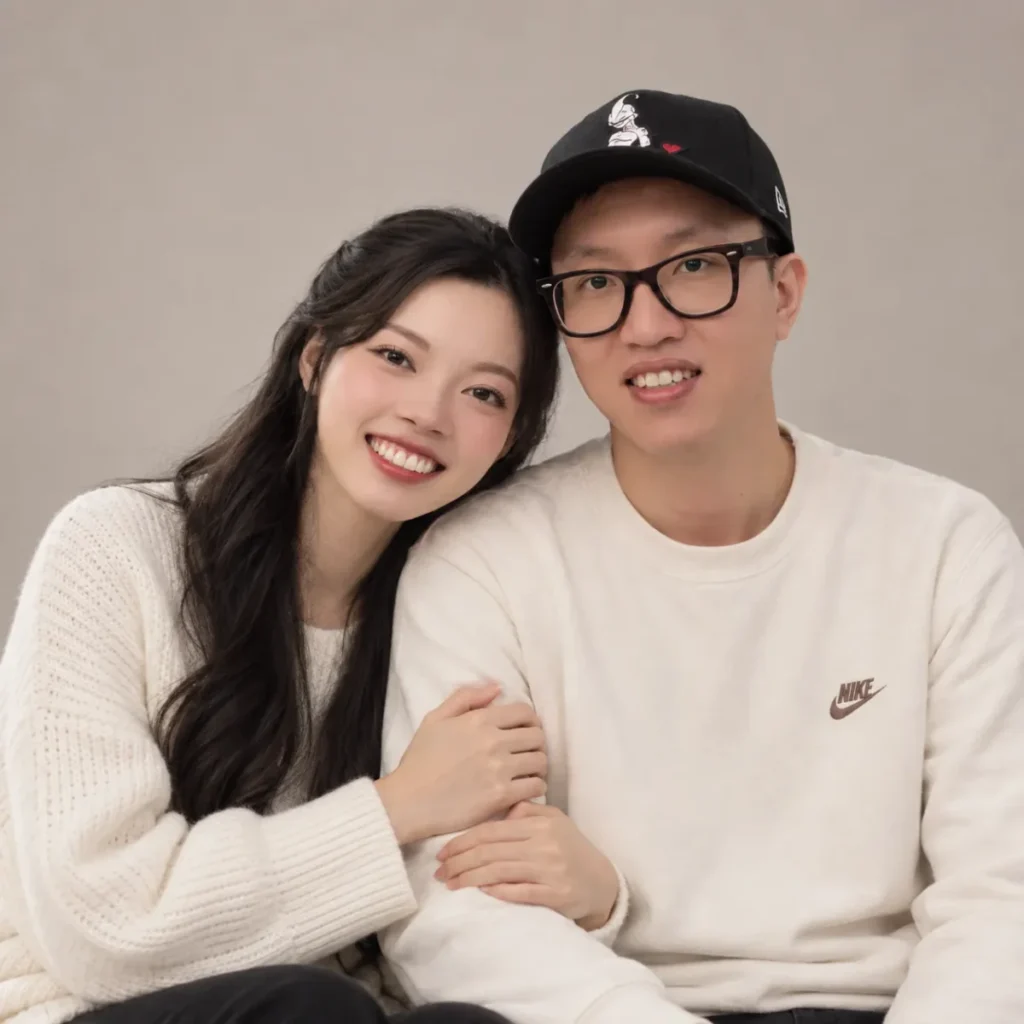
Use it for: a clean portrait that will crop well for a profile or a print. Input: one photo of both people.
Use the uploaded couple photo as the identity reference. Keep both people recognizable and preserve their natural proportions. Recompose them into a waist-up studio portrait with shoulders touching and one person's hand resting naturally on the other's upper arm. Use a warm gray backdrop, one large soft key light, gentle fill, realistic skin texture and restrained retouching. Change only the pose, the background, the lighting and the clothing, which should be coordinated neutral tones. Output 1:1. Add no props and no text.
Check first: hand placement, both jawlines and both sets of eyes.
7. Lakeside After Dark
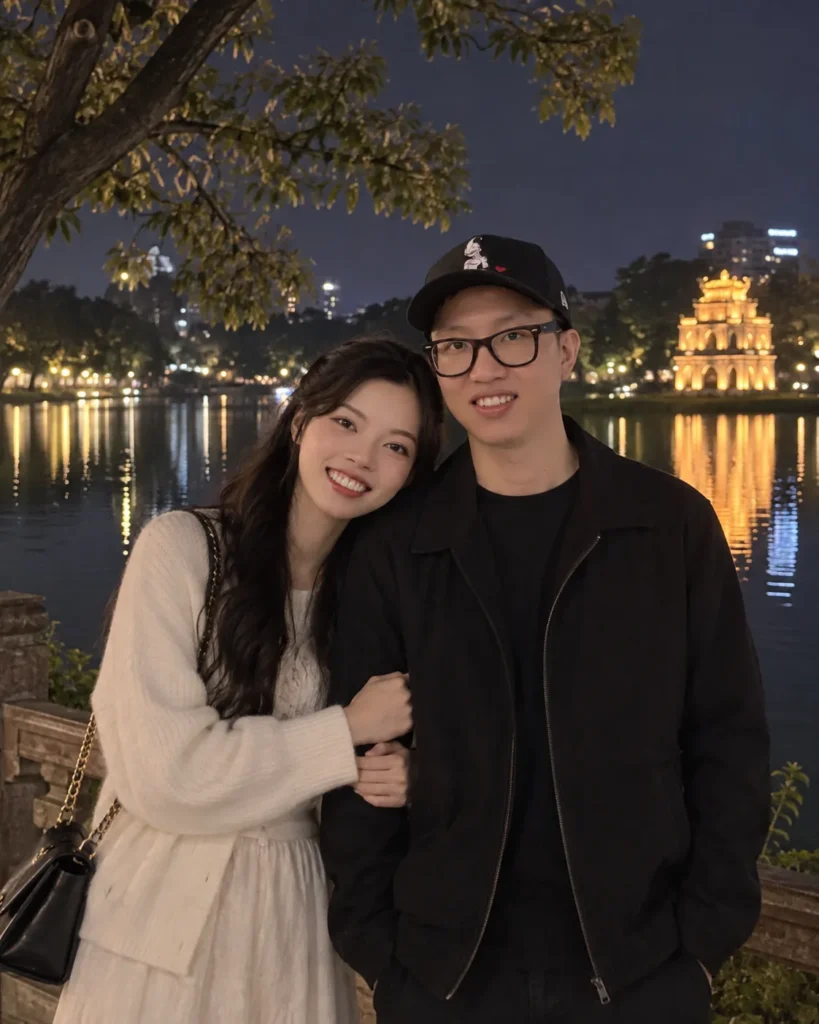
Use it for: a calm, low-key portrait with almost no background clutter. Input: one photo of both people.
Transform the uploaded couple photo into a calm lakeside evening portrait. Preserve both recognizable faces, both hairstyles, both skin tones and their body proportions. Place the couple close together near still water with soft moonlit ambience, a faint warm lantern glow from one side, subtle reflections, deep blue tones and natural expressions. Keep the mood understated rather than fantastical. Change only the location, the lighting and the color grade. Output 4:5. Add no extra people and no text.
Check first: whether the low light flattened or altered either face, since a dark scene gives the model less of each face to work from.
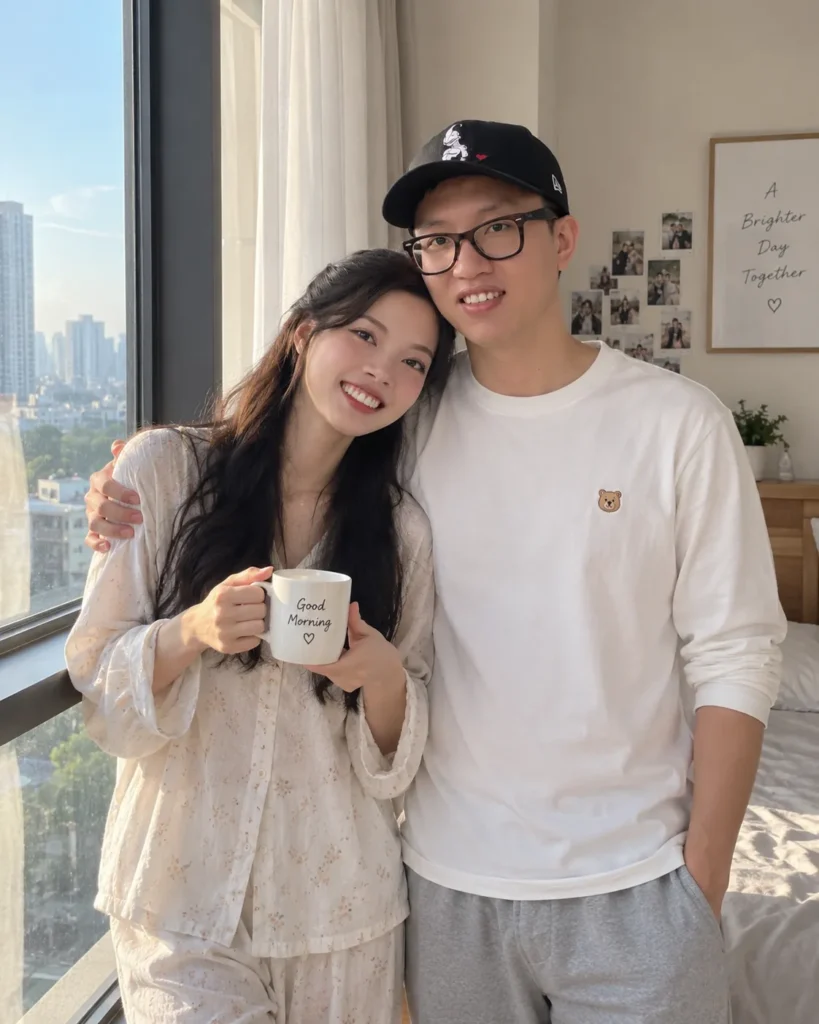
8. Window Light in the Morning
Use it for: a soft, honest-looking image that needs no props. Input: one photo of both people.
Edit the uploaded couple photo into a quiet morning portrait beside a large window. Preserve both recognizable identities, both hairstyles, both skin tones and natural proportions. Show them standing close with relaxed expressions, soft overcast daylight wrapping both faces evenly, sheer curtains, neutral interior colors and a documentary photography feel. Change only the setting, the light and the clothing, which should be simple casual loungewear. Output 4:5. Add no extra people and no readable text.
Check first: skin texture, facial symmetry, and whether one face is blown out by the window while the other is not.
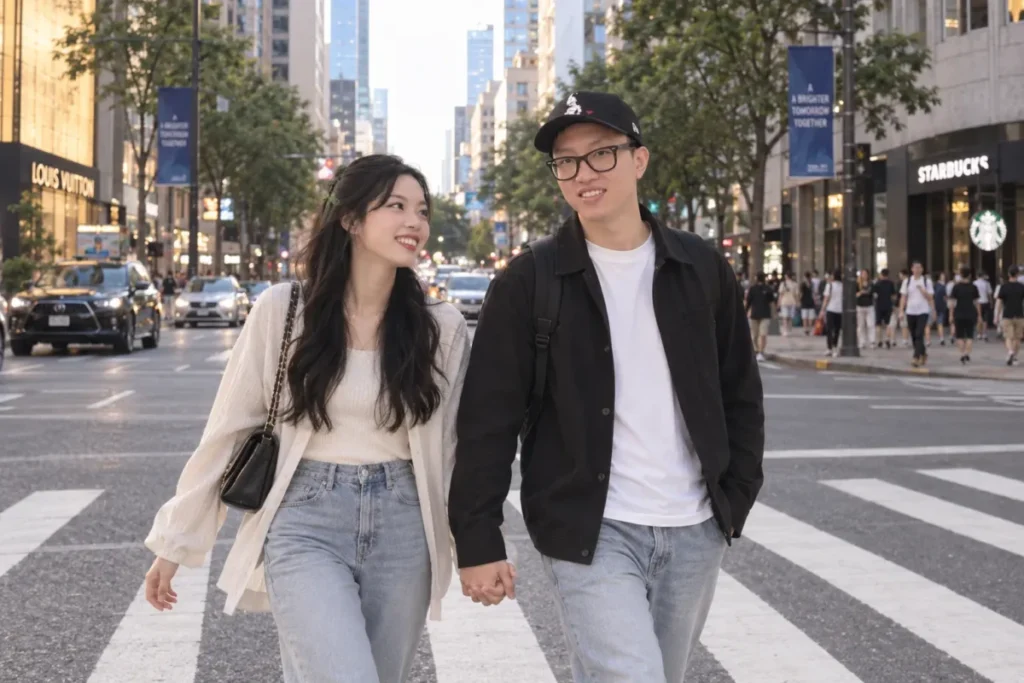
9. Downtown Crosswalk
Use it for: a candid street image with motion in it. Input: one photo of both people.
Use the uploaded couple photo as the reference for both people. Keep their faces recognizable and preserve their natural body proportions. Create a candid image of them crossing a broad downtown street together, mid-step and smiling, in late afternoon light with gentle background motion, crisp faces, realistic street perspective and coordinated casual outfits. Change the environment and the walking pose while keeping both identities stable. Output 3:2. Avoid readable brand names, storefront signs or license plates.
Check first: legs and feet, both faces, and any text that crept into the background.
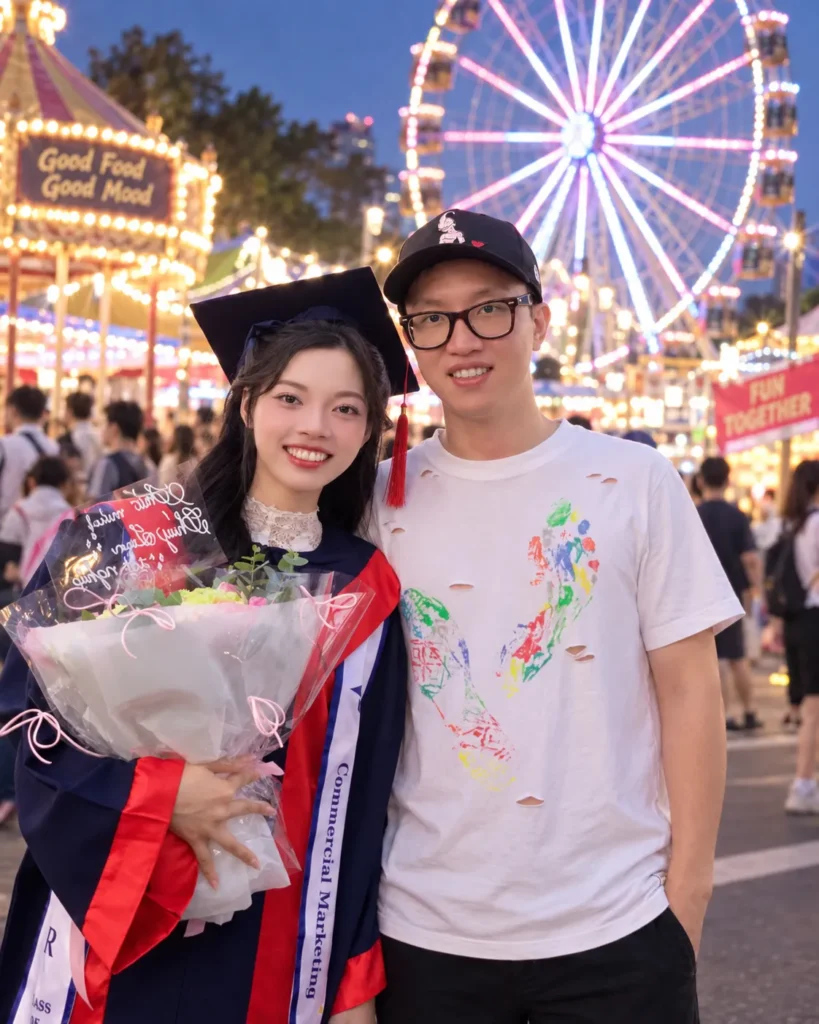
10. Ferris Wheel Evening
Use it for: a warm, high-contrast image with built-in bokeh. Input: one photo of both people.
Restyle the uploaded couple photo as an evening fairground portrait near a softly glowing Ferris wheel. Preserve both recognizable faces, both hairstyles, both skin tones and their proportions. Keep the couple close together in a natural standing pose with warm bulbs behind them, a cool twilight sky, subtle bokeh and candid smiles. Change only the background, the lighting, the clothing colors and minor pose direction. Output 4:5. Do not add extra people in the foreground.
Check first: both faces, and the hair edges where the bulbs sit directly behind them.
Everyday and Candid Prompts (11 to 20)
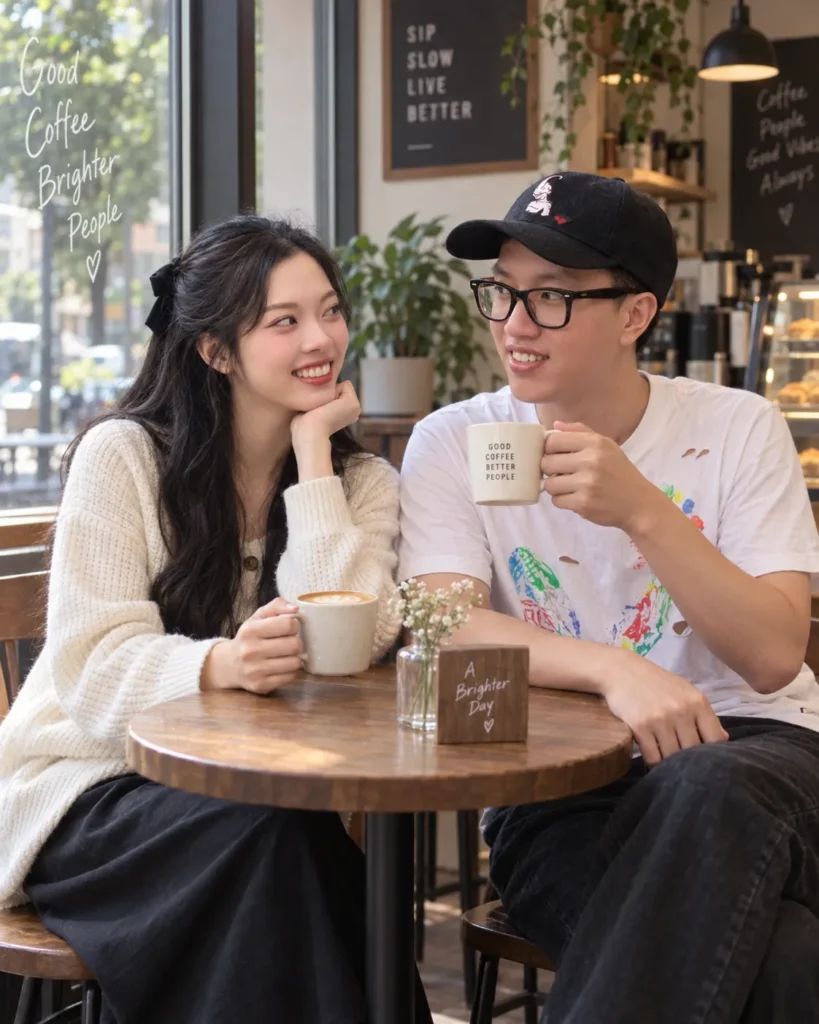
11. Coffee Shop Window Seat
Use it for: a natural image that does not look staged. Input: one photo of both people.
Edit the uploaded couple photo into a candid coffee shop scene. Keep both people recognizable and preserve their natural facial proportions. Seat them near a window with one cup each, talking and smiling naturally, in soft morning daylight with warm wood textures, mild background activity held in soft focus and realistic casual clothing. Change only the setting, the seated pose and the lighting. Output 4:5. Keep any background text unreadable or absent.
Check first: hands around the cups, and both faces in three-quarter view.
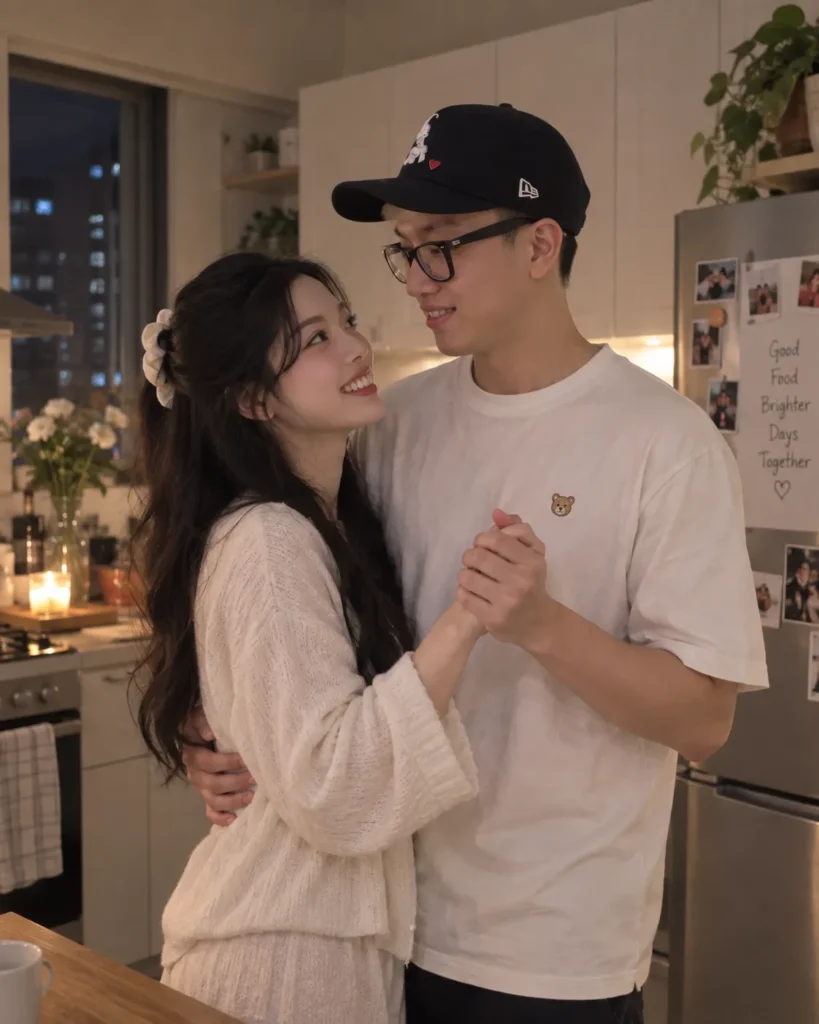
12. Kitchen Slow Dance
Use it for: a warm at-home image with real body language. Input: one photo of both people.
Use the uploaded couple photo as the identity reference. Preserve both recognizable faces, both hairstyles, both skin tones and their body proportions. Recompose the couple slow dancing in a modest home kitchen at night, with warm pendant lights, relaxed smiles, natural hand placement, subtle movement in the clothing and a documentary snapshot feel. Change only the pose, the setting and the lighting. Output 4:5. Do not add other people.
Check first: the interlocked hands, both arms, and whether the closer pose blended the two faces.
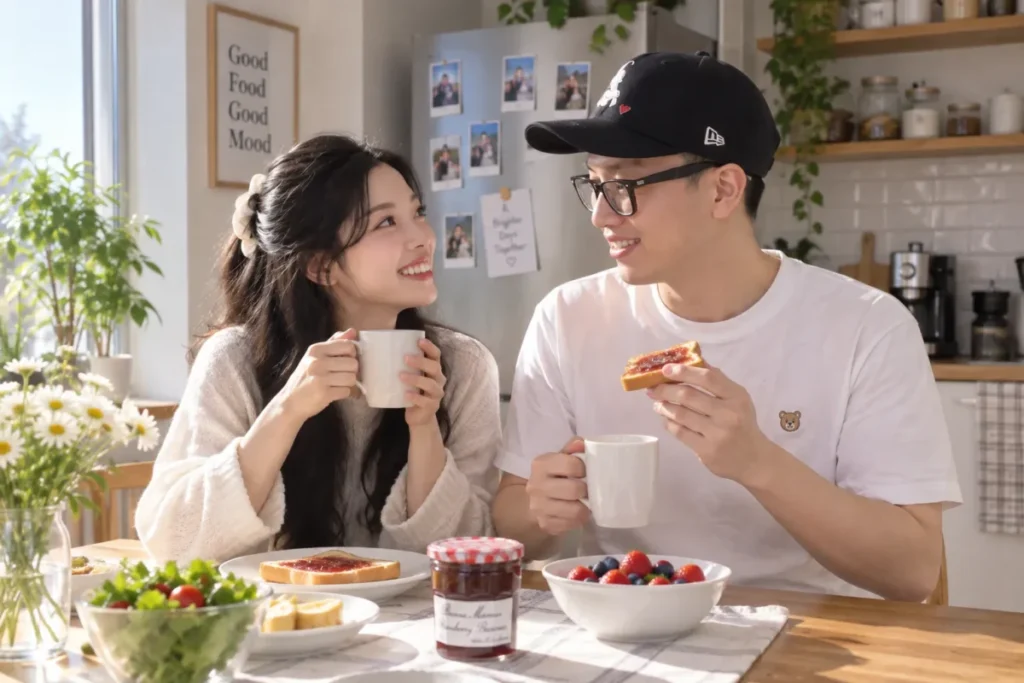
13. Sunday Breakfast
Use it for: a bright, low-drama lifestyle image. Input: one photo of both people.
Transform the uploaded couple photo into a bright Sunday breakfast scene at a small kitchen table. Keep both people recognizable and preserve their apparent ages and proportions. Show them sharing coffee and toast with relaxed expressions, soft morning window light, simple neutral decor and realistic everyday clothing. Change only the setting, the seated pose and the lighting, and keep a natural lifestyle photograph look. Output 3:2. Render no readable text.
Check first: fingers, cup handles and both faces.
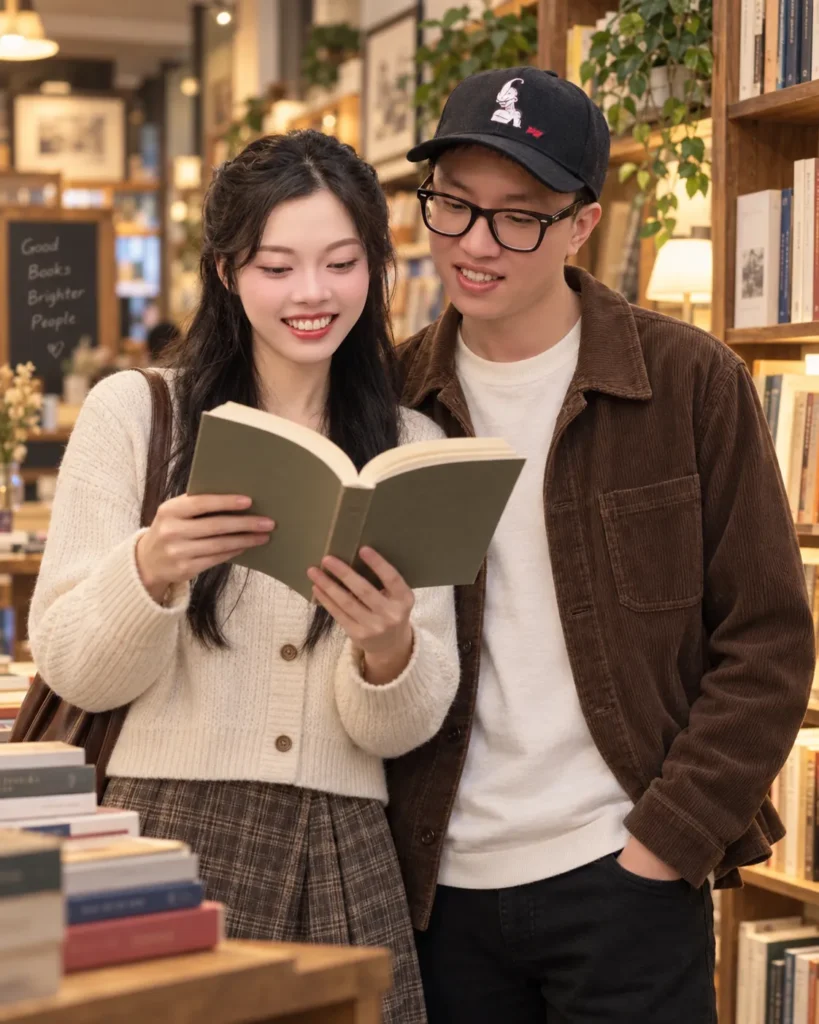
14. Bookstore Browse
Use it for: a quiet image with a strong sense of place. Input: one photo of both people.
Edit the uploaded couple photo into a candid independent bookstore scene. Preserve both recognizable faces, both hairstyles, both skin tones and natural proportions. Place one person holding an open book while the other looks over with a small smile, surrounded by softly blurred wooden shelves and warm window light. Change only the setting, the pose and the clothing, which should read as smart casual. Output 4:5. Keep book covers and shelf signs free of invented readable text.
Check first: the hands on the book, and any lettering the model tried to render on the spines.
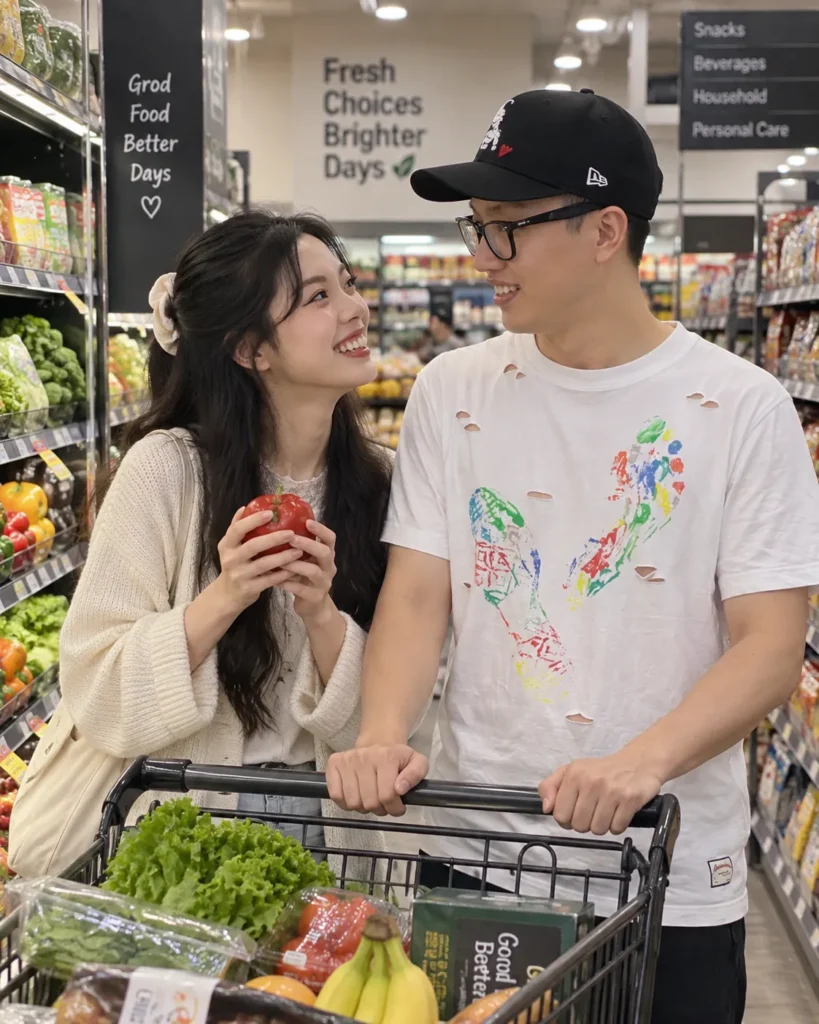
15. Grocery Aisle Laugh
Use it for: an unglamorous, believable everyday image. Input: one photo of both people.
Use the uploaded couple photo as the reference and keep both identities recognizable. Create a casual grocery store moment where the couple stands beside a cart laughing at each other, with soft overhead lighting, realistic shelves behind them, candid body language and everyday clothing. Change only the environment and the pose. Output 4:5. Do not render legible product labels and do not add other shoppers in the foreground.
Check first: cart geometry, both sets of hands, both faces, and packaging text.
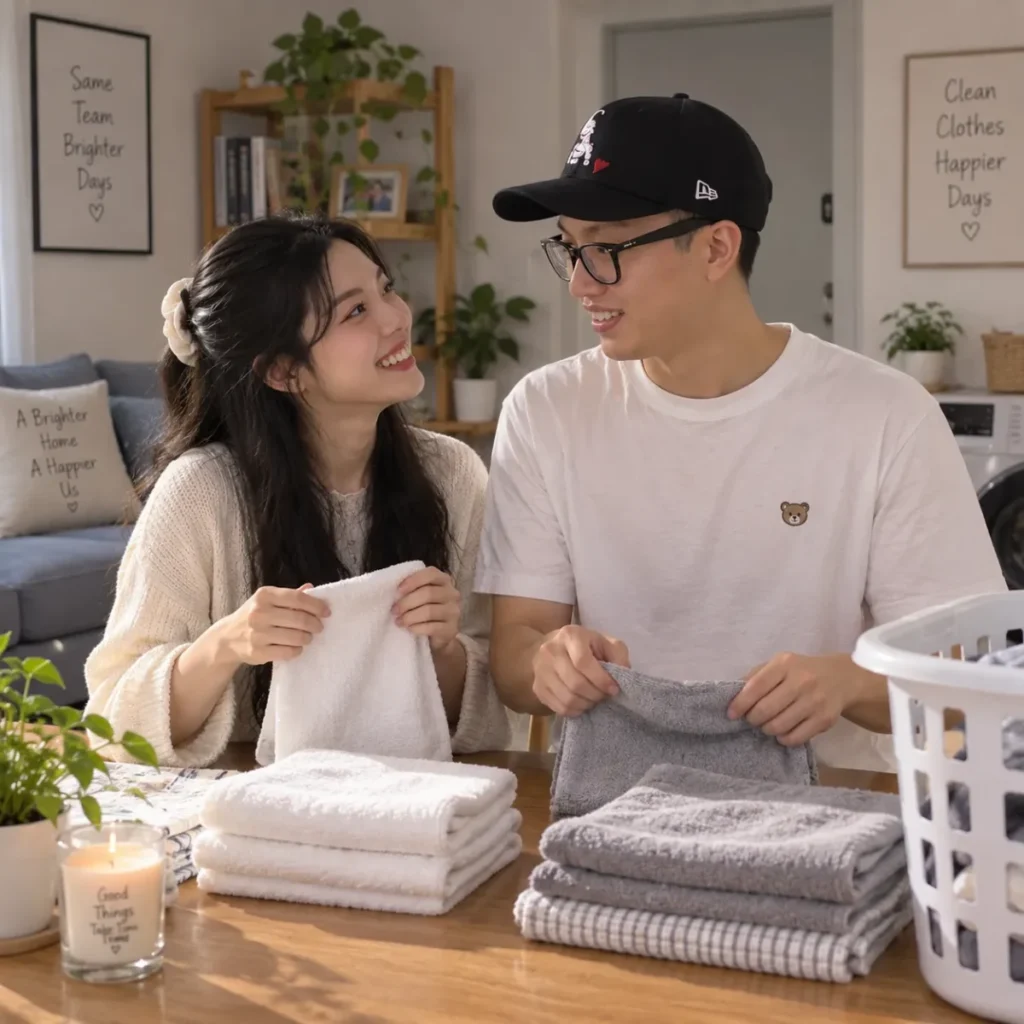
16. Laundry Day Snapshot
Use it for: a playful image that needs no location. Input: one photo of both people.
Restyle the uploaded couple photo as a playful home laundry day snapshot. Preserve both recognizable faces, both hairstyles, both skin tones and their proportions. Show them folding clean towels together at a table, with bright diffuse daylight, neutral home colors, slight candid movement and relaxed smiles. Change only the setting, the pose and the casual clothing, and keep the result photorealistic and uncluttered. Output 1:1. Add no extra people and no text.
Check first: fingers, fabric edges and both faces.
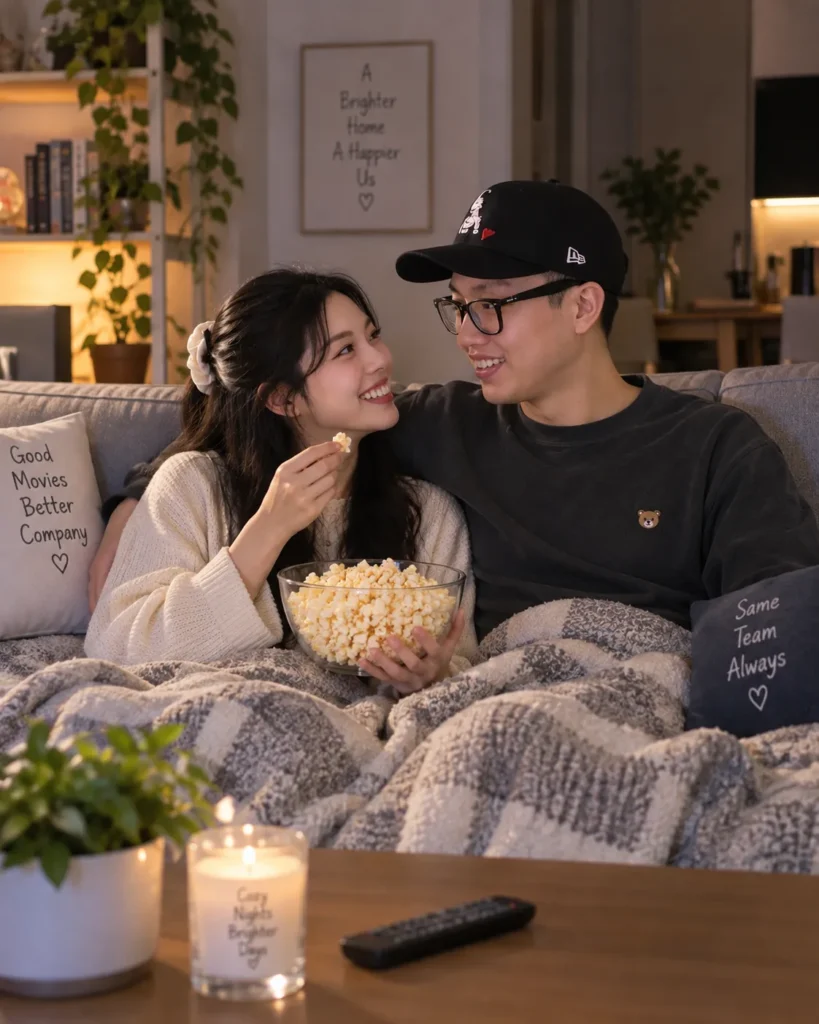
17. Sofa Movie Night
Use it for: a cozy image where both faces stay close to camera. Input: one photo of both people.
Edit the uploaded couple photo into a cozy movie night portrait on a sofa. Keep both people recognizable and preserve their natural proportions. Seat them close together under a simple blanket with one person holding a bowl of popcorn, warm lamp light, a subtle screen glow, relaxed expressions and realistic home textures. Change only the setting, the seated pose and the lighting. Output 4:5. Do not render readable text on any screen.
Check first: hands, the bowl, the blanket overlap where the two bodies meet, and both faces.
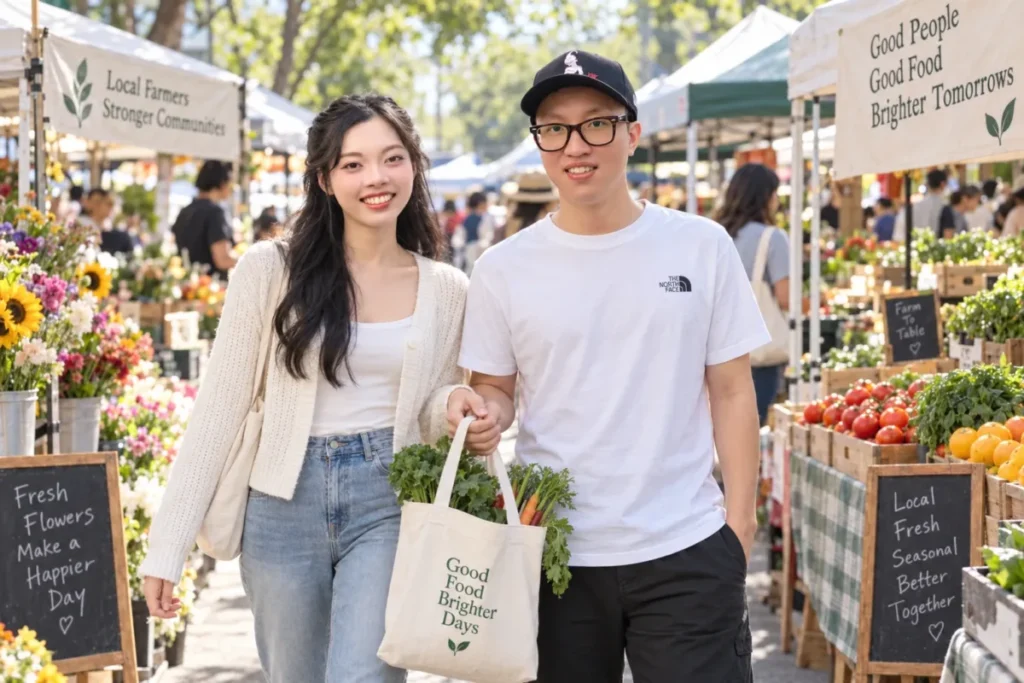
18. Farmers Market Morning
Use it for: a colorful outdoor image with soft light. Input: one photo of both people.
Use the uploaded couple photo as the identity reference. Preserve both recognizable faces and natural proportions. Place the couple walking through an outdoor farmers market in soft morning light, carrying one small reusable bag between them, with colorful produce and flowers blurred behind them, candid smiles and casual weekend clothing. Change only the environment, the walking pose and the lighting. Output 3:2. Keep all stall signs unreadable.
Check first: fingers, the bag handles, both faces, and background signage.
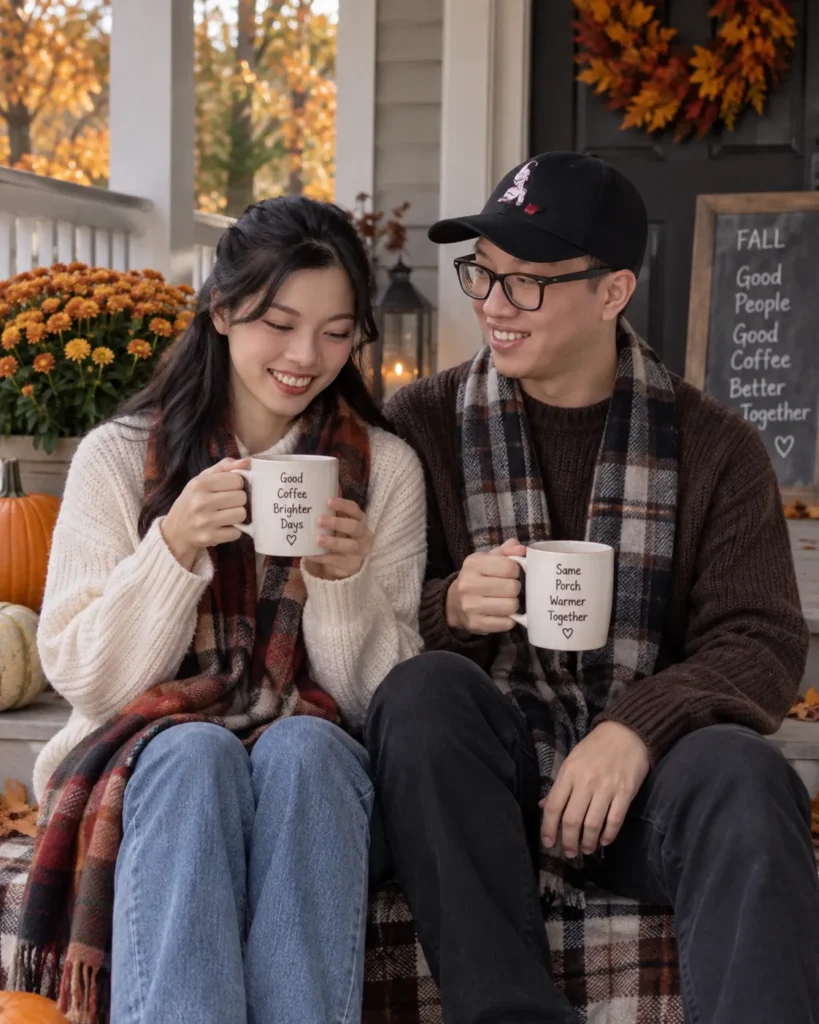
19. Porch Coffee in Fall
Use it for: a seasonal image with a restrained palette. Input: one photo of both people.
Transform the uploaded couple photo into a quiet autumn porch scene. Preserve both recognizable faces, both hairstyles, both skin tones and their body proportions. Seat them side by side with warm mugs, muted orange leaves behind them, soft overcast light, knit layers and natural relaxed expressions. Change only the setting, the clothing and the light. Output 4:5. Keep the image understated and realistic, and render no readable text.
Check first: mug handles, hands, and whether the wardrobe change altered either jawline or hairline.
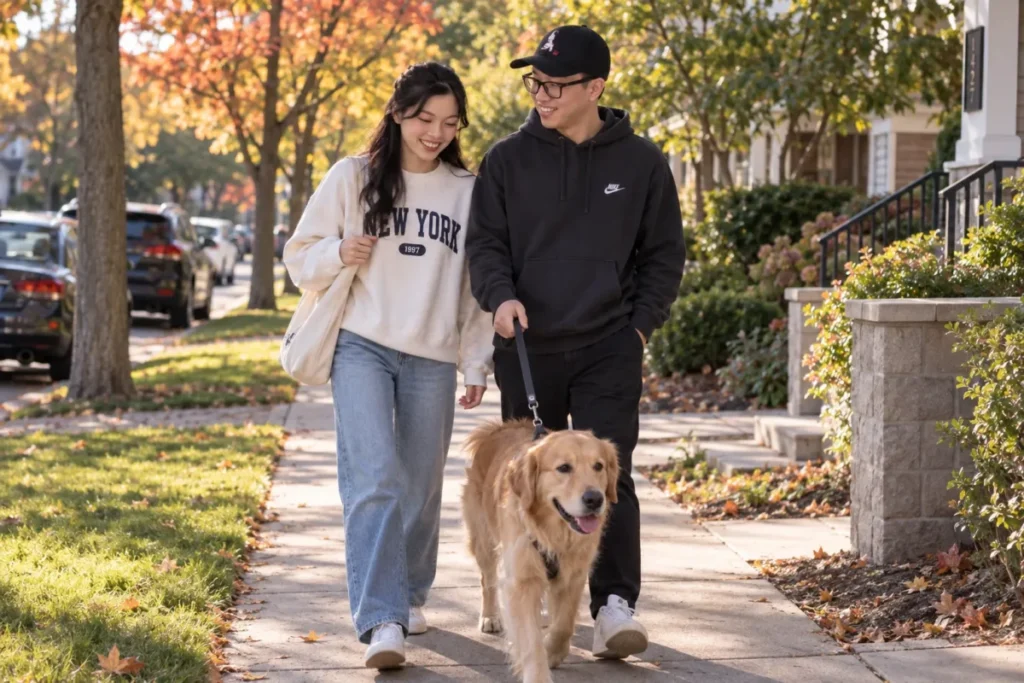
20. Neighborhood Dog Walk
Use it for: an image that adds a pet without a photo of one. Input: one photo of both people.
Edit the uploaded couple photo into a neighborhood dog walk scene. Preserve both recognizable faces and natural proportions. Show the couple walking side by side in early evening light with one calm medium-sized dog on a leash, relaxed smiles, realistic sidewalk perspective and casual clothing. Change only the environment and the walking pose, and add the dog. Output 3:2. Keep the leash and both hands anatomically coherent, and render no readable signage.
Check first: leash continuity from hand to collar, the dog’s anatomy, and both faces.
Retro and Editorial Prompts (21 to 30)
A style instruction is the kind that reaches the whole frame, so every prompt in this group carries its preserve clause alongside the look rather than leaving it implied. For a pair of readers who want one decade rather than a general retro look, the 1985 flashback couple prompts set the same clause against a fixed year.
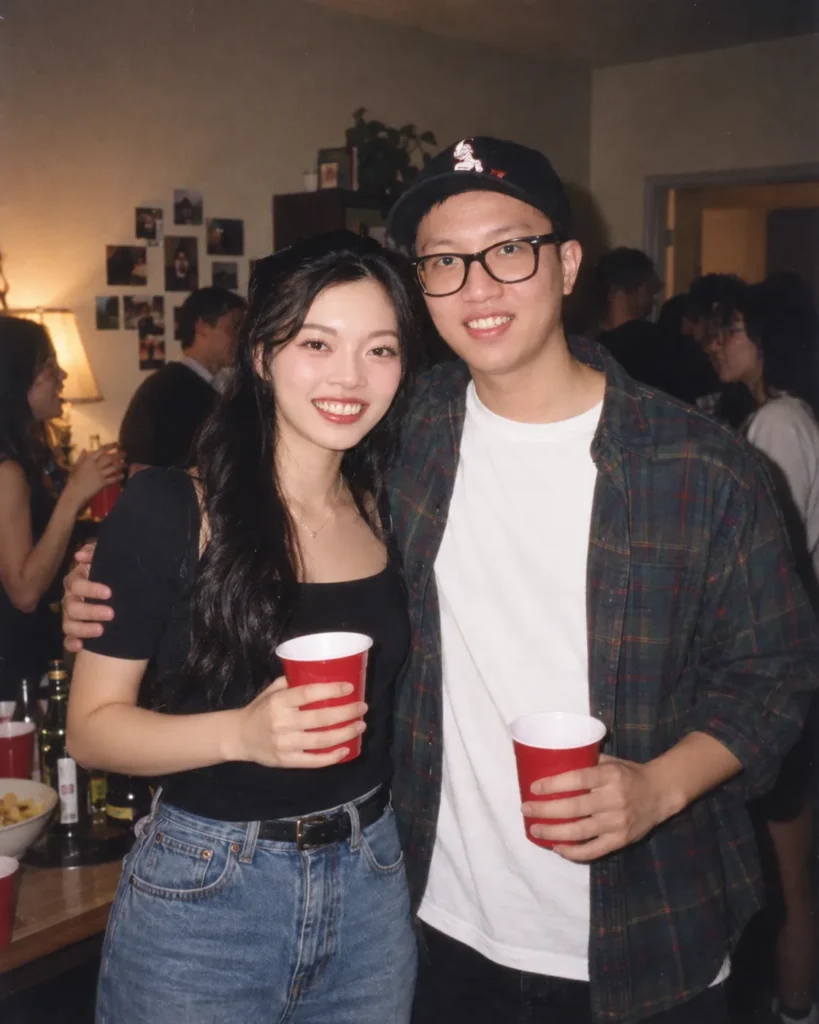
21. Nineties Direct Flash Snapshot
Use it for: a deliberately imperfect image that reads as a real old photo. Input: one photo of both people.
Restyle the uploaded couple photo as a 1990s direct flash snapshot. Preserve both recognizable faces, both hairstyles, both skin tones and their basic pose. Add a modest indoor party background, hard on-camera flash, gentle grain, a slightly warm color cast, natural imperfections and simple period-neutral clothing without logos. Change only the visual treatment, the background and the wardrobe. Output 4:5. Do not add date stamps or any text overlay.
Check first: whether the retro treatment changed either person’s apparent age or facial structure.
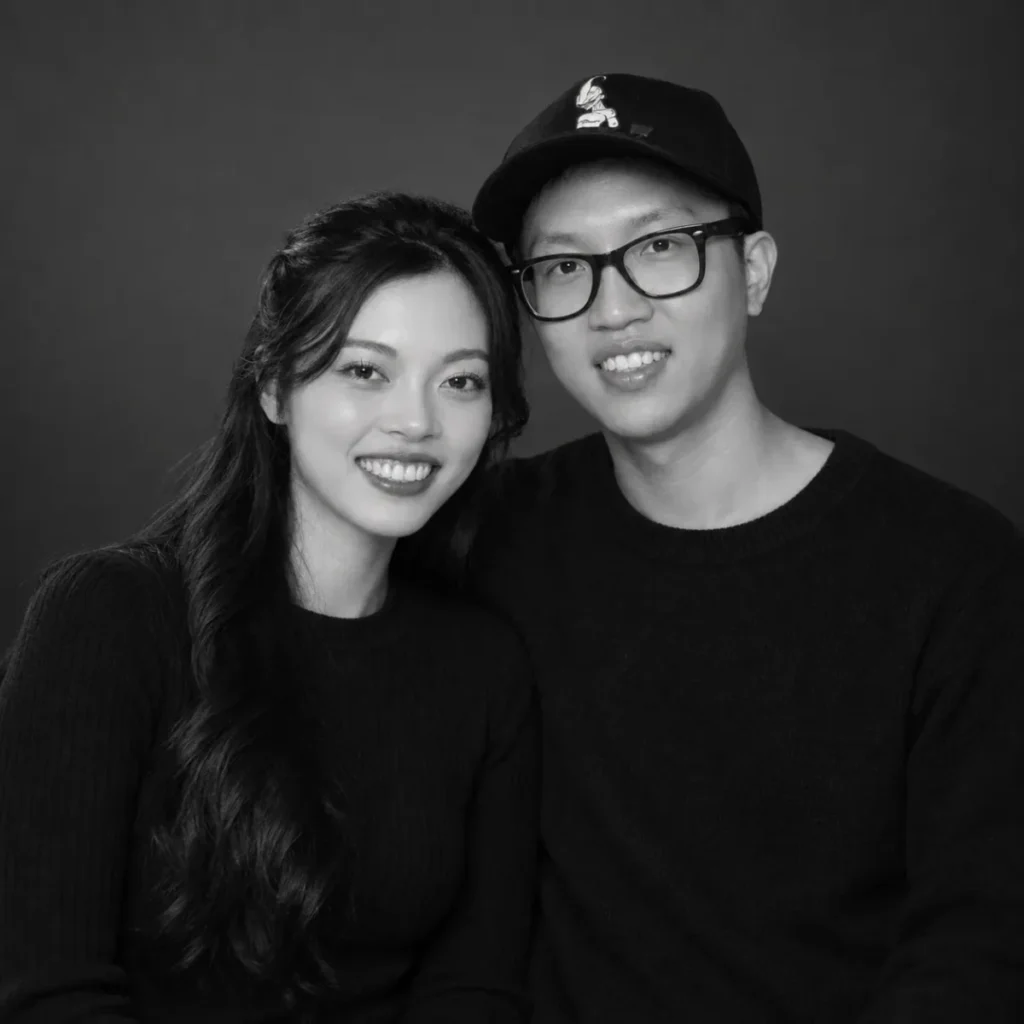
22. Black and White Studio
Use it for: a formal portrait that survives heavy cropping. Input: one photo of both people.
Use the uploaded couple photo as the identity reference. Keep both people recognizable and preserve their natural proportions. Create a classic black and white studio portrait against a dark gray studio sweep, with one soft directional key light, detailed shadow retention, subtle film grain and calm expressions. Recompose to a waist-up pose with shoulders touching. Change only the pose, the background, the monochrome treatment and the clothing, which should be simple and dark. Output 1:1. Add no props and no text.
Check first: both sets of eyes, both jawlines, and whether shadow detail survived on the darker skin tone.
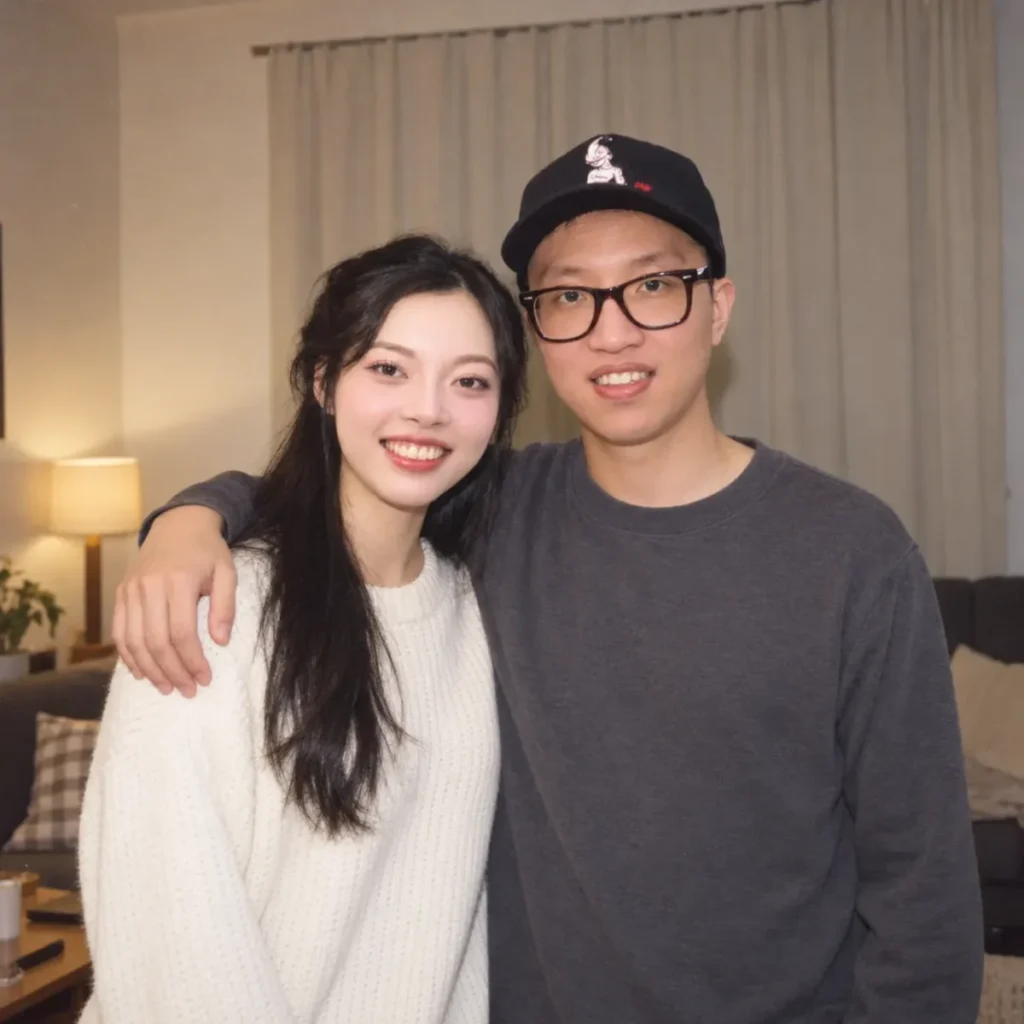
23. Instant Film Living Room
Use it for: a casual keepsake look, the one most people call a Polaroid. Input: one photo of both people.
Edit the uploaded couple photo into a casual instant film style living room snapshot. Preserve both recognizable faces, both hairstyles, both skin tones and their proportions. Keep the couple standing close with one arm around the other, use soft direct flash, slight softness toward the edges of the frame, warm faded colors, plain curtains and simple home decor. Change only the setting, the lighting and the treatment. Output 1:1 with no border text.
Check first: both faces under flash, and the arm overlap where the two bodies meet.
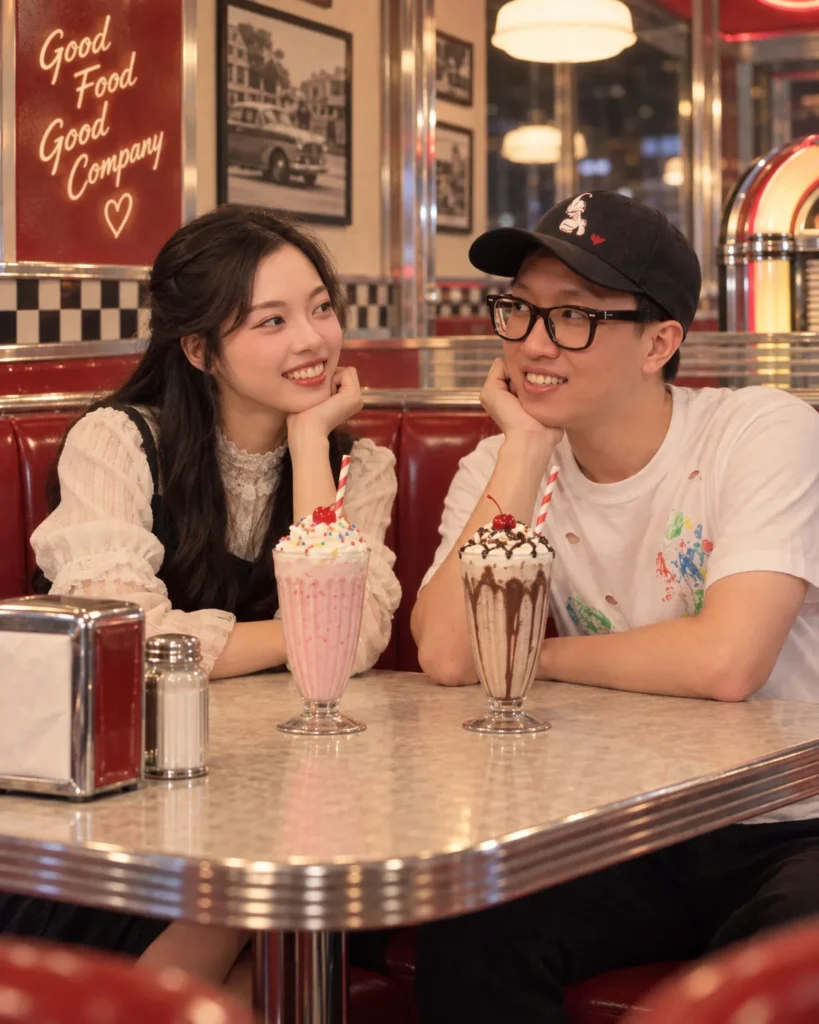
24. Vintage Diner Booth
Use it for: a themed image with strong props and color. Input: one photo of both people.
Transform the uploaded couple photo into a mid-century diner booth portrait while keeping both people recognizable. Seat them opposite each other with milkshake glasses between them, soft window light, restrained red and cream decor, realistic chrome reflections and subtle film grain. Change the setting, the seated pose, the color treatment and the wardrobe, which should read as simple vintage-inspired clothing. Output 4:5. Avoid readable menu or signage text.
Check first: hands, glassware, the chrome reflections, and both faces.
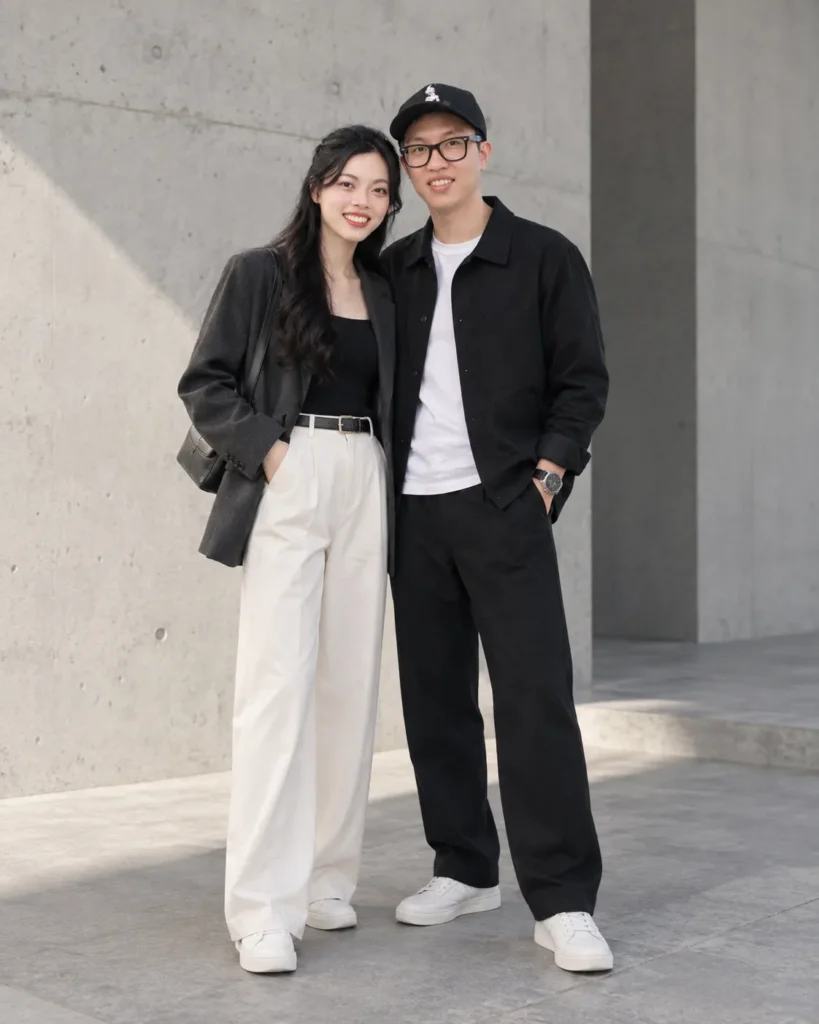
25. Minimal Fashion Editorial
Use it for: a full-length image where clothing is the point. Input: one photo of both people.
Use the uploaded couple photo as the reference for both people. Preserve both recognizable faces, both natural skin tones, both hairstyles and their body proportions. Recompose into a full-length editorial frame against clean concrete architecture, with believable directional daylight, coordinated black and cream outfits, confident relaxed posture and crisp composition. Change only the clothing, the pose, the environment and the lighting. Output 4:5. Add no logos and no text.
Check first: full-body proportions, fingers, and whether the wardrobe change pulled either face off its reference.
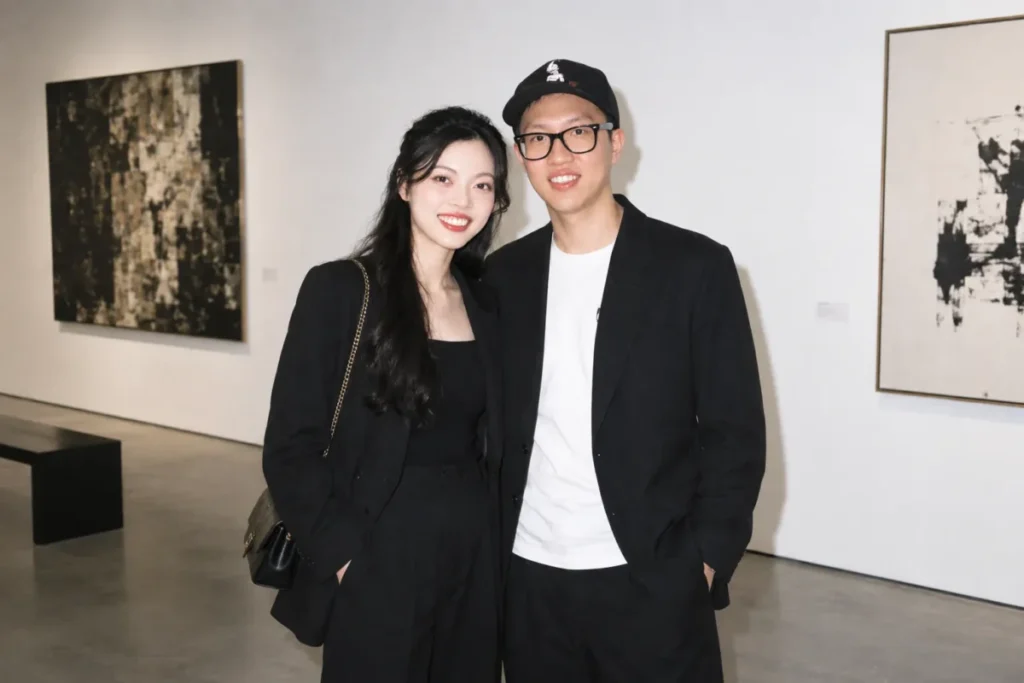
26. Hard Flash Gallery Portrait
Use it for: a contemporary look with clean separation between the two people. Input: one photo of both people.
Edit the uploaded couple photo into a modern art gallery portrait. Keep both people recognizable, with one of them slightly left of center and the other slightly right. Use white gallery walls, hard direct flash, deep clean shadows, minimal monochrome clothing and a contemporary editorial feel. Change only the setting, the wardrobe, the pose and the lighting. Output 3:2. Keep any artwork abstract with no readable text.
Check first: face consistency under hard flash, and the shadow edges where the two figures overlap.
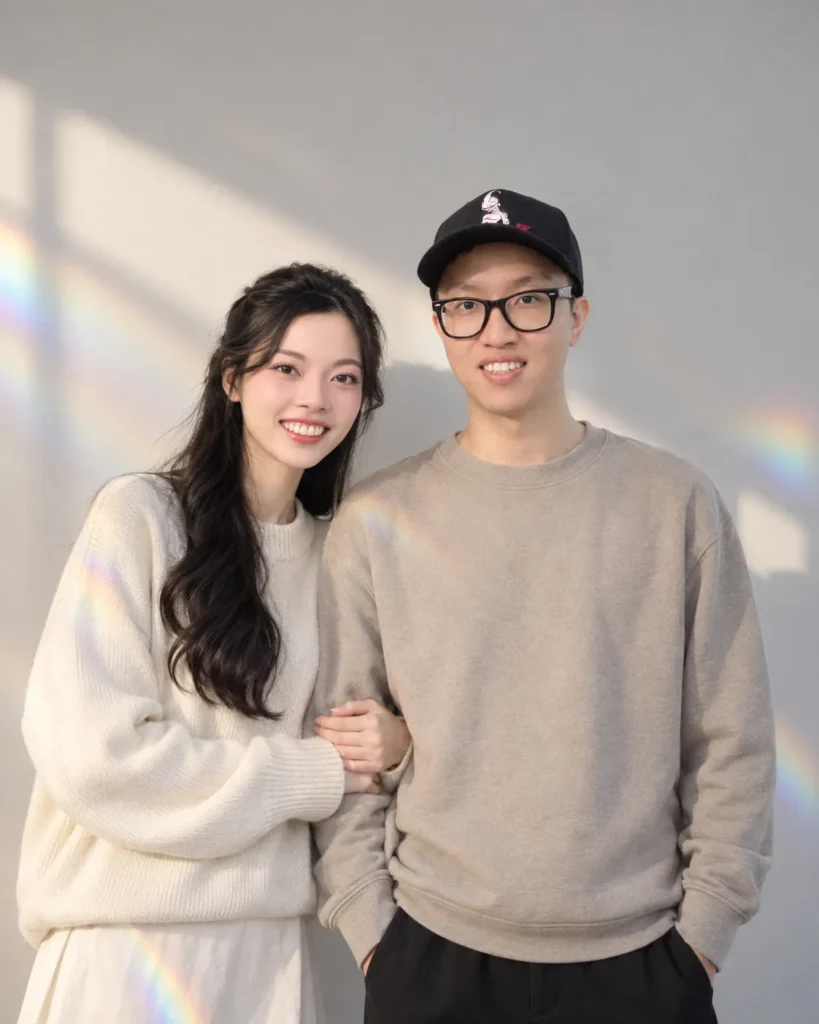
27. Soft Prism Light Portrait
Use it for: a stylized image that still keeps faces clean. Input: one photo of both people.
Restyle the uploaded couple photo as a soft editorial portrait with subtle prism light. Preserve both recognizable faces, both hairstyles, both skin tones and their proportions. Keep the couple in a simple waist-up pose against a neutral studio wall, with one narrow rainbow reflection crossing the background rather than either face, soft key light, natural skin texture and understated neutral outfits. Change only the lighting, the background and the wardrobe. Output 4:5. Add no text.
Check first: that the prism effect stayed off both faces, which is the whole risk in this one.
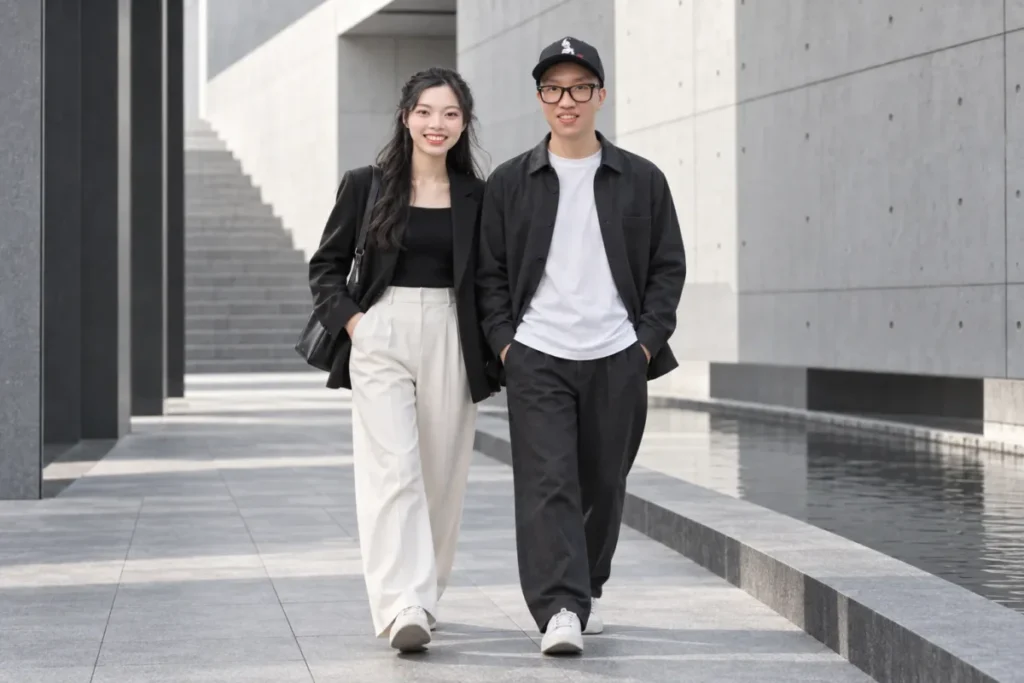
28. Monochrome Architectural Walk
Use it for: a graphic image with strong lines. Input: one photo of both people.
Use the uploaded couple photo as the identity reference and keep both people recognizable. Create a black and white street editorial of them walking beside modern geometric architecture, with clear leading lines, soft overcast light, realistic movement, clean tonal separation and minimalist clothing. Change only the environment, the walking pose, the wardrobe and the monochrome treatment. Output 3:2. Avoid signs and logos.
Check first: legs, hands, and both faces at walking scale, where there is least of each face for the model to work with.
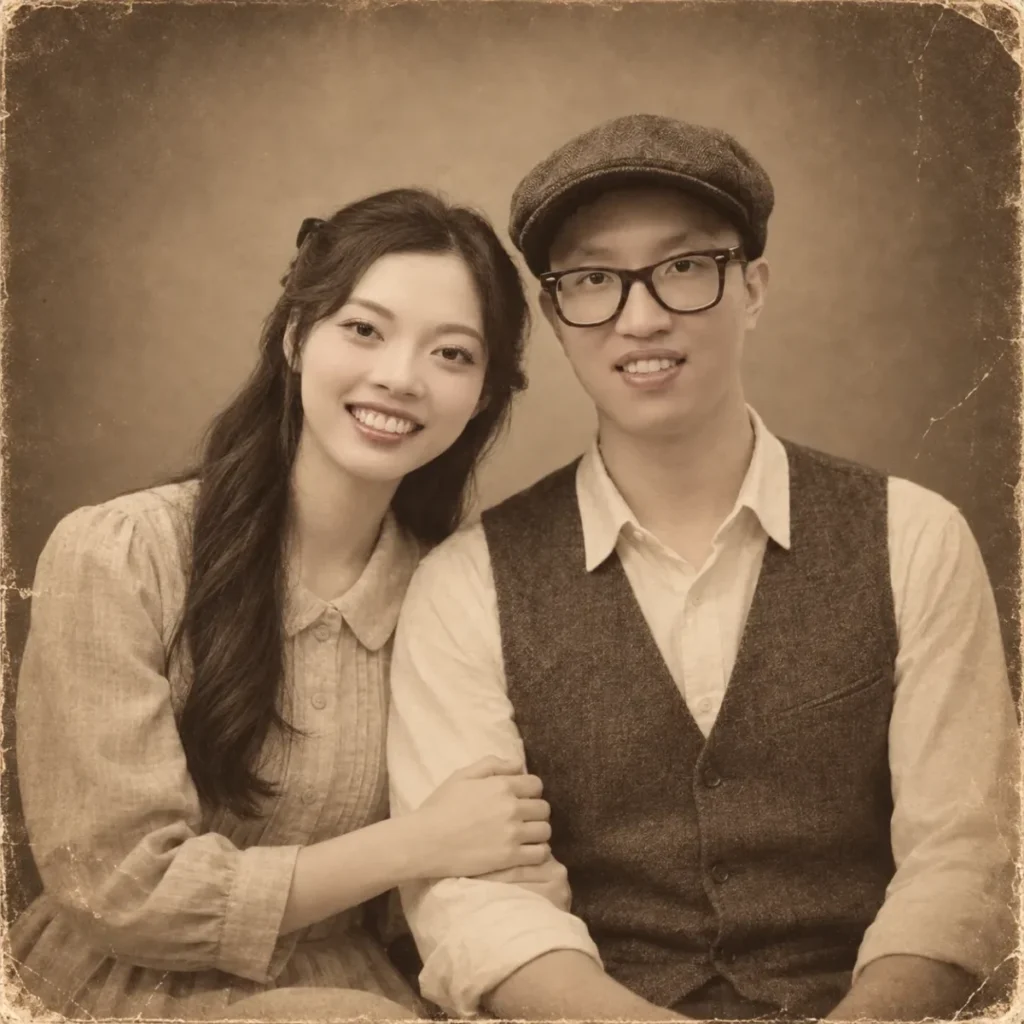
29. Old Album Sepia Portrait
Use it for: a heritage-style image for a family print. Input: one photo of both people.
Edit the uploaded couple photo into an old album sepia portrait. Preserve both recognizable faces, both apparent ages, both hairstyles and their proportions. Use a simple studio composition, soft frontal light, gentle paper texture, restrained fading toward the edges and period-neutral clothing. Change only the color treatment, the background and the wardrobe. Output 1:1. Do not add invented dates, signatures or handwriting.
Check first: facial detail under the texture layer, and whether the paper grain washed out either set of eyes.
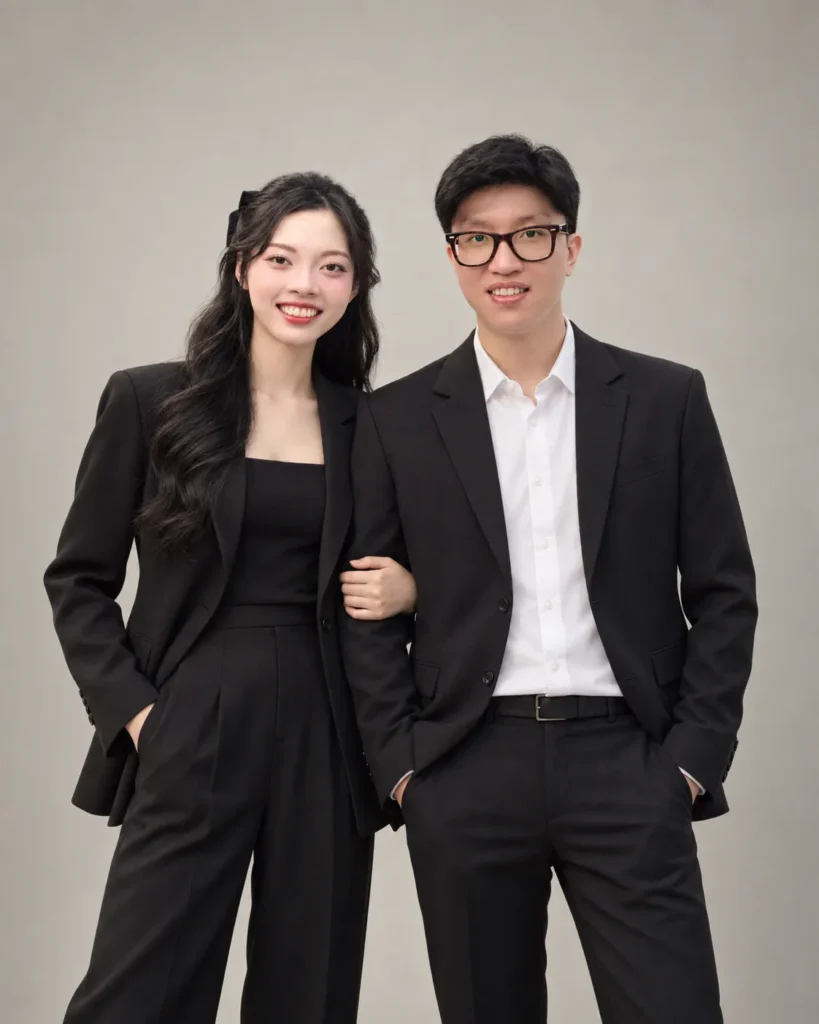
30. Magazine Cover Without Typography
Use it for: a polished hero image you will add your own text to later. Input: one photo of both people.
Transform the uploaded couple photo into a clean high-fashion cover-style portrait with no typography. Keep both people recognizable and preserve both skin tones and their proportions. Use a minimalist studio, sculptural soft lighting, coordinated tailored outfits, confident but natural posture and crisp editorial framing with clear space above their heads. Change only the wardrobe, the pose, the setting and the lighting. Output 4:5. Add no masthead, logo, caption or other text.
Check first: hands, shoulder proportions, both faces, and the amount of clear space left for your own headline.
Celebration and Milestone Prompts (31 to 40)
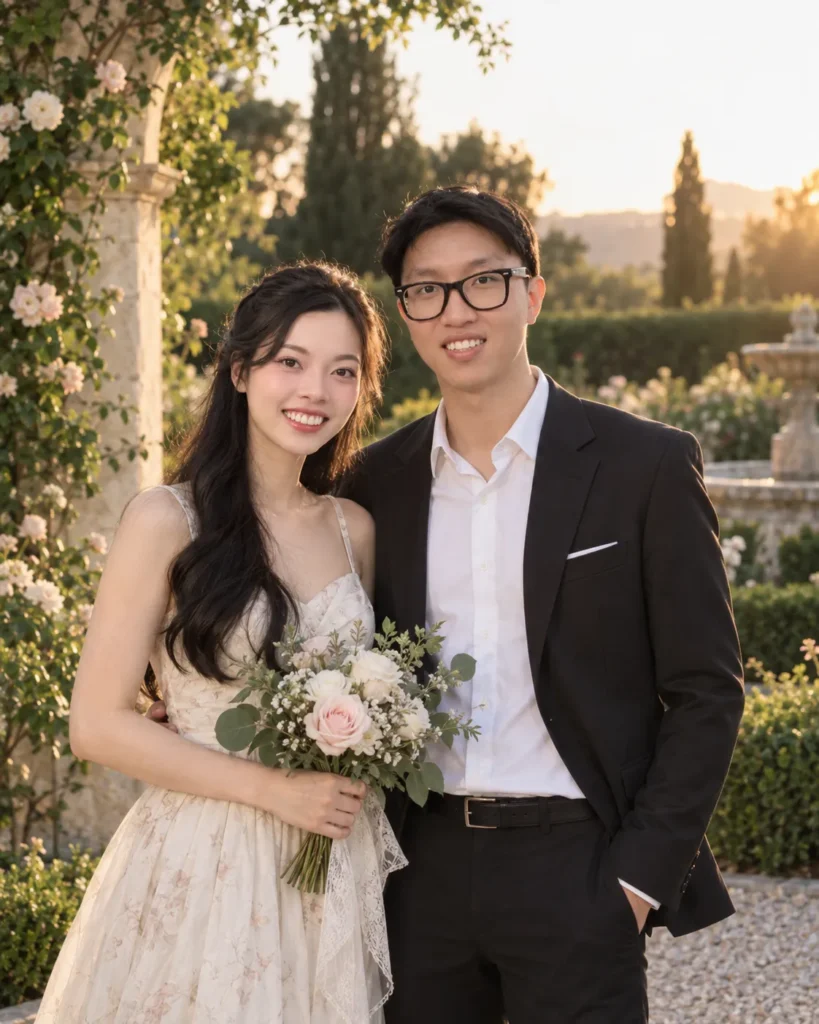
31. Anniversary Garden Portrait
Use it for: an anniversary image that does not shout the number. Input: one photo of both people.
Use the uploaded couple photo as the identity reference. Preserve both recognizable faces, both hairstyles, both skin tones and their natural proportions. Create an elegant anniversary portrait in a garden in late afternoon light, with soft flowers behind them, warm side light, a relaxed close pose and understated formal clothing. Change only the setting, the wardrobe, the lighting and small pose direction. Output 4:5. Do not add anniversary numbers or any text.
Check first: both faces, and whether foreground flowers cut across a hand or an arm unnaturally.
32. Engagement Save-the-Date Frame
Use it for: a layout-ready image with room for text you add yourself. Input: one photo of both people.
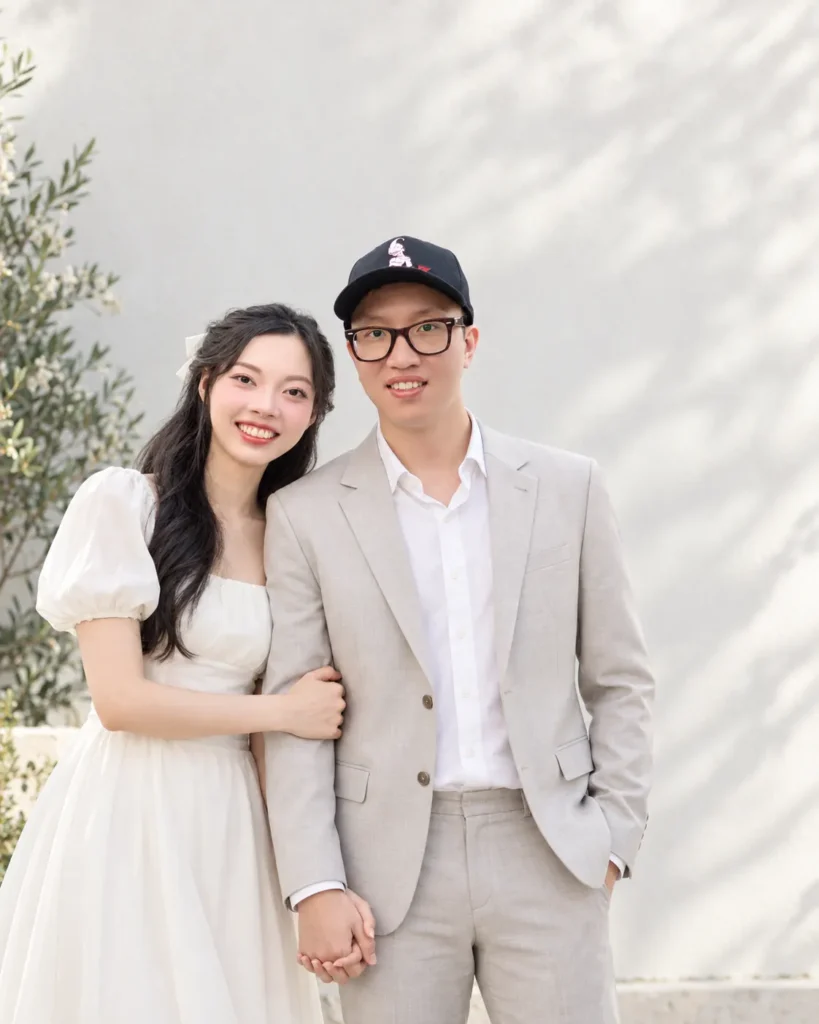
Edit the uploaded couple photo into a clean engagement-style portrait suitable for a save-the-date layout, but render no text of any kind. Keep both people recognizable and preserve their natural proportions. Place them against a bright neutral outdoor wall in soft evening light, in coordinated semi-formal clothing, with relaxed hand holding and generous empty space above them and to one side. Change only the setting, the wardrobe, the pose and the framing. Output 4:5.
Check first: hands, both faces, and whether the empty space is actually large enough for your own type.
33. Courthouse Steps
Use it for: a small-wedding image without a venue. Input: one photo of both people.
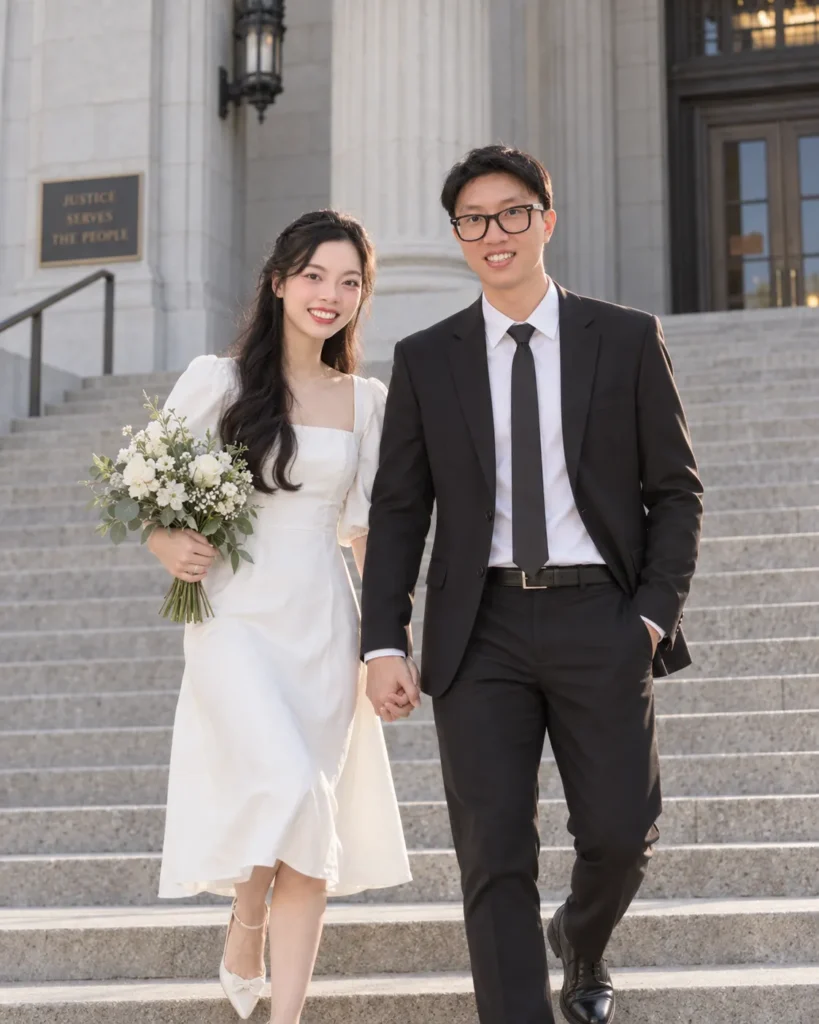
Transform the uploaded couple photo into a refined courthouse steps portrait. Preserve both recognizable faces, both hairstyles, both skin tones and their proportions. Dress both in simple modern formalwear, place them on broad stone steps in soft morning light, and use a candid walking pose with subtle smiles. Change only the wardrobe, the environment, the pose and the lighting. Output 4:5. Avoid readable building names, seals or plaques.
Check first: legs and steps geometry, hands, both faces, and any lettering on the building.
34. Holiday Lights Card
Use it for: a winter card image with warm bokeh. Input: one photo of both people.
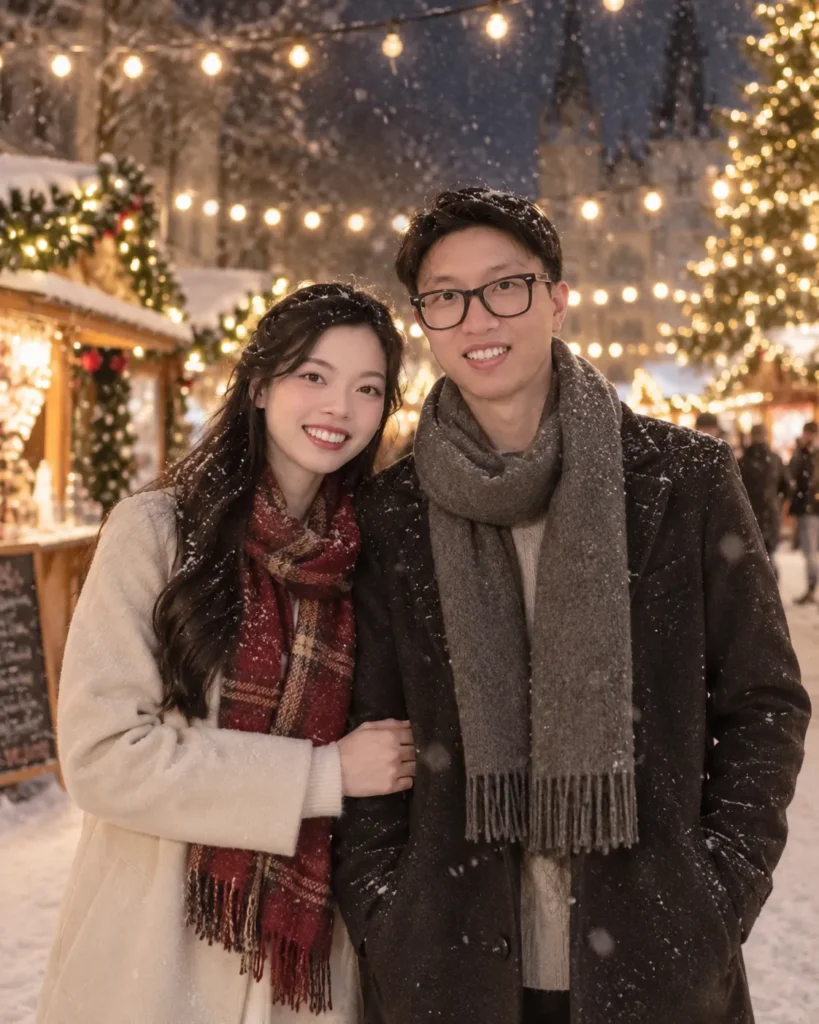
Use the uploaded couple photo as the reference. Keep both people recognizable and preserve their natural proportions. Create a cozy winter holiday portrait outdoors beneath warm string lights, in neutral coats and scarves, with gentle evening bokeh, light falling snow and relaxed smiles. Change only the wardrobe, the setting, the lighting and the weather. Output 4:5. Do not add greeting text, dates or logos.
Check first: scarves near both jawlines, both sets of hands, and snow artifacts sitting on top of facial detail.
35. New Year Rooftop
Use it for: a celebratory image that stays tasteful. Input: one photo of both people.
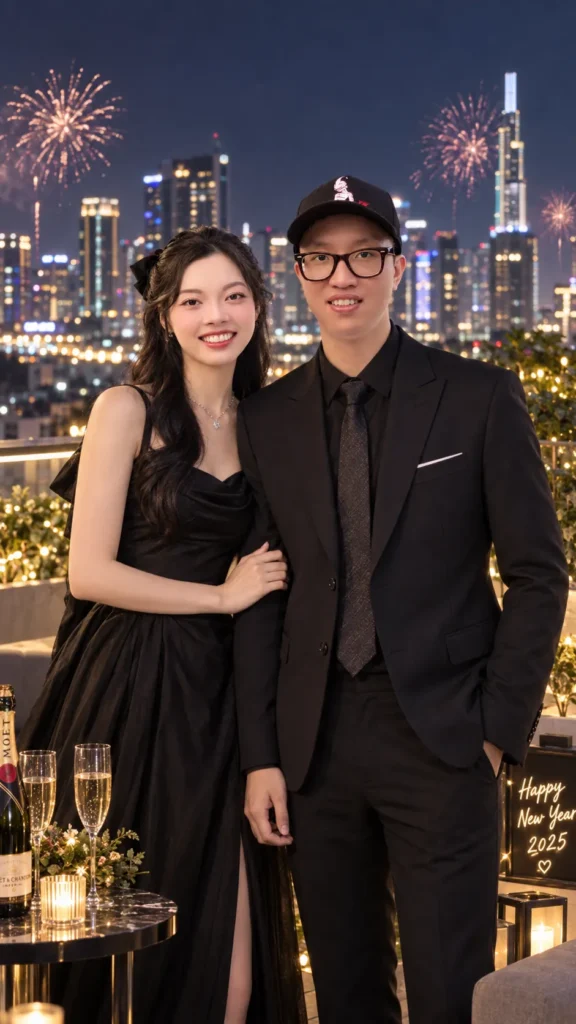
Edit the uploaded couple photo into an understated New Year rooftop portrait. Preserve both recognizable faces, both hairstyles, both skin tones and their body proportions. Show the couple standing together with city lights behind them and subtle distant fireworks, elegant dark clothing, warm rim light and candid celebratory expressions. Change only the setting, the wardrobe, the lighting and the background effects. Output 9:16 for a vertical story frame. Add no year numbers and no readable signs.
Check first: how the rim light shaped both faces, and whether firework artifacts landed on either person.
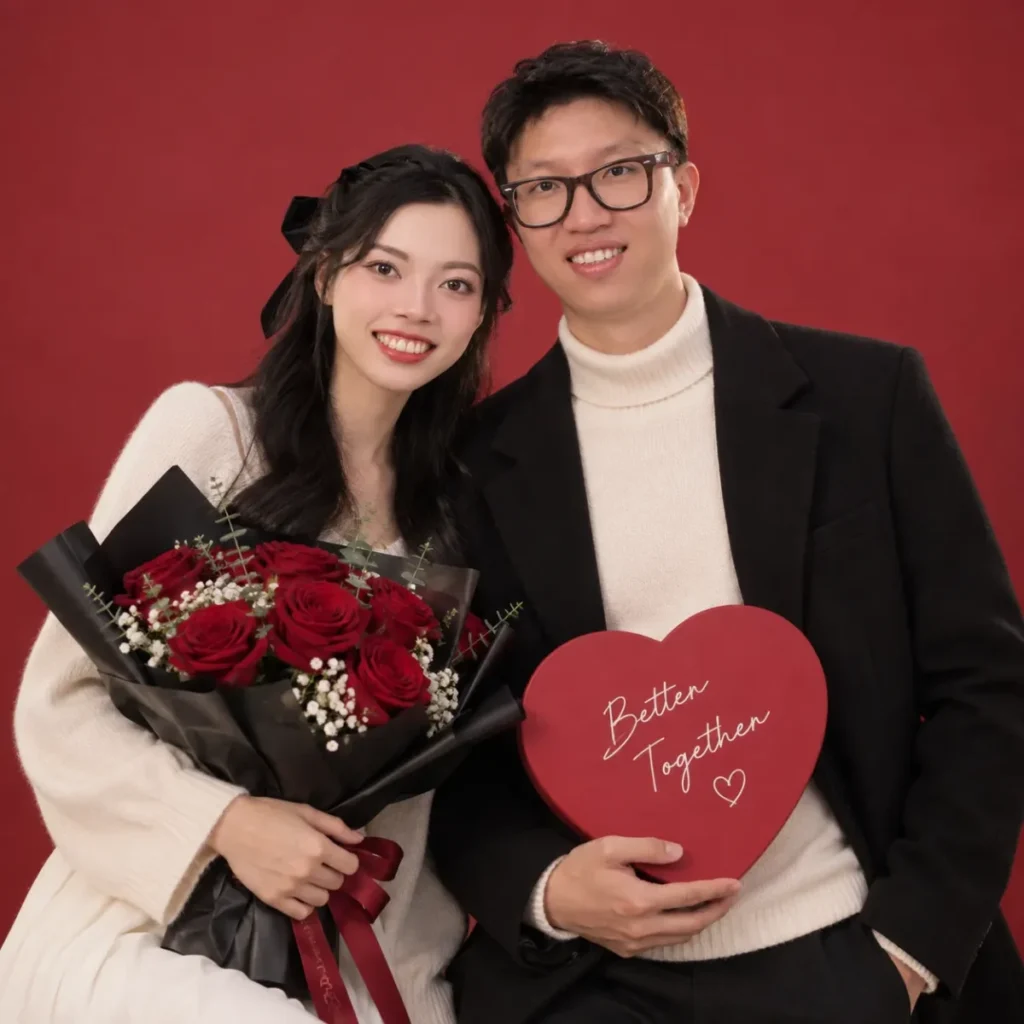
36. Modern Valentine Studio
Use it for: a February image without the usual clichés. Input: one photo of both people.
Restyle the uploaded couple photo as a modern Valentine portrait with no clichéd symbols. Keep both people recognizable and preserve their natural proportions. Use a simple rose-red studio sweep, soft frontal light, coordinated cream and black clothing, relaxed close posture and a few out-of-focus flowers at the edge of the frame. Change only the background, the wardrobe, the pose and the lighting. Output 1:1. Do not add hearts, words or logos.
Check first: how both skin tones read against the red backdrop, and where the hands ended up.
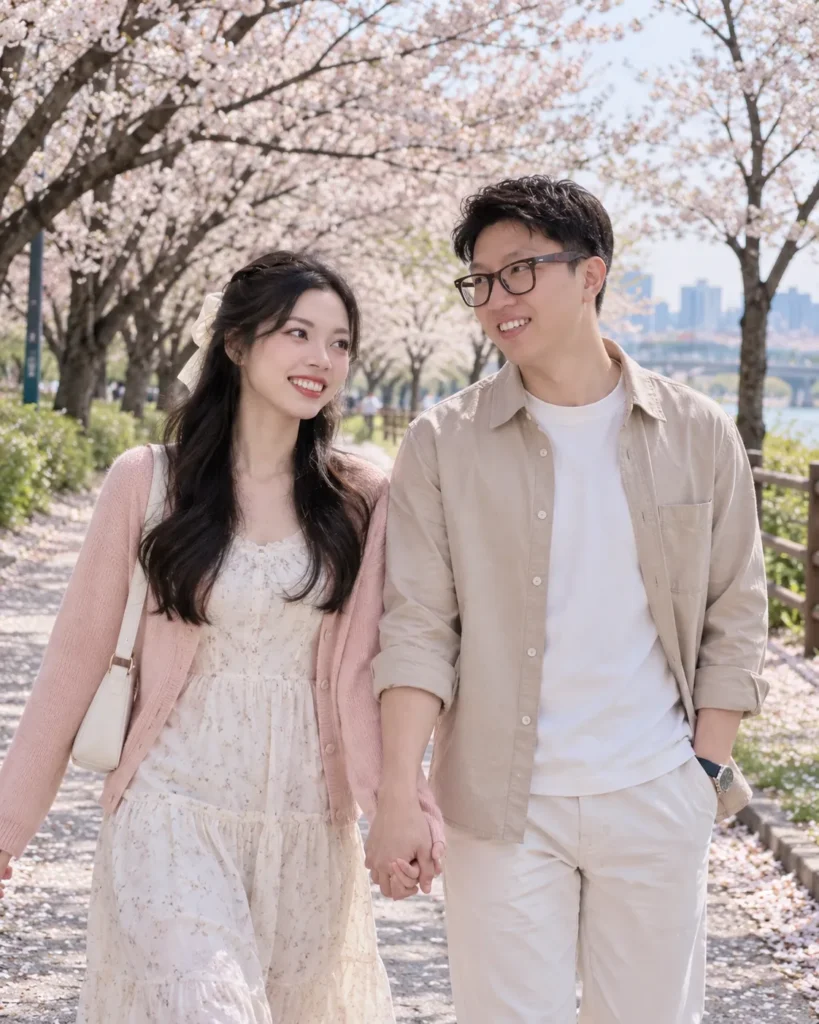
37. Spring Blossom Path
Use it for: a bright seasonal image with soft color. Input: one photo of both people.
Use the uploaded couple photo as the identity reference. Preserve both recognizable faces, both hairstyles, both skin tones and their proportions. Create a spring portrait on a tree-lined path with pale blossoms, soft morning light, a gentle breeze, coordinated pastel-neutral clothing and a natural walking pose. Change only the environment, the wardrobe, the lighting and the pose direction. Output 4:5. Keep the scene realistic rather than fantastical, and add no extra people.
Check first: blossoms overlapping either face, hands, and walking anatomy.
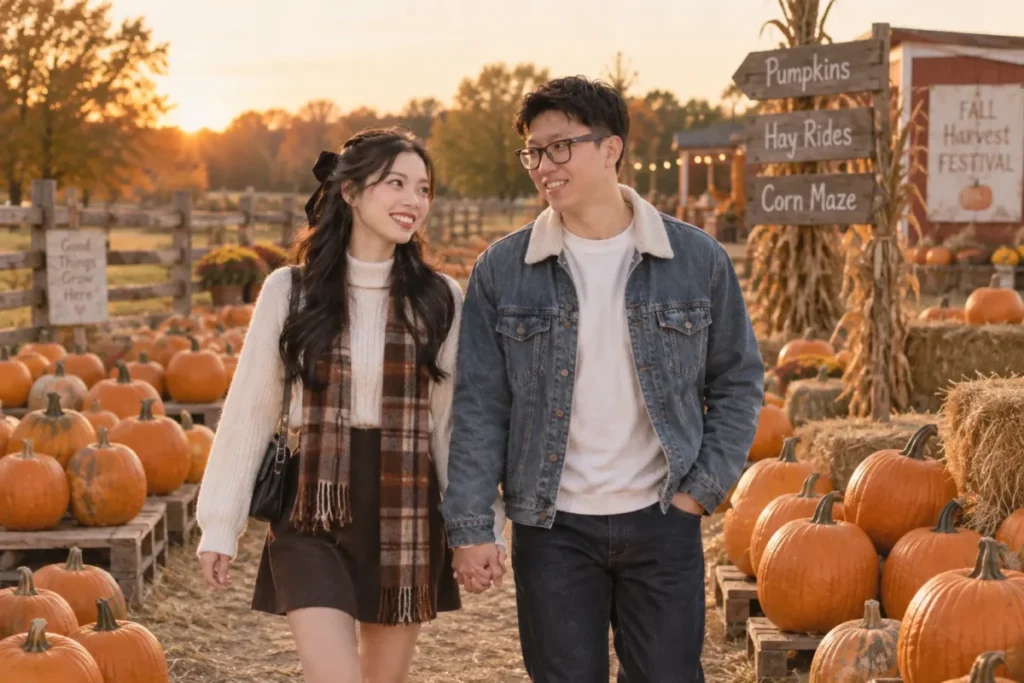
38. Pumpkin Patch Afternoon
Use it for: a relaxed fall image with obvious season cues. Input: one photo of both people.
Edit the uploaded couple photo into a casual fall pumpkin patch scene. Keep both people recognizable and preserve their natural proportions. Show them walking between rows of pumpkins in late afternoon light, wearing simple denim and knit layers, with candid smiles and a warm but natural color palette. Change only the setting, the clothing, the pose and the lighting. Output 3:2. Avoid signs and text.
Check first: feet against uneven ground, hands, both faces, and background clutter.
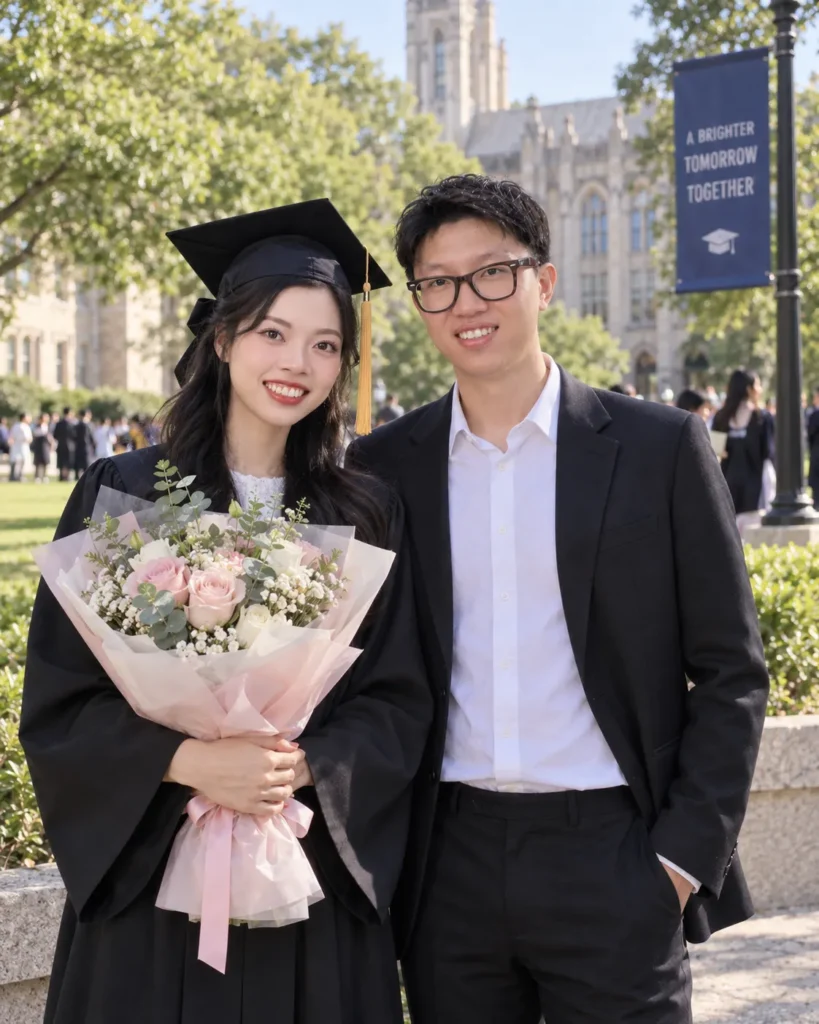
39. Graduation Day Together
Use it for: a milestone image where only one person is graduating. Input: one photo of both people.
Transform the uploaded couple photo into a graduation celebration portrait in which the person on the left wears a plain graduation gown and cap and the person on the right wears semi-formal clothing. Preserve both recognizable faces, both skin tones, both hairstyles and their proportions. Place them outdoors near a campus lawn in soft daylight, in a proud and relaxed pose. Change only the clothing, the setting and the pose. Output 4:5. Do not add school logos, institution names or diploma text.
Check first: where the cap meets the hair, both sets of hands, and both faces.
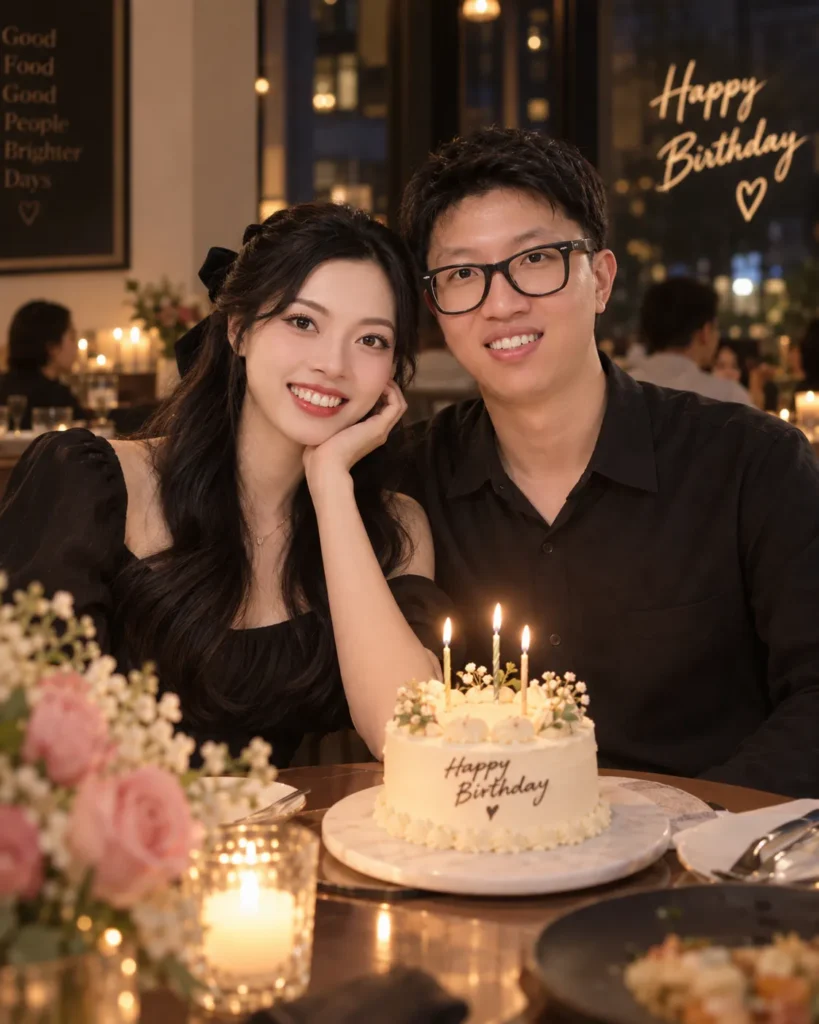
40. Birthday Dinner Portrait
Use it for: a warm indoor celebration image. Input: one photo of both people.
Use the uploaded couple photo as the reference. Keep both people recognizable and preserve their natural proportions. Create a warm birthday dinner scene with one small cake on the table, a few subtle candles, soft restaurant lighting, tasteful evening clothing and natural smiles. Change only the setting, the wardrobe, the seated pose and the lighting. Output 4:5. Do not add age numbers or readable writing on the cake.
Check first: candlelight falling on both faces, fingers near the cake, and any lettering on the icing.
Two Reference Photo Prompts (41 to 50)
These ten start from two separate portraits rather than one shared photo. Two things change: the model has to build a shared scene that never existed, and it has to keep two identities apart while doing it.
Every prompt below assigns a fixed role to each reference and tells the model not to average the two faces.
Read the model-setting section before you use them. Google states that Nano Banana 2 Lite “isn’t designed for multiple image references or for multiple edits”.
Lite is what runs when your Gemini model is set to Flash-Lite.
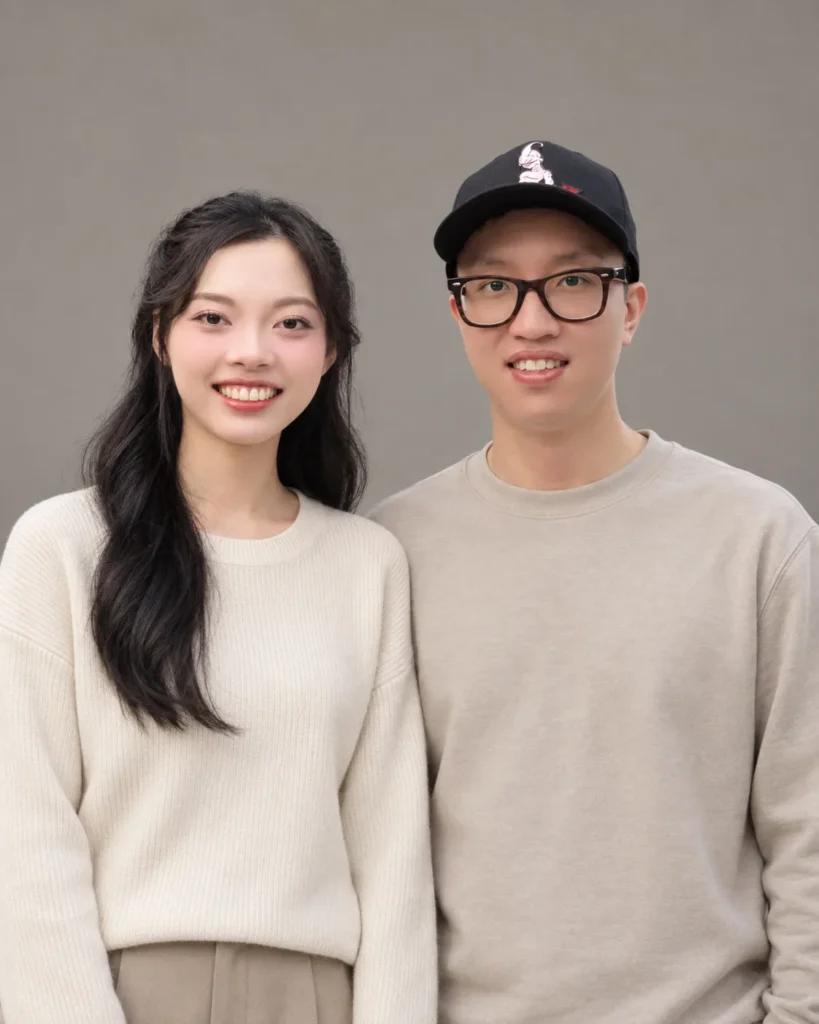
41. Neutral Base Composite
Use it for: the first turn of any two-photo job, before you style anything. Input: two separate portraits.
Use the first uploaded portrait as the person on the left and the second uploaded portrait as the person on the right. Create one neutral waist-up photo of both people standing side by side against a plain warm-gray background. Keep each person recognizable from their own reference, do not blend or average their facial features, and match their scale and lighting so the two look photographed together. Use soft even studio light and dress both in simple neutral clothing. Output 4:5. Add no props and no text.
Check first: each face against its own source, and relative head size. Fix both here before you add any scene.
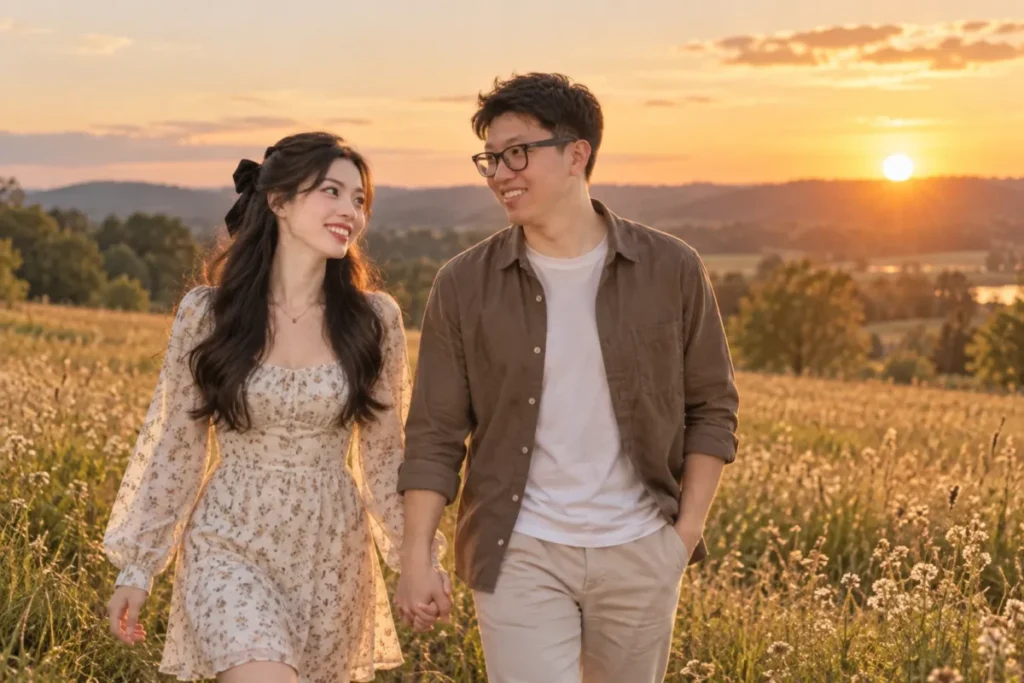
42. Golden Hour Field
Use it for: a warm outdoor scene from two indoor selfies. Input: two separate portraits.
Use the first uploaded portrait for the person on the left and the second uploaded portrait for the person on the right. Keep each person recognizable from their own reference and do not blend their facial features. Place them walking side by side through an open field at golden hour, hands loosely connected, with warm backlight, realistic ground shadows and coordinated casual clothing. Match the skin lighting and body scale on both so the scene reads as one photograph. Output 3:2. Add no text and no extra people.
Check first: both identities, the hand contact, and whether the light direction agrees on both faces.
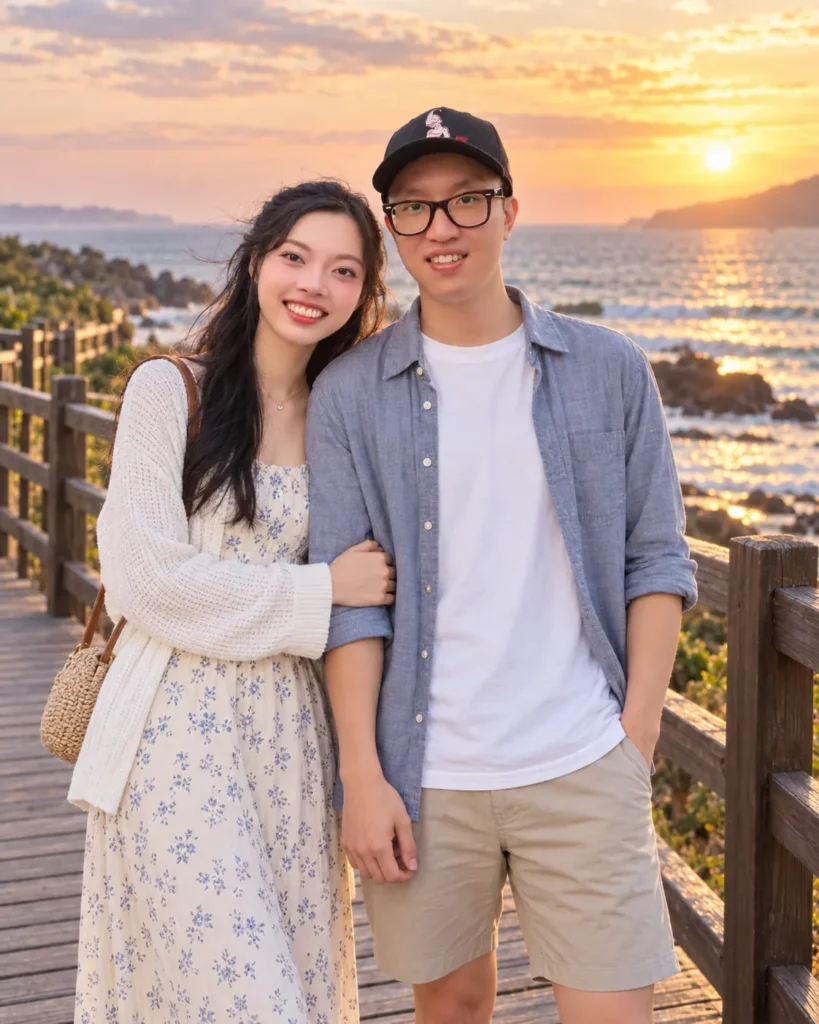
43. Coastal Boardwalk
Use it for: a travel-style image neither person has a photo of. Input: two separate portraits.
Use the first reference as the left person and the second reference as the right person. Preserve each person's recognizable face, hairstyle, skin tone and apparent age without averaging any feature between them. Create a relaxed coastal boardwalk portrait at sunset with both people standing close, a soft ocean background, warm side light, light breeze and simple travel clothing. Match the camera perspective and body scale. Output 4:5. Add no text and no extra people in the foreground.
Check first: relative scale, the separation between the two faces, hair edges, and perspective agreement.
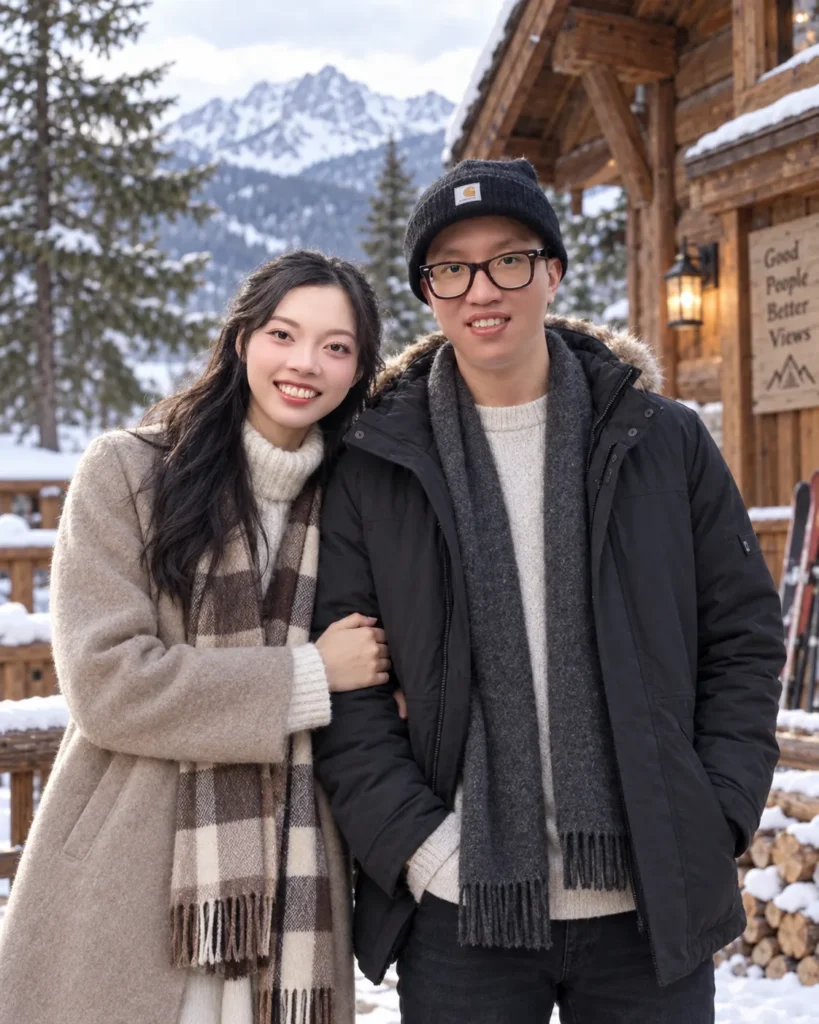
44. Mountain Cabin in Winter
Use it for: a cold-weather scene with heavy clothing. Input: two separate portraits.
Use the first uploaded portrait for the person on the left and the second for the person on the right. Keep each person recognizable from their own reference and do not merge any facial characteristics. Place them outside a wooden mountain cabin in early winter wearing neutral coats, with soft overcast light, faint snow, a warm window glow behind them and a natural close standing pose. Match the lighting and the proportions on both. Output 4:5. Render no readable signage and add no extra people.
Check first: coat collars against both jawlines, the arm overlap, relative scale, and both identities.
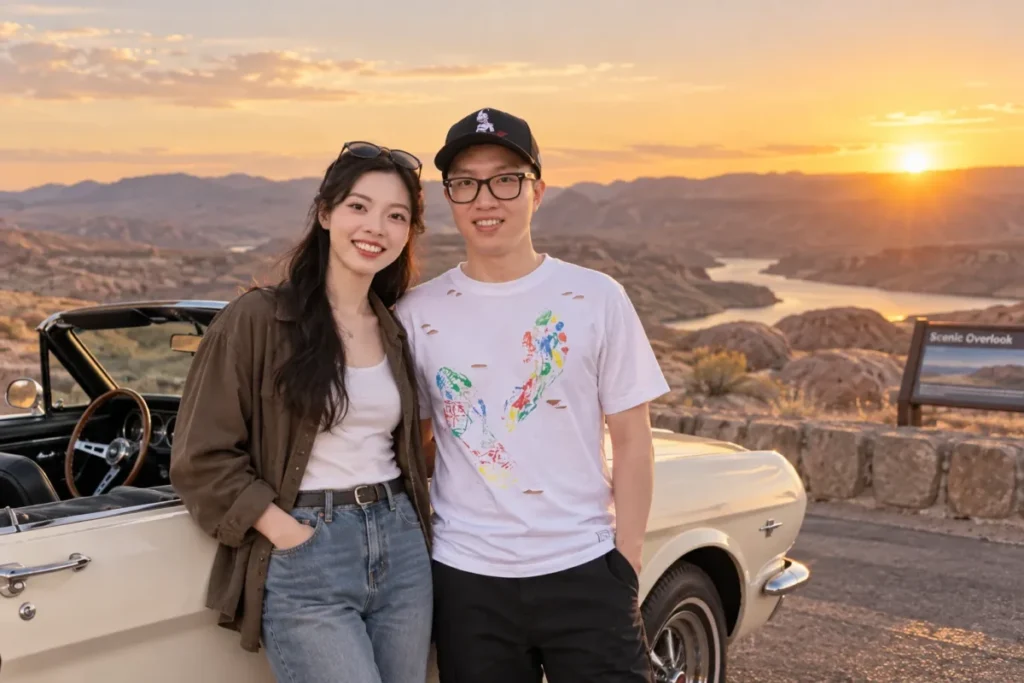
45. Desert Overlook Road Trip
Use it for: a wide scenic frame with a strong prop. Input: two separate portraits.
Use the first uploaded portrait as the left person and the second as the right person. Preserve each person's recognizable facial features, hairstyle and skin tone, and keep the two faces distinct. Create a candid road trip portrait beside a parked vintage-style convertible at a desert overlook near sunset. Place the couple close together but not overlapping, with warm low light, realistic shadows and casual travel clothing. Match body scale and camera angle. Output 3:2. Add no logos and no license plate text.
Check first: both identities, the car’s geometry, relative scale, and any text on the vehicle.
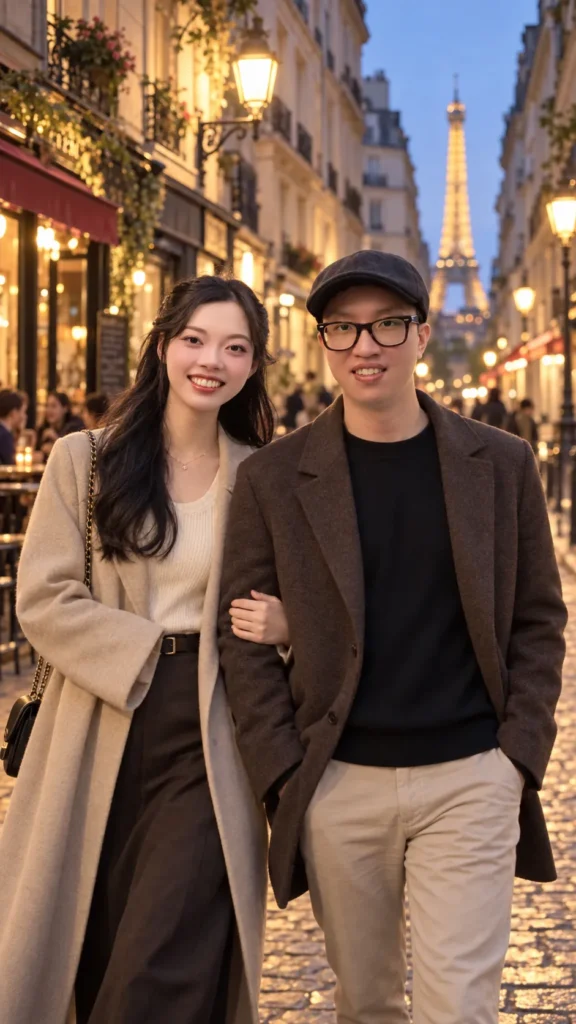
46. Evening Street in Paris
Use it for: a classic city-break image with warm practicals. Input: two separate portraits.
Use the first uploaded portrait for the left person and the second for the right person. Keep each person recognizable from their own source and do not blend their faces. Create a romantic evening travel portrait on a narrow Parisian street with warm cafe lights, a soft blue-hour sky, wet pavement reflections, understated smart-casual clothing and a relaxed walking posture. Match the lighting, the scale and the perspective on both people. Output 9:16 for a vertical story frame. Keep storefront text unreadable or absent.
Check first: both faces, walking anatomy, perspective agreement, and background lettering.
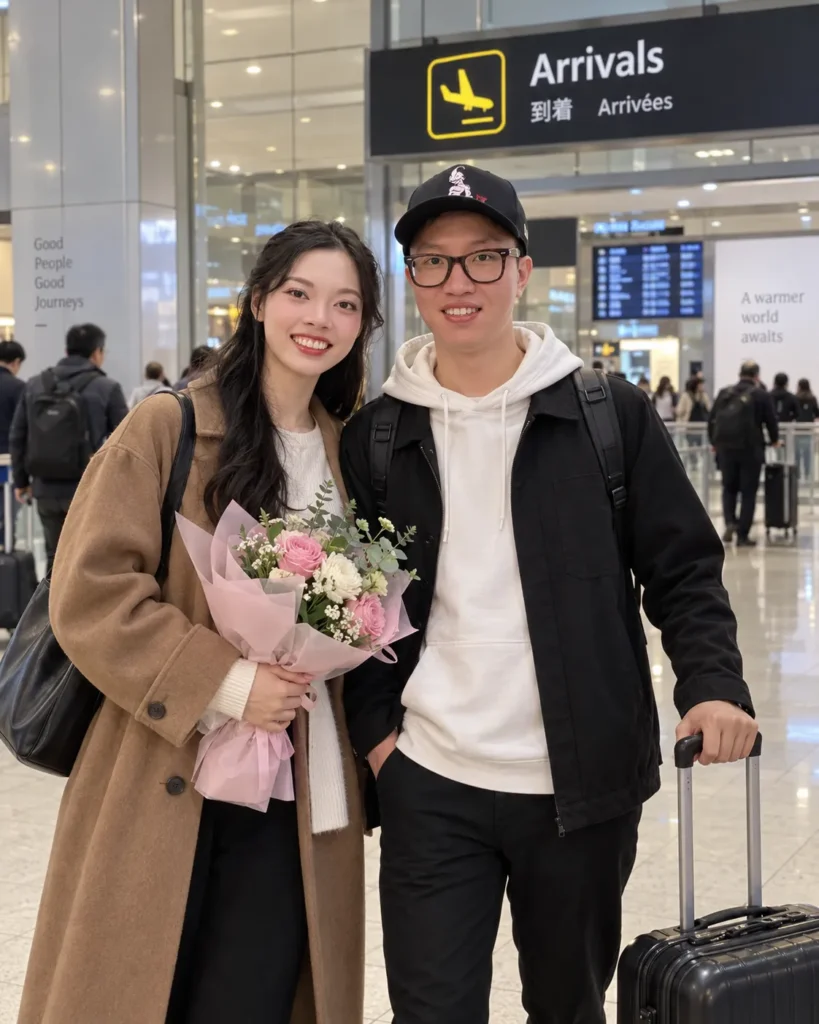
47. Airport Arrivals Reunion
Use it for: a long-distance couple image with real emotion in it. Input: two separate portraits.
Use the first uploaded portrait as the person on the left and the second portrait as the person on the right. Preserve each person's recognizable identity from their own reference. Create a warm airport arrivals scene with the two standing close and smiling, one small carry-on bag beside them, soft overhead light, shallow background blur and natural casual clothing. Keep the pose affectionate but calm, match scale and lighting, and do not blend the two faces. Output 4:5. Avoid readable flight board or signage text.
Check first: hands, the bag handle, both faces, and any text on the boards behind them.
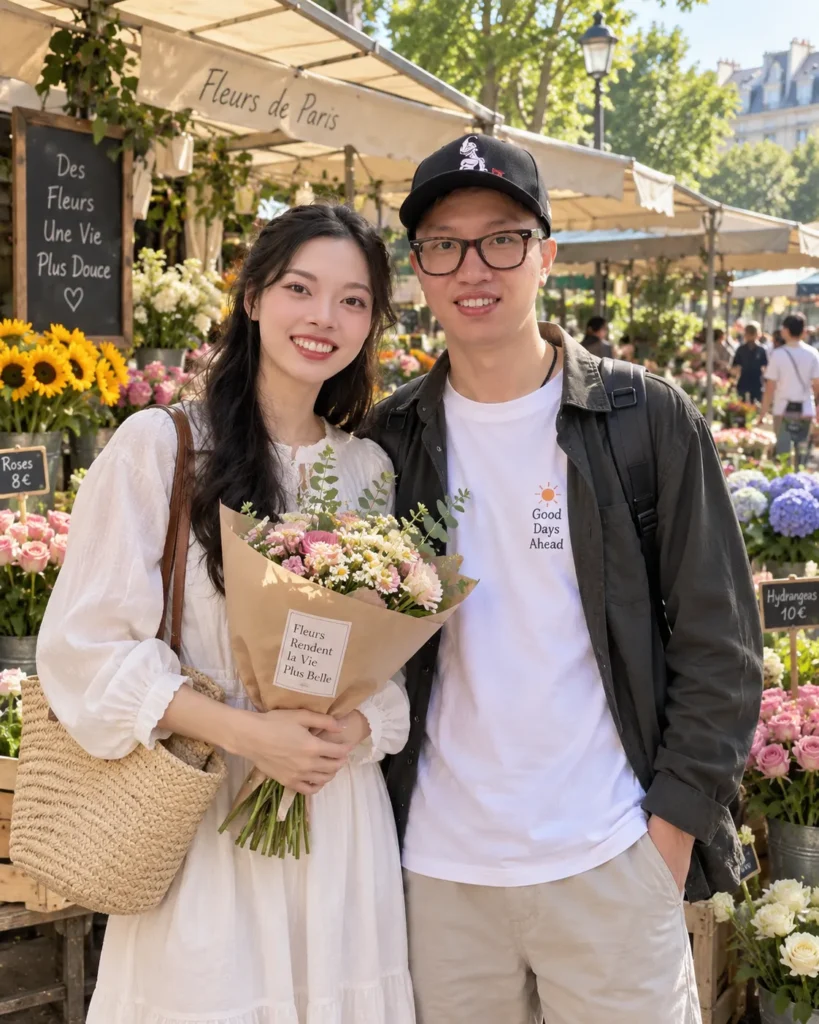
48. Flower Market Morning
Use it for: a colorful daytime image with a natural prop. Input: two separate portraits.
Use the first portrait as the left person and the second portrait as the right person. Keep each person recognizable from their own reference and prevent any facial blending between them. Place them together at an outdoor flower market in soft morning light, with one person holding a small bouquet and the other standing close, natural smiles, colorful flowers softly blurred behind them and coordinated casual clothing. Match body scale, camera perspective and light direction. Output 4:5. Render no readable signs.
Check first: the bouquet and hand geometry, the separation between the two faces, and relative scale.
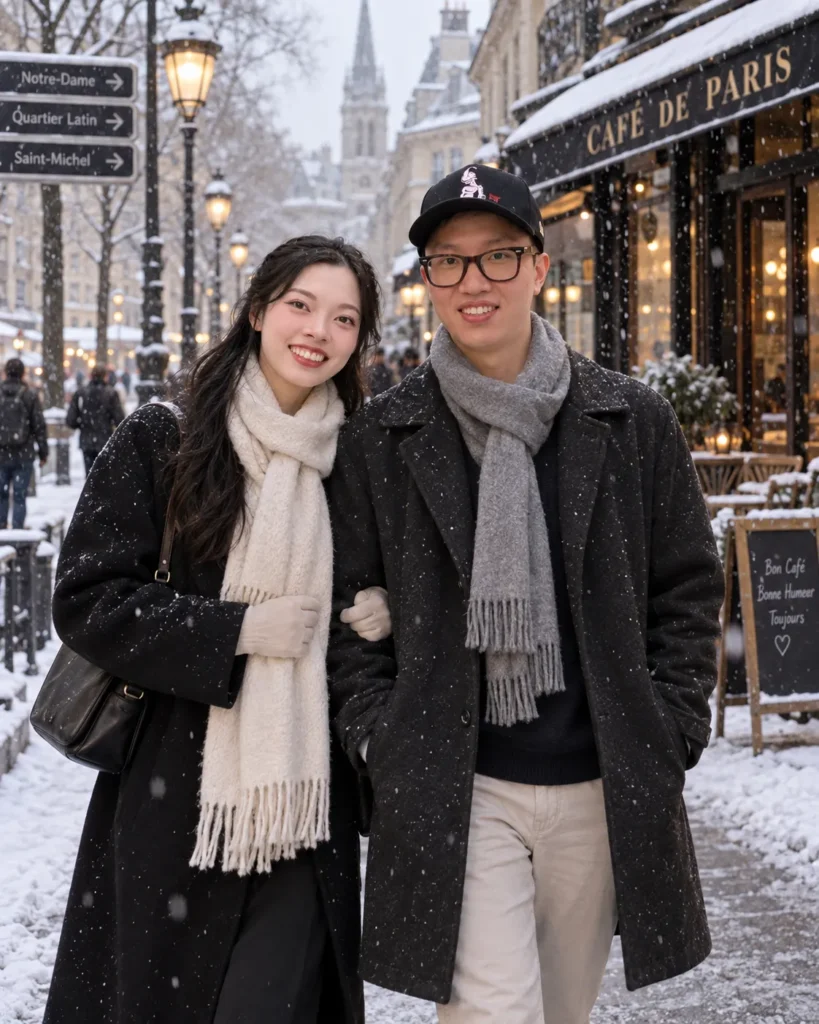
49. Snowy City Walk
Use it for: a winter street image with strong practical light. Input: two separate portraits.
Use the first reference as the person on the left and the second reference as the person on the right. Preserve each person's recognizable face, hair, skin tone and apparent age from their own source. Create a winter city walk portrait during light snowfall, with a warm shop window glow, neutral coats and scarves, a natural side-by-side posture and realistic pavement reflections. Match scale and lighting on both and do not blend the faces. Output 4:5. Keep all signs unreadable.
Check first: scarf boundaries, fingers, both faces, and snowfall sitting over facial detail.
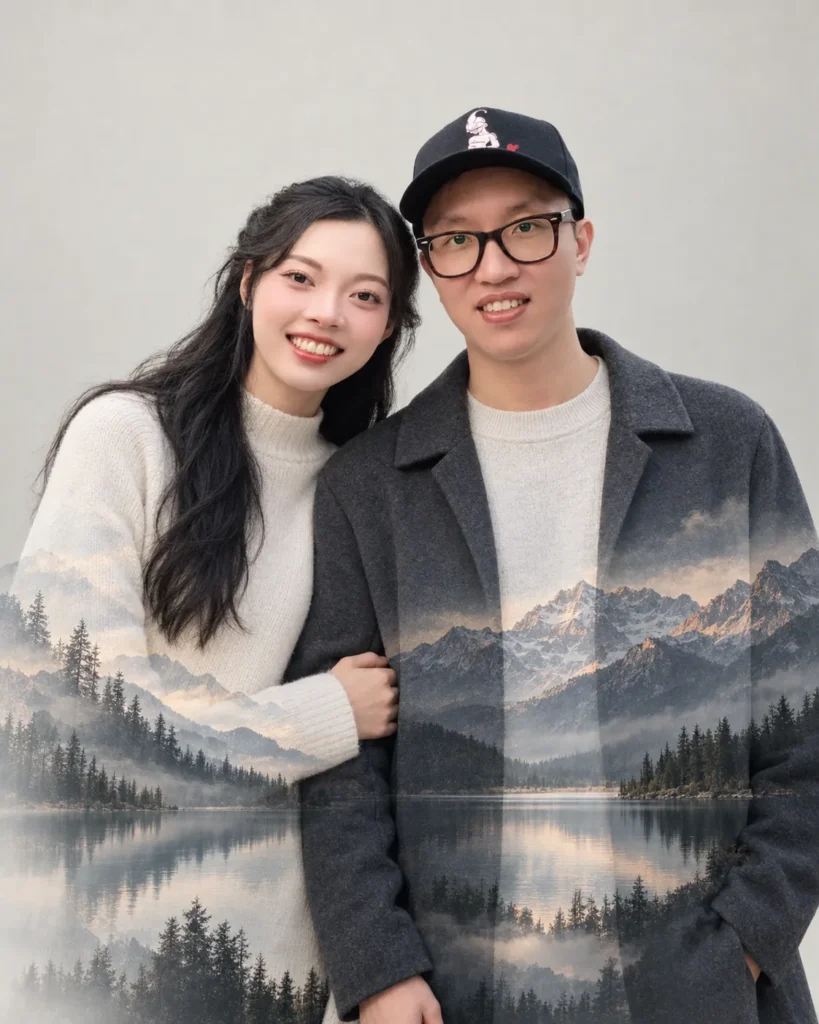
50. Restrained Double Exposure
Use it for: an artistic image that still has to look like both of you. Input: two separate portraits.
Use the first uploaded portrait for the left person and the second for the right person. Keep each person recognizable from their own reference and keep the two faces fully separate. Create a clean double exposure portrait in which a waist-up image of the couple stays clearly visible while subtle mountain and lake scenery fades into the lower half of their clothing and the background. Keep both facial areas realistic and untouched by the effect. Use soft neutral light and restrained color. Output 4:5. Add no text.
Check first: that the effect stopped below both chins and left both sets of eyes clean.
What Is a Gemini Couple Photo Prompt?
A Google Gemini couple photo prompt is an ordinary image prompt with one extra job: holding two identities steady at once.
Everything a single-subject prompt needs, the scene, the light, the framing and the style, a couple prompt needs too. What it adds is a preserve clause naming both people, a change scope that stops the edit reaching their faces, and a role assignment for when the two people arrive in separate files.
That is why the fifty prompts above are photorealistic rather than stylized. Identity is the hard part of a photorealistic couple image, and it stops being the hard part the moment you ask for a cartoon or an illustration, where nobody expects an exact likeness.
For stylized or illustrated couple images, the identity constraint matters much less, and the broader prompt hub linked above is the better starting point.
The occasions these fifty cover are the ones a couple has a real reason to make: anniversary posts, engagement and pre-wedding concepts, save-the-date frames, holiday cards and travel scenes.
The fifty also cover the long-distance case, where two people have plenty of selfies of each other and none together.
How to Use These Prompts in Gemini
Every prompt above is a filled-in template, in the shape its input mode calls for. The work left to you is picking the right one and then reading the result properly.
Pick by use case first. The italic line under each title states the use case and the required input.
The required input decides everything else, because a prompt written for one shared photo never assigns a role to each of two separate portraits.
The tool workflow runs seven steps.
- Confirm permission and eligibility. You need the other person’s agreement to use their photo, and Gemini Apps sets a minimum age for image editing that the consent section below sets out.
- Choose your input mode. One photo containing both people if you are restyling a composition that already works, two separate portraits if the shared scene has to be built from scratch.
- Set the Gemini model before you upload. The Gemini model you pick decides which image model runs, and only one of those models is documented as accepting multiple reference images.
- Paste one prompt without editing it. The first run is a measurement, not the finished piece. Customize on the second turn, once you can see what the model did with the original.
- Read the result against both people separately. Not the image as a whole. One face at a time, then hands, then the requested crop.
- Repair the narrowest thing that is wrong. A single follow-up instruction naming only the failed element, rather than a rewritten scene.
- Save, and know what is attached. Downloads carry provenance metadata whether or not you can see a mark on the picture.
On desktop, Google’s Gemini Apps Help page documents the generate path through the sidebar’s Images entry. The edit path runs through Library: select an image, open Chat, submit an edit prompt.
Note where that edit path starts, on the existing image in Library rather than in a fresh conversation.
When you do customize, swap the location, or the wardrobe, or the aspect ratio, but not three of them in one turn. A result that changes in three ways tells you nothing about which change caused the problem.
Every prompt below carries its own example output, the image that prompt actually returned. The common error patterns sit in the mistakes table further down.
Which Gemini Model Setting Decides Your Image Model
This is the setting that decides whether a two-photo couple image is a supported job at all, and whether you can keep editing after the first result.
You do not pick the image model directly. You pick the Gemini model, and Gemini Apps picks the Nano Banana model that runs your couple prompt from that.
| Gemini model setting | Image model that runs | What Google’s Help page says it is designed for |
|---|---|---|
| Flash-Lite | Nano Banana 2 Lite | Isn’t designed for multiple image references or for multiple edits |
| Flash | Nano Banana 2 | Can accept multiple reference images |
| Pro | Nano Banana 2 | Can accept multiple reference images |
| Pro, with a Google AI Plan | Nano Banana Pro also available | Not stated |
Source: Google’s official Gemini Apps image generation Help page, checked 2026-09-10.
Read the top row twice. If your Gemini model is set to Flash-Lite and you upload two portraits, you are asking a model Google describes as not designed for multiple image references to do exactly that.
That row also rules Lite out for the one-photo prompts, and this is the part that catches people. Repeated edits are the second thing Google says Lite isn’t designed for, and almost every couple image on this page takes a follow-up turn.
There is one more gate worth knowing before you start a long session. Paid subscribers can regenerate an image with Nano Banana Pro, but that stops once you hit the daily quota for Nano Banana 2.
No number is attached to that quota on the page behind this article, so plan for a ceiling rather than for a specific count.
Google published Nano Banana 2 in February 2026, also known as Gemini 3.1 Flash Image, and says it adheres much more strictly to complex, multi-layered developer prompts. That announcement covers the developer API rather than the consumer app, and the word developer sits inside the claim, so treat it as background on the model rather than a statement about what the Gemini app will do with your prompt.
Google uses two named tiers in the pages behind this article: a Google AI plan, which is what the Pro image model and the larger download size sit behind, and AI Ultra, which appears only in the regional watermark rule further down. For what either changes across the rest of the product, the Gemini review covers the wider picture.
One Couple Photo or Two Separate Portraits
The input mode is a real fork, not a preference. It changes which prompts work, which model setting you need, and how many turns the job takes.
| What you have | Use this mode | Start with |
|---|---|---|
| One photo where both people already look right together | Edit the existing composition | Prompts 1 to 40 |
| One photo of both people, but the pose or grouping is wrong | Edit, then repair the placement in a second turn | Prompts 1 to 40, then the placement repair below |
| Two separate portraits or selfies, one of each person | Build a new shared composition | Prompt 41, then 42 to 50 |
| Two photos of the same person and none of the other | Neither. Get a usable second portrait first | Nothing yet |
Google documents three input paths in Gemini Apps: editing an image generated in Gemini, editing an image you upload, or using multiple uploaded images to create a new one.
The third path is the one that carries the model-setting condition above.
Choose the workflow based on whether you have one shared couple photo or two separate portraits.
Build the Base Composite Before You Style It
A two-reference prompt is two jobs stacked on top of each other. It has to place two separate identities in one frame, and it has to build a scene around them.
Ask for both at once and a failure tells you nothing, because you cannot see whether the identity broke on its own or broke under the styling.
So split the turns. Prompt 41 exists for this: a plain gray background, even studio light, simple clothing, no props.
Nothing in that frame competes with the two faces.
If both people come back recognizable at that stage, you have a composite worth styling, and a failure in the next turn has one obvious suspect. If one of them does not, you have found the fault before spending a turn on a sunset.
Split a two-reference couple image into a neutral base composite first, then add styling only after both people are recognizable.
What Google’s Six Prompt Components Do, and the Four Fields I Add
Most prompt libraries hand you a formula of their own invention. Google publishes one, and it is better to start from that and say plainly where the additions come from.
Google’s official prompting guidance names six components: subject, composition, action, location, style and editing instructions. The Gemini Apps Help page adds three habits on top: start the prompt with a verb like draw, generate or create, describe the style you want, and include a detailed visual description of what should be in the image. The prompts above open with edit, use, restyle or transform instead. That is an editorial departure from the verb tip, made because every prompt here starts from photographs you upload rather than generating an image from nothing.
| Google’s component | What it decides | In a couple prompt |
|---|---|---|
| Subject | Who or what is in the image | Both people, named by reference role |
| Composition | How the shot is framed | Waist-up, side by side, camera distance |
| Action | What is happening | Walking, seated, hands connected |
| Location | Where the scene takes place | Park, rooftop, studio, boardwalk |
| Style | The overall aesthetic | Golden hour, monochrome, direct flash |
| Editing instructions | What to modify in an existing image | Change background and light only |
Google’s sixth component, editing instructions, tells the model what to modify. It does not say anything about what to leave alone, and a couple photo lives or dies on that second half.
So the prompts in this library carry four more fields. Three of them add nothing to Google’s list; they tighten it, and they are named here as editorial rather than as anything Google published.
| Added field | What it does | Why a couple photo needs it |
|---|---|---|
| Preserve clause | Names what must stay recognizable | Two identities, either of which can drift |
| Change scope | Closes the editing instruction into a finite list | Stops a background change from restyling faces |
| Output request | States the intended crop | The finished image has a destination |
| Exclusions | Names what must not appear | Extra people and invented text are the two recurring intruders |
The preserve clause and the change scope are the pair that matter, and they only work together. A prompt that names what to protect but never closes the list of what may change has left the rest of the frame open.
What a Preserve Clause Actually Buys You
A preserve clause is a constraint. It is not a guarantee, and several prompt pages that rank for this term promise otherwise.
Google’s own position on this is unusually direct. The prompting guidance says that while the model excels at character consistency, it may not always get it right.
The same page says the model struggles with maintaining aspect ratios, and that it may occasionally misspell words or struggle with complex typography.
Read that as three separate operating rules rather than a disclaimer.
Identity can slip, so inspect it every time. No wording makes a face certain. A preserve clause tells the model which parts of the picture it is being asked not to change, and that instruction is the whole of what it offers.
The crop you asked for is a request. Every prompt in this library states an output ratio anyway, because an unstated ratio is one you cannot check the result against. Verify the frame you got before you build a layout around it, and crop by hand when it comes back wrong.
Text is fragile, and Google says so. That is why so many of these prompts end with an instruction to render no readable signage, no menus and no captions. A blurred storefront is a background; a storefront with invented lettering is an artifact you cannot remove without another turn.
The Resolution Claim You Should Ignore
Typing 4K or 8K into a Gemini prompt does not produce a 4K or 8K file. The dimensions of what you download are set by your plan, not by the words in the prompt.
Gemini Apps image downloads are 2K with a Google AI plan and 1K without one. Ask for the visual character you actually want, meaning fine detail and realistic skin texture, and treat that language as unrelated to the pixel dimensions of the file that lands in your downloads folder.
If a print is the destination, plan around that download size from the start. That is a framing and cropping decision, and it belongs in the prompt rather than in a rescue attempt afterward.
| Aspect ratio | Where it is going | Prompts written for it |
|---|---|---|
| 4:5 | Feed portrait, the default for a couple image | Most of the library |
| 9:16 | Vertical story or reel | 3, 35, 46 |
| 1:1 | Profile picture, square print | 6, 16, 22, 23, 29, 36 |
| 3:2 | Print, wide crop, desktop wallpaper | 9, 13, 18, 20, 26, 28, 38, 42, 45 |
The Two-Person Validation Gate
Most guidance stops at the prompt. The prompt is the cheap half, and the expensive half is deciding whether the image that came back is good enough to keep.
Look at one person at a time. A couple image read as a whole hides the failure, because your eye fills in the face you know best and moves on.
| Check | It passes when | If it fails |
|---|---|---|
| Person A face | Recognizable against their own source at full zoom | Single-person repair, see below |
| Person B face | Recognizable against their own source at full zoom | Single-person repair, see below |
| Feature bleed | Neither face has borrowed the other’s nose, jaw or eye shape | One face affected: single-person repair. Both: rebuild |
| Hands and contact | Correct finger count, plausible grip, no fused limbs | Targeted repair naming the hands only |
| Relative position | Scale and eye level agree, nobody is floating | Placement repair, see below |
| Wardrobe and background | Only what the change scope allowed has changed | Targeted repair naming the drifted element |
| Requested crop | The frame matches the ratio you asked for | Reframe in a follow-up, or crop by hand |
| Unwanted text | No invented signage, labels or captions | Targeted repair naming the text location |
The rule is short. Treat three or more failures as a rebuild, and treat both faces being wrong as a rebuild whatever else passed, because at that point there is nothing left to preserve.
Everything else is a repair, and repairing is much cheaper than starting over.
Reframing and cropping are the two failures a prompt cannot reliably solve, so keep an editor in reach for them. A general-purpose AI photo editor changes the frame without re-rendering either face.
Fix-It Prompts: Repair One Thing Without Rebuilding the Scene
When a result is mostly right, rewriting the whole prompt throws away everything that worked. Google’s targeted editing guidance describes using direct, conversational commands to modify specific elements within an image without re-generating the entire scene, and that is the recovery pattern to reach for first.
The rule is simple. Name the one thing that is wrong, name what must not move, and send nothing else.
| Symptom | Repair scope | What to send |
|---|---|---|
| One face drifted, the other is fine | That person only | The single-person repair below |
| Both faces drifted or blended | Whole composite | The rebuild below, which differs by input mode |
| An extra person appeared | Removal only | “Remove the person in the background. Change nothing else about either subject, the pose or the lighting.” |
| Background is wrong, people are right | Background only | The background-only prompt below |
| Clothing is wrong | Wardrobe only | “Change only the clothing on the person on the left to a plain cream sweater. Keep both faces, both hairstyles, the pose and the background exactly as they are.” |
| Color grade is too heavy | Grade only | “Reduce the warm color grade to a neutral, natural photograph look. Keep both faces, the pose, the wardrobe and the background unchanged.” |
| Placement or pose is wrong, faces are right | Placement only | “Keep both faces, both hairstyles, the clothing, the lighting and the background exactly as they are. Move the two people closer together at the same eye level, both facing the camera. Change nothing else.” |
| Crop is wrong | Framing only, with your own ratio in place of 4:5 | “Reframe this as a 4:5 vertical portrait with both people fully in frame and space above their heads. Change nothing else in the image.” |
| Invented text appeared | Text region only | “Remove the lettering on the sign behind them and replace it with a plain, blank surface. Change nothing else.” |
Repairing Only the Drifting Partner
This failure only exists when there are two people in the frame, which is why a single-subject guide rarely addresses it.
Keep this image exactly as it is, including the person on the right, the pose, the clothing, the background and the lighting. Using the attached reference photo of the person on the left, correct only that person's face so their features, face shape, hairline and apparent age match their reference. Do not change the person on the right in any way, and do not restyle the scene.
Check first: that the corrected face now matches its reference, and that the untouched person is genuinely untouched.
If Both Faces Failed
Rebuilding means going back to a plain starting point, and what that means depends on which mode you are in.
With two separate portraits, the plain starting point is prompt 41: no scene, no props, no styling, just the two people on a gray background. Get both faces right there before you spend another turn on a location.
With one shared photo, start a fresh edit from the original photo rather than from the failed result, and ask for less.
Using the uploaded couple photo, keep both people recognizable, keep their pose and their relative positions exactly as they are, and change only the background to a plain warm-gray studio wall with soft even light. Change nothing about either face, the clothing or the framing. Output the same aspect ratio as the source photo.
Check first: both faces against the original photo. If they hold at this level of change, add the scene you wanted in a second turn. If they do not, the source photo is the problem rather than the prompt.
Changing Only the Background
Keep both people exactly as they are, including both faces, both hairstyles, the pose, the hand positions, the clothing and the scale. Replace only the background with a quiet tree-lined path at golden hour, and match the light on both people to that new background. Change nothing else. Keep the same aspect ratio.
Check first: the edges around hair and shoulders, and whether the relit faces still match their sources.
None of these prompts promises the untouched half stays untouched. Each one names it anyway, because an unnamed boundary is one the model was never given.
Red Flags in a Couple Prompt
These are the patterns this library is written to avoid. Most of them come from prompts written for a single subject and reused without thinking about the second person.
- No preserve clause at all, so the model treats both faces as suggestions.
- One preserve clause covering “the couple” instead of naming each person.
- A two-reference prompt that never says which reference is which person.
- A repair turn that changes wardrobe, location, lighting and pose at once, so a new failure names no cause.
- A heavy stylization request with no instruction to keep facial areas realistic.
- A resolution promise standing in for the detail language that describes what you actually want.
- A scene built around signage, a menu or a banner the model has to spell.
- A pose that puts one face behind the other, which removes the model’s reference for it.
- A source photo where one person wears sunglasses or a low hat brim.
- A group photo cropped down to two people, leaving a stray shoulder in frame.
- An effect layer such as double exposure or prism light with no boundary on where it may fall.
- A follow-up edit that restates the entire original prompt instead of naming the one failure.
Common Mistakes That Waste a Generation
| Mistake | Do this instead |
|---|---|
| Leaving the Gemini model on Flash-Lite | Switch to Flash or Pro before you upload, whether you have one photo or two |
| Styling and merging in the same first turn | Build a neutral composite first, style on the second turn |
| Judging the image as a whole | Zoom to one face, then the other, then the hands |
| Rewriting the prompt to fix one wrong element | Send a targeted edit naming only that element |
| Starting a new chat to fix an image | Open the image from Library and edit it there, the path Google documents |
| Treating the requested ratio as settled | Check the frame, then reframe or crop |
| Padding the prompt with ultra-high-resolution words | Ask for realistic skin texture and shallow depth of field |
| Using a photo where a face is partly hidden | Replace the source photo before you spend a turn |
Example: How to Plan One Run
A worked plan, written the way I plan a run before touching the app.
The job. A fifth-anniversary post. Two people, one existing photo of them together at a kitchen table, and a destination of a vertical feed post.
| Decision | Choice | Reason |
|---|---|---|
| Input mode | One shared photo | Both people already look right together |
| Gemini model | Flash | Multiple edits are likely, and Lite is not built for them |
| Starting prompt | 31, Anniversary Garden Portrait | Formal enough for a milestone, no text to render |
| Output ratio | 4:5 | Vertical feed post |
| Change scope | Setting, wardrobe, lighting, small pose direction | The grouping already works, so it stays |
What to watch for on the first result. Two faces at full zoom before anything else. Then the hands, because the pose direction clause invites the model to move them. Then whether the garden foreground cut across an arm.
The likely second turn. If the wardrobe reads too formal, that is a wardrobe-only repair naming the clothing and protecting everything else. If the frame came back wide instead of 4:5, that is a reframe, and the preserve clause section above says why to expect it.
When to stop. Both faces recognizable, hands plausible, crop correct, no invented text. Further turns past that point trade a working image for a slightly different one.
Consent, Watermarks, and What Gemini Attaches to Your Image
A couple photo is the one prompt category where the input is somebody else’s face. Three separate obligations follow from that, and none of them is optional.
Ask first. Google’s generative AI use policy prohibits violating the rights of others including privacy rights, and gives using personal data or biometrics without legally required consent as the example.
The same policy covers non-consensual intimate imagery, impersonating an individual without explicit disclosure in order to deceive, and claiming generated content was created solely by a human in order to deceive.
There is also an eligibility gate that most prompt pages skip. Google’s Gemini Apps Help page carries two age lines: 18 or over to generate and edit images, and 13 or the applicable age in your country to generate them.
Every prompt here starts from a photograph of real people, which is editing, so the 18 or over line is the one to work to.
Then there is what leaves with the file. Two different things get conflated in most coverage, and they behave differently.
The visible watermark is a setting. Google’s Android watermark Help page documents a Media Watermark control in Gemini Apps settings.
That page also states that in India, South Korea and Vietnam the control only appears to AI Ultra subscribers, with visible watermarks applied automatically otherwise.
The invisible layer is not a setting. All AI-generated media created or edited with Gemini Apps carries an invisible SynthID watermark, Gemini Apps include C2PA Content Credentials metadata describing the content’s origin, and the visible watermark control affects neither of them.
An anniversary picture your friends know is a picture of the two of you is not what any of those four prohibitions describes. The one about provenance is narrow and specific: claiming a generated image was made by a human alone, in order to deceive.
When Not to Use These Prompts
Some jobs are outside what a conversational image edit should be asked to do.
- When you do not have permission from every identifiable person in the source photos.
- For anything intended to deceive about who a person is or what they did.
- For non-consensual intimate imagery, which Google’s policy prohibits, or for sexually explicit content, which it prohibits separately.
- When an exact likeness is legally or officially required, such as an identity document or anything used as evidence.
- When the essential requirement is multiple reference images and the only available option is Nano Banana 2 Lite.
- When the real task is retouching a single face rather than building a scene, where a dedicated editor does less damage.
- When you need a specific licensed style, a real brand mark or a recognizable copyrighted character in the frame.
If a prompt is fighting Gemini’s constraints on every turn, the tool may be the wrong fit rather than the prompt. Comparing AI image generators is a faster route than a tenth rewrite.
How This Guide Was Written and Run
Macedona wrote this library for SaaS CRM Review and ran every prompt in it.
All fifty prompts were run in Gemini Apps in September 2026, with the Gemini model set to Pro, on an account carrying a Google AI plan. The image under each prompt is that prompt’s own output, downloaded and placed without retouching or recropping.
The source photographs are of real people. Both people in every photograph gave permission for their picture to be edited and published here, which is the same permission this page asks you to get before you paste anything.
Every image on this page was created or edited in Gemini Apps, so each one carries the invisible SynthID watermark and the Content Credentials metadata described further up.
The prompts themselves are original, written against Google’s published prompting components and against the failure modes a two-person image creates and a single-subject image does not.
Every product statement was checked on 10 September 2026 against four official Google sources: the Gemini Apps image generation and editing Help page, Google’s official image prompting guidance, the Gemini Apps watermark Help page, and Google’s generative AI prohibited use policy. The February 2026 Nano Banana 2 announcement is cited once, labeled as a developer API announcement, and is not used to describe consumer app behavior.
A claim earned a place here only when it changes what a reader pastes, which model setting they choose, or whether they proceed at all. Competing pages ranking for this term were read to find what the category leaves out, and were never used as evidence about how Gemini behaves.
Two boundaries are worth naming. Every run behind these images used one account, one plan and the Gemini model set to Pro, so nothing here measures how the same prompt behaves on Flash-Lite or without a Google AI plan.
And no success rate is published for face preservation. Competing pages sometimes state one; a run count on a single account is not a measurement, and no such figure appears in any of the four Google pages checked here either.
Frequently Asked Questions
These are the questions the sections above do not fully close.
Can Gemini combine two separate photos into one couple photo?
Yes, and Google documents using multiple uploaded images to create a new image as one of the three supported paths. The condition is the model: the Gemini model setting has to be Flash or Pro, because the Flash-Lite option runs a model Google describes as not designed for multiple image references.
Why did Gemini change only one person’s face?
Because consistency can hold for one person and not the other. Google says only that the model may not always get character consistency right, and in a two-person frame that miss can land on a single face.
So the fix is a repair aimed at that person alone, using their own reference photo, with an explicit instruction to leave the other person and the scene untouched.
How do I tell Gemini which person goes on the left?
Assign the role in the first sentence and never change the wording afterward. Every two-reference prompt in this library opens by tying the first uploaded portrait to the person on the left and the second to the person on the right.
Repeat that wording verbatim in every follow-up turn, so nothing in the session leaves the roles open to interpretation.
Are Gemini couple photos watermarked?
There are two layers, and only one of them can be switched off. A visible watermark is controlled by a setting in Gemini Apps, which Google says appears only to AI Ultra subscribers in India, South Korea and Vietnam.
Google also says that setting does not affect the invisible SynthID watermark or the Content Credentials metadata at all.
Why did Gemini ignore the aspect ratio I asked for?
Google states plainly that the model struggles with maintaining aspect ratios, so a stated ratio is a request rather than an instruction the model is bound to. Ask for it anyway, check the frame you got, and reframe or crop when it comes back wrong.
Should I upload one photo of both people or two separate portraits?
Upload the shared photo whenever one exists and the grouping already looks right, because editing an existing composition is a smaller job than inventing one. Two separate portraits are for the case where no usable shared photo exists at all.
Can I use my partner’s photo without asking them?
No. Google’s use policy prohibits using personal data or biometrics without legally required consent, and asking takes a few seconds.
What should I change if the first image looks wrong?
One thing, named precisely, with an instruction protecting everything else. A result that is mostly right is worth repairing.
A result where both faces failed is worth rebuilding from a plain starting point instead.
What to Do Next
Pick one prompt that fits the scene you actually want, confirm you have permission to use every reference photo in it, and set the Gemini model before you upload anything.
Generate or edit once. Then inspect both people separately, at full zoom, against their own source photos.
If one element is wrong, send a targeted follow-up edit naming only that element. If both identities failed, go back to a plain starting point and rebuild there before adding a scene.
Everything past a recognizable pair of faces, plausible hands and the crop you planned for is optional polish. The most common way to lose a good couple image is to keep going after you already had it.
About the author

Macedona is the founder and lead reviewer at SaaS CRM Review, where he has published 175+ in-depth reviews, pricing guides, and comparisons of CRM and SaaS tools. Each review is based on hands-on testing or verified documentation, and every article states clearly which method was used. Pricing and features are checked against official vendor sources, with the verification date noted in the article. Macedona follows a published review methodology and editorial policy. SaaS CRM Review earns affiliate commissions from some links, which never influence ratings or rankings. Read the full affiliate disclosure.