
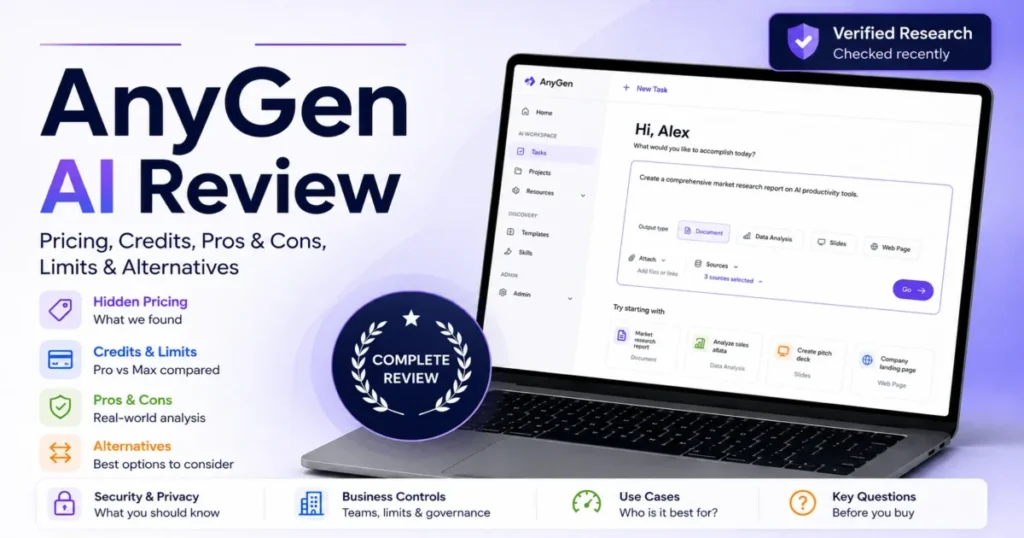
AnyGen suits solo consultants and small marketing or operations teams that need editable documents, slides, and data analysis to come out of one workspace. It suits nobody who has to build a budget before signing up, because the official plan documentation names Plus, Pro, Max, and a Business Plan without publishing a dollar amount for any of them.
That gap is the buying problem in this category, and it is the one thing most AnyGen coverage gets wrong by filling it with numbers nobody can source. This review separates what the official documentation proves from what it leaves undisclosed, then turns each unknown into a question to ask before a card goes in.
Buyers comparing it against AI content creation tools that publish rate cards openly should read the pricing section first.
In This Article (17 sections)
AnyGen Quick Verdict
| Category | Verdict |
|---|---|
| Best for | Solo consultants and 2-to-10-person teams turning research, briefs, or spreadsheets into editable reports, decks, and web pages |
| Not ideal for | Buyers who must model total cost, or who need verified SSO, audit logs, or US data residency before procurement approval |
| Starting price | Not publicly disclosed on the official pages checked 2026-08-09 |
| Best practical plan | Not nameable from public evidence; Pro is the lowest tier with a documented concurrency figure |
| Free plan or trial | Not established from the official documentation reviewed |
| Setup difficulty | Low for a first deliverable, Medium once Skills, connectors, and shared credit rules are involved |
| Main strength | A clarification step and a select-to-edit editor that keep a draft revisable instead of regenerating it wholesale |
| Main limitation | Credit-based consumption with no published tier allowance, top-up price, or overflow behavior |
| Best alternative | A dedicated presentation tool when deck design is the deliverable, or a general assistant when the output is reasoning rather than a file |
Source: AnyGen official plan and administrator documentation, checked 2026-08-09.
Read that table as a shortlist gate rather than a verdict. AnyGen earns a trial slot on workflow depth, and it fails a procurement gate on commercial transparency, which are two different decisions a buyer usually makes a month apart.
Which AnyGen This Review Covers
Two products share this name in search results, and mixing them produces advice that is wrong in both directions. This review covers the AI workspace documented at anygen.io and docs.anygen.io, not the separate anygen.ai identity that appears in older directory listings.
The official documentation describes AnyGen as an autonomous execution partner and states that it is Powered by Lark. That is the only ownership language the official pages establish, so treat any claim that a named parent corporation develops or owns AnyGen as unverified until an authoritative corporate source appears.
AnyGen is an artifact-first workspace rather than a chat assistant, a different job from what generative AI is in the general sense: the unit of value here is a finished, editable file.
Methodology: How AnyGen Was Reviewed
This analysis is based on AnyGen’s official product documentation, the plan and administrator guides, the OpenAPI reference, the dated release archive, and the 2026 privacy and security white papers. Volatile facts, including plan names, credit mechanics, and concurrency limits, were checked on 2026-08-09.
AnyGen was assessed against the same buyer-focused criteria applied to every workspace tool on this site: workflow fit for a real deliverable, plan gates, usage limits, credit and cost structure, integration reach, administrative control, and documented security posture.
Greater weight went to factors that change a purchase decision rather than a demo impression, including disclosed commercial terms, concurrency ceilings, credit governance at team scale, and the questions a finance or IT reviewer will raise.
Claims that could not be verified from official evidence were excluded rather than estimated, and every commercial figure absent from the official pages is reported as undisclosed instead of inferred from third-party listings.
AnyGen Pricing: What Is Public and What Is Still Hidden?
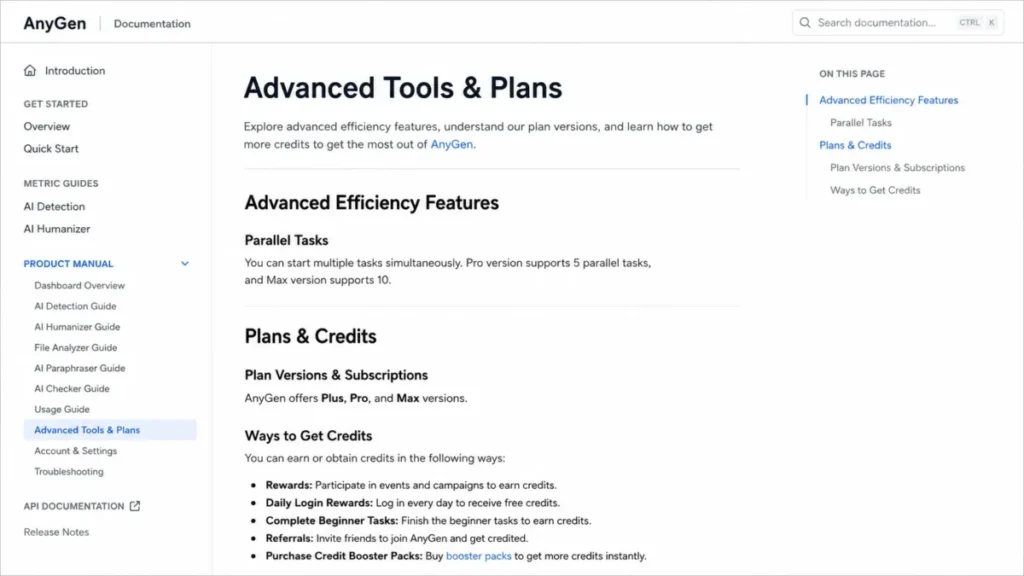
The official plan page confirms the tier structure and the credit mechanics, and it stops short of the numbers a buyer needs. Plus, Pro, and Max are named, and a separate Business Plan is documented for organizations, but no US dollar subscription amount appears on the pages reviewed for this article.
| Pricing element | Public status | What the official documentation shows |
|---|---|---|
| Consumer tier names | Verified | Plus, Pro, and Max |
| Organization tier | Verified | A Business Plan built on an organization-level monthly credit pool |
| Pro concurrency | Verified | Up to 5 parallel tasks |
| Max concurrency | Verified | Up to 10 parallel tasks |
| Ways to earn credits | Verified | Daily login rewards, beginner tasks, and referral invitations |
| Credit booster packs | Available, price undisclosed | Purchasable top-ups are documented without pack size or amount |
| Monthly and annual subscription amounts | Not published | No figure on the official plan pages reviewed |
| Included credits per tier | Not published | No per-tier allowance table |
| Free-tier allowance | Not published | No canonical free usage ceiling |
| Business Plan commercial terms | Not published | No price, seat minimum, contract length, or renewal terms |
| Export gating by tier | Not published | Formats are documented, the per-tier gate is not |
| API pricing, quotas, rate limits | Not published | Operation types are documented, capacity terms are not |
Sources: AnyGen official plan documentation and the Business Plan administrator guide, checked 2026-08-09. Full details appear in the Advanced Tools and Plans and administrator pages.
The credit layer is where the real bill forms
Credits arrive through four documented routes: daily login rewards, beginner tasks, referral invitations, and purchased booster packs. Three of those are earned, which means baseline consumption is partly a function of how often a user shows up rather than what the subscription includes.
Purchasable booster packs turn AnyGen into a variable-cost tool. Pack size, price, expiry, and rollover are not published, so a team that runs heavy months cannot forecast the top-up line at all.
I would not budget from the tier name alone here. The pattern that hurts buyers in credit-metered products is a cheap-looking base plan plus an unbounded top-up line, and AnyGen gives a buyer no public way to test whether that pattern applies.
For contrast, tools that publish a plain rate card let a buyer finish this arithmetic in a browser tab, which is why ChatGPT pricing comparisons resolve in minutes while an AnyGen budget needs a vendor conversation.
Total cost cannot be calculated from public evidence
A 10-user cost model needs three inputs: a per-seat or per-organization price, an included credit allowance, and a top-up rate. None of the three is published, so any 10-user figure in circulation is invented rather than derived.
That moves AnyGen from a self-serve purchase into a quoted one, which changes who has to approve it and how long that takes.
Feature Gates: What You Get on Each AnyGen Plan
The one feature gate the documentation quantifies is concurrency. Everything else in the tier comparison is either undisclosed or described without being mapped to a plan.
| Plan | Documented parallel tasks | Credit source | Admin controls | Gate evidence status |
|---|---|---|---|---|
| Plus | Not published | Personal credits | Not published | Named tier only |
| Pro | Up to 5 | Personal credits | Not published | Concurrency documented |
| Max | Up to 10 | Personal credits | Not published | Concurrency documented |
| Business Plan | Not published | Organization monthly credit pool | Owner, Admin, and Member roles with team and per-member usage limits | Governance documented, commercial terms undisclosed |
Source: AnyGen official plan documentation and Business Plan administrator guide, checked 2026-08-09.
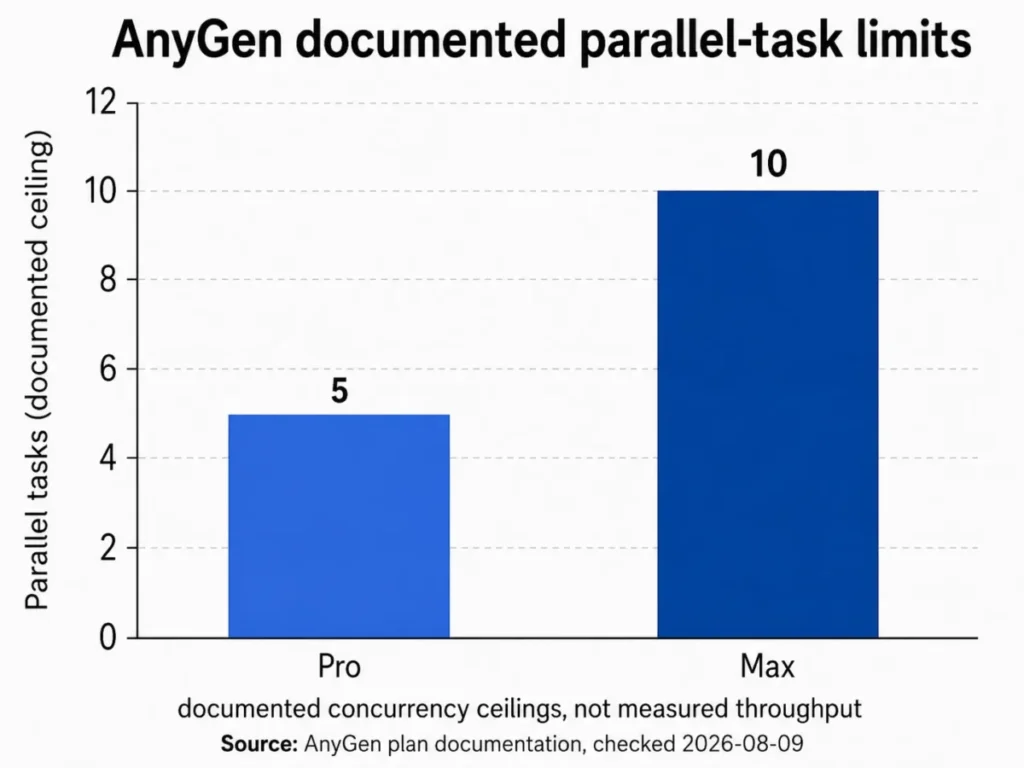
Max documents twice the concurrency of Pro, and that is all it documents. It is not evidence of double the speed, double the credits, or double the value, and the behavior when a user exceeds the ceiling is not described.
Concurrency only becomes an upgrade trigger under one condition: several deliverables genuinely running at once. A consultant producing one report at a time will never touch the Pro ceiling, while a three-person team generating a deck, a data analysis, and a client brief in the same hour will.
The workflow consequence is narrow but real, because this is the one plan gate the official documentation quantifies. If a team routinely runs more than five jobs together, that trade-off is the reason to choose Max over Pro, and if it does not, the tier decision has to rest on credits and price that AnyGen has not published.
The honest read on the rest of the tier map is that it does not exist publicly. A buyer who needs a specific export format, a specific connector, or a specific credit allowance on a specific plan has to confirm it inside the authenticated billing page rather than from any published comparison.
How AnyGen Runs a Deliverable From Brief to Export
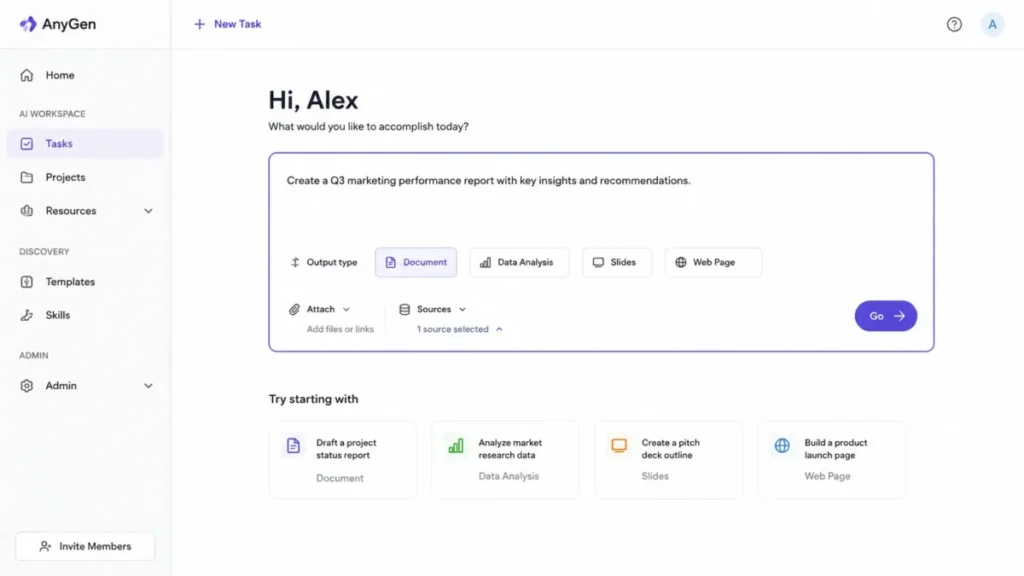
The documented flow is closer to a supervised workflow than a one-prompt generator, and that shapes who it fits. A task starts from a goal typed into the home input box, with an optional output type selected from Document, Data Analysis, Slides, or Web Page.
Attachments and citation channels are configured at the same step, drawing on Web Search, Google Drive, Slack, and other connected sources. AnyGen then generates an interactive form to clarify direction before it produces anything, which is the step that separates it from tools that guess and regenerate.
Revision happens three ways: conversational modification across turns, an Ask AI local optimization for a single paragraph, and fully manual editing. A Revision Review Mode setting applies edits only after approval, which matters for research documents where an unreviewed rewrite is worse than no rewrite.
Delivery closes the loop. Finished work exports to Word, PDF, PowerPoint, images, and ZIP archives, and an online document syncs to Google Docs in one click once Google Drive is bound through the connector.
Version history is unusually well behaved for this class of tool. Restoring an earlier version generates a new content state without overwriting or deleting the current one, so a rollback during a client revision cycle costs nothing.
Sharing carries two permission levels, View Only for delivery and Editable for collaborators, applied either to a whole task including its dialogue history or to a single output. A consultant sending a client a result rather than a working session will care about that distinction.
AnyGen Key Features and the Limits Attached to Them
Documents, slides, web pages, and storybooks
The documented output set covers structured documents, presentations, web pages, storybooks, and open-ended research work. One-click conversion turns an existing document into a web page, slide deck, or storybook, which removes the usual copy-and-reformat step between a written brief and a client deck.
The limit is that no per-tier export or conversion gate is published. A team that buys specifically for PowerPoint output should confirm the format is available on the plan it intends to buy before committing.
Data analysis from a spreadsheet
Dropping a CSV or similar data file in triggers automatic loading, structure detection, and dimensional analysis, with charts and insight summaries as the output. That fits an analyst who needs a business-facing read of a dataset rather than a reproducible pipeline.
Statistical depth, dataset size ceilings, and reproducibility guarantees are not documented. I would treat AnyGen as a first-pass analysis layer and keep governed reporting in a dedicated platform when a number has to survive an audit.
Projects and scoped memory
A project is a collection space holding related tasks, background materials, and outputs, with project rules that keep output standards consistent and materials the model references automatically. Memory operates at three scopes: global across all tasks, project-level, and temporary for a single task.
Every memory entry can be viewed, edited, updated, or deleted at any time, which is the control that makes shared context safe to use on client work. This is scoped context rather than a governed knowledge base, so do not plan a company wiki migration around it.
Skills, and the conflict they can create
A Skill packages a repeatable workflow plus a stable output structure, imported as a .zip, .md, or .skill file and invoked either implicitly or explicitly by name. For a team that produces the same monthly report, that is the difference between a good run and a repeatable standard.
The documentation names the failure mode directly: multiple overlapping Skills can produce overlap or style inconsistency. The documented workaround is to call the intended Skill by name and temporarily disable similar ones, which in practice means a team needs an approved Skill list and an owner for it.
Browser Operator and its permission boundary
Browser Operator runs on the local machine rather than a cloud instance, using existing sign-ins and the local network connection to reach content the user is already authenticated against. It is toggled on or off inside a task or in Connectors, and the documentation states it does not read, collect, or upload passwords.
It is documented as available to all users with no additional charge, which is rare for a capability of this kind. The governance cost is real: any feature that borrows an authenticated session needs a stated policy about which sites it may touch and who may enable it.
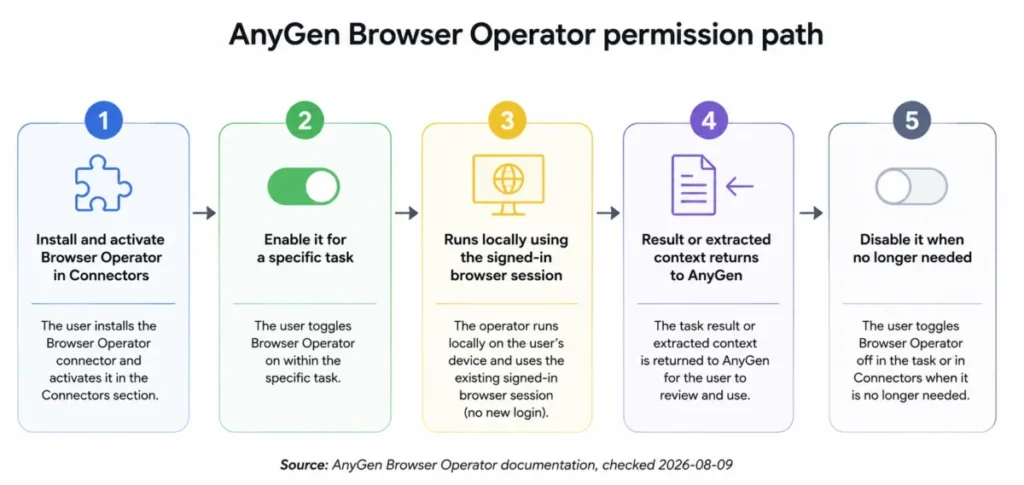
The step most teams skip is the last one. An always-on connector to an authenticated browser session is a standing permission, and treating it as a per-task grant is the cheaper habit to build early.
Ease of Use and Setup
First deliverable difficulty is Low. A goal, an optional output type, and an answer to the clarification form is the whole path to a first draft, and no prompt-engineering expertise is assumed because the product asks the questions.
Difficulty rises to Medium at the second stage, for administrative reasons rather than interface ones. Skills need curating, connectors need authorizing, and Business credit allocation needs an owner.
The 30-day test is whether one person has taken ownership of the Skill library and the connector list. The 90-day test is whether outputs from two different team members still look like they came from the same company, because that is precisely what Skill overlap erodes.
Buyers switching from an existing stack should scope this carefully. Supported inputs cover common document, spreadsheet, image, and PDF formats, and that is not the same thing as a platform migration: comment history, automations, and permission structures from another workspace are not documented as transferable.
Integrations, API, and Automation
Documented connectors cover Google Drive, Slack, Lark, and custom tooling through MCP, which corrects a claim still circulating from mid-2026 reviews that AnyGen has no meaningful integration surface. Scheduled Tasks run work at specified times without a person triggering it.
The OpenAPI is the larger correction. It authenticates with an API key and exposes generation operations for slides, documents, websites, storybooks, data analysis, diagram output, and a set of finance-specific analyses, all producing downloadable files.
Anyone planning production automation should understand how an API works commercially as well as technically here. Operation coverage is documented; rate limits, quotas, per-call cost, and service commitments are not, which means capacity planning has to happen through the vendor rather than the docs.
Webhook triggers add an event-driven path, and they carry a specific security obligation. The webhook_id in the path acts as the bearer secret, so a leaked trigger URL is a leaked credential and belongs in a secrets manager rather than a shared automation config.
Execution is asynchronous. A trigger returns a token, the caller polls for status, and the documentation defines error responses for a missing webhook, a disabled webhook, and a failed session start, which is enough to build retry logic against.
Security, Privacy, and Admin Controls
The 2026 white papers make this the strongest-evidenced part of AnyGen’s public posture, and they retire the older claim that its privacy story is undocumented.
| Control area | Documented position | Evidence status |
|---|---|---|
| Model training on customer data | Input and Output are not used to train any models | Vendor documentation |
| Employee access | Employees do not have access to personal data by default | Vendor documentation |
| Regional infrastructure | A data center node in Singapore | Vendor documentation |
| Information security certification | ISO 27001, per the privacy white paper | Vendor documentation |
| Privacy regimes addressed | GDPR, CCPA/ | Vendor documentation |
| Data in transit | HTTPS and WSS encryption across internal and external networks | Vendor documentation |
| Data at rest | Sensitive stored information encrypted, plus full-disk encryption on employee devices | Vendor documentation |
| Isolation and monitoring | Network segmentation, permission isolation, host intrusion detection, and a web application firewall | Vendor documentation |
| AI-specific defenses | Sandboxed agent execution, data-loss prevention, dynamic masking, and prompt-injection defense | Vendor documentation |
| SSO, SCIM, audit logs | Not established from the pages reviewed | Unverified, not absent |
Sources: the AnyGen privacy white paper and security white paper, checked 2026-08-09.
Every row above is vendor-documented rather than independently audited, and the distinction matters to a reviewer who has to attest to something. The last row is the one procurement will stop on: absence of evidence is not evidence of absence, and SSO, SCIM, and audit-log availability need a direct answer from the vendor rather than an assumption either way.
The Singapore node is a fact about infrastructure, not a residency commitment. A US buyer with a contractual residency requirement should ask where their data is processed and stored, in writing, before the security review closes.
How Business credit governance works
The administrator model is a three-level allocation chain. The organization holds a pool of monthly credits, teams receive an adjustable monthly credit limit drawn from that pool, and individual members can be given a usage limit inside their team.
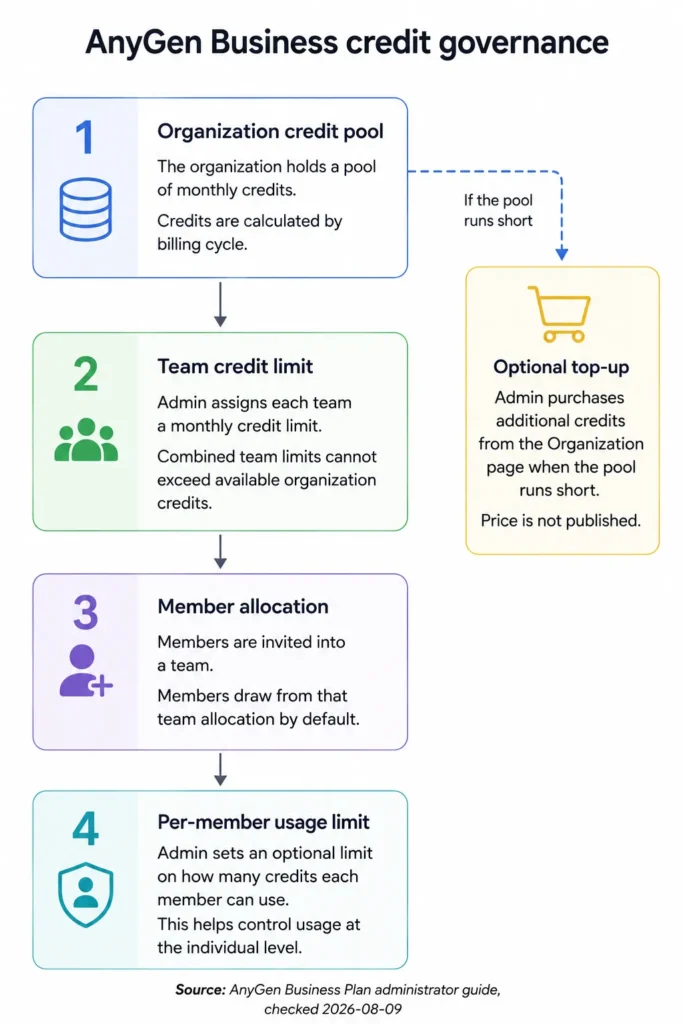
Roles run Owner, Admin, then Member, with only Owners and Admins reaching the Admin Center. Members can switch their credit source between personal and team credits, and a team is normally set as the default source after an invitation.
Combined team limits cannot exceed the organization’s available credits, which is a genuine budget guardrail rather than a reporting view. When the pool runs short, an admin buys more from the Organization page, and that purchase has no published price.
For a finance reviewer, the allocation ceiling is the enforceable half of a cost control. The unit economics behind it stay invisible until someone signs in.
AnyGen Limitations Buyers Should Price In
No public US pricing. Plan names and credit mechanics are documented while every dollar figure is not, which blocks any pre-signup budget and pushes even a small purchase through a vendor conversation.
Unbounded top-up exposure. Booster packs are confirmed to exist with no published pack size, price, expiry, or rollover rule, so heavy months have no forecastable ceiling.
Only one quantified plan gate. Pro at 5 parallel tasks and Max at 10 is the entire published tier comparison, and behavior on exceeding either ceiling is undocumented.
Skill overlap degrades consistency. The vendor documents that multiple overlapping Skills can produce inconsistent instructions or styles, which directly attacks the repeatability that makes Skills worth adopting.
Enterprise controls unconfirmed. SSO, SCIM, audit logs, support tiers, and US residency options are not established in the public documentation, which stalls a security review rather than failing it.
Verification is architecture, not a measurement. AnyGen documents a second agent that fact-checks output before delivery, and publishes no accuracy rate or benchmark, so human review of consequential numbers and claims stays mandatory.
AnyGen Pros and Cons
| Pros | Cons |
|---|---|
| Clarification form runs before generation, so a vague brief becomes a scoped one instead of a wasted draft | No US dollar price is published for Plus, Pro, Max, or the Business Plan, so cost cannot be modeled before signup |
| Select-to-edit revision and an approval mode mean a bad suggestion never silently overwrites a reviewed document | Credit booster packs create a variable-cost line with no published pack size, price, or expiry |
| One-click conversion from a document to slides, a web page, or a storybook removes the reformatting step between brief and client deck | Only concurrency is mapped to a tier; export gates, credit allowances, and connector access are undisclosed per plan |
| Version restore creates a new state without deleting the current one, so rollback during client revisions carries no data risk | Multiple overlapping Skills can produce inconsistent output styles, so a team needs an owner for the Skill library |
| Business Plan enforces an organization pool, team ceilings, and per-member caps that cannot exceed available credits | API operation types are documented while rate limits, quotas, and per-call cost are not, which blocks capacity planning |
| Privacy and security white papers state no model training on customer Input and Output, plus encryption, isolation, and prompt-injection defenses | SSO, SCIM, audit logs, and US data residency are unconfirmed in public documentation, which stalls a formal security review |
Source: AnyGen official product documentation, plan and administrator guides, and 2026 privacy and security white papers, checked 2026-08-09.
Who Should Use AnyGen?
Solo consultants producing recurring client reports and decks. Research, drafting, editing, version history, and export live in one place, and the conversion step between a written report and a client presentation disappears.
Two-to-ten-person marketing or operations teams. Projects, shared materials, project rules, and the Business credit ceiling give a small team a working structure without an administrator on staff, provided the credit economics survive a vendor quote.
Analysts turning spreadsheets into business-facing output. CSV ingestion, dimensional analysis, and one-click conversion into a deck fit the reporting half of an analyst’s week, with the modeling half staying elsewhere.
Automation-minded teams that already run event-driven workflows. The OpenAPI, Scheduled Tasks, and webhook triggers make AnyGen callable from an existing stack, and teams already invested in team collaboration tools will find the connector list covers the obvious hops.
Who Should Avoid AnyGen?
Buyers who must approve a budget before a trial. With no published price, allowance, or top-up rate, a finance approval cannot be prepared from public evidence, and that alone disqualifies AnyGen in procurement-led organizations.
Organizations with a hard SSO, SCIM, audit-log, or US residency requirement. These are unconfirmed rather than absent, and a security reviewer who needs a documented answer will not get one from the public pages.
Teams that need proven output accuracy. A documented fact-checking agent is a design choice, not a measured result, so regulated or high-stakes research work still needs a human verification step budgeted in.
Developers who need production API guarantees. Without published rate limits, quotas, or service commitments, designing a customer-facing integration around the OpenAPI is a capacity bet rather than a plan.
Buyers whose core need is code. AnyGen’s documented outputs are finished business artifacts, so a team looking for a development environment is shopping in the wrong category.
AnyGen Alternatives
| Alternative | Better for | Why choose it instead |
|---|---|---|
| A dedicated presentation tool such as Gamma | Deck design quality as the primary deliverable | Presentation-first workflows and template systems beat a multi-artifact workspace when the slide itself is the product |
| A general AI assistant such as ChatGPT | Reasoning, exploration, and flexible analysis | The output is an answer rather than a file, and published pricing lets a buyer approve it without a vendor call |
| An established knowledge workspace such as Notion | Organization-wide documentation and wiki structure | Mature permissions, governance, and long-lived structure matter more than generation speed for a shared knowledge base |
| A governed analytics platform | Reproducible modeling, semantic layers, and audited reporting | AnyGen’s data workflow is documented for business-facing analysis, not for numbers that must survive an audit trail |
These are category-routing recommendations derived from AnyGen’s own documented boundaries, not a priced feature comparison; no competitor pricing or capability was researched for this article.
Choose the assistant route if the work ends in a conversation, and the workspace route if the work ends in a file. On the assistant side, the practical starting point is the ChatGPT review rather than a like-for-like AnyGen comparison, because the two products optimize for different last steps.
On the knowledge side, the Notion workspace review covers the governance depth AnyGen’s Projects feature deliberately does not attempt.
Final Verdict: Is AnyGen Worth It?
AnyGen is worth a trial for solo consultants and small teams whose week ends in a deliverable file. The clarification step, the select-to-edit editor, the version model, and the export range genuinely reduce the number of tools between a brief and a client-ready document. The 2026 release history backs that up: Projects in January, Browser Operator in February, Skills in February, and the OpenAPI in March all landed after the reviews still shaping search results were written.
It is not worth a purchase commitment for any buyer who has to defend the number first. Plan names, credit routes, and a single concurrency gate are not enough to build a budget, and the top-up line has no published ceiling.
My recommendation is to treat AnyGen as a quoted purchase rather than a self-serve one. Run a real deliverable through it, then take four questions to the vendor before anyone signs anything. Ask for the exact tier price and included credits, the booster-pack price and expiry, whether SSO and audit logs exist and on which plan, and where US customer data is processed and stored.
If those four answers come back clean, the workflow is strong enough to justify the switch for a small team. If they do not come back at all, that silence is the answer, and a tool with a published rate card is the safer place to put a recurring budget.
FAQ
Is anygen.io the same as anygen.ai?
No, unless a vendor statement establishes otherwise. This review covers the AI workspace documented at anygen.io and docs.anygen.io.
A separate anygen.ai identity appears in older directory listings, and pricing, deployment, or platform claims attached to that name should not be applied to the workspace reviewed here.
Is AnyGen worth paying for?
Yes, if your week ends in a document or a deck and you are willing to get a quote before committing. The workflow depth, version safety, and export range hold up well against single-purpose tools.
No, unless you can accept that the subscription amount, the included credit allowance, and the booster-pack price are all absent from the public documentation.
How much does AnyGen cost?
The official plan documentation names Plus, Pro, Max, and a Business Plan without publishing a US dollar amount for any of them, verified 2026-08-09. Any specific figure circulating in third-party listings is unverified against those pages.
The authenticated subscription and billing screen, or a direct vendor quote, is the only reliable source for a current price.
Is there a free AnyGen plan?
The public documentation does not publish a canonical free tier or a free usage allowance, so this is genuinely unresolved rather than a no. It does document ways to earn credits without paying, including daily login rewards, beginner tasks, and referral invitations.
Confirm free-tier limits in the account plan page before planning around them.
What is the difference between AnyGen Pro and Max?
The only difference the documentation quantifies is concurrency: Pro supports up to 5 parallel tasks and Max supports up to 10. That is a ceiling on simultaneous jobs, not a claim about speed, credits, or value.
Behavior when a user exceeds either limit is not published, so ask before assuming work queues rather than fails.
Is AnyGen good for a small business team?
Yes, if the team produces recurring documents, decks, or analyses and can run a quick vendor conversation about credits. Projects, shared materials, project rules, and the Business Plan’s organization pool with team and per-member limits give a small team real budget control.
The blocker is commercial visibility, not capability.
Can AnyGen export to PowerPoint and Word?
The documentation lists Word, PDF, PowerPoint, images, and ZIP archives as download formats, plus one-click sync of an online document to Google Docs once Google Drive is connected. What it does not publish is which plan unlocks which format.
Confirm the format you depend on is available on the tier you intend to buy.
Does AnyGen use my data to train AI models?
AnyGen’s privacy white paper states that it will not use your Input and Output to train any models, and that employees do not have access to personal data by default. The same document names GDPR, CCPA/CPRA, APPI, and PDPA compliance systems and describes a data center node in Singapore.
Treat these as vendor-documented positions rather than independently audited findings.
AnyGen vs ChatGPT: which fits deliverable work better?
They optimize for different last steps. AnyGen is built around producing an editable artifact with a clarification step, revision approval, version history, and file export, which suits recurring client deliverables.
A general assistant is stronger when the output is reasoning or exploration, and buyers weighing that side should start from the broader AI chatbot tools comparison.
What should I confirm before purchasing AnyGen?
Decide first whether AnyGen fits your deliverable workflow, and then whether Pro or Max concurrency matters for the way your team works. Because public USD pricing is missing, the buyer’s last step is checking the authenticated billing page or requesting commercial terms before purchase.