
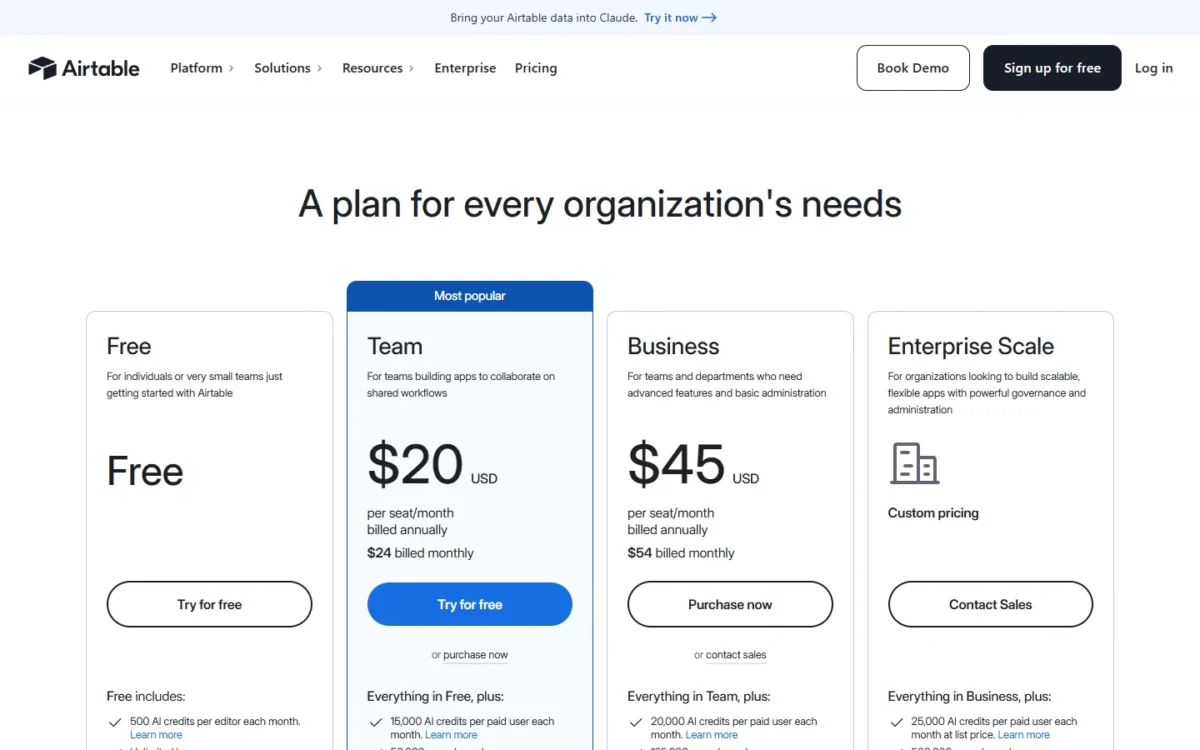
Airtable pricing has four plans: a $0 Free plan, then Team at $20 and Business at $45 per seat per month billed annually, or $24 and $54 billed monthly, while Enterprise Scale is custom pricing through sales.
A seat is a billable collaborator: anyone with Owner, Creator or Editor permissions on a paid plan, plus anyone with Commenter permissions on Team. Read-only collaborators, standalone form submissions and shared view links cost nothing.
Every price is in US dollars and billed per workspace on the self-serve plans, and I checked them on Airtable’s pricing page and Help Center in November 2026. A team of 10 users pays 10 x $20 x 12 = $2,400 a year on Team with annual billing, or 10 x $24 x 12 = $2,880 paying month to month.
Free fits up to 5 editors and 1,000 records per base. Team adds features such as extensions and Gantt and timeline views, with up to 50,000 records per base, and Business adds SAML single sign-on and an admin panel.
On an annual plan, a collaborator added mid-term is charged for the full remaining contract, and removing one does not cut the current invoice. Whether Airtable is the right tool at all is a question for my Airtable review; this page covers what you pay.
Quick pricing answer
Airtable’s entry paid plan is Team at $20 per seat per month billed annually ($24 billed monthly); Business is $45 ($54 monthly), and Enterprise Scale is quoted by sales.
Free costs $0 for up to 5 editors, and a new account’s first workspace gets a 14-day Team trial.
For a small team in one workspace, buy Team on annual billing: 5 users pay $20 x 5 x 12 = $1,200 a year. The caveat is that Team bills Commenters as seats and self-serve Business does not. Checked November 2026, in USD.
In This Article (14 sections)
Airtable Pricing at a Glance
Team is the first paid plan at $20 per seat per month on annual billing, and Business raises the record cap from 50,000 to 125,000 records per base.
| Plan | Annual billing | Monthly billing | Best for | Main limitation |
|---|---|---|---|---|
| Free | $0 | $0 | One person or up to 5 editors | 1,000 records per base, 100 automation runs |
| Team | $20 per seat per month, billed annually | $24 per seat per month, billed monthly | Small teams working in one workspace | 50,000 records per base; Commenters are billed |
| Business | $45 per seat per month, billed annually | $54 per seat per month, billed monthly | Departments that need SSO and an admin panel | 125,000 records per base; private email domain required |
| Enterprise Scale | Custom pricing | Contact sales | Organizations that need audit logs and DLP | No published price |
Sources: Airtable’s pricing page and Airtable plans overview, checked November 2026.
Price history: At every check (January 2024, January 2025, January 2026 and today), Team cost $20 per seat a month, billed annually. Earlier prices come from archived copies of Airtable’s pricing page, and my SaaS and AI price index tracks the same entry-plan prices across other tools.
These are US list prices in USD per billable collaborator per month, read on November 7, 2026. The annual column is a monthly equivalent of a yearly commitment, not a monthly bill, and the pricing page does not state whether prices include tax.
Who Counts as a Paid Seat in Airtable?
Airtable bills you for each billable collaborator, meaning anyone with Owner, Creator or Editor permissions on a workspace, base or interface, and on Team also anyone with Commenter permissions. How the four plans treat each role:
- Free: up to 5 editors and 50 commenters per workspace, unlimited read-only collaborators, no charge.
- Team: Owners, Creators, Editors and Commenters are billed at $20 per collaborator per month on annual billing or $24 on monthly billing.
- Self-serve Business: Owners, Creators and Editors are billed at $45 or $54; Commenters are not billable.
- Sales-led Business and Enterprise Scale: billing terms are set with Airtable’s sales team.
Billing is attached to the workspace, not your account. A Team plan covers one workspace, while Business and Enterprise Scale cover unlimited workspaces, so three Team workspaces mean three separate bills.
Seats also hide below the workspace level: someone who looks non-billable in the workspace list is still billable through Editor access to a single base or interface. Audit base and interface sharing before you budget.
Airtable words the Team rule two ways. The pricing page FAQ says Team and Business charge “for all users who have edit permissions for at least one base in the workspace.” The help center’s billing article and plans overview state that on Team plans, Commenters are billable. This guide follows the help center, which names each permission by plan; if your team relies on commenters, ask Airtable which rule your invoice uses.
The cheap fix on Team is Airtable’s own advice: give reviewers who only need to look Read-only permissions instead of Commenter. External partners can use Portals, where a guest with Editor permissions takes a portal seat, unless the same person edits portals in more than one base, which bills them as an internal editor.
Airtable Pricing Plans Explained
Free costs $0, Team $20, Business $45 per seat per month on annual billing, and Enterprise Scale is quoted; the first limit I would check before choosing is records per base.
Free
Free gives a workspace up to 5 editors, 50 commenters and unlimited read-only collaborators, with 1,000 records per base, 100 automation runs and 1,000 API calls a month, 1 GB of attachments per base and 500 AI credits per editor each month.
History lasts 2 weeks, and extensions, record coloring and form branding removal are not supported.
Free works for one person, or a few people building a tracker that stays under 1,000 records. The upgrade arrives with the 6th editor, the 51st commenter, or the record that pushes a base past 1,000.
Team
Team costs $20 per billable collaborator per month billed annually, a $240 yearly commitment per seat, or $24 billed monthly. It raises the caps to 50,000 records per base, 25,000 automation runs a month, 100,000 API calls a month and 20 GB of attachments per base.
Team also adds extensions, Gantt and timeline views, standard sync integrations, 1-year revision history and 15,000 AI credits per billable collaborator each month, all inside one workspace.
Team stops short of admin control: the admin panel, SAML single sign-on and two-way sync all start on Business.
My take
Team is the plan I would start a small team on, as long as its reviewers can be Read-only and no base is heading past 50,000 records. Plan the move to Business as soon as either condition breaks, because both raise the bill.
Business
Business costs $45 per billable collaborator per month billed annually, $540 per seat a year, or $54 billed monthly. That is 2.25 times Team’s annual seat price ($45 / $20), and the money buys scale and control.
For that premium a base holds 125,000 records, the workspace gets 100,000 automation runs a month and unlimited API calls, and attachments reach 100 GB per base. Business also brings unlimited workspaces, the admin panel, SAML-based single sign-on, two-way sync, premium sync integrations, 2-year history and 20,000 AI credits per paid user each month.
Commenters stop counting as seats on self-serve Business, which can make it cheaper than Team for review-heavy teams. Business and Enterprise Scale also need a private email domain: a Gmail or Yahoo account cannot upgrade to either.
Enterprise Scale
Enterprise Scale is custom pricing through Airtable’s sales team; the pricing page lists no figure. It raises the caps to 500,000 records per base, 500,000 automation runs a month and 1,000 GB of attachments per base, with 3+ years of revision history.
It adds the Enterprise API, Enterprise Hub, HyperDB, audit logs and data loss prevention, and 25,000 AI credits per paid user each month at list price. Seats are charged for every user with edit permissions on at least one base in the organization.
Call sales when a base is heading past 125,000 records, or when a security review asks for audit logs and DLP.
Does Airtable Have a Free Plan or Trial?
Yes: Airtable has a Free plan with no charge, and a new account’s first workspace starts a complimentary 14-day trial of Team automatically. Workspaces you create later on the same account get no trial.
The trial caps attachments at 10 GB per base and AI credits at 7,500 per editor a month, and it leaves out the Run a script automation action and premium form features.
Watch the payment step: adding a payment method during the trial upgrades the workspace to Team and starts billing. You cannot extend the trial yourself, and when the 14 days end the workspace can stay on Free.
Students and educators with a .edu email address get a 120-day Team trial instead, starting when they create a workspace.
Monthly vs Annual Airtable Pricing
Annual billing saves $4 per seat per month on Team ($24 – $20) and $9 on Business ($54 – $45), which is $48 and $108 per seat a year.
| Plan | Monthly billing | Annual billing | Year on monthly billing | Year on annual billing | Saving per seat a year |
|---|---|---|---|---|---|
| Team | $24 per seat per month | $20 per seat per month | $24 x 12 = $288 | $20 x 12 = $240 | $48 |
| Business | $54 per seat per month | $45 per seat per month | $54 x 12 = $648 | $45 x 12 = $540 | $108 |
Sources: Airtable’s pricing page, checked November 2026.
Both plans discount annual billing by about 16.7% ($4 / $24 and $9 / $54). The catch is the seat lock: a collaborator added to an annual plan is charged for the full remaining contract, and removing one keeps the seat paid until renewal. Airtable itself recommends a monthly cycle when team size fluctuates.
You can switch either way. A monthly workspace moved to annual is invoiced at the end of the current month for 12 months at the annual rate; an annual workspace moved to monthly stays annual until its cycle ends. Plans renew automatically on either cycle.
My take
Annual billing pays off when a seat stays most of the year: a year of Team at $20 x 12 = $240 costs the same as $240 / $24 = 10 months on monthly billing. I would pick monthly billing if your headcount will swing within the year.
Limits That Force an Airtable Upgrade
Records per base is the cap I would check first: 1,000 on Free, 50,000 on Team, 125,000 on Business and 500,000 on Enterprise Scale.
| Limit | Free | Team | Business | Enterprise Scale |
|---|---|---|---|---|
| Records per base | 1,000 | 50,000 | 125,000 | 500,000 |
| Automation runs per month | 100 | 25,000 | 100,000 | 500,000 |
| Attachment space per base | 1 GB | 20 GB | 100 GB | 1,000 GB |
| Editors per workspace | 5 | Unlimited | Unlimited | Unlimited |
| Workspaces | 1 | 1 | Unlimited | Unlimited |
Sources: Airtable’s pricing page, checked November 2026.
The record cap counts every table in a base together: a base with two 25,000-record tables is at Team’s limit, just like one with a single 50,000-record table.
Hitting a cap does not lock you out. At the record or attachment limit, bases stay usable and no data is removed, but you cannot add records or attachments until you upgrade. Automation runs and API calls stop at the plan’s cap.
Automation runs reset on the first day of each month, not on your billing date, and failed or canceled runs count. A misfiring automation can use up Free’s 100 runs quickly, so watch the count after you build one.
Additional Airtable Costs to Consider
Two add-ons carry published prices. AI credit packs cost $20 a month or $200 a year for 10,000 monthly credits. Portals on Team start from $120 a month for 15 guests, and Portals on Business from $150 a month for 15 guests.
| Cost type | When it applies | Pricing basis | Notes |
|---|---|---|---|
| AI credit packs | Included credits run out before month end | $20 a month or $200 a year for 10,000 monthly credits, up to $800 a month or $8,000 a year for 400,000 | Free must upgrade to Team to buy packs |
| Portals on Team | External users need to edit or comment | From $120 a month for 15 guests | Packs of 15, 25, 50, 100 and 200 |
| Portals on Business | External users need to edit or comment | From $150 a month for 15 guests, $127.50 a month on annual Business | Enterprise Scale: Contact sales |
| Professional Services | Qualified Business and Enterprise Scale customers | Add-on, no published price | Sold as service packages |
| Ask An Expert | Expert help beyond in-product and email support | Add-on, no published price | Listed in the support rows |
Sources: Airtable’s pricing page, Airtable AI billing and Airtable Portals help article, checked November 2026.
Included AI credits are pooled across the workspace on Team, so a team of 10 users on Team shares 10 x 15,000 = 150,000 credits a month. Airtable’s own estimate puts a 10-page contract analysis at about 200 credits, which makes that pool roughly 750 such analyses a month (150,000 / 200). Included credits expire at the end of each month, and Airtable’s AI billing page says Team workspaces get an email alert past 75% of the limit.
A credit pack is cheaper on annual billing: $20 x 12 = $240 a year bought monthly against $200 a year bought annually, a $40 difference for the 10,000-credit pack.
Portals is where outside users stop costing full seats. Priced month to month, fifteen client editors as Team seats would cost 15 x $24 x 12 = $4,320 a year, while the 15-guest Portals pack on Team, from $120 a month, costs $120 x 12 = $1,440 a year. Read-only portal users are not billable at all.
How Much Does Airtable Cost for Your Team?
Seats drive the bill: 10 users cost 10 x $20 x 12 = $2,400 a year on Team with annual billing or 10 x $24 x 12 = $2,880 on monthly billing, and 25 users on Business annual cost 25 x $45 x 12 = $13,500.
Airtable cost calculator
This calculator needs JavaScript. The scenario table below gives the same estimate for typical workloads.
Enter what you need. The calculator prices it on every plan at list prices and names the cheapest plan that covers it.
- List prices in USD from Airtable’s official pricing pages, checked Nov 7, 2026. Tax and regional prices are not included.
- 12-month figures are 12 times the monthly cost at the billing you choose.
- A planning estimate at list prices, not a quote.
Enter how many billable people you have, choose monthly or annual billing and tick what your bases need: more than 1,000 or 50,000 records in a base, the admin panel with SSO, or Gantt and timeline views. The calculator shows Free, Team and Business side by side for your team size, with a monthly and a yearly total for each plan. It leaves out Enterprise Scale (custom pricing), AI credit packs, Portals and tax.
| Team size | Plan | Billing | Monthly equivalent | Annual total | Assumptions |
|---|---|---|---|---|---|
| 1 user | Free | No charge | $0 | $0 x 1 x 12 = $0 | Under 1,000 records per base and 100 runs a month |
| 5 users | Team | Annual | $20 x 5 = $100 | $20 x 5 x 12 = $1,200 | A base over 1,000 records; no commenters |
| 10 users billed annually | Team | Annual | $20 x 10 = $200 | $20 x 10 x 12 = $2,400 | Under 50,000 records per base; no commenters |
| 10 users billed monthly | Team | Monthly | $24 x 10 = $240 | $24 x 10 x 12 = $2,880 | Same team, billed month to month |
| 25 users | Business | Annual | $45 x 25 = $1,125 | $45 x 25 x 12 = $13,500 | A base over 50,000 records; commenters free |
Sources: Airtable’s pricing page, checked November 2026.
Each total is list price x billable seats x months, an estimate from published prices that leaves out AI credit packs, Portals and tax. Moving those 10 users from monthly to annual billing saves $2,880 – $2,400 = $480 a year.
When Business Costs Less Than Team: The Commenter Math
Business costs less than Team once Commenters outnumber editors by more than 1.25 to 1, because Team bills every Commenter and self-serve Business bills none.
On annual billing, Team costs $20 x (editors + commenters) per month and Business costs $45 x editors. The two are equal when commenters = 1.25 x editors, and the same ratio holds on monthly prices ($24 x 2.25 = $54).
| Setup | Team, Commenters billed | Business, Commenters free |
|---|---|---|
| 12 users: 8 users who edit, 4 who comment | 12 x $20 x 12 = $2,880 | 8 x $45 x 12 = $4,320 |
| 18 users: 8 users who edit, 10 who comment | 18 x $20 x 12 = $4,320 | 8 x $45 x 12 = $4,320 |
| 20 users: 8 users who edit, 12 who comment | 20 x $20 x 12 = $4,800 | 8 x $45 x 12 = $4,320 |
| 20 users: 8 users who edit, 12 who only view | 8 x $20 x 12 = $1,920 | 8 x $45 x 12 = $4,320 |
Sources: Airtable’s pricing page and Airtable billing article, checked November 2026.
The last row is the cheaper answer for most review-heavy teams: if reviewers only need to see records, Read-only keeps them free on Team. Business wins when they must comment, or when the team also needs the admin panel, SSO or bigger bases.
Which Airtable Plan Should You Choose?
Pick the lowest plan whose record cap and admin needs fit, and count Commenters before you pick Team.
| Your needs | Plan to consider | Why | Main limitation |
|---|---|---|---|
| Up to 5 editors, every base under 1,000 records | Free | No upgrade needed; $0 | 100 automation runs a month; 2-week history |
| Small team, one workspace, bases under 50,000 records | Team, annual billing | $20 per seat per month, $240 a seat a year | Commenters are billed; no SSO or admin panel |
| Headcount changes during the year | Team, monthly billing | $24 per seat; removals drop off at the next cycle | ($24 – $20) x 12 = $48 more per seat a year |
| A base over 50,000 records, SSO, admin panel or two-way sync | Business | 125,000 records per base and admin control | $45 per seat; private email domain required |
| Commenters outnumber editors by more than 1.25 to 1 | Business | Commenters are not billable on self-serve Business | Costs more if reviewers can be Read-only on Team |
| 500,000-record bases, audit logs or DLP | Enterprise Scale | Highest caps and governance tools | Custom pricing through sales |
| A qualifying nonprofit or educational institution | Nonprofit or Education Team plan | $12 per collaborator per month | No annual discount; Airtable AI cannot be added |
Sources: Airtable’s pricing page and Airtable nonprofit, education and student plans, checked November 2026.
If two rows fit, the record cap decides: a team whose base needs more than 50,000 records is on Business whatever its commenter count.
Is Airtable Worth the Price?
Airtable is worth $20 a seat for a team that runs linked records and automations in bases that stay under 50,000 records; it is a weaker buy for teams whose reviewers must comment on Team, or who only need task lists.
The bill climbs in three places: Commenters on Team, the 2.25 times jump to Business when one base outgrows 50,000 records, and Portals from $120 a month per 15 guests.
My take
Pay for Team when the bases replace spreadsheets that several people edit every day. Skip Airtable if the work is mostly assigning and tracking tasks, because a task-first tool fits that job better.
Two cheaper routes come first: stay on Free while you have 5 editors or fewer, or keep reviewers Read-only on Team. If Airtable still looks like the wrong shape, compare an alternative:
- A task-first team: Asana’s per-seat prices.
- Databases inside documents: my Notion pricing guide.
- Spreadsheet-style project tracking: Smartsheet’s plans and limits.
- A wider search: project management tools ranked by team fit.
Billing, Discounts and Cancellation
Qualifying nonprofits and educational institution employees get 50% off the monthly Team rate, $12 per collaborator per month ($144 a year), and the annual discount does not stack on top.
Most US nonprofits apply from an existing Airtable account with an IRS letter showing 501(c)(3) status, and have 4 weeks after approval to activate the plan. The discount covers Team only, is paid by credit card, and cannot add Airtable AI; eligible nonprofits and educators can also ask for 50% off Portals.
Students can get free Team accounts for a single workspace for 6 to 24 months, depending on approval and expected graduation date.
Team and self-serve Business are paid by card through the workspace; the billing overview also lists debit cards, bank debits, ACH for US customers, Apple Pay and Google Pay, and says cards with 3D Secure enabled do not work. Every plan is billed in USD regardless of location.
Cancelling means downgrading, which takes effect at the end of the current billing cycle; plans renew automatically until then. A declined payment drops a paid workspace to Free on its own. Airtable does not publish a refund window on its pricing page.
How I Verified Airtable Pricing
Every price here comes from airtable.com/pricing and the Airtable Help Center, read on November 7, 2026 in USD; a copy of the pricing page served to a US visitor showed the same prices.
The billing rules come from the help center’s plans overview, its collaborator billing article and its billing overview. Downgrade and renewal terms come from the plan change article, and add-on terms from the AI billing, Portals and discounted-plans articles.
Published prices are quoted as Airtable lists them, per billable collaborator per month. Annual totals (list price x seats x months, seats only) are my calculations, not quotes.
The plan advice and the commenter break-even are my analysis of those figures. Where the pricing page FAQ (“edit permissions”) and the help center (Commenters billable on Team) differ, this page follows the help center. Airtable does not publish Enterprise Scale or sales-led Business prices, whether prices include tax, or prices for Professional Services, Ask An Expert, Enterprise Key Management or Portals packs above 15 guests.
Frequently Asked Questions
Can I pay Airtable by invoice?
Yes, but only on Business or Enterprise Scale bought through Airtable’s sales team, which can issue an annual invoice paid by PO, ACH, wire or check. Team and self-serve Business bought in workspace settings are paid by card, and one card at a time: Airtable does not support split payments.
What happens to my data if I downgrade to Free?
Nothing is deleted. Bases over Free’s 1,000-record limit keep their records but cannot add new ones, including through forms or the API. Revision history shrinks to 2 weeks, and snapshots outside that window are removed for good, even if you upgrade again later.
Does every Airtable plan include AI?
Yes. All plans include monthly AI credits: 500 per editor on Free, 15,000 per billable collaborator on Team, 20,000 per paid user on Business and 25,000 per paid user on Enterprise Scale. Building apps and agents with Omni consumes no credits. The discounted nonprofit and education plans are the exception: Airtable AI cannot be added to them.
Final Pricing Verdict
Buy Team on annual billing if you are a small team in one workspace whose bases stay under 50,000 records: $20 per seat per month, $240 a seat a year. Stay on Free while you have 5 editors or fewer and no base passes 1,000 records.
Move to Business when a base heads past 50,000 records, when IT requires SAML single sign-on or the admin panel, or when Commenters outnumber editors by more than 1.25 to 1 and those reviewers must comment, not only view. Pay monthly instead if headcount will change within the year, since annual seats added mid-term are billed for the rest of the contract.
- Skip it if:
- your team mostly assigns and tracks tasks and never needs linked records; a task-first tool fits that job better.
Final recommendation
Most small teams: Team, annual billing, $20 per seat per month. Up to 5 editors under 1,000 records: Free.
Large bases, SSO or many commenters: Business at $45 per seat per month billed annually. Audit logs, DLP or 500,000-record bases: Enterprise Scale, priced by sales.