
Zoho Inventory suits small ecommerce and wholesale sellers who stay under its per-organization caps. Standard covers 500 orders a month, 3 users and 2 locations for $29 per organization per month, billed annually. It gets expensive the day serial or batch tracking forces Premium at $79.
This Zoho Inventory review covers the US edition as its pricing page and help center stood in October 2026. My short answer: start on Standard when you need no traceability, and price the add-ons before you accept an upgrade.
Quick verdict
- Worth it for: Zoho Inventory fits sellers with up to 10 users on Shopify, Amazon, Etsy or eBay US who want one stock count across channels.
- Skip it if: you need production planning, or list on a marketplace in a currency other than your base currency.
- Main strength: pricing per organization, so Premium covers 5 users for $79 a month in total, billed annually.
- Biggest limit: serial and batch tracking start on Premium; Standard stops at 3 users and 500 orders a month.
- Price basis: $29 to $249 per organization per month billed annually, or $39 to $299 billed monthly, before local taxes.
In This Article (11 sections)
Zoho Inventory at a Glance
Zoho Inventory is Zoho’s inventory and order management app, and its US edition prices every plan per organization rather than per user.
- Category: inventory and order management, US edition
- Best for: small sellers on Shopify, Amazon, Etsy or eBay US, and small wholesalers
- Starting price: $29 per organization per month billed annually, or $39 billed monthly
- Free plan or trial: a Free plan for 1 user, 50 orders and 1 location; a 14-day trial of any paid plan
- Main limitation: orders, users and locations are capped per plan, and tracking starts on Premium
Two Zoho products sit close by and are not reviewed here: the Zoho Inventory add-on inside Zoho Books, and Zoho Commerce, which appears below only as a sales channel.
Zoho Inventory Pros and Cons
Zoho Inventory’s strengths come from flat per-organization pricing and native channel sync; its downsides are hard plan caps and sync conditions.
Pros
- Pricing is per organization, so Premium’s 5 users cost $79 a month in total on annual billing, not $79 per seat
- The Free plan includes composite items, dropshipment and backordering, enough for one person handling 50 orders
- Native sync with Amazon, Etsy, eBay US, Shopify and Zoho Commerce pushes one stock level to every connected channel
- Zoho Books shares Zoho Inventory’s core, so a Zoho Books user sees the same orders and bills in both apps once the two apps are connected
- Add-ons raise one cap at a time: a Users add-on or 500 extra orders lists $7.5 per organization per month, billed annually
Cons
- Standard stops at 3 users, 500 orders a month and 2 locations, so a fourth team member means an add-on or Premium
- Serial number tracking, batch tracking and barcode generation start on Premium, $50 a month above Standard on annual billing ($79 − $29)
- Plus and Enterprise both include 10 users, so the $249 top plan buys orders and locations, not more people
- Marketplace sync requires the marketplace currency to match your base currency and the SKUs to match
- Amazon sync records are deleted after one month when successful and two months when failed, so keep your own log
Most of those points trace back to four features, and two of them, locations with bins and serial and batch tracking, change with the plan.
Zoho Inventory Features
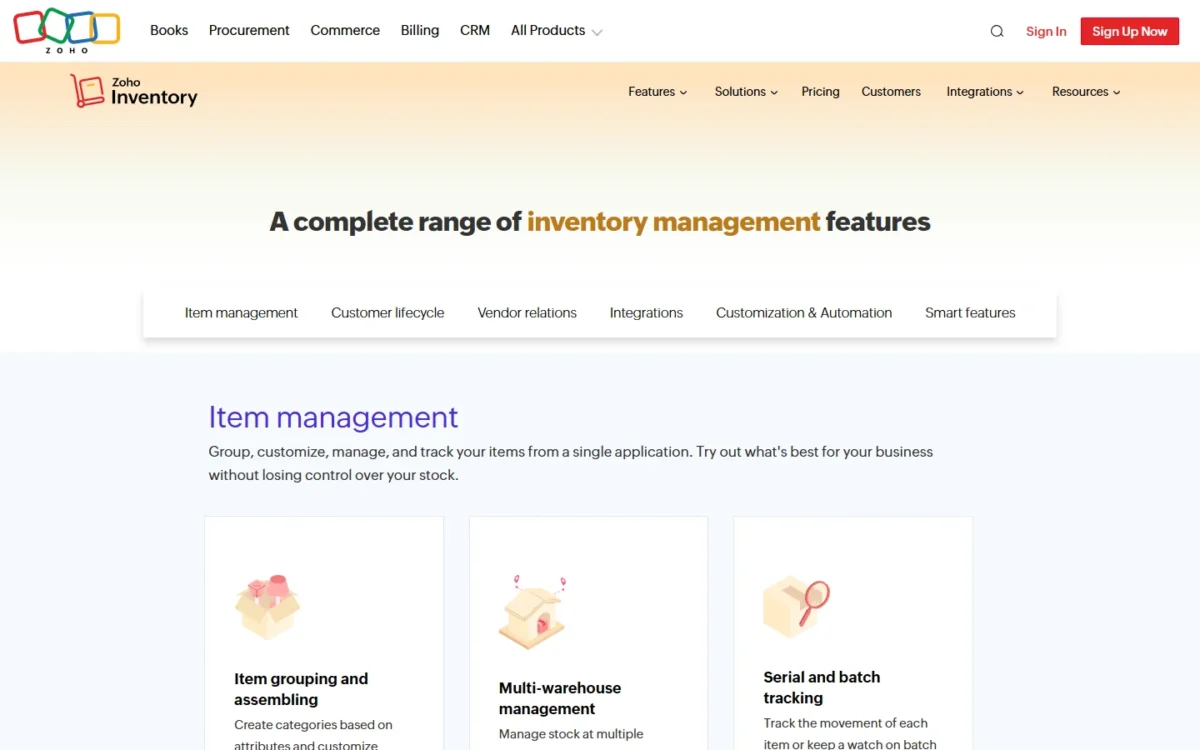
Four features decide whether Zoho Inventory fits: the order-to-shipment flow, multichannel sync, locations and bins capped per plan, and serial and batch tracking from Premium.
From customer order to shipment
Yes, Zoho Inventory runs a customer order through to delivery in one record. A sales order converts into an invoice, then packing slips, real-time shipping rates and shipping labels follow.
Carriers connect directly or through EasyPost, a shipment aggregator, and sales returns record a refund or apply credits to invoices.
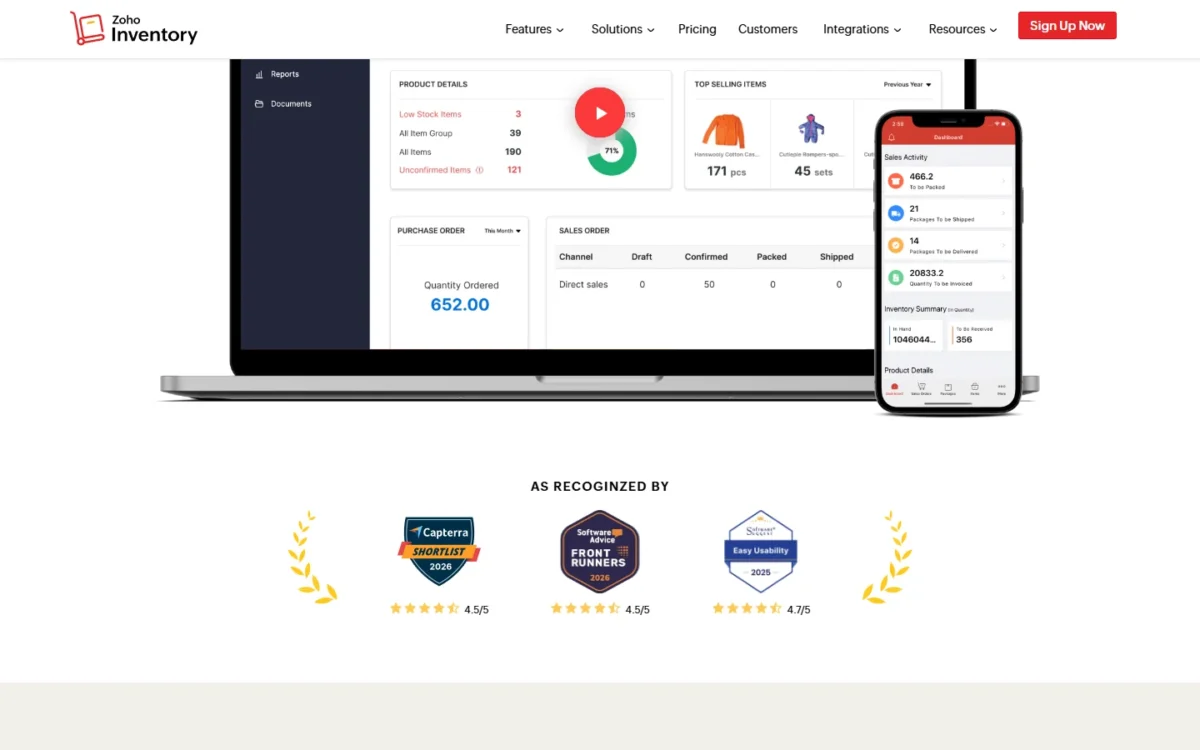
Purchase orders, vendor bills and drop shipments live in the same app. For a wholesaler, the Crossfire EDI integration receives orders and passes them to 3PL providers, which lifts the app beyond a store back office.
Multichannel sync with Shopify, Amazon, Etsy and eBay
Zoho Inventory connects natively to Amazon, Etsy and eBay US, plus the Shopify and Zoho Commerce shopping carts. A stock change in Zoho Inventory updates every connected channel, and an unfulfilled channel sale arrives as a sales order.
The catch is the starting stock. Shopify’s Fetch Stock Counts and Amazon’s stock fetch run only once, at the initial sync, so clean your channel counts before you connect.
Items flow one way: you add them on the channel and they come into Zoho Inventory, not the reverse. Several Shopify stores can connect to one organization.
Locations, warehouses and bins
Locations scale with the plan: 1 on Free, 2 on Standard, 4 on Premium, 6 on Plus and 10 on Enterprise. Bins start on Premium at 500 per location and reach 5,000 per location on Enterprise.
An extra location is a $10 add-on per organization per month, billed annually, so a third warehouse costs a Standard seller $10 a month before it costs an upgrade.
Multiwarehouse is switched on under Settings > Warehouses. Admins can restrict each warehouse to selected users, which keeps a packer at one site out of another site’s stock.
Serial and batch tracking
Yes, traceability needs Premium: serial number tracking, batch tracking, barcode generation and stock counting all sit in Premium’s list under “Everything in Standard +”.
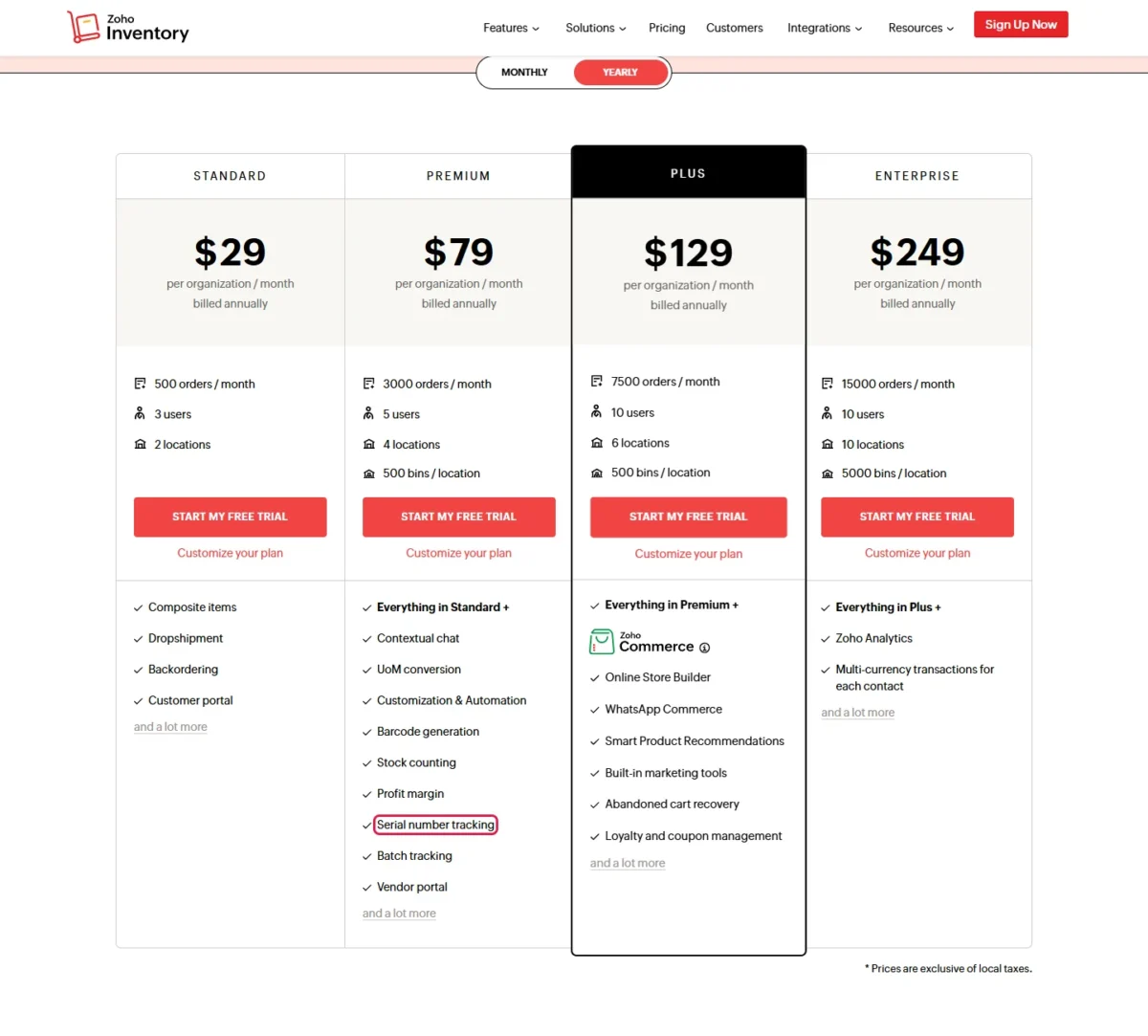
That makes $79 per organization per month, billed annually, the real entry price for a seller of perishables or warrantied goods. The add-ons cover users, orders, locations, advanced autoscans and advanced warehousing; none adds tracking to Standard.
Premium also adds Customization & Automation, the area that holds webhooks, Deluge custom functions and email or field-update workflow rules.
Zoho Inventory Ease of Use
The Zoho Inventory help center documents each setup step: imports, multi-warehouse, and channel prerequisites such as matching SKUs and currency.
Imports take CSV or TSV files into any module in three steps (configure, map fields, preview), and Zoho Inventory maps similar fields automatically. The Shopify connection needs the same email address on both accounts.
The channel help pages list prerequisites to meet before you connect. Tax must be enabled before integration, and each item must already exist on the channel with the SKU it will carry in Zoho Inventory.
The 14-day trial runs on any paid plan and lets you switch between plans to try plan-specific features. Connect one real channel with your own SKUs during the trial; if that sync holds, the rest is plan choice. Zoho also offers a demo on request.
An organization that does not subscribe after the trial moves to the Free plan, so nothing is billed by default.
Zoho Inventory Pricing
Zoho Inventory costs $29, $79, $129 or $249 per organization per month billed annually for Standard, Premium, Plus and Enterprise, or $39, $99, $159 and $299 billed monthly. Prices exclude local taxes.
The plan you need is set by four things: orders, users, locations and tracking.
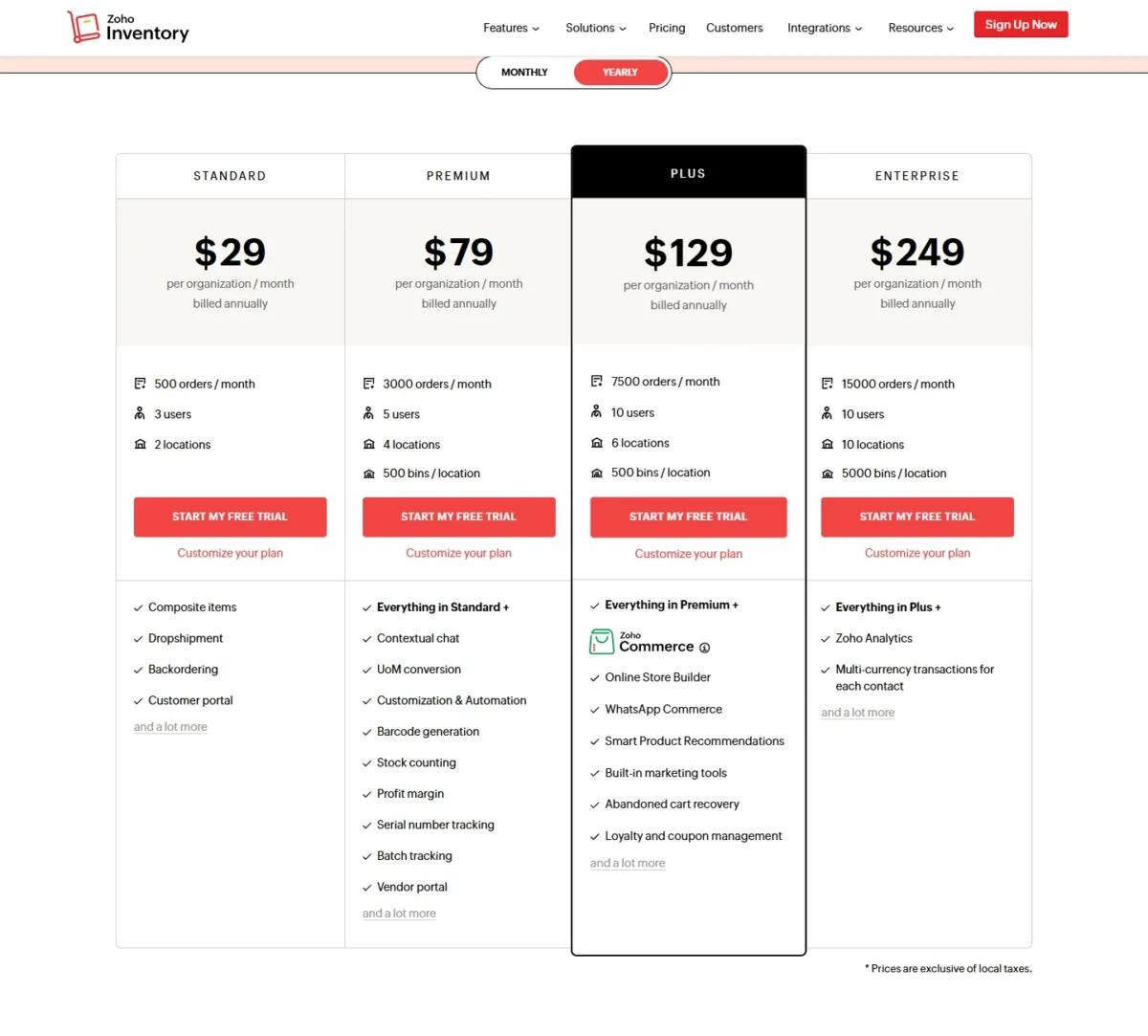
| Plan | Annual billing, per org per month | Monthly billing, per org per month | Orders | Users | Locations |
|---|---|---|---|---|---|
| Free | Free | Free | 50 | 1 | 1 |
| Standard | $29 | $39 | 500 a month | 3 | 2 |
| Premium | $79 | $99 | 3,000 a month | 5 | 4 |
| Plus | $129 | $159 | 7,500 a month | 10 | 6 |
| Enterprise | $249 | $299 | 15,000 a month | 10 | 10 |
Sources: Zoho Inventory US pricing page, yearly and monthly views, US dollars, checked October 2026.
A three-person Shopify store shipping 400 orders a month from 2 locations fits Standard: $29 x 12 months = $348 a year billed annually, or $39 x 12 months = $468 billed monthly. Pay monthly only until you know you will stay.
A four-person wholesaler handling 1,200 orders a month without batch tracking outgrows Standard on users and orders.
Standard plus one Users add-on and two 500-order add-ons costs $29 + $7.5 + $7.5 + $7.5 = $51.50 a month billed annually, or $51.50 x 12 months = $618 a year.
Premium would cost the same team $79 x 12 months = $948 a year. Its $50 monthly step over Standard ($79 − $29) covers six $7.5 add-ons (6 x $7.5 = $45). Add-ons win while they total less than Premium’s $50 step; past six add-ons, or once a Premium-only feature such as batch numbers is on your list, take Premium.
Plus earns its $129 in two cases: you want Zoho’s storefront tools, such as Online Store Builder and abandoned cart recovery, or Premium’s order and user add-ons would pass $50 a month ($129 − $79).
A seller at 7,500 orders a month on Premium would pay $79 + 9 x $7.5 = $146.50 a month, more than Plus.
Enterprise at $249 adds Zoho Analytics and multi-currency transactions for each contact, with the same 10 users as Plus.
Pricing note
Monthly billing costs $10 to $50 more per month than annual billing, from Standard ($39 − $29 = $10) to Enterprise ($299 − $249 = $50).
If those caps already feel tight, my ranking of the best inventory management software sets Zoho Inventory beside tools built for larger teams and for manufacturing.
If you want every plan and add-on laid out, see my Zoho Inventory pricing guide.
Integrations and Support
Zoho Books shares Zoho Inventory’s core, so joining the two syncs contacts, items, sales orders, purchase orders and bills, and new work in one app appears in the other.
A reader unsure where stock control ends and bookkeeping starts can first settle what accounting software does.
QuickBooks Online is the other accounting integration the help center lists, without describing what syncs. Check that scope during the trial; my QuickBooks Online review covers the accounting side.
Zoho Inventory also integrates with Zoho CRM to add leads and prospects automatically, useful when a wholesaler’s reps work accounts there. My Zoho CRM review weighs that CRM for a small sales team.
Support runs 24/5 at no charge, and a premium support plan adds a dedicated support manager. For security, the pricing page points to Zoho’s company-wide security page rather than listing Zoho Inventory certifications.
Who Should Use Zoho Inventory?
Zoho Inventory fits sellers with up to 10 users and 15,000 orders a month who sell on its native channels. It does not fit manufacturers that need production planning, Zoho Books Elite or Ultimate users, or sellers listing in a second currency.
Best for
- A 1-3 person store under 500 orders a month on 2 locations, which Standard covers at $29 a month billed annually
- A team of up to 5 that needs serial or batch tracking, the job Premium does at $79 a month billed annually
- A seller on Amazon, Etsy, eBay US and Shopify who wants one stock level pushed to every channel
- A business already on Zoho Books or QuickBooks Online that wants inventory beside its books
Not ideal for
- A manufacturer that needs production planning, which Katana’s plans cover with manufacturing management
- An operation that needs more than 10 users or 15,000 orders a month, the most Enterprise includes before add-ons
- A seller whose marketplace currency differs from its base currency, which the sync prerequisites rule out
- A Zoho Books Elite or Ultimate user, who can switch on the Zoho Inventory add-on inside Books instead
A service business that bills clients but holds no stock needs none of this; my Zoho Invoice review covers Zoho’s lighter invoicing app.
Zoho Inventory vs Competitors
Sortly fits simple item tracking with a free plan, Cin7 Core fits operations that need unlimited inventory locations from $349 a month, and Katana fits manufacturers.
| Software | Best for | Starting price | Key difference | Main trade-off |
|---|---|---|---|---|
| Zoho Inventory | Small multichannel sellers and wholesalers | $29 per organization per month, billed annually | Native Amazon, Etsy, eBay US and Shopify sync | Tracking starts on Premium at $79 |
| Sortly | Teams that track items and stock counts | Free plan at $0 | Free plan counts 100 unique items, while Zoho Free counts 50 orders and 1 location | 1 user license on the free plan |
| Cin7 Core | Operations that need unlimited inventory locations | Standard at $349 a month | Unlimited inventory locations and 5 users on Standard | 6,000 sale orders a year on Standard |
| Katana | Manufacturers | Free plan at $0 | Manufacturing management, unlimited users on Free | Up to 30 SKUs free; Advantage is a custom annual contract |
Sources: Zoho Inventory pricing, Sortly pricing, Cin7 pricing, Katana pricing, checked October 2026.
Cin7 Core’s Standard plan allows 6,000 sale orders a year, 500 a month on average (6,000 / 12), the volume Zoho Standard covers for $29. Cin7’s $349 buys 5 users and unlimited inventory locations, not more orders. If Cin7 Core is still on your shortlist, read my Cin7 review.
Katana’s Advantage plan has no fixed price, so a manufacturer gets a quote rather than a price list. If you make the goods you sell, read my Katana review.
How I Evaluated Zoho Inventory
In October 2026 I read Zoho Inventory’s US pricing page in its yearly and monthly views, and its features page. I also read its help-center articles on subscriptions, sales channels, Shopify, Amazon, accounting, warehouses, imports and shipping. I read the pricing pages of Sortly, Cin7 and Katana in the same month.
The facts come from those official pages; the cost scenarios and plan-fit calls are my analysis of them. Zoho’s pricing and help pages do not publish a total integration count or Zoho Inventory security certifications.
FAQ
Is Zoho Inventory free?
Yes. Zoho Inventory has a forever-free plan for 1 user, 50 orders and 1 location. The help center says the Free plan has no validity period but limited feature access, so it works as a long-term home for a one-person shop, not only as a trial.
Is there a discount for nonprofits?
Yes, Zoho offers nonprofits a 15% discount on Zoho Inventory. Zoho asks nonprofits to email its presales team at presales@zohoinventory.com. Ask for it before you commit to annual billing.
Can I cancel or downgrade anytime?
Yes. Zoho Inventory has no contract, and you can upgrade or downgrade when you choose. Cancelling means downgrading to the Free plan, which you can schedule for the end of the current billing cycle; your existing data is retained.
Zoho Inventory Review: Final Verdict
Yes, Zoho Inventory is worth it for a small seller that fits Standard or Premium and sells on Amazon, Etsy, eBay US, Shopify or Zoho Commerce. Start the 14-day trial on the plan your order volume needs. Connect one real channel with your own SKUs, and confirm the initial stock fetch before you pay.
Its biggest trade-off is the Premium gate. A store that needs batch numbers pays $79 a month on annual billing from the first day. A store short only on users or orders can stay on Standard with up to six $7.5 add-ons, the most that still cost less than Premium’s step ($79 − $29 = $50).
A manufacturer that needs production planning should shortlist Katana instead. A team past 10 users can stay on Enterprise and buy Users add-ons at $7.5 per organization per month, billed annually. An operation that needs unlimited inventory locations should price Cin7 Core.