
Cin7 Core suits product sellers with 5 to 15 users who need channels, accounting sync and assembly in one system at $349 to $1,199 a month. Very small shops and multi-entity EDI operations should look elsewhere.
This Cin7 review covers Cin7 Core, whose login still runs on inventory.dearsystems.com. Cin7 Omni is a separate, quote-priced edition, and every Omni fact below is labelled “Omni”.
Quick verdict
- Worth it for: Cin7 Core fits sellers with 5 to 15 users on 2 to 6 channels who need accounting sync plus assembly or batch tracking.
- Skip it if: 3 users, 2 locations and no batch tracking cover you (a $29 plan elsewhere does that), or you run several entities on native EDI (Omni territory).
- Main strength: assembly, batch and expiry tracking, unlimited inventory locations and Xero or QuickBooks Online sync on every tier.
- Biggest limit: 2 integrations and 6,000 sale orders a year on Standard, with API, POS and forecasting sold as add-ons at unpublished prices.
- Price basis: $349, $599 or $1,199 a month, USD excluding taxes, for new customers.
In This Article (13 sections)
Cin7 Core at a Glance
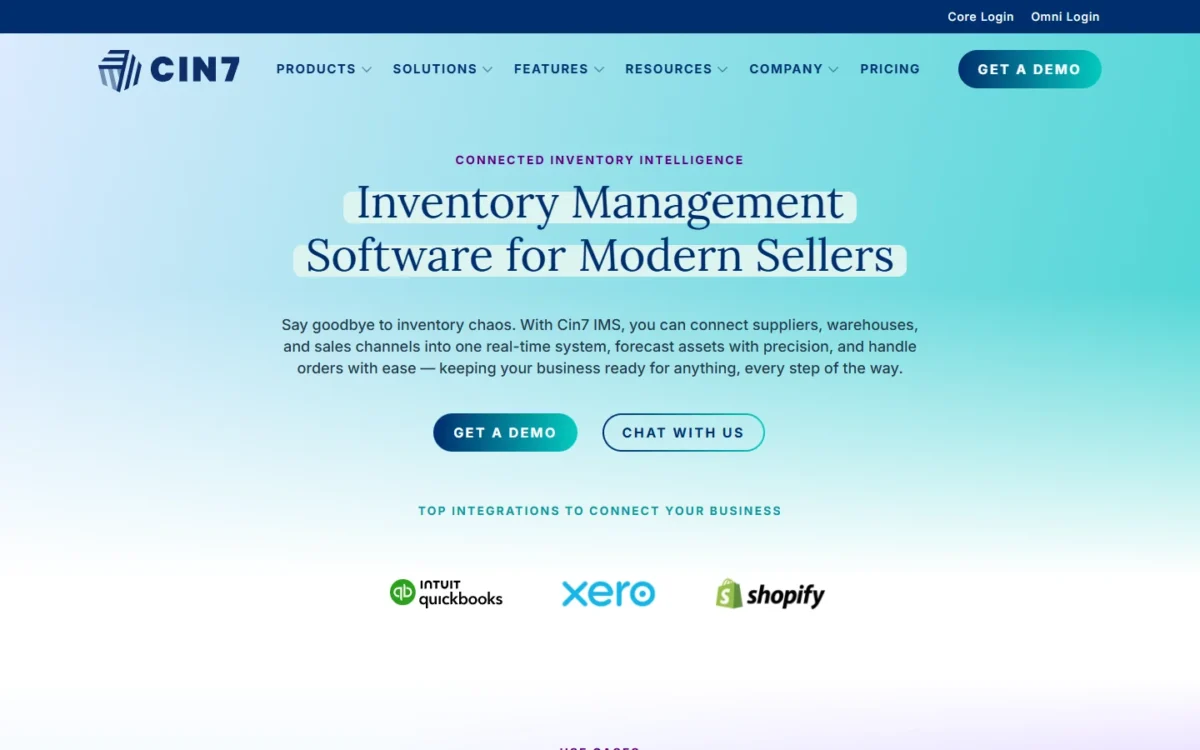
Cin7 Core is cloud inventory and order software for manufacturers, retailers, e-commerce sellers and wholesalers, with 5 users on its entry tier and a 14-day free trial.
- Category: inventory and order management with assembly manufacturing
- Best for: product sellers with 5 to 15 users across 2 to 6 sales channels
- Starting price: $349 a month on Standard, USD excluding taxes
- Free plan or trial: no free plan; a 14-day free trial
- Inventory locations: unlimited on every tier
- Main limitation: 2 e-commerce and app integrations and 6,000 sale orders a year on Standard
The trial page offers “a 14-day free trial of Cin7” without naming the edition, so confirm the trial account runs Core before you load real data.
Cin7 Core vs Cin7 Omni: Which Edition Do You Need?
Cin7 Core is the edition with three published tiers, and it is the one reviewed here; Cin7 Omni is a separate edition that Cin7 prices by quote for multi-entity operations. The Core sign-in page sits on inventory.dearsystems.com, and dearsystems.com itself now opens Cin7’s homepage.
| Attribute | Cin7 Core | Cin7 Omni |
|---|---|---|
| Price basis | $349, $599 or $1,199 a month | Custom quote |
| Users included | 5, 10 or 15 | 8 |
| E-commerce and app integrations included | 2, 4 or 6 | 5 |
| Sale order volume | 6,000, 24,000 or 120,000 a year | N/A on the plan table |
| EDI and 3PL | Via API and partner solution | Native EDI and 3PL on the Omni page |
| Material requirements planning | Add-on on Standard, included on Pro | N/A on the plan table |
Sources: Cin7 pricing page and Cin7 Omni page, checked October 2026.
The Omni page sells “native EDI and 3PL integrations, advanced multi-entity support” for “companies looking to scale above Cin7 Core’s capabilities”. The shared plan table still lists EDI/3PL as “Via API & Partner Solution” for every plan, Omni included, so ask sales which applies to your retailers.
Omni is not simply Core with more on top: the plan table marks MRP, advanced production, advanced warehouse management, returns (RMA) and SKUs over 100K as “N/A” for Omni, without defining the mark.
Cin7 Core Pros and Cons
Pros
- Unlimited inventory locations on every tier
- Assembly, kits, BOM tracking and batch and expiration tracking on every tier, which food, beverage, health and beauty businesses often need
- Xero or QuickBooks Online sync on every tier, with new or existing accounts
- Over 700 app partners in Cin7’s directory, including EDI connectors such as SPS Commerce and Crstl
- 24/7 chat, a knowledge base and Cin7 Academy on every plan, before any Premium Support add-on
Cons
- Two integrations on Standard leave a seller with a web store, a marketplace and a shipping app one short
- API access is an add-on on every tier, which hurts a team that builds its own integrations
- POS and the B2B portal stay add-ons even on Advanced
- Cin7 publishes no prices for extra users, order volume, connections or add-ons, and its sales team quotes users, connections and modules, so the yearly total is unknown until a quote
- Multi-warehouse picking needs Pro plus an add-on, or Advanced
Cin7 Core Features
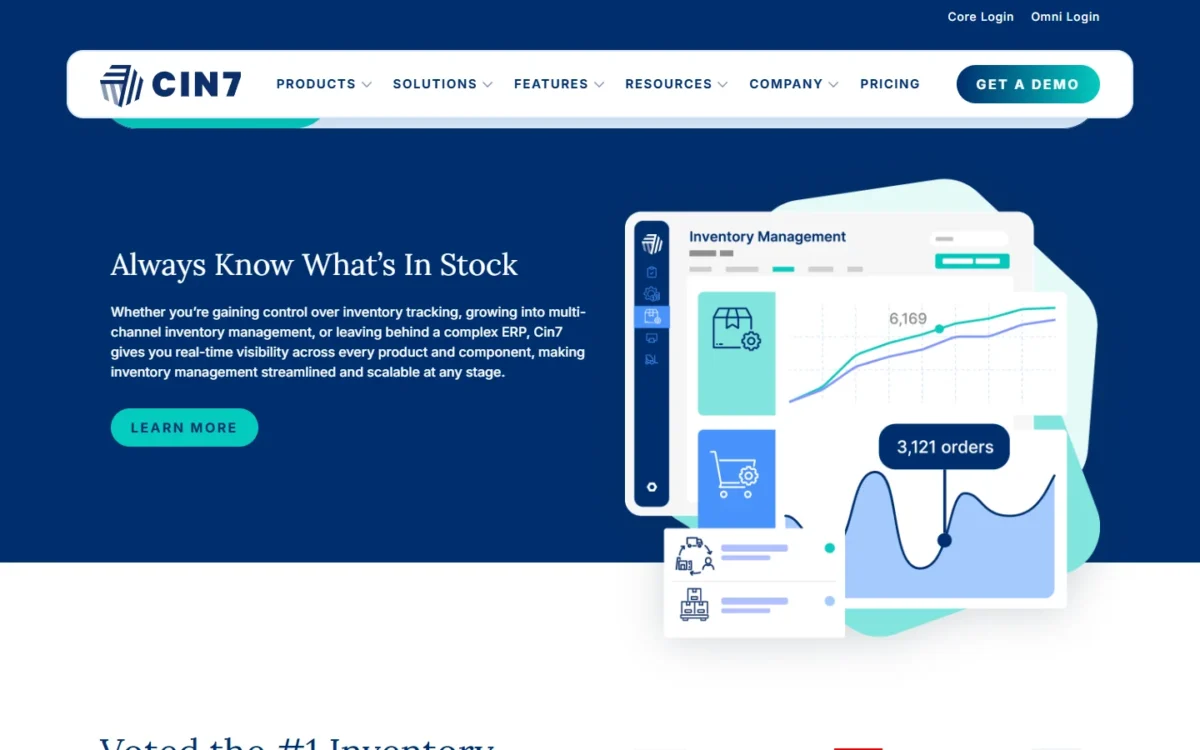
Six areas decide a Cin7 Core purchase: channel connections, accounting sync, assembly and MRP, warehouse management, reporting, and the add-ons, most of them gated differently by tier.
Multichannel orders and the connection allowance
The connection allowance grows from 2 on Standard to 4 on Pro and 6 on Advanced, with more available for purchase. It covers marketplaces, e-commerce channels, payment processors, shipping providers, fulfillment services and point of sale systems, so a shipping app uses a slot just as a store does.
Take an illustrative seller with one web store, one marketplace and one outside fulfillment service: 3 connections before any shipping tool.
On Standard, that seller is one connection short; Pro covers it with one to spare.
Xero and QuickBooks Online accounting sync
Yes, every Cin7 Core tier connects to Xero or QuickBooks Online, new or existing accounts. The plan table lists accounting integrations on their own row, separate from the e-commerce and app count.
The QuickBooks connection syncs sales, purchases and costs and tracks landed costs; the Xero connection handles multi-currency transactions. If you are still choosing the ledger, my comparison of QuickBooks or Xero for your books sets the two side by side.
Assembly, BOMs and MRP
Assembly, kits and bundles, BOM tracking and batch and expiration tracking come on every tier. Material requirements planning (MRP) is an add-on on Standard and included on Pro; Advanced Production Manufacturing is excluded on Standard and an add-on above it.
Cin7’s homepage notes that food, beverage, health and beauty businesses often need batch tracking and expiry date control, which Standard covers. A maker who plans materials against open orders buys the MRP add-on or moves to Pro.
Warehouse management and barcode scanning
The standard WMS mobile app with barcode scanning comes on every tier, but Cin7 states “One warehouse location supported”. Advanced warehouse management, built for multiple warehouses, is excluded on Standard, an add-on on Pro and included on Advanced.
Unlimited inventory locations do not mean multi-warehouse picking. Advanced WMS also enforces FIFO/FEFO pick order, which a seller of dated goods may need before volume forces an upgrade.
Returns follow the same ladder: Return Merchandise Authorization (RMA), with refunds, repairs, replacements and a customer RMA portal, is excluded on Standard, an add-on on Pro and included on Advanced. A seller who handles many returns should budget for Pro plus the add-on at least.
Reporting and forecasting
The Cin7 Core page lists over 70 reports, which gives a buyer more to check in the trial than one stock dashboard. ForesightAI Forecasting is an add-on on every tier, so a buyer who needs demand forecasts adds its quote to the plan price.
B2B portal, POS and other add-ons
The B2B portal, point of sale, API, ForesightAI Forecasting, Premium Support and Professional Services are add-ons on every Core tier, and Cin7 publishes no add-on prices. Advanced Automations is an add-on on Standard and Pro.
A wholesaler whose customers reorder online pays for the B2B portal on any tier, so price it before choosing one. API access matters when a developer connects Cin7 to software without a ready-made integration; my explainer on what an API does for your integrations covers why.
Cin7 Core Ease of Use
Cin7 lists onboarding in three forms on every tier (group, 1-to-1 and partner led) and backs it with help centers, 24/7 chat and Cin7 Academy. That points to a guided setup rather than a self-serve afternoon.
The Core page lists an interactive demo and demo slots “in as little as 3 hours”.
Sign-in changed on 20 September 2026: Cin7 Core no longer accepts security questions or alternative emails, so each user needs a passkey, another login option or 2FA.
Use the 14-day trial to connect your real store, marketplace and accounting file, then push one sample order from channel to invoice.
Cin7 Core Pricing
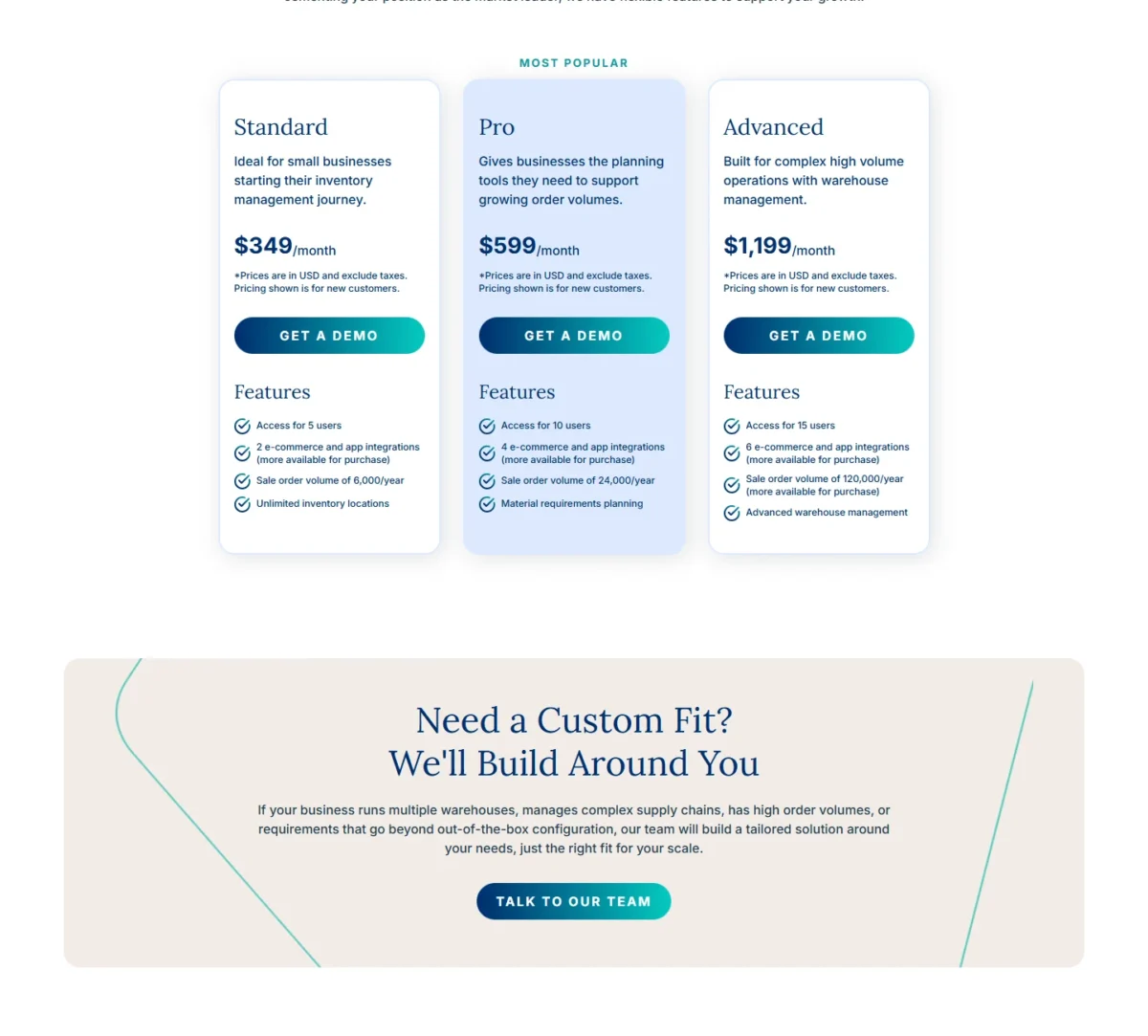
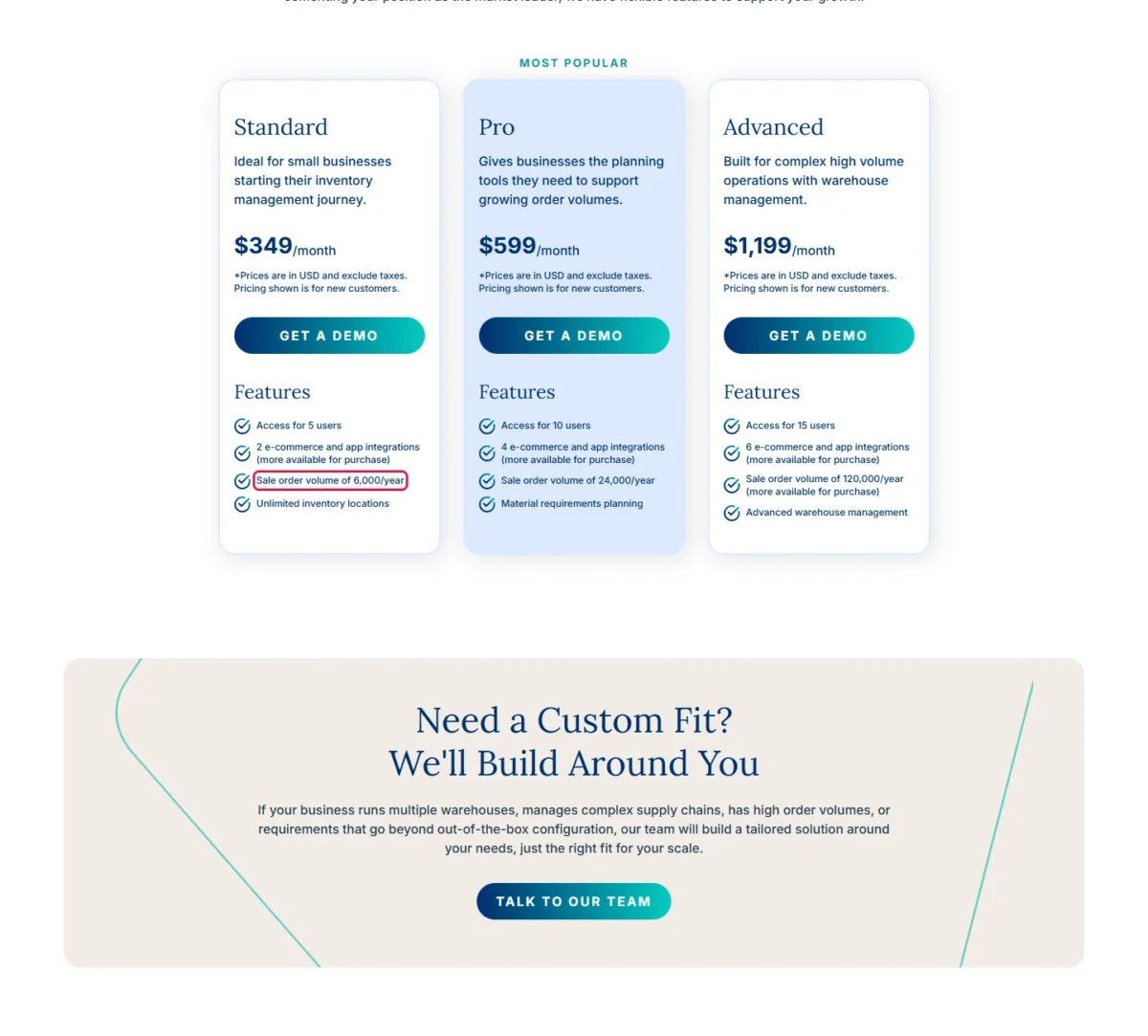
Cin7 Core costs $349 a month on Standard, $599 on Pro and $1,199 on Advanced, in USD excluding taxes, for new customers. A full year at list price is $349 x 12 = $4,188, $599 x 12 = $7,188 or $1,199 x 12 = $14,388, before add-ons.
Each tier includes a fixed number of users, integrations and yearly sale orders. Cin7 sells more users, integrations and order volume, and its sales team quotes extra users and connections. Omni has no published price.
| Plan | Price a month | Users | Integrations | Sale orders a year | Key gate |
|---|---|---|---|---|---|
| Standard | $349 | 5 | 2 | 6,000 | MRP add-on; no advanced WMS, RMA or SKUs over 100K |
| Pro | $599 | 10 | 4 | 24,000 | MRP included; advanced WMS, RMA and SKUs over 100K add-ons |
| Advanced | $1,199 | 15 | 6 | 120,000 | Advanced WMS and RMA included; SKUs over 100K add-on |
| Omni | Custom quote | 8 | 5 | N/A | Separate edition |
Sources: Cin7 pricing page, checked October 2026.
I would start a 5-person seller with no more than 2 connections on Standard.
The upgrade triggers that push you toward Pro are the sixth user, a third connection and the 6,001st sale order of the year. Standard’s cap averages 6,000 / 12 = 500 a month.
Standard also lacks MRP without its add-on, multi-warehouse picking (advanced WMS), returns through RMA and catalogs over 100K SKUs.
Moving to Pro adds $599 – $349 = $250 a month, or $7,188 – $4,188 = $3,000 a year. When MRP is the only trigger, set the MRP add-on quote against that $250 step.
A 10-user team moves to Advanced at the 11th user, the fifth connection, the 24,001st sale order of the year, or when it needs advanced WMS or RMA without paying for add-ons. That step adds $1,199 – $599 = $600 a month, or $14,388 – $7,188 = $7,200 a year.
Pricing note
Cin7 labels these prices “for new customers” and does not publish the billing term behind “/month”. Get the renewal price and contract length in writing with your quote.
If you are still deciding which tier to buy, read my Cin7 pricing guide next.
To see what rivals charge at the same volume, compare inventory management software prices in my ranking of the category.
Integrations, Support and Security
Cin7 lists over 700 app partners, includes 24/7 chat on every plan and states it is SOC 2 Type 2 compliant. The tier you buy still caps how many apps run at once.
The directory names Amazon, Shopify and Walmart for sales, ShipStation for shipping and Avalara for tax. Premium Support and Professional Services cost extra on every plan.
Cin7’s security page says customer data is encrypted in transit and at rest, MFA is enforced and the platform runs on Microsoft Azure with geo-redundant backups. Customers can request the SOC 2 Type 2 report through its Trust Center.
Who Should Use Cin7 Core?
Cin7 Core fits sellers with 5 to 15 users, several channels and assembly or batch tracking, under 120,000 sale orders a year. It does not fit a two-person shop or a multi-entity EDI operation.
Best for
- A team of 5 to 15 users on 2 to 6 channels and apps, the range the three tiers include
- Food, beauty and kit makers that need batch, expiry and BOM tracking, included on every tier
- Xero or QuickBooks Online users who want stock and costs synced to the ledger
- Sellers under 120,000 sale orders a year, Advanced’s included volume
Not ideal for
- A small shop with 3 users or fewer, 2 locations and no batch tracking, which Zoho Inventory Standard covers at $29 per organization a month, billed annually
- A multi-entity business that needs native EDI and 3PL, which Cin7 sells as Omni
- A manufacturer that wants unlimited users on one contract, which Katana’s Advantage plan lists
- A buyer who needs a fixed yearly total before speaking to sales
Cin7 Core vs Competitors
Cin7 Core costs more at entry than Zoho Inventory and lists a lower monthly price than Unleashed, and unlike Katana it caps users on each tier.
| Software | Best for | Starting price | Key difference | Main trade-off |
|---|---|---|---|---|
| Cin7 Core | 5 to 15 user sellers with assembly | $349 a month, 5 users | Unlimited locations; batch tracking on every tier | 2 integrations and 6,000 orders a year on Standard |
| Unleashed | Buyers who want a published annual price | $399 a month paid monthly, 3 users | $4,389 a year on annual billing | 100 sales orders a month on Core |
| Katana | Manufacturers wanting unlimited users | Free up to 30 SKUs; Advantage on custom pricing | Unlimited users and integrations on both plans | No published price for Advantage |
| Zoho Inventory | Small sellers on a budget | $29 per organization a month, billed annually, 3 users | 500 orders a month on Standard | 2 locations; batch tracking starts on Premium |
Sources: Cin7 pricing, Unleashed pricing, Katana pricing and Zoho Inventory pricing, checked October 2026.
Zoho Inventory is the sharpest contrast: its Standard plan allows 500 orders a month, the same average as Cin7 Core Standard. Cin7’s higher price buys 5 users instead of 3, unlimited locations instead of 2, and batch tracking on the entry tier.
Unleashed Core includes 3 user licenses and 100 sales orders a month (100 x 12 = 1,200 a year), so Cin7 Standard gives more room on both. Katana suits a manufacturer that would rather sign one annual contract with unlimited users than count seats.
Best Cin7 Core Alternatives
Zoho Inventory is the cheaper start for a small catalog, Katana fits a manufacturer that wants unlimited users, and Unleashed is the priced rival to quote against Cin7. Multi-entity operations should ask about Cin7 Omni; the inventory software ranking linked in the pricing section covers the rest.
If your catalog is small and the entry price worries you, read my Zoho Inventory review before you commit.
If you are a maker comparing production tools, see my Katana review next.
How I Evaluated Cin7 Core for This Review
I built this review from Cin7’s pricing, Core, Omni, integrations, security, free-trial and about pages and the Cin7 Core login page, read on October 28, 2026. I added the pricing pages of Unleashed, Katana and Zoho Inventory for the comparison.
The yearly costs, upgrade triggers and fit calls are my analysis of those pages.
Cin7 does not publish:
- Add-on prices
- Extra-user, extra-volume or extra-connection prices
- The billing term
- Any Omni price
- What “N/A” means on its plan table
FAQ
Is Cin7 a real company?
Yes. Cin7’s about page says it started as a small team in 2012 and now has offices in six countries serving over 8,500 customers. The Cin7 Core login page carries the line “2012-2026 © Cin7 Americas, Inc”.
What companies use Cin7?
Product businesses in retail, e-commerce, wholesale and manufacturing use it. Cin7’s pricing page tells customer stories from GROF USA, Meghan Fabulous, Gumball Poodle and AQ Outdoors. The AQ Outdoors story, about a paddle sports goods company, names Cin7 Core directly.
How do I log in to Cin7 Core?
Cin7 Core users sign in at inventory.dearsystems.com, on the “Log in to Cin7 Core” page. If security questions were your only login option, Cin7 asks you to contact Cin7 Support to regain access.
Final Verdict
Book the Cin7 Core demo if you have 5 to 15 users, two or more channels and assembly or batch needs, and price every add-on before signing. Skip it if $4,188 a year is too much for a small catalog, or if you run several entities on EDI.
The biggest trade-off is visibility: the entry price is published, but add-ons, extra users and extra volume are not. In the trial, connect your real channels, compare your order pace with your tier’s cap, and get the add-on quote in writing.