
Attio pricing starts at $0 and tops out at $79 per user per month on annual billing ($99 if you pay monthly), with Enterprise quoted by sales. For most US teams of four to ten people, the real decision is Plus at $35 a seat versus Pro at $79, and three things force Pro: an 11th seat, email sequences and call recording.
Evidence basis: official pricing pages and documentation, checked Oct 2026.
The numbers that matter before you read further:
- Free: $0 for up to 3 seats and 50,000 records.
- Plus: $35 per user per month billed annually, $44 billed monthly, capped at 10 seats.
- Pro: $79 per user per month billed annually, $99 billed monthly, no seat cap.
- Enterprise: custom quote, billed annually only.
- Credits: AI features and workflows draw from monthly credit pools; extra workspace credits start at $70 a month on annual billing.
In This Article (11 sections)
Attio Pricing Plans at a Glance
Attio sells four plans, all priced per seat. The pricing page loads with annual billing selected; the monthly toggle shows the higher list price, and annual billing is the 20% discount Attio advertises on Plus and Pro.
| Plan | Billed annually | Billed monthly | Seat limit | Records | Workspace credits per month | Seat credits per user per month |
|---|---|---|---|---|---|---|
| Free | $0 | $0 | Up to 3 | 50,000 | 250 | 100 |
| Plus | $35 per user/mo | $44 per user/mo | Up to 10 | 250,000 | 1,500 | 500 |
| Pro | $79 per user/mo | $99 per user/mo | Unlimited | 1,000,000 | 10,000 | 1,000 |
| Enterprise | Custom quote | Annual billing only | Unlimited | Custom | Custom | 2,500 |
Sources: Attio pricing page, checked Oct 2026.
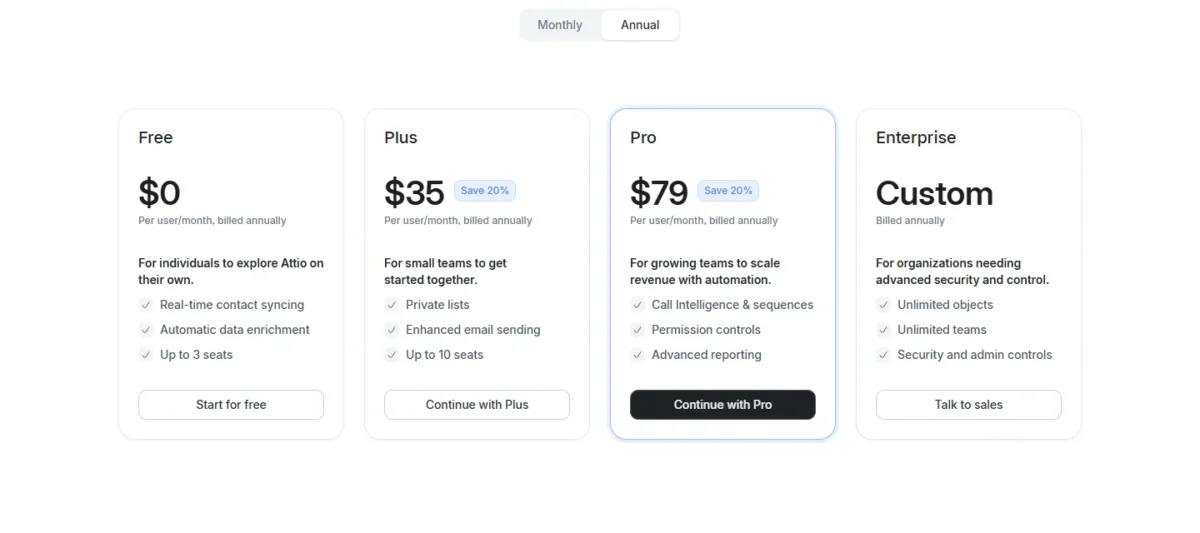
Two rules in Attio’s plans and features article shape the budget more than the headline price. Every member of a workspace must be on the same plan, so you cannot put five reps on Pro and five ops users on Plus. And each workspace is a separate subscription, billed on its own.
What Each Plan Adds
The table below shows the plan gates that most often decide the purchase. The pricing page lists integrations, API and webhook access, workflows and the Ask Attio assistant as included on Free, Plus, Pro and Enterprise.
| Feature | Free | Plus | Pro | Enterprise |
|---|---|---|---|---|
| Objects | 3 | 5 | 12 plus custom objects | Unlimited |
| Email sends per user per month | 200 | 1,000 | Unlimited | Unlimited |
| Synced mailboxes per user | 1 | 1 | 2 | 3+ |
| Remove “Sent with Attio” | No | Yes | Yes | Yes |
| Email sequences | No | No | Yes | Yes |
| Call Intelligence (call recording) | No | No | Yes | Yes |
| Formula attributes and record templates | No | No | Yes | Yes |
| Reports | Up to 3 | Up to 15 | Up to 100 | 100+ |
| Teams | None | None | Up to 10 | Unlimited |
| Access permissions | None | Basic | Advanced | Advanced |
| Pay by invoice | No | No | Yes | Yes |
| SSO and SCIM | No | No | No | Yes |
| Priority support | No | No | Yes | Yes |
| File storage | 50 GB | 50 GB | Unlimited | Unlimited |
Sources: Attio pricing page, checked Oct 2026.
Free: three seats and no privacy controls
Free covers Companies and People plus one more standard object (Deals, Users or Workspaces), and up to 50,000 records. Each user syncs one mailbox and can send 200 emails a month, 10 at a time, and every email carries a “Sent with Attio” line.
In my view, access control is the Free limit to weigh first. The help center says the whole workspace is visible and editable by every user, and reporting stops at three Insight reports. Free also gets 250 workspace credits a month with no option to buy more.
Plus: up to 10 seats with better email
Plus adds Deals, Users and Workspaces as standard objects, raises the record cap to 250,000 and the email limit to 1,000 sends per user per month, 50 at a time. You can remove the “Sent with Attio” line, keep private lists and set basic workspace-wide permissions on objects, lists, workflows and dashboards.
Reporting gains funnel reports and the Segment by option. One inconsistency to flag: the pricing page lists up to 15 reports on Plus, while the help center says up to 20 Insight and Funnel reports. I would plan around 15 until Attio confirms in writing.
What Plus leaves out matters as much: no sequences, no call recording, no formula attributes, no teams, no invoice billing and no priority support.
Pro: the plan for outbound teams and anyone past 10 seats
Pro removes the seat cap and raises the record limit to 1 million. It adds email sequences, unlimited monthly sends, two synced mailboxes per user and Call Intelligence, which the help center describes as call recording with AI transcripts and insights.
On the data side, Pro allows custom objects, formula attributes, record templates, custom relationship attributes and three rules per object. Admins get up to 10 teams, team-level and individual permissions, and a protected recipients list that hides chosen domains from email and calendar sync. Reporting goes to 100 reports with targets, historical attributes and time comparisons.
Pro is also the first plan that can pay by invoice (PO, ACH, check or wire) and the first with priority support.
Enterprise: SSO, SCIM and export controls
Enterprise adds SAML single sign-on, SCIM user provisioning, the option to limit CSV exports to admins, the ability to end user sessions, unlimited teams and unlimited reports. Records and workspace credits are set in the contract, and each seat gets 2,500 seat credits a month.
If your security team requires SSO, Pro is not an option. The price conversation then starts with Attio’s sales team, because Enterprise has no published price.
How Attio Credits Work and What Extra Credits Cost
Attio meters AI and automation with two credit pools, explained in Attio’s guide to workspace and seat credits. Seat credits are personal and only pay for Ask Attio, the built-in AI assistant. Workspace credits are shared and pay for workflows, AI attributes and any Ask Attio use after a member’s seat credits run out. Both renew monthly on your billing date.
The guide lists what common actions consume:
- Ask Attio: “prep me for my next meeting” costs 10–20 credits; a daily briefing costs 30–50.
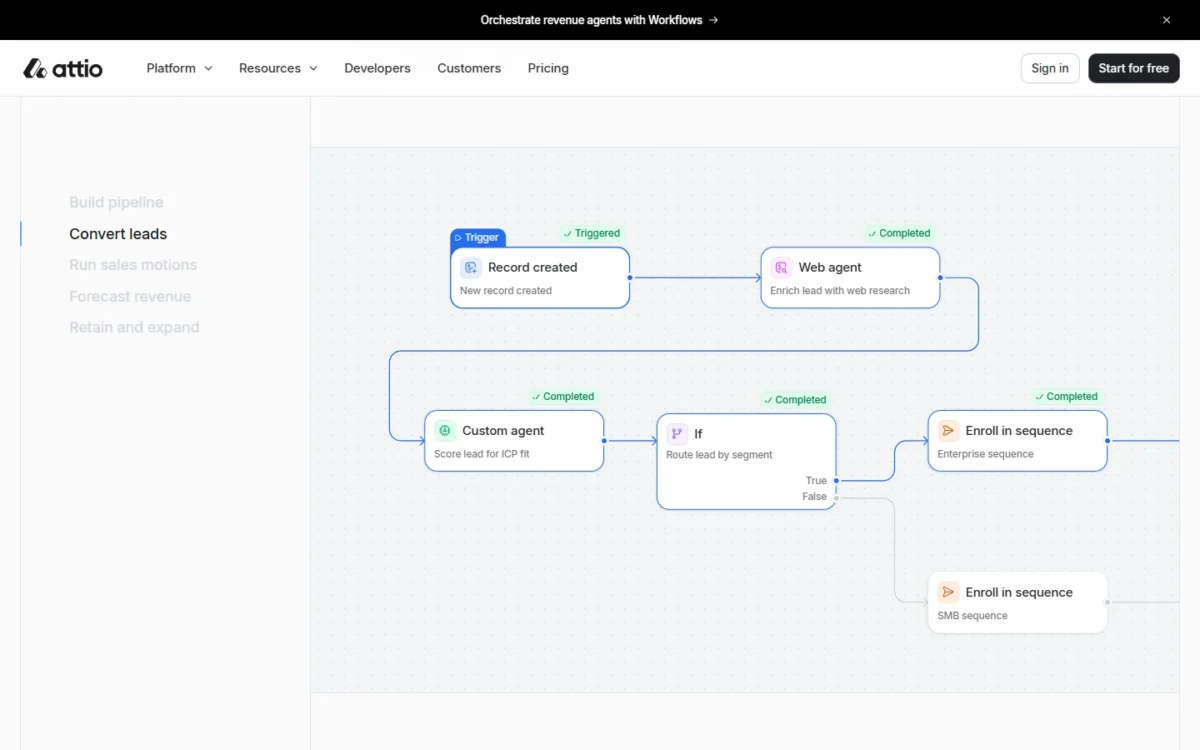
- Workflows: each block that writes data, such as creating a record, adding to a list or enrolling in a sequence, costs 1 credit. Triggers, conditions and lookups are free in the new workflow builder.
- AI attributes: a summary costs 1 credit per record; the web agent costs 10 credits per record.
- Sequences: emails sent by a sequence use no credits unless a workflow enrolls people.
Here is how fast that adds up. A rep who runs the daily briefing every workday (about 21 days) uses 30–50 x 21 = 630–1,050 credits a month. That is more than the 500 seat credits on Plus and can exceed the 1,000 on Pro, so the rest comes out of the shared pool. Web-agent enrichment at 10 credits per record covers 150 records a month on Plus (1,500 ÷ 10) and 1,000 on Pro (10,000 ÷ 10).
| Extra workspace credits | Billed annually | Billed monthly |
|---|---|---|
| +5,000 per month | $70/mo | $85/mo |
| +10,000 per month | $120/mo | $150/mo |
| +25,000 per month | $260/mo | $330/mo |
| +50,000 per month | $475/mo | $595/mo |
Sources: Attio pricing page, checked Oct 2026.
Credit packs are sold on Plus, Pro and Enterprise; Free cannot buy more. Bigger packs cost less per credit. On annual billing, the 50,000 pack gives ten times the credits of the 5,000 pack for under seven times the price ($475 against $70). On monthly billing it costs exactly seven times as much ($595 against $85). A year of the smallest pack adds $70 x 12 = $840 to the bill.
By default, Ask Attio may spend up to 100% of the workspace pool once seat credits are gone. I would set a limit in the Ask Attio usage settings before rollout, so one heavy user cannot starve the workflows that keep your data clean.
What Attio Costs for 1, 10 and 25 Users
A solo user or a team of up to three can stay on Free at $0. For paid seats, the table shows yearly totals before taxes and credit packs.
| Users | Plus, billed annually | Plus, billed monthly | Pro, billed annually | Pro, billed monthly |
|---|---|---|---|---|
| 1 | $420 | $528 | $948 | $1,188 |
| 5 | $2,100 | $2,640 | $4,740 | $5,940 |
| 10 | $4,200 | $5,280 | $9,480 | $11,880 |
| 25 | Not available | Not available | $23,700 | $29,700 |
Sources: Attio pricing page, checked Oct 2026.
The math behind each row:
- 1 user: $35 x 1 x 12 = $420; $44 x 12 = $528; $79 x 12 = $948; $99 x 12 = $1,188.
- 5 users: $35 x 5 x 12 = $2,100; $44 x 5 x 12 = $2,640; $79 x 5 x 12 = $4,740; $99 x 5 x 12 = $5,940.
- 10 users: $35 x 10 x 12 = $4,200; $44 x 10 x 12 = $5,280; $79 x 10 x 12 = $9,480; $99 x 10 x 12 = $11,880.
- 25 users: Plus stops at 10 seats, so Pro is the only option: $79 x 25 x 12 = $23,700, or $99 x 25 x 12 = $29,700 billed monthly.
The 11th seat is the expensive one
Ten users on Plus cost $4,200 a year on annual billing. Hire one more person and the whole workspace must move to Pro, because Plus caps at 10 seats and every member shares one plan: $79 x 11 x 12 = $10,428 a year. That single hire adds $6,228 to the annual bill.
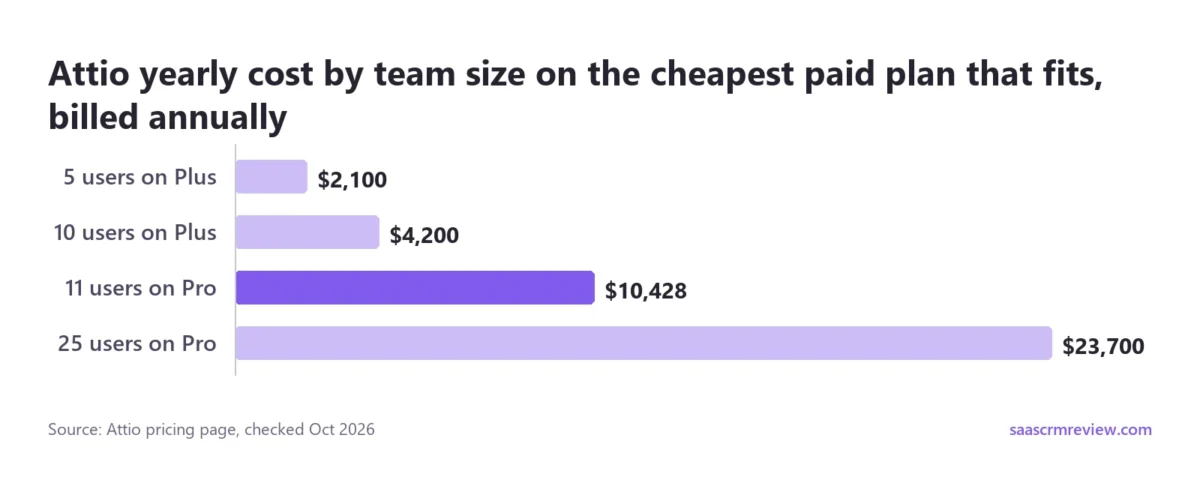
If your hiring plan crosses 10 people within the year, I would budget for Pro from the start rather than sign an annual Plus contract and upgrade mid-term.
Monthly vs Annual Billing
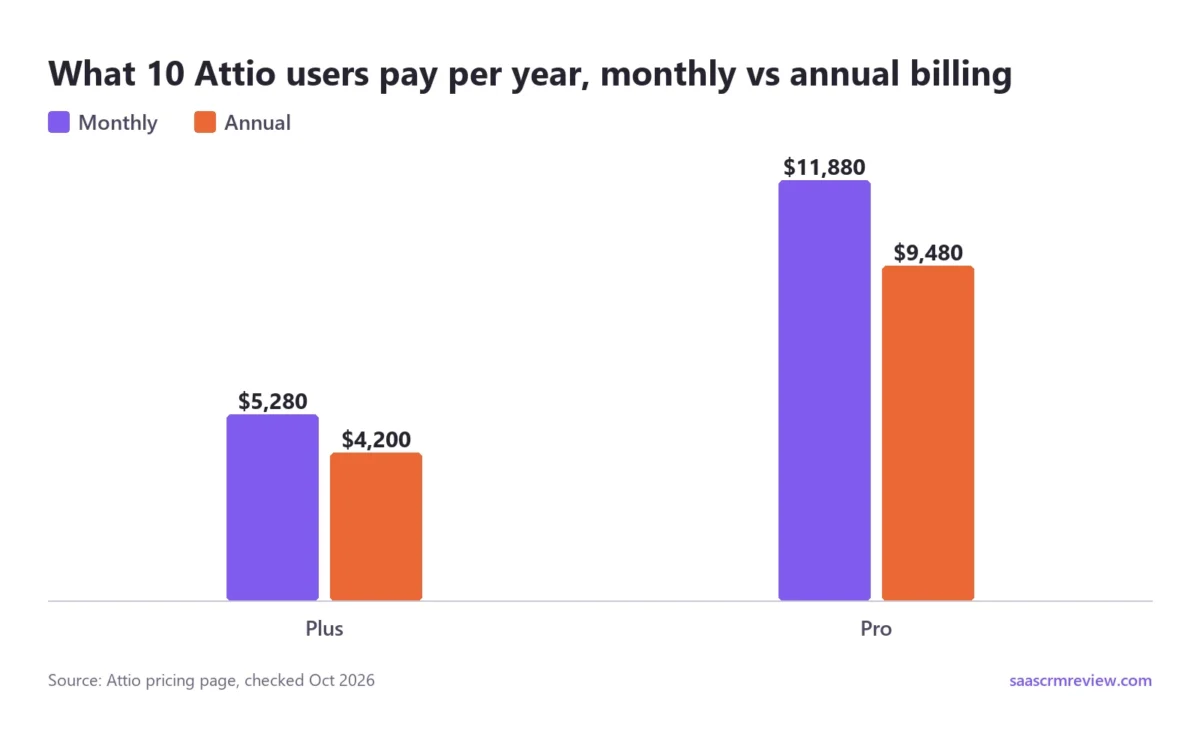
One Plus seat costs $44 x 12 = $528 a year billed monthly and $35 x 12 = $420 billed annually, so annual billing takes about a fifth off each seat, in line with the 20% discount Attio advertises. One Pro seat costs $99 x 12 = $1,188 billed monthly and $79 x 12 = $948 billed annually, a saving of $240 per seat. For 10 Pro seats that is $2,400 a year, the difference between $11,880 and $9,480.
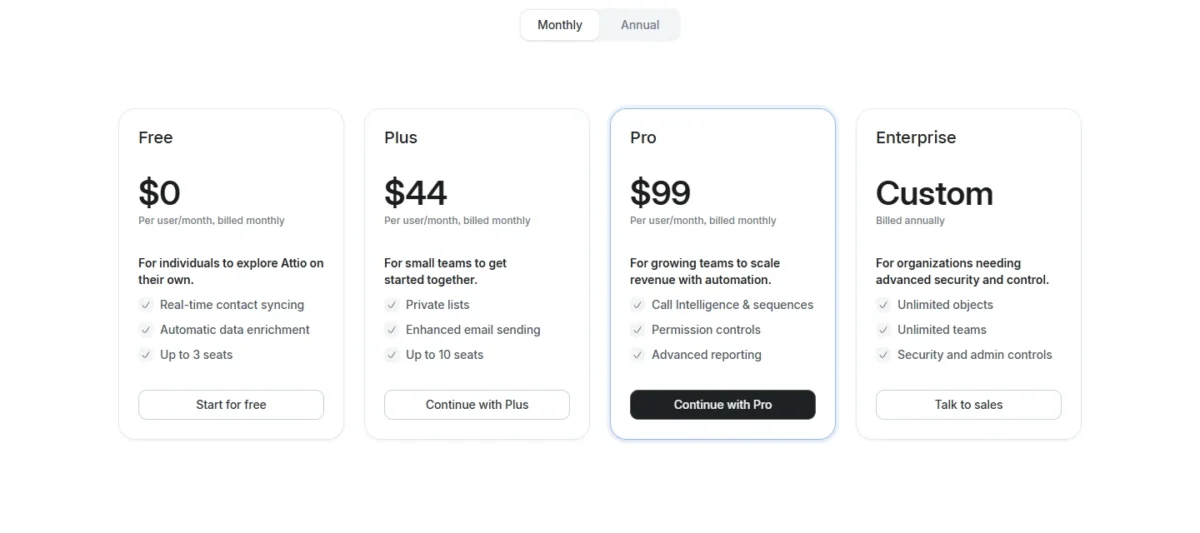
The billing rules in Attio’s billing and payments article make annual a real commitment. You are billed at the start of each interval, upgrades are charged pro rata right away, and downgrades only take effect at the next renewal. If you cancel, access ends when the current billing period ends, so export your data first. Payment is in USD, GBP or EUR.
My approach for a new team: pay monthly for the first 30–60 days, then switch to annual once seat count and adoption look stable. Attio credits the unused part of the current monthly payment toward the annual plan when you switch.
Free Plan, Free Trial and Startup Discount
New workspaces start with a 14-day trial of Pro, and the pricing page says no credit card is required. When the trial ends, admins can pick any plan, including Free. Use the trial to test the features you would pay for: sequences, call recording and team permissions are all Pro gates.
The Attio startup program offers 80% off the annual Pro plan and credits for the first year and 30% off in the second year. To qualify, a company must be VC-backed, have signed up within the last 90 days and be incorporated less than 10 years ago, and the discount applies to workspaces of up to 10 seats.
For 10 Pro seats that list at $9,480 a year, the first year costs $9,480 x 0.2 = $1,896 and the second $9,480 x 0.7 = $6,636. The startup page lists no discount beyond the second year, so I would budget year three at the list price of $9,480 until Attio says otherwise. The pricing page FAQ mentions no other standing discount besides the 20% for annual billing.
Hidden Costs on the Attio Bill
The pricing page shows a seat price. These are the items that move the real number:
- The 10-seat wall. Moving from Plus to Pro at the 11th user raises the per-seat price from $35 to $79 on annual billing.
- Seats, not active users. A seat is held by an active member or a pending invite, and billing follows seats purchased, not logins. Remove unused seats yourself to stop paying for them in later cycles.
- One plan per workspace. Light users who only view records still pay the same seat price as your heaviest rep.
- Separate workspaces. If you belong to two workspaces, your seat is counted and charged in each one.
- Credit packs. AI attributes, Ask Attio and workflow writes all draw credits; extra packs run $70–$475 a month on annual billing.
- Migration help. CSV import is included, but the migration service is listed as “Talk to sales” on paid plans, with no published price.
- Security requirements. SSO, SCIM and export limits sit only on Enterprise, which has no list price.
Which Attio Plan Should You Buy?
Match the plan to the job, not the team’s ambition:
- Choose Free if you are one to three people, under 50,000 records, and everyone can see everything.
- Choose Plus if you have four to ten users who send email by hand, need private lists and basic permissions, and can live with about 15 reports. Budget $35 per seat per month on annual billing.
- Choose Pro if you run outbound sequences, want call recording, need team-level permissions or invoice billing, or will pass 10 seats. Budget $79 per seat per month on annual billing.
- Choose Enterprise if IT requires SAML SSO, SCIM provisioning or export limits.
My pick for a 10-person US sales team doing outbound is Pro at $9,480 a year on annual billing. For a 10-person partnerships, fundraising or investor relations team that mostly tracks relationships, Plus at $4,200 a year covers the work.
Who should not buy Attio? A team of four or more that needs a free CRM, since Free caps at three seats. A budget-first outbound team, since sequences require Pro at $79 a seat. And a company that needs SSO but has no appetite for an Enterprise sales cycle.
Cheaper Attio Alternatives
HubSpot’s free CRM allows up to 2 users and 1,000 contacts with no time limit, plus up to 1 million records across all other standard object types, according to HubSpot’s free tools pricing page. Attio Free allows 3 seats, one more than HubSpot, but caps records at 50,000. For HubSpot’s paid plans, see our HubSpot pricing guide.
Pipedrive’s entry plan lists US$14 per seat per month billed annually, and its top plan US$79, on Pipedrive’s pricing page. Ten users on that entry plan cost US$14 x 10 x 12 = $1,680 a year, against $4,200 on Attio Plus. Pipedrive’s US$39 plan also lists automations and nurturing sequences, a feature Attio keeps for Pro.
For a closer look at Pipedrive, read our Pipedrive CRM review. If those two are your shortlist, HubSpot vs Pipedrive compares them at the same team size.
Teams that want a wider list can start with our roundup of HubSpot CRM alternatives, which covers pricing and migration effort for several tools in the same class.
Verdict: Is Attio Worth the Price?
For a team of up to 10 that lives in relationships rather than call volume, Plus at $35 a seat is a fair price for 250,000 records, enrichment and email sync. Pro at $79 a seat makes sense if you need sequences, call recording, team permissions, payment by invoice or more than 10 seats.
Before signing, check two numbers: how many seats you will have in 12 months, and how many credits your AI and workflow plans will burn. Those two figures decide the Attio bill more than the plan names do.
Attio Pricing FAQ
How much does Attio cost per month?
Attio costs $0 on Free, $35 per user per month on Plus and $79 per user per month on Pro when billed annually. Monthly billing raises Plus to $44 and Pro to $99 per user per month. Enterprise has no public price and is billed annually. A 10-person team on Plus pays $4,200 a year ($35 x 10 x 12), before any extra credit packs.
Is Attio free to use?
Yes, for up to three seats. The Free plan includes 50,000 records, one synced mailbox per user, 200 email sends per user per month and three reports. It has no access permissions, so everyone can see and edit everything, and its 250 monthly workspace credits cannot be topped up. A fourth user means moving the workspace to Plus or Pro.
Does Attio have a free trial?
Yes. Every new workspace starts with a 14-day trial of the Pro plan, and the pricing page says no credit card is required to start. When the trial ends, an admin chooses a plan, and Free is one of the options. Use the trial to check whether you need Pro-only features such as sequences, call recording and team permissions.
Is Attio a good CRM for a small team?
For a team of up to 10 that tracks relationships, partners or investors, the documentation supports a yes: Plus covers 250,000 records, enrichment, email sync and basic permissions at $35 per seat billed annually. For a small outbound sales team, the answer depends on budget, because sequences and call recording only arrive on Pro at $79 per seat.
What is the main pricing difference between Attio and HubSpot?
On free plans, HubSpot’s CRM allows 2 users, 1,000 contacts and up to 1 million records across all other standard object types, while Attio Free allows 3 seats and 50,000 records. On paid plans, Attio charges one per-seat price per plan for every member, with no mixing of plans in a workspace. For HubSpot’s paid structure, see our HubSpot CRM review.
Is Pipedrive cheaper than Attio?
At entry level, yes. Pipedrive lists US$14 per seat per month billed annually for its first plan, against $35 for Attio Plus, so 10 users pay $1,680 a year on Pipedrive versus $4,200 on Attio. Both top published plans list $79 per seat. For teams of three or fewer, Attio Free at $0 still costs less than any paid entry plan.
What happens when Attio credits run out?
When a member uses up their seat credits, Ask Attio keeps working from the shared workspace pool unless an admin has turned that off or set a limit. If both pools are empty, Ask Attio stops until credits renew on the monthly billing date. Admins on paid plans can buy extra workspace credits, starting at $70 a month for 5,000 on annual billing.
Can I pay for Attio by invoice?
Only on Pro and Enterprise. Attio’s pricing FAQ says it can issue invoices on those plans and accepts PO, ACH, check or wire. Free and Plus are paid by credit card. If your finance team requires invoices and purchase orders for software, factor that into the plan choice, since it pushes even a small team to Pro.