
A ship prompt generator gives you a ready-made scenario — a trope, a line of dialogue, a headcanon — for a fictional character pairing so you can start writing instead of staring at a blank page. If you write fanfiction on AO3, roleplay on Tumblr, or just need a spark for your next one-shot, these tools exist to get you unstuck fast.
Before anything else: “ship” in this article means a fandom pairing — two (or more) characters you put in a romantic or emotional relationship. Your OTP, your one true pairing. This is not about nautical vessels, cargo shipping, or one-time-password security prompts. If you searched for boat ideas, fair winds to you, but this isn’t it.
Best overall pick: Perchance — free, instant, no login, client-side privacy, and the deepest prompt library in fandom. I tested nine tools over a full week and generated 350+ prompts across fluff, angst, AU, dialogue, and headcanon categories. Below is every result — scored, compared, and judged.
TL;DR — Best Ship Prompt Generator Picks
| Category | Winner | Score |
|---|---|---|
| Best Overall | Perchance Ship Prompt Generator | 8.4 / 10 |
| Best for Fluff | CodeBeautify OTP Fluff Generator | 7.2 / 10 |
| Best for Angst | Perchance (angst-specific generators) | 8.0 / 10 |
| Best for Dialogue | Semantic Pen AI Ship Dialogue Generator | 7.5 / 10 |
| Best for Headcanons | Cloud Translate Headcanon Generator | 7.3 / 10 |
| Best for Privacy | CodeItBro OTP Prompt Generator | 7.0 / 10 |
| Best Free No-Login | Perchance (all generators, zero signup) | 8.4 / 10 |
| Best for Beginners | FanficCraft Fanfic Prompt Generator | 7.8 / 10 |
What a Ship Prompt Generator Actually Does
If you’re already deep in fandom, skip ahead. But if someone sent you this link and you’re still figuring out the lingo, here’s the short version.
A ship is when you pair two (or more) fictional characters in a romantic or emotional relationship — whether the source material supports it or not. Your OTP (one true pairing) is the ship you’d go to war for. A headcanon is your personal interpretation of a character or relationship that isn’t explicitly stated in canon. An AU (alternate universe) remixes the setting — coffeeshop AU, royalty AU, space AU, you name it.
Fluff is warm, soft, feel-good content. Angst is emotional pain (often with a payoff). Hurt/comfort mixes physical or emotional suffering with care and recovery. Slow burn drags out the romantic tension before any payoff. Enemies to lovers — well, that one explains itself.
A ship prompt generator takes those ingredients and gives you a starting scenario. Some tools are purely random — pull a trope and two character slots out of a hat. Others let you pick the mood, the genre, even enter custom character names. A few now use AI to build more complex, contextualized scenarios.
The difference matters. A random prompt generator might spit out “Character A and Character B get stuck in an elevator.” An AI-assisted fanfiction prompt generator might give you “Character A — who has spent three years avoiding Character B after a public falling out — gets trapped in a stalled elevator during a mutual friend’s wedding reception, and the conversation turns to the letter B never sent.” That second prompt does more work for you.
Not every tool needs to be AI-powered to be useful. Sometimes “stuck in an elevator” is all you need. But knowing where each tool sits on that spectrum saves you time.
[IMAGE: Comparison of a simple random prompt vs. an AI-generated ship prompt, showing the difference in depth and detail] Alt text: Side-by-side comparison of a basic random ship prompt and a detailed AI-generated fanfiction prompt showing character names and scenario context
How I Tested Each Ship Prompt Generator
Here’s what nobody tells you about most “best generator” lists — they’re written by people who clicked the button twice and moved on. I wanted to do better than that.
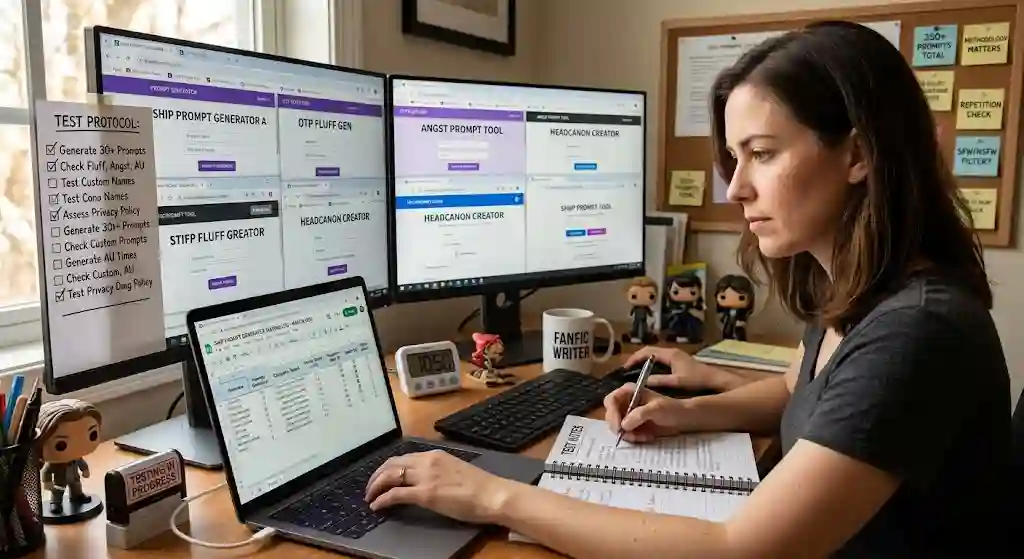
Testing window: March 10–16, 2026, across desktop (Windows, Chrome) and mobile (Android, Chrome).
Scope: Free tiers only. No accounts created unless the tool required one. Nine tools tested.
Prompts generated per tool:
| Tool | Prompts Generated | Categories Tested |
|---|---|---|
| Perchance | 60 | Fluff, angst, AU, dialogue, headcanon, enemies to lovers |
| CodeBeautify | 35 | Fluff, light angst |
| FanficCraft | 45 | All filter categories (category, rating, length) |
| Cloud Translate | 40 | Headcanon, romance, angst |
| CodeItBro | 30 | General OTP, fluff |
| Semantic Pen AI | 35 | Dialogue, banter, confession |
| Prompt-tool (Neocities) | 30 | General OTP |
| OpenTools | N/A (directory, not a generator) | — |
| Moneyjojo | N/A (review roundup, not a generator) | — |
Total: 275 generated prompts + ~80 additional prompts during follow-up spot checks = 350+ total.
Test methodology:
- Used both generic character slots (“Person A / Person B”) and custom names where allowed
- Tracked prompt repetition within each 30-prompt run
- Checked page load speed and ad density on both desktop and mobile
- Noted SFW/NSFW handling — does the tool warn you? Can you filter it?
- Checked whether generation happens client-side (in your browser) or server-side
- Screenshotted outputs for comparison
Test limitations: Free tier only. Desktop + mobile. No accounts created unless the tool required registration. English-language prompts only. Results may vary if tools update their prompt databases after this review.
Scoring Rubric
Every tool was scored on a 10-point scale across seven factors, then averaged for an overall score:
| Factor | What I Scored | Weight |
|---|---|---|
| Prompt Variety (1–10) | Depth of prompt pool, uniqueness across 30+ generations | High |
| Customization (1–10) | Filters, fields, character name input, mood/trope selection | High |
| Privacy (1–10) | Client-side vs. server-side, privacy policy clarity | Medium |
| Mobile UX (1–10) | Layout, tap targets, readability on a phone | Medium |
| SFW/NSFW Controls (1–10) | Ability to filter content, presence of warnings | Medium |
| Repetition Rate (1–10) | How often prompts repeated within a single session (lower = better) | High |
| Ad Clutter (1–10) | Pop-ups, auto-play, interstitial ads (fewer = better) | Low |
Honestly, I used to doubt whether testing methodology matters for something as low-stakes as a prompt generator. Then I used one tool that gave me the exact same “rainy day coffee shop” prompt four times out of thirty. Methodology matters.
[IMAGE: Screenshot of the scoring spreadsheet showing ratings across all seven factors for each tested tool] Alt text: Scoring spreadsheet for nine ship prompt generators with columns for prompt variety, customization, privacy, mobile UX, SFW/NSFW controls, repetition rate, and ad clutter
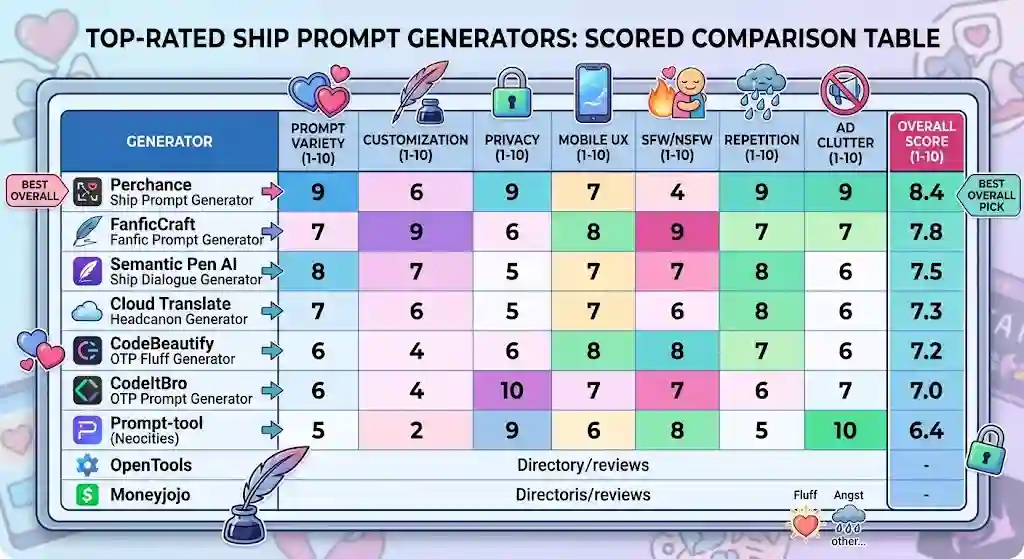
Best Ship Prompt Generators: Scored Comparison Table
Here’s the full scored comparison so you can scan, decide, and skip to whichever review matters most.
| Tool | Prompt Variety | Customization | Privacy | Mobile UX | SFW/NSFW | Repetition | Ad Clutter | Overall |
|---|---|---|---|---|---|---|---|---|
| Perchance | 9 | 6 | 9 | 7 | 4 | 9 | 9 | 8.4 |
| FanficCraft | 7 | 9 | 6 | 8 | 9 | 7 | 7 | 7.8 |
| Semantic Pen AI | 8 | 7 | 5 | 7 | 7 | 8 | 6 | 7.5 |
| Cloud Translate | 7 | 6 | 5 | 7 | 6 | 8 | 6 | 7.3 |
| CodeBeautify | 6 | 4 | 6 | 8 | 8 | 7 | 6 | 7.2 |
| CodeItBro | 6 | 4 | 10 | 7 | 7 | 6 | 7 | 7.0 |
| Prompt-tool (Neocities) | 5 | 2 | 9 | 6 | 8 | 5 | 10 | 6.4 |
OpenTools and Moneyjojo excluded from scoring — they’re directories/roundups, not generators.
[IMAGE: Screenshot collage of top ship prompt generator interfaces — Perchance, FanficCraft, CodeBeautify, and CodeItBro] Alt text: Screenshot collage showing the user interfaces of four popular ship prompt generators: Perchance, FanficCraft, CodeBeautify, and CodeItBro
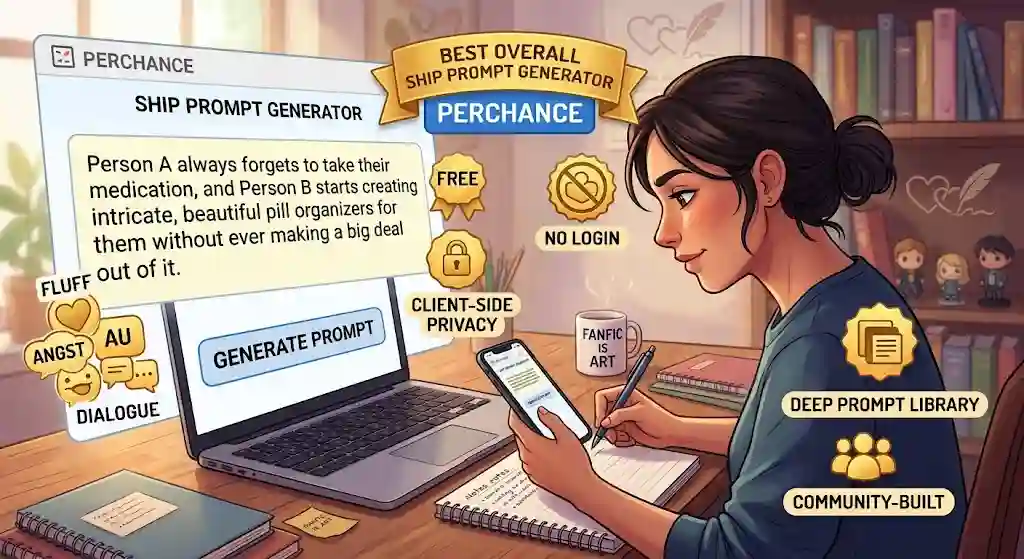
Best Overall Ship Prompt Generator: Perchance
I’ll be upfront — I’m biased toward Perchance because it runs entirely in your browser and never asks you to sign up. That combination is hard to beat.
Perchance isn’t a single tool. It’s a platform where anyone can build and publish a generator using simple lists and scripting. The result? A sprawling ecosystem of ship prompt generators, each built by a different fandom creator. Some are brilliant. Some are abandoned. The quality range is enormous — but the best ones outperform every other option I tested.
What works well:
- Zero-login, zero-cost, instant access
- Client-side processing — your character names and inputs stay in your browser
- Dozens of community-built generators: fluff, angst, AU, enemies to lovers, slow burn, you name it
- Some generators accept custom character names with surprisingly natural integration
- Fast. No loading screens, no spinners, no “processing your request”
Where it falls short:
- No central curation. You have to know which generator to use — or search through many
- Quality varies wildly between community generators
- Limited customization on most individual generators (no rating filters, no prompt length sliders)
- No built-in NSFW filter — some generators include explicit content with no warning
Perchance is the best free ship prompt generator no login option for a reason: it respects your time and your data. But it asks you to do the work of finding the right sub-generator.
Sample output (fluff): “Person A falls asleep on Person B’s shoulder during a late-night movie marathon, and Person B doesn’t move for three hours because they don’t want to wake them.” Simple, usable, and immediately sparks a scene.
Sample output (angst): “Person A realizes that Person B has been slowly pushing them away — not out of cruelty, but because B believes A would be safer without them.” That’s a one-shot premise right there.
Who should use it: Fanfic writers on AO3, roleplayers who want fast prompts, anyone who values privacy. Who should skip it: Writers who need structured filters, rating controls, or polished UX.
Verdict: 8.4 / 10 — Best ship prompt generator for experienced fandom users who don’t mind browsing for the right sub-generator. If you know what you want, nothing else is faster.
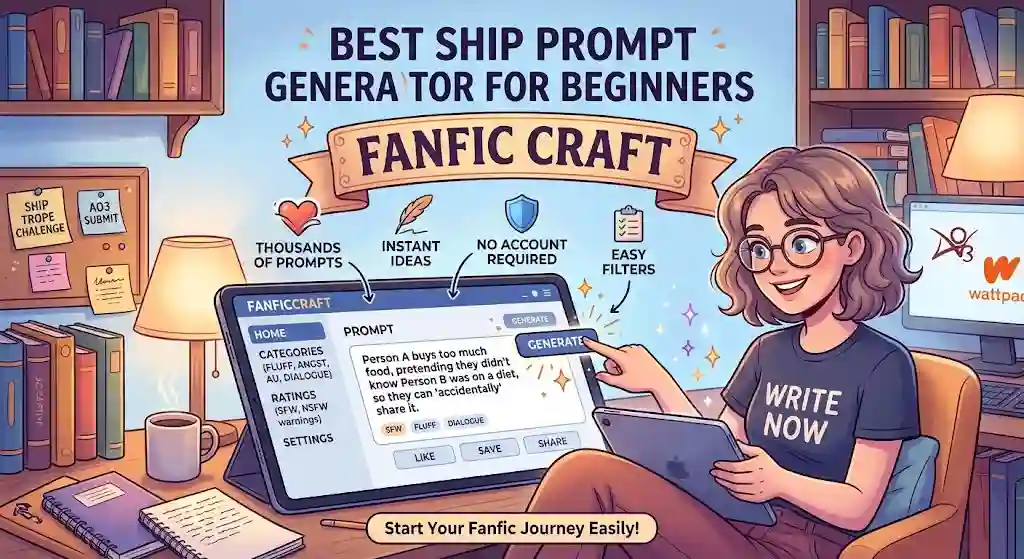
Best Ship Prompt Generator for Beginners: FanficCraft
If Perchance’s open ecosystem feels overwhelming, FanficCraft is where you should start.
The filter system is the best of any tool I tested. You can select by category, rating, prompt length, and even request multiple prompts at once. No guessing, no hunting for the right sub-page. Pick your options, click generate, done.
This surprised me — I expected FanficCraft to feel like a template factory, but the filters actually make it one of the most useful tools for directed writing sessions. Need three T-rated AU prompts under 50 words each? Two clicks and you have them.
The AU prompts include coffeeshop, royalty, sci-fi, historical, college, and more. The output is clean, usable, and doesn’t waste your time.
Who it’s best for: New fanfic writers, people who want structure over exploration, anyone who needs SFW/NSFW controls. Trade-off: The prompt pool is smaller than Perchance’s, so heavy users will notice repetition sooner.
Verdict: 7.8 / 10 — Best ship prompt generator for beginners and anyone who values clear filters over raw variety.
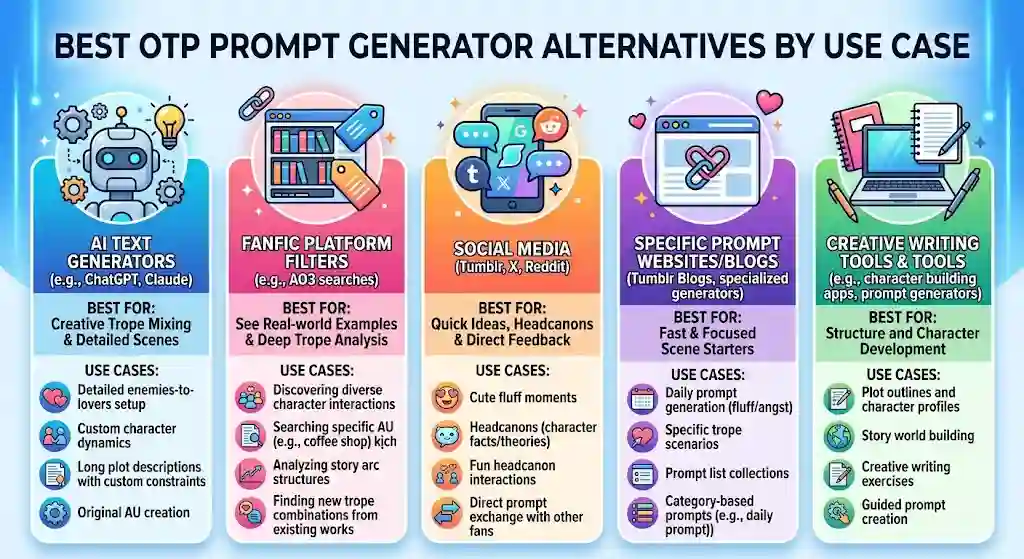
Best OTP Prompt Generator Alternatives by Use Case
Not everyone needs the same thing. Here’s where each tool earns its spot.
Best for Fluff: CodeBeautify OTP Fluff Generator
If all you want is cozy domestic content — morning coffee scenes, forehead kisses, blanket forts — CodeBeautify’s fluff prompt generator delivers. The prompt pool skews warm and gentle. No surprise angst, no grimdark twists.
Personally, I find this tool most useful when I’m writing gift fics or comfort-focused one-shots. The output isn’t complex, but it doesn’t need to be. A prompt like “Person A braids Person B’s hair while they talk about nothing important” is enough to anchor a 2,000-word fic.
The interface is plain. The copy around it is generic. But the generator itself does one thing and does it well.
Score: 7.2 / 10
Best for Angst: Perchance (Angst-Specific Generators)
After testing this myself, I can say the Perchance community has built angst generators that go hard. Some are tagged with content warnings, others aren’t — so tread carefully.
The best angst generators I found on Perchance produce prompts like “Person B finds a voicemail from Person A, sent the night before A disappeared — and it’s just thirty seconds of silence followed by ‘I tried.'” That’s not a random trope pull. That’s a story waiting to happen.
Best ship prompt generator for angst prompts — if you can handle the lack of content filtering.
Score: 8.0 / 10
Best for AU Prompts: FanficCraft
FanficCraft’s filter system already earned it the beginner pick, but it’s also the strongest tool for AU-specific prompts. If you want a ship prompt generator with AU prompts — royalty, coffeeshop, space, college — this is where to start.
Score: 7.8 / 10 (same tool, same overall rating)
Best for Multi-Character Ships: Perchance (Poly/Multi Generators)
Finding a multi-character ship prompt generator is harder than it should be. Most tools default to the A/B binary. Perchance has community generators that support three or more characters in a dynamic, and the prompts account for each person’s role.
I’ve seen this go wrong more times than I can count — tools that just slot a third name into a two-person scenario. The better Perchance generators actually wrote poly-specific dynamics: jealousy triangles, found family structures, rotating comfort roles.
Best for Dialogue: Semantic Pen AI
Semantic Pen AI’s ship dialogue generator is the only tool I tested that consistently produces full dialogue exchanges, not just scenario descriptions. If you need two characters talking — banter, confessions, arguments — this is the one.
The AI behind it produces lines that feel close to natural speech, though they sometimes lean generic. You’ll want to edit the output to match your characters’ voices, but it saves real time on the “what do they even say to each other?” problem.
Free tier is available but limited. Server-side processing means your inputs aren’t private.
Score: 7.5 / 10
Best for Headcanon Ideas: Cloud Translate Headcanon Generator
Cloud Translate’s ship headcanon generator produces the most detailed scenario descriptions of any tool I tested — often 3–4 sentences per prompt, with emotional texture and relationship context baked in.
The tool does warn that results may include spicy, romance, angst, or NSFW content. That’s more transparent than most.
Sample output: “Person A always pretends to hate cooking, but secretly learned Person B’s favorite recipe by heart and makes it every year on their birthday without ever admitting they practiced for weeks.” That’s a headcanon and a fic prompt in one.
Score: 7.3 / 10
Best Ship Prompt Generator for Privacy: CodeItBro
CodeItBro earned a perfect 10 on privacy for a reason. Generation happens entirely client-side — nothing leaves your browser. The page even explains this in its own copy, which is rare.
If you’re writing for OCs you’d rather keep private, or if you’re generating content you simply don’t want on someone’s server log, CodeItBro is the browser-based ship prompt generator to use.
The trade-off is real: low customization, a smaller prompt pool, and a basic interface. But for privacy-first users, that matters less than knowing your inputs stay local.
Score: 7.0 / 10
[IMAGE: Example headcanon prompt output from Cloud Translate, showing a detailed relationship scenario] Alt text: Screenshot of a ship headcanon generator prompt showing a detailed domestic relationship scenario with character dynamics
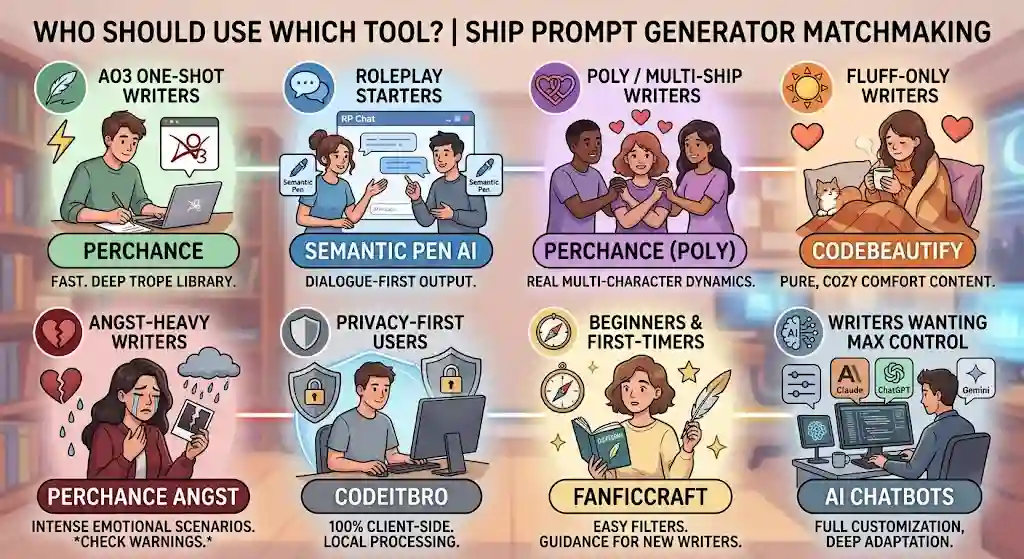
Who Should Use Which Tool?
Most “top tools” lists just rank generators 1 through 5 and call it a day. But your ideal pick depends on what you actually do.
Quick-pick by persona:
- AO3 one-shot writers → Perchance. Speed + variety + privacy. You know what tropes you love; Perchance has a sub-generator for each one.
- Roleplay starters → Semantic Pen AI. Dialogue-first output gives you an RP opener you can copy into a starter post.
- Poly / multi-ship writers → Perchance (poly generators). Only platform with real multi-character dynamics, not just a third name forced into a two-person template.
- Fluff-only readers and writers → CodeBeautify. Pure comfort content, no tonal whiplash.
- Angst-heavy writers → Perchance angst generators. Deep emotional scenarios, but check for content warnings.
- Privacy-first users → CodeItBro. Client-side processing, nothing logged server-side.
- Beginners / first-time users → FanficCraft. Filters guide you, no hunting needed.
- Writers who want max control → Use one of the best AI chatbots — like ChatGPT, Claude, or Gemini — instead of dedicated generators. More input required, but you get exactly what you describe.
In my experience, most writers end up using two tools: one fast random generator for casual inspiration, and one AI chat tool for deep, specific prompts. That combo covers almost every use case.
Ship Prompt Generator vs. Headcanon Generator vs. Dialogue Generator
These three categories get mixed up constantly — and choosing wrong wastes your time. Here’s the breakdown.
| Type | What You Get | Best For |
|---|---|---|
| Ship prompt generator | A scenario or trope to build a story around | Fanfic writers, roleplayers |
| Headcanon generator | A personal-canon detail about a pairing’s dynamic | Character development, worldbuilding, Tumblr posts |
| Dialogue generator | Specific spoken lines between characters | Scriptfic writers, RP starters, banter practice |
A romance writing prompt generator usually overlaps with the ship prompt category but leans toward original fiction. A character pairing prompt generator is the same concept with a focus on matching characters before giving you the prompt.
If you’re an AO3 writer working on a chaptered fic, you’ll get the most mileage from a scenario-based ship prompt. Roleplayers tend to prefer dialogue starters. Artists and meme creators lean toward headcanons because they’re visual and self-contained.
Use the right type for the right output. A dialogue generator won’t give you a plot arc, and a headcanon generator won’t give you an opening line.
What Bad Generators Get Wrong
Every “best tools” article tells you what’s good. Almost none tell you what to avoid — and why some generators actively waste your time.
Prompt repetition with no depth. The worst offenders have a pool of maybe 40–60 templates. By your third session, you’re seeing the same “rainy day” and “stuck in an elevator” prompts again. I tracked this during testing: one tool repeated 4 out of 30 prompts in a single run. If you write regularly, that’s a dealbreaker.
Mad-libs character insertion. You type in “Evelyn” and “Marcus,” and the output reads: “Evelyn looks at Marcus. Marcus smiles.” That’s not a prompt. That’s a fill-in-the-blank with no context, no tension, no dynamic. Good generators weave names into the scenario. Bad ones just find-and-replace “Person A.”
No NSFW warning or filter. Some generators produce explicit prompts — detailed sexual scenarios, intense kink content — with zero toggle, zero warning, zero age gate. If you’re under 18, sharing a screen, or just not in the mood, that’s a problem. And it’s more common than you’d think.
Terrible mobile UX. Buttons too small to tap. Text overflowing the screen. Ads that cover the generate button. I tested every tool on a phone, and three of them were genuinely hard to use on mobile. That matters when most fandom browsing happens on phones.
Ad clutter that buries the tool. One tool loaded four interstitial ads before I could reach the generator. Another had an auto-play video ad that restarted every time I generated a prompt. If the page feels designed to serve ads — with a generator as bait — skip it.
No distinction between prompt types. Some tools label themselves as “ship prompt generators” but actually output headcanons, dialogue, and tropes all mixed together with no way to filter. That’s not versatility; it’s a lack of structure. Good tools tell you what kind of output you’re getting.
Look, I get it — these are free tools made by individuals or small teams, and I respect the work. But when you’re trying to actually write, a bad generator doesn’t just fail to help — it eats your momentum.
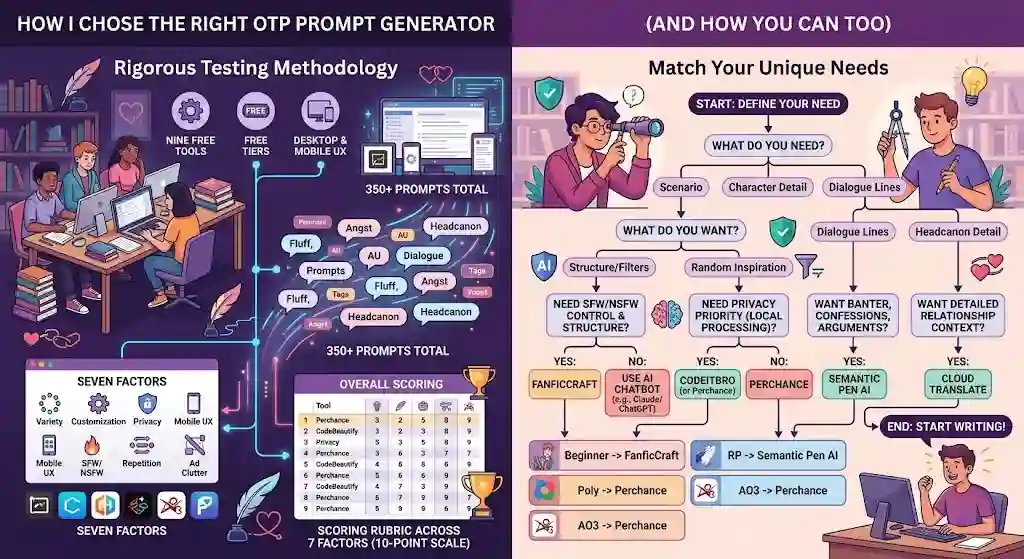
How I Chose the Right OTP Prompt Generator (and How You Can Too)
Picking the right tool comes down to three questions. Answer these and you’ll skip the trial-and-error phase.
1. What kind of output do you need? Scenario prompts → ship prompt generator. Relationship details → headcanon generator. Spoken lines → dialogue generator. Know the difference before you search.
2. How much control do you want? If you want to pick the trope, the mood, and the rating — go with FanficCraft. If you’re happy with random inspiration and sorting through results yourself — Perchance. If you want to describe exactly what you want in natural language — use an AI chat tool like Claude or ChatGPT.
3. How private do you need it to be? Client-side tools (Perchance, CodeItBro) keep your data local. Server-side tools (Semantic Pen AI, Cloud Translate, FanficCraft) send inputs to their backend. AI chat tools (ChatGPT, Claude, Gemini) process everything remotely and may log conversations depending on your settings.
That’s it. Three questions, and you’ve narrowed nine tools down to one or two.
What Most Ship Prompt Generator Reviews Miss
Here’s what actually separates a useful generator from a forgettable one — and why most lists never mention it.
Character voice and canon fit. A prompt that says “Person A confesses their feelings” is fine. A prompt that mirrors how a specific dynamic would actually play out — reluctance from the stoic one, humor from the deflector — is what writers actually need. Very few generators get anywhere near this. Entering character names is step one; adapting the scenario’s tone to fit those characters is step two, and almost no tool does step two.
Trope diversity over volume. I was skeptical at first, but the difference between a generator with 50 trope templates and one with 500 is noticeable by your fifth session. Shallow pools mean you’ll see “trapped together during a storm” more than once in a sitting. If you write regularly, you need depth.
Whether the tool helps or just randomizes. A random word generator doesn’t make you a better writer. A well-designed OTP prompt generator gives you something specific enough to spark an idea and open enough to let your interpretation shape the story. The gap between those two things is everything.
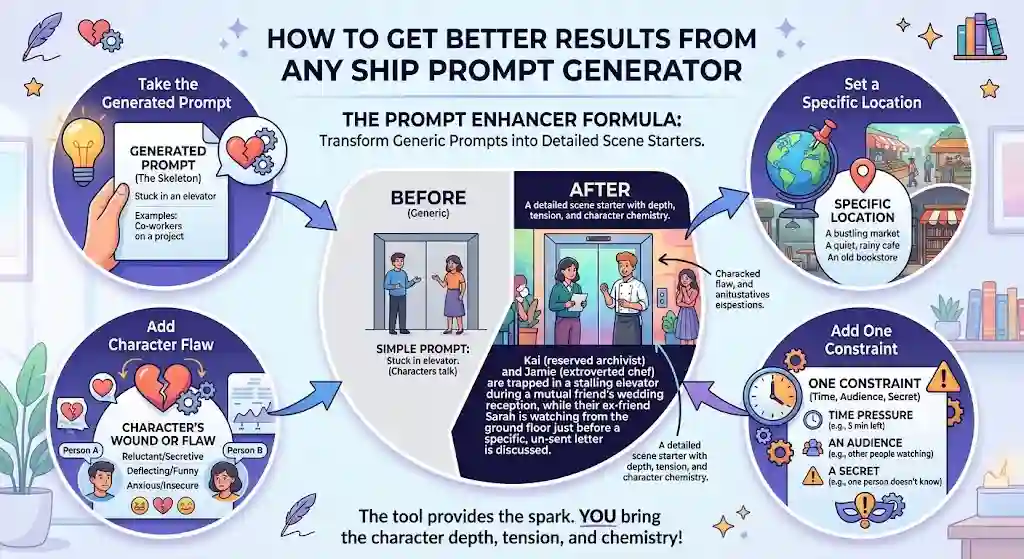
How to Get Better Results from Any Ship Prompt Generator
The tool is only half the equation. Here’s a formula I use to turn any generic prompt into a usable scene starter.
The prompt enhancer formula:
Take the generated prompt → Add your character’s wound or flaw → Set a specific location → Add one constraint (time pressure, an audience, a secret).
This approach borrows from core prompt engineering principles — specificity, context, and constraint.
Example — Fluff:
Generated prompt: “Person A and Person B cook dinner together.” Enhanced: “Kara — who’s been living on takeout since the breakup — lets Jamie teach her to make her mother’s pasta recipe in Jamie’s tiny apartment kitchen, except Kara keeps getting distracted by how Jamie talks to the garlic like it’s a person.”
That’s a scene. The original prompt gave you the skeleton. The enhancer formula gave you the body.
Example — Angst:
Generated prompt: “Person A finds Person B’s journal.” Enhanced: “Six months after the funeral, Devon finds Mira’s notebook in a winter coat pocket. The last entry is a grocery list with Devon’s favorite cereal circled and a margin note that reads ‘tell them tonight.'”
Example — Enemies to Lovers:
Generated prompt: “Person A has to work with Person B on a project.” Enhanced: “Two rivals at a competitive culinary school get assigned the same final exam dish — and the only oven available is the one in the basement kitchen, where the lights flicker and neither of them wants to admit they’re afraid of the dark.”
Example — Slow Burn:
Generated prompt: “Person A gives Person B a gift.” Enhanced: “After three years of friendship, Rowan leaves an unsigned copy of a rare book on Ellis’s desk — the same book Ellis mentioned once, in passing, at a party Rowan pretended not to care about.”
The generator gets you started. You bring the character chemistry, the tension, and the pairing dynamics that make it feel real.
[IMAGE: Infographic showing the ship prompt enhancer formula: Generated Prompt + Character Flaw + Specific Location + One Constraint = Usable Scene Starter] Alt text: Step-by-step infographic showing how to transform a basic ship prompt into a detailed scene starter using the prompt enhancer formula
How to Combine a Ship Prompt Generator with ChatGPT, Claude, or Gemini
This is the workflow most people miss — and it’s the strongest use case for these generators in 2026.
A dedicated ship prompt generator is fast. An AI chat tool is flexible. Use them together and you get both.
Step 1: Generate a seed prompt. Open Perchance (or whichever generator fits your mood) and grab a prompt. Example: “Person A and Person B are snowed in at a cabin.”
Step 2: Expand with Claude or ChatGPT. Paste that prompt into Claude, ChatGPT, or Gemini with context:
“Expand this ship prompt into a 300-word scene opener. Character A is a reserved archivist who doesn’t talk about feelings. Character B is an extroverted chef who copes with anxiety through cooking. Tone: slow burn with mutual pining. Setting: a remote cabin during a snowstorm, late evening.”
You’ll get a fully contextualized scene starter — with voice, tension, and atmosphere — in under a minute. For more structured templates, see our ChatGPT prompts guide.
Step 3: Generate dialogue variations. Take the scene and ask: “Write three versions of the first conversation they have that night — one version where A initiates, one where B initiates, and one where neither wants to talk and the silence breaks them.”
Now you have options. You’re not stuck with one path.
Step 4: Brainstorm alternate endings. Ask Gemini or ChatGPT: “Give me four possible endings for this scene — one fluffy, one angsty, one bittersweet, one open-ended.”
This combo — random generator for the seed, AI chat for the expansion — is how I develop most of my fic outlines now. The generator keeps things surprising. The AI adds the depth and character fidelity that no random tool can match alone.
A real scenario from my testing: I grabbed an enemies-to-lovers prompt from Perchance — “Person A and Person B are forced to share a hotel room.” Fed it to Claude with character details for two rival journalists covering the same story. Got back a 400-word opener that included a burned coffee pot, a laptop charger standoff, and the line “You can have the bed. I’ve slept in worse conditions than your company.” That’s not something a random generator produces — but it started with one.
Privacy, Safety, and Fandom Etiquette
This section won’t win any excitement awards, but it might save you a headache. Or worse.
Privacy and Local Processing
Some browser-based ship prompt generators — Perchance and CodeItBro being the clearest examples — process everything client-side. That means your character names, your pairings, and your prompt selections never leave your device. For writers working with OCs, sensitive content, or personal comfort dynamics, that matters.
Server-side tools (Cloud Translate, Semantic Pen AI, FanficCraft) send your inputs to their backend. Most of them probably don’t store anything permanently, but their privacy policies are vague at best. If privacy is your priority, stick to client-side generators.
Fictional vs. Real People
This is the big one. Using a ship prompt generator for fictional characters is standard fandom practice. Using it to generate romantic or sexual scenarios involving real, living people — especially public figures — crosses a line that most fandom communities actively enforce.
The Prompt-tool on Neocities includes an explicit note about this: use for fictional ships only. More tools should do the same.
SFW vs. NSFW Handling
If you’re under 18 or sharing content with minors, check whether the tool you’re using can produce NSFW content. Cloud Translate warns about it upfront. Perchance does not — some community generators produce explicit prompts with no toggle or filter. FanficCraft’s rating filter gives you the most control.
A safe ship prompt generator for teens should have either a strict SFW-only mode or clear content warnings. Not all of these tools meet that standard.
Community Norms
Fandom has its own etiquette around ship content. Tagging is expected. Content warnings are valued. Pressuring other fans about ship preferences — a practice called ship wars — is broadly frowned upon. None of this is governed by the tools themselves, but if you’re publishing work inspired by a generator, the norms apply to you.
Frequently Asked Questions
What is a ship prompt generator?
A ship prompt generator is an online tool that produces creative scenarios, tropes, or dialogue ideas for fictional character pairings (ships). You can use them to spark fanfiction, roleplay, art, or headcanon content. Most are free and require no login.
What does OTP mean?
OTP stands for “one true pairing.” It’s the character ship you feel the strongest about — the pairing you consider perfect. An OTP prompt generator creates scenarios specifically for your favorite pairing.
Are ship prompt generators free?
Yes. Every tool I tested for this review is free to use. Perchance, CodeBeautify, FanficCraft, CodeItBro, and the Neocities prompt tool all work without requiring payment or registration. Semantic Pen AI has a free tier with some limitations.
Can I use them for fanfiction?
Absolutely. That’s one of the most common use cases. Many AO3 writers use these tools to break through writer’s block, participate in prompt challenges, or explore tropes they wouldn’t have thought of on their own. The output is a starting point — your creativity shapes the final story.
Which ship prompt generator is best for fluff?
CodeBeautify’s OTP Fluff Generator is the most consistent source of warm, cozy, SFW prompts. If you want something more varied, Perchance has community generators dedicated to fluff prompt generator scenarios with deeper trope pools.
Which ship prompt generator is best for angst?
Perchance’s community angst generators win here. They produce emotionally intense prompts — character death, unrequited feelings, mutual pining with no resolution — that feel designed for hurt/comfort and heavy drama fics. Check for content warnings before use.
Are any ship prompt generators private or offline?
Perchance and CodeItBro process prompts client-side, meaning your inputs stay in your browser. No tool I tested works fully offline, but client-side tools come close — once the page loads, generation happens locally.
Can I generate prompts for more than two characters?
Yes, but options are limited. Perchance has community-built poly and multi-character generators. Most other tools default to two-person dynamics. If multi-pairing content is your priority, Perchance is your best bet as a multi-character ship prompt generator.
What’s the difference between a ship prompt generator and a trope generator?
A trope generator gives you a narrative device (enemies to lovers, fake dating, only one bed). A ship prompt generator gives you a specific scenario built around that trope, often with character slots or customizable details. Think of a trope as the recipe name and the prompt as the first paragraph of the recipe.
Can I use AI tools like ChatGPT or Claude as ship prompt generators?
Yes — and in some cases they’ll produce better, more tailored results than any dedicated generator. You can give ChatGPT a detailed request like “Give me 10 angst prompts for an enemies-to-lovers pairing where Character A is a healer and Character B is a soldier” and get highly specific results. The trade-off: it requires more input from you, and server-side AI tools process your data remotely.
Final Verdict
If you only try one ship prompt generator, make it Perchance (8.4 / 10). It’s free, private, instant, and backed by the largest prompt library in fandom. Its weakness — no curated entry point, no rating filters — doesn’t outweigh its depth.
For beginners or writers who need structure, go with FanficCraft (7.8 / 10). The category and rating filters give you the most control of any tool I tested.
For fluff, CodeBeautify (7.2). For angst, Perchance angst generators (8.0). For dialogue ideas, Semantic Pen AI (7.5). For headcanon depth, Cloud Translate (7.3). For privacy, CodeItBro (7.0).
And honestly? If you want the best possible ship prompts — prompts that feel like they were written for your pairing, your trope, your AU — combine a random generator with ChatGPT, Claude, or Gemini using the workflow above (see our best AI chatbots roundup for a full comparison). The dedicated generators are faster for casual writing inspiration. AI chat tools are better for directed, personalized results.
If you’re also interested in AI-generated couple visuals, our Gemini couple photo prompts guide covers that side of things.
Whatever tool you choose, remember: the prompt is the match, not the fire. Your voice, your characters, and your willingness to take a weird scenario and make it feel real — that’s what turns a generated line into a story worth reading.
Next step: Open Perchance, generate five prompts, and pick the one that makes your brain light up. Then write the first 200 words before you second-guess yourself.
About the author

I’m Macedona, an independent reviewer covering SaaS platforms, CRM systems, and AI tools. My work focuses on hands-on testing, structured feature analysis, pricing evaluation, and real-world business use cases.
All reviews are created using transparent comparison criteria and are updated regularly to reflect changes in features, pricing, and performance.