
Two AI video subscriptions can carry the same sticker price and buy wildly different amounts of video. Runway Pro and Pika Pro both bill at $28 per month on annual terms.
One of them includes 187 seconds of flagship generation per month. The other includes 575 seconds at 720p.
That gap is the whole decision, and almost no comparison resolves it, because a Runway credit and a Pika credit only become comparable once both are converted into seconds of video at a stated resolution. This comparison does that conversion first, then finds where the cheaper seconds stop being the better buy.
Pricing, credit rates and plan gates were checked on September 8, 2026.
In This Article (23 sections)
Quick Verdict: Runway vs Pika
| Decision Category | Winner | Why |
|---|---|---|
| Cost per second at matched 720p output | Pika | 4.57 cents on Pika Standard against 23.04 cents on Runway Standard, once credits and price are converted |
| Free tier for evaluation | Pika | Basic renews 80 credits monthly against a one-time 125-credit deposit, though its card marks watermark-free download and commercial use as excluded |
| Native 1080p on the flagship model | Pika | Pika 2.5 generates 1080p on paid tiers; Gen-4.5 documents 720p, though Runway lists Seedance 2.0 Pro at 1080p on the same balance |
| Cost per second at 1080p delivery | Incomparable | Runway Max is close in money, but a 720p generation plus an upscale is not the same product as a native 1080p one |
| Longest documented single generation | Pika | Pikaframes reaches a 20 to 25 second band; Gen-4.5 documents 2 to 10 seconds, and Runway publishes no duration for its other models |
| Direction of unit economics as volume rises | Runway improves, Pika does not | Runway’s per-second cost falls 58 percent from Standard to Max while Pika’s rises slightly, and Pika still costs less per 720p second at every tier |
| Included-credit rollover | Runway, among what is published | Max and Team roll one month forward; Pika sells rollover credits from Standard upward and does not state what happens to included ones |
| Commercial-use rights by plan | Runway | Runway’s usage-rights page attaches no plan condition; Pika’s cards mark commercial use as excluded on Basic and Standard and included from Pro |
| Security evidence for client media | Runway documents, Pika unverified | Runway publishes two certifications and private-by-default assets; no Pika security page was retrieved in this pass |
| Effect-driven social output | Pika | Pikaffects, Pikascenes, Pikaswaps and Pikatwists are priced as first-class tools |
| Production workflow depth | Runway | Projects, Brand Kits, voice clones and studio formats gate upward by tier |
| Self-serve API economics on the flagship models | Pika | Pika 2.5 from $0.04 per second against 12 cents for Gen-4.5, though Runway also lists Gen-4 Turbo at 5 cents |
| Measured render quality | Unresolved | No symmetric authenticated test was run for this comparison |
| Measured generation speed | Unresolved | Both vendors describe relative speed by tier without published timings |
Source: plan prices and credit allowances from the Runway pricing page and the Pika pricing page, checked September 8, 2026.
Choose Pika if the job is volume: short social cuts, effect-driven pieces, or any workflow where 720p is the delivery format. Choose Runway if the job is a small number of directed shots that have to ship in ProRes, HDR or an image sequence, or if the media is confidential.
For paid client work the Pika entry point is Pro rather than Standard, because commercial use is marked excluded on the two cheapest cards.
Specifications at a Glance
| Attribute | Runway | Pika |
|---|---|---|
| Flagship video model | Gen-4.5 | Pika 2.5 |
| Credit cost per second | 12 credits at the documented 720p output, 17 with the ProRes or PNG-sequence surcharge | 4 credits at 720p, 8 at 1080p, 2.4 at 480p |
| Documented output resolution | 720p, with separate 4K upscaling | 480p, 720p and 1080p by plan |
| Single generation length | 2 to 10 seconds | 5 or 10 seconds, or 20 to 25 seconds via Pikaframes |
| Frame rates | 24fps and 25fps | Not published on the pricing page |
| Free plan | 125 one-time credits, no Gen-4.5 access; watermark status not stated | 80 monthly credits, 480p only, watermark-free download and commercial use marked excluded |
| Paid entry plan | Standard, $15 monthly or $12 annual | Standard, $10 monthly or $8 annual |
| Top individual plan | Max, $95 monthly or $76 annual | Fancy, $95 monthly or $76 annual |
| Included credit rollover | Max and Team, one month | Not stated for included monthly credits; purchasable rollover credits from Standard upward |
| Commercial use | No plan condition stated on the usage-rights page | Marked excluded on Basic and Standard, included on Pro and Fancy |
| Watermark-free download | Not stated on the pricing page | Marked excluded on Basic and Standard, included on Pro and Fancy |
| Minimum credit top-up | 1,000 credits | Not published as a credit floor |
| API rate | Gen-4.5 at 12 credits per second, with API credits sold at $0.01 each | Pika 2.5 from $0.04 per second |
| Documented certifications | SOC 2 Type II and ISO/ | No security page retrieved in this pass |
Source: Runway plan and credit table and Pika plan and credit table, both checked September 8, 2026. Model specifications come from the Runway model documentation, checked the same day.
Methodology: How We Compared
This comparison is based on current vendor pricing pages, official help-centre documentation, published model specifications, developer API pricing and vendor security documentation, all checked on September 8, 2026.
Both products were assessed against the same buyer-focused criteria. The measurable one is cost per second of nominally generated output at a matched resolution, alongside plan gates, generation length, credit expiry and top-up mechanics, commercial-use terms, security posture, and API economics.
Greater weight went to factors that change a purchase: the resolution a plan can generate, the seconds an allowance buys, and the point at which a cheaper per-second rate stops being cheaper. Marketing positioning and tier names carried none.
Both pricing pages were read as rendered rather than as extracted text. The Pika page opens on its yearly view, so its monthly figures come from its monthly view.
Rendered text still flattens a feature matrix into row labels, so the include and exclude markers on the Pika cards were read from a screenshot of the card row.
Output-quality claims require product evidence or labelled comparative testing, so none appear here as a first-party result. Claims not verifiable from a retrieved page were excluded.
Workflow 1: A 30-Second Social Cut
The most common job on either platform is a short vertical piece assembled from several generations. Call it 30 seconds of finished 720p video, built from six clips, with realistic regeneration.
On Pika, 30 seconds of 720p Pika 2.5 costs 120 credits before any retries. Standard’s 700 monthly credits absorb that job roughly five times over, leaving genuine room to discard work that did not land.
On Runway, the same 30 seconds of Gen-4.5 costs 360 credits, and the vertical path below adds six stills at 8 credits each for Gen-4 Image, or 2 each for Gen-4 Image Turbo. At the higher of those, 408 credits.
Standard’s 625 credits per month cover the job once, with 217 credits left, which is not quite one more 30-second attempt.
The vertical requirement adds a wrinkle that pricing tables never show. Gen-4.5 text-to-video documents a single 16:9 aspect ratio at 1280×720, while image-to-video documents six, including 9:16 at 720×1280.
Vertical social video on Gen-4.5 therefore runs through the image-to-video path, which means producing a still first.
Pika prices its short-form tools separately rather than routing them through the base model. Pikaffects runs 18 credits for a 5-second paid generation, and Pikaformance runs 3 credits per second at 720p with audio durations up to 30 seconds.
Source: the Gen-4.5 rate from the Runway model documentation and the Pika 2.5 rate card on the Pika generation rate card, both checked September 8, 2026. The totals above apply those two rates to a 30-second job.
Winner for this workflow: Pika on retry budget, at equal retry rates. The deciding factor is headroom rather than headline price, and 700 credits at 4 credits per second is a different working condition from 625 at 12.
Whether the retry rates are equal is what neither vendor publishes. A higher discard rate on Pika would erode the margin, and nothing here establishes one.
Accessible text version of the chart above. Runway Gen-4.5 costs 12 credits per generated second.
Pika 2.5 costs 2.4 credits per second at 480p, 4 credits per second at 720p and 8 credits per second at 1080p.
Workflow 2: A Directed 10-Second Hero Shot
The second job is the opposite shape: one shot, specific, reviewed by somebody who did not write the prompt. An ad opener, a product beauty shot, a title sequence.
Here the credit arithmetic stops carrying the decision. Ten seconds is 120 Gen-4.5 credits or 40 Pika 2.5 credits at 720p, and neither threatens a paid monthly allowance.
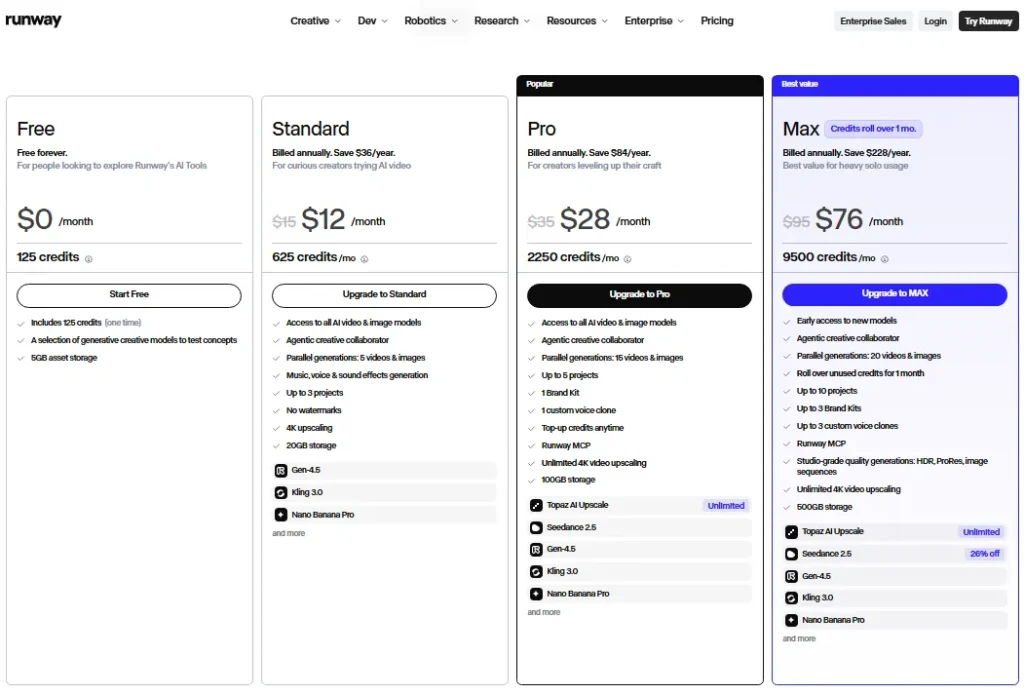
What decides it is control and delivery format. Runway Pro raises parallel generations to 15 and Max to 20, so a shot can be explored in variations at once.
Max also gates the finishing formats that a colourist or editor expects. Studio-grade generation on Max covers HDR, ProRes and image sequences.
The Runway model specification documents a 5-credit-per-second surcharge for the ProRes and PNG-sequence paths, taking those to 17 credits per second. It names Max, Unlimited Legacy and Enterprise as the plans that carry them.
Runway’s plan ladder is built around this job. Brand Kits appear at Pro and reach three at Max, custom voice clones follow the same shape, and project slots rise from three to five to ten.
Pika’s ladder is not. Every paid tier lists the same tool access, and the difference between Standard, Pro and Fancy is credits and generation speed, described as fast, faster and fastest.
Winner for this workflow: Runway, on documented finishing formats and parallel exploration rather than any quality claim. A buyer who needs ProRes out of the generator has one option here.
Workflow 3: A 25-Second Continuous Sequence
The third job breaks one of the two flagship models outright. A sequence longer than 10 seconds cannot be produced as one Gen-4.5 generation, because the documented duration range is 2 to 10 seconds.
That limit is documented for Gen-4.5 only. Runway publishes no maximum duration for Aleph 2.0 or either Seedance model, so this is a flagship-to-flagship reading rather than a platform ceiling.
Pika’s Pikaframes runs duration bands to 20 to 25 seconds. At 720p that band costs 100 credits, and at 1080p it costs 200, as the Pika rate card sets out.
That is a structural difference, not a preference. Runway’s answer to a 25-second sequence is to generate shorter pieces and assemble them, which is ordinary practice but a different amount of work and failure mode at the joins.
Winner for this workflow: Pika, because the capability exists at all. The qualification is that continuity across a 25-second band is the kind of output quality this comparison cannot rank without symmetric testing.
Pricing and Value per Dollar
Credit counts are not comparable across vendors, so every figure below is converted into seconds of video at a stated resolution before any comparison is drawn.
Runway publishes this conversion itself. The pricing page states that 625 credits monthly buys 52 seconds of Gen-4.5, 2,250 buys 187 seconds, and 9,500 buys 791 seconds.
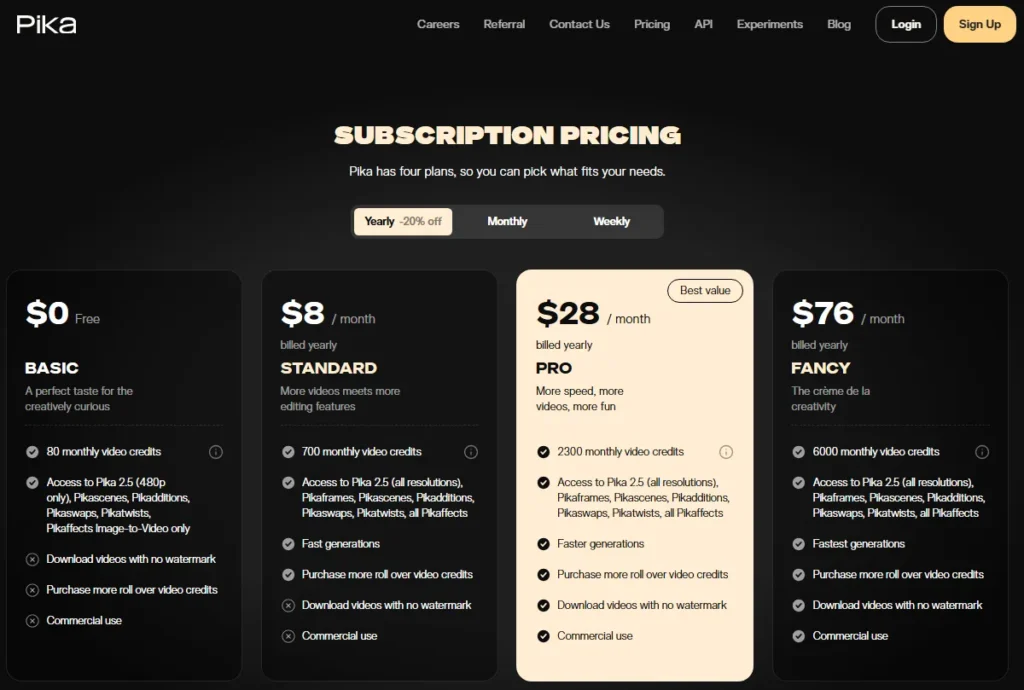
Pika publishes credit costs but not seconds, so the Pika figures below come from its own rate card: 20 credits per 5 seconds at 720p is 4 credits per second, and 40 per 5 seconds at 1080p is 8.
| Plan | Monthly Price | Annual Effective | Monthly Credits | Nominal Seconds Included |
|---|---|---|---|---|
| Runway Free | $0 | $0 | 125 one-time | No Gen-4.5 access on this plan |
| Runway Standard | $15 | $12 | 625 | 52 seconds of Gen-4.5 at 720p |
| Runway Pro | $35 | $28 | 2,250 | 187 seconds of Gen-4.5 at 720p |
| Runway Max | $95 | $76 | 9,500 | 791 seconds of Gen-4.5 at 720p |
| Pika Basic | $0 | $0 | 80 monthly | 30 seconds of Pika 2.5 at 480p |
| Pika Standard | $10 | $8 | 700 | 175 seconds at 720p, or 85 at 1080p |
| Pika Pro | $35 | $28 | 2,300 | 575 seconds at 720p, or 285 at 1080p |
| Pika Fancy | $95 | $76 | 6,000 | 1,500 seconds at 720p, or 750 at 1080p |
Source: Runway subscription tiers and Pika subscription tiers, both checked September 8, 2026.
Runway states its own Gen-4.5 seconds per tier.
The Pika seconds are calculated in whole generations, because that vendor sells fixed 5-second and 10-second bands and any remainder is stranded.
Two plan gates sit outside that table. The Pika plan cards mark watermark-free download and commercial use as excluded on Basic and on Standard, and included on Pro and Fancy.
The cheapest Pika plan that licenses client work is therefore Pro, at $28 per month on annual billing or $35 monthly.
Accessible text version of the chart above. On annual billing, a Gen-4.5 second costs 23.04 cents on Runway Standard, 14.93 cents on Pro and 9.60 cents on Max.
The Pika 2.5 series runs 4.57, 4.87 and 5.07 cents per second at 720p across Standard, Pro and Fancy.
The 1080p series for the same three tiers runs 9.41, 9.82 and 10.13 cents per second.
Cost at Volume
Sticker price answers nothing above light use, so the table prices four monthly output volumes on the cheapest plan of each platform that carries them at 720p.
| Monthly 720p Output | Credits Needed on Runway | Cheapest Runway Plan | Credits Needed on Pika | Cheapest Pika Plan by Credits |
|---|---|---|---|---|
| 60 seconds | 720 | Pro at $28 annual | 240 | Standard at $8 annual |
| 180 seconds | 2,160 | Pro at $28 annual | 720 | Pro at $28 annual |
| 500 seconds | 6,000 | Max at $76 annual | 2,000 | Pro at $28 annual |
| 1,200 seconds | 14,400 | Max at $76 annual plus a top-up of unpublished price | 4,800 | Fancy at $76 annual |
Source: Runway credit rates from the Runway pricing page and Pika credit rates from the Pika pricing page, both checked September 8, 2026. The credit totals are calculated at 12 credits per Gen-4.5 second and 4 credits per Pika 2.5 second at 720p.
The last column prices generation capacity, not a commercial licence. A buyer whose output is client work replaces the Standard entry with Pro, at the same annual price as the Runway Pro row beside it.
The 60-second row is the one worth pausing on. One minute of 720p video a month already pushes a Runway buyer past Standard and onto Pro.
The same minute uses about a third of Pika’s cheapest paid plan.
The 1,200-second row shows the other end. Runway Max cannot carry that volume from included credits, so the buyer meets the top-up rule, and the pricing page states the 1,000-credit minimum without its price.
The Hidden Pricing Rules
Three mechanics move the real cost away from the advertised one, and none appear on a comparison chart.
Runway’s monthly credits expire on Standard and Pro, as its credit documentation sets out. They reset within 24 hours of the billing date.
A month at 60 percent utilisation on Pro therefore buys 112 seconds rather than 187, against $28, the effective monthly price when billed annually. That lifts the real rate to about 25 cents per second.
The same haircut cannot be applied to Pika, because whether its included credits roll over is not stated. Every Pika rate here assumes the allowance is fully spent.
Max is the only individual plan that protects unused credits, rolling up to one month forward. Purchased credits never expire on any plan.
Runway’s top-up floor is 1,000 credits. That is 83 seconds of Gen-4.5, 1.6 times the entire Standard allowance, so a shortfall of a few seconds cannot be solved by buying a few seconds.
Pika’s plan cards mark purchasable rollover credits as excluded on Basic and included on the three paid plans. Whether included monthly credits roll over is not stated, so a buyer planning around uneven months should confirm it in the billing interface before committing to a year.
Runway states that its web and API credits are separate balances that never transfer. A subscription is not an API budget.
Feature Comparison
| Dimension | Runway | Pika | Winner |
|---|---|---|---|
| Flagship credit rate | 12 credits per second | 4 credits per second at 720p | Pika |
| Native resolution on the flagship model | 720p documented for Gen-4.5 | Up to 1080p on paid plans | Pika, though Runway lists Seedance 2.0 Pro at 1080p |
| Post-generation upscaling | 4K upscaling from Standard, unlimited from Pro | Not listed on the pricing page | Runway only, on published evidence |
| Longest documented single generation | 10 seconds on Gen-4.5; not published for other models | 25 seconds via Pikaframes | Pika |
| Aspect ratios on the flagship model | One for text-to-video, six for image-to-video | Not published on the pricing page | Runway only, on published evidence |
| Parallel generations | 5, 15 and 20 by tier | Not published; tiers are described as fast, faster and fastest | Only Runway publishes a figure |
| Model breadth on one subscription | Gen-4.5, Aleph 2.0, Seedance 2.0 and image and audio models | Pika 2.5 plus the effect tool family | Runway |
| Effect and transformation tools | Not priced as separate tools | Six named tool families with their own rates | Pika |
| Brand and voice assets | Brand Kits and voice clones from Pro | Not listed | Runway only, on published evidence |
| Studio delivery formats | HDR, ProRes and image sequences on Max | Not listed | Runway only, on published evidence |
| Included-credit rollover | Max and Team, one month | Not stated; purchasable rollover credits from Standard upward | Runway, among what is published |
| Commercial use on the entry paid plan | Permitted, with no plan condition stated | Marked excluded on Standard, included from Pro | Runway |
| Watermark-free download | Not stated on the pricing page | Marked excluded on Basic and Standard, included from Pro | Neither, on published evidence |
| Free tier usefulness | One-time deposit, no flagship model | Recurring monthly credits at 480p | Pika |
Source: Runway plan features and Pika plan features, checked September 8, 2026.
A cell reading “not listed” records that the vendor does not publish the attribute, not that the capability is absent. No Pika model documentation was retrieved in this pass, so several gaps here are asymmetries in the evidence rather than the products.
AI Model Comparison
Runway sells access to a catalogue rather than to one model. Its model credit table puts Gen-4.5 at 60 credits per 5 seconds and Aleph 2.0 at 140.
Seedance 2.0 Pro sits at 160 credits per 4 seconds and Seedance 2.0 Fast at 116, alongside image and audio models drawing on the same balance.
Pika sells one video model and a set of tools built on it. Pika 2.5 handles text-to-video and image-to-video, and Pikascenes, Pikadditions, Pikaswaps, Pikatwists, Pikaffects and Pikaframes each carry their own rate.
The buying consequence is what a bad month looks like. On Runway a model that suits the shot poorly can be swapped for another on the same credits; on Pika the fallback is a different tool rather than a different model.
Ease of Use and Setup
Neither platform requires installation, so setup difficulty is mostly how much structure a buyer must create before producing anything.
Pika’s structure is flat. Every paid tier lists the same tool access, so the only decision at signup is how many credits are needed.
Runway’s structure is a project system with slots that gate by tier: three on Standard, five on Pro, ten on Max. A team that organises work by client or campaign meets that ceiling earlier than a solo creator.
Runway’s free plan is the weaker way to evaluate, because Gen-4.5 access begins at Standard. Trialling its flagship model means paying for it.
Pika’s free plan renews 80 credits a month, but Basic caps Pika 2.5 at 480p and marks watermark-free download and commercial use as excluded. A free evaluation is bounded by that resolution, and nothing it produces is licensed for paid work.
Automation, API and Ecosystem
Both platforms expose an API and an MCP integration, so the comparison is about rate and throughput rather than availability.
Runway’s API pricing guide sells API credits at $0.01 each in the developer portal, and Gen-4.5 costs 12 credits per second there, or 12 cents per second.
Gen-4 Turbo runs 5 credits per second on the same basis.
Pika’s API pricing page lists most Pika 2.5 models at $0.04 per second at 720p and $0.06 at 1080p. Default accounts are documented there at 60 requests per minute and 10 concurrent jobs.
At 720p the flagship API gap is roughly threefold in Pika’s favour, 4 cents against 12.
No 1080p comparison exists on that pair, because Gen-4.5 documents a 720p output. Runway’s API page lists its 1080p model, Seedance 2.5, at 68 credits per second.
Runway’s subscription route is the cheaper of its own two options at full utilisation. Max on annual billing works out to 9.60 cents per Gen-4.5 second against 12 cents through the API.
Below full utilisation that reverses, because the subscription rate rises with every unspent credit while purchased API credits never expire. The crossover depends on how much of the allowance is actually spent.
Runway MCP appears at Pro and Max, so an agent-driven workflow there starts at $28 per month on annual billing rather than at the entry tier. Pika lists Pika MCP alongside Pika Agent and the Pika video app.
A throughput figure exists on only one side. Pika publishes default rate limits; no equivalent Runway figure was established, so no throughput winner is declared.
Output Tracking and Cost Control
AI video platforms have no reporting layer in the CRM sense, so the analogue is how well each lets a buyer predict and control spend.
Runway is the more predictable, because it publishes seconds per tier, separates web and API balances, pools credits across a workspace, and states rollover and expiry rules per plan.
Two gaps remain on that page: it prices neither a credit top-up nor the Team plan whose per-seat allowance the credit documentation states.
Pika publishes a denser rate card, covering seven priced tool families at up to three resolutions, with five duration bands on Pikaframes, but the buyer does the conversion. Included-credit rollover is the one gap, and it matters most for uneven workloads.
For a Runway Team workspace, the credit documentation puts credits at 6,900 per seat, pooled across the workspace rather than held per member. Pooling helps a team with uneven output and hurts one where a single user absorbs the pool.
Support, Security and Admin Controls
Runway documents SOC 2 Type II compliance and ISO/IEC information security certification in its 2022 revision on its security and privacy page. The same page states that all uploaded assets are private automatically, and sharing requires a deliberate change to the asset privacy setting.
For an agency putting unreleased client footage into a generator, that is the paragraph the client’s legal team asks for.
No Pika security page was retrieved in this pass. That records which pages this comparison fetched, not a finding that Pika lacks those controls.
Commercial rights are documented more firmly on Runway. Its usage rights page states that users retain ownership and all rights to content they upload and generate.
It also states that content created using Runway is theirs to use without any non-commercial restriction, and attaches no plan condition.
Pika documents it as a plan gate. Its plan cards mark commercial use as excluded on Basic and on Standard and as included on Pro and Fancy, and Pika states separately that all API outputs are licensed for commercial use under its API agreement.
The difference is what each statement is. Runway’s is a rights page that addresses ownership directly; Pika’s is a line item on a plan card and a sentence on an API page.
The difference is also where each one starts. Runway Standard carries the same commercial position as Max, while the cheapest commercially licensed Pika subscription is Pro.
Neither vendor’s terms of service was read in this pass, and that is the binding document on both sides. A buyer taking either into paid client work should read it first.
Winner on documented trust evidence: Runway, on the strength of the pages this comparison retrieved rather than on any comparative security judgement.
What Changed in 2026
One plan change is still moving, and several competing comparisons have it wrong. Runway’s plan transition notice records that Unlimited stopped being offered to new subscribers on June 1, 2026, and that Max replaced it.
Eligible legacy Unlimited access continues through November 30, 2026. On that date, Unlimited subscribers move to Max, and monthly subscribers move automatically at the same $95 per month.
For monthly subscribers the credit consequence is large in their favour. Unlimited carried 2,250 monthly credits and Max carries 9,500, which is the difference between 187 and 791 seconds of Gen-4.5.
One live inconsistency is worth knowing: Runway’s credit documentation still lists Pro and Unlimited together at 2,250 credits, accurate for the legacy plan and irrelevant after the November transition.
at $95 per month
Switching Difficulty
| Switching Factor | Runway to Pika | Pika to Runway |
|---|---|---|
| Capability given up | ProRes, HDR and image sequence output | Native 1080p generation and the 25-second Pikaframes band |
| Capability gained | Roughly five times the 720p seconds per dollar at entry tier | Studio delivery formats and one month of credit rollover on Max |
| Rights position after the move | A plan-gated commercial-use card replaces a rights page with no plan condition | A rights page with no plan condition replaces a commercial-use gate that starts at Pro |
| Structure to rebuild | Project slots, Brand Kits and voice clones have no equivalent | Six effect tool families collapse into one model plus prompts |
| Cheapest plan preserving entry-tier output | Pika Standard at $8 annual, or Pika Pro at $28 annual for commercial work | Runway Pro at $28 annual, since Standard’s 625 credits carry only 52 seconds |
Source: plan capabilities and prices from the Runway plan capability list and the Pika plan capability list, checked September 8, 2026. No figure in this table appears for the first time here.
Neither vendor publishes export or migration tooling, so the describable switching cost is relearned prompting and whichever documented capability the buyer gives up.
Runway plans include 5GB to 500GB of stored assets, and what happens to those on a switch is undocumented on both sides.
The asymmetric risk sits on the rights side. Moving into Runway improves the documented position at every tier; moving out replaces a statement with no plan condition with one that begins at Pro.
Where Runway Wins
Runway is the better buy when the work is small in volume and high in consequence.
Directed shots that need finishing formats have one answer. HDR, ProRes and image sequence output arrives on Max, and the model documentation prices the ProRes and PNG-sequence paths at 5 credits per second above the base rate.
Confidential client media has one answer too, on published evidence. Private-by-default assets and two named security certifications are documented, which is more than the other side publishes.
That page does not address retention, scope or whether uploads train anything, so it answers the first question a client asks, not all of them.
Volume above roughly 500 seconds a month is where Runway’s economics stop looking bad against themselves. The per-second cost falls 58 percent from Standard to Max, and Max is the only individual plan that carries unused credits forward.
It does not overtake Pika on rate at any tier; what it buys is a curve that rewards scale.
Model variety on one balance is the quiet advantage. A shot that Gen-4.5 handles poorly can be attempted with Aleph 2.0 or Seedance without a second subscription.
Commercial certainty is the last one. The usage-rights page states no non-commercial restriction and attaches no plan condition to it, while the competing plan cards mark commercial use as excluded on the two cheapest tiers.
Where Pika Wins
Volume work with a forgiving delivery format is where Pika stops being the cheaper option and starts being the obvious one.
Cost per second at 720p is the headline. Once credits and price are converted, a Pika Standard second costs 4.57 cents, against 23.04 cents at the equivalent tier on the other side.
Pika Standard is also the cheaper subscription, at $8 per month on annual billing against $12.
Retry budget follows from it. Pika Standard buys 175 seconds of 720p generation a month.
Runway Standard buys 52. Neither vendor publishes how much of an allowance goes to discarded work, so the gap is margin for error rather than a measured cost.
Native 1080p on the flagship model is a genuine difference. Paid Pika tiers generate 1080p directly.
Gen-4.5 documents a 720p output and reaches higher resolution through a separate upscale, though Runway does list Seedance 2.0 Pro at 1080p on the same balance.
Sequences beyond 10 seconds have one documented answer here. Pikaframes reaches a 20 to 25 second band at 100 credits at 720p.
Runway publishes a duration range for its flagship model only.
The free tier is the one that survives contact with real use as an evaluation. Eighty credits renew monthly, against a one-time 125-credit deposit with no flagship model at all.
What renews is generation rather than deliverable output, because the same card marks watermark-free download and commercial use as excluded.
Who Should Choose Runway
Choose Runway if finished files have to arrive in ProRes, HDR or an image sequence. The model documentation names Max, Unlimited Legacy and Enterprise for that path.
Budget the surcharge described in Workflow 2 rather than the base rate, because the ProRes path is the more expensive second and the reason for choosing this plan.
Choose Runway if client footage is confidential and somebody will ask what happens to uploads, because private-by-default assets and two named certifications are documented.
Choose Runway if monthly output runs past roughly 500 seconds and rollover matters, because Max is where its own rate stops falling and where unused credits stop expiring.
It still costs more per 720p second than the competing tier at every level.
Choose Runway if the work benefits from several models on one balance, or if an agent workflow through Runway MCP is part of the plan from Pro upward.
Who Should Choose Pika
Choose Pika if the delivery format is 720p social video, because the rate difference compounds across every retry and the entry plan already carries 175 seconds a month.
That entry plan is Standard, and if the video is paid client work its commercial-use exclusion moves the starting point up to Pika Pro, which carries 575 seconds instead.
Choose Pika if native 1080p generation on the flagship model is a requirement, and note that this means Standard or above, since Basic is capped at 480p.
Choose Pika if the output is effect-driven, because Pikaffects, Pikascenes, Pikaswaps, Pikatwists and Pikadditions are priced as tools rather than prompts against a general model.
Choose Pika if a single continuous sequence has to run past 10 seconds, because Pikaframes is the only documented path to a 25-second band in this comparison.
Choose Pika if the evaluation has to happen before any spend, because Basic renews every month, and treat what it produces as a test rather than a deliverable, since its card marks watermark-free download and commercial use as excluded.
Who Should Avoid Both
Neither platform suits a buyer who needs a fixed output quality standard, because neither publishes a benchmark and this comparison did not run one. That work needs a supervised pilot before any annual commitment.
Neither suits a buyer whose sole requirement is long-form narrative video. The longest single generation in this comparison is a 25-second Pikaframes band, so anything past that is an editing job regardless of platform.
Neither suits a buyer who needs a documented throughput guarantee for an automated pipeline. Only Pika publishes API rate limits, Runway publishes only per-tier parallel-generation counts, and neither publishes generation timings.
A buyer in any of those positions is better served by a wider supervised trial than by either annual plan.
Alternatives to Runway and Pika
| If the Blocker Is | Option Inside This Comparison | What It Costs |
|---|---|---|
| Gen-4.5 suits the shot poorly | Aleph 2.0 on the same Runway balance | 140 credits per 5 seconds |
| A 1080p Runway generation is needed | Seedance 2.0 Pro on the same web credit balance | 160 credits per 4 seconds |
| Gen-4.5 is too expensive per second | Gen-4 Turbo, priced only in the API documentation | 5 credits per second on the API balance, separate from web credits |
| Pika credits run short on stills-driven work | Pikaffects rather than base generation | 18 credits per paid 5-second clip |
| Audio-led output is the goal | Pikaformance on any Pika tier | 3 credits per second at 720p |
Source: the Runway model credit table and the Pika tool rate card, checked September 8, 2026. The Gen-4 Turbo rate comes from the Runway API pricing guide, checked the same day.
The most useful alternative is often a different model on the platform already being paid for, which is why the table stays inside the two products compared. Choosing between whole platforms needs evidence this comparison did not gather; the wider field is covered in the best AI video generators roundup.
Runway vs Pika: Which Should You Choose?
Pika is the better default for most buyers reading this, and the reason is narrow and checkable.
At matched 720p output a Pika Standard second costs 4.57 cents, once credits and price are converted together. The equivalent tier on the other side costs 23.04 cents.
For a solo creator or a social team shipping short-form video, that is not a marginal saving.
Pika Standard at $8 per month on annual billing includes 175 seconds of 720p generation.
Runway Standard at $12 on the same annual billing terms includes 52.
That reading holds for personal and internal work. For paid client work it does not, because commercial use is marked excluded on the Pika Standard card, so the comparison becomes Pika Pro against Runway Standard, and the cheaper subscription is then the Runway one.
Runway is the better buy for a smaller, more specific group, and the case does not rest on generation volume. It rests on three documented things: studio delivery formats on Max, private-by-default assets backed by two named security certifications, and a usage-rights page that attaches no plan condition to commercial use.
An agency handling unreleased client media, or a producer who needs ProRes out of the generator, has one option here.
The verdict this comparison cannot deliver is a quality ranking, and the omission is deliberate. No symmetric authenticated test was run, so no claim is made about render fidelity, prompt adherence, motion coherence or failure rate.
That matters. A cheaper second stops being cheaper the moment a higher share of generations gets discarded, and nothing in either vendor’s published material establishes that rate.
One measurable evaluation criterion decides this comparison: cost per second of nominally generated output at a matched resolution. Every plan difference described above follows from it.
Cost per second of usable output would decide it better, and neither vendor publishes the retry rate.
Take the first product, Runway, where a Gen-4.5 second costs 12 credits.
Set that against the second product, Pika, whose Pika 2.5 second costs 4 credits at 720p.
Choose when two things are known, the delivery resolution and the seconds of finished video a normal month produces, because those facts move the answer further than either brand name.
Two boundaries belong on any shortlist from this page. Pika’s commercial use is a plan gate rather than a product-wide permission, so a buyer intending client work should price Pro or Fancy and confirm the position in the terms of service.
Runway’s Unlimited plan is also not a current option. It closed to new subscribers on June 1, 2026, and legacy access ends on November 30, 2026.
Frequently Asked Questions
These are the questions the body does not fully close, mostly because they turn on a number a reader applies to their own output volume.
Is Runway better than Pika?
Not on generation economics, and yes on delivery formats and documented trust evidence.
At matched 720p, converting credits and price together puts a Pika Standard second at 4.57 cents.
The same conversion puts the equivalent tier on the other side at 23.04 cents.
Runway is the stronger option where output must ship as ProRes, HDR or an image sequence, or where client media requires documented certifications.
Which is cheaper, Runway or Pika?
Pika, at matched 720p output, by roughly five times at the entry tier. A Pika 2.5 second costs 4.57 cents on Pika Standard, on annual billing.
A Gen-4.5 second on Runway Standard costs 23.04 cents.
The gap narrows at the top of both ladders.
At 1080p a Pika Fancy second costs slightly more in money than a 720p flagship second on the competing top tier, and the two are not the same output.
A buyer who needs 1080p at volume should therefore price both top tiers rather than assuming Pika wins.
How many credits does Runway use per second?
Gen-4.5 costs 12 credits per second, and generating in ProRes or as a PNG sequence adds 5 credits per second on the plans that allow it. Other models on the same balance differ: Aleph 2.0 runs 140 credits per 5 seconds and Seedance 2.0 Pro runs 160 per 4 seconds.
How many credits does Pika 2.5 use?
Twenty credits for a 5-second 720p generation and 40 for 10 seconds, which is 4 credits per second. At 1080p those figures double to 40 and 80.
On the free Basic plan, 480p generation costs 12 credits for 5 seconds, so an 80-credit month buys six generations, 30 seconds of evaluation footage, and no 720p output at all.
Does Pika generate 1080p video?
Yes, on Standard and above. The Basic plan is capped at 480p for Pika 2.5, so 1080p generation begins at $10 per month, or $8 on annual billing.
What resolution does Runway Gen-4.5 generate?
The Gen-4.5 documentation states a 720p output. Higher-resolution delivery goes through Runway’s separate upscaling feature, which is included from Standard and unlimited from Pro, so generation resolution and final export resolution are two different things.
Can I use my Runway subscription credits for API calls?
No. Runway states that credits or plans purchased on the web app are completely separate from credits purchased via the API, and that neither balance appears in the other.
API credits are sold at $0.01 each in the developer portal, so an automated pipeline needs its own budget line on top of any subscription.
Can Pika videos be used commercially?
Not on the two cheapest plans. The Pika plan cards mark commercial use as excluded on Basic and on Standard and as included on Pro and Fancy.
Pika states separately that all API outputs are licensed for commercial use under its API agreement, which is a different surface from the subscription.
Runway attaches no plan condition, and its usage rights page states that content created using Runway is the user’s to use without any non-commercial restriction.
What happens to Runway Unlimited subscribers?
Eligible legacy Unlimited access continues through November 30, 2026, after which subscribers move to Max. Monthly subscribers move automatically at the same $95 per month, and the credit allowance rises from 2,250 to 9,500.
Which free plan is better for evaluating the product?
Pika Basic, because its 80 credits renew every month.
The Runway free plan is a one-time deposit of 125 credits instead.
The limitations on Pika’s side are that Basic caps Pika 2.5 at 480p and marks watermark-free download and commercial use as excluded.
On Runway the limitation is different: Gen-4.5 access begins at Standard, so the flagship model cannot be tried for free.
Your Next Step
Pick the tier from the output type rather than the price. Decide the delivery resolution, count the seconds a normal month produces, multiply by the per-second rates in the pricing section and add a retry margin.
A buyer who lands under 175 seconds of 720p a month should start on Pika Standard, which is exactly what its 700 credits carry. If the output is commercial, the card’s exclusion moves that starting point up to Pika Pro.
Keep any Runway evaluation for the shots that need finishing formats.
Between five hundred and 575 seconds a month, both Pika Pro and Runway Max carry the load. Pika Pro is the cheaper plan and the cheaper second; Runway Max carries unused credits forward.
Above 575 seconds Pika Pro no longer covers it, and the comparison moves to Pika Fancy.
Before committing to annual billing, confirm the commercial terms for the specific plan and whether included monthly credits carry forward. Those answers change the cost of a wrong month more than any rate here.
For the deeper single-product picture, the Runway ML review covers its workflow and plan gates in detail.
The Runway ML pricing guide works through its credit mechanics tier by tier, and the Pika Art review does the same job for Pika.
Prompt construction on either platform is covered in the AI video prompts guide, which matters here because the retry rate this comparison cannot measure is partly a function of prompt quality.