
If you have asked how to make AI video, tried once, and watched the model return something almost right, the hard part is telling which part of the prompt caused it. That guessing loop is what burns generation credits.
In This Article (20 sections)
The fix is not a better tool. It is deciding which of four workflows your starting material belongs to, then writing the shot brief that workflow expects before anything is generated.
Every product fact below is traced to the vendor’s own documentation, with the date it was read.
Quick Copy: The AI Video Shot Card Checklist
Copy these items into a note or a spreadsheet row before the first generation. Anything unanswered is a reason to stop, not a reason to hit Generate and find out.
- Project goal in one sentence: explain, sell, demonstrate, train, or entertain.
- Target audience and the single thing they should understand.
- Destination and aspect ratio, locked before prompting.
- Workflow mode, one only: text to video for an idea, image to video for a still you must keep, avatar script video for a presenter, video to video for a clip you already have.
- Shot ID and the job this shot does in the sequence.
- Target duration, kept inside the selected model’s supported window.
- Primary subject, plus a deliberate count of how many subjects appear.
- One primary visible action.
- Environment, described only when the model has to invent it.
- Camera motion, subject motion, and environmental motion written as three separate lines.
- Visual style, added only when the chosen mode needs it.
- Reference assets, each labeled with the role it plays.
- Rights confirmed for every uploaded image or clip.
- The exact prompt text, saved verbatim so iterations stay comparable.
- Model name and every exposed setting, re-read on the day of generation.
- Acceptance criteria that another person could check by watching the clip.
- Failure observed, limited to the single worst problem.
- Next change, limited to one variable.
- Final status: keep, revise, reject, or ready for edit.
Quick Decision: Which AI Video Workflow Fits Your Starting Material
The first mistake is choosing a tool. The starting asset decides the workflow, and the workflow decides what the prompt is allowed to say.
| You Are Starting With | Use This Workflow | The Prompt’s Job |
|---|---|---|
| An idea and nothing else | Text to video | Describe the scene and the motion, because the model invents both |
| A still you need to keep intact | Image to video | Describe motion and timing, because the still already fixes the look |
| A script and a presenter | Avatar or agentic script video | Supply script, voice, brand assets, and scene order rather than camera language |
| A clip that is nearly right | Video to video edit | Describe the change, not the whole scene |
Runway documents both text and image entry points for its video model, HeyGen documents a separate studio built around scripts and avatars, and Google documents conversational editing of an uploaded video. Those are four workflows built around four different input structures, which is why one prompt formula cannot serve all of them.
already have?
keep intact
lighting, style
presenter
documented menu
brand assets, scene order
nearly right
regenerate
Check Availability Before You Follow Any 2026 Tutorial
A product discontinued in April 2026 can still appear as a starting point in a tutorial written before that date. That is worth knowing before a reader spends an afternoon looking for a sign-up page.
| Product | What the Documentation States | What That Means for This Workflow |
|---|---|---|
| Runway Gen-4.5 | Documented and available | Text to video and image to video shots |
| Adobe Firefly Video | Documented and available | Reference-driven shots inside an editing workspace |
| HeyGen AI Studio and Video Agent | Documented and available | Presenter-led and assembled video |
| Gemini Apps video generation | Documented and available | Conversational generation and editing |
| OpenAI Sora web and app | Discontinued on April 26, 2026 | Not a path a beginner can follow |
Source: official OpenAI discontinuation notice and the vendor documentation page linked in each section below. Checked: 2026-09-09.
OpenAI states that the Sora web and app experiences were discontinued on April 26, 2026, and that the Sora API will be discontinued on September 24, 2026. Any tutorial that still lists it as a starting point for a beginner was written against a product that has been retired.
How to Make an AI Video Step by Step
This is the workflow the shot card supports. It applies to every mode, and the mode only changes what goes into the prompt field.
Step 1: Name the use case and pick one mode. Write the job of the video in a sentence, then choose text to video, image to video, avatar script video, or video to video edit. Two modes on one shot is an error worth catching here, because the prompt ends up fighting itself.
Step 2: Lock the destination format. Set the aspect ratio and orientation before any prompt exists, so the framing decision is not made twice.
Step 3: Gather the required input for that mode. Text to video needs only a written scene, and image to video needs a still that Runway advises should be high quality and free of visual artifacts. An avatar workflow needs a script and a voice, and an edit needs the source clip.
Step 4: Confirm rights on every upload. Google’s help documentation is explicit that users must have rights to any images they upload, so this belongs in the template rather than in a footnote.
Step 5: Write the prompt using the grammar for the mode. The two prompt templates below are not stylistic variants of each other, because the official guidance for each mode asks for different information.
Step 6: Re-read the model settings. Adobe states that the availability of settings such as resolution, duration, and audio varies by the model selected. A settings recipe carried over from another tool workflow can therefore stop applying without any visible error.
Step 7: Generate one short shot, then score it. Review against the acceptance criteria in a fixed order, record the single worst failure, change one variable, and customize the shot card entry for the next attempt.
The example output further down completes the card for a seven-second product shot, at the level of detail each field needs.
Copy This AI Video Shot Card
The card below is the reusable template. Copy the whole thing per shot, not per video.
| Field | What to Write | Why It Changes the Result |
|---|---|---|
| Project goal | One sentence naming the job of the video | Stops a shot drifting into decoration |
| Audience | Who watches, and what they must understand | Sets vocabulary, pace, and on-screen text |
| Destination and ratio | Platform plus aspect ratio | Framing decisions cannot be undone later without a crop |
| Workflow mode | Exactly one of the four modes | Decides which prompt grammar applies |
| Shot ID and role | A stable label plus the shot’s job | Makes an iteration log readable weeks later |
| Target duration | Seconds, inside the model’s window | A duration outside the window cannot be generated as briefed |
| Subject and count | The primary subject, and how many appear | Adobe recommends limiting subject count for Firefly, saying more than four can often confuse it |
| Action | One primary visible action | One action per shot keeps the brief unambiguous |
| Environment | The setting, when the model must invent it | Runway lists environment among the visual components for text to video, and advises omitting elements already present in a source image |
| Camera and motion | Camera move, subject motion, environmental motion | Three separate motions are three separate instructions |
| Visual style | Lighting, grade, framing, mood | Only needed when the mode expects the model to invent the look |
| Reference assets and role | Each asset plus what it controls | A reference with no declared role is an untracked variable |
| Rights confirmed | Yes or stop | An upload without rights is a problem no regeneration fixes |
| Prompt | The exact text sent | Iterations are only comparable when the previous text survives |
| Model and settings | Model name, duration, ratio, resolution, audio | Settings vary by model, so they belong in the record |
| Acceptance criteria | Observable pass conditions | Vague criteria produce vague reviews |
| Failure observed | The single worst problem | One named failure keeps the next change diagnosable |
| Next change | One variable | Changing three things teaches nothing about any of them |
| Final status | Keep, revise, reject, ready for edit | Turns a folder of clips into an edit list |
If You Only Have an Idea: The Text to Video Path
This is the path where the model invents everything, so the prompt has to carry both what the shot looks like and what moves in it.
Runway’s text to video prompting guide splits prompt content into visual components and motion components. The visual list is subject appearance, environment, lighting, composition and framing, and style.
The motion list is subject action, environmental motion, camera motion, motion style and timing, and direction and speed.
Its documented beginner formula is a camera shot of a subject or object performing an action in an environment, followed by supporting component descriptions.
Two things in that guidance are easy to miss. Runway says not every component is needed, and that omitting certain components grants the model creative freedom.
It also says structure and order matter far less than clearly conveying an idea and reducing ambiguity, and that the order in which elements are introduced does not matter.
So the formula is scaffolding for a beginner rather than a fixed syntax. Runway says both keywords and full sentences work, and that natural language usually gives more control, because full sentences provide context that helps guide how elements appear.
Adobe’s guidance for Firefly Video reaches a similar shape from a different angle. Its documented video prompt structure is shot type description, character, action, location, and aesthetic, with camera language drawn from pan, tilt, and dolly vocabulary.
The practical read across both vendors is that a text prompt answers what is in frame and what changes over time. Leave out the motion half and the model is left to invent it.
If You Have a Still Image: The Image to Video Path
Here the prompt’s job inverts.
Runway’s image to video prompting guide states that the input image acts as the first frame and supplies composition, subject matter, lighting, and style. The prompt’s role is to describe what should happen: the motion, camera work, and temporal progression.
The guidance is blunt about emphasis. Effective image to video prompts focus almost exclusively on motion, and rather than describing elements present in the image, the prompt should describe the motion of the scene.
Re-describing the product, the face, or the lighting works against that instruction.
Runway’s text to video guide notes that its prompts are typically longer than image to video prompts, which is what you would expect when half the information arrives as a picture.
Two Prompt Templates, Not One
Motion is what both modes need. The difference is everything else, and Runway’s image to video guide puts it as focusing almost exclusively on motion.
| Prompt Element | Text to Video | Image to Video |
|---|---|---|
| Subject appearance | Write it, the model has nothing else | Omit, the image supplies it |
| Environment | Write it | Omit unless the scene needs it, per the motion-first instruction |
| Lighting and style | Write it | Omit; the image supplies it |
Source: official Runway prompting documentation, one guide per mode. The omission column applies Runway’s instruction to describe motion rather than elements already present in the image.
Quality-Check the Still Before You Animate It
Runway’s input image guidance advises that the input image should be high quality and free of visual artifacts.
It adds that artifacts such as blurry hands or faces may be intensified once the image is transformed into a video.
So a defect that is easy to ignore in a still is not easy to ignore once the image moves. Repairing or replacing the image is the cheaper repair, because the image is handed to the model as the first frame.
Run this pass before any upload. Any row that fails is repaired in the still, not in the prompt.
| Check | Look For |
|---|---|
| Faces | Soft focus, distorted features, merged eyes |
| Hands | Extra or fused fingers, blurred edges |
| Product geometry | Warped handles, asymmetric shapes, broken edges |
| Text and logos | Garbled letters, wrong spacing |
| Crop and framing | Subject touching an edge that motion will cross |
| Lighting | Blown highlights or crushed shadows on the subject |
| Unwanted objects | Anything in frame you would edit out later |
Source: official Runway image to video documentation states that the input image should be high quality and free of visual artifacts, and names blurry hands or faces. The remaining rows are this guide’s editorial extension of that principle.
If You Need a Presenter: The Script and Avatar Path
A training video, an onboarding walkthrough, or a product explainer is not a cinematic shot problem. It is a script, a voice, and a scene order.
HeyGen’s AI Studio overview documents an entry path through Create, then Create a Video, with an orientation choice. The documented start modes are creating in AI Studio, photo to video, a template, an uploaded PPT or PDF, and Video Agent.
The documented right side menu tells you what this workflow expects as input. Its items are Avatar, Script, AI, Media, Text, Music, Stylized Captions, Templates, and Layers.
None of those items is a camera field, though the AI menu lists a Motion Designer tool whose function the overview does not describe. Forcing camera language into a presenter workflow produces a shot card full of empty rows, because there is no field for that language to occupy.
HeyGen’s own step by step tutorial sets out an agentic version of the same shape. Set up a brand system of logo, fonts, and colors, then set the format by supplying video length and orientation.
Choose avatar and voice, upload assets such as a one-pager, product shots, or B-roll, then write a prompt covering who the video is for and how it should flow scene by scene.
The agent assembles a wireframe, and the creator refines scene by scene before export.
That is a vendor-authored walkthrough rather than an independent evaluation, so read it as a description of how the product is meant to be driven.
For this branch, the shot card changes shape. Replace camera and motion with script, presenter, voice, brand assets, captions, and scene order, and keep every other field.
If You Already Have a Clip: The Video to Video Path
Regenerating from text is the wrong instinct when footage already exists and only one element is wrong.
Google’s Gemini video help page documents video to video editing and multi-turn editing, described as continually editing a video within a single conversation. Aspect ratio is chosen before the video is created, and pre-made templates are offered as a starting point.
The documented input allowance is one video and up to five images. Google also states plainly that users should only upload photos they have the right to use, and that they must have rights to any images they upload.
Access is not uniform. Google states that uploading videos to use for video edits is unavailable in the EEA, Switzerland, the United Kingdom, and some US states, and the help page does not name which states.
That matters for a US reader who cannot find the upload control. The absence of a button is a region question before it is a user error.
Personal accounts need a Google AI plan for this feature, work and school accounts need a qualifying Workspace license, and the documentation says the feature is not available to users under 18.
Break the Video Into Shots Before You Generate
A thirty-second video is not one generation. Runway’s documented 2 to 10 second window for Gen-4.5 makes shot decomposition a production decision rather than a stylistic one.
Runway’s model specification page for Gen-4.5 documents supported durations of 2 to 10 seconds, output at 720p, and frame rate options of 24fps or 25fps. It documents a rate of 12 credits per second for both text to video and image to video, and access requires a Standard or higher plan.
Those numbers convert directly into a shot budget, and the arithmetic is worth doing before the storyboard, not after.
| Clip Length | Credits Consumed | Typical Use in a Sequence |
|---|---|---|
| 2 seconds | 24 credits | A cutaway or a reaction beat |
| 5 seconds | 60 credits | A standard establishing or product shot |
| 8 seconds | 96 credits | A shot carrying a full action |
| 10 seconds | 120 credits | The documented maximum for one generation |
Source: official Runway model specification page, for supported durations and the per-second credit rate. Credit figures are model-specific and are not a dollar amount.
Read that as a planning constraint rather than a price. A thirty-second piece becomes at least three shots at the documented ten-second ceiling, and more when the shots are shorter.
Each shot is a separate card, revisable without touching the others.
Splitting also protects the parts that already work. Regenerating a whole sequence to fix one bad second is how a creator loses the shot they liked.
Add References Only When They Solve a Specific Problem
A reference asset is an instruction, and an instruction with no declared purpose is a variable nobody is tracking.
Adobe documents composition and camera motion as two different controls, each with its own requirement.
| Reference Role | What It Transfers | Documented Requirement |
|---|---|---|
| Composition reference | The arrangement of edges, depth, and composition | 5 to 10 seconds, 200 MB or less, 1080p recommended |
| Camera motion reference | Pans, zooms, tilts, and motion path | 5 to 10 seconds, under 200 MB |
| First and last frame images | The exact opening and closing frames | Added in the Frames section of the generation settings |
Source: official Adobe composition reference documentation and camera motion documentation.
The two trim rules are not identical. Adobe states that a composition reference longer than the window is trimmed to the first five seconds, and separately that a camera motion reference exceeding five seconds uses only its first five seconds.
Pick the role first. If the problem is that the framing keeps drifting, the answer is a composition reference; if the problem is that the camera will not hold still, the answer is a motion reference.
Set the Generation Controls Before Every Run
Settings are an easy source of wasted generations, because a familiar model name inside an unfamiliar product does not guarantee a familiar control panel.
Adobe’s generation workspace documentation states that model-specific settings change when you switch between models. It adds that the availability of additional settings such as Resolution, Duration, and Audio will vary depending on the model you select.
That is the reason the shot card records settings per shot rather than once per project.
| Control | What to Confirm | Why It Moves |
|---|---|---|
| Model name | The exact model selected for this run | Adobe documents selecting from Adobe or partner models in one dropdown |
| Aspect ratio | Matches the destination on the card | Runway documents a specific ratio list for one model and mode, so confirm your own |
| Duration, resolution and audio | Set each one, or confirm it is absent | Adobe documents that the availability of these settings varies by the model you select |
| Reference controls | Which slot each asset sits in | Composition, camera, and frame slots do different jobs |
Source: official Adobe generation settings documentation, stating that available settings vary by selected model.
Keep Each Shot Simple Before Adding Detail
Adobe gives two instructions here that pull in different directions.
Adobe’s subject count guidance recommends limiting the number of subjects when building a prompt, and says more than four subjects can often confuse Firefly. That guidance is written for Firefly and should not be repeated as a universal ceiling for every model.
The transferable habit is the ordering. Adobe advises starting with a basic prompt and refining it with more detail in each iteration, and it recommends limiting subject count while doing so.
Score the Draft Before You Regenerate
“Looks wrong” is not a finding. A fixed review order turns a vague reaction into one named failure and one next change.
Work down the list in this order, scoring every row from 1 to 5 and multiplying by its weight.
| Review Order | Weight | Pass Condition | Scoring Below 4 Means |
|---|---|---|---|
| 1. Identity and geometry | 5 | Subject, face, or product keeps its shape and color | Reject the take |
| 2. Intended action | 4 | The one action on the card actually happens | Reject the take |
| 3. Text and logos | 4 | On-screen type and marks are intact | Reject the take |
| 4. Camera behavior | 3 | The camera does what the prompt asked and nothing more | Revise the prompt |
| 5. Continuity | 3 | The shot cuts cleanly against its neighbors | Revise the prompt |
| 6. Audio and captions | 2 | Voice, music, and captions match the script | Revise in the editor |
| 7. Aspect and crop | 2 | Nothing important sits outside the safe area | Revise the settings |
Rights are not scored here. They are confirmed before upload at step 4, so a shot whose inputs were never cleared does not reach this review.
The three rows marked reject are the must-have rows: any of them below 4 rejects the take whatever the total. The seven weights sum to 23, so a perfect take scores 115.
Below 60 percent of that the brief is wrong rather than the generation, so rewrite the card before spending another run. Between 60 and 80 percent, change one variable and try again.
Above 80 percent with no must-have failure, mark the shot ready for edit.
Then record the failure and the next change. One variable per attempt is what makes the next result readable.
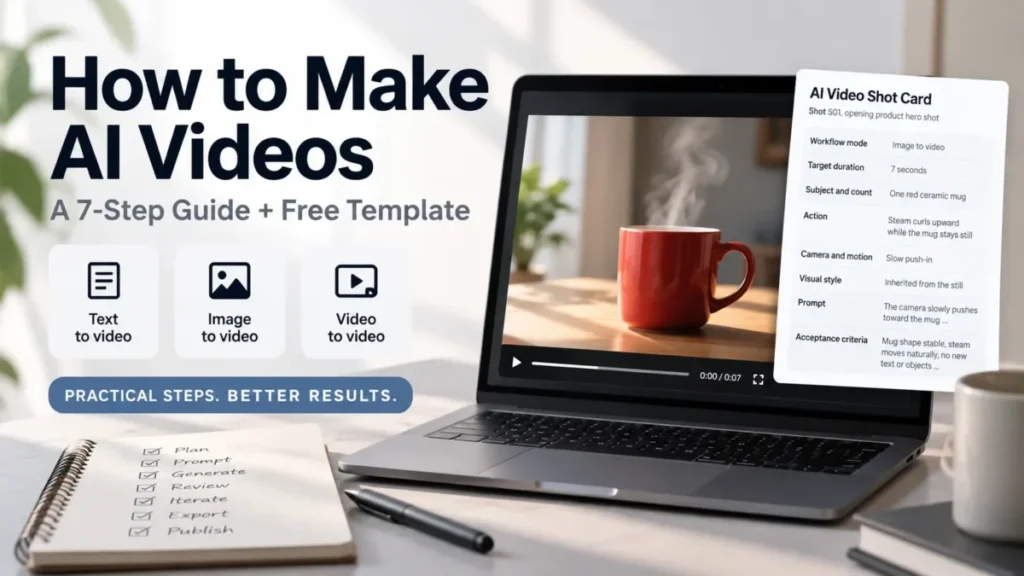
Example Filled-In Shot Card
Here is the template filled in for a short vertical product teaser. The duration entry stays inside the window Runway sets out on its model specification page.
The last four rows stay open because they are written after the first draft comes back.
| Field | Entry |
|---|---|
| Project goal | A seven-second vertical teaser presenting a ceramic coffee mug as a premium morning product |
| Audience | US social viewers scrolling a vertical feed |
| Destination and ratio | Vertical short-form, 9:16 |
| Workflow mode | Image to video |
| Shot ID and role | S01, opening product hero shot |
| Target duration | 7 seconds, inside the selected model’s supported window |
| Subject and count | One red ceramic mug, single subject |
| Action | Steam curls upward while the mug stays still |
| Environment | Already set by the licensed source photo, not restated |
| Camera and motion | Camera: slow push-in. Subject: none. Environmental: steam rising gently |
| Visual style | Inherited from the still, no change requested |
| Reference assets and role | Licensed product still, used as the first frame |
| Rights confirmed | Yes, licensed for commercial use |
| Prompt | The camera slowly pushes toward the mug as thin steam curls upward. The mug stays fixed in place and keeps the same shape and red glaze. Morning light stays stable. |
| Model and settings | To be recorded at generation time from the product you use |
| Acceptance criteria | Mug shape and handle stable, red glaze unchanged, steam moves naturally, one smooth push-in, no new text or objects, crop safe for vertical |
| Failure observed | To be completed after the first draft |
| Next change | To be completed after the first draft |
| Final status | Not yet generated |
Notice what the prompt does not say. It never describes the mug’s color temperature, the tabletop, or the background, because the still already carries all three and Runway advises describing motion rather than elements present in the image.
The acceptance criteria are all observable by watching the clip once. That is the test for a usable criterion: another person could mark it pass or fail without knowing the brief.
Red Flags That Should Stop a Generation
Each of these is a reason to fix the brief rather than spend another run.
| Red Flag | Why It Stops the Run |
|---|---|
| Two workflow modes on one card | The prompt will contradict itself |
| A shot longer than the selected model’s documented window | The generation cannot be produced as briefed |
| A reference asset with no declared role | An untracked variable in every later comparison |
| Acceptance criteria nobody else could check | Reviews become opinions and iterations stop converging |
| A tutorial recommending a retired product | The workflow cannot be followed at all |
| A missing upload control blamed on user error | Regional availability limits exist and are documented |
Common Mistakes When Making AI Videos
Treating one prompt formula as universal. The mode decides the grammar, and the two Runway guides ask for different content.
Expecting one generation to hold a whole story. Runway documents a 2 to 10 second window for its Gen-4.5 model, so a longer sequence is assembled from shots rather than requested in a sentence.
Fixing a bad still with a better prompt. The image acts as the first frame, and Runway says its visual artifacts may be intensified in the video.
Adding detail to a crowded scene. Adobe recommends limiting the number of subjects when building a prompt, and separately advises being specific about lighting and aesthetic style.
Changing several variables between attempts. The next clip may be better and the reason will be unrecoverable.
Skipping the rights question until publishing. The check belongs at upload, where Google’s documentation puts it.
Carrying settings between models. Adobe documents that model-specific settings change when you switch between models.
Tool-Specific Access Notes Worth Checking First
Access gates decide whether a documented workflow is available to a particular reader, and they are easy to miss inside a tutorial that assumes a paid account.
| Product | Documented Gate | Practical Effect |
|---|---|---|
| Runway Gen-4.5 | Standard plan or higher | A lower plan cannot follow the documented generation path |
| Gemini video generation, personal accounts | Google AI plan required | Work and school accounts need a qualifying Workspace license instead |
| Gemini video uploads for edits | Unavailable in some US states, the EEA, Switzerland, and the UK | The upload control may be absent rather than hidden |
| Gemini video generation | Not available to users under 18 | Applies alongside the plan requirement, not instead of it |
| Adobe Firefly Video settings | Availability varies by selected model | Adobe documents that resolution, duration and audio settings may or may not be exposed |
Source: official Runway specification documentation and Google Gemini video documentation. Source: official Adobe generation settings documentation, for the final row.
How This Guide Was Researched
Every product fact here comes from the vendor’s own help center or product documentation, read on September 9, 2026, and each claim stays scoped to the product it was written about.
No authenticated product session sits behind this guide, and no clip was produced for it, so nothing here is presented as a first-hand result. Where a workflow is described, it is a reconstruction of the documented steps rather than a record of a completed run.
The selection criteria were narrow on purpose. A source qualified only if it was published by the product owner and stated the operational detail directly, which is why vendor blog content appears once and is labeled as vendor-authored.
What to Do After the Shot Passes
Mark the card ready for edit and move to the next shot rather than polishing a clip that already meets its criteria.
Once the shot list is complete, assemble in an editor and treat the generated clips as source footage: trim, order, add voice and captions, then export at the ratio on the card. A guide to video editing software covers that assembly stage.
If the prompts are the part that keeps failing, a library of AI video prompts gives worked examples to adapt rather than invent.
If the tool is the constraint, compare the field before committing credits. Reviews of the Runway platform and Adobe Firefly cover those two platforms in depth, and a roundup of AI video generators surveys the wider field.
For the conversational editing branch, a review of the Gemini apps covers the wider product the video features sit inside.
Frequently Asked Questions
The answers below stay inside what the vendor documentation states, and say where it does not cover the question.
How Do I Make an AI Video Step by Step as a Complete Beginner?
Pick the workflow that matches what you already have, fill in a shot card, write the prompt in that mode’s grammar, generate one short clip, score it against your acceptance criteria, and change one thing before trying again.
Should I Use Text to Video or Image to Video?
Use image to video whenever a specific look has to survive, because the still fixes composition, subject, lighting, and style. Use text to video when nothing needs preserving and the model is free to invent the frame.
Why Does My Image to Video Result Keep Changing the Picture?
Check first whether the prompt is describing things the image already supplies. Runway’s guidance is that an image to video prompt should focus almost exclusively on motion, so trimming the visual description is the first thing to try.
How Long Should Each AI Video Clip Be?
Long enough for one action and no longer. Runway documents a 2 to 10 second window for Gen-4.5, so the shot card records the window of whatever model is selected.
How Do I Keep the Same Character Across Several Shots?
Runway documents that the input image acts as the first frame and supplies composition, subject matter, lighting, and style, and that the prompt should focus on motion. Reusing one still across shots follows from that, though no documentation checked here covers consistency across several shots.
Do AI-Generated Clips Still Need Editing?
Yes. Short generations are source footage, and the sequence, pacing, captions, and audio are still assembled in an editor afterwards.
Can I Upload Any Image I Find Online?
No. Google’s documentation for its video features states that users must have rights to any images they upload, and treating that as the habit for every upload is this guide’s own recommendation.
Is Sora Still an Option for Making AI Videos?
Not as a consumer product. OpenAI ended the web and app experiences in April 2026, and says the API follows on September 24, 2026.
The Bottom Line
Route by the material already in hand, complete the shot card before generating, and keep each clip short and controlled. Generate one shot at a time, quality-check it against criteria another person could verify, and iterate by changing a single variable so each attempt teaches something.
Then assemble the shots that passed into the final video.
One habit outlasts the rest. Availability and settings move, so check the vendor’s own documentation before following any guide, including this one, several months from now.
About the author

Macedona is the founder and lead reviewer at SaaS CRM Review, where he has published 175+ in-depth reviews, pricing guides, and comparisons of CRM and SaaS tools. Each review is based on hands-on testing or verified documentation, and every article states clearly which method was used. Pricing and features are checked against official vendor sources, with the verification date noted in the article. Macedona follows a published review methodology and editorial policy. SaaS CRM Review earns affiliate commissions from some links, which never influence ratings or rankings. Read the full affiliate disclosure.