
Most post-interview mistakes are not writing mistakes. They are routing and timing mistakes: the wrong message type, sent to the wrong address, before the employer’s own decision date has even passed.
A follow-up email after an interview is three different messages with three different triggers.
One thanks the interviewer. One asks where the hiring decision stands.
The third closes the loop after long silence.
This page gives you the copyable checklist, the eight-field template, a scoring matrix that tells you whether the draft is ready, and six filled-in examples by scenario. It also tells you when not to send anything at all.
One housekeeping note before the template. Write down the interviewer names, the exact job title, and any decision date the employer gave you, because every timing rule below depends on that last item.
In This Article (22 sections)
Quick Copy: The 12-Point Follow-Up Email Checklist
Copy this block. It works on its own, before you read anything else.
| # | Check | Pass condition |
|---|---|---|
| 1 | Message type chosen | Thank-you, status check, or final closure. Not a blend |
| 2 | Trigger confirmed | Interview just ended, or the employer’s stated date has passed |
| 3 | Recipient identified | A named interviewer, or the recruiter who can route it |
| 4 | To and CC verified | The reply reaches a person, not an automated mailbox |
| 5 | Subject line names the role | Exact job title, no gimmick |
| 6 | Interviewer name spelled correctly | Checked against the invitation or signature |
| 7 | Thanks the interviewer’s time | Genuine appreciation, not “just following up” |
| 8 | One specific interview detail | A real topic, project, or challenge you discussed |
| 9 | One relevance bridge | The detail connects to one strength or reason for interest |
| 10 | One clear next-step request | A single ask, matched to the message type |
| 11 | Tone matches the interview | Formality mirrors how the interviewer wrote and spoke |
| 12 | No resume rewrite | Under roughly 150 words, no second cover letter |
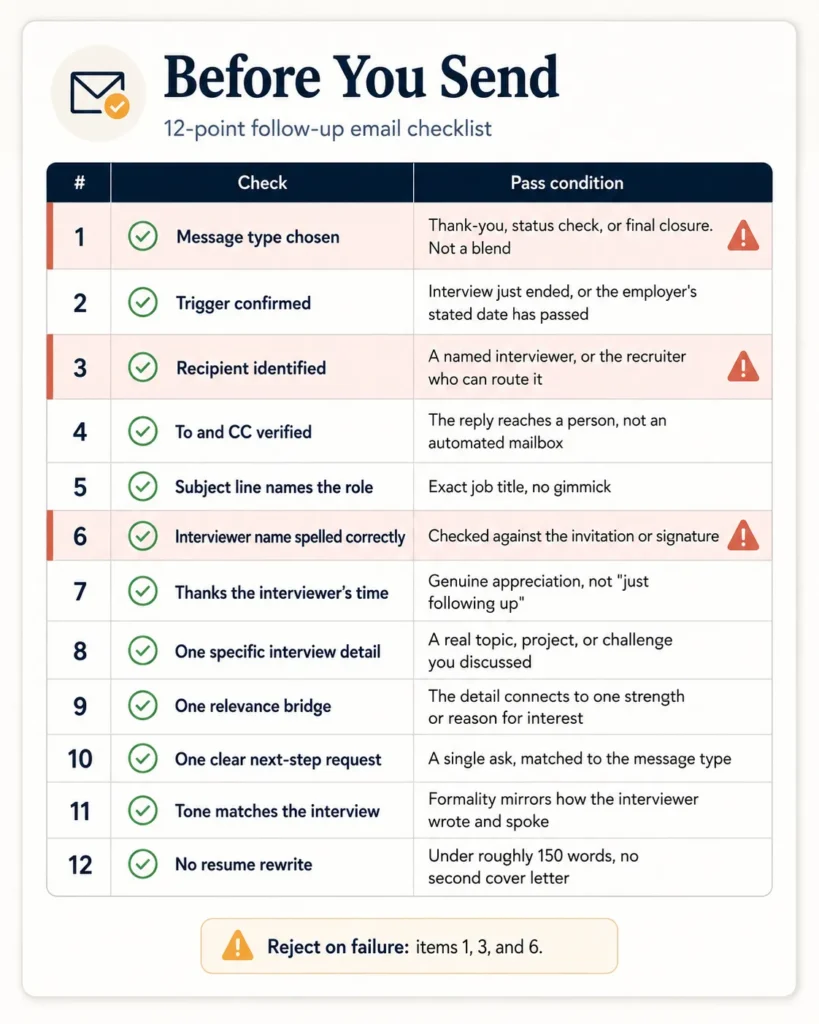
Items 1, 3, and 6 are reject conditions. Fail any of them and the draft does not go out, no matter how good the writing is.
How to Use This Checklist
Seven steps take a draft from blank page to sent. Each step resolves one thing: the use case, the required input, the send time, the score, the recipient, the final checks, and whether a second message is warranted.
Every step below rests on the university career-services guidance and the official product documentation cited throughout this page.
- Pick the message type. The trigger decides it, not your mood.
- Customize the template. Fill the eight required input fields, and treat anything outside them as optional.
- Set the send time against the employer’s timeline. Not against a generic day count.
- Score the draft. Use the weighted matrix below and its thresholds.
- Confirm the recipient and the thread. Verify who receives the reply.
- Run the pre-send checks. Name, title, company, To field, tone.
- Decide whether a second message is warranted. Then stop, or schedule the next one.
The order matters because each step feeds the next, so a wrong message type in step 1 invalidates the score in step 4.
If you are only thanking the interviewer, steps 1 through 6 are the whole job. Run step 7 only when the employer’s stated decision date has already passed.
A draft that scores below 3.0, or that fails any reject condition, goes back to step 2 rather than into the outbox.
Step 1: Decide Which Message You Are Sending
Search results routinely use “follow-up email” for all three messages, and that is where the tone errors start. Someone who only needs to say thank you ends up asking for a decision on day two.
The trigger and the goal are different in each row, so the call to action has to change with them.
| Message type | Trigger | Goal | Recipient | The one ask |
|---|---|---|---|---|
| Thank-you | The interview just ended | Acknowledge the time, reinforce interest | Each interviewer, or the primary contact | Offer additional information |
| Status check | The employer’s stated decision date has passed | Learn where the process stands | Recruiter or hiring contact | Ask for a timing or next-step update |
| Final closure | An earlier status check produced no reply | Get closure and exit cleanly | The same contact as the status check | Ask for a final update, and accept none |
Harvard Law School’s public interest advising office frames the first message as a note sent within 24 hours. It also treats email as a normal delivery method for that note (Harvard Law School OPIA guidance on interview thank-you notes).
The second message is a different act entirely. UC Berkeley Career Engagement’s interview guidance ties it to the employer having missed its expected time frame, not to the calendar.
Treat the two as separate assets in a job-search tracker, the same way a sales team separates a first touch from a pipeline review. Blending them is the single most common reason a candidate sounds impatient in week one.
Step 2: Fill the Eight Required Fields
The template has eight fields. Six are required in every message type, and two change depending on which message you picked in step 1.
| Order | Field | Purpose | Required? | Validation rule |
|---|---|---|---|---|
| 1 | Subject line | Identify the role fast | Required | Exact job title, no gimmick |
| 2 | Greeting | Reach the right person | Required | Correct spelling, formality matched to the interview |
| 3 | Thank-you sentence | Acknowledge the time | Required | Real appreciation, not “checking in” |
| 4 | Specific interview detail | Prove the message was written for this conversation | Required | One real topic discussed, not a summary of everything |
| 5 | Relevance bridge | Connect that detail to one strength or interest | Required | No full resume restatement |
| 6 | Continued-interest statement | Make your position clear | Required | Direct, no manufactured enthusiasm |
| 7 | Call to action | Move the process one step | Required | Exactly one ask, matched to the message type |
| 8 | Optional additions | A promised link or one clarification | Optional | Only if requested or discussed in the interview |
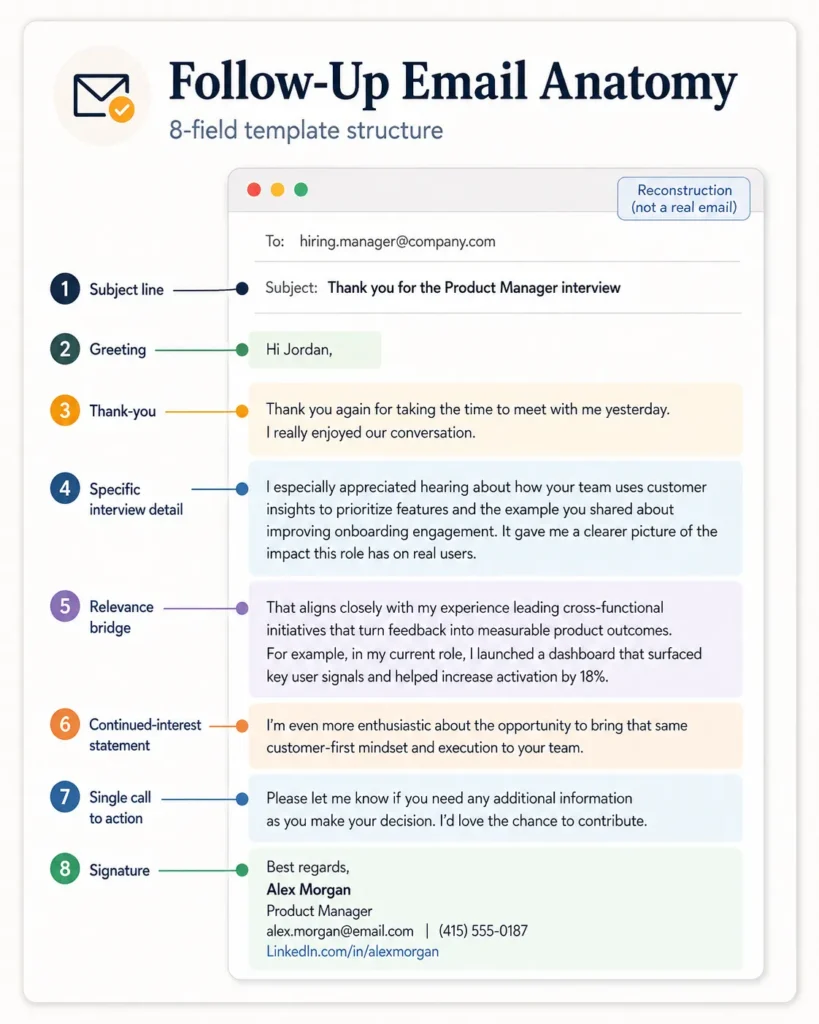
Field 4 is where most templates fail. Penn’s career services guidance asks for something specific you learned, connected to your own skills or interests, which is a much tighter instruction than “personalize it” (University of Pennsylvania Career Services interviewing guidance).
Use a three-part formula and stop there: the specific point discussed, what it told you, and the one capability or interest it connects to. That formula fits in two sentences and removes the temptation to recap the whole interview.
Field 8 has a hard boundary. A veteran recruiter interviewed by Business Insider named three avoidable problems in these messages: getting the interviewer’s name wrong, retelling the resume, and turning the note into a self-focused pitch.
Reject rule. If a field 1 through 7 is empty, the draft is not ready. Optional content never substitutes for a required field.
Step 3: Set the Send Time Against the Employer’s Timeline
The strongest timing rule in the evidence is event-based, not a day count.
Send the thank-you promptly. Trigger the status check off the employer’s promised date.
| Situation | Send window | Basis |
|---|---|---|
| Interview just ended, thank-you not sent | Within 24 hours | Harvard Law School OPIA, UC Berkeley, and Penn career guidance all point at this window |
| The 24-hour window already passed | Send a short sincere note now | Penn favors a later note over no note |
| The employer named a decision date | Wait until that date passes | Berkeley and Penn both anchor the status check to the stated time frame |
| No decision date was given | About one week is a cautious default, not a rule | Published advice ranges from a few business days to two weeks |
| A status check produced no reply | Space the next contact, do not stack messages | Recruiter guidance warns that aggressive follow-up creates a negative impression |
| Every row above rests on the Harvard Law School OPIA, UC Berkeley, and Penn career-services guidance linked in this section, checked 14 August 2026. |
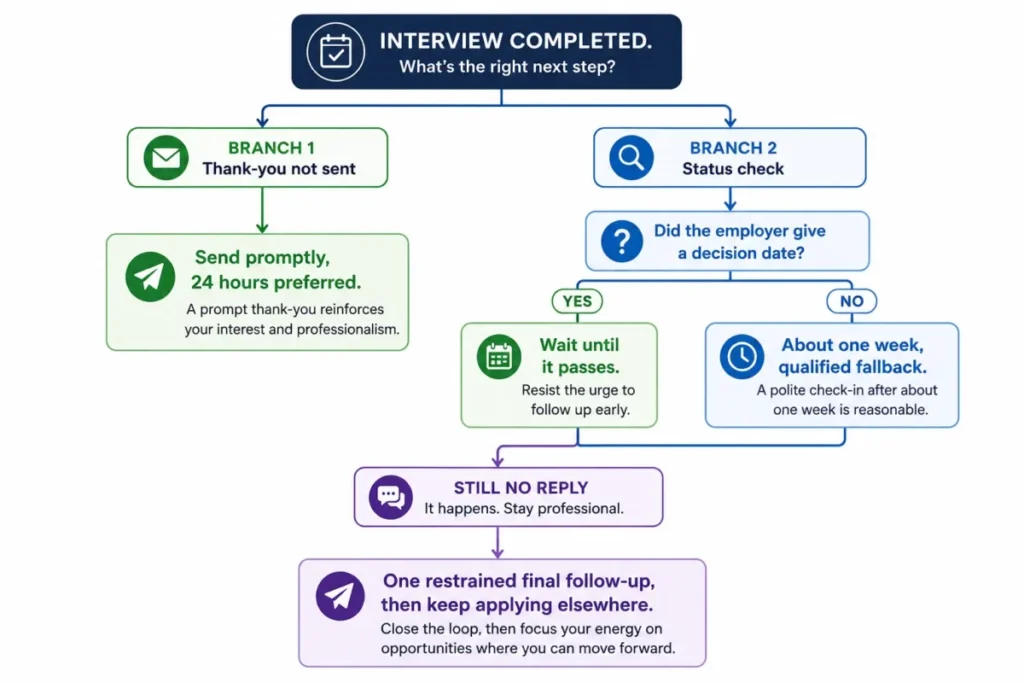
That no-timeline row is where the published sources genuinely disagree, and showing the spread is more useful than inventing a number.
Robert Walters suggests two to three business days as its fallback. Glassdoor moves toward roughly a week, and Proton’s follow-up guide points at a second message after about two weeks of silence.
No source in this set establishes a universal interval, so treat one week as a defensible middle, not as a rule you can quote back at anyone. The employer’s own stated date always outranks it.
Missing the 24-hour window is not a reason to skip the note. Penn’s guidance on thank-you notes supports sending follow-up communication a day or two after the event, and a short sincere message beats an elaborate apology for being late.
Step 4: Score the Draft Before You Send It
This scoring matrix is an original editorial framework, built from the checks in the sources above rather than from any measured hiring outcome. Score each criterion from 1 to 5, multiply by the weight, and add the results.
| Criterion | Weight | What a 5 looks like | Evidence basis |
|---|---|---|---|
| Correct message type for the trigger | 20% | Thank-you, status check, or closure, chosen from the trigger table | Berkeley and Penn separate gratitude from process checking |
| Timing fits the employer’s window | 20% | Sent inside 24 hours, or after the stated decision date | Harvard, Berkeley, Penn timing guidance |
| Recipient and routing verified | 15% | Named interviewer, or recruiter routing, To field checked | IONOS recipient-address caution |
| One specific interview detail | 15% | A real topic, not a generic compliment | Harvard, Berkeley, Penn personalization guidance |
| One clear next-step request | 15% | Exactly one ask, matched to the message type | Harvard lists an invitation for further information |
| Tone matches the interview | 10% | Greeting and formality mirror the interviewer | IONOS tone-matching guidance |
| Length and proofreading | 5% | Under roughly 150 words, names and titles correct | Recruiter guidance on wrong names and resume repetition |
| The weights in that table are an original editorial framework rather than a measured score. Each criterion traces back to the career-services and recruiter guidance linked in the sections above. |
Decision thresholds. 4.2 to 5.0, send it. 3.6 to 4.1, fix the weakest criterion, then send. 3.0 to 3.5, rewrite before sending. Below 3.0, do not send this draft.
Must-have failure equals reject. A wrong interviewer name, an unverified recipient, the wrong message type, or a status check sent before the employer’s stated date is a reject regardless of the weighted total.
The weights are not arbitrary. Message type and timing carry 40% between them because those two are the errors that change how a reader perceives the whole message, and no amount of polish repairs them.
Step 5: Confirm the Recipient and the Thread
Replying inside the existing interview thread preserves context, which is why it is such common advice. It also silently sends your message wherever the original thread points.
| Check | Pass | Fail |
|---|---|---|
| Who sent the invitation? | A named recruiter or interviewer | A no-reply or departmental mailbox |
| Does the To field reach a person? | Yes, verified before sending | Unverified, or an automated address |
| Do you have the interviewer’s direct address? | Yes, use it | No, route through the recruiter |
| Is CC appropriate? | Only people who were in the conversation | Anyone added for visibility |
| Separate conversations, separate notes? | Yes, personalized individually | One identical message pasted to everyone |
IONOS’s follow-up guidance flags exactly this: check the recipient address carefully when replying to an existing thread, and match the level of formality established during the interview.
When you have no direct address, there is a legitimate route rather than a guess. Penn’s guidance suggests asking the recruiter for the interviewers’ email addresses or asking the recruiter to forward the note, and Coursera’s follow-up article describes the same path starting from the invitation or existing email thread.
Do not guess at a personal address format. A message that lands in the wrong inbox is worse than a message sent one day later through the recruiter.
Step 6: Run the Pre-Send Checks
Six checks, roughly ninety seconds. Run them on the finished draft, not on the outline.
- Interviewer name, spelled as it appears in their signature.
- Exact job title and company name.
- To and CC fields, verified against step 5.
- One specific interview detail, present and real.
- Exactly one call to action.
- Greeting and formality matched to the interview.
Scheduling tools do not perform any of these checks. That distinction matters more than it sounds, because a scheduled message with a misspelled name arrives on time and wrong.
Step 7: Decide Whether a Second Message Is Warranted
| Situation | Decision | Action |
|---|---|---|
| Thank-you sent, no reply, decision date not reached | Wait | No message. A thank-you does not require a reply |
| Stated decision date has passed | Send a status check | One short message, one ask |
| Status check sent, no reply, reasonable interval elapsed | Send one final note | Neutral tone, request final update |
| Final note sent, still no reply | Stop | Redirect effort to other applications |
| Employer said not to contact them until a set point | Follow their instruction | Generic timing guidance does not override it |
That last row overrides everything else on this page. An explicit employer instruction beats every published convention.
The Ready-to-Use Follow-Up Email Template
Copy this template, customize the bracketed fields, and delete the optional line if it does not apply.
Subject: Thank you for the [exact job title] interview
Hi [Interviewer first name],
Thank you for taking the time to speak with me [yesterday / on Tuesday] about the [exact job title] role. I especially appreciated learning about [one specific topic, project, or challenge you discussed].
That conversation reinforced my interest in the position. My experience [one relevant capability or project] seems closely connected to the priorities you described.
[Optional, one line only: a promised link, or one brief clarification of a single answer.]
Please let me know if I can provide any additional information. Thank you again for your time.
Best, [Your name]
Everything in that template maps to a field in step 2. If you find yourself adding a fourth paragraph, you are drafting a second cover letter.
Templates for Candidates Who Just Interviewed
After a phone or recruiter screen
Keep it shorter than a full interview note and make the ask about advancing, not about a decision. A recruiter screen rarely produces a hiring decision, so asking for one signals you misread the stage.
Reference one thing the recruiter told you about the role or the team, then confirm you want to move to the next conversation. Two short paragraphs is the right size.
After a one-to-one hiring manager interview
Subject: Thank you for the Customer Success Manager interview
Hi Maya,
Thank you for taking the time to speak with me yesterday about the Customer Success Manager role. I especially appreciated learning how the team is working to shorten time-to-value during the first month of customer onboarding.
That discussion reinforced my interest in the position. My experience redesigning onboarding workflows and coordinating with support and product teams seems especially relevant to the priorities you described.
Please let me know if I can provide any additional information. I appreciate your time and look forward to hearing about the next steps.
Best, Jordan Lee
That message is 96 words and contains exactly one ask. The detail in the second sentence is what stops it reading as a template.
After a panel interview
Subject: Thank you for the Operations Manager interview
Hi Priya, Marcus, and Elena,
Thank you for the conversation about the Operations Manager position. I appreciated hearing each of your perspectives on the team’s upcoming process-standardization work, especially the discussion around reducing handoff delays between customer operations and finance.
The conversation made me even more interested in the role, and I would be glad to bring my experience documenting cross-functional workflows to that effort.
Thank you again for your time. Please let me know if I can provide anything else.
Best, Taylor Morgan
Use that single-note version only when the panel genuinely met you together. Separate conversations get separate notes, which is the subject of the recipient section below.
Templates for Candidates Waiting on a Hiring Decision
Status check after the promised date has passed
Subject: Product Marketing Manager interview follow-up
Hi Daniel,
I enjoyed speaking with you last Tuesday about the Product Marketing Manager role and remain very interested in the opportunity.
You mentioned that the team expected to complete its next-step decisions by the end of this week, so I wanted to check whether there is an updated timeline you can share. I would be happy to provide any additional information that would be useful.
Thank you again, Avery Chen
The second paragraph names the employer’s own commitment before asking anything. That is what separates a status check from a nudge.
When another offer creates a real deadline
Subject: Follow-up on the Revenue Operations Manager role
Hi Alex,
Thank you again for the conversations with the team about the Revenue Operations Manager position. I remain very interested in the opportunity and in the forecasting and CRM-governance work you described.
I wanted to share a timing update on my side. I have received another offer and have been asked to make a decision by Thursday, August 20. If possible, could you let me know whether your team expects to have an update on my candidacy before then?
I understand your process may still be underway and appreciate any timing guidance you can share.
Best, Morgan Ellis
Penn’s guidance supports telling an employer about changing personal timelines or other offers after the stated timeline has passed. The same source places compensation negotiation after an offer arrives in writing, which is why this template asks about timing and says nothing about salary.
Two conditions apply. The deadline has to be real, and the message asks one question rather than issuing an ultimatum.
Final follow-up after continued silence
Subject: Final follow-up on the Account Executive interview
Hi Riley,
I wanted to send one final follow-up regarding my interview for the Account Executive position. I enjoyed learning more about the team and remain interested if the role is still moving forward.
If the hiring process has concluded, I completely understand. If there is still an update you can share, I would appreciate it.
Thank you again for your time and consideration.
Best, Jamie Patel
Neutral wording is doing real work in that draft. Business Insider’s reporting on post-interview silence cites recruiter guidance suggesting roughly a week before a short final inquiry, and warns that aggressive messages create a negative impression.
Templates for Candidates Who Need to Repair or Route a Message
Correcting one answer you gave badly
Subject: Thank you for the Data Analyst interview
Hi Sofia,
Thank you for speaking with me about the Data Analyst role. I enjoyed the discussion about improving reporting consistency across the sales and finance teams.
I also wanted to briefly clarify my answer about dashboard adoption. In my previous role, I was responsible not only for building the reporting layer but also for training the commercial team and documenting the metric definitions, which increased adoption across the group.
I appreciate the opportunity to speak with you and remain very interested in the position.
Best, Cameron Brooks
One clarification. That is the entire allowance.
Berkeley’s guidance permits adding a selling point you omitted during the interview, and the recruiter evidence above warns against retelling the resume. Those two together define the boundary: add missing context, do not replay the interview.
When you never got the interviewer’s email address
Work the routing problem in order rather than guessing. Check the interview invitation and any existing email thread first, because the address is often already in your inbox.
If it is not there, identify the recruiter or HR contact who scheduled the interview. Ask them for the interviewers’ addresses, or ask them to forward your note, and keep the finished message ready to send the moment you get an answer.
Who to Email After a Panel Interview
Credible sources disagree here, and picking one rule for every panel is how candidates end up sending three identical emails.
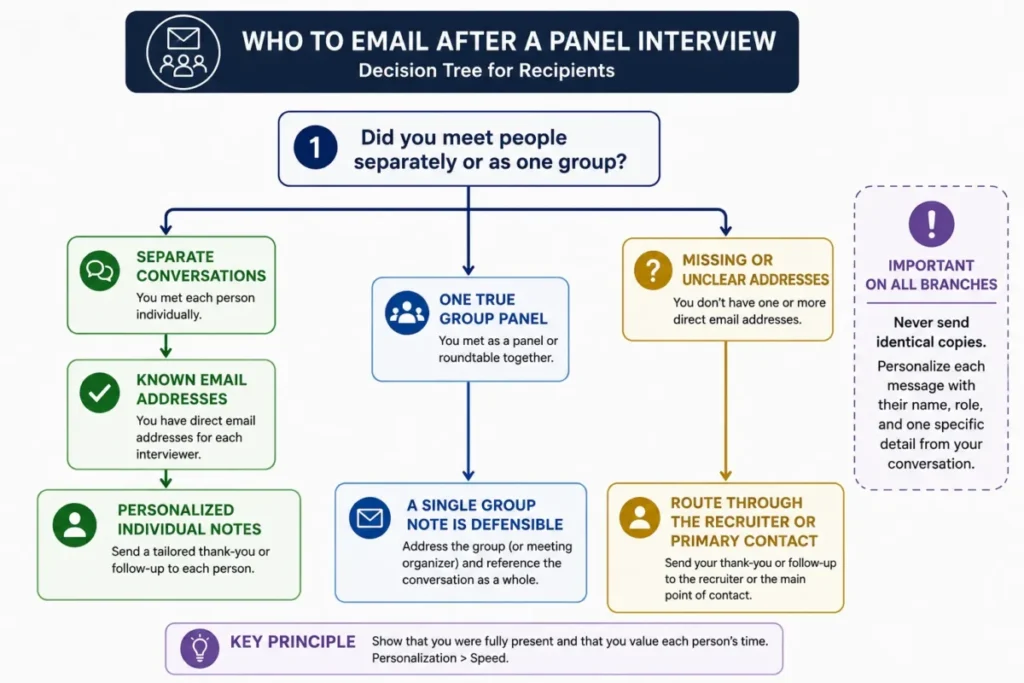
| Interview format | Contact details available? | Recommended recipients |
|---|---|---|
| Separate one-to-one conversations | Yes | A personalized note to each interviewer |
| Separate one-to-one conversations | No | Recruiter routing, with names acknowledged |
| One true group panel | Yes | One group note, or individual notes if the conversations differed |
| One true group panel | No | The primary contact, with appreciation extended to the panel |
Berkeley’s guidance points at addressing the primary contact while extending appreciation to panel members. Penn favors a brief note to each interviewer within 24 hours, and Robert Half’s guidance on post-interview thank-you emails recommends separate, slightly personalized notes when several people interviewed you.
The recruiter account in Business Insider resolves the apparent conflict: one message is acceptable when everyone met you together, and separate personalized messages fit better when you met people individually.
Candidates on r/interviews raise this same question repeatedly, and the recurring objection in that thread is not group emails as such. It is identical copy-and-paste notes, which read as identical the moment two interviewers compare them.
What to Do When There Is No Response
Silence after a thank-you is not a rejection signal. A thank-you note does not require a reply, and hiring delays have many ordinary causes.
The meaningful trigger for your next message is the hiring timeline, not whether anyone acknowledged your thanks. That single reframe prevents most of the anxious second emails sent in week one.
Cadence that stays defensible:
- Thank-you: within 24 hours of the interview.
- Status check: after the stated decision date, or after about a week when no date was given.
- Final note: after a further reasonable interval with no reply.
- Stop: after the final note, whether or not it produces an answer.
LinkedIn career advice from Jenny Foss makes the same structural point. Honor a stated timeline, wait at least about a week when none exists, keep the first status message short, and space later follow-ups.
Nobody can promise you a reply after any specific number of messages. Once the final note is sent, the productive move is the other applications, not a fourth email.
Red Flags That Should Stop You From Sending
| # | Red flag | Consequence | Fix |
|---|---|---|---|
| 1 | Interviewer’s name is misspelled or wrong | Undermines the entire message | Copy the spelling from their signature |
| 2 | Recipient address is unverified | The message reaches nobody who decides | Verify To and CC, or route via the recruiter |
| 3 | Status check sent before the stated date | Reads as impatient | Wait for the date to pass |
| 4 | Identical text sent to several interviewers | Reads as a mass mail the moment they compare | Personalize each note or send one group note |
| 5 | The message restates your resume | Buries the one useful detail | Cut to one relevance bridge |
| 6 | Two or more asks in one message | Nothing gets answered | Keep exactly one call to action |
| 7 | Salary or negotiation raised before an offer | Changes the purpose of the message | Negotiate after a written offer arrives |
| 8 | A competing deadline that does not exist | Manufactured urgency that can be checked | Only state a real, dated deadline |
| 9 | Accusatory language about being ghosted | Closes a door that is still open | Assume process delay, stay neutral |
| 10 | Unsolicited attachments or a portfolio dump | Makes a short note bulky | Send only what was requested or discussed |
| 11 | Formality that clashes with the interview | Reads as a template | Mirror the interviewer’s own tone |
| 12 | Scheduled to send without a proofread | An error arrives punctually | Proofread before scheduling |
Red flags 1, 2, and 3 are the reject conditions from the quick checklist. The rest cost you polish rather than credibility.
Common Mistakes
Six common errors account for most weak follow-up emails.
Treating all three messages as one template. The thank-you and the status check have different triggers and different asks, so a single blended message either thanks too late or asks too early. Pick the type in step 1 before writing a word.
Reading silence as rejection. No reply to a thank-you tells you almost nothing. Mixed views among hiring managers and job seekers on r/interviews suggest the note is a courtesy rather than a decisive factor.
Wait for the timeline trigger instead.
Turning the follow-up into a negotiation. Penn’s guidance places compensation discussion after a written offer has been received and reviewed. Raising pay in a thank-you changes what the message is.
Correcting everything you wish you had said. One clarification is useful. Four is a second interview the reader did not agree to.
Sending an identical note to every panel member. Interviewers on the same panel do compare notes, and identical text is the version of personalization that gets noticed for the wrong reason.
Skipping the note because the 24-hour window closed. A short, sincere, slightly late message is a normal thing to receive. Silence is the only version with no upside.
Recommended Email Tools for Sending at the Right Time
The tool workflow is optional. Both major email clients can hold a finished message until a chosen time.
That behavior is documented in Gmail Help on scheduling emails and in Microsoft’s guide to delaying or scheduling Outlook messages.
Neither one validates anything about the content.
| Tool | Documented path | Documented limit or condition | Where the message sits |
|---|---|---|---|
| Gmail | Compose, then the arrow next to Send for more send options, then Schedule send | Up to 100 scheduled emails, sent in the time zone used to schedule them | The Scheduled folder. Cancelling returns it to a draft |
| Microsoft Outlook | While composing, the dropdown next to Send, then Schedule send | Not available for IMAP or POP accounts in new Outlook | The Draft folder until the delivery time |
| Both rows restate the Google and Microsoft product documentation linked above, checked 14 August 2026. |
Gmail’s scheduling controls sit inside the same mail client covered in the Google Workspace review, so nothing extra has to be installed.
The time-zone behavior in Gmail is the detail worth remembering. Scheduling a 9 a.m. message while travelling sends it at 9 a.m. in the zone you scheduled from, which is not always the interviewer’s morning.
Schedule-send is an execution aid, and nothing more. It does not check a name, a recipient address, personalization, or tone, so run step 6 before you set a delivery time.
Example Filled-In Checklist
The example output below is the Customer Success Manager thank-you above, scored against the matrix in step 4.
| Criterion | Weight | Score | Weighted | Why |
|---|---|---|---|---|
| Correct message type | 20% | 5 | 1.00 | Thank-you, sent the day after the interview |
| Timing fits the window | 20% | 5 | 1.00 | Inside 24 hours |
| Recipient and routing | 15% | 4 | 0.60 | Direct address confirmed, no CC needed |
| One specific detail | 15% | 5 | 0.75 | Time-to-value in first-month onboarding |
| One clear ask | 15% | 4 | 0.60 | One ask, slightly softened by the closing line |
| Tone match | 10% | 4 | 0.40 | First-name greeting matched the interview |
| Length and proofreading | 5% | 5 | 0.25 | 96 words, names and title verified |
| Total | 100% | 4.60 | Above the 4.2 threshold, send it | |
| Those scores are applied by this article to its own worked example using the weights published in step 4. No external source states this total. |
The calculation is the sum of the weighted column: 1.00 plus 1.00 plus 0.60 plus 0.75 plus 0.60 plus 0.40 plus 0.25 equals 4.60. Reproduce it with your own scores rather than trusting the total.
A draft scoring 3.8 usually has one weak criterion rather than seven mediocre ones. Fix that criterion and rescore instead of rewriting from scratch.
How This Guide Was Put Together
The guidance here is drawn from American university career services publications, attributed recruiter reporting, current candidate discussion, and official Gmail and Microsoft product documentation. Every volatile detail in the tools table was checked on 14 August 2026.
Every recommendation was assessed against the same criteria. Those criteria are whether it identifies the message type, ties timing to a trigger the reader controls, names a specific recipient, and produces a sendable message.
Greater weight was given to guidance that changes a concrete decision, such as which message to send and when. Where published sources disagreed on a timing interval, the conflict is shown to the reader rather than resolved into a single invented number.
Claims about hiring outcomes were excluded, because the available evidence supports professional communication value rather than a measured effect on offer probability. The editorial framing behind this discipline is described in the site review methodology.
What to Do After You Send
If you get a reply with a new timeline. Record the new date and reset the trigger in step 3. Nothing else changes.
If you get an interview invitation for a further round. Treat each round as its own cycle: new interviewers, new detail, new thank-you.
If you get a rejection. A short, neutral reply asking to stay in touch costs nothing and keeps a real contact. That contact belongs in whatever system holds your job-search records, which is the same discipline behind contact management in a sales team.
If you get nothing after the final note. Stop, and put the time into other applications.
If you are interviewing with several companies at once, track the interview date, the promised decision date, your own follow-up date, and the current status in one sheet. A simple Google Sheets CRM template can handle that without adding another job-search app.
The same seven-step method works outside hiring. If you need to chase a proposal, an unpaid invoice, or a client who has gone quiet, these follow-up email examples apply the same structure to other situations.
Frequently Asked Questions
What is a follow-up email after an interview?
It is one of three distinct messages: a thank-you sent right after the interview, a status check sent after the employer’s stated decision date, or a final closure note after continued silence. Each has its own trigger, recipient, and single request, which is why one blended template tends to misfire.
When should I send a follow-up email after an interview?
Send the thank-you within 24 hours, which is the window Harvard Law School OPIA, UC Berkeley, and Penn career services all point at. Send a status check only after the employer’s stated decision date has passed, or after about a week if no date was ever given.
How do I use this checklist if I have already sent a thank-you?
Skip step 1’s first row and go straight to the status-check branch of step 3. The eight fields stay the same, but your call to action changes from offering information to asking for a timing update.
How do I score my draft before sending it?
Rate each of the seven criteria in step 4 from 1 to 5, multiply by its weight, and add the results. Send at 4.2 or above, fix one criterion between 3.6 and 4.1, and rewrite anything below 3.0.
Which parts of the template are must-have and which are optional?
Fields 1 through 7 are required in every version: subject, greeting, thanks, one specific detail, relevance bridge, continued interest, and one ask. A promised link or a single clarification is optional, and only belongs there if it was requested or discussed.
Is it too late to send a follow-up a few days after the interview?
No. Penn’s guidance supports sending a note a day or two after the event and favors a late sincere message over none at all, so send a short one now rather than a long apology for the delay.
Should I email every person who interviewed me?
It depends on the format. Personalized individual notes fit separate one-to-one conversations when you have the addresses, one group note is defensible after a true group panel, and the recruiter routes the message when you have no addresses at all.
Does no reply to my thank-you email mean I was rejected?
Not by itself. A thank-you note does not require a reply, and Business Insider’s reporting on post-interview silence describes process delays and disorganization as ordinary causes, so use the hiring timeline as your trigger instead of the absence of a reply.
Is it OK to follow up twice after an interview?
Yes, when the two messages have different triggers: a status check after the stated date, then one final note after a further interval of silence. Beyond that, stop, because no published guidance promises a reply after any specific number of attempts.
What should I do after I finish the checklist?
Send the message, log the date and the promised timeline, and set your own reminder for the next trigger. If the process goes quiet after your final note, redirect the effort to other applications rather than a fourth email.