
Every Element451 budget line in 2026 starts as a blank. The public calculator ends at a quote request and publishes no numeric base subscription price, which means the one number a vice president of enrollment has to defend is the number the vendor holds back until a sales call.
The verdict first: Element451 is a defensible choice for enrollment, marketing, and student success teams that want higher-education-specific AI workflows inside one system of record and can accept an annual custom contract. It is the wrong buy for programs with deeply customized application review, for teams that need writes back into Canvas, and for any institution that requires a public list price before it will open a vendor conversation.
This Element451 review works through setup, the core workflows, the limits, then the contract math. If the category is still open, start with CRM for higher education or the primer on what CRM software does.
In This Article (19 sections)
Quick Verdict
| Decision point | Where Element451 lands |
|---|---|
| Best for | US colleges and universities consolidating marketing, admissions, and student success on one higher-education-native platform with AI agents |
| Not ideal for | Medical schools and similar programs with multi-reader, rubric-heavy application review, and teams needing bidirectional LMS writes |
| Starting price | Not published. Annual, quote-based, and scaled by institution size and support tier. Checked: 2026-08-03 |
| Practical package | Element for Admissions and Marketing for a combined enrollment team; Bolt for Student Success where retention is the primary project |
| Free plan or trial | No public free plan or self-serve trial on the current pricing page |
| Setup difficulty | High for the institution even when the vendor timeline is short, because data cleanup, identifiers, integrations, and agent knowledge are institution-owned work |
| Main strength | Higher-education-specific workflows and AI agents that arrive configured for admissions and student success rather than assembled from a generic sales CRM |
| Main limitation | Contract opacity: base price, included usage caps, and cap expansion rates are all negotiated rather than published |
| Best alternative | Slate by Technolutions, when configurability of application review outranks speed of rollout |
How We Evaluated Element451
This analysis is based on Element451’s official pricing page, updated package page, support-service page, security and compliance page, public API reference, and help-center documentation, plus labeled third-party evidence from review platforms, an implementation partner, and independent higher-education comparisons. Pricing, package names, and usage limits were checked on 2026-08-03.
Element451 was assessed against the same buyer criteria applied to every CRM on this site: workflow fit, package entitlements, usage limits, migration effort, integration direction, support entitlements, security and accessibility posture, and full contract cost.
Greater weight went to the factors that change a signed order form. Those are quote-only pricing, soft annual usage caps, live support seat counts, feature gates on admissions AI, and one-way data flows between systems.
Claims that lacked reliable evidence were excluded rather than estimated. Older vendor content that quoted starting-price ranges is treated as history, and every workflow description follows documented navigation, stated prerequisites, and published limits.
What Is Element451?
Element451 is a higher-education CRM and AI agent platform for marketing, admissions, student success, and continuing education or workforce teams. The vendor positions it as AI-native rather than as a general CRM adapted to campus use, and reports more than 350 institutions, more than 60 million student journeys, and more than 5.5 million agent-driven conversations.
Treat those figures as vendor-reported scale, not audited metrics. They are useful for judging whether the company is a going concern in the segment, not for judging whether the platform fits a specific enrollment funnel.
The product splits into two families. Bolt covers the AI agent layer sold by department, and Element covers the broader CRM and system-of-record packages.
Setup, Onboarding, and Ease of Use
The first real task is not configuration. It is deciding which identifier will match records across every source the institution plans to import, because the documented import path uses a stable identifier such as email or institutional ID to match people and prevent duplicates.
Imports run through Data and Automations, then Import and Export, then Imports. Accepted source formats are CSV and TXT, so an Excel-native office has a conversion step and an encoding step before anything reaches the platform.
That single constraint decides the first two weeks for most teams. A college with three sources of truth for the same prospect, inconsistent program codes, and non-UTF-8 exports is not doing CRM configuration in week one, it is doing data reconciliation.
An Element451 implementation partner describes configuration, migration validation, data cleanup, and training as separate meaningful workstreams.
That partner view is the honest counterweight to any fast-launch claim. A vendor can stand up an instance quickly and the institution can still spend a full term on identifiers, permissions, program taxonomy, and message governance.
Third-party sentiment on usability points the same direction. Accessible Software Advice material suggests users value support and day-to-day usability while facing a learning curve when locating settings and configuring the front end.
The 30-day adoption test for this platform is narrow and specific.
If, after 30 days, the admissions team is working inquiries inside Element451 conversations instead of Outlook, and duplicate person records are under control, the rollout is working. If staff still export lists to run a campaign, the configuration is not finished no matter what the project plan says.
The Workflows That Have to Carry the Contract
Five workflows justify the annual spend for most institutions. Each one carries a package condition and a documented limit, and the limits are where budgets move.
Bolt Agents Across Messenger, SMS, Email, and Voice
Bolt Agents are the reason most institutions look at Element451 rather than a general CRM. Agent testing runs in a test interface across Messenger, SMS, email, and voice, with response details available for inspection, and the documentation recommends isolated controlled live tests before broader launch.
Use case: front-line inquiry response and nudge campaigns that no human team can staff at 9pm on a deadline weekend.
Plan condition: agent availability follows the selected Bolt or Element package, so the entitlement has to be written into the quote rather than assumed from a demo.
Limitation: a passing test conversation proves the agent answered a prompt, not that it will hold up against a live applicant asking about a program that was renamed last spring.
Application Reader and Application Fraud Detection
Application Reader and application fraud detection sit inside qualifying admissions packages, and both are documented as outside the usage-cap model.
Use case: an AI first read on applications so human readers spend committee time on the files that need judgment.
Plan condition: Bolt for Admissions or Element for Admissions and Marketing.
Limitation: an independent comparison flags that highly complex application-review environments, such as medical schools, are the profile most likely to need deeper review functionality than a marketing-led platform provides.
Transcript Evaluation and Identity Verification
These two admissions features look like siblings of Application Reader and behave nothing like it commercially. Both are usage-capped categories, alongside US and Canada messaging, US and Canada phone minutes, AI Voice Mode minutes, and phone numbers.
Identity verification adds a workflow ceiling on top of the account ceiling. A student gets three attempts, and after three failed or mismatched attempts staff must reset the verification status before another attempt.
Use case: fraud control on high-volume open-admission applications, where fake and duplicate applications distort the funnel.
Limitation: the reset is a human task, and it lands during exactly the deadline weeks when the admissions office has the least capacity for exception handling.
Conversations, Telephony, and the Student Inbox
Outbound calling is documented for +1 US and Canada numbers only. International calling is not supported, and inbound calls require forwarding to an external number or to a Bolt Agent.
Use case: consolidated conversation history so a call, an SMS, and an email about the same missing document sit on one person record.
Limitation: an international recruitment desk that dials Lagos, Hanoi, or São Paulo needs a separate telephony stack, which splits the conversation record the platform was bought to unify.
StudentHub and Student Success Workflows
StudentHub is documented as browser-based and can be added to a mobile home screen.
The official evidence supports mobile web delivery with a home-screen shortcut. Any assumption about an app-store download, push notification behavior, or offline mode belongs in the demo script, not in the business case.
What Breaks at Scale
Four ceilings show up once volume arrives, and none of them appear on a feature comparison sheet.
Usage caps reset and stop rolling over. Caps reset annually at renewal and do not roll over or transfer, and alerts fire at 80 percent and 100 percent. Reaching a cap does not stop the feature, so the institution contacts its account manager for added capacity.
That design is friendlier than a hard shutoff and worse for budget certainty. The failure mode is a mid-year capacity conversation with a vendor who already knows the campaign is live, and the price of that added capacity is not published anywhere.
Agent jobs queue instead of scaling. A Bolt Agent Job cannot exceed the instance-level enrollment limit, contacts beyond active capacity remain pending until space frees up, and a job goal cannot be changed after the job is created.
The numeric instance limit is not published, so capacity planning for a 40,000-contact melt campaign requires the contracted value in writing before launch week.
Knowledge sources fail quietly above 10 MB. Knowledge Hub files larger than 10 MB carry a higher parsing-failure rate, and the documentation recommends splitting them into roughly 10 MB chunks.
A 60 MB combined catalog PDF is the single most likely artifact an institution tries to upload first, and it is the one most likely to produce an agent that answers confidently from partial content.
Canvas data flows one direction. The native Canvas course integration reads data from Canvas and does not write data back.
Advising teams that planned to log intervention outcomes once, in the CRM, and have them appear in the LMS need a different design or a middleware line item.
Element451 Pricing and Plans: The Math Behind a Quote
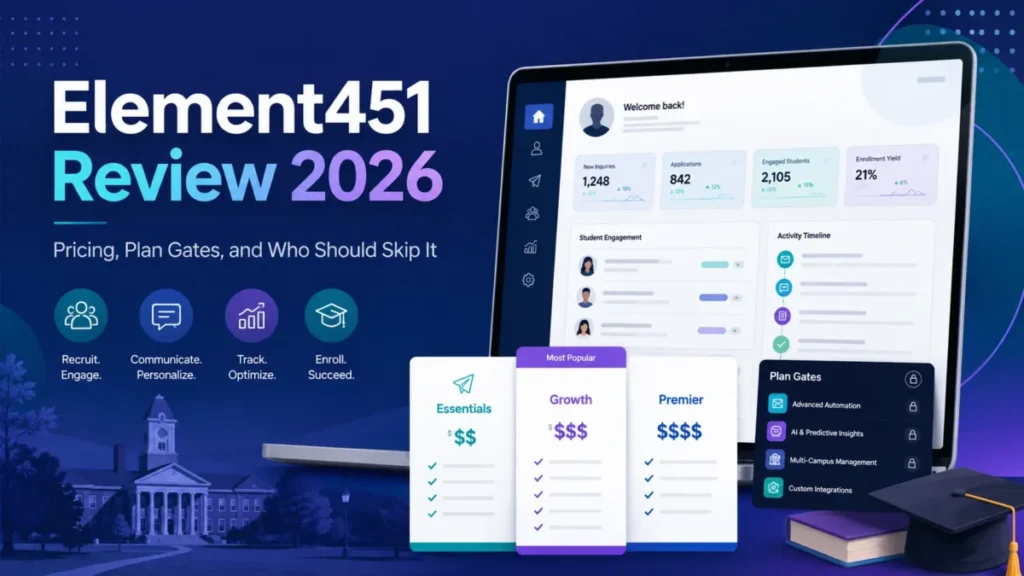
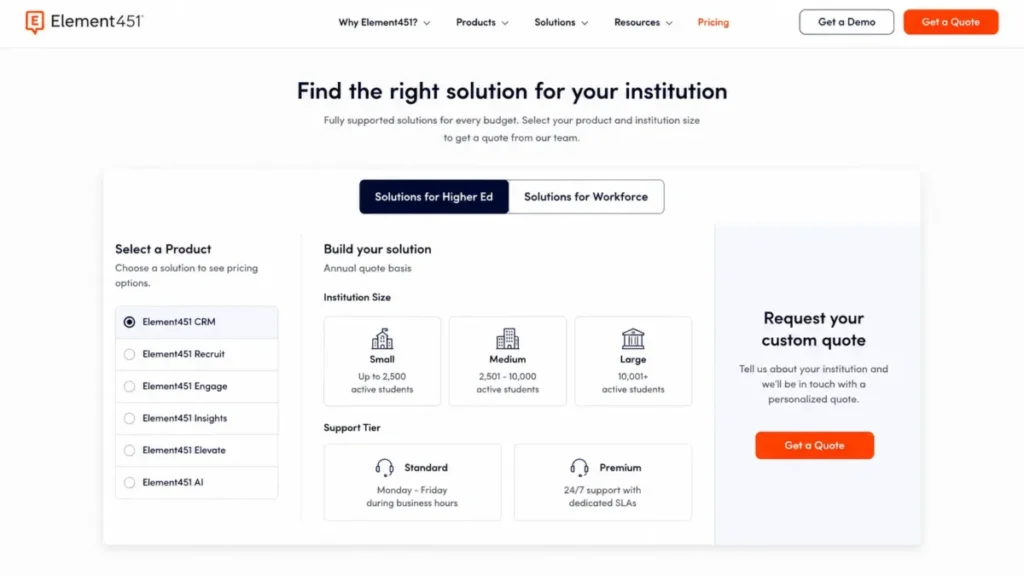
The current public buying page lists seven packages: Bolt for Marketing, Bolt for Admissions, Bolt for Student Success, Bolt for CE and Workforce, Element for Admissions and Marketing, Element for Student Success, and Element for CE and Workforce.
None of the seven carries a public price. The pricing page states that annual pricing varies with institution size and support tier, and the calculator routes to a quote request.
| Package | Family | Primary buyer | Published annual price |
|---|---|---|---|
| Bolt for Marketing | Bolt agents | Marketing and communications | Quote only |
| Bolt for Admissions | Bolt agents | Admissions operations | Quote only |
| Bolt for Student Success | Bolt agents | Retention and advising | Quote only |
| Bolt for CE and Workforce | Bolt agents | Continuing education and workforce | Quote only |
| Element for Admissions and Marketing | Element CRM | Combined enrollment team | Quote only |
| Element for Student Success | Element CRM | Student success as system of record | Quote only |
| Element for CE and Workforce | Element CRM | Non-credit and workforce programs | Quote only |
Source: Element451 documentation, Updated pricing and product packages, checked 2026-08-03.
Older third-party pages and a 2022 vendor blog still circulate starting-price ranges for this platform. Those figures are history, not a 2026 quote, and using one in a budget request is the fastest way to have a finance committee reject the second-round number as a cost overrun.
The Package Names Do Not Match the Help Center
A May 2025 help article describes a different model: a Core layer plus Marketing, Engagement, Admissions, and Student Success Teams, with an Element One bundle above them. Core is documented as including conversations, tasks, forms, people, security controls, workflows, integrations, and insights.
Both models are official and neither page maps to the other. Your finance team may push back at renewal because a feature the team uses daily sits in a documentation layer that the order form never named.
The fix is contractual rather than editorial. Require the quote to list every requested capability against the exact commercial package it ships in, and require that the mapping survive renewal.
What 10 Users Actually Cost
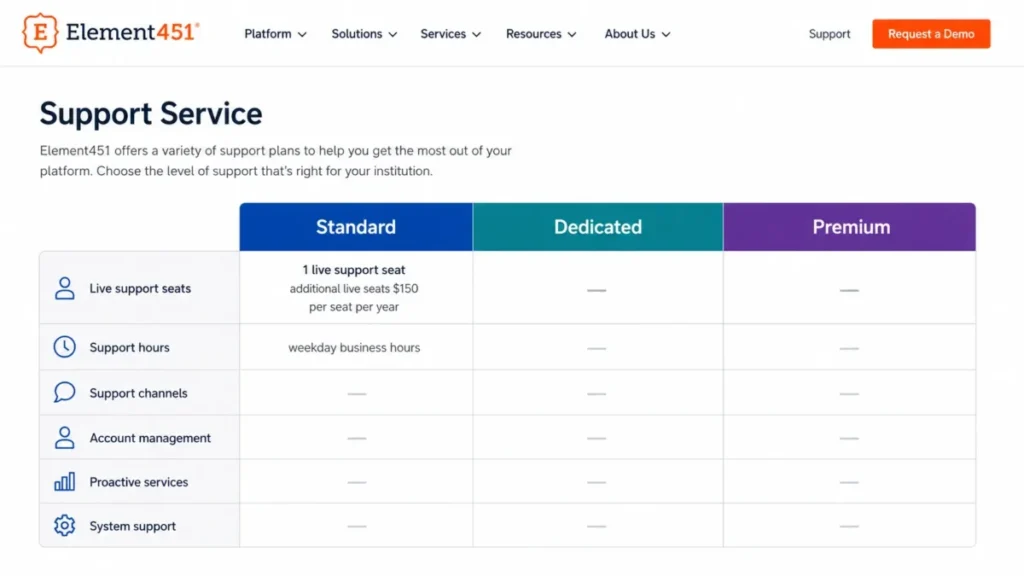
Element451 does not price by seat, so a per-seat table for 10 users is not the right model. Support access is where a headcount number does appear, and it is the only publicly numeric per-person cost in the contract.
Standard support includes one live support seat. Additional live support seats cost $150 per seat per year.
A 10-person admissions and marketing team that wants all 10 staff able to reach human support on the Standard tier is buying nine extra seats, which is $1,350 per year on top of the base contract. That is small money against an enterprise CRM, and it is a real line item that no competing review publishes.
The Cost Lines That Are Publicly Numeric
| Cost line | Public 2026 price | Basis |
|---|---|---|
| Additional live support seat | $150 per seat per year | Beyond the seats included in the support tier |
| Legacy usage credit purchase | $0.01 per credit | Only for contracts still running on Usage Credits |
| Base package subscription | Not published | Annual quote by institution size and support tier |
| Support tier uplift | Not published | Standard, Dedicated, or Premium |
| Usage cap expansion | Not published | Negotiated with the account manager by category |
| Managed services and extra service credits | Not published | Optional, discounted at Dedicated, priority at Premium |
| Snowflake add-on | Not published | Listed as an add-on in the package documentation |
Sources: Support service and Usage-based billing credits. Checked: 2026-08-03.
The defensible total cost formula is base package quote, plus support tier, plus extra live seats at $150 each per year, plus usage expansion or legacy credits, plus managed services, extra professional service credits, Snowflake, telephony, implementation, renewal uplift, and data-exit assistance. Any single annual total published without a quote in hand is invented.
Credits Versus Caps: The 2026 Contract Change
Element451 runs either Usage Caps or legacy Usage Credits depending on contract status, and renewals beginning August 1, 2026 transition to Usage Caps.
| Contract mechanic | Usage Caps | Legacy Usage Credits |
|---|---|---|
| Applies to | Renewals beginning 2026-08-01 and new contracts on the cap model | Contracts still running on credits |
| Unit | Contracted quantity per category | Credits consumed per activity |
| Rollover | None, caps reset annually at renewal | Purchased credits do not expire |
| Behavior at the ceiling | Alerts at 80 and 100 percent, the feature keeps working | Balance draws down as activity occurs |
| Adding capacity | Account manager, price not published | $0.01 per credit, nonrefundable, no cash value |
Sources: Understanding Usage Caps and Usage-based billing credits. Checked: 2026-08-03.
Credit-mode rates are worth reading even if a campus is heading to caps, because they reveal the vendor’s relative cost weighting. Legacy charges run 2 credits per domestic US SMS segment, 4 per MMS, and up to 50 per international SMS.
Voice and document work costs more: 2.5 credits per phone minute, 4 per recorded or transcribed minute, 10 per advanced voice minute, 75 per transcript evaluation, and 200 per completed or failed identity verification.
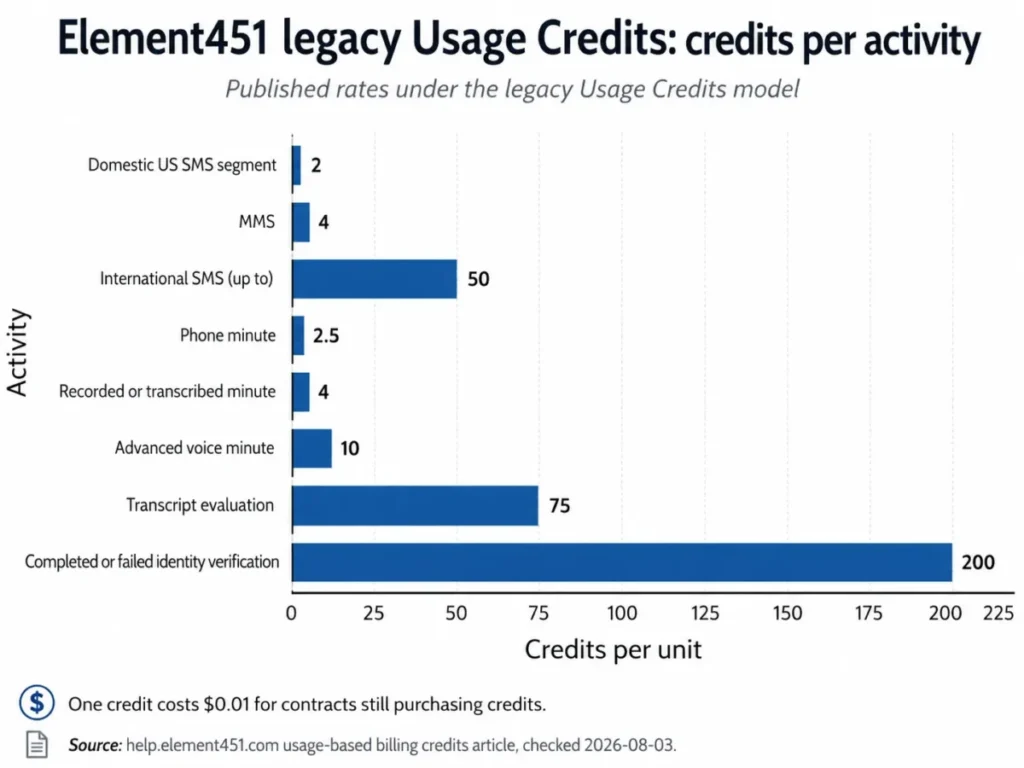
Read that last number twice. A failed identity verification costs the same as a successful one, so an applicant population with poor document quality carries a cost the funnel report never shows.
Feature Gates: What You Get on Each Package
| Capability | Package condition | Usage treatment | Fallback if not entitled |
|---|---|---|---|
| Application Reader | Bolt for Admissions or Element for Admissions and Marketing | Not usage-capped | Manual first read or an external review tool |
| Application fraud detection | Bolt for Admissions or Element for Admissions and Marketing | Not usage-capped | Manual fraud review |
| Transcript evaluation | Qualifying admissions or student success package | Usage-capped, quantity set by contract | Manual evaluation or an external evaluator |
| Identity verification | Qualifying admissions package with the application enabled | Usage-capped, plus a three-attempt workflow ceiling | Institutional identity process |
| Native course integrations | Student Success or CE and Workforce packages | Not usage-capped | Flat files, API, or middleware |
| Live human support seats | Standard 1, Dedicated 5, Premium 10 | Extra seats at $150 per year | Help center and AI support |
| Snowflake | Add-on | Not applicable | Exports, API, or an existing warehouse route |
Sources: Understanding Usage Caps and Support service. Checked: 2026-08-03.
Email, contacts and users, administrators, AI content and workflow generation, and Bolt web chat are also documented as outside the cap model. That distinction matters more than it looks: the AI features that scale headcount are uncapped, and the AI features that touch documents and identity are metered.
Integrations and Ecosystem
| Integration path | Method | Direction | Condition |
|---|---|---|---|
| Flat file | CSV or SFTP | Into Element451 | Documented for people data |
| Zapier and Make | Connector | Two-way through the connector | Requires an Element451 feature token |
| Webhooks | Event push | Out of Element451 | Documented in the integration set |
| WordPress and Zoom | Native | Varies by tool | Documented in the integration set |
| Canvas | Native course integration | Reads from Canvas only | Student Success packages |
| Salesforce, LMS, Ellucian Ethos | Native, vendor-marketed | Vendor claim, direction to confirm | Selected Student Success and CE or Workforce packages |
Sources: Getting started with integrations and Element451 integrations. Checked: 2026-08-03.
The Ellucian Ethos, Banner, Colleague, and Salesforce connectivity is vendor-marketed rather than documented field by field in the pages opened for this review. An IT director should treat every one of those as a demo item with named objects and a named sync direction, not as a logo on a slide.
The public API reference exposes bearer-token authenticated endpoints. No numeric API rate limit appears in that documentation.
For a nightly SIS sync of 50,000 records, unknown throughput is an architecture risk rather than a feature gap.
The shared vocabulary for scoping that work sits in the CRM integration explainer. Get burst limits, daily limits, concurrency, webhook retry behavior, and sandbox availability in writing before the integration design is approved.
Automation, AI, and Reporting
The AI governance workflow is the part most institutions underestimate. Knowledge sources have to be inventoried and split, agents tested across each channel with response details reviewed, then run as an isolated live test with real routing before anything faces a full applicant pool.
Agent jobs then run inside an instance enrollment limit with a pending queue and an immutable goal, which makes campaign sequencing a design decision rather than a runtime adjustment. A job built for the wrong goal has to be rebuilt, not edited.
Reporting sits in the Core layer as insights, with Snowflake positioned as an add-on for institutions that want the data in a warehouse.
Agent depth is the reason this platform shows up alongside the wider field of AI CRM software. Institutional research offices that already run a warehouse should price that add-on early, because the alternative is a scheduled export routine that someone has to own.
Exports are built from a selected segment with a chosen row basis and field mappings, and an incorrect row scope produces duplicate-looking rows.
Source: Creating Exports. Checked: 2026-08-03.
That is the reporting trap in this platform. A dean who exports at the wrong row basis sees inflated counts, and the credibility cost of one bad board report outlives the fix.
Security, Support, and Admin Controls
The vendor states that Element451 is SOC 2 Type II compliant, supports FERPA and GDPR obligations, uses US data residency, and encrypts data at rest and in transit. The same page states role-based permissions, SAML 2.0, audit logs, and a 99.9 percent service-level agreement.
The vendor also states that customers own their data and can export it, that payment handling is PCI-DSS aligned, and that HIPAA-regulated data is not housed in the platform.
Those are vendor statements on a vendor-controlled page. Procurement should ask for the current SOC 2 report scope, the SLA exclusions behind the 99.9 percent figure, the subprocessor list, and the breach notification terms as contract exhibits.
The HIPAA line has a real consequence for campus health services and counseling centers. Any student-facing workflow that touches clinical records needs a different system, not a permission setting.
Accessibility documentation reports full or partial support for WCAG 2.1 Level A and AA, and names color contrast, focus visibility, and status messages among the partial-support areas, with user-generated and embedded third-party content falling outside Element451’s control.
Public institutions with an accessibility review office should route those three areas to testing before signature. Partial support is a normal disclosure and an unexamined one is an audit finding waiting to happen.
Support Tiers and the Seat Math
| Entitlement | Standard | Dedicated | Premium |
|---|---|---|---|
| Live support seats | 1 | 5 | 10 with priority assistance |
| Live seat hours | Monday to Friday, 9:00am to 5:00pm ET | Not separately stated on the page | Not separately stated on the page |
| Resolution wording | Within three business days | Tier entitlements above Standard | Priority assistance |
| Product Adoption Expert | Not included | Pooled | Assigned |
| Professional service credits | Not included | 5 | 15 |
| Managed services | Optional | Discounted | Priority |
| Engage Summit passes | Not included | 2 | 4 |
Source: Element451 documentation, Support service, checked 2026-08-03.
General vendor pages describe 24/7 support resources. The support-service page limits the included Standard live seat to weekday business hours in Eastern Time, so a west-coast community college running a 7pm deadline has AI and help-center resources after 5pm ET, not a human on the included seat.
Professional service credits are valid for twelve months and additional credits can be purchased, with no public price for the extra credits. Unused credits expire, which turns the Dedicated tier’s five credits into a use-it-or-lose-it planning item rather than a bank.
Upgrade Triggers Worth Pricing Now
Upgrade from Standard to Dedicated when a second staff member needs human support access, or when the project needs quarterly business reviews and service credits during implementation.
Upgrade from Dedicated to Premium when ten people need live seats with priority assistance, or when an assigned Product Adoption Expert and adoption reporting replace work no internal owner can absorb.
Expand a usage cap before the 80 percent alert rather than after it, because peak admissions season is the worst negotiating position available.
Move from a Bolt package to an Element package when the institution needs the broader system of record and multi-team workflows rather than one department’s agents.
Migration: What Moves and What Gets Rebuilt
The documented import path covers people data through mapped CSV or TXT files with a stable identifier. Notes, activities, attachments, historical conversations, applications, decisions, and automations are not established as covered by that same flat-file path in the opened documentation, which makes each of them an object to confirm before cutover rather than to assume.
A working migration sequence for a summer cutover looks like this:
- Normalize headers, program codes, and identifiers at the source, and standardize on UTF-8 encoding.
- Run a pilot import of a few hundred representative records, including the messy ones, not the clean ones.
- Reconcile row counts and unique person IDs against the source extract before scaling the import.
- Confirm object by object, in writing, which of notes, activities, attachments, applications, decisions, and automations the project will migrate, rebuild, or archive.
- Export a pre-cutover backup and define the correction and re-import rule before the first production load.
Institutions with weak identifiers, ambiguous duplicate rules, or a decade of historical objects carry the highest risk here. The general playbook in the CRM migration guide applies, and the sequencing detail lives in the CRM implementation guide.
Element451 Pros and Cons
| Pros | Cons |
|---|---|
| Purpose-built for higher education, so admissions and student success workflows arrive shaped rather than assembled | Base subscription price is not published, so budget approval depends on a sales conversation |
| Application Reader and fraud detection sit outside the usage-cap model in qualifying admissions packages | Transcript evaluation and identity verification are metered, with contracted quantities not published |
| Usage caps are soft, so hitting a ceiling triggers alerts and a conversation rather than a service stop | Cap expansion pricing is negotiated, which removes budget certainty mid-year |
| Support tiers publish exact live seat counts and a $150 per seat per year extra-seat fee | The included Standard live seat is weekday business hours, not 24/7 human coverage |
| Documented import path, integration log, and public API give a real integration surface | Native Canvas course integration reads only, and no numeric API rate limit is published |
| Vendor states SOC 2 Type II, FERPA support, US residency, SAML 2.0, and a 99.9 percent SLA | Package names on the buying page and the help center do not map to each other |
Sources: Element451 pricing page for the quote model and Understanding Usage Caps for the metered categories. Checked: 2026-08-03.
Element451 Limitations
Contract values are set in negotiation, not published. Base package price, included cap quantities per category, cap expansion rates, support tier uplift, implementation fees, renewal uplift, and data-exit assistance are all absent from the public pages. An institution that needs a defensible three-year cost model has to build it from a line-item quote.
Two official package models coexist. The seven-package buying page and the Core-plus-Team help article describe different structures, and no official mapping between them appeared in the pages opened for this review. Feature assumptions taken from the wrong model turn into change orders.
Canvas writes are not supported by the native course integration. Advising workflows that assume a round trip need a redesign or middleware.
Telephony is +1 only. International recruitment calling has to live outside the platform, and inbound calls require forwarding.
Knowledge ingestion has a practical file ceiling. Files above roughly 10 MB carry higher parsing-failure risk, so large catalogs and policy manuals need splitting and retrieval testing before agents go live.
Third-party review evidence is thin. The opened TrustRadius page displayed no Element451 reviews, and the accessible G2 sample is too small for a current buyer consensus.
Accessible Capterra material praises ease of use, live chat, and help resources, which is directionally consistent with the Software Advice themes.
Treat all of that as a weak signal. A buyer who wants statistically mature peer validation will not find it for this platform, and reference calls with three comparable institutions are worth more than every star rating on the internet here.
Who Should Use Element451?
Regional universities consolidating marketing and admissions operations. A centralized enrollment team that wants pages, forms, campaigns, conversations, applications, and AI first-read support in one system gets the most out of the Element for Admissions and Marketing package.
Community colleges running recruitment, adult learning, and workforce programs together. The public packaging includes CE and Workforce options on both the Bolt and Element sides, which is unusual in this category and worth pricing against a two-system alternative.
Student success teams that accept Canvas as the source of record. Proactive outreach built on course, attendance, and appointment signals works well when the design treats the LMS as upstream and the CRM as the engagement layer.
Small central admissions offices without CRM engineering capacity. An independent comparison frames Element451 as faster and easier to operate than highly configurable alternatives, with less open-ended customization as the trade.
Institutions ready to govern AI properly. Knowledge ownership, test scripts, escalation rules, and a named human handoff path are prerequisites here, not nice-to-haves.
Who Should Avoid Element451?
Medical, dental, law, and similar programs with rubric-heavy committee review. Multi-reader workflows, exception handling, and auditability need a scenario demo with real committee stages before any signature.
Institutions that require published list pricing to start procurement. Nothing about the current pricing model supports a public price comparison.
Advising operations that need bidirectional LMS writes. The documented Canvas integration reads only.
International recruitment centers dependent on built-in telephony. Outbound calling covers +1 numbers, so global dialing lives elsewhere.
Teams that need a verified native student mobile app or offline access. The official evidence supports browser-based StudentHub with a home-screen shortcut, and anything beyond that needs vendor confirmation in the demo.
Element451 Alternatives
| Alternative | Choose it if | Pricing basis | Main trade-off |
|---|---|---|---|
| Slate by Technolutions | Application review logic, reader workflows, and configurability outrank speed of implementation | Quote-based, confirm current terms with the vendor | Configuration depth demands in-house expertise and time |
| Salesforce Education Cloud | The institution already runs Salesforce architecture, governance, and admin capacity | Quote-based, confirm current terms with the vendor | Higher services and admin cost to reach campus-specific workflows |
| Ellucian CRM Advance | Advancement and alumni engagement is the primary use case rather than enrollment | Quote-based, confirm current terms with the vendor | Enrollment marketing depth is not the product center of gravity |
| TargetX | A Salesforce-based recruitment CRM is preferred over a standalone platform | Quote-based, confirm current terms with the vendor | Platform dependency on the underlying Salesforce contract |
| Existing SIS plus point tools | Only one narrow workflow needs solving and an annual CRM contract is hard to justify | Varies by tool | Fragmented student record and duplicate manual work |
Deeper evaluations of the first four sit in the Slate by Technolutions review, the Salesforce CRM review, the Ellucian CRM Advance review, and the TargetX review. Current Salesforce list rates are tracked separately in the Salesforce pricing guide.
Final Verdict: Is Element451 Worth It?
Every capability judged above is a documented capability drawn from official documentation rather than a sales promise, and each one carries an operating consequence for a named team.
For a regional university or community college consolidating enrollment marketing, admissions, and student success on one higher-education-native platform, Element451 earns a place on the shortlist. That recommendation holds only if the enrollment team accepts the plan gate on admissions AI and the limitation on Canvas writes. The AI layer is the differentiator, and the fact that Application Reader and fraud detection sit outside the metering model tells you where the vendor expects volume to grow.
For a program whose competitive advantage is a nuanced, committee-driven application review, the first step is a scripted scenario demo. If that demo needs custom development to reproduce the current process, the configurability of a platform like Slate is worth the slower implementation.
The recommended buying path here is narrow. Start from the smallest package that matches the primary workflow.
Then require three things in the quote: an entitlement map from every requested capability to its exact commercial package, the contracted cap quantity for every metered category, and the expansion price for each of those categories.
Ask for three usage scenarios rather than one: expected volume, peak admissions season, and a growth case at 130 percent of current applications. If the vendor will price only the expected case, the mid-year capacity conversation is already scheduled.
The renewal question to answer before signing is simple. Twelve months from now, can the institution show that agent conversations replaced work the team could not staff, and that the metered categories stayed inside contracted caps without an emergency amendment?
If the answer to both is likely yes, this is a good contract. If usage forecasting is guesswork and the enrollment team has no owner for AI knowledge governance, delay the decision by one cycle and fix the data first.
FAQs
The questions below come from the buying stage this article serves: budget approval, package scoping, and integration design.
What is Element451?
Element451 is a higher-education CRM and AI agent platform covering marketing, admissions, student success, and continuing education or workforce teams. The vendor is headquartered in Raleigh, North Carolina, and sells the product in two families, Bolt for the AI agent packages and Element for the broader CRM packages.
How much does Element451 cost in 2026?
There is no published price.
Pricing is annual and quote-based, and the public calculator states that the number varies with institution size and support tier, then routes to a quote request. Any specific starting figure circulating online comes from older content rather than the current page.
Is Element451 a CRM?
Yes. It functions as the system of record for prospective and current students, with conversations, tasks, forms, people records, workflows, integrations, and insights documented in the Core layer, plus department-specific packages layered on top.
What happens when an Element451 usage cap is reached?
Nothing stops.
Alerts fire at 80 percent and 100 percent of a category cap, the feature continues to operate, and the institution contacts its account manager to add capacity. Caps reset annually at renewal and do not roll over, and the price of added capacity is negotiated rather than published.
Does Element451 integrate with Canvas, Banner, Colleague, or Salesforce?
The native Canvas course integration is documented as reading from Canvas without writing back. Native Salesforce, LMS, and Ellucian Ethos connectivity is marketed for selected Student Success and CE or Workforce packages, so confirm the objects, direction, and package condition for each one during the demo.
Does Element451 have a mobile app?
The documented delivery model is mobile web with a home-screen shortcut rather than an app-store download. Treat push notifications, device management, and offline access as demo questions until the vendor confirms them in writing.
Is Element451 FERPA compliant?
The vendor states that the platform supports FERPA and GDPR obligations, holds SOC 2 Type II compliance, uses US data residency, and provides SAML 2.0, role-based permissions, and audit logs. Those are vendor statements, so request the current report scope and contract exhibits during review.
How long does Element451 implementation take?
No independently bounded timeline exists for a specific institution. An implementation partner describes configuration, migration validation, data cleanup, and training as separate workstreams, which means the institutional effort is driven by data quality and integration scope rather than by the vendor’s setup calendar.
Is Element451 better than Slate?
They optimize for different things. Element451 favors speed, AI workflows, and structured configuration, while Slate favors deep configurability in application review, so a program with complex reader logic will often prefer Slate and a marketing-led enrollment team will often prefer Element451.
What should be in an Element451 quote before signing?
Ask for the base package price, the support tier price, the included cap quantity for every metered category, and the expansion price per category. Then ask for extra live seat cost, professional service credits and their expiry, managed services rates, the Snowflake add-on price, implementation fees, minimum term, renewal uplift, and data-exit assistance terms.