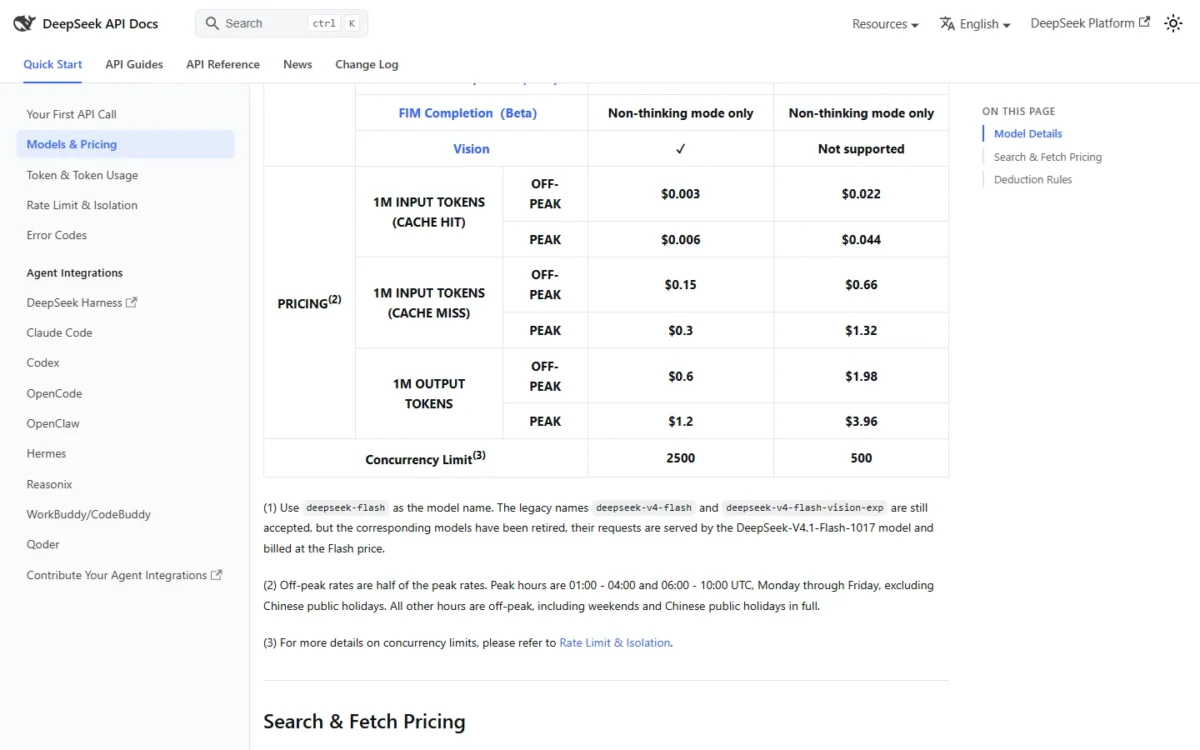
DeepSeek pricing starts at $0.15 per 1M input tokens (cache miss) and $0.6 per 1M output tokens on deepseek-flash at off-peak rates, while the DeepSeek web chat and app list no price at all. Every token rate has a peak and an off-peak price, and the off-peak rate is half the peak rate. Peak hours are 01:00-04:00 and 06:00-10:00 UTC on weekdays.
With the US time zones in 15 U.S.C. § 261 on Cornell’s Legal Information Institute, a 9 a.m. to 5 p.m. weekday in Eastern or Pacific time falls entirely in off-peak hours. At those rates, the support-bot row of the cost table below costs $0.003 x 100 + $0.15 x 100 + $0.6 x 40 = $39.30 a month (each rate times millions of cached input, uncached input and output tokens).
That suits teams with steady, cache-friendly API traffic, not a buyer who wants a flat per-seat subscription, which Models & Pricing does not list. You pay from a prepaid balance.
The trade-off on deepseek-v4-pro is cost and capacity: it charges $1.98 per 1M output tokens off-peak, 3.3 times Flash’s $0.6, and caps an account at 500 concurrent requests.
Quick pricing answer
DeepSeek bills its API per account, pay-as-you-go per 1M tokens on two models, from a prepaid balance with no subscription. Rates were checked in November 2026, in US dollars.
- deepseek-flash: $0.15 per 1M input tokens (cache miss), $0.003 (cache hit) and $0.6 per 1M output tokens off-peak; peak rates are double.
- deepseek-v4-pro: $0.66 per 1M input tokens (cache miss), $0.022 (cache hit) and $1.98 per 1M output tokens off-peak; peak rates are double.
- Free plan or trial: none listed on Models & Pricing; the web chat and app show no price.
- Start on: deepseek-flash, with traffic in off-peak hours.
- Cost caveat: weekday peak windows (01:00-04:00 and 06:00-10:00 UTC) double every token rate.

In This Article (13 sections)
DeepSeek Pricing at a Glance
Each DeepSeek API model has three token rates, and each rate has an off-peak and a peak price per 1M tokens.
| Plan | Input price, cache hit | Input price, cache miss | Output price, billed per 1M | Best for | Main limitation |
|---|---|---|---|---|---|
| deepseek-flash | $0.003 / $0.006 | $0.15 / $0.3 | $0.6 / $1.2 | Chatbots, prototypes, image input, high traffic | Rates double in peak windows |
| deepseek-v4-pro | $0.022 / $0.044 | $0.66 / $1.32 | $1.98 / $3.96 | Hard coding and agent tasks | No vision; 500 concurrent requests per account |
Sources: DeepSeek Models & Pricing and Rate Limit & Isolation, checked Nov 2026.
Prices were read on November 7, 2026 from DeepSeek’s API docs page, which lists prices in US dollars and bills usage from a topped-up balance. The page does not state whether prices include tax.
Budget from the off-peak figures for weekend traffic and US daytime traffic, which the US-time table below (time zones from Cornell’s Legal Information Institute) shows as off-peak. A weekday job inside 01:00-04:00 or 06:00-10:00 UTC pays the peak figures, double the off-peak ones. Cached input on Flash is the cheapest rate on the page.

Those are all API prices. Does anything from DeepSeek cost nothing?
Is DeepSeek Free? The Chat App vs the API
Under Products, DeepSeek’s homepage links Downloads, DeepSeek Web, DeepSeek Harness, API Platform, API Docs, API Pricing and Service Status, and its only pricing link is API Pricing. Models & Pricing lists only per-token and per-request rates, and fees are deducted from a topped-up or granted balance. DeepSeek’s homepage links DeepSeek Web, the app download and a “Chat with DeepSeek” button, and shows no plan or price.
In the help center, the money questions (top-ups, balance expiry, refunds, invoices) sit in the API section, and the Chat Issues and User Guide sections list no billing topic.
On the API, Models & Pricing deducts fees from a topped-up balance or a granted balance, and spends the granted balance first when an account has both. DeepSeek does not publish how much granted balance an account receives, so plan on paying for the first API call.
If you only want to chat and never call the API, you need no API budget at all, and my ranking of the best AI chatbots is the better place to compare assistants.
DeepSeek API Models and Rates Explained
DeepSeek sells two model names, deepseek-flash and deepseek-v4-pro, each pointing to a dated model version, and both take a 1M-token context with a maximum output of 384K tokens. Both support thinking and non-thinking modes, JSON output and tool calls. Flash adds vision and a 2,500-request concurrency limit; Pro has neither.
Both models answer on an OpenAI-format base URL (api.deepseek.com) and an Anthropic-format one (api.deepseek.com/anthropic). DeepSeek’s docs include agent integration guides for Claude Code, Codex, OpenCode and other coding tools, so a developer who knows how to set up Claude Code can point it at the Anthropic-format URL.
A developer weighing a coding agent’s own subscription should compare these token rates with what Claude Code costs on its plans before deciding which bill to carry.
My take
Pick the model first if cost is your limit: Pro’s uncached input rate is 4.4 times Flash’s, while peak hours only double a rate.
deepseek-flash (DeepSeek-V4.1-Flash-1017)
deepseek-flash costs $0.15 per 1M uncached input tokens and $0.6 per 1M output tokens off-peak, and $0.3 and $1.2 at peak. It is the only one of the two models with vision, and it allows 2,500 concurrent requests per account.
DeepSeek cut API prices when it released DeepSeek-V4.1-Flash on September 10, 2026, and the October 17, 2026 update to DeepSeek-V4.1-Flash-1017 kept pricing unchanged. Older code that still calls deepseek-v4-flash or deepseek-v4-flash-vision-exp is served by DeepSeek-V4.1-Flash-1017 and billed at the Flash price, so it pays current rates without a code change.
Flash fits chatbots, internal tools, document and screenshot workflows, and anything with many parallel users.
deepseek-v4-pro (DeepSeek-V4-Pro-0813)
On deepseek-v4-pro, uncached input costs $0.66 per 1M tokens off-peak ($1.32 at peak), output $1.98 ($3.96), and cached input $0.022 ($0.044).
Pro gives up two things Flash has: it does not support vision, and it caps an account at 500 concurrent requests. DeepSeek said on September 10, 2026 that it would keep serving V4 Pro after September 14, 2026 with billing unchanged, so the model is still a paid option rather than a retired one.
Pro makes sense for a coding agent or a hard reasoning job where one better answer saves a human review. Skip it if your traffic includes images, or if it needs more than 500 concurrent requests and you would rather not file a capacity expansion request, which DeepSeek handles at no additional cost.
What happened to deepseek-chat and deepseek-reasoner?
deepseek-chat and deepseek-reasoner are legacy names: DeepSeek’s changelog announced on April 24, 2026 that both would be discontinued on July 24, 2026, pointing them meanwhile to the non-thinking and thinking modes of deepseek-v4-flash. Models & Pricing no longer lists either, so a “deepseek-chat” price quote describes an older model; budget from the two current names.
Every rate above has two prices, and the hour a request runs decides which one you pay.
Peak vs Off-Peak DeepSeek Pricing: When the Half-Price Hours Apply
DeepSeek charges its peak price tier from 01:00 to 04:00 and from 06:00 to 10:00 UTC on weekdays. Every other hour, weekends and Chinese public holidays included, bills at the off-peak tier, which is half of peak. The two tiers started at 16:00 UTC on August 16, 2026, with the V4 model family.
DeepSeek states the windows only in UTC. Per 15 U.S.C. § 261 on Cornell’s Legal Information Institute (read Nov 7, 2026), the second zone’s standard time is UTC retarded by 5 hours and the fifth zone’s by 8 hours, and Cornell’s copy of § 263 names those zones Eastern and Pacific standard time. Cornell’s copy of § 260a moves each zone one hour ahead from 2 a.m. on the second Sunday of March to 2 a.m. on the first Sunday of November.
| US time zone | Peak window 1 (01:00-04:00 UTC) | Peak window 2 (06:00-10:00 UTC) | Local days | 9 a.m.-5 p.m. weekday | Time-zone source |
|---|---|---|---|---|---|
| Eastern, standard time (UTC-5) | 8-11 p.m. | 1-5 a.m. | Window 1 Sunday-Thursday evenings; window 2 Monday-Friday mornings | Off-peak | Cornell LII: 15 U.S.C. §§ 261, 263 |
| Eastern, daylight time (UTC-4) | 9 p.m.-midnight | 2-6 a.m. | Window 1 Sunday-Thursday evenings; window 2 Monday-Friday mornings | Off-peak | Cornell LII: 15 U.S.C. §§ 260a, 261, 263 |
| Pacific, standard time (UTC-8) | 5-8 p.m. | 10 p.m.-2 a.m. | Both windows start Sunday-Thursday evenings | Off-peak; peak starts at 5 p.m. | Cornell LII: 15 U.S.C. §§ 261, 263 |
| Pacific, daylight time (UTC-7) | 6-9 p.m. | 11 p.m.-3 a.m. | Both windows start Sunday-Thursday evenings | Off-peak | Cornell LII: 15 U.S.C. §§ 260a, 261, 263 |
Sources: DeepSeek Models & Pricing for the UTC windows, checked Nov 2026; Cornell LII’s copies of 15 U.S.C. §§ 260a, 261 and 263 for the US offsets, read Nov 7, 2026.
By those Cornell-sourced offsets, US daytime traffic on either coast is already on the cheap tier. The trap is the overnight batch job: at UTC-5, Eastern standard time under Cornell’s copy of §§ 261 and 263, a weekday run from 1 a.m. to 5 a.m. Eastern sits in the second peak window.
In millions of uncached input and output tokens, the Overnight US batch row costs $0.3 x 100 + $1.2 x 20 = $54.00 at peak. The same tokens off-peak, on a weekend for example, cost $0.15 x 100 + $0.6 x 20 = $27.00.
West Coast teams face the opposite edge in winter: at UTC-8, Pacific standard time under Cornell’s copy of §§ 261 and 263, work that runs past 5 p.m. Pacific, Sunday to Thursday, pays double.
How Context Caching Cuts the Input Bill
A repeated prompt prefix that fully matches a cached prefix unit is billed at the cache-hit rate, which on deepseek-flash off-peak is $0.003 per 1M tokens instead of $0.15. That is 50 times cheaper on Flash, and $0.022 against $0.66 makes it 30 times cheaper on Pro. Caching is on by default and needs no code change.
The catch is the matching rule. A request hits the cache only when it fully matches a prefix unit DeepSeek has already written to its disk cache, such as an earlier conversation turn or a common prefix it detected across requests. DeepSeek calls the cache best-effort, with no guarantee of a 100% hit rate, and clears unused cache entries usually within a few hours to a few days.
In practice, that rewards a fixed system prompt and shared documents placed at the start of every request, unchanged. Counted in millions of tokens, the support bot with nothing cached pays $0.15 x 200 + $0.6 x 40 = $54.00 on Flash off-peak; with half that input cached, it pays $0.003 x 100 + $0.15 x 100 + $0.6 x 40 = $39.30.
You do not have to guess your hit rate: each response reports prompt_cache_hit_tokens and prompt_cache_miss_tokens in its usage field, as the context caching guide shows, so a week of logs gives your real cached share.
Additional DeepSeek Costs to Consider
Search and Fetch cost $0.75 per 1,000 successful requests each, and they are the only per-request charges on Models & Pricing; everything else is billed as tokens.
| Cost type | When it applies | Pricing basis | Notes |
|---|---|---|---|
| Search API | Web search calls | $0.75 per 1,000 successful requests | Standalone API, opened October 17, 2026 |
| Fetch API | Web page fetch calls | $0.75 per 1,000 successful requests | Standalone API |
| Thinking-mode output | Thinking mode, the default | No separate rate listed; billed as input and output tokens | Chain of thought returns in reasoning_ |
| Image input | Images sent to deepseek-flash | Input tokens, estimated from image size | Usage field gives the actual count |
| Higher concurrency | Above 2,500 (Flash) or 500 (Pro) requests | No additional cost | By capacity expansion request |
| Tax | Any top-up | Not stated on the pricing page | Check at checkout |
Sources: DeepSeek Models & Pricing, Rate Limit & Isolation, Token & Token Usage and Thinking Mode, checked Nov 2026.
A research agent that runs 10,000 successful searches a month adds $0.75 x 10 = $7.50, small next to the tokens those results feed back into the model. Thinking mode matters more: it is on by default, so run a few calls at the effort you plan to use and read the output token count before you budget.
How Much Does DeepSeek Cost per Month?
A DeepSeek API month costs your token counts in millions times each rate, so a small Flash prototype at off-peak rates costs $0.15 x 20 + $0.6 x 5 = $6.00, and the larger workloads below run higher.
DeepSeek API input cost calculator
This calculator needs JavaScript. The scenario table below gives the same estimate for typical workloads.
Enter what you need. The calculator prices it on every plan at list prices and names the cheapest plan that covers it.
- List prices in USD from DeepSeek API’s official pricing pages, checked Nov 7, 2026. Tax and regional prices are not included.
- 12-month figures are 12 times the monthly cost at the billing you choose.
- A planning estimate at list prices, not a quote.
The calculator takes the millions of uncached input tokens you expect each month and three check boxes: peak-hour traffic, a need for deepseek-v4-pro, and image input. It shows each model and time band side by side and the cheapest one that fits. It counts uncached input only and leaves out output tokens, cache hits, Search, Fetch and tax, so use the table below for a full bill.
| Team workload | Plan | Monthly cost (rate x millions of tokens) | Annual total | Assumptions |
|---|---|---|---|---|
| Prototype | deepseek-flash, off-peak | $0.15 x 20 + $0.6 x 5 = $6.00 | $6.00 x 12 = $72.00 | Usage-based; uncached input and output; no Search or Fetch |
| Support bot | deepseek-flash, off-peak | $0.003 x 100 + $0.15 x 100 + $0.6 x 40 = $39.30 | $39.30 x 12 = $471.60 | Usage-based; cached input, uncached input, output; US daytime traffic |
| Overnight US batch | deepseek-flash, peak | $0.3 x 100 + $1.2 x 20 = $54.00 | $54.00 x 12 = $648.00 | Usage-based; uncached input and output; runs on weekdays inside 06:00-10:00 UTC |
| Coding agent | deepseek-v4-pro, off-peak | $0.022 x 400 + $0.66 x 100 + $1.98 x 30 = $134.20 | $134.20 x 12 = $1,610.40 | Usage-based; cached input, uncached input, output; US daytime |
Sources: DeepSeek Models & Pricing, checked Nov 2026. Totals are estimates from list rates; they leave out tax, failed retries and price changes.
The coding agent is where model choice moves the bill most. The same tokens on deepseek-flash off-peak cost $0.003 x 400 + $0.15 x 100 + $0.6 x 30 = $34.20, about a quarter of the Pro row.
To turn your own text into tokens, DeepSeek’s rule of thumb is about 0.3 token per English character and 0.6 per Chinese character. If you handle 50,000 conversations a month, input comes to 50,000 x 6,000 x 0.3 = 90,000,000 tokens and output to 50,000 x 2,000 x 0.3 = 30,000,000 tokens (conversations x characters each x tokens per character). On Flash off-peak, that costs $0.15 x 90 + $0.6 x 30 = $31.50 in millions of tokens, before any cache hits.
Which DeepSeek Plan Should You Choose: Flash or Pro?
Start on deepseek-flash in off-peak hours, and move a task to deepseek-v4-pro only when Flash’s output fails on it.
| Your needs | Plan to consider | Why | Main limitation |
|---|---|---|---|
| A prototype, chatbot or internal tool | deepseek-flash, off-peak | Lowest rate on all three token types | Answer quality on hard tasks is yours to check |
| Image or screenshot input | deepseek-flash | Pro does not support vision | Images add input tokens by size |
| Hard coding or agent tasks where Flash fails | deepseek-v4-pro | The higher-priced model, at 3.3 times Flash’s output rate | 500 concurrent requests and no vision |
| Batch jobs that can wait | Either model, outside peak windows | Off-peak is half of peak | Weekday runs from 01:00-04:00 or 06:00-10:00 UTC pay double |
| More than 500 concurrent requests | deepseek-flash, or a capacity request on Pro | 2,500 concurrent requests per account against 500 on Pro | A request above the limit gets an HTTP 429 error |
| Chat only, no code | The web chat or app, no API balance | The API bills tokens; the homepage lists no chat price | No team plan listed |
Sources: DeepSeek Models & Pricing and Rate Limit & Isolation, checked Nov 2026.
My take
Pick Flash for an image workflow or a high-traffic bot: it takes images and allows 2,500 concurrent requests to Pro’s 500, so those two limits decide before price does.
Is DeepSeek Worth the Price?
DeepSeek is worth it for high-volume, cache-friendly or schedulable API work, and not for a buyer who needs a per-seat team plan with admin controls or a fixed monthly bill. Models & Pricing lists token rates and flat Search/Fetch request prices, and it says DeepSeek may adjust prices, so a budget built today is an estimate, not a contract.
A slow or long task costs the tokens it reads and writes, since the expense is tokens times price. Counted in millions of output tokens, a long agent run costs $0.6 x 2 = $1.20 on Flash off-peak and $1.98 x 2 = $3.96 on Pro off-peak. That makes output length, thinking effort and retries the numbers to watch, not wall-clock time.
If you are weighing DeepSeek against a pricier model API, run the same monthly token counts through Claude’s API pricing to see the gap at your volume.
My take
For a chatbot or internal tool with a stable system prompt, the support-bot row costs $0.003 x 100 + $0.15 x 100 + $0.6 x 40 = $39.30 a month on Flash off-peak, so DeepSeek is worth it when your volume is high and your prompts repeat.
- Skip it if:
- your finance team needs per-seat billing and admin controls, because DeepSeek’s pricing page lists neither.
Billing, Top-Ups and Refunds
DeepSeek bills from a prepaid balance that you top up online, and top-up balances do not expire.
- Payment methods: PayPal, bank card, Alipay or WeChat Pay, on the Top Up page.
- Refunds: unused balances can be refunded; online payments through Billing > Refunds, corporate bank transfers by a Refund Request ticket.
Because unused balance is refundable and does not expire, a small first top-up carries little risk: run a real week of traffic, read the usage field, then top up for the month.
How I Verified DeepSeek Pricing
I read DeepSeek’s Models & Pricing page, its Rate Limit & Isolation, Context Caching, Token & Token Usage and Thinking Mode guides, its changelog and its help center answers on top-ups, expiry and refunds on November 7, 2026. For pricing region and currency, the pricing page lists prices in US dollars. The screenshots were captured from the same pricing page and the homepage in November 2026.
Every rate on this page comes from the Models & Pricing docs page. DeepSeek’s API Platform landing page still shows a price card for DeepSeek-V4-Flash, a model the changelog retired on September 10, 2026, and a V4-Pro card with no peak or off-peak split; that card says prices may change and points to the API docs, which is why the docs page wins here.
I calculated each monthly total as tokens in millions times the per-1M list rate, summed across rate types, and the annual total as the month times 12; both are estimates. DeepSeek does not publish a minimum top-up, the amount of any granted balance, a tax treatment or a separate thinking-mode rate. Output quality depends on your own prompts, so a small refundable top-up and a week of your real traffic settle it faster than any benchmark table.
Frequently Asked Questions
Does DeepSeek charge more for thinking mode?
No separate thinking-mode rate appears on Models & Pricing; the API bills input and output tokens at the model’s rates. Thinking mode is on by default at high effort, and you can set low, high or max effort per request; DeepSeek suggests low for simple tasks and max for complex ones.
Does DeepSeek have a monthly subscription?
No subscription or seat plan appears on Models & Pricing: the API is pay-as-you-go from a prepaid balance, and the help center’s API section explains how to request an invoice.
Can I raise DeepSeek’s rate limit?
Yes: DeepSeek takes capacity expansion requests and sets concurrency to your business needs at no additional cost. The limit counts every request on the account, whichever API key sends it. After an expansion, each user_id you pass is held to 2,500 concurrent requests on Flash and 500 on Pro.
Final Pricing Verdict
Top up a small balance, run your real workload on deepseek-flash during US daytime hours, and read the cache-hit share in the usage field before you decide on anything else. A workload near the prototype or support-bot token counts lands near those rows’ totals in the cost table.
My take
Pick deepseek-flash if you run a chatbot, internal tool or image workflow; it is worth it when your traffic sits in US daytime hours. I would move only the hard coding or agent steps to deepseek-v4-pro once Flash’s output fails your checks, and schedule batch jobs outside the weekday peak windows.