
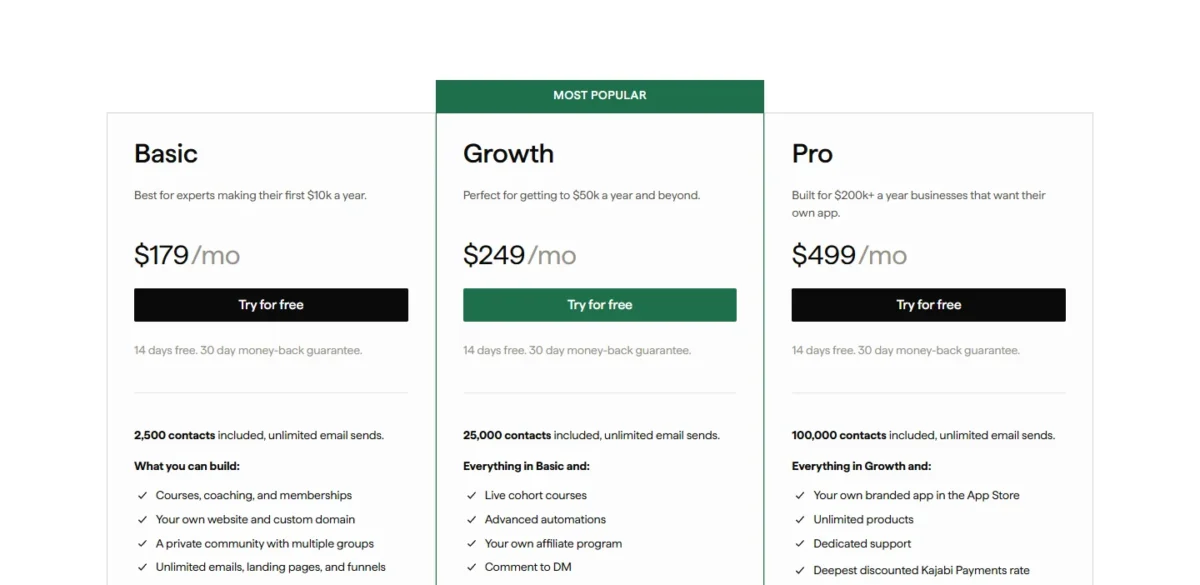
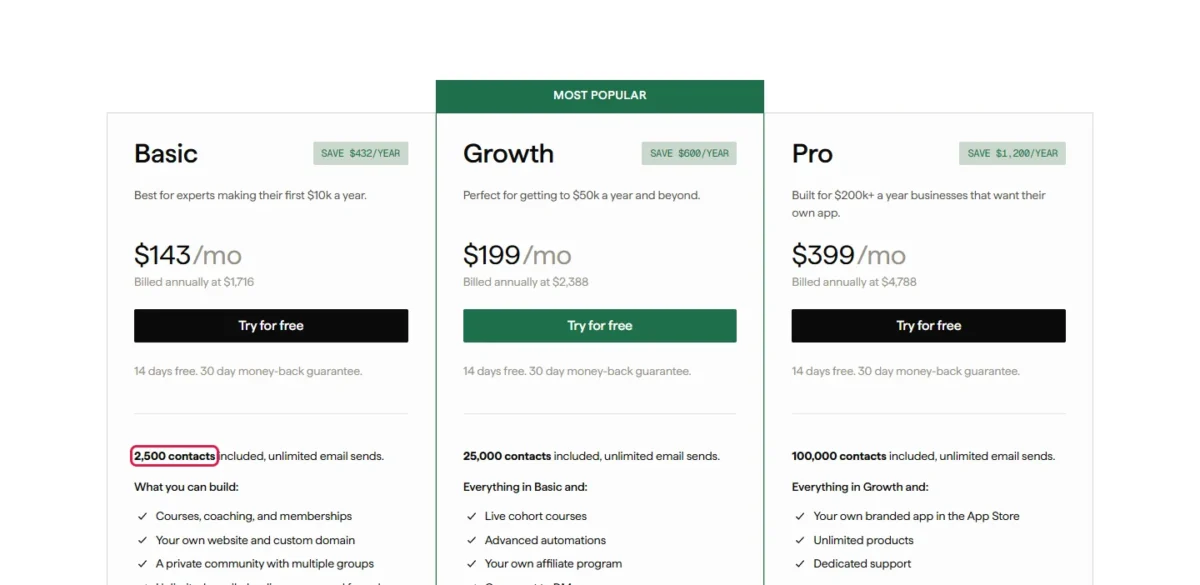
Kajabi pricing comes in three plans on its pricing page: Basic at $179 a month, Growth at $249 and Pro at $499 on monthly billing, or $143, $199 and $399 a month billed annually, in USD, checked November 2026. Each price covers one account with no per-seat charge; contacts (2,500, 25,000 or 100,000) set the plan. My verdict: Basic is worth buying for a first course.
Quick pricing answer
Annual billing is prepaid once a year ($1,716, $2,388 or $4,788) and saves $432 to $1,200. Every plan has a 14-day free trial; Kajabi lists no free plan.
Extra contacts cost $25 a month per 5,000 on monthly billing, so Basic with two increases still undercuts Growth at 12,500 contacts; a third does not.
Start a first course on Basic billed monthly, then switch to annual billing after launch. Growth fits an affiliate program or a list past 12,500 contacts; Pro, a branded app plus Growth-level features.
Refunds stop 30 days after the first charge.
In This Article (7 sections)
Real Kajabi Cost for a New, Growing and Multi-Brand Business
A new creator on annual Basic pays $1,716 a year, a coach on annual Growth $2,388 and a two-brand business on annual Pro $4,788: the subscription alone, at US list prices in USD checked November 2026, before tax.
Kajabi cost calculator
This calculator needs JavaScript. The scenario table below gives the same estimate for typical workloads.
Enter what you need. The calculator prices it on every plan at list prices and names the cheapest plan that covers it.
- List prices in USD from Kajabi’s official pricing pages, checked November 2026. Tax and regional prices are not included.
- 12-month figures are 12 times the monthly cost at the billing you choose.
- Extra contacts come in packs such as 5,000; their price is not part of this estimate, so a shortfall shows in contacts.
- A planning estimate at list prices, not a quote.
Enter your list size, tick the features you need and pick monthly or annual billing to see the cheapest plan that covers your list. The calculator prices the three plans only, not contacts increases, so for 2,500 to 12,500 contacts use the break-even table below. Tax and card fees are left out.
Take four illustrative businesses at Kajabi’s list prices: the first three list sizes are ranges set by plan limits; the two-brand business’s list size and sites are invented.
| Team size (business stage) | Plan | Billing | Monthly cost | Annual total | Assumptions |
|---|---|---|---|---|---|
| New course creator: up to 2,500 contacts | Basic | Annual | $143 | $143 x 12 = $1,716 | Illustrative example; no add-on or tax; inside Basic’s 2,500 contacts and 5 products |
| Creator with 2,500 to 7,500 contacts: no Growth feature needed | Basic + 1 contacts increase | Monthly | $179 + $25 = $204 | $204 x 12 = $2,448 | Illustrative example; Basic’s 2,500 contacts + 1 contacts increase of 5,000 = 7,500, a usage add-on at $25 a month |
| Coach with up to 25,000 contacts: runs an affiliate program | Growth | Annual | $199 | $199 x 12 = $2,388 | Illustrative example; no add-on or tax; Growth includes 25,000 contacts; Basic has no affiliate program |
| Two-brand business: 60,000 contacts, 2 websites | Pro | Annual | $399 | $399 x 12 = $4,788 | Illustrative example; no add-on or tax; Growth would need 1 sites increase and 7 contacts increases |
Sources: Kajabi’s pricing page and Kajabi paid extras, checked November 2026.
The creator with 2,500 to 7,500 contacts is the row to notice: Growth alone would cost $249 x 12 = $2,988 a year, more than Basic with one contacts increase.
Kajabi sells extra contacts as feature limit increases: 5,000 contacts for $25 a month, or $300 a year on an annual plan. Each one adds to Basic’s 2,500, so two increases carry a list of 12,500. Kajabi’s pricing page FAQ describes blocks of 25,000 contacts for $125 a month: the same $5 per 1,000 contacts ($125 / 25) as the 5,000-contact increase ($25 / 5), the unit the paid extras page prices and the one used here.
| Route | Per month, billed monthly | Per year, billed annually |
|---|---|---|
| Basic + 1 increase | $179 + $25 = $204 | $1,716 + $300 = $2,016 |
| Basic + 2 increases | $179 + $25 x 2 = $229 | $1,716 + $300 x 2 = $2,316 |
| Basic + 3 increases | $179 + $25 x 3 = $254 | $1,716 + $300 x 3 = $2,616 |
| Growth, 25,000 contacts included | $249 | $2,388 |
Sources: Kajabi paid extras and Kajabi’s pricing page, checked November 2026.
Kajabi Pricing Plans Compared
The three plans on Kajabi’s pricing page run from $179 to $499 a month billed monthly, or $143 to $399 a month billed annually.
| Plan | Monthly billing | Annual billing | Best for | Main limitation |
|---|---|---|---|---|
| Basic | $179 per account per month | $143 per account per month, billed annually at $1,716 | A first course or coaching offer | 2,500 contacts, 5 products, no affiliate program |
| Growth | $249 per account per month | $199 per account per month, billed annually at $2,388 | An affiliate program, live cohorts or a list past 12,500 contacts | 1 website, 50 products |
| Pro | $499 per account per month | $399 per account per month, billed annually at $4,788 | Your own branded app plus Growth-level features, or several brands on a large list | 100,000 contacts, 3 websites |
Sources: Kajabi’s pricing page, Monthly and Annual views, checked November 2026.
Prices are US list prices in USD, checked November 2026. An annual plan is paid upfront once a year, and Kajabi’s plans and pricing help page says prices do not include applicable taxes.
What Each Kajabi Plan Actually Gets You
Basic sells up to 5 products to 2,500 contacts from one website; Growth and Pro raise those limits and add the features below.
All three include unlimited landing pages, funnels and marketing emails, so email marketing volume is never the reason to upgrade.
Kajabi Basic plan
Basic is enough to launch online courses, coaching or a membership: 5 products, 2,500 contacts, 1 website and 2 team logins. Each course, coaching program, podcast and newsletter counts as 1 product, and all your digital downloads together count as 1.
What Basic leaves out decides the upgrade: no affiliate program, no advanced automations, no live cohort courses, 0 AI credits a month and a “Powered by Kajabi” footer. Custom domains and third-party integrations such as Kit, Mailchimp and Google Analytics are included.
Kajabi Growth plan
Growth costs $249 – $179 = $70 a month more than Basic on monthly billing, and the first reason to pay it is features: your own affiliate program, advanced automations (automations with a conditional filter), live cohort courses, comment to DM, webhooks and no Kajabi branding.
The limits rise to 25,000 contacts, 50 products and 11 team logins, with 500 AI credits a month and a discounted Kajabi Payments rate. Buy Growth for one of those advanced features, or once your list passes 12,500 contacts.
Kajabi Pro plan
Pro is for a business that wants its own branded app along with Growth’s features or limits, or runs several brands on a large list. It includes 3 websites, your own branded app in the App Store, API access, the code editor, unlimited products, 26 team logins, 1,000 AI credits a month and dedicated support.
The app changes the math. The branded mobile app add-on costs $199 a month, charged monthly even if you’re on an annual plan, and Kajabi’s paid extras page lists it as “Branded Mobile App Premium”, its only tier. Pro includes your own branded app.
A year of annual Growth plus the app costs $2,388 + $199 x 12 = $4,776, so annual Pro’s $4,788 costs only $4,788 – $2,388 – $199 x 12 = $12 more. Annual Basic plus the app costs $1,716 + $199 x 12 = $4,104, which stays under Pro for a business inside Basic’s limits. On monthly billing the answer changes: Growth plus the app costs $249 + $199 = $448 a month against Pro’s $499 a month. Pro costs about the same as annual Growth plus the app, so it is worth it for its other inclusions.
A second site alone is cheaper as a sites increase: $249 + $49 = $298 a month on Growth, billed monthly.
My take
Pick Basic and add contacts increases until you need an affiliate program or pass 12,500 contacts. For the branded app inside Basic’s limits, Basic plus the add-on costs less than annual Pro. I would buy annual Pro over Growth plus the add-on when you also need Growth’s features or limits: for almost the same yearly bill it adds two websites, the API and unlimited products.
Kickstarter and Parked plans
Two plans sit outside the pricing page. Parked pauses your subscription for $29 a month in USD, plus applicable taxes: your sites go offline, your custom domain stays connected and Kajabi stores your content, as its subscription help page explains.
Kickstarter is a smaller plan with 250 contacts, 1 product and 1 admin user, and no custom domains or third-party integrations. Kajabi’s plans and pricing help page, linked above, shows its current price.
Kajabi Free Trial, Refunds and Monthly vs Annual Billing
Kajabi lists no free plan: each plan starts with a 14-day free trial that leads into the plan you chose.
If you need a free option, a list of free LMS options is the better place to look.
On Basic, 12 monthly bills cost $179 x 12 = $2,148 against $1,716 paid upfront, a $432 saving. Growth saves $249 x 12 = $2,988 – $2,388 = $600, and Pro saves $499 x 12 = $5,988 – $4,788 = $1,200. The refund rule turns that saving into a commitment: Kajabi’s terms of service give a full refund within 30 days of your first charge, and after that payments are nonrefundable, with no credit for a partly used subscription.
My take
I would pay monthly through the first launch and switch after it: Kajabi lets you go from monthly to annual at any time. Until then, the extra $179 – $143 = $36 a month on Basic buys the option to walk away.
Price changes and cancellation
Kajabi raised prices across all plans in its Q4 2025 pricing update, and an existing customer’s price updated on their first billing date on or after January 13, 2026. The same update raised an extra 5,000 contacts from $20 to $25.
Kajabi’s terms of service let you cancel at any time, with no refund for a partly used subscription after the first 30 days.
Extra Kajabi Costs to Consider
On top of the plan you pay transaction fees: a card fee on Kajabi Payments sales, or an extra Kajabi fee on sales through an outside processor such as Stripe where Kajabi Payments is offered. Kajabi’s pricing page says it does not take a revenue share as a platform, but that outside-processor fee still applies.
| Cost type | When it applies | Pricing basis | Notes |
|---|---|---|---|
| Kajabi Payments card fee | Every US card sale | 2.9% + 30 cents on Basic, 2.8% + 30 cents on Growth, 2.7% + 30 cents on Pro | 4.4%, 4.3% and 4.2% + 30 cents for international cards |
| Outside-processor fee | Sales through a processor such as Stripe, where Kajabi Payments is available | 2% on Basic, 1% on Growth, 0.5% on Pro | Added to the processor’s fees; excludes PayPal |
| Contacts increase | A list past the plan’s limit | $25 a month or $300 a year per 5,000 contacts | Follows the plan’s billing cycle |
| Products increase | More products than the plan includes | $50 a month or $600 a year per 10 products | Follows the plan’s billing cycle |
| Sites increase | More websites than the plan includes | $49 a month or $588 a year per 1 site | Follows the plan’s billing cycle |
| Admin users increase | More team logins than the plan includes | $5 a month or $60 a year per admin user | Follows the plan’s billing cycle |
| AI credits | More than the plan’s monthly credits | $15 a month per 500 credits | Monthly only |
| Branded mobile app add-on | On Basic or Growth; Pro includes it | $199 a month for your own app | Charged monthly, even on an annual plan |
| Public API add-on | On Basic or Growth; Pro includes it | $25 a month for API access | Charged monthly, even on an annual plan |
| Tax on the subscription | Business addresses in taxed locations such as New York, Texas and Washington | Not included in list prices | Applies to your Kajabi bill, not to customer payments |
Sources: Kajabi’s plans and pricing help page, Kajabi’s pricing page and Kajabi paid extras, checked November 2026.
Take an illustrative month of 5,000 US dollars in sales from 50 US card payments of 100 dollars each. Through Kajabi Payments, Basic’s 2.9% + 30 cents comes to 5,000 x 0.029 + 50 x 0.30 = 160 dollars, against 155 on Growth and 150 on Pro at their lower rates.
Keep an outside processor that month and Kajabi adds 5,000 x 0.02 = 100 dollars on Basic, 50 on Growth or 25 on Pro, before the processor’s own fees. The plan moves the card bill by 10 dollars at most; the choice of payment options moves it by up to 100.
For a seller who keeps Stripe, that gap can decide the plan: Basic’s 2% against Growth’s 1% is 1% of sales, so Growth’s monthly-billing step of $249 – $179 = $70 pays for itself at 70 / 0.01 = 7,000 dollars a month in outside-processor sales. Above that, Growth costs that seller less than Basic, even on a list under 12,500 contacts.
Which Kajabi Plan Should You Buy, and Is the Pricing Worth It?
Buy Basic for a first course and add contacts increases up to 12,500; move to Growth past that or for an affiliate program, and to Pro for your own app with Growth’s features or limits, or several brands on a large list.
| Your needs | Plan to consider | Why | Main limitation |
|---|---|---|---|
| First course, under 2,500 contacts | Basic, billed monthly at first | $179 a month covers 5 products and unlimited marketing emails | No affiliate program |
| 2,500 to 12,500 contacts, no Growth feature needed | Basic + 1 or 2 contacts increases | $179 + $25 = $204 with one and $204 + $25 = $229 with two, against $249 for Growth | Still 5 products and 2 team logins |
| More than 12,500 contacts, or an affiliate program, live cohorts or advanced automations | Growth | $249 a month covers 25,000 contacts; Basic with 3 increases costs $179 + $25 x 3 = $254 | 1 website, 50 products |
| Your own branded app inside Basic’s limits | Basic + branded mobile app add-on | $1,716 + $199 x 12 = $4,104 a year on annual Basic, under Pro’s $4,788 | 5 products and 2,500 contacts; the app is billed monthly |
| Your own branded app plus Growth’s features or limits, or several brands on a large list | Pro, billed annually | $4,788 a year includes the app; annual Growth plus the app costs $2,388 + $199 x 12 = $4,776 | A year paid upfront |
| Already on Basic, under 2,500 contacts and 5 products | Stay on Basic | No limit is close | Past a limit, add an increase before upgrading |
| Unsure Kajabi fits | The 14-day trial, then monthly billing | Refunds end 30 days after the first charge | $179 – $143 = $36 a month more than annual billing on Basic |
Sources: Kajabi’s pricing page, Kajabi paid extras and Kajabi terms of service, checked November 2026.
Kajabi is worth its price when it replaces your stack: its pricing page sells one subscription in place of five tools (website, email, checkout, community and courses). Set Basic’s $1,716 a year against what those cost you now, starting with what a standalone email tool costs.
My take
Pick Basic if this is your first course and you will use its website, email and checkout together.
For course hosting alone, Kajabi’s own pricing FAQ agrees it is expensive; compare a dedicated course platform such as Teachable, Thinkific or Skool, starting from my best LMS list.
Training employees rather than selling courses? Start with TalentLMS’s plan prices.
How I Verified Kajabi Pricing
I read Kajabi’s pricing page for the US region, in USD, on its Monthly and Annual views, its plans and pricing, paid extras and subscription help pages, its Q4 2025 pricing update and its terms of service in November 2026; the pricing page does not list Kickstarter. The yearly totals are my calculations (price x 12, plus the paid extras a row names), not quotes.
- Skip it if:
- you would use Kajabi for course hosting alone.
FAQ
Will I lose everything if I cancel my Kajabi subscription?
Not right away: after you cancel, you keep full access until the end of your billing cycle. If you reactivate more than 90 days after cancelling, your sites are no longer available. The Parked plan avoids that by storing your content while your sites are offline.
Is Kajabi like Shopify?
Not in what it is built to sell. Kajabi’s plans count courses, coaching, memberships, downloads and podcasts as products, and bundle the website, email, community and checkout around them. A business built on physical goods should weigh Shopify’s plans and card fees instead.