
Online review management services are the software, staff or agency work a business uses to request reviews where a platform allows it, monitor and answer reviews on Google, Yelp, Trustpilot and directories, flag reviews that break platform rules, track recurring themes and check how that text appears in search and AI answers.
In my reading the text now matters as much as the rating: AI Overviews, AI Mode and chat assistants describe a business in sentences, and Google says any indexed, snippet-eligible page can support them. You cannot script it: Google bars requests for specific content or for only positive reviews, and Yelp asks businesses not to request reviews at all.
Several locations with a steady review flow justify a service; one location with a few reviews a month can use Google Business Profile’s own tools.
Key facts
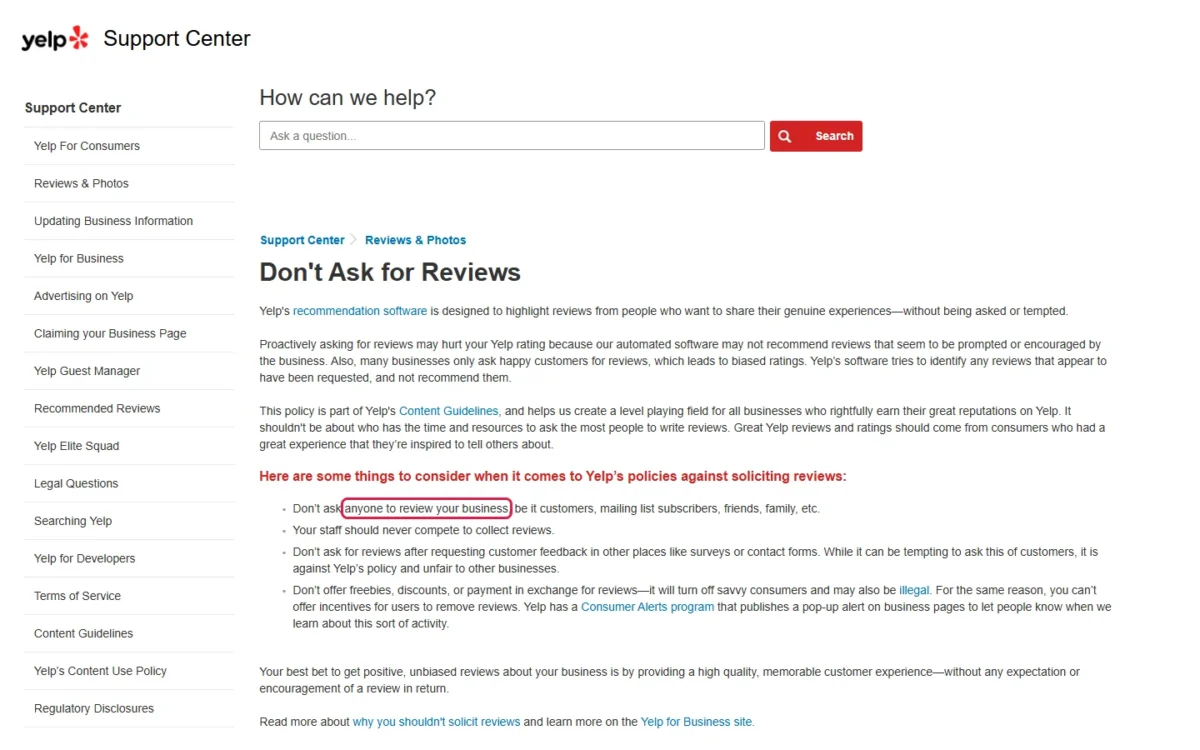
Google allows asking, not gating, incentives or scripted wording. Yelp: do not ask anyone. FTC rule in force since October 21, 2024. Removal needs a policy violation.
In This Article (10 sections)
What Are Online Review Management Services?
Online review management services do five jobs: request reviews, answer them, flag the ones that break a platform’s policy, tag reviews by theme and sentiment, and check how that text shows up in search and AI answers.
The unit of work is the consumer review as the FTC’s rule defines it: a consumer’s evaluation of a product, service or business, submitted to and published on a site or platform that exists at least in part to display such evaluations.
Review Management vs Reputation Management and Social Listening
Online reputation management is broader and adds search results, news, content removal and PR. Social listening tracks brand mentions on social networks but does not request or answer reviews. Review platforms such as Google, Yelp and Trustpilot host the reviews and set the rules; reputation management for individuals is a separate service, out of scope here.
Why Does Review Text Matter More Than Star Ratings Now?
A star average answers “how good”; the words answer “good at what”. Ask an assistant which plumber takes weekend calls and the rating says nothing, but a run of reviews mentioning Saturday repairs does.
Google’s documentation on AI features sets a low bar for the pages those features draw on: a page that is indexed and can show a snippet in regular Search qualifies as a supporting link in AI Overviews and AI Mode, with nothing more required. A public review page clears that bar.
The trap is that you cannot write those words for your customers. Google’s Maps content policy bars merchants from requesting that specific content be included, from asking staff to collect reviews that name a staff member, and from selectively soliciting positive reviews.
My take
I would track the topics customers repeat and how specifically the business answers them, not the decimal on the rating. Pick operations over wording: fix the front-desk problem and keep asking every customer, because a script that says “mention our fast service” breaks Google’s policy.
How Can Review Content Show Up in AI Answers?
I expect four patterns to matter most when an AI tool describes a business: repeated themes, owner replies, stale complaints and other sites filling a thin profile. None is a documented ranking rule. The path runs in four steps:
- A customer writes a review and the business replies; Google’s Business Profile help says an approved reply is posted publicly under the review.
- Both sit as public text on Google, Yelp, Trustpilot or a directory.
- Those pages are indexed like any other, which makes them eligible as supporting links.
- AI Overviews, AI Mode and assistants search across subtopics and data sources and compose a description.
Google’s AI-features page names nosnippet, data-nosnippet, max-snippet and noindex as the controls that limit what Search shows from a site owner’s own pages. In my reading none of them reaches a review page that Google or a platform hosts, so a business cannot switch those pages off; the levers left are the reviews and replies.
My take
Before buying anything, I would read the latest reviews on each profile for these four patterns; one repeated complaint with no reply is the first job.
Recurring Themes Become the Summary
Google’s AI-features page says query fan-out issues multiple related searches to develop one response, so in my reading a complaint that recurs across dozens of reviews will weigh more than one that appears once.
Owner Responses Add Context
A reply puts the business’s side next to the complaint. Google’s Business Profile help says the reply appears as the business’s, without a personal name, and that the reviewer is notified and can still change the review after reading it.
Outdated Reviews Can Linger
An old complaint about a fixed problem stays on the page until the reviewer edits it or newer reviews describe the change. On Google, a reviewer who changes a review after reading the reply gets a new date on it, showing when the latest update was made. On Trustpilot only a reviewer’s most recent review counts toward the TrustScore, and a business should never pressure a reviewer to edit, so the lever is the one-invitation-per-experience flow below.
Third-Party Sites Fill the Gaps
When the main profile holds few reviews, I expect other sources to tell the story. Google’s Business Profile help says a profile can also display reviews that customers left on trusted outside sites, travel and local review sites among them. Monitor the directory that holds the most reviews first.
How Do Reviews and Replies Build or Lose Brand Trust for a Business?
A business’s brand trust rests on reviews that look genuine and replies that show how it treats problems: Google’s review tips say a mix of positive and negative feedback often feels more trustworthy, and that a genuine apology can go a long way in rebuilding trust.
The same tips say honest, balanced reviews help potential customers decide. Trustpilot’s guidelines for businesses describe replying as a way to answer questions, resolve issues and build trust with customers.
Trust is lost in public when the handling breaks a rule. Yelp’s Consumer Alerts page says Yelp displays a warning over a business’s reviews when it detects abnormal activity or attempts to mislead users, after a thorough investigation. Two of those alerts, Compensated Activity and Questionable Legal Threats, are published on Yelp business pages in the U.S. only.
Trustpilot’s guidelines for businesses say misuse of the platform can lead to account suspension or a Consumer Warning on the profile. Google’s Maps policy removes fake or biased content and rating manipulation as part of keeping Maps trustworthy.
On Yelp, advertising does not buy that trust back. Yelp says there is no connection between advertising on Yelp and how its recommendation software treats a business’s reviews. That software looks for reviews it suspects the owner or an employee asked for.
My take
In my reading, handling decides brand trust in AI answers more than the star average does. AI Overviews and AI Mode can run related searches across data sources to build one response, so a Consumer Alert, unanswered complaints or a careful apology sit on pages those answers may draw on. Google publishes no weighting for any of them. I would ask every customer, reply to each complaint with care, and never pay or threaten a reviewer.
What Do Online Review Management Services Include?
Five areas of work make up a program: request flows, responses, policy-based flagging, theme and sentiment tracking, and AI answer monitoring. A single-location restaurant on Google alone needs the first two; a multi-location clinic on three platforms needs all five.
Review Request Flows
A compliant request is a timed text or email after a purchase or visit, sent to every customer, with a direct link. On Google that is a review link or QR code, and the customer must be signed into a Google Account to post. On Trustpilot the guidelines for businesses set one invitation per experience, sent to everyone the same way at the same point in the customer journey.
Yelp is the exception: its content guidelines say businesses should never ask customers to write reviews, and its support page asks businesses not to ask anyone, friends and family included. The flow starts from the transaction record, which is what a CRM does for the business.
Responses to Reviews
A template can start a routine thank-you if each one is varied for the review it answers; each complaint needs a specific written answer.
Google’s Business Profile help says only a verified business can reply and that Google checks each reply against its content policies, a check that usually takes up to 10 minutes and sometimes up to 30 days.
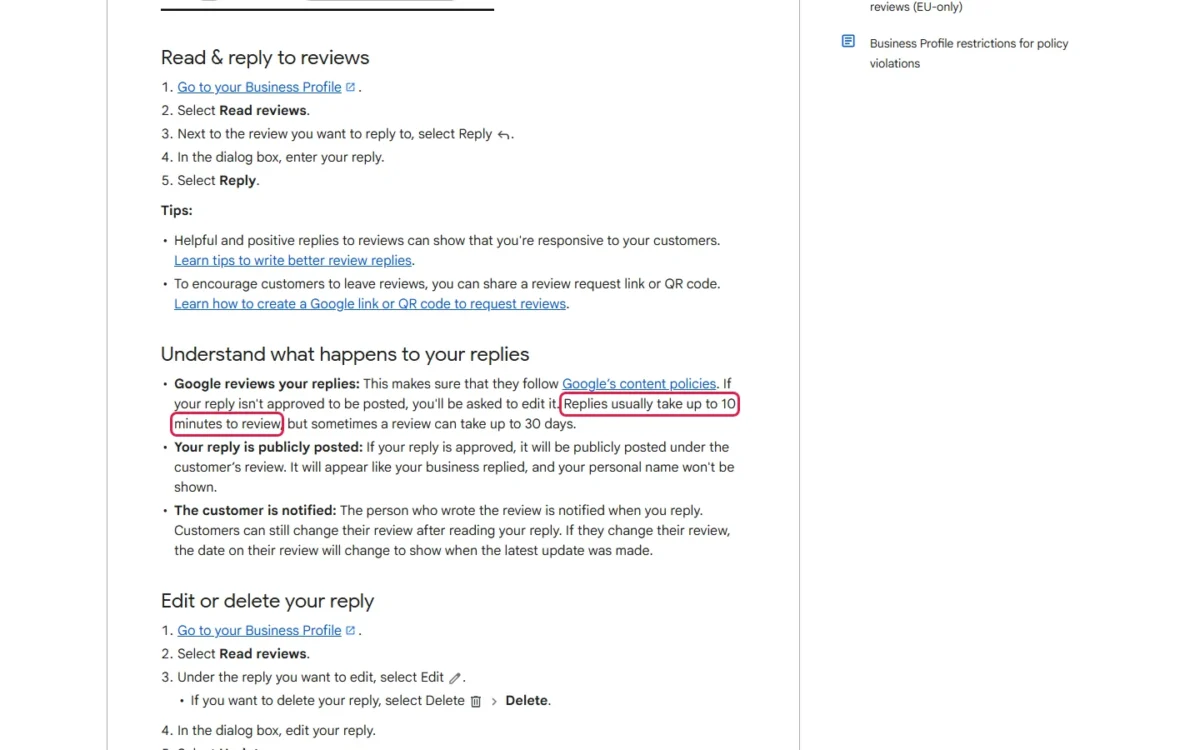
A reply that is not approved comes back to be edited, so a complaint reply in moderation is not lost; follow up with the customer without waiting for it.
Google’s reply tips ask businesses to keep replies short, avoid sending the same thank-you to everyone, leave deals out and never share a reviewer’s private information.
Trustpilot removes replies with personal information, threats or aggressive language. The FTC rule adds a legal floor: no unfounded legal threat, physical threat or intimidation to get a review removed, and no accusation the business knows to be false. For tone and structure, this guide to how to respond to negative reviews covers the reply itself; the rules above set its limits.
Policy-Based Flagging
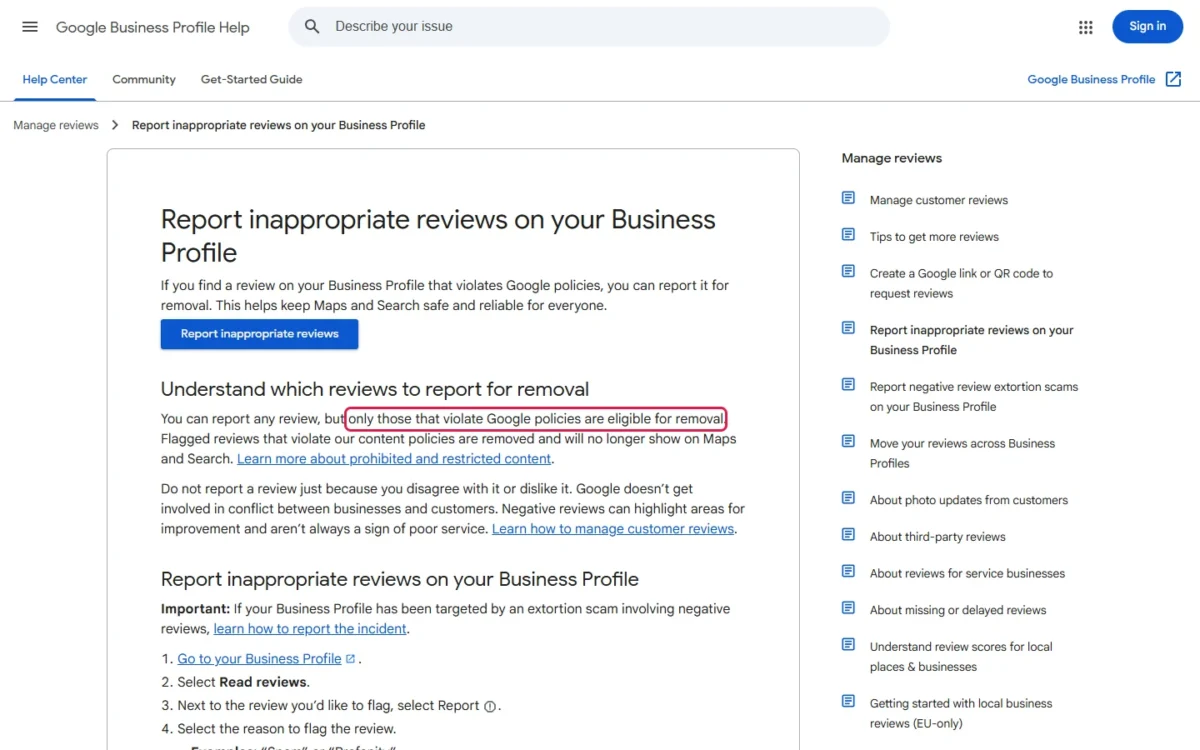
Flagging means reporting a review through the platform’s own tool, and the platform decides whether it comes down. Google’s reporting page says any review can be reported but only those that violate Google policies are eligible for removal, and asks businesses not to report a review just because they disagree with it.
Google’s Maps content policy names the kinds that break it, among them incentivized content, content based on a conflict of interest and off-topic content. Yelp’s content guidelines set their own conflict-of-interest line: no reviews of your own business or employer, your friends’ or relatives’ business, or your competitors. Trustpilot’s guidelines for businesses say not liking a star rating or disagreeing with a negative review is not a valid reason to flag.
Google’s reporting page says evaluation typically takes several days, and when a flag finds no policy violation, the page offers a one-time appeal of up to 10 reviews. On Trustpilot a business must flag 5-star reviews for the same reasons as 1-star ones.
Sentiment and Theme Monitoring
Theme tracking tags each review by topic, such as price, staff or speed, and follows sentiment per topic over time, which turns hundreds of reviews into a short list of what keeps coming up and which topic drove a falling average. A business that wants to run this in-house can start with customer feedback tools that tag themes.
AI Answer Monitoring
The newest layer runs the same prompts in ChatGPT, Gemini, Perplexity and Google’s AI features on a schedule and compares the descriptions with the review themes. For the business’s own website, Google’s AI-features page says appearances in AI Overviews and AI Mode are counted in Search Console’s Performance report, within the “Web” search type.
A business that wants this handled alongside replies and requests can ask providers of online review management services whether AI answer checks are part of their reporting.
Software, Agency or In-House: Where Do Tools Help and Where Does Human Judgment Matter?
Software wins on speed and consistency; people win on context.
| Task | Where tools help | Where human judgment matters |
|---|---|---|
| Review requests | Timed messages after every transaction, per platform | Keep Yelp out; neutral wording |
| Responses | Draft replies to routine praise | Complaints, safety issues, anything legal |
| Flagging | Surface spam signals or a likely conflict of interest | Which policy applies and whether to report |
| Theme tracking | Tag topics and chart sentiment over time | Which problem to fix first |
| AI answer checks | Run the same prompts on a schedule | Whether a description is fair |
In healthcare, finance and legal services the risk is disclosure, so a person approves every complaint reply before it posts. I would route the complaint itself to a follow-up queue rather than the reply thread; see customer service software for complaint follow-up for that side.
My take
I would automate the request flow, the tagging and the scheduled prompts, and keep a named person on complaints and flag decisions, because a wrong reply is public once approved and a flag Google rejects can be appealed once.
Who Needs an Outside Service and Who Can Skip It
A business with one location, one platform and a few reviews a month needs no service. The thresholds below are my rules of thumb, not measured data.
| Your situation | What to run | Why |
|---|---|---|
| One location, Google only, a handful of reviews a month | Google Business Profile’s reply, report and review-link tools | Google’s Business Profile help covers replying, reporting and review links, enough for that volume |
| Several platforms or locations, staff time available | Review management software | Requests, alerts and tagging need consistency; replies stay in-house |
| Complaint-heavy or regulated, little staff time | An agency with human approval of replies | Each complaint needs a specific, policy-safe reply and nobody inside has the hours |
What Review Practices Keep a Program Compliant?
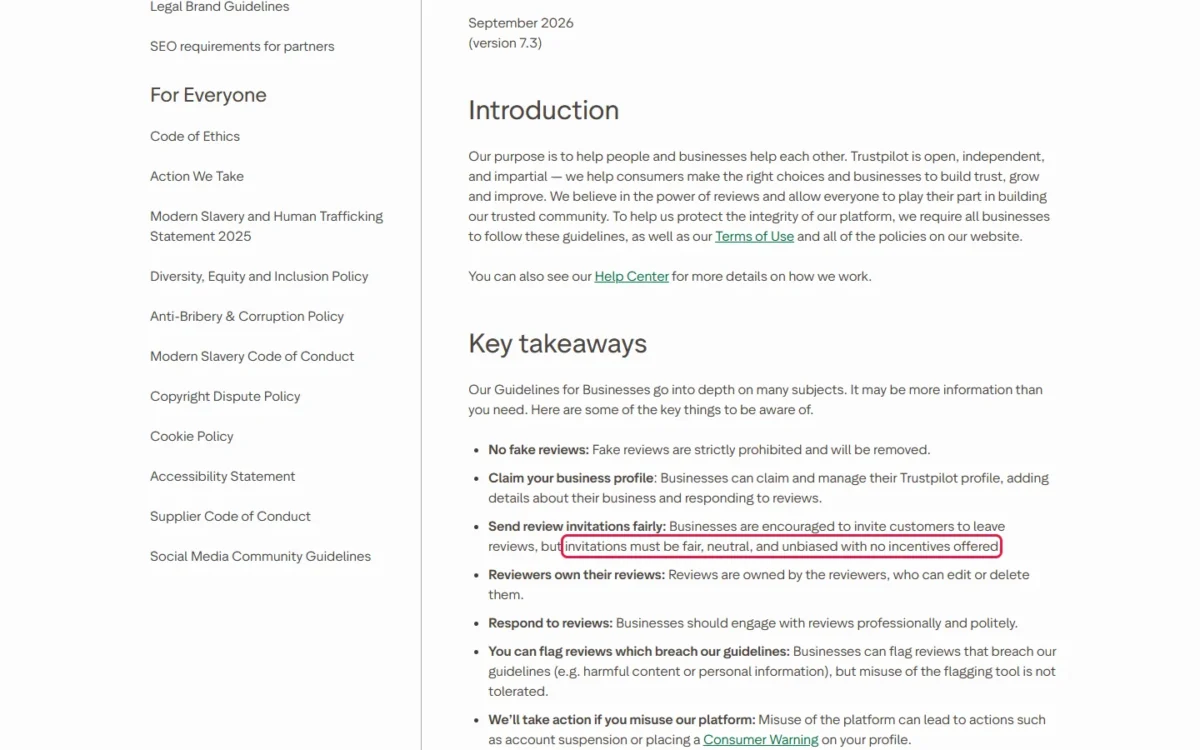
On Google a business may ask every customer for a genuine review but may not offer incentives, ask selectively, pressure anyone on the premises or request specific content. Trustpilot’s guidelines for businesses require invitations that are fair, neutral and unbiased, with no incentives, sent to everyone the same way.
The FTC rule, in force since October 21, 2024, bars fake reviews, sentiment-conditioned incentives and review suppression, with civil penalties for knowing violations.
Review gating means sending the review request only to customers expected to leave a good review, for example a link sent only to customers who gave a top survey score.
| Practice | Google (Maps policy; Business Profile Help) | Yelp (support page; guidelines; trust pages) | Trustpilot (guidelines for businesses) | FTC rule (staff Q&A) |
|---|---|---|---|---|
| Asking for reviews | Allowed for genuine experiences, with no incentive or influence on content | Not allowed: do not ask anyone | Allowed when fair, neutral and unbiased | Not restricted; a generalized solicitation to purchasers is exempt from the insider-review section |
| Asking only happy customers (review gating) | Prohibited | Asking is prohibited in any form | Prohibited, including timing only satisfied customers reach | No specific prohibition in the rule, but FTC staff say the practice could violate the FTC Act |
| Incentives | Payment, discounts, free goods or services prohibited, including for removing a review | Support page: no freebies, discounts or payment; Consumer Alerts page: offering payment to change or remove a review breaks Yelp’s guidelines | No discounts, promo codes, prize draws, refunds or freebies | Allowed unless a particular sentiment is required; undisclosed incentives may violate the FTC Act |
| Pressure on the premises or staff quotas | Both prohibited | Support page: staff should never compete to collect reviews; Consumer Alerts page: pressuring a reviewer to change or remove a review breaks Yelp’s guidelines | No reviews collected on business devices; no pressure | Not addressed on the page checked |
| Requesting specific wording | Prohibited, including content that names a staff member | Asking is prohibited in any form | No “If you like us, please leave us a 5-star review” | Sentiment-conditioned incentives prohibited, even with a disclosure |
| AI-drafted reviews | AI not named in the Maps policy; a review must reflect an actual experience and be genuine and unbiased | Guidelines: reviewers may not use AI tools or chatbots to draft or revise | AI-generated content listed as a reason to flag a review | Not addressed on the page checked |
| Limits on replies | Business Profile Help: replies moderated; no private information, no deals | General guidelines for all content: no threats or harassment, no one’s private information | Replies with personal information, threats or aggressive language removed | No unfounded legal threats, intimidation or knowingly false accusations |
| Flagging and appeal | Business Profile Help: policy violations only; one appeal, up to 10 reviews | Flagging not covered on the pages checked; no Yelp employee can override the recommendation software | Disagreement is no reason; content stays visible unless harmful or illegal | Not addressed on the page checked |
Sources: Google Maps content policy, Google Business Profile Help on replies, reporting and requests, Yelp: Don’t Ask for Reviews, Yelp guidelines, Yelp’s pages on recommendation software and Consumer Alerts, Trustpilot guidelines, FTC rule Q&A, read November 2026.
I would check two differences first. A review link that is fine on Google breaks Yelp, which says reviews consumers write when asked tend to be biased.
The second difference is incentives. An incentive the FTC rule allows, one offered to every customer with no sentiment attached, is still ruled out by Google’s Maps policy and Trustpilot’s guidelines.
This states platform rules and FTC staff guidance, not legal advice.
Worked Example: Fixing a Gated Request Flow
Take an illustrative three-location dental clinic with an invented flow: a post-visit survey, then a text with Google, Yelp and Trustpilot links and a raffle entry for patients who give a top survey score, and a target of ten new reviews a month per front desk.
| Step in the flow | Rule it breaks | Fixed step |
|---|---|---|
| Review link only to top scorers | Google’s Maps policy: selective solicitation; Trustpilot’s guidelines: pre-screening | The same text to every patient two days after the visit |
| Raffle entry for a review | Incentive bans in Google’s Maps policy and Trustpilot’s guidelines, which name prize draw entries | No prize |
| Yelp link, sent after a survey | Yelp’s content guidelines: businesses should never ask; support page: not after a survey | Google link and Trustpilot invitation only |
| Ten reviews a month per desk | Google’s Maps policy: no staff quota | A target for sending the request to every patient |
The survey stays but no longer decides who gets the review link; low scores go to the office manager as a service follow-up, in addition to the request. Sources: illustrative example; the rules are those of the matrix above.
How Should You Evaluate a Review Management Provider?
Six questions say more than a client list: five test a platform or FTC rule, and the sixth tests what the reports show. The FTC’s staff add the liability point: advertising agencies, PR firms, review brokers and reputation management companies are not immune under the rule, so a provider’s bad practice is your exposure too.
| Question to ask | A good answer | Red flag | Rule it tests |
|---|---|---|---|
| Which platforms do you reply on directly? | A named list; Google replies from a verified profile | “All of them”, with no distinction | Google Business Profile Help: only a verified business can reply |
| Who approves replies to negative reviews? | A named person reads every complaint reply first | Fully automatic complaint replies | Google’s tips for review replies; FTC rule on threats and false accusations |
| What happens when a flagged review does not qualify? | Official tools only; a written note that it stays | A promise to remove negative reviews | Google’s reporting page and Trustpilot’s guidelines: policy breaches only |
| Does the request flow go to everyone, unscreened, with no incentive, and skip Yelp? | Yes to all four, with the template to show | A “happy customers first” step or a reward | Google’s Maps policy, Yelp’s content guidelines and Trustpilot’s guidelines on asking |
| What do reports show beyond the average? | Themes with sentiment per topic and a scheduled AI answer check | A rating graph alone | None; this one tests usefulness |
| How is the fee set? | Per location or per platform, with what is included listed | A fee that rises with reviews removed | Google’s reporting page: only policy violations are removed |
My take
The removal promise settles it. A provider that says it will remove genuine negative reviews has two ways to attempt it: flagging reviews it knows comply, which Trustpilot’s guidelines call misuse, or intimidating or threatening reviewers to remove or change a review, which the FTC rule prohibits and courts can penalize for knowing violations. I would hire the one that tells you which reviews will stay.
Frequently Asked Questions
Can a review management service remove negative reviews?
Not a genuine one. A service can report a review that breaks a platform policy through the platform’s own tool, and the platform decides.
Is it allowed to offer discounts for reviews?
Not on Google, Yelp or Trustpilot. Google’s page of tips to get more reviews calls incentives for posting, changing or removing reviews fake and misleading content. The FTC rule permits an incentive only when no particular sentiment is required, and paying for 5-star reviews violates it even with a disclosure.
Can you ask Yelp customers for reviews?
No. Yelp’s content guidelines say businesses should never ask customers to write reviews; its support page adds friends, family and requests after a survey.
Can AI write your review replies?
AI can draft routine thank-you replies; a person should check every reply to a complaint. Google’s reply guidance asks businesses to personalize each reply.
Final Thoughts
Start with four moves: ask every customer the same way on the platforms that allow it, reply to each complaint with a specific answer a person has read, fix the problem reviews keep repeating, and run the same prompts through the AI tools once a month.
My take
I would pick software when the problem is consistency across profiles, hire an agency when the problem is complaint volume and nobody inside has the hours, and skip both while one Google profile collects a few reviews a month.