
Capsule CRM pricing starts with a free plan for up to 2 users; the paid plans cost $18 to $72 per user per month billed annually, or $22 to $75 billed monthly, USD, checked November 2026. Workflow automations, email sync and a second pipeline start on Growth, not Starter, so a sales team usually pays $36 per user per month billed annually: $36 x 10 x 12 = $4,320 a year for ten users. A two-person team under 250 contacts may never pay.
Quick pricing answer
- Plans: Capsule CRM sells Free ($0, max 2 users, 250 contacts), Starter $18, Growth $36, Advanced $54 and Ultimate $72 per user per month billed annually, or $22, $40, $60 and $75 billed monthly.
- Trial: 14 days on any paid plan for a new account, no card required.
- Plan for a small sales team: Growth, the first plan with workflow automations, email sync and 5 pipelines.
- Cost caveat: on annual billing, a seat you remove mid-year stays on the bill until renewal.
- Checked: November 2026, USD, the pricing page’s US & International view.
In This Article (7 sections)
Real Capsule CRM Cost for 1, 5, 10 and 20 Users
Capsule bills per user per month, paid in advance either month by month or for a year at an agreed user count, in US dollars on the pricing page’s “US & International (USD)” view, checked November 2026. Every total below is the list price x users x 12 months, before tax and before any Transpond subscription.
Capsule CRM cost calculator
This calculator needs JavaScript. The scenario table below gives the same estimate for typical workloads.
Enter what you need. The calculator prices it on every plan at list prices and names the cheapest plan that covers it.
- List prices in USD from Capsule CRM’s official pricing pages, checked Nov 12, 2026. Tax and regional prices are not included.
- 12-month figures are 12 times the monthly cost at the billing you choose.
- A planning estimate at list prices, not a quote.
Enter your user count, choose monthly or annual billing and tick what you need: more than 2 users, more than 250 contacts, more than 30,000 contacts, workflow automations, more than 5 pipelines. The calculator prices every plan side by side and names the cheapest plan that covers the need. It leaves out tax, regional prices and Transpond.
| Team size | Plan | Billing | Monthly equivalent | Annual total | Assumptions |
|---|---|---|---|---|---|
| 1 user | Starter | Annual | $18 x 1 = $18 | $18 x 1 x 12 = $216 | More than 250 contacts, so Free is out; no automations needed; excludes tax and Transpond |
| 5 users | Starter | Annual | $18 x 5 = $90 | $18 x 5 x 12 = $1,080 | A third user ends Free; contacts stay under 30,000; one pipeline is enough |
| 10 users | Growth | Annual | $36 x 10 = $360 | $36 x 10 x 12 = $4,320 | The team needs workflow automations and email sync; up to 5 pipelines |
| 20 users | Advanced | Annual | $54 x 20 = $1,080 | $54 x 20 x 12 = $12,960 | More than 5 pipelines or more than 60,000 contacts; all 20 users billed, suspended and pending ones included |
Sources: Capsule pricing page, checked Nov 2026; Capsule billing help, checked Nov 2026.
Billed users are the users on the account on billing day, active, suspended and pending, so a seat you forgot to delete is a seat you pay for.
Capsule CRM Plans and Prices Compared
Capsule lists five plans, and the four paid ones are priced per user per month on two billing bases; Ultimate’s prices come from the pricing page’s FAQ because its plan card prints none.
| Plan | Monthly billing (per user per month) | Annual billing (per user per month) | Best for | Main limitation |
|---|---|---|---|---|
| Free | $0 | $0 | A solo seller or a pair trying a CRM | Max 2 users, 250 contacts, 1 sales pipeline |
| Starter | $22 | $18 | Teams of 1-5 that manage contacts without automation | 30,000 contacts; no workflow automations; multiple pipelines start on Growth |
| Growth | $40 | $36 | Sales teams that run repeatable stages with tasks and emails | 60,000 contacts, 5 sales pipelines, 5 project boards |
| Advanced | $60 | $54 | Teams past 5 pipelines or 60,000 contacts | 120,000 contacts, 50 sales pipelines, 50 project boards |
| Ultimate | $75 | $72 | Larger businesses that want an account manager and custom training | Contact limit not listed on the pricing page |
Sources: Capsule pricing page, Pay Annually and Pay Monthly views, checked Nov 2026.
Evidence note: prices checked in November 2026 in US dollars on the pricing page’s “US & International (USD)” view, per user per month; Capsule’s customer terms state that all fees are exclusive of all taxes.
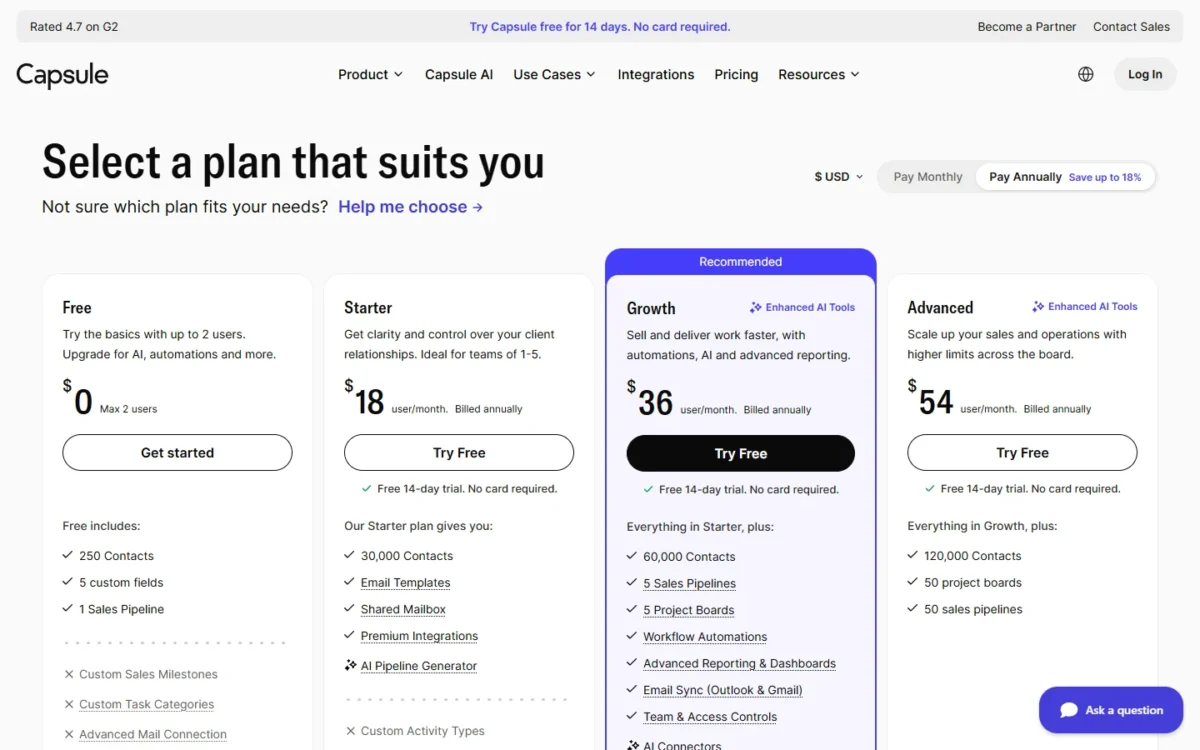
Every step up to Advanced raises the contact ceiling, from 250 on Free to 30,000, 60,000 and 120,000. Starter adds email templates, a shared mailbox, premium integrations and the AI pipeline generator; Growth adds workflow automations, email sync, team and access controls and advanced reporting; Advanced adds 50 sales pipelines and 50 project boards. The last step, to Ultimate, adds service: expert support, your own account manager and custom training.
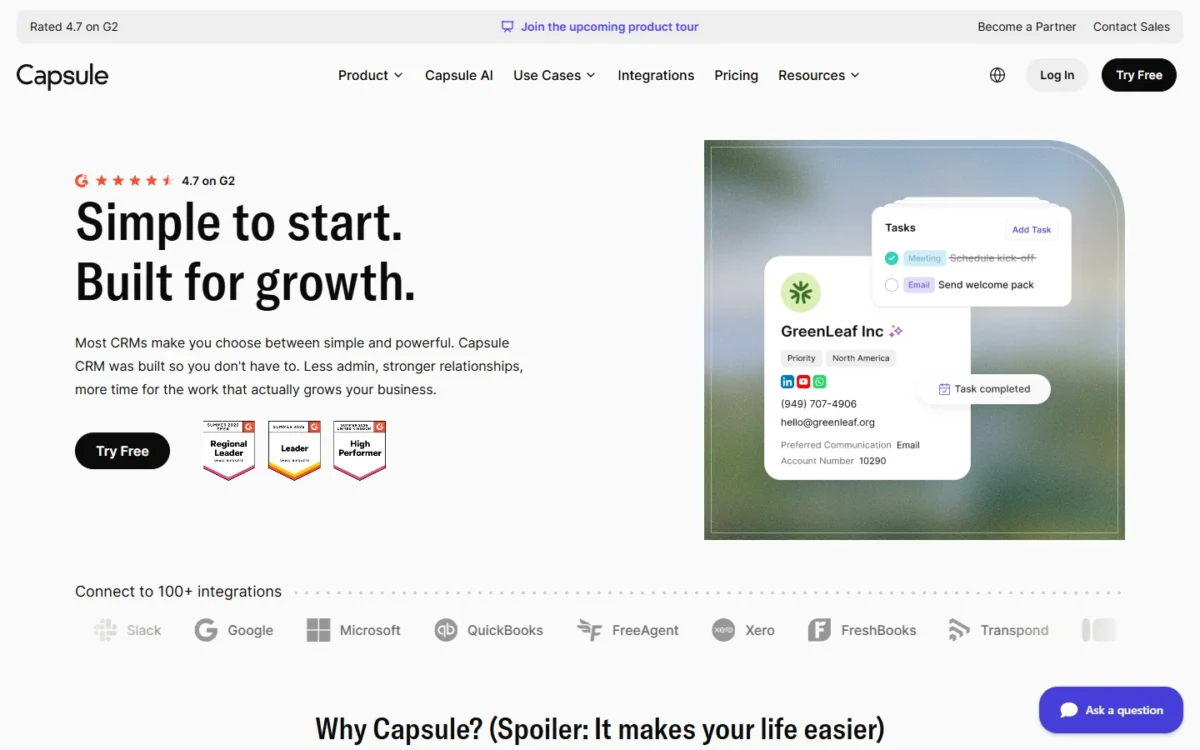
What Each Capsule CRM Plan Actually Gets You
The step that changes the bill is Starter to Growth: $18 more per user per month on annual billing ($36 against $18) buys workflow automations, email sync, team and access controls, advanced reporting and five pipelines, while Advanced and Ultimate mostly raise ceilings or add service.
Free
Free costs $0 for at most 2 users, 250 contacts, 5 custom fields and 1 sales pipeline, and Capsule’s free-plan page calls its core features “completely free, forever”. Two founders working one pipeline under 250 contacts can run on it for as long as they like.
Two terms matter. An account nobody opens for more than 3 consecutive months may be cancelled and deleted after an email notice to the Super Administrator. And an upgrade from Free gets no trial: the first month is charged as soon as the card goes in. The upgrade comes at contact 251, at the third login, or when the team wants a shared mailbox.
Starter
Starter costs $18 per user per month billed annually or $22 billed monthly, and Capsule’s own card calls it “Ideal for teams of 1-5”. The $18 buys 30,000 contacts, email templates, a shared mailbox (a sales@ or support@ inbox answered by several people), premium integrations such as Xero, Zendesk and Import2, and the AI pipeline generator.
What it does not buy is any process: workflow automations, email sync and multiple pipelines all sit on the Growth card under “Everything in Starter, plus”. So Starter fits a small team that logs deals and emails by hand; five people pay $18 x 5 x 12 = $1,080 a year for that.
Growth
Growth, at $36 per user per month billed annually or $40 billed monthly, is the plan a small sales team with repeatable stages needs. Over Starter it adds 60,000 contacts, 5 sales pipelines, 5 project boards, workflow automations (tasks, email notifications or stage changes triggered inside a pipeline or project board), advanced reporting and dashboards, and email sync for Outlook and Gmail.
It also adds team and access controls with user roles, AI connectors for ChatGPT and Claude, and AI enrichment and summaries.
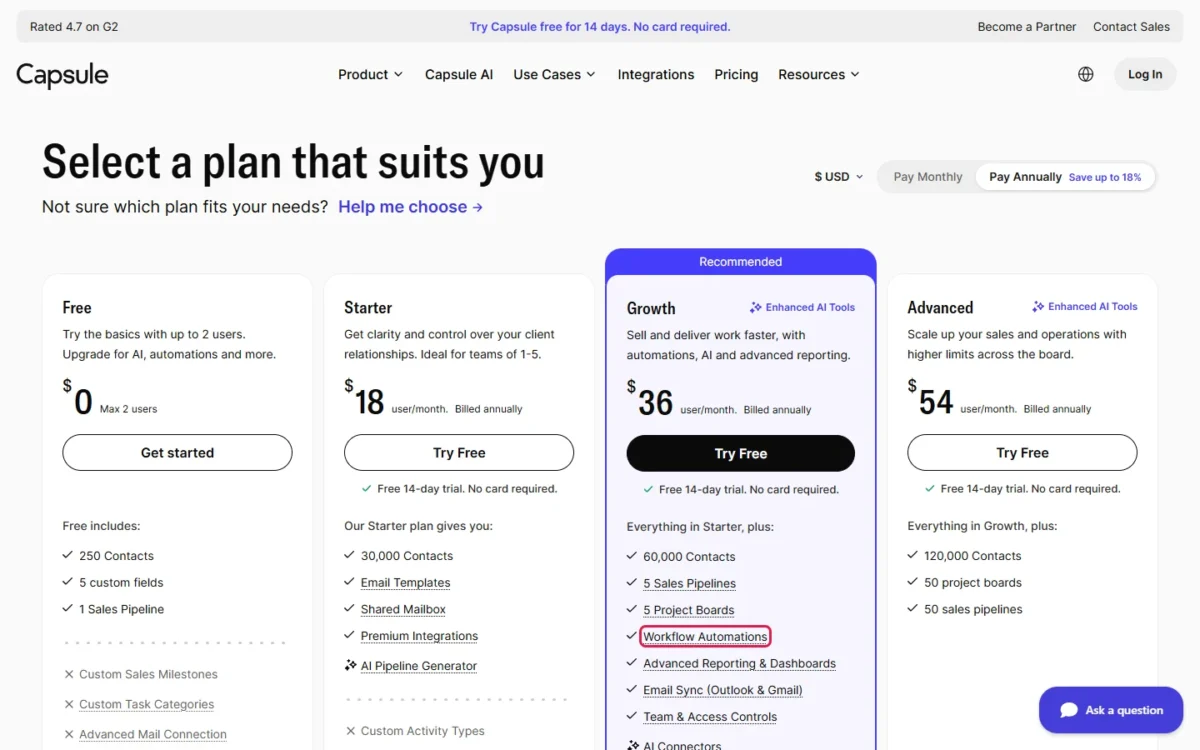
Whether Capsule’s automations and reporting do enough for the money is a judgment my Capsule CRM review makes; the price question is simpler.
My take
Ten users pay $36 x 10 x 12 = $4,320 a year on Growth against $18 x 10 x 12 = $2,160 on Starter, so the automations, email sync and permissions cost that team $2,160 a year, or $216 per user. I would pay it for any team where more than one person touches a deal: the access controls and the synced email are what keep a shared pipeline from turning into guesswork. A solo seller who follows their own stages by hand should stay on Starter and keep the $216.
The next ceiling is the sixth pipeline or project board, or contact 60,001.
Advanced
Advanced costs $54 per user per month billed annually or $60 billed monthly, and over Growth it adds only ceilings: 120,000 contacts, 50 sales pipelines and 50 project boards. Its card lists no feature category that Growth lacks, so the extra $18 per user per month on annual billing is worth paying only when the team runs more than 5 pipelines or boards, or holds more than 60,000 contacts.
A 20-user team selling six product lines pays $54 x 20 x 12 = $12,960 a year, against $36 x 20 x 12 = $8,640 on Growth, for the extra pipelines alone. If that 20-user team stays under Growth’s limits, the $12,960 – $8,640 = $4,320 difference buys headroom it does not use.
Ultimate
Ultimate costs $72 per user per month billed annually or $75 billed monthly, both from the pricing page’s FAQ. Capsule describes it as built for larger businesses, with expert support, your own account manager and custom training, and the Ultimate page sums it up as “All features included, custom training & priority support.”
No contact limit is listed on the pricing page, so Ultimate is a service tier, not a limit tier: pay for it when the account manager and the training matter, not because Advanced ran out. Annual billing saves only ($75 – $72) x 12 = $36 per user per year here, so prepaying gains little.
Capsule CRM Free Plan, Trial and Monthly vs Annual Billing
A new account on any paid plan starts with a 14-day trial that needs no card and includes every feature of the plan and any number of users; an upgrade from Free gets no trial, and payment starts as soon as the card details go in. Free itself is a separate $0 plan for 2 users, not a trial. When the trial ends you stay, switch plan or cancel; keeping the data means adding a payment card.
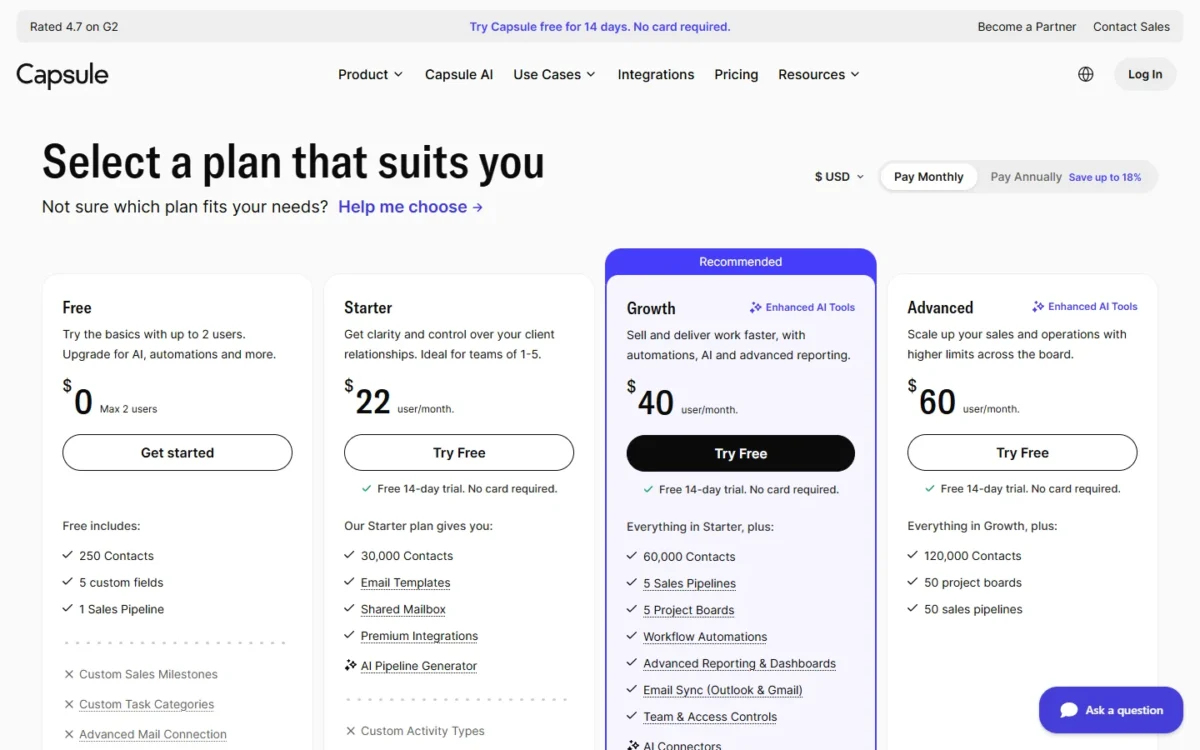
Annual billing is the lower list price on every paid plan; the page says “Save up to 18%”, and the per-plan math shows where that figure comes from.
| Plan | Monthly billing (per user per month) | Annual billing (per user per month) | Annual commitment per user | Saving per user per year | Saving as a share of the monthly price |
|---|---|---|---|---|---|
| Starter | $22 | $18 | $18 x 12 = $216 | ($22 – $18) x 12 = $48 | $4 of $22, 18% |
| Growth | $40 | $36 | $36 x 12 = $432 | ($40 – $36) x 12 = $48 | $4 of $40, 10% |
| Advanced | $60 | $54 | $54 x 12 = $648 | ($60 – $54) x 12 = $72 | $6 of $60, 10% |
| Ultimate | $75 | $72 | $72 x 12 = $864 | ($75 – $72) x 12 = $36 | $3 of $75, 4% |
Sources: Capsule pricing page, Pay Monthly and Pay Annually views, checked Nov 2026.
Paid monthly, each team from the cost table pays more a year:
- One Starter user: $22 x 1 x 12 = $264 against $216 on annual billing, a $48 gap.
- Five Starter users: $22 x 5 x 12 = $1,320 against $1,080, a $240 gap.
- Ten Growth users: $40 x 10 x 12 = $4,800 against $4,320, a $480 gap.
- Twenty Advanced users: $60 x 20 x 12 = $14,400 against $12,960, a $1,440 gap.
The gap is real money, but annual billing changes the rules, and those rules sit on Capsule’s billing help page rather than the pricing page.
An annual subscription fixes the price and the maximum number of users when you sign up and bills the agreed users x plan price x 12 months in advance. Users you add are billed pro rata to the renewal date; users you remove do not change the bill until the cycle renews.
The switch back to monthly billing is possible only in the final month of the cycle. Monthly billing recalculates on each billing date from the users on the account and adjusts by itself when you add or remove one.
So my rule: take annual billing when the headcount is stable for a year, which for most 3-10 person teams it is; take monthly on a team that is still hiring or trimming, and treat the premium ($22 – $18 = $4 per user per month on Starter) as the price of flexibility. Either way, payment is by card only (Mastercard, Visa or Amex), charged at the start of each period.
Cancellation, refunds and renewal
Plans renew automatically until cancelled, and Capsule’s customer terms give no refund or credit for partial periods, so cancelling an annual plan in month four does not return the other eight months. The pricing page’s FAQ says you can cancel at any time and that there is no setup fee and no onboarding fee.
Capsule’s billing help page allows upgrades and downgrades at any time, with billing updated at the next payment date. An upgrade makes the higher plan’s features available at once; a downgrade removes them at once and must fit the lower plan’s limits, so moving from Growth to Starter means cutting contacts to 30,000. Features lost on a downgrade, such as Teams or Custom Activity Types, are not restored automatically if you move back up.
On a failed payment, the same page says, the account is suspended 20 days from the due date, cancelled 60 days after suspension, and its data cleared 14 days after that.
Extra Capsule CRM Costs to Consider
Capsule publishes no setup fee and no onboarding fee, so the extras come from who counts as a billed user and from a product sold separately.
| Cost type | When it applies | Pricing basis | Notes |
|---|---|---|---|
| Suspended and pending users | Every billing date on a paid plan | Users (active, suspended and pending) x plan price | Delete the seat before billing day, or it is billed like an active one |
| Users added mid-cycle on annual billing | Any time during the year | Pro rata to the renewal date | Removed users stay on the bill until the cycle renews |
| Transpond, Capsule’s marketing platform | When you run email campaigns, web forms or marketing automations | A separate subscription with its own pricing page | Engagement syncs back to Capsule contacts; no CRM plan price above includes it |
| Tax | At payment | All fees are exclusive of all taxes, per Capsule’s customer terms | Taxes are payable by the customer on top of the list prices above |
Sources: Capsule billing help, Capsule pricing page and Capsule customer terms, checked Nov 2026.
Transpond is the line most teams will meet. Capsule’s email templates cover one-to-one mail, but campaigns, scheduled social posts and marketing automations live in Transpond, which Capsule calls its own marketing platform with a native connection. It is a separate subscription with its own pricing page; I give no figure for it here, so budget for it apart from the CRM seats if marketing email is part of the plan.
Which Capsule CRM Plan Should You Buy, and Is the Pricing Worth It?
For most small sales teams the plan is Growth at $36 per user per month billed annually; Free or Starter make sense only when nobody needs an automation, synced email or a second pipeline.
| Your needs | Plan to consider | Why | Main limitation |
|---|---|---|---|
| 1-2 users, under 250 contacts, one pipeline | Free | $0 with no upgrade needed while those limits hold | A third user or contact 251 forces Starter; an unused account can be deleted after 3 months |
| 1-5 users past 250 contacts, or a shared mailbox | Starter | $18 per user per month billed annually buys 30,000 contacts, templates and a shared inbox | No workflow automations; multiple pipelines start on Growth |
| A team that needs automations, email sync or permissions | Growth | The first plan with workflow automations, Outlook and Gmail sync and team and access controls, at $36 per user per month billed annually | 5 pipelines, 5 project boards, 60,000 contacts |
| More than 5 pipelines or boards, or more than 60,000 contacts | Advanced | 50 pipelines, 50 boards and 120,000 contacts at $54 per user per month billed annually | No new feature category over Growth |
| Wants an account manager and custom training | Ultimate | Expert support, your own account manager and custom training at $72 per user per month billed annually | Contact limit not listed; annual saves only 4% |
| Headcount likely to drop within the year | The needed plan, billed monthly | Monthly billing recalculates on each billing date; annual keeps removed seats billed until renewal | The higher monthly list price ($22 against $18 on Starter) |
Sources: Capsule pricing page and Capsule billing help, checked Nov 2026.
Is it worth it? At $36 per user per month billed annually, Growth gives a five-person team automations, synced email and permissions for $36 x 5 x 12 = $2,160 a year, with no onboarding fee and no seat minimum published, so the first-year cost is easy to predict. How that sits against the rest of the market is the job of my guide to what CRMs cost per user.
It stops being worth it in two cases. A one- or two-person team under 250 contacts that needs one pipeline should stay on Free and spend nothing. And a team that outgrows Growth’s five pipelines without needing more contacts pays $18 per user per month more, on annual billing, for Advanced’s ceilings alone; that is the point to look at Zoho CRM pricing before paying.
Skip it if: marketing campaigns have to live inside the CRM subscription, because here they live in Transpond, a separate bill; a wider shortlist for that case is my ranking of the best CRM software for small teams.
My recommendation: a 3-20 person sales team starts on Growth, billed annually once the headcount is settled, and moves to Advanced only when a sixth pipeline or contact 60,001 forces it. A solo seller starts on Free, moves to Starter at contact 251, and skips Growth until a second person works the same deals.
How I Verified Capsule CRM Pricing
Every price comes from Capsule’s pricing page, read in November 2026 for the US region in US dollars, in both billing views (“Pay Annually” and “Pay Monthly”) on its “US & International (USD)” setting, with Ultimate’s prices from the page’s FAQ. The billing rules come from Capsule’s billing help page and its customer terms, read the same month.
Totals are my own arithmetic, list price x users x 12 months, before tax and Transpond: estimates from list prices, not quotes. Capsule does not publish an Ultimate contact limit or a seat minimum on the pricing page, and its terms state that fees exclude taxes.
FAQ
How much does Capsule CRM cost?
Capsule CRM costs $18 (Starter), $36 (Growth), $54 (Advanced) or $72 (Ultimate) per user per month billed annually, or $22, $40, $60 and $75 billed monthly, in US dollars as of November 2026, with a Free plan for 2 users. The invoice is the plan price times every user on the account, suspended and pending ones included.
Is Capsule CRM free?
Yes, for up to 2 users and 250 contacts with one sales pipeline and 5 custom fields, and Capsule’s free-plan page says its core features come with no time limit. It needs no payment card. The catch is inactivity: a free account nobody opens for more than 3 consecutive months can be cancelled and deleted after an email warning.
Is annual billing cheaper?
Yes: on the pricing page annual billing saves $22 – $18 = $4 per user per month on Starter, $40 – $36 = $4 on Growth, $60 – $54 = $6 on Advanced and $75 – $72 = $3 on Ultimate. Starter’s $4 of $22, 18%, is the largest share of the four and matches the page’s “Save up to 18%”. The trade is that the year is paid in advance, and a user you remove mid-year stays on the bill until renewal.
What support does each plan include?
The pricing page lists a support level only for Ultimate: expert support, your own account manager and custom training, which the Ultimate page calls priority support. The Free, Starter, Growth and Advanced cards list no support tier, so budget for Ultimate only if a named account manager is worth $72 per user per month instead of Advanced’s $54, both billed annually.