
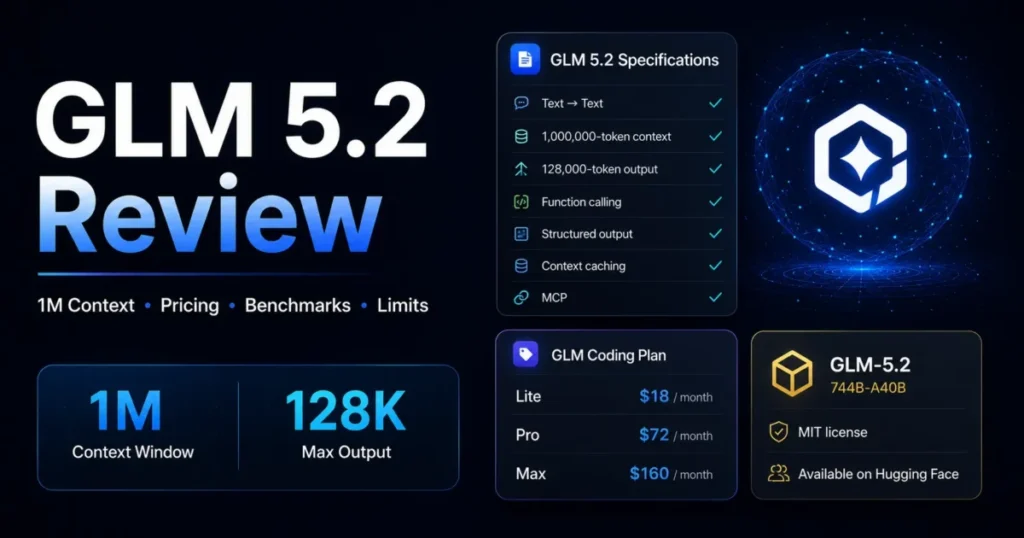
Before you route a single production coding task to GLM-5.2, separate what Z.ai has shipped and documented from what your own testing still has to confirm. The shipped list is real and now concrete: a documented 1,000,000-token context, 128,000-token output, MIT-licensed model weights, published pay-as-you-go API pricing, a paid Coding Plan, and endpoints that mimic the two clients most teams already use.
What is still unproven is reliability, not availability, and that gap is where a US buyer gets hurt.
My verdict as a buying analyst is narrow on purpose. GLM-5.2 is a strong pilot candidate for text-based coding work, not a proven drop-in replacement for a premium model, and the gap between those two statements is exactly what this GLM 5.2 review is about.
Treat it as a model to trial on your own repositories with a fallback in place, not a switch you flip because a leaderboard looked good.
This review is written for developers, engineering leads, and AI-platform buyers in the US who have to defend the decision to finance. It maps the model against three separate purchases most competing reviews blur together: the subscription, the metered API, and self-hosting.
In This Article (20 sections)
GLM-5.2 Quick Verdict
| Quick Verdict | GLM-5.2 |
|---|---|
| Best for | Teams piloting text-based coding agents that want a very large context window and a lower-cost or open-weight option |
| Not ideal for | Image-dependent workflows, latency-bound pair programming, or teams needing a fixed concurrency and a compliance SLA |
| Starting price | GLM Coding Plan Lite at $18 per month list; MIT model weights carry no license fee |
| Practical plan | Pro at $72 per month for frequent individual or small-team agent use |
| Free option | Open model weights under MIT; a five-day ZCode new-user trial is time-limited |
| Setup difficulty | Low for a supported coding tool; moderate for API migration; high for self-hosting a 744B-A40B model |
| Main strength | Documented 1M-token context and 128K output with agent-ready endpoints |
| Main limitation | Text-only modality, time-windowed quotas, and unverified latency and concurrency under real load |
| Best alternative | Anthropic Claude Opus or Sonnet for latency-sensitive, compliance-bound production work |
Source: Z.ai GLM-5.2 model documentation and the Coding Plan pricing page, checked July 22, 2026.
The rest of this GLM 5.2 review quantifies the plan quotas competitors skip, reconciles two official pages that disagree on the annual price, and translates independent test evidence into a task-routing rule. Where the evidence stops, I say so rather than fill the gap.
GLM-5.2 Pros and Cons
The pros are documented capabilities. The cons are the operating constraints and the unresolved questions a pilot has to answer.
| Pros | Cons |
|---|---|
| Documented 1,000,000-token context and 128,000-token output on every access path | Documented as a text-only model, so no image or screenshot understanding from this exact model |
| MIT-licensed open weights allow private self-hosting and control | Self-hosting a 744B-A40B model needs real infrastructure, not just the free license |
| Anthropic Messages-compatible and OpenAI-compatible endpoints reduce client rework | Coding Plan quota is time-windowed, model consumption is multiplied by time of day, and MCP calls are capped monthly |
| Coding Plan starts at $18 per month, well under premium coding subscriptions | Official annual Coding Plan pages still disagree on the renewal total, so verify the annual price at checkout |
| Vendor benchmarks report clear gains over GLM-5.1 on coding tasks | Independent reporting found it slower than premium models, and one code-review test found weak cross-repository consistency |
Source: Z.ai official documentation, the Coding Plan overview, and reporting from Reuters, Business Insider, and Kilo.
Neither column tells the whole story on its own. The value of GLM-5.2 depends on which of the three purchase routes you pick and whether your workload survives a pilot, which the sections below work through in order.
What Is GLM-5.2?
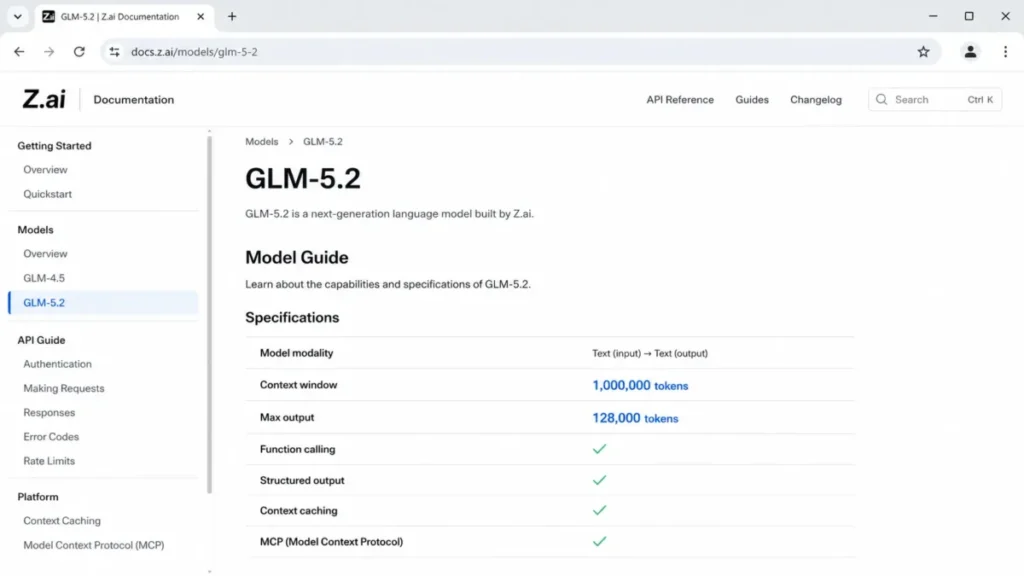
GLM-5.2 is Z.ai’s flagship text large language model, positioned for long-horizon coding, repository-scale reasoning, tool use, and agent workflows. The official model guide documents it as text input and text output, with a 1,000,000-token context window and up to 128,000 output tokens, according to Z.ai’s GLM-5.2 model documentation.
The developer is Zhipu AI, and the international product and documentation surfaces use the Z.ai brand, as Reuters reported in July 2026. If you have read broader coverage of the company’s generative AI models, note that this specific model is text-only; the vision-capable members of the family are separate models.
That text-only boundary is the first buyer-selection fact, and it is easy to miss. A workflow that inspects screenshots, UI mockups, or diagrams needs a different model, because GLM-5.2 has no verified image input.
The reason this GLM 5.2 review leads with capability boundaries rather than a benchmark table is simple. A model that reads an entire repository and one that reliably reasons across it are not the same claim, and the marketing collapses them.
How I Reviewed GLM-5.2
This GLM 5.2 review is based on Z.ai’s official model documentation, the migration guide, the Coding Plan overview and FAQ, the public subscription page, the GLM-5 repository, the Hugging Face model card, the published privacy and service terms, and labeled independent reporting from Reuters, Business Insider, and Kilo. Prices, quotas, and plan limits were checked on July 22, 2026.
Each capability was assessed against the same buyer criteria: workflow fit, context and output limits, tool and agent support, plan gates, real operating cost, deployment portability, and documented limitations. Pricing and quota mechanics carried more weight than headline benchmark scores, because those figures decide the budget and the practical throughput.
Vendor benchmark and architecture numbers are attributed to Z.ai and are not presented as reproduced results. Independent observations stay attributed to their publishers, and public GitHub issue reports are treated as individual signals, not prevalence estimates.
Claims that could not be verified from reliable evidence were excluded from the recommendations rather than smoothed over. Temporary promotions are labeled separately from standard pricing and must be re-verified on the day you buy.
What Is Shipped, and What Is Still Unproven
Most GLM-5.2 coverage treats the specification sheet and the performance claim as one thing. Splitting them is the single most useful move for a buyer, so here is the divide as of the checked date.
| Status | Item |
|---|---|
| Shipped and documented | 1M-token context, 128K output, text modality, function calling, structured output, context caching, MCP support |
| Shipped and documented | MIT-licensed weights, a 744B-A40B model, BF16 and FP8 variants, and supported self-host frameworks |
| Shipped and documented | GLM Coding Plan (Lite, Pro, Max) with published quotas, published pay-as-you-go API pricing, plus Anthropic- and OpenAI-compatible endpoints |
| Vendor-reported, not reproduced | Terminal-Bench 2.1 and SWE-bench Pro gains over GLM-5.1, and the IndexShare and MTP efficiency claims |
| Independently observed, bounded | Slower responses and capacity friction (Business Insider); variable code-review consistency (Kilo) |
| Unresolved in the evidence checked | Fixed concurrency limits, long-context retrieval quality under load, and a complete compliance and SLA package |
Source: Z.ai model documentation, the GLM-5 repository, and the Hugging Face model card page.
The shipped column is what you can rely on. The unresolved column is what a pilot exists to close, and no leaderboard score substitutes for it.
GLM-5.2 Key Features and Their Limits
Features only matter next to their gates and failure modes. Here are the ones that change a coding decision, each with the workload it serves and the constraint attached.
1,000,000-token context
The context window is the headline, and it is genuinely large. The official documentation records a 1,000,000-token maximum on every access path, which lets a team send repository-scale prompts without heavy manual chunking.
Capacity is not comprehension. A window that holds a million tokens does not prove the model retrieves every cross-file rule inside it, and I would validate retrieval on your own code before trusting whole-repository reasoning.
128,000-token output
The documented 128,000-token output ceiling supports long plans, generated modules, and detailed refactors in one response. That reduces the stitching a team does across multiple calls.
Long output has a cost. Larger generations raise latency and consume quota faster, so a 128K response is a budgeting event, not a free feature.
Reasoning effort control
GLM-5.2 exposes reasoning controls, and the migration guide documents reasoning_effort values of high and max, with max as the stated default in the captured guidance, according to Z.ai’s migration documentation. Higher effort suits multi-step agent tasks where a shallow answer fails, and clear prompt engineering matters as much as the effort setting.
The default choice matters for cost. Inheriting max reasoning without a decision can raise latency and token spend on tasks that never needed it.
Tool call streaming
For streamed tool-call workflows, the documented path requires both stream and tool_stream set to true. That combination drives agent orchestration where tool arguments assemble as they stream.
Incomplete configuration is a real trap. A client that sets one flag and not the other can break or degrade streamed tool handling, which is a parser problem, not a model problem.
MCP and structured output
The model documents function calling, structured JSON output, context caching, and Model Context Protocol support, per the official model guide. Teams building agent-style coding workflows get the primitives they expect from a premium client.
MCP access is not unlimited on the subscription. It carries a monthly cap that varies by plan, covered in the pricing section, and that cap can become a separate bottleneck from model prompts.
Open model weights
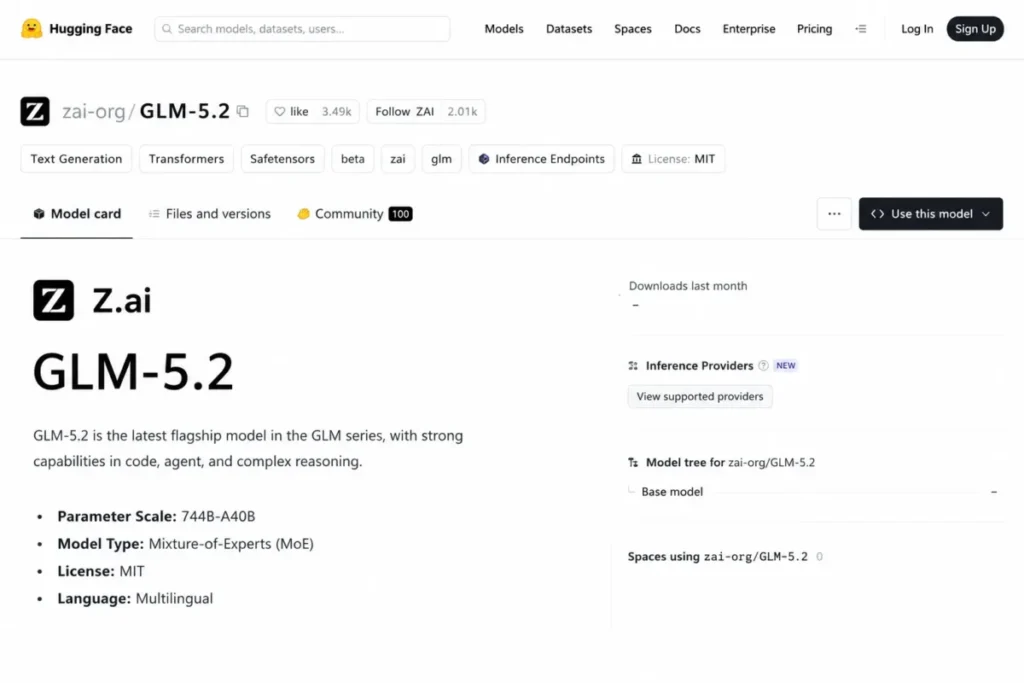
The weights are published under MIT, which allows commercial use and private deployment, according to the Hugging Face model card. This is the feature that separates GLM-5.2 from closed premium models for a governance-sensitive buyer.
The license is free; the operation is not. Serving a 744B-A40B model is an infrastructure project, and the section on self-hosting treats it as one.
The 1M Context: What It Proves and What It Does Not
The million-token window is the most over-read spec in every GLM 5.2 review on the results page. A large window is a capacity limit, not a guarantee that the model uses everything inside it well.
The documentation supports the maximum, and nothing more. There is no first-party evidence in the material checked that task-level retrieval stays reliable across the full window, so I treat the number as an input ceiling rather than a comprehension promise.
Independent testing gives a reason for caution. Kilo’s code-review evaluation found stronger results on local, self-contained defects than on repository-wide rules and cross-route consistency, with catch rates that varied by run, as described in Kilo’s published test.
The buyer consequence is specific. For a large pull request that depends on cross-file constraints, I would not trust a single GLM-5.2 pass, and I would route high-stakes reviews through a second model or a human.
A verification checklist beats a leaderboard here.
Benchmarks: Useful, Not a Verdict
Z.ai publishes benchmark gains, and they are worth reading as vendor-reported figures rather than settled performance. The repository table reports a Terminal-Bench 2.1 score of 81.0 for GLM-5.2 against 62.0 for GLM-5.1, and a SWE-bench Pro score of 62.1 against 58.4, per the official GLM-5 repository.
The architecture claims sit in the same bucket. Z.ai reports that its IndexShare mechanism reduces per-token compute by 2.9x at a 1M-token context and that its multi-token prediction raises average acceptance length by up to 20 percent.
Those are vendor claims, not results reproduced for this review.
| Evidence type | What it can prove | Example |
|---|---|---|
| Vendor-reported | The developer’s own measured scores and architecture gains | Terminal-Bench 2.1 81.0 vs 62.0; SWE-bench Pro 62.1 vs 58.4 |
| Independent observation | A named publisher’s bounded test result | Business Insider found it capable but slower than premium models |
| User report | An individual, unquantified signal | GitHub issues on rate limiting, tool-result rendering, and slow agents |
Source: GLM-5 repository benchmark documentation and the named independent publishers.
The independent layer matters because it uses different tasks than the vendor. Business Insider’s July 2026 test described GLM-5.2 as capable but noticeably slower than premium alternatives and affected by capacity problems during use, per Business Insider’s report.
That is a chat-task observation rather than a coding-agent result, and I would not stretch it past its scope.
The Pricing Math Competing Reviews Skip
Headline price is the easiest number to quote and the least useful on its own. The GLM Coding Plan gives GLM-5.2, GLM-5-Turbo, and GLM-4.7 access on all three tiers, according to the Coding Plan overview, so tier choice is about capacity and priority, not basic model access.
Here is the plan matrix with the operating quotas most reviews omit, priced from the public subscription page and the Coding Plan documentation, checked July 22, 2026.
| Plan | Monthly list | Annual-view monthly | 5-hour prompt estimate | Weekly prompt estimate | MCP monthly cap |
|---|---|---|---|---|---|
| Lite | $18 | $12.60 | ~80 | ~400 | 100 |
| Pro | $72 | $50.40 | ~400 | ~2,000 | 1,000 |
| Max | $160 | $112 | ~1,600 | ~8,000 | 4,000 |
Source: Z.ai subscription page and Coding Plan documentation, checked July 22, 2026.
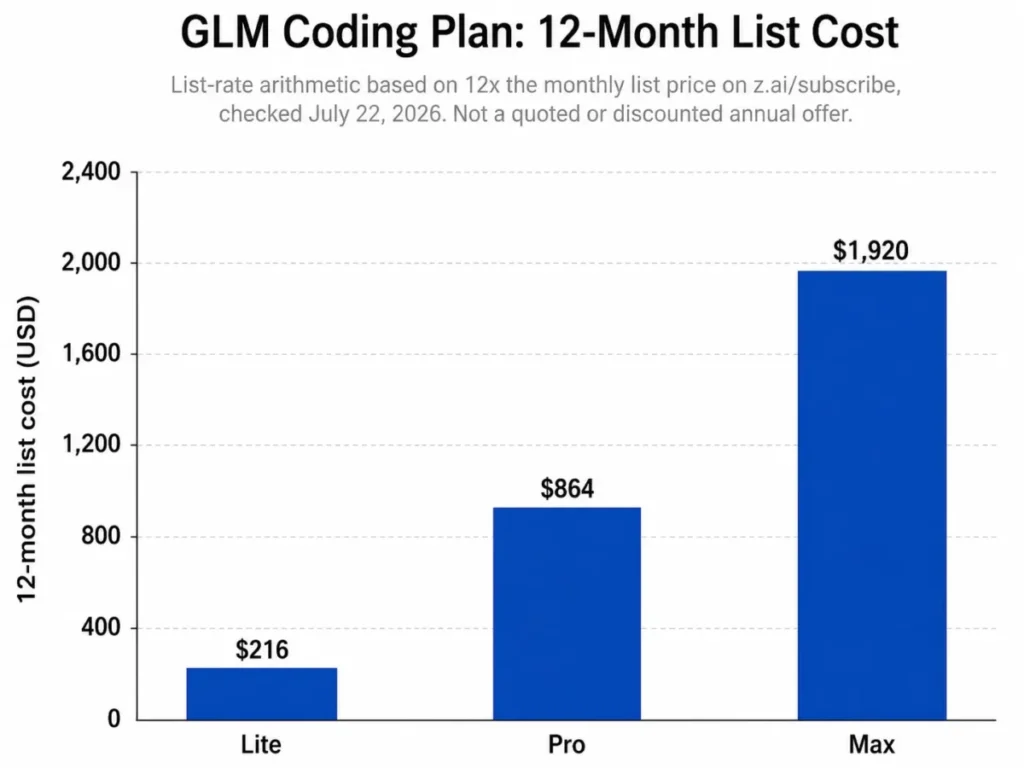
The 12-month list cost is $216 for Lite, $864 for Pro, and $1,920 for Max, which is simple arithmetic from the monthly price rather than a quoted annual offer, and it sits apart from the conflicting annual numbers below. Z.ai positions Pro as roughly five times Lite usage with faster generation and curated MCP, and Max as roughly twenty times Lite usage with peak resources and first access to new features.
Read the prompt estimates carefully. Z.ai states they assume roughly 15 to 20 model calls per prompt, so they are planning estimates, not guaranteed request counts, and an agent-heavy task consumes the allowance faster.
The 3x peak multiplier nobody advertises
The prompt allowance is not spent at a flat rate. The documentation states that GLM-5.2 and GLM-5-Turbo consume 3x quota during the peak window and 2x off peak under the normal policy, with a temporary 1x off-peak concession through the end of September, per the Coding Plan overview.
The peak window is 14:00 to 18:00 UTC+8. For a US team, that window falls in the small hours of the morning: roughly 06:00 to 10:00 UTC, which is early-morning US Eastern time and overnight US Pacific time on the dates checked.
The practical read favors US buyers, for now. Most US working hours land off peak, so a US team mostly avoids the 3x rate, but the off-peak concession is temporary and I would not budget as if the 1x rate is permanent.
What happens when the quota runs out
The FAQ answers the question most pricing tables ignore. When plan quota is exhausted, the documented behavior is to wait for the next five-hour window, and subscription usage does not automatically deduct from your separate account balance, per the Coding Plan FAQ.
That is a continuity fact, not a billing surprise. There is no silent overage, but there is a hard stop, so a team running continuous agents needs to plan around the window rather than assume it can buy through the ceiling.
The annual price the two official pages disagree on
This is where a buyer needs a warning, not a single number. The current subscription page and the official transition notice display materially different annual Coding Plan totals, so the renewal price is genuinely conflicting rather than settled.
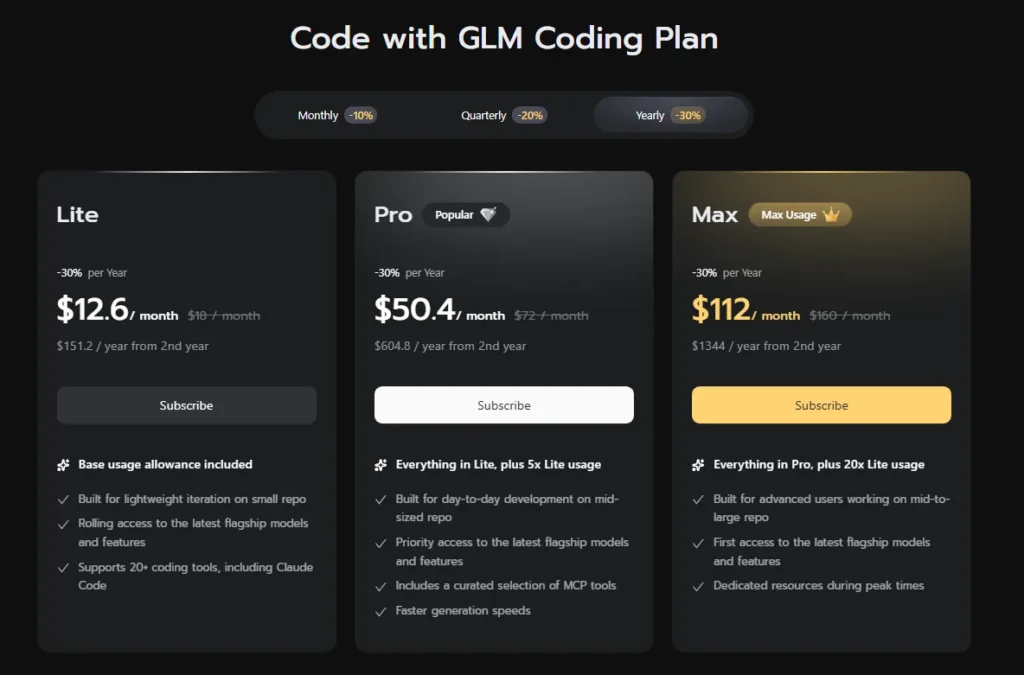
The current subscribe page shows annual-view monthly figures of $12.60 for Lite, $50.40 for Pro, and $112 for Max, with second-year annual totals of $151.20, $604.80, and $1,344.
The legacy transition notice lists higher totals, and I would not treat either figure as a guaranteed renewal price. Verify the amount at checkout and read the renewal terms before you commit.
Feature Gates: What You Get on Each Plan
The plan gates are about capacity and priority, not locked features, because all three tiers list GLM-5.2. The table below reads across the practical gates a buyer feels.
| Capability | Lite | Pro | Max |
|---|---|---|---|
| GLM-5.2, GLM-5-Turbo, GLM-4.7 access | Yes | Yes | Yes |
| 5-hour prompt estimate | ~80 | ~400 | ~1,600 |
| Weekly prompt estimate | ~400 | ~2,000 | ~8,000 |
| MCP monthly cap | 100 | 1,000 | 4,000 |
| Generation priority | Standard | Faster | Peak resources |
| Early access to new features | No | No | Yes |
Source: Z.ai Coding Plan documentation and the subscription page, checked July 22, 2026.
The upgrade trigger is a measured bottleneck, not a feeling. I would move from Lite to Pro only when a pilot shows the five-hour allowance, the MCP cap, or generation priority is the limiting factor, and I would reserve Max for sustained agent workloads where Pro’s ceiling or priority genuinely fails.
Do not buy Max for model access alone. Every paid tier lists GLM-5.2, so the jump to $160 per month must be justified by avoided delay or by separate API spend it replaces.
Ways to Access GLM-5.2
The most common pricing error in this category is treating one purchase as three. GLM-5.2 has three separate access routes with different scopes, and picking the wrong one invalidates the cost and integration assumptions.
| Route | What you are buying | Billing evidence | Best for |
|---|---|---|---|
| GLM Coding Plan | Model access inside supported coding tools | Public plan prices; time-windowed quotas | Individual developers and small teams on supported clients |
| First-party general API | Metered application access outside the plan | Published USD list price: $1.40 input and $4.40 output per 1M tokens, checked July 23, 2026 | Application workloads and custom integrations |
| Self-hosting | Running the MIT-licensed weights on your own infrastructure | No license fee; you own hardware and operations cost | Governance-sensitive teams with serving expertise |
Source: Z.ai subscription terms, quick-start documentation, the model API page, and the official pricing page, checked July 23, 2026.
The Coding Plan is scope-limited on purpose. Official subscription terms restrict its use to supported coding tools and do not make it a general-purpose API or a resale allowance, per the subscription terms.
A team that assumes the subscription covers arbitrary application traffic has bought the wrong route.
The API route now has a public first-party price. Z.ai lists pay-as-you-go GLM-5.2 pricing in USD at $1.40 per 1M input tokens, $4.40 per 1M output tokens, and $0.26 per 1M cached input tokens, with cached-input storage free for a limited time, per the Z.ai pricing page, checked July 23, 2026.
Cached input reads cost roughly a fifth of standard input, so a context-reuse pattern lowers the effective rate, but the free cached-input storage is a limited-time promotion, not the standard rate, and should not be built into a permanent budget. Treat it as provisional and re-verified on the publish date: 2026-07-23, because a limited-time offer can end without notice.
Third-party router prices exist, but they are provider-specific and must never be quoted as official first-party pricing.
Ease of Use, Setup, and Migration
Setup difficulty depends entirely on the route. A supported coding tool is quick, an API migration is a regression exercise, and self-hosting is a project.
For a supported client such as a Cline-style tool or a Claude Code-compatible tool, the quick-start documents Anthropic Messages-compatible and OpenAI Chat Completions-compatible endpoints, per the Coding Plan quick start. Teams new to how an API endpoint works get a familiar request shape here.
A team configures the endpoint, credential, and model name, then works inside the tool.
Migration from an older GLM model is more than a name swap, and this is where reviews go thin. The official migration guide documents a set of changes a team must regression-test, not just a new model code.
The migration checklist that matters:
- Set the model code to
glm-5.2, per the migration guide. - Choose
reasoning_effortdeliberately between high and max rather than inheriting the max default by accident. - Enable both
streamandtool_streamfor streamed tool calls, and confirm the parser handles streamed tool arguments. - Start from the documented sampling defaults of temperature 1.0 and top_p 0.95, and avoid changing both at once without evidence.
- Run regression tests for latency, cost, parameter completeness, tool-call correctness, and long-output handling before cutover.
Keep the previous model as a fallback during the canary. A model-name-only swap risks silent orchestration or quality regressions, and the safe path is to route a slice of traffic first and keep a rollback ready.
Tool Use, MCP, and Agent Workflows
The agent primitives are documented and match what a premium client offers. Function calling, structured output, context caching, and MCP are all listed for GLM-5.2, which supports the tool-heavy loops teams build for coding agents.
A low-risk adoption path exists in the documentation. The common-workflow guide describes a Plan Mode, a read-only planning path before the model is allowed to change code, per the common workflow documentation.
I would start every evaluation there. Load the repository context, ask for architecture and dependency analysis with explicit file references, review the plan against a second opinion for high-risk changes, and permit mutations only after the plan passes your own acceptance criteria.
The MCP cap is the constraint to watch in agent loops. With 100 combined monthly MCP uses on Lite, 1,000 on Pro, and 4,000 on Max, a tool-rich workflow can exhaust MCP calls before it exhausts model prompts, and that ceiling is a real planning input.
Security, Support, and Admin Controls
Enterprise fit is a routing decision, not a yes or no. The right question is which code and data a US company sends to the hosted service, and which it keeps in-house.
The published terms give a starting point, not a full compliance package. Z.ai’s privacy policy states that personal data is retained as needed for stated purposes and legal obligations, per the privacy policy, and its terms state that API end-user content is used for service provision, legal, policy, and abuse purposes and is not used to improve models unless explicitly agreed, per the terms of use.
Independent reporting frames the enterprise picture honestly. Reuters described strong developer interest and cost-performance appeal alongside enterprise adoption concerns around data security and likely selective model routing, in its July 2026 report.
Here is the data-routing rule I would apply:
| Data class | Route I would choose |
|---|---|
| Public or open-source code | Hosted Coding Plan or API is reasonable |
| Ordinary private repositories | Hosted service only after a security review passes |
| Regulated data, secrets, or customer data | Self-hosting or an approved provider, not the hosted service by default |
Source: Z.ai privacy policy and terms of use, and Reuters reporting on enterprise adoption.
Support and concurrency are the two admin gaps to close before a rollout. Z.ai publishes a feedback email, a sales path, and community channels, per the contact page, but no numeric response-time SLA was verified.
The usage policy states that concurrency is dynamically adjusted and gives Max higher priority than Pro and Lite, per the usage policy, without a fixed public number, so team-scale concurrency belongs in the pilot.
GLM-5.2 Limitations
These are the standalone constraints, separate from the pros-and-cons summary, that a buyer must weigh before routing production work.
The model is text-only. The official documentation records text input and output, so any workflow that depends on image, screenshot, or diagram understanding needs a different model.
Latency and capacity are not proven for interactive use. Business Insider found it slower than premium alternatives and hit capacity problems, and public GitHub issues report rate limiting, a context-correlated tool-result rendering problem, and slow agent behavior.
Those issue reports are individual signals, not prevalence measurements, but they are the failure modes a pilot should reproduce.
Code-review reliability varies by task. Kilo’s evidence shows local bug detection is stronger than cross-repository rule enforcement, so a single review pass is not safe for architecture-wide or security-sensitive changes.
One pricing question is now settled and one remains. Z.ai publishes first-party pay-as-you-go API pricing in USD, but the annual Coding Plan totals still conflict across official pages, so verify the renewal amount at checkout.
Self-hosting is open-weight, not low-effort. The model is 744B-A40B, and the MIT license removes the fee, not the hardware, serving, observability, and staffing cost.
Who Should Use GLM-5.2
Teams piloting text-based coding agents. A group that can route repository analysis, planning, and text coding through a supported tool or a compatible endpoint gets a very large context window and agent-ready primitives at a lower entry price than premium subscriptions.
Governance-sensitive organizations with serving expertise. A team that can operate a 744B-A40B model in its own environment can keep inference private under the MIT license, which is a real advantage for data control.
Cost-conscious individual developers and small teams. Lite at $18 per month or Pro at $72 per month gives supported-tool access with documented quotas, which is a legible starting point for intermittent to frequent solo work.
Who Should Avoid GLM-5.2
Image-dependent workflows. A team that needs the model to read screenshots, UI mockups, or diagrams should choose a verified vision-capable model, because this exact model is text-only.
Latency-bound or SLA-bound production teams. A group running interactive pair programming or parallel agents that needs guaranteed responsiveness, fixed concurrency, or a numeric support SLA does not yet have enough public evidence for an unconditional hosted-service commitment.
Small teams without ML-serving capability. A startup reading the MIT license as proof that self-hosting is cheap will find the 744B-A40B scale and serving stack exceed the value of local control. A hosted route or a smaller model is the better call.
Regulated buyers needing a certified compliance package. The public evidence checked did not establish a complete certification set, a numeric SLA, or workload-specific regulatory eligibility, so a compliance-bound team must verify those directly before dependency.
GLM-5.2 Alternatives
GLM-5.2 competes on price and openness, not on proven production certainty, so the right alternative depends on the constraint it fails for you.
| Alternative | Choose it if | Pricing note |
|---|---|---|
| Anthropic Claude Opus or Sonnet | You need latency-tested, compliance-ready coding with mature agent tooling | Premium-tier subscription and API; see the internal pricing guide |
| OpenAI GPT-5 family and Codex | You want a broad ecosystem and strong tool integration for coding agents | Premium-tier metered API and subscription pricing |
| Google Gemini coding models | You are already in Google Cloud and want native integration | Usage-based and subscription tiers |
| DeepSeek coding models | You want another lower-cost open-leaning option to benchmark against GLM-5.2 | Low metered API pricing |
| Kimi K2 family | You want a competing long-context coding model to pilot side by side | Metered API pricing |
Source: internal SaaS CRM Review review and pricing pages for each named model.
For the latency-bound and compliance-bound case, I would default to Anthropic’s Claude Opus and Sonnet and check the current rates on the Claude pricing guide before committing. For a broad-ecosystem coding stack, OpenAI’s ChatGPT and Codex is the safer incumbent, with rates on the ChatGPT pricing guide.
Two more are worth a side-by-side pilot rather than a switch. Google Gemini fits teams already inside Google Cloud, and the Kimi K2 family is the closest long-context open-leaning comparison to run against GLM-5.2 on your own tasks.
Final Verdict: Is GLM-5.2 Worth It?
GLM-5.2 is worth a pilot for most text-based coding teams and worth avoiding as an unconditional production switch. The combination of a 1M-token context, 128K output, MIT weights, and agent-ready endpoints is real, and the unresolved questions around latency, concurrency, long-context reliability, and security certification are equally real.
My recommendation is task routing, not a single score, because the evidence differs by workload. Route the work where the evidence supports it and keep a fallback everywhere else.
| Workload | Recommendation |
|---|---|
| Exploratory coding and local bug fixes | GLM-5.2 is a strong, low-cost fit |
| Long-repository planning | GLM-5.2 with human review of cross-file constraints |
| Cross-system or security-sensitive review | Add a second model or a human pass; do not trust one GLM-5.2 pass |
| Latency-sensitive pair programming | A premium model until a pilot proves GLM-5.2 latency |
| Regulated or private inference | Self-hosting or an approved provider after security approval |
Before routing production work, run a defined pilot that closes the unknowns. Test representative repositories, long-context retrieval, tool-call correctness, concurrency at your expected load, peak-hour latency, quota-depletion behavior, and data-governance approval, and set your own acceptance thresholds rather than borrowing a vendor benchmark.
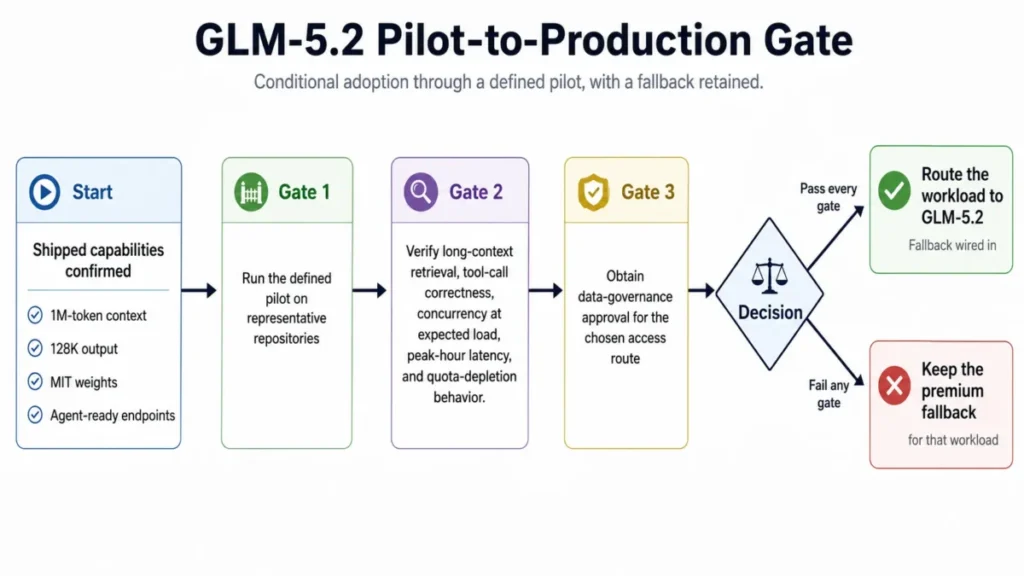
For a small team on supported tools, I would start on Pro at $72 per month, begin in Plan Mode, and keep a premium fallback wired in. For an enterprise, I would treat GLM-5.2 as a routed pilot with a security sign-off gate, not a wholesale migration, and I would answer the renewal question before the first invoice: is the model reliable and fast enough on the team’s real workload to defend at renewal.
Frequently Asked Questions
What is GLM-5.2?
GLM-5.2 is Z.ai’s flagship text large language model, built for long-horizon coding, repository-scale reasoning, tool use, and agent workflows. The developer is Zhipu AI, and the international brand is Z.ai.
The official documentation records a 1,000,000-token context and a 128,000-token maximum output, with text input and output only.
Is GLM-5.2 available now?
Yes. The model weights and documentation were publicly accessible on the checked date of July 22, 2026, and the paid Coding Plan and supported coding tools are live.
Reporting dates and the model-card publication date differ, so treat announcement timing and artifact availability as separate facts.
Is GLM-5.2 open source?
The model weights are published under the MIT license, which allows commercial use and private self-hosting. The GLM-5 repository code is published under Apache-2.0, so the two artifacts carry different licenses and a legal review should read the exact files it distributes.
How much does GLM-5.2 cost?
The GLM Coding Plan lists Lite at $18, Pro at $72, and Max at $160 per month, checked July 22, 2026. The metered first-party API is priced separately in USD at $1.40 per 1M input tokens, $4.40 per 1M output tokens, and $0.26 per 1M cached input tokens, checked July 23, 2026, while self-hosting the MIT-licensed weights carries no license fee but real infrastructure cost.
Does GLM-5.2 support a full 1M-token context?
The documented maximum context is 1,000,000 tokens on every access path. That is a capacity limit, not a guarantee of reliable retrieval across the whole window, so a team should validate long-context quality on its own repositories before trusting whole-codebase reasoning.
Is GLM-5.2 better than GLM-5.1?
Z.ai’s own benchmarks report gains, including a Terminal-Bench 2.1 score of 81.0 against 62.0 and a SWE-bench Pro score of 62.1 against 58.4. Those are vendor-reported figures, not results reproduced here, so they indicate direction rather than a settled verdict for your workload.
Can GLM-5.2 replace Claude Code?
For exploratory coding and local fixes on supported tools, GLM-5.2 is a credible lower-cost option. For latency-sensitive, compliance-bound, or cross-repository work, the evidence favors keeping a premium model like Claude until a pilot proves GLM-5.2 on your own tasks.
Does GLM-5.2 support images?
No. The official documentation classifies GLM-5.2 as a text input and text output model, so image and screenshot understanding are not available from this exact model.
A visual workflow needs a separate vision-capable model.
Can GLM-5.2 be self-hosted?
Yes, under the MIT license, with documented support for SGLang, vLLM, Transformers, KTransformers, Unsloth, and Ascend ecosystems at specified minimum versions. The model is 744B-A40B, so self-hosting is an infrastructure project that needs hardware, serving expertise, and observability, not just the free license.
What happens when the Coding Plan quota runs out?
The documented behavior is to wait for the next five-hour window, and subscription usage does not automatically deduct from the separate account balance. There is no silent overage, but there is a hard stop, so continuous agent workloads should plan around the window.