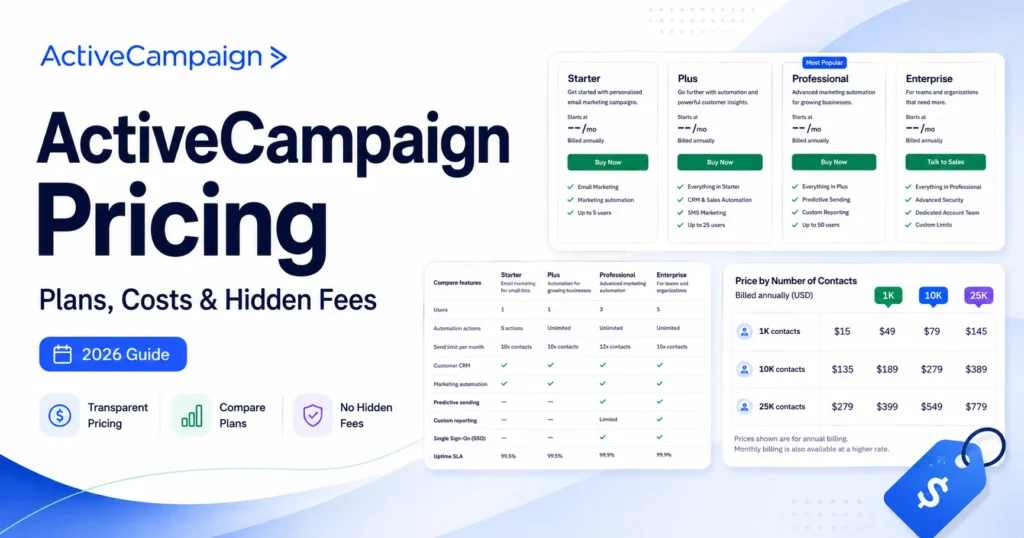
ActiveCampaign advertises $15 a month. A growing list at 10,000 contacts on Plus, the realistic step up from the entry plan, runs about $189 a month billed annually, and that is before a single SMS credit, CRM pipeline, or custom report gets added. The $15 figure is real, but it describes the cheapest plan at the smallest contact tier, and it hides the way the bill actually moves.
That gap between the entry price and the real bill is where most ActiveCampaign buyers get surprised. ActiveCampaign pricing is not simple per-user SaaS pricing. It runs on five separate cost drivers that compound: your contact count, your monthly send limit, the number of included seats, the plan-gated features you need, and the add-ons you bolt on. Miss any one of them and your estimate is wrong.
This guide breaks down all four Email plans, the monthly versus annual math, the contact-tier pricing at scale, the add-ons that have no public price, the post-2025 contact-counting rule that quietly raises bills, and the email overage fee almost no competitor mentions. Pricing here was verified against ActiveCampaign’s official pricing page and help center on June 30, 2026. Prices can change, so confirm in-app before you buy.
In This Article (14 sections)
Quick Pricing Verdict
If you only read one section, read this one.
| Question | Answer |
|---|---|
| Starting price | $15/ |
| Free plan | No permanent free plan. 14-day free trial, no credit card required |
| Billing basis | Contact tier, plus included seats, plus feature gates, plus add-ons |
| Best plan for most serious teams | Professional ($79/ |
| Plan to be careful with | Starter, if you run complex lifecycle automation (capped at 5 actions per automation) |
| Biggest hidden cost | Add-on stack (SMS, CRM pipelines, custom reports, transactional email) plus email send overages |
| If it is too expensive | Brevo, Mailchimp, Omnisend, Kit, or Klaviyo, depending on whether you bill by sends, contacts, or profiles |
What this means: ActiveCampaign is cheap to start and gets expensive in three predictable ways: more contacts, more advanced features, and more add-ons. The buyers who overpay are the ones who priced the Starter plan and budgeted for the Professional workload.
The Five Things That Actually Drive Your ActiveCampaign Bill
Most pricing pages list four plan prices and stop. That is the mistake. Your real cost is the product of five inputs, and they move independently.
- Contact count. This is the primary lever. Every plan is priced in contact tiers, so 1,000 contacts and 25,000 contacts on the same plan are very different bills.
- Send limit. Each plan caps your monthly sends at a multiple of your contact limit. Starter and Plus allow 10x contacts, Professional 12x, Enterprise 15x. Exceed it and you pay per extra email.
- Included seats. Starter and Plus include 1 user, Professional includes 3, Enterprise includes 5. ActiveCampaign’s public Email pricing is not a flat per-seat number, so a 10-person team cannot just multiply.
- Feature gates. Landing pages, predictive sending, conditional content, attribution, SSO, and custom reporting open at specific plans. The feature you need often forces the plan you buy.
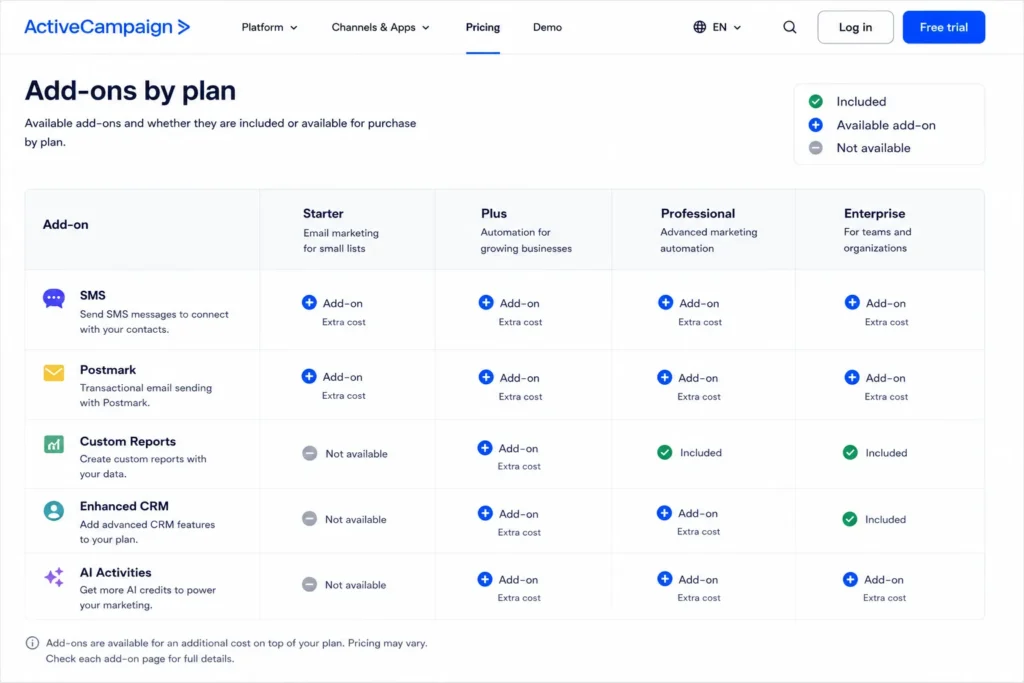
- Add-ons. SMS, enhanced CRM pipelines, sales engagement, custom reports, AI Activities, and transactional email sit on top of the base price. Several have no public price at all.
Get these five right and you can estimate your own bill before you read another word. Get one wrong and your budget is off by a tier.
ActiveCampaign Pricing Plans Overview
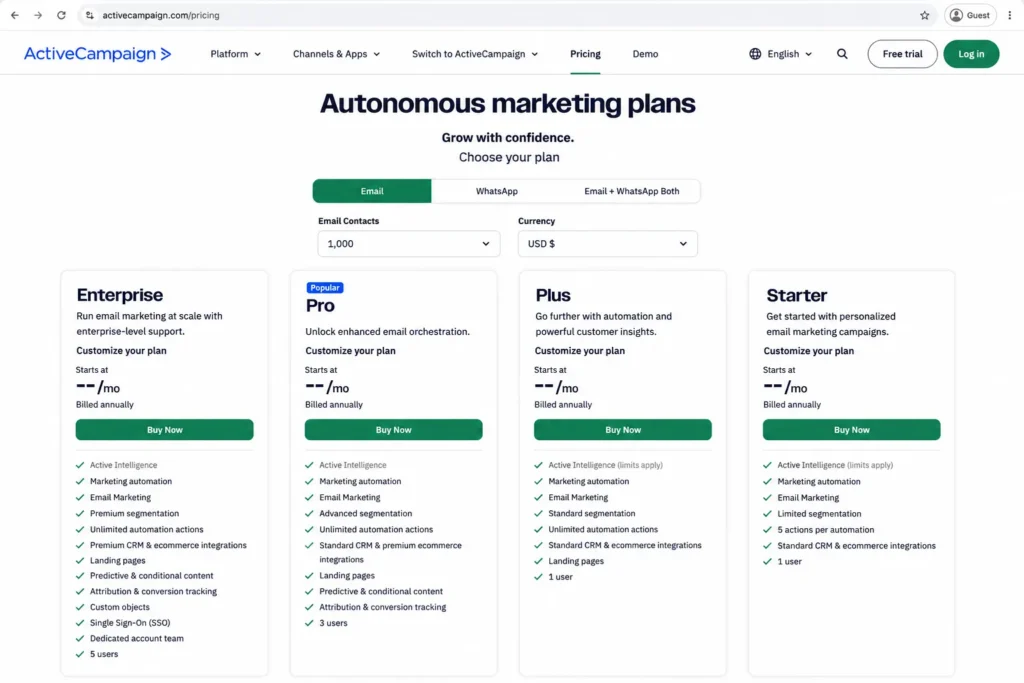
ActiveCampaign sells four Email plans: Starter, Plus, Professional, and Enterprise. Prices below are the entry tier at 1,000 contacts, verified on the official pricing page on June 30, 2026.
| Plan | Annual (1,000 contacts) | Monthly (1,000 contacts) | Included users | Send limit | Best for |
|---|---|---|---|---|---|
| Starter | $15/ | $19/ | 1 | 10x contacts | Simple email and basic automation |
| Plus | $49/ | $59/ | 1 | 10x contacts | Small teams needing landing pages and add-on access |
| Professional | $79/ | $99/ | 3 | 12x contacts | Automation-heavy marketers and revenue teams |
| Enterprise | $145/ | $179/ | 5 | 15x contacts | Larger teams needing governance, reporting, and premium support |
Source: ActiveCampaign pricing page, verified June 30, 2026. Starter, Plus, and Professional starting prices are corroborated by TechRadar’s 2026 pricing coverage.
What this means: the jump from Starter to Plus more than triples your base price, and Plus to Professional adds two more seats and the features that make automation worth running. The plan names are the easy part. The contact tier is what actually sets your bill. If you want the capability side of the equation, our full ActiveCampaign review covers what the platform does beyond price.
What Each Plan Includes (and What It Quietly Leaves Out)
Starter
Best for: solo senders and small lists running newsletters and one or two simple automations.
Includes: 1 user, up to 25,000 contacts maximum, automation, and basic segmentation. Sends are capped at 10x your contact limit.
Leaves out: landing pages, advanced segmentation, predictive sending, conditional content, attribution, and add-on access. Automation is hard-capped at 5 actions per automation.
Mini verdict: Starter is a low-cost entry plan for simple campaigns, not a workspace for lifecycle marketing automation. The 5-action automation ceiling is the trap. A welcome series with a wait step, a tag, a conditional split, an email, and a second email already hits the wall. If your automations branch, Starter will block you, not slow you down.
Avoid if: you plan to build branching or multi-step lifecycle automation, or you need landing pages.
Plus
Best for: small teams that have outgrown simple sends and need landing pages plus the ability to buy add-ons.
Includes: 1 user, unlimited automation actions, landing pages, standard segmentation, custom permissions, and eligibility to purchase any add-on (SMS, enhanced CRM, custom reports).
Leaves out: predictive sending, conditional content, and attribution, which stay locked until Professional. Still only 1 included seat.
Mini verdict: Plus removes the automation ceiling and opens the add-on shelf, which is what most growing teams actually need. The catch is that it still includes only one user, so a two-person team is already looking at seat questions ActiveCampaign does not price publicly.
Avoid if: you need predictive sending, conditional content, or attribution. You would be paying Plus money for Professional needs.
Professional
Best for: automation-heavy marketers, B2B teams, and revenue operations that live in segmentation and reporting.
Includes: 3 users, 12x send limit, advanced segmentation, predictive sending, conditional content, attribution and conversion tracking, custom event tracking, and priority support.
Leaves out: SSO, HIPAA support, included custom reporting, and premium CRM integrations, which are Enterprise only. Custom reports are available here as a paid add-on, not included.
Mini verdict: Professional is the plan most serious teams should price first. It unlocks the features that justify paying for ActiveCampaign over a basic newsletter tool, and the 3 included seats cover a small marketing team without an immediate seat conversation.
Avoid if: you genuinely only send newsletters. You would be paying for predictive and attribution tools you will not touch.
Enterprise
Best for: larger teams that need governance, premium support, and included reporting.
Includes: 5 users, 15x send limit, SSO, HIPAA support, included custom reporting, premium segmentation, premium CRM integrations (Salesforce, Microsoft Dynamics 365, Zendesk Sell), unlimited inbox preview testing, and a dedicated team.
Leaves out: nothing major at the feature level. The constraint here is price, which climbs steeply with contacts.
Mini verdict: Enterprise earns its keep on compliance and governance, not on raw features. If you need SSO, HIPAA, or those premium CRM integrations, this is the only plan that has them. If you do not, the gap to Professional is hard to justify.
Avoid if: you do not need SSO, HIPAA, included custom reporting, or the premium CRM integrations. Professional plus a custom-reports add-on may cost less.
Feature Gates: What Forces an Upgrade
This is the table that decides your plan. The feature you need pulls you up a tier whether your contact count does or not.
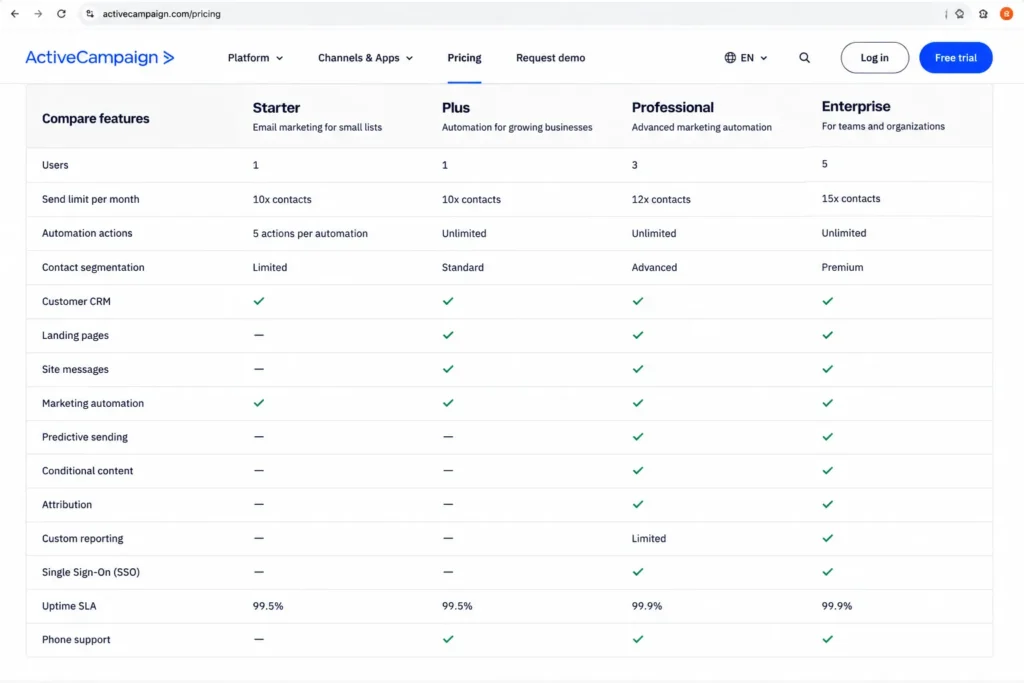
| Feature | Starter | Plus | Professional | Enterprise |
|---|---|---|---|---|
| Included users | 1 | 1 | 3 | 5 |
| Send limit | 10x contacts | 10x contacts | 12x contacts | 15x contacts |
| Automation actions | 5 per automation | Unlimited | Unlimited | Unlimited |
| Segmentation | Limited | Standard | Advanced | Premium |
| Landing pages | No | Yes | Yes | Yes |
| Predictive sending | No | No | Yes | Yes |
| Conditional content | No | No | Yes | Yes |
| Attribution and conversion tracking | No | No | Yes | Yes |
| Custom reporting | No | Add-on | Add-on | Included |
| SSO | No | No | No | Yes |
| HIPAA support | No | No | No | Yes |
| Premium CRM integrations | No | No | No | Salesforce, Dynamics 365, Zendesk Sell |
Source: ActiveCampaign pricing page and the official ActiveCampaign plans article, verified June 30, 2026.
What this means: three gates do most of the upgrade pushing. The 5-action automation cap pushes complex senders off Starter. Predictive, conditional content, and attribution push serious marketers off Plus and onto Professional. SSO, HIPAA, and premium CRM integrations push regulated or enterprise buyers onto Enterprise. Price your plan by the gate you hit, not the tier you hoped for.
ActiveCampaign Cost at Scale: Pricing by Contact Tier
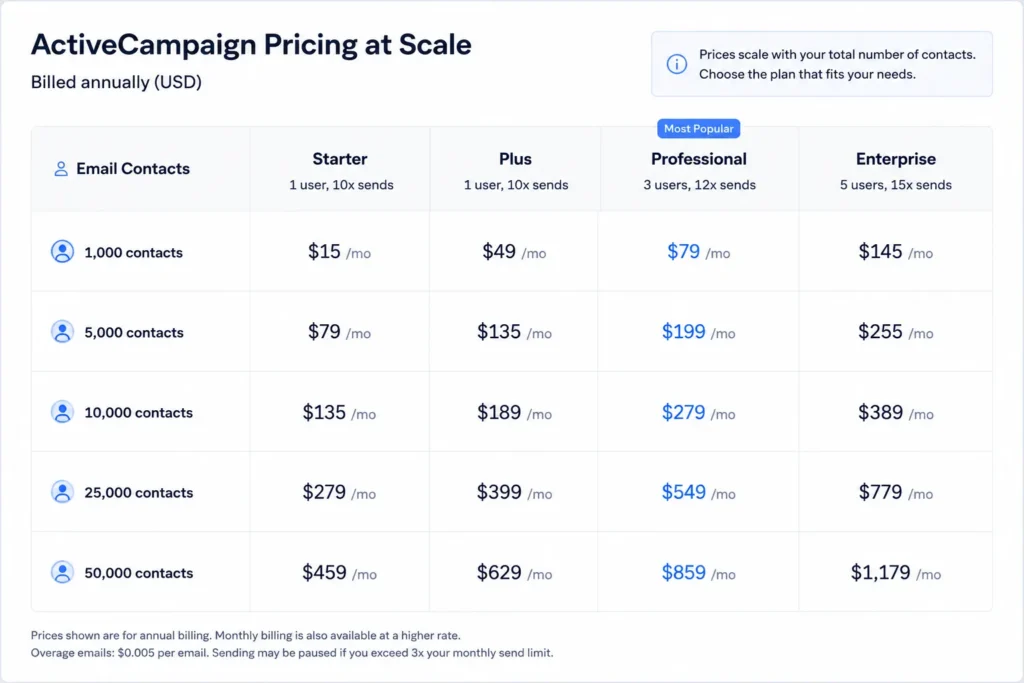
The starting price tells you almost nothing once your list grows. ActiveCampaign’s official pricing page renders these tier prices dynamically, so the tables below come from reputable third-party pricing guides that track them, and are labeled as corroborating data rather than direct quotes from the official page.
Annual billing by contact tier (per month)
| Contacts | Starter | Plus | Professional | Enterprise |
|---|---|---|---|---|
| 1,000 | $15 | $49 | $79 | $145 |
| 2,500 | $39 | $95 | $149 | $255 |
| 5,000 | $79 | $145 | $205 | $375 |
| 10,000 | $149 | $189 | $375 | $589 |
| 25,000 | $319 | $389 | $629 | $879 |
| 50,000 | Not listed | $609 | $969 | $1,169 |
Corroborating source: VentureHarbour ActiveCampaign pricing, reviewed June 30, 2026.
Monthly billing by contact tier (per month)
| Contacts | Starter | Plus | Professional | Enterprise |
|---|---|---|---|---|
| 1,000 | $19 | $59 | $99 | $179 |
| 2,500 | $49 | $119 | $189 | $319 |
| 5,000 | $99 | $179 | $259 | $469 |
| 10,000 | $189 | $239 | $469 | $739 |
| 25,000 | Not listed | $489 | $789 | $1,099 |
| 50,000 | Not listed | $759 | $1,209 | $1,459 |
Corroborating source: EmailVendorSelection ActiveCampaign pricing, reviewed June 30, 2026.
What this means: notice the Starter and Plus lines converge as contacts grow. At 1,000 contacts, Plus costs more than three times Starter. At 10,000 contacts, the annual gap shrinks to about $40 a month. If you are heading past 10,000 contacts anyway, paying for Plus to escape the 5-action automation cap costs far less than the starting prices imply. Starter also tops out at 25,000 contacts, so high-volume senders cannot stay on it regardless.
Monthly vs Annual Billing: How Much You Save
Annual billing runs roughly 20% cheaper than monthly at the entry tier, though the exact percentage varies by plan.
| Plan | Monthly (1,000 contacts) | Annual (1,000 contacts) | Monthly saving |
|---|---|---|---|
| Starter | $19 | $15 | $4 |
| Plus | $59 | $49 | $10 |
| Professional | $99 | $79 | $20 |
| Enterprise | $179 | $145 | $34 |
Source: pricing figures verified against the ActiveCampaign pricing page and corroborated by third-party guides, June 30, 2026.
What this means: annual billing locks you in for a year but pays for itself quickly on the higher plans. The Professional annual rate saves $240 a year over monthly at the entry tier. The only reason to choose monthly is if you are genuinely unsure you will stay past a few months. If you are committing, annual is the obvious call, and ActiveCampaign states there are no setup costs to start, so the annual commitment is not stacked on top of an onboarding fee the way HubSpot’s higher tiers are.
Hidden Costs and Add-Ons That Move the Bill
This is where ActiveCampaign’s real total cost lives, and where most pricing pages go quiet. Some of these have no public price, so the honest answer is to flag them rather than invent a number.
| Cost item | Eligibility | Price status |
|---|---|---|
| Email send overage | All plans | $0.005 per extra email (official) |
| All-contact counting (new accounts) | Accounts created on or after Nov 3, 2025 | Indirect contact-tier cost (official policy) |
| SMS credits | Plus, Professional, Enterprise | Price not publicly listed; credits do not roll over |
| Transactional email via Postmark | All plans (with approved Postmark account) | Postmark: free 100/ |
| Custom Reports | Plus and Professional buy as add-on; Enterprise includes it | Add-on price not publicly listed |
| Enhanced CRM (pipelines) | Plus, Professional, Enterprise | Price not publicly listed |
| Enhanced CRM (sales engagement) | Plus, Professional, Enterprise | Price not publicly listed |
| AI Activities | All plans | Price not publicly listed |
| Setup / onboarding | All plans | $0 to start, free migration and training |
Sources: SMS add-on help article, Custom Reports overview, Postmark integration, Postmark pricing, and the ActiveCampaign pricing page. Verified June 30, 2026.
The email overage fee competitors skip
Exceed your monthly send limit and ActiveCampaign charges $0.005 per additional email. Keep sending, and if your overage reaches 3x your monthly send limit, email sending is turned off until the next month. On a Plus plan with 10,000 contacts, your send limit is roughly 100,000 emails a month. A single oversized campaign blast plus an active automation can chew through that faster than teams expect, and the per-email fee is small until it is not. Source: ActiveCampaign email send limits and overage fees.
Why your bill can rise without adding a single active subscriber
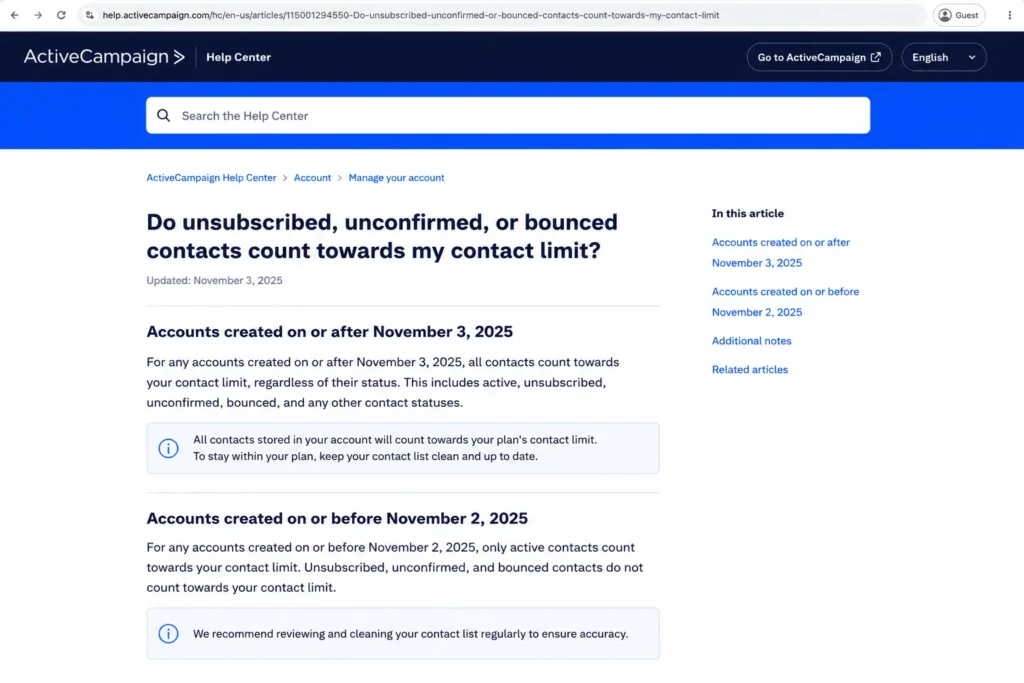
ActiveCampaign changed how it counts contacts. Accounts created on or after November 3, 2025 count all contacts toward the contact limit regardless of list status, including unsubscribed, unconfirmed, and bounced contacts. Accounts created on or before November 2, 2025 still count only active contacts. Source: ActiveCampaign contact-counting policy.
For a new buyer, that means a dirty import full of old unsubscribes pushes you into a higher contact tier on day one. Before you pick a tier, clean your list: remove bounced addresses, purge stale unsubscribes, and confirm your real active count. The policy is dated, public, and easy to miss, and it is the single most common reason a new ActiveCampaign bill comes in higher than the buyer planned.
What happens when you hit the contact limit
Reach your contact limit and ActiveCampaign can block email campaigns and skip the send-email step inside automations until you upgrade. Starter also caps at 25,000 contacts, so growth past that point forces a plan change, not just a tier change. Source: What happens when you reach your contact limit.
The balance: free services that offset switching cost
It is not all hidden cost. ActiveCampaign states there are no setup costs or hidden fees to start, and includes free migration, onboarding resources, training, support, and a 30-day money-back guarantee. The 14-day trial needs no credit card. For a team switching from another platform, that migration support is a real saving that the competitor-led hidden-cost articles tend to understate. Source: ActiveCampaign pricing page.
Real Cost Scenarios by Team Size
Here is where honesty matters more than a tidy table. ActiveCampaign’s public Email pricing is contact-tier pricing with included seats. It is not a flat per-seat number you can multiply, and the price of additional seats beyond the included count is not published. So some of these scenarios are calculable and some are not, and pretending otherwise would be inventing figures.
| Team size | Publicly calculable? | What you can rely on |
|---|---|---|
| 1 user | Yes | Any plan works on seats. Starter and Plus include 1 user |
| 3 users | Yes | Professional includes 3 users at $79/ |
| 5 users | Partially | Enterprise includes 5 users at $145/ |
| 10 users | No | Requires additional seats or a sales quote. Do not multiply the plan price by 10 |
| 25 users | No | Likely Enterprise plus a custom configuration depending on contacts, seats, and add-ons |
| 50 users | No | Requires a sales quote or verified in-app seat pricing |
| 100 users | No | Requires a sales quote or verified in-app seat pricing |
Source: included-seat counts from the ActiveCampaign plans article; additional-seat pricing not published as of June 30, 2026.
What this means: if a pricing article shows you a clean “ActiveCampaign for 50 users costs $X” number, treat it with suspicion. The included seats are public. Everything above them needs a quote. The right move for a larger team is to pick the plan by feature gate and contact tier, then ask sales for the seat delta rather than guessing.
Who Wins and Who Loses on ActiveCampaign Pricing
Who wins
Lifecycle marketers, B2B teams, ecommerce operators, and SMBs that will actually use segmentation, branching automation, attribution, and CRM workflows win here. For teams weighing it against other CRM and marketing automation tools, Professional at $79 a month annual unlocks the predictive sending, conditional content, and attribution that separate ActiveCampaign from a basic newsletter tool, and the 3 included seats cover a small team. The platform rewards complexity. If your sends are sophisticated, the price buys real capability.
Who loses
Newsletter-only senders and tiny lists lose. If all you do is send a weekly broadcast to a small list, you are paying for automation depth you will never touch, and ActiveCampaign has no permanent free plan to fall back on. The same goes for a team that prices Starter, then discovers the 5-action automation cap two weeks in and has to upgrade anyway. The honest read: ActiveCampaign is good value for teams that grow into it and poor value for teams that just need cheap email.
Better-Fit Alternatives If ActiveCampaign Is Too Expensive
The reason cheaper competitors can look cheaper is that they bill differently. Before you switch, compare the billing model across email marketing platforms, not just the sticker price.
| Tool | Billing model | Free plan | Starting price | Best fit |
|---|---|---|---|---|
| Mailchimp | Contacts plus send limits | Yes, up to ~250 contacts | ~$13/ | All-in-one marketing for small lists |
| Klaviyo | Active profiles and channel usage | Yes, up to 250 profiles | Calculator-based | Ecommerce with deep profile data |
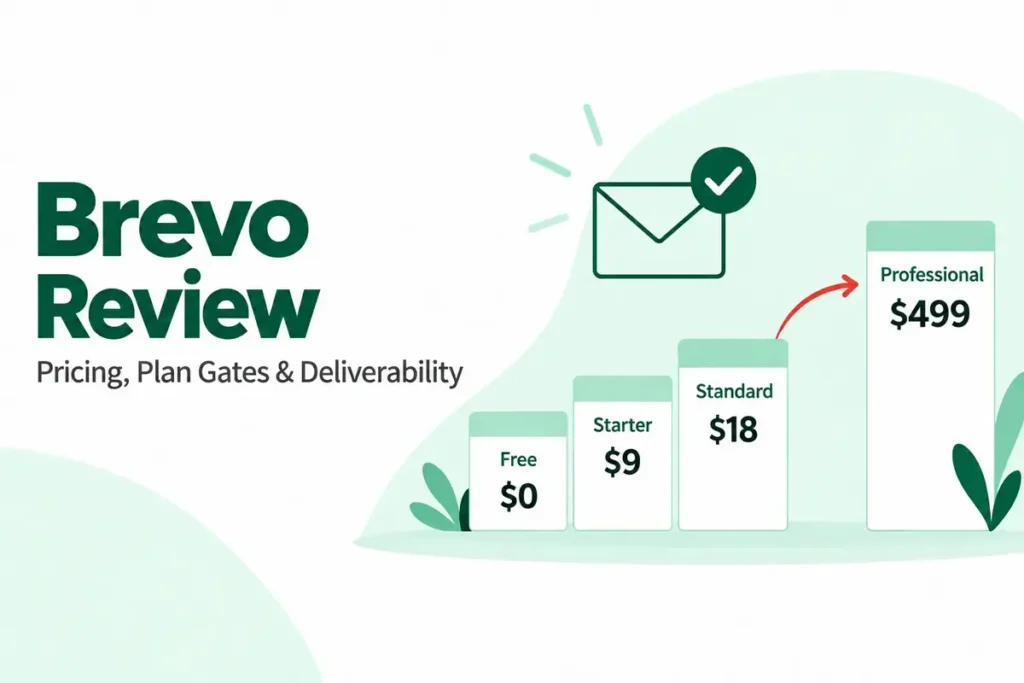
| Brevo | Email volume with a contact allowance | Yes, 300 emails/ | ~$9/ | Teams whose cost scales with sends, not list size |
| Kit | Subscriber tier (creator model) | Yes, free Newsletter to ~10,000 subscribers | Tier-based | Creators and newsletter-first audiences |
| Omnisend | Contacts and email volume | Yes, up to ~250 contacts | ~$16/ | Ecommerce email and SMS |
| HubSpot Marketing Hub | Marketing contacts plus seats plus onboarding | Free tools, not full Marketing Hub | Tier-based with mandatory onboarding on higher plans | Teams wanting CRM and marketing in one platform |
Sources: official pricing pages for each vendor plus 2026 third-party pricing coverage, reviewed June 30, 2026. Competitor prices change often; treat these as directional and confirm on each vendor’s page.
What this means: if your list is small and stays small, a free or near-free plan from Brevo, Mailchimp, Omnisend, or Kit may serve you better than ActiveCampaign’s trial-then-pay model. If your cost is driven by send volume rather than list size, Brevo’s volume billing can undercut ActiveCampaign at scale. But if you need ActiveCampaign’s automation and attribution depth, the cheaper tools are not actually a substitute, they are a different job.
Is ActiveCampaign Worth the Price?
It is worth it if you will use the automation, segmentation, and attribution. For a lifecycle or B2B team that builds branching workflows and tracks attribution, Professional is strong value and the bill is justified by capability you cannot easily get cheaper.
It is not worth it if you only need basic email. Newsletter-only senders, tiny lists wanting a permanent free plan, and teams that just want low-cost broadcasts will overpay, and they have free-tier options elsewhere.
The best value plan is Professional. It opens the features that make ActiveCampaign worth choosing and includes 3 seats. The plan to be careful with is Starter, not because it is bad, but because its 5-action automation cap and missing landing pages quietly force an upgrade for anyone doing real lifecycle work.
How to Avoid Overpaying for ActiveCampaign
- Clean your list before you pick a tier. New accounts count all contacts, so old unsubscribes and bounces can push you up a tier on day one. Purge them first.
- Price the plan you will use, not the one you hope to. If your automations branch, budget for Plus or Professional, because Starter’s 5-action cap will block you.
- Choose annual if you are committing. It runs roughly 20% cheaper, and there is no separate setup fee stacked on top.
- Watch your send multiplier. Map your real monthly send volume against your plan’s limit (10x, 12x, or 15x contacts) so a big campaign does not trigger overage fees at $0.005 per email.
- Get add-on prices in writing. SMS, custom reports, enhanced CRM, and AI Activities have no public price. Ask sales for the exact figure before you commit, and remember SMS credits do not roll over.
- Skip Enterprise unless you need its specific gates. If you do not need SSO, HIPAA, or premium CRM integrations, Professional plus a custom-reports add-on can land lower.
- Take the free migration. ActiveCampaign includes migration and training at no cost, so factor that saving in when comparing switching costs against rivals.
ActiveCampaign Pricing FAQ
How much does ActiveCampaign cost per month? It starts at $15 a month for the Starter plan billed annually at 1,000 contacts, or $19 a month billed monthly. Cost rises with your contact tier, the plan you choose, and any add-ons. Verified June 30, 2026.
Does ActiveCampaign have a free plan? No. There is no permanent free plan. You get a 14-day free trial with no credit card required, and a 30-day money-back guarantee.
Is ActiveCampaign priced per contact or per user? Mainly per contact. Plans are sold in contact tiers with a set number of included users (1 on Starter and Plus, 3 on Professional, 5 on Enterprise). It is not simple per-seat pricing, and additional-seat prices are not published.
What is included in the ActiveCampaign Starter plan? One user, up to 25,000 contacts, automation capped at 5 actions per automation, basic segmentation, and a 10x send limit. It does not include landing pages, predictive sending, conditional content, attribution, or add-on access.
What is the difference between ActiveCampaign Plus and Professional? Plus removes the automation action cap and adds landing pages and add-on access but keeps 1 user. Professional adds 3 users, a 12x send limit, advanced segmentation, predictive sending, conditional content, and attribution.
Does ActiveCampaign charge for unsubscribed contacts? For accounts created on or after November 3, 2025, yes. All contacts count toward your limit regardless of status. Accounts created on or before November 2, 2025 count only active contacts.
What happens if I go over my email send limit? You are charged $0.005 per additional email. If overage sends reach 3x your monthly limit, email sending is turned off until the next month.
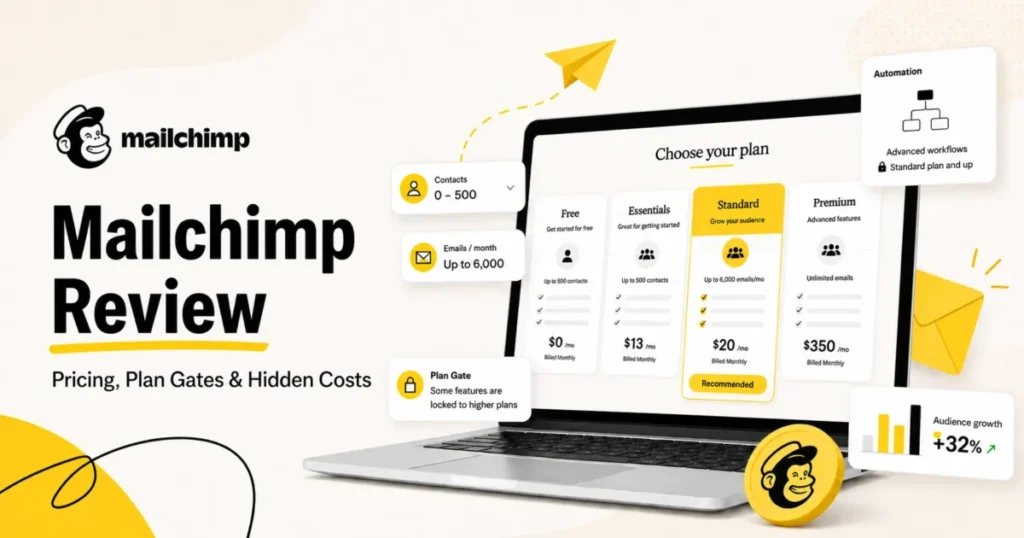
Is ActiveCampaign cheaper than Mailchimp? It depends on your list and needs. Mailchimp has a free plan and a lower entry price, but ActiveCampaign’s automation and attribution are deeper. For a closer look at the rival, see our Mailchimp pricing breakdown. For basic email on a small list, Mailchimp is usually cheaper. For advanced automation, the comparison is about capability, not just price.
How much is ActiveCampaign Enterprise? Enterprise starts at $145 a month billed annually at 1,000 contacts ($179 monthly), and rises steeply with contacts. It adds SSO, HIPAA support, included custom reporting, and premium CRM integrations.
What add-ons does ActiveCampaign charge extra for? SMS credits, enhanced CRM pipelines, sales engagement, custom reports (on Plus and Professional), AI Activities, and transactional email via Postmark. Several add-on prices are not published and require a quote.
Pricing in this guide was verified against ActiveCampaign’s official pricing page and help center on June 30, 2026. SaaS prices change frequently; confirm current pricing in-app or with ActiveCampaign sales before purchasing.