

For musicians who need to fix one bad scene without paying for the whole song again, the best AI music video maker (text to video included) is a song-first tool. Neural Frames, Tapemoon and Muzie edit scene by scene. LTX Studio and Runway work shot by shot, so a retake is a new generation you place by hand.
Quick verdict
Tapemoon bills a re-rendered scene for that scene’s length only. On a 3-minute song, a full Seedance pass uses 180 of the 240 credits in Tapemoon’s $19 size, and a 6-second retake (my example length) 6 more; Runway’s Gen-4.5 pass uses 2,160 of Pro’s 2,250 credits at $35, then 60 for 5 seconds.
Prices are each vendor’s own, in USD at monthly billing, checked November 2026.
It fits artists with a finished track: Neural Frames for stems, Tapemoon for priced retakes, Muzie for a singer, LTX Studio for storyboards, Runway for hand-directed shots.
The trade-off: the more a tool builds from the song, the less shot-by-shot control you keep.

Neural Frames
Best for: stem-driven control over a full song
Eight extracted stems drive the visuals, and three editors let you rework one scene.
Limit: Neural Knight, the entry plan, has no 4K upscaling

Tapemoon
Best for: paying only for the scene you redo
A scene re-render is charged by that scene’s length, not the song’s.
Limit: a character’s look can vary from scene to scene

Muzie
Best for: singer-led, lip-synced videos
A photo becomes the singer, and Studio regenerates one shot with the audio in sync.
Limit: the Standard plan keeps a small static watermark

Runway
Best for: hand-directed shots you assemble yourself
Gen-4.5 bills 12 credits per second, so each shot has a known price.
Limit: no song or beat mapping on its pricing or home page
In This Article (10 sections)
Quick Comparison: Which Tools Redo One Scene Without Re-Rendering the Song?
Tapemoon bills a one-scene redo by that scene’s length; Muzie redoes one shot with the audio in sync. Neural Frames documents scene-level refinement in its editors. LTX Studio documents shot tools, but neither it nor Runway describes a redo locked to a song.
| Software | Best for | Workflow | One-scene redo | Starting price | Recommended plan |
|---|---|---|---|---|---|
| Neural Frames | Stem-driven control over a full song | Song-first | Chat refinement per scene, plus two editors | $39/mo billed monthly, or $26/mo billed yearly | Neural Ninja: $99/ |
| Tapemoon | Paying only for the scene you redo | Song-first | One scene, billed for its length | $19/ | 240 credits: $19/ |
| Muzie | Singer-led, lip-synced videos | Song-first, from a singer photo | One shot; audio stays in sync | $24.99/ | Premium: $49.99/ |
| LTX Studio | Storyboard-first directors | Script first | Shot tools; no song-locked redo described | Free (800 one-time credits); Lite $15/mo | Standard: $35/ |
| Runway | Hand-directed shots you assemble yourself | Shot-first | A new generation per shot | Free (125 one-time credits); Standard $15/mo | Pro: $35/ |
Sources: Neural Frames pricing, Tapemoon pricing, Muzie pricing, LTX Studio pricing, Runway pricing, checked November 2026.
How I Chose These Tools
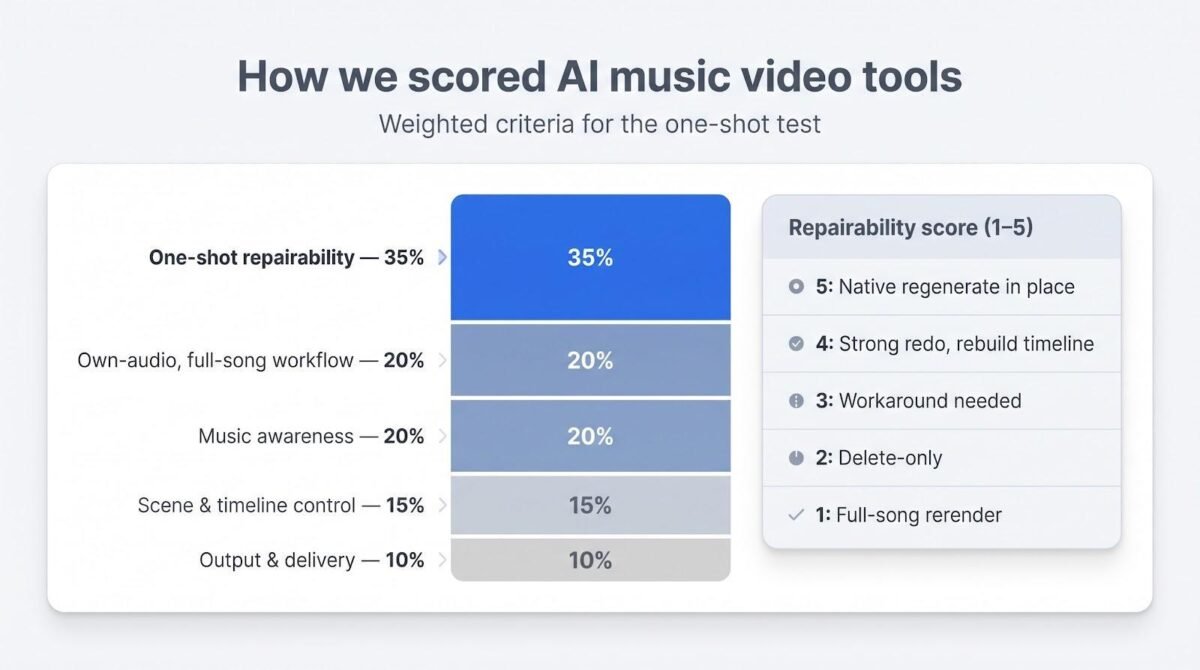
Every tool had to accept your own audio. I then weighted one-shot repairability highest, followed by own-audio full-song workflow and music awareness, then scene and timeline control, and output and delivery last.
Redo levels run from a song-locked scene redo, through a shot you re-cut yourself, to a full re-render. I read each vendor’s documentation and pricing pages in November 2026.
This ranking does not measure output quality, so preview a chorus on a free start before you pay. Freebeat and Kaiber were also looked at and sit outside the 5 picks below.
My take
I would start from the redo column with a finished track, and from the workflow column if you write shots first. Then read the Starting price column: Neural Frames’ entry plan lacks 4K upscaling, Muzie’s adds a watermark and LTX Studio’s carries no commercial license.
Why the One-Shot Test Matters: What a Retake Costs on Each Tool
On a 3-minute song, Tapemoon’s Seedance pass uses 180 of the 240 credits in its $19 size, and a 6-second retake, my example length, costs 6. Runway’s Gen-4.5 pass uses 2,160 of Pro’s 2,250 credits at $35, and a 5-second retake 60.
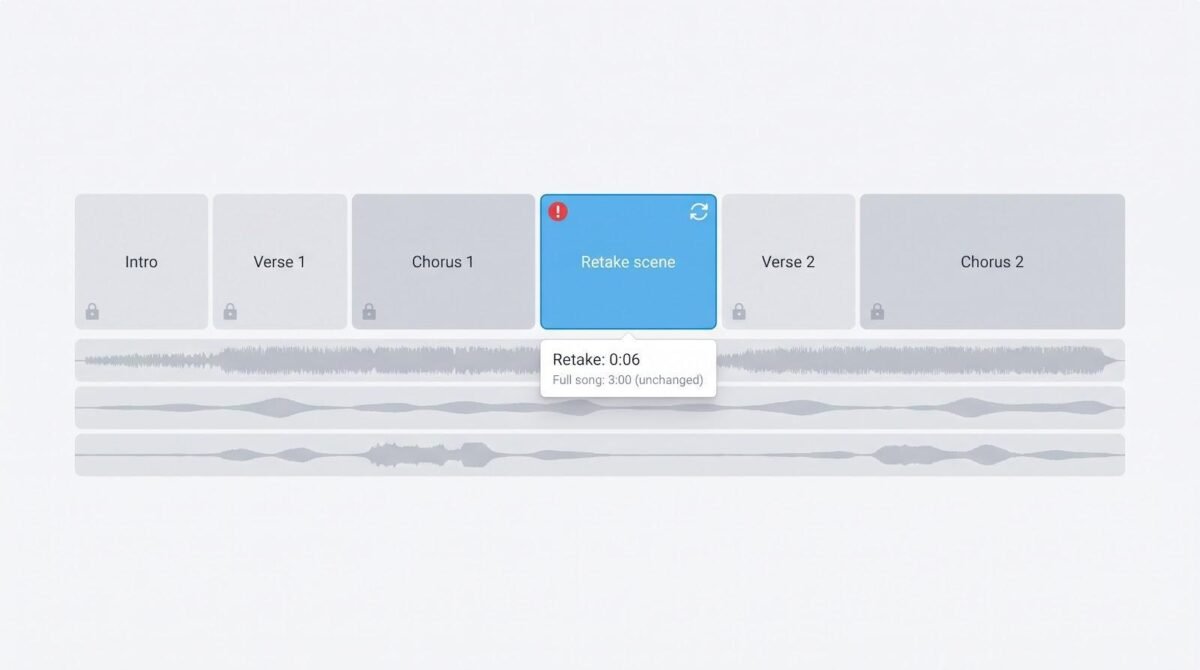
Tapemoon itself warns that generated scenes can drift from the prompt, so a first pass is a draft. When a tool can only re-render the whole song, every fix pays again for minutes you already approved.
| Tool and model | One 3-minute pass | One short retake | Plan it needs |
|---|---|---|---|
| Tapemoon, Seedance (480p, upscaled to 720p) | 180 credits ($0.079 x 180 = $14.22) | 6 credits for 6 seconds, my example length ($0.079 x 6 = $0.47) | 240 credits, $19/ |
| Tapemoon, Kling 3.0 (1080p) | 720 credits (4 x 180) | 4 credits per second | 720 credits, $49/ |
| Neural Frames Autopilot, Seedance Pro Fast | About 1,152 credits (384 x 3) | Not published per scene | Neural Ninja, the plan marked “Good for Autopilot” |
| Muzie, Normal quality | About 1,584 tokens (8.8 x 180) | Not published; shown in the app | Premium, $49.99/ |
| LTX Studio | Not published | Not published | Standard, $35/ |
| Runway, Gen-4.5 | 2,160 credits (12 x 180; $35 / 2,250 x 2,160 = $33.60) | 60 credits for 5 seconds ($35 / 2,250 x 60 = $0.93) | Pro, $35/ |
Tapemoon’s pricing page prices its own 3-minute song example on Seedance; Kling 3.0 is its 1080p model. Seedance Pro Fast uses the fewest credits per minute on Neural Frames’ Autopilot cost table. Muzie’s pricing page sizes each plan in minutes at Normal quality. Runway’s sizes each paid plan in seconds of Gen-4.5 first. Dollars are plan price over credits ($19 / 240, $35 / 2,250).
After the first pass, Tapemoon’s 240-credit size keeps 60 credits (240 – 180): ten retakes at my 6-second example length. Runway Pro keeps 90 credits (2,250 – 2,160): one 5-second retake.
A credit is each vendor’s own unit, so compare the share of a plan a song uses, never credits across tools. My comparison of cost per clip and credit rules covers rollover and expiry for general AI video generators.
1. Neural Frames: Best for Stem-Driven Control Over a Full Song
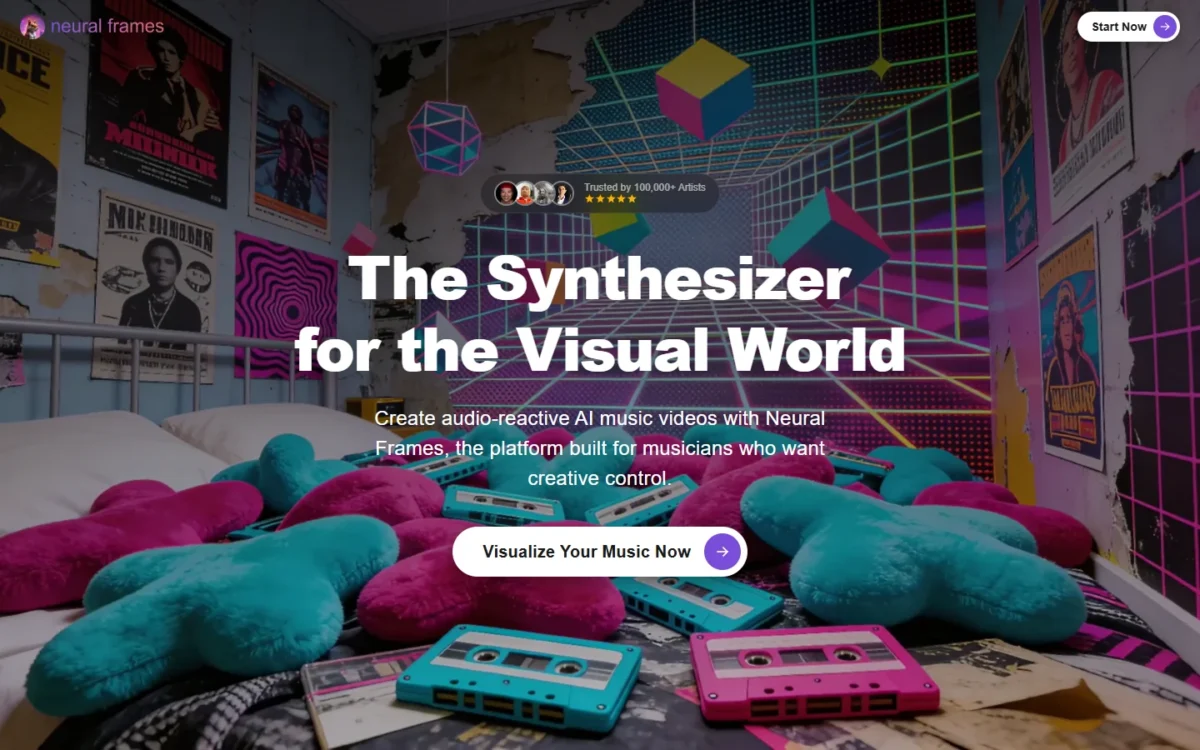
- Starting price: $39 a month billed monthly, or $26 a month billed yearly ($312)
- One-scene redo: chat refinement per scene, plus two editors
- Free start: no credit card; paid plans remove the watermark
Neural Frames is my pick when the music itself should steer the picture and you want to rework single scenes by hand. It extracts 8 stems from the upload and builds in three modes: Autopilot, a Frame-by-Frame Editor and a timeline-based Text-to-Video Editor. The trade-off is the entry plan: Neural Knight has no 4K upscaling and is marked “Not recommended for Autopilot”.
The stems (drums, bass, vocals, melody and more) feed 10+ modulation parameters, so colors can pulse with the kick drum while transitions follow the melody. That suits producers in beat-driven genres; Tapemoon maps tempo, beats, sections and lyric timing, a coarser grid.
A bad scene has two documented routes: “Refine every scene through chat”, and the frame-by-frame and text-to-video editors, which control individual scenes, prompts and timing but usually take longer to create. Neural Frames says 10 to 20 uploaded images train a custom model for consistent characters, and it lists Lyric & lipsync for vocal performances. Neural Frames lays out the full song-to-video workflow at neuralframes.com.
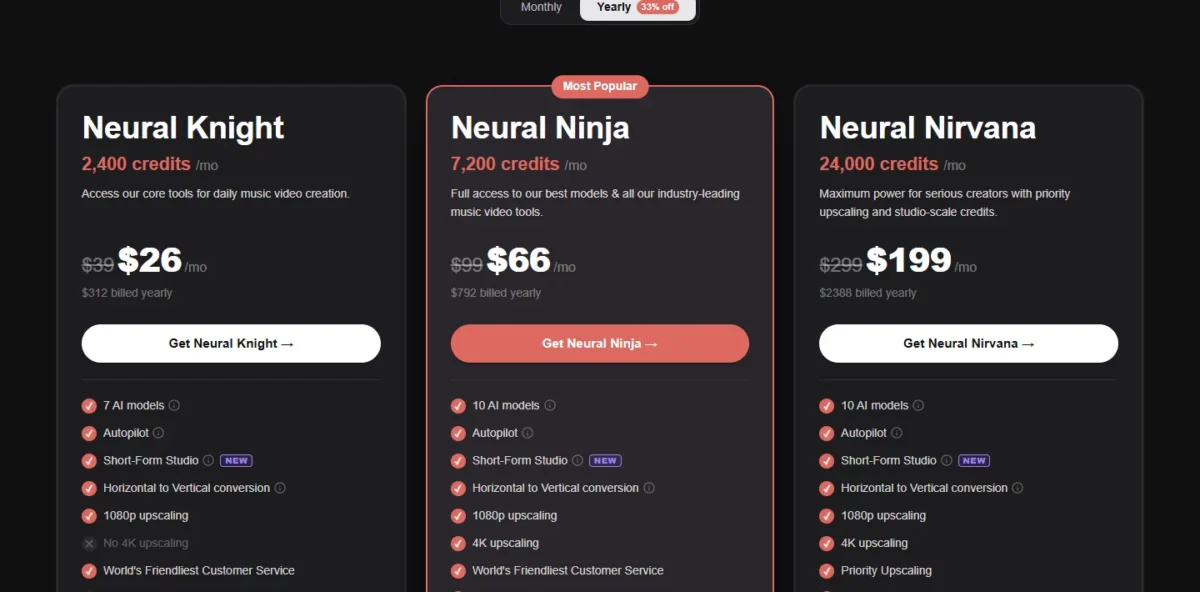
Neural Ninja is the plan to price: $99 a month billed monthly, or $66 a month billed yearly ($792), with 7,200 credits, 10 AI models and 4K upscaling. A 3-minute Seedance Pro Fast pass leaves about 6,048 (7,200 – 1,152). Unused credits roll over up to three times the monthly allocation while you stay subscribed.
| Plan | Monthly billing | Yearly billing | Key limit |
|---|---|---|---|
| Neural Knight | $39/mo | $26/mo ($312 billed yearly) | 2,400 credits; no 4K upscaling |
| Neural Ninja | $99/mo | $66/mo ($792 billed yearly) | 7,200 credits; 4K upscaling |
| Neural Nirvana | $299/mo | $199/mo ($2,388 billed yearly) | 24,000 credits; priority upscaling |
Sources: Neural Frames pricing, checked November 2026.
Pros
- 8 stems and 10+ modulation parameters tie visuals to single instruments
- Three build modes, from two-click Autopilot to frame-by-frame editing
- You own the videos and may monetize them
Cons
- The $39 entry plan lacks 4K upscaling
- No per-scene retake price on the pricing page
- No blanket refund guarantee
- Skip it if:
- you want a retake’s cost printed before you subscribe. Tapemoon bills a re-rendered scene by its length, from 1 credit per second.
2. Tapemoon: Best for Paying Only for the Scene You Redo
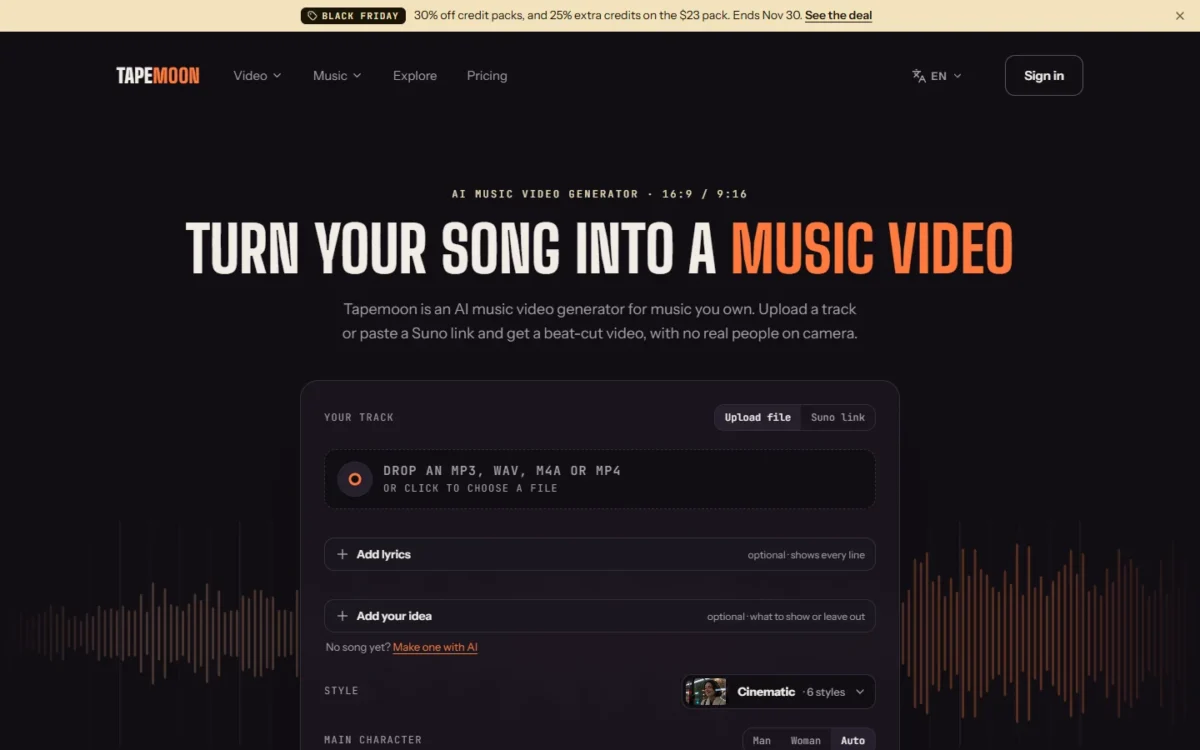
- Starting price: $19 a month for 240 credits, or $23 once for a 240-credit pack
- Free start: 15 credits, for a storyboard and a 15-second watermarked chorus preview at 480p
A retake has a printed price on Tapemoon, which makes it my pick when the cost of a fix decides. Its pricing page says a scene re-render is charged by that scene’s length alone. The trade-off is consistency: Tapemoon warns that a character can look slightly different between scenes.
Tapemoon maps the track first (tempo, beats, sections, energy, lyric timing) and drafts a storyboard you can change before spending credits. You pick one of six styles and the mood instead of writing a prompt per clip; the audio sets the pacing.
The input can be a WAV, an MP3 or a Suno link of up to 8 minutes, and the output an MP4 in 16:9 or 9:16 with your original audio. Fixes happen in that storyboard, one scene at a time.
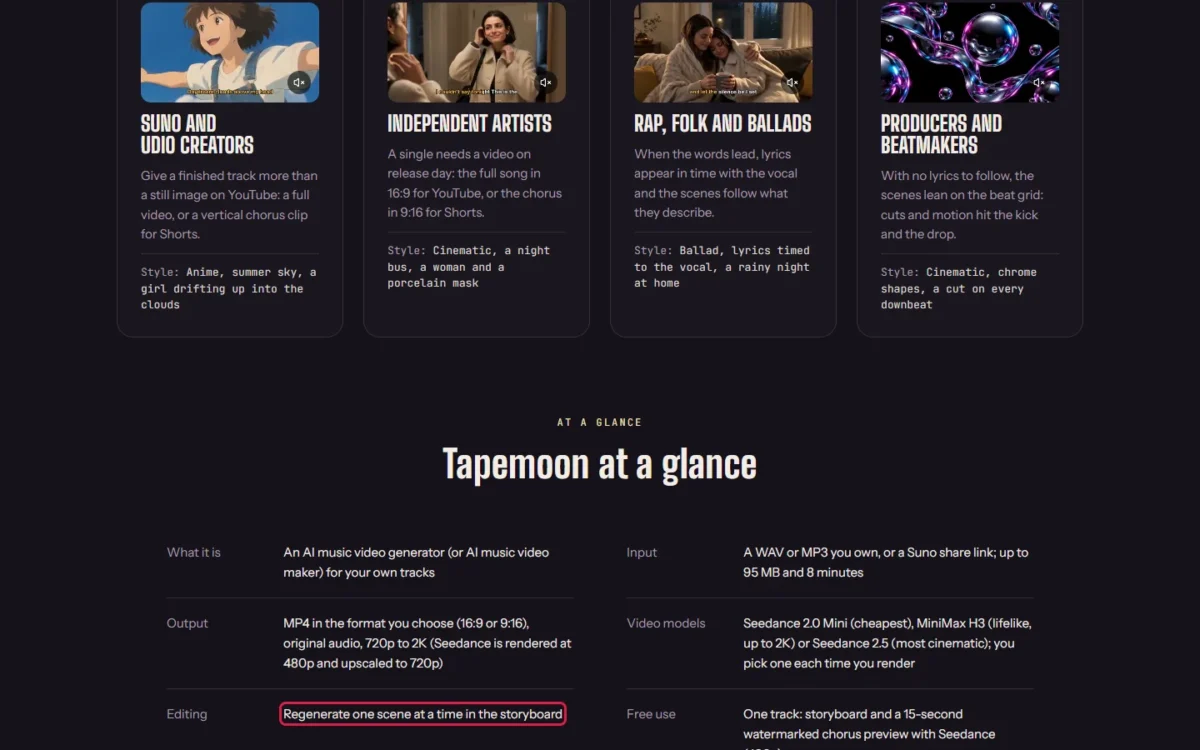
You can also render only the chorus or any stretch of scenes and pay for those seconds alone. Scenes you paid for are kept, so finishing the song later on the same model charges only what is still unrendered. The lead can sing your lyrics, lip-synced, as a generated fictional character. Tapemoon uses no real faces and rules out concert footage.
The 240-credit size, enough for one 3-minute Seedance song plus retakes, is $19 a month, or $23 once with nothing to renew.

| Credits | Every month | Seedance video |
|---|---|---|
| 240 | $19/ | 4 min |
| 720 | $49/ | 12 min |
| 1,500 | $99/ | 25 min |
| 3,600 | $199/ | 60 min |
Sources: Tapemoon pricing, last updated by Tapemoon on November 9, 2026, checked November 2026.
Monthly credits roll over one month, and a pack lasts 3 months.
Pros
- A scene re-render bills that scene’s length, and paid scenes are kept
- The storyboard can be changed before any credits are spent
- Per-second rates printed for all 6 video models, from 1 to 11 credits
Cons
- A character’s look can shift from one scene to the next
- No shot-by-shot control of every frame
- Seedance, the 1-credit model, renders at 480p and is upscaled to 720p
- Skip it if:
- you need shot-by-shot control of every frame, which Neural Frames sells, or a real singer’s face on screen, which is what Muzie is built on.
3. Muzie: Best for Singer-Led, Lip-Synced Videos

- Starting price: $24.99 a month (Standard, 2,124 tokens, small static watermark)
- One-shot redo: Studio regenerates a single shot; audio stays in sync
When the vocalist has to carry the video, Muzie is my pick. One photo becomes the singer, lip-synced to the vocal across multiple scenes storyboarded from the lyrics, and Studio can regenerate a single shot while the audio stays in sync. The trade-off: a watermark-free video needs Premium.
The photo can be a person, a pet or a drawing. Neural Frames needs 10 to 20 images to train a consistent character, and Tapemoon’s singer is generated and fictional. In Studio you can also rewrite a scene, swap its image or re-render everything.
Text prompts steer two things: Muzie can generate an original song with vocals from a description, and you can write your own visual direction in place of a preset visual style such as anime, claymation or cinematic film. Videos render in 9:16 portrait by default for short-form content, with widescreen for YouTube, as an “HD render” with no pixel resolution given. Its pages describe no stem or beat-level control.
Premium is the plan without a watermark: $49.99 a month for 4,721 tokens, about 9 minutes of video at Normal quality. A 3-minute song uses about 1,584 of them (8.8 x 180), leaving about 3,137 for retakes. Muzie’s home and pricing pages state no commercial-use terms, so check them before a paid release.
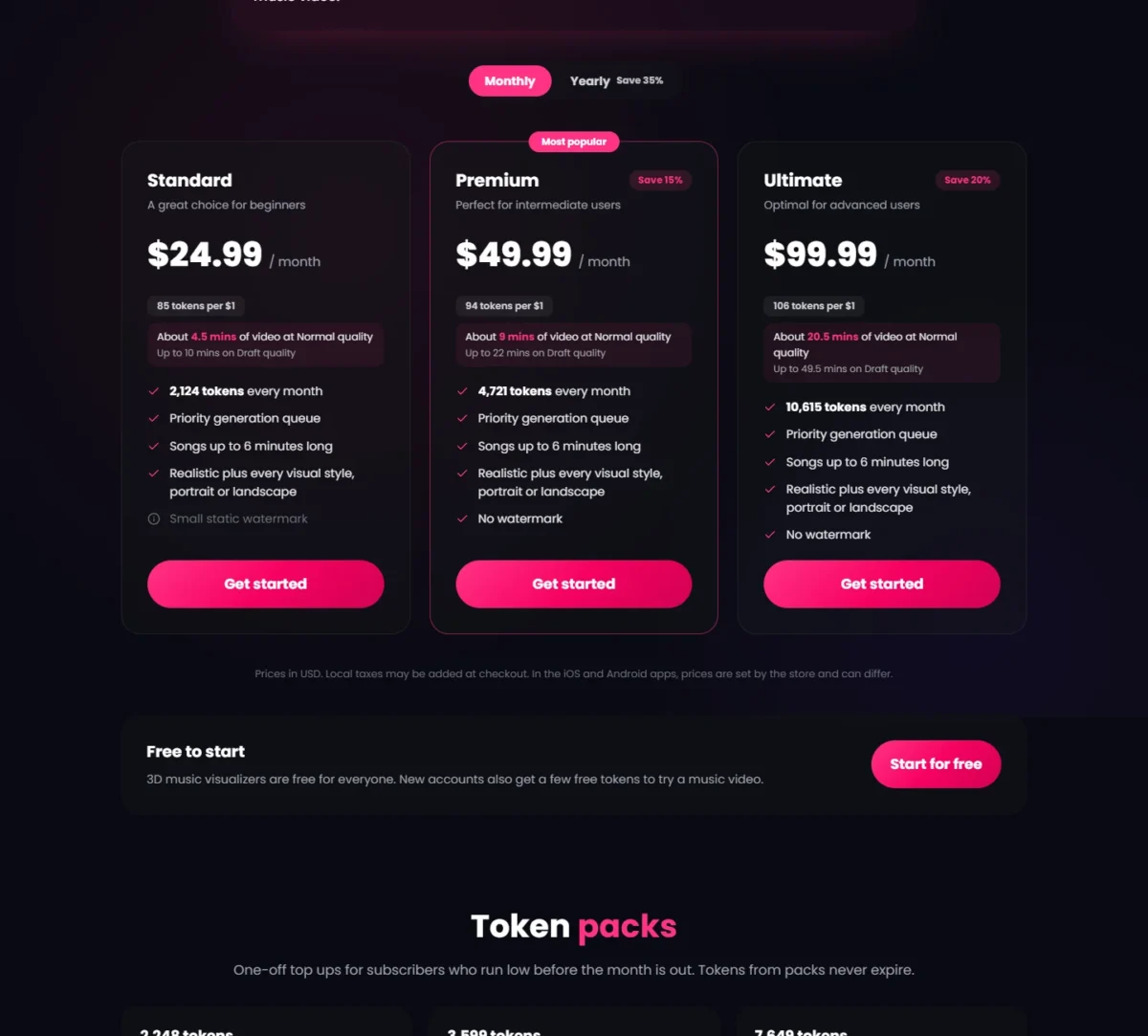
| Plan | Price | Tokens a month | Key limit |
|---|---|---|---|
| Standard | $24.99/ | 2,124 | About 4.5 minutes at Normal quality; watermark |
| Premium | $49.99/ | 4,721 | About 9 minutes; no watermark |
| Ultimate | $99.99/ | 10,615 | About 20.5 minutes; no watermark |
Sources: Muzie pricing, checked November 2026.
Pros
- Any photo becomes a lip-synced singer across multiple scenes
- Studio redoes one shot while the audio stays in sync
- Runs on the web, iPhone and Android
Cons
- The $24.99 Standard plan exports with a small static watermark
- No per-shot retake price or yearly price on the pricing page
- Songs stop at 6 minutes, also on paid plans
- Skip it if:
- you want stems to drive beat-level visuals, which is Neural Frames’ job, or no performer on screen, where Tapemoon fits.
4. LTX Studio: Best for Storyboard-First Directors

- Starting price: Free with 800 one-time credits (personal use); Lite is $15 a month, or $12 a month billed yearly ($144)
- One-scene redo: shot tools (camera, keyframes, references); no song-locked redo described
LTX Studio is my pick for a story video planned like a film: the story comes first and the song second. It starts from a script, a concept, an image or a video, boards the scenes, and lets you direct each shot with camera movement, keyframes and visual references. Audio-to-Video generation is listed from the Free plan up.
Upload a script and LTX generates scenes and storyboards, the reverse of Tapemoon and Muzie, which build the storyboard from the track or its lyrics. The Timeline Editor and Sound Design tools sit in the same workspace, but no LTX page I read describes mapping a song’s sections or beats, so the sync is your job.
LTX runs in desktop browsers, with no mobile app. My list of the best AI tools for content creation covers the rest of a production stack.
Standard is the plan a releasing artist should price: $35 a month, or $28 a month billed yearly ($336), with 28,000 credits and the commercial use license. Lite at $15 a month builds on Free, whose personal use license excludes business, marketing and paid work.
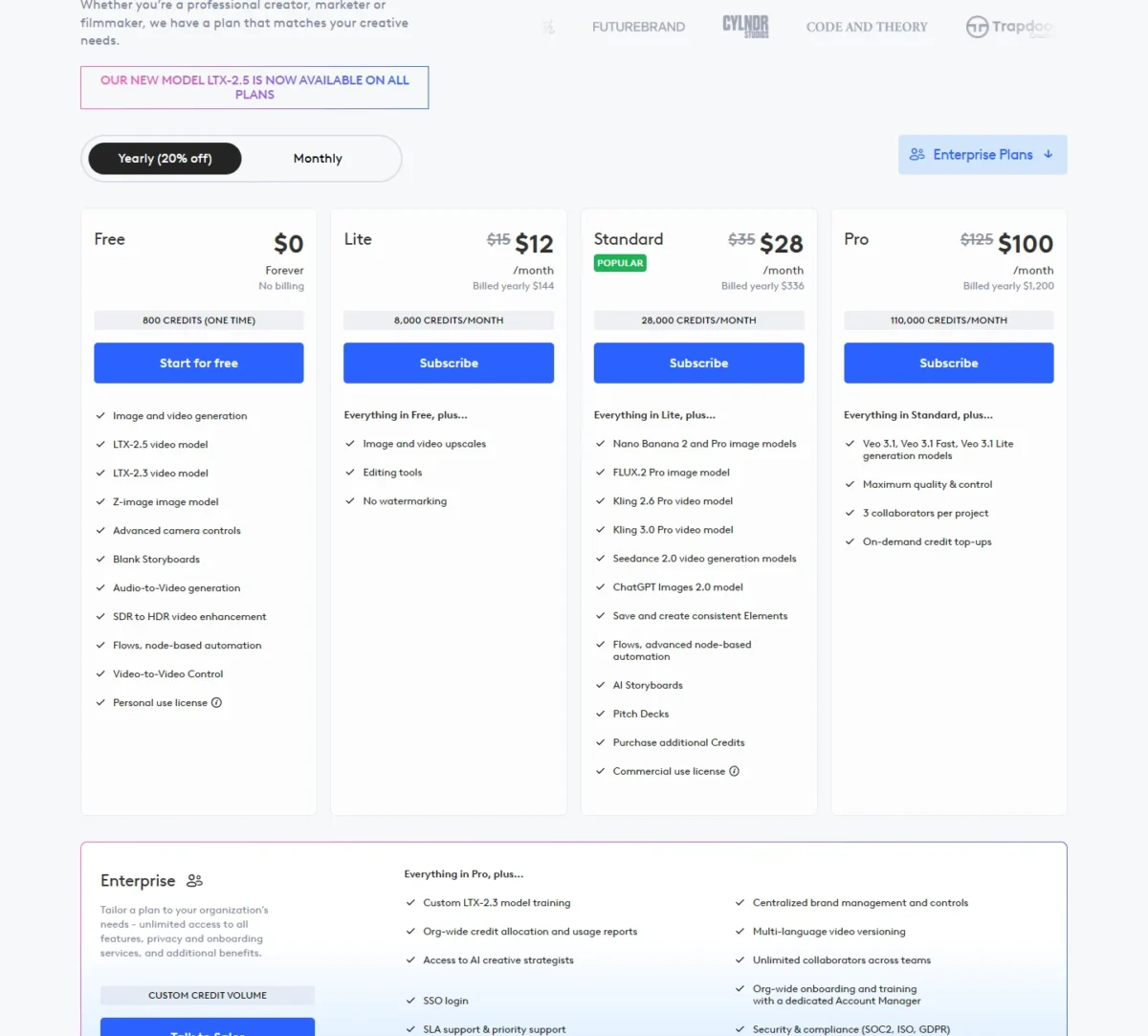
| Plan | Monthly billing | Yearly billing | Key limit |
|---|---|---|---|
| Lite | $15/mo | $12/mo ($144 billed yearly) | 8,000 credits; no watermarking |
| Standard | $35/mo | $28/mo ($336 billed yearly) | 28,000 credits; commercial use license |
| Pro | $125/mo | $100/mo ($1,200 billed yearly) | 110,000 credits; 3 collaborators per project |
Sources: LTX Studio pricing, checked November 2026.
Pros
- Starts from a script, a concept, an image or a video
- Camera movement, keyframes and visual references per shot
- Free plan with 800 one-time credits and Audio-to-Video generation
Cons
- No song mapping or song-locked redo on its home or pricing page
- The commercial use license starts at Standard
- Credits per action are not printed
- Skip it if:
- you start from a finished song and want it mapped for you. Tapemoon builds the storyboard from the track.
5. Runway: Best for Hand-Directed Shots You Assemble Yourself
- Starting price: Free with 125 one-time credits; Standard is $15 a month, or $12 a month billed annually
- One-scene redo: a new generation per shot, placed in the edit by you
Runway prices the shot, not the song, which makes it my pick for a handful of hand-directed hero shots. Gen-4.5 costs 12 credits per second, so a 5-second retake is 60 credits and you know it before you generate. The trade-off is everything around the shot: its pricing and home pages describe no song, section or beat mapping, so syncing the cut to the music is your work.
Each shot follows the prompt you write; Runway lists prompt adherence among Gen-4.5’s strengths. Its plan table counts a Gen-4.5 video as 5 seconds at 60 credits, so a 3-minute song is 36 such clips (180 / 5), each one placed by you.
Standard includes 4K upscaling, no watermarks and music, voice and sound effects generation; Pro and Max make 4K video upscaling unlimited. My Runway review judges the rest of the product.
Pro costs $35 a month, or $28 a month billed annually, for 2,250 credits, which Runway equates to 187 seconds of Gen-4.5. Pro is the smallest plan that covers one 3-minute pass, and Runway’s home and pricing pages state no commercial-use terms. Standard and Pro credits reset each billing cycle, and Runway’s plans and credit math go through each tier.
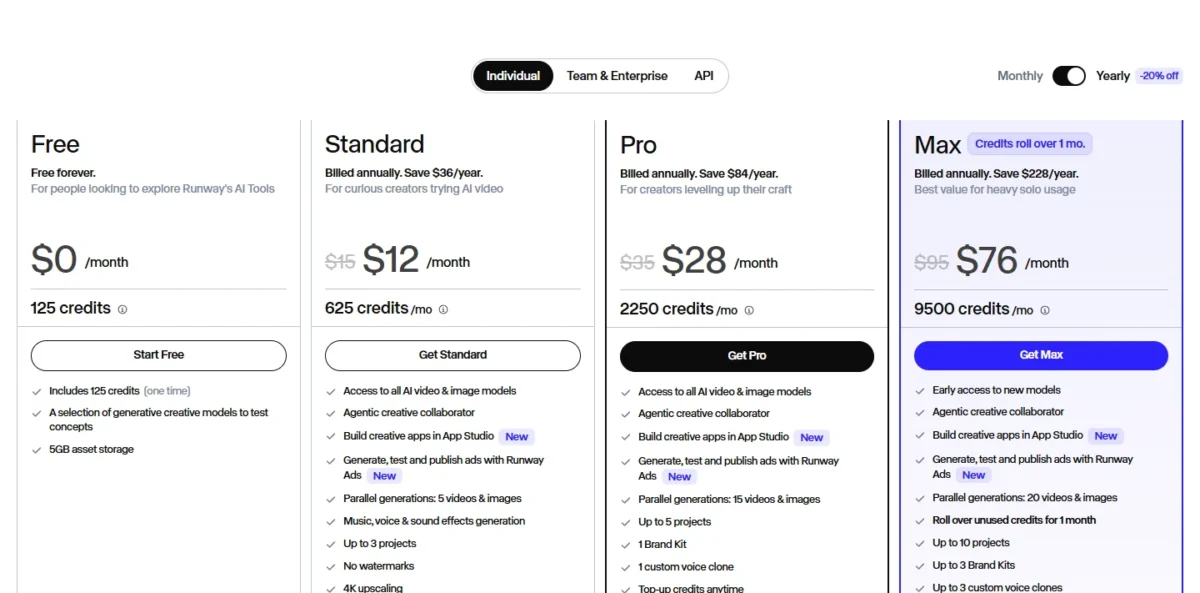
| Plan | Monthly billing | Annual billing | Key limit |
|---|---|---|---|
| Standard | $15/mo | $12/mo | 625 credits, 52 seconds of Gen-4.5 |
| Pro | $35/mo | $28/mo | 2,250 credits, 187 seconds of Gen-4.5 |
| Max | $95/mo | $76/mo | 9,500 credits; one-month rollover |
Sources: Runway pricing, checked November 2026.
Pros
- Per-second pricing by model: 12 credits per second of Gen-4.5
- 4K upscaling from Standard, unlimited on Pro and Max
- Purchased credits never expire
Cons
- With no song or beat mapping, the sync is manual
- A 3-minute Gen-4.5 pass uses 2,160 of Pro’s 2,250 monthly credits
- Standard’s 625 credits cover 52 seconds of Gen-4.5
- Skip it if:
- you want the song to drive the cut. Neural Frames and Tapemoon both build the video from your track.
How to Choose the Best AI Music Video Maker: Text to Video, Song-First or Shot-First?
Choose a song-first music video generator if you start from a finished audio track and want fixes billed by the scene. Choose a shot-first tool if you start from shots or a script and are ready to edit.
A regenerate beats a delete, because a scene redo keeps the cut. Song-first tools take music video creation from track to finished video, while shot-first tools leave the sync to you.
| Criterion | Neural Frames | Tapemoon | Muzie | LTX Studio | Runway |
|---|---|---|---|---|---|
| Maps your finished song | Yes: 8 stems | Yes: beats, sections, lyrics | Yes: lyrics | Not listed | Not listed |
| One-scene redo, audio in sync | Chat refinement | One scene, billed by length | Yes | Not listed | Not listed |
| Lip-synced singer | Lyric & lipsync | Fictional character | Your photo | Not listed | Not listed |
| 4K | Neural Ninja | Up to 2K | HD render | Not listed | Standard |
| No watermark | Paid plans | Every paid option | Premium | Lite | Standard |
| Commercial use | Yes | Every paid option | Not listed | Standard | Not listed |
Sources: Neural Frames, Tapemoon, Muzie, LTX Studio, Runway, checked November 2026.
My take
My advice: if you cannot name the editor you would cut the video in, buy a song-first tool.
Shortlists by Job
If none of the five fits:
- Prompts only, with no song: text-to-video generators ranked by job
- No song yet: AI music generators, then come back with the track
- Footage already shot: AI video editors, since Tapemoon rules out concert footage
FAQ
Can AI Make a Music Video From My Own Song?
Yes. Neural Frames, Tapemoon and Muzie build the video from your uploaded track, and LTX Studio lists Audio-to-Video generation from its Free plan. Runway leaves the sync to you.
Can I Make a Music Video From a Text Prompt Alone?
Partly. Neural Frames has a Text-to-Video Editor, and LTX Studio starts from a script or a concept. Muzie can generate the song itself from a description. Tapemoon needs a track or a Suno link first; its AI music maker creates a song for 5 credits. On Runway, a prompt directs each shot, and syncing the song stays your job.
Is There a Free AI Music Video Maker?
Each free start is a sample, not a release. Neural Frames starts free with no credit card, Tapemoon gives one track a storyboard and a 15-second watermarked preview, Muzie gives new accounts in many countries a few tokens, LTX Studio’s Free plan holds 800 one-time credits for personal use. Runway’s holds 125 one-time credits. My ranking of free AI video generators compares general tools.
Do AI Music Video Makers Export in 4K?
Two of the five list 4K, as upscaling: Neural Frames on Neural Ninja and Neural Nirvana, and Runway from Standard. Tapemoon goes up to 2K, Muzie says “HD render” without a pixel figure, and LTX Studio lists upscales without a resolution.
Final Verdict: My Pick for Each Situation
- Neural Frames, on Neural Ninja at $99 a month, for stem-driven control. The trade-off: no printed retake price.
- Tapemoon, at $19 a month or the $23 pack, for a fix billed by the second. The trade-off: characters that shift between scenes.
- Muzie, on Premium at $49.99 a month, for a singer on screen. The trade-off: no stem-level control.
- LTX Studio, on Standard at $35 a month, for a storyboard-first video. The trade-off: the sync is yours.
- Runway, on Pro at $35 a month, for hand-directed hero shots. The trade-off: one 3-minute pass uses most of the month’s credits.
With one finished single and no editor, I would open Tapemoon’s free 15-second chorus preview first. Judge its lip-sync and scene match yourself, then test one retake on the $23 pay-once pack before you subscribe. For video without a song to sync, see my AI video tools compared by job.