
This Monid review lands on a split verdict: Monid is worth trying if your AI agent runs varied, occasional data jobs, and it is not yet a default dependency for customer data or unattended high-volume work. Your agent finds, inspects and runs a paid tool at runtime from one wallet, with no per-tool sign-up.
I tested Monid in my own prepaid wallet on November 6, 2026: 19 completed runs cost $0.11233 in total.
There is no subscription: each endpoint bills per call or per result, and you start with $1 in free credit.
Skip it if one steady job on one provider fills your month, or if your work falls under HIPAA, which Monid’s terms rule out. Plan first for the wallet itself: a short balance stops the run with a 402.
Quick verdict
Monid is worth it for a solo builder or small team whose agent needs different data sources from week to week: one balance replaces a stack of provider sign-ups.
Skip Monid if you run one provider at steady volume, handle HIPAA-regulated data, or need guaranteed availability, which its terms say they cannot promise. A business team should first get one clause clarified in writing: the terms bar commercial endeavors except those Monid specifically endorses or approves.
Main strength: the agent picks and prices a tool at runtime. Biggest limit: no fixed monthly price, because each endpoint has its own price.
Price basis: prepaid wallet, $5 minimum top-up, per call or per result, $1 in free credit.
In This Article (13 sections)
Monid at a Glance
- Category: gateway to paid data endpoints for AI agents and developers
- Best for: varied, occasional agent data jobs on a small team
- Price basis: prepaid wallet, each endpoint priced per call or per result
- Free credit: $1, one signup credit per workspace
- Catalog: 2,984 tools from 97 providers on the Tools page, checked Nov 2026
- My test: November 6, 2026, prepaid wallet, 19 completed runs
Monid Pros and Cons
Pros
- No subscription or contract, so an occasional user has no monthly charge to carry
- No per-tool sign-up, which helps an agent whose data jobs change week to week
- Prices appear in discover, inspect and run responses, so a builder can gate spend before a call, though the pricing guide does not say whether discover and inspect are charged
- Provider errors are not charged, and a 408 timeout is zero-billed
- Workspace budgets and per-run caps give an unattended agent a hard spending limit
Cons
- Each endpoint has its own price, which hurts a team that needs a fixed monthly number
- Per-result cost grows with results, so a high result limit is the quickest way to overspend
- Endpoints without the 0 Markup label may include a platform fee, so buying direct can cost less
- Monid’s terms bar HIPAA- and FISMA-bound use, which rules out regulated teams
- On the one site I tested, Ahrefs counted 1,157 live referring domains and DataForSEO 226, so the provider changes the answer
My take
The con I would weigh first is the missing fixed monthly price: Monid is worth it when a team can live with a variable bill.
What Is Monid?
Monid is a gateway to paid data endpoints that humans and AI agents pay for from one wallet. It is a tool layer, not an agent, so it is worth it when you already run a client such as Claude Code or Codex, and that client’s model bill is separate.
Monid’s GitHub page pitches it as “OpenRouter, but for agent tools”, and the comparison holds only for the billing idea.
Monid Features
Monid’s MCP quickstart offers four starter prompts of its own: a public profile, a competitor research report, GTM leads and customer sentiment. The profile and lead prompts touch personal data, so check your own compliance duties first.
Four things decide whether Monid fits.
Discover, inspect and run at runtime
Your agent searches in plain language, reads the endpoint’s input schema, output shape and price, then makes the call. If Claude is your likely client, my full Claude verdict is the place to weigh it.
One wallet across every provider
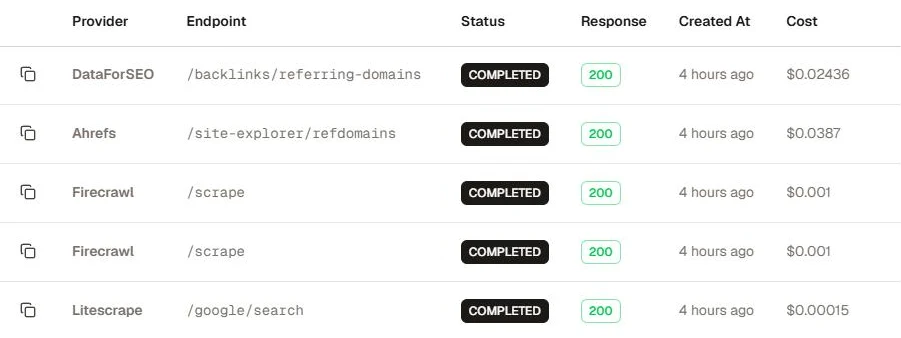
In my account, the dashboard’s Usage page listed each run with provider, endpoint, status, response code, time and cost, and the costs matched what the API reported. The catch: one empty balance stops every tool at once.
The catalog: 2,984 tools or hundreds of endpoints?
Check your tool by name, because Monid’s own pages give four different sizes. The Tools page says 2,984 tools from 97 providers, the homepage says 2900+ across 97+ providers, the GitHub page says 2,000+ across 72+, and three docs pages still say “hundreds of data endpoints”.
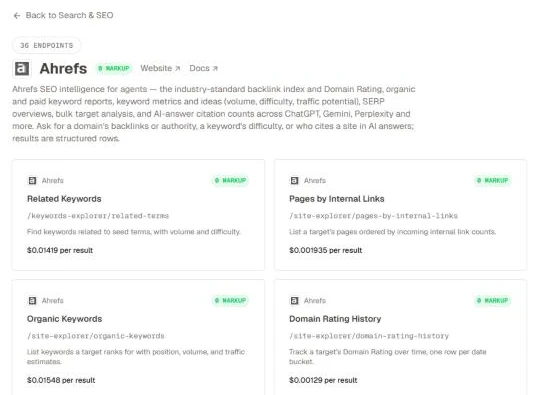
I read a “tool” as an endpoint, not a product: in my account, the Ahrefs page alone listed 36 endpoints, each with its own per-result price.
What real endpoints returned
On the one site and one keyword I tried, the provider changed both the bill and the answer.
Link data. For saascrmreview.com, a limit of 10 rows on referring domains cost $0.0387 on Ahrefs and $0.02436 on DataForSEO. Ahrefs counted 1,157 live referring domains, and DataForSEO gave a total count of 226. I would run both on a domain whose links you already know before you pick one, since the check costs cents.
Pricing pages. With the location set to the US, Firecrawl returned Shopify at $29, $89 and $359, Squarespace at $25, $39, $65 and $139 monthly and Pipedrive at $14, $39, $59 and $79, each matching the US price I already knew. Set to Vietnam, the Pipedrive page returned the same US prices, so this one test does not prove the location setting changes what a page serves. If regional prices are your job, first try a page whose regional price you know.
Google results. For “xero review” in the US, Litescrape returned 8 organic results, 5 with google.com/goto wrapper links, and DataForSEO returned 7, all with those links. Against a result saved 30 minutes earlier from the SERP tool I normally use, these two returned only 2 of that tool’s 8 domains. The reads were not simultaneous and I did not establish which result is right, so compare these endpoints with your own SERP source before you build a rank report on them.
My take
Runtime discovery and the shared wallet are worth it when your agent’s data needs change from job to job. Pick a pinned provider if the same endpoint runs every time, because you give up little.
Monid Ease of Use
An existing MCP client such as Claude Code, Codex or ChatGPT needs one server URL and an authorization step, with no CLI install. The Skill route has you create a key and send it to the agent, so the agent holds a live key. The CLI route has four numbered steps and shows the key once.
The HTTP API takes a Bearer API key or OAuth/JWT token; pick it if you are wiring Monid into your own code.
If you are still choosing a terminal client, how Codex and Claude Code differ settles that first.
My take
Pick MCP if your client supports it, because authorization replaces pasting a key into a conversation. With the Skill, give the agent a key without the topups:create scope.
Monid Pricing
Monid has no plans and no per-seat price: each endpoint has its own price, charged to a prepaid wallet per call or per result.

| Model | Price | Billing | Key limit |
|---|---|---|---|
| Per-call | $0.003 per call in Monid’s example | Prepaid wallet | Flat fee whatever the result count |
| Per-result | $0.002 base fee + $0.001 per result in Monid’s example | Prepaid wallet | Cost grows with results |
| Signup credit | $1 | One per workspace | No expiry stated |
| Top-up | $5 minimum | Hosted Stripe checkout | Processing fee applies |
| x402 | $0.01 minimum per run | USDC per run | No metered endpoints |
Sources: Monid pricing, top-up limits, Pay with x402, checked Nov 2026.
Those two prices are illustrations, not a rate card, so ask the agent for the inspect price first. Monid’s pricing guide shows prices in discover and inspect responses but does not state whether those two calls are charged. Three more costs sit outside those two:
- Platform fee. Monid’s terms price “0 Markup” endpoints at the provider’s standard self-serve rate; others may include a platform fee.
- Top-up fee. The top-up configuration describes a percentage processing fee with 5% as its example rate: 5% x $100 = $5 on a $100 top-up.
- Rent. The docs index lists provider resources such as phone numbers with recurring rent, so “no subscription” describes the wallet, not every item.
The terms point to a Return Policy and state no refund rule, which is my reason to keep early top-ups small. If Claude is your client, price its model plan with my Claude pricing guide.
What real calls cost
The calls I report cost from $0.00015 for one Google result pull to $0.0387 for 10 Ahrefs rows, so a trial the size of mine fits inside the $1 credit at those prices. The cheapest call I report was also the slowest, at 11.5 seconds, and the fastest took 1.1 seconds, so read the time as well as the price if your agent waits on each answer.
What a Monid job costs
On per-result endpoints the result limit sets the bill, not the call count.
Take an illustrative agent job built on Monid’s two example prices: 3 flat calls (3 x $0.003 = $0.009) plus one per-result run.
| Results | Whole job | 440 jobs a month |
|---|---|---|
| 100 | $0.009 + $0.102 = $0.111 | 440 x $0.111 = $48.84 |
| 1,000 | $0.009 + $1.002 = $1.011 | 440 x $1.011 = $444.84 |
Sources: Monid pricing, checked Nov 2026; the job mix is illustrative.
So set the result limit before you size the wallet. The dial is an input such as maxItems in Monid’s CLI example.
What replaces the upgrade trigger
Nothing forces an upgrade, because there is no plan to outgrow. Two signals do that job:
- One endpoint dominates your spend. Compare
monid inspectwith the provider’s own page: Apify’s page for apidojo’s tweet scraper lists from $0.40 per 1,000 tweets ($0.40 / 1,000 = $0.0004 a tweet), against$0.003/callin Monid’s sample output. The flat call is cheaper above $0.003 / $0.0004 = 7.5 tweets a call, and direct is cheaper below. - Traffic turns steady and high. Monid invites those users to email support@monid.ai about volume-based discounts.
My take
Monid’s pricing is worth it when your jobs vary. On a per-result endpoint at the example table’s larger result count, I would price the provider direct first. A flat-call endpoint can reverse that, so compare monid inspect with the provider’s page at your own result count.
Is Monid Ready for Production?
Monid fits supervised and low-stakes runs, and it can run unattended only after you set its spending controls and handle its stop conditions.
A workspace budget caps spend per hour, day, week or month, and a run cap limits a single run. A run that hits a control comes back as a 200 with status BLOCKED, so an agent that reads only the HTTP code will think it succeeded.
| Signal | Meaning | What to build |
|---|---|---|
| 402 | Your wallet balance is short | Stop and send a person a checkout link |
| 200 BLOCKED | A workspace control rejected the run | Read the run status, not only the HTTP code |
| 408 TIMED_ | The run passed its time budget; zero-billed | Retry once with a smaller job |
| 502 | The provider’s own payment or quota failure; not charged | Discover another endpoint |
| 503 | Service unavailable, for example an inactive wallet | Stop and have a person check the wallet |
| Provider 4xx or 5xx | Provider error or no match; not charged | Treat it as no data |
Sources: Start a run, monid run, API overview, checked Nov 2026.
The 408 hits synchronous runs; an async run returns a 202, and the agent polls its status and can stop it, zero-billed, while it is queued or running.
I sent one deliberately incomplete call, Ahrefs /site-explorer/backlinks-stats without its required date, and got an HTTP 400 with no charge seen on the balance. That is one call, so still watch the balance.
An HTTP 200 with poor data is the case that table leaves out. monid dispute covers broken or useless results, but the page promises no refund.
The terms, updated October 16, 2026, say users subject to laws such as HIPAA and FISMA may not use the service. They make you solely responsible for data you transmit.
One clause bars commercial use except what Monid specifically endorses or approves, so get that clarified in writing. The terms also say “We cannot guarantee the Services will be available at all times.”
The privacy notice says no purpose needs personal information kept past the life of your account, but it names no DPA, compliance report or retention period for run data. A customer-data team should ask Monid for those before sending any records.
My take
Running Monid unattended is worth it when the job is public web research, a daily budget and a run cap are set and the agent handles the stop signals above.
Who Should Use Monid?
Monid is worth it when you are a small team or solo builder with an agent client already running and data jobs that change. If you have no agent yet, choosing an AI chatbot to start from comes before any wallet.
Best for
- A solo builder on Claude Code or Codex whose data sources change, since no per-tool sign-up is needed
- A product builder prototyping data access, since OAuth and proxy routes exist for later, though the terms bar commercial use Monid has not approved and reserve the right to limit orders that appear to come from resellers
Not ideal for
- One steady high-volume scraping job, since the provider’s own price may beat an endpoint without the 0 Markup label
- An unattended agent with no budget or balance alerts, since a 402 or BLOCKED run stops the work
- Customer records, until legal has read the terms
- Skip it if:
- regulated data defines your work, or one steady job fills your month.
Monid vs Competitors
Monid sells metered data tools from one balance, while Composio connects agents to apps, Apify sells scrapers direct and RapidAPI sells APIs one by one.
| Software | Best for | Starting price | Main trade-off |
|---|---|---|---|
| Monid | Varied agent data jobs | No subscription; $1 credit, $5 minimum top-up | Price varies by endpoint |
| Composio | Agents acting in your own app accounts | Hobby free with 100,000 tool calls a month; Pro $29 a month | Pro’s monthly credit does not roll over |
| Apify | Steady scraping on known scrapers | Free $0 with $5 to spend; Starter $19 a month | Separate from your other data vendors |
| RapidAPI | Buying one API on its own plan | Set by each API’s provider | Quotas and overage fees per plan |
Sources: Composio pricing, Apify pricing, RapidAPI plan types, checked Nov 2026.
My take
Composio is worth it when the agent must send the email or update the CRM record. Pick Monid if it must find the data first.
Best Monid Alternatives
A direct provider is worth it when one job fills your month. For recurring email finding on a predictable budget, a dedicated email finder like Hunter is the simpler buy.
How I Tested Monid
On November 6, 2026 I tested Monid in my own account on its prepaid wallet, through the API with my key and in the signed-in dashboard. The balance went from $101.00 to $100.88767, which is $0.11233 across 19 completed runs. The table holds the runs I report here, not all 19, so it does not add up to that change.
| Run | What came back | Cost | Time |
|---|---|---|---|
| Ahrefs link totals, saascrmreview.com | 2,279 live backlinks, 1,157 live referring domains | $0.00774 | 1.6 seconds |
| Ahrefs top referring domains, limit of 10 rows | 10 rows | $0.0387 | 1.3 seconds |
| DataForSEO referring domains, limit of 10 rows | Total count of 226 domains | $0.02436 | 1.1 seconds |
| Firecrawl, three pricing pages, US location | Matched the known US prices | $0.001 a page | 5 to 11 seconds |
| Firecrawl, Pipedrive pricing page, Vietnam location | The same US prices | $0.001 | 5.3 seconds |
| Litescrape Google US results, “xero review” | 8 organic results | $0.00015 | 11.5 seconds |
| DataForSEO Google US results, “xero review” | 7 organic results | $0.002 | 5.1 seconds |
| Ahrefs link totals without the required date | HTTP 400 | No charge seen on the balance | Not recorded |
Sources: my test account, November 6, 2026; Monid’s Ahrefs page lists the per-result prices.
This test covers one day, one site and one SERP keyword, and the run times are single readings, not averages. I did not test long-run reliability, volume, the MCP connection, x402 payment or social and review endpoints. I draw no conclusion on prices of pages other than the three I named.
Plans, limits and terms come from Monid’s own pages, which I read on November 6, 2026. The promo-code page states no expiry for the signup credit.
Monid FAQ
Which Monid does this review cover?
This page covers the agent gateway at monid.ai, run by Monid, Inc., not any other product that shares the name.
Is Monid open source?
Partly. Monid’s GitHub page lists an MIT license for the connector layer, and the hosted version holds the wallet and the single balance.
Monid Review: Final Verdict
Fund a Monid wallet for a low-stakes trial on a real job, using the $1 credit and a small result limit, and keep customer data out until the terms pass your own check.
My test supports that start: each call I report cost under 4 cents and the Usage page matched the API. It also showed why to compare providers first, since Ahrefs and DataForSEO differed widely on one site.
My take
A small balance is worth it when four checks pass: the endpoint you need shows a price you accept on inspect, it carries the 0 Markup label or a fee you can live with, a workspace budget and run cap are set, and Monid has approved any commercial use in writing.