
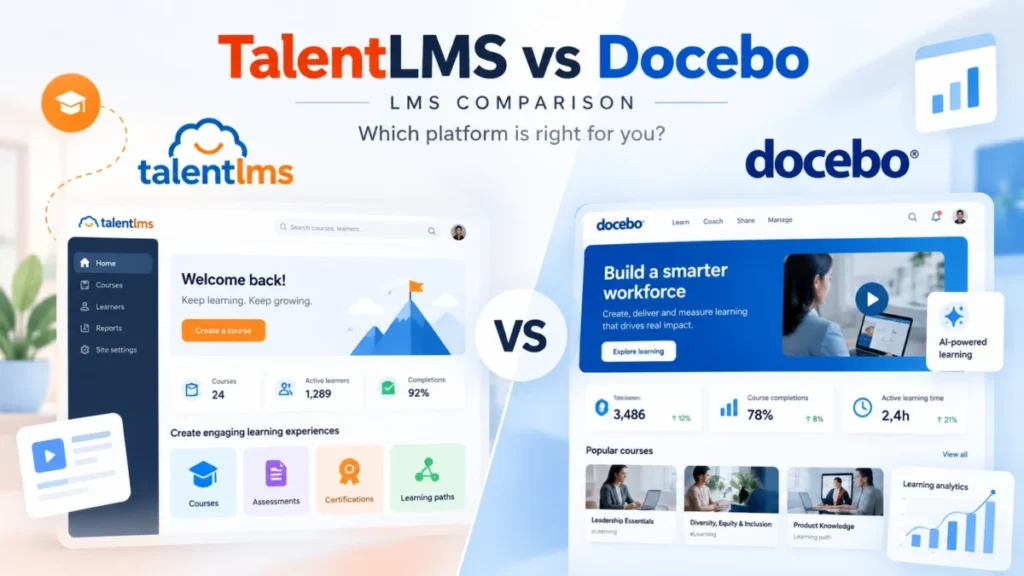
In TalentLMS vs Docebo, pick TalentLMS if you train up to about 100 people and want a price you can see today. Pick Docebo for 250 or more learners across employees, customers and partners.
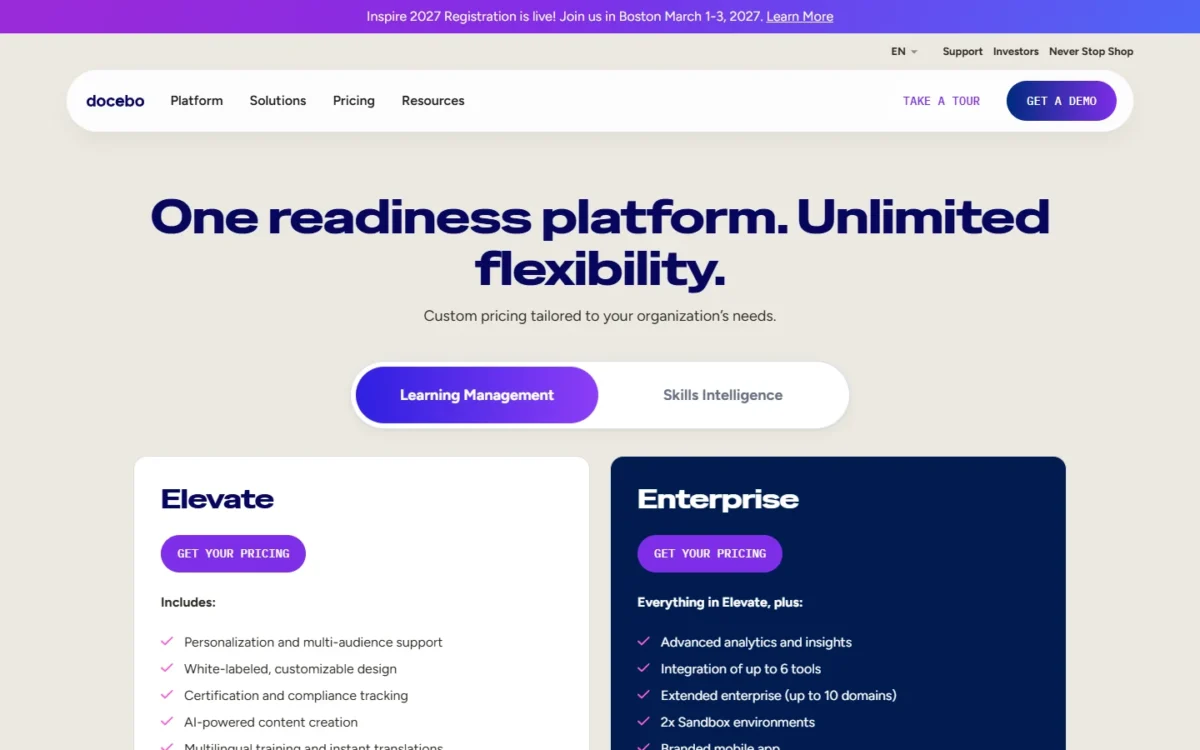
TalentLMS Core costs $119 a month billed yearly for up to 40 users, and a free plan lets you build before paying. Docebo publishes no prices: it quotes by tier and active users, with a one-year minimum contract.
In This Article (11 sections)
TalentLMS vs Docebo: The Short Answer
TalentLMS wins on a visible price and a free start; Docebo wins when several large audiences meet a procurement team that accepts a quote. Learner count and audience count decide it:
| Your situation | Pick | The fact that decides it |
|---|---|---|
| 40 employees, one internal academy | TalentLMS Core | $119 a month billed yearly ($1,428 a year) for 1-40 users |
| Up to 100 learners in up to 15 branded portals | TalentLMS Pro | $449 a month billed yearly ($5,388 a year) for 1-100 users and 15 branches |
| 250+ learners across employees, customers and partners | Docebo | Docebo’s own best-fit statement starts at 250+ learners |
| Branded customer and partner domains plus test sandboxes | Docebo Enterprise | Extended enterprise up to 10 domains and 2 sandbox environments |
| A US federal agency | Docebo Federal | Docebo’s FedRAMP-authorized platform |
| Monthly billing and the right to cancel any time | TalentLMS | Cancel any time; the portal stays active to the end of the billing cycle |
Sources: TalentLMS pricing page and Docebo pricing page, checked October 2026.
The hard zone is 100 to 250 learners: TalentLMS Pro adds a per-user charge above 100, and Docebo’s fit statement starts at 250. Price TalentLMS first, using the plan costs in my TalentLMS review, and ask Docebo for a quote only when you need several audiences or sandbox environments.
TalentLMS vs Docebo at a Glance
The table’s clearest differences are price visibility, contract terms and the user range each vendor states.
| Product | Price you can see | Billing and contract | User range the vendor states | Branded portals | AI emphasis |
|---|---|---|---|---|---|
| TalentLMS | Core $119, Grow $229, Pro $449 a month billed yearly; Enterprise by quote | Monthly or yearly; cancel any time | Core base bracket 1-40 users; Pro includes 1-100 users; Enterprise starts at 1,000 users | 1 branch on Core, 3 on Grow, 15 on Pro, unlimited on Enterprise | Course creation in TalentCraft, metered in AI credits |
| Docebo | None: custom pricing per tier (Elevate or Enterprise) | One-year minimum; most customers sign 3–5 years | 250+ learners across customers, partners and employees | Extended enterprise up to 10 domains on Enterprise | AI assistant for search, admin help and reporting |
Sources: TalentLMS pricing page and Docebo pricing page, checked October 2026.
Both support SAML single sign-on, mobile learning, certifications and gamification, and both list ISO and GDPR credentials, so none of these should decide the purchase. The price column is the widest gap.
My 100-learner line for TalentLMS is the 100 users Pro includes before its $6 per additional user.
Pricing: A Published Price List vs a Custom Quote
TalentLMS publishes every self-serve plan price; Docebo publishes none. A 40-person team can budget TalentLMS today, while a Docebo buyer waits for a sales conversation to end.
What TalentLMS costs at 40, 70 and 100 users
A year of TalentLMS costs $1,428 for up to 40 users on Core, $2,748 for up to 70 on Grow and $5,388 for up to 100 on Pro, billed yearly. Monthly billing raises each total:
| Plan and base bracket | Billed yearly | Billed monthly for 12 months | Yearly billing saves |
|---|---|---|---|
| Core, 1-40 users | $119 x 12 months = $1,428 | $149 x 12 months = $1,788 | $360 ($1,788 – $1,428) |
| Grow, 1-70 users | $229 x 12 months = $2,748 | $299 x 12 months = $3,588 | $840 ($3,588 – $2,748) |
| Pro, 1-100 users | $449 x 12 months = $5,388 | $579 x 12 months = $6,948 | $1,560 ($6,948 – $5,388) |
Sources: TalentLMS pricing page, yearly and monthly views, checked October 2026.
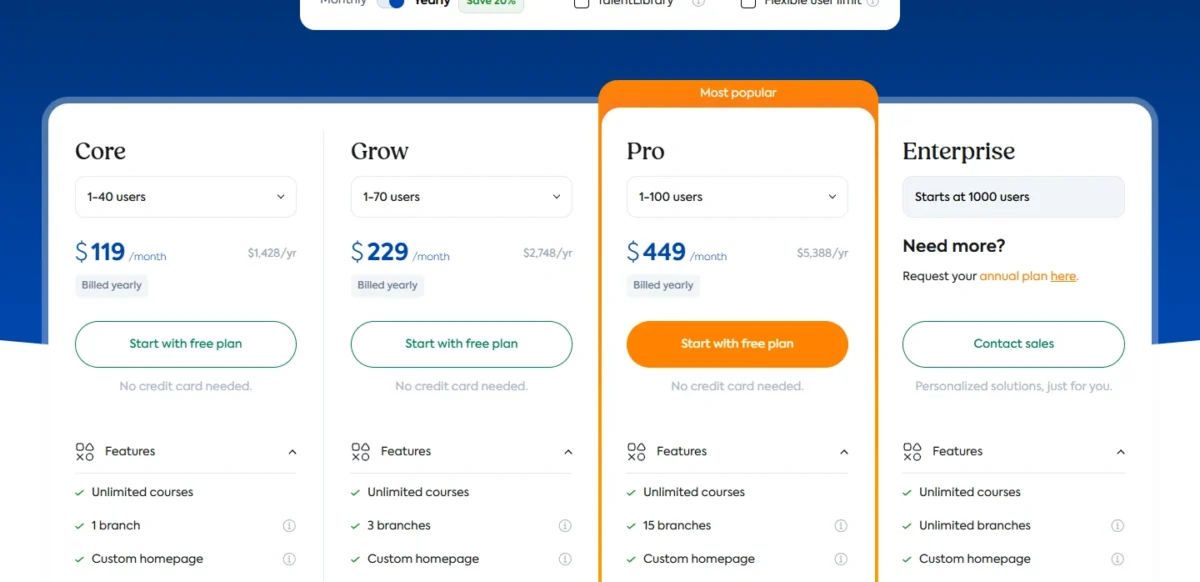
The page advertises “Save 20%” for yearly billing. Core matches it ($119 against $149), but Grow’s $229 against $299 is a 23% cut and Pro’s $449 against $579 about 22%.
These are base brackets: Core’s dropdown also lists 41-70 and 71-100 users, so a 70- or 100-person team should price Core before assuming it needs Grow or Pro.
Above 100 users, Pro adds $6 per additional user. The Flexible user limit, available up to 500 users on Pro, bills on unique monthly logins with soft limits, so a seasonal spike costs money but never locks learners out.
How Docebo builds a quote
A Docebo quote is set by tier (Elevate or Enterprise), by active-user model and by optional add-ons, on a contract of at least one year. Docebo counts users in one of three ways:
- Monthly Active Users (MAU): learners active within a given month
- Yearly Active Users (YAU): anyone active at any point in the contract year
- Registered Active Users (RAU): every user marked active, with licenses you can deactivate and reassign
MAU suits a customer academy whose learners log in only some months. RAU suits a stable workforce, since a leaver’s license can pass to the next hire.
Going over the user limit does not force a new plan: Docebo bills the extra users and suggests the next tier at about 30% overage, per its pricing FAQ. Setup may be included for simple deployments; otherwise Docebo scopes onboarding fees during the sale.
Five questions settle most of a Docebo quote:
- Which tier, and which Enterprise items (domains, sandboxes, API rate) do you need?
- Which user model fits how often your learners log in?
- Is onboarding included, or what is the scoped fee?
- Which add-ons are in the quote, including Salesforce or Teams embedding?
- What are the renewal terms on one year versus a multiyear term?
I would not take Docebo to procurement for a program under 250 learners unless it needs several audiences or sandbox environments, because 250 is where Docebo’s own fit statement begins.
The limits that push you to the next plan
On TalentLMS, more users first move you to a higher bracket. The plan triggers are branches, learning paths, automations, branding removal and AI credits. On Docebo they are the Enterprise additions and the overage rule above.
TalentLMS:
- Users: a larger team first moves to a higher bracket on the same plan (Core also lists 41-70 and 71-100 users). Pro adds $6 per additional user above 100; Enterprise starts at 1,000 users. The yearly totals above are base-bracket prices.
- Branches: a fourth branded portal means Pro, a sixteenth means Enterprise.
- Learning paths: 5 on Grow, unlimited on Pro and Enterprise.
- Automations: Pro and Enterprise, per the TalentLMS automations guide.
- Branding removal: Pro and Enterprise, per the help article on removing TalentLMS branding.
- AI credits: Core’s 5,000 are one-time; Grow renews 10,000 a month.
Docebo Enterprise adds extended enterprise up to 10 domains, 2 sandbox environments, a branded mobile app, API access at 100 calls/min, a dedicated database, advanced analytics and elite support.
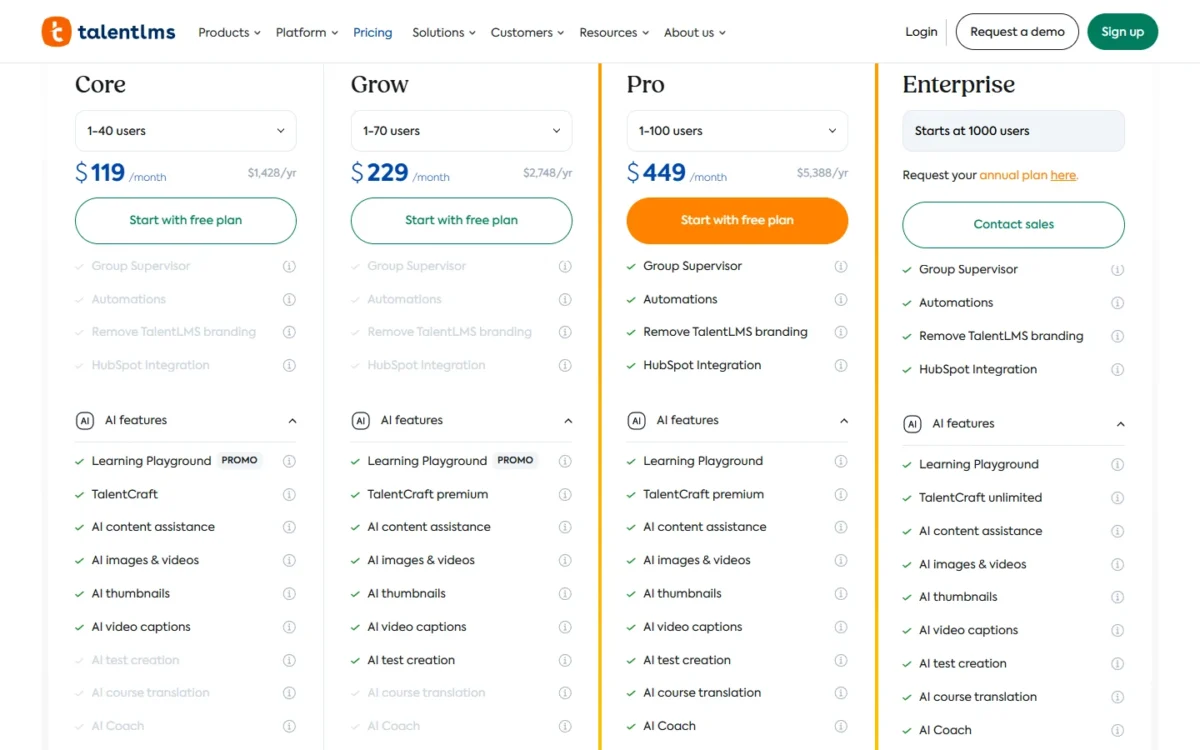
The trigger I would watch first is automations. A 20-person team that wants rule-based course assignment pays $5,388 a year for Pro instead of $1,428 for Core, both base-bracket prices billed yearly: $3,960 more for the same headcount.
Docebo folds onboarding into its quote, which raises the setup question.
Setup: A Free Self-Serve Portal vs a Scoped Implementation
TalentLMS needs no sales step: an admin opens a Free portal with no credit card and no setup fee, then gets onboarding help that grows with the plan. Docebo runs an implementation whose fee, if any, is scoped during the sale.
The TalentLMS Free plan has no time limit and holds 5 users and 10 courses. Its 1,000 one-time AI credits cover at least 3 generated pages (1,000 ÷ 300), a taste of TalentCraft rather than a catalog.
Paid TalentLMS plans add onboarding in steps:
- Core: Discovery, ready-made guides plus one expert-led consultation call
- Grow: Starter, two weeks of guided onboarding with two expert-led sessions
- Pro: Advanced, a month of weekly sessions, then two months on demand
- Enterprise: Premium, unlimited support from a dedicated Account Manager
Docebo’s onboarding runs through consultation, needs assessment, configuration, content migration, admin training, integration setup, user import and QA testing.
TalentLMS needs no contract to open a Free portal, which suits a team without an LMS admin that wants to test before committing. An integration-heavy program gets more from Docebo, whose team sets up and tests the integrations.
Once both are live, the daily training work looks more alike.
Course Creation, Content and Training Management
TalentLMS lists courses, learning paths, assessments, certificates and reports; Docebo’s base tier lists certification and compliance tracking plus learning insights and reporting. Both run SCORM and xAPI packages, and TalentLMS also lists cmi5 and LTI 1.3.
TalentLMS adds its own TalentLibrary of 1,000+ CPD-accredited courses, an add-on that is exclusive to TalentLMS and used as is, with no editing. Its Course Store adds compliance courses, including options that meet specific state training requirements.
Docebo’s base tier includes certification and compliance tracking, instant translations, admin and workflow automation, and social learning; Enterprise adds advanced analytics. For ready-made content, Docebo connects OpenSesame and Go1, while TalentLMS connects OpenSesame and LinkedIn Learning.
Docebo lists workflow automation in its base tier, while TalentLMS reserves automations for Pro and Enterprise. TalentLMS favors the small HR team that wants finished compliance courses on day one; Docebo favors the L&D team running its own multilingual catalog.
Both pitch AI as the time saver, aimed at different people.
AI Features: Authoring Credits vs an AI Assistant Layer
TalentLMS spends its AI on creating content, metered in credits by plan; Docebo spends its AI on finding answers for learners, admins and managers.
TalentCraft generates course pages, images, videos, flashcards and questions. The TalentLMS AI credits guide prices each action: up to 300 credits for an AI-generated page, up to 600 for a document import.
That makes Core’s one-time 5,000 credits worth at least 16 generated pages (5,000 ÷ 300), ever. Grow’s 10,000 a month covers at least 33 pages a month (10,000 ÷ 300); Pro gets 15,000 a month (25,000 on ProFlex) and Enterprise 80,000.
Annual plans receive the year’s credits up front (120,000 on Grow), which suits a team building a catalog in one burst. A plan change resets the balance to the new plan’s limit, so unused credits do not carry over.
The Pro card also lists AI course translation into 40+ languages and AI Coach, which guides learners inside courses.
Learning Playground is a built-in practice space where learners rehearse conversations and test their knowledge without grades. It carries a PROMO tag on Core and Grow, because TalentLMS says it may move to a higher plan.
Docebo’s AI assistant works on retrieval and guidance instead:
- Semantic search and course recommendations for learners
- Step-by-step guidance for admins
- Conversational Insights: enrollment and compliance questions answered in plain language
- AI Tutor inside each course
- An MCP Server that connects Docebo to Claude, Microsoft Copilot and ChatGPT
Docebo states that customer data never trains its models, and its base tier includes both the AI assistant and AI-powered content creation. Docebo does not publish usage limits or credit counts for its AI.
With no published limits for Docebo’s AI, the two cannot be compared on how much content each lets you author.
TalentLMS can be counted: a one-person L&D team writing from scratch gets at least 16 generated pages in total on Core, whose credits do not renew, and at least 33 a month on Grow.
A large catalog with many admins gains more from Docebo, where a manager asks for overdue compliance enrollments instead of building a report.
AI only pays off if the LMS also connects to your HR and CRM systems.
Integrations: Native Connectors and Zapier vs 400+ and Docebo Connect
Both connect to the common stack, including BambooHR, ADP Workforce Now, Salesforce, HubSpot, Microsoft Teams and SAML single sign-on. TalentLMS fills gaps through Zapier’s 1,000+ apps and a REST API, while Docebo lists over 400 integrations plus a low-code integration platform, Docebo Connect.
On the TalentLMS integrations page, Salesforce embeds the learning portal in Salesforce with single sign-on, HubSpot syncs contacts, and BambooHR creates accounts so new hires are enrolled automatically.
Docebo includes integrations in its package price, except Docebo for Salesforce and Docebo for Microsoft Teams, which embed Docebo in another tool and cost extra. Enterprise also lists “integration of up to 6 tools”, a line to have sales define.
The Docebo integrations FAQ recommends a resource with API, data-model and database skills for anything beyond an off-the-shelf connector. Budget for that person before choosing Docebo for a custom stack.
A small team on BambooHR and Zoom is covered by TalentLMS’s native connectors. A sales team that wants training inside Salesforce should ask each vendor what the setup costs: TalentLMS lists a native Salesforce integration, and Docebo for Salesforce costs extra.
Plan your connectors once customers and partners join, which is the next section’s case.
Customer and Partner Training (Extended Enterprise)
TalentLMS separates audiences with branches (1 on Core, 3 on Grow, 15 on Pro) and sells courses through PayPal, Stripe, Shopify or WooCommerce. Docebo builds a separate experience per audience, with its own admins and branding, up to 10 domains on Enterprise.
A TalentLMS branch is a branded portal with its own content and users. PayPal can run a different account per branch, which keeps revenue apart for each client academy.
Docebo’s extended enterprise page describes one experience each for franchisees, channel partners, resellers or customers, with reporting that brings all audiences together. Its ecommerce app sells courses, catalogs and certifications by subscription or per course.
A consultant selling courses, or a software company with a small customer academy, fits TalentLMS Grow or Pro. Several large audiences that need one report across all of them fit Docebo Enterprise.
Each buyer type now lands on one side.
Who Should Pick TalentLMS, Who Should Pick Docebo, and Who Should Skip Each
Pick TalentLMS for under about 100 learners and a budget you can see in advance; pick Docebo for 250+ learners across audiences.
TalentLMS’s real advantage is that a buyer can see and model the plan prices before talking to anyone. Docebo’s is separation at scale, for a company that runs training as a product line.
Pick TalentLMS if:
- You train up to 100 people and want Pro’s $5,388 a year, billed yearly, as a fixed budget line.
- You want to build the portal on the Free plan before paying.
- You need monthly billing or the right to cancel at any time.
Pick Docebo if:
- You train 250+ learners across employees, customers and partners.
- You need separate branded domains, sandboxes or a branded mobile app.
- You are a US federal agency that needs a FedRAMP-authorized platform.
Skip TalentLMS if:
- You need more than 15 branded portals, which moves you to Enterprise, a quote that starts at 1,000 users.
- You need a FedRAMP-authorized platform or sandbox environments; the TalentLMS pricing and features pages name neither.
Skip Docebo if:
- You train fewer than 250 learners, below Docebo’s own fit statement, and need neither several audiences nor sandbox environments.
- You need a contract shorter than one year or a price before the first sales call.
- You have no budget for scoped onboarding and no one with API skills for custom integrations.
A pick is not permanent, so it helps to know what a later move takes.
Switching Between TalentLMS and Docebo
Original SCORM and xAPI files and user records can move from TalentLMS into Docebo. Courses built in TalentLMS’s editor and TalentLibrary courses cannot, and Docebo’s migration guide lists groups and certificates as not available for migration from other LMSs.
| Direction | Moves as files or CSV | Needs conversion or care | Left behind or rebuilt |
|---|---|---|---|
| TalentLMS to Docebo | SCORM 1.2 and xAPI packages you uploaded to TalentLMS; users, branches, courses and which users are assigned to which courses, from the CSV or XLSX export | The export reformatted into Docebo’s CSV templates; completion history: Docebo imports up to two historical records per user per course | Courses built in TalentLMS’s editor and TalentLibrary courses; groups and certificates, which Docebo lists as not available for migration from other LMSs |
| Docebo to TalentLMS | SCORM 1.2 and xAPI packages you still hold as original files | SCORM 2004 packages, re-exported as SCORM 1.2, the only SCORM version TalentLMS supports | Settings outside Docebo’s course-data export, which lists course details, properties, equivalences, instructor-led session data and training-material data; if you rely on extended enterprise domains, sandbox environments or Docebo for Salesforce or Teams, write their settings down before you leave |
Sources: TalentLMS import and export guide, TalentLMS SCORM guide, Docebo system requirements and Docebo migration guide, checked October 2026.
TalentLMS cannot export a course built in its own editor as a standalone package; only the original files you uploaded come back out. TalentCraft is TalentLMS’s content editor, so every TalentCraft course is a rebuild on Docebo or on other TalentLMS alternatives.
Docebo’s onboarding can migrate courses, quizzes, user data and enrollment records. Its migration guide warns that completions imported through the interface take the import date as their completion date, so agree with your Docebo deployment manager how original dates carry over.
In the other direction, Docebo’s course export emails a CSV or XLS file of course data, so keep the original SCORM and xAPI files from your authoring tool for TalentLMS.
Leaving Docebo is a contract question first, so plan the move for renewal. Leaving TalentLMS is simpler, since the portal stays active until the paid billing cycle ends.
Two narrower worries remain: whether TalentLMS is a safe vendor, and which product suits compliance-heavy training.
FAQ
Is TalentLMS legit?
Yes. TalentLMS states ISO 27001:2013 and ISO 9001:2015 certification, GDPR compliance and WCAG 2.1 accessibility on its features page. Every plan, Free included, comes with unlimited email support, so you can judge the vendor’s responses before paying.
Which is better for compliance training?
Docebo, for government and regulated enterprises: Docebo Federal is its FedRAMP-authorized platform, and its pages list ISO, SOC, GDPR and CCPA. TalentLMS suits a small team that wants ready-made compliance courses, with TalentLibrary topics such as cybersecurity and workplace safety.
Can I try Docebo before signing?
Not with a free trial. Docebo’s own enterprise LMS guide says there is no free trial; its site has “Take a tour” and “Get a demo” buttons instead. Ask for a demo built on your own audiences, since the contract that follows runs at least a year.
Is there a nonprofit discount?
TalentLMS gives registered nonprofits 20% off the annual plan: sign up for the Free plan, then send the portal name, nonprofit status documentation and a website link. For Docebo, ask during the quote whether a nonprofit discount applies.