
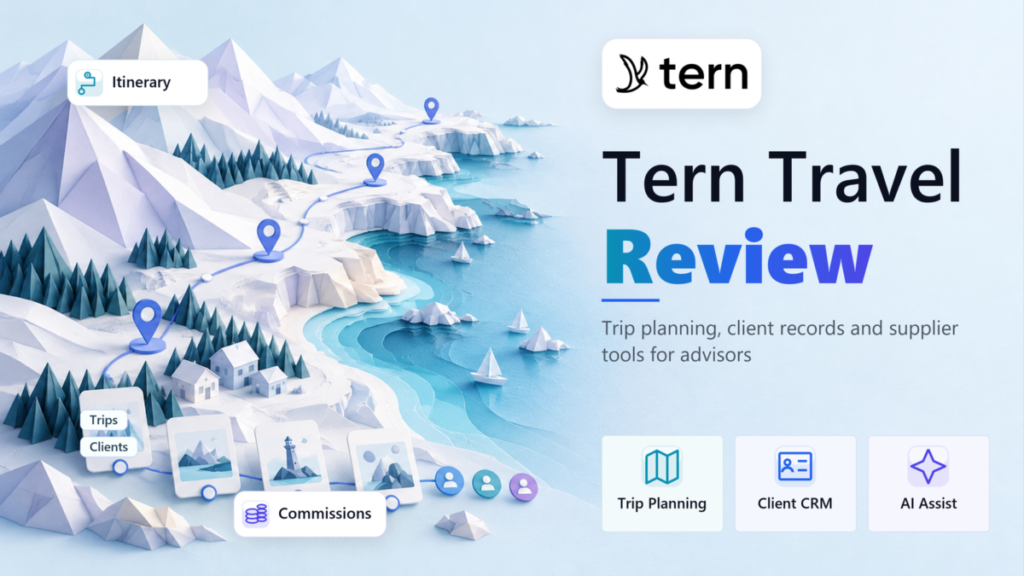
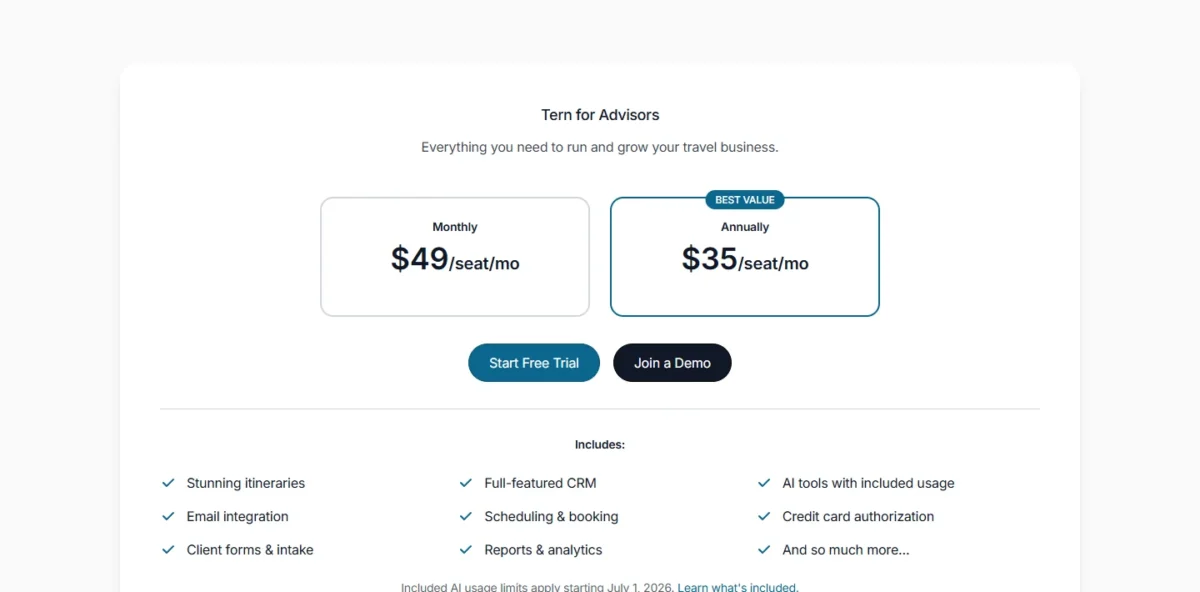
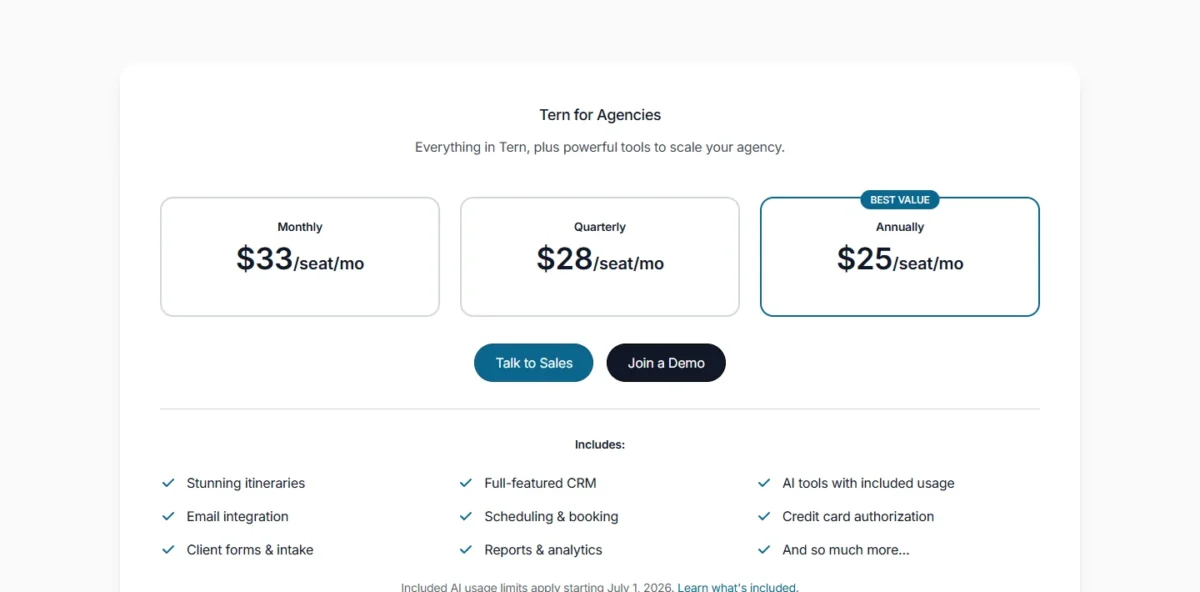
Tern suits travel advisors and small agencies that want CRM, itineraries, client payments and commission tracking in one system. It costs $35 per seat per month on annual billing for one or two advisors, and $25 per seat per month for every seat once the team reaches three advisors (the price holds for 3-24 advisors).
That makes this Tern travel review a question of fit more than features. Every plan carries the same advisor tools, and the limit that makes heavy users pay more is the shared monthly AI cap enforced since July 1, 2026.
Quick verdict
Tern is worth it for advisors who sell custom trips, and agencies of 3 or more that want proposals, payments, CRM and commission splits in one tool.
Skip it if: you book only a few trips a year, or you need a live general ledger now.
Main strength: one feature set on every plan, plus agency back-office tools from 3 seats. Biggest limit: AI Chat, AI Assist and extension imports pause at a monthly cap shown only as a percentage.
Price basis: per seat, from $25 a month on annual billing at 3-24 seats; solo advisors pay more per seat.
In This Article (11 sections)
Tern at a Glance
Tern is travel agency software that replaces a CRM, itinerary builder, scheduler, forms and back-office tools with one platform.
- Category: travel agency software (CRM, itineraries, payments, back office)
- Best for: solo advisors, agencies and host agencies that sell custom trips
- Starting price: $35 per seat per month billed annually, or $49 billed monthly (1-2 advisors)
- Agency price: from $25 per seat per month billed annually (3-24 seats)
- Free trial: 14 days for new subscribers
- Main limitation: one shared monthly AI limit; Tern Pro adds usage from $19 a month
Tern Pros and Cons
Tern’s strengths come from joining front office and back office; its weaknesses are usage caps and beta features.
Pros
- Every plan includes itineraries, the CRM, AI tools, email, scheduling, card authorization, forms and reports
- Seats drop to $25 per seat per month on annual billing at 3-24 seats, which rewards a growing agency
- Commission splits, payout statements and AI-read supplier statements are live for agency owners
- AI Notetaker and voice transcription sit outside the AI limit, so meeting notes keep working at 100%
Cons
- AI Chat, AI Assist, extension imports and AI reconciliation pause at 100% of the monthly limit
- Workflows and images do not migrate, so a TravelJoy user with many automations rebuilds them by hand
- The advisor app, Campaigns and Hotels by Tern are in beta and the general ledger is in preview
- One connected inbox per account, with email and calendar from the same provider
- AI usage shows only as a percentage, so the allowance cannot be sized before you buy
Tern Features
Every plan carries the same advisor features; agency seats add back-office tools, and AI is capped by usage rather than by plan.
Itineraries, proposals and client payments
Tern builds a trip as one sellable proposal: drag-and-drop itineraries, reusable templates, and room options clients select while pricing updates automatically. Payment authorization records itemized totals, terms and timestamped approvals, and declined insurance generates a PDF waiver.
Because proposal, approval and payment live on one trip, the agency keeps the paper trail a chargeback dispute needs. AI Assist turns a pasted supplier PDF into a structured itinerary, but each import draws on the AI allowance.
CRM, intake forms and automations
Tern’s CRM holds client profiles, contact history and notes linked to every trip, which covers what a CRM actually does for an advisor. Intake forms create trips with client details pre-filled, and automations trigger tasks, emails and reminders as trips move through stages.
Campaigns, the email marketing tool, is in beta, and free trials can send test emails but not campaigns to contacts.
Tern AI and the July 2026 usage limit
All Tern AI features share one monthly limit, enforced since July 1, 2026. At 100%, AI Chat, AI Assist, the Chrome extension and AI reconciliation pause until the next cycle or a Tern Pro purchase. Tern charges no overage fees, and unused usage does not roll over.
Trips, proposals, commissions and reports keep working at the cap, and AI Notetaker never counts. The AI usage limits article shows the allowance only as a percentage, so I would run a normal week of AI Assist imports and email triage in the trial, then read the meter in Subscription Settings.
Commission reconciliation and agency back office
Agency owners get automatic commission splits, AI that structures supplier statements, payout rules and one-click payout statements. On Tern’s back-office page, reconciliation, unclaimed commission and payout rules are live, invoicing is in closed beta, and the general ledger is in preview.
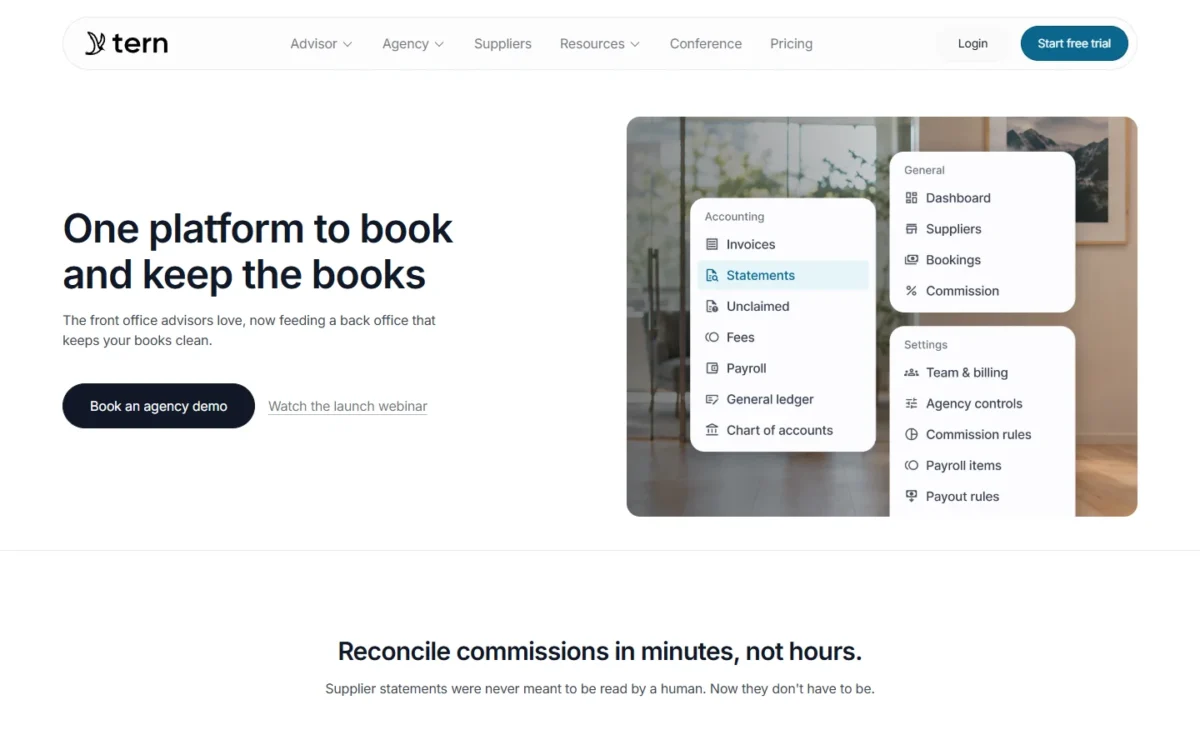
Until the ledger launches, Tern runs alongside your accounting system, so budget for both. Roles help a growing team: an Agency Collaborator edits shared trips and contacts without seeing commissions or reporting.
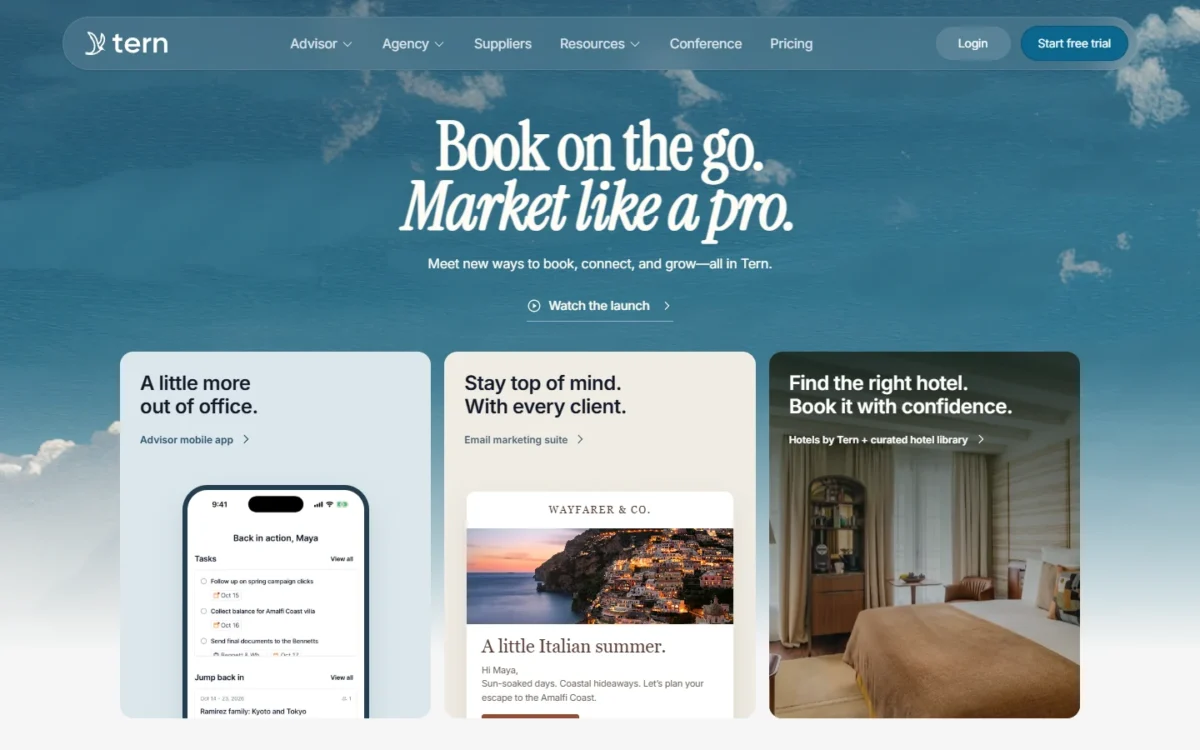
Hotels by Tern (open beta)
Hotels by Tern pays a flat 10% commission at launch to the agency that owns the accreditation, the Friday after the client checks out. It is opt-in per agency, Tern buys rooms at net rates and adds a markup, and bookings do not count toward consortium volume today.
That suits an independent advisor who wants guaranteed commission; an agency earning consortium perks should keep booking those hotels through its usual channel.
Tern Ease of Use
A solo advisor can start the same day, and Tern’s migration guide splits the move into what imports and what you rebuild. Smaller agencies set up largely self-service in a few weeks.
- Contacts, including passport details: CSV or Excel import
- Email, form and itinerary templates, plus trip content: the Chrome extension
- Images: re-added by hand
- Workflows: rebuilt in Tern’s workflow builder
TravelJoy stores the full passport name in one field, while Tern uses separate given-name and surname fields, so split that column first. Add an import_id column so a re-import updates contacts instead of duplicating them, and start with a test import of 5 to 10 contacts.
Extension imports of itineraries use AI, so a migration month can eat the allowance. The advisor mobile app is in open beta through TestFlight on iPhone and Google Play testing on Android, with no iPad or Mac version. Tern’s help center also lists a Tern for Travelers mobile app article; this review covers the Tern for Advisors app only.
Tern Pricing
Tern charges per seat: $49 billed monthly or $35 billed annually per seat per month for 1-2 advisors, down to $22 billed annually at 100-499 seats.
Every tier includes the same core features; agency plans (3+ seats) add commission reconciliation, supplier payment management, agency-wide reporting and centralized billing.
| Tier | Seats | Monthly billing | Quarterly billing | Annual billing |
|---|---|---|---|---|
| Just me (Tern for Advisors) | 1-2 | $49/ | $35/ | $35/ |
| Small team (Tern for Agencies) | 3-24 | $33/ | $28/ | $25/ |
| Growing agency | 25-99 | $31/ | $27/ | $23/ |
| Large agency | 100-499 | $29/ | $25/ | $22/ |
| Enterprise | 500+ | Contact sales | Contact sales | Contact sales |
Sources: Tern pricing page, each seat view, checked October 2026.
| Team | Tier | Billed annually, per year | Billed monthly, per year |
|---|---|---|---|
| 1 advisor | Just me | $35 x 12 = $420 | $49 x 12 = $588 |
| 2 advisors | Just me | $35 x 2 x 12 = $840 | $49 x 2 x 12 = $1,176 |
| 3 advisors | Small team | $25 x 3 x 12 = $900 | $33 x 3 x 12 = $1,188 |
| 10 advisors | Small team | $25 x 10 x 12 = $3,000 | $33 x 10 x 12 = $3,960 |
| 30 advisors | Growing agency | $23 x 30 x 12 = $8,280 | $31 x 30 x 12 = $11,160 |
Sources: Tern pricing page, checked October 2026. Excludes Tern Pro and tax.
The third seat is the odd spot. Two advisors on annual billing pay $35 x 2 = $70 a month, and three pay $25 x 3 = $75 a month. For a two-person team about to hire, the third seat costs $75 – $70 = $5 more a month and brings the agency tools.
A solo advisor saves $588 – $420 = $168 a year on annual billing, which I would take once the trial confirms fit. Agency seats cannot mix billing cadences, so pick one for the whole team.
The cost the seat price leaves out
The upgrade triggers are AI usage and Custom Reporting, and both sit in the Tern Pro add-on, not a higher seat tier. Tern Pro costs $19, $39, $99 or $149 a month (Pro, 2x, 5x, 10x), billed monthly only, even on an annual plan.
Every Pro tier adds Custom Reporting. On an agency seat, Pro bills the advisor’s personal account: $19 x 12 = $228 a year at the entry tier.
Integrations, Security and Support
Tern connects Google or Microsoft email, and its email setup guide requires email and calendar from the same provider, so Outlook email with Google Calendar is not supported. Each account connects one inbox.
Tern integrates with Signature and major insurance providers, books tours from the itinerary, and takes Virtuoso, Signature and Travel Leaders Network marketing codes on a CRM record. Tern does not publish an integration count.
The data centers behind Tern are certified under ISO 27001, SOC 1 and SOC 2, and PCI Level 1; those certificates cover the infrastructure, not Tern’s app. Data moves over TLS 1.2 or higher, and passport details get an extra encryption layer.
Support comes from a dedicated team, onboarding help and a help center, with 24/7 support for Hotels by Tern bookings.
If you leave, Tern promises on its homepage: “You own your data. Export it anytime.” Export a few test contacts in the trial to see which fields come out.
Who Should Use Tern?
Tern fits custom-trip advisors and agencies of three or more; it fits low-volume advisors and ledger-first agencies less well.
Best for
- A solo advisor replacing a CRM, itinerary builder, scheduler and forms tool with one $35 per seat per month annual plan
- An agency of 3-24 advisors that needs commission splits and payout statements at $25 per seat per month billed annually
- A host agency with sub-agencies and multi-layer commission splits
- An advisor who relies on meeting notes, since AI Notetaker sits outside the AI limit
Not ideal for
- A low-volume advisor: TravelJoy’s Starter plan at $19 a month covers 12 trips a year
- An agency that needs a live general ledger now
- A heavy AI user who will not add a monthly Tern Pro charge
- Skip it if:
- you sell a dozen trips a year or fewer, or your accountant needs Tern’s ledger live before you switch.
Tern vs TravelJoy and Travefy
Tern costs more per seat than TravelJoy’s capped Starter plan and slightly less than Travefy’s Core plan on annual billing. Its edge is the agency back office.
| Software | Best for | Starting price | Key difference | Main trade-off |
|---|---|---|---|---|
| Tern | Advisors and agencies selling custom trips | $35/ | Commission reconciliation and payouts for 3+ seats | Monthly AI cap; ledger in preview |
| TravelJoy | Low-volume solo advisors | Starter $19/mo | Starter covers 12 trips a year | Starter has no AI, automations or team members |
| Travefy | Itinerary-first advisors | Core $39/ | Core adds a website and landing page builder | Agency adds $20/ |
Sources: Tern pricing, TravelJoy pricing, Travefy pricing, checked October 2026.
Tern’s migration guide names TravelJoy as the most common starting point. An active advisor outgrows Starter’s 12-trip cap and moves to TravelJoy Pro: $32 a month on annual billing or $39 a month on monthly billing.
If TravelJoy is your other option, see my TravelJoy pricing guide.
For one advisor, Pro costs $35 – $32 = $3 a month less than Tern on annual billing and $49 – $39 = $10 less on monthly billing. Tern earns that gap once you add advisors: Pro lists team members as an add-on, while Tern’s seat drops to $25 a month on annual billing at three advisors and holds through 24.
On annual billing, Tern’s 1-2 advisor seat costs $39 – $35 = $4 a month less than Travefy Core.
Travefy’s Agency plan lists $20 a month per additional seat through sales, with no billing basis stated. A 25-seat Tern agency pays $23 per seat per month on annual billing, so ask Travefy for its basis and base plan before comparing team totals.
If Travefy is still on your shortlist, read my Travefy review.
Tern Alternatives
Look elsewhere if you book few trips or want an itinerary-first tool; my shortlist of travel agency CRMs for advisors and small agencies compares the options.
An agency that also sells non-travel services may get more from general-purpose CRM picks than from a travel suite.
How I Evaluated Tern
I read Tern’s pricing page in each seat-tier view and its product pages in October 2026, with TravelJoy’s and Travefy’s pricing pages. Tern’s help center articles covered Tern Pro, AI limits, agency pricing, billing, the trial, migration, security, roles and email.
The facts come from those pages; the cost math and verdicts are my analysis. Tern does not publish the numeric AI allowance, an integration count or whether the trial needs a card.
Tern Travel Review: Final Verdict
Tern is worth a trial for an advisor or small agency that wants one system and sells enough trips to use it, on annual billing once the trial confirms fit. The trade-off is AI: the base allowance is unpublished, and extra usage costs $19 to $149 a month per advisor.
Pick TravelJoy’s Starter plan if you book a dozen trips a year or fewer. Before you sign, run a 5-10 contact test import, rebuild your most-used workflow, and check the AI percentage after a normal week.