If you’re researching AnyGen AI reviews before buying, you’ve probably noticed something confusing: search results mix up two completely different products under the same name.
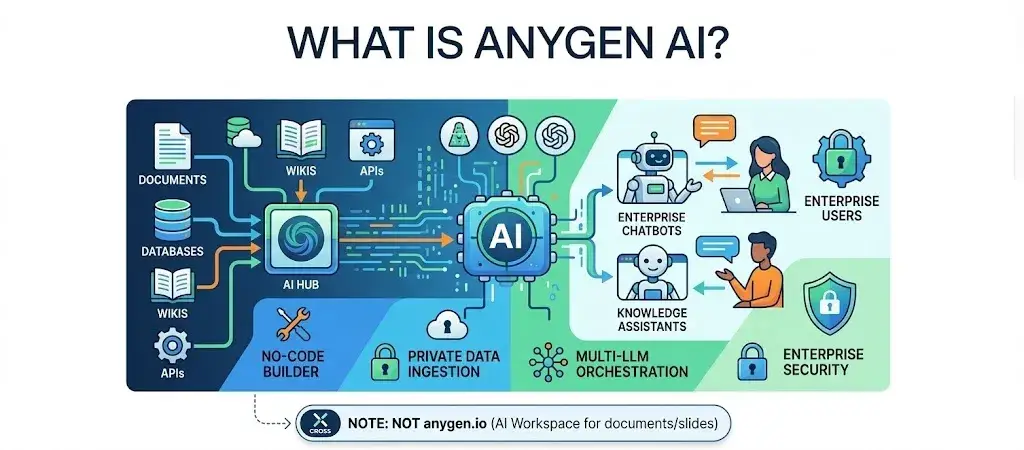
This review cuts through that noise. We focus specifically on AnyGen AI — the enterprise generative AI platform built for organizations that need to deploy chatbots, knowledge assistants, and AI-powered apps using their own data and choice of LLM. It is not a review of anygen.io, the ByteDance-backed collaborative workspace for documents, slides, and data analysis (we address that distinction below).
This AnyGen AI review is written for US-based IT leaders, data teams, and software buyers evaluating no-code enterprise AI platforms in 2026.
AnyGen AI at a Glance
| Type | Enterprise AI chatbot & app platform |
| Best for | Internal knowledge assistants, customer support automation, enterprise search |
| Pricing | Custom enterprise pricing (contact sales) |
| Deployment | Cloud-agnostic (AWS, Azure, GCP, private cloud, on-prem) |
| LLM support | Multi-LLM: GPT, Claude, Gemini, Mistral, and others |
| Key strength | No-code chatbot building with multi-LLM flexibility |
| Main drawback | Limited public validation, opaque pricing, thin compliance documentation |
| Company | Powered by Blinx AI (New York) |
| Website | anygen.ai |
TL;DR — Quick Verdict
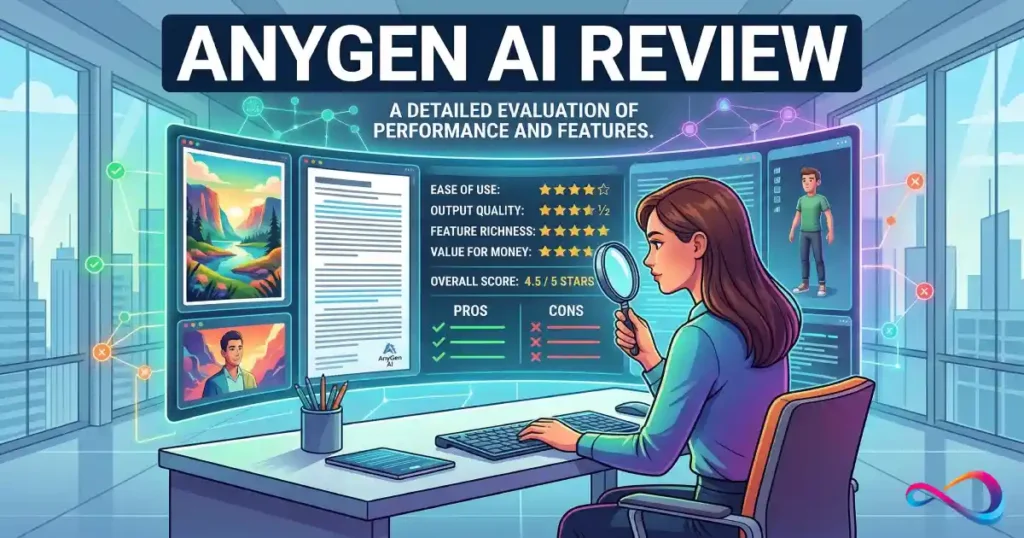
AnyGen AI is a solid option for mid-market and enterprise organizations that want to build internal chatbots and knowledge assistants without writing code — especially if model flexibility and cloud-agnostic deployment matter to your team. However, pricing transparency is poor, the public review footprint is thin, and buyers in highly regulated industries will need to pressure-test the vendor’s security claims directly before committing.
| Category | Rating (out of 5) |
|---|---|
| Ease of use / setup | ★★★★☆ |
| Deployment flexibility | ★★★★☆ |
| Security & privacy posture | ★★★½☆ |
| Integration breadth | ★★★☆☆ |
| Pricing transparency | ★★☆☆☆ |
| Scalability | ★★★★☆ |
| Vendor maturity / trust signals | ★★½☆☆ |
Best for: Enterprise and mid-market teams that need a no-code way to build AI chatbots from proprietary data, want to avoid vendor lock-in on LLMs, and prefer cloud-agnostic deployment.
Not ideal for: Small businesses on a tight budget, teams that need a mature ecosystem with deep third-party integrations, or buyers who require published pricing and extensive independent reviews before procurement.
What Is AnyGen AI?
AnyGen AI (anygen.ai) is a no-code enterprise platform for building ChatGPT-like chatbots, knowledge assistants, and generative AI applications from organizational data. It is powered by Blinx AI and headquartered in New York.
Before we go further, let’s clear up a real source of confusion in the market.
There are at least two distinct products using the “AnyGen” name:
| AnyGen AI (anygen.ai) | AnyGen (anygen.io) | |
|---|---|---|
| Core function | Enterprise generative AI platform for chatbots, knowledge assistants, and AI apps | AI-powered collaborative workspace for documents, presentations, and data analysis |
| Parent company | Powered by Blinx AI (New York) | Developed by ByteDance |
| Target user | CIOs, CTOs, data teams, enterprise IT | Knowledge workers, content teams, individuals |
| Key capability | No-code chatbot builder, multi-LLM orchestration, private data ingestion | AI writing assistant, slide generation, data charting, real-time collaboration |
| Deployment | Cloud-agnostic, supports private/on-prem | Cloud SaaS |
| Pricing model | Custom / contact sales | Free, Plus ($10/mo), Pro ($20/mo), Max ($200/mo) |
This review covers AnyGen AI (anygen.ai) — the enterprise platform. Most directory pages ranking for “AnyGen AI reviews” conflate the two, which leads to inaccurate feature lists and misleading pricing information. If you’re looking for a review of the anygen.io workspace tool, this isn’t it.
Who this review is for: Software buyers, IT managers, CIOs/CTOs, and data leaders at US organizations evaluating no-code enterprise AI platforms for internal chatbots, knowledge management, or customer-facing AI applications.
How We Evaluated This AnyGen AI Review
Every AnyGen AI software review should be transparent about its methodology. Here’s ours:
What we did:
- Reviewed AnyGen AI’s official product positioning, public documentation, and marketing materials on anygen.ai
- Cross-referenced claims against third-party directory listings (SourceForge, Slashdot, Groupify, Toolbit, and others)
- Analyzed publicly available user feedback, including a very small number of public reviews on Trustpilot (3.5/5 TrustScore as of March 2026)
- Compared AnyGen AI’s stated capabilities against direct competitors (Writer, AnythingLLM, Microsoft Copilot Studio, custom RAG stacks)
- Evaluated the platform against a standardized rubric: ease of use, deployment flexibility, security posture, integrations, pricing transparency, scalability, and vendor maturity
What we did NOT do:
- We did not have extended hands-on access to a live enterprise deployment. Where our assessment is based on vendor claims rather than direct testing, we say so explicitly.
Transparency note: AnyGen AI’s enterprise pricing is not publicly listed. Several feature claims (e.g., specific LLM integrations, on-premises deployment details, governance controls) are based on marketing materials and third-party descriptions. We could not independently verify all claims. We flag areas of uncertainty throughout this review.
AnyGen AI Features: What the Platform Actually Offers
Multi-LLM Support
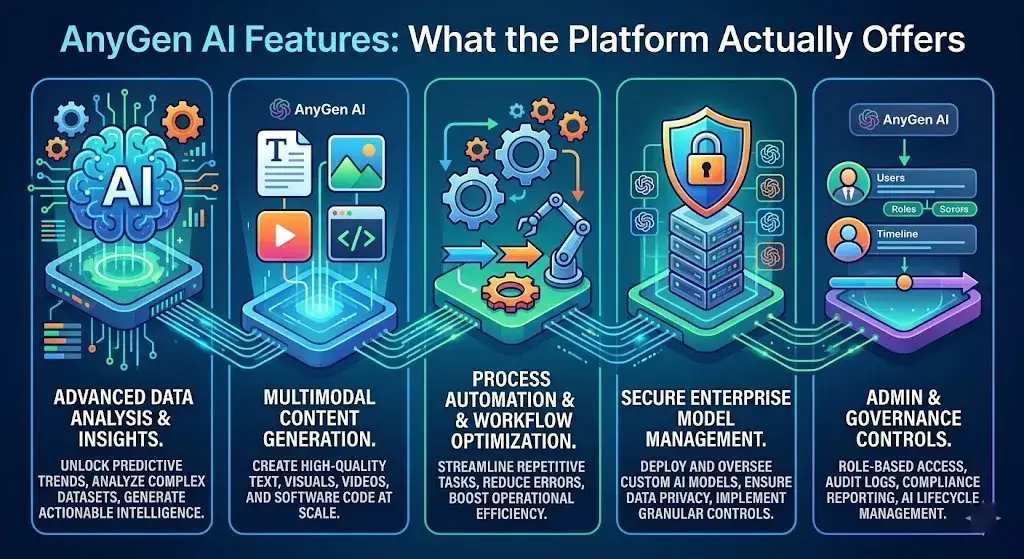
AnyGen AI supports multiple large language models, including GPT, Claude, Gemini, and Mistral — avoiding single-vendor lock-in. This is a critical differentiator for enterprise buyers in 2026 who want freedom to switch models based on cost, performance, or compliance.
The platform claims compatibility with any LLM, giving enterprise teams the flexibility to choose or switch models without rebuilding their applications. If you’re currently evaluating standalone models like ChatGPT, Claude, or Google Gemini, AnyGen AI’s value proposition is that you don’t have to choose — you can orchestrate across all of them.
Caveat: We could not independently verify the full list of supported models or how seamlessly switching between them works in production.
Cloud-Agnostic Deployment
AnyGen AI works across any cloud platform, including private cloud and potentially on-premises environments. For organizations with strict data residency requirements or existing cloud commitments (AWS, Azure, GCP), this flexibility is a meaningful differentiator compared to vendor-locked alternatives like Microsoft Copilot Studio (Azure-only) or Vertex AI Agents (GCP-only).
No-Code / Low-Code AI App Building
Non-technical users can build AI-powered chatbots and applications from organizational data without writing code. This is aimed squarely at business teams that want to prototype and deploy AI apps without waiting for engineering resources — particularly useful for departments like HR, IT operations, and customer support that need to move fast.
Enterprise Chatbot and Knowledge-Base Workflows
AnyGen AI’s flagship use case is building ChatGPT-like chatbots that draw on an organization’s proprietary data — internal documents, knowledge bases, databases, and other enterprise data sources. The platform supports ingestion from multiple data types and languages, functioning as both a conversational AI layer and an enterprise knowledge base solution.
Private Deployment and Data Privacy
Security, privacy, and confidentiality are positioned as core design principles. For enterprise buyers asking “does AnyGen AI support private LLMs?” — the vendor messaging suggests yes, though the specifics of private model hosting, data encryption at rest and in transit, and compliance certifications are not clearly documented in public-facing materials.
Admin, Governance, and Lifecycle Controls
Enterprise AI governance is increasingly non-negotiable. AnyGen AI references capabilities around role-based access, admin controls, and AI application lifecycle management. However, the depth of these controls — audit logs, model versioning, approval workflows, compliance reporting, prompt management, and knowledge refresh workflows — is not clearly detailed in available documentation.
AnyGen AI Integrations: What Connects and What Doesn’t
The integration ecosystem is one of AnyGen AI’s least-documented areas — and one of the most important for enterprise buyers.
Enterprise AI platforms live or die by their ability to connect with existing systems. Based on available information, here’s what we know about AnyGen AI’s integration landscape:
Data source ingestion (likely supported):
- Documents: PDFs, DOCX, TXT, and similar file formats
- Databases: SQL and NoSQL data sources (specifics not published)
- Cloud storage: Likely compatible with major providers given cloud-agnostic positioning
- Internal knowledge bases and wikis
Enterprise system integrations (unclear / not documented):
| Integration category | Status | Why it matters |
|---|---|---|
| CRM (Salesforce, HubSpot) | ❓ Not documented | Chatbots grounded in customer data need CRM access |
| Helpdesk (Zendesk, Freshdesk, ServiceNow) | ❓ Not documented | Support automation requires ticket system integration |
| Communication (Slack, Microsoft Teams) | ❓ Not documented | Deploying chatbots where employees already work |
| Knowledge platforms (Confluence, Notion, SharePoint) | ❓ Not documented | Primary data sources for internal knowledge assistants |
| HRIS (Workday, BambooHR) | ❓ Not documented | HR chatbot use cases depend on people-data access |
| Identity / SSO (Okta, Azure AD) | ❓ Not documented | Enterprise authentication and role-based access |
| API access | ✅ Likely (based on platform positioning) | Custom integrations and workflow automation |
What this means for buyers: If your use case requires tight integration with Slack, ServiceNow, Salesforce, or SharePoint, you should request a detailed integration matrix from AnyGen AI’s sales team before committing. The lack of public documentation here is a gap — most competing platforms publish supported integrations clearly.
AnyGen AI Pricing Review: How Much Does It Cost in 2026?
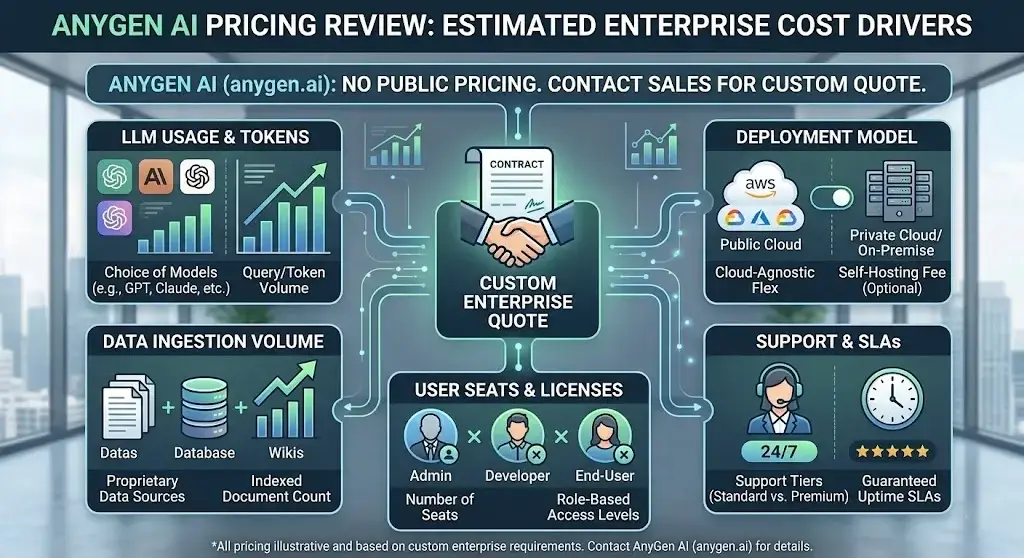
Short answer: AnyGen AI does not publish pricing. Enterprise plans require contacting their sales team.
What’s Publicly Available
This is where many “AnyGen AI pricing” articles get it wrong. AnyGen AI (anygen.ai) uses custom enterprise pricing — you need to contact sales for a quote. This is common for enterprise AI platforms, but it makes it difficult for buyers to benchmark costs before entering a sales conversation.
Important: Many directory pages listing AnyGen “pricing” are actually showing plans for anygen.io (the ByteDance workspace tool), which offers: Free ($0), Plus ($10/mo), Pro ($20/mo), and Max ($200/mo). These prices do not apply to the enterprise AnyGen AI platform reviewed here.
Estimated Total Cost of Ownership
Based on how similar enterprise AI platforms price their products, here are the cost drivers you should expect to discuss with AnyGen AI’s sales team:
| Cost factor | What to ask |
|---|---|
| Base platform license | Per-user, per-seat, or flat platform fee? |
| LLM usage / tokens | Are LLM API costs included or passed through? |
| Data ingestion volume | Is there a cap on document/data volume? |
| Private deployment | Additional cost for on-prem or private cloud hosting? |
| Support tier & SLAs | What’s included vs. premium support pricing? What are uptime guarantees? |
| Onboarding / implementation | Is there professional services cost for setup? Estimated implementation timeline? |
| Model hosting (if private LLM) | Who bears the infrastructure cost for self-hosted models? |
| Training & change management | Is user training included, or billed separately? |
Pricing Transparency Score: 2 out of 5
AnyGen AI loses points here for the same reason many enterprise vendors do: lack of public pricing makes comparison shopping harder and extends sales cycles. If you’re evaluating “how much does AnyGen AI cost,” the honest answer is: you won’t know until you talk to sales. For comparison, open-source alternatives like AnythingLLM offer free self-hosted options, while platforms like Claude publish transparent per-seat and API pricing.
AnyGen AI Use Cases for Enterprise Teams
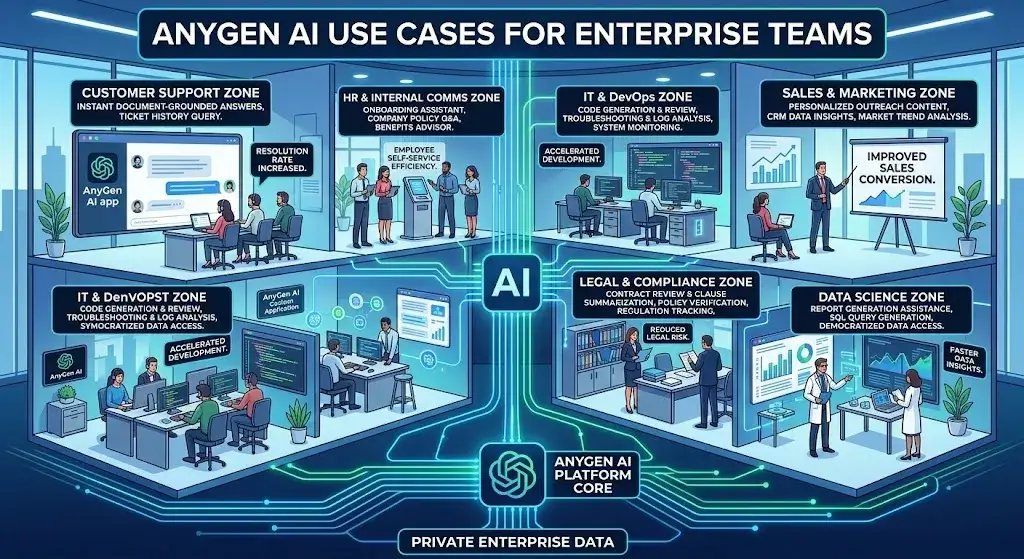
The AnyGen AI chatbot platform is positioned for several enterprise scenarios. Here’s where it fits — and where you should look elsewhere.
Internal Employee Knowledge Assistant
Best for organizations with large, distributed workforces. Build a chatbot that answers employee questions by pulling from internal policies, handbooks, SOPs, and knowledge bases. This is the most common enterprise use case for platforms like AnyGen AI — especially where HR and IT teams are overwhelmed with repetitive questions.
Customer Support Automation
Strongest when support queries are predictable and can be grounded in structured knowledge. Deploy a customer-facing chatbot trained on product documentation, support articles, and FAQs. AnyGen AI’s multilingual support makes this relevant for companies serving global customers. If your team is also evaluating dedicated help desk platforms, AnyGen AI can complement them as a conversational AI layer.
Enterprise Search and Knowledge Retrieval
Use AnyGen AI as a natural-language search layer across unstructured and structured data. This overlaps with the retrieval-augmented generation (RAG) approach that has become standard in enterprise AI. Teams can query documents, PDFs, wikis, and databases using conversational prompts instead of keyword search.
HR / IT / Operations Helpdesk Automation
Purpose-built chatbots for specific departments: IT troubleshooting, HR policy Q&A, facilities management, onboarding workflows, compliance Q&A. AnyGen AI’s no-code approach is designed for exactly this — empowering department leads to build and maintain their own bots without engineering support.
AI App Prototyping for Enterprise Teams
Useful for organizations in early stages of AI adoption. Data science and innovation teams can use the platform to rapidly prototype AI applications and demonstrate value to stakeholders before committing to a custom build or larger platform investment.
Multilingual Enterprise Workflows
Relevant for global organizations with offices across the US, EU, and APAC. The platform’s support for multiple languages makes it a contender for consistent AI-powered experiences across regions — provided output quality in non-English languages meets production standards (which we could not independently verify).
AnyGen AI Pros and Cons — Honest Assessment
| Pros | Cons |
|---|---|
| Multi-LLM flexibility — not locked into a single model vendor | Pricing is opaque — no public plans or transparent cost structure |
| No-code chatbot builder — accessible to business users, not just developers | Limited independent reviews — very thin public review footprint (1 Trustpilot review) |
| Cloud-agnostic deployment — works across cloud environments | Integration ecosystem unclear — depth of third-party integrations not well-documented |
| Multilingual support — relevant for global enterprises | Vendor maturity questions — smaller player compared to Writer, Microsoft, or AWS-based stacks |
| Enterprise-focused positioning — targets CIOs, CTOs, and data leaders | Feature verification gap — several capabilities are based on vendor claims, not independently confirmed |
| Rapid chatbot prototyping — fast time-to-value for common use cases | Governance depth unknown — specifics on audit, compliance, and lifecycle controls are vague |
Where tradeoffs show up in practice: AnyGen AI’s strength is accessibility. If you need a no-code path to building chatbots from internal data across any LLM, the platform delivers on that promise (based on available information). The tradeoff is that you’re betting on a smaller, less battle-tested vendor compared to established enterprise AI platforms. For risk-averse procurement teams, that can be a blocker.
AnyGen AI Alternatives for Enterprise Teams: Comparison Table
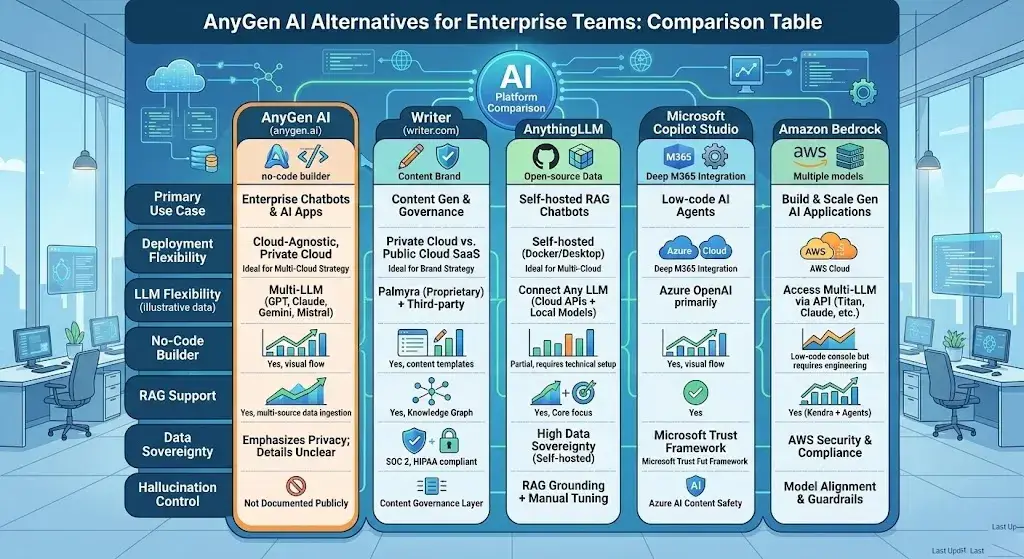
| Feature | AnyGen AI | Writer | AnythingLLM | Custom RAG Stack | Microsoft Copilot Studio |
|---|---|---|---|---|---|
| Primary use case | No-code enterprise chatbots & AI apps | Enterprise content generation & governance | Self-hosted LLM interface with RAG | Fully custom retrieval-augmented generation | Low-code AI agents within Microsoft 365 |
| Deployment | Cloud-agnostic, private cloud | Cloud SaaS | Self-hosted (Docker) or desktop | Your infrastructure | Azure cloud |
| LLM flexibility | Multi-LLM (GPT, Claude, Gemini, Mistral) | Palmyra (proprietary) + third-party | Any LLM (cloud APIs + local models) | Any LLM | Azure OpenAI primarily |
| No-code builder | ✅ Yes | ✅ Yes (for content apps) | ❌ Requires some technical setup | ❌ Requires engineering | ✅ Yes |
| RAG support | ✅ Yes (data ingestion from multiple sources) | ✅ Knowledge Graph | ✅ Core strength | ✅ Full control | ✅ Yes |
| Data privacy / control | Emphasizes privacy; details unclear | SOC 2, HIPAA compliant | Full data sovereignty (self-hosted) | Complete control | Microsoft trust framework |
| Pricing | Custom (contact sales) | Custom enterprise | Free (open source) + paid cloud | Infrastructure costs only | Per-message + capacity pricing |
| Hallucination controls | Not documented publicly | Content governance layer | RAG grounding + manual tuning | Full control via pipeline design | Azure AI Content Safety |
| Best for | Mid-market+ teams wanting fast, flexible chatbots | Large enterprises needing content governance | Technical teams wanting total data control | Teams with engineering capacity | Microsoft-native organizations |
| Maturity / market presence | Emerging | Established | Growing (open-source community) | N/A | Established (Microsoft) |
AnyGen AI vs Writer
Writer is the stronger choice for compliance-conscious enterprise buyers. It offers SOC 2 and HIPAA compliance out of the box, plus brand governance for content. AnyGen AI may be more flexible on LLM choice, but Writer’s compliance posture and content-specific tooling are more battle-tested.
Choose AnyGen AI if: You need multi-LLM flexibility and chatbot-first use cases. Choose Writer if: Compliance certifications and enterprise content governance are non-negotiable.
AnyGen AI vs AnythingLLM
AnythingLLM gives technical teams complete data sovereignty. It’s open-source, self-hosted, and supports any LLM — from cloud APIs to local models via Ollama. AnyGen AI is more accessible for non-technical users but offers less infrastructure control.
Choose AnyGen AI if: Your team is less technical and wants a managed, no-code experience. Choose AnythingLLM if: Your engineering team wants full control and self-hosting.
AnyGen AI vs Custom RAG Stack
A custom RAG stack gives you maximum flexibility and zero vendor dependency. Building with LangChain, LlamaIndex, vector databases, and your own LLM connections is the most powerful option — but the tradeoff is time, cost, and ongoing maintenance. AnyGen AI is essentially a productized version of what a custom stack does.
Choose AnyGen AI if: You want RAG-based chatbots without building infrastructure. Choose a custom stack if: You have the engineering team and need total control.
AnyGen AI vs Low-Code Enterprise AI Platforms
Platforms like Microsoft Copilot Studio, Amazon Bedrock-based stacks, and Vertex AI Agents offer similar no-code/low-code chatbot building tied to their respective cloud ecosystems. If you’re already invested in Azure, AWS, or GCP, these options will integrate more naturally. If you’re evaluating conversational AI platforms more broadly, our best AI chatbots comparison covers the broader landscape.
Best AnyGen AI Alternatives by Priority
| Your top priority | Best alternative |
|---|---|
| Maximum data control / self-hosting | AnythingLLM |
| Regulated industry compliance | Writer |
| Microsoft ecosystem integration | Microsoft Copilot Studio |
| AWS-native AI stack | Amazon Bedrock + Kendra |
| Google Cloud–native | Vertex AI Agents |
| Open-source flexibility | AnythingLLM or custom RAG |
| Budget-sensitive / SMB | AnythingLLM (free tier) or Omnifact |
| Maximum LLM flexibility | AnyGen AI or custom RAG stack |
| AI-powered content creation | See our guide to thebest AI tools for content creation |
Security, Privacy, and Compliance Considerations
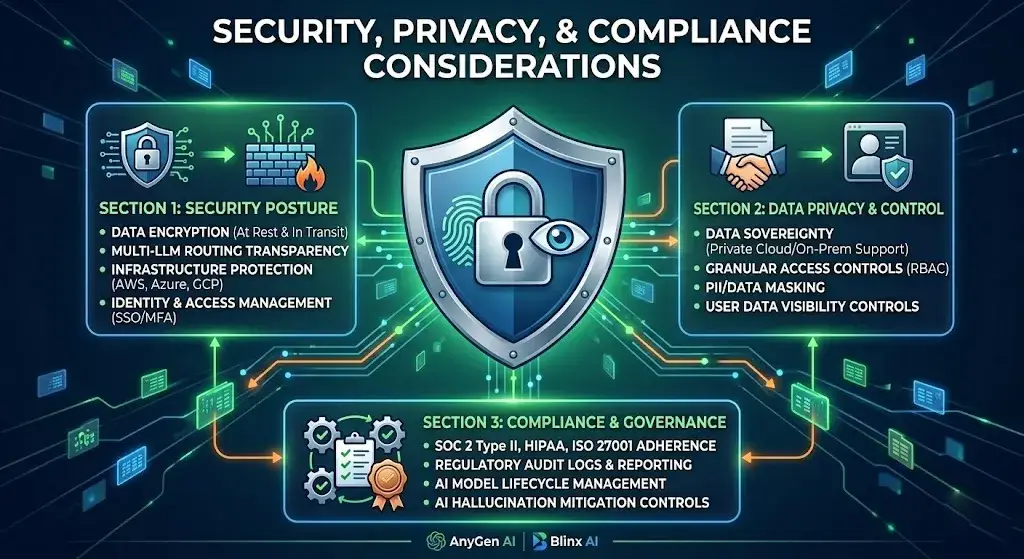
Is AnyGen AI secure? Yes — at a messaging level. But compliance documentation is thin.
For enterprise buyers, this is the right first question. Here’s what we know — and what we don’t.
What AnyGen AI claims:
- Security, privacy, and confidentiality are described as “core tenets” of the platform
- Cloud-agnostic deployment suggests options for private cloud or on-premises hosting
- Multi-LLM support means organizations can theoretically use private models to keep data off third-party APIs
- Data can be ingested and processed without leaving organizational boundaries (for private deployments)
What is NOT clearly documented (as of March 2026):
- Specific compliance certifications (SOC 2, HIPAA, ISO 27001, FedRAMP)
- Data encryption standards (at rest and in transit)
- Audit logging and monitoring capabilities
- Data retention and deletion policies
- Third-party security audit results
- Model routing transparency — do queries hit external APIs, and which ones?
Procurement checklist for IT/security teams:
- [ ] Request specific compliance certifications and audit reports
- [ ] Clarify where data is stored and processed (geography, cloud provider)
- [ ] Understand the data flow when using third-party LLM APIs vs. private models
- [ ] Confirm whether private model hosting is truly on your infrastructure or vendor-managed
- [ ] Ask about penetration testing and vulnerability disclosure practices
- [ ] Review the vendor’s incident response process and support SLAs
- [ ] Verify hallucination control mechanisms and output grounding quality
Bottom line: AnyGen AI talks the right talk on security, but enterprise buyers in compliance-sensitive environments should verify these claims independently before procurement. The lack of publicly listed certifications is a gap compared to more established competitors like Writer.
What We’d Validate in a Live Demo
Since we did not have extended hands-on access, this section outlines exactly what we would test in a pilot evaluation — and what your team should test before signing a contract. This framework is based on our experience evaluating enterprise AI platforms across categories.
Setup & Time-to-Value
- Time to first chatbot: How long from login to a working internal chatbot? Enterprise platforms in this category typically range from 30 minutes to several days, depending on data ingestion complexity.
- Onboarding requirements: Does setup require dedicated CS/implementation support, or can IT self-serve?
- Implementation timeline: What’s realistic for a full production deployment (not just a demo)?
Data Ingestion & Source Compatibility
- Supported data formats: PDFs, DOCX, CSVs, databases, APIs, Confluence, SharePoint, Notion, Slack — which sources are natively supported?
- Knowledge refresh workflow: How frequently can source data be re-synced? Is it automated or manual?
- Data source limits: Are there caps on document count, file size, or total ingestion volume?
Output Quality & Hallucination Control
- Citation / source grounding quality: Does the chatbot cite the exact source document? How reliable are attributions?
- Hallucination control: What mechanisms prevent the bot from generating information not in the knowledge base?
- Sample prompt quality: Run the same test prompts across AnyGen AI and competitors — compare accuracy, citation quality, and response completeness.
- Multilingual accuracy: Test the same query in English, Spanish, and Mandarin — compare response quality across languages.
Admin & Governance
- Access control granularity: Role-based access at what level? Per-bot, per-data-source, per-department?
- Admin dashboard clarity: What monitoring, analytics, and chatbot performance metrics are available out of the box?
- Model routing transparency: Can admins see which LLM is being used for each query?
- Prompt management: Is there a centralized system for managing, versioning, and auditing prompts?
- Chatbot evaluation metrics: Does the platform provide built-in analytics on response accuracy, user satisfaction, or escalation rates?
Enterprise Readiness
- Escalation flows: When the chatbot can’t answer, how does it hand off to a human agent?
- Change management: What training and documentation does AnyGen AI provide for enterprise rollout?
- Pilot project success criteria: Ask the vendor to define measurable success metrics for a 30/60/90-day pilot.
Why this matters: Even if you can’t test before a demo, presenting this checklist to the AnyGen AI sales team signals procurement maturity and forces specificity that marketing materials avoid.
Who Should Use AnyGen AI?
Best Fit
- Enterprise IT and data teams looking for a managed, no-code way to build AI chatbots from internal data
- Mid-market organizations that want LLM flexibility without vendor lock-in
- Operations leaders (HR, IT, customer support) who want to stand up department-specific AI assistants quickly
- Organizations early in their AI journey that need fast prototyping capabilities
- Companies with multi-cloud or cloud-agnostic strategies that don’t want to be tied to one hyperscaler’s AI ecosystem
Who Should Skip It
- Small businesses and startups on tight budgets — the lack of transparent pricing and the enterprise sales process suggest this isn’t built for low-spend buyers
- Highly regulated enterprises that need verified compliance certifications today (SOC 2, HIPAA, FedRAMP) — until AnyGen AI publishes these, competitors with established compliance programs are safer bets
- Technical teams that want full control — if you want to own your RAG pipeline, model hosting, and infrastructure, AnythingLLM or a custom stack is a better fit
- Organizations deep in one cloud ecosystem — if you’re all-in on Azure, AWS, or GCP, native AI tools from those providers will integrate more smoothly
- Buyers who need extensive community/peer validation — the extremely thin public review footprint means you’re largely relying on vendor claims
Frequently Asked Questions – AnyGen AI Review
What is AnyGen AI?
AnyGen AI is an enterprise no-code platform for building chatbots, knowledge assistants, and generative AI apps from organizational data. It is powered by Blinx AI (New York) and supports multiple LLMs with cloud-agnostic deployment. It is a separate product from anygen.io, the ByteDance-backed AI workspace.
Is AnyGen AI free?
No. AnyGen AI’s enterprise platform does not offer a publicly listed free tier. Pricing requires contacting their sales team. The free tier you may see referenced online belongs to anygen.io, the separate workspace product.
How much does AnyGen AI cost?
Custom enterprise pricing only — contact sales for a quote. Based on industry benchmarks for similar platforms, expect costs to vary by number of users, data volume, LLM usage, deployment model (cloud vs. private), and support tier. No public pricing page exists.
Is AnyGen AI secure?
The vendor claims security as a core principle, but specific compliance certifications are not publicly documented. Enterprise buyers should request SOC 2, HIPAA, and ISO 27001 documentation directly from the vendor before procurement.
Does AnyGen AI support private LLMs?
Yes, based on vendor positioning — but the specifics need verification. AnyGen AI’s multi-LLM and cloud-agnostic claims suggest private model deployment is possible. Whether this means self-hosted models on your infrastructure or vendor-managed private instances is not clearly documented.
What are the best AnyGen AI alternatives?
It depends on your priority:
- Data sovereignty and self-hosting: AnythingLLM (open-source, free)
- Compliance-first (SOC 2, HIPAA): Writer
- Microsoft ecosystem: Microsoft Copilot Studio
- AWS-native: Amazon Bedrock + Kendra
- Google Cloud–native: Vertex AI Agents
- Budget-friendly / SMB: AnythingLLM or Omnifact
Is AnyGen AI good for small businesses?
Probably not. The enterprise sales model, custom pricing, and platform positioning suggest AnyGen AI is designed for mid-market and enterprise organizations. Small businesses would likely find better value in open-source options like AnythingLLM or simpler chatbot builders.
Can AnyGen AI build chatbots from internal data?
Yes — this is its primary use case. AnyGen AI is designed to ingest organizational data (documents, databases, knowledge bases) and build chatbots that answer questions grounded in that data using RAG (retrieval-augmented generation) techniques.
Is AnyGen AI better than Writer?
They solve different problems. AnyGen AI is chatbot-and-app-first with multi-LLM flexibility. Writer is content-governance-first with strong compliance certifications. The right choice depends on whether your primary need is building internal chatbots or governing enterprise content at scale.
Is AnyGen AI worth it for internal knowledge assistants?
Yes, if your team values no-code setup and LLM flexibility — and you can validate the platform’s performance in a pilot. For internal knowledge management, AnyGen AI’s use case alignment is strong. The risk is vendor maturity; the reward is speed to deployment without engineering dependency.
Limitations and Where Information Is Unclear
In the interest of an honest, in-depth AnyGen AI review, here’s what we couldn’t confirm:
- No independent, large-scale user reviews exist. The Trustpilot profile shows a single review from 2023. No G2, Capterra, or Gartner Peer Insights presence was found as of March 2026.
- Integration ecosystem is undocumented publicly. We could not find a list of supported integrations (CRM, ITSM, HRIS, etc.).
- Enterprise governance features are described in broad terms but not detailed enough to evaluate against competitors like Writer or Microsoft.
- Compliance certifications are absent from public materials. This is a significant gap for enterprise procurement.
- Hallucination control mechanisms are not described — a critical concern for enterprise deployments handling sensitive or compliance-relevant information.
- The relationship between AnyGen AI and Blinx AI is mentioned on third-party sites but not extensively explained.
- Monitoring and analytics capabilities — whether the platform provides dashboards for chatbot performance, user adoption, and response quality — are not documented.
We recommend treating this review as a starting framework for your evaluation. Supplement it with a direct vendor demo, reference calls with existing customers, and your own security review.
Final Verdict: Is AnyGen AI Worth It in 2026?
AnyGen AI reviews in 2026 come down to a straightforward tradeoff: you’re getting a promising, flexible enterprise AI platform — but from a vendor that hasn’t yet built the public trust signals that risk-averse buyers need.
The platform’s strengths are real. Multi-LLM support, cloud-agnostic deployment, and no-code chatbot building are exactly what mid-market and enterprise teams want from an AI platform right now. If your organization values model flexibility and fast prototyping over brand-name vendor backing, AnyGen AI deserves a spot on your shortlist.
But the gaps are equally real. Opaque pricing, near-zero public reviews, undocumented compliance certifications, and an unclear integration ecosystem mean you’ll be doing more due diligence than you would with Writer, Microsoft, or an open-source option like AnythingLLM.
Bottom Line: Your Decision Framework
✅ Choose AnyGen AI if:
- You need no-code chatbot building from internal data
- Multi-LLM flexibility and avoiding vendor lock-in are priorities
- You have the risk appetite for an emerging vendor with promising capabilities
- Cloud-agnostic or private deployment is a hard requirement
- Your team can run a focused pilot before committing
❌ Avoid AnyGen AI if:
- You need verified compliance certifications (SOC 2, HIPAA) today
- Your team requires extensive third-party integrations
- Budget transparency is critical for procurement approval
- You want a platform with a large user community and proven track record
🔄 Best alternative if your priority is:
- Total data control → AnythingLLM
- Content governance + compliance → Writer
- Microsoft or Google ecosystem → Copilot Studio / Vertex AI
- Lowest cost → AnythingLLM (open-source) or custom RAG
📋 Best next step: Request a demo and define a 30-day pilot with measurable success criteria. Use the validation checklist in our “What We’d Validate in a Live Demo” section as your evaluation framework. Get pricing and compliance documentation in writing before any contract discussion.
This AnyGen AI review reflects publicly available information as of March 2026. We have no commercial relationship with AnyGen AI, Blinx AI, or any competitors mentioned in this article. If you represent AnyGen AI and would like to provide updated information, corrections, or access for a hands-on review, contact us.
Sources referenced: AnyGen AI official site, Trustpilot, SourceForge enterprise AI directory, AnythingLLM documentation, Writer enterprise AI platform.
About the author

I’m Macedona, an independent reviewer covering SaaS platforms, CRM systems, and AI tools. My work focuses on hands-on testing, structured feature analysis, pricing evaluation, and real-world business use cases.
All reviews are created using transparent comparison criteria and are updated regularly to reflect changes in features, pricing, and performance.