
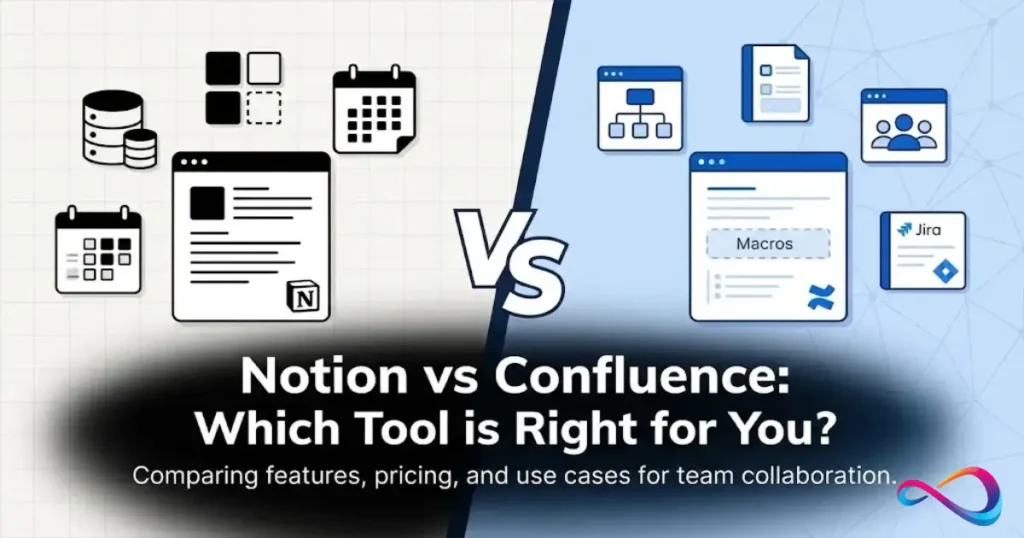
Neither Notion nor Confluence is universally “better.” Notion is the stronger choice for teams prioritizing flexibility, speed, and an all-in-one workspace. Confluence is better for organizations embedded in the Atlassian ecosystem, engineering-heavy teams, or those requiring mature governance and structured documentation.
For a 50–500 person company, your decision should hinge on your existing tooling, how tightly you need Jira integration, and whether you prioritize creative flexibility or standardization.
Read our full: 30 Best Knowledge Base Software (2026): Reviews & Pricing
In This Article (20 sections)
Notion vs Confluence: Who Should Pick Which
Choose Notion If:
- Your team values flexibility and builds custom workflows (databases, wikis, project trackers in one place).
- You want a modern, block-based editor with fewer content constraints.
- You’re a product, design, or cross-functional team without heavy Jira usage.
- AI-powered content generation and search matter.
- You want to consolidate tools (docs, wikis, light project management, notes).
Read full review: Notion Review 2026 – Pricing, Pros & Cons, Best Use Cases
Choose Confluence If:
- You’re already invested in the Atlassian ecosystem (Jira, Bitbucket, Trello).
- Structured, hierarchical documentation is non-negotiable.
- You need advanced admin controls, audit logs, and governance out of the box.
- Engineering and IT teams need deep issue tracker integration.
- Compliance certifications and data residency are business-critical.
Read full review: Confluence Review 2026: Features, Integrations, Pros & Cons
Decision Summary Table
| Factor | Notion | Confluence |
|---|---|---|
| Flexibility | ★★★★★ | ★★★☆☆ |
| Jira Integration | ★★☆☆☆ | ★★★★★ |
| Governance/ | ★★★☆☆ | ★★★★★ |
| AI (2025+) | ★★★★☆ | ★★★★☆ |
| Ease of Adoption | ★★★★★ | ★★★☆☆ |
| Scalability (500+ users) | ★★★★☆ | ★★★★★ |
What Is Notion?
Notion is a cloud-based, block-based workspace developed by Notion Labs, Inc. It combines wikis, documents, databases, and lightweight project management in a single platform, though teams needing deeper tracking can compare project management tools in my ranking. Notion is designed for flexibility: users build pages from composable blocks (text, databases, embeds, toggles, callouts, etc.) and link them in a freeform hierarchy.
Notion is popular among product teams, startups, and cross-functional organizations that want to consolidate multiple tools.

What Is Confluence?
Confluence is a wiki and knowledge management platform developed by Atlassian. It uses a hierarchical “spaces and pages” model, with structured templates optimized for technical documentation, meeting notes, project plans, and knowledge bases. Confluence integrates deeply with Jira and other Atlassian products.
Confluence is widely used by engineering, IT, and operations teams, especially where structured documentation, compliance, and governance are priorities.
At-a-Glance Comparison Table
| Dimension | Notion | Confluence |
|---|---|---|
| Docs Structure | Block-based, flexible, freeform hierarchy | Hierarchical spaces/ |
| Collaboration | Real-time co-editing, comments, mentions | Real-time editing, inline comments, @mentions |
| Permissions | Workspace, teamspace, page-level; guest access | Space-level, page-level, group-based |
| Search | Full-text, database filters, AI-powered | Full-text, CQL (Confluence Query Language), Rovo AI |
| Integrations | 100+ (Slack, Google, GitHub, Figma, etc.) | Deep Atlassian (Jira, Trello, Bitbucket), Marketplace apps |
| Automation | Database automations, Notion AI, limited native | Extensive automation rules, Jira triggers, Rovo AI |
| AI Features | Notion AI (summaries, Q&A, autofill, agents) | Atlassian Rovo (AI answers, content suggestions) |
| Analytics | Page views, workspace analytics (Business+) | Atlassian Analytics, content engagement reports |
| Admin/ | Audit logs, SCIM (Enterprise), content search | Audit logs, SCIM, advanced roles, Atlassian Guard |
| Deployment | Cloud only | Cloud, Data Center (self-hosted) |
| Pricing Approach | Per user/ | Per user/ |
Deep-Dive Comparison by Decision Factors
Document Structure and Hierarchy
Notion: Content is built from blocks—text, databases, toggles, embeds, synced blocks, etc. Pages can be nested infinitely, and there’s no enforced hierarchy. This flexibility enables creative use cases (wikis, project trackers, CRMs, habit trackers) but can lead to disorganization without deliberate information architecture.
Confluence: Uses a structured “space → page → child page” model. Templates enforce consistency. This structure is well-suited for technical documentation, runbooks, and compliance artifacts but can feel rigid for teams wanting more flexibility.
- Verdict:
- Notion wins on flexibility; Confluence wins on enforced consistency.
Real-Time Collaboration
Both platforms support real-time co-editing, inline comments, and @mentions. Notion’s collaboration feels snappier for small teams; Confluence’s is more mature for larger, distributed organizations.
Permission and Access Controls
Notion: Permissions are set at workspace, teamspace, and page levels. Guest access is flexible (limited or full). SCIM provisioning is available at Enterprise tier.
Confluence: Permissions are space-based and page-based. Group-based permissions, explicit guest controls, and Atlassian Guard provide granular access management. Enterprise includes advanced roles and audit.
- Verdict:
- Confluence has more mature, granular permission controls.
Search and Content Discovery
Notion: Full-text search, database filters, and (as of 2025) AI-powered Q&A across workspaces.
Confluence: Full-text search, CQL for advanced queries, and Rovo AI for semantic search and content recommendations.
- Verdict:
- Both are strong. Confluence’s advanced query language is a plus for power users.
Integrations Ecosystem
Notion: Offers 100+ integrations via native connectors, embed blocks, and API. Key integrations: Slack, Google Workspace, GitHub, Figma, Zapier.
Confluence: Deep integration with Jira, Bitbucket, Trello, and the Atlassian Marketplace (thousands of add-ons). Third-party integrations (Slack, Teams) available.
- Verdict:
- If you’re in the Atlassian ecosystem, Confluence wins. Otherwise, Notion’s integration flexibility is comparable.
Automation Capabilities
Notion: Database-level automations, Notion AI for content generation. Less robust workflow automation natively.
Confluence: Native automation rules, Jira-linked triggers, and powerful macro ecosystem. Atlassian Rovo extends automation with AI.
- Verdict:
- Confluence is more powerful for workflow automation; Notion is simpler but less deep.
AI Features
Notion AI (2025): Integrated in Business and Enterprise plans. Features: content generation, summarization, Q&A, autofill, database creation, meeting notes, AI agents for multi-step workflows.
Atlassian Rovo (2025): Included in Premium and Enterprise. Features: AI search, content suggestions, automation, answers based on connected Atlassian products.
- Verdict:
- Both are investing heavily in AI. Notion’s AI is more “creative assistant” focused; Rovo is more tightly integrated with Jira/project workflows.
Analytics and Reporting
Notion: Page views, workspace analytics (Business+). Limited compared to Confluence.
Confluence: Atlassian Analytics, space/page engagement, user activity reports. Enterprise includes Data Lake access.
- Verdict:
- Confluence wins for analytics depth.
Security, Compliance, and Admin Controls
SSO and Identity Management
| Capability | Notion | Confluence |
|---|---|---|
| SAML SSO | Business, Enterprise | Standard, Premium, Enterprise |
| SCIM Provisioning | Enterprise | Premium, Enterprise (with Guard) |
| Directory Sync | Okta, Azure AD, etc. | Okta, Azure AD, Google, etc. |
| Domain Verification | Required for SSO | Required for SSO/ |
Compliance Certifications
| Certification | Notion | Confluence |
|---|---|---|
| SOC 2 Type II | ✓ | ✓ |
| ISO 27001 | ✓ | ✓ |
| ISO 27701 | ✓ | ✓ |
| GDPR | ✓ | ✓ |
| HIPAA | With BAA (Enterprise) | With BAA (Enterprise) |
| FedRAMP | No | Atlassian Gov Cloud (select) |
Admin and Governance Features
Notion: Audit logs, content search (Enterprise), admin controls, legal hold, export restrictions.
Confluence: Audit logs, advanced roles, IP allowlisting, Atlassian Guard (enforced 2FA, threat detection), content lifecycle management.
- Verdict:
- Confluence’s governance is more mature for regulated industries.
Performance and Scalability Considerations
Notion: Cloud-only. Scales well for 50–500 users. Some users report slowdowns with very large databases (10,000+ rows).
Confluence: Cloud scales to 150,000 users per site. Data Center (self-hosted) option for organizations needing full control.
- Verdict:
- Confluence is the safer choice for very large organizations or regulated environments needing on-prem.
AI Capabilities and Guardrails
What to Evaluate
- Data handling: Where does your content go when processed by AI?
- LLM retention: Does the vendor commit to zero data retention with LLM providers?
- Opt-out options: Can you disable AI features for sensitive spaces?
- Audit trails: Are AI interactions logged?
Risks and Benefits
| Risk/ | Notion AI | Atlassian Rovo |
|---|---|---|
| Data retention | Zero retention with LLMs (Enterprise) | Contractual controls |
| Content exposure | User-controlled opt-in | Workspace-controlled |
| Productivity gains | High (creative, Q&A) | High (workflow, Jira) |
| Guardrails | Enterprise-tier only | Guard/ |

Common Use Cases and Workflows
Engineering Wiki / Technical Documentation
- Notion: Good for smaller teams, flexible structure, code blocks, embeds.
- Confluence: Best for Jira-linked specs, RFCs, runbooks, incident postmortems.
Product Specs and PRDs
- Notion: Popular for PRD templates, linked databases, cross-functional visibility.
- Confluence: Native Jira linking, approvals, and PM workflows.
SOPs and Operational Playbooks
- Notion: Easy to create, toggle lists, checklists, quick edits.
- Confluence: Template enforcement, version history, audit trail.
Project Hubs
- Notion: All-in-one: docs, databases, timelines, calendars.
- Confluence: Best when paired with Jira for issue tracking.
Onboarding and Training
- Notion: Fast to build, visually appealing, embed videos/tools.
- Confluence: Structured learning paths, quiz macros.
Pro Tip: Both platforms excel when paired with Loom for onboarding videos. Record quick walkthroughs for new hires, embed directly into your wiki, and skip scheduling live training sessions for every new team member.
Implementation Reality
Rollout Time
- Notion: Typically 2–4 weeks for 50–500 users. Low friction, minimal IT involvement.
- Confluence: 4–8 weeks for enterprise deployments. SSO, Guard, space setup, template design.
Change Management
- Notion: Lower barrier to adoption; risk of organic sprawl without governance.
- Confluence: Steeper learning curve; requires training, but structure helps long-term.
Templates and Information Architecture
- Notion: Start from scratch or use community/partner templates. Define your own IA.
- Confluence: Rich template gallery. Atlassian-recommended IA patterns for spaces.
Migration Considerations
Notion → Confluence
- Export Notion as Markdown/HTML.
- Restructure for Confluence’s space/page model.
- Rebuild databases as Confluence tables or linked Jira issues.
- Migrate permissions manually.
Confluence → Notion
- Export Confluence as HTML or via API.
- Map spaces to Notion workspaces/teamspaces.
- Recreate templates and macros as Notion blocks/databases.
- Re-establish SSO and SCIM in Notion.
Migration Checklist
| Step | Notes |
|---|---|
| 1. Audit existing content | Identify stale, duplicate, or sensitive content. |
| 2. Map information architecture | Define spaces/ |
| 3. Export data | Use native export or third-party tools. |
| 4. Test import | Import a subset to validate formatting. |
| 5. Rebuild permissions | Re-create groups, roles, and guest access. |
| 6. Train users | Document new workflows, host onboarding sessions. |
| 7. Set cutover date | Announce migration, lock old system. |
| 8. Monitor adoption | Track usage, gather feedback, iterate. |
Pricing and Total Cost of Ownership (TCO)
Pricing Model Overview
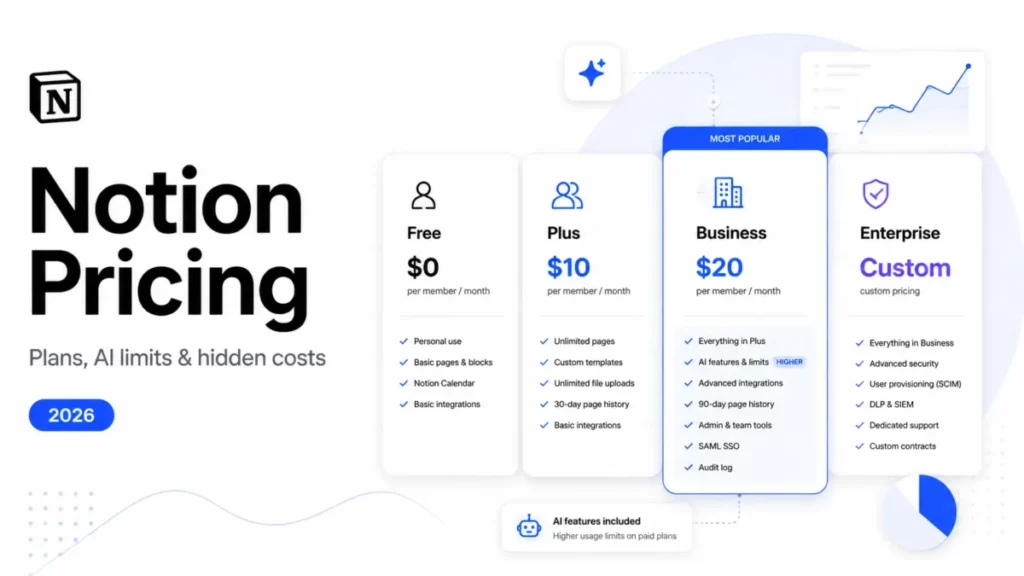
| Tier | Notion | Confluence |
|---|---|---|
| Free | Up to 10 guests, limited blocks/ | Up to 10 users, 2GB storage |
| Standard/ | ~$10–12/ | ~$5–6/ |
| Business/ | ~$20–24/ | ~$10–12/ |
| Enterprise | Custom | Custom |
Note: Atlassian announced 5–10% price increases effective October 2025. For a detailed breakdown of Notion’s current plans and costs, see our Notion pricing guide.
TCO Evaluation Checklist
| Factor | Questions to Ask |
|---|---|
| Seat count | How many users? Active vs. occasional? |
| Guest/ | How many guests? Paid or free? |
| Add-ons | Marketplace apps, AI, Guard, etc.? |
| Training | Internal or external training costs? |
| Migration | One-time migration labor + tools? |
| Admin overhead | Ongoing governance, support, audits? |
| Productivity gains | Time savings from AI, automation, integrations? |
Best For Scenarios
| Scenario | Recommended Tool |
|---|---|
| Product/ | Notion |
| Engineering-heavy, Jira-centric | Confluence |
| Startup, consolidating tools | Notion |
| Regulated industry, compliance-first | Confluence |
| Cross-functional, flexible workflows | Notion |
| Large org (500+ users), mature governance | Confluence |
| AI-powered content creation | Notion |
| Deep Atlassian integration | Confluence |
Avoid If Scenarios
| Scenario | Tool to Avoid |
|---|---|
| Heavy Jira usage, need tight integration | Notion |
| Want structured, enforced templates | Notion |
| Need on-prem/ | Notion |
| Prefer minimal structure, creative flexibility | Confluence |
| Want fast, low-friction adoption | Confluence |
| Need very granular, space-level permissions | Notion |
Decision Framework
Scoring Rubric
| Criterion | Weight | Notion Score (1–5) | Confluence Score (1–5) |
|---|---|---|---|
| Flexibility | 20% | 5 | 3 |
| Jira/ | 15% | 2 | 5 |
| Governance/ | 15% | 3 | 5 |
| AI Features | 10% | 4 | 4 |
| Ease of Adoption | 15% | 5 | 3 |
| Scalability | 10% | 4 | 5 |
| Pricing/ | 15% | 4 | 4 |
How to Weight Factors:
- If you use Jira heavily, weight “Jira Integration” at 25%+.
- If compliance is critical, weight “Governance/Admin” at 25%+.
- If adoption speed matters, weight “Ease of Adoption” higher.
Read full review: Tettra Review 2026: Features, Pricing, Pros & Cons
Frequently Asked Questions – Notion vs Confluence 2026
Is Notion better than Confluence? It depends. Notion is better for flexibility and all-in-one workflows. Confluence is better for structured documentation and Atlassian integration.
Can Notion replace Confluence? For some teams, yes—especially product, design, and cross-functional teams. For engineering or compliance-driven orgs using Jira, Confluence is harder to replace.
Does Notion have SSO? Yes. SAML SSO is available on Business and Enterprise plans.
Does Confluence integrate with Jira? Yes. Confluence has native, deep integration with Jira, including issue linking, Jira macros, and automation triggers.
Which is cheaper, Notion or Confluence? Confluence Standard is less expensive per seat. Notion Business includes AI; Confluence Premium does not.
Is Notion secure for enterprise? Yes. Notion offers SOC 2, ISO 27001, SAML SSO, SCIM, audit logs, and legal hold (Enterprise).
Does Confluence have AI features? Yes. Atlassian Rovo provides AI search, content suggestions, and automation.
Can I migrate from Confluence to Notion? Yes. Export Confluence as HTML, restructure for Notion, and rebuild templates. Expect 2–8 weeks depending on content volume.
Which tool has better search? Both are strong. Confluence’s CQL is more powerful for advanced queries; Notion’s AI Q&A is more intuitive for everyday users.
Is Notion GDPR compliant? Yes. Notion is GDPR compliant and offers EU data residency (on request for Enterprise).
Methodology
This comparison was developed using:
- Official product documentation from Notion and Atlassian (2024–2025).
- Publicly available pricing and feature pages.
- Aggregated user feedback from G2, TrustRadius, and Reddit.
- Implementation patterns observed across client deployments (not personal hands-on use).
- No vendor sponsorship or affiliation.
What to Test in a Pilot (7-Day Evaluation Plan)
| Day | Activity |
|---|---|
| 1 | Set up workspace/ |
| 2 | Invite 5–10 users. Test real-time collaboration and comments. |
| 3 | Configure SSO (if available). Test permission inheritance. |
| 4 | Evaluate search: find old content, use filters/ |
| 5 | Test integrations: Slack, Jira, GitHub, etc. |
| 6 | Evaluate AI features: Q&A, summarization, content generation. |
| 7 | Gather team feedback. Score against your rubric. Make decision. |
Common Mistakes Teams Make
- Skipping information architecture planning. Result: content sprawl, poor discoverability.
- Not defining governance early. Result: inconsistent permissions, orphaned pages.
- Over-relying on AI features. Result: inaccurate content, trust issues.
- Ignoring change management. Result: low adoption, shadow wikis.
- Migrating everything at once. Result: broken links, formatting issues.
- Not involving IT/security early. Result: SSO/SCIM delays, compliance gaps.
- Choosing based on UI preference alone. Result: missing critical integrations or governance.
- Underestimating training. Result: users don’t use advanced features.
Conclusion
Notion is the better choice for teams that value flexibility, want to consolidate tools, and prioritize ease of adoption. It’s especially strong for product, design, and cross-functional teams.
Confluence is the better choice for organizations deeply invested in Atlassian, needing structured documentation, or requiring mature governance and compliance controls. It’s the default for engineering-heavy, Jira-centric environments.
Next Steps:
- Map your must-have features (Jira integration, SSO, AI, permissions).
- Run a 7-day pilot with both tools.
- Score each tool using the rubric above.
- Factor in TCO—not just seat price, but training, migration, and admin overhead.
- Make your decision based on your specific team context, not general popularity.
References
- Notion Security & Compliance: https://www.notion.so/security
- Atlassian Confluence Trust & Security: https://www.atlassian.com/trust
- G2 Crowd: Notion vs Confluence Reviews: https://www.g2.com/compare/notion-vs-confluence