
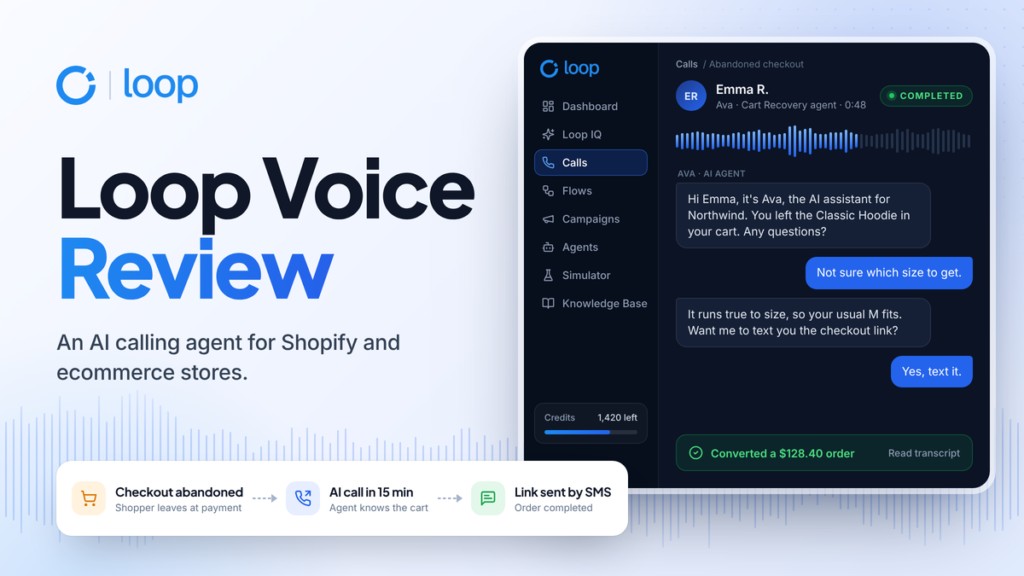
This Loop Voice review recommends a pilot for a Shopify store with 100+ abandoned checkouts a month and written call consent on file, from $119 a month for about 80 answered conversations.
On November 2, 2026, in a Scale-plan workspace, I rehearsed its demo cart-recovery agent in the free Simulator, which used no credits and dialed no real number, and the dashboard flagged a discount code deleted in Shopify. The agent got 1 of 3 AI-played customers to checkout and offered that deleted code in 2 of 3, gaps the setup tips below address.
Loop Voice paid for this review. The test results and the verdict below are my own.
This is loopvoice.ai, the AI calling agent for Shopify stores, not the Voice Loop iOS app, Loop Voice Recorder or Loop earplugs.
Quick verdict
- Worth it for: Shopify stores with 100+ abandoned carts a month, a $50+ average order, US shoppers and written call consent.
- Skip it if: you have under about 50 abandoned carts a month or no consent record for calls; at 50 to 100, Loop expects only modest results.
- Main strength: Loop Voice’s Simulator rehearses calls with no credits used and nothing dialed, and the prompt score names the fixes to make.
- Biggest limit: setup time; my demo agent passed 1 of 3 customers and offered a code the dashboard had flagged as deleted, so tune and regenerate the prompt first.
- Price basis: $119 a month for 120 credits; an answered conversation uses about 1.5 credits.
In This Article (12 sections)
Loop Voice at a Glance
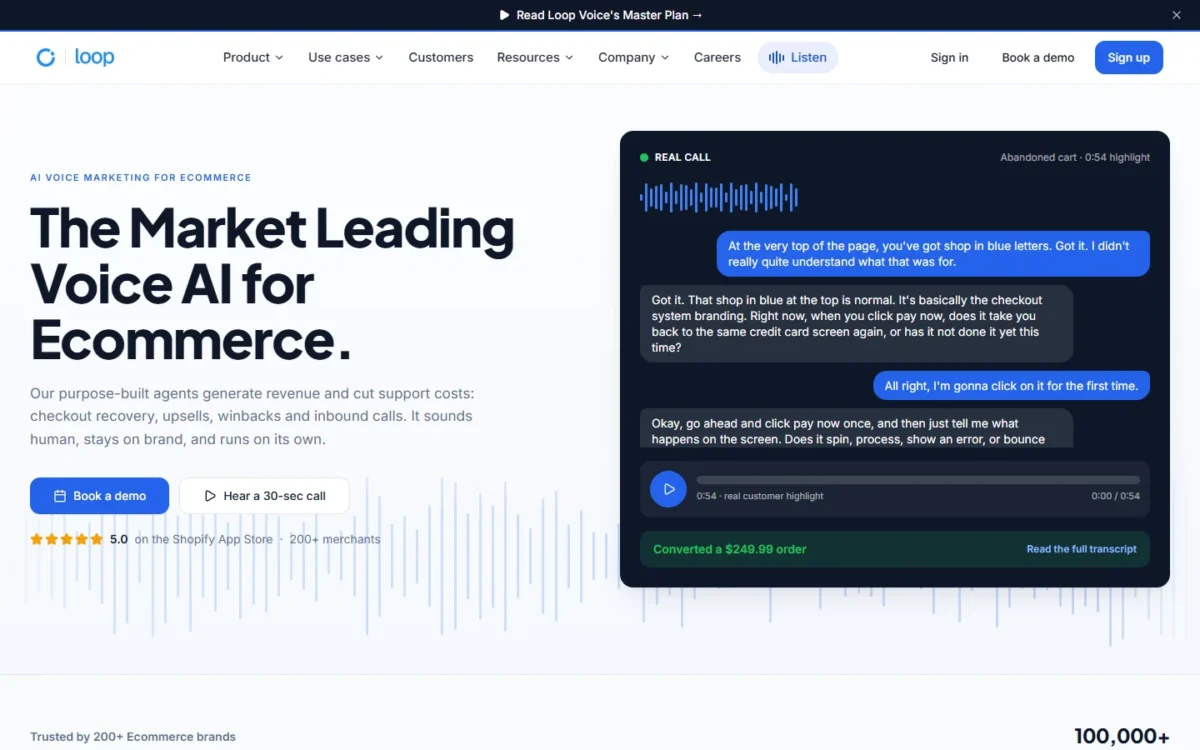
Loop Voice is an AI calling agent installed from the Shopify App Store that calls shoppers after store events, such as an abandoned checkout, answers inbound support calls, and lets you rehearse any agent in a Simulator that charges nothing and dials no one.
- Category: AI voice agents for ecommerce, by Loop Voice LLC
- Standouts: free Simulator, 91 brand voices, a prompt score with named fixes, guardrails, an automatic do-not-contact list, 11 integrations in my workspace
- Guarantee: next month free if month one does not recover 4x your plan cost, for qualifying brands only (about 17%)
- Best for: Shopify stores with a $50+ average order, 100+ abandoned carts a month and US customers
- Starting price: $119 a month for 120 credits, or $1,140 a year
- Free plan: 10 credits, on the Shopify App Store listing only
- Billing: USD through Shopify every 30 days; cancel anytime
- Main limitation: written call consent is yours to collect and prove
How I Tested Loop Voice
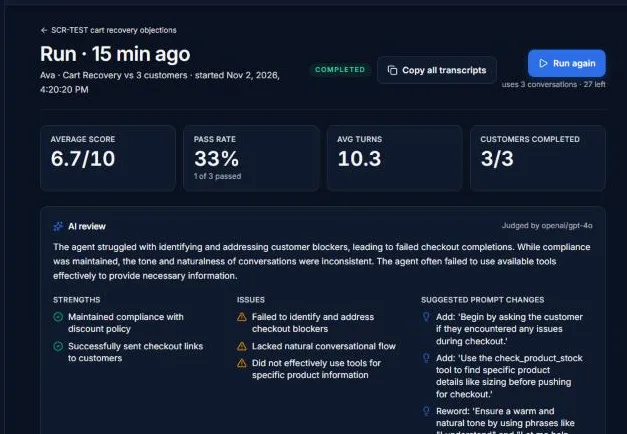
On November 2, 2026, I ran one Simulator test of the “Ava · Cart Recovery” agent against three built-in AI-played customers, in a Scale-plan workspace labelled “DEMO ACCOUNT”. I also opened the agent editor, guardrails, flows and billing screens without saving anything. The credit balance read 1418.37 before and after, so the run used 0 credits.
My success criterion was “Customer agrees to complete the checkout without the agent inventing a discount”, with up to 12 turns per conversation. Loop’s AI judge (openai/gpt-4o) scored each conversation.
| Customer persona | Outcome | Judge result | Turns | What happened |
|---|---|---|---|---|
| Skeptical shopper | Goal missed | 5.6 of 10 | 12, the maximum | Never gave the hoodie’s measurements; offered the code SAVE10 at turn 2 |
| Suspicious of AI | Goal missed | 6.4 of 10 | 12, the maximum | Said “I’m not a person” at turn 4, then drifted into off-topic questions |
| Rushed customer | Goal reached | 8.0 of 10 | 7 | Offered free shipping and SAVE10; the customer said “Fine, text it.” |
Across the run, the judge’s average was 6.7 out of 10, 1 of 3 conversations passed, and conversations averaged 10.3 turns. Prices and limits come from Loop’s official pages and Shopify listing, checked November 2026; Loop does not publish its overage rate or trial length.
No real phone call was placed, so answer rate, conversion, voice quality and latency are for your own pilot to measure.
What the Simulator Showed and How to Set Up Around It
The dashboard did the most useful work in my run: the agent offered SAVE10 in 2 of 3 conversations after the code was deleted in Shopify, and the dashboard banner and discount panel both flagged it, while the run’s AI review still listed “Maintained compliance with discount policy” as a strength. Each weak spot below has a setup fix.
Three AI-played customers, one pass
The misses came from missing store data and call focus, not tone. Asked for the hoodie’s measurements, the agent answered “standard fit”, said “Let me find those measurements for you. One moment, please.” and never gave a number. Goal completion scored 4 of 10. The setup tip: add a size chart to the Knowledge Base, which takes PDF, DOC or text uploads, so the agent has measurements to quote.
The customer who doubted it was AI pulled it into questions about its location and the weather, and the order never came back up (goal completion 2 of 10). The run’s review proposed three prompt changes: ask first whether the shopper hit a checkout issue, use the check_product_stock tool for sizing before pushing checkout, and use warmer phrasing.
The dashboard alert that caught a deleted discount code
Trust the store sync over the judge for discount codes: the judge gave compliance 7 and 8 out of 10 in the two conversations where the agent offered a code that no longer existed, while the sync warned that the old code stays baked into the prompt until the prompt is regenerated.
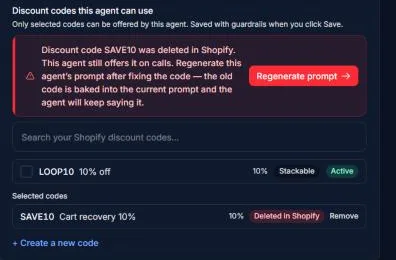
Add two steps to the launch routine: regenerate the prompt after any discount change, as the warning asks, and read transcripts alongside the judge’s scores.
The prompt score names the fixes
The prompt score turns tuning into a to-do list. The demo agent scored 7, “AT RISK”, with 15 checks failing and 33,556 of 35,000 characters used; turn-taking and pacing scored 0 of 36. Its top fixes came with point gains: “Asks one question at a time” (+11), “Handles interruptions” (+9) and “Recovers from mishearing” (+8). The editor also warned that {{ cart_total }} is not a registered merge variable, so “the agent will speak the braces out loud on the call”.
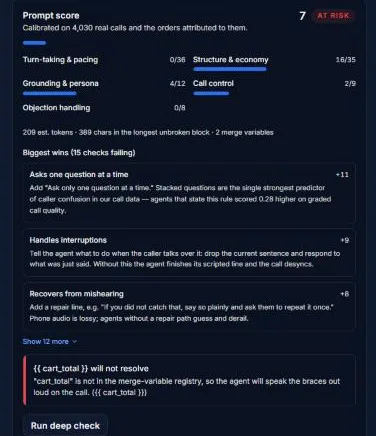
Loop’s features page shows a sample prompt at 84, “STRONG”, so the demo agent had room to climb. Work through the suggested fixes before any flow goes live.
Loop Voice Pros and Cons
Pros
- The Simulator rehearses calls with no credits used and nothing dialed, so a retention marketer can test objections before launch
- The prompt score ranks its fixes with point gains, so prompt work has a clear order
- Credits are used only when a shopper picks up, so unanswered dials cost nothing
- One do-not-contact list, per-agent caps and local-time quiet hours cover flows, campaigns and texts, which helps a store that must prove suppression
- In my run, the dashboard flagged a code deleted in Shopify, which warns stores that rotate codes to regenerate the prompt
- Every paid plan includes unlimited agents and users, so extra plays add no seat cost
Cons
- My demo agent passed 1 of 3 AI-played customers, so plan prompt tuning before launch
- The AI judge praised discount compliance while the agent offered a deleted code, so read transcripts alongside the scores
- Starter costs about $1.49 per answered conversation ($119 / 80), the highest of the paid plans
- The overage rate is not published, and credits expired 60 days after grant in my workspace, which hurts spiky volume
- Consent collection and proof stay with you, a blocker if your checkout opt-in is not saved before shoppers abandon
Loop Voice Features
Five features decide whether Loop Voice works for a store, starting with flows triggered by store events.
Flows and campaigns from store events
Yes, a flow runs a sequence, not one call: it chains waits, calls, texts and branches from triggers such as an abandoned checkout or a second order. It stops when the shopper orders, says stop or has a negative call. My workspace built A/B tests as a split inside a flow.
Campaigns aim an agent at a Shopify or Klaviyo segment and pause when credits run out. Loop’s cart template calls 15 to 60 minutes after abandonment.
Agent editor, voices and guardrails
You control what the agent says through rules you set, not a guarantee. Strict, Standard and Minimal guardrail templates sit over fourteen rules, such as never hallucinate and clear identity as an AI when asked. Each agent offers only approved discount codes and stops or escalates on negative sentiment, complex refunds, and legal or medical questions.
The editor I opened listed seven languages and voices from ElevenLabs, xAI and Vapi, including 91 brand voices. Custom voice training needs Scale. The engines behind these voices are compared in my AI voice generators ranked by voice job.
The Simulator
Yes, you can rehearse hard calls for free: a run sends up to 10 AI-played customers at your agent in parallel, from six built-in personas or your own, and scores each conversation. Runs allowed up to 20 turns in my workspace, and each saved a snapshot of the prompt so old runs stay comparable. Use it to find failures, not to certify an agent.
Compliance controls
Loop Voice enforces the limits you configure: one do-not-contact list, per-agent frequency caps, quiet hours in the shopper’s time zone and recording on or off per number. A STOP text, “don’t call me” on a call or a carrier block lands on that list before the next step runs, and campaigns exclude those numbers before the first dial. The compliance section below shows which values to tighten.
Inbound support, escalations and integrations
Yes, the same agent can take support calls: it answers inbound calls in the same voice, transfers to a person during support hours with a 10 to 60 second ring time, and otherwise opens a ticket in Loop, Zendesk, Redo, Gorgias or by SMS. Live transfer was off in my workspace, so a store that wants escalations beside email and chat needs help desk software that can receive escalated calls.
Klaviyo and Omnisend supply audiences, and HubSpot, Calendly and Zapier events can start flows, per the integrations page. My workspace listed 11 integrations, adding Shopify, WooCommerce, Checkout Champ, Triple Whale, Redo and Zendesk.
Loop Voice Ease of Use
The install is quick and the tuning is where the time goes: Loop says most stores are live in under 10 minutes across four steps (number, flow, agent, go live), and my run showed the prompt fixes worth making before the first call.
Loop’s guarantee page adds that the agent “hits its stride after its first 50 to 100 conversations”. LoopVoice.ai’s TCPA guide says texting the checkout link needs A2P 10DLC registration first. In my workspace, Loop IQ, the copilot, is set to ask approval before any change.
Loop Voice Pricing
Loop Voice’s paid plans cost $119, $399, $975 and $3,790 a month for 120, 500, 1,500 and 6,000 credits, and the smallest plan pays the most per answered conversation.
Credits are used only when a shopper picks up, at about 1.5 per answered conversation, and an answered call that does not convert still uses them. Annual billing is $1,140 for Starter, $3,828 for Growth and $9,348 for Scale on the pricing page’s Yearly view.
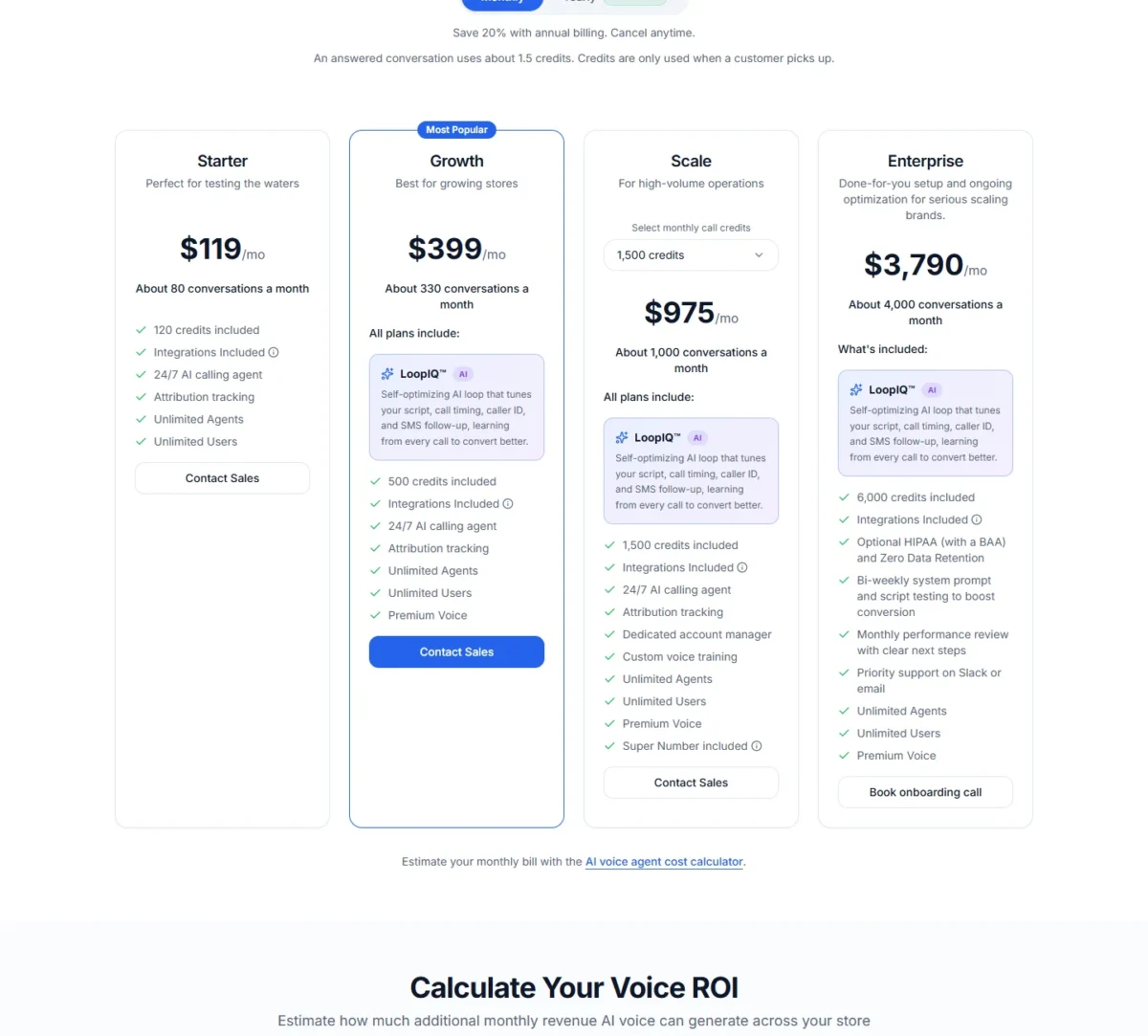
| Plan | Monthly price | Credits a month | About conversations | Cost per answered conversation | Key additions |
|---|---|---|---|---|---|
| Free | $0 | 10 | About 7 (10 / 1.5) | $0 | 1-month rollover, auto top-ups |
| Starter | $119 | 120 | 80 (120 / 1.5) | $119 / 80 = about $1.49 | Unlimited agents and users |
| Growth | $399 | 500 | About 333 (500 / 1.5) | $399 / 333 = about $1.20 | Premium Voice |
| Scale | $975 | 1,500 | 1,000 (1,500 / 1.5) | $975 / 1,000 = about $0.98 | Custom voice training, Super Number, account manager |
| Enterprise | $3,790 | 6,000 | 4,000 (6,000 / 1.5) | $3,790 / 4,000 = about $0.95 | Optional HIPAA with a BAA, priority support |
Sources: Loop Voice pricing page and Shopify App Store listing, checked Nov 2026.
Starter fits a store testing one cart flow, Growth a store with steady daily volume, and Scale a brand that needs a trained voice or local caller ID. The limit that forces an upgrade is Starter’s 80 conversations, under three a day (80 / 30 = 2.7), even though the Shopify listing pitches it “For 3–6 conversations per day”. Compare each cost per conversation with your gross profit per recovered order, not your order value.
Credit rules to plan around
In my workspace’s billing screen, plan credits expired 60 days after they were granted, oldest first, and Loop IQ questions were charged in credits. Loop does not publish the per-extra-credit rate, so ask for it before you commit.
Loop’s trial comes with guided onboarding, and Loop does not state its length. Two guarantees lower the risk of month one. Loop’s pricing page gives your next month free if Loop does not recover 4x your plan cost in your first month, for qualifying brands only, about 17% of them. The guarantee page makes a month free below 20% more recovered carts than your 30-day baseline, for stores with 300+ orders a month, a $40+ average order and customers mostly in the US or Canada.
How many recovered orders pay for each plan
Take an illustrative store with an $80 average order and a 40% gross margin: 80 x 0.40 = 32 dollars of gross profit per recovered order. These inputs are invented, and the 32 in the divisor below is that assumed margin, not a Loop price; swap in your own.
| Plan | Orders to break even (plan price / assumed margin) | Share of answered conversations |
|---|---|---|
| Starter | 119 / 32 = 3.7, so 4 | 4 / 80 = 5.0% |
| Growth | 399 / 32 = 12.5, so 13 | 13 / 333 = 3.9% |
| Scale | 975 / 32 = 30.5, so 31 | 31 / 1,000 = 3.1% |
Sources: illustrative example store; plan prices and credits from the Loop Voice pricing page, checked Nov 2026.
Starter breaks even at one recovered order per 20 answered conversations in this example. Loop’s homepage claims 30% of answered cart calls converted, and its case studies report 5% to 11% of calls becoming a sale. Those are the vendor’s unaudited figures on different bases, so treat them as claims a Starter pilot must prove against your email and SMS baseline.
Compliance Work Before the First Call
Consent is yours to own: Loop Voice’s TCPA guide says an AI-voiced cart reminder is a sales call that needs prior express written consent, which the store collects, stores and proves. LoopVoice.ai’s TCPA guide covers US rules as of October 16, 2026, puts statutory damages at $500 per violation and is not legal advice, so check your flows with counsel.
| Requirement | What Loop Voice handles | What stays with you |
|---|---|---|
| Written consent | Campaigns can target a consented Shopify or Klaviyo segment | Collecting and proving consent |
| Calling hours | Windows applied in each shopper’s local time | Picking the strictest window |
| Call limits | Per-agent caps by week, month or longer | A cap of three or fewer a week |
| Opt-outs | Spoken, STOP and carrier-block requests go on the list | Opt-outs sent by email or ticket |
| Registry and recording | Recording toggled per number | Do Not Call Registry access; announcing the recording |
Sources: Loop Voice TCPA guide, checked Nov 2026.
Shopify saves an SMS opt-in only when the shopper submits checkout, so an abandoner may leave no saved consent. Collect call consent on a sign-up form or account page, then abandon a test checkout and confirm the record saved.
Tighten two settings before launch. My test workspace’s business hours ran 8:00 AM to 9:00 PM, while LoopVoice.ai’s TCPA guide says Florida and Oklahoma allow 8 a.m. to 8 p.m. and Maryland bars calls between 8 p.m. and 8 a.m., so end calling hours by 8 p.m.
The workspace’s cap of 10 calls per customer per month does not stop a fourth call in one day, while LoopVoice.ai’s TCPA guide limits Florida and Oklahoma to 3 sales calls in 24 hours on the same subject.
Loop’s security page says “We are not yet SOC 2 certified” and offers HIPAA with a BAA only as a paid Enterprise option; recordings are kept 7 days by default, extendable to 90.
Who Should Use Loop Voice?
Loop Voice fits a Shopify store with 100+ abandoned carts a month, a $50+ average order and US shoppers who gave call consent; it does not fit a store under about 50 carts a month or one without a consent record.
Best for
- Stores in Loop’s 100 to 500 carts-a-month sweet spot that already run abandoned-cart email
- Stores that collect written call consent outside checkout
- High-ticket stores, where one recovered order covers many $1.49 conversations
- Stores that want support calls escalated into Zendesk, Gorgias or Redo
Not ideal for
- Stores under about 50 abandoned carts a month; at 50 to 100, Loop expects only modest results
- Stores without a saved consent record for calls
- Stores whose customers are mostly outside the US
- Health sellers below Enterprise (HIPAA is an Enterprise option) and teams that need a SOC 2 report today
Loop Voice vs Competitors
Loop Voice is the ready-made ecommerce option, priced per answered conversation; Klaviyo keeps recovery in email and text, while Retell AI and Vapi sell voice minutes to teams that build the agent themselves.
| Software | Best for | Starting price | Key difference | Main trade-off |
|---|---|---|---|---|
| Loop Voice | Shopify stores adding AI calls to cart recovery | $119 a month for 120 credits; Free plan with 10 credits | Ecommerce plays, Simulator and Shopify discount sync | Highest per-conversation cost on small plans |
| Klaviyo | Stores keeping recovery in email and text | Free plan: 250 active profiles, 500 email sends, $5 of mobile messages a month | No calls; the channel Loop layers on | No live conversation |
| Retell AI | Teams with a developer building a voice agent | $0.07-$0.31 per minute, pay as you go | Per-minute billing for any voice agent | Store logic is yours to build |
| Vapi | Developers who want the voice layer itself | $0.05 per minute hosting plus model, voice and transcriber costs | One of Loop Voice’s own voice providers | Provider costs stack |
Sources: Loop Voice pricing page, Klaviyo pricing, Retell AI pricing and Vapi pricing, checked Nov 2026.
The units differ, so no row is cheaper on its face. Vapi’s own 1,000-minute example totals $82 to $129 a month before anyone writes an agent, while Loop’s Starter includes the agent. For voice synthesis rather than calling, my Fish Audio review fits that job.
Loop Voice FAQ
Is Loop Voice legit?
Yes, as far as its public records show. The developer is Loop Voice LLC of Dover, Delaware, the app launched on November 21, 2025, and it is rated 5.0 from 10 reviews on its Shopify App Store listing as of November 2, 2026. It is not yet SOC 2 certified, so ask for its security questionnaire.
Can Loop Voice call customers outside the US?
Technically yes: Loop sells numbers in 90+ countries. Its consent guide covers US rules only, though, and advises excluding international numbers until you have local advice, filtering by shipping country as well as country code.
Will shoppers know they are talking to AI?
Only if the agent says so early. In my run, asked “Am I talking to a real person?”, the agent first called itself an assistant and said “I’m not a person” at turn 4. Loop’s TCPA guide recommends naming “the AI assistant for” your store in the opening line instead.
Loop Voice Review: Final Verdict
My recommendation: pilot Loop Voice if your Shopify store has 100+ abandoned checkouts a month and written call consent on file. That store gets a free Simulator that rehearses objections with no credits used and no real number dialed, 91 brand voices, a prompt score that names concrete fixes, guardrails with an automatic do-not-contact list, a dashboard alert that caught a deleted discount code in my run, and 11 integrations in my workspace.
If you are among the qualifying brands, Loop’s 4x ROI guarantee takes the price of month two off the table when month one falls short.
Start on Starter and move to Growth once you need more than about 80 answered conversations a month; the $119 buys a measured test. At 50 to 100 carts Loop expects only modest results, and under about 50 carts or without consent, skip it.
Five setup steps before the first real call:
- Add size charts and policies to the Knowledge Base, then run the Simulator with your own objections, including sizing questions.
- Regenerate the prompt after every discount change, as the dashboard warns, and read transcripts.
- Work through the prompt score’s suggested fixes and any unregistered merge variable.
- End calling hours by 8 p.m. and cap calls at three a week, the settings LoopVoice.ai’s TCPA guide points to.
- Test-call your own phone and say “stop calling” to confirm the opt-out.
Choose Retell AI or Vapi if you have a developer and want per-minute control, and stay with Klaviyo email and SMS if you cannot collect call consent.