
ChatGPT prompts for real estate agents can cut hours off your weekly content, outreach, and admin workload — if you use the right ones. This is not another 50-item copy-paste list. It is a workflow-organized prompt library built specifically for US real estate agents, Realtors, brokers, and teams who want to use generative AI without sounding generic, violating compliance rules, or publishing inaccurate information.
Each prompt below is tagged by use case, includes the context you need to fill in, and comes with an editorial note on why it works and what to review before publishing.
TL;DR — The Quick Answer
- This article gives you 50 ready-to-use real estate AI prompts organized by actual agent workflow: prospecting → listing prep → marketing → communication → transactions → referrals.
- Every prompt uses a 7-part structure (role, task, context, constraints, tone, output format, review flag) so you get usable output on the first try.
- We cover fair housing compliance, hallucination risks, and a human-review checklist — the stuff most prompt lists skip.
- Best low-risk uses: email drafts, social captions, blog outlines. Highest-risk uses: property facts, legal language, market predictions.
How to Use This Prompt Library
- Find your workflow stage. Prompts are grouped by what you’re doing right now: generating leads, writing listings, following up, etc.
- Fill in the bracketed fields. Every prompt includes placeholders like
[neighborhood],[price],[client name]. Replace them with real details. - Review every output before publishing. AI can hallucinate facts, invent neighborhood details, and accidentally violate fair housing language rules. Always fact-check.
- Iterate. If the first output is 80% right, paste it back and ask ChatGPT to revise the weak sections. The best results come from 2–3 rounds.
- Save your best prompts. Build a personal swipe file in your CRM, Google Doc, or Notion board so you’re not starting from scratch every time.
How We Selected These 50 Prompts
We didn’t just compile the most popular prompts from the internet. Each prompt in this library was selected based on four criteria:
- Maps to a real workflow — Every prompt corresponds to a task agents actually do weekly: lead follow-up, listing prep, client nurturing, transaction coordination.
- Practical value — We prioritized prompts that save measurable time (15+ minutes per use) or consistently produce copy you can use with minor editing.
- Risk level assessed — Each prompt is tagged by how much human review it needs. Low-risk prompts (email drafts, social captions) get light review; high-risk prompts (property facts, CMA summaries) require full verification.
- US market compliance — All prompts include guardrails for Fair Housing language, accuracy verification, and privacy protection, because your license depends on it.
Who This Article Is For
- New agents looking for ready-to-use templates to build their first outreach and marketing systems
- Solo agents who need to save time by automating repetitive writing tasks
- Listing agents who want better property descriptions, brochure copy, and seller communication
- Buyer’s agents who need streamlined client communication and transaction updates
- Real estate teams looking to standardize communication while keeping a personal touch
- Luxury agents who need elevated, nuanced copy that matches their brand
- Brokers who want to train their agents on responsible AI use
What Makes a Good ChatGPT Prompt for Real Estate Agents?
Short answer: A good real estate prompt gives the AI enough context to sound like you on a good day — local, specific, and professional — without producing content that needs heavy rewriting or, worse, creates compliance risk.
Most agents type something like “Write me a listing description” and wonder why the output sounds like every other AI-generated listing on Zillow. The problem is not ChatGPT — it is the prompt.
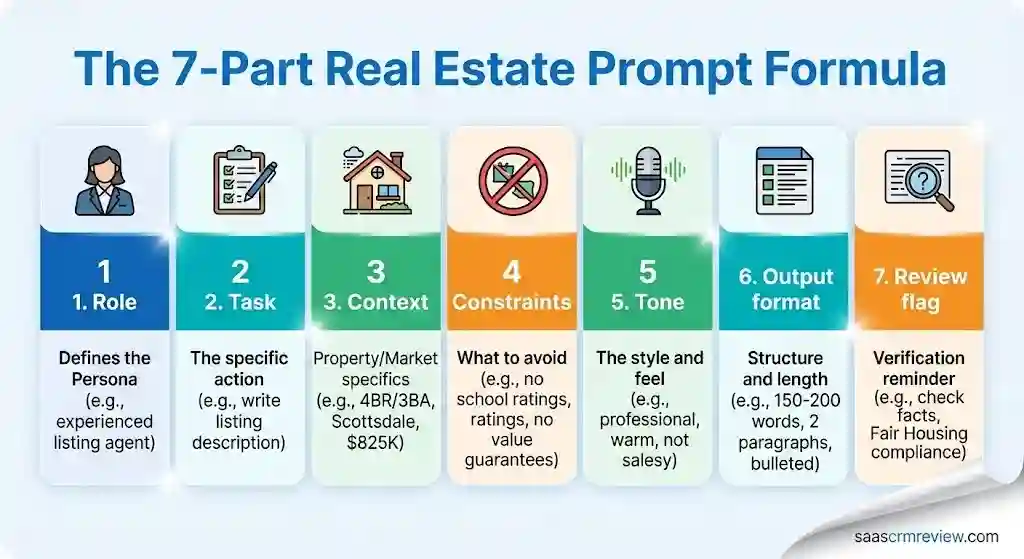
The 7-Part Real Estate Prompt Formula
| Component | What It Does | Example |
|---|---|---|
| Role | Tells AI who it is | “You are an experienced US listing agent” |
| Task | What you need | “Write a listing description” |
| Context | Property/market specifics | “4BR/3BA in Scottsdale, AZ, $825K, renovated kitchen” |
| Constraints | What to avoid | “Do not mention school ratings or make claims about property value appreciation” |
| Tone | How it should sound | “Professional, warm, confident — not salesy” |
| Output format | Structure of the result | “150–200 words, 2 paragraphs, bulleted feature list” |
| Review flag | Reminds you to verify | “Flag any factual claim that needs MLS verification” |
Before/After: Weak Prompt vs. Strong Prompt
❌ Weak prompt:
Write a listing description for a house in Dallas.
✅ Strong prompt:
You are an experienced listing agent in Dallas, TX. Write a listing description for a 3-bedroom, 2.5-bathroom home in Lakewood listed at $675,000. The home has original hardwood floors, a renovated chef’s kitchen with quartz countertops, a private backyard with a mature pecan tree, and a detached garage converted to a home office. Tone: confident and warm, not salesy. Length: 150–200 words. Do not mention school ratings or estimated property value increases. Flag any claim that would need MLS verification.
Before/After: Raw AI Output vs. Publish-Ready Edit
❌ Raw ChatGPT output (from weak prompt):
Welcome to this stunning property in Dallas! This dream home features beautiful finishes throughout and is located in one of the most sought-after neighborhoods. Don’t miss this incredible opportunity to own a piece of paradise!
✅ After human editing (from strong prompt, then refined):
Hardwood floors run through every room of this Lakewood ranch, from the open living area to the renovated kitchen with quartz countertops and soft-close cabinetry. The backyard is private — a mature pecan tree shades the patio, and a converted garage now serves as a climate-controlled home office. 3 beds, 2.5 baths, 1,820 sq ft. Listed at $675,000. Schedule a private showing to see it in person.
The difference shows why prompt structure and human review both matter. The weak prompt produced generic filler. The strong prompt produced something close to usable — and a quick human edit made it ready to publish.
How to refine outputs: Tell ChatGPT exactly what to fix. Say “Make paragraph one shorter and remove the phrase ‘dream home'” — not “make it better.” Vague follow-ups produce vague revisions.
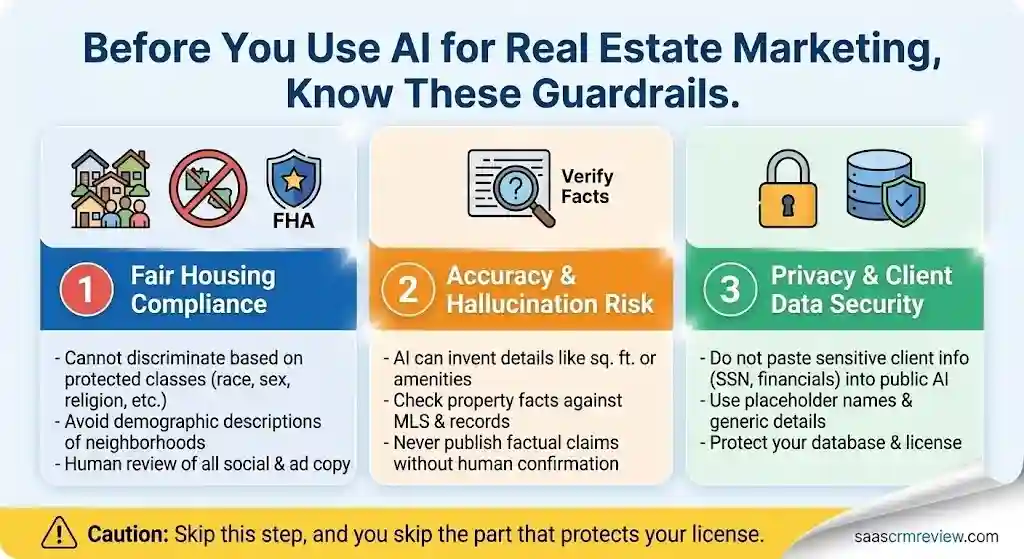
Before You Use AI for Real Estate Marketing, Know These Guardrails
CAUTION
Compliance and accuracy matter. Using AI prompts for real estate agents can save significant time, but there are real risks that most prompt lists never mention. If you skip this section, you are skipping the part that protects your license and reputation.
Fair Housing Compliance
The Fair Housing Act applies to all real estate advertising — including AI-generated content. That means your AI-written listing descriptions, social posts, and ad copy cannot include language that discriminates based on race, color, religion, sex, national origin, familial status, or disability.
The National Association of REALTORS has also emphasized that AI in real estate carries specific risks around bias, privacy, disclosure, and accountability.
Practical rule: Never let ChatGPT describe a neighborhood’s demographics, religious institutions, or “family-friendly” character without reviewing the language carefully. AI models are trained on internet data that may reflect biased patterns. Your name is on the listing, not OpenAI’s.
Accuracy and Hallucination Risk
ChatGPT can and does invent details. It may fabricate square footage, neighborhood amenities, school ratings, walkability scores, or comparable sales data. Never publish AI-generated factual claims without checking them against MLS data, county records, or verified sources.
The FTC has made clear that businesses are responsible for the accuracy of AI-generated claims used in marketing. Public reporting has documented cases of agents publishing AI-generated listing details that were fabricated or inaccurate.
Privacy and Client Data
Do not paste client phone numbers, financial details, or personally identifiable information into ChatGPT. OpenAI has improved its data policies, but the safest practice is to use placeholder names and generic details when drafting, then add real client info in your CRM or email tool — not in the AI chat window.
Human Review Checklist Before Publishing
- All property facts verified against MLS or county data
- No fair housing language violations
- No invented neighborhood claims or amenities
- No specific ROI, appreciation, or value guarantees
- Client names and contact info removed from the AI session
- Tone sounds like you, not like a robot
- Content reviewed by your broker if required by your office policy
NOTE
Disclaimer: This article is not legal advice. Real estate regulations vary by state and locality. Always verify compliance requirements with your managing broker, state real estate commission, and/or attorney before publishing any marketing content. Facts must be independently verified before publication.
Low-Risk vs. High-Risk Uses of ChatGPT for Real Estate
What should agents automate with AI, and where should they be cautious?
Not all real estate AI tasks carry the same risk. Here is a practical breakdown:
| Risk Level | Task Type | Examples | Review Needed |
|---|---|---|---|
| 🟢 Low risk | Drafting relationship-focused content | Follow-up emails, nurture sequences, social captions, blog outlines, event invitations, thank-you notes | Light edit for tone and personalization |
| 🟡 Medium risk | Marketing copy with subjective claims | Listing descriptions, property brochures, ad copy, video scripts, neighborhood guides | Verify all features, check fair housing language, edit for accuracy |
| 🔴 High risk | Content with factual/legal/financial claims | CMA summaries, market reports, pricing recommendations, legal disclosures, property data, school ratings | Full fact-check against MLS, county records, and verified data. Never publish without human verification |
Rule of thumb: If the content could be wrong and the error could cost you a client, a complaint, or your license, it’s high-risk. Treat AI output as a first draft, not a final product.
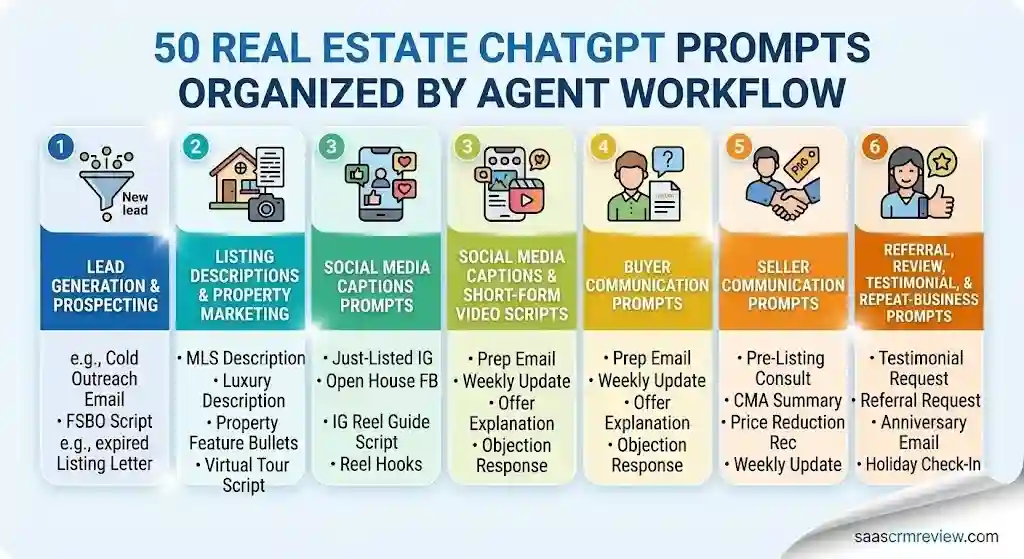
50 Real Estate ChatGPT Prompts Organized by Agent Workflow
Below are 50 of the best ChatGPT prompts for real estate agents, organized by how agents actually work — from lead generation through post-close referral growth. Each prompt follows the same format for easy scanning.
Lead Generation and Prospecting
Prompt 1 — Cold Outreach Email for Geographic Farming
Best for: Agents building presence in a target neighborhood Inputs needed: Neighborhood name, recent market stat, your name/brokerage
“You are a real estate marketing copywriter. Write a short, friendly cold email from [Agent Name] at [Brokerage] to homeowners in [Neighborhood], [City, State]. Mention that [X] homes sold in the area in the last 90 days at an average price of [$/range]. Offer a free, no-obligation home value estimate. Tone: conversational, helpful, not pushy. Length: 100–150 words. Do not include any language that could imply guaranteed property appreciation. Include a clear call to action.”
Why it works: Specific stats and a local focus make this feel relevant, not spammy. The constraint on appreciation language keeps you compliant. Review before publishing: Verify the sales stat against MLS data. Confirm your brokerage’s email marketing policies.
Prompt 2 — FSBO Outreach Script
Best for: Agents prospecting For Sale By Owner listings Inputs needed: FSBO address, days on market, local market context
“You are an experienced buyer’s agent advisor. Write a phone script for contacting a FSBO seller at [Address] that has been on the market for [X] days. Acknowledge their effort selling independently, offer a free CMA as a value-add, and explain one specific benefit of professional representation (exposure to MLS buyer pool). Tone: respectful, not condescending. Length: 8–10 sentences. Do not criticize their pricing or approach.”
Why it works: Respectful framing and a single clear value prop make this usable in real conversations. Agents who sound like they’re lecturing FSBO sellers lose the call immediately. Review before publishing: Adjust phrasing to your personal style. Confirm you are not making claims about guaranteed outcomes.
Prompt 3 — Expired Listing Outreach Letter
Best for: Agents targeting expired listings Inputs needed: Expired listing address, original list price, days on market
“You are a listing agent writing a direct mail letter to the owner of an expired listing at [Address]. The home was listed at [$Price] for [X] days without selling. Empathize with their frustration, briefly explain that market conditions, pricing strategy, and marketing approach all affect outcomes, and offer a complimentary consultation. Tone: empathetic, professional, confident. Length: 150–200 words. Do not blame the previous agent. Do not promise a specific sale price.”
Why it works: Empathy first, value second. The constraint against blaming the previous agent keeps you professional. Review before publishing: Verify the expired listing data. Customize with your track record if appropriate.
Prompt 4 — First-Time Homebuyer Lead Magnet Copy
Best for: Agents building a lead funnel for first-time buyers Inputs needed: Target city/state, your expertise area
“Write a landing page headline and 100-word description for a free PDF guide titled ‘Your First Home in [City, State]: A Step-by-Step Buyer’s Guide.’ The target audience is first-time homebuyers who are nervous about the process. Tone: reassuring, knowledgeable. Mention common fears (qualifying for a mortgage, bidding wars, hidden costs) and promise clear answers. Include a call to action to download the guide. Do not make any claims about mortgage rates or guaranteed approval.”
Why it works: It targets emotional needs (fear, uncertainty) with specific reassurance, which converts better than generic “download our guide” copy. Review before publishing: Make sure the actual guide delivers on the landing page promise.
Prompt 5 — Buyer Lead Qualification Questions
Best for: Agents who need a structured intake script for new buyer leads Inputs needed: Your market area
“You are a buyer’s agent in [City, State]. Create a list of 10 qualification questions to ask a new buyer lead during the first phone call. Include questions about timeline, budget, pre-approval status, must-have features, deal-breaker features, and neighborhood preferences. Format as a numbered list. Tone: professional and friendly.”
Why it works: Saves time by giving you a structured script instead of improvising on every call. Review before publishing: Customize to your market’s specific concerns (HOA restrictions, flood zones, commute routes, etc.).
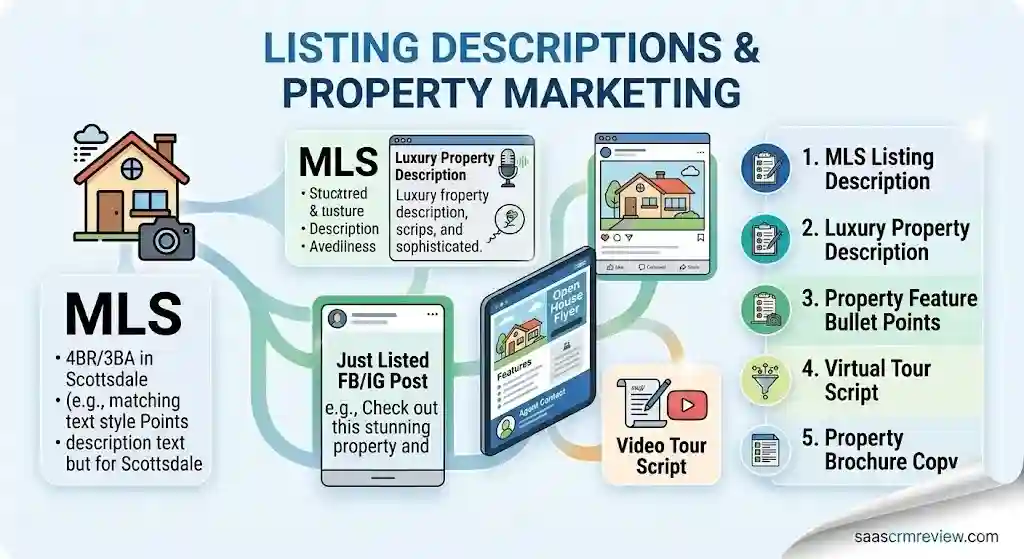
Listing Descriptions and Property Marketing
Prompt 6 — MLS Listing Description
Best for: Listing agents writing the primary MLS description Inputs needed: Full property details, key upgrades, neighborhood name
“You are a listing agent writing an MLS listing description. Property: [Beds/Baths/SqFt] in [Neighborhood], [City, State]. List price: [$Price]. Key features: [list features]. Recent upgrades: [list upgrades]. Write a compelling, fact-based description in 150–200 words. Do not use the words ‘stunning,’ ‘dream home,’ or ‘must see.’ Do not mention school quality or neighborhood demographics. End with a clear next step (schedule a showing). Tone: confident, specific, professional.”
Why it works: The banned-word list forces ChatGPT to write original, non-generic copy. The length constraint keeps it MLS-friendly. Review before publishing: Verify every factual claim against what you see on-site and in MLS.
Prompt 7 — Luxury Property Description
Best for: Agents marketing high-end or luxury listings Inputs needed: Luxury-specific features, architectural style, lot details
“You are a luxury real estate copywriter. Write a 200–250 word listing description for a [architectural style] estate at [Address] listed at [$Price]. Highlight: [premium features such as wine cellar, infinity pool, smart home system, custom millwork]. Tone: refined, understated, sophisticated — not flashy or hyperbolic. Use sensory language. Do not use superlatives like ‘best’ or ‘most exclusive.’ Do not mention ROI or investment potential.”
Why it works: Luxury buyers are turned off by the same adjective-heavy copy that works for entry-level listings. This prompt sets the right register. Review before publishing: Have someone outside the transaction read it for tone. Confirm all features exist.
Prompt 8 — Property Feature Bullet Points
Best for: Social media posts, flyers, property brochures Inputs needed: Core property features
“Create 8 short, punchy bullet points highlighting the top selling features of [Property Address]. Features include: [list]. Each bullet should be under 12 words. Avoid clichés. Start each bullet with a strong noun or action word.”
Why it works: Short bullet points perform better on Instagram, flyers, and brochure layouts than long paragraphs. Review before publishing: Verify each claim. Remove anything that sounds exaggerated.
Prompt 9 — Virtual Tour Script
Best for: Video walkthroughs, Matterport narration, YouTube tours Inputs needed: Room-by-room details, key selling points
“Write a 90-second virtual tour narration script for [Address]. Walk through: [list rooms/spaces in order]. Mention [key feature] in the kitchen, [key feature] in the primary suite, and [key feature] in the backyard. Tone: warm, engaging, like a knowledgeable friend showing you around. Do not use ‘welcome to’ as the opening line. Include a closing CTA to schedule a private showing.”
Why it works: Most virtual tour scripts sound identical. This prompt forces a fresh opening and a conversational tone. Review before publishing: Time it. Edit for length. Verify all room descriptions match reality.
Prompt 10 — Property Brochure Copy
Best for: Print or digital brochures for open houses and listing presentations Inputs needed: Property details, neighborhood highlights, agent info
“Write the copy for a single-page property brochure for [Address]. Include: a headline, a 75-word property summary, 6 feature bullet points, a brief neighborhood description (2–3 sentences), and agent contact info placeholder. Tone: polished, informative. Do not make claims about school ratings or property value trends.”
Why it works: Gives you brochure-ready structure, not just a wall of text. Review before publishing: Proofread, verify facts, check fair housing compliance on neighborhood language.
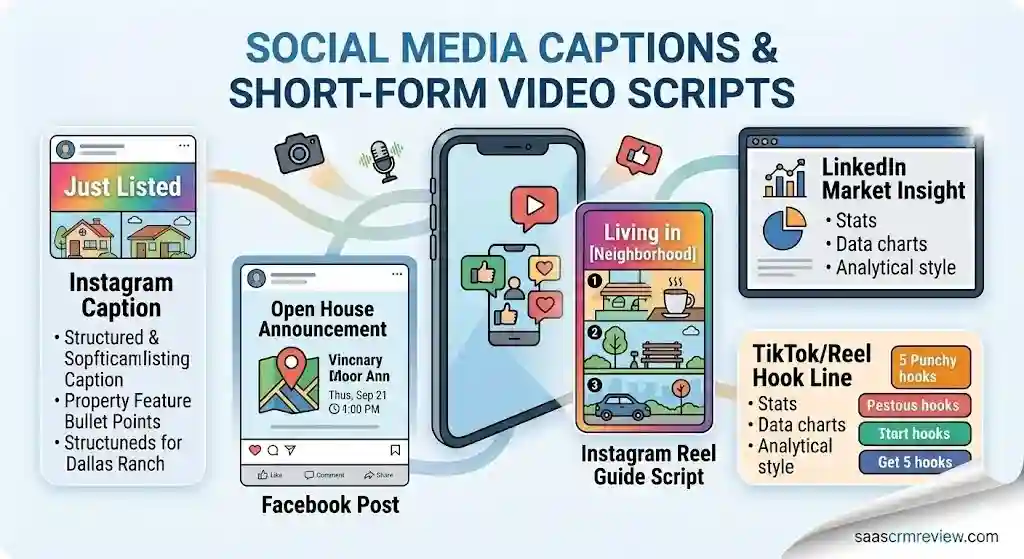
Social Media Captions and Short-Form Video Scripts
Prompt 11 — Instagram Caption for Just-Listed Post
Best for: Listing agents sharing new properties on Instagram Inputs needed: Beds/baths, neighborhood, price, top features
“Write an Instagram caption for a just-listed post. Property: [Beds/Baths] in [Neighborhood], [$Price]. Highlight [top 2 features]. Include 2–3 relevant hashtags. Tone: excited but professional. Length: 40–60 words. CTA: ‘DM me for details or to schedule a tour.'”
Why it works: Constrains length and tone — exactly where most AI-generated social content goes wrong (too long, too formal). Review before publishing: Check that hashtags are active and relevant to your market.
Prompt 12 — Facebook Post for Open House Announcement
Best for: Agents promoting open houses on Facebook Inputs needed: Property address, date/time, key features
“Write a Facebook post announcing an open house at [Address] on [Date, Time]. Include the property type, price, and top 3 features. Tone: inviting and neighborly. Include a line encouraging shares. 60–80 words.”
Why it works: Short, shareable, and neighborhood-friendly. The “encourage shares” instruction extends organic reach. Review before publishing: Confirm open house date/time details are correct.
Prompt 13 — Instagram Reel Script: Neighborhood Guide
Best for: Agents building local brand through short-form video Inputs needed: Neighborhood name, 3 local highlights
“Write a 45-second Instagram Reel script about living in [Neighborhood], [City]. Cover: 3 specific things a newcomer should know (coffee shops, parks, commute, vibe). Tone: local expert, casual but credible. Do not mention school demographics or religious institutions. End with: ‘Follow for more [City] neighborhood guides.'”
Why it works: Neighborhood content builds local authority. The constraints keep you fair-housing safe. Review before publishing: Verify every local business and amenity mentioned actually exists.
Prompt 14 — LinkedIn Post: Market Insight
Best for: Agents sharing market expertise with their professional network Inputs needed: One verified market stat, your interpretation
“Write a LinkedIn post (100–130 words) sharing one key insight about the current housing market in [City/Region]. Use a specific, verified stat: [insert stat]. Offer a brief interpretation of what it means for buyers or sellers. Tone: analytical, helpful, professional. CTA: ‘What are you seeing in your market? Comment below.'”
Why it works: LinkedIn rewards analysis over promotion. This prompt produces thought-leadership-style content. Review before publishing: Double-check the stat against its original source.
Prompt 15 — TikTok/Reel Hook Lines
Best for: Agents who need scroll-stopping video openers Inputs needed: 5 topic areas
“Generate 5 scroll-stopping opening lines for short-form real estate videos. Topics: [home-buying mistake, market myth, staging tip, neighborhood secret, negotiation trick]. Each hook should be under 10 words. Format: numbered list.”
Why it works: The constraint (under 10 words, strong topics) forces punchy, attention-grabbing hooks. Review before publishing: Make sure each hook is accurate and not misleading.
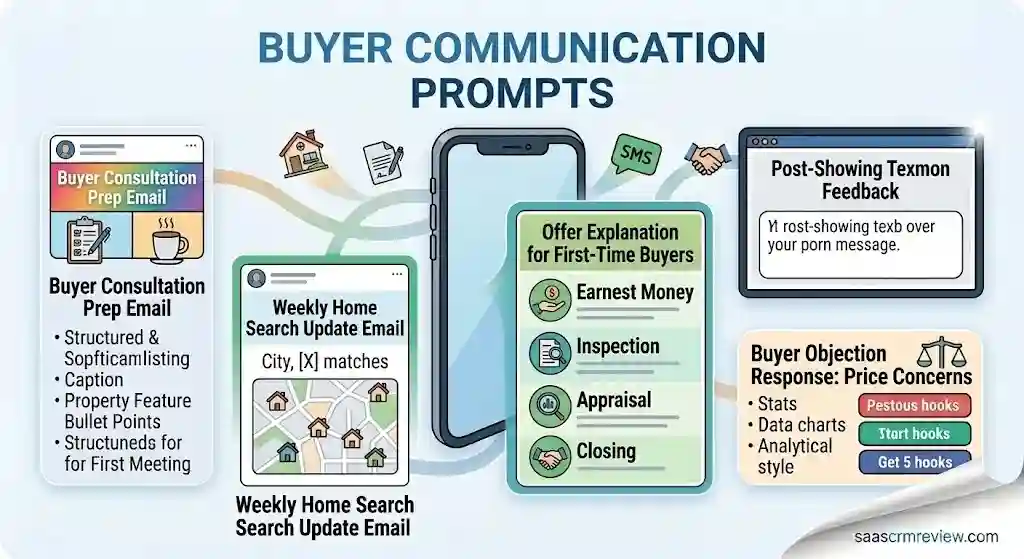
Buyer Communication Prompts
Prompt 16 — Buyer Consultation Prep Email
Best for: Agents preparing new buyers for the first meeting Inputs needed: Meeting date/location
“Write an email from a buyer’s agent to a new buyer client preparing them for their first consultation. Include: what to bring (pre-approval letter, wish list, deal-breaker list), what to expect during the meeting, and a reassuring note about the process. Tone: professional, warm. Length: 150–180 words.”
Why it works: Sets expectations and builds confidence before the meeting even starts. Review before publishing: Tailor to your specific buyer consultation format.
Prompt 17 — Weekly Home Search Update Email
Best for: Buyer’s agents keeping active clients engaged Inputs needed: City, number of new matches, current market conditions
“Write a weekly email update from a buyer’s agent to a client actively searching for a home in [City]. Mention [X] new listings that match their criteria, summarize market conditions in 1–2 sentences, and ask if they want to tour any properties this week. Tone: helpful, concise.”
Why it works: Keeps communication consistent without being salesy. Saves you from drafting these every week. Review before publishing: Verify listing counts and market summary against actual data.
Prompt 18 — Offer Explanation Email for First-Time Buyers
Best for: Agents guiding buyers through their first offer Inputs needed: None (general educational content)
“Write an email explaining the offer process to a first-time buyer. Cover: how offers work, earnest money, inspection contingency, appraisal contingency, and timeline. Tone: reassuring and clear. Avoid legal advice — frame everything as general information and recommend consulting their attorney. Length: 200–250 words.”
Why it works: Reduces the volume of individual client questions by providing a clear, proactive summary. Review before publishing: Confirm all process details reflect your state’s specific requirements.
Prompt 19 — Post-Showing Feedback Text
Best for: Agents checking in after a property tour Inputs needed: Property address
“Write a short text message (under 40 words) checking in with a buyer after they toured [Address]. Ask for their honest feedback on the home and whether they want to see it again or move on.”
Why it works: Quick, conversational, and easy to customize per property. Review before publishing: Personalize with the buyer’s name and a specific detail from the showing.
Prompt 20 — Buyer Objection Response: Price Concerns
Best for: Agents addressing buyer pushback on asking price Inputs needed: Neighborhood name, comparable sales context
“Write a response to a buyer who says a home is overpriced. Acknowledge their concern, explain how list price relates to recent comparable sales in [Neighborhood], and suggest a strategy (offer below asking, request closing credits). Tone: empathetic, factual. Do not guarantee the seller will accept. 120–150 words.”
Why it works: Objection handling is one of the most time-consuming communication tasks. This creates a template you can adapt repeatedly. Review before publishing: Verify comparable sales data. Never promise outcomes.
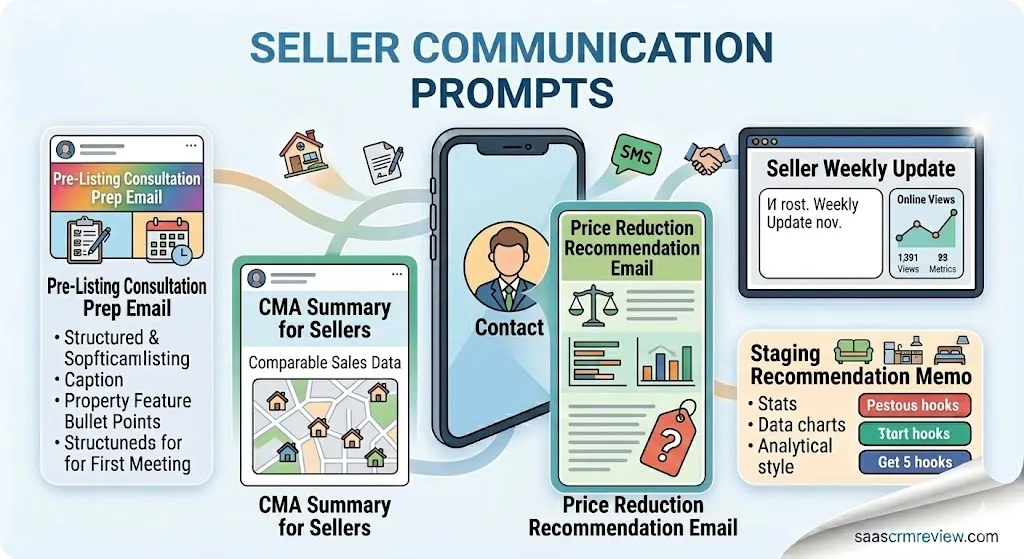
Seller Communication Prompts
Prompt 21 — Pre-Listing Consultation Email
Best for: Agents confirming and preparing for listing meetings Inputs needed: Client name, meeting date/time
“Write an email to a homeowner who requested a listing consultation. Confirm the appointment, explain what you’ll cover (CMA, pricing strategy, marketing plan, timeline), and ask them to prepare a list of recent upgrades. Tone: organized, confident. 120–150 words.”
Why it works: Professional first impression that sets the stage for a structured consultation. Review before publishing: Customize with your specific listing presentation agenda.
Prompt 22 — CMA Summary for Sellers
Best for: Listing agents explaining market data in plain language Inputs needed: Comparable sales data, address, recommended price range
“Write a plain-language summary of a Comparative Market Analysis for a homeowner at [Address]. Include: [X] comparable sales, average price per square foot in the area, average days on market. Recommend a list price range of [$low]–[$high] and explain the reasoning in 2–3 sentences. Tone: analytical, honest, respectful. Do not guarantee the final sale price.”
Why it works: Sellers need CMA explanations they can understand, not raw data sheets. Review before publishing: ⚠️ High risk. All comparable data must come from MLS. Never rely on ChatGPT for market data.
Prompt 23 — Price Reduction Recommendation Email
Best for: Listing agents recommending a price adjustment Inputs needed: Address, days on market, showing count, offer count, new price range
“Write an email recommending a price adjustment to a seller whose home at [Address] has been on the market for [X] days with [Y] showings and [Z] offers. Be honest about market feedback while being empathetic. Suggest a specific new price range of [$X–$Y] and explain the reasoning. Tone: direct but respectful. Do not blame the seller. 150–200 words.”
Why it works: Price reduction conversations are one of the hardest parts of listing management. This creates a starting framework. Review before publishing: Customize with specific buyer feedback if available. Verify market data.
Prompt 24 — Staging Recommendation Memo
Best for: Agents suggesting pre-listing improvements Inputs needed: Home type, price range
“Write a short memo to a seller recommending 5 pre-listing staging improvements for [home type] in [price range]. Focus on high-ROI, low-cost changes. Tone: practical, encouraging. Bullet-point format. Do not claim specific ROI percentages.”
Why it works: Actionable, specific, and avoids the common mistake of claiming exact dollar-for-dollar returns. Review before publishing: Adapt recommendations to the specific property condition.
Prompt 25 — Seller Weekly Update Email
Best for: Listing agents keeping sellers informed during active marketing Inputs needed: Showing count, online views, buyer feedback summary
“Write a brief weekly update email from a listing agent to a seller. Report: [X] showings this week, [Y] online views, [summary of buyer feedback]. Offer a brief recommendation for the coming week. Tone: transparent, calm, professional. 100–130 words.”
Why it works: Sellers who feel informed are less likely to panic or micromanage. Consistency builds trust. Review before publishing: Verify all metrics. Summarize buyer feedback honestly.
Open House, Showing, and Follow-Up Prompts
Prompt 26 — Open House Invitation Email
Best for: Agents promoting open houses via email Inputs needed: Address, date/time, key property details
“Write an email invitation to an open house at [Address] on [Date/Time]. Include property highlights (beds/baths/sqft/price), parking instructions, and a note that the listing agent will be available for questions. Tone: inviting, professional. 100–130 words. CTA: RSVP or just stop by.”
Why it works: Covers all the practical details that get people through the door. Review before publishing: Confirm date, time, and parking information.
Prompt 27 — Open House Follow-Up Email (Buyer Lead)
Best for: Converting open house visitors into clients Inputs needed: Property address
“Write a follow-up email to someone who attended the open house at [Address]. Thank them for visiting, ask what they thought of the home, and offer to set up a private showing or send similar listings. Tone: genuine, not pushy. 80–100 words.”
Why it works: Speed and tone matter in open house follow-up. This template lets you respond quickly without sounding generic. Review before publishing: Personalize with any specific conversation you remember from the open house.
Prompt 28 — Open House Follow-Up Email (Neighbor)
Best for: Prospecting from neighbor open house visitors Inputs needed: Property address, neighborhood name
“Write a short follow-up email to a neighbor who stopped by the open house at [Address]. Thank them for coming, mention that you’re an active agent in [Neighborhood], and offer to provide a complimentary home value estimate if they’re curious. Tone: friendly, low-pressure. 70–90 words.”
Why it works: Neighbors at an open house are potential future sellers. This plants the seed without pushing. Review before publishing: Make sure the tone feels neighborly, not transactional.
Prompt 29 — Showing Confirmation Text
Best for: Quick confirmation of scheduled showings Inputs needed: Address, date/time
“Write a text message (under 30 words) confirming a private showing at [Address] on [Date/Time]. Include the address and a reminder to call if they need to reschedule.”
Why it works: Short, professional, and prevents no-shows. Review before publishing: Confirm address and time are correct.
Prompt 30 — Post-Showing Feedback Request (Agent to Agent)
Best for: Listing agents gathering showing feedback from buyer’s agents Inputs needed: Property address
“Write a brief email from a listing agent to a buyer’s agent after a showing at [Address]. Ask for candid feedback about the buyer’s interest level, thoughts on price, and any concerns. Tone: professional, collegial. 60–80 words.”
Why it works: Getting prompt feedback helps listing agents adjust strategy. A professional template makes follow-up consistent. Review before publishing: Tailor based on your relationship with the buyer’s agent.
Email, SMS, and Nurture Campaigns
Prompt 31 — Drip Campaign Email: Just Browsing Lead
Best for: Nurturing early-stage leads who aren’t ready to transact Inputs needed: City/market area
“Write the first email in a 5-email nurture sequence for a lead who downloaded a home search guide but isn’t ready to buy yet. Goal: build trust, stay top-of-mind. Include a useful tip about the current [City] market. Tone: helpful, no hard sell. 100–120 words. CTA: reply with questions.”
Why it works: Low-pressure nurture keeps you in the lead’s inbox without annoying them. Review before publishing: Verify any market tip against current data.
Prompt 32 — Re-Engagement Email for Cold Leads
Best for: Reviving leads who went quiet 6+ months ago Inputs needed: Target neighborhood/city
“Write an email to re-engage a lead you haven’t heard from in 6 months. Acknowledge the gap without being awkward. Offer a quick market snapshot of their target area [Neighborhood/City] and invite them to reconnect when ready. Tone: low-pressure, genuine. 80–100 words.”
Why it works: Acknowledging the silence feels honest and avoids the “just checking in” cliché. Review before publishing: Include a real market data point for added credibility.
Prompt 33 — Anniversary / Home-iversary Email
Best for: Past-client retention and referral pipeline building Inputs needed: Client name, purchase address, date
“Write a friendly email to a past client on the one-year anniversary of their home purchase at [Address]. Congratulate them, offer a complimentary property value update, and remind them you’re available for referrals. Tone: warm, personal. 80–100 words.”
Why it works: Home-iversary emails are one of the highest-ROI retention tactics. They cost nothing and keep you top-of-mind. Review before publishing: Get the date right. Nothing kills personalization faster than a wrong anniversary date.
Prompt 34 — Holiday Check-In Email
Best for: Seasonal touchpoints with your database Inputs needed: Season/holiday context
“Write a brief holiday email to your real estate client database. Do not be overly promotional. Wish them well, share one helpful seasonal homeownership tip, and sign off warmly. Tone: genuine, not salesy. 70–90 words.”
Why it works: Keeps you on the radar without the cringe of a hard sell during the holidays. Review before publishing: Make sure the homeownership tip is accurate and seasonally relevant.
Prompt 35 — Text Message: New Listing Alert
Best for: Notifying active buyers about matching properties Inputs needed: Neighborhood, beds/baths/price
“Write a text message (under 40 words) alerting a buyer client about a new listing in [Neighborhood] that matches their criteria. Include beds/baths/price and ask if they want to see it this weekend.”
Why it works: Texting is the fastest way to reach buyers. This keeps it brief and actionable. Review before publishing: Verify the listing is still active before sending.
Market Updates, CMAs, and Local Expertise Content
Prompt 36 — Monthly Market Update Email
Best for: Positioning yourself as the local market expert Inputs needed: City/region, market data placeholders
“Write a monthly market update email for homeowners in [City/Region]. Include placeholders for: median home price, month-over-month change, average days on market, inventory level. Interpret the numbers in plain language — what this means for buyers and sellers. Tone: informed, objective. 200–250 words. Do not predict future prices.”
Why it works: Consistent market updates build authority and keep your database engaged. The “no predictions” constraint keeps you out of trouble. Review before publishing: ⚠️ High risk. Fill all placeholders with verified data from MLS or a trusted market report.
Prompt 37 — Neighborhood Guide Blog Post Outline
Best for: Building long-term local SEO and community authority Inputs needed: Neighborhood name, city/state
“Create a detailed blog post outline for a neighborhood guide about [Neighborhood], [City, State]. Include sections on: location and commute, housing types and price range, local dining and shopping, parks and recreation, community vibe. Mark which sections need local research and photos. Do not include school ratings or demographic breakdowns.”
Why it works: Neighborhood content drives local SEO and long-term organic traffic. This prompt creates a research framework, not fabricated content. Google’s Search Essentials emphasize that helpful, people-first content is what ranks. Review before publishing: ⚠️ Fill in every section with verified local information. Do not publish ChatGPT’s guesses about neighborhood restaurants or parks.
Prompt 38 — Market Update Video Script
Best for: Agents producing regular market update video content Inputs needed: City, 3 key data points
“Write a 60-second video script for a monthly market update for [City]. Open with a surprising or noteworthy stat. Present 3 key data points (median price, inventory, days on market) with brief interpretation. Close with a CTA to contact me for a personalized analysis. Tone: authoritative, approachable. Do not predict where the market is heading.”
Why it works: Structured video scripts outperform improvisation. The constraint against market predictions protects your credibility. Review before publishing: Verify all data points before recording.
Prompt 39 — Community Event Roundup Social Post
Best for: Building community presence through event promotion Inputs needed: City/neighborhood, month, 3–4 events
“Write a social media post highlighting 3–4 upcoming community events in [City/Neighborhood] for [Month]. Include event names, dates, and brief descriptions. Tone: enthusiastic local expert. 80–100 words. End with: ‘What event are you most excited about?'”
Why it works: Community content gets high engagement and positions you as a local insider. Review before publishing: Confirm all event details, dates, and locations are accurate.
Prompt 40 — Real Estate Blog Post Draft
Best for: Agents building content marketing and website SEO Inputs needed: Topic, target audience
“Write an 800-word blog post titled ‘[Topic: e.g., 5 Things Every First-Time Buyer in [City] Needs to Know].’ Target audience: [first-time buyers / sellers / investors]. Include practical tips backed by general knowledge — do not invent statistics. Tone: helpful, authoritative, US-market focused. Add a CTA at the end. Do not provide legal or financial advice.”
Why it works: Blog content is the backbone of organic search. This prompt produces a solid first draft that requires fact-checking but not a total rewrite. Review before publishing: Fact-check all claims. Add local data, personal stories, and internal links to make it unique.
Transaction Coordination and Admin Prompts
Prompt 41 — Transaction Timeline Email for Buyers
Best for: Helping buyers understand what happens after an accepted offer Inputs needed: State, key milestone dates
“Write an email explaining the transaction timeline from accepted offer to closing for a buyer in [State]. Include key milestones: inspection period, appraisal, loan approval, title search, final walkthrough, closing day. Note approximate timeframes. Tone: organized, reassuring. Recommend consulting their lender and attorney for exact dates. 200–250 words.”
Why it works: Proactive timeline emails reduce client anxiety and “where are we?” calls. Review before publishing: Adjust timelines based on your state’s specific process and current market pace.
Prompt 42 — Closing Day Checklist for Buyers
Best for: Preparing buyers for their closing appointment Inputs needed: None (general template)
“Create a checklist for a buyer coming to closing. Include: what to bring (photo ID, cashier’s check or wire confirmation, proof of insurance), what to expect, and typical timeline of the appointment. Format as a bulleted list. Tone: clear, helpful.”
Why it works: A simple checklist prevents closing-day confusion and demonstrates professionalism. Review before publishing: Adjust for your state’s closing process and title company requirements.
Prompt 43 — Inspection Summary Email for Buyers
Best for: Helping buyers interpret inspection results without panic Inputs needed: List of inspection findings
“Write a plain-language email to a buyer summarizing their home inspection results. Inspection found: [list issues]. Categorize the issues into ‘major concerns,’ ‘minor repairs,’ and ‘routine maintenance.’ Recommend discussing repair requests with their agent. Tone: factual, not alarmist. Do not provide contractor cost estimates unless verified.”
Why it works: Turning raw inspection reports into a clear summary helps buyers make informed decisions calmly. Review before publishing: ⚠️ High risk. Verify categorization with the inspector’s report. Don’t downplay serious issues.
Prompt 44 — Transaction Status Update for Sellers
Best for: Keeping sellers informed during the contract-to-close period Inputs needed: Current milestone, next steps, estimated closing date
“Write a brief email updating a seller on the transaction status. We are currently at: [milestone, e.g., inspection period completed, appraisal scheduled for DATE]. Next steps: [describe]. Estimated closing date: [DATE]. Tone: professional, reassuring. 80–100 words.”
Why it works: Consistent updates prevent seller anxiety and build trust. Review before publishing: Verify all dates and milestones before sending.
Prompt 45 — Contract-to-Close Internal Checklist
Best for: Transaction coordinators and organized solo agents Inputs needed: None (standard template)
“Create an internal checklist for a real estate agent to track the contract-to-close process. Include items like: earnest money deposited, inspection ordered, inspection response deadline, appraisal ordered, title search, loan commitment deadline, final walkthrough, closing date. Format: table with columns for Task, Deadline, Status.”
Why it works: Standardized checklists prevent missed deadlines and protect transactions. Review before publishing: Customize for your state’s specific requirements and brokerage protocols.
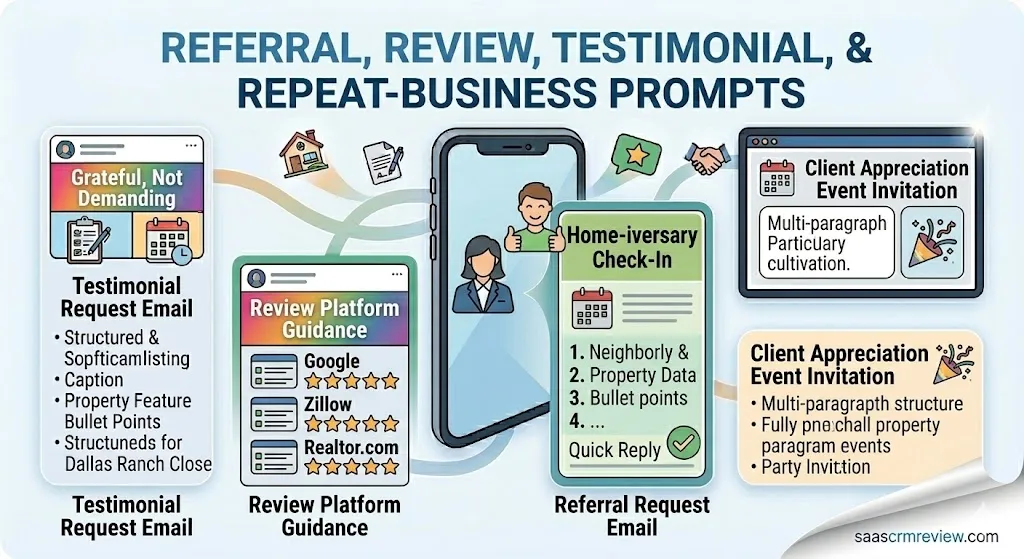
Referral, Review, Testimonial, and Repeat-Business Prompts
Prompt 46 — Testimonial Request Email
Best for: Agents building social proof through online reviews Inputs needed: Client name, days since closing, review platforms
“Write a short email to a client [X] days after closing, asking them to leave a review. Explain where to leave the review (Google, Zillow, Realtor.com). Make it easy: suggest they write 2–3 sentences about their experience. Tone: grateful, not demanding. 80–100 words.”
Why it works: Specific guidance (where + how long) dramatically increases review completion rates. Review before publishing: Personalize with a detail about their transaction.
Prompt 47 — Referral Request Email
Best for: Agents growing through word-of-mouth Inputs needed: Client name
“Write an email to a past client asking for referrals. Mention that your business has grown through word-of-mouth and you would appreciate any introductions to friends, family, or colleagues who might be thinking about buying or selling. Offer to send a small thank-you for any referral. Tone: genuine, appreciative. 90–110 words.”
Why it works: Direct referral asks work far better than hoping clients will think of you. A grateful, non-pushy tone makes all the difference. Review before publishing: Comply with your brokerage’s referral fee and gift policies.
Prompt 48 — Client Appreciation Event Invitation
Best for: Agents hosting events for past-client retention Inputs needed: Event type, date, time, location
“Write an email inviting past clients to a client appreciation event (e.g., summer BBQ, holiday party). Include event details: [Date, Time, Location]. Tone: warm, personal. Mention that you’re grateful for their trust and want to stay connected. 80–100 words.”
Why it works: Client appreciation events build loyalty and generate referrals. A warm invitation sets the right expectation. Review before publishing: Confirm all event logistics before sending.
Prompt 49 — Annual Check-In Email
Best for: Agents maintaining long-term relationships with past clients Inputs needed: Client name
“Write an annual check-in email to a past client. Ask how they’re enjoying their home, offer a complimentary home value update, and mention that you’re available if they or anyone they know has real estate questions. Tone: personal, low-pressure. 80–100 words.”
Why it works: Consistent annual check-ins keep you top-of-mind for repeat business and referrals. Review before publishing: Personalize heavily. A template that reads like a template defeats the purpose.
Prompt 50 — Thank-You Note After Closing
Best for: Agents who want to end every transaction on a personal note Inputs needed: Client name, one specific positive detail from the transaction
“Write a handwritten-style thank-you note to a client after closing on their home. Express genuine gratitude, mention one specific thing that made working with them great, and wish them well in their new home. Tone: heartfelt, personal. 50–70 words.”
Why it works: The agents producing the most referrals are not the ones with the best marketing — they are the ones who stay in touch consistently. A sincere closing note is the last impression you leave. Review before publishing: Customize every note. A generic thank-you card is worse than no card at all.
The Best AI Prompts for Realtors by Use Case
Not every agent needs all 50 prompts. Here is where to start, depending on your situation:
New agents: Start with Prompts 5 (buyer qualification), 6 (MLS listing description), 16 (buyer consultation prep), and 31 (nurture drip). These cover the fundamentals.
Busy solo agents: Focus on the time-savers: Prompts 11–15 (social media), 25 (seller update), 33–34 (client nurture), and 45 (contract-to-close checklist). Automate the repetitive writing, keep the relationship work human.
Listing agents: Prompts 6, 7, 8, 9, 10 (listing content suite) + 22, 23, 25 (seller communication) are your core stack.
Buyer’s agents: Prompts 5, 16, 17, 18, 19, 20 (buyer communication) + 41, 42, 43 (transaction support) handle most of your writing.
Luxury agents: Prompt 7 (luxury listing) is your starting point, but also use Prompt 48 (appreciation events) and Prompt 37 (neighborhood guides) — luxury clients expect local expertise and personal attention.
Real estate teams: Build a shared prompt library from the top performers in each category. Prompts 45, 41, and 44 (transaction and admin) standardize your team’s communication without making it robotic.
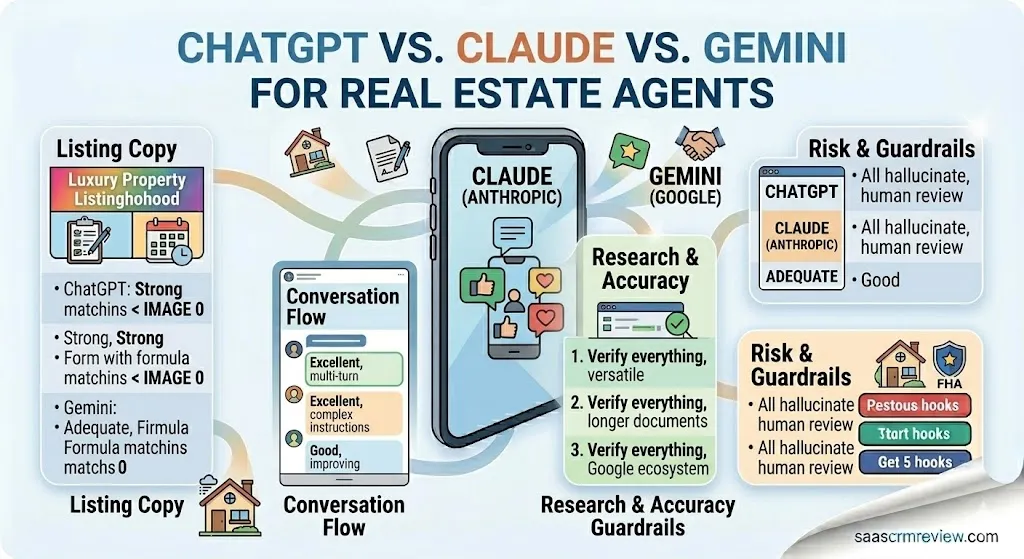
ChatGPT vs. Claude vs. Gemini for Real Estate Agents
Short answer: The prompt framework matters more than the AI model. But there are practical differences worth knowing.
Agents frequently ask which AI tool is “best” for real estate workflows. Here is what we have found from testing all three for the types of tasks that agents encounter most — including those covered in our ChatGPT review, Claude review, and Gemini review:
| Feature | ChatGPT (OpenAI) | Claude (Anthropic) | Gemini (Google) |
|---|---|---|---|
| Best for | General writing, versatile output styles | Longer documents, nuanced tone | Research, Google ecosystem integration |
| Listing copy | Strong | Strong | Adequate |
| Conversation flow | Excellent multi-turn refinement | Excellent at following complex instructions | Good, improving |
| Free tier | Yes (limited) | Yes (limited) | Yes |
| Data accuracy | Verify everything | Verify everything | Verify everything |
For a broader comparison of AI writing and chatbot tools, see our roundup of the best AI chatbots and best AI tools for content creation.
Bottom line: All three hallucinate. All three need human review. If you master the 7-part prompt formula above, you will get strong results from any of them. Do not get stuck debating tools when the real leverage is in how you prompt.
Common Mistakes Agents Make with Real Estate AI Prompts
What should agents avoid when using ChatGPT for real estate marketing?
1. Generic inputs → generic outputs. If you type “write a listing description,” you will get something that sounds like every other AI listing on the internet. Context is everything. Provide the property details, your tone, and your constraints.
2. No audience targeting. A prompt for first-time buyers should read differently than one for luxury investors. Tell the AI who the reader is.
3. Publishing without fact-checking. This is the biggest risk. AI-generated content has already caused real problems for agents who published fabricated property details. Always verify against your MLS, county records, and personal knowledge of the property.
4. Fair housing blind spots. AI models may generate language that describes demographics, family composition, or religious character of neighborhoods. This can violate the Fair Housing Act. Review every piece of neighborhood-facing content through a compliance lens.
5. Sounding robotic or overhyped. If your AI-generated emails and posts do not sound like you, your clients will notice. Always edit for voice. Your personal tone is a competitive advantage that no AI template can replicate.
6. Pasting sensitive client data into AI tools. Financial details, social security numbers, and private client information do not belong in any AI chat window. Use placeholder data and add real details in your CRM.
For more guidance on how to write effective prompts across use cases, see our complete guide to ChatGPT prompts.
ChatGPT Prompts for Real Estate Agents – FAQs
Can real estate agents use ChatGPT for listing descriptions?
Yes. ChatGPT can draft MLS listing descriptions, property feature lists, brochure copy, and listing presentation materials. However, every factual claim (square footage, features, upgrades, neighborhood amenities) must be verified against MLS data and personal property inspection before publishing. AI-generated listing content should be treated as a first draft, never a final product.
Are ChatGPT prompts safe for real estate marketing?
They are safe if you follow a human review process. The key risks are factual hallucination (invented property details), fair housing language violations, and privacy exposure if you paste client data into the tool. Use the guardrails checklist in this article and review all content before it goes live.
Can ChatGPT write real estate follow-up emails?
Yes, and follow-up emails are one of the safest and highest-value uses of AI for agents. Emails like open house follow-ups, nurture drip sequences, and closing anniversary check-ins are low-risk because they are relationship-focused, not fact-heavy. Always personalize the output so it sounds like you.
Should real estate agents disclose AI-generated content?
At the time of writing, we could not identify a general federal disclosure rule specific to AI-generated real estate marketing content, but brokerage policies, MLS rules, state requirements, and use-case-specific obligations may still apply. The National Association of REALTORS recommends transparency and responsible use. Always check with your managing broker and review your state’s current guidance.
What should agents always review before publishing AI-generated content?
At minimum: all property facts and figures, neighborhood descriptions, any language that could be interpreted as discriminatory, pricing claims, market predictions, legal or financial guidance, and client-specific details. If the content makes a factual claim, verify it. If it describes a protected class or neighborhood, review it for fair housing compliance.
Conclusion
The best ChatGPT prompts for real estate agents are not the ones with the cleverest formatting — they are the ones that solve real workflow problems, save measurable time, and produce output that actually sounds like a competent professional wrote it.
Use the 50 real estate AI prompts in this guide as your starting library. Apply the 7-part prompt formula to get better results on the first try. Run every piece of AI-generated content through the compliance and accuracy checklist before publishing. And remember: AI is a drafting tool, not a replacement for your expertise, your local knowledge, or your client relationships.
The agents who win with AI will not be the ones who automate the most. They will be the ones who automate the right things — and keep the human touch where it matters most.
NOTE
Disclaimer: This article is for informational purposes only. It does not constitute legal, financial, or professional advice. Real estate regulations vary by state and locality. All AI-generated content must be independently verified before publication. Consult your managing broker, state real estate commission, and/or attorney for compliance-specific guidance.
About the author

I’m Macedona, an independent reviewer covering SaaS platforms, CRM systems, and AI tools. My work focuses on hands-on testing, structured feature analysis, pricing evaluation, and real-world business use cases.
All reviews are created using transparent comparison criteria and are updated regularly to reflect changes in features, pricing, and performance.