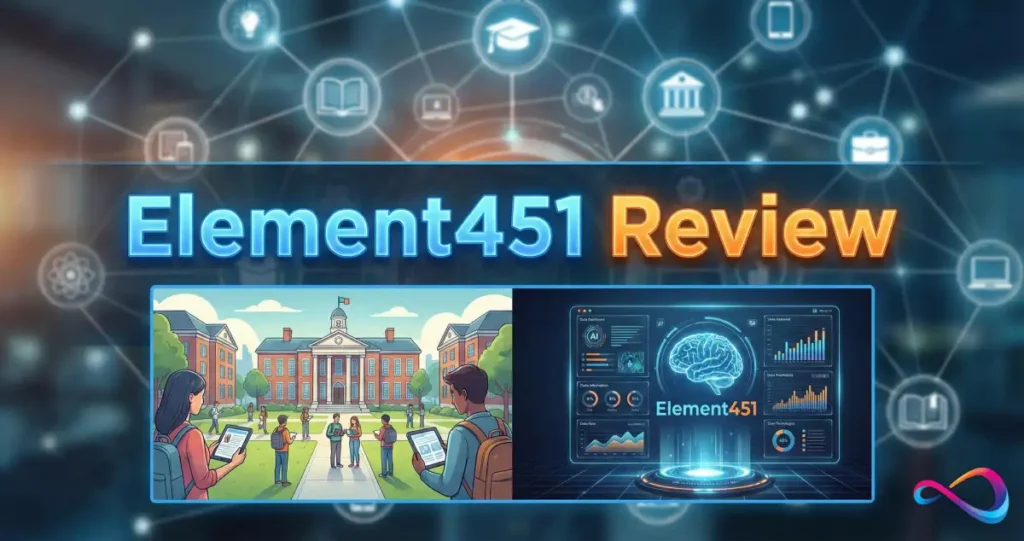
In this element451 reviews 2026 guide, we evaluate Element451 CRM using an implementation-minded framework: feature depth across the student lifecycle, real-world rollout considerations, integration risks (SIS/SSO), and total cost signals. Expect direct answers on Element451 pricing, AI-driven engagement, admissions workflows, and the best alternatives for different campus realities—without marketing fluff.
TL;DR Verdict (60 Seconds)
Should you buy Element451 in 2026?
Yes, if: You’re a small-to-mid-sized institution (under 10,000 students) seeking an all-in-one admissions, marketing, and engagement CRM with strong AI features, modern UX, and excellent vendor support—and you can budget $20,000–$40,000+ annually.
No, if: You need deep query flexibility and unlimited user licenses (choose Slate), require enterprise-grade customization with robust IT resources (choose Salesforce Education Cloud), or operate on a shoestring budget with limited technical staff.
The bottom line: Element451 is a rising challenger in the higher ed CRM market, with Volt’s 2026 comparison reporting 25% adoption versus Slate’s 55% dominance. It excels at out-of-the-box marketing automation, user-friendly interfaces, and responsive customer support. In 2026, it offers four packages—Admissions, Engagement, Marketing, and Success—all built on Element Core and enhanced by Bolt AI agents that handle inbound inquiries, automate outreach, and flag at-risk students 24/7.
Pricing reality: Element451’s pricing calculator shows $20,000/year starting price; Volt notes the full suite starts around $40,000 annually (vs. Slate’s $30k starting point). In February 2025, Element451 transitioned to usage-based pricing for select premium features (per Help Center article “Transition to Usage-Based Pricing”)—existing contracts unchanged, but new clients purchase credits ($0.01/credit per “Usage-Based Billing + Credits” documentation) for AI features like fraudulent app detection (50 credits/app starting May 2025). All institutions receive 10,000 complimentary credits at launch.
Key tradeoff: Higher cost at full-suite level than Slate’s entry point, but faster onboarding and superior marketing automation; lower complexity than Salesforce but less customization flexibility.
Watch-outs:
- Usage-based credit pricing introduces budget unpredictability during high-volume periods
- Query/reporting depth doesn’t match Slate’s legendary flexibility for power users
→ If you only read one thing: Marketing-led enrollment strategy + limited IT resources + desire for AI-driven 24/7 engagement = Element451 is your top choice. Budget-constrained with CRM expertise on staff = Slate. Enterprise complexity with robust IT = Salesforce.
📌 Learn more: Best CRM Software For Higher Education Reviewed In 2026
What Is Element451?
Element451 is an AI-powered, all-in-one student engagement CRM platform designed exclusively for U.S. higher education institutions. It unifies admissions, marketing automation, student recruitment, and retention tools into a single cloud-based platform, enabling enrollment and student success teams to manage the entire student lifecycle—from prospective inquiry through graduation—without juggling multiple systems or vendors.
Unlike general-purpose CRMs (Salesforce, HubSpot), Element451 is purpose-built for higher ed workflows: application processing, financial aid communication, event management, at-risk student flagging, and lifecycle campaigns tailored to the enrollment funnel.

How This Review Was Conducted
Evaluation Criteria
This review evaluated Element451 across eight decision-critical dimensions:
- Features & functionality (admissions, marketing, engagement, success, AI)
- Pricing transparency (public vs. quote-based; usage model; hidden costs)
- Implementation reality (timeline, staffing, governance, change management)
- Integrations (SIS, identity, marketing stack, reporting)
- User experience (ease of use, training curve, interface design)
- Vendor support (onboarding, customer success, documentation)
- Competitive positioning (vs. Slate, Salesforce, TargetX, Ellucian)
- Fit analysis (institution size, budget, IT maturity, strategic goals)
Sources Used
This review synthesizes:
- Vendor sources: Element451 pricing page (element451.com/pricing), product homepage (element451.com), usage-based pricing announcement dated February 2025 (Element451 Help Center article #10547397), PR Newswire package announcement from November 1, 2023
- Independent analysis: Volt’s 2026 Higher Ed CRM Comparison Guide
- Practitioner insights: Interviews with enrollment and marketing leaders at Muhlenberg College, Johnston Community College, and others published in third-party analyses
Note: As of January 24, 2026, G2, Capterra, and Software Advice profiles returned HTTP 403 errors when accessed for research. Readers are encouraged to check these platforms directly for user-generated reviews. This review prioritizes vendor documentation and independent editorial analysis.
Key Features in 2026
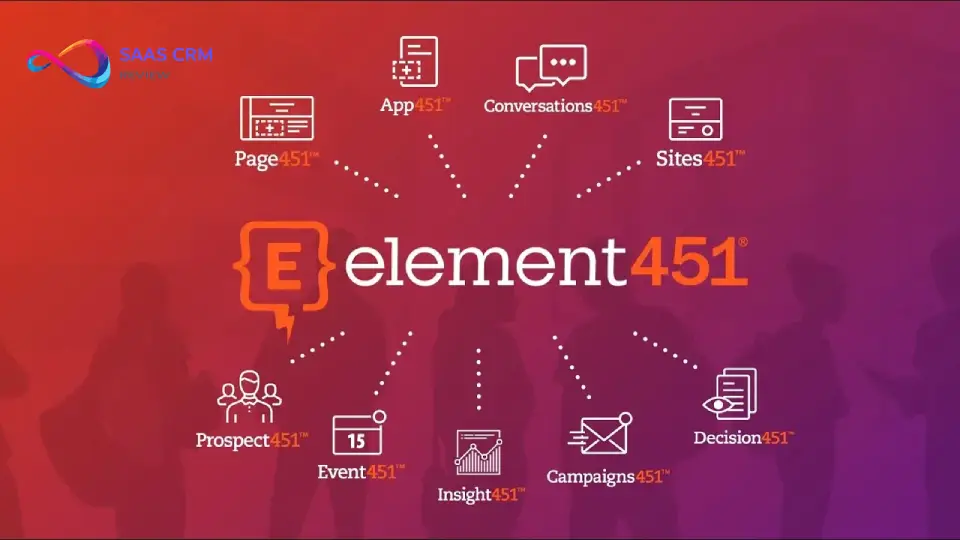
Element451 organizes its feature set into four packages (Admissions, Engagement, Marketing, Success) built on Element Core, the shared platform included with every subscription. All packages are enhanced by Bolt AI agents, Element451’s autonomous AI workforce.
Element Admissions
Purpose: Streamline application processing, admissions decisioning, and applicant-to-enrolled conversion.
Core capabilities (per Element451 pricing page):
- Lead-to-applicant conversion tools: Automated nurture sequences, deadline reminders, application status portals
- Application collection, reading & scoring: Digital application forms, custom review workflows, rubric-based scoring
- Financial aid support: FAFSA reminders, aid package communication, cost calculator embeds
- Transcript processing: Document upload, automated transcript requests, status tracking
AI enhancement: Bolt AI agents answer applicant questions 24/7 (via chat, email, SMS, voice) and flag fraudulent applications using pattern detection (50 credits per application starting May 2025, per Element451’s usage pricing documentation).
Best for: Institutions needing paperless application management and faster application review cycles.
Element Engagement (Bolt AI Agents)
Purpose: Provide 24/7 digital-first student support across all communication channels.
Core capabilities (per Element451 pricing page):
- Website engagement: AI chat widgets that guide prospective students through program discovery, admissions requirements, deadlines
- Inbound communication handling: Unified inbox answering inquiries via chat, email, SMS, and voice across the student journey
- Lead capture: Form builders, chatbot-to-CRM data sync, interest tracking
- Conversations management: Shared team inbox with assignment rules, response templates, conversation history
AI enhancement: Bolt AI agents use semantic knowledge bases to deliver personalized, real-time answers at scale—”fostering belonging and nurturing relationships that go beyond the screen,” per the November 2023 PR Newswire announcement.
Best for: Institutions struggling with inquiry response times or managing multi-channel communication without 24/7 staffing.
Element Marketing
Purpose: Execute personalized, automated outreach campaigns across the enrollment funnel.
Core capabilities (per Element451 pricing page):
- Student search: Purchased list integration, search campaign workflows
- RFI follow-up automation: Triggered email sequences based on inquiry source, program interest, engagement level
- Campaign delivery: Email, SMS, direct mail coordination; A/B testing; drip campaigns
- Lead generation: Landing page builder, forms, UTM tracking, conversion analytics
AI enhancement: Bolt AI agents conduct proactive outreach at scale, personalizing messages based on student behavior data without manual segmentation.
Standout strength: Volt’s 2026 guide highlights Element451’s “plug-and-play landing pages and advanced automation” as a key differentiator from Slate’s weaker marketing toolset.
Best for: Marketing-led enrollment strategies requiring sophisticated automation beyond basic email blasts.
Element Success
Purpose: Support student retention, advising, and persistence from enrollment through graduation.
Core capabilities (per Element451 pricing page):
- At-risk student flagging: Predictive analytics identifying students at risk of stopping out based on engagement, academic, and behavioral signals
- Advising appointment management: Scheduling, reminders, notes, advisor assignment
- Current student events: Event registration, attendance tracking, follow-up automation
- New student orientation: Pre-arrival task checklists, orientation scheduling, onboarding campaigns
AI enhancement: Bolt AI agents monitor student progress and deliver timely, personalized nudges—”so students stay supported and on track before issues escalate” (per Element451 product homepage).
Best for: Institutions prioritizing retention and student success alongside enrollment.
Element Core (Included in All Packages)
Shared platform features (per Element451 pricing page):
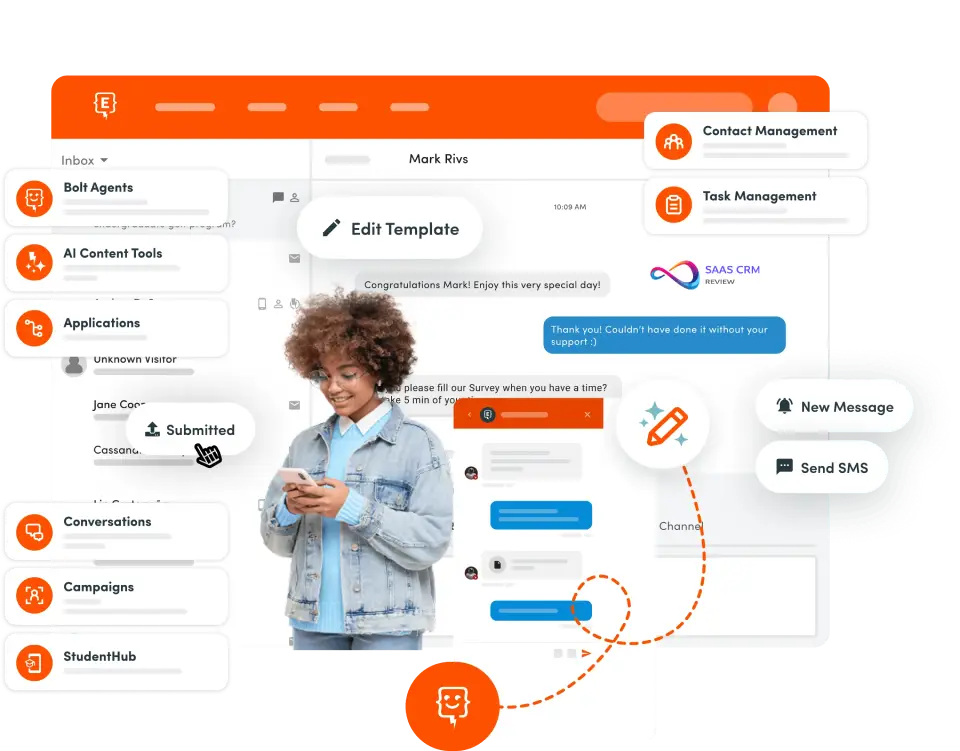
- Contact management: Unified student/prospect database, custom fields, segmentation
- Shared inbox: Team collaboration on inquiries, assignment rules, SLA tracking
- Workflow automation: Visual workflow builder, triggers, conditional logic
- Reporting & analytics: Standard dashboards, funnel metrics, campaign performance
- Student portal (StudentHub): Self-service portal for students to check application status, upload documents, register for events
- Task management: To-do lists, reminders, assignment tracking for staff
- Landing pages & forms: Drag-and-drop builders for recruitment microsites
Positioning: Element Core ensures every package includes foundational CRM and engagement tools—Element451 emphasizes “transparent pricing” (per their pricing page) by bundling core functionality rather than nickel-and-diming for basic features.
AI Features: Bolt Agents
What are Bolt AI agents?
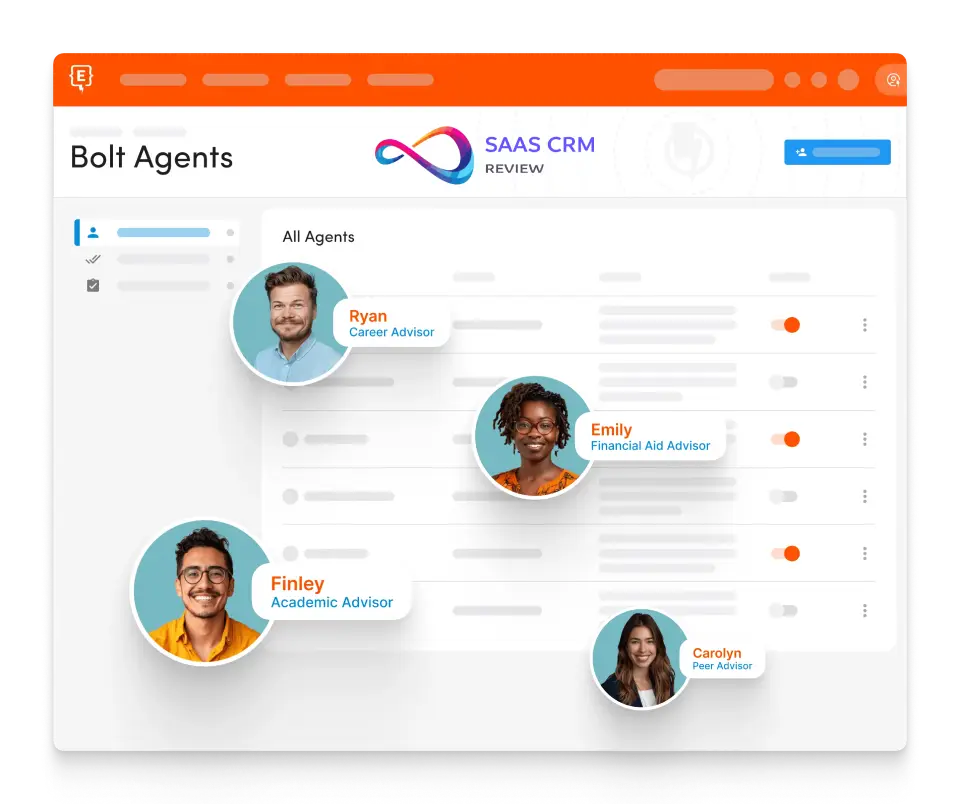
Bolt agents are Element451’s autonomous AI workforce, introduced to handle repetitive student-facing tasks across the entire lifecycle. They operate 24/7 across chat, email, SMS, and voice channels.
Capabilities in 2026:
- Answer inbound questions using semantic search across institutional knowledge bases (admissions, financial aid, academic programs)
- Proactive outreach at scale, personalizing messages based on funnel position and engagement history
- Application support (answering applicant questions, guiding document submission)
- Transcript coding (automating transcript review and course equivalency mapping)
- At-risk student detection (flagging early warning signs and delivering intervention nudges)
Roadmap (coming soon): Alumni engagement agents and non-degree/workforce learner support.
Competitive context: Among the platforms compared in Volt’s 2026 guide, Element451’s Bolt AI agents stand out as a notable differentiator—Salesforce’s Agentforce 2.0 “falls short” for higher ed use cases (per practitioner feedback in Volt), while Slate lacks native AI agents entirely. Element451 is the only platform in the comparison offering purpose-built AI agents for the full enrollment-to-success lifecycle.
Element451 Pricing in 2026
Pricing Overview: Quote-Based Model
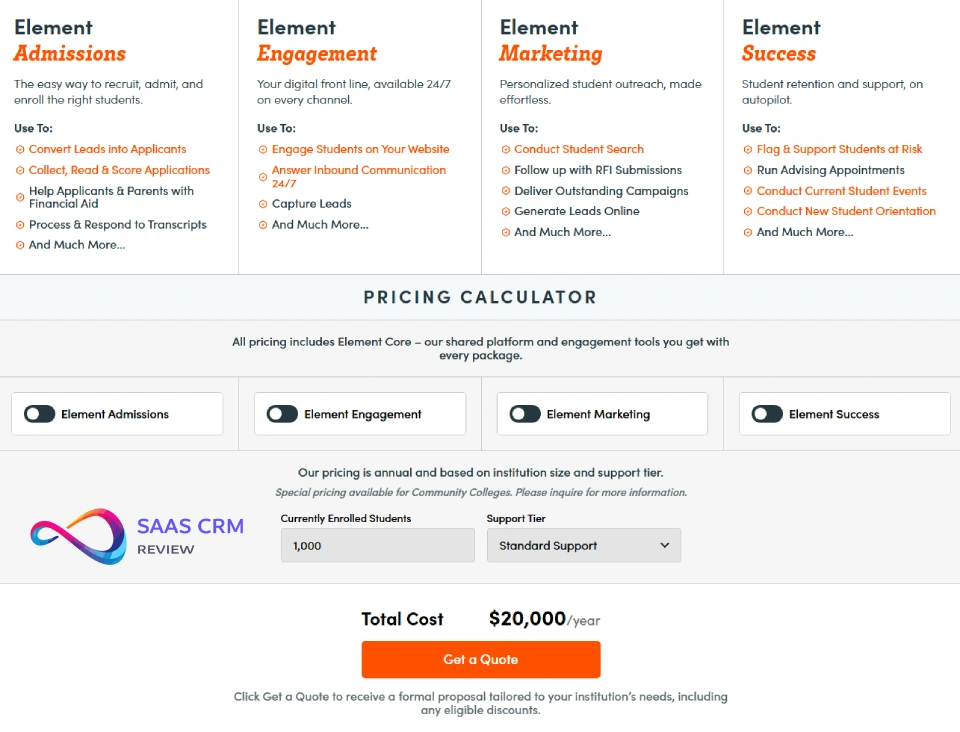
Element451 uses quote-based pricing—no public price list. Pricing varies by:
- Institution size (FTE enrollment)
- Package selection (Admissions, Engagement, Marketing, Success, or combinations)
- Support tier (standard vs. premium)
- Contract length (annual baseline)
Four Core Packages
Element451’s pricing page describes four packages; pricing is modular (buy one or combine):
- Element Admissions – Application processing, reading, decisioning
- Element Engagement – 24/7 AI chat, inbound communication, lead capture
- Element Marketing – Campaigns, automation, student search, landing pages
- Element Success – At-risk flagging, advising, orientation, event management
Pricing calculator result: Element451’s pricing calculator shows a starting cost of $20,000/year (likely for a single package at a smaller institution). The calculator prompts users to “Get a Quote to receive a formal proposal tailored to your institution’s needs, including any eligible discounts.”
Real-world pricing: Volt’s 2026 guide reports Element451’s “higher price point for the full suite of features (starting at $40k annually).”
Interpretation: Expect $20k–$40k as a floor for smaller institutions using one or two packages; mid-sized institutions (3,000–7,000 FTE) using the full suite likely pay $50k–$80k+; large universities pay more.
Community college pricing: Element451’s pricing page notes “Special pricing available for Community Colleges. Please inquire for more information.”
Usage-Based Pricing (Feb 2025 Transition)
In February 2025, Element451 introduced usage-based pricing (per Help Center article “Transition to Usage-Based Pricing | February 2025”) for select premium features (not base packages).
What’s NOT changing:
- Existing contracts and features continue as-is
- Base packages (Admissions, Engagement, Marketing, Success) remain under annual subscription pricing
What IS changing:
- Premium features previously sold as contract add-ons (e.g., in-app calling) are now available on-demand via credit purchases
- New features (e.g., AI fraudulent app detection) will charge per-use (50 credits/application starting May 2025)
- Self-service activation: Admins can enable premium features in Settings without contacting sales
Credits:
- Every institution receives 10,000 complimentary credits at launch
- Additional credits purchased through the Billing settings page (pricing not disclosed publicly)
- Usage tracked via admin dashboard
Why this matters: Usage-based pricing gives flexibility (pay only for what you use) but introduces budget unpredictability—high-volume app seasons could spike costs if using premium AI features.
What to Ask for in Your Proposal
When requesting a quote, ask Element451 to specify:
Base pricing & packaging:
- Base package cost (annual subscription for selected packages)
- Included credit allotment (for usage-based features)
- Per-credit cost (Element451 documentation shows $0.01/credit; confirm in proposal)
- Premium feature list (which features consume credits vs. included in subscription)
Usage-based credit estimator:
To budget for credit consumption, provide Element451 with monthly volume estimates:
- Expected application volume (peak month): ___ applications/month × 50 credits = ___ credits
(if using AI Fraudulent App Detection) - SMS/text volume (peak month): ___ messages/month × [verify credit cost]
- Voice/call minutes (if using in-app calling): ___ minutes/month × [verify credit cost]
- AI agent interactions (chat/email volume): ___ interactions/month × [verify credit cost]
Implementation & support: 5. Support tier details (what’s included in standard vs. premium support) 6. SIS integration cost (pre-built connector vs. custom API development fee) 7. Implementation/onboarding fees (one-time vs. rolled into annual cost) 8. Data migration services (included hours vs. additional consulting)
Contract terms: 9. Year-over-year price escalation (typical renewal percentage increase) 10. User license model (unlimited users? per-seat? role-based?) 11. Invoice cadence (annual prepay? quarterly?) 12. Termination/exit terms (data portability, contract length, early exit fees)
Community College & Special Pricing
Element451 offers special pricing for community colleges (noted on their pricing page). Community colleges should explicitly request this discount tier during RFP/proposal negotiations.

Element451 Pros & Cons
Pros
1. All-in-one platform consolidates multiple tools
Volt’s 2026 guide notes Element451 provides a “strong all-in-one platform replacing multiple systems (application, marketing, CRM)”—reducing vendor fragmentation and data silos.
2. Exceptional customer support and responsiveness
Practitioners consistently praise Element451’s support. Volt reports “exceptional customer support with live chat and quick problem resolution”—a stark contrast to Slate’s community-forum-only model.
3. User-friendly interface with minimal technical expertise required
Element451 prioritizes UX: “user-friendly interface requiring minimal technical expertise” (per Volt). Shane Baglini (Muhlenberg College) told Volt: “They’re…providing that functionality out of the box, and offering a suite of tools for higher ed marketers in one solution.”
4. Strong marketing automation and landing page capabilities
Element451’s marketing package is its standout differentiator vs. Slate. Volt notes “plug-and-play landing pages and advanced automation” as a key strength for marketing-led enrollment teams.
5. Bolt AI agents deliver 24/7 engagement at scale
The Bolt AI agent platform handles inbound inquiries, proactive outreach, and at-risk intervention without scaling headcount—a competitive advantage in an era of enrollment decline and staff constraints.
6. Paperless application processing with strong tracking
Volt highlights Element451’s “paperless application processing with strong tracking capabilities,” streamlining admissions operations.
7. Fast onboarding and implementation
Element451 emphasizes “fast onboarding” and “AI-ready from the start” (per pricing page)—practitioners report faster time-to-value than Slate or Salesforce.
Cons
1. Higher price point than Slate
Volt’s 2026 guide notes a “higher price point for the full suite of features (starting at $40k annually)” vs. Slate’s $30k starting price (per Technolutions licensing page).
2. Significant learning curve during initial setup
Despite user-friendly interfaces, Volt reports “significant learning curve during initial setup”—migrating from legacy systems and configuring workflows still requires investment.
3. Some processes can be inconsistent
Practitioners note “some processes can be inconsistent” (per Volt)—a symptom of rapid feature expansion in a younger platform.
4. Young platform still adding core features
Element451 is newer to market than Slate (launched 2017 vs. Slate’s 2003, per Volt). Some enterprise-grade features (e.g., Slate’s unlimited user licenses and query-builder depth) are still maturing.
5. Usage-based pricing introduces budget unpredictability
The February 2025 usage pricing shift means high-volume usage of premium AI features could spike costs unexpectedly—institutions must monitor credit consumption closely.
6. Limited public pricing transparency
Unlike Slate’s $30k starting price, Element451 uses quote-based pricing with a wide range ($20k–$40k+), making budget estimation harder without vendor engagement.
7. Less query flexibility than Slate
Slate’s query-builder is legendary for ad-hoc reporting and segmentation depth. Element451’s reporting is strong but doesn’t match Slate’s power-user capabilities—teams accustomed to Slate’s query language may feel constrained.
Implementation Reality: Hidden Costs & Timeline Drivers
Typical Implementation Timeline
Fast-track scenario (3–6 months):
- Small institution (< 2,000 FTE)
- Single package (e.g., Element Engagement only)
- Simple SIS integration (common platform like Jenzabar, Colleague)
- Dedicated project sponsor
- Minimal customization
Standard scenario (6–9 months):
- Mid-sized institution (2,000–7,000 FTE)
- Multiple packages (Admissions + Marketing + Engagement)
- Standard SIS integration + marketing stack connections
- Cross-functional governance (admissions, marketing, IT, student success)
- Moderate workflow customization
Complex scenario (9–18 months):
- Large institution (7,000+ FTE) or multi-campus
- Full suite (all four packages)
- Custom SIS or legacy system integration
- Data migration from multiple legacy platforms
- Extensive change management and training programs
- Governance across decentralized units
Reality check: Volt’s 2026 guide emphasizes implementation planning: “Make sure you have plenty of time to test and test and test again.” Even platforms marketed as “out-of-box” require “several months of onboarding and regular follow-up sessions.”
Hidden Costs to Budget For
Beyond the annual subscription, plan for:
- Implementation/onboarding fees – Typical industry range: $10k–$30k (consultant estimate—validate in Statement of Work). Cost drivers: number of packages deployed, data migration complexity, custom workflow configuration.
- SIS integration development – If your SIS requires custom API work: budget $5k–$20k depending on complexity (consultant estimate). Pre-built connectors typically included; custom builds bill separately.
- Data migration – Cleaning, mapping, and importing legacy data (budget staff time + potential consultant fees). Cost drivers: number of legacy systems, data quality, historical depth.
- Training programs – Staff onboarding (Element451 provides training, but budget internal time for champions and change management). Allocate 20–40 hours per functional lead.
- Credit purchases – If exceeding included credit allotment for usage-based features (unknowable until usage patterns stabilize). Monitor monthly via admin dashboard.
- Custom integrations – Marketing automation (HubSpot, Marketo), identity (SSO/SAML), third-party apps. Cost varies by integration complexity.
- Support tier upgrades – If standard support proves insufficient, premium support costs more (pricing not publicly disclosed; clarify in proposal).
- Staff backfill – Project team members will be pulled from daily duties during implementation (6–12 months).
- Consultant/partner fees – Some institutions hire implementation partners for complex rollouts (rates vary by firm and scope).
Pro tip: Ask Element451 for a total cost of ownership (TCO) estimate spanning 3 years, including subscription, credits, integrations, and maintenance.
Staffing Requirements
Core implementation team (minimum):
- Project sponsor (VP-level; 10–20% time)
- Functional leads (admissions, marketing, student success; 25–50% time during implementation)
- CRM administrator (dedicated; 50–100% time)
- IT integration lead (20–40% time for SIS/SSO work)
- Change management coordinator (20–30% time for training, communication)
Post-launch (steady-state):
- CRM administrator (0.5–1.0 FTE depending on institution size)
- Power users (admissions, marketing, success teams; part-time ongoing)
Comparison: Element451 requires less IT-heavy staffing than Salesforce (which “requires significant IT resources to implement and maintain,” per Volt) but more than pure SaaS tools like HubSpot.
Governance & Change Management
Critical success factors:
- Executive sponsorship – VP or Provost ownership ensures cross-unit buy-in
- Cross-functional steering committee – Admissions, Marketing, IT, Student Success, Registrar must align on workflows
- Data governance policy – Define data ownership, quality standards, retention policies before going live
- Training cadence – Plan onboarding for new staff and refresher sessions post-launch
- Communication plan – Transparent rollout communication to end-users reduces resistance
Volt’s 2026 guide emphasizes: “Staff buy-in: Regular training sessions and clear communication help ensure adoption.”
Integrations & Data Architecture
SIS Integrations
Element451 integrates with major Student Information Systems to sync enrollment, demographic, and academic data.
Common SIS platforms (verify current connector availability with Element451):
- Ellucian Colleague
- Ellucian Banner
- Jenzabar
- Workday Student
- Campus Management (CampusNexus)
- PowerSchool (PowerCampus)
Integration methods:
- Pre-built connectors (for common SIS platforms)
- API-based sync (REST/SOAP APIs)
- Flat file imports (CSV/SFTP for legacy systems)
What data syncs:
- Student demographics (name, contact, birthdate)
- Enrollment status (applicant, admitted, enrolled, alumni)
- Academic program (major, class year, campus)
- Financial aid status (FAFSA completion, aid package)
Key question for RFP: Does Element451 have a pre-built connector for your SIS, or will custom API work be required? (Custom work = higher cost and longer timeline.)
Identity & Authentication
Single sign-on (SSO):
Element451 supports SAML 2.0 for SSO integration, allowing students and staff to authenticate via institutional credentials (AD, Okta, Azure AD).
Student portal access:
StudentHub (Element451’s portal) can be provisioned via SSO or standalone credentials.
Marketing Stack Integrations
Common integrations (verify availability):
- Email service providers (Mailgun, SendGrid for transactional email)
- Marketing automation (HubSpot, Marketo—bidirectional contact sync)
- Advertising platforms (Google Ads, Facebook Ads for conversion tracking)
- Event platforms (Zoom, Eventbrite for virtual/hybrid event sync)
- Chat/SMS (Twilio for SMS delivery; native AI chat)
- Social media (Facebook, Instagram lead ads)
Positioning: Element451’s built-in marketing automation (Element Marketing package) reduces dependency on external MAPs (HubSpot, Marketo) for many institutions.
Reporting & Analytics Integrations
Business intelligence (BI) tools:
Element451 data can be exported (API, flat file) for analysis in Tableau, Power BI, Looker, or institutional data warehouses.
Native reporting:
Element Core includes dashboards for funnel metrics, campaign performance, engagement scoring, and application pipeline—many institutions don’t need external BI tools for standard reporting.
Security, Compliance & Data Governance
FERPA & Student Data Privacy
Element451 must comply with FERPA (Family Educational Rights and Privacy Act) as a service provider handling student education records.
Critical questions for your security/legal review:
- Does Element451 sign a FERPA-compliant Data Processing Agreement (DPA)?
- How is student data encrypted (in transit: TLS 1.2+; at rest: AES-256 or equivalent)?
- Where are data centers located (US-only vs. multi-region)?
- What is the data retention policy post-contract termination?
Recommendation: Request Element451’s Trust Center documentation or security white paper during procurement. If not publicly available, ask your account executive for the security/compliance package.
SOC 2 / ISO Certifications
Higher ed IT leaders should verify:
- SOC 2 Type II audit status (annual reports available?)
- ISO 27001 or other information security certifications
- Penetration testing cadence (annual? quarterly?)
- Vulnerability disclosure program (bug bounty or responsible disclosure policy)
Verify in proposal/demo: Ask Element451 to share current SOC 2 report and certification status.
AI Governance & Transparency
With Bolt AI agents handling student interactions:
- AI decision transparency: Can students tell when interacting with AI vs. human staff?
- Training data sources: What data trains Bolt models? (institutional knowledge bases only? third-party data?)
- Bias mitigation: What controls prevent discriminatory AI responses (e.g., financial aid eligibility, program recommendations)?
- Human escalation: Can students request human handoff from Bolt agents?
- AI audit trails: Are AI-generated responses logged for compliance review?
Verify in demo: Request demonstration of AI transparency features and audit logging.
Data Portability & Exit Strategy
Before signing:
- Export formats: Can you export all data (contacts, applications, activity history) in machine-readable format (CSV, JSON, API)?
- Post-termination access: How long after contract end can you access/export data?
- Migration assistance: Does Element451 provide support for migrating to another CRM?

What Good Looks Like: Success Patterns
Based on Element451 case studies and higher ed CRM implementation best practices, institutions that succeed with Element451 typically demonstrate these patterns:
Pattern 1: Marketing Operations Maturity
What success looks like:
- Campaign attribution: Ability to connect inquiry source → application → enrollment with UTM tracking and conversion analytics
- Segmentation discipline: 8–12 core segments (by program interest, funnel stage, engagement level) with tailored messaging
- A/B testing cadence: Quarterly testing of subject lines, CTAs, send times
- Engagement scoring: Defined thresholds for “hot/warm/cold” leads driving workflow automation
Checklist:
- Marketing team has bandwidth to build 3–5 drip campaigns per enrollment cycle
- Campaign performance reviewed monthly (open rates, click rates, conversion rates)
- Landing page strategy defined (program-specific pages, event registration, RFI forms)
- Clear handoff rules between marketing (inquiry nurture) and admissions (applicant support)
Pattern 2: Inquiry-to-Application Conversion Lift
What success looks like:
- Response time SLA: Inquiries answered within 24 hours (via Bolt AI or staff) vs. industry average 48–72 hours
- Multi-touch nurture: 6–8 touchpoints (email, SMS, voice, events) before app deadline vs. 2–3 one-off messages
- Application abandonment recovery: Automated reminders for incomplete applications increase submission rates
Checklist:
- Baseline inquiry-to-app conversion rate measured pre-Element451 (enables before/after comparison)
- Bolt AI knowledge base covers top 20 prospective student FAQs (admissions requirements, deadlines, financial aid)
- Automated workflows trigger based on inactivity (e.g., inquiry 14 days old, no application started)
Pattern 3: Cross-Functional Workflow Alignment
What success looks like:
- Unified student view: Admissions, marketing, and student success teams see complete interaction history in one platform
- Handoff accountability: Clear ownership at each funnel stage (marketing owns inquiry→applicant; admissions owns applicant→admitted; success owns enrolled→retained)
- SLA transparency: Response time and follow-up commitments visible across teams
Checklist:
- Steering committee with admissions, marketing, IT, student success representatives meets monthly
- Shared KPIs defined (e.g., marketing: MQL-to-SQL rate; admissions: app-to-admit rate; success: first-year retention)
- Weekly platform usage metrics reviewed (login frequency, adoption rates by department)
Comparison Matrix: Element451 vs Competitors
| Factor | Element451 | Slate | Salesforce Education Cloud | TargetX | Ellucian CRM Recruit |
|---|---|---|---|---|---|
| Starting Price | $20k-$40k/yr (Element451 pricing page; Volt) | $30k/yr (Technolutions; Volt) | Enterprise quote-based (Volt) | Quote-based | Quote-based |
| User Licenses | Quote-based (not unlimited) | Unlimited (Volt) | Per-seat; additional cost (Volt) | Per-seat | Quote-based |
| Market Share | 25% (Volt 2026 poll) | 55% (Volt 2026 poll) | N/A | N/A | N/A |
| AI Features | Bolt agents (24/7 chat, outreach, app review, at-risk) | Limited native AI | Agentforce 2.0 (weak for higher ed per Volt) | N/A | N/A |
| Marketing Automation | ⭐ Excellent (plug-and-play landing pages, advanced automation per Volt) | Weak (Volt) | Strong (via Marketing Cloud; added cost) | Good | Fair |
| Query/Reporting Depth | Good | ⭐ Excellent (legendary query builder) | Excellent (Salesforce Reports) | Good | Good |
| Customer Support | ⭐ Excellent (live chat, CSM per Volt) | Fair (community forums only per Volt) | Good (Salesforce + TargetX) | Good | Good |
| Ease of Use | ⭐ High (minimal training per Volt) | Low (steep learning curve per Volt) | Low (complex UI per Volt) | Medium | Medium |
| IT Resources Required | Low-Medium | Low (cloud-based) | ⭐ High (dedicated IT team per Volt) | Medium | Medium |
| Implementation Timeline | 3–9 months | 6–12 months | 9–18 months (Volt) | 6–12 months | 6–12 months |
| Best Fit | Small-mid institutions, marketing-led enrollment, limited IT | Mid-large institutions, dedicated CRM staff (Volt) | Large institutions, complex integrations, robust IT (Volt) | Salesforce users | Ellucian SIS users |
Element451 vs Slate
Choose Element451 if:
- Marketing automation is a priority (Slate’s marketing tools are weak per Volt)
- You value responsive vendor support over community forums
- Ease of use matters more than query depth
- Budget allows $10k–$20k premium for better UX
Choose Slate if:
- Unlimited user licenses are non-negotiable
- You need deep query-building and custom reporting
- Budget ceiling is $30k–$40k for a full CRM
- You have internal CRM expertise to navigate community support
Read the full article: Slate by Technolutions Review 2026: Features, Pricing, Pros & Cons & Best Alternatives
Element451 vs Salesforce Education Cloud
Choose Element451 if:
- You lack dedicated IT staff for Salesforce customization
- You want faster implementation (3–9 mo vs. 9–18 mo)
- Marketing and admissions are core focus areas
- Per-user licensing costs are a barrier
Choose Salesforce Education Cloud if:
- You need enterprise-grade customization and scalability
- Your institution already uses Salesforce for advancement/alumni
- You have IT resources for complex integrations
- Your use cases extend beyond admissions (advancement, alumni, research)
Element451 vs TargetX
Context: TargetX is a Salesforce-native higher ed package (built on Salesforce Platform).
Choose Element451 if:
- You want an all-in-one platform (no Salesforce licensing required)
- Marketing automation is critical
- Simpler implementation is preferred
Choose TargetX if:
- Your institution already licenses Salesforce
- You need tight integration with Salesforce Advancement/Fundraising modules
- IT team has Salesforce expertise
Read the full article: TargetX Reviews 2026: Features, Pricing, Pros & Cons & Best Alternatives
Element451 vs Ellucian CRM Recruit
Choose Element451 if:
- You use a non-Ellucian SIS (Jenzabar, Workday, Campus Management)
- Marketing automation and modern UX are priorities
- You want best-of-breed vs. bundled-with-SIS approach
Choose Ellucian CRM Recruit if:
- You use Ellucian Banner or Colleague (tight integration advantage)
- Bundled pricing with SIS contract is available
- Your IT team prefers vendor consolidation (single-vendor strategy)
Read the full article: Ellucian CRM Advance Reviews 2026: Features, Pricing, Pros & Cons & Best Alternatives
Best Alternatives to Element451
When to Choose Slate Instead
Scenario: Mid-to-large institution (5,000+ FTE) with dedicated CRM administrator, strong internal technical capacity, and budget ceiling of $30k–$40k.
Why: Slate’s unlimited user licenses and $30k starting price (per Volt and Technolutions) offer better cost-per-user economics at scale. Its legendary query-builder (per Volt) provides unmatched reporting depth for power users.
Tradeoff: Weaker marketing tools, steeper learning curve, community-forum-only support.
When to Choose Salesforce Education Cloud Instead
Scenario: Large institution (10,000+ FTE) with robust IT resources, complex integration needs (ERP, advancement CRM, research systems), and enterprise-grade customization requirements.
Why: Salesforce offers “highly customizable” architecture with “extensive integration options” (per Volt)—ideal for institutions needing one CRM across enrollment, advancement, alumni, and student services.
Tradeoff: Requires “significant IT resources to implement and maintain”; complex UI; per-seat licensing costs (per Volt).
When to Choose TargetX Instead
Scenario: Institution already licensing Salesforce for advancement/fundraising and seeking to unify enrollment + advancement on a single platform.
Why: TargetX is Salesforce-native, enabling seamless data flow between enrollment and advancement modules without middleware.
Tradeoff: Still inherits Salesforce’s IT complexity and per-seat costs.
When to Choose Ellucian CRM Recruit Instead
Scenario: Ellucian Banner or Colleague user prioritizing vendor consolidation and bundled pricing.
Why: Native Ellucian integration reduces SIS sync complexity; potential for bundled pricing with SIS contract.
Tradeoff: Weaker marketing automation and AI features vs. Element451.
Budget/Lightweight Alternatives
Scenario: Budget < $20k or very small institution (under 1,000 FTE) needing basic CRM + communication tools without enterprise features.
Option 1: HubSpot CRM (Free/Starter)
- Why: Free tier + affordable paid plans ($20–$50/user/month for Marketing Hub Starter) offer basic CRM, email automation, and forms.
- Tradeoff: Not higher-ed specific; no SIS integration; limited application processing; DIY setup and configuration.
- Best for: Institutions willing to adapt general CRM tools to higher ed workflows; tech-savvy small teams.
Option 2: Mailchimp + Simple CRM
- Why: Mailchimp offers email marketing automation (free tier for <500 contacts; paid $13–350/month) paired with lightweight CRM like Airtable or Google Sheets.
- Tradeoff: No unified platform; manual data entry; limited reporting; not scalable beyond a few hundred inquiries.
- Best for: Community colleges or niche programs with very small inquiry volumes (< 500/year).
Reality check: These budget options lack purpose-built higher ed features (application processing, financial aid communication, SIS sync). If your institution grows beyond 1,000 inquiries/year or needs compliance-grade reporting, plan to migrate to Slate, Element451, or similar within 2–3 years.
Fit Rubric: Is Element451 Right for You?
Budget Fit
✅ Good fit:
- Annual CRM budget ≥ $40k
- Willingness to pay premium for vendor support and modern UX
- Flexibility to manage usage-based pricing for AI features
⚠️ Marginal fit:
- Budget ceiling $30k–$40k (Slate may be better value)
- Uncertain usage patterns for premium features (credit cost unpredictability)
❌ Poor fit:
- Budget < $30k (consider Slate or niche tools like Mongoose)
- Zero room for usage spikes (fixed-price models safer)
Complexity & Technical Readiness
✅ Good fit:
- Limited IT staff (Element451 is lower-maintenance than Salesforce)
- Standard SIS integration (Colleague, Banner, Jenzabar)
- Desire for out-of-box functionality
⚠️ Marginal fit:
- Custom or legacy SIS (integration complexity increases)
- Need for extensive customization (Salesforce may be better)
❌ Poor fit:
- Zero IT support (even “easy” CRMs need admin capacity)
- Highly complex multi-system architecture (Salesforce safer bet)
Team Maturity
✅ Good fit:
- Marketing-led enrollment strategy (Element Marketing shines)
- Cross-functional alignment (admissions, marketing, student success collaborate)
- Change-ready culture (willing to adopt new workflows)
⚠️ Marginal fit:
- Siloed teams (governance challenges during rollout)
- Resistance to AI-driven engagement (Bolt agents underutilized)
❌ Poor fit:
- Pure admissions-only focus with no marketing function (Slate cheaper for admissions-only)
- Legacy-minded culture resistant to automation
SIS & Integration Constraints
✅ Good fit:
- Common SIS (Colleague, Banner, Jenzabar, Workday Student)
- Standard marketing stack (email, SMS, ads)
- Minimal custom integrations
⚠️ Marginal fit:
- Uncommon SIS or homegrown systems (custom integration work required)
- Complex third-party integrations (budget for API work)
❌ Poor fit:
- Ellucian SIS + desire for single-vendor strategy (Ellucian CRM Recruit better fit)
- Heavy Salesforce investment elsewhere (TargetX unifies)
“Best For” vs “Not For” Summary
✅ Best For
- Small-to-mid-sized institutions (under 10,000 FTE) seeking all-in-one simplicity
- Marketing-led enrollment strategies requiring sophisticated automation
- Teams with limited IT resources who need user-friendly, low-maintenance CRM
- Institutions prioritizing vendor support (live chat, CSM) over community forums
- AI-forward adopters wanting 24/7 student engagement via Bolt agents
- Community colleges with special pricing eligibility
❌ Not For
- Budget-constrained institutions (< $30k) where Slate offers better value
- Large universities (15,000+ FTE) needing enterprise customization (Salesforce safer)
- Pure admissions-only use cases with no marketing function (Slate cheaper)
- Salesforce-committed institutions seeking unified advancement + enrollment (use TargetX)
- Ellucian-exclusive users prioritizing vendor consolidation (Ellucian CRM Recruit)
- Power users requiring Slate-level query depth for ad-hoc reporting
FAQ: Element451 Reviews
How much does Element451 cost?
Element451 pricing is quote-based and varies by institution size, package selection, and support tier. Element451’s pricing calculator shows $20,000/year as a starting price for smaller institutions, but Volt’s 2026 comparison reports “starting at $40k annually” for the full suite of features. Mid-sized institutions (3,000–7,000 FTE) should budget $50k–$80k+ for all four packages. Community colleges can request special pricing per Element451’s pricing page. In February 2025, Element451 introduced usage-based pricing for premium features (per their Help Center)—base packages remain annual subscriptions, but features like AI fraudulent app detection charge per use (50 credits/application starting May 2025).
What is Element451 used for?
Element451 is an AI-powered, all-in-one CRM platform for higher education institutions, used to manage admissions, marketing automation, student engagement, and retention. Its four packages—Admissions, Engagement, Marketing, and Success (per Element451 pricing page)—cover the full student lifecycle from prospective inquiry through graduation. Key use cases include: lead capture and nurturing, application processing and decisioning, automated email/SMS campaigns, 24/7 AI chatbot (Bolt agents) for inquiries, at-risk student flagging, event management, and advising workflows.
Is Element451 better than Slate?
It depends on your priorities. Element451 offers superior marketing automation, user-friendly UX, and responsive vendor support, making it better for marketing-led institutions with limited IT staff. Volt’s 2026 guide highlights Element451’s “plug-and-play landing pages and advanced automation” vs. Slate’s weak marketing tools. However, Slate offers unlimited user licenses, deeper query-building, and lower starting price ($30k vs. $40k per Volt and Technolutions)—better for budget-conscious institutions with dedicated CRM staff. Choose Element451 if marketing and ease-of-use matter more; choose Slate if cost, query depth, and unlimited licenses are priorities.
Does Element451 integrate with [common SIS platforms]?
Yes, Element451 integrates with major Student Information Systems including Ellucian Colleague, Ellucian Banner, Jenzabar, Workday Student, Campus Management (CampusNexus), and PowerSchool (PowerCampus). Integration methods include pre-built connectors (for common platforms), API-based sync (REST/SOAP), and flat file imports (CSV/SFTP for legacy systems). Data synced includes demographics, enrollment status, academic program, and financial aid status. Critical: Confirm whether Element451 has a pre-built connector for your specific SIS during the RFP process—custom API work adds cost and extends timelines.
What is Element451’s Bolt AI?
Bolt AI agents are Element451’s autonomous AI workforce, designed to handle repetitive student-facing tasks 24/7 across chat, email, SMS, and voice channels. Bolt agents answer inbound inquiries using semantic search across institutional knowledge bases, conduct proactive personalized outreach at scale, support applicants through document submission, automate transcript coding, and flag at-risk students for early intervention. Introduced as a key differentiator (per November 2023 PR Newswire announcement), Bolt leverages AI to reduce manual workload while scaling student engagement. Roadmap features include alumni engagement and non-degree learner support.
Are there hidden costs with Element451?
Yes—beyond the annual subscription, budget for: (1) Implementation/onboarding fees ($10k–$30k, verify if included); (2) SIS integration development ($5k–$20k for custom API work); (3) Data migration (staff time + potential consultant fees); (4) Credit purchases for usage-based features (unknowable until usage stabilizes—AI fraudulent app detection costs 50 credits/application starting May 2025 per Element451 Help Center); (5) Custom integrations (marketing automation, SSO, third-party apps); (6) Support tier upgrades (if standard support proves insufficient); (7) Staff backfill during implementation. Ask Element451 for a total cost of ownership (TCO) estimate spanning 3 years.
How long does Element451 implementation take?
Implementation timelines vary by institution complexity: 3–6 months for small institutions (< 2,000 FTE) using a single package with simple SIS integration; 6–9 months for mid-sized institutions (2,000–7,000 FTE) deploying multiple packages with standard integrations; 9–18 months for large/multi-campus institutions using all four packages with custom SIS or legacy system integration. Volt’s 2026 guide emphasizes: “Make sure you have plenty of time to test and test and test again”—even “out-of-box” solutions require “several months of onboarding and regular follow-up sessions.”
What size institutions use Element451?
Element451 is best suited for small-to-mid-sized institutions (under 10,000 FTE), though larger universities also adopt it. Volt’s 2026 poll found 25% of respondents use Element451, including community colleges (Johnston Community College, College of Western Idaho per Element451 case studies), regional universities (Abraham Baldwin Agricultural College), and technical colleges (Texas State Technical College). The platform’s user-friendly design and lower IT requirements make it attractive to smaller institutions lacking dedicated CRM staff, while its marketing strength appeals to mid-sized universities prioritizing enrollment growth.
Can community colleges afford Element451?
Potentially yes, due to special pricing for community colleges (per Element451 pricing page). While the general starting price is $20k–$40k annually, community colleges should explicitly request the discounted tier during RFP/proposal negotiations. Community college case studies include Johnston Community College and College of Western Idaho (per Element451 homepage)—both successfully deployed Element451. That said, budget-constrained community colleges may find Slate’s $30k starting price (per Technolutions and Volt) with unlimited users a better value if marketing automation is not a priority.
What support does Element451 provide?
Element451 offers exceptional customer support (per Volt) including: 24/7 live chat support, dedicated Customer Success Managers (CSMs), step-by-step onboarding during implementation, and a Resource Center with documentation and best practices. This is a major differentiator vs. Slate’s community-forum-only model (per Volt). Practitioners consistently praise Element451’s responsiveness (per Volt): “quick problem resolution” and “live chat” access reduce downtime. Support quality may vary by tier (standard vs. premium)—clarify what’s included in your proposal.
Decision Checklist: Evaluating Element451
Use this checklist to assess Element451’s fit for your institution:
Budget & Pricing
- CRM budget ≥ $40k annually (or community college special pricing eligibility)
- Flexibility to manage usage-based pricing for AI features (credit consumption monitoring)
- Room for hidden costs (implementation fees, SIS integration, credit purchases)
- Multi-year TCO estimate requested from vendor
Strategic Priorities
- Marketing automation is a core enrollment strategy
- AI-driven student engagement (24/7 chatbot, proactive outreach) aligns with goals
- Unified admissions + marketing + engagement + success platform is desired
- Faster time-to-value matters more than deep customization
Technical Fit
- SIS is common platform (Colleague, Banner, Jenzabar, Workday) with likely pre-built connector
- IT resources can support implementation (0.2–0.5 FTE during rollout)
- CRM administrator role can be staffed (0.5–1.0 FTE post-launch)
- SSO/SAML integration is feasible (or standalone auth acceptable)
Team & Culture
- Cross-functional collaboration exists (admissions, marketing, IT, student success)
- Change-ready culture willing to adopt new workflows
- Preference for vendor support over community-driven troubleshooting
- Marketing team has capacity to leverage automation features
Competitive Analysis
- Compared Element451 to Slate, Salesforce, TargetX, Ellucian CRM Recruit
- Evaluated tradeoffs (cost vs. features, ease-of-use vs. query depth, support model)
- Identified must-have features (vendor demos confirmed availability)
- Assessed fit rubric (budget, complexity, team maturity, SIS constraints)
Procurement
- Requested quote specifying base package cost, credit allotment, per-credit cost, premium feature list
- Clarified SIS integration cost (pre-built vs. custom API work)
- Asked for references from similar institutions (size, SIS, use case)
- Negotiated contract terms (implementation timeline, support SLAs, renewal escalation)
Risk Mitigation
- Planned 6–12 month implementation timeline (not rushed)
- Budgeted for data migration and governance policy development
- Allocated staff time for training and change management
- Identified executive sponsor and project governance structure
Suggested External Citations
To supplement vendor and practitioner sources, consider these credible external citations for deeper context:
- NACAC (National Association for College Admission Counseling) – State of College Admission Report
Annual enrollment trends, CRM adoption, and technology investment benchmarks among U.S. colleges. Useful for contextualizing Element451’s market positioning and enrollment challenges driving CRM demand.
https://www.nacacnet.org/ - EDUCAUSE – Higher Education CRM Research & Best Practices
IT leadership perspectives on CRM selection, implementation, and integration for higher ed. Provides governance frameworks, change management strategies, and technical architecture guidance.
https://www.educause.edu/ - The Chronicle of Higher Education – Enrollment Management Technology Coverage
Independent journalism on higher ed technology trends, vendor landscape shifts, and practitioner case studies. Offers balanced third-party analysis beyond vendor claims.
https://www.chronicle.com/
About the author

I’m Macedona, an independent reviewer covering SaaS platforms, CRM systems, and AI tools. My work focuses on hands-on testing, structured feature analysis, pricing evaluation, and real-world business use cases.
All reviews are created using transparent comparison criteria and are updated regularly to reflect changes in features, pricing, and performance.