
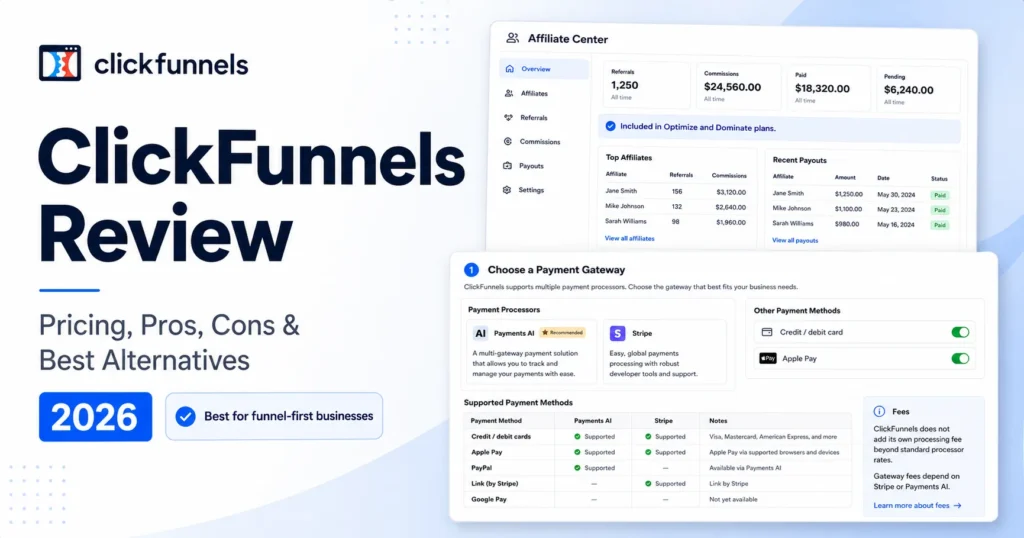
Most buyers land on a ClickFunnels review asking one question: is $97 a month worth it? That is the wrong number to budget from, because the plan that most sales funnel businesses actually need sits higher, and the plan that looks cheapest hides the gates that decide whether the tool fits.
ClickFunnels is a rational purchase when your revenue is built around offers, upsells, checkout flows, and follow-up. It is expensive and overbuilt when you mainly need a landing page, a real CRM, an email newsletter tool, or a full ecommerce catalog.
This review breaks down the current 2026 pricing after the June 2025 restructure, the plan gates that trap buyers, the Payments AI versus Stripe tradeoff, course and contact caps, and when a cheaper tool is the smarter call. Pricing was checked on July 1, 2026 against the official ClickFunnels pricing page, and this is a documentation-based review, not a hands-on account test.
| Quick verdict | Detail |
|---|---|
| Best for | Coaches, course sellers, consultants, and direct-response marketers who sell offers through funnels |
| Not ideal for | Landing-page-only buyers, standalone CRM buyers, catalog ecommerce, full-LMS course businesses, free-plan seekers |
| Starting price | $97/ |
| Best practical plan | Scale at $197/ |
| Free plan / trial | No free plan, 14-day trial |
| Setup difficulty | Medium |
| Main strength | Offer-led funnels with built-in checkout, upsells, email, and course delivery in one platform |
| Main limitation | Launch locks API, webhooks, and custom code, and Affiliate Center is gated to Optimize and above |
| Best alternative | Leadpages for landing pages, HubSpot for CRM, Kajabi for full courses, GoHighLevel for agencies |
In This Article (19 sections)
How I Reviewed ClickFunnels
I evaluated ClickFunnels the way a buyer reviews a contract before signing, not the way an affiliate reviews a product they want you to buy. The sources were the official ClickFunnels pricing page, the support pricing documentation, the CRM and Affiliate Center product pages, the payment setup docs, the webhooks and Zapier docs, the SMTP setup docs, the mobile app listings, and the privacy and DPA pages.
I also read the top-ranking competitor reviews to find what they skip. Pricing and plan limits were checked on July 1, 2026, and reflect the plan structure ClickFunnels moved to after its June 2025 pricing update.
This is a documentation-based review. I did not run a hands-on ClickFunnels account, so I do not report page-load speeds, click-by-click testing, or conversion results from personal use.
Where third-party review sites report user sentiment, I label it as sentiment, and where a claim conflicts with official docs, I trust the official source.
What Is ClickFunnels?
ClickFunnels is a sales funnel builder that has grown into an all-in-one marketing platform. It lets you build websites, sales funnels, checkout flows, email campaigns, marketing automation, online courses, communities, and a basic CRM without a developer.
The positioning is a platform for offer-led businesses: sell a product or program, take payment with upsells, and follow up by email, all in one account. It competes with focused tools in each of those categories, and the buying question is whether one bundled platform beats several specialized ones for your specific model.
ClickFunnels Pros and Cons
The tradeoffs are concrete, not vague. Each of these is tied to a plan, a limit, or a buyer type rather than a general impression.
| Pros | Cons |
|---|---|
| Offer-led checkout with upsells built into the funnel flow | Launch plan lacks API, webhooks, and the custom code editor |
| Funnels, email, courses, and CRM in one account, reducing broken integrations | Affiliate Center is gated to Optimize ($297/ |
| Course delivery sits next to the funnel that sells it, up to 3 courses on Launch | CRM is funnel-first and will not replace a dedicated sales CRM |
| Stripe and Payments AI support, including Apple Pay, PayPal, and Link | Google Pay is not yet available and only one currency per workspace |
| Email send limits scale to 1.2M/ | Deliverability needs external SMTP setup with domain and webhook config |
| 14-day free trial to validate fit before paying | No permanent free plan, and starting price understates the real budget |
The honest summary is that the pros concentrate in one buyer profile and the cons hit everyone outside it. That is the whole review in one line.
The Three Problems ClickFunnels Actually Solves
ClickFunnels earns its price for a narrow buyer. If you are that buyer, the value is real and specific.
Problem 1: Stitching a funnel together from five separate tools
A typical offer funnel needs a landing page, an order form, an upsell page, an email sequence, and a place to deliver a course or membership. Buying those separately means a page builder, a checkout tool, an email platform, and an LMS, plus the glue to connect them.
ClickFunnels puts funnels, checkout, email marketing, automations, courses, community, and a basic CRM in one account. Official product pages present funnels, store, CRM, email marketing, online courses, community, opportunities, analytics, payments, and appointments as native apps inside the platform.
The buyer value here is not “all-in-one” as a slogan. It is that a coach or course seller can launch an offer, take payment, trigger follow-up email, and deliver the product without maintaining four integrations that break when one vendor changes an API.
Problem 2: Selling with upsells built into checkout
Direct-response revenue depends on what happens at and after the checkout, not just traffic. ClickFunnels is built around offer-led checkout, so upsells are part of the funnel logic rather than a bolt-on.
Payments run through Stripe or Payments AI, and the official payment docs confirm support for credit and debit cards, Apple Pay, PayPal through Payments AI, and Link through Stripe. For a business whose model is “sell a $47 offer, then present a $197 upsell,” that checkout structure is the product, and it is hard to replicate cleanly with a generic store.
Problem 3: Delivering a course as part of the offer, not as a separate platform
Many creators sell one flagship course or a coaching program attached to a funnel. They do not need a full learning-management system with a large catalog, and they need the course to live next to the funnel that sells it.
ClickFunnels includes courses and community, with course counts scaling by plan. For a creator selling one to three signature offers, delivering the course inside the same platform that runs the funnel and email removes a moving part.
Here is the pattern across all three: ClickFunnels is strong when the funnel is the business. The moment the landing page, the CRM, or the course catalog becomes the main job, the math changes.
The Two Problems ClickFunnels Creates
An honest review names what the purchase breaks, not just what it fixes. Two problems show up before most buyers finish their first billing cycle.
The starting price is not the real budget
The $97 Launch plan is the number in every ad, but Launch is missing the tools serious funnel operators reach for fast. Based on the official pricing table, Launch has no custom code editor and no webhooks or API access, which means no clean way to send funnel data into an external system in real time.
Launch also caps you at 1 workspace, 2 team members, 10,000 contacts, 50,000 emails per month, 3 courses, and 5 custom domains. For a solo coach validating one offer, that can be enough for a while.
For anyone running multiple brands, an agency model, or an integration-dependent stack, Launch is a trial tier, not a home.
My read: budget from Scale at $197 a month if you know you will need API access, webhooks, or more than one workspace, and treat Launch as a validation runway rather than the plan you settle on.
It is easy to buy more platform than the business uses
ClickFunnels bundles a store, a CRM, courses, community, email, and automations. If your business only uses two of those, you are paying for six.
That is the quiet cost most reviews skip. A performance marketer who only needs fast landing pages, or a company that only needs a proper sales CRM, will pay ClickFunnels prices for tools that sit idle while a focused competitor does the one needed job better and cheaper.
ClickFunnels Pricing Reality in 2026
ClickFunnels moved to a new plan structure with its June 2025 pricing update, and older reviews that still say “Startup” or “Pro” are describing plans that no longer match the pricing page. The current tiers are Launch, Scale, Optimize, and Dominate.
| Plan | Monthly | Annual effective | Contacts | Emails/ | Workspaces | Team | Courses | API + custom code | Affiliate Center | Support |
|---|---|---|---|---|---|---|---|---|---|---|
| Launch | $97 | $81/mo ($970/ | 10K | 50K | 1 | 2 | 3 | No | No | Standard |
| Scale | $197 | $164/mo ($1,970/ | 75K | 300K | 5 | 5 | 6 | Yes | No | Priority + live chat |
| Optimize | $297 | $248/mo ($2,970/ | 150K | 750K | 10 | 10 | 10 | Yes | Yes | Priority + live chat |
| Dominate | Annual only | $5,997/yr | 400K | 1.2M | 20 | 20 | 20 | Yes | Yes | VIP + live chat |
Prices are from the official ClickFunnels pricing page and support pricing doc, checked July 1, 2026. Prices can change, so confirm on the pricing page before you buy.
There is no permanent free plan. ClickFunnels offers a 14-day free trial, which is your window to test whether the funnel and checkout logic fits before any charge.
The practical plan recommendation
For most funnel businesses that are past validation, Scale at $197 a month is the practical floor, because it unlocks webhooks, API access, and the custom code editor, and it raises contacts to 75,000 and emails to 300,000 per month. Those are the gates that separate a hobby funnel from an operating one.
Optimize at $297 a month becomes the real decision point for one reason most reviews bury: the Affiliate Center. If running an affiliate program is part of your growth plan, that is an Optimize-level purchase, not a Launch or Scale feature.
Dominate is annual-only at $5,997 a year and is aimed at larger operations that need 20 workspaces, 400,000 contacts, VIP support, private onboarding, and top-tier admin features. Most buyers reading this review are not Dominate buyers.
The hidden costs to plan for
ClickFunnels itself does not add a processing fee beyond standard processor rates, according to the official payment docs, but that does not mean payments are free. Your gateway fees are set by Stripe or Payments AI, and those apply on every sale.
Some third-party pages claim an extra gateway percentage on top, but the official docs did not confirm that, so treat any specific added-fee figure as unverified until you see it in ClickFunnels’ own terms. Beyond payments, budget for a domain, an external SMTP provider if you send serious email volume, possible expert setup help, and the plan upgrade you will likely need if Launch limits pinch.
Feature Gates: What You Actually Get on Each Plan
The plan gates are where buyer regret hides, so this is worth reading before you pick a tier. The table below focuses on the gates that change a buying decision.
| Feature | Launch | Scale | Optimize | Dominate |
|---|---|---|---|---|
| Workspaces | 1 | 5 | 10 | 20 |
| Team members | 2 | 5 | 10 | 20 |
| Contacts | 10K | 75K | 150K | 400K |
| Emails/ | 50K | 300K | 750K | 1.2M |
| Courses / communities | 3 | 6 | 10 | 20 |
| Custom domains | 5 | Unlimited | Unlimited | Unlimited |
| Stores | 1 | 5 | 10 | 20 |
| Custom code editor | No | Yes | Yes | Yes |
| Webhooks / API access | No | Yes | Yes | Yes |
| Affiliate Center | No | No | Yes | Yes |
| Support | Standard | Priority + live chat | Priority + live chat | VIP + live chat |
Read this table as a set of upgrade triggers. If you need API or webhooks, Launch is out.
If you need an affiliate program, Scale is out and you are looking at Optimize. If you run multiple brands, the single Launch workspace forces an upgrade before you even test the funnel.
The gates near the top tier are worth flagging too. Based on the pricing table, items like dedicated IP, SSO, branding removal, certification training, and an account manager sit at the Dominate level, so buyers who need admin-style controls should not expect them on the cheaper plans.
Key Features and the Plans That Gate Them
Each feature below answers four questions: what it does, who it helps, which plan unlocks it, and where it stops.
Funnels and page building
Funnels are the core, and this is where ClickFunnels is strongest. You build landing pages, sales pages, order forms, upsell pages, and thank-you pages inside one funnel flow, available from Launch up.
The limitation is not the builder, and the custom code editor is gated off Launch. If your team needs to inject custom scripts or fine-tune markup, you are on Scale or higher.
CRM and customer management
ClickFunnels CRM is funnel-first, not a full sales CRM. The official CRM page frames it around MessageHub, Appointments, and Opportunities, which track leads and customer journeys tied to your funnels.
You can import contacts by CSV and manage funnel leads, but this is a different buying decision than a dedicated sales CRM. If you need forecasting, complex pipeline reporting, and a real system of record for a sales team, ClickFunnels CRM is not that, and I would not buy ClickFunnels to replace HubSpot or Keap.
Email marketing and automations
Email is built in, with send limits scaling from 50,000 per month on Launch to 1.2 million on Dominate. For a funnel business, sending broadcasts and automated follow-up from the same tool that runs checkout is convenient.
The caveat is deliverability setup. Official docs describe using an external SMTP provider such as SendGrid or Mailgun, which requires connecting your domain and configuring webhooks to track opens, clicks, bounces, and unsubscribes.
Serious senders should treat ClickFunnels email as capable but not a plug-and-play replacement for dedicated email marketing software.
Courses and community
Course counts scale by plan at 3, 6, 10, and 20, which is the detail most course-creator reviews leave out. That cap is the whole decision for a course business.
If you sell one to three signature courses attached to offers, ClickFunnels fits. If you are building a catalog of many courses or need deep LMS features like graded assessments, treat course depth as a caveat and compare a dedicated platform.
Third-party pages raise quiz and LMS-depth limitations, but I would verify those against official docs before relying on them.
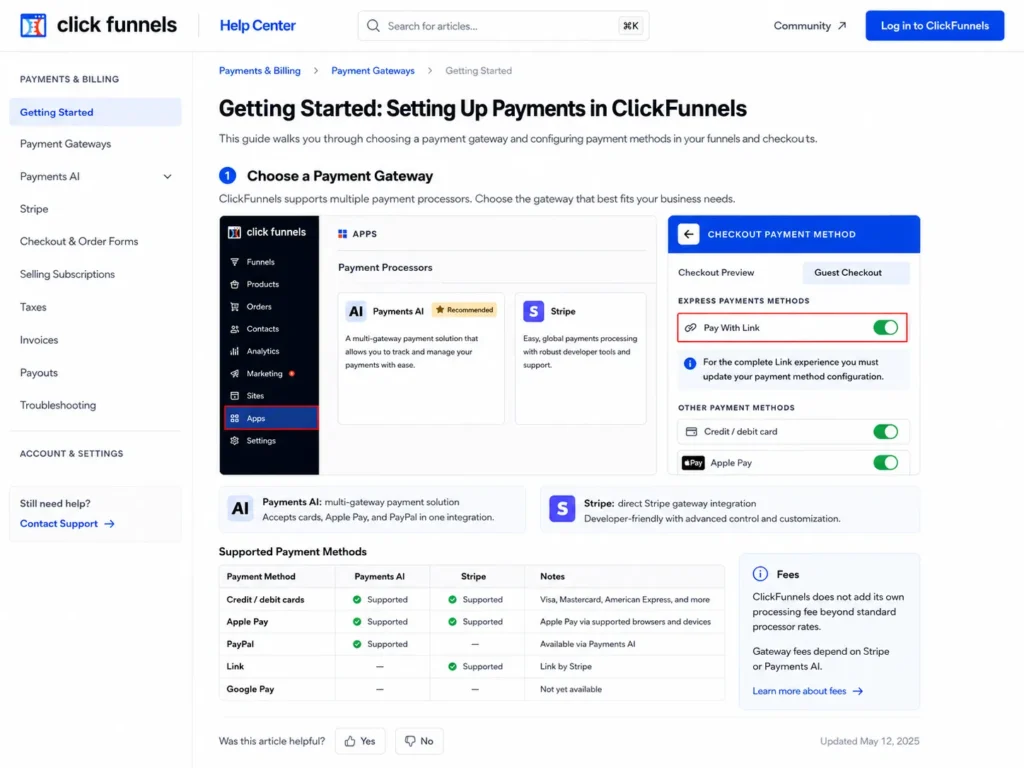
Affiliate Center
Affiliate management is often sold as a ClickFunnels strength, but the official Affiliate Center app page places it in Optimize and Dominate only. That is a real budget consequence.
If an affiliate program is central to how you plan to grow, your entry price is not $97 or $197 but the $297 Optimize plan. Buyers routinely miss this and anchor on the wrong number.
Payments and Checkout: Stripe, Payments AI, and What Is Missing
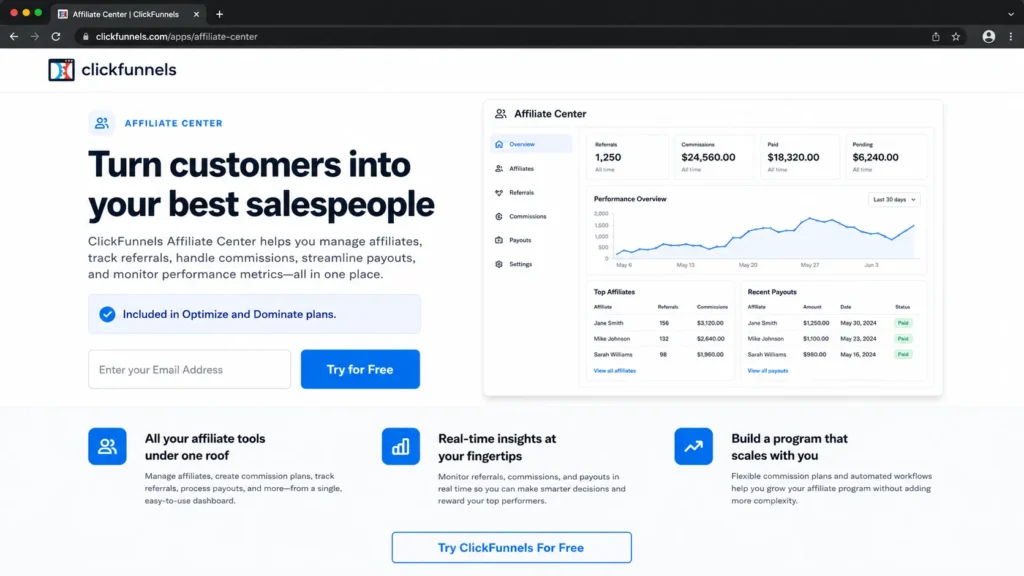
Checkout is where funnel revenue is won or lost, so the payment details matter more here than in a generic review. ClickFunnels integrates with Stripe and with Payments AI, its own third-party payment solution that the docs describe as adding fraud prevention and recurring billing.
| Payment method | Supported? | Via |
|---|---|---|
| Credit / debit cards | Yes | Stripe or Payments AI |
| Apple Pay | Yes | Supported gateways |
| PayPal | Yes | Payments AI |
| Link | Yes | Stripe |
| Google Pay | Not yet available | N/A |
| 3D Secure | Yes | Supported gateways |
Two operational details are easy to miss. First, Google Pay is not yet available according to the official payment docs, so if a chunk of your buyers expect it at checkout, plan around that gap.
Second, ClickFunnels allows one currency per workspace. International sellers who want to price in multiple currencies need to plan their workspace structure before building the checkout, and workspaces are themselves plan-gated.
You can also test orders in a test mode before going live, which is worth doing on any funnel where an upsell or subscription is involved.
Ease of Use, Integrations, and Support
ClickFunnels is no-code, but “no-code” and “simple” are not the same thing. The platform spans funnels, checkout, CRM, email, automations, payment setup, domains, SMTP, and integrations, so setup difficulty is medium and real implementation takes planning.
For integrations, the escape hatches matter as much as the native apps. Beyond built-in connections, Zapier can move data between ClickFunnels and other apps, and webhooks send real-time data to external platforms when no native integration exists.
Both of those depend on plan, though. Webhooks and API access are gated off Launch, so a Launch buyer who assumed they could pipe leads into an external CRM in real time will hit a wall and an upgrade.
Support is also tiered. Launch gets standard support, Scale and Optimize add priority and live chat, and Dominate gets VIP support with private onboarding hours.
The buyers who most need hand-holding, beginners on Launch, get the least support, which is a pattern worth pricing into the decision.
Automation, AI, Reporting, and Mobile
ClickFunnels includes automations for triggering email and workflow actions off funnel events, plus analytics for opt-ins, sales, and page performance. AI writing word allowances scale on the higher plans, listed at 2 million words on Scale, 5 million on Optimize, and 10 million on Dominate.
Reporting is adequate for funnel-level decisions but is not a substitute for a dedicated analytics or BI stack. If your reporting needs are deep, ClickFunnels analytics will feel shallow, and that is a known critique in third-party reviews.
Mobile deserves a precise answer because reviews often overstate it. The official Classic Stats app on iOS and Android lets you monitor opt-ins, sales, and page visits, and the ClickFunnels Portal app is a companion for courses, community, the affiliate dashboard, and notifications.
Neither is a full mobile funnel builder, so do not buy expecting to build funnels from your phone.
Security and Trust: What Is Verified and What Is Not
Business buyers need to know the boundary between what ClickFunnels documents and what it does not. ClickFunnels publishes a privacy policy under Etison LLC and provides a Data Processing Addendum that its FAQ says is incorporated into the Terms and applies to EU personal data.
That is the verified layer. No official SOC 2, ISO 27001, or HIPAA certification was found in this research, so I would not claim ClickFunnels holds those, and buyers in regulated industries should ask ClickFunnels directly for a current trust or compliance package before committing.
ClickFunnels Limitations Worth Pricing In
Pulling the tradeoffs into one place makes the buying risk visible. These are the limitations most likely to cause regret.
The starting plan is a false floor, because Launch lacks API, webhooks, and custom code, and caps contacts at 10,000 and emails at 50,000 per month. Affiliate management is an Optimize-level cost, not a base feature, which reshapes the budget for anyone running affiliates.
The CRM is funnel-first, so it will not replace a real sales CRM for a pipeline-driven team. Course counts are capped by plan, so a growing catalog forces upgrades or a move to a dedicated LMS.
Google Pay is not yet available and only one currency is allowed per workspace, which constrains international checkout. Admin-style controls like SSO and dedicated IP sit at the Dominate tier, so leaner plans are not built for larger-org governance.
The Buyer Risk Ledger: What Actually Goes Wrong
Before the “who should use it” call, it helps to name the risks a buyer carries into month two and how to blunt each one. This is the part vendor pages never write.
The five risks below are the ones that turn a reasonable purchase into an expensive one. Each pairs the buyer consequence with the fix.
| Risk | What goes wrong | The fix |
|---|---|---|
| Wrong-plan trap | You anchor on $97, build on Launch, then hit the API, webhook, or workspace wall and pay for an unplanned upgrade | Choose your plan from the gates you need, not the price you want |
| Idle-platform tax | You pay for a store, CRM, courses, and community while using only funnels and email | Count how many of the six native apps you will actually run before buying |
| Affiliate sticker shock | Your growth plan assumes an affiliate program that only exists on Optimize and above | Budget $297/ |
| Deliverability drift | Email sends grow, but SMTP, domain, and webhook setup was never done properly | Treat email setup as a real implementation task, not a checkbox |
| CRM mismatch | A sales team expects pipeline reporting the funnel-first CRM does not deliver | Keep a dedicated CRM as the system of record and use ClickFunnels for funnel leads |
Run the 30 and 90-day check against these. By day 30, payment and follow-up should be live and attributable, and by day 90 you should be able to name the offer revenue the platform produced.
Who Should Use ClickFunnels
ClickFunnels is a rational purchase for a specific set of buyers. If you recognize your business here, the price is defensible.
Coaches and consultants selling a paid program benefit from funnels, checkout, and follow-up in one place. Course creators with one to three signature offers get course delivery next to the funnel that sells it.
Direct-response marketers who live on upsells get checkout logic that generic stores handle poorly.
Small teams that can justify at least the Launch or Scale cost, and whose revenue is measurably tied to offers, will get more from the bundle than from four separate tools. The 30-day test is simple: if your funnel is taking payment and triggering follow-up that you can attribute to revenue within the first month, the purchase is working.
Who Should Avoid ClickFunnels
Just as important is knowing when this is the wrong tool. Several common buyers should look elsewhere.
Pre-revenue beginners who only need a simple website or a single landing page are overbuying, and a focused page builder is cheaper and faster. Teams that mainly need a real CRM and sales pipeline should buy a CRM, because ClickFunnels CRM is funnel-first.
Businesses that need a newsletter or dedicated email platform can get better deliverability tooling and lower cost elsewhere. Ecommerce sellers with large catalogs need a real store platform, not funnel-first checkout.
Anyone who needs a permanent free plan should stop here, because ClickFunnels only offers a 14-day trial.
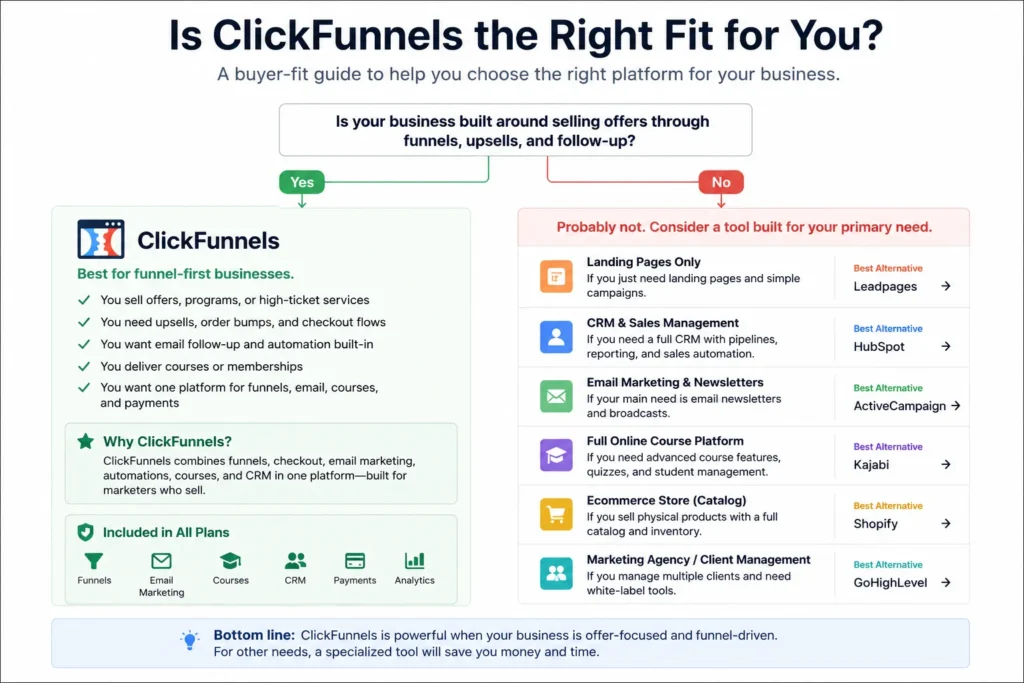
Better Alternatives for the Buyers ClickFunnels Loses
If you are one of the buyers above, here is where to look, mapped by the job you are hiring the tool to do. If deliverability is your real need, a platform like ActiveCampaign is built for it, and CRM-first buyers are usually better served by Keap or a dedicated system than by a funnel tool.
Prices below are directional and should be confirmed on each vendor’s page.
| Your main job | Consider instead | Why it fits better |
|---|---|---|
| Fast landing pages only | Leadpages, Unbounce, Landingi | Cheaper and more focused when you do not need funnels, courses, or CRM |
| Real CRM and sales pipeline | HubSpot, Keap | Built as a system of record, not a funnel-first CRM |
| Email marketing and automation | ActiveCampaign, GetResponse, Brevo | Stronger deliverability tooling and lower entry cost |
| Full course catalog or LMS | Kajabi, Kartra | Deeper course and membership features for education businesses |
| Budget all-in-one funnels | Systeme.io | Lower-cost funnel and email bundle for early-stage sellers |
| Agency managing many clients | GoHighLevel | Multi-client and agency workflows ClickFunnels is not built for |
| Quizzes and interactive lead flows | involve.me, Heyflow | Purpose-built for calculators, quizzes, and interactive capture |
The switch-or-stay logic is straightforward. Stay with ClickFunnels if the funnel is the business and you use at least three of its native apps.
Switch, or never buy in, if you would leave four of the six bundled tools idle.
Final Verdict: Is ClickFunnels Worth It in 2026?
ClickFunnels is worth it for offer-led businesses and a waste of money for everyone else, and the plan you choose decides which experience you get. For coaches, course sellers, consultants, and direct-response marketers whose revenue runs through funnels, upsells, and follow-up, the bundle is a defensible purchase, and Scale at $197 a month is the practical plan for most serious operators because it unlocks API, webhooks, and custom code.
For landing-page-only buyers, standalone CRM buyers, newsletter senders, catalog ecommerce, and anyone needing a free plan, ClickFunnels is overbuilt and overpriced, and a focused alternative will do the one job better. Budget from the plan whose gates match your workflow, not the $97 headline, and factor in the Optimize jump if affiliates are part of the plan.
The renewal question to answer before you commit for a year: can you point to offer revenue that the funnel, checkout, and follow-up produced, and would that revenue survive if you rebuilt the same stack from cheaper separate tools?
If yes, ClickFunnels earns its place. If you cannot answer it after 90 days, the platform is costing you more than it returns.
FAQ
Is ClickFunnels worth it in 2026?
Yes, if your business sells offers through funnels with upsells, checkout, and follow-up, and no, unless you can tie real revenue to that funnel. Landing-page-only, CRM-only, or newsletter-only buyers will find it overbuilt.
How much does ClickFunnels cost?
Launch is $97 a month ($81 billed annually), Scale is $197, Optimize is $297, and Dominate is $5,997 a year and annual-only, per the official pricing page checked July 1, 2026. Most serious funnel businesses land on Scale.
Does ClickFunnels have a free plan?
No permanent free plan was found. ClickFunnels offers a 14-day free trial to test the platform before you are charged.
Does ClickFunnels charge transaction fees?
ClickFunnels says it does not add fees beyond standard processor rates, according to its payment docs, but your gateway fees from Stripe or Payments AI still apply. Some third-party pages mention extra gateway fees, but that was not confirmed in official docs.
Can ClickFunnels replace my CRM?
Only for funnel-first needs. The CRM is built around MessageHub, Appointments, and Opportunities tied to funnels, so a pipeline-driven sales team is usually better served by one of the best CRM software options.
Is ClickFunnels good for course creators?
Yes for one to three signature courses sold through funnels, where course counts start at 3 on Launch. No if you need a large catalog or deep LMS features, where a dedicated course platform fits better.
What plan do I need for API access?
Scale or higher. Webhooks, API access, and the custom code editor are all gated off the Launch plan.
Which plan includes the Affiliate Center?
The Affiliate Center is included in Optimize ($297/month) and Dominate only, per the official Affiliate Center page. Launch and Scale do not include it.
Can I use Stripe and PayPal with ClickFunnels?
Yes. Stripe is supported directly, and PayPal is supported through Payments AI, along with Apple Pay and Link, while Google Pay is not yet available.
What is the best ClickFunnels alternative?
It depends on the job: Leadpages for landing pages, HubSpot or Keap for CRM, ActiveCampaign or GetResponse for email, Kajabi for full courses, GoHighLevel for agencies, and Systeme.io for budget all-in-one funnels.