
Pricing and features verified as of January 2026. Verify current details on official vendor pages before purchase.
Choosing between Zendesk and Intercom is not about which platform is “best.” It’s about which platform fits your support model, team size, and growth trajectory.
Zendesk is the ticket-first, enterprise-grade workhorse—built for high-volume, structured support operations. Intercom is the messaging-first, product-led platform—built for real-time conversations and proactive engagement.
This guide breaks down the real differences: features, pricing, AI, implementation, and honest tradeoffs. No fluff. No vendor spin.
In This Article (16 sections)
What’s New in 2026: Zendesk and Intercom Updates
Both platforms have evolved significantly since 2024. Here’s what matters for buyers evaluating in 2026:
Zendesk (2025→2026):
- Advanced AI add-on now generally available across all Suite plans
- Agent Workspace UI refresh for improved usability
- Expanded WhatsApp and social messaging integrations
- Pricing adjustments: some tiers increased; verify on Zendesk pricing page
- New partnerships with Shopify Plus and Microsoft Teams
Intercom (2025→2026):
- Fin 2 AI Agent: improved accuracy, multilingual support, and governance controls
- Resolution-based pricing now standard (replaces legacy per-seat models for AI)
- Messenger redesign: faster load times, improved customization
- Series and Product Tours enhancements for onboarding automation
- Deeper Shopify and Segment integrations
Note: Product roadmaps and pricing change quarterly. Always verify on official pages before making decisions.
Read more: 30 Best Knowledge Base Software (2026): Reviews & Pricing
The Fundamental Difference: Ticketing vs Conversational Inbox
The core difference between Zendesk and Intercom is philosophical—and it shapes everything else.
Zendesk = Ticket-First
- Every customer interaction becomes a ticket
- Built for queues, SLAs, escalation, routing, and structured workflows
- Agents work through a queue; tickets are assigned, tracked, and resolved
- Optimized for support ops teams managing volume and complexity
Intercom = Messaging-First
- Every customer interaction is a conversation
- Built for real-time chat, in-app messaging, and proactive engagement
- Agents manage conversations in a unified inbox; less queue-centric
- Optimized for product-led SaaS and ecommerce teams
Implications:
- If you run a traditional support desk with SLAs, escalation tiers, and ticket volume KPIs, Zendesk’s model is more natural.
- If you want to feel like you’re “chatting with customers” and prioritize speed over structure, Intercom’s model fits better.
Which model fits your support philosophy? If you’re unsure, ask: “Do we measure tickets resolved or conversations handled?”
Feature Comparison: Zendesk vs Intercom in 2026
Ticketing & Queue Management
| Capability | Zendesk | Intercom |
|---|---|---|
| Native ticketing | Advanced (core feature) | Layered on conversations |
| Views & queues | Highly customizable | Basic views |
| Macros & canned responses | Extensive | Good |
| Triggers & automations | Deep, multi-condition | Workflows exist, less granular |
| SLA policies | Native, granular | Basic support |
| Multi-brand | Supported | Limited |
- Verdict:
- Zendesk is purpose-built for ticket-heavy operations. Intercom can handle tickets but isn’t optimized for queue-centric support.
Omnichannel Support
| Channel | Zendesk | Intercom |
|---|---|---|
| Native | Native | |
| Live chat | Native | Native (strong) |
| Social (Facebook, Twitter/X, Instagram) | Native | Native |
| Native | Native | |
| SMS | Native (Zendesk Talk) | Via integrations |
| Voice/ | Native (Talk add-on) | Via integrations |
- Verdict:
- Zendesk offers true native omnichannel, including voice. Intercom is strong on messaging channels but relies on integrations for voice/phone.
Knowledge Base & Self-Service
| Feature | Zendesk (Guide) | Intercom (Articles) |
|---|---|---|
| KB builder | Robust, multi-brand | Clean, simple |
| AI-powered search | Yes | Yes |
| In-app help widget | Yes | Strong (native) |
| Community forums | Yes | No |
| Customization | High | Moderate |
- Verdict:
- Both offer solid knowledge bases. Zendesk scales better for large, multi-brand KB needs. Intercom excels at in-product, contextual help.
Automation, Workflows & Routing
| Capability | Zendesk | Intercom |
|---|---|---|
| Workflow builder | Triggers, automations, macros | Series, custom bots, workflows |
| Skills-based routing | Yes | Limited |
| Auto-assignment | Yes | Yes |
| Escalation rules | Yes | Basic |
- Verdict:
- Zendesk for complex, multi-step routing. Intercom for simpler, conversational automations.
SLA & OLA Management
Zendesk offers native SLA policies with breach tracking, reporting, and granular configuration. Intercom has basic SLA support but less depth.
- Verdict:
- If SLAs are critical (enterprise, B2B, regulated industries), Zendesk is the safer bet.
Reporting & Analytics
| Feature | Zendesk (Explore) | Intercom |
|---|---|---|
| Dashboards | Deep, customizable | Good, improving |
| Custom reports | Yes | Limited |
| API/ | Yes | Yes |
| AI/Fin analytics | Separate | Integrated |
- Verdict:
- Zendesk Explore is the industry benchmark for support ops analytics. Intercom is improving but not as granular.
Integrations Ecosystem
- Zendesk: 1,500+ apps (Salesforce, Jira, Slack, Shopify, SAP, Microsoft Dynamics, Workato, Zapier)
- Intercom: 350+ apps (Shopify, HubSpot, Segment, Slack, Stripe, Salesforce)
- Verdict:
- Zendesk has more enterprise connectors. Intercom covers SaaS/ecommerce stacks well but has gaps in legacy or ERP integrations.
CRM Fit & Compatibility
Both integrate with Salesforce, HubSpot, and other CRMs. Zendesk’s Salesforce integration is deeper and more mature. Intercom’s native CRM-lite features (contact management, lead qualification) work well for product-led teams.
- Verdict:
- CRM-heavy enterprises lean Zendesk. Product-led SaaS teams often prefer Intercom’s unified view.
Security & Compliance
| Standard | Zendesk | Intercom |
|---|---|---|
| SOC 2 Type II | Yes | Yes |
| ISO 27001 | Yes | Yes |
| HIPAA | Yes (Enterprise, with BAA) | Yes (select plans, with BAA) |
| GDPR | Yes | Yes |
| FedRAMP | Yes (Gov Cloud) | No |
| SSO/ | Yes | Yes |
| SCIM | Yes | Yes |
- Verdict:
- Zendesk has a stronger compliance story for regulated industries (healthcare, government, finance). Verify current certifications on official pages.
Admin Complexity & Customization
Zendesk is highly customizable—but that means more admin complexity and a steeper learning curve. Intercom is simpler to set up but offers less configuration headroom.
- Verdict:
- Power users and large teams favor Zendesk. Teams prioritizing speed-to-deploy prefer Intercom.
Scalability
Both platforms scale. Zendesk is proven at 1,000+ agents and complex global deployments. Intercom has grown its enterprise footprint but is more commonly seen in SMB and mid-market.
- Verdict:
- Zendesk is the safer choice for very large teams. Intercom scales well for product-led orgs up to several hundred agents.
AI in 2026: Zendesk AI vs Intercom Fin
AI Agents, Copilots & Bots
Zendesk AI:
- Agent assist (suggesting replies, surfacing KB articles)
- Answer Bot (self-service deflection)
- Advanced AI add-on: generative replies, intelligent triage, macro suggestions
- Priced as an add-on
Intercom Fin:
- Fin AI Agent: answers questions, resolves issues, escalates to humans
- Resolution-based pricing (pay per Fin resolution)
- Copilot: agent assist, reply suggestions, knowledge grounding
- Strong focus on chat deflection and self-service
- Verdict:
- Intercom Fin is strong at chat deflection for product-led teams. Zendesk AI is more modular, with agent assist and automation depth for high-volume ops.
Knowledge Grounding & Accuracy
Both platforms ground AI answers in your knowledge base and help content. Hallucination risk exists in any AI; test with your own content.
Human Handoff & Escalation
Both support smooth handoff from bot to human, with context transfer. Evaluate the UX in your trial.
Automation Depth & Deflection
Vendors claim 30–60% deflection rates; real results depend on your KB quality and question complexity. Run your own trial to validate.
AI Analytics & Governance
Both offer reporting on AI performance, cost tracking, and governance controls. Zendesk’s controls may be more granular for enterprise compliance needs.
Multilingual AI Support
Both support multiple languages; coverage and auto-translation quality vary. Test with your priority languages.
AI pricing can spike with usage. Model your expected volume before committing.
Pricing Comparison: Zendesk vs Intercom (2026)
Pricing Models Explained
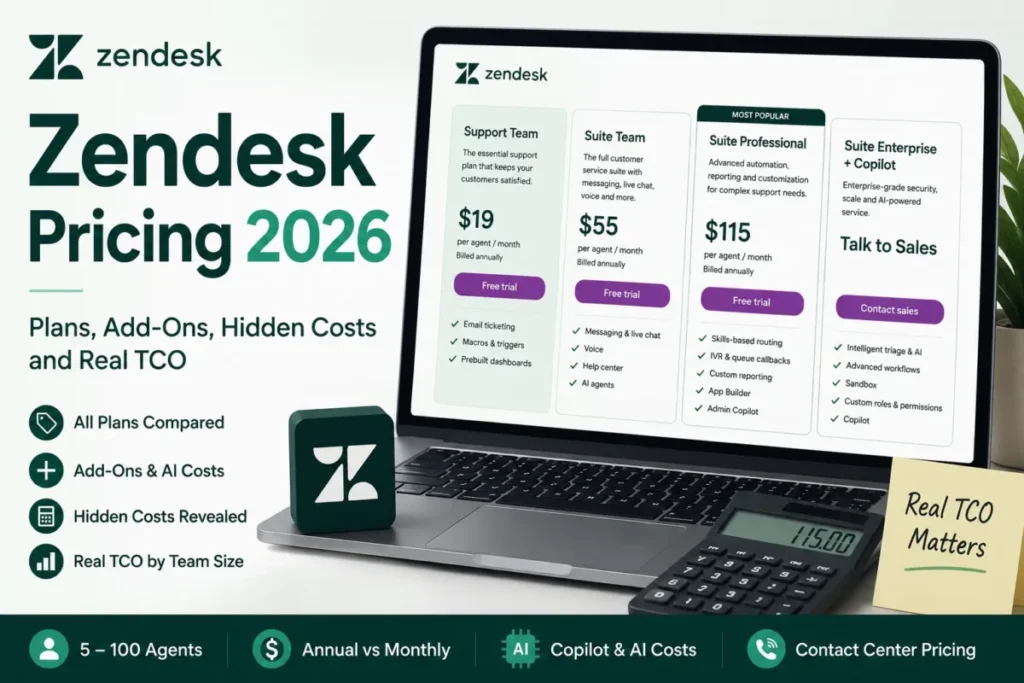
Zendesk:
- Per-agent/month, tiered plans (Team, Growth, Professional, Enterprise)
- Add-ons: Advanced AI, Talk (voice), Explore (analytics), Sunshine (platform)
Intercom:
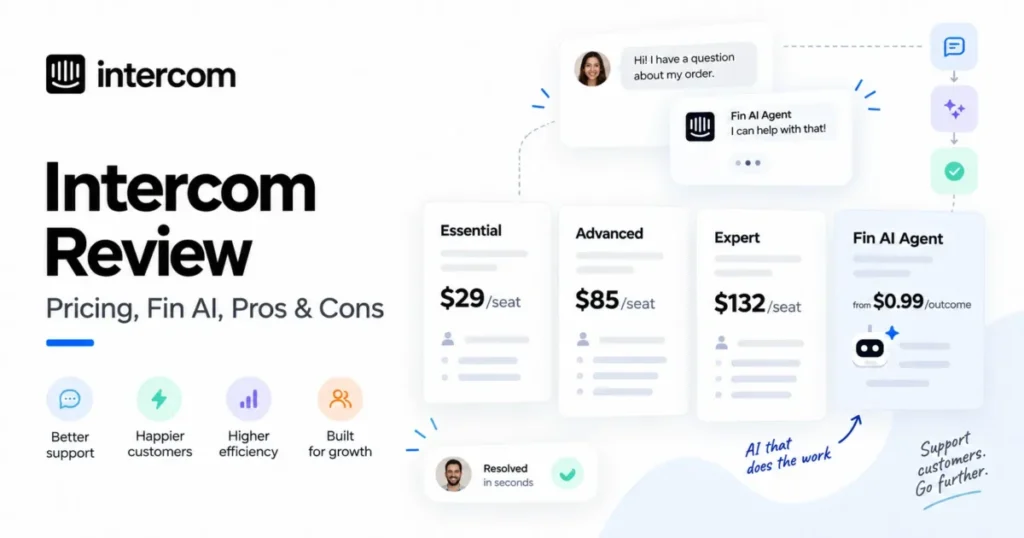
- Per-seat/month, tiered plans (Essential, Advanced, Expert)
- Usage-based: Fin AI resolutions, proactive contacts reached
- Add-ons: Product Tours, Series, premium support
What’s Included vs Add-ons
| Feature | Zendesk Suite Pro | Intercom Advanced |
|---|---|---|
| Ticketing/ | Yes | Yes |
| KB | Yes | Yes |
| Basic chat/ | Yes | Yes |
| SLA policies | Yes | Basic |
| Advanced AI | Add-on | Included (resolution-priced) |
| Voice | Add-on | Integration |
| Advanced analytics | Add-on (Explore) | Limited |
Usage-Based Fees & “Gotchas”
- Intercom: Fin AI resolutions are billed per resolution. Proactive messaging (outbound) may incur additional costs. Model your volume carefully.
- Zendesk: Add-ons (AI, voice, advanced analytics) stack up. Legacy plan migrations can trigger price increases.
Budgeting Model: Cost Scenarios
| Scenario | Zendesk (Est.) | Intercom (Est.) |
|---|---|---|
| 5-agent startup (Suite Team) | $275–$400/mo | $200–$350/mo + usage |
| 25-agent mid-market (Suite Pro) | $2,500–$4,000/mo | $1,500–$3,000/mo + usage |
| 100-agent enterprise (Suite Ent) | $12,000–$18,000/mo | Varies widely (usage-based) |
Note: These are estimates. Actual costs depend on plan, add-ons, and usage. Verify with vendors.
TCO Calculator Logic
Include:
- Seat/agent licensing
- Add-ons (AI, voice, analytics)
- Usage fees (Fin resolutions, messaging)
- Implementation/consulting
- Training
- Integration development
- Ongoing admin
Pricing verified as of January 2026. Check official pages for current rates.
Implementation, Migration & Time-to-Value
Typical Implementation Timeline
| Company Size | Zendesk | Intercom |
|---|---|---|
| SMB (1–25 agents) | 4–6 weeks | 2–4 weeks |
| Mid-market (25–100 agents) | 6–10 weeks | 4–6 weeks |
| Enterprise (100+ agents) | 10–16 weeks | 6–10 weeks |
Migration Complexity
- Data migration: Tickets, contacts, KB articles, macros
- Integration re-wiring: CRM, Slack, Jira, Shopify
- Agent training: New workflows, UI, reporting
- Change management: Stakeholder buy-in, process updates
Staffing Roles & Change Management
Typical project team:
- Project lead (internal or vendor)
- Platform admin
- IT/security (for integrations, SSO)
- Training lead
- Support team champions
Time-to-Value Comparison
Intercom is faster to stand up and see quick wins. Zendesk takes longer to configure but delivers more value at scale.
Plan for 2–4 weeks of agent ramp-up regardless of platform.
Which Platform Fits Your Company?
By Company Size
| Size | Recommendation |
|---|---|
| SMB (1–50 agents) | Intercom for speed; Zendesk if workflows are complex |
| Mid-market (50–200 agents) | Either; depends on support model |
| Enterprise (200+ agents) | Zendesk default; Intercom if messaging-first |
By Industry
| Industry | Recommendation |
|---|---|
| B2B SaaS (product-led) | Intercom |
| B2B SaaS (enterprise) | Zendesk |
| Ecommerce (Shopify-first) | Intercom or Gorgias |
| Ecommerce (multi-brand, high-volume) | Zendesk |
| Fintech/ | Zendesk (compliance) |
| Startups | Intercom (speed, cost) |
Read more: Zendesk Review 2026: Pricing, Features, Pros & Cons, and Real Use Cases
Honest Pros and Cons: Zendesk vs Intercom
Zendesk Pros
- Deep ticketing and workflow customization — Essential for high-volume, SLA-driven ops
- Enterprise-grade reporting (Explore) — Support ops visibility, benchmarking
- Massive integrations ecosystem — Connects to Salesforce, SAP, Jira, and more
- Proven at scale — Battle-tested at 1,000+ agents
- Strong compliance story — HIPAA, FedRAMP, SOC 2
- Multi-brand, multi-region support — Ideal for global enterprises
Zendesk Cons
- Pricing complexity — Add-ons stack up, hard to budget
- Steeper learning curve — Admins and agents need training
- UI can feel dated — Less modern than Intercom
- Slow innovation cycles — Enterprise pace, not startup speed
- Implementation effort — Longer time-to-value
- AI add-on costs — Advanced AI not included in base plans
Intercom Pros
- Modern, conversational UX — Agents and customers prefer it
- Fast setup — Weeks, not months
- Fin AI strong at deflection — Good for self-service-heavy teams
- In-app messaging and product tours — Great for SaaS onboarding
- Unified sales/support — Single platform for GTM teams
- Proactive engagement — Drives adoption, reduces churn
Intercom Cons
- Usage-based pricing surprises — Hard to budget with Fin resolutions
- Ticketing less mature — Not built for queue-heavy ops
- Reporting less deep — Limited advanced analytics
- Fewer enterprise integrations — Not a Salesforce powerhouse
- Scaling concerns at 200+ agents — Less proven at top end
- Fin AI costs compound — Resolutions add up with volume
Read more: Intercom Review 2026: Features, Pricing, Pros & Cons – Is It Worth It?
7 Mistakes to Avoid When Choosing Zendesk or Intercom
- Ignoring usage-based cost modeling — Intercom’s Fin resolutions can spike your bill. Model real volumes.
- Overbuying Zendesk features you won’t use — Don’t pay for Enterprise if you don’t need it.
- Assuming AI is “free” or included — Both platforms charge extra for advanced AI.
- Underestimating migration and data cleanup time — Budget 4–8 weeks for mid-sized migrations.
- Not testing with real agents before signing — Run a 14-day trial with real tickets.
- Letting vendor demos drive the decision — Demos are optimized for sales, not your workflow.
- Forgetting ongoing admin and training costs — Factor in time for ongoing maintenance.
Alternatives to Zendesk and Intercom
| Alternative | When to Consider |
|---|---|
| Freshdesk | Budget-conscious, Zendesk-like, less complex |
| Salesforce Service Cloud | Deep CRM integration, enterprise sales orgs |
| HubSpot Service Hub | HubSpot CRM ecosystem, SMB–mid-market |
| Help Scout | Simple, human-centric support for SMBs |
| Zoho Desk | Budget, Zoho ecosystem |
| Gorgias | Ecommerce-native, Shopify-first |
| Kustomer | Customer-centric view, CRM-like support |
| Front | Email-centric, collaborative inbox |
| Gladly | People-match, customer-first design |
Evaluate at least 2–3 alternatives before signing a multi-year deal.
The Verdict: Zendesk or Intercom?
Choose Zendesk if:
- You manage high ticket volumes with complex routing and SLAs
- You need enterprise-grade reporting and integrations
- Compliance (HIPAA, FedRAMP) is a must
- You’re scaling a global, multi-brand support operation
Choose Intercom if:
- You want messaging-first, conversational support
- AI chatbot deflection and proactive engagement are priorities
- You’re a product-led SaaS or ecommerce brand
- Speed-to-deploy matters more than deep customization
Decision Tree
- High ticket volume + complex SLAs? → Zendesk
- Messaging-first, low-ticket volume? → Intercom
- Enterprise with Salesforce, compliance? → Zendesk
- Product-led SaaS, in-app focus? → Intercom
- Speed over customization? → Intercom
- Deep reporting, support ops analytics? → Zendesk
When in doubt, run a 14-day trial with real agents and real tickets. Vendor demos won’t surface the friction.
Frequently Asked Questions: Zendesk vs Intercom
Q: Is Zendesk better than Intercom? A: Zendesk is better for high-volume ticketing, complex workflows, and enterprises needing deep integrations. Intercom is better for messaging-first, product-led teams prioritizing speed and conversational UX.
Q: How much does Zendesk cost per agent? A: Zendesk Suite plans range from $55–$150+/agent/month depending on tier. Add-ons cost extra. Verify on the Zendesk pricing page.
Q: How much does Intercom cost? A: Intercom starts at $39/seat/month (Essential), scaling up for Pro and Premium. Usage-based Fin AI fees add to the total. Check the Intercom pricing page.
Q: Does Intercom have ticketing? A: Intercom offers ticket-style workflows within its conversation inbox, but ticketing is not its core strength. For high-volume queues, Zendesk is more purpose-built.
Q: Is Zendesk HIPAA compliant? A: Zendesk offers HIPAA on Enterprise plans with a signed BAA. Verify eligibility on Zendesk’s compliance page.
Q: Which has better AI—Zendesk or Intercom? A: Intercom Fin is strong at chat deflection. Zendesk AI offers agent assist and automation depth. “Better” depends on use case—test both.
Q: Can I migrate from Zendesk to Intercom (or vice versa)? A: Yes, but migration requires data mapping, ticket export, KB migration, and integration reconfiguration. Budget 4–8 weeks.
Q: Which is better for ecommerce? A: Intercom is popular for Shopify stores. Zendesk suits high-volume, multi-brand ecommerce.
Q: What are the hidden costs? A: Zendesk: add-on stacking. Intercom: usage-based Fin fees. Always model total cost before signing.
Q: How long does implementation take? A: SMB: 4–6 weeks. Mid-market: 6–8 weeks. Enterprise: 8–12+ weeks. Complexity and integrations drive timelines.
Methodology: How This Comparison Was Evaluated
This comparison assesses Zendesk and Intercom across 11 weighted criteria:
| Criteria | Suggested Weight |
|---|---|
| Ticketing/ | 15% |
| AI Capabilities | 15% |
| Pricing/ | 15% |
| Integrations | 10% |
| Reporting/ | 10% |
| Omnichannel | 8% |
| KB/Self-Service | 7% |
| Security/ | 7% |
| Admin/ | 5% |
| Scalability | 4% |
| Implementation | 4% |
Adjust weighting based on your priorities.
Hands-on Evaluation: What to Test in a Free Trial
- Create 10 test tickets (or conversations) with different scenarios
- Set up 2–3 automations or workflows
- Build a basic knowledge base with 5+ articles
- Test AI chatbot/Fin on real customer questions
- Configure SLA policies and test breach alerts
- Connect 1–2 integrations (CRM, Slack, Shopify)
- Run a sample report and export data
- Assign tickets/conversations to multiple agents
- Test mobile/app experience for agents
- Review admin settings, permissions, and customization
- Simulate a customer escalation and handoff
- Estimate your monthly cost with realistic volumes
Trust Signals & Disclosures
- Disclosure: This article is produced by an independent consultancy. We may include affiliate links. Recommendations are based on hands-on evaluation and publicly available data.
- Update Policy: This article was last reviewed January 2026. Pricing and features are re-verified quarterly.
- Limitations: AI performance claims are vendor-reported. Run your own trials.
Zendesk’s AI add-on and Intercom’s ISO 27001 certification were checked against Zendesk’s official pricing page and Intercom’s official Security & Trust page on September 26, 2026.
External Citations
- Zendesk Official Pricing Page
https://www.zendesk.com/pricing/
Authoritative source for Zendesk plan tiers, per-agent pricing, add-on costs, and feature inclusions. - Intercom Official Pricing Page
https://www.intercom.com/pricing
Authoritative source for Intercom seat pricing, usage-based fees, and add-on products. - Capterra: Intercom vs Zendesk Comparison
https://www.capterra.com/compare/134347-164283/Intercom-vs-Zendesk
Neutral third-party aggregator of verified user reviews, ratings, and real-world sentiment.